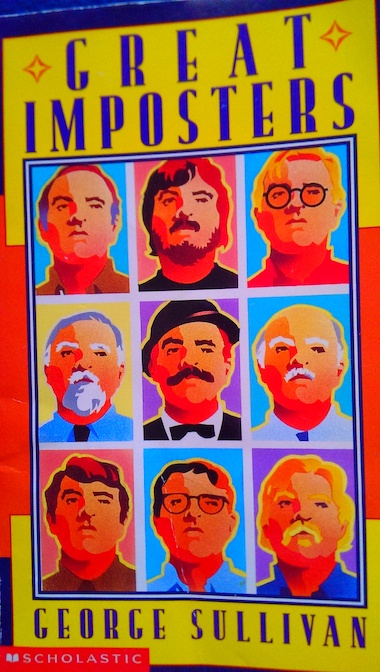
Great Imposters by George Sullivan, 1982.
This is one of those unusual history books that I like about odd, little-covered topics. The author begins by explaining what an imposter is: “a person who practices deception under an assumed name or character.” Each of the people in the following collected stories is pretending to be someone they’re not, for a variety of different reasons. The author points out the differences in the imposters’ motives, which range from pure greed to a desire for fame and attention to thrill-seeking behavior. Each of these stories really happened, and the people involved were real people, even if their claimed identities weren’t. The stories skip around in time and location, so they can be read in any order.
Willie the Actor – Willie Sutton started out as a petty thief while growing up in a tough Brooklyn neighborhood and later graduated to pulling a series of daring robberies while wearing various disguises during the 1930s through the early 1950s.
Bad Habit – Ferdinand “Fred” Waldo Demara, Jr. was the son of a fairly wealthy man who later lost the family’s money. Sis family’s loss of their previously well-off position was hard for Fred, and it led to a lifetime of him trying his hand at various professions (winging it without proper qualifications) and adopting (or stealing) new identities. The movie The Great Imposter was based on his life and exploits.
Princess of Pretense – Sarah Wilson was a maid in the household of Queen Charlotte in England during the 18th century. When she stole some clothes and jewelry belonging to the queen, she was exiled to the American colonies as an indentured servant. However, she used her knowledge of royal and the objects she stole to run away and pose as an exiled younger sister of the queen.
Lord Gordon-Gordon – Philip Guy spent his youth stealing and selling stolen goods for extra money until he ended up stealing a trunk that happened to contain gentlemen’s clothes that happened to fit him. When he noticed how much better everyone treated him when he was dressed as a wealthy gentleman, he created a new identity for himself as an English lord, undertaking greater thefts and frauds to maintain it.
The Counterfeit Count – Victor Lustig acquired a skill for languages when he was young and later used them when he masqueraded as an impoverished nobleman, covering up his gambling habits and confidence swindles in Europe and America, including his daring scheme in 1920s Paris to sell people materials from the Eiffel Tower, which was supposedly going to be dismantled. He also once successfully swindled Al Capone.
The Claimant – During the mid-1800s, Arthur Orton pretended to be Roger Tichborne, the long-lost (and probably deceased) heir to an English baron.
The Baron of Arizona – James Addison Reavis, a former Confederate soldier from the American Civil War, learned that he had a talent for forgery and tried to use it to forge land grants, giving himself a large section of land in the Arizona Territory and the title the “Baron of Arizona.”
The Actress – Constance Cassandra “Cassie” Chadwick was a girl from a poor family in the 1800s who posed as a spiritualist, swindling people while claiming to save them from terrible fates, and later, pretended to be a lover of Andrew Carnegie. (This book doesn’t mention it, but other sources say that Cassie’s real name was Elizabeth Bigley, and they say that she claimed to be Carnegie’s daughter, not his lover.)
Electronic Trickery – Reginald Jones was a scientist in Britain during the 1940s. He was also a practical joker who enjoyed taking on new identities in order to play pranks on friends and colleagues over the phone. Later, during WWII, he found ways to put his practical joking to practical use.
The Skywayman – Frank Abagnale took on a variety of new identities while writing bad checks during the 1960s and 1970s. The story of his life was later turned into a book called Catch Me If You Can and a movie of the same name.
Dangerous Game – This chapter is about WWII intelligence agents, who also had to assume new identities to do their jobs without being caught.
The Man of a Hundred Lies – Stanley Clifford Weyman was an imposter from the 1920s through the mid-20th century who held a variety of prestigious positions . . . all self-appointed.
The book is currently available online through Internet Archive.
 The Haunting of Cabin 13 by Kristi D. Holl, 1987.
 General Butterfingers by John Reynolds Gardiner, 1986.
 Mrs. Wilson and Walter talk to a lawyer, but he says that, since the General apparently didn’t leave a will, the estate has to go to his nearest relative, which is Ralph. As far as he’s concerned, there’s nothing they can do about, even though the General made a verbal promise to the men that they could stay in his house for the rest of their lives.
 In some ways, you could feel sorry for Ralph, who is a very unhappy person. Because of his meanness and selfishness, his father spent years giving him pretty much anything that he wanted on the condition that he not come around to see him. Ralph is hurt at his family’s avoidance and disdain for him, which is why Walter, at one point, invites him to come for dinner and be their friend. However, Ralph’s motives are always selfish, and that causes him to suspect that the same is true of everyone, so he refuses their kindness. It gives the impression that he’s probably done the same for many others over the years, for the same reasons.
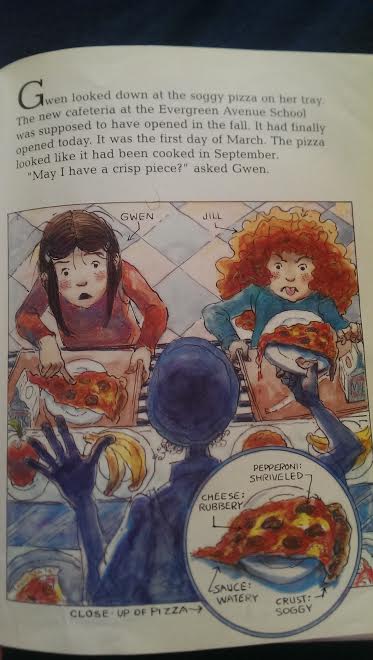 Ms. Lensky, the cafeteria lady at Gwen and Jill’s school, is just plain mean. All of the food that the cafeteria serves is yucky, even though the cafeteria is new. There will be a party to celebrate the opening of the new cafeteria, and even the kids’ parents and the mayor are invited. Gwen and Jill are happy because their class will get to help decorate the cake. However, Ms. Lensky, the M.C.L. (Mean Cafeteria Lady), doesn’t like the girls, and she blames them for a number of accidents that happen in the cafeteria.

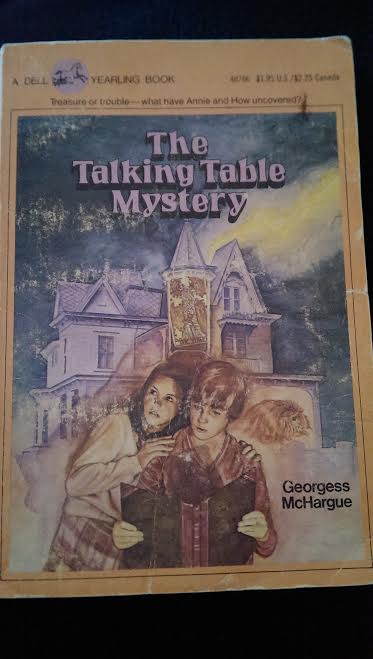 The Talking Table Mystery by Georgess McHargue, 1977.
 Jestress's Forgotten Books and Stories