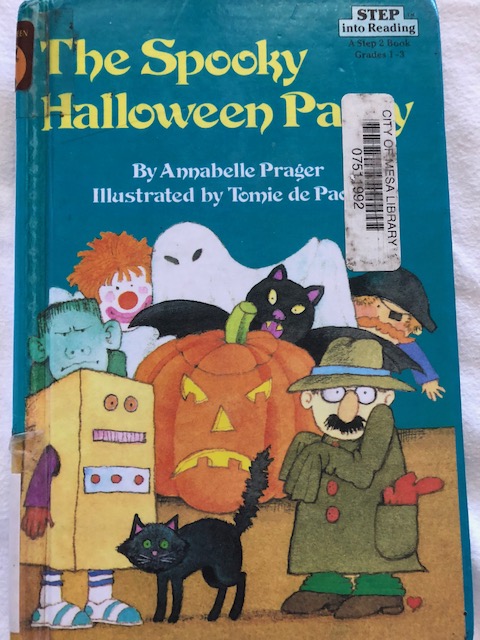
The Spooky Halloween Party

SpookyHalloween

The Spooky Halloween Party by Annabelle Prager, illustrated by Tomie de Paola, 1981.

This book was an old Halloween favorite of mine when I was a kid.  It’s funny, slightly spooky, and has a bit of a twist ending!

Albert’s friend, Nicky, is inviting all of their friends plus his cousin Suzanne to a spooky Halloween party at his new apartment on Halloween night.  Albert hasn’t been to his new apartment yet, and Nicky says that it’s going to be really scary because he wants everyone to come in costume and to not tell anyone what they’re going to be so that everyone will be surprised when they take off their masks at the end of the evening.

SpookyHalloweenNickysParty

Albert doesn’t think Nicky’s party is going to be all that scary because he’s pretty confident that he’ll know who his friends are right away, even in costume.  Some of them have already given him hints.  Nicky was practicing going, “Whoo, whoo!” in order to scare people, so Albert knows that, whatever his costume is, it’s something that makes that sound.  Jan called up and asked Albert if he had an old mop that she could borrow, so he thinks that she’s probably going to be a witch and that she just got confused, thinking that witches carry mops instead of brooms.  Dan told Albert straight out that he’s going as a pirate because he doesn’t see the point in keeping his identity a secret.  So, Albert isn’t expecting any real surprises at Nicky’s party.

As for Albert’s costume, he’s tired of wearing the usual old clothes in the dress-up box, so he decides that this time, he’ll wear the box itself.  He cuts holes for his eyes and arms and decorates it so that he looks like a robot.  Almost completely covered by the box, he’s sure that everyone will have a harder time guessing his identity than he will theirs.

SpookyHalloweenElevator

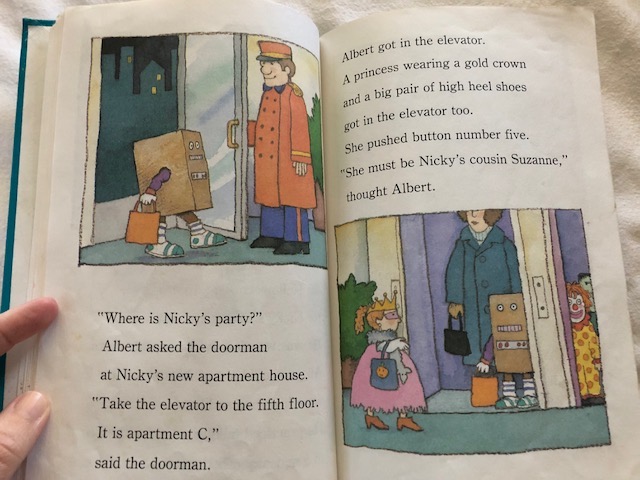
When Albert arrives at Nicky’s new apartment house, he meets a girl dressed like a princess in the elevator.  She says that she’s going to the Halloween party on the fifth floor, and when Albert says that he is too, she suggests that they walk there together.  Albert guesses that she is Nicky’s cousin, Suzanne, who he hasn’t met before.

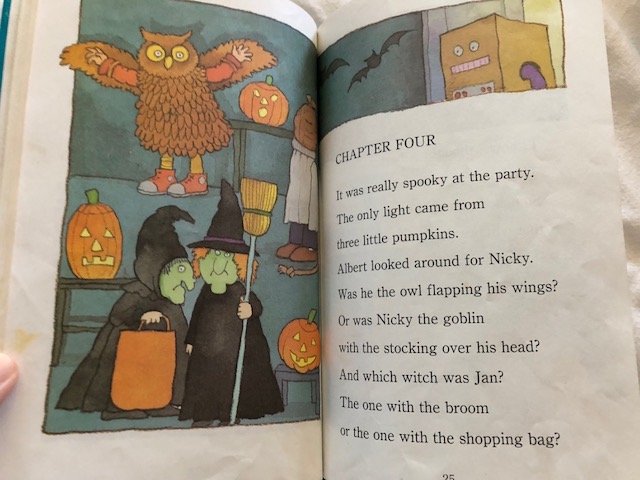
The apartment is pretty spooky, lit by jack o’lanterns, and there are already some guests there.  Albert is a little surprised that he doesn’t see a pirate, but there are a couple of witches and an owl, who could be Nicky.  Yet, when Albert tries to talk to the other guests, they seem to be acting strangely, and he realizes that he’s not quite sure who is really who.

SpookyHalloweenArrival

The princess is pretty spooked, and as the party goes around the apartment house, trick-or-treating, she kind of clings to Albert.  When some strange noises and a far-away “Whoo, whoo” sound startle her, Albert reassures her that it’s only Nicky in his owl costume.  Then, the princess tells him that she knows the owl, and it’s not Nicky.  That’s when Albert really starts getting scared, wondering why he doesn’t seem to know his own friends.

SpookyHalloweenTrickOrTreat

The book is available to borrow and read for free online through Internet Archive.

My Reaction and Spoilers

The reason why Albert doesn’t seem to know anyone becomes apparent when they unmask themselves after trick-or-treating.  Albert is really among strangers!  The princess isn’t Nicky’s cousin at all, and he followed her to the wrong Halloween party!  There were two Halloween parties on the fifth floor that night.  Nicky lives in apartment C, and Albert accidentally joined the party in apartment B.  Fortunately, Albert’s friends are also trick-or-treating around the apartment building and show up at that moment.

What started out as a potentially embarrassing mistake actually ends up making the evening more fun for everyone.  Albert’s mix-up brought an element of real suspense to both of the Halloween parties, with him wondering who everyone really was, the guests at the wrong party wondering who he was, and all of Albert’s friends wondering where he was.  Also, Albert gets some new friends out of this experience, and both parties end up combining into one big party at Nicky’s apartment.

SpookyHalloweenBigParty

Race isn’t important to the story and is never mentioned, but I’d just like to say that I appreciated the diversity of characters in the pictures.  Albert is black and so is Jan (you can see that when she isn’t wearing her clown costume), and the boy in the owl costume looks like he might be Asian.  I also really love that owl costume!  I don’t think I’ve ever actually seen anyone dress as an owl for Halloween, but it looks awesome!

The Dreadful Future of Blossom Culp

DreadfulFutureBlossomCulpThe Dreadful Future of Blossom Culp by Richard Peck, 1983.

This book is part of the Blossom Culp Series.

It’s 1914, and Blossom Culp is just starting high school. Although the principal of her old school tells her that this is a chance for her to make a fresh start, it looks like Blossom’s future is going to be very much a continuation of her immediate past.  In high school, she’s still a social outcast, looked down on by girls from better-off families, like Letty, the class president.  Also, despite her principal’s assertion that Blossom’s previous forays into the occult were imaginary, the product of the mental confusion that accompanies puberty, and that she is bound to grow out of them, Blossom knows that her psychic abilities are a natural gift and will not be ignored.

Blossom begins high school friendless because Alexander Armsworth has been ignoring her lately because of his important new position as class vice-president, his infatuation with Letty, and his friendship with a couple of local hooligans, Bub and Champ. Alexander is looking forward to his role in planning the school’s Halloween Festival, telling Blossom that he’s over their earlier, childish occult escapades and the Halloween pranks he used to pull.  Meanwhile, all of the other girls in school are infatuated with their handsome history teacher, Mr. Lacy, and so is the girls’ gym teacher, much to Blossom’s disgust.  Blossom thinks that Mr. Lacy is full of himself and denies that she has any such silly crush on Alexander.

Blossom makes an unexpected friend in a girl called Daisy-Rae, a girl from the country who has brought her younger brother into town to attend school and hoped to get an education herself but has been too afraid of the big town to actually attend classes.  Daisy-Rae hides in the school during the day and lives alone with her brother at night in the old chicken coop at the abandoned Leverette house.  It is through Daisy-Rae that she learns that Alexander and his friends aren’t so above childish pranks as they claim to be.  Blossom also discovers that Mr. Lacy has been romancing her old principal.  Mr. Lacy isn’t quite what he appears to be and has some unsavory secrets in his past.

Matters come to a head when Alexander (at Letty’s urging) tries to persuade Blossom to dress up and become the fortune teller for the haunted house that the freshmen class is doing for the Halloween Festival.  The haunted house is also a fundraiser, and Letty figures that they can get extra money from people if they’re willing to pay to have their fortunes told, and who would be better for the job than Blossom?  However, Blossom isn’t one to go out of her way to please others, especially Letty, and it turns out that they’re holding the haunted house in the Old Leverette place.  For some reason, that old house makes Blossom’s mother uneasy.  She seems to think that it’s haunted, but in an unusual way.  Blossom tells Alexander that she will not agree to be their fortune teller until he agrees to check out the house with her before Halloween and find out what’s wrong with it.  She figures that, since both of them are psychic, they can learn what’s so unusual.

As Blossom learns, her abilities don’t confine themselves to the past and people who have died but extend to the future and the people who haven’t yet been born.  Inside the Old Leverette house, Blossom suddenly finds herself entering the distant future, the 1980s.  In the 1980s, the Leverette house is once again lived in, and Blossom meets a boy named Jeremy who is a lonely social outcast, like herself.  Jeremy is a computer nerd, living with his divorced mother.  He takes Blossom on a tour of their town as it is in Blossom’s future, much larger than it used to be and with many familiar landmarks missing.  However, what Blossom sees in the future gives her the inspiration she needs to solve her problems in the past and hope that things will improve.  In return, she also proves to Jeremy that he is far from alone and has had a friend for longer than he ever imagined.

The time travel to the 1980s comes off as being a little corny (or so it seemed to me), but the writing quality of the book is excellent.  The author has an entertaining turn of phrase, and the book, like others in the series, is humorous and a lot of fun to read.

Besides being a kind of fantasy story, there are some interesting tidbits of history in the book, showing how people lived in the 1910s.  Blossom explains about the things she and her classmates did at school, like wearing beanies on their heads to show which year they were (freshmen, future graduating class of 1918).  At one point in the story, Blossom takes Daisy-Rae and her brother to their first movie, a silent film with an episode of The Perils of Pauline serial.  While Blossom worries about the future, readers can get a glimpse of the past!

As for what Blossom learns about her own future, she avoids finding out too much because she’d rather not know the details.  However, there are implications that she and Alexander may eventually marry and live in his family’s old house.

The book is currently available online through Internet Archive.

The Ghost Belonged to Me

GhostBelongedToMe

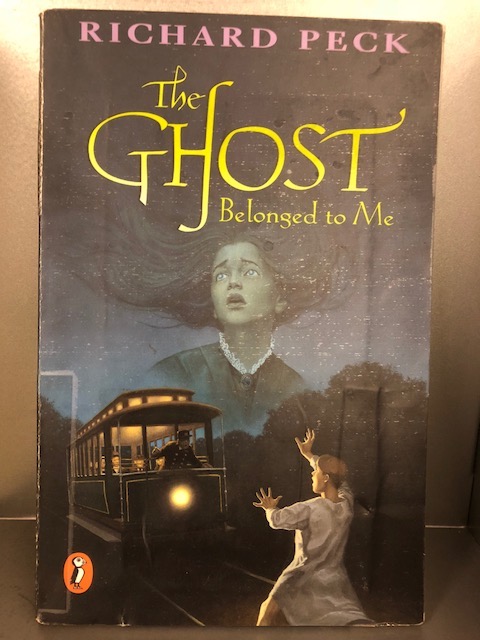
The Ghost Belonged to Me by Richard Peck, 1975.

The book takes place in the 1910s in a small town on the Mississippi River. Alexander Armsworth, a boy in his early teens, is approached by a girl from his class who tells him that the barn on his family’s property is haunted and that Alexander himself has the ability to see the “Unseen.” The girl, Blossom Culp, is a poor girl from a family of outcasts who has been known to tell tall tales, so Alexander isn’t sure he believes her at first. However, he can’t help but be curious, and when he sees a light coming from the barn at night, he decides to investigate.

Inside, he finds the ghost of a young girl who warns him of danger on the trolley tracks near his house and tells him that he must act fast to save everyone. Frightened, Alexander gets the trolley to stop and learns that by doing so, he has saved the lives of everyone on board from a disaster at the bridge further on. Naturally, everyone wants to know how Alexander knew to warn them. When Alexander explains, he is met with skepticism from his social-climbing mother and sister and unwelcome attention from news people and curiosity-seekers from town.

The ghost, who tells Alexander that her name is Inez Dumaine, is also in need of help before she can rest peacefully. Alexander will need the help of those who believe in him and the ghost to find Inez’s body and return it to her home in New Orleans.

In this first book in of the Blossom Culp series, Alexander is the main character, but the other books focus more on Blossom, who discovers that she also has the ability to see ghosts.  The book is available to borrow and read for free online through Internet Archive.

This is the movie that the Disney movie Child of Glass was based on, and the movie is available on dvd. Sometimes, you can also find it on YouTube, at least clips and reviews of it.

My Reaction

The story has sad and scary points, but those are balanced out by humorous situations. Alexander’s sister’s turmoil over the fiasco at her coming-out party is hilarious, and his mother’s change in attitude when she realizes that, instead of making them social outcasts, the ghost business actually attracts attention from one of the town’s leading citizens is a hoot. Blossom, of course, is wonderfully nosy, elbowing her way into Alexander’s life and selling tours of the haunted barn.

I was very young when I saw the Disney movie based on this book, Child of Glass (a live action movie that aired on television), and I was afraid of ghosts. However, years later, I took another look at the movie and decided to read the book that it was based on. When I did, I saw things I didn’t appreciate when I was young. The dialog and depiction of life in the early 20th century in the book are wonderful. It conjured up memories of Meet Me in St. Louis, especially the Halloween scene (which took place only about a decade earlier than this story). Unfortunately, this early 20th century setting wasn’t present in the movie version of this book because Child of Glass was placed contemporary with the time it was made, during the late 20th century.

The Disney movie was also different from the original book because it added the feature of the “child of glass” which didn’t exist in the original book. The “child of glass” was mentioned in a poem at Inez’s grave that explained how to lay her ghost to rest. At first, the Alexander and Blossom in the movie don’t know what it means, but it turns out to be Inez’s doll, which was lost when she was murdered by her wicked uncle. In the book, Inez died under different circumstances. However, the discovery of the doll in the movie uncovers the secret motive behind her murder, which is similar to the reason why Inez’s body was hidden in the book after she died in a riverboat accident.  In the book, Inez’s spirit finds rest after her body is found and taken to her family’s cemetery in New Orleans.  The Disney movie also turns this story specifically into a Halloween story, which wasn’t the case in the original book.

Molly Saves the Day

MollySummer

Molly Saves the Day by Valerie Tripp, 1988.

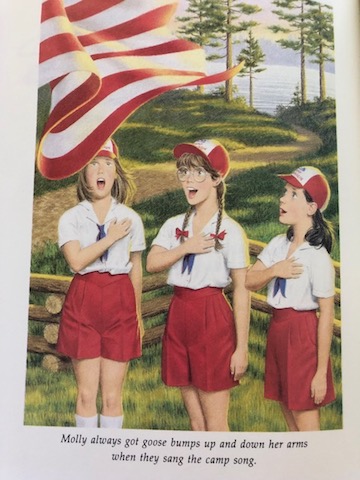
MollySummerCampMolly and her friends, Linda and Susan, are attending Camp Gowonagin over the summer.  They love summer camp because there are so many fun things to do, like nature hikes, archery, arts and crafts, and campfire sing alongs.  The only thing Molly doesn’t like is swimming underwater, although she’s embarrassed to admit it.  Susan has trouble with canoeing because she doesn’t know how to keep her canoe moving straight.  Other than that, all three girls have fun at camp and as their time at camp is coming to an end, they think about how much they’ll miss it.

Then, the counselors announce a special event for the end of camp: The Color War.  At Camp Gowonagin, the Color War is like a giant game of Capture the Flag.  The girls are randomly assigned to two teams, Red and Blue.  The Red Team will be guarding their flag on a small island in the lake near camp.  The Blue Team’s job will be to try to steal the flag from the Red Team.  The contest will take place over the course of an entire day.

MollySummerPlanMolly and Susan end up on the Blue Team, while Linda is assigned to the Red Team.  Molly and Susan aren’t really looking forward to the Color War because their team captain will be Dorinda, a bossy, competitive girl who likes to act like she’s the general of an army and this camp game is a real war.  Molly is uneasy about what Dorinda will order them to do, afraid that it might involve the thing she dreads most, swimming underwater.  The only comfort Molly takes is what her father told her before he went away to war, that being scared is okay because it gives a person a chance to be brave.

As it turns out, Dorinda’s strategy is very simplistic.  She wants the entire Blue Team to row out to the island, landing directly on the beach.  Then, while her army takes the Red Team prisoner, she will triumphantly capture the flag.  Molly says that she thinks that the Red Team will spot them easily if land on the beach and asks if there is a less obvious place where they could land.  However, Dorinda simply says that there is no less obvious place and taunts Molly about whether she would rather swim there underwater.  Molly and Susan have no choice but to follow Dorinda’s orders.

MollySummerRetreatOf course, Dorinda’s plan doesn’t work out as she thought.  The Red Team’s scout spots them right away and takes most of the Blue Team prisoner.  Only Molly and Susan are left free because Susan accidentally overturned their canoe on the way to the island.  After they manage to get back into their canoe and bail it out, they try to approach the beach, but Linda spots them and signals to the rest of the Red Team.  Molly and Susan have no choice but to return to camp to avoid capture.

Back at camp, the two of them have to decide what to do.  They are vastly outnumbered by the Red Team, and they feel betrayed by Susan treating them as her enemies.  Molly does think up a plan for freeing the rest of the Blue Team, but to carry it out, she must face what she fears the most . . . and force Linda to face something that frightens her.

MollySummerEscapeMolly and Susan (and the rest of the Blue Team, once they’re free) manage to snatch victory from the jaws of defeat, but they worry that perhaps their friendship with Linda is ruined because of the trick they play on her.  Fortunately, Linda decides to take it in the spirit of the game and shows sympathy for the girls when it turns out that their victory plan ends with the entire Blue Team getting poison ivy.

I’m with Molly and Susan in not liking overly competitive games and people, but I thought that the book handled this situation well, focusing on how the girls each had to face something that was difficult for them in order to do their jobs for their respective teams.  It was a learning experience for all of them, and part of what they learned was that facing what worried them the most wasn’t as bad as they thought it would be.

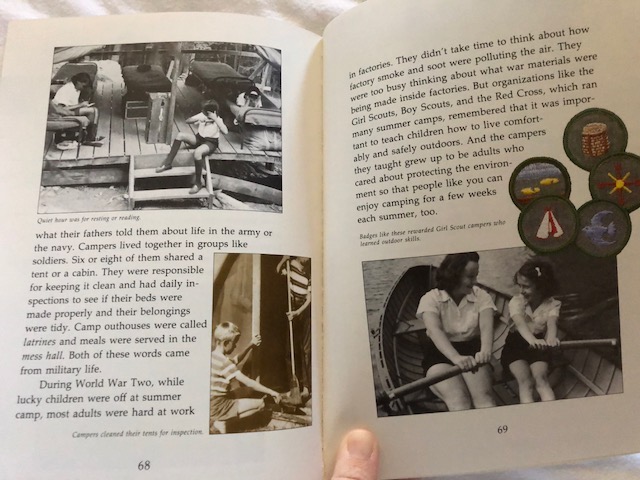
In the back of the book, there is a section of historical information about summer camps during World War II.  Because many families were separated by the war and people were discouraged from traveling much in order to save fuel and space on trains, children were often sent away to summer camps by themselves instead of going on family vacations.  The camps could be run by different organizations, such as the Girls Scouts, the Boy Scouts, or the Red Cross.  There, they would learn wilderness skills, like how to identify different plants, how to swim, and how to build a campfire.  They also had lots of fun activities, like horseback riding and arts and crafts.

The book is currently available online through Internet Archive.

MollySummerHistory

Molly Learns a Lesson

MollyLesson

Molly Learns a Lesson by Valerie Tripp, 1986.

MollyLessonHideoutIn 1944, everyone is concerned with finding ways to help the war effort.  In Molly’s third grade class at school, her teacher announces that their class is invited to participate in the Lend-a-Hand contest.  The class will be divided in half, and each half will compete against the other to find the best way to help the war effort.  The class decides to make the contest boys against girls, and Molly immediately starts trying to figure out a spectacular idea that will impress everyone.  Unfortunately, one of the other girls says that the girls in class should knit socks for soldiers, and the teacher accepts that as the goal for the girls’ team, before Molly can say anything.

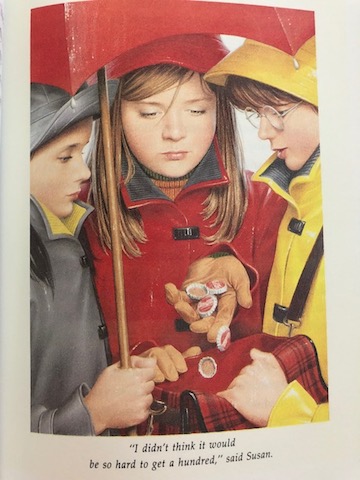
MollyLessonCollectingMolly is appalled at the idea of knitting socks.  It’s partly that she had wanted to be the one to come up with the best idea, and it’s also partly because she has tried knitting before, and she knows that socks are difficult, time-consuming projects, especially for beginning knitters.  Molly is sure that the other girls are going to find it too difficult and that, in the end, they’ll have nothing to show for their project.  Her friend Susan doesn’t think that the project sounds so bad, but Linda also dreads the idea of knitting because she’s not very good at it.  Talking it over in their secret hideout in the storage area of Molly’s garage, the three girls decide that they’ll work on a secret project by themselves, something that will save the day when the other girls’ project falls through.

At first, the idea of doing something in secret sounds exciting.  However, coming up with a good secret project and seeing it through turn out to be more difficult than they expected.  All they can think of to do is to collect bottle tops for scrap metal, and as they go door to door in the rain, asking for them, they learn that most people have already given theirs to the Boy Scouts who were collecting scrap metal.  Tired, wet, and discouraged, the Molly and her friends decide to look in on the other girls and see what progress they’re making.

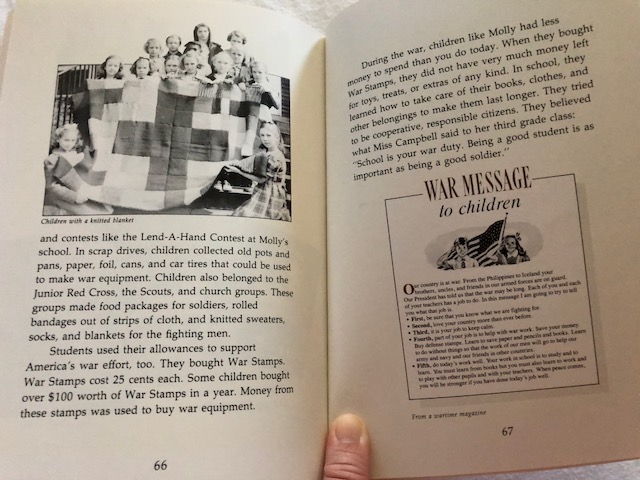
MollyLessonBlanketThe other girls are certainly a lot more comfortable, knitting inside.  However, as Molly predicted, they are finding their project harder than they thought it would be.  None of them has completed an entire sock yet; all they really have are the square shapes at the top of the sock, and they’re getting discouraged.  That’s when Molly gets a better idea: why not take the squares they’ve made and turn them into a blanket?  Simple squares are much easier to make than socks, they can make a lot of them quickly with everyone helping, and the girls who can’t knit well can sew the squares together.  A blanket is still a good war effort project because Molly’s father has told her that the hospital where he works is always in need of blankets for the wounded soldiers.  With this new idea, the other girls become much more excited, and they make more progress.

The theme of this story is that working together and sharing ideas benefits everyone more than working alone or trying to be too competitive.  Molly’s first ideas weren’t very good by themselves, and neither was the sock-knitting idea.  However, when Molly and her friends join the other girls, Molly finds a way to help them build on the idea that they already had (knitting) and take it in a better direction.  Molly and her friends also explain to the other girls about the bottle tops they were trying to collect, and some of them think of other places where Molly and her friends didn’t go for their collecting.  All of the girls working together manage to finish the blanket and collect 100 bottle tops in a single day, surprising and pleasing their teacher.

In the back of the book, there is a section with historical information about what it was like to go to school in America during World War II.  Discipline was more strict than it was in schools during the late 20th century, and there was also more separation between boys and girls.  Sometimes, boys and girls going to the same school and attending the same classes played on completely separate playgrounds, and sometimes, they even had to enter and exit the school through different doors (this is something that was also mentioned in the book Cheaper By the Dozen, which takes place during the late 1910s/early 1920s).  Teachers emphasized patriotism and taught the children about the war, why soldiers were fighting, and what life was like in other countries that were involved in the war.  It was common for schools to have drives to collect scrap metal or other materials to help the war effort.  Special projects like knitting clothing or blankets for soldiers were also popular.

The book is currently available online through Internet Archive.

MollyLessonHistory

Queen of the Sixth Grade

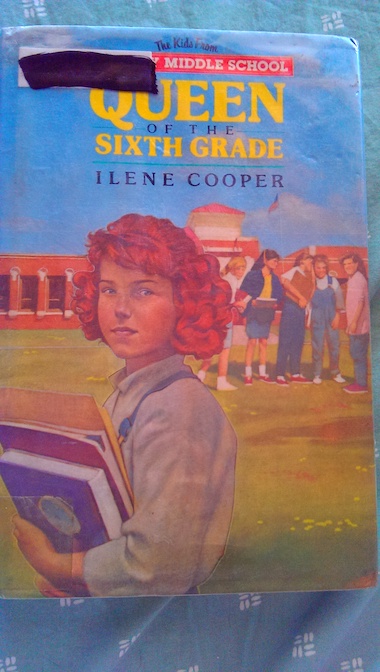
QueenSixthGradeQueen of the Sixth Grade by Ilene Cooper, 1988.

This is part of The Kids From Kennedy Middle School series.

Robin Miller has been best friends with Veronica for years, although it hasn’t always been the easiest friendship. Veronica can be exciting. She gets lots of interesting ideas and her apparent confidence in herself can be contagious. Unfortunately, she isn’t really a nice person, not even to her closest friends. She likes to call Robin “Curly” because of her hair, which Robin hates, but she tolerates the nickname for Veronica’s sake. The way Veronica teases and bullies other people makes Robin uncomfortable, too, but Robin hesitates to speak up about it both for the sake of maintaining her friendship with Veronica and because she doesn’t want to get on Veronica’s bad side herself. However, now that the girls are in sixth grade, things are about to change.

Veronica has decided to start a kind of club with some of the girls in their class called the Awesome Kennedy Girls (or AKG for short). Of course, Robin is a member. Veronica chooses the other members herself from the girls in the class that she thinks are the coolest, at least by her standards.

Then, Veronica tells Robin that she has a crush on Jonathan Rossi, a cute boy in their class. Robin likes him herself. In fact, she’s had a serious crush on him for some time, although she’s never told Veronica about it. It’s been Robin’s good fortune that she and Jonathan have been assigned to be partners for an oral book report in class. While working on the project together, Robin and Jonathan discover that they have some interests in common and start becoming friends. However, somewhat like the love triangle in Cyrano de Bergerac, Veronica asks Robin to use her influence with Jonathan to tell him that Veronica likes him and wants him to be her date for the Halloween party she’s planning. Because she always does what Veronica wants, Robin does attempt to do so, even though it pains her. But, Jonathan really likes Robin and misunderstands what Robin is saying, agreeing to be Robin’s date for the party. That’s when Robin’s real problems begin.

Veronica is used to getting what she wants and having people do thing her way. Instead of accepting Jonathan’s decision that he likes Robin completely on his own, she decides that Robin has “stolen” Jonathan from her. Immediately, Robin goes from being Veronica’s best friend to her worst enemy. Worse still, Veronica starts spreading terrible rumors about Robin to the other girls in class. Soon, no one in class wants to be friends with Robin, and the other girls in the AKG go out of their way to make life miserable for her with their bullying.

At one point in the story, Robin remembers back to when she and Veronica first became friends in the third grade. Before she met Veronica, she was friends with Gretchen, a fat girl who is now one of Veronica’s favorite people to bully. While Robin is on the outs with Veronica and shunned by most of the rest of the girls in class, she tries to become Gretchen’s friend again out of loneliness, but to her surprise and shame, Gretchen tells her that she is no longer interested in her friendship. Gretchen correctly realizes that Robin is still too much attached to Veronica and the way she does things. There were many times when she could have stood up to Veronica and defended Gretchen, but she chose not to. Gretchen points out to Robin that if Veronica decided that she wanted to be friends with her again, she’d be off like a shot after Veronica, dropping Gretchen and forgetting all about her like she did when they were younger. Robin is ashamed when she realizes that everything Gretchen says is true. In becoming friends with Veronica, Robin lost part of the nice person she used to be. Although she is not as mean as Veronica, Robin isn’t completely nice and, in some ways, has become rather shallow. If getting dumped and bullied by a former best friend hurts, it hurts even more when Robin realizes that she partly deserves it because of the kind of person she’s been and the type friendships she’s chosen.

However, there is hope for Robin in realizing the mistakes she’s made. She comes to admire Gretchen for her ability to put up with the bullying she’s endured and for continuing to stand on her own, not come crawling to the first person who offers her friendship. Gretchen is sometimes lonely and she did once fall for a trick of Veronica’s when she pretended to offer her a place in the AKG, but Gretchen still respects herself, in spite of the bullying she’s endured. In a way, she has better self-esteem than Robin does. Gretchen has her problems, but she doesn’t define herself solely by her relationships with other people, like Robin does at first. When Gretchen can’t find friends who appreciate her, she simply does the best she can without them, pursuing her own interests by herself. In a way, that attitude becomes the solution to Robin’s problems. At her mother’s urging, Robin begins pursing new interests in life.

Robin’s mother correctly points out that Robin needs to develop her own interests for her own sake and to look for friendship beyond her cramped little circle of “cool” kids. There are many other options for good friends around her, but Robin has been stuck in a mindset that hasn’t allowed her to see them. By getting out, finding new interests, and learning to be her own person again after spending the last few years mainly being Veronica’s sidekick/puppet, Robin develops new confidence and new insights on herself and the people around her.

Robin is successful at finding new friends when she takes a drama class. She even connects with another girl from her school who was neither part of the in-crowd nor the bullied ones in her class, Sharon. For a time, Robin still feels badly about what happened to her friendship with Veronica, but the more time they spend apart, the less Robin misses her and the more she begins to see Veronica, her behavior, and the problems in Veronica’s life for what they are. In the process, she begins to recover a bit of her old self, the nicer, freer person she was before she became Veronica’s friend.

When a drama project allows Robin to meet a celebrity, she becomes something of a celebrity in her class. Suddenly, people who had shunned her before are anxious to be her friend again, making Robin feel awkward because she knows their motives are self-serving, not honest or sincere. At the same time, Veronica’s controlling behavior and the one-upmanship she encouraged in her little club backfire on her. The other girls get fed up with her behavior, and Veronica is put in the uncomfortable position of appealing to Robin for help. With her former best friend and tormentor at her mercy, Robin has to decide if she will use the opportunity to take revenge or if she will go forward with her efforts to be a better person and use her new popularity for good instead of evil. There is power in popularity, but there is also power in knowing who you are and what you really stand for.

The book is available to borrow and read for free online through Internet Archive.  I’d also like to give special kudos to this book for mentioning other books that Robin likes, including Where the Wild Things Are, The Wolves of Willoughby Chase, and The Westing Game (the book Robin and Jonathan use for their book report, which they both like).

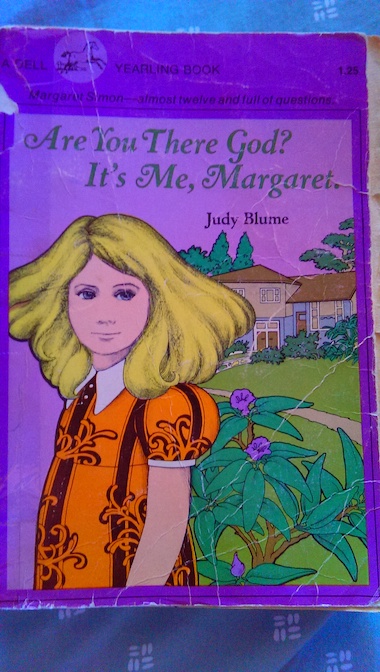
Are You There, God? It’s Me, Margaret

MeMargaretAre You There, God?  It’s Me, Margaret by Judy Blume, 1970.

This is one of the more controversial children’s books because parents raised concerns about the discussions of religion and puberty which are central to the story, and it has been banned or challenged in some libraries.  (Read to the end and see the spoilers before you decide if you agree with that.)

I wouldn’t recommend this book for young children because they wouldn’t understand the issues the story discusses, but it does speak to the concerns that pre-teen girls typically have about growing up, finding their place in the wider world, and fitting in with their friends as well as that haunting fear kids often have that they aren’t normal, compared to everyone else.  This isn’t a spoiler for the story (although there are plenty of those later on because I can’t really describe my thoughts about this book without them), but I just have to say that, in my experience, by the time people are done with college, maybe even by the time they’re done with high school, most of them come to realize that nobody out there is completely “normal.”  Some are just better at giving that impression.  Everyone out there has their quirks or issues, so if you think you’re a little odd in one way or another, or if you think your family is a little weird, you’re in pretty decent company.  Generally, it’s best not to worry too much about it and just get on with life.  In a way, I think that does fit in with the ending of the book.  But, I’ll talk a little more about my personal opinions about the controversial parts later.

When Margaret Simon is eleven years old, her parents decide to move from New York City to a suburb in New Jersey.  Margaret is accustomed to living in an apartment in a big city, and her new town and house seem a little odd to her.  She isn’t sure that she’s going to like her new home, and she knows that part of the reason why her mother wanted them to move was that she was worried that Margaret was becoming too close to her grandmother in New York and too easily influenced by her.

Margaret’s family is a little unusual in that her mother is Christian but her father is Jewish. (This is a little more unusual for when the book was first written than now because marriages of mixed religions are more common now than they were before, although they can still be complicated.)  The religious differences between her parents caused conflicts in their family even before Margaret was born.  Neither side of the family really approved of the match, so Margaret’s parents had to elope to get married.  Margaret’s mother’s parents disowned their daughter because of her marriage and haven’t seen or spoken to the couple in years or met their granddaughter.  However, Margaret’s father’s mother (his father is deceased) continues to spend time with the family, although she admits that it’s mostly for Margaret’s sake.  Margaret’s only close grandparent likes to spoil her and pays for her education at a private Jewish school, which is why her mother has become concerned that Margaret is influenced by her too much.  Margaret’s mother wants some separation so that she and Margaret can become closer as mother and daughter. The move and Margaret’s new friendships in New Jersey raise a number of troubling questions for Margaret about growing up, both physically and spiritually.

Because of the family religious conflicts, Margaret’s parents purposely raised her without a religion, telling her that she could choose for herself when she was old enough.  Until now, Margaret was not terribly concerned about it, but the move, the new friends she makes in New Jersey, and her increasing awareness of how religious differences have influenced her relationships with her family and other people cause her to question the choices she must make and what she really believes.  Throughout the book, she prays frequently in a casual, conversational fashion, telling God about the things that are happening in her life, the questions and problems she has, and what she really wants most.  Sometimes, she gets angry with God or disappointed when things don’t work out well, but the story makes it clear that her relationship with God is evolving, just as Margaret herself is changing as she grows up.  At one point, Margaret worries that, at age twelve, she is too old already to choose a religion and wishes that her parents had just given her one when she was little so she wouldn’t have this uncertainty.  However, growing up is a long process that Margaret is only beginning to appreciate.

The first new friend Margaret makes is a girl her age who lives next door, Nancy.  Nancy is eager to grow up and not at all shy about talking about things like boys, periods, bras, kissing, and even sex.  Sometimes, Nancy talks like she knows a lot about such things, although more mature people (and, eventually, Margaret) would realize that she doesn’t.  She introduces Margaret to two other girls, Gretchen and Janie, and the four of them form a kind of club that they call the Pre-Teen Sensations (PTS for short).  They give themselves secret names and hold meetings, talking about boys, people they know at school, and concerns that they have in their lives, especially related to growing up, periods, and sex (no one has any in the story, but the girls are fascinated by the idea).  One of the requirements of this club is that each of the girls has to wear a bra, and they feel each other’s backs at the beginning of each meeting to make sure.  Up until then, Margaret didn’t have a bra, so she has to buy her first one.  The girls worry about their breast size (none of them has much yet), and they try exercises to see if they can improve it (which is ridiculous, but it is the kind of thing that some pre-teen girls believe).  At the beginning, none of the girls has had their first period yet, and they’re looking forward to it with nervousness and anticipation, wondering what it’s going to be like.  They agree that whoever gets their period first has to tell the others about what it’s like.  Margaret nervously worries that she’ll be the last one to get hers or that she’ll turn out to be “weird” and never have one for some reason, although her mother assures her that it’s not likely and that it’s really just a matter of time.

Meanwhile, Margaret has some awkwardness at her new school, getting to know new people, sometimes making mistakes in the ways she relates to others, and figuring out which boys she likes the best. (She doesn’t get a boyfriend, just crushes.)  Her new teacher is also a little awkward because he’s young and this is his first teaching assignment, and he seems self-conscious that male teachers aren’t as common as female teachers.  Even adults can worry about being accepted by others.  He seems to be a good teacher, however, and he asks the students questions about themselves in an effort to get to know them better.  He learns early on that Margaret doesn’t have a religion and that it bothers her.  When he tells the students to choose a topic for a year-long research project into something that they care about, he allows Margaret to choose the topic of religion.

Margaret decides that her project for the year will be to learn about different religions and to finally choose one for herself.  Her focus is mainly on trying to decide between Judaism and Christianity because that’s what the two sides of her families are, that’s what most of the people her community are, and she says at one point that she doesn’t know anyone who is Muslim or Buddhist, so she can’t talk to them about their religions.   People in this community tend to belong either to the local YMCA or the Jewish community center, and Margaret thinks that if she figures out if she should be Christian or Jewish, she’ll be able to join one of those herself and fit in better.  Her friends help her in her project, some of them letting her come to church with them.  Each of the PTS girls is a different religion.  Janie is Jewish, and Nancy and Gretchen each attend a different Christian church.

Margaret’s friends aren’t particularly concerned about which choice Margaret will eventually make.  They find the story of her parents’ elopement romantic and are sympathetic to Margaret’s feelings.  However, Margaret notices that other people react differently to her project.  It seems like some of them view the idea of winning her to their side as some kind of personal victory for them, which hurts because she realizes that this is how her grandparents view her, even her beloved grandmother.  When her mother’s parents decide to visit them for the first time, there is an ugly scene where the family conflicts over religion come to a head, and Margaret feels so overwhelmed that she wants to give up on God and religion completely.  However, Margaret’s story isn’t over yet.  She’s really just started growing up, and whether she believes it or not at first, God hasn’t given up on her.  Getting what she wants most is really just a matter of time and patience.  Everyone grows up eventually.

So, what’s my overall opinion?  Generally favorable.  I read this book when I was about Margaret’s age and had the same concerns she did (or very similar, no two people are alike) and my friends and I were talking about the same kinds of things she and her friends were.  I think the key to this book is age-appropriateness.  Like I said, girls younger than about ten or eleven years old probably would not understand Margaret and her concerns because they just don’t share them.  It’s like Margaret and her friends themselves: they talk about the concerns that they all share, growing up and their new interests in boys and the idea of first periods.  If the reader isn’t a girl at that phase of her life, she just wouldn’t understand and connect with the story, and a few years later, those girls would likely move beyond all of that and on to other concerns (like whether or not they should go to college, what their major or career should be, etc. – life is full of things to figure out).  The things that seem so new and mysterious at age eleven, like real signs of growing up, later won’t matter so much because they’ve already lived it and found out that it’s not such a big deal.  Girls eager to get their first period or start shaving their legs at age twelve because they want to feel grown-up often start thinking of these things as hassles when they’re older and it’s all just become part of the routine of life.  They groan when a period starts on the day they want to go swimming or wear long pants on days when they’re too busy or just don’t want to bother shaving.  The novelty wears off, and you never look at it the same way again.  When older girls and women enjoy this book, it’s mainly as nostalgia for when they were Margaret’s age and still figuring things out.

The reason why this controversial story still remains popular even decades after its original publication is because it pretty accurately captures the thoughts and feelings of that pre-teen phase of life, when girls are just starting to grasp the complexities of life and the changes that lie ahead, alternately worrying about them and eager to get on with it and grow up.  It speaks to girls who are currently in that phase.  Reading it again as an adult, it reminds me of a time when I was in a similar place in life, although part of me now wishes that I could take young Margaret aside and tell her a few things that she eventually will come to realize:

  • That her friends are still finding their own way in life, just like she is, and even the ones who act like they know a whole lot really don’t (especially Nancy).
  • That growing up doesn’t end when you get your first period or even when you hit 18 or 21 because change is a life-long process and people mature at different rates, mentally as well as physically.
  • That many of the questions she’s struggling with are ones that everyone wonders about.  Some of them, like the religious issues and her own identity, are life-long struggles, even for people raised in more religiously-conventional households.  What human being can say that they thoroughly understand God and the mysterious ways in which He works?  It’s a worthwhile struggle, but not one that people resolve with complete certainty, certainly not by age twelve (Margaret’s age at the end of the book).  Margaret is far from being too old to consider these issues.  Philosophers and theologians have spent entire lifetimes on that subject.

But, even if I could say some of those things to young Margaret, they probably wouldn’t help completely because some things just have to be lived to be understood, which is the main reason why I would say banning the book is a mistake.  The issues Margaret deals with in the book are just common issues that come up in daily living, and the questions she asks about what she believes and what’s ahead for her are things that girls think about anyway and talk about with their friends, whether they read about them or not.  There’s no point in trying to get kids to stop thinking about these things because, at some point, they just have to because it’s a part of life, growing up, and the world around them.   Until they do consider some of these issues, it is difficult to move on to other, even more complex aspects of life, so I think it’s better to face them directly when the subjects come up instead of trying to dodge the subjects or put off thinking about them.

I think that Margaret’s elders were somewhat unhelpful in their approaches to Margaret’s religious life.  Her maternal grandparents are clearly selfish in their motives, caring only about winning the argument for their side, not really taking any interest in getting to know Margaret personally or caring about her feelings.  In fact, they only decide that they want to meet Margaret when they realize that she will be their only grandchild by blood, and even then, they make it clear that they expect the relationship to be on their terms alone.  Margaret’s paternal grandmother is better in her approach, nurturing Margaret from an early age in the hopes that she will grow up in the way she thinks best, but she endangers her relationship with her granddaughter when it seems like her previous nurturing and attention had the same selfish motive, wanting to win the argument in the same way that her other grandparents did.  Margaret wants them to like her for the person she is, not for what she might become or the ego boost they might get from her agreeing with their point of view.  Margaret’s parents are more interested in allowing her to develop her religious side on her own terms, loving her no matter what she chooses. However, Margaret might be correct in that they should have started discussing the issue honestly with her earlier in life, being a little too hands-off in order to avoid trying to win the argument or influence her too much one way or the other.

Even if the adults in Margaret’s life aren’t always the most helpful, children also learn the things that they don’t want to do from their elders.  Margaret at age twelve thinks that she’d like to raise any children she might have with a religion early in life so they won’t have to deal with the uncertainty and conflicts that she has, but she still has a lot of growing up to do, so anything can happen in her future.  Margaret’s future children (if any) will depend in equal measure on who Margaret’s eventual husband turns out to be and what he believes.  Life is a long journey, but Margaret seems headed for good things.

Many of Margaret’s growing-up issues will, like her first period, resolve themselves in time, and when she’s more experienced, part of her will look back and wonder why it all seemed so big and serious back then.  But, that’s just the phase of life she has to live through first.  Her religious issues will probably take a lot longer than physically growing up, but I think it’s important for readers to remember (as well as Margaret herself or anyone in a similar position) that Margaret is still young.  At the end of the story, Margaret still doesn’t know what religion she will choose (if any), but she’s still growing and changing, her life is changing, she’s becoming more aware of the larger world, and her mind may change many times with maturity and experience (like how many of us change majors about two or three times in college and then eventually end up in a completely different career).  Anything could happen in her life, and the range of possibilities in her life are part of the real magic of being young.  Because Margaret is a thoughtful person who seriously wants to understand the bigger issues in life, I think that she will probably be okay in the long run and that her personal relationship with God will continue to develop even if she finds it difficult to connect to an established religion.  That might not seem ideal to many people, but Margaret does the best she can with what she has in life, her circumstances and her understanding, and I think that’s a good sign.

Later editions of this book were revised to reflect new details of modern life, including how women and girls handle periods.  I’ve never actually seen the old belt-style of period pads that Margaret describes in the original version of the book, and later versions of the book describe the ones that are common today.  There is a movie version planned.
Janie’s Private Eyes

JaniesPrivateEyes

Janie’s Private Eyes by Zilpha Keatley Snyder, 1989.

This is part of the Stanley Family mysteries series.

Janie Stanley has decided to open her own detective agency, The J.V. Stanley Agency, Incorporated, Private Eyes, with the help of her younger siblings and some other friends.  Eight-year-old Janie has had many different aspirations in her young life, from being a Shakespearean actress to being a vampire, so her older brother, David, doesn’t take her detective games too seriously at first.

However, at Mr. and Mrs. Stanley’s New Year’s Eve party, Janie’s “investigations” come to everyone’s attention when she borrows David’s tape recorder to make audio recordings of guests talking and plays them on the stereo that has been hooked up to speakers to play music for the party.  Gossipy Mrs. Dorfman recognizes her own voice, saying uncomplimentary things about her hosts and the other guests, and leaves in a huff of embarrassment.  When Janie’s father confronts her over the incident, Janie says that she was trying to find evidence on a murderer.  When her father and David question her further, she says that old Mr. Rupert, the deceased father of the Mr. Rupert who owns the local grocery store in Steven’s Corners, was murdered.

When old Mr. Rupert died around Thanksgiving, all the kids in the area were sad.  He was always nice to kids when they were in the grocery store and would sometimes give them candy for free.  They called him Grandpa Rupert.  But, Grandpa Rupert’s death was a heart attack, natural causes.  When David asks Janie what makes her think it was murder, she says that she suspects his son and his wife because they inherited the grocery store.  David says that he doesn’t think that Al Rupert would have killed his father.  Janie also says that she heard that there was no autopsy after the death, and she thinks that’s suspicious.  David says that it was well-known that Grandpa Rupert had heart trouble, so a heart attack wasn’t unexpected.  Janie also says that Huy, the younger brother of her friend, Thuy Tran, saw the mailman talking to Grandpa Rupert just before he died, but David doesn’t see why that’s so suspicious.  Eventually, David and her father talk Janie out of her murder investigation idea, but it turns out that the “murder” wasn’t the only investigation that Janie has undertaken.

Dogs in the area have been disappearing, and the Tran family has come under suspicion.  The Trans haven’t been living in the United States for very long.  Originally, they came from Vietnam.  The reason why people are looking at them suspiciously is because dogs started disappearing around the time the Trans moved to the area, and there are rumors that Vietnamese people eat dogs. (Hint: No, the Trans aren’t eating dogs. That’s an old stereotype/rumor that’s been used against various immigrant groups, and no dogs are eaten in this story.)  Janie knows that the Tran family isn’t guilty of dognapping, but proving it is another matter.  After the trouble at the New Year’s Eve party, she asks David and Amanda to help her investigate.  At first, they don’t want to, but David does have to do a journalism project for school with a partner, Pete Garvey.  Pete Garvey is the school bully who also has a crush on Amanda (which is established in a previous book in the series), but he likes the idea of interviewing people about their missing dogs.

However, even though David, Amanda, and Pete Garvey begin talking to people about the missing dogs, Janie and the other members of her detective agency are still on the case!  David has great misgiving about Janie’s involvement.  Then, suddenly, Pete doesn’t want to work on the project anymore and starts behaving suspiciously.  What does he know that no one else does?

The book is available online through Internet Archive.

The Case of the Wandering Weathervanes

McGurk Mysteries

WanderingWeathervanes
WanderingWeathervanesReporter

Brains Bellingham brings a new case to the other members of the McGurk Organization: a weathervane that he was using for his latest science experiment has been stolen!  Although Brains says that the weathervane was extremely valuable because it was a critical part of his experiment, the others don’t think much of it.  However, Brains’ weathervane turns out to be just one of many weathervanes that have disappeared all over town.

At first, everyone is sure that it’s just a prank, probably by some local kids, and it gets reported as an odd tidbit on the local news.  However, the more weather vanes that disappear and the more time that goes by without them being returned, the more disgruntled the local citizens become.  People (like Brains) start claiming that their weathervanes were worth more than they probably were, although there were a couple of legitimate collectors’ items among the stolen weathervanes.  The police fail to see the humor behind the incident and start talking about serious consequences for the one responsible for the weathervanes’ disappearances.  Unfortunately, as often happens in these cases, people begin looking at Wanda’s brother, Ed, as the culprit.

WanderingWeathervanesEd

Ed has a long-standing reputation as a prankster, and so is the first person most people suspect when strange things start happening.  Wanda is sure that he isn’t guilty this time, though.  Her brother wouldn’t be above taking something for a short period of time just as a joke, but he wouldn’t just steal things from people and keep them.  When some of the weathervanes start reappearing, at the wrong houses, it looks like it might have been a prank after all, but Ed still maintains that that he’s innocent.

The members of the McGurk Organization believe that the real culprit might be a friend of Ed’s who admires some of his pranks and might be trying to imitate him with a wild scheme of his own.  However, if Ed’s friend is really guilty, where are the missing weathervanes and why haven’t they been returned?  A professional private investigator has been pressing the kids for what they know about the thefts, and Ed suddenly disappears!  There may be much more to the mysterious disappearing weathervanes than meets the eye.  What started as an odd prank may have uncovered something more serious!

The book is currently available online through Internet Archive.

WanderingWeathervanesSecret

The Case of the Muttering Mummy

MutteringMummy

The Case of the Muttering Mummy by E.W. Hildick, 1986.

Joey Rockaway needs to buy a special present for his mother’s birthday. Having broken his mother’s china cat ornament recently, he has decided that he will buy one of the replicas of a golden cat statue from Egypt at the Egyptian exhibit at the local museum. The other members of the McGurk Organization come to the museum with him, and McGurk uses this as an opportunity to give them a kind of memory test about objects in the exhibit.

Actually, everything in the exhibit is a replica, not just the items sold in the museum gift shop. Justin Matravers, a wealthy man who has recently died, collected Egyptian artifacts, but part of his will specified that the collection should never be put on public display. However, his widow, who wanted to show off the collection, had replicas made of everything in the collection so that she could have those put on display.

MutteringMummyCase

McGurk sneers about how everything in the exhibit is fake, although he is actually surprisingly superstitious. The museum always did have a real mummy case on display. They always said that the mummy case was empty, but some of the more superstitious kids, like McGurk, believe that there is a mummy inside the case and that there is a curse on it. McGurk has nicknamed the mummy Melvin. The other kids aren’t afraid of Melvin or Egyptian curses, and while they are looking around the Egyptian exhibit, Mari plays a joke by using her ventriloquist skills to make the mummy case “talk.” This trick sets off a bizarre mystery for the McGurk Organization.

A scholar and author, Harrison Keech, is sketching the replicas at the exhibit and witnesses Mari’s trick and Joey picking out the replica cat for his mother. After he asks Joey if he can take a look at the cat, Keech suddenly becomes very upset, saying that the cat statue is cursed! He says that Mari’s joke has angered the spirit of the mummy and awakened the spirit of Bastet. The mummy was a follower of Bastet, the Egyptian cat goddess, and it will now be drawn to the statue if they remove it from the museum. Mari tells Joey that she can tell from Keech’s voice that he’s making up the whole story and that he shouldn’t let that stop him from buying the cat.

MutteringMummyNight

However, strange things start happening after Joey buys the cat. It seems like someone is following him home, a dark, shadowy figure. Joey thinks it might even be the mummy, come back to life! The others are skeptical, and McGurk arranges a kind of test where Joey brings the statue with him to a meeting of the organization. Sure enough, a strange figure lurks outside their meeting, and they hear strange whispers in a foreign language!

The spookiness doesn’t last for long. It turns out that Mari, as well as being a ventriloquist, has some skill with different languages and recognizes what the “mummy” says as being Greek, not Egyptian, and the phrases as being typical things that someone might say in a restaurant. When the kids find a scrap of bandage outside, they are quick to notice that it’s a modern, elasticized bandage, like the kind you can get at any pharmacy.

So, the question becomes who is playing at being a mummy and why? Is it Keech, wanting to make the kids think that the mummy story he told them is real, and if so, what would he have to gain from it? The only other two people who know about the story are Joanne, who works at the museum, and Donny, her fiancé, who is jealous of the attention she’s been paying to Keech when he comes to the exhibit.

MutteringMummyLies

I have some complaints about this book that hadn’t occurred to me when I read it as a kid. At one point, Donny, who is described as being a social worker, comes to visit the kids because he wants to hire the organization to check up on Keech and his relationship with Joanne. Donny is very jealous, and when he explains how Joanne seems to be falling for all of Keech’s crazy mummy stories, he suddenly turns to Wanda and Mari and says, “You women, you’ll believe anything when a smarmy two-bit jackass like that starts shooting his mouth off!” That’s just really inappropriate for an adult to say to kids, and the whole situation is weird on several levels. First of all, Donny is an adult, and if he’s having issues with his love life, especially with the woman he thinks he wants to spend the rest of his life with, the last thing he should do is hire kids (even really smart ones) to handle the issues for him. Second, Wanda and Mari are young girls, not “women,” and what little girls believe is no business of Donny’s. Trying to imply that Wanda and Mari might someday fall for a “jackass” is not only insulting but implies that Donny is thinking about Wanda and Mari in terms that no grown man should be thinking about girls their ages. I find it disturbing that Donny is apparently a social worker, a person in a position of trust who is supposed to help people in difficult situations to manage their lives, and he’s acting like this. Also, toward the end of the book when the bad guy (I won’t say who it is here, although I thought that the answer was pretty obvious even early in the story) is making his escape, he shoves Joanne aside and calls her a “slut.” That’s pretty strong language for a kid’s book of this level. None of this occurred to me when I was a kid, so maybe other kids reading this wouldn’t notice, but I thought that I’d mention it because these things bother me now.

At one point, Brains gives a demonstration of using water displacement to determine the volume of irregularly-shaped objects, explaining how Archimedes discovered the principal (although I’m not sure that Archimedes’ Principal was quite as he explains it), as the kids investigate what makes Joey’s cat statue so special. You might be able to guess what it is. It seemed pretty obvious to me. The one thing that seemed the most puzzling was how it was done. Mari also offers an interesting explanation of the different kinds of lies that people tell and their motives for doing so.

The book is currently available online through Internet Archive.