Deadline at Spook Cabin

Deadline at Spook Cabin by Eugenia Miller, 1958.

Twelve-year-old Mitch Adams is a newsboy for the summer, but the bicycle that he uses to deliver his newspapers is old and frequently breaks down. He often has to stop and fix it, which means that getting anywhere and delivering his papers takes him longer than it does for the other newsboys. If he doesn’t do something about it soon, his bike might break down completely, and he won’t be able to keep his paper route.

However, the paper he works for is having a contest for the newsboys, and the prize is a new bicycle. If Mitch can win the new bike, his problems will be solved. He’s been saving some money that he could use to get a new bike, but he’s hoping that, if he wins the new bike, he can use the money to buy a special present for his mother – a piano to replace the one they had to sell because they needed money after his father died. It’s an important present because his mother now has a job playing the piano for a dance studio, and she’s been thinking that, if she had a piano of her own again, she could also give piano lessons. In order to win the newspaper contest, Mitch has to be on time with his route, not get any complaints from customers, and sign up more new subscribers this month than any of the other newsboys. Mitch has been working hard at it, and by his count, he’s tied for first place with another boy. If he can keep up the good work to the end of the week, he stands a good chance of winning.

Mitch also has ambitions of becoming a reporter some day. When one of the best reporters for the paper, Jim McCain, says he wants to talk to Mitch about something, Mitch is delighted. Jim invites Mitch to meet him at the newspaper office early the next day so he can show him how the reporters get information from the police and fire department for their stories. Mitch is excited because he’s been asking Jim about that and agrees to meet Jim the next morning.

The next day, Jim actually lets Mitch do some of the calling to the fire department himself after first coaching him about what to say. In particular, he teaches Mitch to base his questions around the “five W’s” – who, what, when, where, and why – that make up a story. Because they live in a small town, there isn’t any particularly startling news from the fire department or the police, but Jim explains that people will want to know what’s happening in the area anyway. Some people may have heard the sounds of a fire engine recently, so they’ll check the newspaper to find out where the fire was, even if it was just a little brush fire.

After Mitch is done with his work for the newspaper, he meets his friend Lyle and Lyle’s younger brother Beanie for a bike ride and a cookout. As they look for a good place to set up a camp fire, they find an abandoned cabin in the woods and decide to take a look inside. There’s not much there, and the boys think that it might be fun to fix it up like it’s their secret hideout and camp there some night. They give the old house the nickname “Spook Cabin” because Beanie thinks it’s kind of creepy. Exploring a little further, they also discover that there’s a tree house in one of the trees surrounding the cabin that’s hard to see from the ground.

Soon, some exciting news comes to Mitch’s paper after all. There was bank robbery in a nearby town. One of the robbers got away, and the police are searching for him. Police officers patrol the town, on the lookout for the fugitive.

Then, a report about a campfire that was left unattended comes from the local fire department. From the description of the campfire, Mitch knows that his friends were the ones who set it because they made it the way they said they would for sending smoke signals. However, they never would have left their fire unattended. Mitch knows that something bad must have happened, and his friends need his help!

The book is available to borrow and read for free online through Internet Archive.

My Reaction

This is a pretty short chapter book, and I thought it was pretty obvious where the missing bank robber was going to end up, but I really liked the story. The part I liked best was all of the information about how a newspaper works, or rather, how it worked in the mid-20th century. The book would have been educational for its time, and it still is, but many of the processes involved in putting together a newspaper would be done electronically now, using computers. The characters in the story are using manual typewriters, printing presses, and teletype machines. There’s a scene where Mitch asks Jim how the teletype machines work, and Jim explains that they’re “a combination telegraph and typewriter.” The machines in the story would be considered antiques or at least somewhat outdated now, but Jim’s tips for asking the right questions to write a story still apply. When I was a kid, though, my teachers usually said it as the “five W’s and an H” – to write a story or essay, you need to know who, what, when, where, why, and sometimes how something happened.

Susannah and the Purple Mongoose Mystery

Susannah and the Purple Mongoose Mystery by Patricia Elmore, 1992.

This is the third book in the Susannah Higgins mystery series.

It’s summer, and Lucy has been helping Susannah practice for the Black Poetry Recitation contest. She’s not expecting the summer to get any more exciting than that because her father has told her that he can’t afford summer camp for her this year.

One day, Lucy and Susannah go to visit a friend of Susannah’s grandmother, Mrs. Quigley. Mrs. Quigley, often called Quiggy, says that she has a surprise for them. The “surprise” turns out to be that Quiggy has taken in a foster child, a girl named Theresa. Theresa is about the same age as the other girls and will be going to school with them in the sixth grade. Theresa tells the other girls that she likes Quiggy, but she doesn’t like Ruth, Quiggy’s cousin who lives with her. Ruth is a fussy woman who doesn’t like kids much, and Lucy tells Theresa that she’s like that with everyone. The only people Ruth really seems to like are Quiggy and her dog, Pipsqueak.

However, the girls are also shocked when they see that Quiggy’s garage has burned down. Fortunately, the fire didn’t spread to her house, but the garage is destroyed, and it looks like arson. Susannah tries to question Theresa about the fire, but Theresa says that she was asleep until Quiggy smelled smoke and woke her. Lucy thinks that the fire reminds her of when a girl she knew in second grade tried to set fire to a storage shed on the playground. Then, Lucy suddenly realizes why Theresa looks so familiar to her – Theresa was that girl from the second grade. Susannah doesn’t remember Theresa or the shed incident because she was going to a different school then.

Lucy is quick to suspect that Theresa is the one who set the garage on fire because of her firebug past, but Susannah is more doubtful. She wants to learn a little more about Theresa’s past since the second grade, where she’s been living, and whether she’s continued her firebug habit in other places she’s lived.

However, Theresa falls under suspicion again when another fire destroys Quiggy’s back porch, deliberately set by lighting a pile of newspapers on fire. Quiggy and Ruth were out at the time, and Theresa was home, but she says that she went to the park and didn’t know about the fire until she got back. Ruth is quick to accuse Theresa, saying that she knew that she’d be trouble from the beginning.

Mrs. Weinberger, the woman who called the fire department, said that she noticed the smoke right away because she was working in her garden around the time the fire started. When Susannah asks her if she was in the garden the whole time, she says that she did leave for awhile because she got an unexpected delivery of roses from a secret admirer, and the delivery boy even sang “You Are My Sunshine.” It sounds suspicious, like someone who knew Mrs. Weinberger’s normal habits deliberately tried to distract her so she wouldn’t see the arsonist arrive. Mrs. Weinberger describes the delivery boy, saying he looked about 18 years years old, he was blonde, and he had a tattoo on his arm. Also, both his shirt and his bicycle were purple. All she can remember about the name of the florist is “Mongoose”, which is a pretty odd name for a flower shop. The roses make it seem less likely that Theresa would have been the arsonist. Roses would be an expensive gift/distraction for a recently-arrived foster child to send.

When the girls learn from a boy Theresa used to live with in another foster home that she was sent away for trying to set a fire there, it looks bad for her. The girls talk to Theresa and suggest that she needs professional help, but Theresa denies ever setting any fires at all, at least, not on purpose. The fire at her last foster home was just a cooking accident, and Theresa wasn’t sad to leave there because the family wasn’t nice to her. As for the shed in the second grade, Theresa explains that she wasn’t actually trying to light the shed on fire. She was living in a foster home back then, too, and she’d just gotten a bad report card and a letter from her teacher that she was afraid to show to her foster family. She was trying to destroy them, and things just got out of control. Theresa insists that she would never want to do anything to hurt Quiggy or make her mad because she’s been nicer to her than any of her previous foster parents have, and she really wants to stay with her.

Theresa isn’t the only suspect for the arsonist, though. Could Ruth have somehow arranged the fires to get rid of the child because she didn’t want to share a home with her? What about Mr. Reid, the cranky next door neighbor who is annoyed about the sound of kids playing? There’s also Toby, Quiggy’s handsome nephew, who does handyman work for his aunt. He has access, but does he have a motive? What about George Peterson, who wants to buy Quiggy’s house? What about Arthur Featherstone from Theresa’s former foster home? Could he be holding some kind of grudge? It seems like the key to finding the real arsonist is finding the boy who delivered the flowers on the purple bike with the name “Mongoose” printed on it.

The book is available to borrow and read for free online through Internet Archive (multiple copies).

My Reaction

One of my favorite things about this series is that the author does a good job of making a number of people look like equally good suspects. In the beginning, I had multiple theories about who the real arsonist could be, and I honestly wasn’t sure who it was for much of the book. One of my early theories turned out to be correct, but I changed my mind two or three times along the way.

Something else that I’d like to mention is that, at one point, the characters go to the library to do some research, and they use microfiche to read some old newspaper articles. When this book was written, the Internet and the World Wide Web were just starting to evolve into something that the general public could use, but most people didn’t have access yet. Even libraries didn’t have the rows of Internet-capable computers they have now. Some may have been starting to get them by this point, but it was a gradual process, and I don’t think my local library had them until a few years later. In fact, I think this was around the time that my school’s library replaced the old card catalog with the new computer catalog, and it wasn’t an online catalog; it was just a database stored on the computer in the library. Remembering things like this makes me feel old, but I was part of that 1980s/1990s generation of kids (the very oldest of the Millennials) who were first taught to use more manual forms of data storage before being gradually trained in more digital forms as we moved up through the grades in school.

Because, in those days, in the 1980s and into the early 1990s, there was no ability for most public libraries and other institutions to scan documents, like newspapers, and upload them to the Internet for easy sharing, or just write them directly to the Internet in the first place, they would convert printed materials to microfiche, which are essentially smaller film images taken of the documents. In order to read them, you would have to use a microfiche reader, physically load the images you want on sheets of transparent film, and look at a magnified version of them on the screen, scrolling through them until you found the information you were looking for. There was no way to make the process go faster with a keyword search. It was a royal pain. I had to do it a few times for various school reports, and I never thought it was fun. If you look at this video of people demonstrating how to use a microfiche reader, you see how they have to turn the dial to get the image aligned properly so they can read it, and also when they physical move the piece of film in the opposite direction to the way the image scrolls on the screen. I always thought that was annoyingly counter-intuitive. I know why it does that, because it’s about where the viewer is positioned over the image, not where film is moving, but I remember being annoyed with it when I was a kid because I’d move it in the wrong direction and get mixed up. Maybe it’s just how my mind works. When you find the image/page you want on the microfilm, there is a way to print it out on paper. Some libraries still use microfiche (which is why this video exists), and it can be useful for looking at old records, but online archives are starting to replace this method of data storage. When my local library underwent renovations in the early 2000s, they decided to replace their old microfiche area with a new teen center and more computers. I think they sent the microfiche machines and archives to the local university library. I’m not even 40 yet, and I feel old.

The Secret of the Indian

The Secret of the Indian by Lynne Reid Banks, 1989.

This is the third book in the Indian in the Cupboard series.

This book immediately picks up where the last book in the series left off, with Omri injured after witnessing the battle in Little Bear’s time and he and Patrick and their small army having just fended off the gang of local hoodlums who had tried to break into Omri’s house and rob it. Omri’s parents return home from the party they had attended and are appalled to see Omri hurt, although the story of the burglary covers up the real reason for Omri’s injuries, which the boys don’t think they can tell Omri’s parents. Omri still can’t adequately explain how part of his head got burned, but he makes up a story about him and Patrick trying to light a bonfire and accidentally getting burned. His parents are occupied, alternately angry with the babysitter who was supposed to come and didn’t and with themselves for leaving before they were sure that she had arrived. The police come to question the boys and inform the parents that the reason why the babysitter didn’t come was that she was mugged that night. Omri knows who the thieves are, but hesitates to turn them in.

First, Omri needs to deal with Little Bear and his band of warriors. Some of them were killed in the battle, and others are injured. Patrick and Omri bring the Matron who treated Little Bear before to life to help them, but although she does her best, she says that her skills aren’t adequate to help them all and that they need a real surgeon. The Matron is sharp and tells the boys that it’s useless to insist that this is all just a dream because she knows that, strange as this situation is, it’s all real and that the death and pain she’s witnessed around her are real. The boys explain to her about the key and cupboard that bring plastic figures to life, and she asks them if they can get a doctor. It’s Sunday, so the boys can’t just go buy one, but the Matron came from a set owned by Patrick’s cousin, Tamsin, and there were other medical professional figures in it. When Patrick’s other cousin, Tamsin’s twin, Emma, comes to Omri’s house to see Patrick, Omri is forced to let her in on the secret and recruit her to help him.

Meanwhile, Patrick has gone back in time with Boone the cowboy. In Boone’s time, Patrick is tiny, the size of the figures in his own time. Unfortunately, Patrick made a terrible mistake by going back to Boone’s time with Boone as a plastic figure. That meant that Boone became a real person in the chest, trapped under Patrick’s body and almost smothered to death and needs to be treated by the Matron in order to survive.

In Boone’s time, tiny Patrick ends up in the company of Ruby Lou, a woman who likes Boone. Patrick knows that Boone is unconscious in the desert and helps Ruby Lou to find him. The doctor in their time doesn’t know what’s wrong with Boone and can’t figure out why he’s unconscious, suggesting only that they let him rest for the present and recover. Ruby Lou presses Patrick for answers, and he explains everything to her about how they travel through time using the magic key and how Boone has just left his full-size body behind to go into the future in the form of a little figurine. It’s an incredible story, but Ruby Lou believes him and expresses concern about getting Boone back safely. But soon, they’re all in trouble when there’s cyclone threatening.

Also meanwhile, Mr. Johnson, the headmaster of Omri’s school, has learned about Omri’s story that won the contest. Back in the first book of this series, Mr. Johnson actually saw Little Bear. At the time, he thought that he was hallucinating, but Omri’s supposedly fictional story has now convinced him that he really saw what he saw. He demands that Omri tell him the truth about his “Red Indian.” (Omri corrects him, saying that it isn’t right to say “Red Indian” and that they prefer to be called “American Indian” or “native American”, but Mr. Johnson angrily insists that he’s always said “Red Indian” and will continue to do so, establishing him as an unsympathetic villain in the story.) Mr. Johnson is relieved to know that he wasn’t hallucinating before, but since Omri is reluctant to explain anything, he decides to call Omri’s mother. When she answers, she demands that Omri tell her where Patrick is because his mother is frantically looking for him.

Of course, Omri knows that Patrick is still in the trunk in his room, in a coma-like state because he’s still in the past and there are living miniature people in his room who will also be discovered if people start searching. Can Omri fix everything in time to rescue Patrick and his little friends and prevent their secret from being exposed?

The book is available to borrow and read for free online through Internet Archive (multiple copies).

My Reaction

Although the story takes place immediately after the previous one left off, the rules of the magic in this world have changed a little. Before, when a person from Omri and Patrick’s time went back to the past, they kind of became part of the scenery. This time, when Patrick visits the Old West, he is there as a tiny person, although no figurines of the boys exist in the past. What this book does emphasize is that the magic key does change real people from modern times into little people into people in another time and real people from other times into tiny people in modern times. At this point in the series, it’s all still mysterious why the key is magic and why the little cupboard in particular only seems to affect plastic items and people. Some of those explanations come in the next book.

I did like the parts where other people, including Patrick’s cousin Emma and Mr. Johnson in the present and Ruby Lou in the past, catch on what’s happening with Omri and Patrick and their plastic figures. In so many children’s books, the magic absolutely depends on secrecy. In this series, Patrick and Omri both know that they don’t want most people to know their secret because they don’t want people either interfering or thinking that they’re crazy. With Patrick disappearing mysteriously and other things happening because of their interactions with the little people from the past, it makes sense that people would start noticing that the boys have become involved in something really strange, even thought some of them don’t know what it is. However, the magic still works for them even when other people find out and the people who could pose a threat to their activities either never find out the truth or are distracted or apparently discredited.

At the end of this book, Omri becomes more serious about the risks of the cupboard and decides that he wants the key put away, to be give to his future children in the event of his death. However, there are other books in this series to come, so they do use the key again.

The Return of the Indian

The Return of the Indian by Lynne Reid Banks, 1986.

This is the second book in the Indian in the Cupboard series.

Omri’s family has moved to a new house, but Omri doesn’t like it. The new house is bigger than the old one, but the neighborhood around it is a bit run-down and shabby. Most of the kids in the area go to the state school (public school in the US), but Omri attends a private school, and his school uniform makes him stand out from the other kids. The other kids in the neighborhood view him as an outsider and like to push him around, especially the group of bigger boys who like to hang out near the arcade. Omri is a little afraid of the local bullies, but he doesn’t like to show it. Instead, he remembers how brave his small American Indian friend, the one who came to life from his plastic figurine, was with him, even though Omri was many times bigger than he was. Still, Little Bear was a real warrior, who knew how to fight. Ormi wishes that he could fight like an American Indian or maybe a cowboy, like Boone. If he could do that, he wouldn’t have any reason to fear the local bullies.

Patrick, Omri’s best friend, is also living in a new house in the country and is now going to a different school because his parents have divorced. (The story indicates that Patrick’s father was abusive, hitting his wife and children.) When the two of them meet again, Patrick denies remembering their plastic figures that came to life. That bothers Omri, although he thinks that Patrick really does remember but doesn’t want to admit it because talking about things like that would make him seem weird when he’s trying to fit in with his new home.

Then, Omri wins a writing contest for a story that he wrote about his plastic Indian. He’s thrilled, although he also feels a little guilty because the contest was supposed to be for fiction, and his magical adventures with Little Bear were real. Although, his story is his own work, even if he didn’t exactly make up Little Bear.

Ever since his adventures with Little Bear the previous year, Omri has asked his mother to keep the key to the cupboard “safe” for him. Really, he has wanted to remove the temptation to bring Little Bear to life again. After their previous adventures, they had all decided that it would be better for Little Bear and Boone to remain in their own lives in the past. Yet, having won this contest, Omri has the sudden desire to see Little Bear again and tell him all about it. His mother usually wears the key as a pendant around her neck, and one day, when she takes it off, Omri decides that he’s going to use it.

However, when he brings Little Bear and his wife, Bright Stars, back to life from plastic, he finds that time has moved forward for Little Bear, just has it has for him. Little Bear is badly injured, having been shot by a soldier. Bright Stars begs Omri for help. Since Omri once brought a WWI medic to life to help with a wound before, he tries it again. Unfortunately, this time, all Omri gets is an empty pile of the medic’s clothes. Shocked, Omri realizes that this is a sign that the medic was killed in action. Time moved forward for him since their last encounter, and the medic, Tommy, who was a real person in the past, was killed during the war.

Still desperate to help Little Bear, Omri rushes to see Patrick at his aunt’s house and explains the situation. At first Patrick tries to pretend that the figures coming to life was just their imaginations, but when Omri impresses on him that Little Bear is in trouble and needs help, Patrick takes him seriously and comes up with a solution. One of his cousins got a set of plastic figures for her birthday, and they all have different professions. Among them, there is a nurse and two doctors. If they borrow one of those figures, they will have medical help. The cousin finds them messing with her toys and fights with them, so they have to rush off in a hurry, taking the nurse figure instead of one of the doctors, but she’s better than nothing.

After the nurse, known only as Matron, gets over the shock of finding herself very small, Omri explains Little Bear’s condition to her. She’s reluctant to try to operate on him herself because she’s not a surgeon, but since there is no one else to help, she does so anyway. Omri gives her Tommy’s medical bag so she’ll have the implements she needs. She manages to help Little Bear, and Little Bear recovers.

Although Patrick says that his mother got rid of most of his plastic figures when he stopped playing with them, he still has the cowboy, Boone, because he was special. Patrick uses the cupboard to bring him back to life, and they explain to him about Little Bear. When Little Bear is well enough to talk, he explains that his village was attacked by French soldiers, and many of his people are dead. Boone spots Omri’s collection of plastic figures, with soldiers from different periods and suggests sending them back with Little Bear to fight the French. Patrick is all for it, but Omri points out that there are problems with that. All of those figures aren’t just toy soldiers; they represent real people from history. They all come from different periods of history, and they all have their own goals and personalities. They would all be shocked at finding themselves in an unexpected place and a completely different time period than their own, and there’s no telling how these armed people might react. What would a Medieval knight, who might be on his way to the Crusades, understand about American Indians from the 18th century, and why would he be willing to fight on their behalf? Which side would a member of the French Legion pick? They wouldn’t be able to even speak to all of Omri soldiers because they come from different countries and speak different languages, and even if they choose modern British soldiers using modern weaponry, what would that mean for history? They don’t belong in the 18th century, and because they’re real people, they would be killing other real people and might get killed themselves.

Patrick thinks that Omri thinks too much, but Ormi knows that Patrick is too impulsive. Patrick does impulsively bring some modern soldiers to life, and they almost shoot everyone because they’re in the middle of a battle. Patrick quickly turns them back to toys and apologizes. Then Omri has another idea: they can’t explain to people from other time periods that Little Bear needs their help to fight in the French and Indian Wars, but they could appeal to other American Indians. Finding allies for Little Bear is fine, as long as they’re the kind of allies who could reasonably appear in Little Bear’s time and understand and be willing to aid him.

There are complications in this plan when Little Bear says that he wants modern weapons his people can use and a modern soldier to teach them how to use them. Omri has misgivings about this but gives in to Little Bear’s request. While Little Bear goes back to his time with his new allies and weapons, the boys worry about what’s happening in the battle and Bright Stars, who is still in their care, gives birth to Little Bear’s son. Boone suggests to Omri that, if he’s concerned about how the battle is going, there might be a way to go back in time and see it.

Ormi has an old wooden chest in his room, and Boone suggests that he could see if the key fits the box and use it to send himself back to Little Bear’s time. Not only does Omri help Little Bear and the others, but this odd army also helps Omri when the local bullies try to rob his house in the middle of the night.

The book is available to borrow and read for free online through Internet Archive (multiple copies).

My Reaction:

I read the first book in this series when I was in elementary school as part of a class assignment. There are parts of this series I like, but parts I don’t.

I like the way Omri thinks about the little people from his cupboard. He remembers that all of the plastic figures are only plastic when they’re toys, but as soon as they come to life, they are real people, pulled out of their own lives and into his, and they have a responsibility to them. He feels terrible when he realizes that his old friend, the WWI medic called Tommy, died during the war because he wasn’t just a toy, he was a real person who helped them when they needed him, and Omri realizes that he probably died not long after they returned him to his own time. Patrick is less thoughtful, but he does wonder if their interaction with him played a part in his death, and Omri thinks it probably didn’t because his full-sized body must have remained in the past and would have died anyway. When they last talked to him, Tommy said that he’d heard the sounds of an attack, and that could have been the attack that killed him. When Omri sends Little Bear back with his new allies and weapons, Omri feels guilty because he realizes that he’s basically playing God, sending real people to kill other real people in past, but he goes through with it because he feels committed to it at that point, having assembled and armed this fighting force and promised it to Little Bear.

I didn’t like some of the stereotypical stuff about cowboys and American Indians. This is one of those books where they try to write characters speaking with an accent, and that always feels awkward to read, and I’m not sure that everything Omri says about American Indians is true. At first, Omri says that American Indians gave birth alone, so he’s not too worried about Bright Stars. When I read that, I wasn’t sure if any American Indian tribes had that as a custom, so I looked it up. Apparently, there is some basis for that happening, although sometimes women would also help each other, and since most of the white people who said that Native Americans gave birth alone were men and wouldn’t have been involved in assisting the birth anyway, they may not have been fully aware of who else would have been involved. When Bright Stars starts giving birth, Omri remembers hearing that, when women give birth for the first time, it can take a long time for the baby to arrive, and he wonders if that’s true of American Indians as well as white women. That question made me cringe a little. As an adult white woman, I would assume it probably is because there many aspects of the human condition that are just universal, but again, Omri’s a boy who doesn’t have any relevant life experience experience, and even I can’t swear what Native American births are like, so I suppose I can’t fault him for wondering.

This is the book that establishes that the key used with the cupboard is magic by itself. It seems to fit in any lock and can send people back in time. When they’re sent back from the present day, Omri observes that the person sent to the past is cold and motionless in the chest, which scares him. Also, the boys observe that when they go to the past, they seem to be part of the scenery, part of the paintings on the side of Little Bear’s teepee, unable to speech or move by themselves, just watching what happens. It’s odd, but in stories where there’s magic, there are still rules, and as the boys experiment more with the key, part of the rules start becoming more clear to the readers.

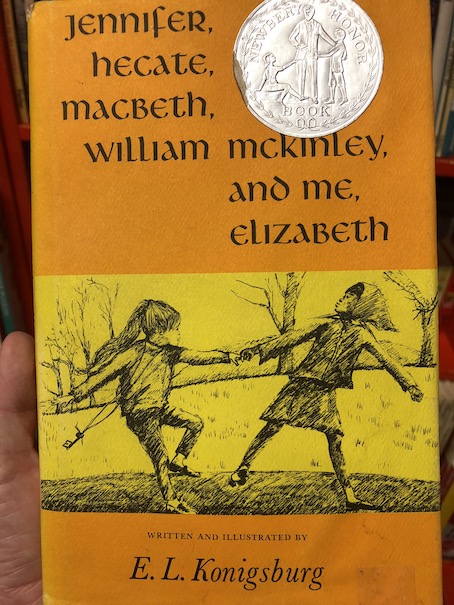
Jennifer, Hecate, Macbeth, William McKinley, and Me, Elizabeth

Jennifer, Hecate, Macbeth, William McKinley, and Me, Elizabeth by E. L. Konigsburg, 1967.

Elizabeth tells the story about how she first met her friend Jennifer one Halloween. Elizabeth is new in town, and doesn’t know many people yet. She doesn’t have any friends to walk with to or from school, and she encounters Jennifer in the woods she passes through on her way to school. When they meet, Elizabeth is dressed as a Pilgrim for the school’s Halloween parade. Jennifer also happens to be wearing a Pilgrim costume, and she’s sitting in a tree. Elizabeth sees that Jennifer is about to lose a shoe because it’s too big for her, so she impulsively pushes the shoe back onto Jennifer’s foot. Jennifer says that witches don’t lose things, and Elizabeth tells her that she’s not dressed like a witch because she’s wearing a Pilgrim costume. Jennifer says that this is what real witches dress like, not like the silly pointed hat costumes. (It becomes more clear later that Jennifer is referring to the accused witches at Salem, Massachusetts.) Elizabeth admires Jennifer’s costume because it looks more authentically old-fashioned than hers does, like a real antique. Elizabeth points out that they’ll have to hurry or be late to school, and Jennifer says that she’ll walk with her in exchange for the cookies Elizabeth is carrying. Elizabeth gives her the cookies because she isn’t hungry and badly needs some company. Jennifer makes it barely on time to her class, but Elizabeth is slightly late because she’s in a different class that’s further down the hall.

Elizabeth describes the Halloween parade at school, and you can tell that this book was written decades ago because there are kids wearing cardboard boxes because their costume is a pack of cigarettes, which would never happen at a 21st century school. Even in the 1980s and 1990s, when I was a kid, nobody would have dressed as a pack of cigarettes. There were a lot of anti-smoking campaigns when I was young, our teachers and most of our parents wouldn’t have allowed it, and with more exciting things to be, like super heroes and Ninja Turtles as well as the traditional witches, ballerinas, robots, vampires, and monsters, why the heck would somebody want to be a pack of cigarettes anyway? Lung cancer may be scary, but dressing as a pack of cancer sticks isn’t exactly fun Halloween scary. If you want to be a box of something, at least pick crayons so you can tell people you’re the sharpest crayon in the box. But, I digress.

At the parade, Elizabeth sees Jennifer unsnap the tutu of school mean girl Cynthia, who is dressed as a ballerina, so it falls down. It’s not a serious embarrassment because Cynthia’s still wearing her leotard underneath. Still, Cynthia is one of those two-faced kids who are good-looking and act like perfect angels when adults are watching but turn into nasty little monsters when the adults look away, so this minor embarrassment pleases Elizabeth and many of the other kids. Jennifer also passes a note to Elizabeth to meet her for trick-or-treating that evening, telling her to bring two bags. As the students parade across the stage for the costume contest, Jennifer amazes everyone by wearing a paper bag over her head that doesn’t have any eye holes cut into it, yet she doesn’t have any trouble walking, somehow seeing where she’s going or knowing where to go anyway. This is one of the odd things that Jennifer does that makes Elizabeth wonder if she really does have powers of some kind.

When the girls meet for trick-or-treating, Jennifer tells Elizabeth to give her the bigger bag of the two bags she brought. It’s a bit rude, but Elizabeth is fascinated by Jennifer and lets it go. Also, Jennifer has brought a small wagon with her. Jennifer has invented and mastered an act to get extra candy. At each house, she acts weak and breathless and asks for a drink of water. When the home owners give her a drink of water, she drops her empty bag, so the home owners will feel sorry for her and give her more candy. Then, out of sight of the home owner, Jennifer empties her bag of candy into the little wagon and does the same performance at the next house. Elizabeth wonders how Jennifer is able to drink so much water, but they collect an amazing amount candy from Jennifer’s act.

After Halloween, Jennifer tells Elizabeth to meet her at the library on Saturday, and she invites Elizabeth to become her apprentice witch. Elizabeth thinks it over and decides to accept. Jennifer begins leading Elizabeth through a series of rituals to make her into a witch. The first ritual involves both of them putting a drop of their blood on an old key that Jennifer was wearing around her neck. Afterward, Jennifer gives the old key to Elizabeth to wear. This ritual is kind of like a friendship pact.

Jennifer gives Elizabeth books to read from the library about witches and tells her to eat a raw egg every day for a week (she does it by mixing it into a milkshake), insisting that she also bring her a hard-boiled egg. From there, they progress through a list of other strange foods. When their grade starts rehearsing for their Christmas play, the food of the week is raw onions, which Elizabeth happens to love, in spite of being a notoriously picky eater. People notice the onions because Elizabeth is supposed to be a puppy in their school play that the princess played by nasty Cynthia gets for Christmas, and Cynthia can’t bear to get close to her.

Being Jennifer’s apprentice also means putting up with her rudeness and bossiness. When the girls decide to try making an ointment to change themselves into animals, they argue about what animals they’re going to be. Sometimes, Elizabeth finds Jennifer difficult to deal with because she isn’t considerate of her feelings, but she’s also fascinating because Jennifer is a serious reader and likes to talk about a wide range of interesting things, from witchcraft trials to Vincent Van Gogh to shipwrecks to the guillotines used in the French Revolution to secret codes. Their rituals continue through Christmas and the New Year and into the spring, with Jennifer promoting Elizabeth to Journeymen Witch and assigning her various “taboos”, things that she isn’t supposed to do.

For most of the book, Elizabeth doesn’t tell her mother about being friends with Jennifer. Jennifer, as a witch, is rather odd, and Elizabeth’s mother wants her to be friends with nice, normal children. In particular, she wants her to be friends with Cynthia because, like other adults, Elizabeth’s mother has been taken in by Cynthia’s two-faced act and thinks that Cynthia is a sweet, well-behaved little girl. When Cynthia invites her to her birthday party, Elizabeth knows that the invitation was really from Cynthia’s mother because she and Cynthia aren’t friends. However, Elizabeth’s mother makes her accept the invitation. The party is a trial because, thanks to Jennifer’s taboos, there are many party activities that Elizabeth can’t do (no eating cake, no pin-the-tail-on-the donkey because she can’t touch pins, etc.), but Elizabeth decides to make the most of it and enjoy being an oddball. Elizabeth has some fun when she realizes that she can act mysterious and witchy about knowing certain things and winning at the games she plays. She knows where the treasure is in the treasure hunt because it was just behind a pillow on the couch and she accidentally sat on it earlier, she wins at the clothespin drop game because she’s shorter than the other girls and finds the game easier, and she knows who brought which gift to the party without looking at the tags because she was the first to arrive and remembered what everyone else brought when they came. Of course, she doesn’t explain this to anyone, she just acts mysterious and witchy, like Jennifer. When she talks to Jennifer about the party, Jennifer acts like Elizabeth has actually used her witch powers to do those things, but Elizabeth insists that they were just ordinary incidents and her good memory for remembering the presents. Jennifer seems a little disappointed that Elizabeth doesn’t seem to see what she’s getting at with the witch business, and Elizabeth is disappointed that Jennifer doesn’t seem interested in the gossip she’s collected about the “normal”, non-witchy girls at the party.

The girls get a toad, which they name Hilary Ezra, their first compromise with each other by combining the two names that they wanted. Jennifer says that the toad will help them with their flying spell. They treat the toad like a pet, giving it insects that they’ve caught and measuring how far he can jump. They both love Hilary Ezra, but when Jennifer plans to add Hilary Ezra to their flying potion, Elizabeth refuses to allow it. She makes Jennifer set Hilary Ezra free. Jennifer tells Elizabeth that she’ll never be a witch because she’s too sentimental and dismisses her as her student witch.

Elizabeth is angry at Jennifer and thinks that their friendship is over as well as the witch business. However, after thinking it over, Elizabeth realizes something: Jennifer actually wanted Elizabeth to stop her from putting the toad in the pot with the other ingredients because she changed the order in which the ingredients were added from the order that was given in MacBeth, saving the toad for last and making a big show of dangling him over the pot, waiting for Elizabeth to stop her. Still, it makes Elizabeth mad that Jennifer made her stop her when she could have stopped herself and probably would have if Elizabeth hadn’t intervened.

Elizabeth has a right to be angry, but she also goes back to being lonely, and she doesn’t like that. While she’s alone at her family’s apartment one day, she spends some time looking at the greenhouses on a nearby farm called the Samellson Estate, and some of Jennifer’s cryptic comments about Hilary Ezra’s origins and her father being a “plant wizard” fall into place. The more Elizabeth thinks about it, the more the things Jennifer acquired for their “spells” make sense and the more Jennifer herself begins to make sense. Then, Jennifer makes the first move in repairing their friendship.

The book is a Newbery Honor book. It’s available to borrow and read for free online through Internet Archive (multiple copies).

My Reaction

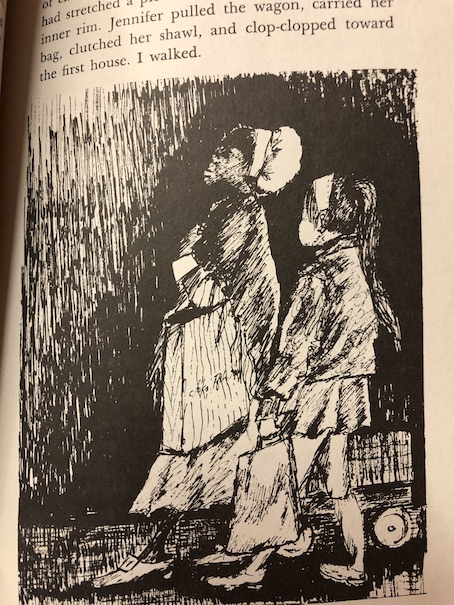
One of the important points about this story that helps make Jennifer more understandable as a character is that she’s African American and this book was written in the 1960s. The book doesn’t refer to Jennifer’s race or describe her physical appearance apart from her clothes until about halfway through the story, although she does appear in pictures before that. The 1960s was the time of the Civil Rights Movement, and in 1967, when this book was first published, Martin Luther King, Jr. was still live. School desegregations were a recent issue. The only time in the book that Elizabeth mentions race is when she notices Jennifer’s mother at the performance of the school play for the PTA, and she says that she knew that the woman must be Jennifer’s mother because “she was the only Negro mother there.” This one line says, without really saying it, that Jennifer is the only African American kid in her class because, if there was even one other, the black woman in the audience could have been somebody else’s mother.

When the story begins, each of the girls has a reason to feel like an outcast – Elizabeth because she’s new at school and doesn’t know anybody and Jennifer because she’s the only black kid. Both of them are lonely, and they’re actually a good fit for each other in terms of their interests, but in order to become real friends, they have to learn to relate to each other without the cover of their made-up witchcraft rituals. After Elizabeth realizes where Jennifer actually lives and what her life is really like, and Jennifer shows that she cares about Elizabeth’s feelings, the two of them are able to bond as friends instead of witches.

Elizabeth never explains why Jennifer came up with the witch idea in the first place, and the book ends soon after their friendship is repaired, so it’s left up to the readers’ imaginations. It might have something to do with feeling like an outcast because of her race and because her father is a blue-collar worker when the kids who live in the nearby apartment building are the children of white-collar workers. Because Jennifer feels different from other kids and often spends time alone, reading books and playing games of pretend, she might have felt uncomfortable explaining herself to Elizabeth, fearing that she might not accept her. Training Elizabeth to be a witch gave the two girls a reason to see each other, adventures to share, and something interesting to talk about. As long as Elizabeth needed Jennifer to teach her witch things, Jennifer would feel confident that she’d stick around as a friend. The girls gave that up when Jennifer realized that Elizabeth would be her friend anyway and might actually like her better just as Jennifer instead of a witch.

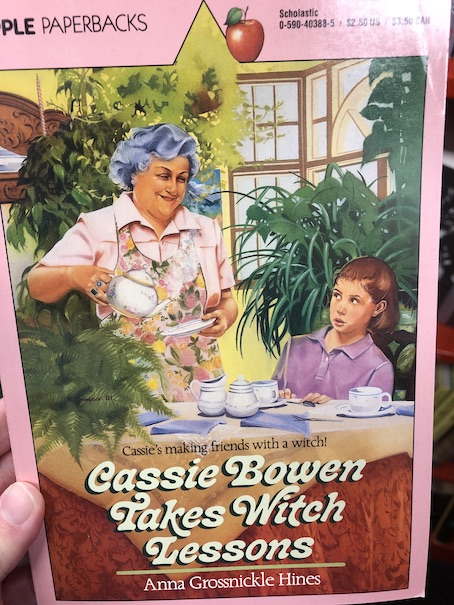
Cassie Bowen Takes Witch Lessons

Cassie Bowen Takes Witch Lessons by Anna Grossnickle Hines, 1985.

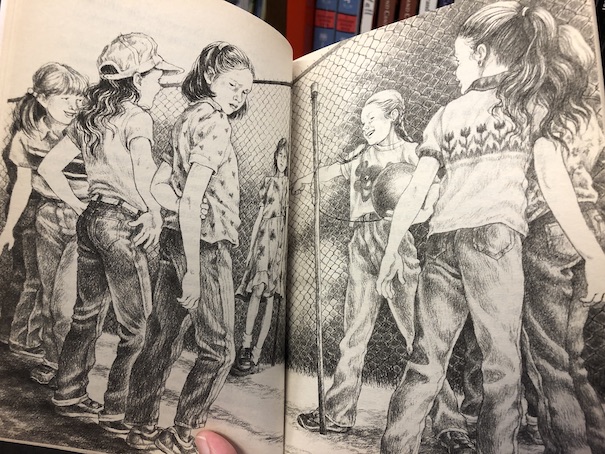
Cassie Bowen and Brenda Bolter have been friends for years, but lately, Brenda has been getting friendlier with Sylvia, another girl in their fourth grade class at school. Sylvia is a mean girl, and the favorite target of her meanness is Agatha Gifford, the new girl at school. Sylvia likes to call her “Saggy Aggy” and “Thrifty Gifford” because Agatha always comes to school wearing dresses that are too loose on her and Sylvia thinks that she probably got them at a thrift store. Most of the girls at school wear brand new jeans, not dresses. Agatha doesn’t bother to fight back when the other girls tease her, and Cassie doesn’t know what to say or do about it, even though the teasing makes her uncomfortable, too.

Even if the other girls are right about Agatha wearing used clothes, Cassie can understand. Cassie wears jeans like most of the other girls, but hers are actually hand-me-downs from an older cousin. (The story of my own youth, too. Thrift stores are the story of my present because I still don’t have much money, and anything I don’t spend on clothes is something I could potentially use to buy books, most of which will also be used because I like older books and because it maximizes my buying power. Life and budgets are about priorities.) Cassie’s mother hasn’t had money to buy new clothes since Cassie’s parents got divorced. The book is vague about what happened in Cassie’s family before the divorce, but Cassie’s father now lives in another state and doesn’t even write or communicate with the family, and he’s certainly not sending money. Cassie’s mother says that he’s got to sort out his life, and Cassie says that her father is kind of a “creep” now, but the book doesn’t go any deeper into it. It’s more important that Cassie’s family is now tight on money, and Cassie has mixed feelings about the divorce. On the one hand, she misses her father and wishes that the divorce had never happened, but on the other, she’s also angry with her father for his part in the divorce and the ways that he changed from the father she knew and loved before. Cassie’s mother says that everyone changes over time, and sometimes, when they change, they grow apart. Cassie will soon come to understand that better through her experiences with Brenda.

Cassie doesn’t like the ways that Brenda is changing, and she resents Brenda sharing the secret hideout they built with Sylvia without even talking it over with her. One day, when the girls are going to their secret fort, they pass the old house where Agatha lives with her grandmother. There are neighborhood rumors that Mrs. Gifford is actually a witch because her old house looks kind of creepy and she often does odd things, like talking to her plants. As the girls pass her house, they hear her talking to her flowers, and suddenly, Sylvia trips up Brenda so that she goes sprawling into the flower bed. As Mrs. Gifford laments about her flowers, Sylvia dramatically exclaims that they must pick some flowers and actually starts yanking more out of the bed until Mrs. Gifford angrily chases them off with a broom.

Cassie is appalled by the entire incident, although she admits that it was funny, watching Mrs. Gifford chase the other girls. Brenda is fascinated with Sylvia because of the daring way she likes to show off and grab attention, and it inspires her to do the same thing, finding ways to make fun of people or cause trouble. It upsets Cassie, who just wants Brenda to be the same Brenda she’s always known. Brenda also tells Cassie that Sylvia has amazing things in her room, like a collection of glass animal figurines. Sylvia even gives her one to keep. Also, Sylvia’s parents supposedly let her stay up as late as she wants, and she can usually get her way with them just by throwing a tantrum. Brenda thinks that all this is cool, which makes her different from the kids I knew growing up. Most self-respecting fourth graders were beyond tantrums and would have been called babies if they had admitted to having one at that age. Having great clothes and a lot of cool stuff in her room would have gone a long way, though.

When the children’s teacher, Mr. Gardner, assigns the kids partners to work on presenting a story to the rest of the class, Cassie hopes that she and Brenda will be partners so that things can be like they were before. However, Brenda and Sylvia end up being partners, and Cassie is assigned to Agatha. Cassie isn’t enthusiastic about it, and Agatha notices, but Cassie decides that she’s going to be as friendly as she can. She asks Agatha about which story she would like to present to the class because she doesn’t like reading that much, and Agatha says that she knows because she’s noticed that Cassie is better at math. Cassie is surprised that Agatha would know that, considering how new she is, and Agatha says that she envies her because she’s been having trouble with fractions. Agatha says that she really likes the story The Nightingale because it reminds her of a beautiful music box that her grandmother owns, and Cassie is fascinated.

One day, when Cassie’s brother is off playing baseball and Brenda and Sylvia are working on their project together, Cassie passes by Agatha’s house and is invited in. Cassie hesitates at first because the house is creepy, but she has to work on the project with Agatha, so she accepts. Agatha’s grandmother serves the girls rose hip tea and cookies. Cassie thinks that rose hip tea sounds weird at first, but it tastes nice. Mrs. Gifford is an eccentric lady, but rather sweet. She introduces Cassie to Roberto, her favorite plant. Part of the reason why she talks to plants is that she lived alone and was lonely before Agatha came to live with her. She is also a member of the same gardening club that Cassie’s mother belongs to. Cassie uses the cookies at tea to explain fractions to Agatha, and Mrs. Gifford shows Cassie her music box, which is beautiful. The music box is special to Mrs. Gifford because it was the last present her father gave her before his death, when she was about the age of the girls now. Cassie understands the feeling because she prizes the teddy bear that her father gave her before he went away.

The more Cassie learns about the Giffords, the less strange they seem, and she no longer believes that Mrs. Gifford is a witch. Agatha tells Cassie that she lives with her grandmother because her parents were killed in a car accident. The only other family she has is an older sister who is away at college, which is why Agatha can’t live with her. Cassie acknowledges that Agatha’s situation is worse than hers because, even though Cassie misses her father, she’s not an orphan. Agatha also explains that the reason why she wears those dresses to school is that her old school was a private church school, where all the girls were required to wear dresses. When Cassie explains to Agatha’s grandmother that there is no requirement about dresses at their school and that most of the girls wear jeans, Agatha’s grandmother is surprised and says that she didn’t realize, so she buys Agatha some new clothes, taking Cassie with them on their shopping trip.

The new clothes fit Agatha better, and Cassie hopes that they will help her fit in better at school, but Sylvia and Brenda won’t let up on the teasing. In fact, Sylvia seems irritated at Agatha dressing more normally and mocks her, saying, “What’s she trying to do? Act like a normal person?” Cassie tries to tell them that Agatha is normal, but they don’t believe her. Soon after, Brenda asks Cassie if she wants to hang out when she’s on her way to see Agatha again about their project. In an effort to get Brenda to ease up on Agatha, Cassie asks Brenda to come with her so that she can see for herself that Agatha and her grandmother are fine.

The Giffords are nice to Brenda, but during the visit, Mrs. Gifford’s special music box disappears. Agatha says that Brenda stole it, and Cassie gets offended by the accusation, saying that Agatha is making it up and telling her that she doesn’t want to be friends anymore out of loyalty to Brenda. Unfortunately … Agatha was right, and Cassie is shocked when she discovers the truth. Cassie retrieves the music box from Brenda, but with Brenda and Sylvia both angry at her for taking the music box back and Agatha and her grandmother probably mad at her for bringing Brenda to their house in the first place and siding with her over the theft, what is Cassie going to do?

I think the ending of the story is very realistic, although it does leave some things unresolved. Agatha does forgive Cassie for not believing her after Cassie returns the music box. Cassie doesn’t tattle on Brenda and Sylvia because they had accused her of being a tattletale earlier, but she does eventually tell her mother everything that has been happening with Sylvia and Brenda. Her mother reassures Cassie that she did the right thing, even if Brenda didn’t. She says that it sounds like Cassie is angry at Brenda for a lot of things besides this, and Cassie agrees that she doesn’t like it that Brenda is so mean sometimes. Cassie mother says that everyone changes, and sometimes, they change for the better and sometimes for the worse. Cassie doesn’t think she and Brenda will ever be friends again, and her mother says that someday Brenda will also get tired of Sylvia’s meanness, but even if she doesn’t, Cassie will find plenty of other friends. Cassie realizes that she and Agatha really do understand each other, and she’s glad when they make up. At school, Sylvia and Brenda both tease Cassie now, saying that she’s taking witch lessons from the Giffords. It hurts Cassie’s feelings to see her old friend turn against her, but she follows Agatha’s advice and ignores them.

Sylvia and Brenda are never punished for the things they’ve done, which is sadly the case for most of the little bullies I knew as a kid. However, it is nice that Cassie and Agatha realize that they are better friends for each other than either Brenda or Sylvia would have been. I noticed that there is also potential for them to be friends with other people in their class besides Brenda and Sylvia. When Cassie got to school at the end of the book, a girl named Stacy asked her if she wanted to play tether ball, which shows that other girls don’t think badly of her for hanging out with Agatha. I also wished that the book would show more of Pam, who had been Sylvia’s best friend at the beginning of the book before Sylvia and Brenda started hanging out. After being abandoned by Sylvia, perhaps she would also be open to making some new friends. Cassie and Agatha might have other options for making new friends.

There is no magic in the story or witchcraft of any kind. In fact, Brenda and Sylvia probably never really believed that Agatha or her grandmother are actually witches. It’s more that, for reasons of their own, Sylvia and Brenda were looking for someone to pick on, and the “witch” accusations were just their excuse. That’s why they were so irritated when Agatha started dressing like the other girls. If their excuse for bullying Agatha disappeared, they didn’t want to lose their ability to bully her. It was never about making Agatha dress or act like the other girls; it was always about Sylvia and Brenda’s need to have someone to victimize. The truth is that even if the Giffords had seemed less strange in the beginning, Sylvia and Brenda probably would either have picked on them anyway or maybe selected some other victim, perhaps going straight to Cassie as their first choice, because they were looking for a victim and would have found one eventually because that was always their goal.

The Green Toenails Gang

Olivia Sharp, Agent for Secrets

The Green Toenails Gang by Marjorie Weinman Sharmat and Mitchell Sharmat, 2005.

Olivia’s best friend, Taffy, who left San Francisco and moved to Carmel just before the beginning of the first book in the series, writes a letter to Olivia and invites her to come for a visit.  In her letter she mentions that there is a club in Carmel that she doesn’t want to join.  Olivia senses that Taffy is upset about something and decides to visit her for the weekend.

When Olivia visits Taffy, Taffy tries to persuade her at first that nothing is bothering her, but Olivia correctly guesses that the club she was talking about is one that refuses to let her in and that she’s upset about it.  Taffy calls the club “stupid,” and Olivia says that “lots of clubs are stupid. Like, if three people have green toenails they form a green toenails club and leave everybody else out.” (I like the way Olivia puts things.)  Taffy is inspired by what Olivia says, and she suggests that they should really form a green toenails club and exclude everyone, including the members of the other club.  Olivia thinks that the idea is interesting, but the problem is that there is only the two of them (three, if they can persuade Olivia’s chauffeur to join them) and that when Olivia goes back to San Francisco, Taffy will be the only member of her club in Carmel.

Olivia questions Taffy about the members of the other club and what they do.  Taffy says that a lot of it is secret, but the members are all girls her neighborhood, and they all wear shirts with their first initials on them.  Olivia and Taffy begin to spy on the girls to learn more about them and to see how they can help Taffy to fit in with their club.

When they see the girls riding bicycles, Olivia thinks that they must be a bicycle club.  She buys Taffy a bicycle and teaches her how to ride it.  Riding a bike works to get the other girls’ attention.  Olivia and Taffy ride their bikes past the other girls and stop to talk to them.  The other girls seem friendly enough, and they invite Taffy to go riding with them later.  However, to Olivia’s surprise, one of the club members calls her later and invites her to join the club, not Taffy.  The girl, Nettie, tells her that they aren’t really a bicycle club and that only members are allowed to know the true purpose of the club and the conditions for joining.  Olivia fits the conditions, but they’ll only explain it to her if she agrees to join.  Nettie also says that they all like Taffy but that they’re “not ready for her” and that they’ll be one step closer to inviting Taffy if Olivia joins.  What is this club really about, and how will Olivia joining help Taffy to join?

I guessed, even before Olivia did, that names are important in the club.  The girls were very interested when Olivia told them her name, and there is a reason why they all wear shirts with their first initials on them.  The five girls in the club are: Jasmine, Katrina, Leah, Millicent, and Nettie.  In order to get Taffy in, Olivia has to point out that Taffy’s last name is Plimpton.  (Get it?)  There, I was a little surprised because I had expected that the name Taffy would turn out to be a nickname and that Olivia would tell them that her real name is Patricia or something.  I had forgotten what Olivia said her last name was.

I thought that Olivia made some good points about the nature of clubs and exclusivity.  The reasons for a lot of exclusive groups are really silly and arbitrary because the main point of those group is just to be exclusive, not to fulfill any other purpose.  That this particular club rides bikes could have been their main purpose, and that would be a purpose that actually involves doing something, but their real requirement for joining is much more arbitrary and is mostly based on random chance, making it very difficult for them to ask new people to join even when they want to invite them.  Taffy would have had exactly the same problem if her name had been Abigail or Wendy.  I’m not really sure what they would have done if she had been Jessica or Linda.  Either they’d have to allow some duplication, or they might say that they couldn’t have her at all.

Olivia says, “I hate clubs. All those secret handshakes and pins and meetings and all that rot.” To Olivia, the whole thing is just silly, and she thinks that they should just be friends with people without all the silly secrecy and ritual.  I liked that stuff more when I was a kid myself, and I remember forming clubs with varying degrees of secrecy with kids in elementary school, but to tell the truth, none of them did very much or lasted very long because they had little other purpose to them besides just being a club and the routine of meetings with all the trappings that annoy Olivia take more effort to maintain than they’re worth. The best solution to having a lasting club would probably be to give the club a purposeful activity or set of activities that all of the members could enjoy and that would allow them to recruit new members easily.  If this club eventually focuses more activities like bicycling, it would be likely to last longer and leave them open to more members than they currently have whenever they want to add them.

The book is currently available online through Internet Archive.

Ramona the Brave

Ramona the Brave by Beverly Cleary, 1975.

Six-year-old Ramona Quimby thinks of herself as brave. Now that she’s going into the first grade, she’s no longer just a little kid. She even stood up to some boys on the playground who were making fun of her older sister, Beatrice, for being called “Beezus.”

However, Ramona soon discovers that not every sees her the way she sees herself. Beezus is embarrassed at the way her little sister told off those boys and is sure that they’re now going to make a much bigger deal of the incident at school because of it. Beezus says that she’s sick of her silly nickname, which rhymes with “Jesus” and just wants to be called “Beatrice.” Ramona agrees with her, both because she feels bad that she accidentally embarrassed her sister and because it’s her fault that Beezus got her nickname. When she was smaller, Ramona couldn’t pronounce the name “Beatrice” very well and ended up saying “Beezus” instead, and the mispronunciation stuck. Ramona is trying hard to be a big kid now, and she doesn’t like to remember that she used to not even be able to say her own sister’s name. Ramona agrees to call her sister Beatrice in public and to only use the Beezus nickname at home.

Ramona wants to be taken seriously, and she hates it when her mother is amused by some of the silly things she does. (I know the feeling, and so do many other people!) The last thing she wants is to just be a silly little kid that people laugh at, and nobody seems to understand how she feels. She especially hates it when her sister keeps calling her a pest.

Fortunately, their mother understands that part of the problem is that the girls are getting bigger, and they’re starting to feel cramped sharing a room with each other. Mr. and Mrs. Quimby have decided to add an extra room onto the house so the girls won’t have to share anymore, and Mrs. Quimby is going to take a part-time job to help pay for it. Before the girls can start arguing about who gets the new room, Mrs. Quimby tells them that it’s already decided that they will take turns, trading off rooms every six months and that Ramona will have the first turn in the new room.

Watching the workmen make a hole in the wall of their house and build the new room is fascinating, although Ramona doesn’t have the patience for planning, methodical work, and learning how different tools are supposed to be used, like her friend Howie. Ramona prefers playing their made-up game of Brick Factory, where she and Howie smash old, broken bricks with rocks. Ramona takes the opportunity to put her special initial, a Q with cat ears and whiskers, into the wet concrete for the floor of the room, and she can’t resist the opportunity to jump through the new hole in the wall of their house. The workmen cover the hole with a sheet of plastic when they go home for the day, but the girls think it’s kind of spooky having a hole in the wall of their house. They imagine that something horrible could sneak in through the hole, like a ghost, maybe one that looks like a gorilla. Ramona can’t wait to tell the other kids all about it when she starts first grade!

Unfortunately, the new school year doesn’t start out the way Ramona hopes. Instead of everyone being excited about her news and how she watched the workmen chop a hole in the side of her house, everyone laughs because the teacher had just made a joke about her being Ramona Kitty Cat because she drew the cat ears and whiskers onto the Q on her name tag the way she always does. Ramona hates being laughed at and made to feel like a fool. Worse still, her friend Howie doesn’t defend her because Ramona said that they “chopped” a hole instead of “prying” it open with crowbars. Because of Ramona’s technical inaccuracy, Howie makes her sound like she was lying about the whole thing!

Then, when the kids make paper bag owls for Parents’ Night, Susan copies Ramona’s design, and the teacher, Mrs. Griggs, praises Susan to the whole class for coming up with the idea of having the eyes looking to the side. She doesn’t even notice Ramona’s owl. Ramona, afraid that everyone else will think that she’s the copycat because of Mrs. Grigg’s public praise of Susan’s owl, just like they all thought she was a liar and laughed at her before because of what Mrs. Griggs and Howie said on the first day of school, crumples her owl up and throws it away before anyone can see it. But, that doesn’t help relieve Ramona’s feelings at the injustice of the situation. She’s owl-less because of Susan stealing her idea. In a fit of temper, she crumples up Susan’s owl, too, and runs away when Susan tells on her even though Mrs. Griggs repeatedly says that she doesn’t like tattletales. (Honestly, I’ve never understood why adults tell kids that. It just encourages kids to behave badly and label others as “tattletale” when they complain, even when the complaint is just. It just gives bullies more power to act with impunity. I also think kids should be encouraged to talk about things, especially some of the more difficult things to talk about, and the whole “I don’t want to hear from tattletales” shuts down conversations before they even start. I’ve guessed that it has something to do with not wanting to take the time to deal with a lot of petty complaints, but at least hear someone out before you decide what they’re going to tell you and how important it is!) Even when Ramona explains the situation to her mother, she can tell that her mother doesn’t fully understand how she feels, and she is forced to apologize to Susan. Mrs. Griggs makes it all the more embarrassing by forcing Ramona to apologize in front of the whole class. Ramona knows that Mrs. Griggs doesn’t understand her and is sure that Mrs. Griggs hates her.

Ramona’s new room isn’t much of a comfort, either. She finds it a bit spooky, and when she’s alone in it, her imagination runs wild, like it did the night that she and her sister were imagining what kind of ghost could get in through the hole in the wall. Ramona certainly doesn’t feel very brave and grown-up about having a room to herself, but she refuses to admit it because she doesn’t want anyone to think that she’s a baby for being scared.

Things come to a head when Mrs. Griggs sends home a progress report that says that Ramona needs to use more self-control and keep her eyes on her own work. Ramona knows that it’s totally unfair because she’s been very self-controlled since the owl incident, in spite of Mrs. Griggs’s inconsiderate lack of understanding, and the only reason why she sometimes looks at the paper of the boy next to her is that he’s been seriously struggling with his work, and she’s been trying to help him. When Ramona is so fed up that she tells her family that she needs to say a bad word and the worst word she can think of to say is “guts”, everyone laughs at her, and Ramona bursts into tears, unable to take it anymore.

Tears and anger serve a purpose, though. Sometimes, an outburst is the only way to make someone understand, and understanding is what Ramona most needs. The family has an honest discussion about Ramona’s feelings, and Beezus tells her that she understands what it’s like to be little and laughed at for doing or saying something silly, reminding her mother about the times when she laughed about things she did, back when Ramona was too little to remember it. Beezus says that her mother’s laughter hurt her feelings when she was Ramona’s age, too, and Mrs. Quimby apologizes. Beezus also says that she never liked Mrs. Griggs very much when she was her teacher, either. Ramona asks if she could switch to the other first grade class at school, but her mother is reluctant to arrange it because her schoolwork has improved and because some of Mrs. Griggs’s criticism was correct and that Ramona does need to improve on her self-control. Mrs. Quimby also says that she wants Ramona to learn to understand and work with different types of people. Mrs. Griggs might not be her kind of person, and she might not always understand Ramona, but Ramona isn’t always easy to understand.

Personally, I didn’t think that last comment was a very good way to put it. One of the great things about the Ramona books is that Ramona’s feelings are easy to understand and identify with. Beezus certainly understood what Ramona meant about what it’s like to be laughed at for just being a kid. It’s something many of us experienced when we were kids, and we identify with how Ramona feels about it. (Didn’t Ramona’s mother ever go through this herself, or does she just not think about it? I kind of wondered when she didn’t seem to understand what her daughters were talking about at first.) I think it would have been better to put more of the emphasis on the idea that different types of people need to learn to respect each other and get along even when they don’t fully understand each other. Other people aren’t always easy to understand, but that’s not because Ramona herself is difficult to understand. Ramona’s feelings aren’t any less understandable than Mrs. Griggs’s, it’s more that not all people have the same capacity for understanding others because they don’t have as much empathy as others or the imagination to consider circumstances they haven’t personally been in themselves or are too focused on their own priorities and don’t have the time or patience for understanding. Adults often don’t consider things from a child’s point of view because their adult priorities in their busy adult lives take precedence, they discount the validity of what children think and feel because children are less experienced in life and sometimes express themselves clumsily, and they don’t slow down and take a step back or a second look or listen when they should. But, they could show a little more consideration for the child’s feelings even they don’t fully understand them. My own first grade experience wasn’t any better than Ramona’s, and I had my own “Mrs. Griggs.” Adults forget that kids can feel and experience things beyond their ability to fully explain them to others. One of the difficulties of being young, at least for me, was not having the vocabulary necessary to make myself understood or ask all the questions that I wanted to ask, and I often had to deal with adults who were short on patience. I can see that Ramona also struggles with finding the right words to express what she’s feeling or what’s really happening, like when she used the word “chopped” instead of “pried” to describe how the workmen opened a hole in the side of her house. I think that learning words and new ways to communicate with different people is an important part of the story.

Fortunately, Ramona’s father is right that the bad things will blow over, and Ramona’s situation improves. Some of the other kids in class become sympathetic to Ramona because they recognize that Mrs. Griggs shouldn’t have made her apology to Susan an embarrassing public apology. Ramona, although frequently bored in class, learns to read better, and she enjoys reading, finding that she can read more interesting stories when she knows more difficult words. She also meets her older sister’s teacher, and he calls her Ramona Q instead of Ramona Kitty Cat, like Mrs. Griggs did, making Ramona realize that there’s life beyond first grade and that better, more sympathetic teachers are waiting for her. She also becomes less afraid of her new room.

A scary encounter with a dog on the way to school that causes Ramona to lose one of her shoes also brings some unexpected sympathy and understanding from Mrs. Griggs. Ramona comes to understand that Mrs. Griggs is trying to be helpful when she offers her one of the old boots from the lost and found to replace the shoe she lost, that Mrs. Griggs simply doesn’t understand Ramona’s feelings about those old boots (they’re old, dirty, and kind of yucky), and that she isn’t likely to understand because she has her own priorities. Instead of getting mad at Mrs. Griggs for her lack of understanding, this realization causes Ramona to come up with her own creative solution to the problem. Ramona gains a better image of herself because of her creative problem solving and her bravery in a difficult situation. Mrs. Griggs also begins to show signs of understanding that Ramona is a creative person who needs a little room to demonstrate her creativity.

The book is available to borrow and read for free online through Internet Archive (multiple copies).

The Son of the Slime Who Ate Cleveland

The Son of the Slime Who Ate Cleveland by Marjorie Weinman Sharmat, 1985.

Frank is the first to admit that he’s a bit eccentric and that his mind doesn’t quite work like other kids’. He’s a bit more imaginative, more daring. When he thinks of something, he can’t resist doing it, even pulling pranks on his best friends, Jack and Lee. He sees it as a way of expressing himself, and he wants to go into show business someday.

One day, the boys spot a jelly bean counting contest at the mall. The prize is two tickets to a move called Monster Mayhem and all the jelly beans they can eat in two hours. Frank isn’t really interested in counting contests. Jack and Lee, who have ambitions to go into law and banking, are more interested in counting things and competing with each other. Jack and Lee both come up with the exact same number of jelly beans that they think are in the jar, and they start arguing about which of them came up with the estimate first. Frank can’t decide which of them was first, so he just tells them that they’re both wrong and guesses his own random number without even trying to count the jelly beans. All three of them enter the contest.

That could have been the end of it, but Frank can’t resist telling other people about the contest. Not only does he tell them that he and his friends have entered the contest, but he tells them the exact number that Jack and Lee both guessed.

A classmate, Bianca, invites everyone to a party at her house where everyone has to come dressed as their favorite monster. Her parents are also there, dressed as Mr. and Mrs. Slime Who Ate Cleveland. Bianca’s parents are both psychologists, and they think it’s emotionally healthy for kids to expend their energies and go wild at parties, so they’re very permissive with Bianca and her friends. At the party, Bianca’s father takes an interest in Frank, calling him “son” (hence the name of the book) and telling him that he should mingle more with the other kids and be less of a loner. He offers to help Frank with vocational counseling for his future, which Frank is not eager to accept from a guy who is currently dressed as a Slime Who Ate Cleveland and who actively encourages the kids to have a potato sack race in the living room. Frank thinks an indoor potato sack race sounds crazy, Jack thinks it sounds dumb, but Lee is all for it. When Jack and Lee argue about the potato sack race, Bianca brings up the story that Frank told her earlier about the jelly bean counting contest and the boys’ argument over which of them guessed the answer first, putting it to a vote among the party guests. Lee wins the vote (which doesn’t mean much since the other party guests weren’t even there when they made their guesses), and Bianca switches her attentions from her current crush, Jack, to Lee (who doesn’t want Bianca’s attentions and becomes afraid to answer the phone when she keeps calling him).

Jack and Lee both get irritated with Frank for turning the jelly bean counting contest into a big deal and ask him to stop telling people about it because neither of them really even expects to win. However, the incident doesn’t even stop there, because it turns out that both Jack and Lee are declared the winners of the contest because their identical guesses are the closest to the real answer. The contest judges decide to award the prize jointly to the two of them – a movie ticket each and all the jelly beans that each of them could eat in an hour.

Sharing the prize could have resolved the incident, but Jack and Lee still have a competitive streak. Even though Frank congratulates them both as winners, Jack and Lee still argue about which of them is the “real” winner for coming up with the answer first. Frank tries to point out that each of them really only needs one movie ticket anyway, so what difference does it make if the other friend gets the other one? That doesn’t do any good, though. Jack and Lee both want to be acknowledged as the “real” winner, and thanks to the vote at Bianca’s party, other kids at school are taking sides to support their votes.

The entire jelly bean counting situation has gotten completely out of control! Jack and Lee won’t stop arguing with each other about who really won the contest, and both of them are mad at Frank for spreading the word about it and turning it into a bigger deal than it had to be. Frank needs to find a way to solve the argument and reconcile with his two best friends. Meanwhile, Bianca’s father, Mr. Wasserman, keeps calling Frank “son” and trying to talk to him about his vocational future, which makes Frank feel as green as the Son of the Slime Who Ate Cleveland.

Just when Frank thinks he’s got everything solved, a new contest threatens to set Jack and Lee against each other again. Frank tries one more outlandish scheme that exposes Jack and Lee’s arguments to an even wider audience than before. It takes some sincere friendship from Bianca, some words that actually make sense from her mother, and some “perfectly frank” talk from Jack and Lee to help Frank to recognize how his own behavior has contributed to the problems and how his friends really feel about some of the things he’s said and done.

The book is humorous, but Frank does develop some empathy through the course of the story, coming to a better understanding of how the people in his life really think and feel and the effects that his various pranks and stunts have had on people around him. Frank learns not just what it means to be “Perfectly Frank”, as he puts it, but what it really takes to be a sincere and honest friend. One of the best parts of the book is the banter between the various eccentric characters, from Frank’s straight-forward responses to the strange offers of advice from Bianca’s well-meaning slime monster father to the school principal’s attempts to convince Frank to take up paper clip collecting as a hobby to keep him out of trouble to the frank discussion of friendship Frank and Bianca have when Bianca asks Frank to kiss her.

The book is available to borrow and read online through Internet Archive.

Who Ran My Underwear Up the Flagpole

School Daze

It’s still just a few weeks into the first new school year at Plumstead Middle School, and Eddie still feels a little out of place. He still feels like he’s a grade school kid at heart and doesn’t fit in with the big kids at middle school. The most grown-up impulse that he has is to frequently stare and smile at Sunny Wyler, and she doesn’t even like him to do that.

Then, something horribly embarrassing happens. Mr. Hollis, the social studies teacher is so late that the entire class gives up on him arriving and decides to go to the locker rooms to change early for gym. Mr. Hollis storms into the boys’ locker room a minute later and barks orders at the boys to return to his class immediately. Eddie, scared to death of his angry teacher, follows this order to the letter – forgetting that he isn’t wearing any pants and is just sitting there in his underwear. Eddie is the only person who doesn’t get any punishment from Mr. Hollis, who is sympathetic to his plight, but that’s not enough to make up for everyone seeing Eddie in his underwear.

Eddie’s underwear has cartoon characters on it, which is just another thing that makes him feel like a baby in middle school. He enlists the help of his best friend, Pickles, to help him burn his old cartoon character underwear, planning to buy some new ones with money he was saving to buy comic books. Then, Pickles suggests to him that he do something else to see how grown-up he is: try out for the school’s football team.

Unbeknownst to the boys, Salem and Sunny are both trying out for the school’s cheerleading squad. Salem isn’t at all the cheerleading type, but that’s the very reason why she wants to join the cheerleading squad. She wants to be an author, and she’s trying to understand different types of people so she can create more realistic characters. Therefore, she sometimes does things that would otherwise be out of character for her just for the experience or to get inside the head of different types of people. However, Salem realizes that she isn’t a very good cheerleader, so she invites Sunny over to consult her on what to do.

In spite of her grumpy, prickly personality, Sunny is actually a very good cheerleader, but she can’t help Salem to improve enough to make the squad. The girls do see Eddie at the football try-outs, though. Eddie’s uniform is really too big for him, his helmet gets turned around, and he ends up with a nosebleed. The coach complains about everything that’s going on with the team and how little time he has to train them and says that what he needs is a manager, so Salem volunteers for the position. Salem is very good at organizing things. With Pickles as part of the school’s small marching band, the entire group of friends is now involved in the school’s football games.

The four kids still have lunch with the school principal once a week, having developed a friendship with him during their rocky first days of school. They tell the principal about their football involvement, and Sunny brings up the subject of Eddie’s Superman underwear that everyone in the class saw him wearing. Eddie denies having any Superman underwear (which is now true), and Pickles backs him up, saying that one pair was just an old pair that he had to wear that day because the others were in the wash. The principal tries to hint to Sunny that she should stop teasing Eddie, but she takes it too far, and Eddie ends up smashing a Devil Dog snack cake (link repaired Nov. 2023) into Sunny’s face. The principal is actually impressed that timid Eddie had to the nerve to do it, and oddly, Sunny doesn’t even seem upset afterward.

Thus begins Eddie’s first steps at learning to be more grown-up. However, it’s not going to be easy for him. His current reputation is going to be hard to live down. The other guys on the football team are all bigger than he is, and he’s been bullied by the big kids since school started. At one practice meet, his pants fall down because his uniform is too loose, and a big kid hoists him in the air to show everyone that he’s not wearing Superman underwear.

But, what Pickles had told Eddie when they were burning Eddie’s old underwear was correct: Eddie might be a kid, but so are all the other sixth graders at their school. Eddie isn’t the only boy on the football team who is new and small. He’s not the only one who is sometimes timid and awkward, either. As team manager, Salem soon begins helping the new football players tie the drawstrings of their pants more tightly because other players are worried about losing their pants like Eddie did. She also begins soothing their various injuries, fears, and ruffled feelings. Around their coach, the boys have to act tough and not cry, even when they’re scared or hurt, but since their team manager is an understanding girl, the boys can sometimes let down their guard and be more human with her. Salem gets a lot of insight into the emotions of football players, and in return, she helps the young players to understand and manage their emotions, too. Eddie resists most of Salem’s help because he’s trying to prove that he’s tough and grown-up, but without her support, many of the other boys would have quit the team.

As the season progresses, Eddie gets the chance to a football hero, the very first player to score a touchdown at their brand-new school, and Sunny realizes that she’d rather be a mascot than a cheerleader because she’s too grouchy to be a cheerleader and nobody tells a Fighting Hamster to keep smiling. However, even Eddie’s football victory doesn’t end the teasing, and somebody runs a pair of Superman underpants up the flagpole to mock him. In a desperate attempt to cheer him up, Salem promises to arrange the thing she knows that Eddie wants the most – a chance to kiss Sunny. Will it work?

The book is available to borrow and read for free online through Internet Archive.

The kids do some growing-up in this book, but not unreasonably so for eleven-year-olds. The party where Salem tries to arrange for Sunny and Eddie to kiss is suitably awkward. As the kids talk about the idea of kissing, they tease each other. I didn’t like the part where Salem called Sunny a baby for not wanting to kiss Eddie. It’s not that I don’t think that’s realistic for some eleven-year-olds, but I believe more in the modern idea of giving consent and respecting someone’s “no” when it comes to anything romantic. That didn’t occur to me when I first read this book as a kid, but that’s what real maturity does for you. The word “sex” does appear in the story when Salem challenges Sunny’s maturity, saying that she probably still giggles when someone says that word, to which Sunny quickly replies, “Don’t you?”

“‘No,’ said Salem, ‘as a matter of fact, I don’t. What’s there to giggle about? It’s nature. It’s as natural as trees and cows. Do you giggle when somebody says trees or cows?’
‘If the tree tries to kiss the cow,’ said Sunny, ‘sure, absolutely.'”

As part of their maturity talk, Salem points out that women do mature faster than men, and that’s why some young women marry older men. Well, that’s one explanation for that, although, as an adult, I can think of at least two more.

To her credit, Sunny thinks of a way to deliver a kiss to Eddie without exactly kissing him. She does it in a joking way as part of a game of Truth or Dare.

As a side plot, the kids were also trying to decide whether or not they want to go to the Halloween Dance at school. On Halloween, they all meet in their costumes, and Eddie is over his Superman underwear embarrassment enough to wear a Superman costume. At first, the kids think that maybe they’ll go to the dance, but on the way, they can’t resist stopping to trick-or-treat and end up changing their minds. They’re not really ready to be completely grown-up yet, any more than they’re interested in romance in any serious sense. What’s more, they’re all fine with that.

This is the book where Pickles makes himself a new skateboard out of an old surfboard that’s big enough to carry not only him but all of his friends, too. He calls it the Picklebus.