Most of this story is framed as a flashback, actually two of them. In the beginning, during the late 1800s, a girl named Mary is taken by her grandmother, Susannah, to visit an old friend of hers who is dying. The friend, Bethlehem, is a black woman who is a teacher in Canada and has a student living with her, a young black girl named Free, who is about the same age as Mary. At first, Mary doesn’t completely understand who Bethlehem is and why they are there to see her, and Free is somewhat aloof and suspicious of these white people, but together, Bethlehem and Susannah explain to both the girls about their unusual friendship and a shared history that changed both of their lives forever. As they explain, Mary writes down their story.
Years ago, before the American Civil War, Susannah was a young teenage orphan. She traveled from her home in Vermont to the home of her aunt and uncle in Virginia, her new guardians. Homesick, missing not only her deceased parents but the friends she left behind, especially a boy who is her best friend (and who eventually becomes her husband, Mary’s grandfather), Susannah finds life in Virginia strange and unpleasant. Her aunt and uncle own slaves, which is something that makes Susannah uneasy. She was raised not to believe in slavery, but her aunt and uncle give her a slave of her own to take care of her, a girl about her age named Bethlehem. Susannah is extremely uncomfortable with the situation, not really being the kind of person to get others to do things for her or order anyone around, and Bethlehem isn’t happy about being saddled with this sad, somewhat weak and clueless, white girl.
Bethlehem already has serious problems. Susannah’s older, male cousin has taken a liking to Bethlehem and pursues her, trying to force his attentions on her. Bethlehem resists but knows that one day she might not be able to stop him because she’s in his family’s power. They own her and have authority over her. Susannah is unaware of this situation at first, being a rather naive girl. However, Susannah’s unhappiness at her new home increases, and more and more, she longs to return to her real home in Vermont, and her desire to escape also becomes Bethlehem’s ticket to freedom.
Both of the girls long for freedom, although each craves a different kind of freedom and has in mind a different kind of life they long to live elsewhere. Together, they team up to run away in disguise as boys, although Bethlehem does not trust Susannah at first because she resents white people and the slavery that has been forced on her for her entire life. However, with their common interest in escape, they learn to rely on each other. They come to trust and understand one another much better during the course of their journey. It is an eye-opening and life-changing experience for both of them. Then, when it comes time for them to say goodbye and go their separate ways, it is one of the hardest things that either of them have had to do.
It is a story about lives with separate directions but which crossed in unexpected ways to the benefit of both of them. Because Susannah and Bethlehem have different destinies and different things that they want in life, they cannot live their lives together and do not see each other again for many years after their adventures, but because of their shared experiences, they still share a bond that lasts across time.
After Bethlehem’s death, Mary becomes concerned about the young student of Bethlehem’s, Free, who was living with her as a part of her family, but Free doesn’t want their help. Susannah tells Mary that they have to let her live her life and establish her own independence in the way she wants, just as Susannah had to let Bethlehem go her own way years before as a strong, independent young woman who only wanted the freedom to choose her own course in life.
In the end, Mary, as an adult looking back on the one and only time she met her grandmother’s old friend, just before her death, realizes that she has also learned much from the experience, not just about her grandmother’s history, but about herself, other people, racial differences and attitudes, and some of the realities of the world, absorbing vicariously some of the lessons her grandmother learned years ago through her story and Bethlehem’s.
This isn’t really a happy story. The ending kind of leaves readers with an unsettled feeling because there are many things left unanswered and unresolved. The book does explain a little about what happens to the characters at the end, but for the most part, they all kind of go their separate ways. Although they’ve had an effect on each other, nothing is clear-cut, and they share moments together more than lives. I have to admit that I felt like some of the story dragged in places and others were downright depressing, making this a difficult book to get through. However, it is interesting for showing a part of history, a life-changing event from different points of view, and some poignant thoughts about caring but letting go.
The book is available to borrow and read for free online through Internet Archive.
Greta
loves fog and always has, although other people can’t understand it. When she is ten years old, she begins to get
the sense that there is something in the fog that she should find. One day, when she goes looking for a lost cow
from her family’s farm, she sees a house in the fog that isn’t there when the
fog is gone. Apparently, there used to
be a house on that site, but it’s gone now.
Except when there’s fog.
From
then on, Greta loves to walk in the fog.
When she does, she meets people from the past. One day, she meets a woman named Laura Morrill,
who recognizes her as being from the Addington family and says that her name
must be Greta. According to Laura, there’s
always a Greta in every generation of Addingtons and that there’s always a
child in every generation who has a great love of fog. Greta’s ability to use the fog to travel back
in time and see her town as it once was is apparently inherited.
Greta
makes friends with Retha Morill, Laura’s daughter. However, when Mrs. Morrill gives her a piece
of pie to take home, it disappears, making Greta realize that she can’t bring
things from the past to the present.
Retha’s parents seem to realize it, too.
When Retha offers her a little silver egg cup to take home, Mrs. Morrill
suggests that perhaps it would be better for Greta to leave it at their house
and use it when she comes. Greta also
has the feeling that, when the fog starts to lift, she needs to go home, and
Mrs. Morrill agrees.
On another day, Greta and Retha spot an older girl in the woods. Retha seems to know who she is and calls out to her, but she runs from them. They try to catch up to her, but she gets away, and Retha is upset. It turns out that the girl is named Ann, and she was falsely accused of theft. When it was discovered that she hadn’t stolen anything, the townspeople had tried to find her, but she’s been hiding from them ever since, too afraid to come back. At first, people had thought that maybe she had gone to another town to find work, but now that they know that she’s been living alone in the woods, they’re worried about her. The story also upsets Greta because she has heard a local ghost story about a girl who haunts the woods after being falsely accused, and Greta takes that to mean that Ann will die. The Morrills assure her that they will look out for Ann.
Greta
is tempted to talk to Retha about her mysterious time traveling in the fog, but
Retha stops her from talking about it. Retha
says that even her mother doesn’t want to talk about where Greta goes while she’s
not with them, only saying that both men who go to sea and the women who wait for
them on shore “have to learn to be content and at peace shut in by their
horizon.” To Greta, that means that she
should be content with wherever she is while she’s there and with the fog that
allows her to see her friends in the past.
The
more Greta visits the Morrills, the more she gets caught up in the lives and troubles
of the people living in the past. At one
point, Greta and Retha talk about some of the sad things that have happened to
people the Morrills know, and Retha asks Greta if there is sorrow where she
lives. Greta has to admit that there
is. People generally do have their
troubles, no matter when they live.
Retha says that her mother says that living and dying are both natural
things, so there is no use being sad about them, except when the death is an
unnatural one, like in a war. There is
no war going on in Retha’s time, but Greta lives during the time this book was
written, in the middle of World War II.
Greta is aware of the war and says that sometimes people have to fight
whether they want to or not, but Retha doesn’t think so. Greta realizes that she can’t make Retha
understand the circumstances of the world in the future.
However,
as Greta’s twelfth birthday approaches, she has the feeling that things are changing. Her birthday will be the last time that she
can visit her fog friends, but they give her a special present to remember them
by. Greta’s father seems to know what
Greta has been doing in the fog, and he reveals to her, without actually saying
it, that he once did the same thing himself.
He says that when people grow up, they leave the things of childhood
behind, but each of them is able to keep a special birthday gift from the past
as a reminder that some things do last.
The ending of the story implies that, although Greta’s adventures in the fog were real, not purely imaginary, she has to give them up to make room for the new things that will enter her life as she grows up. Her life lies in her present and future, so she can’t keep going back to the past. However, her experiences with her friends in the past are part of what has made her more mature, and they will stay with her forever.
The book is a Newbery Honor Book. It is available to borrow and read for free online through Internet Archive.
My Reaction
The idea of magic and magical adventures ending at a certain age, as the person begins to grow up, is a classic idea in children’s literature. Sometimes, in other books, it’s implied that the reason this happens is because the “magic” was all imaginary, and the child in the story grew out of that particular kind of imagining, but that isn’t the case in this story. The explanation in this book for why the magic has to end is simple but makes sense. The characters don’t really analyze the issue too deeply, simply taking it in stride. We never find out why this particular family seems to have this tradition of going back in time in the fog as children, and the characters seem to decide that there is no reason to find out why.
Unlike in some modern books, there doesn’t seem to be any particular mission for Greta (or her father or any other generations before her) to fulfill in her time traveling. Greta is mostly an observer of the events in the past, not really participating in them directly or changing them in any way. She doesn’t even seem to influence the thoughts or attitudes of people in the past much. When she talks about the concept of war with Retha, she doesn’t try to change Retha’s mind about it or tell her about World War II and other future events because she realizes that each of them really belongs to two different times and sets of circumstances, and each of them needs to live in their own time, dealing with their own situations. It is their differing situations which give them their attitudes. The Morrills seem to be aware that Greta comes from the future, but they treat the subject carefully, never directly stating where she is from, just hinting at it. From they way they act, it seems as though they’ve met other members of Greta’s family before, but again, the ties between their two families (if any) are never explained, and none of them seems to want to delve too deeply into the matter. For the most part, they just seem to take the whole situation as being a natural part of life in their families and in the area where they live, something just to be enjoyed and not questioned. In fact, some of their attitudes seem to imply that they fear questioning too deeply, as if that in itself might end the magic too soon.
Although the story leaves the reasons behind the time traveling very open and unresolved (probably, other children in Greta’s family will be doing this in the future, also not really knowing why), it is really a very calm story. Not having a special mission to complete in the past leaves Greta free to simply enjoy the company of the people in the past, observing their lives without the stress of needing to solve their problems for them, and readers can similarly enjoy the ride without worrying that anything really bad will happen. You do end up being interested in what happens to some of the characters, like the woman who is in danger of losing her family’s home, but events unfold in the way Greta knows they will. She’s sad when she knows that certain people are going to die (not the woman whose home was in danger, that works out well) and there is nothing she can do about it, but it all seems to be part of the natural circle of life, something that matures Greta when she realizes it.
One of the fun things that I liked about the book were some of the unusual first names of the characters, like Retha, Eldred (Retha’s father), and Ardis (Mrs. Stanton).
Molly is excited because she has just learned that an English girl will be coming to stay with her family for a while. The girl, Emily, is one of the child evacuees from London. Really, she’s supposed to be staying with her aunt, who also lives in Molly’s town, but her aunt is in the hospital with pneumonia and won’t be able to take her for another couple of weeks. In the meantime, Molly and her friends are eager to meet her, imagining her to be something like the English princesses, Elizabeth and Margaret Rose.
The girls have a fascination for England after all the things they’ve seen in movies and newsreels. Recently, they saw a newsreel about bomb shelters in England. Inspired by what they’ve seen, the girls make a pretend bomb shelter under an old table and enjoy pretending that they are like the people in the newsreel. Molly’s brother, Ricky, says that it isn’t very realistic, and the girls say that they’ll have to ask Emily when she comes.
However, Emily turns out to be very shy and quiet. She’s pale and skinny and hardly talks at first. When the girls show her their “bomb shelter”, she doesn’t want to play in it. Molly thinks that maybe Emily doesn’t like them, but her mother reminds her that, in World War II England, bomb shelters aren’t places to play. Emily is the same age as Molly, and the war has been going on since she was a little kid. Molly’s mother points out that Emily probably doesn’t remember much about life before the war. Emily is accustomed to bombings and danger all around her, and Molly’s mother compares her to a flower “who’s not sure it’s spring yet. It will take some time for her to realize it’s safe to come out now.”
Emily goes to Molly’s school, and their classmates are fascinated with her. This fascination makes Emily even more shy than she would be otherwise as kids try to imitate her accent and ask her questions about what it’s like to see buildings bombed. To the America kids, the war seems exciting, and they want to know what it’s like to see it up close, but Emily dodges their questions.
Molly finally comes to understand why Emily is so evasive when their town has a blackout drill. When the drill starts, a siren sounds, and everyone has to go down into their basements until they get the signal that it’s all clear. Molly is surprised to see that Emily is actually frightened by the drill, but everyone assures her that it’s just for practice, not because Illinois is actually going to be bombed. In Molly’s family, it’s almost like a game, but Emily has memories of real bombings during the Blitz. As they sit in the basement during the drill, Emily explains it to Molly: the fear, the explosions, destroyed buildings, people getting hurt or killed. Molly and her friends thought it was exciting to hear about the war in newsreels, but living it is an entirely different thing. The drill and everyone’s questions about what bombings are like bring back bad memories for Emily.
As Molly comes to understand Emily’s feelings more, Emily opens up to her. The girls discover that they share a fascination with Princess Elizabeth and her sister Margaret Rose. They start playing a game where they pretend to be the princesses, dressing alike in blue skirts and sweaters. Because the princesses have pet dogs, the girls also pretend that they have dogs, using jump ropes as leashes for their imaginary pets.
Molly’s birthday is approaching, and she offers to let Emily share in her party and help plan it. She’s curious about what people in England do on their birthdays, and the idea of an English tea party sounds great to her friends. However, Molly doesn’t like the way that Emily describes English birthdays, and the types of sandwiches that the English tea with tea don’t sound very good. Worst of all, Emily says that, at her last birthday before the war rationing started, she had a lemon tart instead of a cake. Molly can’t imagine her birthday without a birthday cake. Mrs. Gilford, the housekeeper, has been saving up rationed goods for her cake this year, and it’s what she’s been looking forward to the most!
Sharing things with Emily becomes more of a trial for Molly, and when the girls argue about their countries’ contributions to the war effort, they get into a fight and Molly starts thinking that she doesn’t even want Emily at her birthday party. However, Molly’s mother points out to the girls that the war effort is a team effort. A couple of special birthday surprises help the girls to make up, including something extra special that helps Emily to heal further from the trauma of the war.
In the Molly, An American Girl movie, Emily plays a larger role than she did in the books. This is the only book in the series where Emily appears. Her story was changed somewhat for the movie, too. In the movie, she says that her mother was killed in a bombing. In the book, her parents are both still alive, and it was her dog who was killed. Molly doesn’t learn that until the end of the book when her family gives the girls a pair of puppies as a present, and Emily tells her about her pet dog who died.
In the back of the book, there’s a section with historical information about what it was like to grow up in the 1940s. It explains how women used to stay in the hospital for about a week after giving birth, and sometimes, they could hire a practical nurse to help them at home as well. Canned baby food was a new invention, and vaccines helped to prevent disease. Back then, people still got smallpox shots because the disease hadn’t been eradicated, but there was still nothing to prevent chicken pox or measles, so children with those diseases had to be kept at home with warning signs out front to tell people to stay away from the quarantined house. (Note: My father was born in 1944, the year that this series takes place, and he said that throughout his early childhood, parents who knew of a child who had chicken pox would deliberately take their children to visit and get the disease. It wasn’t that they really wanted their children to get sick, but since there was no way to prevent the disease at the time, they had to accept that it was inevitable that their child would catch it eventually, and chicken pox is somewhat peculiar in that there is a kind of age window in which the disease isn’t likely to be too bad. If you waited too long, and the child got older or even to adulthood without getting it, it was bound to be much worse when they eventually caught it. So, if your child was about the right age for getting it, in early childhood but no longer a baby, people thought it was best to get it over with so they could benefit from the lifetime immunity afterward. This remained true even up through the 1980s, my early childhood, which is why I have a permanent scar on my face from the disease. Now, there are vaccines to prevent it, although I understand that some people still have chicken pox parties in places where the vaccine isn’t readily available. If you have the option, go for the vaccine. Preventing chicken pox also prevents shingles.)
The historical section also talks about child evacuees, like Emily, and what teenagers did during the 1940s. It was around this time that people began looking at the teenage years as being a distinct phase of life, and businesses began specifically catering to teenagers.
The book is currently available online through Internet Archive.
Who’s Afraid of Haggerty House? By Linda Gondosch, 1987.
Kelly McCoy is eager to begin selling greeting cards for the Bismarck Greeting Card company because she wants to earn extra money for Christmas shopping. Her best friends, Jennifer and Adelaide are selling cards, too, and Kelly is looking forward to teaming up with them. However, she soon finds out that Jennifer and Adelaide have already finished their selling. While Kelly was visiting her grandparents for a couple of days, the other girls hurried right out and started selling their cards. They were worried about other kids beating them to the neighborhood houses. By the time Kelly is ready to begin, the others are done and tired of going door-to-door, and many of the houses in the area have already bought all the Christmas cards they want.
Angry and hurt, Kelly has a fight with the other girls, and they mention that one house they didn’t visit was Haggerty House, which is supposed to be haunted. Although the house spooks Kelly, she decides to go there and try to sell her cards. When her brother, Ben, followers her and hits her with snowballs, further angering her, she dares him to come to Haggerty House, too. Ben might be annoying company, but he’s still company.
Usually, the only time that kids in the neighborhood go to Haggerty House is on Halloween, and old Mr. and Mrs. Haggerty give good treats for the kids who are daring enough to visit, usually candied apples and nickels. When Kelly and Ben approach the house to sell Christmas cards, Mrs. Haggerty invites them in for hot chocolate. Mrs. Haggerty buys one of Kelly’s cards, and Kelly and Ben learn that Mrs. Haggerty is very lonely. Her husband is ill and in the hospital. She invites the garbage men in for hot chocolate, too, but is disappointed that they can’t stay very long because they have to finish their rounds.
Kelly and Ben can’t stay very long, either, much to Mrs. Haggerty’s disappointment. However, Kelly later accepts an invitation from Mrs. Haggerty to visit again. Mrs. Haggerty shows her some Christmas cards that people have given her previous years and tells her about her son, Tyler, who is a filmmaker in Los Angeles. Tyler doesn’t visit very often because his work keeps him busy. Mrs. Haggerty plays the piano, and she’s writing a song for Tyler for Christmas. Mrs. Haggerty enjoys Kelly’s visit and wishes she could stay even longer.
Mrs. Haggerty becomes closer to Kelly’s family. Ben helps Kelly to take Mrs. Haggerty’s picture and record the song she’s writing for Tyler so she can send it to him for Christmas. Mrs. Haggerty also comes with the McCoys when they go shopping for a Christmas tree, and she comes to see Kelly as the Ghost of Christmas Past in her school’s A Christmas Carol play.
Then, while the kids are helping Mrs. Haggerty decorate at her house, an eccentric woman from the neighborhood, Malvina Krebs, comes to the house to ask if Mrs. Haggerty would like to participate in one of the seances that she holds regularly with friends. Actually, they are hoping that she will let them hold a séance at her house because her house has such wonderful atmosphere and “vibrations.” Mrs. Haggerty agrees because she’s never seen a séance before, and the séance group will be additional company. Kelly asks if she could come because she’s curious to see what a séance looks like as well, and the ladies agree.
The séance is a very strange experience, although Kelly later discovers that some of what happened was a prank by her brother and his friend. It occurs to Kelly that what she likes about visiting Mrs. Haggerty is that, unlike her friends right now, Mrs. Haggerty is always glad to see her and the interesting things that they do take her mind off of her fight with her friends. However, she has come to miss talking to people who really understand her. She can imagine what Jennifer would say about the séance and how she would find it interesting and how she would understand how Kelly felt about it. Kelly’s earlier anger at her friends wasn’t really about how they made money with their cards and left no customers for her so much as they were having a good time without her and how they no longer seem interested in spending time with her. She confides a little in Mrs. Haggerty how she feels about her friends, and she says that friends don’t always act like friends should. Mrs. Haggerty herself doesn’t have as many friends as she used to because many of them have passed away.
Kelly does make up with Jennifer and Adelaide, inviting them to a Christmas party at Mrs. Haggerty’s. There, she learns that some of their stand-offishness and secretiveness was because they’ve been planning a special Christmas present for Kelly. The Christmas party is fun with a lot of old-fashioned games, but the best part is when Tyler finally comes home for Christmas!
The book is available to borrow and read for free online through Internet Archive.
My Reaction
Friendship is a large part of the theme of this story. Kelly comes to understand Mrs. Haggerty’s loneliness partly through her quarrels with her friends. At this point in their lives, each of them needs the other because they don’t really have anyone else. Kelly’s time with Mrs. Haggerty gives her a new perspective on her relationship with her friends, and she also comes to understand some of the difficulties that Mrs. Haggerty faces because she is elderly. Mrs. Haggerty’s song for her son is what makes him realize that he needs to spend more time with his aging parents, and Kelly and her friends decide that they will continue to visit with Mrs. Haggerty regularly.
The Courage of Sarah Noble by Alice Dalgliesh, 1954.
In 1707, a man living in Massachusetts named John Noble bought some land in Connecticut which had recently been purchased from a tribe of Indians (Native Americans) living nearby. He planned to move his family there and start a new homestead, but with his children so young and the baby somewhat sickly, it was decided that he would travel to the new land ahead of his family and start building a new house there. The only family member to accompany him was his eight-year-old daughter, Sarah, who came along to cook for him. Before they leave home, Sarah’s mother tells her to “Keep up your courage,” something which Sarah repeats to herself from time to time.
On the way to their new property, Sarah and her father have to camp out in the wilderness, although they do manage to stay one night with a family called Robinson. The Robinson boys tease Sarah, saying that where she’s going, the Indians will probably chop off her head and eat her or do other horrible things. Their sister tells Sarah not to worry because her brothers just like to tease. Sarah’s father and Mistress Robinson also reassure her that the Indians in the area are friendly and that they sold their land knowing that new people would come there.
The Robinsons make Sarah uncomfortable. Sarah later says to her father that there doesn’t seem to be love in the Robinson house. Her father agrees with the observation and says that the Robinsons should learn to watch their words and teach their children to do the same, adding “there are people in this world who do not help others along the way, Sarah, while there are those who do. In our home all will be treated with kindness-always, Sarah. The Indians, too, and they will not harm us.” Although the Robinsons allowed the Nobles to stay the night in their house, they didn’t exactly make them feel welcome, and both of them realize that the things the boys were saying and their rough manner were clues to the Robinsons’ real attitudes and the kinds of things the parents talk about when no one else is around.
When Sarah and her father reach the land that is to be their new home, they take refuge in a hollow place in a hillside, and John begins building their new house. However, Sarah is still very nervous and lonely. Then, while Sarah sits, reading the Bible, some curious Indian children from the nearby tribe come to see her. She reads a Bible story aloud to them, and they listen, but she when she finishes the story, she can tell that they didn’t understand what she was saying. Sarah can’t understand them, either, when they try to talk to her. She gets impatient and snaps at them for not knowing English, and they run away from her. Sarah is sorry about that because she realizes that she shouldn’t have been so irritable, and even if they couldn’t talk to each other, it was still nice to have people around.
Fortunately, the Indian children come back to see her again, and they become friends. She tries to teach them English, but they don’t make much progress at first. Even without being able to talk to each other, though, they can still do things like picking berries together.
Sarah’s father also becomes friends with an Indian he nicknames “Tall John” because he can’t figure out how to pronounce his real name. John and Tall John trade with each other, and John allows Sarah to visit Tall John’s home to play with his children.
When John finishes building the house and it is time for him to go and fetch the rest of their family, he decides that it would be better for Sarah not to make the long journey again, so he leaves her in the care of Tall John and his family.
At first, Sarah is a little worried about living with the Indians. Being friends and visiting during the day is one thing, but what would it be like to actually live with them? Although Sarah likes her Indian friends, it’s obvious that the stories that she’s heard all her life about “savage” Indians bother her, and she still has some prejudices and misconceptions to overcome. There are also the worries that often accompany children who are staying with someone other than their parents: what if something bad happens, her father never comes back, and she never sees her family again? Sarah worries that, even though the tribe that lives nearby is nice, there are other Indians who aren’t, and some of them might attack while her father is away.
Fortunately, things go well during Sarah’s time with the Indians. She finds some of their habits strange, and she notices that Tall John’s children (nicknamed “Small John” and “Mary”) find some of her habits strange, like the clothes she wears and the way she prays at night. Tall John’s family gives Sarah some deerskin clothing, like they wear, and some moccasins, which she finds surprisingly comfortable. There is a scare about a possible attack, but that passes without incident, and Sarah ends up enjoying her time with her Indian friends, playing games and participating in chores with them. Tall John and his wife treat Sarah like one of their own children.
When it’s time for her to rejoin her family, Sarah changes back to her old clothes, but they no longer seem as comfortable to her, and she decides to keep wearing the moccasins. A little of her Indian friends has rubbed off on her, and she is a different person because of her experiences. Sarah’s mother expresses some concern about her daughter having lived with “savages” (her word), but Sarah is quick to defend them, saying that they aren’t savages and that they’re friends. Her father agrees that Tall John and his family are good people who took good care of Sarah.
This book is a Newbery Honor Book. It is currently available online through Internet Archive (multiple copies).
My Reaction
Throughout the story, various characters have obvious prejudices about American Indians, and the language used isn’t what we would use today (ex. “Indians” instead of “Native Americans” and nobody says “squaw” anymore (or shouldn’t – white people used to think it simply meant “woman” but it has other connotations as well, better to just say “woman” when that’s what you mean)), but these are fitting with the time period when the story takes place. The overall attitude of the story, especially Sarah’s evolving attitudes toward her new Native American friends, is good. Sarah begins by being frightened because of all of the scary things people have told her about Indians, but once she begins spending time with them and living among them, she sees that the things she heard before weren’t true, and she values their friendship. The parts where characters behave in prejudiced or condescending ways are uncomfortable, but you can’t have a story about improvement without someone behaving or thinking wrongly in the first place. At least, that was my interpretation. I understand that there are others who are more concerned. At the end of the story, Sarah’s mother doesn’t seem convinced about the Indians, but I like to think that experience may change her as it did Sarah. I think Sarah’s mother represents where Sarah came from but not where she ends up. I think it’s important to explain to children the historical context of the story and put the emphasis on Sarah’s changing opinions. Sarah’s experiences help her to see the truth about her new neighbors.
The author’s note in the beginning of the book explains that the story of Sarah Noble is based on the life of the real Sarah Noble, who did accompany her father to the family’s new homestead when the community of New Milford was forming in order to cook for him while he built the family’s new house. The real Sarah did live with the nearby tribe of Native Americans for a time, although the author of the story had to invent some of the details of her stay. It also says that the real Sarah maintained a friendship with the Indian the book refers to as “Tall John.” The real Sarah become a school teacher as an adult, as the Sarah in the story said that she wanted. She also married and had children.
It’s 1914, and Blossom Culp is just starting high school. Although the principal of her old school tells her that this is a chance for her to make a fresh start, it looks like Blossom’s future is going to be very much a continuation of her immediate past. In high school, she’s still a social outcast, looked down on by girls from better-off families, like Letty, the class president. Also, despite her principal’s assertion that Blossom’s previous forays into the occult were imaginary, the product of the mental confusion that accompanies puberty, and that she is bound to grow out of them, Blossom knows that her psychic abilities are a natural gift and will not be ignored.
Blossom begins high school friendless because Alexander Armsworth has been ignoring her lately because of his important new position as class vice-president, his infatuation with Letty, and his friendship with a couple of local hooligans, Bub and Champ. Alexander is looking forward to his role in planning the school’s Halloween Festival, telling Blossom that he’s over their earlier, childish occult escapades and the Halloween pranks he used to pull. Meanwhile, all of the other girls in school are infatuated with their handsome history teacher, Mr. Lacy, and so is the girls’ gym teacher, much to Blossom’s disgust. Blossom thinks that Mr. Lacy is full of himself and denies that she has any such silly crush on Alexander.
Blossom makes an unexpected friend in a girl called Daisy-Rae, a girl from the country who has brought her younger brother into town to attend school and hoped to get an education herself but has been too afraid of the big town to actually attend classes. Daisy-Rae hides in the school during the day and lives alone with her brother at night in the old chicken coop at the abandoned Leverette house. It is through Daisy-Rae that she learns that Alexander and his friends aren’t so above childish pranks as they claim to be. Blossom also discovers that Mr. Lacy has been romancing her old principal. Mr. Lacy isn’t quite what he appears to be and has some unsavory secrets in his past.
Matters come to a head when Alexander (at Letty’s urging) tries to persuade Blossom to dress up and become the fortune teller for the haunted house that the freshmen class is doing for the Halloween Festival. The haunted house is also a fundraiser, and Letty figures that they can get extra money from people if they’re willing to pay to have their fortunes told, and who would be better for the job than Blossom? However, Blossom isn’t one to go out of her way to please others, especially Letty, and it turns out that they’re holding the haunted house in the Old Leverette place. For some reason, that old house makes Blossom’s mother uneasy. She seems to think that it’s haunted, but in an unusual way. Blossom tells Alexander that she will not agree to be their fortune teller until he agrees to check out the house with her before Halloween and find out what’s wrong with it. She figures that, since both of them are psychic, they can learn what’s so unusual.
As Blossom learns, her abilities don’t confine themselves to the past and people who have died but extend to the future and the people who haven’t yet been born. Inside the Old Leverette house, Blossom suddenly finds herself entering the distant future, the 1980s. In the 1980s, the Leverette house is once again lived in, and Blossom meets a boy named Jeremy who is a lonely social outcast, like herself. Jeremy is a computer nerd, living with his divorced mother. He takes Blossom on a tour of their town as it is in Blossom’s future, much larger than it used to be and with many familiar landmarks missing. However, what Blossom sees in the future gives her the inspiration she needs to solve her problems in the past and hope that things will improve. In return, she also proves to Jeremy that he is far from alone and has had a friend for longer than he ever imagined.
The time travel to the 1980s comes off as being a little corny (or so it seemed to me), but the writing quality of the book is excellent. The author has an entertaining turn of phrase, and the book, like others in the series, is humorous and a lot of fun to read.
Besides being a kind of fantasy story, there are some interesting tidbits of history in the book, showing how people lived in the 1910s. Blossom explains about the things she and her classmates did at school, like wearing beanies on their heads to show which year they were (freshmen, future graduating class of 1918). At one point in the story, Blossom takes Daisy-Rae and her brother to their first movie, a silent film with an episode of The Perils of Pauline serial. While Blossom worries about the future, readers can get a glimpse of the past!
As for what Blossom learns about her own future, she avoids finding out too much because she’d rather not know the details. However, there are implications that she and Alexander may eventually marry and live in his family’s old house.
The book is currently available online through Internet Archive.
Robin Miller has been best friends with Veronica for years, although it hasn’t always been the easiest friendship. Veronica can be exciting. She gets lots of interesting ideas and her apparent confidence in herself can be contagious. Unfortunately, she isn’t really a nice person, not even to her closest friends. She likes to call Robin “Curly” because of her hair, which Robin hates, but she tolerates the nickname for Veronica’s sake. The way Veronica teases and bullies other people makes Robin uncomfortable, too, but Robin hesitates to speak up about it both for the sake of maintaining her friendship with Veronica and because she doesn’t want to get on Veronica’s bad side herself. However, now that the girls are in sixth grade, things are about to change.
Veronica has decided to start a kind of club with some of the girls in their class called the Awesome Kennedy Girls (or AKG for short). Of course, Robin is a member. Veronica chooses the other members herself from the girls in the class that she thinks are the coolest, at least by her standards.
Then, Veronica tells Robin that she has a crush on Jonathan Rossi, a cute boy in their class. Robin likes him herself. In fact, she’s had a serious crush on him for some time, although she’s never told Veronica about it. It’s been Robin’s good fortune that she and Jonathan have been assigned to be partners for an oral book report in class. While working on the project together, Robin and Jonathan discover that they have some interests in common and start becoming friends. However, somewhat like the love triangle in Cyrano de Bergerac, Veronica asks Robin to use her influence with Jonathan to tell him that Veronica likes him and wants him to be her date for the Halloween party she’s planning. Because she always does what Veronica wants, Robin does attempt to do so, even though it pains her. But, Jonathan really likes Robin and misunderstands what Robin is saying, agreeing to be Robin’s date for the party. That’s when Robin’s real problems begin.
Veronica is used to getting what she wants and having people do thing her way. Instead of accepting Jonathan’s decision that he likes Robin completely on his own, she decides that Robin has “stolen” Jonathan from her. Immediately, Robin goes from being Veronica’s best friend to her worst enemy. Worse still, Veronica starts spreading terrible rumors about Robin to the other girls in class. Soon, no one in class wants to be friends with Robin, and the other girls in the AKG go out of their way to make life miserable for her with their bullying.
At one point in the story, Robin remembers back to when she and Veronica first became friends in the third grade. Before she met Veronica, she was friends with Gretchen, a fat girl who is now one of Veronica’s favorite people to bully. While Robin is on the outs with Veronica and shunned by most of the rest of the girls in class, she tries to become Gretchen’s friend again out of loneliness, but to her surprise and shame, Gretchen tells her that she is no longer interested in her friendship. Gretchen correctly realizes that Robin is still too much attached to Veronica and the way she does things. There were many times when she could have stood up to Veronica and defended Gretchen, but she chose not to. Gretchen points out to Robin that if Veronica decided that she wanted to be friends with her again, she’d be off like a shot after Veronica, dropping Gretchen and forgetting all about her like she did when they were younger. Robin is ashamed when she realizes that everything Gretchen says is true. In becoming friends with Veronica, Robin lost part of the nice person she used to be. Although she is not as mean as Veronica, Robin isn’t completely nice and, in some ways, has become rather shallow. If getting dumped and bullied by a former best friend hurts, it hurts even more when Robin realizes that she partly deserves it because of the kind of person she’s been and the type friendships she’s chosen.
However, there is hope for Robin in realizing the mistakes she’s made. She comes to admire Gretchen for her ability to put up with the bullying she’s endured and for continuing to stand on her own, not come crawling to the first person who offers her friendship. Gretchen is sometimes lonely and she did once fall for a trick of Veronica’s when she pretended to offer her a place in the AKG, but Gretchen still respects herself, in spite of the bullying she’s endured. In a way, she has better self-esteem than Robin does. Gretchen has her problems, but she doesn’t define herself solely by her relationships with other people, like Robin does at first. When Gretchen can’t find friends who appreciate her, she simply does the best she can without them, pursuing her own interests by herself. In a way, that attitude becomes the solution to Robin’s problems. At her mother’s urging, Robin begins pursing new interests in life.
Robin’s mother correctly points out that Robin needs to develop her own interests for her own sake and to look for friendship beyond her cramped little circle of “cool” kids. There are many other options for good friends around her, but Robin has been stuck in a mindset that hasn’t allowed her to see them. By getting out, finding new interests, and learning to be her own person again after spending the last few years mainly being Veronica’s sidekick/puppet, Robin develops new confidence and new insights on herself and the people around her.
Robin is successful at finding new friends when she takes a drama class. She even connects with another girl from her school who was neither part of the in-crowd nor the bullied ones in her class, Sharon. For a time, Robin still feels badly about what happened to her friendship with Veronica, but the more time they spend apart, the less Robin misses her and the more she begins to see Veronica, her behavior, and the problems in Veronica’s life for what they are. In the process, she begins to recover a bit of her old self, the nicer, freer person she was before she became Veronica’s friend.
When a drama project allows Robin to meet a celebrity, she becomes something of a celebrity in her class. Suddenly, people who had shunned her before are anxious to be her friend again, making Robin feel awkward because she knows their motives are self-serving, not honest or sincere. At the same time, Veronica’s controlling behavior and the one-upmanship she encouraged in her little club backfire on her. The other girls get fed up with her behavior, and Veronica is put in the uncomfortable position of appealing to Robin for help. With her former best friend and tormentor at her mercy, Robin has to decide if she will use the opportunity to take revenge or if she will go forward with her efforts to be a better person and use her new popularity for good instead of evil. There is power in popularity, but there is also power in knowing who you are and what you really stand for.
The book is available to borrow and read for free online through Internet Archive. I’d also like to give special kudos to this book for mentioning other books that Robin likes, including Where the Wild Things Are, The Wolves of Willoughby Chase, and The Westing Game (the book Robin and Jonathan use for their book report, which they both like).
Pippi Longstocking is an iconic figure in children’s literature, a little red-haired girl with amazing strength (she can lift a horse all by herself) and a quick wit, who can “always come out on top” in any situation and is frequently doing exciting and hilarious things without adult supervision. The books in her series were originally from Sweden, with the first one written in 1945, but I’m reading a later English translation.
In the first book, she comes to live by herself in a house, which she calls Villa Villekulla, in a small town in Sweden when her father, a ship’s captain, is washed overboard at sea. Although others fear that he is dead, Pippi thinks it more likely that he was washed up on an island of cannibals, where he will soon be making himself their king. (Of course, Pippi turns out to be right, but that’s getting ahead of the story.) Her mother died when she was a baby, so Pippi now lives all by herself, except for her pet monkey and horse. She pays for the things she needs with money from the suitcase of gold coins that her father left for her and spends her time doing just as she pleases.
Tommy and Annika, the children who live next door to Ville Villekulla, are perfectly ordinary, basically obedient children, who live normal lives with their parents. When Pippi moves in next door, their lives get a lot more exciting. The first time they meet her, she’s walking backward down the street. When they ask her why she’s doing that, she says that everyone walks that way in Egypt. Tommy and Annika quickly realize that she’s making that up, and Pippi admits it, but she’s such an interesting person that they accept her invitation to join her for breakfast. They’re amazed when they find out that Pippi has no parents, only a monkey and a horse living with her, and are entertained by the tall tales that she tells.
When they go back to see her the next day, Pippi tells them that she’s a “thing-finder” and invites them to come and look for things with her. Basically, Pippi is a kind of scavenger, looking for valuable things, things that might be useful, or (which is more likely) just any old random junk that she might happen across. Pippi does find some random junk, although she makes sure that Tommy and Annika find better things (probably by hiding them herself).
Then, the children see a group of bullies beating up another boy and decide to intervene. The meanest of the bullies, Bengt, starts picking on Pippi, but picking on a girl with super strength isn’t the wisest move. She picks him up easily and drapes him over a tree branch. Then, she takes care of his friends, too.
Word quickly spreads through town about this strange girl. Some of the adults become concerned that such a young girl seems to be living on her own. A couple of policemen come to the Ville Villekulla one day to take Pippi to a children’s home, but she saucily tells them that she already has a children’s home because she’s a child and she’s at home. Then, she tricks them into playing a bizarre game of tag that ends with them being stuck on the roof of the house. The policemen decide that perhaps Pippi can take care of herself after all and give up.
Tommy and Annika try to persuade Pippi to come to school with them, but that doesn’t work out, either. Pippi, completely unfamiliar with the routine of school, thinks that the teacher is weirdly obsessed with numbers because she keeps demanding that her students give her the answers to math problems that Pippi thinks she should be able to solve on her own. The teacher concludes that school may not be for Pippi, at least not at this point in her life.
Tommy and Annika delight in the wild things that Pippi does, like facing off with a bull while they’re on a picnic, accepting a challenge to fight a strongman at the circus, and throwing a party with a couple of burglars. When they invite Pippi to their mother’s coffee party, and their mother’s friends begin talking about their servants and how hard it is to find good help, Pippi (having already devastated the buffet of desserts and made a mess in general) jumps in with a series of tall tales about a servant that her grandparents had, interrupting everyone else. Tommy and Annika’s mother finally decides that she’s had enough and sends Pippi away. Pippi does leave, but still continuing the story about the servant on the way out, yelling out the punchline from down the street.
However, Pippi becomes a local hero when she saves some children from a fire after the fireman decide that they can’t reach them themselves.
The book is available to borrow and read for free online through Internet Archive.
My Reaction
I have to admit that, as a character, Pippi sometimes annoys me with her obvious lies and some of the stuff she does. She openly admits that she lies after telling some of her tall tales, but it’s the parts where she admonishes her listeners not to be so gullible that get to me. You can tell that her listeners aren’t really fooled at all; they’re just trying to be polite by not calling her a liar directly, and then she insults them for it. Maybe it’s Pippi who’s really the gullible one, thinking that she’s fooling people when she isn’t really.
Admittedly, Pippi’s wild stories are sometimes amusing. I liked the one where she claimed that the reason why other people don’t believe in ghosts is that all of the ghosts in the world live in her attic and play nine-pins with their heads. When Tommy and Annika go up there to see them, there aren’t any, of course, and Pippi says that they must be away at a conference for ghosts and goblins.
I just don’t like it that Pippi seems to be deliberately trying to make people look dumb when she’s the one saying all the stupid stuff and it’s really obvious that people know it. I also don’t like the part where she makes such a mess at the coffee party because she seems to be trying to be a messy pain on purpose. She insists that it’s just because she doesn’t know how to behave, but I get the sense that it’s just an excuse and that Pippi just likes to pretend to be more ignorant than she is, pushing limits just because she likes to and because she usually gets away with it. I didn’t think it was very funny. But, Tommy and Annika seem to just appreciate Pippi’s imagination, enjoying Pippi’s antics, which bring excitement and chaos to a world controlled by sensible adults, which can be boring to kids, and accepting Pippi’s stories for the tall tales they are, playing along with her.
Pippi herself is really a tall tale, with her super strength, her father the cannibal king, and her ability to turn pretty much any situation her to advantage. Part of her ability to “come out on top” is due to her super strength and part of it is that Pippi approaches situations from the attitude that she’s already won and isn’t answerable to anyone but herself. This approach doesn’t always work in real life (I can’t recommend trying it on any of your teachers, or worse still, your boss – not everyone is easily impressed, especially the people who pay your salary), and nobody in real life has Pippi’s super strength to back it up. The adults in the story frequently let Pippi win because they decide that fighting with her just isn’t worth it. (Admittedly, that does happen in real life, too. I’ve seen teachers and other people give in to people who are just too much of a pain to argue with because they’re too impatient or find the argument too exhausting.) Kids delight in Pippi’s ability to get the better of the adults, who usually have all the control, and in Pippi’s freedom to do what she wants in all situations.
One thing that might surprise American children reading this story is that the children in the story drink coffee. Tommy and Annika say that they are usually only allowed to drink it at parties, although Pippi has it more often. It isn’t very common for American children to drink coffee in general because it’s usually considered more of an adult’s drink and because of concerns about the effects of too much caffeine on young children. Children in Scandinavia tend to drink coffee at a younger age than kids in the United States.
Usually, the girls of Cabin 6 at Camp Sunnyside have fun during the camp’s annual competition. Every year, the girls at camp are divided up into two teams, red and blue, and they compete against each other in a series of contests. Ms. Winkle, the camp director, cautions the girls at the beginning of the Color War not to let themselves be carried away by the competition, to remember that they’re all still friends and members of the same camp, and to keep the contests friendly. Usually, that isn’t a problem for the girls of Cabin 6. They each have their favorite activities, and every year, they’re always on the same team, working together against other cabins. However, this year is different.
When the girls of Cabin Six are split up and put on different teams, the competition between them threatens to ruin their friendship. Some of the girls of Cabin 6 are more competitive than others, especially Katie, who likes to be a leader and hates to lose at anything. Trina, on the other hand, values loyalty and friendship more than competition. She looks on the other girls in her cabin as being almost family because they’ve spent so much time together and considers Katie to be her best friend at camp. There is an unexpected clash between the two girls when Katie turns out to be the captain of the blue team, and Trina ends up on the red team.
Both Trina and Katie are disappointed about the team assignments. Trina had helped to campaign for Katie during the elections that were held for the team captains, before the teams were even assigned, and Katie had told her that she wanted her to be her assistant. But, teams are assigned randomly after the entire camp elects two captains to lead them, and none of the girls had any say in it when Trina and Erin were both placed on the red team, under the leadership of Maura, a snobby older girl who is even more competitive than Katie and not above stooping to some mean tricks to get ahead. Switching teams is against the rules, so there’s nothing to be done about it.
Trina feels badly that she can’t be on Katie’s team and still thinks of her as her friend. But, she notices that, from the moment when the teams are assigned (the girls each have a dot of a different color paint on their foreheads when they wake up one morning, indicating what their team will be), Katie starts behaving awkwardly around Trina, treating her almost as a suspicious stranger, or worse, an enemy. When Katie tries to play on Trina’s sympathies, getting her to let her have an edge at certain contests or even bow out so Katie’s team can win, Trina is willing to go along with it at first because she likes Katie and wants to see her win, if it’s important to her. But, gradually, Katie’s pushy competitiveness begins to wear on Trina, especially when she sees her taking advantage of her and other friends without regard for their feelings. When someone tries to deliberately sabotage an activity that Trina is taking part in, it seems like Katie is willing to stoop to some dirty tricks and even cheating against her “best friend” in order to win, and it doubly hurts.
With Katie expecting Trina to give her advantages and inside information on demand and then shutting her out immediately afterward and acting suspicious of her, even accusing her of doing some of the things Katie herself is doing, Trina is fed up! Katie’s seeming sabotage is the last straw, and Trina decides from that point on, she’s going to treat the Color War as the serious competition Katie acts like it is. The girls’ unfriendly attitudes toward what are supposed to be fun games turns the Color War into a real war with friend against friend. When people as well as friendships seem to be getting hurt, the girls have to decide what’s really important to them and what the cost of winning is going to be.
The book is currently available online through Internet Archive.
My Reaction and Spoilers
Although I liked this book when I was a kid, it frustrates and even angers me now. I have a long-standing contempt for one-upmanship in all of its forms, and I lose respect for anyone I see using one-upmanship tactics. (I didn’t write this, but I agree with it, especially the part that says, “You really do not need to be the winner every single time.” Seriously.) As a character, Katie is my least favorite of the girls because of her overly-competitive attitude and lack of consideration for others. It’s all the more aggravating because, as much as Katie likes to be the leader and the other characters follow her, she isn’t actually good at leading. She’s mainly good at being bossy and manipulative. As soon as Katie gets put into a leadership role in a competitive atmosphere, her usual standards of behavior go straight out the window, and she uses even close friends as mere tools to her glorious victory. Note that she isn’t focusing on leading her troops to victory. The victory is all about her and the trophy she wnats, regardless of what it does to people around her, and that’s why she’s not good at leading. In this story, she’s mainly just selfish. Some people can enjoy some harmless competition without losing their scruples, but sadly, Katie is not one of them. Now that I’m an adult with more experience with this personality type, I have less patience for it than I ever did.
It’s true that Katie isn’t as bad as Maura, who we learn later actually did some of the worst things that Katie and Trina suspect each other of doing. Neither Katie nor Trina actually sabotaged each other’s activities. Maura did that both to give her team an edge and also to stir up Trina’s anger against Katie. Maura saw that Trina wasn’t a competitive person and was willing to let Katie win just for the sake of friendship, and she realized that the only way to get Trina to even try to win would be to make her fighting mad.
Maura’s lying and acts of sabotage were worse than what Katie did because it was direct cheating, but Katie’s tactics were also a kind of cheating. Katie persuades Trina to let her have the better horse for the riding contest, even though Trina was supposed to ride that horse, and she tries to convince her to fake an injury so that she can bow out of a gymnastics contest, which she knows Trina loves, just because she knows that Trina is likely to win that activity.
Supposedly, Katie’s a nice person most of the time, but you wouldn’t know it to see her in this contest. Almost from the word go, Katie turns into a rabid little win-monster, ready to shove even her closest friends under a bus to win . . . at summer camp games. At one point, she tries to make Sarah compete in a pie-eating contest because she knows Sarah is normally a big eater, but Sarah gets upset because she’s been dieting, and it was just starting to pay off, and she doesn’t want to ruin what she’s done just for the sake of some dumb contest. When Trina sees how upset Sarah is, she tells her to be honest with Katie about how she feels, and Katie flies off the handle irrationally, as if she had never heard of Sarah’s diet before (she had, a lot, because Sarah had been talking a lot about how hard it was to fight temptation) and accuses Trina of trying to make her lose. Katie can’t stand the idea of not winning, in case you couldn’t tell, and she doesn’t care about what her friends stand to lose in the pursuit of her personal victory or what the lasting consequences might be after the contest ends.
You might be wondering why winning is so important to Katie. What’s really at stake for her in this summer camp contest? I was wondering this a lot, all through the book. It turns out that winning is important because the alternative, not winning, will make Katie feel like a loser, and people might think she was lame. And . . . nothing. That’s it. Whoopty doo. Katie fears getting jeered as the loser at the end of the contest, which is silly because no one does jeer the loser at the end, and most of the younger girls they talk to while campaigning for Katie to be one of the team captains in the beginning were kind of unenthusiastic about the games, not because they feared losing, but because they figured that the older girls wouldn’t let them try any of the more fun stuff, saving all the best parts for themselves. In other words, very few people beyond Katie and Maura were at all concerned about who won or lost, they just wanted to take part. Mostly, it seems that what Katie is really afraid of is coming up against an opponent, or even other teammates, who are just like her. Katie is the manipulator who uses her friends; her friends are not trying to manipulate her or make her lose. Katie is the rude one who jeers at losers. Ultimately, she’s afraid of what she does to other people coming back on her.
Part of the reason Katie was hoping that Trina would be her assistant on her team was because Katie remembered that the year before some of the girls had ganged up on their team’s captain over a part of the competition that had gone badly. Trina remembers that Katie had been the main instigator of the rebellion. Katie’s scared of getting a taste of what she dished out to someone else before. She fears getting jeered because that’s what she does to others when they lose. She fears teammates getting down on her for not winning because she does that herself, to them. And as the reader, we’re supposed to like her and hope she wins against awful Maura? I have pity for her former team captain, getting stuck with this bratty little girl who ruins fun and makes people miserable because she can’t win at everything. It must have been like babysitting, unpaid, while she’s supposed to be on vacation. Have I mentioned how much I hate one-upmanship?
It’s funny, but by the end of the book, I had more contempt for Katie than I did for Maura. It’s not that I liked Maura at all. Maura’s tactics were definitely worse. If I were in charge of the kids, she would be punished worse for what she did. My anger at Katie is because of her sense of entitlement and because she’s still considered one of the “good guys” at the end, and I don’t think she deserves either. She saw nothing wrong with manipulating her friends and forcing them to do what she wanted for her own personal glory, even when some of what she asked them to do would have been actually harmful to some of them, like interfering with Sarah’s diet. She plays on their feelings of friendship but with no feelings of friendship returned. If she feels real friendship for them, it all evaporates the moment the possibility of being a “winner” is on the horizon. Even if it’s just a dinky summer camp contest. Worst of all, Katie routinely does things to others that she fears and resents having done to her. She does them more frequently to others than anyone does them to her, and often, she’s the first to do them, so she can’t even say that it was retaliation. Part of Maura’s justification for her bad behavior is that Katie would do the same things she’s doing. While Katie might not stoop quite as low as Maura does, the sad part is, Maura’s not that far off in her assessment of Katie. Even though Trina doesn’t like Maura and sees her behavior as worse than Katie’s, she admits that Maura is pretty good at reading people and understanding their motivations.
In the end, Katie does acknowledge to Trina that the situation was really all of her fault and that she intentionally tried to make Trina feel bad about being on the opposite team because she genuine feared that Trina would win against her. I don’t have any sympathy for Katie at all, and her apology falls flat for me. Trina genuinely cared about about Katie. She let her win when she didn’t have to and was actually happy when she did well. All the time, Katie just cared about Katie and winning and that was about it. Even after her apology to Trina, Katie says that she still wants to win. Dang it, girl, don’t you have any other priorities in your life or any other dimensions to your character? I would have found Katie more interesting as a character if she liked winning but had exceptions where the price of winning was just too high. I wish she had limits.
The one part of the book that makes me feel better is when Trina is taking part in the gymnastics competition, and she realizes that if she made a mistake on a very difficult part, she could hand victory to Katie and no one would know that it was intentional. At that moment, Trina realizes that she can’t do that because it wouldn’t be honest. She says to herself, “You don’t have to prove your friendship this way . . . If Katie expects you to, then she’s not a true friend. And if you intentionally give this away, you’re not being a friend either – you’re trying to buy a friend. And that’s not what it’s all about.” Bravo, Trina, for growing a backbone and some self-respect! Katie also shows that she’s happy when Trina does well, and that’s something, a kind of progress for her, learning to care about someone else and be happy when they succeed at something that isn’t also a personal win for her . . . but dang it, that silly, shallow, win-monster still annoys me. I didn’t really want Maura to win, but I have to admit that I wasn’t entirely happy that Katie’s team won, either. I didn’t feel like either one of them really deserved it.
Since I disliked both Maura and Katie, I suppose it’s a given that I was going to be disappointed no matter which of them won. But, I keep thinking of ways that the story could have ended which would have been better. What if . . . no one won? Suppose it was a tie? Trina would have been happy since she doesn’t like to see people lose and doesn’t really care who wins. In a tie, no one wins, but no one loses, either. Also, it might bring it home to both of the team captains that the real goal of the contest, which they both somewhat failed, was to make the contest fun for their teammates. Instead, people on both teams repeatedly remark that the contest is so much nastier this year with both Maura and Katie in charge and everyone feels awkward about it. Nobody really enjoyed this contest except maybe Katie, because she won the trophy she was hungering for. Then, when Katie has her pretty trophy at the end, she doesn’t even acknowledge her teammates’ hard work or how they helped her to win. Many people would be thanking their teammates and talking about this trophy belongs to everyone because everyone won it together, but not Katie. She was just happy that she had her trophy. It’s her trophy, hers. Whee.
I understand that we’re supposed to learn from both Katie and Maura what not to do in competitions, but watching them do what they do is painful and frustrating, a slow train wreck on Katie’s way to victory, and I hated seeing her friends just letting her obsessive meanness slide in the beginning. In the end, the only person I felt was a real winner was Trina. She never cared that much about winning the contest because her self-esteem doesn’t depend on it. Trina is a valuable person and a true friend whether she wins a contest or not. She knows what’s really important to her, and nothing important changes if she wins a game or not. I think the world needs more people like Trina, who aren’t in it for the winning but are willing to work cooperatively with others to make good things happen for everyone. By contrast, Katie needs to win because she is . . . just a winner. At summer camp. She’s got a trophy now. Winner, winner, chicken dinner.
In spite of the fact that a large part of this review is me venting about the frustration, I actually did like this series when I was a kid. This is the only book in it that I’ve been able to get my hands on recently, and it happens to be the one I find most frustrating.
John and Susan are brother and sister, living in a perfectly ordinary town in Connecticut. They are tall, good-looking, and good in school and at sports, so they are generally popular and are often chosen for positions like class president. However, their home life is unusual because they are orphans who live with their grandmother, who sometimes requires them to look after her as much as she looks after them. Their grandmother isn’t very strong, but she is spirited and is sometimes tempted to do things that she probably shouldn’t do at her age, like climbing trees. Because John and Susan feel like they have to look after their grandmother, it’s sometimes difficult for them to get out and do some of the things that other children their age are doing, like going to parties. They’re glad when Barnaby and his sisters move to a house nearby because they make life more exciting.
Barnaby and his sisters, Abigail (called Abbie) and Fredericka, become friends with John and Susan. Their father is a singer in advertisements, and their mother is a realtor. Because their parents work a lot to make ends meet, the children are often left to their own devices. Barnaby is opinionated, stubborn, and sometimes hot-tempered, which causes him to get into fights at school, but John likes him because he’s imaginative and full of interesting ideas.
Barnaby wants to be a writer. He’s secretly writing a story of his own, and he encourages the others to read more. Before meeting Barnaby, John hardly read anything at all, and Susan was mostly into the Sue Barton books, about a young woman who becomes a nurse (a real series that was popular in the mid-20th century, realistic fiction). Barnaby introduces them to a whole new world of fantasy stories, full of adventure. One day, while visiting the library together, the children talk about the kinds of stories that they like and wish that they could find a really good book full of magic and kids that are like themselves. Their wish comes true in a peculiar way.
On impulse, Susan checks out a rather worn-looking book with a red cover, not really knowing what it’s about but thinking that it just looked kind of interesting. The librarian seems a little uneasy when she takes it and warns her that she can only keep that particular book for seven days, which is surprising because that’s the limit usually imposed on new books, not old ones.
On the way home, the children show each other what they got and read parts of their books aloud to each other. When Susan opens the red book, they are all startled to find out that the book is about them. It starts out just like the real life book and tells about their lives and backgrounds and has their conversation about books they like, word-for-word. The children can tell that this is a magic book, but even while the idea is thrilling, it makes them uneasy. There is nothing written beyond their conversation about books, and the book won’t let them turn pages to see what might come next or how their story will end.
As much as the children like the idea of being the stars of their own magical book, it’s worrying. They don’t know what they’re in store for, and they even worry briefly that maybe their entire lives are fictional, that they might just exist in someone’s imagination, although they don’t really believe that because they can remember their lives before the story began. Barnaby points out that the book specifically mentions that he and his sisters recently moved to the area, but he remembers having lived elsewhere before that.
The children carefully consider everything they had originally wished for in a book: that children, just like themselves, would be walking home from somewhere and a magical adventure would start before they even realized that it was happening and that they would have to figure out the rules of the magic in order to use it for their own purposes. Since the first part of their wish has literally (very literally) come true, they decide that they’re going to have to figure out what the rules of this magic are before they decide what to do next. Since looking ahead in the book seems to be against the rules, they decide that they will have to be very careful about anything they wish for next because their wishes seem to be what writes the story, and they need to discuss it first and come to an agreement about it.
Unfortunately, little Fredericka (the youngest of the children) is too impatient for discussion and immediately wishes for an adventure with wizards, witches, and magic, and she wants it to start right away so that they’ll know that the magic is really working. A minute later, a dragon suddenly appears and scoops up Fredericka, flying away with her!
The others try to figure out where the dragon came from, and it turns out that a stage magician who lives nearby was practicing his act at the time that Fredericka made her wish. When she wished for a magical adventure, the rabbit that the magician was supposed to pull out of his hat turned out to be a dragon. The magician, The Great Oswaldo, is mystified, but he’s destined to play the part of Fredericka’s requested wizard. The children ask him to help them, and he says he’ll try, although he’s not sure how.
As Oswaldo tries various tricks in his magic supplies, they don’t work in the way they usually do. Finally, he is able to make his landlady’s house fly after the dragon, much to the landlady’s horror (she’s cast in the role of the witch in Fredericka’s story). In the magical land where the dragon lives, the peasants inform them that the dragon is always carrying off girls and young women to eat them, and they have to think of something fast before Fredericka becomes his next meal!
This is where the children discover that the contents of the magical book change depending on who reads it. When the magician reads it, it’s full of magic spells. When the landlady, Mrs. Funkhouser, takes it from him, it has household hints. For the dragon, it’s all about dragons. Surprisingly, it’s Mrs. Funkhouser’s household hints that save the day, although it’s Oswaldo who gets most of the credit because one of his pet cats eats the dragon after Mrs. Funkhouser shrinks it.
Oswaldo and Mrs. Funkhouser decide to stay in the magic land (which the children think might actually be Oz, in its early days), where they are hailed as heroes, sending the children home by themselves with the help of Mrs. Funkhouser’s vanishing cream. As expected, this adventure is now written in the magic book when the children have another look at it (although Fredericka argues that the illustrations don’t really do her justice).
Susan, as the borrower of the book, says that she wants their next adventure to be calmer, the kind of everyday magic that just creeps up on you. This is the part of the story where it crosses over with the events in Half Magic (another book in the same series as this one). In these children’s world, Half Magic is a fictional book that they’ve read and liked. Susan’s requested adventure picks up where Half Magic left off, explaining what happened after the other four children (Jane, Mark, Katharine, and Martha) left their magic coin to be discovered by a new owner. Susan and her friends delight in explaining to the young girl who found the coin what it does. The girl says that she had thought that the coin might be magic, but was confused because she didn’t get her wish to go into the future and meet some other children. Because the coin only grants wishes by halves (interpreting that pretty liberally), Susan and her friends (who live in the future), came to meet her instead.
Once again (as is common in this series), it leaves the matter of what is fiction and what is reality open to question. Was it the girl’s wish that brought the other children to her, or their wish that took them into her story? Or Both? Was that fantasy story secretly real, or are Susan and her friends more fictional than they like to think? The author likes posing questions like this, but of course, you never completely know the answers, and in some ways, it hardly matters because the adventure doesn’t require anyone’s understanding for them to take place, which is something that, ironically, it has in common with real life – things frequently happen regardless of whether or not you understand the reasons why. Sometimes, figuring out how things work and to deal with them is about all you can do, never getting the complete “why” behind everything. That’s pretty much how all the stories in this series go.
After the children explain to the girl what the coin is and how it’s supposed to work, she makes a more careful, doubled wish to go to the future with the other children. Unfortunately, when they get there, she panics when she realizes that she forgot to bring her one-year-old baby brother with her and makes a hurried half-wish for him to be there, too. Because she didn’t wish right, what she gets is her brother at the age he would be in the other children’s time (about age 37) but still mentally the baby he was back in 1924 (the girl’s time). The “baby” is amazed when he realizes that suddenly he can walk and talk much better than he could before and that he’s suddenly much bigger and stronger than he used to be. He gets hold of the coin and refuses to give it back, telling his little “big” sister that he can do what he wants now, not what she tells him to do. Noting that he can even pick her up and carry her around now, he does that, with the others chasing after him to get the charm and bring him under control. (A somewhat similar incident, where a baby grows up too fast and is dangerously immature, happens in E. Nesbit’s Five Children and It – another instance of Edward Eager playing off her books.)
It’s chaos for awhile because a 37-year-old man who acts like a 1-year-old can’t help but attract attention, especially when he gets it into his head that he wants to drive a train. Eventually, they get the “baby” back under control and to his proper age, allowing his sister to take him back to their own time and plan her future adventures with the coin.
Then, Susan and John’s grandmother gets hold of the book, and it takes her and her grandchildren back in time, to when the grandmother was a young woman working as a prairie schoolteacher. Susan makes a wish for the other children to join them, and they help their grandmother and her students to survive a sudden blizzard. They come to appreciate their grandmother’s youthful personality and formidable spirit even more from the experience. They even get to meet their grandfather, who died before they were born, seeing him rescue their grandmother and her students when he was a young man.
Then, Abbie decides that she wants to try to help her father’s singing career. He typically has to work long hours and never makes very much money, just being part of the chorus on advertisements. She thinks things will be so much better if they can help him to be discovered as a great talent. The others are kind of doubtful about her plan because the book seems to send them on rather “bookish” adventures, related to other stories they’ve read or people’s memories, like in their grandmother’s case because her early life actually did somewhat resemble things from the Little House on the Prairie series (a series which the grandmother enjoys reading for that reason). The other children just don’t know what would happen if Abbie tries to use the book for something more modern and everyday, like their father’s career. She tries it anyway, with some unpredictable results.
During a recording at a television studio (which the children are present to witness), the magic makes their father sing wonderfully but he also does his singing part out of sync with the other singers. He’s sure that he is singing his part at the right time, but for some reason, the other members of the chorus are silent when he sings. The director gets mad at him for singing out of sync and messing up the performance, and the singer who was supposed to be the star gets mad about being upstaged, but the reviewers end up loving the performance. So, while at first it looks like the father is going to be fired, he ends up with more singing parts because of the episode. The only problem is that all the singing parts are silly jingles, like the typical advertising jingles he gets. While he’d welcome more money, he always dreamed of being able to get better parts. However, the magic isn’t quite done, yet. When Abbie meets a playwright who is looking for a new talent to sing in his play, it turns out that he has seen Abbie’s father on tv and likes his voice.
Abbie’s wish is so great and does so much for their family that the kids start thinking that it might be the end of the magic. The seven days are really up, and the book has to go back to the library the next day. However, John and Barnaby haven’t had their chance to wish yet, and each of them wants to have a turn before the book goes back. Barnaby even suggests that perhaps they can keep the book an extra day, turning it in late. Surely a little late fee isn’t too much to ask for an extra day of magic, is it? Abbie is afraid, though, that keeping the book overdue would be breaking the rules and that the magic might go all wrong. She’s right.
Even with the idea of keeping the book for extra time, John and Barnaby argue over which of them will get to go first. The book’s magic, angry about not being returned to the library, turns sour on them, causing them to fight. John angrily tells Barnaby that just because he’s usually the group’s idea man doesn’t mean that he’s the only one who’s allowed to have ideas. (Which, in a way, is something that Barnaby needs to hear because that’s part of the reason why he often gets into fights – he always thinks he knows best.) John and Barnaby fight over the book, and the book gets torn. John ends up with a few pages, and Barnaby gets most of the book, which he uses to make a wish that he refuses to tell to the others. Barnaby disappears, and the others realize that the pages that Barnaby is holding are the last few pages from the end of the book, still blank. Without them, the book can’t end, and Barnaby could end up stuck in the book forever! Can the others find him and get him (and the book) back before it’s too late?
Before the end of the book, John does prove that, although he might not be as quick to come up with ideas as Barnaby is, he does get good ones. After he and the others find Barnaby, John uses his wish to get them back home and to return the book to the library in a most unusual way. (Actually two unusual ways because he couldn’t quite make up his mind about which was best. Both of them are homages to incidents in E. Nesbit’s books.)
The book is currently available online through Internet Archive.
 Steal Away by Jennifer Armstrong, 1992.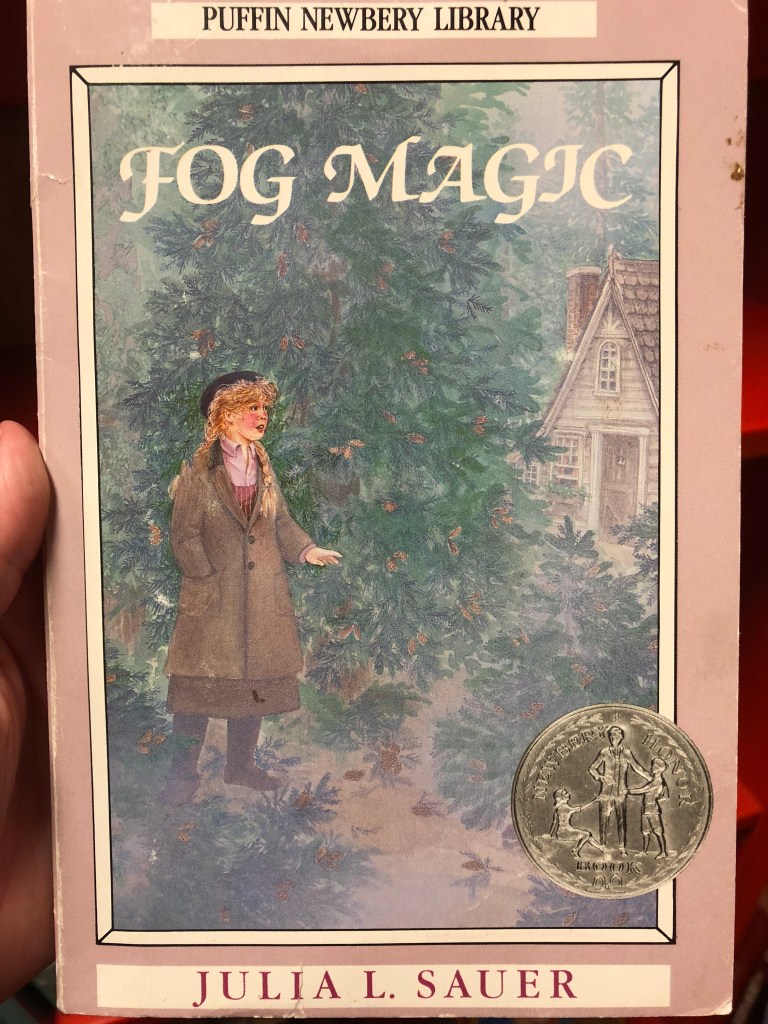


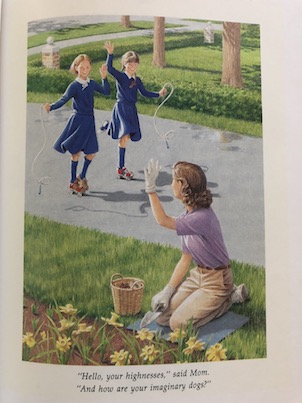
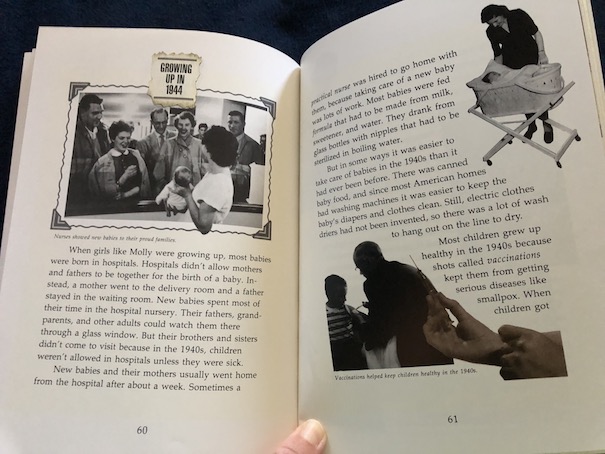
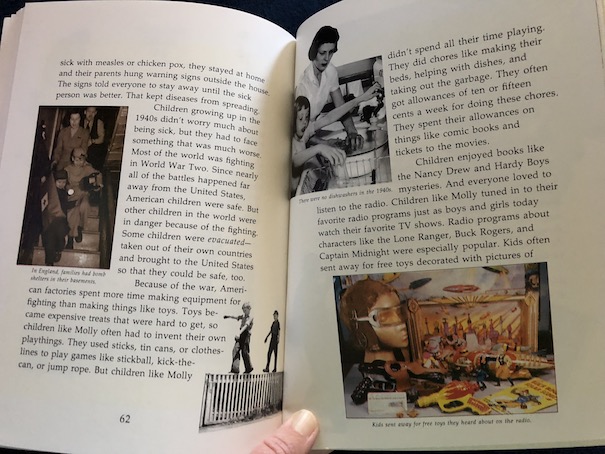


 In 1707, a man living in Massachusetts named John Noble bought some land in Connecticut which had recently been purchased from a tribe of Indians (Native Americans) living nearby. He planned to move his family there and start a new homestead, but with his children so young and the baby somewhat sickly, it was decided that he would travel to the new land ahead of his family and start building a new house there. The only family member to accompany him was his eight-year-old daughter, Sarah, who came along to cook for him. Before they leave home, Sarah’s mother tells her to “Keep up your courage,” something which Sarah repeats to herself from time to time.
 On the way to their new property, Sarah and her father have to camp out in the wilderness, although they do manage to stay one night with a family called Robinson. The Robinson boys tease Sarah, saying that where she’s going, the Indians will probably chop off her head and eat her or do other horrible things. Their sister tells Sarah not to worry because her brothers just like to tease. Sarah’s father and Mistress Robinson also reassure her that the Indians in the area are friendly and that they sold their land knowing that new people would come there.
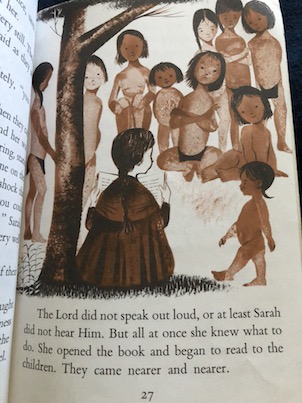 When Sarah and her father reach the land that is to be their new home, they take refuge in a hollow place in a hillside, and John begins building their new house. However, Sarah is still very nervous and lonely. Then, while Sarah sits, reading the Bible, some curious Indian children from the nearby tribe come to see her. She reads a Bible story aloud to them, and they listen, but she when she finishes the story, she can tell that they didn’t understand what she was saying. Sarah can’t understand them, either, when they try to talk to her. She gets impatient and snaps at them for not knowing English, and they run away from her. Sarah is sorry about that because she realizes that she shouldn’t have been so irritable, and even if they couldn’t talk to each other, it was still nice to have people around.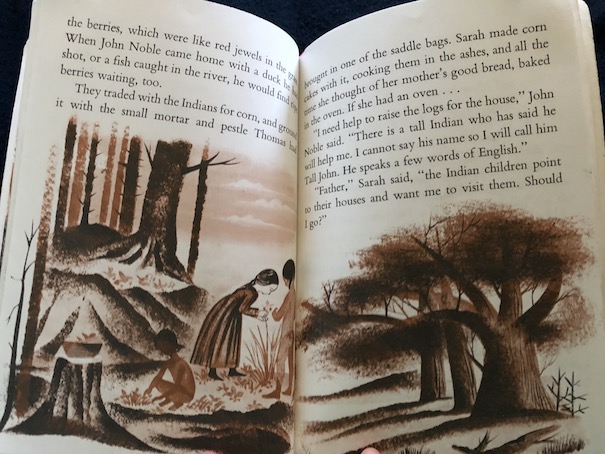

 The Dreadful Future of Blossom Culp by Richard Peck, 1983.
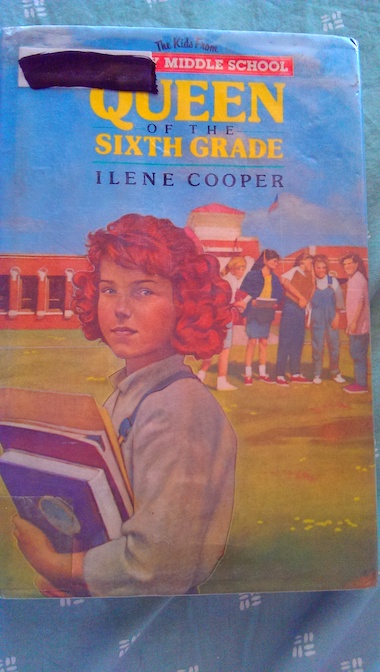 Queen of the Sixth Grade by Ilene Cooper, 1988.

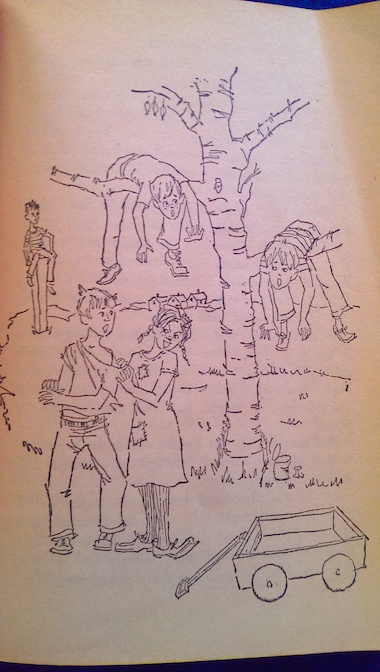
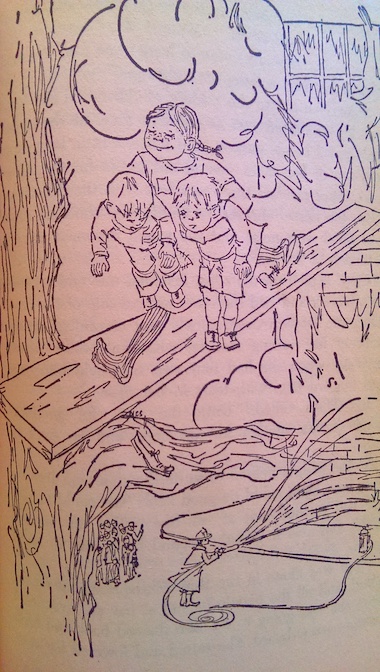
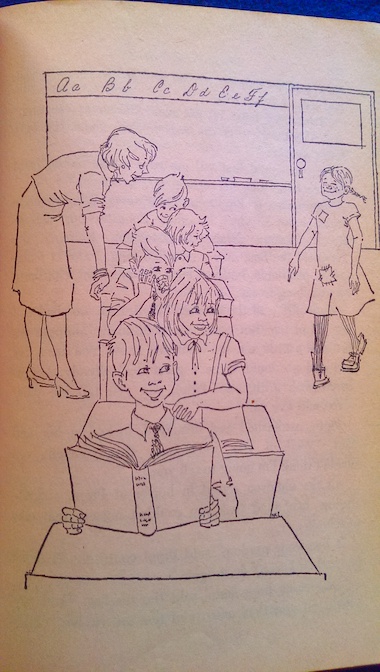
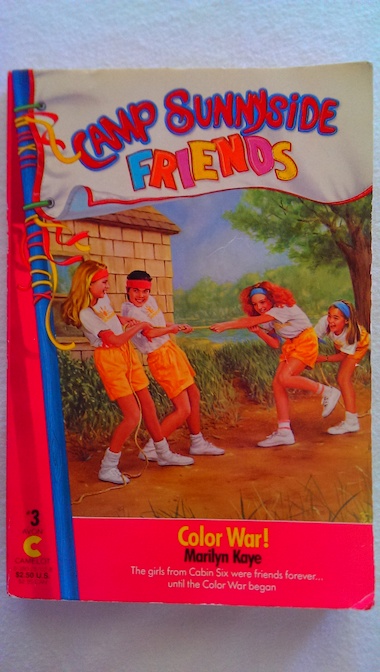 #3 Color War! by Marilyn Kaye, 1989.


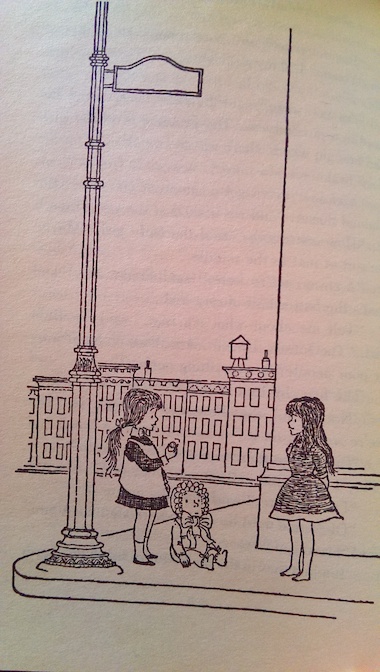


 Jestress's Forgotten Books and Stories