A Pattern of Roses

Tim Ingram has been feeling depressed since his parents decided to move from London to an old house in the country that they’re fixing up. It’s hard for him being separated from his friends and living in this overly-quiet place, where it seems like nothing ever happens, but the truth is that he was depressed even before his family moved. A large part of Tim’s problem is not knowing what he wants out of life. He works hard in school to get good grades, and his school has a reputation for getting its students into good universities, but it all seems so futile because Tim doesn’t know what he really wants to study or what he’ll do when he gets out of school. His father quit school early and went to work, working his way up the ladder in an advertising firm and becoming monetarily successful. However, Tim doesn’t feel like he has either the wit or self-confidence for starting off from practically nothing and working his way up in a direction he’s not even sure he wants to go. His father’s plans and suggestions for the future don’t excite him or make him happy. They actually make him feel more stressed and depressed when he thinks about them. His father is in a position to just give him a job with his company, so Tim does have a guaranteed job if he can’t think of anything else, but advertising doesn’t appeal to Tim. He’s not sure what does appeal to him. He fears and dreads the future, specifically his own future. He doesn’t know what to do with himself, and in this new place, it seems like there isn’t a lot he can do.

Tim has also been arguing with his parents, discovering that he has different interests and priorities in life than they do. While they’re enthusiastic about expanding onto this country house with a new and stylish modern wing, Tim prefers the older part of the house and its simpler style. He thinks the modern additions his parents made look ugly and out-of-place, ruining the natural beauty of the countryside. His parents feel like he’s unappreciative of their standards and the sort of lifestyle they’ve worked hard to build, and his mother even goes so far as to call him “perverse and awkward.” He kind of feels that way, too. Tim often feels like he’s a nobody, not very outstanding at anything. His ambitious parents are disappointed in him because they’ve invested so much in his education to show him off as another one of their achievements in life, and he doesn’t think he’s much to show off. He’s even a little disappointed with himself because, not only does he not seem to live up to his parents’ expectations, he doesn’t even have it in him to stand out as a rebel or a troublemaker, like some of his friends. He’s not an aggressive person, and it’s just not his nature to fight or get into trouble, and that makes him feel like even more of a nobody. If he neither excels at meeting people’s expectations or at deliberately flouting them, what is he? Who is he? Where does he fit in? With all of this, Tim hasn’t been feeling well, and he fakes being sicker than he is so he doesn’t have to get out of bed and deal with any of it. Since he’s been unwell, he’s also excused from school until after Christmas, leaving him with nothing to do in this countryside house but lie in bed and think about all the things that are worrying him.

Then, one day, the builder who’s been working on their house finds an old tin box hidden in the chimney of the room that Tim has chosen for his bedroom. The box catches Tim’s attention. It looks like a very old biscuit (meaning cookie, this book is British) tin decorated with a faded pattern of flowers. The builder opens the box and is disappointed to see that it just contains papers, not anything that looks really valuable. However, Tim is curious and insists that he wants to see the papers.

The papers are drawings, quite old and done in black crayon. Most of them are landscapes and buildings, but there is also a girl, who is labeled “Netty.” Netty’s name is written in a heart, so the artist must have loved her. The date on one of the drawings is February 17, 1910 (the story seems to be contemporary with the time when it was written in the early 1970s because Tim thinks that was 60 years ago), and to Tim’s surprise, the author signed with his initials: T.R.I. Tim’s full name is Timothy Reed Ingram. Tim is intrigued that the artist who lived so long ago had the same initials and apparently lived in his room.

The builder, called Jim, asks Tim if he likes to draw or knows anything about art. Tim gets good grades in art, but he’s not very self-confident about his abilities. Still, he knows enough to tell that the artist wasn’t particularly great at his art. There are places where he got the proportions of his drawings wrong, but Tim is impressed that they convey a lot of feeling. Even though the drawing of Netty isn’t perfect, Tim feels like he can tell what kind of girl she was. She looks like she’s in her early teens and has a kind of proud, somewhat naughty or daring look. Tim asks the builder if he knows anything about the artist or the people who lived in the house back in the 1910s. The builder says that was before his time, but he thinks that he remembers hearing that the family name was Inskip, and he says that he could ask his father if he knows more. Tim wonders why the drawings were hidden in the chimney and begins to imagine what the first T.R.I was like, picturing a boy close to his own age.

Tim is surprised at how real the boy he imagines seems because he’s often found it difficult to imagine old people as once having been young. He’s seen old men and known that they were part of the generation that fought in WWI but is unable to picture them as once having been soldiers. In fact, he knows that his own father flew a Spitfire during WWII, but even though he knows it happened, he has trouble picturing that of the middle-aged advertising manager his father has become. Yet, somehow, T.R.I. seems incredibly real to him, someone he can connect with, even more so than his own father. Details of this past boy’s life flash through Tim’s head without him knowing quite where they came from. However, Netty seems even more real to Tim because of her picture.

When Tim’s mother makes him get out of bed and go visit the local vicar to get a copy of the parish magazine, Tim has a strange vision of the boy artist he imagines as being named Tom Inskip passing him in the lane. It’s so real that Tim feels like Tom is actually there. As he pauses to look around the churchyard, he spots some beautiful purple roses by a gravestone. Taking a closer look, he sees that the grave has the initials T.R.I., a birth date of March 1894, and a death date of February 18, 1910. Tim is shocked to realize that the artist was not only a little less than 16 years old when he died, just a little younger than Tim is now, but that he also died the day after he drew that last picture. It seems like the boy’s death was sudden and unexpected, more like an accident than a long illness.

Tim doesn’t meet the vicar, but the vicar’s daughter, Rebecca, spots him in the churchyard and asks him if he’s all right. Tim just says that he’s there to get a parish magazine. Rebecca isn’t too cheerful or friendly, and she just gives him one and sends him on his way. Tim later learns that Rebecca is the youngest of the vicar’s children and the only one still in school. Her older siblings are all grown up and have jobs working for good causes and charity organizations.

Tim talks to Jim the builder about the grave he saw, and Jim is interested. He suggests that, since T.R.I. is buried in the churchyard, there will be church records about who he was and how he died. Tim has another vision of the boy, and the boy says, “Find out. But be careful it doesn’t happen to you.”

Tim returns to the vicarage and talks to Rebecca about T.R.I. Rebecca says that she doesn’t believe in ghosts and that she thinks the visions he’s had are just his imagination. However, Tim’s guess that the artist’s first name was Tom turns out to be correct. His full name was Thomas Robert Inskip. The records don’t say how he died, but Rebecca suggests that Tim ask an old local man called “Holy Moses.” The old man says that he remembers Tom Inskip but he doesn’t know what happened to him because he left the village to work somewhere else and didn’t come back until after Tom was dead. When Moses shows them an old photograph of all the children at the local school, Tim recognizes Tom instantly as the boy from his visions and strangely even knows the name of Tom’s friend, Arnold, standing next to him in the photograph, without being told.

From this point forward in the story, scenes with Tom alternate with scenes with Tim. Tom’s scenes start with the day the photograph was taken, when Tom was eleven years old. It was also the day that Tom first met the new vicar of the parish, Reverend Bellinger, a fire-and-brimstone kind of preacher, very different from the gentle man who was the last vicar. Like Tim, Tom was bright, imaginative, and artistic, but he was not much of a worrier. Tom fails to impress the new vicar because he is not very good with religious knowledge and often doesn’t pay attention. Tom loves to draw, but after he gets out of school and starts working, he finds that he doesn’t have time anymore. The vicar’s daughter, however, is kind and encourages him to draw because it’s a talent from God and must be used. People often underestimate her and don’t appreciate her because she has a disability, so she understands what it’s like not to have the opportunity to use and develop her talents to the fullest. It’s only sad that a tragic accident cuts Tom’s life short before they can see what he might have developed into, although when Tim and Rebecca manage to contact the people who knew and remember Tom best, one of them points out that, if Tom hadn’t died when he did, he might have been sent off to fight and die with the other young men during WWI, and with his gentle soul, he might have suffered more from the war than he did from the accident that took his life, when died young in an act of self-sacrifice.

Tim’s scenes involve his parents and school discussing his future, asking for little input from him, not caring about how he feels or what he wants. Tim actually does love art, and his art teacher thinks he should go further with it, but his teacher realistically acknowledges that, with Tim’s good grades in his other classes, his family and the school will want to push him into more lucrative and higher-status fields. But, does Tim really care about money and status as much as his parents? Is that really what he wants?

Gradually, Tim begins to consider the idea of the legacies people leave behind. Few living people remember that there was once a boy named Tom Inskip who died young, and after those people are gone, no one will remember. It occurs to Tim that few people would likely remember either him or his father as advertising workers. If all you care about is just getting money to afford the good things in life, any job could do, and there are many well-paying jobs that make little lasting or meaningful impact on the world. On the other hand, if what you want is to leave a lasting and meaningful legacy, you have to think a little deeper and maybe sacrifice some material gain. Money comes, and money goes, and one coin or bill looks like another, but what lasts as long and has as much individual character as a collection of imperfect but evocative drawings hidden away in an old tin box?
The question of what Tim wants to do with his life becomes the question of what Tim wants to leave as his life’s legacy. The quietness of the country, rather than being the torture it initially seemed, gives Tim a chance to think and really consider what he wants. Through his search for Tom’s past and consideration of Tom’s legacy, Tim finds a new vision of his own future that makes him more hopeful instead of more frightened and that may lead him to find what one of Tom’s friends called Tom’s “perfect spiritual grace.”

The book is available to borrow and read for free online through Internet Archive (multiple copies). Some US versions of the book are titled So Once Was I.

That alternate title is fitting for the theme of the story. Tom was once a living boy with choices to make in his future, much like Tim is now. That phrase also appears in the story as part of an epitaph from another tombstone, which I’ve also seen elsewhere. That same epitaph has been used in different forms in real life. It refers to the inevitability of human mortality – all those living will someday die, like every other generation before. As one of my old teachers used to say, “Nobody gets out of life alive.” But, I would also like to point out that the sentiment also refers to growing up. Every adult used to be young (although Tim has trouble picturing it), and every child will someday be an adult (if they live to grow up – Tom was unfortunate). Every person in a profession of any kind was once a student and a beginner, struggling to learn and find or make their place in the world, and every student will one day find or make some place for themselves and try to make a mark on the world. Change is inevitable. Time passes, people grow and change, and everyone moves on in one way or another. Tim won’t always be a student with his parents controlling his education. He will eventually grow up, graduate, and become an adult. That part is inevitable. What else he becomes is up to him and whatever opportunities he seeks and finds for himself. His future legacy is still in the making.

There is also a made-for-television movie version that is available to rent cheaply online through Vimeo. The movie version is notable for being Helena Bonham Carter’s first movie role. She played young Netty.

I found this story very sad, particularly Tom’s death, trying in vain to rescue beloved hunting dogs but drowning along with them in an icy lake when they all fell in. The death of the dogs was as traumatic as Tom’s, and it is described in awful detail. I also hated a part earlier in the story, where one of the dogs kills a pet cat. I love animals, and that was hard to take. It’s all a tragedy, but Tim’s story has a more hopeful ending. Besides leaving behind a box full of drawings, Tom’s effect on Tim’s life becomes a part of his legacy. Even though they lived in different periods of time, Tom and his life story helps Tim, who has been going through a personal crisis, to realize what’s really important and what he wants out of life.

Through much of the book, both Tim and Rebecca are in a similar situation when it comes to their future lives and their family’s expectations for them. As Tim gets to know Rebecca, he discovers that she has hidden depths and is inwardly quite sensitive. She often uses a blunt and abrasive manner to keep people at a distance and hide how sensitive she really is. Like Tim, she is also unimpressed by the money and business-oriented priorities of the modern world and Tim’s parents, preferring things with an old-fashioned, natural beauty – things that, sadly, are often cleared away by modern people in the name of money, business, and being modern. Yet, Rebecca also doesn’t feel like she fits with the lives that her family lives. She doesn’t have the patience to deal with the people her family tries to help, many of whom are nasty and ungrateful instead of kind and appreciative of the help they get, and she feels like her parents don’t have time for her because they spend all of their time helping everyone else. Rebecca is considering a career in social work, but it’s mostly because it’s what her parents want and expect of her. As they compare their family lives, Tim and Rebecca both realize that neither of them quite fits their families’ lifestyles and expectations. They both feel pressured. Their families are also extremes: extreme business and high-achievement vs. extreme charity. Tim and Rebecca are looking for a happy medium that neither one of them knows how to achieve. They feel overwhelmed by a world full of choices, their parents’ expectations, and their own uncertainty about what path to choose.

It occurs to them that a boy like Tom in the 1910s would have limited choices in life and expectations from his family and community. Tom died young, but if he hadn’t, he probably would have been expected to do what other young men in his community did, which was mostly farming or joining the army. In some ways, Rebecca thinks life was probably much easier for those who had no choices than it is for modern people with many more choices and little to no guidance about how to use them. Tim and Rebecca aren’t really bound to their parents expectations because there is less social stigma with being different in their time, but being young, inexperienced, and uncertain of their options in life, they aren’t sure what to do with their relative freedom. They feel trapped, but not in quite the same way as each other and in a different way from people in the past.

Perhaps all people have limits and obstacles no matter when or where they live, and nobody is ever fully in control of their destiny because they are subject to limits in knowledge, ability, and available options. Maybe not everybody is even really suited to where they end up in life. They learn that the man who was the vicar in Tom’s time was more of a bully than a loving and charitable man. Tim’s art teacher comments that he used to work in a job similar to Tim’s father before he found his calling teaching art. Having followed two different professions in his life and seen the people who thrive in each, he thinks that Tim’s personality fits better in the art world than the business world, but he can also see that Tim is going to have to learn to fight and stand up for himself to get where he really needs to be.

But, happiness in life depends on more than fighting or earning money. May, the vicar’s daughter, who is still alive and has lived a happier life than anyone expected after the death of her father, says that one of Tom’s greatest gifts was “perfect spiritual grace.” She explains that Tom never asked a lot out of life and was satisfied with what he had. His life was tragically short, but he enjoyed it to the fullest as long as he lived. Tim thinks that Tom might have gotten less satisfied with his limited prospects in life if he had lived longer, but it’s difficult to say. However, May’s description makes Tim realize that he wants that same sense of “perfect spiritual grace”, making the most of the opportunities open to him and being satisfied that he pursued those opportunities to the best of his ability.

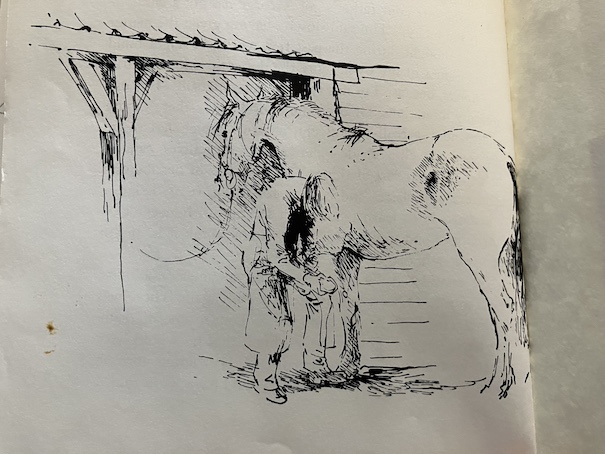
Life has a way of taking many people in directions that they never expected. People often don’t know what they want to do with their lives when they’re young, some of us still question our career choices when we’re older, and many of us end up doing things we didn’t expect or entering fields we didn’t originally study. Tim’s new home and new acquaintances and the inspiration that he receives from Tom’s life story cause him to consider different directions that his life might take. Tim finds a job in the country as the local blacksmith’s assistant. Blacksmithing appeals to Tim’s creative side, and there is enough demand for specially-crafted decorative metal objects that Tim is confident that he can build his own business around it. He’s confident enough about it that he finds the ability to stand up to his parents and insist on the future he really wants. He probably won’t make as much money at it as his father does in his advertising firm, but he’ll be independent and creating real things that will leave the lasting legacy that he now craves. He hopes that, along the way, he’ll also find the “perfect spiritual grace” that Tom had.

Tim also comes to realize that the company that his father built was his father’s act of creation, and that’s why he takes so much pride in it, wanting Tim to continue it as his legacy. However, Tim also realizes that what his father did with his life was his decision, done for his own reasons and his own sense of fulfillment, and he doesn’t need to stifle his own creative urges to validate his father. Tim is adamant that he wants to create something of his own, to know the satisfaction of that kind of creation for himself. His parents are angry with him, seeing his decision as throwing away all that they’ve given him and all they say that they’ve sacrificed for. Still, Tim points out that the lifestyle that his parents chose was their choice, not his. He didn’t ask them to do any of it, they did it because it was what they wanted to do, and he wants the right to make his own choices. It affects their relationship, but Tim already had the feeling that their relationship was strained because of his parents’ expectations for his future, which were making him unhappy. When they argue about it, it becomes apparent that his parents have been emotionally manipulative, and having a say in his own future isn’t an unreasonable thing for Tim to ask for, even though his parents claim that it is. His parents really have been selfish and even neurotic, planning to use Tim as something to show off, ultimately depending on him to make themselves feel successful and fulfilled and validating their life choices. They make it clear to him that their support for him hinges on him doing exactly what they want him to do. Their love is conditional and transactional. In an odd way, it feels like a relief to Tim to have it all out in the open and to take control of his destiny in spite of their opposition. Whether or not his parents will eventually accept Tim’s decision and independence or whether they will remain estranged is unknown.

I don’t think I’d read this book again because of the sad and stressful parts, but it does offer a lot to think about. I’d also like to point out that this story is not for young kids because of the subject matter, and there are also instances of smoking and underage drinking.
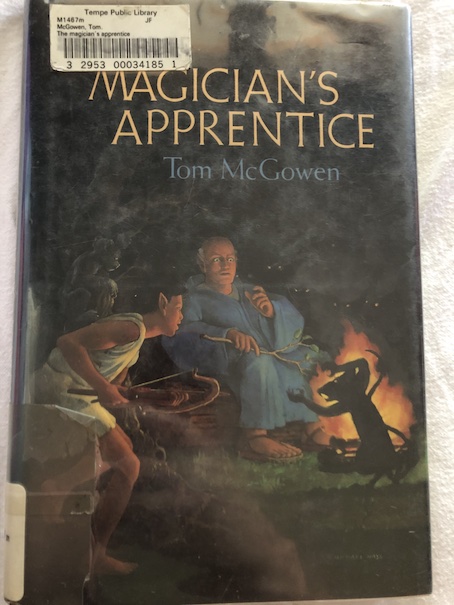
The Magicians’ Challenge

The Magicians’ Challenge by Tom McGowen, 1989.

This is the third book in The Magician’s Apprentice trilogy. It picks up soon after the second book, with the magician Armindor, his apprentice Tigg, Jilla, and Reepah the grubber on their way to the city of Ingarron, where Armindor and Tigg were originally from. They’ve already told the people of the city of Inbal of the threat posed by the reen, the ratlike creatures that are scheming to take over the world by finding old forms of lost technology and using them to dominate and destroy humanity.

Before they return to Ingarron, they want to stop in Orrello and take care of some business there, letting that city know about their discoveries about the reen and the ancient technology they’ve uncovered. On the ship to Orrello, they begin to get some insight into one of the pieces of old technology they’ve uncovered – the magnetic compass. When they first found it, they didn’t know what purpose it served. All they could tell about it was that the compass’s arrow always points in one direction, no matter how you move it. When they show it to the captain of the ship, he says that he could see a purpose in having such a thing if it pointed to a place that he knew he wanted to go, and Tigg begins to realize that the compass doesn’t point to a specific place but the general direction north. They still have a concept of north and south as directions, but they don’t think in those terms unless they’re comparing one known location to another known location, which is why they didn’t think of it before. Armindor is overjoyed at the revelation. Their people currently depend on known locations or observing the sun and stars in the sky to find their way, but with a compass (which they consider a “spell” of finding your way), people could navigate even in unfamiliar areas where the sky isn’t easily visible. This is the sort of thought and investigation that “magicians” (scientists) have had to do since the old technologies were lost and forgotten following a great nuclear war. After thousands of years, people are starting to rebuild society and redevelop technological knowledge, but because they don’t yet understand most of the principles behind it, they think of it as “magic” and “spells.”

However, as they are about to arrive in Orrello, they discover that the city has already been attacked by the reen, and many people there are dead. The captain of the ship says it’s not safe to go to the city now, so Armindor asks him to drop off his party further down the shore so they can continue to Ingarron and warn them of the danger. Now that they understand how the compass works, they can use it to find their way. (Although, readers will notice that, because language and writing have changed over the centuries, they don’t understand which of the letters on the compass actually represents “north”, and they think it’s the ‘S’ symbol, so ‘E’ represents “west” and so on. Close enough. They have the basic principle, and as long as they’re consistent, it will still work.)

On the way to Ingarron, they find a young man who escaped from the attack on Orrello. The young man, tiLammis, turns out to be the nephew of an important merchant in Ingarron, and he confirms that it was reen who attacked Orrello. The others are grateful that tiLammis witnessed the attack so he can help describe and confirm their accounts of the reen.

When they reach Ingarron, they are relieved to see that it has not yet been attacked. Tigg is promoted from Apprentice to Novice Sage and becomes a member of the Guild of Sages. They warn the other sages and the Lord Director of Ingarron about the reen, and tiLammis’s account of the attack on Orrello helps to convince them of the danger. Because they know that the reen hide among human populations and spy on them, Armindor says that they will have to make their preparations to protect Ingarron in secret. No one outside of the city leaders and sages should be told about what is happening. Rumors are already starting to spread about the destruction of Orrello, but the city leaders decide to pretend that they think some marauding barbarians are responsible. They discuss the armor and weapons they’ll need and the possibility of making a first strike on the reen by going into the sewers and tunnels beneath the city, where they know the reen are hiding, pretending to be normal rats.
Thanks to Tigg’s deprived upbringing in the streets of Ingarron, he knows someone who could be invaluable – the King of the Ratcatchers, Goorm. The Ratcatchers are a guild of intermarried families who, for generations, have made their profession catching and killing rats, thus eliminating a city pest and providing meat to poor families, who can’t afford anything else. When Tigg approaches Goorm and the other Ratcatchers to explain the problem of the reen and why the city needs their help, he discovers that they already know about it. They didn’t know exactly what the reen were or how many of them there were, but they’ve encountered them before while hunting rats, and they’ve even lost some of their members to them. They’re more than ready to help lead an expedition against them with the help of the city’s soldiers.

There is a complex system of underground roads beneath Ingarron, which the Ratcatchers explain were once above-ground roads because Ingarron was built over the ruins on a much-older city. Sometimes, Ratcatchers even find old artifacts from the Age of Magic (our time) there. The reen have poison darts that kill instantly, but the humans have improvised incendiary weapons made of flammable liquid in bottles. (Basically, they’ve figured out how to make Molotov cocktails, although they don’t call them that. They just call them “fire bottles”, which is descriptive.) The ensuing underground battle between the reens and the humans seems to end in victory for the humans with many reen dead. The humans are quick to celebrate their victory, but the story isn’t over yet. Tigg and Armindor determine that, although hundreds of reen were killed in the human attack, it’s not enough to account for the full reen population. Although the Lord Director and soldiers want to believe that the remaining reen have fled, they haven’t, and the battle has really just begun.

However, as Tigg and Jilla seek shelter from the reen’s retaliatory attack underground, they come face-to-face with the reen and realize that there is more than one faction of reen, including one that might be willing to negotiate instead of fight.

The book is available to borrow and read for free online through Internet Archive.

My Reaction

I haven’t talked about religion in this post-apocalyptic future, but they do have a different concept of religion from our time. They are polytheists in the fashion of ancient civilizations, with gods who represent different natural forces, like weather, or different professions, almost like patron saints. However, the names for their gods are completely unfamiliar, not based on any classic mythology. I haven’t explained about this before because they only make passing references to their gods and don’t go too deeply into their lore, so it’s hard to say much about them.

In the last book, they described the origins of one god, Roodemiss, who is the god of sages and “magicians”, and it seems that he might be based on some scientist or astronaut from the past because they describe him as a magician who ascended into the sky in a machine that he built in order to keep watch over the Earth from above during the nuclear holocaust that brought an end to civilization as we know it on Earth. However, they don’t explain any more about him, and he apparently never came back to Earth, which leaves a lot of unanswered questions. Was there supposed to be some kind of space station or maybe a Martian space colony where some humans went? I’m guessing a space colony would make more sense because space stations need to be resupplied from Earth, something that would be impossible for people to continue to do after the nuclear holocaust. On the other hand, because we don’t know who “Roodemiss” is, he might not necessarily be a human being, even though they describe him as being a “magician.” It occurred to me that, just as people in this time don’t really understand the difference between “science” and “magic” or “inventions” and “spells,” they might have gotten the story about “Roodemiss” wrong, and Roodemiss might actually be a satellite that would monitor conditions on Earth from above. Since they really only have legends about Roodemiss and no direct, continuing contact, it’s hard to say. Roodemiss is only represented by an eye because he is supposed to be watching over the world. If Roodemiss was a human in a space ship, space station, or space colony of some kind, we have no information about what happened to him or whatever group he may have been with in the thousands of years that have passed since his time. Sometimes, I wondered if the names of the gods are something that I should recognize, like corruptions of the names of modern people or things that I should know, but I just don’t recognize them and can’t think of what they are or would be, so that might not be the case. If anyone thinks they can recognize what “Roodemiss” or “Badoween” (the weather god) or “Durbis” or “Garmood” are supposed to reference, please comment below.

Part of the reason why I’m talking about religion now is that the Ratcatchers have made their headquarters in what is clearly an abandoned church. Tigg recognizes from the way it looks that it was once a place of worship, but he’s not quite sure what god was worshipped there. He looks at the pictures on the walls and describes seeing winged humans (angels), but he doesn’t know what to call them and doesn’t know what god they are surrounding. It gives him an odd feeling, and he worries about what happens to a god if people forget about him. We don’t know by what process this monotheistic society (we know from the previous book that Tigg’s society is located somewhere in North America) turned polytheistic or whether they will ever uncover their religious and cultural past, but there are remnants of that past still there, waiting to be uncovered, along with lost technology.

In the end, the humans and the reen do negotiate with each other. Although a large faction of the reen have wanted to destroy humans, another faction would really rather just be separate from human society. What they want is to leave human cities and build their own civilization in the uninhabited Wild Lands, where humans normally don’t go. The decision to negotiate isn’t easy for the humans because they don’t trust the reen. They consider possibly attacking the reen as they leave the city because they will be vulnerable, and if they kill them there, they could eliminate an enemy who might return to attack them again later. However, Armindor argues that a sneak attack after a peace agreement would be a dishonorable betrayal. There are also the other communities of reen in other cities to consider. If they hear stories about betrayal and massacre of their kind in Ingarron, it will only fuel their hatred of humans and lead to further war and massacre. Armindor and the other sages have the sense that, even though they don’t really understand what exactly the nuclear weapons that lead to the destruction of the past civilization were, that they were weapons of some kind that were used in a great war, and they don’t want their civilization to go the same way, just when they’re beginning to make some real progress on rebuilding it. The Lord Director is persuaded by their arguments and decides to allow Tigg to carry the message to the reen that they will be allowed to leave the city in peace and go to the Wild Lands.

It seems like a sudden end to the conflict with the reen, but only on the surface. There really are no easy answers. In the last book, the humans made the discovery of a computer with tutorials about ancient knowledge, but although the computer is telling them things they’ve always wanted to know, they first have to understand the language that the computer uses, and that’s going to take time. Even then, they’re going to have to work their way up through simple concepts to more complex ones in order to regain the level of technology that society once had. This agreement with the reen of Ingarron is also only the first step into an unknown future. The reen of Ingarron are only one faction of a much larger reen society that extends to other human cities. The reen have already destroyed and conquered Orrello, and as the book and the trilogy ends, it remains to be seen whether reen in other human cities will favor conquest and destruction or if they will join with the reen from Ingarron in building a new society of their own. They have a shared resentment of humans from generations of being treated like pests that need to be eliminated, but they’ve reached the point where they now have intelligence and abilities that are equal to those of human beings. Whatever happens to them, they now don’t have to live off of the crumbs of human society and can continue to build an independent society of their own. It’s possible that gaining recognition as an intelligent species with a society of their own that must be respected will calm some of their anger and resentment, so their future with the humans may include trading with human society as an independent, sovereign nation, but all of that is left to the imagination. It’s enough to know that all of the societies that now inhabit the Earth, both human and non-human, are beginning to change, and that’s a start.

The Magician’s Company

The Magician’s Company by Tom McGowen, 1988.

This is the second book in the Magician’s Apprentice trilogy.

The story picks up where the previous book left off. Armindor the Magician, his apprentice Tigg, and their friend Reepah, who is a creature called a grubber, are on their way home with the “magical” devices that they retrieved in the last book, taking them back to their Guild for investigation. On their way home, they pass through a land consumed by civil war, and they pass a wagon surrounded by dead bodies. They can tell that the people were civilians, probably entertainers, and further down the road the find a young girl about Tigg’s age (around 12 years old), struggling along, carrying her belongings. They ask the girl about herself, and she breaks down crying, telling them how she and her family were fleeing the war, but her aunt and the other members of their puppeteer troupe were murdered by soldiers. The girl, whose name is Jilla, survived by hiding in a secret compartment in their wagon. After her aunt and the others were killed, Jilla gathered up what she could, taking the puppets that would help her to earn her living and a few other belongings not stolen by the soldiers, determined to continue her journey to a safer place, like the city of Inbal.

Armindor and Tigg have horses, and they offer to help the girl on her way to Inbal, a city in another territory. Along the way, Tigg tells Jilla the story of their previous adventures, and Armindor invites Jilla to stay with them awhile longer and even come home to Ingarron with them because it would be very difficult for a young girl to manage on her own in a strange city. Jilla is happy to stay with them because she is thankful for their help and worried about managing on her own yet.

In Inbal, Armindor and Tigg visit the sages in the city to show them their discoveries. They speak to Tarbizon, an old friend of Armidor’s, showing him what they found and explaining the threat posed by the reens, a species of intelligent but diabolical creatures that evolved/mutated from rats, have the ability to talk, use blowguns with poisoned darts, and are plotting to take over the world. (Yes, really. Even they think it’s weird.) Before they continue their journey to Ingarron, they decide to stay in Inbal for the winter because it would be difficult to travel until spring. Someone breaks into the place where they are staying and goes through their belongings. They have no idea who did it, but apparently, whoever it was didn’t find what they were looking for because nothing seems to be missing. Since they will be staying in the city for awhile, they decide to rent a house instead of staying in the guestinghouse (inn) where they have been staying.
While they are looking for a house to rent, Tigg is kidnapped. Fortunately, Reepah is able to sniff out where he is. Armindor pretends that his “magic” is what told him where his apprentice was in order to intimidate the kidnapper. Caught and frightened of the magician’s powers, the kidnapper admits that he was paid to abduct Tigg by Pan Biblo, who is the head servant of Councilor Leayzar, who is part of the High Council of Inbar and who has convinced the other sages that the reen do not pose a serious threat in spite of Armindor’s warnings. When they rescue Tigg, Tigg says that a man had questioned him about the spells that he and Armindor retrieved from the Wild Lands and Armindor would be willing to trade them for Tigg. From this information, Armindor realizes that Leayzar wants the lost technology they’ve discovered, but he can’t figure out why. It doesn’t take long for Armindor to realize that Leayzar is working with the reen. The reen have hired humans to work for them before, and they desperately want pieces of lost technology in order to gain dominance over humans.
Armindor and the others go to the sages in the city and tell them what they’ve discovered about Leayzar, and the other sages take it seriously. Some of them wonder why Leayzar would want to ally with a group that is an enemy of his own species, but Armindor says that it’s hard to say because they don’t know what the reen told Leayzar. Maybe Leayzar doesn’t understand what the reens’ full plans are and whatever they promised him in return was just too compelling to resist. At the end of the previous book, some of the weenitok gave Armindor a sealed box that they found, left over from the end of the Age of Magic. The sages decide that it’s time to open the box and study its contents in the hope of getting some answers. If the last book didn’t fully establish that their world is our world in the far distant future, the contents of the box explicitly state it.

Inside the box, there is a recorded message from the year 2003 (the future at the time this book was written, but the past to us in early 2021, and it’s interesting what this message has to say about the world in 2003). The message is from Dr. Dennis Hammond of the National Science Foundation Project for the Preservation of Civilization. He says that there has been a war between the “Pan-Islamic Brotherhood” (the closest real-life equivalent would probably be the Muslim Brotherhood, but that’s more of a social/political movement or terrorist group (depending on who you ask) rather than an official alliance of nations) and the United States and its allies, including Canada, Europe, China, and the Soviet Union (which stopped existing just a few years after this book was published in real life and would just be called Russia in 2003). Dr. Hammond says that thermonuclear war is pending, and he and other scientists are worried because they think the resulting destruction will be the end of civilization as they know it. (He doesn’t explicitly say this is World War III, but that’s basically what it amounts to. In real life, we haven’t actually had World War III yet as of early 2021, although in 2001 and the following years, there was some speculation that the destruction of the World Trade Center and other terrorist attacks might eventually lead to World War III, so it seems that the author has caught on to a source of world tension even if he didn’t predict how it would come out.) In order to preserve existing knowledge about science and world history, they made a series of these boxes containing small computers designed to last for about 10,000 years and hid them at various locations around North America (so now we know roughly where these characters are) so that future generations that find them will have access to knowledge that may have been lost. The computers even contain language tutorials just in case language has changed too much for this speech to be understandable. It’s fortunate that the early 21th century scientists thought of that because it turns out that none of the sages understood a word of what the voice in the box said. The readers now understand the full situation, but the characters don’t.

Everyone is astonished at this talking box. They’ve never even heard of such a thing, and they think that it must be a “spell” from a past “magician”, which he created to preserve his voice. They understand that the voice is speaking an unfamiliar language, and there is a picture on the included screen showing a finger poking one of the buttons in the box, so they get the idea that the box wants them to press buttons. When Armindor presses the red button indicated, the computer in the box begins a simple language tutorial, showing them pictures of familiar things and saying their names, like “sun” and “cloud.” The sages understand that they’re being taught an ancient language, and they quickly begin taking notes. Armindor is moved to tears because this is exactly what he has been hoping to discover for years, the secrets behind all of the ancient “magic.” They can tell that the “magician” who made the box was trying to teach them, and they’re more than ready to learn!

But, there is still the matter of Leayzar and the reen to deal with. When they learn that Leayzar is looking for Armindor, Jilla suggests a cover they could use to hide their identities: becoming a troupe of puppeteers with her puppets! Becoming puppeteers also gives them the opportunity to spread word of the reen threat to the public through their puppet plays.

The book is available to borrow and read for free online through Internet Archive.

My Reaction

I said in my review of the last book that Armindor and Tigg don’t find any easy answers or any miraculous device that instantly solves all of their society’s problems and launches them back into an age of technology. The computer in the box comes the closest to that, but it’s still not an easy answer because Armindor and the other magicians and sages of his time can’t understand the language it uses or how the computer works when they first find it. They understand enough to know that it’s trying to tell them something and that its creators are trying to teach them how to understand and use it, but it’s going to take some time before they reach the point where they will understand enough of the language to figure out all of the information that the computer has to share. There will be enough work cut out for future “magicians” (really, scientists) of their time, like Tigg, to figure out how the computer works, what information it has to share, and how they can teach the rest of their people what they’ve learned. It’s a turning point in their history, but it’s not an instant solution. Plus, although the characters don’t really understand it at first, the readers are told that there are other boxes that are still waiting to be found. Do these boxes all contain the same information, or are there other pieces of knowledge in each one? There are plenty of secrets for a new generation of scientist/magicians to unravel.

The Magician’s Apprentice

The Magician’s Apprentice by Tom McGowen, 1987.

From the title of this book and others in this series, it sounds like the stories take place in a fantasy world. When you’re reading this book, it seems like fantasy at first, but it’s not. It’s actually science fiction.

Tigg is a poor orphan boy who makes his living in the city of Ingarron as a pickpocket because he has no other means for survival. One night, he notices that a sage has left the door to his house open, and although it’s a risk, he decides to enter and see if he can find anything worth stealing. The sage, a man called Armindor the Magician, catches Tigg. In fact, Armindor had deliberately left the door open for Tigg to enter. When, Armindor questions Tigg about who he is, Tigg says that he’s about 12 years old (he’s unsure of his exact age and defines it in terms of “summers”) and that he has no family that he knows of. He lives with an old drunk who makes him pay to live with him with the money he steals.

Tigg asks Armindor what he plans to do with him. He can’t really punish him for stealing from him because Tigg hadn’t had a chance to take anything of Armindor’s before he was caught. Armindor says that’s true, but he was planning on stealing something, so Armindor tells him that he will do the same to him – plan to take something he has while still leaving him with everything he has. Tigg is confused, and Armindor explains his riddle. He witnessed Tigg picking someone else’s pocket and was intrigued by the boy because he seemed to possess courage, wit, and poise. He left his door open for Tigg because he has been looking for a young person with those qualities to be his apprentice. If Tigg becomes his apprentice, he will have to put his good qualities to use for him, but yet, he would keep these qualities for himself as well.

Tigg likes the praise but has reservations about becoming a magician’s apprentice because an apprenticeship would limit the freedom he currently has. His current existence is precarious, but the long hours of work and study involved in an apprenticeship sound daunting. However, Armindor isn’t about to let Tigg get away. He takes a lock of Tigg’s hair and a pricks his thumb for a drop of his blood and applies them to a little wax doll. He tells Tigg that the doll is a simulacrum and that it now contains his soul, so whatever happens to the doll will also happen to him. If Tigg runs away from his apprenticeship, Armindor can do whatever he likes to the doll as his revenge or punishment. Tigg, believing in the power of the simulacrum and feeling trapped, sees no other way out, so he becomes Armindor’s apprentice.

Although Tigg is fearful and resentful of his captivity as Armindor’s apprentice, it soon becomes apparent that life with the magician is better than what he used to have living with the old drunk. Armindor gives him a better place to sleep and better food. There is work and study, but it’s not as difficult or unpleasant as Tigg first thought. At first, he is daunted at the idea of learning to read and do mathematics, but Armindor is a patient and encouraging teacher, and Tigg soon finds that he actually enjoys learning things he never thought he would be able to do.

Armindor’s magical work seems to mainly involve healing sick people. When people come to him with illnesses, he gives them medicines that he calls “spells.” He keeps a “spell book” with instructions for remedies that he’s copied from other sources. Armindor teaches Tigg about the plants he uses in these spells. Armindor also does some fortune-telling, and he teaches Tigg that, too.

However, Tigg is still uneasy because, although Armindor treats him well, he still has that simulacrum of him, and he can also tell that the money he takes in doesn’t seem to account for his personal wealth. Armindor sometimes goes to meetings with other sages, and Tigg is sure that they’re doing something secret.

It turns out that Armindor is planning a special mission involving Tigg, one that will take them on a journey through uninhabited lands to the city of Orrello. Tigg realizes that if he leaves the city with Armindor, he will be committed to whatever secret plans Armindor has. At first, Tigg wants to take the simulacrum and escape, but when Armindor intentionally leaves the simulacrum unguaded where Tigg can easily take it, Tigg realizes that Armindor is telling him that he’s not really a captive and that Armindor is giving him a choice, trusting him to make the right one. Tigg realizes that he likes being trusted and that he trusts Armindor, too. He decides to stay with Armindor as his apprentice and go with him on his mission.

Tigg and Armindor leave town with a merchant caravan. On the way, the caravan encounters a wounded creature called a grubber. Grubbers are described as furry creatures about the size of a cat and have claws, but they have faces like bears and walk on their hind legs and may be intelligent enough to make fire and have their own language. One of the soldiers with the caravan things that the grubber is wounded too badly to save and wants to put it out of its misery, but Tigg insists on trying to save it. Armindor treats the grubber for Tigg, and it recovers. It is intelligent, and Tigg teaches it some simple human words, so they can talk to it. He tells them that his name is Reepah because grubbers have names for themselves, too. Armindor asks him if he wants to return to his own people when he is well, but by then, the caravan has taken them further from the grubber’s home and people, and he says that he doesn’t know the way back, so he’d like to stay with Armindor and Tigg, which makes Tigg happy.

However, Tigg soon learns that their journey has only just begun. They’re not stopping in Orrello; they’re just going to get a ship there to take them across the sea. Their eventual destination is the Wild Lands, an uninhabited area said to be filled with monsters and poisonous mists. Tigg is frightened, but also feels strangely compelled to see the place and have an adventure. Armindor finally explains to Tigg the purpose of their secret mission.

Years ago, there was another magician in Ingarron called Karvn the Wise, and he possessed some rare “spells” that no one else had. Armindor now has one of these “spells”, which he calls the “Spell of Visual Enlargement.” Tigg describes it as looking like a round piece of ice, and when he looks through it, things look much larger than they really are. Tigg is amazed.

Anyone reading this now would know from its description that what Armindor has is a magnifying lens. Tigg and Armindor don’t know the words “magnifying lens”, which is why they call it a “spell”, but that’s what they have. This is the first hint that this book is actually science fiction, and the “spells” are really pieces of lost technology and knowledge that are being rediscovered. One of Arthur C. Clarke’s Three Laws of science fiction is “Any sufficiently advanced technology is indistinguishable from magic.” Armindor the Magician thinks of himself as practicing magic with “spells” because he’s doing things and using things he can’t fully explain, but he’s actually a doctor and scientist. He doesn’t fully understand why these things work like they do, but he’s investigating how different forms of science, technology, medicine, and knowledge work, and he’s passing that knowledge along to his student and assistant, Tigg. So, you might be asking at this point, who made the magnifying lens and why doesn’t Armindor understand exactly what it is?

Armindor knows enough to understand that the lens is made of glass, not ice. He knows what glass is, but he says that their people don’t have the ability to make glass that clear and pure themselves. This lens is the only one of its type they have, and it’s more than 3000 years old, from what Armindor calls the “Age of Magic.” Tigg has heard stories and legends about the Age of Magic, when people apparently had the ability to fly through the air, communicate over long distances, and even visit the moon. The events that brought an end to the “Age of Magic” were “The Fire from the Sky and the Winter of Death.”

Spoiler: I’m calling it a spoiler, but it really isn’t that much of a spoiler because, by the time you reach this part in the story, it starts becoming really obvious, even if the characters themselves don’t quite know what they’re describing. This fantasy world is our world, but far in the future. For some reason, thousands of years in the future, so much of our knowledge and technology has been lost, society has reached the point where people don’t know what magnifying lenses are. Also, there are creatures in this world, like grubbers, that don’t exist in other times. Something major must have happened, and it doesn’t take too long to realize what it was. Even when I read this as a kid in the early 1990s, I recognized what the characters are talking about. This book was written toward the end of the Cold War, in the 1980s, and the concept of nuclear winter was common knowledge at the time and something that was pretty widely talked about and feared, even among kids. We know, without the characters actually saying it, that the winter was caused by nuclear weapons rather than an asteroid striking the Earth because Armindor knows from writings that he’s studied that animals mutated after the “Fire from the Sky.” An asteroid or massive eruption can cause climate change due to debris in the air, but they wouldn’t cause mutation like the radiation from a nuclear explosion would. People also mutated, and Tigg and Armindor and other people now have pointed ears. People have been like that for so long, they think of it as normal, and it’s only when Armindor explains to Tigg about the concept of “mutation” that Tigg wonders what people in the past looked like.

Armindor explains that Karvn had a nephew who was a mercenary soldier. One day, this nephew came home, seriously wounded. He died of his wounds, but before he died, the nephew gave Karvn this lens, explaining that it came from a place in the Wild Lands. He said that there were many other types of “spells” and magical devices there left over from the Age of Magic. The nephew and his friends had hoped to make their fortune selling the secret of this place, but there was a battle, in which the nephew was seriously wounded and his friends were killed. He told Karvn where to find this place in the Wild Lands, but Karvn was too old to make the journey himself. He wrote an account of his nephew’s story, and after his death, all of his belongings and writings became property of the Guild of Magicians, to which Armindor also belongs. Armindor has studied Karvn’s writings, and he thinks he knows where to find this place with magic and spells, and he is going there to claim whatever he can find on behalf of the Guild.

There is danger on this journey. These lands, which Armindor says were once one country long ago, are now smaller countries that war with each other. (This is probably the United States and the different lands were once individual states. When they travel across water, I think they’re crossing one of the Great Lakes, although I’m not completely sure. The author lived in Chicago, so I think that might be the jumping off point for the crossing.) There are bandits and mercenaries and the strange creatures that inhabit this land, and it’s difficult to say whether there is more danger from the creatures or the humans.

This book is available to borrow and read for free online through Internet Archive.

My Reaction

I remembered this series from when I was a kid. It made a big impression on me because of the way that technology was treated as magic. The types of futures depicted in science fiction books, movies, and tv series can vary between extremely advanced technology and civilization, like in Star Trek, and this kind of regression to the past, where even simple forms of technology that we almost take for granted today seem wondrous and are the stuff of legends. Nobody knows what the future actually holds, but I thought this series did a nice job of showing how people who had forgotten much of the everyday knowledge of our time might think and feel when encountering it for the first time, knowing that people who lived in the past were once able to make these amazing things themselves and use them every day.

Because of the mutations that have taken place in animals, probably due to radiation from nuclear fallout, some types of animals have become intelligent. The grubbers, who call themselves weenitok, are peaceful, but the reen (which Armindor realizes are a mutated variety of rat) actually want to gain access to old technology so they can conquer the humans and take over the world for themselves. These are Armindor and Tigg’s worst enemies, along with the human they’ve hired to do their dirty work. (Yes, the mutated rats are paying a human mercenary. Even the characters in the book realize that’s weird.)

When Tigg and Armindor finally reach the special place with the magical devices, it turns out to be an old military base. Much of what they find there has been destroyed by time. Armindor tells Tigg to look for things that are made out of glass, metal that hasn’t corroded, or “that smooth, shiny material that the ancients seemed so fond of” (plastic) because these are the things that are most likely to still be usable. Tigg makes a lucky find, discovering a “Spell of Far-seeing.” It’s a tube that can extend out far or collapse to be a smaller size, and it has glass pieces similar to the magnifying lens, and when you look into it, it makes things that are far away look much closer. (Three guesses what it is.) Tigg also discovers a strange, round object with a kind of pointer thing in the middle that moves and jiggles every time the object is moved but which always points in the same direction when it settles, no matter which way the object is turned. Most of what they find isn’t usable or understandable, but they do find four other objects, including a “spell for cutting” that Armindor thinks that they might actually be able to duplicate with technology and materials that their people have. Each object that they find is described in vague terms based on its shape and materials because Armindor and Tigg don’t know what to call these things. Modern people can picture what they’ve found from the descriptions, and it isn’t difficult to figure out what they’re supposed to be. Sometimes, Armindor and Tigg can figure out what an object is supposed to do just by experimenting with it, but others remain a mystery. Armindor explains to Tigg that is what magicians do, investigate and solve these types of mysteries, “to take an unknown thing and study it, and try it out in different ways, and try to think how it might be like something you are familiar with.” (They’re using a form of reverse engineering.) Tigg decides that he really does want to be a magician and make this his life’s work. He’s going to become a scientist.

I liked it that none of the objects they find are any kind of advanced super weapon or a miraculous device that instantly solves all of their society’s problems and launches them back into an age of technology (although there is an odd sealed box that proves to be important in the next book). There are no easy answers here. In the grand scheme of things, they risked their lives for things that nobody in modern times would risk their lives to retrieve, but they have to do it because, although these things are common in our time, they are unknown in theirs. If they can figure out not only how the objects work and what they were supposed to do but why they work the way they do, they can gradually rebuild the knowledge of the past. The objects that they find are generally useful. Some are labor-saving devices, some are examples of scientific principles they would use to create other things (demonstrating concepts like optics and magnetism) and one is a medical device, which if they can figure out how to use it, will help advance their medical knowledge and treatments.

One of the fun things this book inspired me to do was to look at the world around me while imagining that I had never seen some of the basic objects in the world before. This could be a fun activity to do with kids, something like the archaeology activity that some teachers of mine did with us years ago, where we had to intentionally create objects from some kind of “lost” civilization for our classmates to analyze, to try to figure out what they were supposed to do and how that civilization would have used them. But, you don’t even have to create anything if you use your imagination and try to think what a traveler from another time or another world might think if they saw some of the things in your own home right now. Imagine what someone from a world without electricity would think of something even as basic as a toaster. How would you explain such a thing to someone who had never seen anything like it?

In the Circle of Time

In the Circle of Time by Margaret J. Anderson, 1979.

This is the second book in the In the Keep of Time Trilogy. There are a couple of characters from the first book that appear in this one, but most are new.

Robert lives on his family’s farm outside of a small town in Scotland.  He loves to draw, but his father doesn’t think much of Robert’s art.  He wants Robert to take over the family farm when he’s grown, especially since Robert’s older brother, Duncan, disappeared two years earlier.  Everyone assumes that Duncan just got tired of the farm and ran off to the city to find work, but Robert has trouble believing that.  Duncan always loved Robert and looked after him, and Robert can’t believe that Duncan would just run off without even telling him.

One day, Robert goes to the ancient circle of stones that stands near his town, known as the Stones of Arden, to draw before school.  There, he happens to meet Jennifer, an American girl who has recently moved to the area because her father is working in the nearby city.  Jennifer has an interest in archeology, and she points out to Robert that there are depressions where there used to be stones in the middle of the circle that aren’t standing anymore.  She persuades Robert to help her do a little digging to see if they can find them.  As they dig, a strange fog comes in, and Jennifer sees a vision of dark-haired people also digging.  However, no one is really there because the ground where they were digging is undisturbed.  Robert doesn’t see the people, but he believes Jennifer when she tells him what she saw.  There are a lot of strange stories about the stones, and Robert has heard many of them from his grandfather.

Jennifer, although spooked by what she saw, refuses to believe any superstitious stories.  She persuades Robert to come back to the stones with her so that she can take another look at them.  However, when they do, the strange fog comes, and the kids suddenly find themselves many years in the future.

The kids learn where (or when) they are when they meet a boy named Karten, who was digging in the spot where Jennifer had seen him digging in her earlier vision.  He tells them that the year is 2179 (two hundred years after the book was written).  The kids can suddenly hear the sound of the ocean from the stones when they couldn’t before, and when they ask about it, Karten tells them that the polar ice caps melted in the 21st century, raising the level of the ocean and bringing the water much closer to the stones.

The future is a harsh place, and Karten fears the people he calls “the Barbaric Ones.”  The Barbaric Ones are people from “across the sea” who, as Karten and his people explain, “have retained the ways of people who lived long ago. They are interested in wealth and machines and factories.” The problem is that resources are in short supply, so the Barbaric Ones kidnap people to use as slaves, gathering as much of the scarce resources as they can to sustain their standard of living.  Karten and his people don’t want to fight the Barbaric Ones if they can avoid it because they have lost people who tried to fight them and because they believe in the values of love and trust above all.

Jennifer is quick to insist that she and Robert return to the stones where they entered this strange and disturbing future, but Robert persuades her to stay awhile and meet more of Karten’s people. Karten particularly tells them about an older woman who told him before about other people from the past who came to their time (the kids from the first book in the series), and Robert is hopeful that this woman will not only be able to tell them how to get home but maybe also what happened to his brother, Duncan. Robert has started to suspect that when Duncan suddenly disappeared, he may have come to the this time period the same way he and Jennifer did and may still be there.

The book is available to borrow and read for free online through Internet Archive.

My Reaction:

I don’t generally go in for dystopian novels because I find them depressing. The real world has enough problems without trying to imagine new and worse ones. However, I do find it interesting that this book, which was written a few years before I was born, has a vision of the future that specifically addresses things that are of major concern to people in the early 21st century. It imagines that the polar ice caps have melted and the sea level has risen. Many of the old coastal cities are gone, and there are new cities and communities in areas where there weren’t before.

Because of what’s happened, the world’s population has separated into two parts that have different ways of coping with the situation. The “Barbaric Ones” are much more technology-oriented, but what makes them barbaric is the way they exploit other people to serve their purposes and support the lifestyle that they want to maintain, which is much harder to maintain in this new future. Karten’s people, on the other hand, have developed a more old-fashioned, communal style of living. In fact, it’s unusually communal, to the point where young children are raised collectively by the adults of the community, nobody really knowing or caring about who their birth parents are. When children are nine years old, they select families they want to join, usually because of similar interests they have, and are raised as children of that family. Karten also likes art, and so he joined a family of artists.

These two types of societies are extreme in their views and lifestyles, polar opposites of each other, and neither is really the sort of society that Jennifer or Robert want to be part of. Jennifer is unnerved that people in Karten’s society don’t really know or care who their parents are and just kind of pick families for themselves without attachment to their birth parents. It just seems unnatural to her. Karten explains that their view is that children belong to the community as a whole. If everyone is part of the same big community, what does it matter who they live with? Their concept of marriage or partnership is never fully explained, but there don’t seem to be any rules or even social conventions about who can live with whom. One girl, called Lara Avara, tells Jennifer that her chosen parental figures/mentors are a pair of women, which surprises Jennifer, who thinks of family in terms of mothers and fathers, one of each per family. However, the future people have a different concept of family that seems to be centered more around sharing personal interests, with no particular conventions around how the family should be shaped. The chosen parental figures/mentors raise the younger members who chose to join their family, teaching them skills and professions they have mastered, according to their interests. It is not explained in the story if these older women are or were married or lovers, and it doesn’t seem to be important to any of the characters in the story, either. Lara Avara just tells Jennifer, “There cannot be rules deciding whom you love and from whom you learn.” I see one disadvantage to not knowing who one’s parents and full-blooded siblings are because there would be no way to ensure against incest, which is worrisome because that tends to bring out certain genetic health problems and weakens the genetic pool of the community, especially if it goes on for generations (unless this society has thought of that and just doesn’t mention their solution during the course of the story – maybe the elders of the community who remember who has the same birth parents and who doesn’t will intervene if siblings try to match up with each other). In some ways, Robert is attracted to this style of life because it would make things easier for him. In his own time, his family undervalues his artistic gifts and his unpleasant, temperamental father forces him to do hard physical labor on the family farm. There are times when Robert would love to exchange his problematic family for one that would help him hone his craft and appreciate his personal talents.

For awhile, Jennifer worries that Robert likes these future people so much that he wants to stay there, and she’ll be stuck in the future with him. Unlike Robert, Jennifer is close to her family and happy in their time, and she wants to go home. The two of them are accidentally separated from each other when a character from the previous book in the series (Ollie) brings Robert back to their own time without Jennifer, through the tower that the previous set of characters had used for their time travels. As Robert figures out how to rescue Jennifer from the future, he discovers the truth about Duncan, who has not traveled through time at all (although it looked like that was the way the story was going to go) but really did run away from home, as people thought he did. Like Robert, Duncan was also unhappy about their home life. Although Duncan is better suited to the farm work than Robert, he also found life there stifling, constantly having to work for their father and deal with his angry moods. Their father’s attitude problems are what makes the farm life difficult for both boys, and Duncan also seems to have been feeling overworked and unappreciated. Although life as a teenage runaway has been difficult for Duncan, he has at least managed to find work (paid, unlike the farm work he was doing for his father, and payment is a monetary form of appreciation as well as providing the worker with a living) and the freedom to begin building a life of his own.

Rescuing Jennifer means returning to the stone circle where their time travels began. After Jennifer returns home to their time, she and Robert talk about their experiences. They feel badly that they were not able to help the future people more with their problems and dangers, but Robert says that maybe what’s important is what they’ve learned from the experience themselves and how it’s changed them. Their problems (just like Robert’s brother, Duncan) have always been in their own time, and they have to live their lives in the present. What they do in the present may also change the future and help make it a better place. By the end of the book, Duncan returns to his family’s farm to tell his parents that he’s all right. Duncan will not work on the farm again, as he once did, but he decides to take a new job nearby and help out on the weekends, which will make things easier for Robert. Their family has some healing to do. A talk with Robert’s grandfather also reveals that other members of Robert’s family have traveled through time in the stone circle, and although Robert’s grandfather did his time traveling many years earlier, the vision he got of the future was actually after Robert and Jennifer’s adventures. They can tell that it was further along in time by the people and things he saw, and it reassures them that their future friends will be all right in spite of everything.

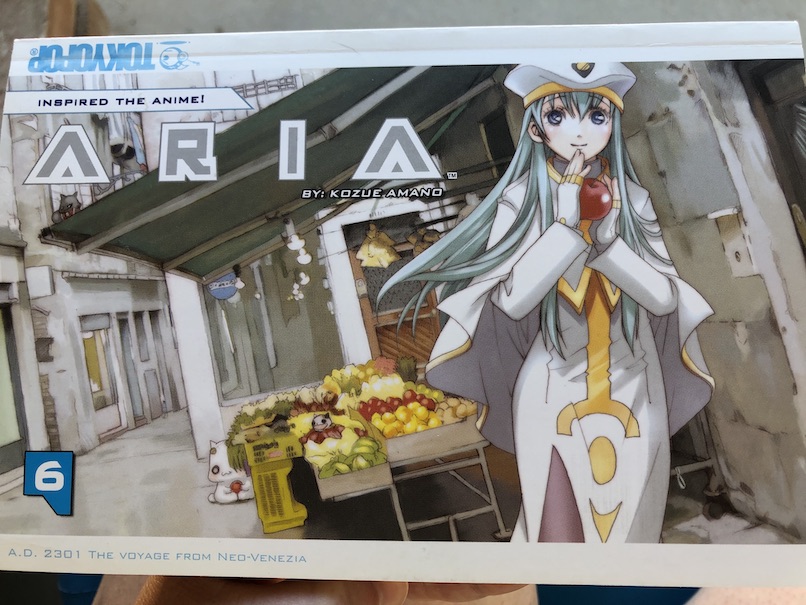
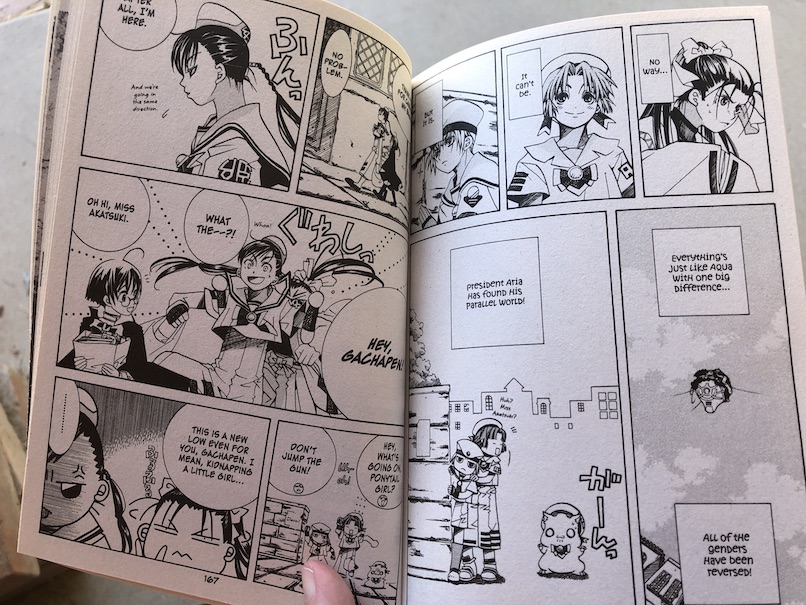
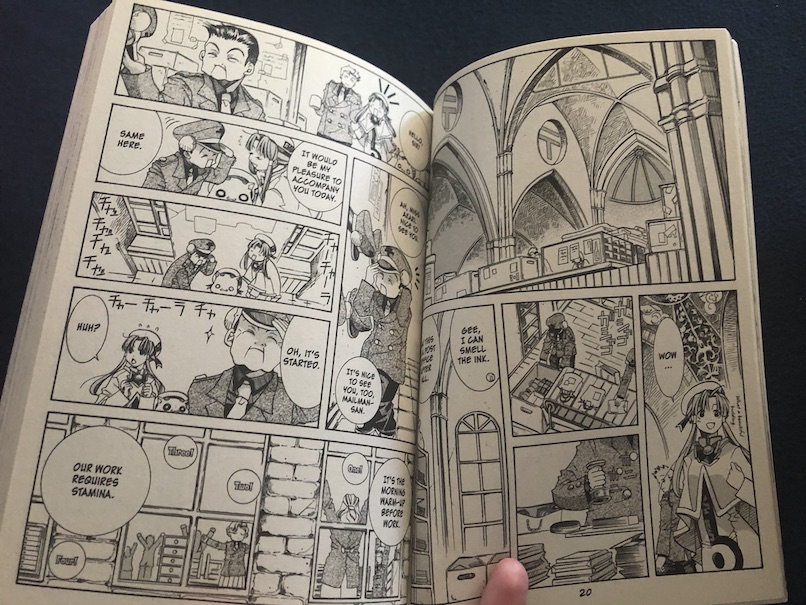
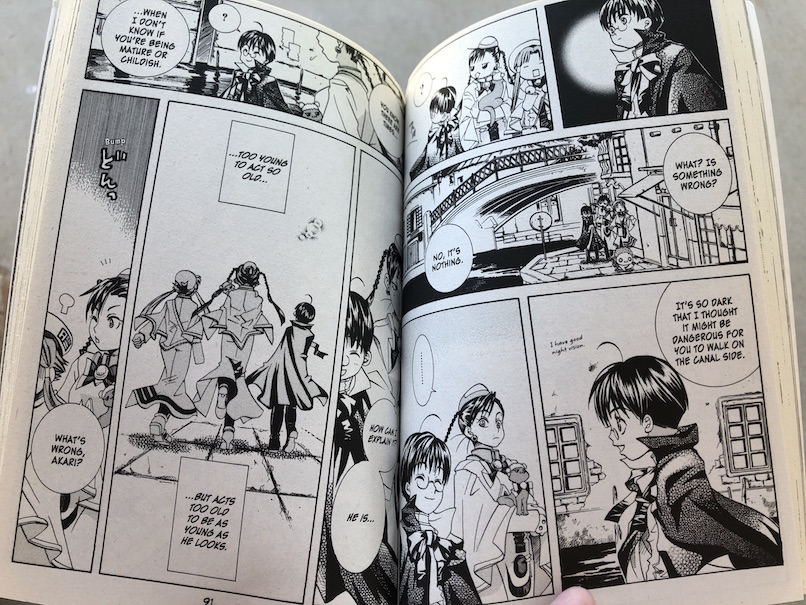
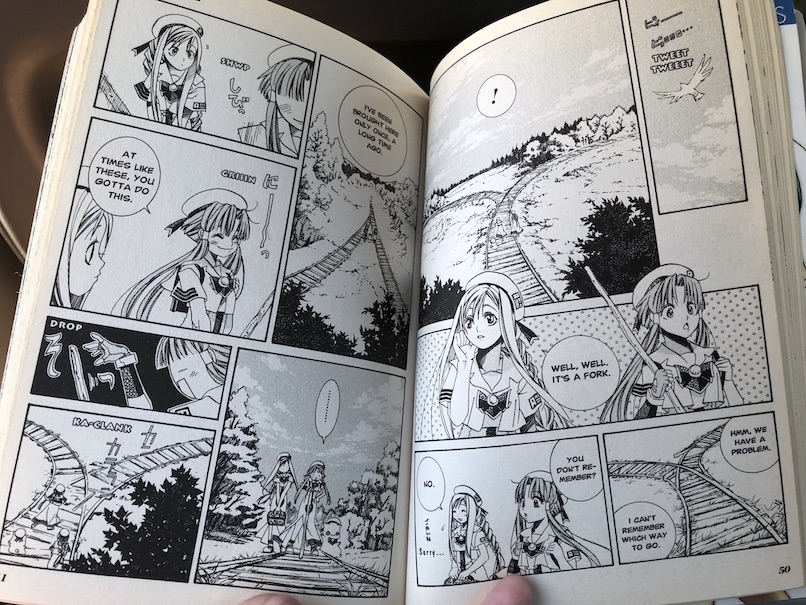
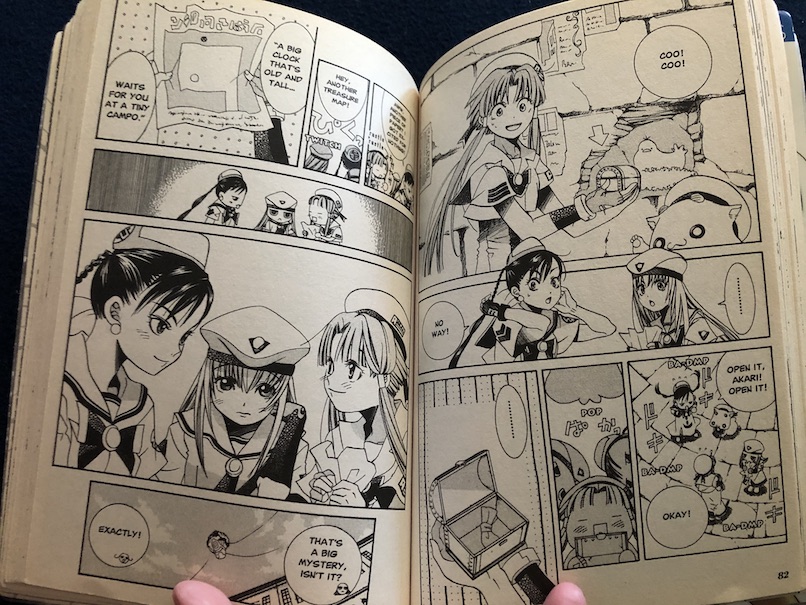
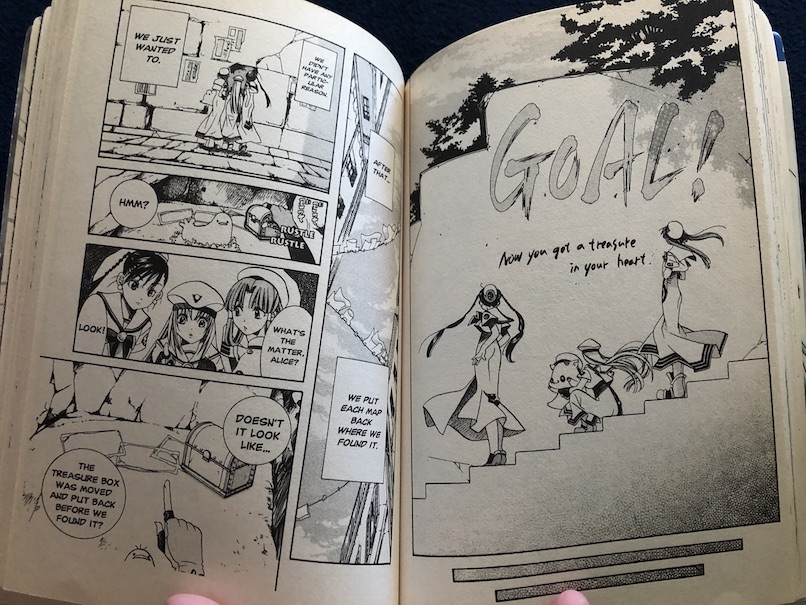
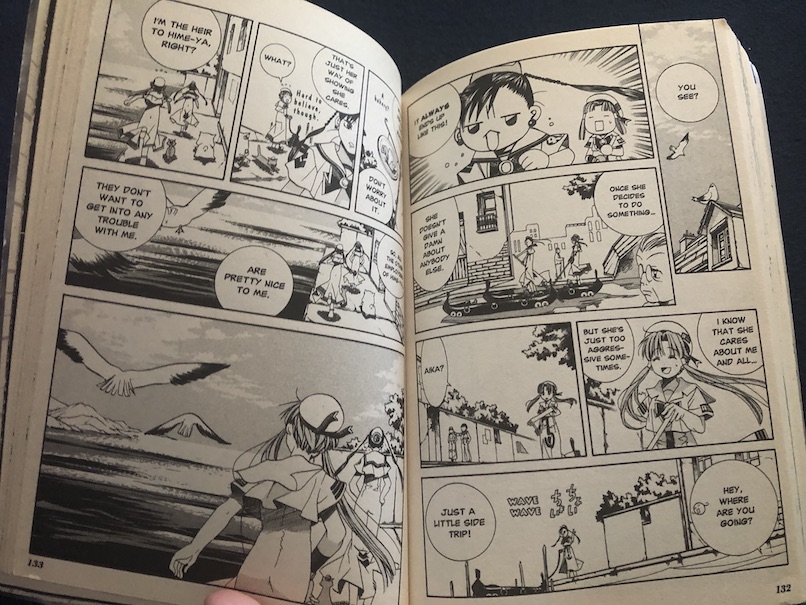
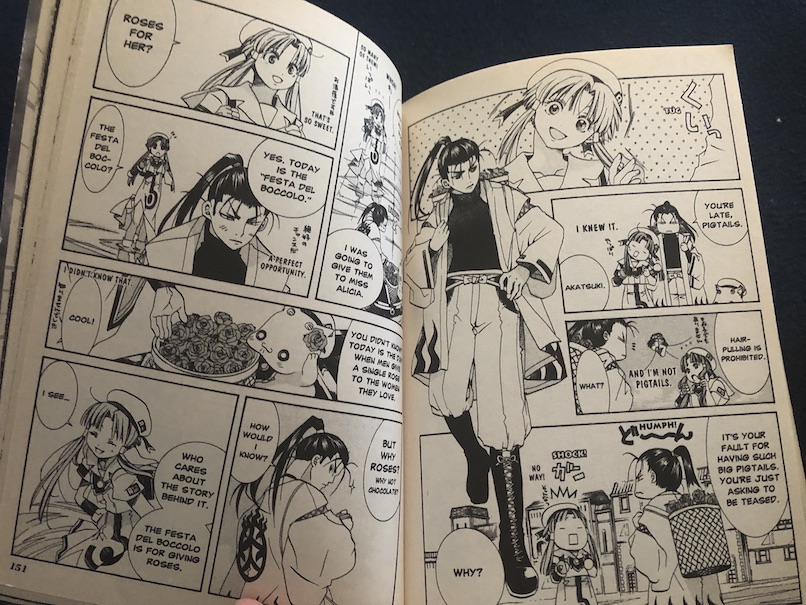
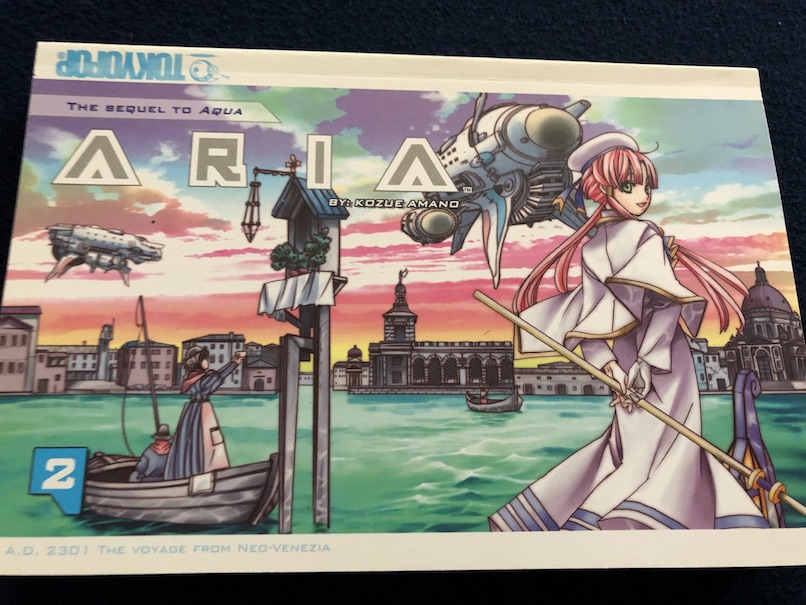
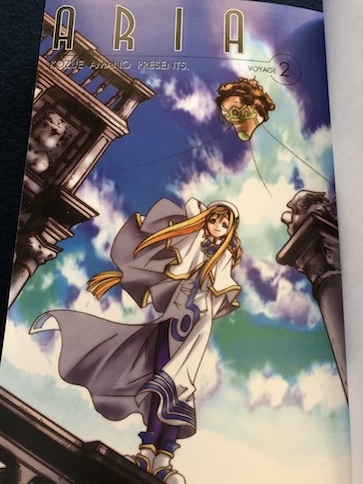
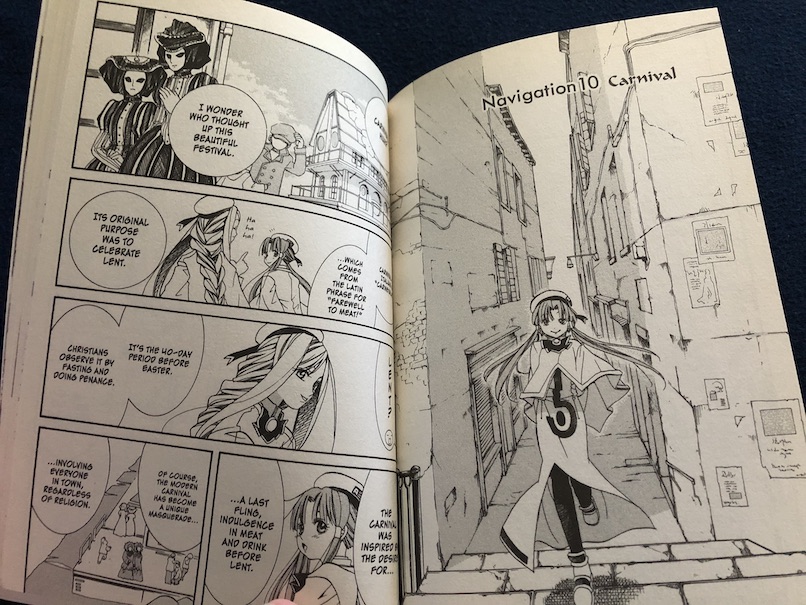
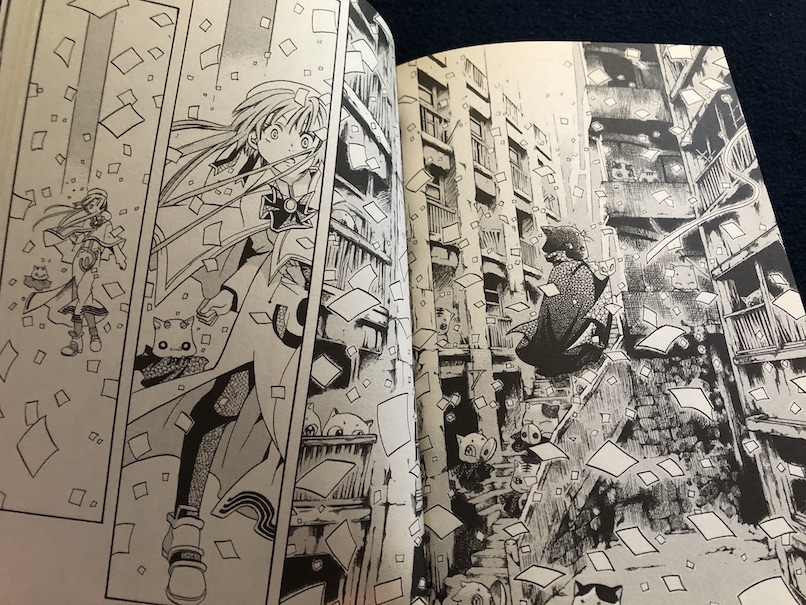
Aria Volume 6

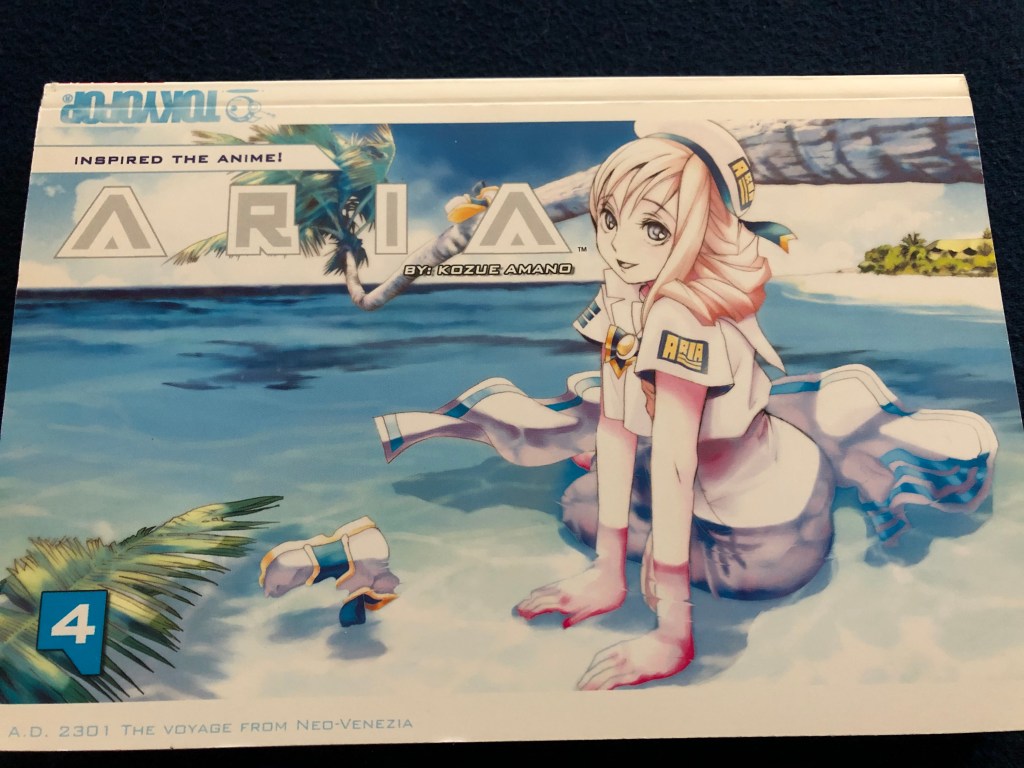
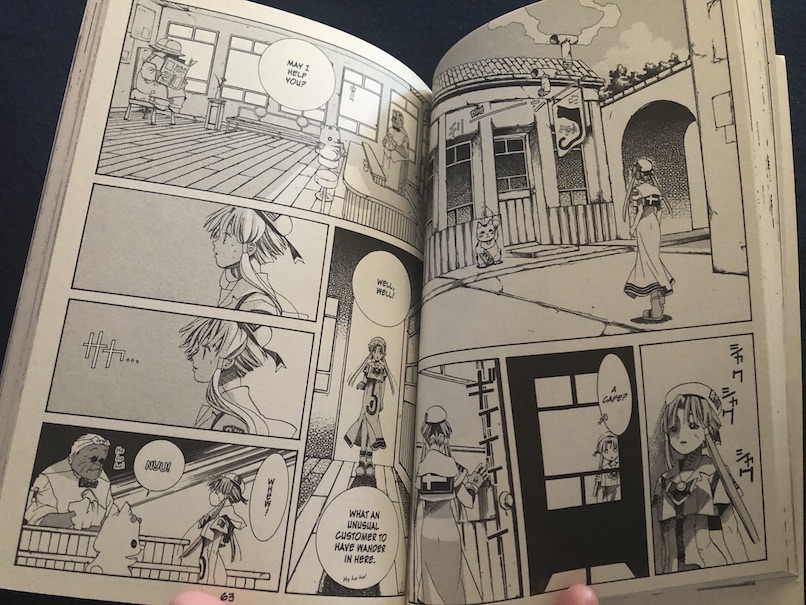
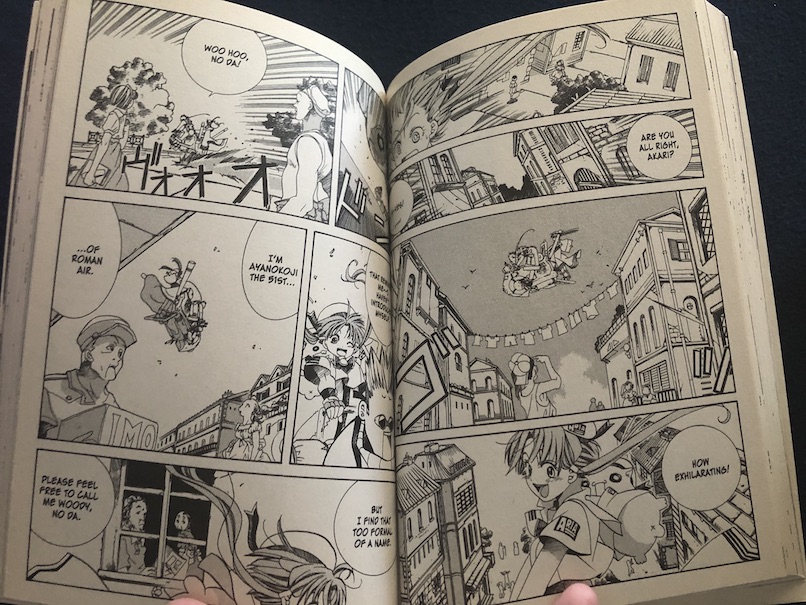
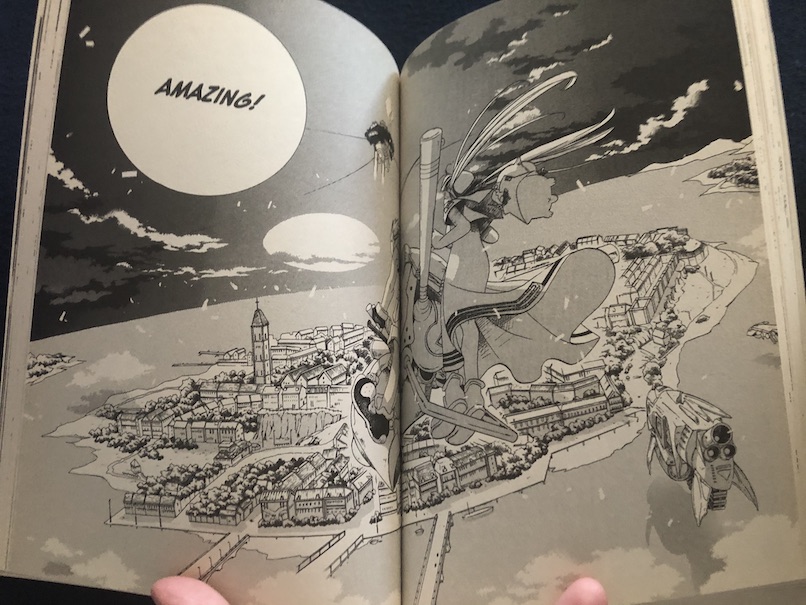
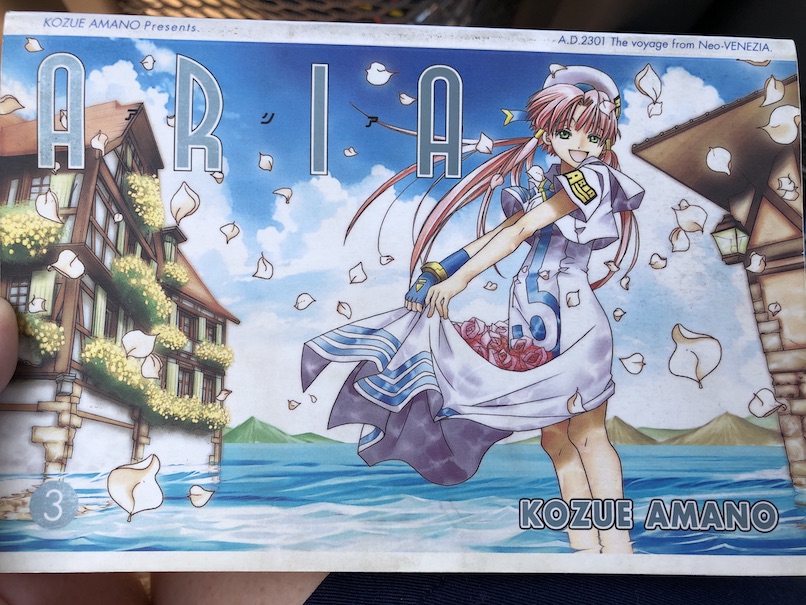
Aria Volume 6 by Kozue Amano, 2005, English Translation 2011.

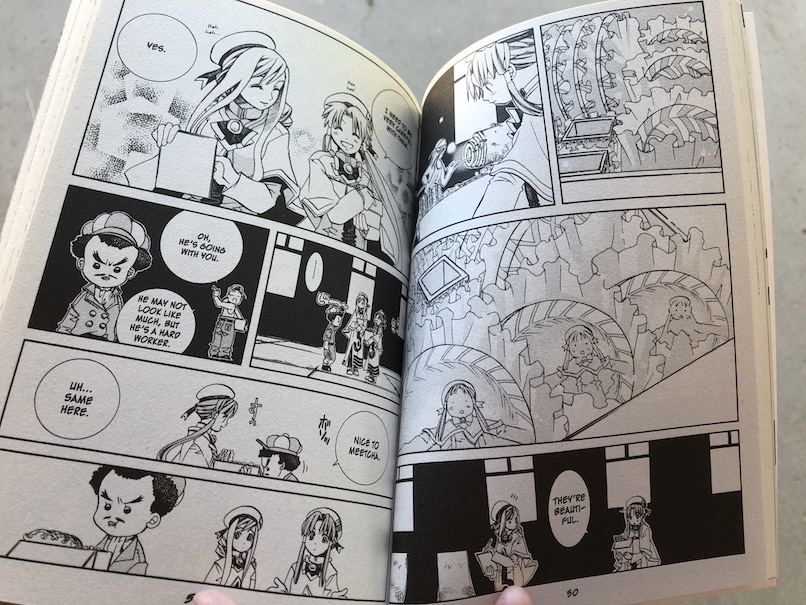
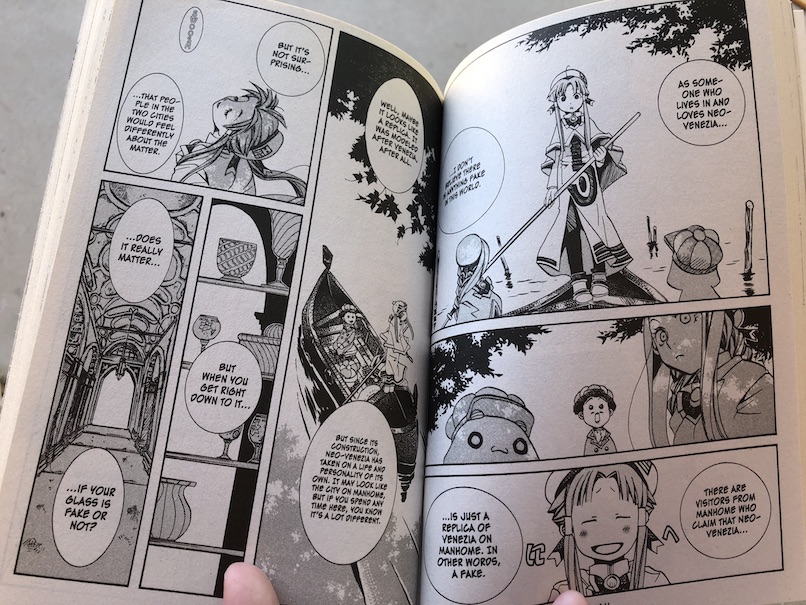
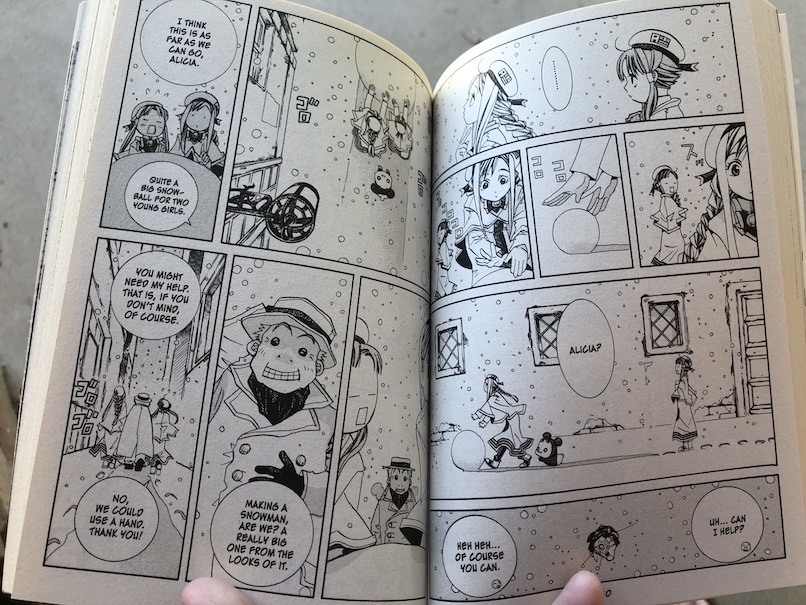
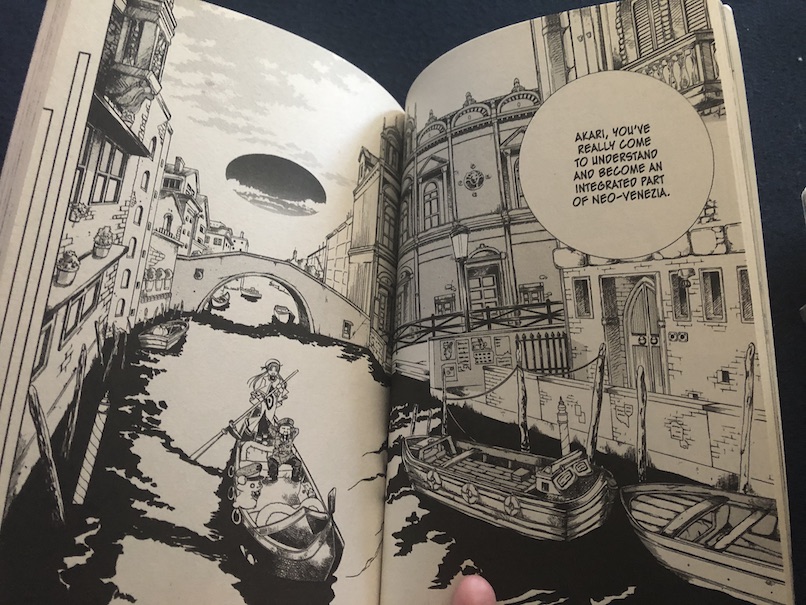
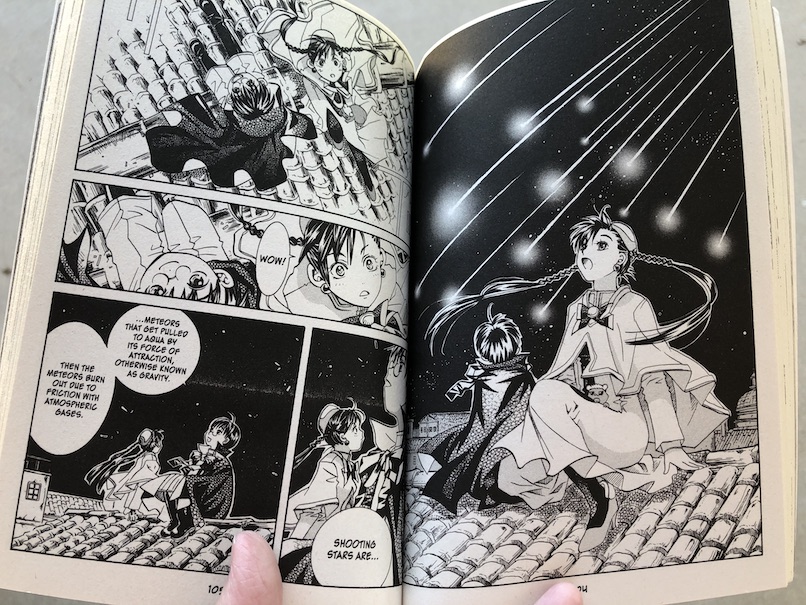
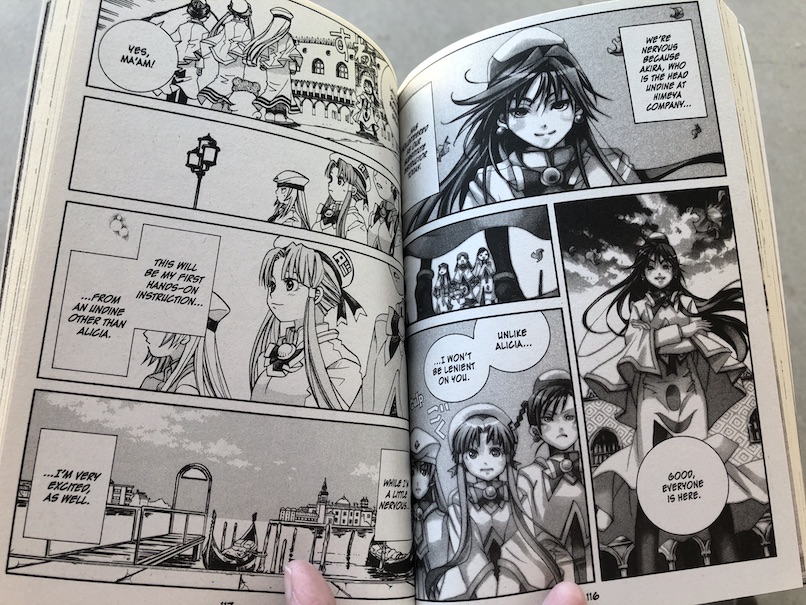
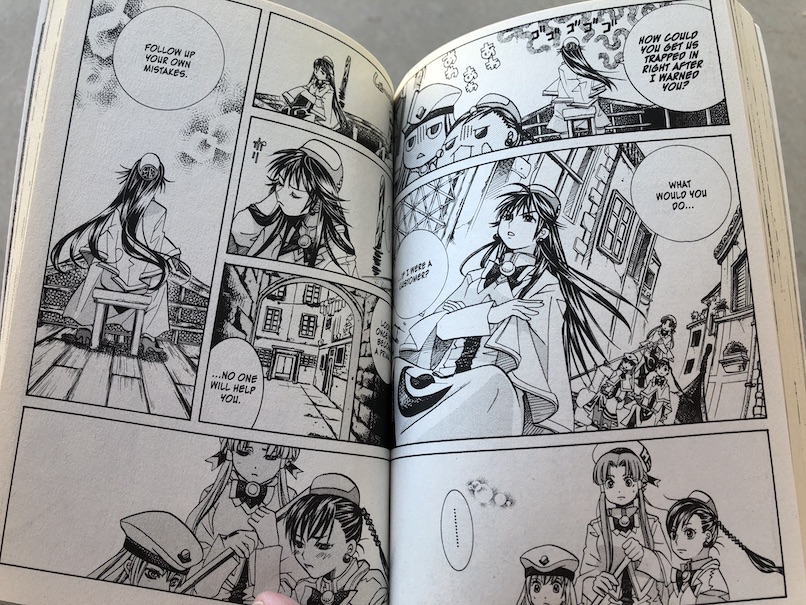
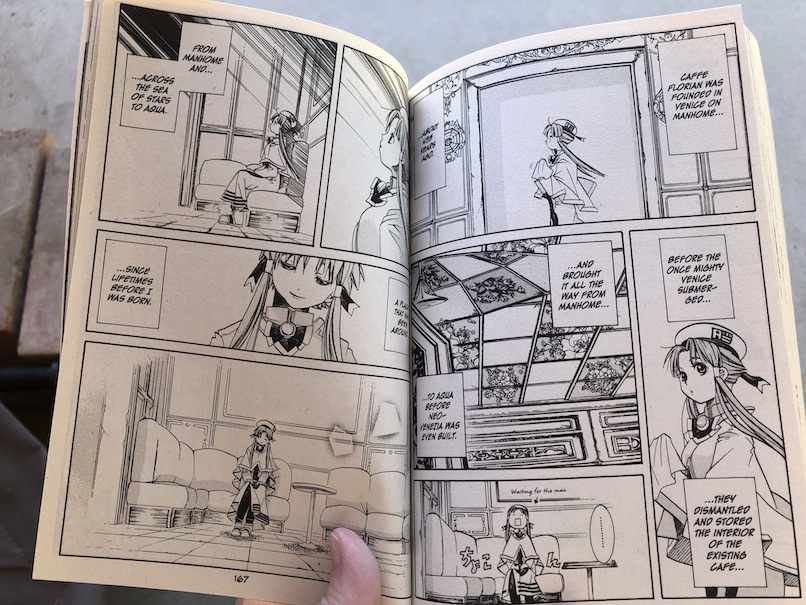
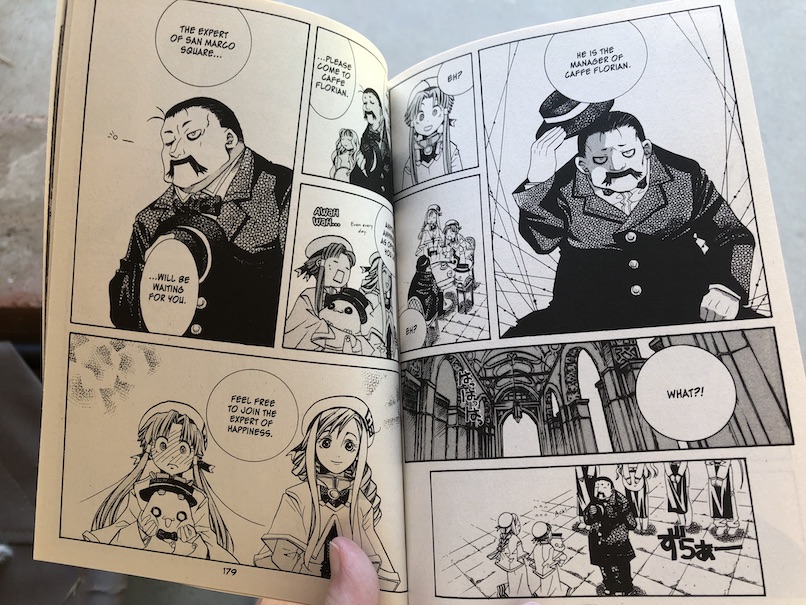
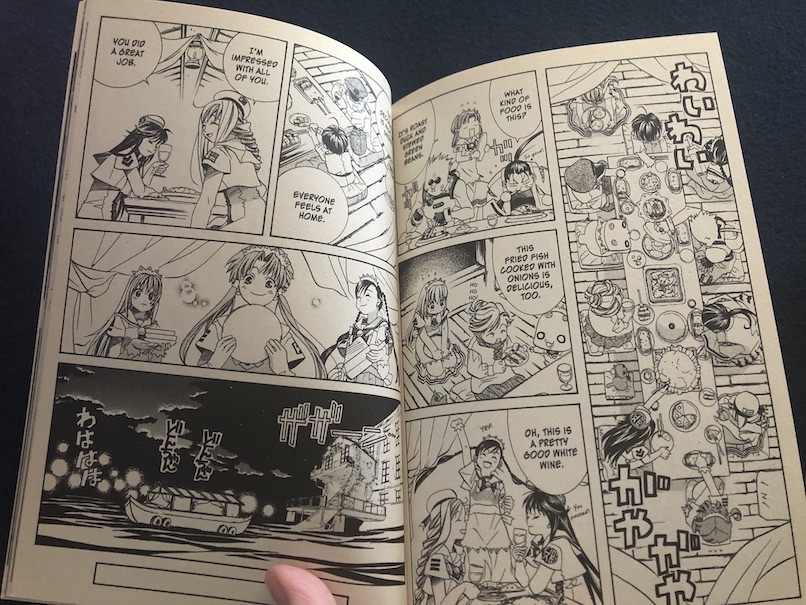
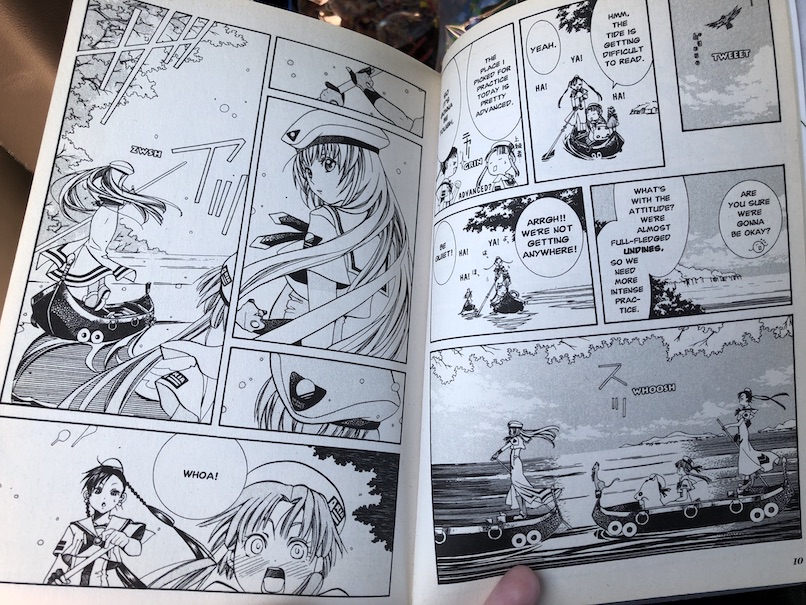
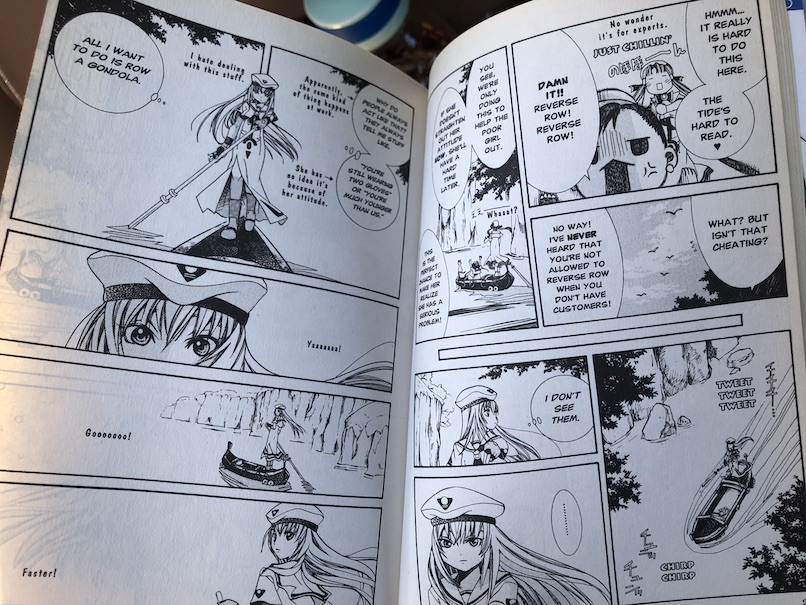
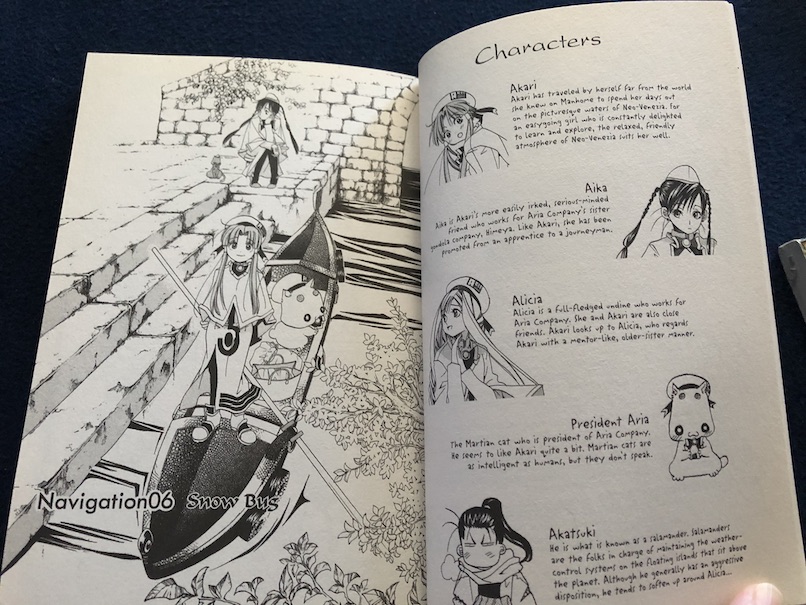
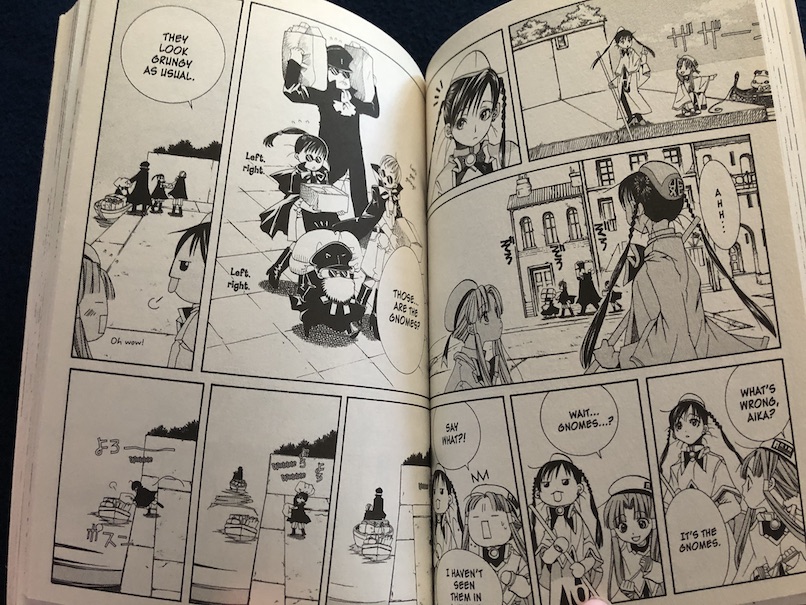
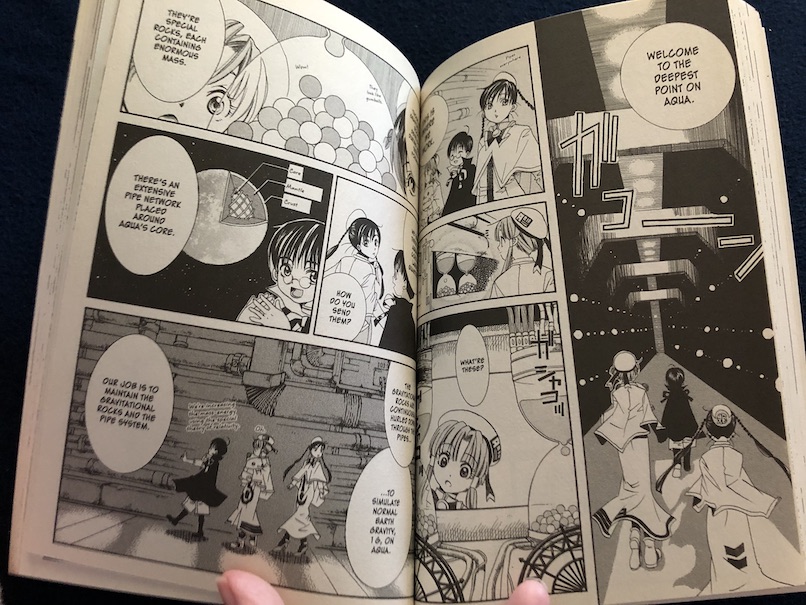
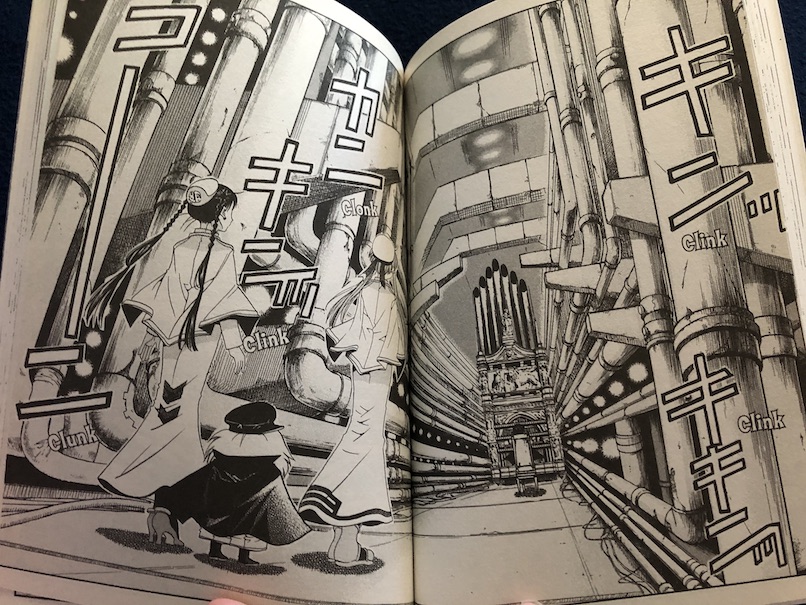
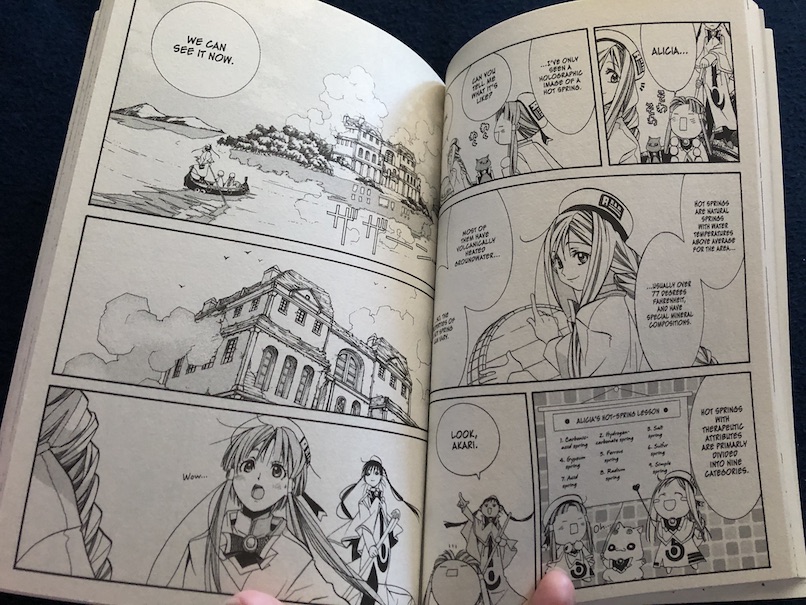
This is the sixth volume of the second part of a fascinating manga series that combines sci-fi, fantasy, and slice of life. The series takes place about 300 years in the future, when Mars has been terraformed and renamed Aqua (because of all the water on its surface). The human colonies on Aqua are designed to resemble old-fashioned cities on Earth (called Manhome here). The people of Aqua prefer a much slower pace of life than people on Manhome, and aspects of life on Aqua more closely resemble Earth’s past.

The series is divided into two parts. The first two books are the Aqua volumes and introduce Akari Mizunashi, the main character, a young girl who came to Aqua to learn to become a gondolier in the city of Neo Venezia (which resembles Venice). Female gondoliers, called Undines, give tours of the city, giving Akari plenty of time to admire the beauty of her new home and meet interesting people. The two Aqua books are the prequel to the main series, Aria. Aqua covers Akari’s arrival on the planet, her introduction to life on Aqua, and the beginning of her training. The main Aria series show Akari’s continuing training, her progression to becoming a full Undine, her evolving relationships with her friends, and as always, her delight in learning more about her new home and admiring its beauty.

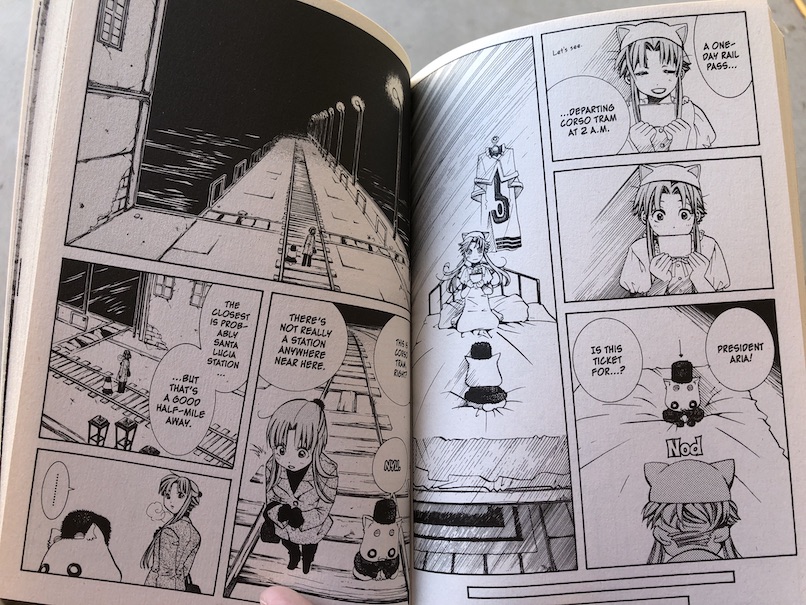
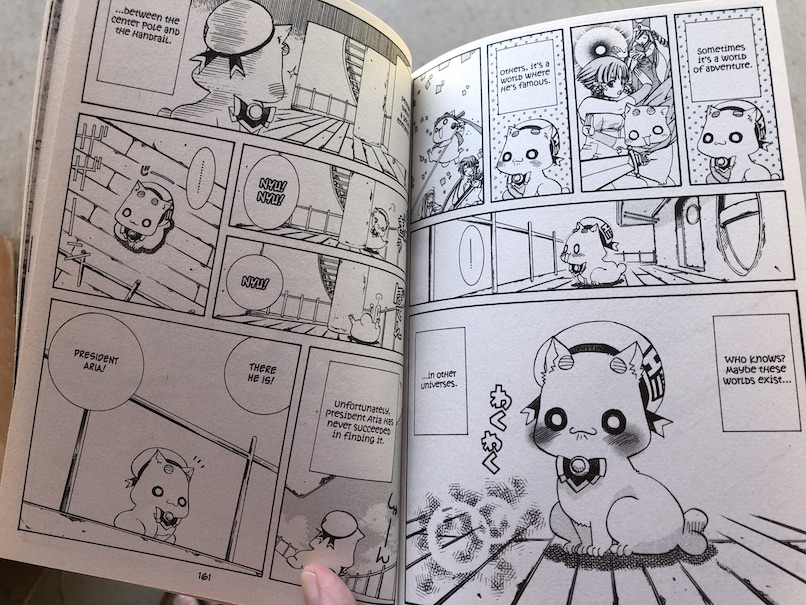
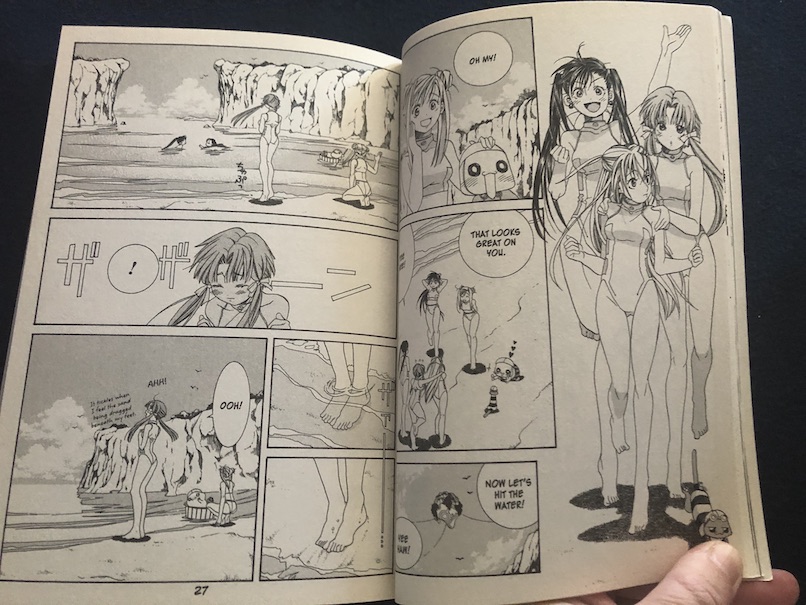
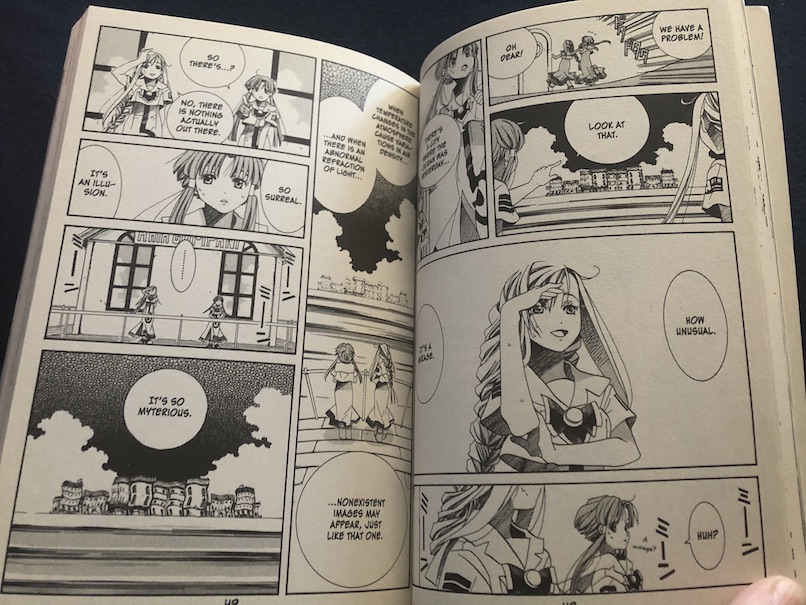
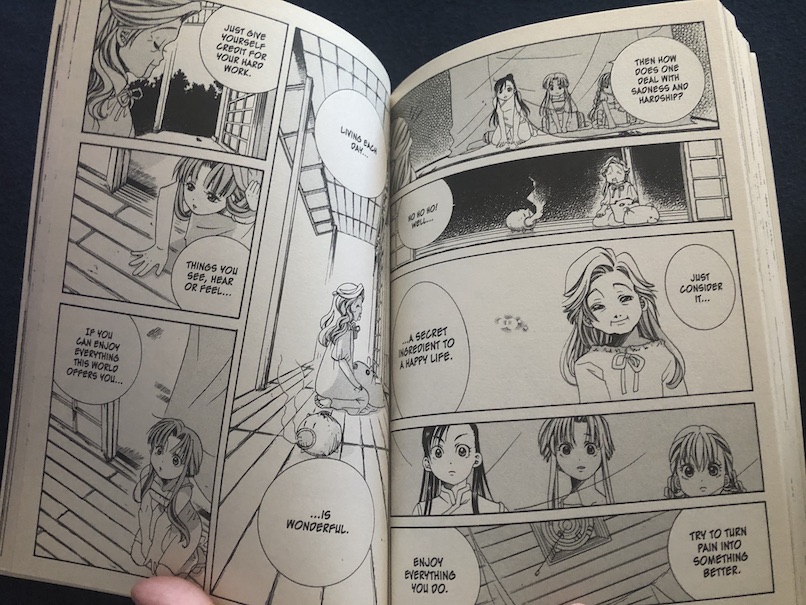
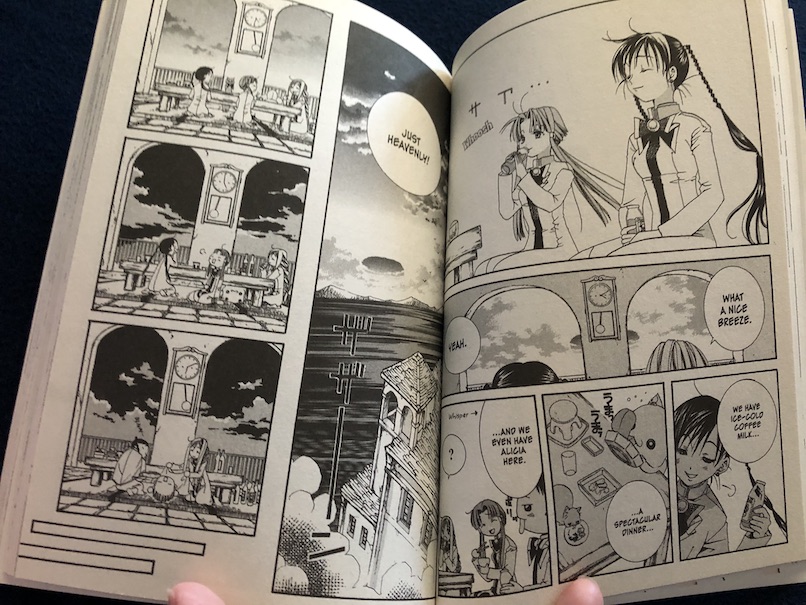
The series has received some criticism for being slow and lacking danger and adventure, but that is not really the point of the series. The main purpose is to show people how to appreciate the small pleasures of life. The sci-fi and fantasy elements (the spaceships, advanced environmental controls, intelligent Martian cats, and even the occasional appearances of the legendary Cait Sith) are mainly background to the stories about the magic of friendship and simple pleasures. Each volume contains a few short stories about Akari and her friends and the little adventures they have on a daily basis and the life lessons they learn. It’s a great series for relaxing when you’re stressed out.

Unfortunately, although this book is only about halfway through the series, this is the last book of the series that I actually own because the others haven’t been printed in English yet, although I think that additional volumes will be published in English.

The stories included in this volume are:

Orange Days

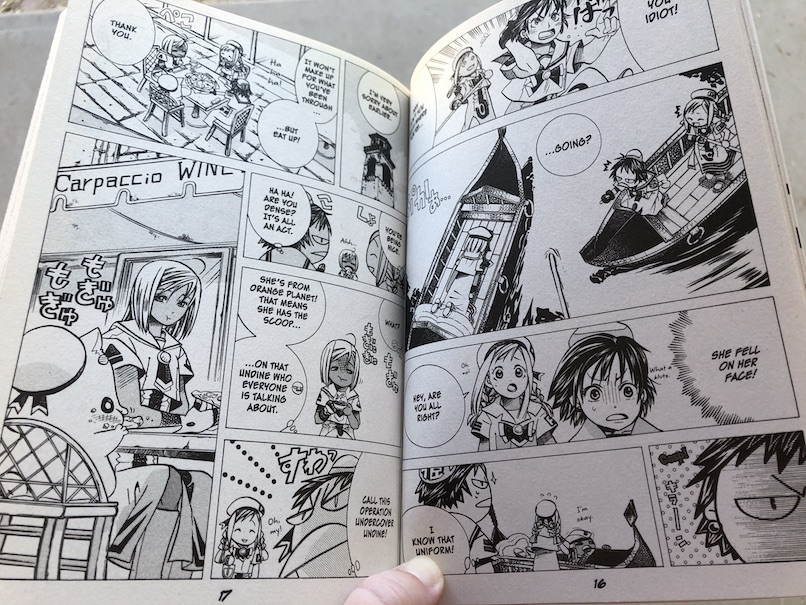
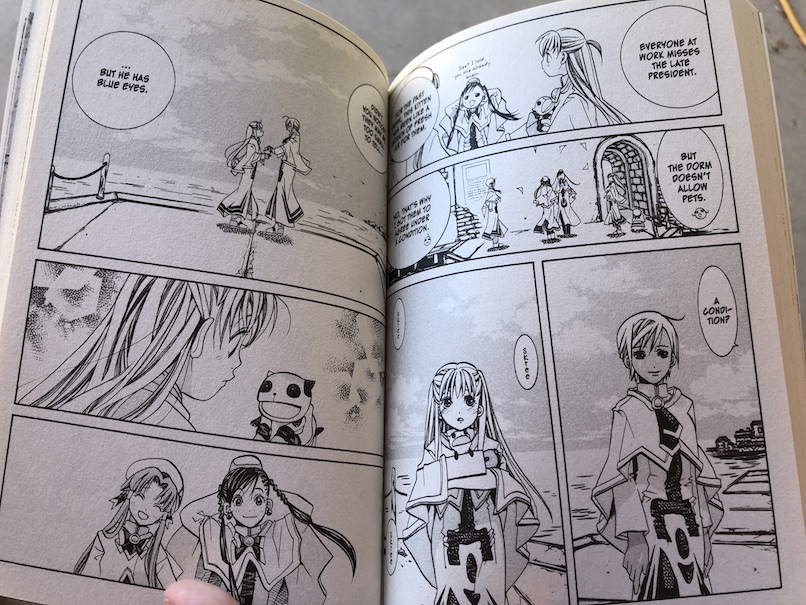
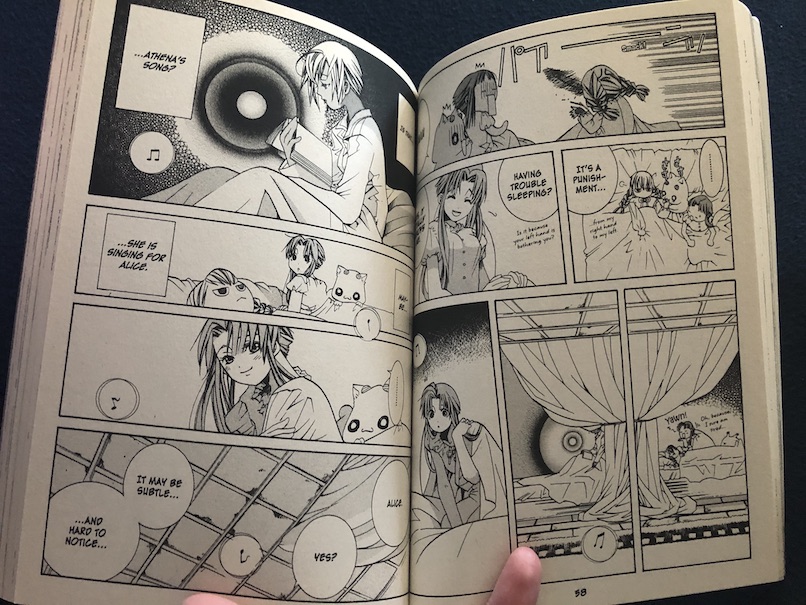
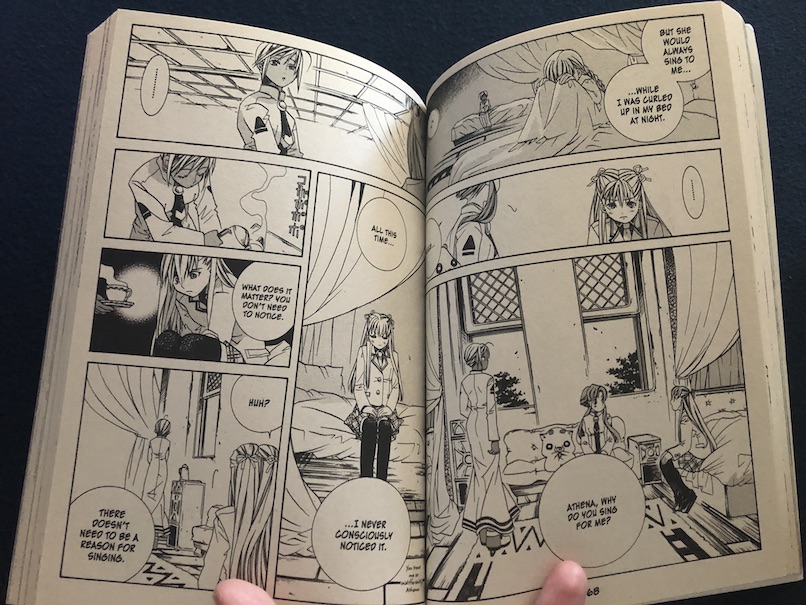
Athena comes to visit Alicia at Aria Company, and the trainees’ mentors reminisce about how they first met when they were trainees.

Akira was just as prickly and competitive when she was young as she is as an adult. Although trainee Akira said that she was just observing the “losers” at Aria Company, she kept coming around and became friends with Alicia. When she heard about a new trainee at Orange Company with an amazing singing voice, Akira wanted to seek her out, worried about the competition.

While she was telling Alicia about it, the two of them accidentally had a collision with young Athena’s gondola, which is the first time either of them had seen her. Athena was knocked over by the collision, so the other two girls treated her to lunch, partly to make it up to her and partly because Akira wanted to pump her for information about the new trainee at Orange Company, not knowing that Athena herself was the new trainee.

However, Athena didn’t answer their questions about the new trainee. Even back then, she was a person of few words, and she just made a drinking straw crawly snake to amuse President Aria. Still, Athena became friends with Alicia and Akira, joining them in their practice sessions, like Akari, Aika, and Alice share their practices together. Alicia and Akira only discovered that Athena was the trainee with the amazing voice when they decided to practice singing canzones one day.

The mentors end their reminiscences by saying that it seems hard to believe that, now that their training is over, they are so busy that they hardly have time to see each other. When they were trainees, it felt like they would always practice together every day, but now, their lives are different. These comments make the present trainees uncomfortable because they realize that the same thing is likely to happen to them when their training is complete. Alice, Aika, and Akari have come to value each other’s friendship and companionship, and they find it difficult to imagine being without each other.

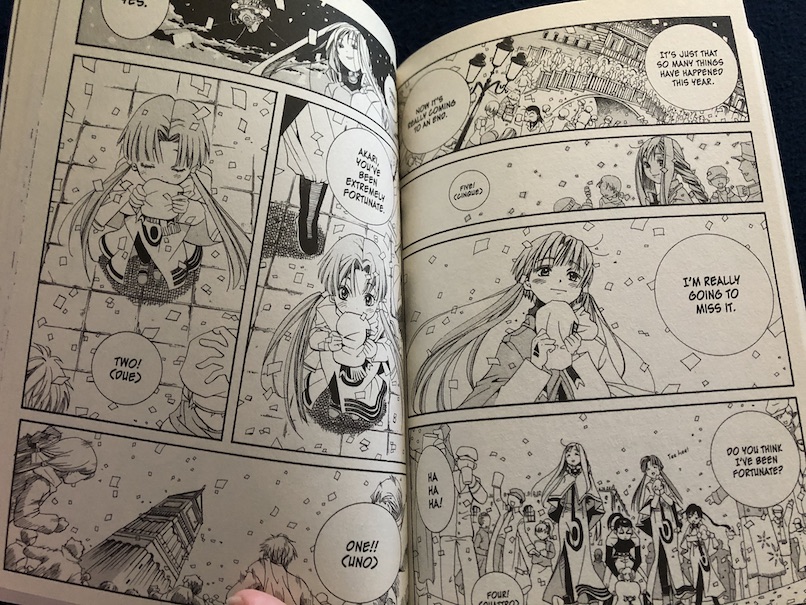
However, Alicia and Athena tell the girls to not worry too much about it. Time is always moving forward, and it’s true that things will change for them, but that’s not entirely a bad thing. Even though they sometimes miss their training days when they spent so much of their time together, they are also happy with their current lives. They enjoy their careers, and they like helping to train new Undines. In fact, helping to train the next generation of Undines helps them to connect to their own pasts because the young Undines remind them of their own training days. Alicia’s advice is to enjoy where you are and what’s currently happening around you as much as you can. Life will eventually move on, and things will change, so you might as well make the most of where you are now and enjoy it to the fullest, so you will be ready to move on to the next stage of your life and enjoy that as well. Athena says, “Fun times really aren’t meant to be compared. Just enjoyed.”

The young trainees are still affected by the story of their mentors’ friendships and the changes in their lives. Aika points out to Akari that their lives aren’t changing just yet, but the girls have come to a greater realization that their lives will eventually change.

It’s just like how, when people are young and in school, surrounded by the same other students every day, it can be hard to imagine that there will come a day after you graduate when you won’t all be working at the same place and you won’t all be eating lunch together every day. As you get busy building careers and families, it will be harder to see each other and keep in touch. However, that’s not entirely a bad thing. As some people like to say, “You can’t begin the next chapter of your life if you keep rereading the last one.” There are many things in life to enjoy and accomplishments to be made, and like Alicia and Athena explain, you might as well enjoy where you are right now and make the most of it so you won’t look back with regret when it’s time to move on.

Venetian Glass

Akatsuki’s elder brother comes to Aria Company to hire Akari to transport some delicate Venetian glass. Akari is excited because this is the first time that anyone has specifically hired her, although, because she isn’t a full Undine yet, Alicia will have to accompany her on her errand.

When they go to pick up the glass, Akari sees glass-blowing and Venetian glass for the first time.

One of the workers from the glass factory seems kind of surly, but he accompanies them while they transport the glass and explains the history of Venetian glass and what makes it so special.

The reason why the glass worker is so surly is that he feels like a lot of people don’t appreciate his craft. He and his master put their heart and soul into their work, but people say that their “Venentian glass” is fake because it’s made in Neo-Venezia, not in the real Venice, which sank beneath the ocean years ago. The worker laments that the craftsmen who left the sinking city were scattered across Earth before making their way to Neo-Venezia and that details of their craft have been lost over time. Neo-Venezian glass will never be quite the same as the original Venetian glass, and people will never look at it the same way, which the worker finds depressing.

However, one of Akari’s great strengths is finding the beauty in everything and bringing it out for other people to see. She tells the worker that the glass is kind of like Neo-Venezia itself. It’s true, it’s not the original Venice, only re-created in its image. Some aspects of it are the same, but it’s also a different place, on another planet. To some people, that might make it seem like a fake city, just an imitation of the original, but Akari doesn’t think that the real vs. fake concept matters because she loves the city for the beautiful treasure it is. Similarly, Akari thinks that Neo-Venezian glass is a treasure by itself and likes it for what it is, regardless of what the original was or what others say about it.

The worker finds Akari’s viewpoint inspirational and is enchanted by Akari herself, remarking that she’s also a unique treasure. Akatsuki’s brother jokes that Akatsuki might have a rival now for his affection for Akari. Akari knows that Akatsuki has had an unrequited crush on Alicia, so she doesn’t think too much about it. Although it’s true that Akatsuki has a crush on Alicia, Akatsuki’s brother is also correct that Akari inspires greater feelings in others than she realizes and Akatsuki values Akari more than he lets on, maybe more than even he realizes himself. Akari is unique because of her unusual way of looking at things, and her optimistic point of view influences others.

Snow White

One day, while they’re practicing together, Akari asks Aika what kind of adult she wanted to be when she was a kid. Aika, who has admired and even hero-worshipped Alicia ever since Alicia was kind to her when she was a young child, says that she’s always wanted to be an elegant woman like Alicia. Akari says that she wants to be like Alicia, too, but Aika criticizes her for wanting to copy her ambition and says that it’s not likely that Akari would ever be as elegant as Alicia because she still does kid-like things, like collecting stuffed animals.

Their discussion causes Akari to wonder what sort of adult Alicia wanted to be when she was a little kid, and she asks Alicia about it while they’re out walking one day. Instead of answering her directly at first, Alicia demonstrates by starting to build a snowman and pointing out how the people around them react to it.

Each time Alicia and Akari start to make a large snowball for the base of the snowman, different adults stop and help them to make it a bit bigger.

Alicia says that she noticed people like this when she was a child. There are always adults who, when seeing a young girl making a snowman, feel compelled to help her because she can make a much bigger snowball with their help. That’s the type of adult Alicia always wanted to be.

Alicia genuinely enjoys not only her career as an Undine but her role as a teacher and mentor in Akari’s life and in the lives of her friends, helping them to develop in their trade and to become better Undines because of her influence.

Stray Cat

Alice finds a tiny stray Martian cat one day while waiting for Akari and Aika to meet her for practice. The cat’s mother doesn’t seem to be around, and Alice doesn’t know whether the little cat is lost, orphaned, or abandoned. When Aika arrives for practice, she finds both Alice and Akari lying on the ground next to the cat because it looks so happy lying in the sun that Alice thinks they should also try it.

Although Aika warns Alice that she won’t be able to keep the cat because she lives in a dorm at Orange Company and isn’t allowed to keep pets, Alice becomes attached to the cat, names it Maa, and hides it in her room.

At first, she is afraid that her mentor, Athena, will be angry with her, and Aika scares her by saying that Athena will probably kill the cat because she doesn’t like cats. However, Alice loves Maa because she misses the previous president cat of Orange Company, who recently passed away, and Maa reminds her a little of him.

When the secret gets out, and Alice is confronted by Athena about the cat, Alice is scared because Athena is holding a knife for slicing fruit and runs away to leave the tiny Maa where she found him, thinking that it might be the only way to save his life. However, she finds herself unable to abandon Maa and returns to get him, only to find him missing from the box where she left him. In a panic, she spends all night searching the city with her friends to try to find Maa.

However, when they finally give up the search, they discover that Athena has Maa. When she had tried to talk to Alice before, she wasn’t angry. She followed Alice to the place where she left Maa and retrieved him and has been waiting for Alice to return to Orange Company. In Alice’s absence, Athena has persuaded Orange Company to keep Maa as their new company president. Like the other cats used as the presidents/mascots of gondola companies, Maa also has blue eyes.

A Night on the Galactic Railroad

When Akari hears the sound of a train at night, she imagines that it’s a magical train like one she read about in a book, A Night on the Galactic Railroad by Kenji Miyazawa.

Aika has a more practical explanation for what it is, that the sounds of freight trains are more noticeable at night, when everything is quiet, but Akari discovers the truth when President Aria gives her a special train ticket.

It turns out that the mysterious train is a train of cats. (Guess who the conductor is?) Akari could use the ticket from President Aria to ride the train, but instead, she gives it to a sad little kitten who lost his ticket.

Because Akari doesn’t board the train, she never finds out where the train was going. The next morning, it all seems like a strange dream, except both Akari and President Aria have the stamps on their foreheads that Cait Sith gave them.

A Parallel World

President Aria accidentally finds a parallel world in which all the people he knows who are girls are boys and vice versa. Frightening!

President Aria has always wanted to find a gateway to another world, but everything seems so strange that all he wants to do is get back to his world.

He ends up returning to the world he knows when someone tosses him too high in the air while playing with him. Did any of it really happen, or was he just dazed from when he fell?

This one isn’t one of my favorite stories in this series because I think that the premise is kind of goofy. The characters don’t really look all that different when their genders are switched. Most of the difference is in hair styles, and the uniforms of the Undines have pants when they’re normally just long dresses.

Aria Volume 5

Aria Volume 5 by Kozue Amano, 2004, English Translation 2009.

This is the fifth volume of the second part of a fascinating manga series that combines sci-fi, fantasy, and slice of life. The series takes place about 300 years in the future, when Mars has been terraformed and renamed Aqua (because of all the water on its surface). The human colonies on Aqua are designed to resemble old-fashioned cities on Earth (called Manhome here). The people of Aqua prefer a much slower pace of life than people on Manhome, and aspects of life on Aqua more closely resemble Earth’s past.

The series is divided into two parts. The first two books are the Aqua volumes and introduce Akari Mizunashi, the main character, a young girl who came to Aqua to learn to become a gondolier in the city of Neo Venezia (which resembles Venice). Female gondoliers, called Undines, give tours of the city, giving Akari plenty of time to admire the beauty of her new home and meet interesting people. The two Aqua books are the prequel to the main series, Aria. Aqua covers Akari’s arrival on the planet, her introduction to life on Aqua, and the beginning of her training. The main Aria series show Akari’s continuing training, her progression to becoming a full Undine, her evolving relationships with her friends, and as always, her delight in learning more about her new home and admiring its beauty.

The series has received some criticism for being slow and lacking danger and adventure, but that is not really the point of the series. The main purpose is to show people how to appreciate the small pleasures of life. The sci-fi and fantasy elements (the spaceships, advanced environmental controls, intelligent Martian cats, and even the occasional appearances of the legendary Cait Sith) are mainly background to the stories about the magic of friendship and simple pleasures. Each volume contains a few short stories about Akari and her friends and the little adventures they have on a daily basis and the life lessons they learn. It’s a great series for relaxing when you’re stressed out.

The stories included in this volume are:

Mailman-San

When Akari’s mailman friend has a hole in his gondola, he tries to hire Alicia to help him deliver the mail. However, Alicia is busy, so she allows Akari to help him instead, even though she’s only a trainee.

Akari gets to visit the post office and spends the day helping the mailman deliver the mail. During the course of the day, Akari thinks about the number of letters that people in Neo Venezia send and wonders why they send physical letters instead of e-mail. The mailman explains to her that physical letters feel different from e-mail, and Akari understands.

People in Neo Venezia like the feel of doing things the old-fashioned way, often because the old-fashioned ways have more of a personal touch. The mailman tells Akari that she has really become a part of Neo Venezia.

Canzone

Alice’s mentor, Athena, is also one of the three greatest Undines on Aqua, the Three Water Fairies, like Akari’s and Aika’s mentors. However, Alice has little patience for her because she is clumsy outside of a gondola. Alice hates clumsiness and weakness, even punishing her own left hand for not being as strong as her right.

Akari is concerned about Alice when she sees what she’s doing to her left hand, and she has a sleepover with Alice to learn more about what’s happening with her. That’s when she meets Athena for the first time, although she had earlier seen her in her gondola, singing an enchanting canzone. Athena’s singing ability is one of the reasons why she is so famous as an Undine.

Akari observes the little things that Athena does for Alice, like singing to her at night, and points out to Alice that her left hand helps her more than she realizes.

Alice doesn’t believe it at first, but the next day, she begins to notice that Akari is right. While Alice eats with her right hand, her left hand holds her bowl. When she writes with her right hand, her left hand is holding the page. Her left hand isn’t inactive or useless; it’s been providing support that allows the right hand to do its job.

This revelation also causes Alice to see her mentor in a different light. Like her left hand, clumsy Athena has also been giving Alice quiet support that Alice often fails to notice. Alice reflects on how Athena’s singing comforted her when she first arrived at Orange Company and was homesick. Alice asks Athena why she sings to her, and Athena tells her that she’s just singing as she pleases, that she doesn’t need a reason to sing, that songs don’t really need to be noticed or thanked, and that she should just let the song do its work. However, Alice gains a new sense of gratitude toward her mentor and begins to treat her much better.

The Night of the Meteor Shower

Akari and her friends find out that there is going to be a meteor shower, and Aika suggests that they invite Al the Gnome to watch it with them.

Of all the boys the girls know, Aika likes Al the best. Al isn’t temperamental like Akatsuki or spacey like Woody. Aika is kind of fascinated by how he looks younger than they are even though he’s older and also talks like an old man or an old-fashioned gentleman.

Plus, after living in the underground city, Al has really good night vision, which is helpful as the girls search for a good place to view the meteor shower, away from the lights and crowds of the public square.

Aika finally suggests that they go up on the roof of one of the Himeya Company buildings, which has an excellent view.

Akari explores the rooftops a little on her own, leaving Aika and Al alone together. When Al, whose work as a Gnome is managing the gravity of Aqua, talks to Aika about gravity and attraction and how the gravity of Aqua pulls, the meteors in, she understands a little more about the attraction she feels for Al.

Margherita

Aika’s mentor, Akira, is tough, but she genuinely cares about her students. After a day of training in which many things go wrong, she finds a way to show the trainees how much she appreciates their hard work.

Akira has Aika, Akari, and Alice show her how they would handle a real customer, from helping them into the gondola to giving them a pleasant tour with interesting information. However, she is critical of the way they do things and particularly, some of the safety regulations they forget, like speed limits, not warning other approaching boats of their presence, and allowing themselves to be stuck when high tide comes and makes it impossible for them to pass beneath certain bridges.

Akira says that the reason why she’s being tough is that, when the girls become full Undines, they will be completely on their own in their boats with their customers, with no one else to help them. When there’s a problem or when they make a mistake, it will be their job to fix the situation themselves with their own skill and ingenuity.

When they become stuck on a section of canal because of the rising tide, Akira challenges them to find a way to solve the problem themselves. They find a side waterway that’s been closed off, and take the gondola through that way.

Akira rewards the trainees by taking them to a pizza parlor for a Margherita pizza. (Named for a queen, it’s topped with tomatoes, basil, and olive oil.) The trainees ask her why she didn’t punish them for making a serious mistake in their practice, and she tells them that there would be no point in punishing them because they realized what they did wrong and made an effort to improve, learning from their experience.

I quibble a bit with the teaching method just telling the students to find a way to fix the problem themselves without guidance. It kind of works here because Aika and Akari are now journeyman Undines and have had basic training and experience of the waterways of Neo Venezia to call on, but you can’t do this sort of thing with real beginners who haven’t had that grounding. I’ve had teachers who have tried, and I know the frustration of having them expecting me to call on a grounding I hadn’t received. When I was a kid, I felt terrible about those situations, like I was an idiot, but as an adult, who has since had gaps in my early education filled, I’ve come to realize that the fault wasn’t with me but with the teachers who had not taught me what to do but still expected me to somehow already know. I couldn’t figure out what to do because I didn’t know enough about what I could do yet. You can’t progress well in your education or training for anything without having someone explain the basics to give you the right grounding to build on. You can’t do algebra without knowing your basic operations. You can’t understand how to cook from memory or improvise a dish without first learning how to follow basic recipes. Akira’s approach to letting the students figure out the solution to a problem themselves calls attention to what the girls already know and encourages them to use it, but when that doesn’t work in real life, when you just don’t know what to do at all, it’s time to take a step back and reacquaint yourselves with the basics. You can figure out what to do if you know what’s possible to do, but I’d like to point out that if you don’t know what’s possible, you need some help and guidance to learn.

Shadow Chasing

Akari never minds waiting for people because there are always interesting things and people to watch. One day, when Alicia has to attend a Gondola Association meeting at a famous cafe, Akari says that she and President Aria will just wait for her instead of heading home.

Akari drinks lattes and watches the people going by, just enjoying the ambiance of the square.

There is a man there who seems familiar to Akari, and the two of them begin talking to each other about people watching in the square. The man introduces Akari to the custom of “shadow chasing”, where the restaurant employees move the cafe’s tables into the shade as the shadows move.

Akari reflects on the history of the cafe, Caffe Florian, which she says is actually the same cafe that once stood in the original Venice (which, in Akari’s time, is now submerged beneath the ocean), having been dismantled and moved years ago.

It turns out that her new friend is actually the manager of the cafe.

Aria Volume 4

Aria Volume 4 by Kozue Amano, 2004, English Translation 2008.

This is the fourth volume of the second part of a fascinating manga series that combines sci-fi, fantasy, and slice of life. The series takes place about 300 years in the future, when Mars has been terraformed and renamed Aqua (because of all the water on its surface). The human colonies on Aqua are designed to resemble old-fashioned cities on Earth (called Manhome here). The people of Aqua prefer a much slower pace of life than people on Manhome, and aspects of life on Aqua more closely resemble Earth’s past.

The series is divided into two parts. The first two books are the Aqua volumes and introduce Akari Mizunashi, the main character, a young girl who came to Aqua to learn to become a gondolier in the city of Neo Venezia (which resembles Venice). Female gondoliers, called Undines, give tours of the city, giving Akari plenty of time to admire the beauty of her new home and meet interesting people. The two Aqua books are the prequel to the main series, Aria. Aqua covers Akari’s arrival on the planet, her introduction to life on Aqua, and the beginning of her training. The main Aria series show Akari’s continuing training, her progression to becoming a full Undine, her evolving relationships with her friends, and as always, her delight in learning more about her new home and admiring its beauty.

The series has received some criticism for being slow and lacking danger and adventure, but that is not really the point of the series. The main purpose is to show people how to appreciate the small pleasures of life. The sci-fi and fantasy elements (the spaceships, advanced environmental controls, intelligent Martian cats, and even the occasional appearances of the legendary Cait Sith) are mainly background to the stories about the magic of friendship and simple pleasures. Each volume contains a few short stories about Akari and her friends and the little adventures they have on a daily basis and the life lessons they learn. It’s a great series for relaxing when you’re stressed out.

The stories included in this volume are:

Neverland

Alicia and Akira arrange a special, surprise trip to the beach for the trainees, a happy day that reminds Akari of Neverland. It starts out with an invitation for each of the trainees that supposedly comes from Peter Pan, inviting them to Neverland, but it turns out to be a fun day at a beach that President Aria found.

Akira wanted the day to be a day of training, but Alicia convinced her that a day of rest and relaxation would benefit the trainees more. The girls put on their swimsuits and enjoy a day of swimming.

Akari thinks that the beach and their day there really is like Neverland, and Alicia realizes that it is because of the way that Akari looks at things. Akari’s strength is the ability to enjoy the simple pleasures in life for what they are, finding the magic in daily life.

This story emphasizes the theme of the series, which is that the most important thing is to choose to be happy.

Traveling Water

Summer on Aqua is very hot, and Akari experiences her first mirages. People on Aqua sometimes call them “traveling water” because they can look like water that you can never reach. (I grew up in Arizona, and I grew up seeing that. On a straight road, the heat waves will look like distant water, waving and reflecting the scenery, but they appear to dry up or move further away as you go toward them.)

On a very hot day, Akari sets out to buy a night light chime and, oddly, seems to find herself all alone, except for President Aria. She follows President Aria, hoping that he will lead her to a place where she can cool off.

Akari finds herself at a mysterious cafe, which is nice and cool. The server gives her and President Aria ice cold milk, and Akari feels better, but the cafe is no ordinary cafe.

It turns out that the cafe is a secret hangout for cats and their king, Cait Sith. Humans do not ordinarily find their way there. They give Akari a special night light chime and urge her to go on her way …

Unless it was all just another mirage.

I love this story for its “was it all a dream” theme and for the cat-shaped chime that helps confirm that it all really happened. I also like the idea/warning that the server offers to Akari, that maybe it’s a good thing not to completely catch up to a mirage. Akari is sometimes a special guest of the magical characters that inhabit their world, going to places and seeing things that others don’t, but she can’t stay among them because her life is in the human world, and she has to let the fantasy elements slip away to return to her ordinary life that is a little less ordinary for the experiences she’s had.

Flying Fish in the Sky

Akari notices that some of the professions on Aqua relate to the four elements: water, fire, earth, and air. The Undines represent water because they spend their time rowing their gondolas, the Salamanders represent fire because they control the heat levels in the atmosphere to control the weather, and the Gnomes represent earth because they work underground to control gravity. The fourth element-based profession is Sylph, which represents air. They are flying deliverymen.

Akari helps a sylph called Woody, a flying deliveryman with a poor sense of direction, after he falls off his flying bike and loses the map he depends on in order to make his deliveries. It’s kind of a scary ride, but it’s also exciting, and Akari gets a bird’s-eye view of her city.

Woody also appears in later stories.

The Legendary Major Fairy

The trainees go to meet the founder of Aria Company, who is considered the Legendary Major Fairy, the grandmother of the younger Undines. She now lives in the countryside, and as the girls help her with some chores and enjoy other activities, Aika keeps looking for hidden tests of their skills or lessons slipped into the activities.

When hidden tests and lessons don’t seem to be in these activities, and the activities just are what they appear to be, Aika gets impatient and worries that maybe the older woman thinks that they’re hopeless and not worth teaching. She asks the Legendary Fairy, who asks them to call her “Grandma”, directly for some advice about being a great Undine, and what she tells them is both simple and yet something that is easy for people to forget.

Grandma’s advice is another repetition of the themes of the entire Aria series, but it’s worth repeating. She tells the girls to enjoy themselves in everything they do (the activities she gave them earlier were for them to enjoy, nothing more), remember that the world and life itself is full of things to enjoy, give yourself credit for your hard work, and when you encounter pain and sadness, try to turn it into something better.

The Redentore

The Undines celebrate Rendentore, a special festival of thanksgiving, with a party on a boat for all of their friends, organized by the trainees. In keeping with the tradition, the trainees invite special guests and use the opportunity to improve their hostess and entertaining skills, designing invitations and planning the meal and entertainment.

The party is a success, and one of the best parts is that the girls have brought together a group of people who otherwise would not have spent time together, except they are tied together by their roles in the lives of the girls.

Aria Volume 3

Aria Volume 3 by Kozue Amano, 2003, English Translation 2004.

This is the third volume of the second part of a fascinating manga series that combines sci-fi, fantasy, and slice of life. The series takes place about 300 years in the future, when Mars has been terraformed and renamed Aqua (because of all the water on its surface). The human colonies on Aqua are designed to resemble old-fashioned cities on Earth (called Manhome here). The people of Aqua prefer a much slower pace of life than people on Manhome, and aspects of life on Aqua more closely resemble Earth’s past.

The series is divided into two parts. The first two books are the Aqua volumes and introduce Akari Mizunashi, the main character, a young girl who came to Aqua to learn to become a gondolier in the city of Neo Venezia (which resembles Venice). Female gondoliers, called Undines, give tours of the city, giving Akari plenty of time to admire the beauty of her new home and meet interesting people. The two Aqua books are the prequel to the main series, Aria. Aqua covers Akari’s arrival on the planet, her introduction to life on Aqua, and the beginning of her training. The main Aria series show Akari’s continuing training, her progression to becoming a full Undine, her evolving relationships with her friends, and as always, her delight in learning more about her new home and admiring its beauty.

The series has received some criticism for being slow and lacking danger and adventure, but that is not really the point of the series. The main purpose is to show people how to appreciate the small pleasures of life. The sci-fi and fantasy elements (the spaceships, advanced environmental controls, intelligent Martian cats, and even the occasional appearances of the legendary Cait Sith) are mainly background to the stories about the magic of friendship and simple pleasures. Each volume contains a few short stories about Akari and her friends and the little adventures they have on a daily basis and the life lessons they learn. It’s a great series for relaxing when you’re stressed out.

The stories included in this volume are:

First Gale of Spring

It’s been a full year (full Martian year, which is equal to two Earth years) since Akari moved to Aqua and began her Undine training, and she’s happy that it’s spring again! While Akari and Aika are practicing their rowing one day, they meet another trainee Undine, Alice.

Alice is a young prodigy, only 14. Even though she is rather young and still in school, she’s really good at handling a gondola. However, Aika takes an instant dislike to her, partly because she belongs to Orange Company, a rival of Aika’s gondola company, Himeya. Akari tries to be friendly to Alice and tries to invite her to join them for lunch, but Alice is rude and unfriendly to them.

Aika thinks that Alice has an uppity attitude and is disrespectful to them even though they’re higher level trainees than she is. (There is some mild swearing in this part of the story. Most of the Aria series doesn’t have any swearing at all.) To prove her point and put Alice in her place, Aika decides to challenge Alice to a race.

Part of the reason why Alice is so prickly and unfriendly is that she thinks that people look down on her for being young and because they’re jealous of her skills , but she doesn’t realize how her abrasive attitude affects the people around her and their perceptions of her.

Aika has Akari row their gondola in the race, partly so she can use her secret ability to row a gondola backwards really fast, but Akari has her own ideas of how the race will end. Akari is still thinking of the beauty of spring, and even though she makes sure that her gondola will come in second by stopping to pick flowers (the fact that they had time to pick an entire boatload of flowers indicates just how much of a lead they had), she uses them to remind the other girls

Alice actually appeared in one of the prequel books to the Aria series, Aqua Volume 2, as the friend who went with Akari to visit Aika when Aika had a cold. It was the only Aqua story she was in, and this story in the third volume of the Aria series is the true introduction to her character.

Under the Cherry Blossoms in Full Bloom

Alicia and Akari decide to go on a picnic to enjoy the beauty of nature in spring. Alicia has a special place in mind for a picnic, but the two of them get lost on the way. Although Alicia remembers that getting to her special spot involves following some old train tracks, when they split off in different directions, she can’t remember which way to go.

Akari picks a random direction. It turns out that the direction she picks doesn’t take them to Alicia’s special place, but they find something else interesting: an abandoned train car underneath a cherry tree in full bloom.

The girls explore the train car and find that part of the roof is missing. They lie in the train car and enjoy the cherry blossoms raining down on them. Akari apologizes to Alicia for not finding her special place, but Alicia says that’s fine because this place is nice, too. She says that sometimes, you have to get a little lost to find something new.

Town Treasure

Akari, Aika, and Alice find a message in an old gondola that they borrow from the gondola repairman while Aria Company’s gondolas are being service. The message is in a small box in a hidden compartment of the gondola, and it turns out to be the first clue in a treasure hunt with a special surprise at the end.

Curious to find the treasure, the girls follow the clues through Neo Venezia, and their search leads them to take a second look at places they pass by all the time with little notice and takes them to lesser-known parts of the city that even Aika and Alice, who were born there, haven’t seen.

The treasure hunt finally ends on an often over-looked stairway that actually provides an excellent view of Neo Venezia, and the treasure they find there is the one that made Akari enjoy the treasure hunt from the very beginning.

The girls decide to put all the clues back where they found them, and to their surprise, they notice that there are marks that indicate that many other people have done the same.

Three Water Fairies

Akari and Aika are training under two of the Three Water Fairies, the best-known Undines on Aqua. However, Aika’s mentor, Akira, is much more strict than Alicia. One day, Aika gets fed up with Akira’s strictness and decides to run away and train under Alicia.

When Akira shows up to reclaim her wayward trainee, Akari learns more about Alicia, Akira, and especially about Aika. Akira was seen briefly in Aqua Volume 2, when Aika snuck out of her room to go buy some pudding, and she was the person Aika was trying to avoid because she was the one making her rest from her cold. However, Akira wasn’t actually introduced until this book, like Alice. This story reveals that Alicia and Akira were friends as trainees, like Akari and Aika, and have had a bit of a rivalry, being considered among the three best Undines, but they haven’t seen each other much in recent years.

Aika had reveals that the reason why she admires Alicia so much is that Alicia was nice to her when she was a child. One day, when she was upset about something, Alicia found her and gave her a ride in her gondola and cheered her up by trying different hairstyles with her hair. This experience is what made Aika want so badly to become an Undine herself. However, Aika could not train under Alicia at Aria Company because her parents actually own Himeya Company, something that Aika has never told Akari before. Aika’s family expects her to work her way up through the ranks as an Undine and eventually take over Himeya Company.

To settle the matter of Aika’s future training, Akira proposes a contest, a race between Aika and Akari, to determine whether Aika will become Alicia’s student or return to Himeya Company with Akira. As Alicia guesses, the “race” between their trainees gives Aika an opportunity to return to Himeya without sacrificing her dignity. It also gives both Akira and Aika an opportunity to consider how they really feel about each other and how much they appreciate each other.

While Akira and Alicia talk about Aika and how she’s both similar to and different from her mentor, Akari and Aika aren’t really having a race. Instead, they talk about how Aika feels about Akira.

Aika says that her position as the future heir of Himeya Company doesn’t matter much to her because she just wants to be an Undine, like Alicia, but she admits that people at Himeya treat her differently from the other trainees because they know who she is. They are extra nice to her and try to avoid getting on her bad side because they want to be friends with the boss’s daughter, who will be their future boss someday. Aika admits that, strict as Akira is, she’s also the one who’s the most honest with her, correcting her when she needs it and not worrying about making her angry. Aika realizes that she needs that honesty in her life and that Akira’s training is helping her. At Aika’s insistance, the girls end their “race” and go buy some walnut pastries for Akira, which Aika offers to her as an apology before returning to Himeya with her. Akari realizes the the bond between Aika and Akira is stronger than either of them wants to admit, and she hopes that, someday, she’ll have a bond that strong with Alicia.

This story is important for explaining more of the backstory of the characters and how they relate to each other. There is a running theme in these stories of having characters whose names begin with the letter ‘A’. In most cases, I don’t mind because the names are usually different enough that it doesn’t matter, but Akira and Akari are rather close.

Festa del Boccolo

Festa del Boccolo is the time when men give red roses to the women they love. Akatsuki has had a crush on Alicia for a long time, and he enlists Akari’s help to give her a boatful of roses to impress her. He needs her help because the town is flooded during high tide again, as it is every year during late spring.

Unfortunately, his elaborate gesture doesn’t go as planned because Alicia has already received many other roses from other people, and she assumes that Akatsuki has bought all of his roses for Akari.

Akatsuki accidentally spills the roses in the water, while trying to get Alicia’s attention. He thinks that he’s completely screwed everything up, but Akari points out that his gesture wasn’t futile because, like the roses floating on the water, his love for Alicia spreads out around him and touches everyone, and one day, Alicia is bound to notice. Akatsuki gives Akari a single rose to thank her for her help, and the two of them enjoy a walk together through the flooded city.

Aria Volume 2

Aria Volume 2 by Kozue Amano, 2003, English Translation 2008.

The is the second volume of the second part of a fascinating manga series that combines sci-fi, fantasy, and slice of life. The series takes place about 300 years in the future, when Mars has been terraformed and renamed Aqua (because of all the water on its surface). The human colonies on Aqua are designed to resemble old-fashioned cities on Earth (called Manhome here). The people of Aqua prefer a much slower pace of life than people on Manhome, and aspects of life on Aqua more closely resemble Earth’s past.

The series is divided into two parts. The first two books are the Aqua volumes and introduce Akari Mizunashi, the main character, a young girl who came to Aqua to learn to become a gondolier in the city of Neo Venezia (which resembles Venice). Female gondoliers, called Undines, give tours of the city, giving Akari plenty of time to admire the beauty of her new home and meet interesting people. The two Aqua books are the prequel to the main series, Aria. Aqua covers Akari’s arrival on the planet, her introduction to life on Aqua, and the beginning of her training. The main Aria series show Akari’s continuing training, her progression to becoming a full Undine, her evolving relationships with her friends, and as always, her delight in learning more about her new home and admiring its beauty.

In the second volume of the Aria series, winter comes to Neo Venezia, and Akari experiences the delights of the changing season and the celebration of a New Year as well as continuing to learn more about her new home.

The series has received some criticism for being slow and lacking danger and adventure, but that is not really the point of the series. The main purpose is to show people how to appreciate the small pleasures of life. The sci-fi and fantasy elements (the spaceships, advanced environmental controls, intelligent Martian cats, and even the occasional appearances of the legendary Cait Sith) are mainly background to the stories about the magic of friendship and simple pleasures. Each volume contains a few short stories about Akari and her friends and the little adventures they have on a daily basis and the life lessons they learn. It’s a great series for relaxing when you’re stressed out.

The stories included in this volume are:

Snow Bug

Snow Bugs (a kind of fluffy aphid) appear on Aqua at the onset of winter. They are larger than Earth aphids, and they look like cute little puff balls with eyes.

Akari makes friends with one of them when she and Alicia go out to gather some firewood, and she brings her Snow Bug friend home with her for awhile.

However, the Snow Bugs appear at this time of year because they are migrating to their winter home, and as snow comes to Neo Venezia, Akari has to accept that her little friend must move on with the other Snow Bugs as it gets colder. Fortunately, Snow Bugs have long life spans, so Akari can count on seeing her little friend again next winter.

Utopia

Akari has trouble adjusting to the winter in Neo Venezia because it’s much colder than the winters she is accustomed to on Earth. Aika suggests visiting a hot spring, which Akari has never done before because people on Earth are more technological and not so much into the beauties of nature. Alicia takes Akari and Aika to visit a very special hot spring where the baths are built into a magnificent old mansion.

The mansion has been there for years, and parts of it are now crumbling with disuse, but the hot water from the spring beneath it is now allowed to flow through the lower floors of the old mansion, giving it a mysterious atmosphere, yet it’s still a very relaxing hot bath.

The girls indulge themselves in the baths and have dinner on one of the upper floors with a grand view of the ocean. (Alicia is older than the other girls and a legal adult, so she drinks alcohol. She lets the teenage trainees try a small amount to see what it’s like, but mostly, the younger girls have iced coffee milk.)

After the younger girls have a nap, they go back in the baths, and Alicia shows them a special part of the hot springs. Akari feels a little guilty for taking the day off and indulging themselves, but Alicia says that a break now and then is good.

This is one of my favorite stories in the Aria books because I just like the idea of a mansion being turned into a giant hot spring bath, with water flowing through it. The crumbling bits look a little dangerous to me, but it’s fun to imagine what the rest of the house might be like.

A Day in the Life of the President

President Aria may be an intelligent Martian cat, but he is still a cute kitty. He does cute kitty things, like climbing into bags and boxes, worrying about Akari’s hair dryer, and fighting with a hair brush. It even says that he doesn’t like baths, although he didn’t mind going to the hot spring in the previous story.

Martian cats are supposed to be as intelligent as humans, and it’s established in the series that President Aria and other cats have their own community with Cait Sith, the king of the cats, sneaking off sometimes to meet with each other, but President Aria also does things that people would expect from ordinary pet cats, and it’s not clear why. Then again, it might not matter. The Aria stories are mostly atmospheric and about emotions, so not everything has to be completely explained.

Voices of the Stars

Akari learns about the Gnomes, a group of people who control the gravity on Aqua. Alicia tells her about the gnomes one day when she explains why the gravity on Aqua seems to be the same as on Earth even though its natural gravity would be much less strong. The Gnomes live in their own community underground and only come up to the surface from time to time to go shopping.

One day, Akari and Aika see a group of Gnomes shopping. They help one of them, who is having trouble loading his supplies into his boat. Akari offers to take him home in her gondola, and he accepts, taking her and Aika to see where the Gnomes live underground.

The Gnome, Al, is a trainee Gnome, just a few years older than Akari and Aika, although he is short and looks younger and, oddly, speaks like an older, old-fashioned man. He explains to the girls how the Gnomes control the gravity on Aqua by conducting special high-mass gravitational rocks through a network of pipes surrounding Aqua’s core. As always, the science and technology on Aqua are borderline magical.

Al shows them where he works, and the machinery that controls the sending of rocks through the pipes is like a large pipe organ, making beautiful musical sounds as it works. Al becomes a recurring character in the Aria stories.

Auguri Di Buon Anno

Akari celebrates New Year’s Eve with her friends. It’s interesting how they compare Japanese New Year’s traditions with ones from Venice, from the types of food eaten during the holiday to the way that Japanese people traditionally consider New Year’s Eve a family holiday, while Akari’s friends consider it a holiday to spend with friends in public. Alicia explains to Akari that one of the traditions of Neo Venezia is similar to a traditional Italian custom of throwing out old things on New Year’s Eve as a way of throwing off bad memories from the previous year.

Akari and Alicia join their other friends in the public square on New Year’s Eve, and Akari reflects on how much her life has changed during the last year, since she came to Aqua. During that time, she’s had many new experiences and made many new friends, and she’s grateful for everything that’s happened and all of the good memories she’s had.

Akari and her friends stay out all night and see the sun rise on the first day of the new year.

Carnival

Akari is introduced to the traditions and wonders of a Venice Carnival! Alicia explains the origins of the tradition to her.

However, Akari becomes intrigued by mysterious figure dressed as Casanova. Rumor has it that the same person has played the role of Casanova for 100 years, but no one knows who it is.

Aika and Akari try to follow a member of Casanova’s entourage to see if they can find out who Casanova really is. The two girls get separated, but Akari meets up with Casanova, and he invites her to join his entourage to parade through the crowd.

In the end, Akari does get a look at Casanova without his mask, and it’s a magical end to Carnival!