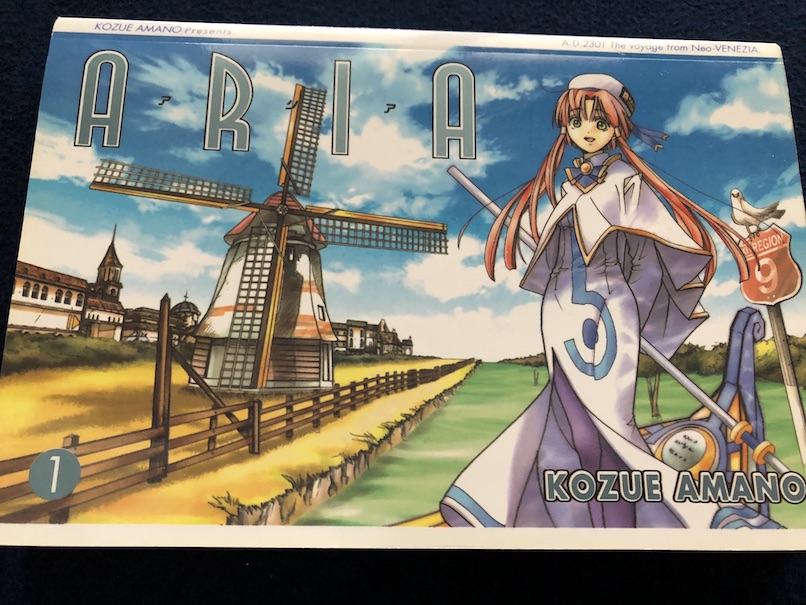
Aria Volume 1

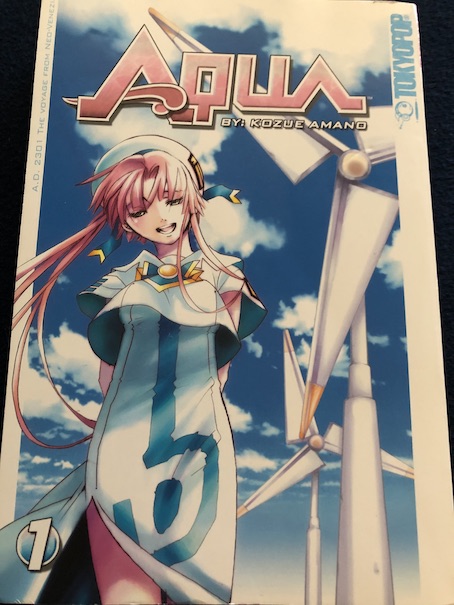
Aria Volume 1 by Kozue Amano, 2002, English Translation 2004.

The is the first volume of the second part of a fascinating manga series that combines sci-fi, fantasy, and slice of life. The series takes place about 300 years in the future, when Mars has been terraformed and renamed Aqua (because of all the water on its surface). The human colonies on Aqua are designed to resemble old-fashioned cities on Earth (called Manhome here). The people of Aqua prefer a much slower pace of life than people on Manhome, and aspects of life on Aqua more closely resemble Earth’s past.
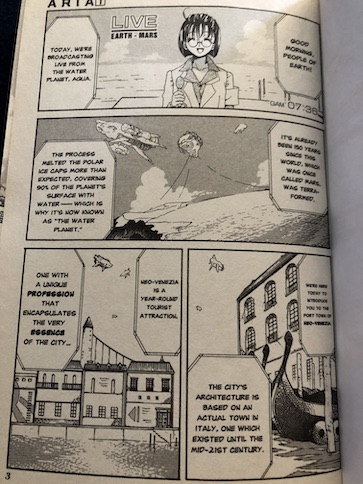
The series is divided into two parts. The first two books are the Aqua volumes and introduce Akari Mizunashi, the main character, a young girl who came to Aqua to learn to become a gondolier in the city of Neo Venezia (which resembles Venice). Female gondoliers, called Undines, give tours of the city, giving Akari plenty of time to admire the beauty of her new home and meet interesting people. The two Aqua books are the prequel to the main series, Aria. Aqua covers Akari’s arrival on the planet, her introduction to life on Aqua, and the beginning of her training. The main Aria series show Akari’s continuing training, her progression to becoming a full Undine, her evolving relationships with her friends, and as always, her delight in learning more about her new home and admiring its beauty.

The series has received some criticism for being slow and lacking danger and adventure, but that is not really the point of the series. The main purpose is to show people how to appreciate the small pleasures of life. The sci-fi and fantasy elements (the spaceships, advanced environmental controls, intelligent Martian cats, and even the occasional appearances of the legendary Cait Sith) are mainly background to the stories about the magic of friendship and simple pleasures. Each volume contains a few short stories about Akari and her friends and the little adventures they have on a daily basis and the life lessons they learn. It’s a great series for relaxing when you’re stressed out.

The stories included in this volume are:

Neo-Venezia

As autumn comes to Neo Venezia, Akari encounters a grumpy old man, a visitor from Earth, who has gotten separated from his daughter and lost in the city. He is frustrated with the confusing and inconvenient nature of Neo Venezia.
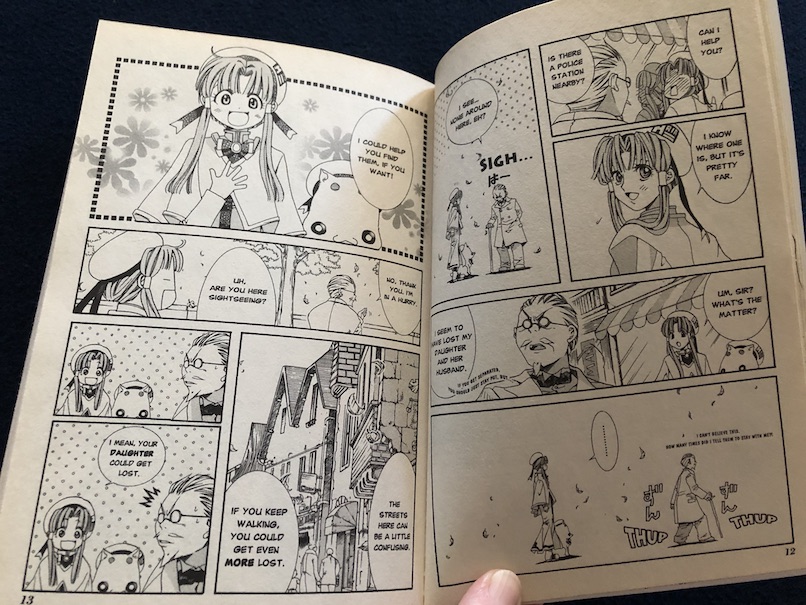
Akari says that she can help him find his daughter and gives him a tour of the city, showing him the beauty of the city and changes his mood with the help of some baked potatoes and green tea. A slower pace of life and appreciation for the little pleasures has benefits.

Drydocking

It’s time for the gondolas to be cleaned, so they are moved onto dry land. Akari and her friend, Aika are in charge of the cleaning, but it is Akari who makes it fun.

The Bridge of Sighs

Like the original Venice, Neo-Venezia also has a “Bridge of Sighs.” Akari goes there one day to meet Aika and finds her friend, Akatsuki, waiting for someone. Akatsuki is impatient while he is waiting, so he convinces Akari to give him a short tour to pass the time. Akari tells him about the original Bridge of Sighs and how she thinks the name is still appropriate but for a different reason.
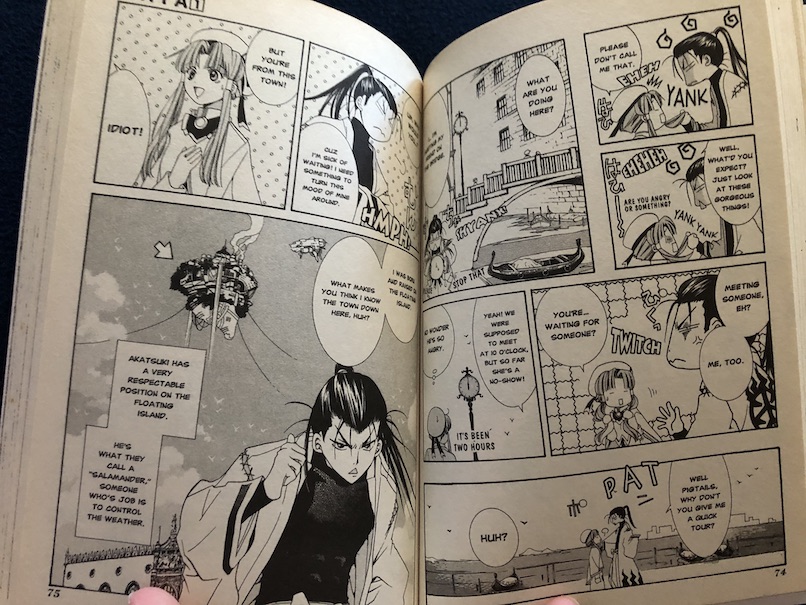
The original Bridge of Sighs, as Akari explains, was between an old courthouse and a prison, and the prisoners were said to sigh as they crossed the bridge because they were being led away to be incarcerated. However, Akari sighs because she likes living in the beautiful city of Neo-Venezia and feels like she’s lucky to be there. Her sigh is a sigh of contentment.

When the person Akatsuki is waiting for shows up, it turns out to be his older brother, who also appears in later stories.

Sun Shower

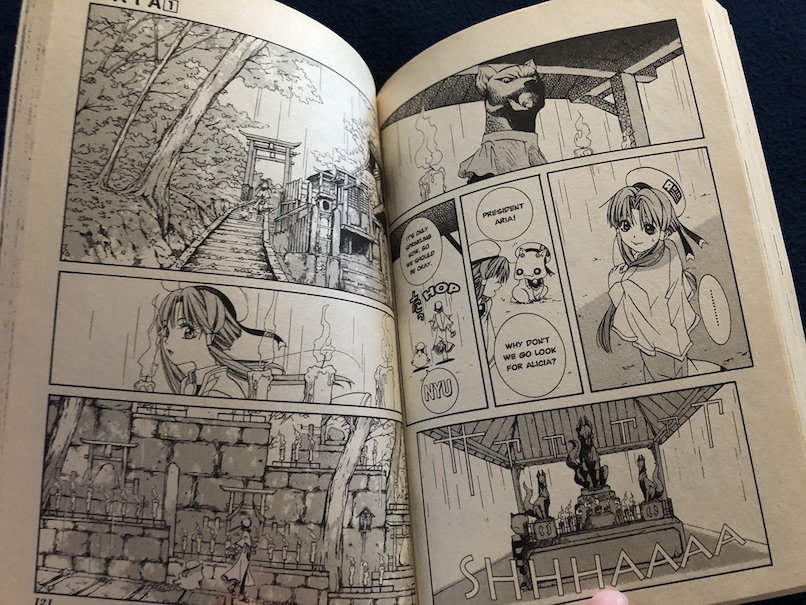
Although Akari lives in Neo-Venezia, which is designed to look like Venice, there are other parts of Aqua designed to look like different parts of Earth. Alicia takes Akari to an area much like Japan to see the changing autumn leaves and get some inarizushi.

They see a shrine on the island, and the woman at the sushi shop tells them a Japanese legend about the fox’s wedding, giving them a warning that the Inari fox might spirit them away to another world.

While admiring the red autumn leaves, Akari finds herself separated from Alicia, and she witnesses a strange wedding procession. When she seems to be invited to join it, she thinks quickly and gives the procession her inarizushi instead.

The story explains that a Japanese term for a sun shower (when it rains while the sun is still shining) is “the fox’s wedding.” Sun showers happen quite often when it rains where I live in Arizona, and I now think of this when I see one. I also know where to get some inarizushi. The Aria stories are good for making me want different types of food, whether it’s inarizushi or baked potatoes and green tea or pudding (from a previous book).
Vogare Longa

This story is based on a real gondola race that takes place in Venice.

Akari and Aika are told about the Vogare Longa gondola race, which all of the gondoliers, including the trainees, will participate in. Aika is determined to make a good showing in the race because there’s a rumor that it is used to judge trainees, but Akari gets caught up in the beauty of the day.

In the end, Akari admits to herself that she never forgot what Aika said about the race being used to judge trainees, but she just didn’t want to hurry because she was enjoying herself, and that’s the way she feels about her training in general. Akari wants to become a full Undine, but she wants to do it at her own pace and enjoy herself along the way.

It turns out to be just as well because the rumor about the race being used to judge trainees was only a rumor.

Aqua Volume 2

Aqua Volume 2 by Kozue Amano, 2003, English Translation 2008.

The is the second volume a fascinating manga series that combines sci-fi, fantasy, and slice of life. The series takes place about 300 years in the future, when Mars has been terraformed and renamed Aqua (because of all the water on its surface). The human colonies on Aqua are designed to resemble old-fashioned cities on Earth (called Manhome here). The people of Aqua prefer a much slower pace of life than people on Manhome, and aspects of life on Aqua more closely resemble Earth’s past.

In the previous volume, a young girl, Akari Mizunashi, came to Aqua to learn to become a gondolier in the city of Neo Venezia (which resembles Venice). Female gondoliers, called Undines, give tours of the city, giving Akari plenty of time to admire the beauty of her new home and meet interesting people.

The two Aqua books are the prequel to the main series, Aria. Aqua covers Akari’s arrival on the planet, her introduction to life on Aqua, and the beginning of her training. The series has received some criticism for being slow and lacking danger and adventure, but that is not really the point of the series. The main purpose is to show people how to appreciate the small pleasures of life. The sci-fi and fantasy elements (the spaceships, advanced environmental controls, intelligent Martian cats, and even the occasional appearances of the legendary Cait Sith) are mainly background to the stories about the magic of friendship and simple pleasures. Each volume contains a few short stories about Akari and her friends and the little adventures they have on a daily basis and the life lessons they learn. It’s a great series for relaxing when you’re stressed out.

The stories included in this volume are:

My First Customer

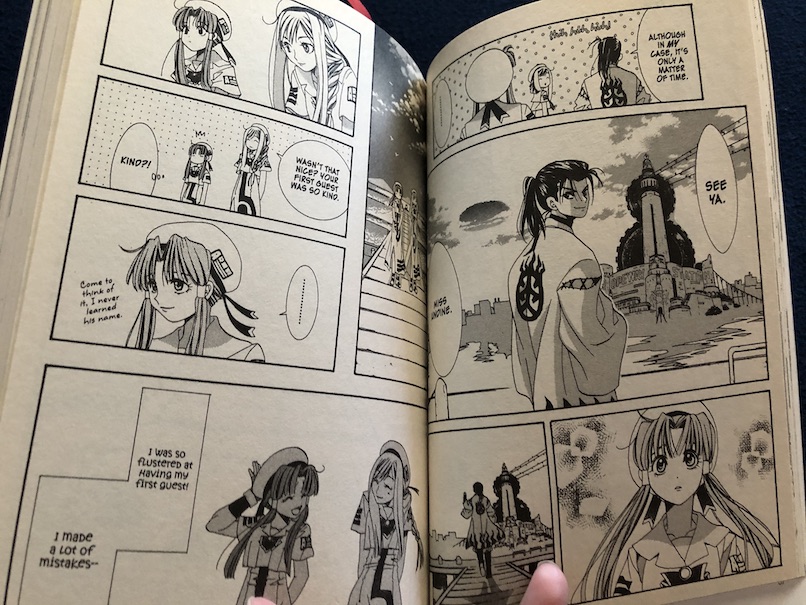
Akari gives her first customer a ride in her gondola. Although she makes mistakes, it is still a memorable experience, and she makes a new friend. Her ability to row a boat very fast backward even comes in handy!

It’s good to read the books and stories in this series in order because characters reappear. Akari’s first customer is Akatsuki, who is a trainee “Salamander” who lives on the floating island of Ukijima above Neo Venezia, which is reached by cable cars. Because Akatsuki spends most of his time on Ukijima, he tends to get lost when he comes into town. He becomes an important character who makes regular appearances through the books. There’s a story later in this book that explains more about his job.

It’s Hard Being President

President Aria feels useless because he can’t help with the spring cleaning. He decides that he isn’t a good president to Aria Company and tries to run away from home but learns that there is nowhere else where he is happy and that his friends still love him.


Night-light Bells

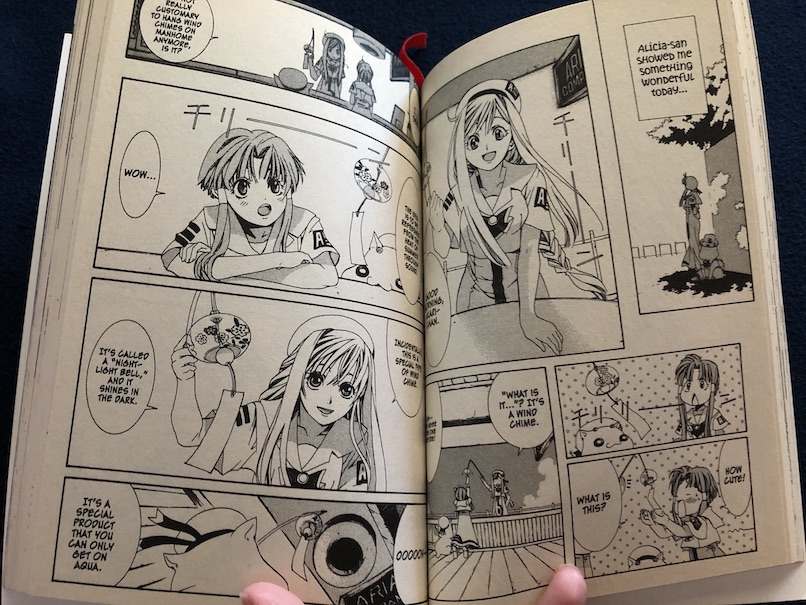
In the summer, people in Neo Venezia buy special night-light bells, chimes that glow in the dark.

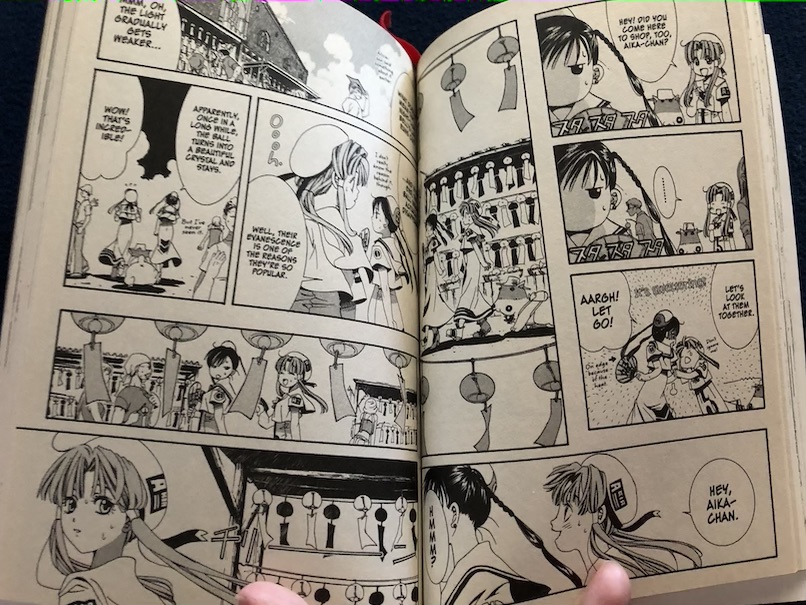
These bells do not last forever because the glowing center eventually falls out, but sometimes they leave something special behind besides happy summer memories, a tiny crystal.

Akari goes to a night light bell festival and gets a night light bell of her own. The night light bells are a cheery part of summer, and when it’s time for them to expire, the people of Neo Venezia have a special ritual to return the glowing centers to the water when they fall out. However, Akari is lucky and gets one of the bells that has a tiny crystal when the center falls out.

I like this story because I think that the idea of having glow-in-the-dark wind chimes is really charming.

Enter the Hero!

President Aria dreams of being a super hero, like the hero of his favorite television show.

His attempts to be an ally of justice aren’t very successful until he discovers that even doing something small can make a big difference, returning a lost toy to a grateful child.


Fireworks

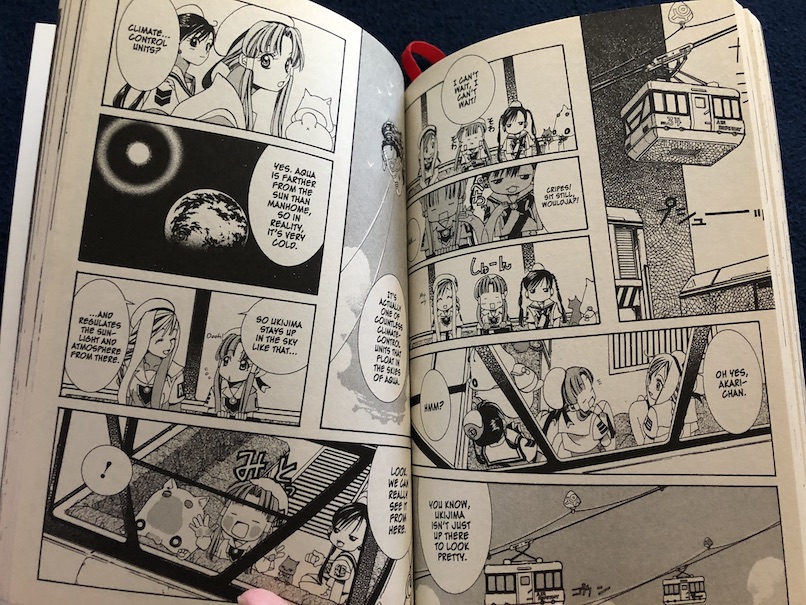
Akari and her friends visit the floating island of Ukijima where her friend, Akatsuki, is learning to be a Salamander. Salamanders help control Aqua’s climate. Because Ukijima is anchored above Neo Venezia, they have to use a cable car to get there, and Akari thinks that the view is amazing, like she’s flying when she’s there.

Akari and her friends have dinner wtih Akatsuki, and he shows them around and explains more about how Ukijima works and what his job as a Salamander involves. Neo Venezia experiences different seasons and different types of weather, but the Salamanders help to regulate it and keep it safe for the residents by controlling the amount of heat released into the atmosphere. The processes behind some of the technology on Aqua sound almost magical.

There are many amazing things on Ukijima, but Akari is most entranced by her first fireworks show. Even though Akari has never seen fireworks before, she finds herself connecting with the nostalgia surrounding them, which she realizes is a feeling that surrounds everything on Aqua and in Neo Venezia because the style of living is more old-fashioned than on Earth/Manhome.


Colds and Pudding

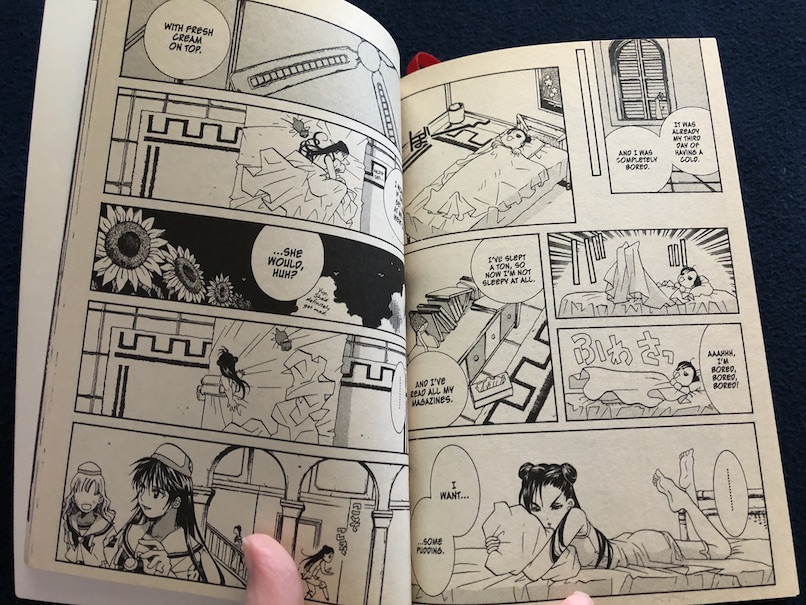
Akari and another friend, Alice (who you don’t really get to meet until the Aria series begins – she’s another trainee Undine), go to visit Aika, who is sick with a cold. They find her upset and learn how a simple trip to get some pudding led to a disturbing epiphany for her.

Aika was bored, hungry, and tired of staying in her room, so she decided to sneak out to get some pudding.

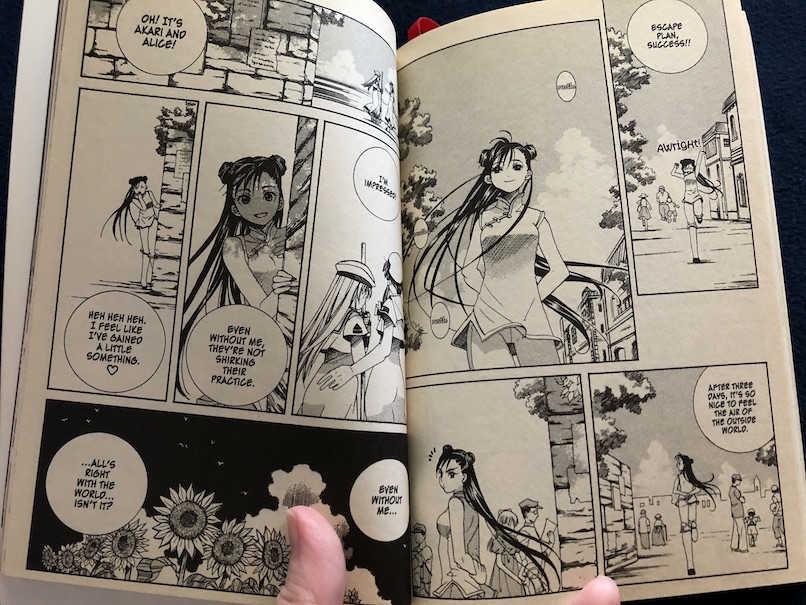
While she was walking through the streets, enjoying her freedom without anyone knowing she that she was gone, she caught sight of Akari and Alice practicing their rowing. At first, Aika is amused that she can spy on them without them noticing her, but then, she gets a strange feeling, realizing that, under normal circumstances, she would be practicing with them, but she can’t be with them now.

It feels eerie to her to see people going on with their day without her, as if she didn’t exist or that her absence doesn’t matter. Aika gets so spooked by the feeling that she runs home and goes back to bed, crying.

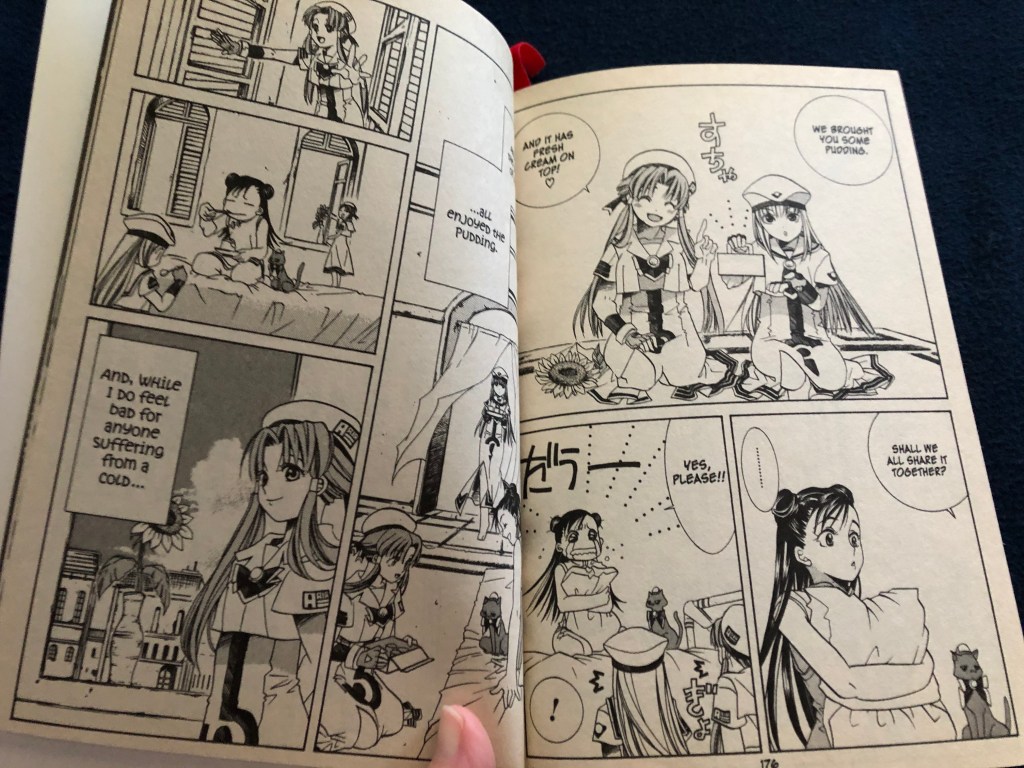
However, Aika’s friends do miss her and are thinking about her while she’s sick, and they know exactly what she needs. Trust your friends to help you feel better (and bring you pudding) when you need it!

This is the story that convinced me to learn how to make pudding from scratch one day when I was sick at home. You don’t have to go out and get creepy feelings when you know how to make pudding yourself! Pudding is an easy dessert to make; it just takes awhile to thicken on the stove.

Aqua Volume 1

Aqua Volume 1 by Kozue Amano, 2003, English Edition 2007.

I debated at first about whether or not I wanted to include any Japanese manga or light novels in this blog. When I was in high school and college, I knew a lot of people who were really into anime and manga, and I know that there are teens who still are, and my overview of children’s literature in different decades wouldn’t be complete if I didn’t mention that. However, the variety is pretty extensive, some of the series run very long, and it’s impossible to just skip around in some series because the story-telling is very linear, and I didn’t want them to take over the blog. Also, I tend to like the less popular ones, so I’d be bound to get some grumbling from manga fans about why I chose these when there are so many others that are more exciting or more iconic. Notice that I didn’t say “better.” “Better” is subjective, and I like what I like. I decided to go ahead and make an exception in this case because this is one of my favorite manga series and because I think this is something that people could really use right now. The stories are very calming, and they’re good to read during stressful times.

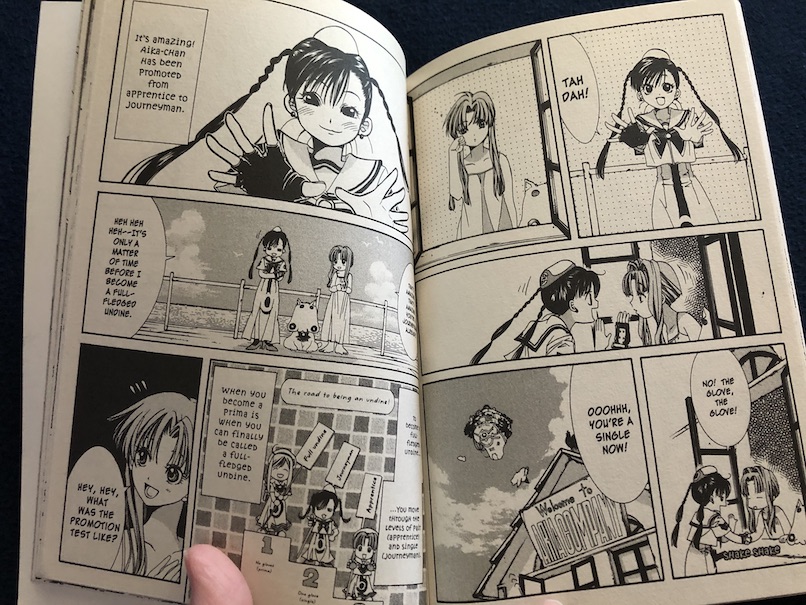
This book is the first volume of a series. I don’t have them all because they haven’t all been published in English yet, but know how it ends, and it’s a really good series with a happy ending. If you’re not familiar with manga, they’re basically graphic novels from Japan. I can’t read Japanese, so I rely on the English translations. However, manga like this typically follow the Japanese format of reading from right to left instead of left to right, like in English, so the books open and the pages flow in the opposite direction. When you look at the panels on a page, remember to look at them in right to left order.

The Aqua and Aria series is unusual because it combines elements of science fiction and fantasy, but most of the stories themselves aren’t really either science fiction or fantasy. That’s just the setting for the stories. The stories themselves are more slice-of-life, about daily events or small adventures in the lives of the characters and sometimes lessons they learn from them. There is a lot of emphasis on slowing down and enjoying the simple pleasures in life.

The series takes place in the future, when Mars has been terraformed and renamed Aqua (because of all the water on its surface). The human colonies on Aqua are designed to resemble cities on Earth (called Manhome here). The people of Aqua prefer a much slower pace of life than people on Manhome, and aspects of life on Aqua more closely resemble Earth’s past.

A young girl, Akari Mizunashi, comes to Aqua to learn to become a gondolier in the city of Neo Venezia, which resembles Venice. Female gondoliers, called Undines, give tours of the city, giving Akari plenty of time to admire the beauty of her new home and meet interesting people.

There are two parts to this series, called Aqua and Aria. The two Aqua books are the prequel to the main series, Aria. Aqua is only two volumes long, and it covers Akari’s arrival on the planet, her introduction to life on Aqua, and the people who will be her friends. In the Aria books, Akari progresses in her training as an Undine. All of the books in both series contain several short stories.

This book, the first one in the Aqua series, focuses on Akari’s arrival on Aqua and her friendship with Aika, the first fellow Undine trainee she meets.

The stories included in this first volume are:

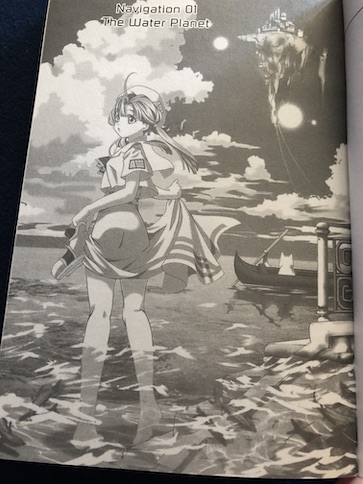
The Water Planet

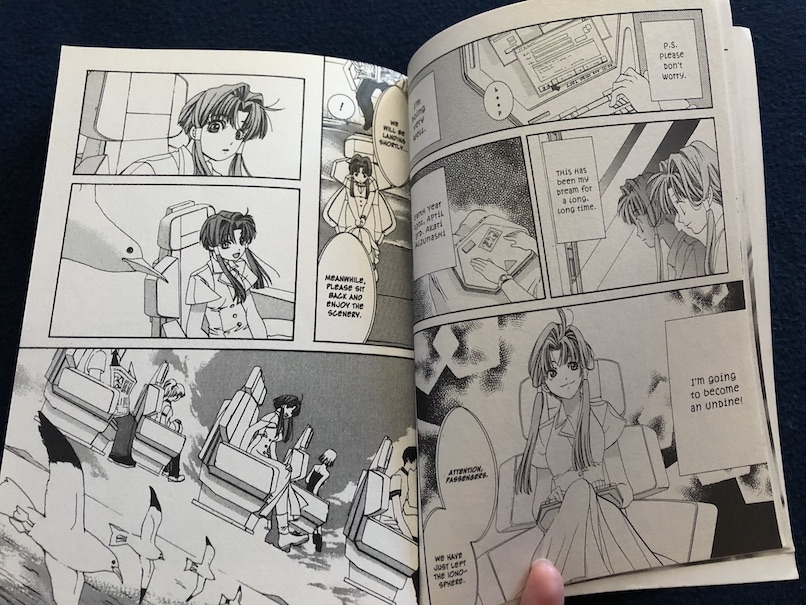
The series begins with Akari Mizunashi on the shuttle carrying her from Manhome to Aqua. She is typing a message to someone on her computer, but there is nothing to indicate who she is writing to. This is a running theme throughout the series, but the identity of Akari’s pen pal isn’t revealed until the very end of the series, and it wouldn’t make sense if I told you who it is right now. Akari explains a little about the history of Mars/Aqua, and how the melting of Mars’s polar ice caps during the terraforming of Mars 150 years earlier has turned it into a water planet, earning it the name Aqua. Currently, the year is 2301.

One of the nice things about the Aqua/Aria series is the imagery. As Akari’s shuttle arrives at Mars/Aqua, the walls of the shuttle turn transparent, so the travelers can feel like they’re flying in with the seagulls.

On Earth/Manhome, Akari lived in Tokyo, Japan. The modern cities of Manhome are very tidy and convenient, with people able to work and shop from home. Still, Akari has felt like something is missing from her life in all the convenience and tidiness. In Neo Venezia on Aqua, people rely on boats constantly to help them get around town, which is inconvenient, but Akari finds it calming and peaceful, which is why she wants to become an Undine, one of the female gondoliers who act as tour guides and help travelers to navigate Neo Venezia. Overall, life on Aqua and in Neo Venezia has a much slower pace than that on Manhome.

Akari arrives on Aqua and meets a friendly mailman and the only two employees of the gondola company she will work for: her mentor, Alicia, and the company’s president, a Martian cat named Aria. All gondola companies on Aqua have a Martian cat as their mascot/president. Alicia explains that Martian cats are as intelligent as humans, even though they can’t talk, but in many ways, President Aria still acts like a very large kitty.

The Guide on the Water

Akari wakes up on her first morning at the gondola company Aria, and she meets Aika, who is a trainee at Himeya, another gondola company. She catches sight of Aika hanging around, watching Alicia, and Aika witnesses Akari’s first time practicing in a gondola under Alicia’s watch.

Akari is embarrassed to learn that when she practiced rowing on Manhome, she was doing it backwards, standing in the front of the boat, which would block the view of her passengers. Because Akari practiced the wrong way on Manhome, she can row very fast the wrong way, but is clumsier when she tries to row the correct way.

However, Aika tells Akari that Alicia is the best of the Undines, and Akari is reassured that under Alicia’s guidance, she will do better. Aika hero-worships Alicia (for reasons that are explained further in later books), and she agrees to become Akari’s friend partly so that she can see more of Alicia. Aika and Akari become best friends through the course of the books, sharing their training and adventures.

The City Submerged

Akari wakes up one morning and is shocked to find that the lower floor of Aria company has flooded, but Alicia explains to her that this is a natural phenomenon in Neo Venezia in Spring.

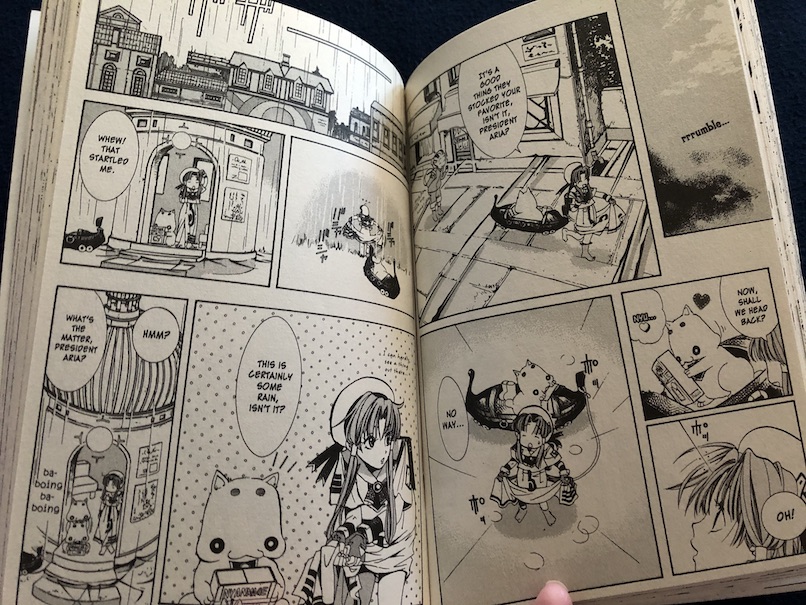
Much of the city is flooded during this high tide, causing many of the businesses in town to close temporarily and making it unsafe to go out in gondolas. However, when President Aria needs more of his favorite food, Akari decides to venture into the city on foot.

On the way home, Akari and Aria are stranded when it starts to rain and travel become more dangerous, but Aika sees them and invites them to spend the night at Himeya Company with her. Himeya Company is a much larger gondola company than Aria Company, with many more employees living there.

Aika and Akari have a sleepover in Aika’s room, and Aika asks Akari who she’s always writing to, but Akari tells her that it’s a secret. When the rain stops, Akari admires the view of the water by moonlight. (There are two moons in the sky because this is Mars.)

The Kingdom of Cats

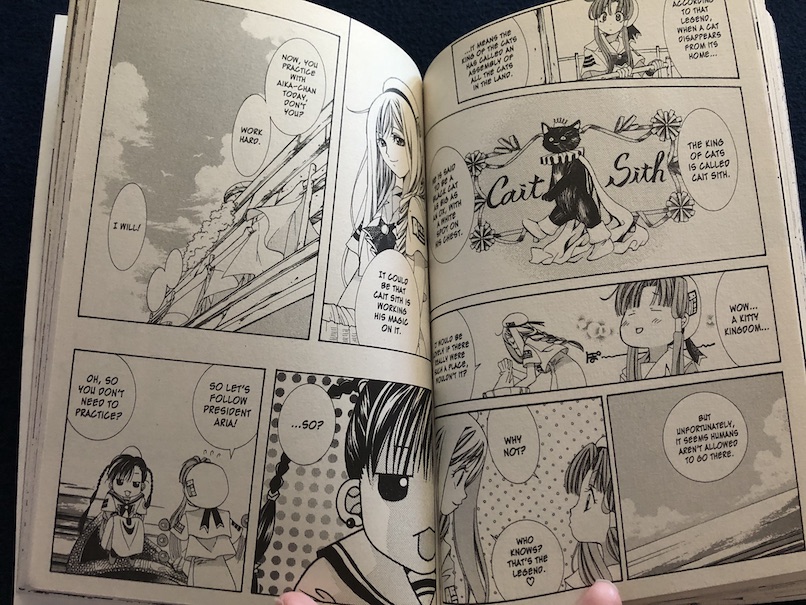
President Aria sometimes ventures off alone, and Alicia tells Akari the story of Cait Sith and the mythical kingdom of cats.

When Akari and Aika practice their rowing together, Akari convinces Aika to help her follow President Aira to see if there’s any truth to Alicia’s story perhaps get a look at the kitty kingdom ruled by the legendary king of the cats, Cait Sith.

However, the trip is stranger than they bargained for. The girls find themselves on a strange waterway through apparently abandoned buildings, going around in circles until President Aria points the way out. Akari only gets a glimpse of the cats before they leave.

The Hill of Hope

Aika shows up at Aria company one morning to brag about how she has been promoted to single (the next step up in gondola training, as shown by the gloves that the girls wear – as the trainee Undines learn the techniques to row their boats more skillfully, they get fewer callouses and need their gloves less, removing them one at a time as they are promoted to new levels).

Akari tries to ask Aika what the promotion test is like, but Aika refuses to tell her. The Undines traditionally keep the test a secret from their trainees until they pass the test. When Alicia hears about Aika’s promotion, she decides to take Akari on a special picnic, giving her the opportunity to prove her skills and introducing her to the concept of aquatic elevators, or canal locks. There is a special surprise for Akari at the end of the journey.
The Halloween Tree

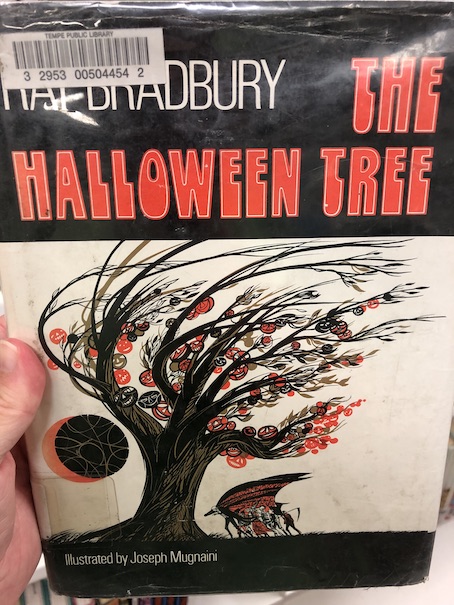
The Halloween Tree by Ray Bradbury, 1972.

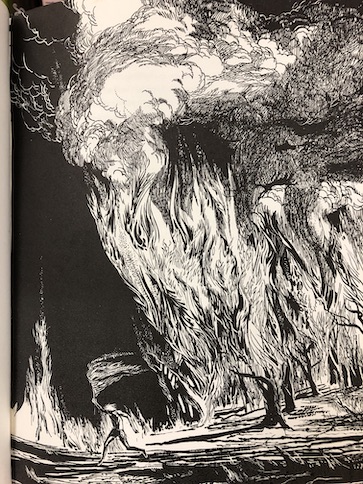
A group of neighborhood boys want to go trick-or-treating on Halloween night, but they’re upset because it looks like a friend of their, Joe Pipkin, won’t be coming with them.  When they get to Pipkin’s house, he seems ill and is clutching his side.  His friends worry that he’s sick, but he valiantly reassures them that he’ll be fine.  He sends them on, telling them that he’ll catch up with them and that his costume will be great.  Specifically, he tells them to “head for the House” which is “the place of the Haunts.”

The house that Pipkin is talking about is the creepiest house in town.  It’s large, so large that it’s hard to tell how many rooms it has.  The boys knock on the creepy-looking door knocker on the front door, and a man answers the door.  When the boys say, “trick or treat,” the man says, “No treats.  Only—trick!”  Then, he slams the door without giving them anything.

Not knowing what else to do, the boys walk around the side of the house and see a large tree, filled with jack o’lanterns.  This is the Halloween Tree.  The strange man they saw before rises up from a pile of leaves and scares the boys, giving them the “trick” that he promised them earlier.  He finally introduces himself as Carapace Clavicle Moundshroud.  He begins talking to them about the history of Halloween and asks them if they understand the real meanings behind the costumes they have chosen.  The boys admit that they really don’t know the meanings behind their costumes, and Moundshroud points off into the distance, calling it, “The Undiscovered Country.”  He says that out there likes the past and the history of Halloween and that the boys will learn the answers if they’re willing to go there.  The boys are interested, but they say that they can’t go anywhere without Pipkin, who promised that he would come.

Pipkin suddenly appears in the distance, by a dark ravine, holding a lit pumpkin.  He says that he doesn’t feel well, but he knew that he had to come.  Pipkin trips and falls, and the light in his pumpkin goes out.  From a distance, the others hear him calling for help.  Moundshroud says that something bad has happened.  Pipkin has been taken away to The Undiscovered Country by Death.  Moundshroud says that Pipkin may not be taken permanently but perhaps held for ransom and that, if they follow Pipkin to The Undiscovered Country, they might be able to get his soul back and save his life.

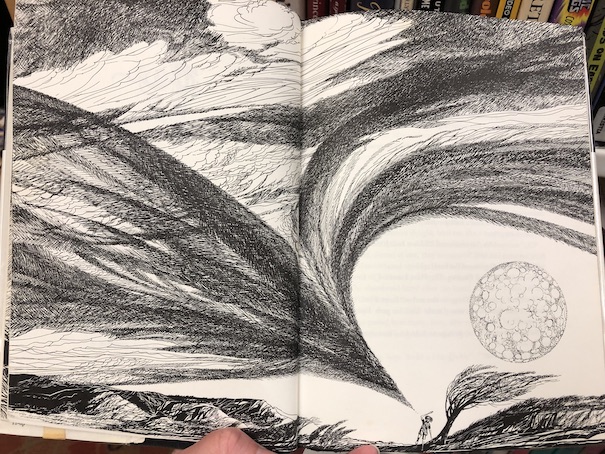
Moundshroud has the boys build a kite that somewhat resembles a pterodactyl, and they use it to travel into the far distant past.  The first place they arrive is Ancient Egypt, where the boys learn about mummies and how the Ancient Egyptians viewed the dead.  They see Pipkin as a mummy, being laid to rest in a sarcophagus, surrounded by hieroglyphs, telling the story of his life.  (Or, as Moundshroud says, “Or whoever Pipkin was this time around, this year, four thousand years ago,” hinting that Pipkin has been reincarnated before and what they are seeing during their journey are his past lives and deaths.)  Pipkin calls out to his friends for help.  Moundshroud tells the boys that they can’t save Pipkin now, but they’ll have a chance later.

They continue their journey through time and around the world, seeing glimpses of Halloweens past in Ancient Rome and the British Isles, where they learn about druids, Samhain, and witches.  Moundshroud describes how the Romans supplanted druidic practices with their own polytheistic religion until that was eventually replaced by Christianity.  All along, they can still hear Pipkin calling to them, and he seems to be carried off by a witch.  As they pursue him, Moundshroud teaches them the difference between fictional witches and real-life witches, which he characterizes as being more like wise women, who don’t really do magic.

From there, they go to Notre Dame to learn about gargoyles.  They continue to see Pipkin in different forms, even as a gargoyle on the cathedral.  Pipkin tells them that he’s not dead, but that he knows that part of him is in a hospital back home.

In Mexico, the boys experience Dia de los Muertos and learn about skeletons and a different kind of mummy from the ones they saw in Egypt.  They find Pipkin, held prisoner in the catacombs by the mummies, and Moundshroud tells the boys that the only way to save him is to make a bargain, both with him and with the dead: each boy must give one year from the end of their lives so that Pipkin may live.  It is a serious decision, for as Moundshroud says, they won’t miss that year now, being only about 11 or 12 years old, but none of them knows how long they will actually live.  Some of them who were destined to die at 55 would now only make it to 54, and as they reach the end of their lives, the year will seem that much more important to them.  Even those who live longer will still want every day they can possibly have.  However, each decides that he is willing to make the sacrifice because, without that sacrifice, Pipkin has no chance, and they can’t just let him die.

They make the bargain and are soon returned home.  When they go to Pipkin’s house to check on him, they are told that Pip is in the hospital because he had his appendix taken out, just in time to save his life.  At the end of the story, Tom (who is the leader of the boys through most of the story), wonders silently who Moundshroud really was, and he hears in his mind, “I think you know, boy, I think you know.”  Tom asks him if they will meet again, and Moundshroud says that he will come for Tom many years from now, confirming that Moundshroud was Death all along, which was why they had to make the bargain with him.

I saw the animated movie version of this story long before I read the book, and it really gave me the creeps!  Moundshroud is creepy because he is kind of two-faced.  On the one hand, he seems somewhat helpful in helping the boys to find Pipkin and teaching them about the history of Halloween, but on the other, he does not admit to the children that he is Death until the very end, that he is the very thing that they need to save Pipkin from, and that they can only do it by offering a sacrifice of years from their own lives. Although it does occur to me that Moundshroud may not be quite as two-faced as he seems because Pip’s illness and potential death may not have been planned by him but simply the fated situation for Pip, and Moundshroud might have just taken it upon himself to provide a way for Pip’s friends to save him in the least painful way. By not telling them that a sacrifice of part of their lives would be necessary until the very end, after they had come to a better understanding of life and death in the history of Halloween, he may have made the choice easier for them to make. Also, he never says exactly how much time they bought for Pip with their sacrifice. The implication is that Pip is now free from his early appointed death date and will now live a full life, similar to what his friends will have. The exchange does not seem to be an even one, a year for a year, with the children needing to decide how many years they will donate to Pip. Although the kids still don’t know at the end how many years each of them will live, it seems that none of the rest of them is in danger of dying in childhood, and they will all live for many more years.

I wouldn’t recommend this book for young children (it still gives me the creeps, and I’m in my 30s), but it is interesting how they take a journey through the origins of Halloween. The book and the movie were somewhat different, partly because there were more kids in the group in the book and partly because the group of kids in the movie also had a girl in a witch costume. In the book, the kid in the witch costume was also a boy.

Both the book and the animated movie are available online through Internet Archive.

Alien Secrets

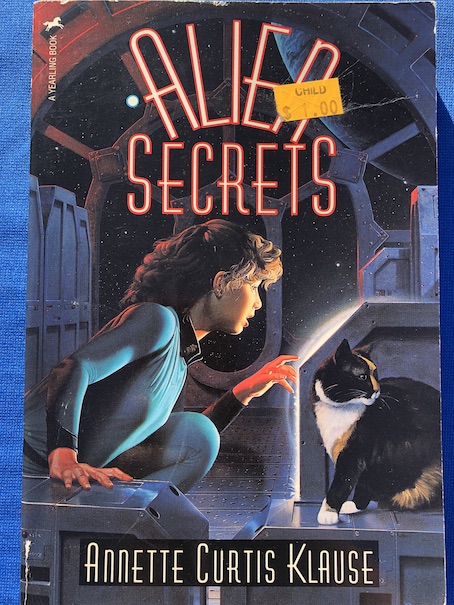
Alien Secrets by Annette Klause, 1993.

Robin Goodfellow, nicknamed Puck (her parents were fond of Shakespeare), is a human girl from Earth in the future.  When the story begins, she has been kicked out of boarding school on Earth and is traveling by space ship to join her parents, who are scientists who have been working on another planet.  They left Robin with her grandmother on Earth, who enrolled her in an English boarding school in order to give her some discipline and some friends her own age, but she was expelled for failing her classes (not to mention throwing a fit and burning her books when she discovered that she had failed).  Puck dreads what her parents will say when she arrives on the planet where they are now living because they had always hoped that Puck would also become a scientist and work with them, but this journey will change Puck’s life.

Before the ship she will be traveling on leaves Earth, Robin witnesses a man attacking someone else, possibly killing him.  Robin does not report the attack because she doesn’t know whether or not the other person was killed, and she doesn’t think that anyone will believe her anyway.  She witnessed this attack while sneaking around a place where she wasn’t supposed to be, and she is being sent to her parents in disgrace after being expelled, so she doesn’t sound like a very credible witness.  However, the man in the fight, Mizzer Cubuk (“Mizzer” is how they say “Mister” in the book), turns out to be traveling on the same ship as Puck.  All Puck can think of to do is to try to avoid him on the ship and hope that he didn’t get a very good look at her after she ran away from his fight.

To Puck’s surprise, the captain of the ship she is traveling on, Captain Cat Biko, asks her if she could make friends with an alien who is also traveling on the ship.  The alien is one of the Shoowa, who were enslaved by another group of aliens called the Grakk.  Now, he is free and finally traveling home to Aurora, the same planet where Puck is going.  The captain feels sorry for him and thinks that he might appreciate a friend and that he might find a human child less intimidating than an adult.

Later, Puck and other passengers are woken out of their sleep by the sounds of wailing and moaning.  One of the women on board, Leesa, says that she saw something that looked like a ghost that walked straight through her. Other people, who didn’t see or hear it, assume that it was nightmares or imagination, but Puck knows that it wasn’t.  One of the crew members, Michael, tells Puck that there have been rumors that the ship is haunted and that other people have seen and heard strange things.

Strange things are happening on the ship, and some of the passengers seem to be hiding something. Who can Puck trust, and who isn’t who they seem to be?

The alien who is traveling on board the ship understands Puck’s feeling of failure.  The alien, called Hush, says that he carries shame because he lost something important, something that his people were counting on him to take home to their planet.  Puck and Hush discuss how people from Earth had fought the Grakk and sought to learn about Grakk technology from Shoowa slaves who were freed after the war.  Even the ship they are now traveling on was once a Grakk ship.  The Earth people kept delaying sending the slaves home because they wanted to pump them for more information and because they were trying to decide if they could really trust them more than the Grakk.  After negotiating with the Earth people about returning home, the Earth people agreed, with some provisions.  They arranged for some of the Shoowa to stay on the Grakk home planet, still working with humans.  Some of them would travel on ships with Earth people, and some others could go home to their own planet.  Hush is the first one to head home, and he was entrusted carrying home an important symbol of his people that his family had protected for generations: a statue that represents a child because children are the future and a source of freedom, according to an ancient Shoowa prophecy. Unfortunately, the statue was stolen from Hush before he could return it to its rightful home. He reported the theft to the Earth security personnel at the station, but they didn’t take him seriously. They thought that he probably just lost it by accident.

The haunting is real in this book.  On a tour of the ship, Puck learns that the ship’s navigator has also seen the ghost aliens.  One of the characteristics of a ship’s navigator is the ability to see hyperspace, something that not everyone has the ability to do, although even scientists in Puck’s future time don’t seem to know why some people can do that and others can’t.  Slowly, it becomes evident that people who are able to see hyperspace are also able to see the ghosts.

On the journey to Aurora, Puck also learns that she is one of the rare people who are able to see hyperspace, giving her a possible future in navigating a space ship, something that she would really enjoy learning.  When she arrives at Aurora and is greeted by her parents, who have missed her while they were apart, Puck also comes to realize that her parents will always love her, even in spite of failing her classes. Even Hush’s people tell him that, although they are happy to have the statue back, his safe arrival was always the most important thing, and they wanted him to come home, whether he successfully brought the statue or not. Both Hush and Puck come to realize that their families will always love and value them even with their imperfections and failings.  With parents who love her and a new vision of the future ahead of her, Puck is ready to make a new life on Aurora.

The book is available to borrow and read for free online through Internet Archive.

The Dreadful Future of Blossom Culp

DreadfulFutureBlossomCulpThe Dreadful Future of Blossom Culp by Richard Peck, 1983.

This book is part of the Blossom Culp Series.

It’s 1914, and Blossom Culp is just starting high school. Although the principal of her old school tells her that this is a chance for her to make a fresh start, it looks like Blossom’s future is going to be very much a continuation of her immediate past.  In high school, she’s still a social outcast, looked down on by girls from better-off families, like Letty, the class president.  Also, despite her principal’s assertion that Blossom’s previous forays into the occult were imaginary, the product of the mental confusion that accompanies puberty, and that she is bound to grow out of them, Blossom knows that her psychic abilities are a natural gift and will not be ignored.

Blossom begins high school friendless because Alexander Armsworth has been ignoring her lately because of his important new position as class vice-president, his infatuation with Letty, and his friendship with a couple of local hooligans, Bub and Champ. Alexander is looking forward to his role in planning the school’s Halloween Festival, telling Blossom that he’s over their earlier, childish occult escapades and the Halloween pranks he used to pull.  Meanwhile, all of the other girls in school are infatuated with their handsome history teacher, Mr. Lacy, and so is the girls’ gym teacher, much to Blossom’s disgust.  Blossom thinks that Mr. Lacy is full of himself and denies that she has any such silly crush on Alexander.

Blossom makes an unexpected friend in a girl called Daisy-Rae, a girl from the country who has brought her younger brother into town to attend school and hoped to get an education herself but has been too afraid of the big town to actually attend classes.  Daisy-Rae hides in the school during the day and lives alone with her brother at night in the old chicken coop at the abandoned Leverette house.  It is through Daisy-Rae that she learns that Alexander and his friends aren’t so above childish pranks as they claim to be.  Blossom also discovers that Mr. Lacy has been romancing her old principal.  Mr. Lacy isn’t quite what he appears to be and has some unsavory secrets in his past.

Matters come to a head when Alexander (at Letty’s urging) tries to persuade Blossom to dress up and become the fortune teller for the haunted house that the freshmen class is doing for the Halloween Festival.  The haunted house is also a fundraiser, and Letty figures that they can get extra money from people if they’re willing to pay to have their fortunes told, and who would be better for the job than Blossom?  However, Blossom isn’t one to go out of her way to please others, especially Letty, and it turns out that they’re holding the haunted house in the Old Leverette place.  For some reason, that old house makes Blossom’s mother uneasy.  She seems to think that it’s haunted, but in an unusual way.  Blossom tells Alexander that she will not agree to be their fortune teller until he agrees to check out the house with her before Halloween and find out what’s wrong with it.  She figures that, since both of them are psychic, they can learn what’s so unusual.

As Blossom learns, her abilities don’t confine themselves to the past and people who have died but extend to the future and the people who haven’t yet been born.  Inside the Old Leverette house, Blossom suddenly finds herself entering the distant future, the 1980s.  In the 1980s, the Leverette house is once again lived in, and Blossom meets a boy named Jeremy who is a lonely social outcast, like herself.  Jeremy is a computer nerd, living with his divorced mother.  He takes Blossom on a tour of their town as it is in Blossom’s future, much larger than it used to be and with many familiar landmarks missing.  However, what Blossom sees in the future gives her the inspiration she needs to solve her problems in the past and hope that things will improve.  In return, she also proves to Jeremy that he is far from alone and has had a friend for longer than he ever imagined.

The time travel to the 1980s comes off as being a little corny (or so it seemed to me), but the writing quality of the book is excellent.  The author has an entertaining turn of phrase, and the book, like others in the series, is humorous and a lot of fun to read.

Besides being a kind of fantasy story, there are some interesting tidbits of history in the book, showing how people lived in the 1910s.  Blossom explains about the things she and her classmates did at school, like wearing beanies on their heads to show which year they were (freshmen, future graduating class of 1918).  At one point in the story, Blossom takes Daisy-Rae and her brother to their first movie, a silent film with an episode of The Perils of Pauline serial.  While Blossom worries about the future, readers can get a glimpse of the past!

As for what Blossom learns about her own future, she avoids finding out too much because she’d rather not know the details.  However, there are implications that she and Alexander may eventually marry and live in his family’s old house.

The book is currently available online through Internet Archive.