Whose Garden Is It? by Mary Ann Hoberman, illustrated by Jane Dyer, 2001.
This is a cute picture book, told in rhyme, about who is the real owner of a garden.
One day, Mrs. McGee goes for a walk and passes a beautiful garden. She wonders aloud whose garden it is. Of course, the owner of the garden, who is tending the plants speaks up, but he’s not the only one.
A small rabbit also tells Mrs. McGee that the garden belongs to him because he’s lived there his whole life, and he eats the vegetables. Then, a woodchuck says that’s nothing because he eats everything that grows in the garden. A bird chimes in, saying he eats the worms from the garden. Then, a worm says that worms are there to make the soil in the garden better, so he’s the real owner of the garden.
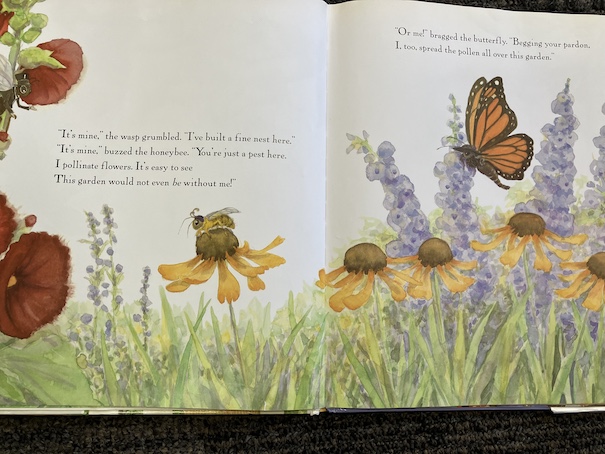
Various other creatures, big and small speak up, each of them pointing out that they live in the garden, what they’ve done for the garden, and what the garden has done for them. The bees and butterflies pollinate the flowers.
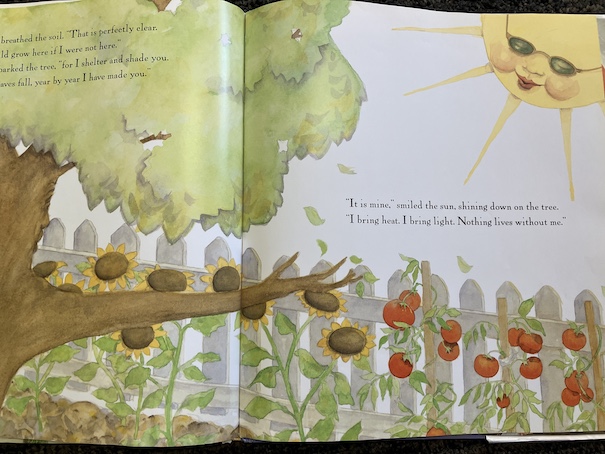
But what about the plants in the garden? They have a strong argument that they are what makes the garden a garden. Then again, the soil is where the plants grow, and the plants need the sun and rain to grow. Also, all plants grow from seeds, so the garden exists for the seeds that will be the future plants.
It seems that the answer to Mrs. McGee’s question isn’t as easy as she might have thought.
My Reaction
This is a charming story about how various plants, animals, creatures, and forces of nature are interconnected. The book doesn’t use the word “ecosystem“, but that’s the concept being described here. The garden’s ownership and the reason for its existence is much more than the gardener who owns the land and planted and tended the garden; it’s everything that’s growing in it, everything that contributes to its growth, and everything that depends on the garden. Without all of these creatures and natural forces put together, the garden wouldn’t be what it is.
The book doesn’t attempt to get scientific about the details of this garden ecosystem, and the animals wear clothes and talk, so the story isn’t meant to be entirely realistic. However, it is thought-provoking about how many different parts of nature affect each other. It could be a good book for introducing the topic to young children before teaching them about the science of ecosystems later. The rhyme scheme makes the story fun to read.
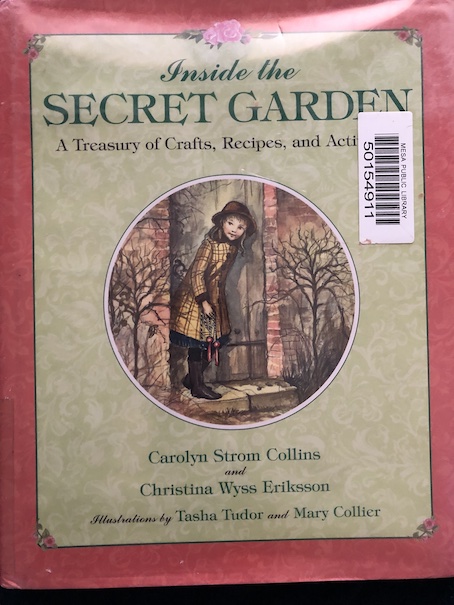
Inside the Secret Garden by Carolyn Strom Collins and Christina Wyss Eriksson with illustrations by Tasha Tudor and Mary Collier, 2001.
This is a how-to book with activities, crafts, and recipes that fit the themes in the classic children’s book The Secret Garden by Frances Hodgson Burnett. The book has some of the classic illustrations from The Secret Garden by Tasha Tudor, and there are also illustrations by Mary Collier.
The book begins with an explanation of the story of The Secret Garden and the life of Frances Hodgson Burnett. In the description of the author’s life, the book discusses some of the places where she lived and people she knew who provided inspiration for aspects of the story of The Secret Garden. There is also a timeline of world events during the author’s lifetime.
The second chapter describes the setting of the story with descriptions of Misselthwaite Manor and its gardens. It explains how a large manor house like Misselthwaite would function and the types of staff and servants it would have. It also explains the types of gardens and plants that would have been grown in the kitchen gardens of English manors and cottages.
The third chapter in the book has recipes and menus based on the foods the characters eat during the story. Food is important in The Secret Garden because Mary and Colin didn’t have appetites when they were unhealthy, but after their time working in the garden and getting fresh air and exercise, their appetites improved. The recipes in the book are based on things the characters eat during the story.
The recipes in the book include:
A pot of tea
Porridge (oatmeal)
Treacle (They use molasses with corn syrup and honey to make it.)
Orange marmalade
Homemade bread
Snow-white eggs (soft boiled)
Raspberry jam
Clotted cream
Muffins
Ham
Oatcakes
Doughcakes
Apple Crumble
Crumpets
Robin cake
Roasted eggs (The instructions call for cooking them in an outdoor stone oven, like they did in the book, but it also discusses how to make an indoor version.)
Roasted potatoes (The instructions call for cooking them in an outdoor stone oven, but it also discusses how to make an indoor version in a standard oven.)
Currant buns
A book of activities based on The Secret Garden wouldn’t be complete without gardening activities! The fourth chapter has suggestions for creating your own garden. The gardening tips and suggestions are based on the plants the characters used in The Secret Garden. I’m not sure all of them would grow well in every climate, and planting seasons can vary by region.
The gardening activities include:
Planting a spring bulb garden
Planting a rose in a flowerpot
Making an indoor “secret garden” with potted plants in a tray or pa
The fifth chapter has a selection of crafts and activities related gardening. They include things you can make to use in your garden and things you can make our of plants from the garden, including:
A twig tool holder
Plant labels (little signs for labeling plants in your garden)
Moss-covered flower urns
Key wind chimes
A planter in a watering can
A twig trellis
Pressed flowers and a pressed flower scrapbook
A bouquet of roses
A topiary flower arrangement
A miniature arrangement
A bird feeder
A bird bath
Nest-building station
It also explains how to make your own skipping rope, like the one Mary had in the book, and there is a section of traditional jump rope rhymes.
The book is available to borrow and read for free online through Internet Archive.
My Reaction
I liked the chapters about the history of The Secret Garden and the life of Frances Hodgson Burnett. I thought it was interesting to see some of what inspired her to write the story. I particularly like the chapter that describes how a manor like Misselthwaite would be run because I like seeing the historical background to stories.
I don’t think that the gardening tips are really universal. I grew up in Arizona, and I know from personal experience that plants and gardening techniques that would work well in cooler and wetter climates don’t work as well in a hot, dry desert climate. However, some of the garden-related crafts looked intriguing. I particularly like the idea of the wind chime that uses old keys as the chimes. I’ve seen antique stores and places that sell crafting supplies that also sell old keys, so know it’s possible to get them.
I like the selection of recipes the book provides, and I think most of them would be pretty easy to make. The most difficult ones are probably roasted eggs and roasted potatoes because they require an outdoor oven, like the kind the characters in The Secret Garden used. The book briefly describes how to make the kind of outdoor stone oven they mean, but I don’t think that kind of oven can be built just anywhere. It’s more for camping and the countryside, where you can safely have fire pits away from buildings. Fortunately, the book also includes instructions for making those dishes inside, in a standard kitchen.
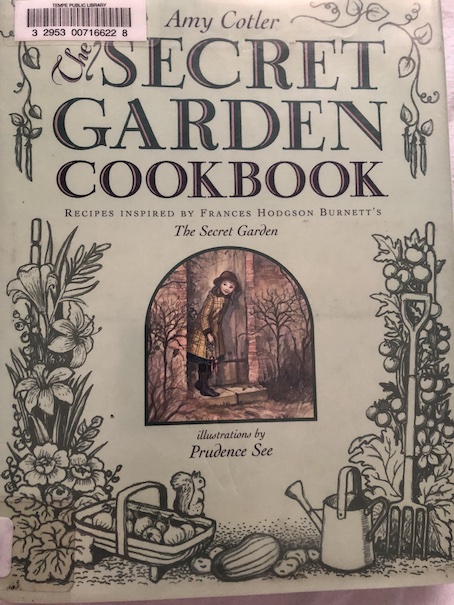
The Secret Garden Cookbook: Recipes Inspired by Frances Hodgson Burnett’s The Secret Garden by Amy Cotler, illustrations by Prudence See, 1999.
This book is a cookbook with recipes based on the types of foods eaten by characters in The Secret Garden by Frances Hodgson Burnett. Food is important in the story because Mary and Collin didn’t have any appetites when they were unhappy and unhealthy, but their appetites improve when they begin working in the garden and getting more fresh air and exercise. Most of the recipes are types of foods that are specifically named during the course of the story, but others are ones that the characters would have been likely to eat for the time and places where they lived. Because the original story focused on gardening, there is also an emphasis on using foods that would be grown in kitchen gardens
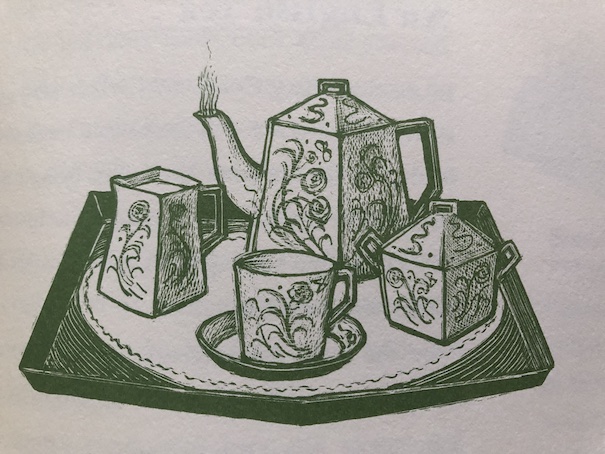
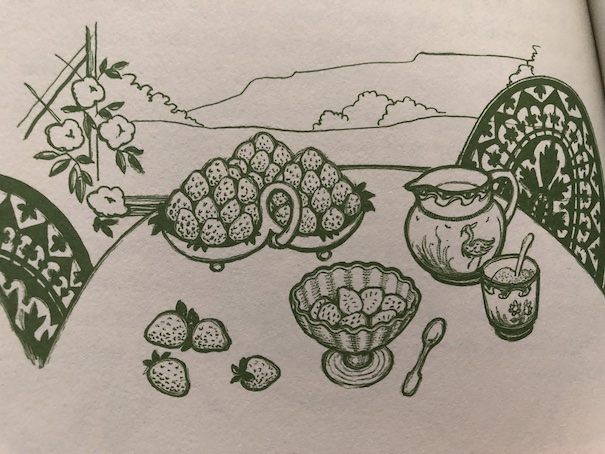
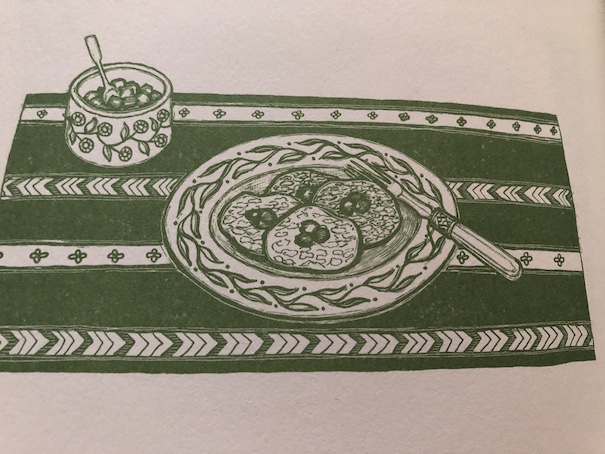
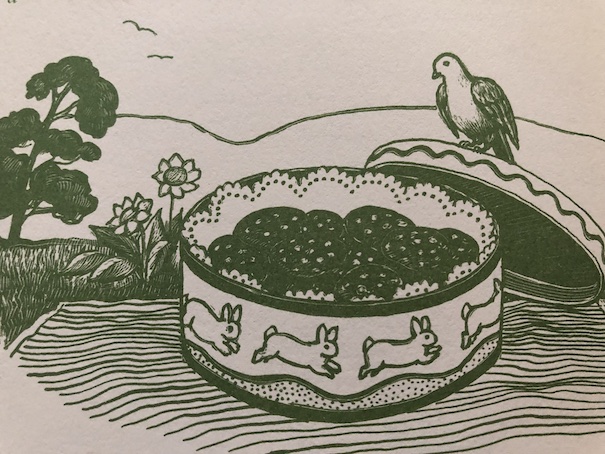
Most of the illustrations in the book are simple green and white drawings of different types of foods that accompany the recipes.
The recipes in the book are sorted into different categories, and each section has historical information about different meals and types of food. Individual recipes also have historical information, trivia, and quotes from The Secret Garden related to the dishes. Some traditional English foods need to be explained to Americans. For example, the word “pudding” refers to a specific type of dairy dessert in the US, but in England, it’s a more general word that can refer to any type of dessert.
I liked the selection of recipes, and I really liked the historical information provided with them!
The sections of the cookbook are:
Yorkshire Breakfasts
These are breakfast foods that the characters in the story ate or might have eaten during the Victorian era.
Porridge
Coddled eggs – Eggs cooked in a cup
Cheese muffins
Little sausage cakes
Cocoa
A Manor Lunch
This section explain the types of things that people of different classes ate as their mid-day meal in the Victorian era.
Yorkshire pudding – These are popovers with meat drippings.
Roasted fowl with bread sauce
Potato snow
Welsh rabbit – This is melted cheese on toast.
Cabinet pudding – This is a molded custard dessert with fruit.
Jam roly poly
An English Tea
This section explains things that Victorian people ate at afternoon tea.
A proper pot of tea
Cucumber tea sandwiches
Scones
Fruit tea loaf
Lemon curd tartlettes
Brandy snap baskets with whipped cream
The Kitchen Garden
This section is about things people would make from fruits and vegetables that they would grow in their kitchen gardens.
Fresh spring peas with mint
Glazed carrots
Summer pudding – This is a molded dessert made with bread and different kinds of berries.
Two fools – “Fools” are old-fashioned fruit-based desserts.
Raspberry jam
Raspberry vinegar
Molded spiced pears
Strawberries and cream
Dickon’s Cottage Food
Poor people, like Dickon’s family, would have eaten different things from the wealthier people in Victorian society.
Tattie broth – A potato soup.
Pease pudding
Yorkshire oatcakes
Cottage loaf – This is a basic bread recipe.
Dough-cakes with brown sugar – A basic dessert made with bread dough.
Parkin – A kind of oatmeal gingerbread.
A Taste of India
These are the types of foods that Mary might have eaten during the time she lived in India.
Fruit lassi – This is a kind of fruit shake made with yogurt.
Sooji – A hot breakfast cereal similar to cream of wheat.
Little bacon and coriander pancakes
Fresh mango chutney
Mulligatawny soup – This soup was invented in India for the British colonists. It’s curry coconut soup whose name means “pepper water.”
Florence Nightingale’s kedgeree – Florence Nightingale has nothing to do with the dish, but the Victorians named it after her because she was famous. It’s a rice and fish dish that was often made from leftovers and served for breakfast or lunch.
Garden Picnics
These are foods that can be prepared outside or are easy to pack for a picnic.
Roasted potatoes and eggs
Currant buns
Crumpets
Cornish pasties – These are savory pies or turnovers with meat and veggies, meant to be eaten with the hands. They’re sort of like larger, better-tasting Hot Pockets.
Chocolate picnic biscuits
The book is available to borrow and read for free online through Internet Archive.
Young Georgie Burgess has been abused his entire life by his mother, Rennie, and her boyfriend, Steve (who is not Georgie’s father, whose identity is unknown, Rennie says that she is a widow). Rennie is an alcoholic, and she and Steve (who is the source of most of the violence in Georgie’s life) once deliberately burned the side of Georgie’s face when he was a baby because he wouldn’t stop crying and they were angry that they had run out of whisky. Sometimes, they tie him up in a closet for days at a time with no food. Other times, they beat him, even leaving scars. When Rennie is confronted by the school nurse about Georgie’s injuries, she claims that Georgie is a problem child who gets into fights. Georgie’s teacher believes that because Georgie is always acting up and doesn’t appear to learn anything, although he is actually smarter than he pretends to be. Because the other adults in Georgie’s life either do not see his condition for what it is or do not want to acknowledge the truth of it, it is a long time before he gets the help he really needs.
Georgie’s early life is bleak, and at first, his future seems equally bleak. The only people who seem to care about him at all are the school librarian and Mrs. Sims, who works at the grocery store. Georgie’s real love in life is flowers. He likes to borrow a book from the school library about flowers, and one day, he enters a drawing at the store and wins a rose bush of his very own!
It’s the best thing that ever happened to Georgie, but shortly afterward, Steve beats him so badly that the police are finally called. Georgie is taken away from his mother, and for the first time, his life becomes different. Georgie insists on bringing his precious rose bush with him when the police take him away, and it becomes instrumental in helping him reshape his life.
For a time, Georgie has to stay in the hospital to recover from his injuries, and then he stays with Mrs. Sims. Unfortunately, as much as Mrs. Sims and her husband care for Georgie, they can’t afford to take care of him. Instead, Georgie is sent to a Catholic boarding school with his new teacher and guardian, Sister Mary Angela. Sister Mary Angela assures Georgie that he will be taken care of at the school and so will his rose bush.
Georgie thinks the school is ugly, but there is a beautiful house nearby with a beautiful garden. It belongs to Mrs. Harper, who lost her husband and one of her sons in a tragic car accident. Although Georgie isn’t supposed to go there, he can’t help himself. It seems like the the perfect place for his rose bush . . . and maybe even for himself.
The tragedies and descriptions of child abuse in this story make it inappropriate for young children. This would be a good book for kids at the middle school level, probably age twelve and up.
Georgie, who has never really known kindness in his life, blossoms like a rose at the school, making new friends for the first time and coming to terms with his past. At the same time, Mrs. Harper, who is still suffering from the loss of her husband and son and also loses her other son (a child with developmental disabilities) during the course of the book, finds her heart warmed by Georgie. Georgie has desperately needed a mother who acts like a real mother and really loves him, and Mrs. Harper comes to realize that she also needs a boy like Georgie to love. While he is not a replacement for the sons she has lost, he does help to fill an empty place in her life, and the two of them become the family that each of them needs.
The book is currently available online through Internet Archive.







 The Lottery Rose by Irene Hunt, 1976.
 Jestress's Forgotten Books and Stories