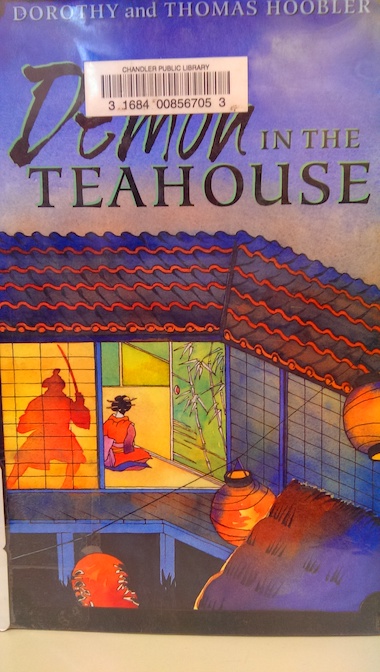
The Demon in the Teahouse by Dorothy and Thomas Hoobler, 2001.
This is the second book in the Samurai Detective series. Like other books in this series, it is not a book for young children!
Seikei is trying hard to learn all the things he must know as a samurai and Judge Ooka’s adopted son. One evening, while the judge is in Edo (now called Tokyo), he sends a message that Seikei and the other samurai must come immediately. Edo is in a state of emergency because of a series of fires that have been deliberately set in shops around the city. Although Judge Ooka helped to design a system of watch towers and fire brigades to help the city in case of fire, the threat of fire is still very serious because most of the buildings in Edo are made of wood.
The only clue they have to the person setting the fires is a geisha who was in one of the shops before it burned. Judge Ooka and Seikei go to the city’s pleasure district, Yoshiwara, where there are theaters and teahouses where geishas provide entertainment. While they are there, they learn that geishas have been dying under mysterious circumstances, and the people of Yoshiwara are afraid.
Judge Ooka has Seikei take a job as a servant at a teahouse in order to learn more. He soon discovers that the dead girls were all friends of Umae, one of the most popular geishas. Then, one of Umae’s many admirers brings her a present, and she is horrified to discover that it is the kimono that one of the dead girls was wearing. Who brought her the kimono, and what connection does she have to the fires?
The nature of the villain and the villain’s motives is rather dark for a middle school level book (although some middle school level books do get fairly dark). Although the reading level of the book would be fine for someone aged twelve to fourteen, the subject matter might make the story more appropriate for someone a little older. I recommend parental discretion on this one. (Remember, it takes place in the “pleasure district” of Edo.) It’s an exciting story, and it contains an interesting picture of feudal Japan, but it’s definitely not for young children!
The part about Judge Ooka organizing watch towers and fire brigades is something that the real, historical Judge Ooka actually did.
The book is currently available online through Internet Archive.
 Jestress's Forgotten Books and Stories