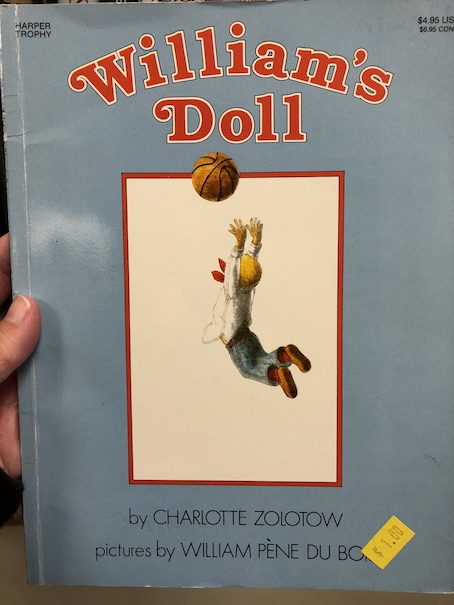
William’s Doll by Charlotte Zolotow, pictures by William Pene du Bois, 1972.
A boy named William wants a doll to play with, like the one the girl next door has. Other boys make fun of him and think he’s a little strange, calling him a “sissy,” but he likes the idea of having a doll to love that he could treat like it was a real baby.
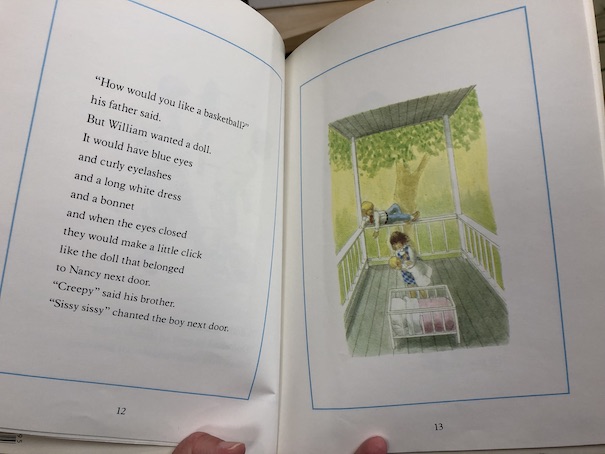
William’s father buys him toys that boys usually like, like a basketball and a train set. William likes the train set and gets pretty good at basketball, but he still wants a doll of his own.

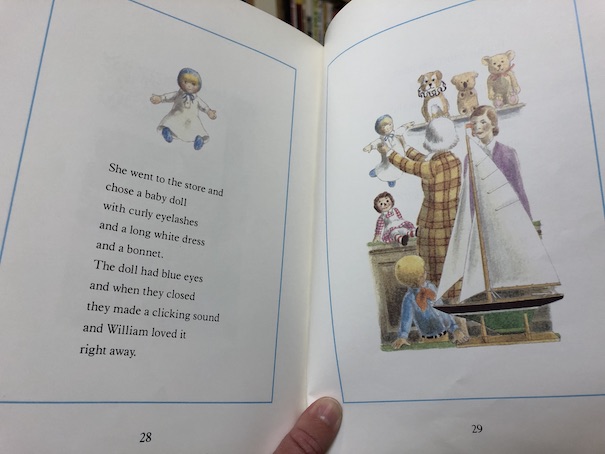
When his grandmother comes to visit, William tells her about wanting a doll, and she decides that it’s a good idea and gives him one. William’s father worries about it, but the grandmother reassures him that there’s nothing to worry about. William’s desire for a doll is a fatherly instinct, not because he’s a “sissy.” William likes having something small to love and care for, like a father would for a real baby, and it’s a good thing for a boy to learn the gentleness and responsibility that he would need to know as a future father.
The book is available to borrow and read for free online through Internet Archive.
Further Thoughts and My Opinion
The book has two messages. First, not everyone feels bound by gender when it comes to the things that they like, and there’s no reason to feel like they should. Sometimes, people feel pressure to like what their friends like or what society think that they should like and to deny that they like certain things because they’re worried that people will think that they’re weird or uncool, which can be an uncomfortable position to be in. Speaking as a childless adult who likes, collects, and reviews children’s books, I know how that is. If it was going to stop me, I wouldn’t have maintained this blog for almost four years, and I wouldn’t have more than 600 books reviewed here, not to mention what’s hanging around my room right now. I’m not even halfway though my personal collection yet.
When you think about it, it does seem kind of unfair that even people who support a little girl’s right to play with traditional boys’ toys, like toy cars, can sometimes get uneasy about the idea of a boy playing with a doll. People weren’t always so understanding when girls wanted to do “boy” things, like play sports, and there are times when they could be a little more understanding about boys who sometimes want to do “girl” things, too. Some people might consider cooking to be more of a girl’s hobby than a boy’s hobby, but some of the most famous chefs in the world are men, and what woman wouldn’t be impressed by a boyfriend who can cook a romantic dinner? People might think that sewing is a girl’s hobby, too, but many professional tailors and leather workers are men as well, and there are some guys who make their own costumes for historical reenactments. To some people, poetry might sound girly and too sentimental for a boy, but try telling that to Shakespeare, Robert Louis Stevenson (who wrote, among other things, poems for children), Percy Shelley (“Look on my works, ye Mighty, and despair!”), and all of the other famous men who have been authors and poets. Sometimes, people just aren’t looking at the big picture. I think that, partly thanks to books like this, people have been loosening up a little on some of the “shoulds” in life – what they think people “should” do or “should” like.
No one in the story says anything about sexual orientation, although that may be part of the father’s worry and possibly the root of the “sissy” accusations. In the story, William is too young to be concerned about sexual relationships, and his wish for a doll has nothing to do with who he might want to date or marry in the future. He has very specific reasons for wanting a doll, which he explains, and they have nothing to do with sex or romance. I’m not going to speculate about William’s potential orientation because it’s outside of the range of this story, and actually, I think that the story is stronger if his orientation is completely unrelated to his wish for a doll. If the other boys and William’s father think that the doll automatically points to homosexuality, they may be overstepping. Part of the grandmother’s point is that emotions like love and caring go beyond the idea of sex, and gentleness and nurturing qualities are good things to encourage. Also, William’s efforts to stand up for what he wants, even knowing that others don’t agree with him, could be seen as a first step to becoming his own man. Who’s really more of a “sissy,” the guy who lets his friends lead him around by the nose and tell him what to think because he’s scared of being called a “sissy,” or the guy who will stand up and defend his baby, taking care of it no matter what?
The grandmother’s explanation leads to what I think is the second message, that having gentle, loving, and nurturing qualities doesn’t make a boy less of a boy or, by extension, a man less of a man. These are human emotions, and all humans have some desire for these feelings. These are the feelings that real relationships are built on: closeness, gentleness, and nurturing. These are qualities that women look for in husbands. These are also qualities that make a man a good father, which is ultimately what William wants to be when he grows up. Children have male parents as well as female parents, and it’s fine for William to want to be a good parent someday.
We don’t know, at the end of the story, how long William’s interest in the doll will last. Children sometimes go through phases where they’re really interested in something, and a few months later (maybe sooner, depending on the kid’s attention span), they put it aside when something new comes along. William is trying out a concept in his life, which is a large part of growing up, and once he’s tried it out, he may either build on it or move on to other things. Given William’s interests and character, I think he will probably remember the feelings he’s had and the lessons he’s learned even after he puts the doll aside. When he’s a little older, perhaps he’ll earn some extra money by babysitting younger kids in the neighborhood. Maybe he’ll combine his varied interests and end up coaching a kids’ basketball class at the local community center. He might end up being a teacher as well as a father, since he likes the idea of nurturing young children.
People who grew up in the 1970s may remember the story of William’s Doll from the cartoon and song on Free to Be… You and Me. There was also a short live action film of the story. In the live action film, it was a grandfather who bought William a doll, and the grandfather reminds the father that he also had a doll for awhile when he was small, reminding him that children grow and change, and this phase in William’s life is just part of his path of growing up. The short film was later parodied on Rifftrax.
 Jestress's Forgotten Books and Stories