The Twelve Dancing Princesses

The Twelve Dancing Princesses retold and illustrated by Ruth Sanderson, 1990.

This is a retelling of the classic German fairy tale collected and published by the Brothers Grimm in 1812. There are various retellings of this story, some changing the number of princesses and some giving the characters different names. This one is actually closer to the Andrew Lang version from The Red Fairy Book, published in 1890.

A king with twelve daughters has a strange mystery to solve. All twelve of his daughters sleep in the same room every night. The door to their room is always locked, but every morning, the girls’ shoes are completely worn out, like they’ve been dancing all night. The girls claim that all they do at night is sleep, but that doesn’t explain what happened to their shoes.

The king is confused and troubled by this odd mystery, so he promises the hand of one of his daughters in marriage to the man who can solve the mystery. A series of princes attempt to solve the mystery by sleeping in a room next to the princesses, but in the morning, each of the princes has mysteriously disappeared and the princesses’ shoes are still worn out.

With the mystery getting more mysterious and more urgent, with the princes’ disappearances, a commoner named Michael decides that he wants to try to solve the mystery. A woman Michael meets recommends that he take a job as a gardener’s helper at the castle and see if he can spot something that would give him a hint. The mysterious woman gives Michael a cloak that will make him invisible so that he can follow the princesses and see what they do.

Michael first meets the princesses when the gardener sends him to give a bouquet of flowers to each of them. He catches the attention of the youngest princess, Lina. Lina’s sisters tease her about admiring a simple garden boy, but Michael also likes Lina.

Because he is a commoner, Michael doesn’t think that he can go the king directly and ask to investigate the mystery of the princesses, so he decides to use his magic cloak to spy on them secretly. When he’s invisible, he slip into their room before the princesses are locked in for the night and hides. After everyone thinks that the princesses have gone to bed, they get dressed as if they’re going to a dance, putting on their new dancing shoes. The eldest princess opens a special trap door in the floor, and they all leave secretly, with Michael following them.

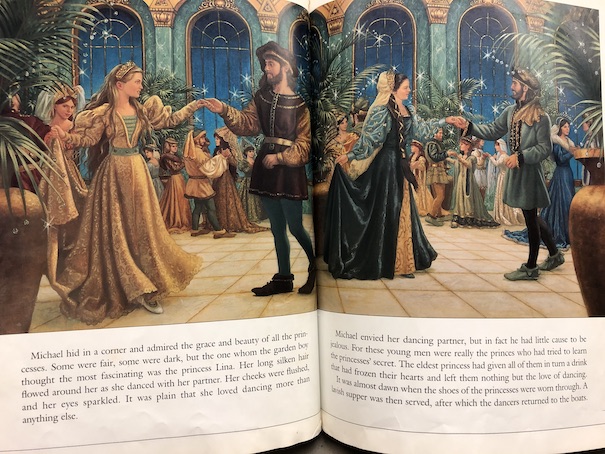
Michael follows the princesses through magical woods to a lake where the captive, now enchanted, princes wait to take the princesses to a magical palace in boats shaped like swans. There, the princesses dance with the princes all night, wearing their shoes to pieces.
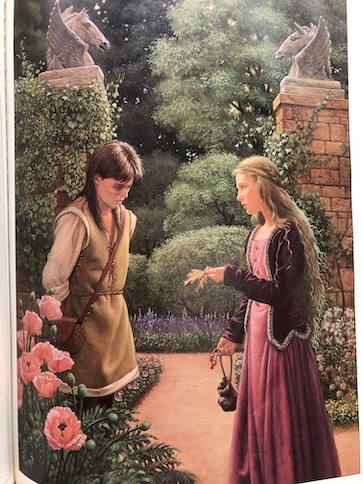
Lina suspects that someone followed them because Michael accidentally stepped on her skirt a couple of times, and Michael confirms her suspicion when he places a branch from the magical woods into her bouquet of flowers. At first, Lina tries to bribe Michael into keeping their secret by offering him money, but he refuses. She asks him if he plans to tell the king and collect his reward by marrying one of the princesses, but Michael says he won’t. Lina tries to ask him why, but he doesn’t want to answer. The truth is that Michael loves Lina and doesn’t want to get her into trouble or force her to marry him if she doesn’t return his affections.

Eventually, Lina tells her eldest sister, the one who is controlling all of the magic behind their escapades, about Michael and what he knows. Lina’s sisters want to have Michael thrown in the dungeon to keep him quiet, but Lina is horrified and says that if they do that, she’ll tell their father the truth herself. Instead, they decide to openly invite him to their next dance and offer him the magical drink that would enchant him like they did with all of the other princes. Michael overhears their plan and decides that he will see if Lina really loves him. If can’t appeal to her heart, he’ll drink the drink and be enchanted.

When Lina prevents Michael from drinking the enchanted drink at the dance because she loves him and can’t stand to see him turned into a mindless magical slave, the spell is broken on all of the other princes. They all return to the castle, and the magical palace crumbles behind them. When they reveal the truth to the king, he makes Michael the heir to the kingdom with Lina as his wife.

I’ve heard many different versions of this story before, but there are always so many unanswered questions. Just how did the eldest princess come up with this whole magical dancing scheme in the first place? Where did she even learn to do magic? How come the princesses are never tired even though they dance every night instead of sleeping? (Well, I guess that could just be magic because magic can fill many plot holes.) Why did the king just keep giving the girls new dancing shoes when they kept wearing them out every night? My parents would have just stopped giving me things that I repeatedly broke, telling me that I can’t have new stuff if I can’t take care of the old. They’d probably say something like, “I don’t know what you’re doing with those shoes every night, but whatever it is, you’re not going to do it anymore because you won’t have them.” But, fairy tale characters just aren’t that practical, and if they were, the story would have ended much sooner. In fact, why didn’t the king himself just sit up for one night with his daughters and see for himself what they did or split them up and put them in different rooms of his castle to put an end to their hijinks? Just what is the king going to do with the eldest princess, now that he knows that she’s some kind of witch or enchantress? Did her powers break completely when Michael broke her spell? Also, what was the deal with the mysterious woman Michael met on the road, who gave him the invisibility cloak? How did she figure into this, or was she just some random, magical being or enchantress who, coincidentally, just happened to have a magical cloak that she could spare? The story doesn’t really say.

I love the pictures in this book because they are beautiful and detailed, but the art style is a little unusual. Instead of having every picture appear in its entirety on a page, some pictures wrap around to the next page, either giving a hint of what’s coming or a taste of what was on the previous page. Sometimes, I found myself wanting to see the whole picture at once, but I can see how the illustrator was trying to make scenes in the story kind of flow into each other.

The book is available to borrow for free online through Internet Archive.
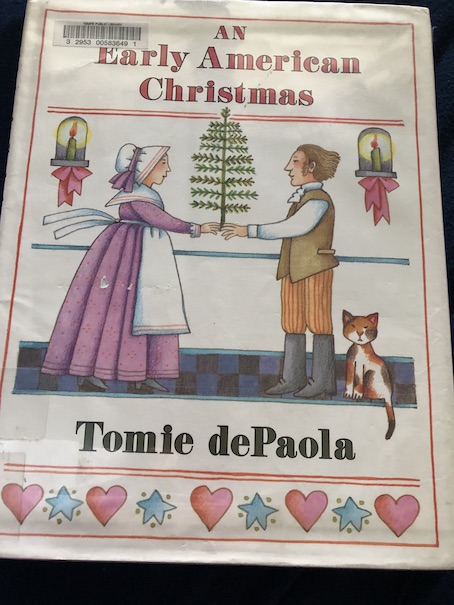
An Early American Christmas

An Early American Christmas by Tomie dePaola, 1987.

A note at the beginning of the book explains the story behind the book, which is based on the history of early Colonial America. Although Christmas is now a popular American holiday with lavish celebrations, many early colonial groups didn’t celebrate Christmas much at all. Even among Christian groups, Christmas was not regarded as a major holiday. In particular, groups like the Puritans, Presbyterians, Quakers, and Baptists tended to avoid celebrating Christmas, seeing it as a frivolous sort of celebration. However, there were other groups, like Catholics, Lutherans, and Episcopalians, who did celebrate the holiday in a festive fashion. The author of this book imagines what it would have been like for a family that celebrates Christmas if they moved to a New England community that didn’t during the early 1800s. In particular, he used New Hampshire as his inspiration.

The beginning of the story describes a New England town that doesn’t celebrate Christmas with decorations or songs. Then, a new family comes to the village. They were originally from Germany, and they had lived in Pennsylvania before coming to the village. (This would make them Pennsylvania Dutch.) They are usual because of their festive Christmas celebrations.

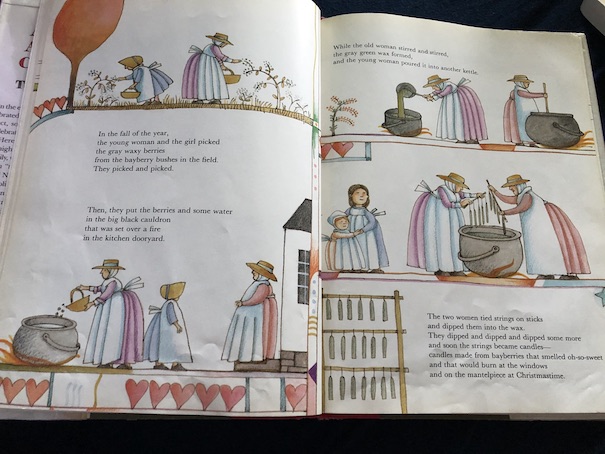
They begin planning for their Christmas celebration in the fall. The women and girls pick bayberries and use them to make candles. They say that bayberry candles bring good luck when they’re burned on Christmas.

The men and boys gather the crops that they will need for their feast. The grandfather of the family carves figures for their manger scene.

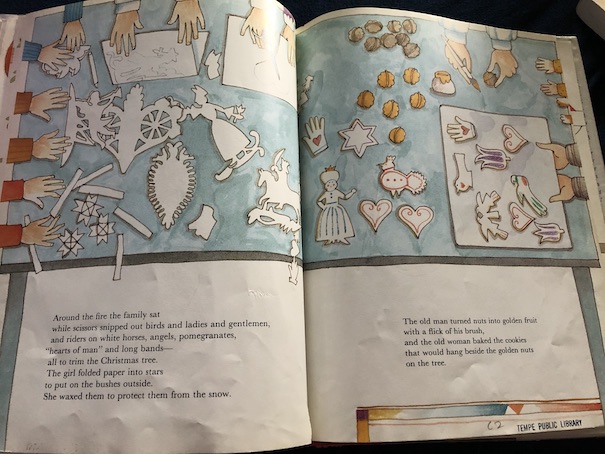
In December, the whole family makes paper decorations and specially-shaped cookies. I liked the variety of baked goods that they show in the pictures. They pick out a tree and make strings of popcorn and dried apples.

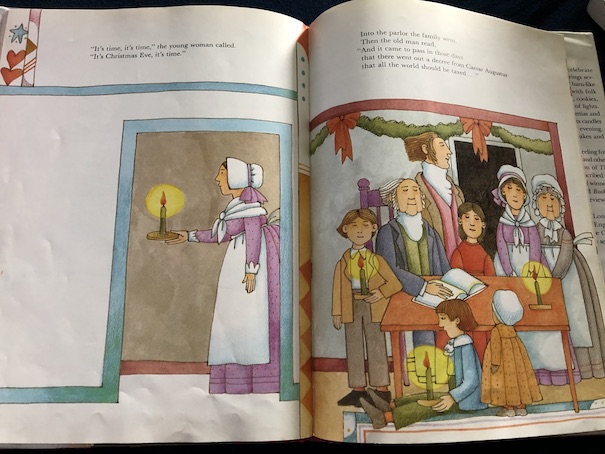
On Christmas Eve, they read the story of Jesus’s birth and decorate their home with all of the decorations they have prepared.

As the years go by and other people in town see what the Christmas Family is doing, they begin to celebrate Christmas, too.

The book is available to borrow and read for free online through Internet Archive.

The Nutcracker

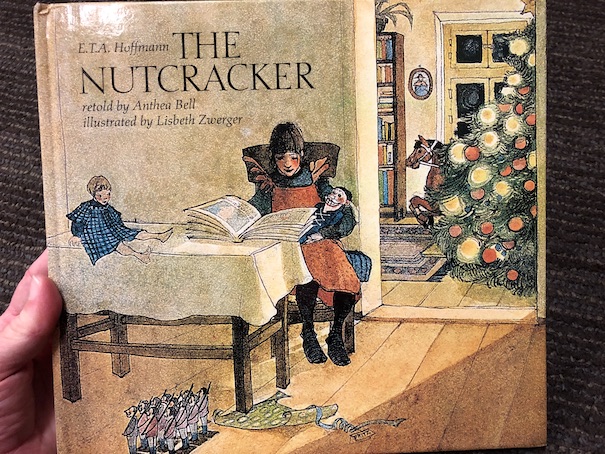
The Nutcracker by E.T.A. Hoffmann, retold by Anthea Bell, 1816, 1987.

The reason for the two dates of this book is that the original Nutcracker story was written by a German writer, E.T.A. Hoffmann, in 1816, as the novella The Nutcracker and the Mouse King. Some places, including the back of this book note different publishing dates for the original story because it was published more than once during the 1810s, as part of different story collections. This article gives more details about the original version of the story and different publications. Since then, it has been retold many times and in many different forms, including the famous ballet based on the story. In ballets and plays, the name of the heroine is often Clara, but in this picture book, as in the original story, the heroine’s name is Marie.

In the beginning of the book, which is set in the 19th century, Marie and her brother Fritz, are opening their Christmas presents on Christmas Eve. (The book explains that opening presents on Christmas Eve is a German tradition. A friend in Germany also explained that to me once because, in Germany, presents are supposedly brought by the Christ Child, not by Santa Claus. Since then, I’ve read that explanation may vary, depending on whether the household is Catholic or Protestant.) The children receive many wonderful presents, including a toy castle from their godfather, Mr. Drosselmeier. Marie’s favorite present is a nutcracker that looks like an odd little man. When Fritz is too rough with the nutcracker and breaks it, Marie takes care of it.

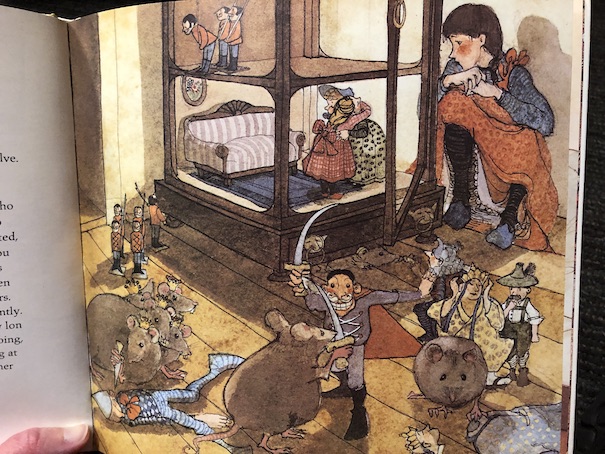
Marie stays up late, and when she finally puts the nutcracker away at midnight, she is astonished to see an army of mice coming out of the floorboards. The leader of the mouse army is the Mouse King, who has seven heads. The Nutcracker leads an army of toys against the mouse army. The mouse army appears to be winning, so, to save the Nutcracker, Marie takes off her shoe and throws it at the mice. Then, her arm hurts, and she apparently faints.

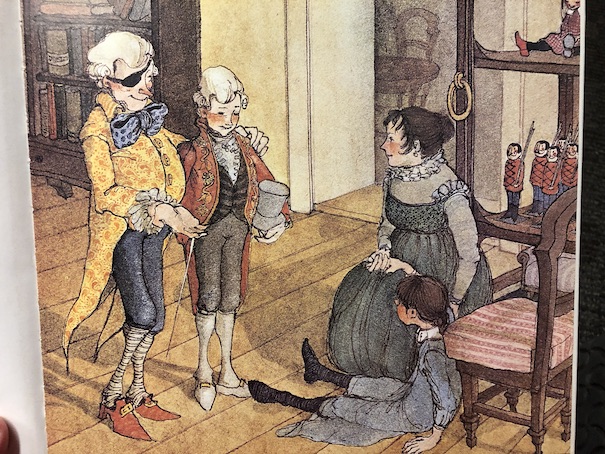
When Marie wakes up, she is in her own bed, and her mother tells her that she apparently put her arm through the glass door of the toy cabinet, cutting herself badly. When Marie tries to tell her mother about the battle between the toys and the mice, her mother and the doctor think that she’s ill and confine her to her bed for a few days. Mr. Drosselmeier repairs the Nutcracker and returns it to Marie, telling her the reason why nutcrackers look so strange and ugly, calling it The Tale of the Hard Nut.

Year ago, there was a royal banquet given by the King and Queen who were the parents of Princess Pirlipat. A mouse who claimed to be the queen of Mousolia demanded some food from the banquet as the Queen was preparing it. The King was angry that the mouse took some of the food and wanted revenge. The King asked his Court Watchmaker, who was also named Drosselmeier, to build some mousetraps to catch the mouse queen’s seven sons. When the sons were caught, the mouse queen vowed that she’d take her revenge on Princess Pirlipat. Princess Pirlipat was a pretty baby, but the mouse queen turned her ugly. The King took out his anger on the Court Watchmaker, ordering him to find a way to change Princess Pirlipat back to normal and threatening to behead him if he failed. After consulting the Court Astronomer, the Court Watchmaker learned that the key to breaking the spell on the princess was a special nut, which had to be cracked by being bitten by a man who filled certain special requirements, which all happened to be met by the son of the Watchmaker’s dollmaker cousin. The King had promised that the person who could break the spell could marry his daughter, but the mouse queen interrupted the last part of the ritual, causing the young cousin to turn ugly himself. When pretty Princess Pirlipat saw her rescuer turn ugly, she didn’t want to marry him anymore. The Court Astronomer said that the only way to break the spell on the young man was for him to defeat the new Mouse King – the mouse queen’s youngest son – and for him to find a woman who would love him regardless of his appearance.

Marie knows that the story is true because she has seen the Mouse King herself. She loves the Nutcracker and wants to help him. The Nutcracker returns to visit Marie during the night and makes repeated demands of her for her candy and toys. Marie knows that, no matter what she gives him, the Mouse King will keep returning to demand something else. The Nutcracker tells her that he needs a sword to fight the Mouse King. They borrow one from a toy soldier, and the Nutcracker successfully defeats the Mouse King, giving Marie his seven golden crowns.

As a reward for helping him, the Nutcracker takes Marie to the land where he is from, leading her there through a magic staircase in an old wardrobe. The Nutcracker’s land is beautiful, filled with candy and sweets and gold and silver fruit. (The Christmas Wood that they pass through reminds me of the woods in the wardrobe in The Lion, the Witch, and the Wardrobe.) The Prince Nutcracker’s home is Marzipan Castle in Candy City, where his beautiful princess sisters live. They welcome Marie and the Nutcracker home.

Then, suddenly, Marie wakes up, as if it were all a dream. However, Marie knows that it wasn’t a dream because she still has the Mouse King’s crowns. Marie tells the Nutcracker that she loves him. There is a sudden bang, and Marie faints. When she wakes up, she is told that Mr. Drosselmeier’s nephew has come to visit them. The nephew is the Nutcracker, restored to human form and now a handsome young man, thanks to Marie’s love. Marie later marries the nephew, and the two of them rule magical Kingdom of Sweets.

There is a section in the back of the book that explains a little more about E.T.A. Hoffmann and the original version of the Nutcracker story.

This book is available to borrow for free online through Internet Archive.