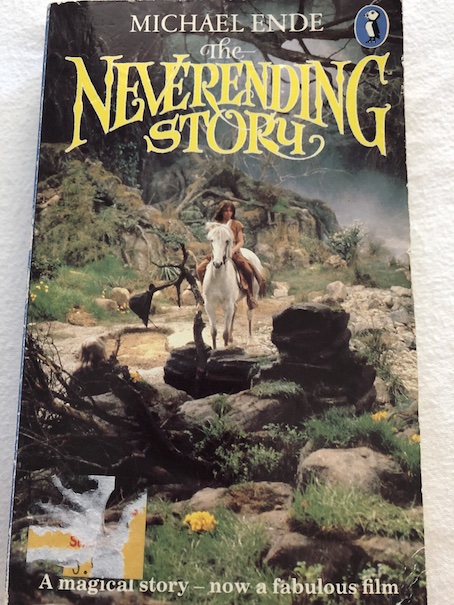
The Neverending Story by Michael Ende, 1979, 1983.
Bastian Balthazar Bux has problems. He’s smaller and fatter than the other boys, no good at sports or fighting, and not even a particularly good student. Because of this, other kids tease him, bullies chase him, and the one time that he tried to talk back to them, the mean kids shoved him into a trash can, so he was afraid to ever try it again. One day, on the way to school, he seeks sanctuary from his bullies in an old bookshop that belongs to Carl Conrad Coreander. Bastian loves books more than anything. In fact, his love of books and his imagination are his only apparent strengths at this point in his life.
Coreander doesn’t like children, and as soon as he sees Bastian, he makes it clear that the boy isn’t welcome in his shop, that he doesn’t carry books for children, and that he won’t sell Bastian any books for adults. Coreander says that children are just noisy and make messes and ruin books. Bastian protests that not all children are like that, and the two them talk about why Bastian is there and why the other children bully him. Bastian says that one of the reasons why the other kids think he’s odd is that he likes to make things up, like imagining places and characters and odd names. He rarely shares these things because nobody else seems interested. Coreander asks what his parents have to say about all of this, and Bastian reveals that his mother is dead and his father doesn’t take much interest in him or things that happen to him in his daily life. Coreander is rather condescending to Bastian but also strangely interested in some of the details about him and his life.
When Coreander gets up to take a phone call, Bastian finds himself looking at the book that Coreander was reading when he came into the shop. It’s called The Neverending Story, a title which captures Bastian’s imagination at once because he always hates it when a book he likes ends. The book seems to call to Bastian, and he suddenly feels like he has to have it. Because Coreander has already made it clear that he won’t sell any books to Bastian, Bastian simply snatches up the book and leaves the shop with it.
After he’s out of the shop, Bastian suddenly feels guilty for stealing the book, even though he still feels compelled to have it and read it. He knows that he can’t take the book home with him because, even though his father doesn’t notice much, he would notice if Bastian showed up at home when he’s supposed to be at school. Bastian knows that he’s already terribly late for school, but he can’t bring himself to go to class, especially not with a stolen book. Desperately, he tries to think of a place to go. Then, he remembers that his school has an attic. Hardly anybody goes up there, and even those who do don’t go there very often. He can hide there for a while and read.
Without giving much thought to how long he’s going to hide and what he’s going to do for food when he gets hungry, Bastian hurries up to the attic of the school, locks himself in, and starts to read The Neverending Story.
From this point on, most of the book is the story in the book Bastian stole, but at the same time, it’s also a story about Bastian himself. There are periods when things in the story remind Bastian of things happening in his life or times when he pauses to think about what his class at school would be doing at this time without him, things that he’s glad to be missing himself. However, gradually, Bastian himself starts to enter the story.
The Neverending Story Begins
The story in Bastian’s book takes place in the magical land of Fantastica. The first characters we meet are messengers who are on their way to see the Childlike Empress who rules the land. Within that land are many fantastical people and creatures who inhabit countries of their own, but strange things are happening here that have nothing to do with the usual magic of Fantastica. A small group of messengers who happen to meet each other talk about what they’ve observed and why they need to talk to the Childlike Empress. Whole sections of their countries and even some of the people and creatures who normally inhabit them have simply disappeared. By “disappeared”, they mean that nothing is left in their place. Whenever people try to look at the areas that used to be there, they see absolutely nothing, as though they have all gone blind when looking in their direction. Nobody knows why this is happening, and people are panicking.
The Childlike Empress lives in a beautiful tower. When the messengers arrive there, they discover that so many messengers have arrived from every corner of Fantastica that they have to make appointments and wait their turn to talk to the Childlike Empress. Everyone seems to have the same problem, and to make matters worse, word has spread that the Childlike Empress is ill, and the doctors can’t seem to understand the nature of her illness and have no idea what to do to help her. The messengers wonder if the Childlike Empress’s illness could have something to do with all the strange things that have been happening. All of the creatures in the kingdom know that the very existence of their kingdom depends on the well-being of the Childlike Empress. If anything ever happened to her, the rest of them would simply cease to exist.
At this point in the story, Bastian is reminded of his mother’s death and stops to think about her. He remembers being at the hospital with his father while his mother was undergoing an operation to try to save her life, but unfortunately, it was unsuccessful. After that point, Bastian’s father changed, becoming mentally and emotionally withdrawn, so it seems as though Bastian not only lost his mother completely but also part of his father. His father continues to look after him physically and even gives him nice things, like a bicycle, but he rarely takes much notice of his son’s day-to-day life, making Bastian feel almost like he isn’t there himself. His father no longer talks to him about ordinary, everyday things, and he’s always preoccupied with his grief.
The doctors trying to treat the Childlike Empress say that she doesn’t have any obvious symptoms of illness. For some reason, she simply seems to be fading away, making it seem likely that her malady is tied to the fading away of Fantastica itself. Chiron the centaur, the greatest of the healers, says that the Childlike Empress has said that someone must go on a quest to find the solution to her problem. She doesn’t say what the solution is, but she has chosen the hero who will go on this quest by name and has given Chiron her medallion to give to this hero. The Childlike Empress’s amulet, Auryn, takes the form of the twined snakes (it’s a sort of elaborate ouroboros) that appears on the cover of the book that Bastian is reading.
Chiron takes the medallion to the Greenskins, a people who resemble nomadic Native Americans who hunt purple buffalo, to find the hero called Atreyu. Atreyu turns out to be a 10-year-old boy, and Chiron is upset at first that a child so young has been given this important mission. Even though he is doubtful that a child could save the Childlike Empress, he has to trust the empress’s decision. He explains the situation to Atreyu and his people, and Atreyu sets off on his quest, although he has little to go on.
Bastian comes to identify somewhat with Atreyu, who is an orphan, raised communally by his people. In a way, Atreyu is like what Bastian himself wishes he was. Atreyu is also an orphan, but where Bastian feels neglected by his remaining parent and has no one else to rely on, Atreyu is regarded as the “son of all” his people, with everyone raising him. Bastian wishes that he could feel like he could rely on everyone around him to care about him. Atreyu is also strong and brave, which Bastian is not, or at least, he doesn’t feel like he is.
Atreyu travels far and asks everyone where he stops if they know how to help the Childlike Empress, but no one does. However, in a dream, a purple buffalo tells him that he must visit an ancient woman called Morla, who lives in the Swamp of Sorrows. She is the oldest creature in Fantastica, and she will know the answer. Atreyu loses his beloved horse in the Swamp of Sorrows because the horse is overtaken by a dreadful depression and cannot save himself from being dragged down into the swamp. (This was the worst part of the movie version of this story for me as a kid although somewhat less traumatic in the book.) Atreyu is protected from the depression by the Childlike Empress’s amulet and is able to reach Morla.
Morla turns out to be a giant and ancient tortoise. She does know the answer to the problem, but Atreyu has trouble persuading her to explain it at first because Morla is so old that she has come to feel like life is meaningless and doesn’t really care if she and everyone else disappears or not. Fortunately, Atreyu’s arguments with her revive enough of her interest for her to talk to him. Morla says that the Childlike Empress has always been young because her life isn’t measured by time like others’ lives. The Childlike Empress’s life is measured by names. She has had many, many names over the years, most of them forgotten now, and even Morla doesn’t know what her current name is. In order for her life and existence to be renewed, the Childlike Empress needs a new name. Atreyu asks Morla how she can get one, and Morla says that she doesn’t know who can give her a new name, only that it can’t be anyone from Fantastica. Atreyu must visit the Southern Oracle to find the answer.
At this point, Bastian thinks it’s too bad that he can’t give the Childlike Empress her name because thinking up unusual names is something that he’s really good at, and this might be the one place where his talent has a use and people who would welcome it. However, the things that are happening in the story are so scary that Bastian is also grateful that he is safe where he is, just reading about them.
Bastian reads that Atreyu wanders out of the swamp on foot. He doesn’t know where he’s going, and he lost all of his supplies with his horse. Then, Bastian hears the clock chime and knows that school is out for the day. As the other children leave the school, Bastian has to decide what to do. He knows that he really should go home and own up to his father about stealing the book, but when he gets up to go, he has the feeling like he has to keep reading, to finish what he’s started, like Atreyu, who is still fulfilling his mission in spite of hardship. Bastian feels a little proud of making a difficult decision because he’s not running away from his responsibilities so much as continuing a quest of his own. He knows that he must finish that book. Indeed, he must because the existence of Fantastica now depends on him.
As he continues reading and following Atreyu’s adventures, Bastian begins to feel more like the story isn’t just a story, that there is something more to it. When Atreyu reaches the Oracle, which communicates only through rhyme, it tells Atreyu that nobody in Fantastica can give the Childlike Empress a new name because the truth is that all of them are only characters in a book who exist as they are because of the needs of the story. The people of Fantastica didn’t invent their world, they don’t create it as it exists, and they don’t have any real power to change anything, even a name. All of those powers belong to humans who live in what they call the “Outer World.” The Oracle says that generations of human children have read the book that contains all of Fantastica, and they are the ones who have used their powerful imaginations to give the Childlike Empress new names, over and over. The problem is that the book has not been read by anyone for too long and children tend not to believe in stories like theirs anymore, so it has been too long since the Childlike Empress was given her last name. The memories of all the names she’s been given have faded, so she is losing her ability to maintain her existence and the existence of all of Fantastica. They need a human child with the ability to believe in Fantastica and think of a new name to rename the Childlike Empress. They need Bastian … if Bastian can manage to believe in himself as the hero of his story.
The book is available to borrow and read for free online through Internet Archive (multiple copies, plus a computer game about it and the theme song from the movie). It was originally written in German, and the version I have is the English translation. There is a movie version from the 1980s that is very well-known among people who were young then and fantasy fans. There are also two movie sequels that aren’t as well-known.
My Reaction and Spoilers
I saw the movie version of this book long before I ever got hold of a copy and way before I was old enough to read a book that long. The movie was big in the 1980s, when I was a young child, and it has a magical and very 1980s theme song that was also used as a cultural reference in the show Stranger Things. I’m actually attached to that song because it’s one of the sounds of my early childhood. For reference, I’m younger than all the Stranger Things kid characters are supposed to be, even Erica, but old enough to have memories of the time period of that show. The mall scenes in that show are practically right out of my childhood. Those electronicized ‘80s songs, bright-colored clothes and clothes with paint splatter designs, Cold War with two Germanies – East and West – these things were all part of my early life, and that is the time period when this book was popular and the movie was new. As Stranger Things points out, things like fantasy books and movies and playing Dungeons and Dragons were all considered part of nerd culture back in the day. To a certain extent, they still are, but Harry Potter brought a renewed interest in and popularization of fantasy books in the late 1990s.
The story is about the power of imagination and the roles that fantasy play in human lives. The story actually gets deep in places about the philosophy of stories and how people use them. It explains that humans fear stories, particularly fantasy stories, because, when fantasy characters get out in the real world and take over people’s minds, they can cause madness and delusions or be used as lies by unscrupulous people to fool and manipulate others. They don’t use the word “propaganda”, but that’s part of what they imply, and it’s a fitting concern for the Cold War era when this story was written. Madness can also be a real risk for people who can’t separate reality from fantasy, as shown in Bastian’s further adventures in Fantastica, described below. Humans are creatures that live and function in the real world, and while we sometimes venture into the realm of fantasy and stories, we can lose ourselves if we don’t know how to keep the two separate in our minds. So, what’s a human supposed to do?
The book suggests the idea that people can’t simply avoid fantasy entirely for fear of the effect that it might have on them, like people who refuse to allow children to read fantasy books. Even though people like that might think they’re smart for avoiding “lies” and “delusions”, but the problem with that is that there are many types of delusions that people have, even in their everyday lives, and people who are convinced that they’re being thoroughly realistic and avoiding any sort of fantasy actually make themselves vulnerable to lies and delusions of other kinds. Anybody who’s lived through the era of accusations of “fake news” should be able to grasp that concept. A real world fact is that people use stories of all kinds to explain and understand the world around them. We all use stories, and those stories have shades of emotion and varying degrees of elements of fiction. The principal of Fantastica is that fantasy is fine when people approach it as fantasy, coming to it willingly in the full knowledge that it is fantasy. Even in fantasy stories there can be elements of realism, such as the reality of human emotions, but people can pick out the real bits from the fictional ones when they know what they’re dealing with and are willing participants, not having it pushed at them by people who are actively seeking to trick them.
People with broad, real-world knowledge, who are used to stories of various kinds in the real world, get accustomed to distinguishing between different types of stories and recognizing fictional elements from false ones. There have been a couple of times when I’ve actively pointed out to people on my neighborhood website who shared “shocking” stories about horrific kidnapping attempts of kids or young women that those stories were false. The local police have even said that they were false, but I knew that they were even before getting that confirmed with the local police. How? I’ve seen them before, or ones very much like them. Honestly, they were basically the type of kidnapping stories that appear on Wattpad, the infamous Internet home of badly-misspelled stories of that ilk, and because I read fanfiction, I’ve seen them before in all their grammatically-incorrect glory. I recognized elements of the fake stories from ones that I read before in the full knowledge that they were completely fictional and probably written by teenagers, most of whom don’t understand how chloroform actually works. I could see their ridiculously complicated premises anywhere and go, “Yep, it’s one of those stories.” The people attempting to share these stories as shocking things that their neighbors need to know about have probably never read Wattpad or any similar amateur fiction and equally don’t know how chloroform works. They just experienced a feeling of shock when reading these stories on Facebook (yes, that is where they said they got them) and did what they automatically do when they feel shocked about something, passed it on to someone else without asking someone more knowledgeable. Some of the other people reading their posts on the neighborhood website called the local police to check their stories, but the original posters did not do that before posting them. It seems that never crossed their minds. I’m telling you this because I’m pointing out that I’m immune to this particular kind of shocking fake kidnapping story because I’ve seen it before, I’m familiar with the general format, and I actually did look up what chloroform does and how it works because I was curious. I’ve sort of inoculated myself against this sort of story. I don’t feel shocked when I see it. I roll my eyes.
I’m not saying that it’s completely impossible to fool me on anything because human beings are limited, and I can’t say that I’ve heard every story out there, but I’ve heard quite a lot of them. I’m a voracious, long-term reader in different genres, fictional and non-fiction, badly-written and award-winning. I don’t fear fiction or fantasy or even “fake news” because I’ve seen it before in various forms. I know how to verify information and already have reliable sources of information lined up on various subjects. Above all, I have the knowledge that I’m always responsible for myself and in control of myself and that no amount of fiction or “fake news” can ever make me do anything without my consent. Even people under hypnosis can’t be made to do anything that is truly against their will or morals, and I’m pretty comfortable with my sense of self and what I’m willing or not willing to do. (By the way, I got the Pfizer vaccine back in April 2021 and the Moderna booster in December 2021, and I’m perfectly fine. It’s not poison, unlike some of those idiot horse cures some people try when they’re so afraid of being tricked by some people that they leave themselves open to being tricked by other people, who can see their real fears. It’s also not magnetic. I used to stick coins to my skin way back in elementary school in the early 1990s, although I preferred the trick where you roll a coin down your forehead and nose. Sticking coins to your skin works because of sweat, not magnetism, like that trick of sticking a spoon to your nose because you licked it first. This is a digression, but honestly, how does anyone get out of childhood without knowing how that works? I wasn’t aware that anybody who had ever been to school with other kids in their childhood hadn’t seen this stuff before.) Fear is one element I know that can cloud people’s perceptions about what’s real and what’s not, and while I’m naturally a nervous person in a lot of ways, this isn’t something that scares me at all. I’m not afraid of being tricked. I never was. I was a fan of magic tricks at a young age, and that led me to read about magic and the tricks that people use. None of them scare me because I’ve done them before myself and know how they work. It’s like that with fiction, too. Been there, done that, seen it, know it, and I urge other people to do the same. This kind of mental vaccination works as well as the other kind. At least, it always has for me.
Book vs. Movie
There are many incidents in the book that are not in the movie, although some appeared in the first movie sequel. In fact, the original movie really only covers about the first half the book. Rather than ending with Bastian giving the Childlike Empress her new name, Moon Child, while she and Atreyu are at the Ivory Tower where she lives, Bastian hesitates because he’s not sure what he’s supposed to do, if he’s really chosen the right name, if he’s really going to enter Fantastica and how, and above all, if a small, weak boy like himself can really be a hero. Seeing that his indecision could ruin Fantastica forever, the Childlike Empress finds a way to put the story into a loop, repeating over and over, making it truly a never-ending story until Bastian finally names her.
After Bastian names her, Moon Child gives him the last grain of sand from Fantastica, like in the end of the movie, so he can rebuild it. At first, Bastian isn’t sure how, but she explains to him that he can do it with his wishes. He has as many wishes as he wants, and he can wish for anything and everything. Bastian feels overwhelmed at the thought that he can think of anything, and that makes it difficult to think of anything because he doesn’t know where to start. Yet, Bastian must make wishes to rebuild Fantastica. From here, I’ll basically describe Bastian’s continuing adventures in Fantastica, although I’m going to leave out a lot of detail and individual incidents and characters because there’s far too much to describe:
Bastian’s Continuing Adventures
To get him started, Moon Child asks Bastian what made him hesitate before to name her. Bastian explains how he doesn’t look or feel like a hero should. He thinks that heroes should be like princes, handsome and strong, not small, weak, and fat like himself. With this first wish, Bastian becomes a handsome prince. Moon Child gives Bastian the Auryn, which gives him the power to control things in Fantastica and yet keep him safe from all dangers at the same time. Using it, Bastian makes himself strong and brave as well as handsome, and his wishes take him on new adventures through new lands, creating things as he goes.
Then, his wish for companionship leads him to find Atreyu. He is glad to be reunited with him, but Atreyu remembers Bastian’s real appearance because he saw him in a mirror before. By now, Bastian’s memories of his former self are fading. The people of Fantastica appreciate Bastian’s ability to make new stories because they lack that ability themselves, but it starts getting out of hand. Bastian’s creations start getting out of his control, and Atreyu realizes that Bastian is losing more and more of his memories, forgetting who he really is and what his home is really like. As Bastian loses touch with his real self, he also gets confused about what he really wants, and his confusion is causing his wishes to produce uncontrollable results. To make matters worse, Bastian is losing his desire to return home along with his memories of home. His friends are distressed because they know that Bastian must return home in order to inspire other children to come to Fantastica. If he doesn’t, other children won’t come and give Moon Child new names in the future, and Fantastica will be in danger once again. Basically, Bastian has lost of the plot of his own story.
Persuaded by his friends, Bastian makes a wish that will help him figure out what to do: he wants to see the Childlike Empress/Moon Child again. Although Atreyu and Falkor wanted him to make a new choice to guide their quest, they’re not convinced this is the right one because one of the rules of Fantastica is that nobody can see her more than once. Bastian says that he thinks he’s different because he’s human and not from Fantastica, and he’s already seen her more than once. As they continue their journey, Bastian continues losing more and more of himself, getting offended with his friends because they treat him like a child, forgetting that’s what he actually is.
At one point, an evil character separates Bastian from his friends by feeding his vanity. As Bastian loses more and more of his memories, he becomes uncertain about whether or not he really wants to continue his journey to see Moon Child, forgetting his original reason for wanting to see her. They do finally arrive at the Ivory Tower, but the Childlike Empress is not there, and nobody knows where she is. At the evil character’s urging, Bastian tries to make himself emperor in her place, thinking that she has left Fantastica forever and that the reason she gave him Auryn is because she wanted him to be her successor. However, the other residents of Fantastica know that it’s not right. Atreyu and Falkor end up leading the forces of Fantastica against Bastian to get the amulet, return his memories, and put things right. I don’t like stories where people turn against their friends like Bastian does because it’s pretty uncomfortable. In this case, many people are killed in the battle against Bastian, Bastian wounds Atreyu, and the Ivory Tower collapses.
At first, Bastian blames Atreyu for his own failures and tries to go after him to get revenge, but along the way, he stumbles on a town occupied with former emperors and empresses of Fantastica. A little monkey explains to Bastian what the town is and who the people there are. All of the people in the town were people who tried to take over Fantastica but lost their minds in the effort. They’re humans and have lost their memories and now do crazy things. Because they’ve lost their minds and memories, they’re unable to wish themselves home. This is what happens to humans who lose their desire to go home to the real world. Readers can look at it as people who become detached from reality and live in a madness based on fantasy. Humans need reality to keep themselves grounded and sane, and they need their memories and their pasts to help themselves build a future.
The monkey shows Bastian how he taught the crazy ex-emperors a game where they spell words with alphabet blocks. Most of what they create is gibberish, but the monkey says that, when they’ve played for a hundred years or so, they’ll occasionally spell out a poem, and since they play endlessly, they’ll eventually spell out all of the works of literature, poking fun at the theory that monkeys pounding endlessly on typewriters could do the same thing. Bastian is horrified and questions the monkey about how he can avoid this fate. Auryn is a liability because it’s removing the memories that Bastian needs to return home, yet the monkey says that Bastian will need Auryn in order to return home.
As Bastian journeys further, he finds a land where people always work together and use the word “we” instead of “I.” It’s inspiring in a way, but Bastian is troubled because, in a land where nobody is distinctive or special, everyone is easily replaceable in the work force, and nobody seems to really love anybody else as an individual. Here, Bastian realizes that his true wish, one that he has long forgotten, is not to be the strongest or handsomeness or most powerful but simply to be loved. He wants to be loved for the person he really is, even with all of his imperfections. The problem is that Bastian is uncertain now about who he really is because he’s changed so much since he came to Fantastica and has lost his memories of who he used to be.
Journeying further yet, Bastian meets a singing woman. He has a strange feeling like he wants to run to her, hug her, and call her “Mama,” but he knows that this woman is not his mother. He remembers that his mother is dead, and she was a very different woman from this one. This is a plant woman who grows fruit herself. The strange woman gives him some fruit to eat and begins telling Bastian a story. The story she tells is Bastian’s own story, the story of how he came to Fantastica, how he gave the Childlike Empress her name, and how he had made wishes that were both good and bad and lost himself along the way. The house where the woman is called the House of Change, which not only changes itself but changes people who are there. The woman says that Bastian’s problem is that he always wanted to be someone else other than what he was, but at the same time, he didn’t want to change himself.
During his time in the House of Change, Bastian becomes like a child again, and the plant woman, Dame Eyola, is motherly to him, fulfilling the need for love that Bastian has had for so long. He feels guilty about all the things that he’s done since he arrived in Fantastica, but Eyola comforts him and advises him to seek the Water of Life. However, when he does, she cautions him that it will be his last wish. Bastian is afraid because he knows now that every time he wishes, he will lose a part of himself. Still, Dame Eyola fills up him with her motherly love, and Bastian finds himself needing less love himself and wishing that he also had the ability to love someone. This is his last wish. With that wish, Bastian forgets his parents, his last memory aside from his own name. Dame Eyola says that Bastian will be able to give that kind of love to others when he has drunk the Water of Life, and he will only be able to return to his own world when he brings some of that Water of Life back to his world with him.
To get to the Water of Life, Bastian must pass through a picture gallery of forgotten dreams and find one of his own forgotten dreams. His wish is to love someone, but to do that, he must choose someone in particular to love and forget the last person he still remembers – himself.
Bastian has to dig to find his forgotten dream because it’s buried, but when he finds it, it’s a dream of his father, sad and trapped in ice, begging him to help free him. Bastian’s troubled relationship with his father has been at the heart of most of his feelings, but now, he finds himself wanting to help his father. He now has the power to reach the Water of Life. There is another problem that he has to deal with before he can reach the Water of Life, and he encounters Atreyu and Falklor again.
The Water of Life is inside Auryn itself, and Bastian reaches it when he finally takes it off. When the three of them get to the Water of Life, he has trouble reaching it because he’s lost all memory of himself. However, Atreyu speaks on his behalf as a friend because he remembers who Bastian really is. Bastian sheds all of the changes that he’s gained in Fantastica, becoming fully himself again and actually being happy with himself for the first time, able to truly love himself and love other people. Bastian wants to bring some of the Water of Life to his father.
There is some consternation when the white snake of the Auryn realizes that Bastian has left uncompleted stories in Fantastica. It wants Bastian to stay in Fantastica and finish them all, but Bastian says he’ll never get to go home if he does that. However, Atreyu and Falkor promise to complete all of the unfinished stories on Bastian’s behalf, and the snakes of Auryn allow Bastian to go home.
Bastian finds himself in the school attic once again. He’s not sure how long he’s been there, but his clothes are still wet, like they were from the rain when he started reading. Bastian remembers that he should return The Neverending Story to the bookshop, but he can’t find it. It seems like the book has disappeared. He decides all he can do is talk to the owner of the bookshop and explain the situation. As he walks through the school, he can’t find anybody and worries that he’s completely alone in the world. He’s forgotten that it’s Sunday, and there’s no classes on Sunday. Since the school building is locked, he has to let himself out through a window and climb down some scaffolding, a fear that would have been terrible for him before his adventures in Fantastica.
Bastian goes home and sees his father, who is glad to see him. His father hugs him. He’s been worried about him and wants to know where he’s been. Bastian learns that he’s only been missing for a day. Bastian explains the whole entire story to his father, and his father listens in a way he hasn’t before and actually understands. When his father holds him on his lap and cries, Bastian knows that his father has received the Water of Life. His father says that things are going to be different between them from now on. At this point, Bastian’s adventures might seem like the imaginings and dreams of an unhappy and neglected boy and his father’s changes as the realization that both he and Bastian experienced loss and that Bastian badly needs his love. However, the story isn’t quite over yet.
The next day, Bastian feels compelled to visit Mr. Coreander and explain to him about the book. When he does, Mr. Coreander questions him about which book he took. Bastian tells him, but Mr. Coreander says that none of his books are missing. He denies ever having had a book called The Neverending Story. Bastian insists that he’s telling the truth, and Mr. Coreander says that he’d better tell him the whole story. Bastian once again tells the whole story. When he’s finished, Mr. Coreander says that Bastian isn’t a thief because the book he took wasn’t from his shop. He says that the book is from Fantastica and it has now moved on to another reader. Mr. Coreander admits that he knows about Fantastica, and the book that Bastian read is only one door into it. Mr. Coreander didn’t read that one, but he has read others, and he also gave the Childlike Empress a name. He says that maybe Bastian will find other books that will return him to Fantastica. When Bastian says that he was told that he could only meet Moon Child once, Mr. Coreander reveals a secret that only humans know: humans can see the Childlike Empress again if they give her a different name. People can only see her once under each name she has, but humans can name and rename her again and again. Mr. Coreander appreciates that he can discuss Fantastica with Bastian because there aren’t many people who have experienced what they’ve experienced, and Mr. Coreander thinks that Bastian will guide others to Fantastica and all of them will also bring back the Water of Life.




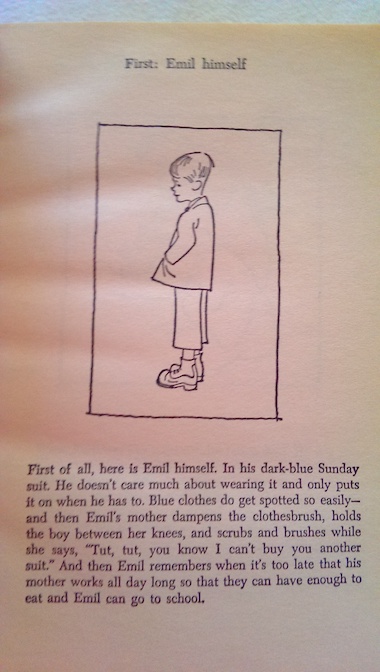 This book was originally written in German. It was written in Germany during the
  At the beginning of this story, it explains that Emil Tischbein’s father died when he was very young and that his mother works hard as a hairdresser to support the two of them. When she can, she saves a little money for Emil’s grandmother as well. When the story begins, Emil is preparing for a train trip to Berlin to visit his relatives. Emil will be traveling by himself and will meet his relatives near the station when he arrives. His mother gives him some money to take to his grandmother and warns him to be careful. Emil pins the money inside his pocket for security.
 Determined to get the money for his grandmother back, Emil searches for Herr Grundeis and spots him getting off the train. It’s too soon for Emil’s stop, but he follows Grundeis off the train anyway, tracking him to a café.
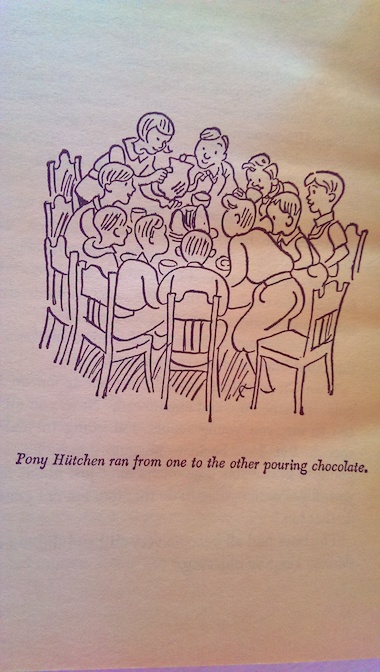 Gustav recruits a bunch of other boys from the neighborhood, and they continue tailing Grundeis through the city to his hotel. The boys call another friend at home, who keeps track of their progress and gives them reports about what others have said. Emil gets one of the other boys to tell his relatives that he has been delayed on important business, causing his cousin, Pony Hutchen, to come and tell him that everyone is worried and that he’s going to be in big trouble with his relatives if he doesn’t show up soon. However, they still have the problem of deciding how to confront Grundeis and get him to return the money. In this case, the detectives don’t need to solve the mystery of who the thief is. The real problem is how to prove it.
 There was a note in the beginning of my copy of the book that says that many of the character names in the book are actually jokes on the part of the author. It’s not as obvious in English because the forms of the names sound reasonable for German names, but anyone who knows German would spot that they aren’t real names. For example, Emil’s last name is Tischbein, which means “table-leg,” and the thief’s alias, Grundeis, means “ground-ice.”
 Lisa and Lottie by Erich Kastner, 1969.
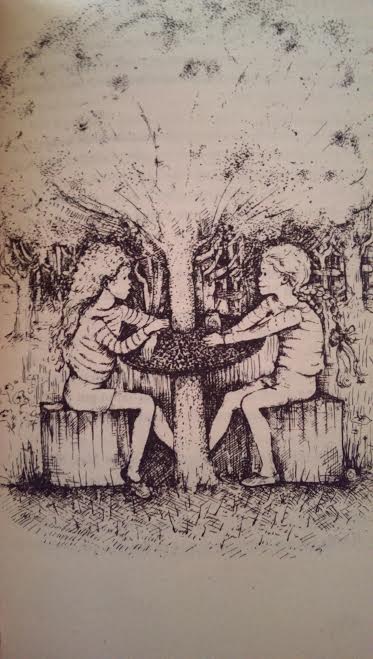 Through the rest of the summer, the girls discuss their lives and parents in great detail and continue speculating about the reasons for their parents’ separation and why they were never told about each other’s existence. They are somewhat angry at their parents for not telling them the truth, but they each also want to know more about the parent that they have never really known and perhaps to learn the truth behind their parents’ separation. They begin hatching a plot to switch places so that Lottie can go to Vienna to meet their father and Lisa can go to Munich to be with their mother. They get little notebooks and fill them with as many details of their lives as they can think of so that each girl can seem to behave like the other, although they know it won’t be easy because they’ve lived very different lives. They don’t like the same foods, and Lottie knows how to cook, but Lisa doesn’t.
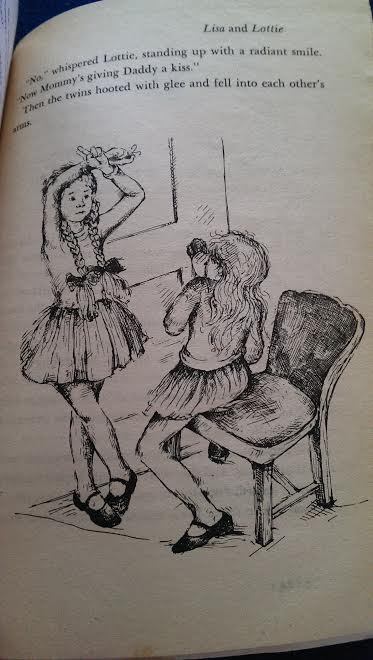 Lisa is overjoyed to finally meet her mother in Munich. But, her mother has to work very hard as a photographic editor for a newspaper, and they don’t have much money. Lisa isn’t as good at cooking or taking care of household chores as Lottie is, so she finds it difficult to help, although she learns quickly.
 The book is much less of a comedy than either of the two Disney movies, although there are some funny parts, like when Lottie (as Lisa) takes over the household accounts to stop Rosa’s stealing and ends up turning her into a much better housekeeper with her practicality. Surprisingly, Rosa actually starts respecting her more and even liking her better because of it.
 Mystery of the Roman Ransom by Henry Winterfeld, 1971.
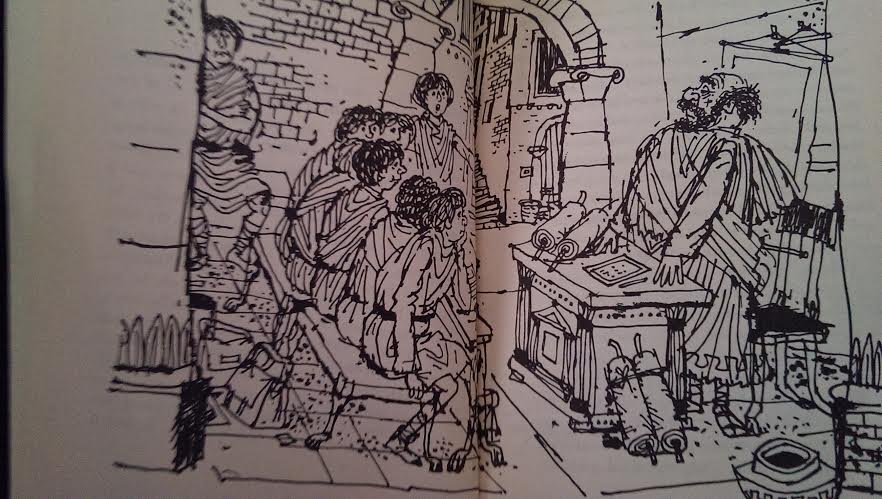 When they return to the slave dealer’s home, he is gone, and the place is boarded up. An elderly slave who was left behind said that all of the other slaves were sold, and then the dealer simply fled, abandoning him. He also says that there was someone else who had come to see the dealer, demanding that he hand over the slave called Udo (the one that the boys had already bought). This man was a former gladiator with only one eye, and he was very angry that Udo was gone. He swore that he would he would get Udo one way or another, dead or alive. He threatened the dealer, saying that he would return later and kill the dealer and all of his slaves if Udo was not among them then. The slave dealer, not knowing the names of the boys who had bought Udo or where he could be found and therefore unable to get Udo back, fled in fear of the former gladiator’s threats.
 Detectives in Togas by Henry Winterfeld, 1956.
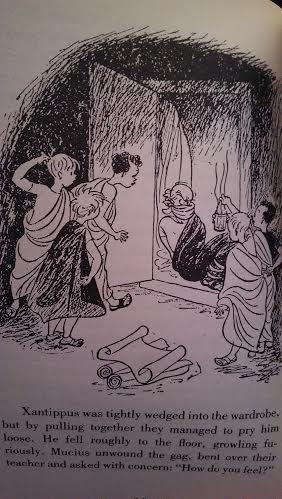 The next day, when the other boys arrive at school, they discover that their teacher has been attacked and robbed during the night. Worse still, when they go to Rufus’s house to visit him, they learn that someone has written “Caius is a dumbbell” on the side of the Temple of Minerva, which has been dedicated to the emperor. Defacing a temple is a crime, and soon Rufus is arrested and sent to prison (being young and part of an important family does not guarantee him special treatment). Rufus swears that he was not the one who defaced the temple, but who else could have done it?
 Jestress's Forgotten Books and Stories
