The Mystery of the Green Ghost

The Three Investigators

Bob and Pete are looking at an old, abandoned house that’s in the process of being torn down when they hear an unearthly scream from the house! There are stories that the old house is haunted, and the boys run away, only to be stopped by a group of local men, who ask them what’s going on. When the boys explain, the men talk about calling the police or going inside the house to investigate. The men decide to just go in and have a look around themselves, in case someone’s hurt and needs help right away. They tell the boys that they can leave because they will handle the situation, but the boys decide that they can’t leave without having a look themselves.

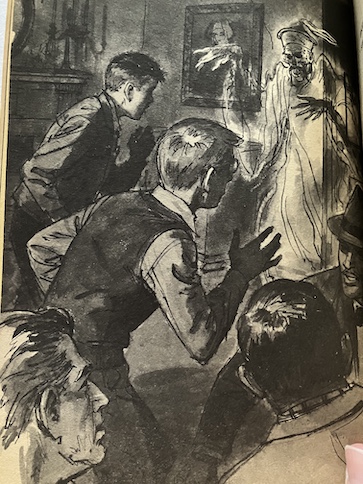
As they take a look around inside, they see the remains of the ornate wall paper and impressive features of the once-rich house, and the men talk about Mathias Green, who used to live in the house. At first, the searchers can’t find anything, but then, they spot a greenish figure on the stairs. Thinking that there’s some prankster in the house, the searchers go upstairs to confront the person, but they can’t find whoever it was. The boys suggest that they have a look at the dust on the floor and try to follow the person’s footprints, but the only footprints the searchers can find are their own. Could they have seen a ghost?

The searchers do notify the police about what they’ve seen in the house, but the police don’t take it too seriously … at first. However, they soon begin receiving other reports from various people around the city who claim to have seen a greenish, ghostly figure. Even then, the police might not have take the reports too seriously, except that a couple of officers on patrol witness a greenish, ghostly figure in the cemetery … at the burial site of Mathias Green, who died falling down the stairs in his house, 50 years before.

While Bob and Pete were at the house, Bob had his tape recorder with him, and he plays the recording of the scream they heard for their friend and fellow investigator, Jupiter. Jupiter is willing to believe it could be the scream of Mathias Green’s ghost, and the boys review the information they know about Mathias Green. Mathias Green was once the skipper of the ship, and he sailed to China. For reasons that nobody fully understands, he had to leave China suddenly, and the rumors were that Mathias’s wife was a Chinese princess and that Chinese nobles had a grudge against Mathias. Mathias brought his wife back to the United States with him, and they built their house in Rocky Beach after Mathias had a fight with his sister-in-law, and they moved away from San Francisco. They had some Chinese servants, but when Mathias was later found dead, apparently from an accidental fall down the stairs, the servants and his wife disappeared. People assumed that they left for fear that they would be blamed for Mathias’s death, and Mathias’s sister-in-law inherited the house. Recently, Mathias’s niece decided to sell the house to a developer, who is planning to tear it down and build more modern houses.

Local newspapers have picked up the stories about the green ghost and its apparent connection to the old Green mansion, and some of them have implied that the ghost is looking for a new place to haunt now that its house is being torn down. The Three Investigators have access to more information than most people because Bob’s father is one of the reporters covering the ghost incidents. The police chief tells them, off the record, that he witnessed the ghost himself, in the cemetery, and it looked like it disappeared by sinking down into Mathias’s grave. Then, the police chief learns that the workmen tearing down the house have discovered a hidden room. Bob’s father and the boys are allowed to come with him to see what the room contains.

The discovery is a shock. The hidden room contains an ornate coffin, holding the skeleton of Mathias’s Chinese bride, dressed in elaborate robes and with an unusual necklace of gray pearls, called ghost pearls. The story is that the reason why Mathias and his bride had to suddenly flee China was that Mathias reportedly stole the pearl necklace to give to his bride. When she died in Rocky Beach, he couldn’t bear to be parted from her, so he “buried” her secretly in his house, along with the necklace.

The discovery of Mathias’s wife’s hidden burial chamber doesn’t lay the ghost to rest, though. Bob and Pete get a phone call from Mathias’s niece, Lydia, asking them to visit her at the vineyard where she lives, to talk about what they witnessed at the house. She says that the ghost has actually appeared at her vineyard! Jupiter is not invited to the vineyard because he didn’t witness the appearance of the ghost with the others, but he couldn’t go anyway because he’s temporarily in charge of his uncle’s salvage yard while his uncle is out of town. He tells Bob and Pete to go ahead and meet with Lydia and let him know what they learn.

At the vineyard, Bob and Pete meet Lydia’s distant cousin, Harold, and Lydia’s great-nephew, Charles, who is actually the great-grandson of Mathias Green and the real heir to Mathias’s estate. Charles, who is called Chang, grew up in China, and they explain that he is descended from Mathias’s first wife, who died of an illness in China. After the death of his first wife, Mathias put his young son into an American missionary school in China and left him there as a boarding student. When he married his second wife and had to flee China, he left his son behind. His descendants remained in China since then, until it became unsafe for Americans or people of American descent in China. Then, Charles, who is an orphan and part Chinese (hence his nickname of Chang), was sent to live with Lydia in the United States. Until that point, he knew very little about his ancestors and his relatives in America. Technically, Mathias’s estate should have come to Chang’s side of the family when Mathias died, but they were living in China at that time and were not in touch with the rest of the family. Lydia says that Chang should even technically own the vineyard that she and Harold have built with the family’s money, but Chang doesn’t want to take it from them, so Lydia says that she is leaving it to Chang in her will. Chang is satisfied with this arrangement, but the family has debts, and if they don’t resolve them, they might lose the vineyard entirely.

Lydia believes that the green ghost is Mathias’s ghost, and he is haunting them because he’s angry with her for selling his old house to be torn down. The ghost has been scaring away workers at the vineyard, and if they can’t get the harvest processed, they won’t be able to keep the vineyard. However, Chang doesn’t believe that his great-grandfather would want to hurt his own family. Chang might be willing to believe that the ghost is an evil spirit, masquerading as his great-grandfather. That’s not the only possibility, though. There could be a human being with a motive for wanting to ruin the vineyard. Then again, there is the question of who really owns the ghost pearl necklace. If Mathias’s family owns the necklace, they could sell it to cover their debts, but it might really belong to the family of Mathias’s Chinese wife. Her family is more difficult to trace, but one person has stepped forward, claiming to be her heir. Then, someone attacks Harold and steals the necklace from him. Was the necklace always the ghost’s target, from the beginning? Meanwhile, back in Rocky Beach, Jupiter has a revelation. There was a dog present when Bob and Pete were searching the Green mansion with the men, and the dog … didn’t do anything. That might be the most important clue of all!

The book is available to borrow and read for free online through Internet Archive (multiple copies, including some in other languages).

I enjoyed the mystery and the reference to Sherlock Holmes about the dog that did nothing in the nighttime. In this story, Jupiter takes the dog’s non-reaction as a sign that there was no supernatural presence in the house because animals are supposed to react to the presence of ghosts. There is definitely a human behind all the spooky happenings, and I was partly right about who it was. However, the author threw in a complication by inserting another mysterious villain who kind of usurped the original plotter’s plot for his own purposes and partly distracts the characters from the original villain for part of the story.

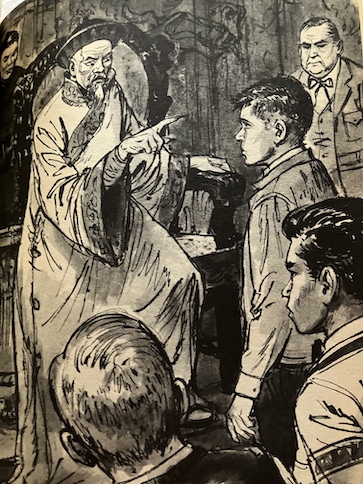
This added villain is a mysterious old man from China who claims that he’s 107 years old and that he wants the pearls because drinking dissolved ghost pearls is the key to immortality. This mysterious old man is wealthy, and he has bought up the family’s debts, meaning that he will get control of the vineyard, if they can’t pay their debts. However, he’s not really interested in the vineyard for its own sake. He just wants those pearls. Although he does some criminal things in the story, nothing much seems to happen to him at the end, and he works out a deal with Lydia, so she can keep the vineyard. It’s left open whether or not he truly ended up with the pearls or whether the pearls actually have properties for preserving someone’s life, but it seems that he truly believes it, and he has no other motivations for his part in the story.

This almost Fu Manchu style character, who uses hypnosis to control people, adds an element of exoticism to the story that I thought wasn’t really necessary. I liked the ghost mystery well enough with its original villain and without him, and I felt like the introduction of the extra villain sent the plot a little off the rails, but he does allow the story to end on a somewhat creepy and ambiguous note. We don’t entirely know who he is, and we never really find out what happens to him. We don’t know if he’s really as old as he says he is or if he continues much further in his quest to live forever. He just disappears after getting what he can of the pearls, presumably to go hunting for more elsewhere.

As far as I’ve been able to determine, the ghost pearls aren’t real, and the legend about them prolonging people’s lives isn’t real. However, there are legends and superstitions from around the world about pearls being associated with wisdom and longevity and having healing powers. Pearls can be dissolved in an acidic liquid and drunk by a human, as in the famous story about Cleopatra drinking a pearl in vinegar, which was supposed to be an aphrodisiac.

Getting back to the mystery, though, I did like the Scooby-Doo-like mystery, and I was satisfied by the original plot, and the villain’s methods and motives. I was looking at that character with suspicion for a number of reasons. Perhaps, if the part about the pearl necklace, the ancient man who drinks pearls, and Mathias’s bizarre room with his dead wife weren’t in the story, the solution would be too obvious, but overall, I enjoyed it. I also appreciated how Jupiter worked out some of the details of the first haunting by visiting the house and studying the scene while his friends were at the vineyard. He comes to some conclusions about how that first haunting occurred that Bob and Pete didn’t think about, and his solution also provides a reasonable answer to the question of why that group of men happened to show up outside the house on the evening the haunting happened, to witness it.

Lady Margaret’s Ghost

Felicity, An American Girl

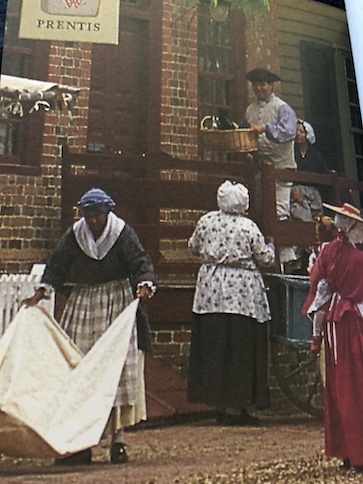
This book is one of the mystery stories published to accompany the American Girl series of historical books. The main character of this book, Felicity Merriman, lives in Colonial era Williamsburg, Virginia, around the beginning of the American Revolution.

Felicity’s mother is going on a trip to visit a relative, along with Felicity’s younger siblings. As the oldest girl in the family, Felicity will be in charge of the household while her mother is gone and her father and his apprentice, Ben, are working in the store her father owns. It’s a big responsibility and an honor that Felicity’s mother considers her capable of managing the household, but because Felicity is still young and some household tasks involve heavy work that is difficult for her to do alone, her mother has hired a temporary cook, Mrs. Hewitt, to help her. Because Felicity is known as a daydreamer who doesn’t always pay attention to what she should be doing, her mother reminds her to focus on the task at hand while she’s minding the house, although she has faith in Felicity and is sure that she will do a good job.

Soon after her mother leaves, a crate arrives at the house for Felicity’s father, along with a letter. The letter explains that a cousin of Felicity’s father has died and that the crate contains some family heirlooms that his cousin left to him. These heirlooms once belonged to a common ancestor of theirs, Sir Edward Merriman, a wealthy nobleman and the first member of their family to live in the colonies, more than 100 years earlier. Felicity’s father didn’t know his cousin well because they never lived very close, and his cousin was much older, but he does know the history of the heirlooms. The heirlooms include a lady’s silver vanity set and a silver cup and rattle for baby. The story is that Sir Edward’s wife, Lady Margaret, owned the vanity set, and the rattle and cup were for their infant son. Unfortunately, the baby was stillborn, and Lady Margaret died shortly after the birth. After her death, her husband and the household servants believed that she still haunted the house. The haunting may have been part of the reason why Sir Edward decided to leave his home in England and go to America, but even though he later remarried and had other children, he could never bring himself to part from the things that belonged to his first wife and child. Even before Felicity’s father tells her about the ghost story, Felicity gets a strange feeling from the vanity set, and she wonders if the objects could be haunted.

However, Felicity soon has to turn her attention to household issues. Mrs. Hewitt, the temporary cook arrives, and she is a brusque and unpleasant woman. She is rude and condescending to Felicity when they are working in the kitchen together. Because Mrs. Hewitt is so rude, Felicity is nervous and makes mistakes, making her look like more of a fool to Mrs. Hewitt. They can’t easily replace her because cooks are in demand right now because this is Publick Times in Williamsburg, and there are many visitors to the city. Everyone is busy tending to them. Mrs. Hewitt was the best they could find available. Felicity’s father does speak to her about her rudeness to Felicity. After that, Mrs. Hewitt is sullen and resentful, and she is even more pleased whenever she sees Felicity doing something wrong.

There is also an exciting event taking place. Felicity has entered her horse, Penny, in a horse race at the fair in town! Ben, her father’s apprentice, will ride her. The day of the race, Penny seems to be doing well, but then, she suddenly develops a problem during the race. When Felicity and Ben check her out to see what was wrong, they discover that someone put burrs under Penny’s saddle! Worse still, the wounds caused by the burrs become infected. Felicity is very upset and worried about Penny, and she wonders who would have hurt her horse. There were a couple of men looking at her before the race. There was also a boy named Dawson and a girl called Anne.

Dawson turns out to be a runaway, but he also has some knowledge of horses. Although Felicity is a little suspicious of him at first, Dawson helps to heal Penny’s wounds. He also says that he saw Anne gathering burrs, but it was probably on behalf of someone else.

When Felicity realizes that her treasured coral necklace, which her mother also wore as a girl, has disappeared, Felicity questions whether she carelessly lost it or if someone has stolen it. Felicity has been doubting herself and her ability to manage the household because of all the mistakes she has made since her mother left, and the clasp of the necklace was a little loose. This could just be another disastrous mistake, but it is suspicious that Anne seemed so friendly to her at the race and then ran away from her later. Anne also literally bumped into Felicity at the race. Could she have taken the necklace? Dawson seems to think so, but then again, can Felicity really trust everything he says?

Felicity still gets an odd feeling from Lady Margaret’s heirlooms, and she thinks that she sees something white moving around at night. At first, she thinks that it could be Lady Margaret’s ghost, but then, strange things begin happening around the house. Things disappear, and Felicity worries that maybe she carelessly mislaid them. Then, her necklace unexpectedly turns up, and Lady Margaret’s vanity set vanishes! Are these strange things part of the haunting of Lady Margaret or the work of a thief? If it’s a human thief, is it the work of the runaway Dawson, mysterious Anne, unpleasant Mrs. Hewitt, or the mysterious person who arranged for Penny to be hurt?

The book ends with a section of historical information about Colonial era Williamsburg. The story is set during Publick Times, which was when court was in session in Williamsburg. People would gather in Williamsburg during Publick Times to see the trials in court and attend a public fair in Market Square. The fair offered various kinds of entertainment, games, and races, like the horse race in the story.

The story leaves it a little ambiguous at the end about whether Lady Margaret’s ghost exists, but if she does, she is not harmful and has nothing to do with the thefts in the story or what happened to Penny at the horse race. As the section of historical information explains, there are many new visitors in Williamsburg during Publick Times. This was a good setting for the story because there are many strangers to the city with unknown pasts and motives, and crowds at the fair might harbor thieves.

Part of the story and part of the section of historical information in the back focuses on the subject of orphans. Both Dawson and Anne are orphans, and neither of them is really being cared for. Dawson admits that he used to steal to support himself after his father died, but he is seriously looking for work. Anne technically has a guardian, but her guardian is abusive and uses her as a servant rather than taking care of her.

When the thefts occur and mysterious things start happening around the Merriman house, both Dawson and Anne look like the best suspects, but there are also possible adult suspects. Even after Felicity realizes Anne’s situation, she isn’t entirely sure which of the men at the fair that day is Anne’s guardian. Mrs. Hewitt also looks suspicious because she is so unpleasant and seems to be trying to make trouble for Felicity. I though the book did a good job of supplying an array of suspects to consider. The solution to the mystery was one of the possibilities I thought was most likely, but there were enough other possibilities to make the story interesting.

The Ghost of the Gracie Mansion

Mysteries in Time

The Ghost of the Gracie Mansion by Susan Kohl, illustrated by Ned Butterfield, 1999.

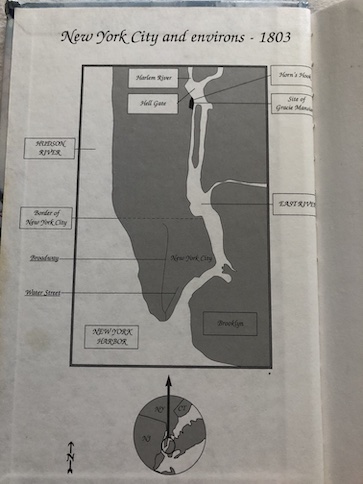
The year is 1803, and the Gracie family has decided to temporarily leave New York City because of the Yellow Fever Epidemic. William Gracie, the eldest son of the family, is disappointed because he has started working for his father’s shipping business, and he was looking forward to being promoted to clerk this spring. He wants to follow in his father’s footsteps, and he’s serious about wanting to learn the business. The trip that they’re taking to their new country home at Horn’s Hook, north of the city, seems to delay his plans because it’s so far away from everything, from his father’s business and from the Tontine Coffee House, where businessmen and other important people meet to discuss the issues of the day. However, William can’t help but admit that the situation in New York is serious. People are dying of Yellow Fever every day, including children, and his parents just want the family to be safe.

William begins to feel a little better when his father tells him that he’s arranged for them to work together from the family’s country mansion. His father says that captains of the ships he owns will stop at Horn’s Hook on their way to New York Harbor to report to him, and William will help him to prepare the cargo lists and timetables for the ships. Their temporary exile from New York hasn’t put a stop to their business or William’s education in that business; they’re just going to be doing things a little differently until the crisis is over.

While the family is traveling to their new country house, Mr. Gracie tells them about the history of the place. There used to be another house on that land, but it was destroyed during the American Revolution (an event still in relatively recent memory at the time this story takes place) as the British and the Patriots struggled to control it because that location is a strategic spot on the Harlem River. Mr. Gracie says that their new house is built over the basement of the old house, and that’s important because he’s aware that the former owners had a secret tunnel that led out of their basement in case they needed to use it as an escape route during the war. He told the builders to look out for it while they were building the new house, but if any of them ever figured out where it is, they never admitted it. The Gracie children are excited about the idea of their new house having a secret tunnel, and they’re eager to find it!

The new Gracie house is beautiful, really more of a mansion than just a house. However, there is something strange going on there. Soon after they arrive, William’s younger sister Sarah sees someone in the house dressed all in white. Sarah thinks that she saw the ghost of the person who owned the house that used to be on their property. The others don’t believe her because Sarah has a vivid imagination and is always making up stories, but Sarah insists that she saw someone.

When things start disappearing from the house, the rest of the family begins to believe that there may be some unknown person in their house. Sarah still thinks it’s a ghost, but William thinks maybe someone has found the secret passageway into the house. Who is this mysterious intruder?

The book is available to borrow and read for free online through Internet Archive.

My Reaction

I always like historical novels, particularly historical mysteries, and I really enjoyed this one. The mystery is meant for children in elementary school, and it isn’t too difficult, but it’s fun to see the Gracie children searching for the secret passage and trying to learn who is sneaking around the family’s country mansion. I also enjoyed that the story offers history lessons on multiple levels. The immediate situation for the characters is the yellow fever epidemic of 1803, but the story also touches on the American Revolution. The solution to the mystery is also related to Revolutionary War history. The Gracies, headed by father Archibald Gracie, were a real family who made their money in shipping, although the events in the story are fictional. There is a section in the back of the book that explains more about the family’s history. They associated with prominent people in New York in the early 19th century, and Alexander Hamilton makes an appearance in the story when he visits the Gracie Mansion. The Gracie Mansion is a real place. When it was first built, it was in the countryside outside the limits of New York City, but since then, the city has grown around it. It is now used as the home of the mayors of New York City.

Although this book was published before the coronavirus pandemic of the early 2020s, I also appreciated the part of the book at the beginning, where William is concerned that the current epidemic has changed his plans and impacted his ability to learn his father’s business. However, his father explains to him that they are still in business, and he has made arrangements for them to continue working in a different way during their time away from the city. People who lived through the quarantines and lockdowns of the covid pandemic will understand how it impacted the way people worked or continued their education and how people had to find ways to work around the problem. I appreciated that this story shows how people have had to deal with public health crises before in history and how they have always had to find creative solutions to deal with problems of this nature.

In this particular situation, the Gracies are a wealthy and privileged family, so their options for escaping from the crisis and working from outside the city are greater than other people of their time. Not everyone had a countryside mansion where they could go to escape the disease, and not everyone had employees who could report to them wherever they were. What Mr. Gracie and his son are doing during the course of the story is the early 19th century equivalent of “working remotely”, pre-Internet, and they accomplish it through people coming to report to them and taking goods and information into the city on their behalf. Even though the Gracie family can stay outside the city, they are still sending their ships into the city’s harbor because the cargo the ships carry is necessary there. There are people in the city who are waiting for the supplies the ships are carrying. The crews of the ships are what people in the 2020s came to call “essential workers” – the people whose type of work was necessary, no matter the circumstances, and who could not perform their duties from a remote location. The same is true for all the other people who must remain in the city because their jobs require them to work with or on behalf of the people who are still there.

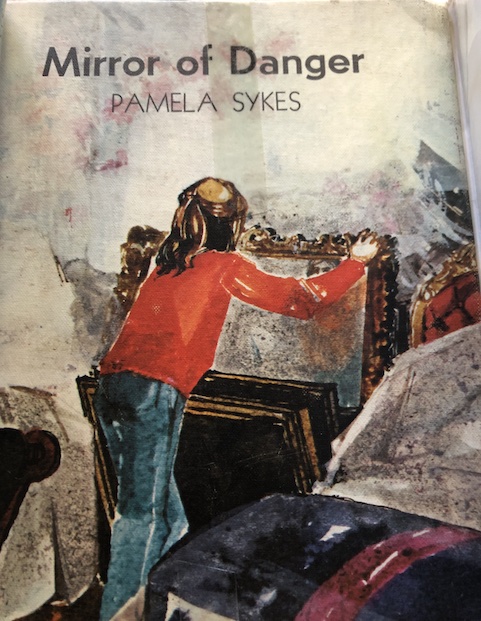
Mirror of Danger

Mirror of Danger by Pamela Sykes, 1973, 1974.

In the beginning, Lucy is an orphan who lives in the countryside with her elderly Aunt Olive. The two of them are very fond of each other. Then, Aunt Olive dies, and Lucy has to go live in London with her distant cousins. Even though Lucy inherited her aunt’s house, there were bills to settle, and the trustees in charge of Lucy’s legacy had to sell the house to pay them and provide money to help support Lucy. Lucy’s cousins have agreed to take her for Christmas, but Lucy isn’t sure whether or not she will be living with them permanently. It depends on how well Lucy gets along with the children of the family. People keep telling her “we’ll see” and reminding her to be brave and sensible and that changes are natural after someone dies. Her trustees and her aunt’s old friends want to do what’s best for Lucy, although they’re secretly a little concerned about whether their plans are what’s best for her. If she doesn’t get along with her relatives, they might have to send her to a boarding school, although they know that type of environment isn’t really suited to Lucy’s personality.

Since Lucy was raised and home-schooled by an elderly and old-fashioned woman, she is not accustomed to living in a big family or with other children and not even accustomed to any type of school environment. The adults who know her understand that Lucy is a quiet, reserved child who acts older than her age. Before she goes to stay with her relatives for Christmas, one of her trustees, Mr. Thomas, talks to Lucy about her life with her aunt and the need to give her other relatives a chance to be friendly. He says that Aunt Olive was an old woman who had a tendency to look back to the past, but Lucy is young and still has her future ahead of her. Mr. Thomas advises her to look forward. However, Lucy can only think of how much she already misses her life with her aunt and how she can’t imagine being happy with these relatives she’s never even met. She escapes thinking about these things by imagining herself other places, immersing herself in past memories.

Lucy feels out of place in her new home and worries if these relatives really want her. The father of the family, called Uncle Peter, is an architect, and the mother, called Aunt Gwen, is an artist who used to design theatrical costumes. Their three children are pretty close in age to Lucy. Patrick is the oldest, Rachel is closest to Lucy’s age, and Bill is the youngest. Their house is an old Victorian house, which pleases Lucy, but she doesn’t like it when she finds out that Uncle Peter is modernizing it. Home renovations are part of what he does as an architect, but Lucy prefers old-fashioned styles to the modern ones, which feel too stark and have garish colors. The children of the family are noisy, and Lucy has to share a room with Rachel, when she’s used to having a room of her own in a quiet, old-fashioned house. Rachel points out that they haven’t been in this house very long themselves, and there are rooms in this house that haven’t been renovated yet. When the renovations are done, Lucy could have one of those rooms for herself, but again, Lucy feels like the renovations are destroying the old-fashioned charm of the place. She doesn’t see why everything has to be new and modern. While she has no idea where else she could go, Lucy just can’t imagine herself living in this house with these people.

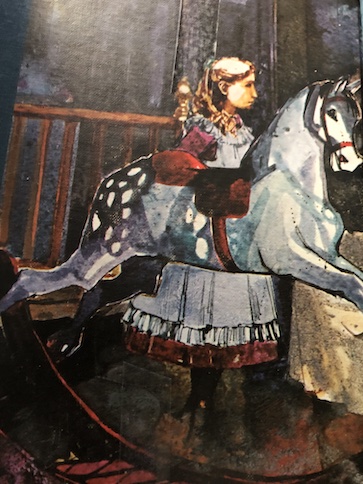
Then, Lucy makes an unusual new friend. Alice is a girl about Lucy’s age, and she used to live in the aunt and uncle’s house 100 years before. Now, she haunts it as a ghost. Lucy first sees Alice in a mirror in the attic, where there are many antiques that have been stored away from Alice’s time. Alice brings Lucy back in time to visit her in the Victorian era because Alice is lonely in the past. She has six older siblings, but four of them have already left home to marry or start careers, and two are at boarding school. Her parents are away much of the time, so most of the time, she is alone with her tutor, whom she calls Mademoiselle. Alice says that she really wants someone to play with.

Alice shows Lucy her toys and games, which are all familiar to Lucy, looking like the ones she always played with at Aunt Olive’s house. However, Alice is spoiled and cheats at games to win. The two of them argue about it, and then Alice sends Lucy to the attic because her tutor is coming, and Alice doesn’t want her to see Lucy. Lucy finds herself in the attic in her aunt and uncle’s house in modern times, unsure of what just happened.

Over the next few days, Lucy spends part of her time with her relatives, preparing for Christmas, and part of her time in the Victorian era with Alice, which is also around Christmastime. Things are still awkward between Lucy and her cousins. On the one hand, she has some fun with them, doing things that Aunt Olive would never have allowed her to do, like going to the movies without adults and eating take-out fish and chips. On the other hand, Lucy is still overwhelmed when her cousins get boisterous, and she is repulsed by their ultra-modern Christmas decorations. Although Alice intimidates and even frightens Lucy, whenever things get overwhelming for her in modern life, Lucy retreats into the past with Alice … only for Alice to get intimidating and frightening again as she tries to keep Lucy in the past with her.

In some ways, Lucy feels more comfortable in the past than she does in her aunt and uncle’s modern home. She likes the homey feel of the house as it was in the Victorian era. The old-fashioned Christmas decorations and Alice’s party are far more charming to her than the modern ones, and she likes the old-fashioned party games better than dancing to modern music. However, Lucy becomes increasingly afraid of Alice. Alice tries to trap Lucy in the past and make her forget all about the present. When Lucy resists and tries to remember things about her family or modern times, Alice gets angry and threatens her. She says that she’ll make something bad happen if Lucy tells anybody about her. Alice has sinister intentions for Lucy. Alice is a lonely and selfish child who isn’t above lies, cheating, and manipulation to get what she wants. She exists only in the Victorian era, and what she wants more than anything is a playmate to join her for all eternity. She says that she always gets what she wants. She wants Lucy.

The book is available to borrow and read for free online through Internet Archive (multiple copies). The original British title of this book was Come Back, Lucy, which was also the title of the tv mini-series from 1978 based on the book. You can sometimes see trailers, clips, or episodes from this series online on YouTube. This fan page has more information about the tv mini-series and the book and its author.

My Reaction and Spoilers

The heart of the story is about looking back and living in the past instead of looking forward and living in the present. Aunt Olive, as an elderly woman, had a tendency to live in the past, bringing up Lucy as if she were a Victorian girl instead of a modern one. Because that was the only life Lucy knew from a young age, she clung to it after Aunt Olive’s death. It was what was familiar and comfortable to her when her life was changing, and she needed comfort. Her London relatives know that this is the case, but they’re not sure how to connect with her at first and to help her see that modern times and a new home can also become comfortable.

There’s a difference between just liking old-fashioned, vintage things and styles and the type of living in the past that Lucy does at first. There are people in modern times who still like the Cottagecore aesthetic and who try to live a slower pace of life and enjoy old-fashioned things and simple pleasures, something that came out of the coronavirus pandemic. But, just having a few vintage things and learning to slow down and appreciate the small things in life isn’t quite what Lucy does. It is the sort of thing she misses from the old-fashioned house in the country, where she used to live, but the problem is that she uses her memories of that time, Aunt Olive, and the stories that Aunt Olive used to tell her about life in the past to take her mind off the things and people in the present too much. Whenever things get stressful or upsetting to her, she retreats into past memories, so she doesn’t have to think about how her life has changed or learn to appreciate the things around her or get along with other people. Her relatives can tell that she’s shutting them out, and while they’re sympathetic to her struggling through her grief, it’s also hurtful that she’s rejecting them. She’s not just using her past memories or love of old-fashioned things for comfort but to avoid dealing with things in the present and forming new relationships.

At the same time, Lucy feels like her relatives don’t really care about her or the life she had before she came to them because they never express sympathy about Aunt Olive’s death or ask her any questions about what she was like. However, that’s due to a misunderstanding and miscommunication rather than her relatives trying to ignore Lucy or Aunt Olive’s death. If Lucy had bothered to read Aunt Gwen’s letter to her all the way through before she arrived at their house, she would have known that Aunt Gwen had told her children not to bring up the subject of Aunt Olive until Lucy did because she didn’t want them upsetting Lucy by forcing her to talk about her death if she wasn’t ready. Her relatives planned to wait for Lucy to feel ready to talk to them and for her to raise the subject herself. Because she was too upset to read the letter, Lucy didn’t understand that and has been waiting for them to talk to her first. At the end of the story, Lucy does read the letter, and she and her relatives have an honest talk about everything, including Alice. This is exactly what Lucy needs to free herself from Alice.

Alice is a similar sort of malevolent child ghost to Helen in Wait Till Helen Comes or Emily in Jane-Emily. She is selfish, and she has no concern for Lucy and Lucy’s life and future. Alice is dead, and she lives only in the past because that’s the only place where she can live. She has no future left. The one thing that past Alice is waiting for is a message from her parents, who are looking for a house in the country to buy. When the message finally arrives for her on December 21, 1873, Lucy has her final encounter with Alice on the 100th anniversary of the event. Alice is happy because she wants to move to the new house and live there with her parents, but she’s also decided that she’s going to bring Lucy with her by drowning her in an icy pond. In a frightening scene, she tricks Lucy into walking out on thin ice, but fortunately, Lucy is saved by her cousin Patrick.

After this incident and her brush with death, Lucy is finally able to release all of her bottled-up feelings about Aunt Olive and the changes in her life and explain everything to her relatives about Alice and how Alice has been influencing her to do and say things that upset them. Aunt Gwen had suspected that Lucy had seen a ghost or at least thought that she had, but she had thought that maybe Lucy had seen someone who made her think that she was seeing Aunt Olive’s ghost. Then, Aunt Gwen saw a door in the house open and close by itself, making her think that maybe the ghost was real. Rachel knew that Lucy was upset about someone named Alice because Lucy was talking in her sleep, but she didn’t know who Alice was. By the time Lucy reveals everything, all of her relatives have had encounters with Alice or things Alice caused to happen. Lucy isn’t sure when she explains things whether or not they all believe her that Alice is a real ghost. Aunt Gwen is convinced, and so is Bill because he met Alice face-to-face at one point and can describe her. Uncle Peter does consider the idea that Alice is a ghost in Lucy’s mind, inspired by all of Aunt Olive’s stories about her Victorian youth and the old house they now live in, but then, he looks through more of the things in the attic and finds Alice’s old scrapbook with her final note about moving to the countryside and starting a new life on December 21st. In the context of the story, Alice is a real ghost who posed a real threat to Lucy, and not just the imagining of a distraught child.

There are a couple of factors that end Alice’s threat to Lucy. The first one is getting past the 100th anniversary of Alice leaving the house, which seems to hold great significance to the ghost, like it was her last opportunity to connect with the house in the present. We never find out Alice’s full history or why she haunts the house as a child in the time shortly before she was supposed to move to the country. She simply disappears after her attempt to kill Lucy so she can remain in the past forever and go to her new home with her. Alice is a ghost who is conscious that she is a ghost, and she knows that Lucy lives in a different time period with people who inhabit her house in the future or present time. Because Alice is a child and seems forever stuck as a lonely child, it seems that she died young somehow and is aware of it, but we never find out exactly how that happened. I have a theory that she was killed in an accident on the way to her new home, but we are never told that. It feels like a let-down that we don’t get the rest of the story about Alice, especially because Lucy says that she would like to learn more about the historical Alice so she can think of her more as a person and less as a ghost.
There is a sequel to this book called Lucy Beware, so perhaps more of that information is revealed in the sequel. The sequel is much more rare than the original, book, though. It only rarely comes up for sale, even online. I’ve checked Amazon, eBay, Etsy, Alibris, and Abe Books, and currently, none of them have a copy. It’s not even on Internet Archive. (At least, not yet, as of this writing.) You can try to get the sequel through an interlibrary loan, but not all libraries will loan out books that are considered “rare.” (I did manage to get a copy through ILL, which is how I finally managed to do a review of it.)

The most important factor that breaks Alice’s connection to Lucy is Lucy’s changing feelings. Lucy has some control over when she goes back in time and when she returns to the present, although it takes her a while to see it. There are times when she deliberately seeks out Alice in the past, even when Alice disturbs her, because she just finds the present time and her relatives so overwhelming. While she doesn’t really want to stay with Alice in the past forever, especially at the expense of her own life, Alice gives her someone to talk to about things that she can’t bring herself to talk about with her relatives and a place to retreat to so she doesn’t have to think about the present or her future. At one point, Lucy and Rachel are talking about the importance of making plans for the future. Rachel says that everyone needs to think of the future, and she is exhilarated by all of the possibilities that modern life has to offer for young women. However, because of her life with Aunt Olive, who lived mainly in the past, Lucy is unaccustomed to thinking about the future and finds the prospect frightening. To a woman like Aunt Olive, girls should simply receive a basic education and then get married. Beyond that, Lucy doesn’t know what she wants out of life. She has never considered having a career or learning to support herself because Aunt Olive never discussed things like that with her and never prepared her to make decisions like that. At the beginning of the story, Lucy finds it difficult to look much beyond the immediate future anyway because it seems uncertain where she will live since Aunt Olive is gone. However, once she and her relatives open up to each other and it becomes clear that they do want her to stay with them, her doubts and fears about her immediate future are resolved. She has people who love her, care about her feelings, and want her to talk to them about things, so she no longer feels so overwhelmed about her situation and in need of a retreat. Aunt Gwen says that Alice no longer has influence over her because, whether or not Alice still wants Lucy, Lucy no longer wants or needs Alice. Lucy can now face her present and future without feeling the need or temptation to escape into Alice’s past.
It’s true for people who are victims of living narcissists, too. Abusive people count on their victims being unable to leave them, and they even try to gaslight victims into thinking that they really need them in their lives, for some reason. As soon as their victims realize that they can escape and manage without them, their abusers lose their hold on them. Lucy has no more desire to return to her abuser/attempted murderer because she has dealt with the insecurities that made her vulnerable to Alice and kept her tied to the past, and she has forged new bonds with other people.

One other thing that I really liked about this story was the description of the antique games and game pieces that Lucy kept from Aunt Olive’s house. If you’ve never heard the term before, Spillikins is an old name for Pick-up Sticks. One of the more unique gaming pieces was the set of fish-shaped game counters. There were real fish-shaped game counters (link repaired 12-11-23) like that that were used in the 1800s for playing card games.

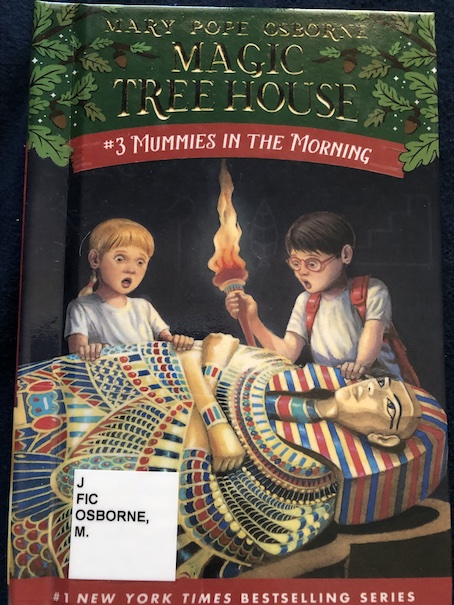
Mummies in the Morning

Magic Tree House

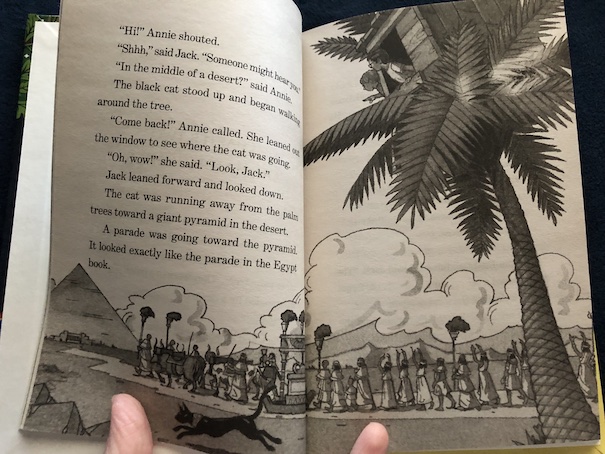
This time, Jack and Annie use a book in the magic tree house to travel back in time to Ancient Egypt. Jack has a fascination for mummies and pyramids, and Annie can’t wait to see them up close. When the children arrive, they witness what appears to be a royal funeral procession, but the people seem to vanish awfully quickly. Annie wonders if they could have been ghosts, although Jack thinks that’s nonsense. He thinks it was probably just a mirage, although he has reason to rethink that later.

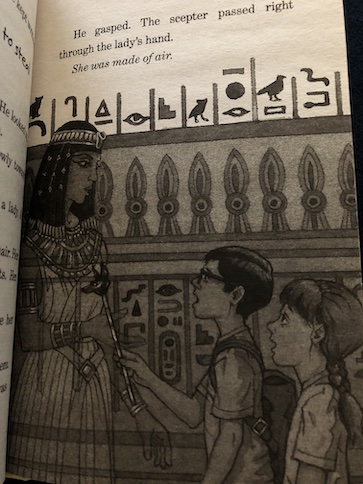
The children follow a mysterious black cat into a pyramid. Annie is eager to see a mummy, but the children are startled when they see what appears to be a walking mummy that drops a scepter. Jack realizes that what they saw wasn’t a real mummy but probably a tomb robber in disguise. He reads in their book about Ancient Egypt about the problem of tomb robbers.

Then, the children encounter a real ghost! She is see-through, and objects pass through her. Fortunately, the ghost is nice instead of scary, and she explains to the children that she needs their help. She is the ghost of an Ancient Egyptian queen, and she has been unable to progress to the afterlife because she cannot find her copy of the Book of the Dead, which is supposed to guide her through the obstacles on the way to the afterlife. She knows that her brother, who designed her tomb, hid the book to protect it from tomb robbers and left clues for her in the symbols carved on the walls of her tomb. However, her brother apparently forgot that her vision was always bad, and she can’t read the symbols. (Apparently, poor vision doesn’t improve after death.) Jack would be willing to loan her his glasses, but since she’s incorporeal (not a word used in the book, but basically, she no longer has a physical presence and can’t use physical objects), the glasses wouldn’t stay on her face.

Instead, she asks the children to describe the symbols on the wall to her so she can interpret them. Together, the children and the ghost use the clues to find the scroll containing the Book of the Dead. After that, Jack and Annie have one more task: escaping the maze-like tomb!

The ghost in the story is a non-scary ghost, but there’s enough mild creepiness and mystery to satisfy kids who enjoy a little creepiness in their stories. Toward the end, they have to put the scroll in the sarcophagus with the queen’s mummy, which both grosses out and fascinates the children.

The historical information was good, although translating Egyptian hieroglyphics is much more complicated than the book indicates. In the book, the symbols are meant to literally depict specific objects, which some hieroglyphics can, but others are used to represent sounds to spell out words or names. I think the story just kept things simple for kids.

I liked the part where the kids get lost in the pyramid because pyramids were build with false hallways and dead ends to confuse tomb robbers. Everything work out fine in the end!

Gone Away

I haven’t found a copy with its dust jacket intact.

Gone Away by Ruth Tomalin, 1979.

Time flies?
Ah no.
Time stays.
We go.

Sundial motto from the beginning of Gone Away

Francie is an only child living on a farm called Goneaway Farm in Sussex in the 1930s. It’s a very old farm, and there’s a story about it that, hundreds of years before, another family once lived there, another couple with only one child. One day, this family went to a fair in another town, Alchester, and for reasons nobody understands, they never returned to this farm. The farm stood empty for a long time before it had a new owner. Because this old family went away with no explanation, the farm came to be called Goneaway. In spite of this strange story and the age of the farm, Francie has never felt that the farm was haunted or that there was anything sinister about it. Then, Francie finds herself staying in a real haunted house.

There are no illustrations in the book. It starts with this quote.

Because the farm where Francie lives with her parents is far away from local schools, Francie studies her lessons at home with her parents’ help, but she often gets distracted by the animals on the farm and doesn’t focus on her lessons. Francie’s great-aunts, Aunt Berta and Aunt Fanny, live in Scotland, but when they come to visit the farm, they see how Francie isn’t getting her schoolwork done. The aunts are also concerned at how isolated Francie’s life is. There are no other children living nearby to be friends with Francie, and they think that her life must be lonely. They talk to Francie’s parents about sending her to boarding school, but they say that they can’t afford it. They can’t even afford a car, which is why they can’t drive Francie to school in town. The aunts remind Francie’s mother that she used to board in a private house with a nice family so she could attend school when she was young. Boarding with a family wouldn’t cost as much as a fancy boarding school, and she could come home on weekends. Still, Francie’s parents are reluctant to send her away because they think she’s too young, and they’re not ready to part with her.

When the aunts leave after their visit and her parents don’t bring up the subject of school again for a while, Francie is relieved. She loves her life on the farm, and she doesn’t want to leave. Yet, she also finds herself oddly disappointed, too. She’s read stories about children at schools, and their adventures do sound exciting. She thinks it would be ideal if she could go to school during the day and come home afterward, like other children do, but that just won’t work with her family’s circumstances. Her parents’ attempts to find friends for her just aren’t working, either. Her parents start inviting other farm families to visit on Sundays, but Francie doesn’t get along with their children. The reasons why she doesn’t get along with them are largely because the other children don’t behave well, but these incidents convince Francie’s parents that maybe the aunts were right and that Francie could benefit from going to school and meeting a wider range of other children.

Her parents write to the high school in Alchester and inquire about registering Francie. They arrange for Francie to take entrance exams, but Francie has mixed feelings about it. On the one hand, the idea of boarding and going to school, with the knowledge that she will come home on the weekends, seems exciting, but on the other hand, she worries that the children at the school won’t be any more friendly than the children of the nearby farm families. Her mixed feelings continue through the day when she and her mother visit the school. At first, Francie thinks that maybe she’ll flunk the entrance exams on purpose so she won’t have to leave her farm. Then, after the initial tour of the school, Francie thinks that going there may be exciting after all, so maybe she’ll try to pass the exams. The exams are difficult, and she expects she’ll fail them after all because she really can’t do the work. Her parents tell her not to worry because, if she fails this year, she can always study more and try again next year. However, it turns out that she did pass. The arithmetic portion of the exam really was too difficult for her because the person giving her the exam accidentally gave her a higher level test instead of the basic entrance exam, but Francie did an excellent job on the writing portion of the test.

Since Francie will be attending the school in Alchester after all, she and her mother begin shopping for her school uniforms and other supplies. Francie is still worried about the prospect of boarding with strangers in town, and her mother isn’t sure how to find a house or family willing to take her. A boarding prospect turns up because Francie is too small and skinny for even the smallest available size of the school uniform, and she and her mother have to visit a professional tailor. The tailor, Mrs. Majendie, also has a few rooms that she rents out to boarders. Francie isn’t sure that she’ll like boarding with Mrs. Majendie at first because she and her house seem a bit grand, her dog seems oddly bored and unresponsive to Francie’s friendliness, and her other boarder is the headmistress of another school in town, the Chantry School. However, the available room is beautiful, with a four-poster bed and tapestries, and the room has a view of the nearby churchyard, where the children from the Chantry School are playing among tombstones in the old graveyard. Mrs. Majendie says that the Chantry School was once a chapel, and her own house was once an old inn. She also says that a new housekeeper will be moving in soon with her daughter, who will attend the Chantry School. It all seems like a fairy tale kind of place to Francie, and she is reassured that there will be another girl living in the house with her, so she tells her mother that she would like to board there.

When she actually starts school, it goes pretty well. The classes aren’t too hard, the subjects are interesting, and she gets along well with the other girls. There is an older girl called Trixie who likes to play pranks on the younger students, and some of the girls tease Francie about her height, but the older girl who is assigned to look after her, Verity, tells Francie not to take any notice of those girls. At first, Francie is able to use her bicycle to get from school to the train station, so she is able to go home every night, but then, as the days grow shorter, and it gets dark sooner, she can’t do that anymore, so she starts to board in town with Mrs. Majendie.

Her boarding experience turns out to be different from what she first thought, though. It turns out that the new housekeeper isn’t very friendly, and her daughter decided to stay with her grandmother instead of coming to town with her mother, so the house is lonelier than Francie had expected. The atmosphere is also different in the winter than in the summer, when Francie first saw her room. The room seems colder, darker, and a little more sinister in the winter, and in the evening, there aren’t any children playing in the churchyard outside. At night, she hears strange sounds, like a tapping and a wailing. When Trixie learns that the place where Francie is boarding is Falcon House, she implies that there’s something really wrong with the place, but Francie assumes it’s just another of Trixie’s tricks. Then, when other students try to get Trixie to shut up and remind her that they all promised not to talk about it in front of Francie, Francie realizes that there really is something weird about the house. She tries to get Verity to explain it to her, but Verity refuses, which just makes Francie angry and more scared. Now, she knows there is a real secret about the house, but she doesn’t know exactly what it is.

A strange man comes to visit Falcon House, and Francie sees that his card says he is Dr. D. Bone Fane from the Circle for Psychical Research. Francie doesn’t know what it means, so she asks some of the other girls at school if they know. One of them, Bryony, says that she’s met this man before. He’s a ghost-hunter from the United States, investigating supposedly haunted places. Bryony’s father teaches in the Abbey choir school, and this man has been pestering him about stories of a haunting there, although Bryony’s father thinks it’s all boring nonsense. From this information, Francie realizes that Dr. D. Bone Fane is interested in Falcon House because he thinks it’s haunted. She confronts Verity about it, and Verity admits that there are stories of hauntings at Falcon house. Nobody’s ever actually seen the ghost that haunts the house, only heard things, and the only people who have heard the ghost are children. According to the stories, Mrs. Majendie’s own children were the last children to be haunted by the ghost, and they were so scared of the house that they begged their mother to send them to boarding school so they could get away from it. Francie is the first child to live in the house since the Majendie children grew up. Francie realizes that this is why the housekeeper didn’t bring her own daughter to the house and why she seems uneasy about Francie’s presence in the house. Mrs. Majendie even gave her nightlights as a gift because she was expecting Francie to be frightened. The headmistress at Francie’s school told everyone not to talk about the ghost stories, not because she believes in them, but because she was afraid that Francie would believe them and get scared. Everyone but Francie has known about the ghost stories from the beginning, and they’ve all been waiting to see what she will experience in the house, if anything.

The more Francie thinks about it, the more she realizes that she sensed the presence of the ghost on her first visit to the house. Besides the noises she’s been hearing at night, the dog in the house reacted to something at the top of the stairs, as if an invisible hand was petting him. When Francie returns to Falcon House after visiting Verity, it’s a stormy night, and she’s terrified about what might be waiting for her at the top of the stairs. However, when she gets there, and she realizes that it’s just her, the dog, and the ghost, she suddenly realizes that the ghost isn’t a menacing presence. The dog likes it, and it seems a little teasing, but it doesn’t mean Francie any harm. Strangely, its presence begins to feel reassuring to Francie because she’s no longer alone in the house, the only child among adults. The ghost is a child, too. In fact, it’s the ghost of the child from Goneaway, the one who disappeared hundreds of years ago, along with its parents.

The more that Francie investigates, the more she comes to realize that the ghost needs her help. Helping the ghost means learning the truth about the family who once lived on the farm that Francie calls home.

This book was originally published in the UK. The book is available to borrow and read for free online through Internet Archive. There is a sequel to this book called Another Day.

My Reaction and Spoilers

This book fits well with the Dark Academia aesthetic, and it could also be considered Dark Cottagecore because of the farm and countryside themes. When Francie is on the farm, she describes the animals and plants in the countryside. Francie’s school isn’t a boarding school, but she does have to board in a spooky place to go there. There are many literary references throughout the story, and there’s a note in the beginning of the book about the poetry references. Francie reads The Story of the Amulet by E. Nesbit for fun, and her class at school reads Treasure Island. She uses stories she’s read to help her understand what is happening around her. When she makes friends with a girl named Geraldine at school, Geraldine also uses story references to explain what she thinks is happening with the ghost.

When Francie first begins to interact with the ghost, she is only able to sense its presence but not really see it. As the ghost begins to interact with her, it gradually begins becoming more visible. At first, Francie can’t even tell whether the ghost is a boy or a girl, only that it’s a child about her size. She wonders why the stories she’s heard about this child and its parents never mention whether the child is a boy or a girl or what its name and age were. She thinks it’s sad that so many little piece of history get lost.

What she eventually realizes is that the child and its parents were probably plague victims because they disappeared around the time that the plague came through this area in the Middle Ages. She thinks that they probably caught the plague when they came to town for the fair and were buried in one of the unmarked mass graves she’s heard about, and that’s why they were never able to return home. When she talks it over with Geraldine, Geraldine realizes that the children who have been able to see the ghost were all suffering from homesickness when they first arrived at Falcon House. The ghost is awakened by feelings of homesickness in other children because that’s what the ghost has been feeling the entire time. What it wants is to go home to the farm, and Francie has to find a way to help bring it home with her. There is a twist in the ghost story later that leaves Francie wondering how much of what she’s perceived about the ghost is her imagination and another girl, the housekeeper’s daughter, sneaking around the house. However, there really is a ghost, and Francie does figure out how how to help it. It comes home for Christmas with Francie.

During the story, Francie struggles with the difficulties of being away from home and going to school for the first time, and she also starts to consider what it’s going to mean for her future. She still thinks of herself as living at Goneaway Farm, but then, the wife of a farm hand refers to her as becoming a “visitor.” Francie feels uneasy about that because she knows that the woman’s son also went away for school and decided that he would rather do something other than farming, so he now lives somewhere else. Francie still thinks of the farm as her home, and it upsets her to think of the farm without her or her life without the farm in her future. But, is that really what she wants? Before her great-aunts raised the issues of school and friends, Francie was content with her life and didn’t realize that either of those things was something she was missing or might want. Now that she’s going to school in town, meeting new friends, and experiencing some independence to explore the town on her own, what else might she discover that she wants and never knew she could experience before? Will the new things she learns and wants to experience mean giving up her old life, which she still loves? These are all questions that people have as they’re growing up and pursuing an education.

Nobody really knows where life will lead them when they’re just starting out, and that can be scary, but at the same time, growing up does mean change. The changes that Francie experiences are ones that she would have experienced anyway, eventually. Her mother understands some of how Francie feels because she also boarded as a child so she could go to school, but at the same time, Francie realizes that her mother doesn’t understand everything that she’s going through because she isn’t there with her every day. Her mother doesn’t fully know what her classes or teachers are like or what the other people she meets and lives with at Falcon House are like. For the first time in Francie’s life, she and her mother are starting to live different lives, and there are some things that Francie must experience and make decisions about on her own.

The practice of children from rural areas boarding at a private house to attend a day school in town is a real part of history, both in the UK and in the US. I covered that earlier when I reviewed Sixteen and Away From Home, a book set in the 19th century Midwestern US, and The Secret School, when a teenage girl named Ida wants to go to high school in the 1920s. Anne Shirley did the same in Anne of Green Gables, which is set in 19th century Canada. This is what children from rural areas in different countries have had to do if they wanted more schooling than they could get in their area.

There is a scene in the story with some gyspies. The book calls them both “gypsies” and “travellers.” One of them tells Francie’s fortune, which gives her hints about what to do. There is also a scene where girls from Francie’s school put on a performance, and there is a dancing dragon and a student who is dressed as a “Chinese boy” for part of it. The “Chinese boy” costume is only mentioned briefly and not described in detail. It’s the sort of thing that is discouraged now in school, people dressing up as people from other races.

The Secret at Sleepaway Camp

The Bobbsey Twins

The Secret at Sleepaway Camp by Laura Lee Hope (Stratemeyer Syndicate), 1990.

Before I begin, I’d like to acknowledge Sean Hagins, for supplying me with photos of this book! Usually, I take pictures of books myself, but I just couldn’t find a physical copy of this one. Sean is a big fan of the Bobbsey Twins, particularly the New Bobbsey Twins mysteries, and you can see some of his video reviews as well as videos about his photography work on his YouTube channel, SJHFoto. Thanks, Sean!

The Bobbsey Twins are headed to Camp Evergreen this summer! Before they leave for camp, their mother, who is a part-time reporter for the local newspaper tells them that she was just covering a story about a baby polar bear who disappeared from the local zoo. Flossie is upset about it because she’s fond of the polar bear, Snowflake, and likes to see her when she goes to the zoo. Nobody knows exactly how Snowflake got out of her enclosure. All they know is that the gate was found open, and Snowflake was gone. Mrs. Bobbsey recommends that the kids forget about it for now and concentrate on having fun at camp.

Nan and Bert are going to be counselors’ helpers at camp, and all the kids are looking forward to activities like swimming, horseback riding, and archery. The only downside is that Danny Rugg, local bully and troublemaker, will also be there as a counselors’ helper. (Danny is a long-standing nemesis in the Bobbsey Twins series, from the original incarnation of the series. See The Bobbsey Twins of Lakeport.)

Strange things start happening at camp right from the moment that the Bobbsey Twins arrive. Tanya, the head counselor, tells them that, for some reason, all of the camp’s rowboats are leaking. When the kids investigate, they discover that someone has deliberately drilled holes in all of the boats.

The first thought that the Bobbsey Twins have is that Danny is responsible because he has a history of playing mean pranks, although he denies it. Danny does say that he doesn’t see why everyone else at camp should have fun while he’s miserable. His job as a counselors’ helper is working in the kitchen, and he hates it because it’s hot in there, and he thinks the cook is weird.

When Freddie goes to unpack in his cabin, he meets another boy named Ian. Ian is from the city and has never been to the countryside before. He’s a little nervous and homesick, and he says that the camp’s cook has told him that the camp is haunted. Freddie says that he’s sure there’s nothing to worry about and that they’ll have fun at camp.

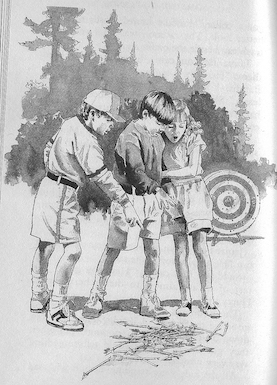
Arts and crafts goes fine, and the kids enjoy meeting the camp’s mascot, a tame raccoon named Bandit. Tanya explains that they found Bandit when he was just a baby and that the kids should never try to play with wild raccoons. However, when the kids arrive at the archery range, they discover that someone has snapped all the arrows in half! Because of the stories the camp cook has been telling everyone, some of the campers think that it’s the work of the camp’s ghost. The Bobbsey Twins still suspect Danny, and they offer their services to Tanya, to investigate and find out who’s really causing all the trouble at camp.

Danny isn’t the only suspect. Nan overhears the cook, Sal, telling the kids about a hungry, child-eating bear in the woods who is supposedly friends with the camp ghost. Does he just like scary stories, or does he have a special reason for wanting to frighten the kids at camp? Even Tanya seems to have something to hide, getting mysterious notes and meeting someone in secret.

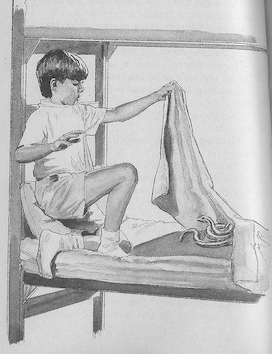
Soon, other strange things happen at camp. Someone puts a snake in Freddie’s bed, and the kids see strange lights in the woods at night. Then, someone steals all the ponies out of the corral and smashes the kids’ clay art projects. Some of the kids think that it’s the work of the ghost Sal has been talking about, but the Bobbsey Twins are sure that someone only wants them to think that. What are all the pranks and sabotage really about?

The book is available to borrow and read for free online through Internet Archive.

My Reaction

I was pretty sure I knew right away who was behind the camp sabotage, but this is one of those stories where there’s more than one person doing things that are unrelated. Danny eventually admits to playing some of the pranks, like the snake in Freddie’s bed, but not all of them. I was also wrong about who the main villain was. The missing polar bear at the beginning does figure into the mystery of the things happening at camp. I figured it would be important, but I didn’t guess how and why.

One of the clues the kids find is a lucky rabbit’s foot keychain. The kids comment that those used to be popular good luck charms, but not many people have them anymore. I have to admit that I had a pink one when I was a kid that I got from a novelty shop. I don’t think I realized at first that it was a real rabbit’s foot. I think I assumed that it was fake because I bought it in a place that sold magic tricks and costume props, so I figured it was imitation, like everything else. I figured it out eventually, and then, I didn’t feel quite so lucky about it. I’m sure that those keychains fell out of popularity because other people felt the same way I did about them, and they were concerned about animal cruelty. I believe it’s still possible to buy real and faux rabbit’s foot keychains, but it’s been a long time since I last saw them displayed at a store, so I think the kids were probably right about them not being as popular as they once were.

The Secret in the Sand Castle

The Bobbsey Twins

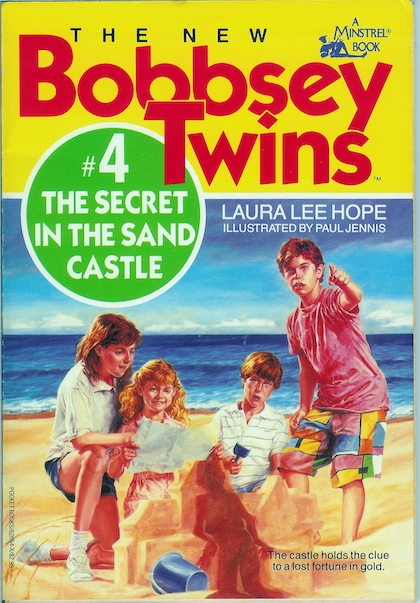
#4 The Secret in the Sand Castle by Laura Lee Hope (Stratemeyer Syndicate), 1988.

Before I begin, I’d like to acknowledge Sean Hagins, for supplying me with photos of this book! Usually, I take pictures of books myself, but I just couldn’t find a physical copy of this one. Sean is a big fan of the Bobbsey Twins, particularly the New Bobbsey Twins mysteries, and you can see some of his video reviews as well as videos about his photography work on his YouTube channel, SJHFoto. Thanks, Sean!

The two sets of Bobbsey Twins and their parents are spending a few weeks in an old house at Beachcliff Bay. It’s sort of a working vacation for their parents. Mr. Bobbsey owns a lumber yard, and he’s helping a local builder, Jim Reade, to either find some antique Victorian wooden gingerbread house trim or make new ones to match a home restoration project. Meanwhile, Mrs. Bobbsey is planning to write a travel article about the area for their local newspaper.

The house where the family will be staying is called the Wilson house, and it’s one of Mr Reade’s recent renovation projects. Flossie is the first in the family to go inside, and she is startled by what she thinks is a ghost. It turns out that it’s only the caretaker, Pete Smedley, taking the old dust sheets off the furniture. It’s not entirely reassuring because Pete says that there are stories about the old Wilson house being haunted by the ghosts of its former owners, who drowned in the nearby bay. He says that he knows when the ghosts have been there because they move things around and leave trails of water, seaweed, and seashells. Mr. Reade thinks that Pete’s stories are nonsense and that the strange things he’s observed are due to windows in the house being left open or something like that.

The inside of the Wilson house is as elaborate as the outside. The Bobbsey twins unpack their things and claim rooms for themselves upstairs. Flossie is quick to claim the biggest room with the best view for herself, and she asks Bert to help her move a mirror she likes into her room. They don’t have anything to hang the mirror, so they set it on Flossie’s bed. Strangely, they later find the mirror still on the bed but broken, and they don’t know how that happened.

Nan is curious about the Wilson family and the history of the house, so she and Freddie take a trip to the local library. There, Nan learns that the last two members of the Wilson family were a brother and sister, called Clay and Jennie. They were both artists, but they never made much money. Badly in need of money, they apparently robbed an armored car and stole gold bars. They tried to escape in a boat, but it was lost in a storm. The Wilsons apparently drowned, although their bodies were never found. The police thought they might have hidden the gold somewhere before getting on the boat, but nobody ever found the gold they stole.

Mr. Reade tells the children that his son, Jimmy, is entering a local sand castle contest, and the Bobbsey twins decide that they would like to enter the contest, too. Nan thinks they should try to build a replica of the Wilson house in sand. Unfortunately, Jimmy turns out to be a troublemaker, and it doesn’t look like he wants to be friends with the Bobbsey twins.

While the girls go to the store, Bert and Freddie decide to check out the old root cellar at the house, and someone traps them inside. The girls let them out when they get back. Then Flossie finds a secret passage and hidden stairs. Mr. Bobbsey says that it was once a servants’ entrance that had been sealed off. Later that night, a ghostly figure tries to enter Nan’s room! Could it have been Jimmy. playing a nasty prank, or is it someone looking for the lost gold? Could it even be a real ghost?

The book is available to borrow and read for free online through Internet Archive.

My Reaction

From the beginning of the book, I had a favorite suspect. However, this is one of those mysteries where there is more than one person involved, and they’re not working together. In the end, I was right about my main suspect, but having a second person doing suspicious things made the mystery more interesting. The title is a little misleading because the story is really about the search for the hidden gold from the robbery, not about the sand castle contest. The sand castle contest is more of a side issue, although studying the design of the house to build the sand castle version leads the kids to the solution of the mystery.

Because this book is from the late 1980s, there are things in the story that were more a part of my childhood than the lives of 21st century children, like renting videotapes. I was about the age of Freddie and Flossie when this book was first published, so it’s a bit of a fun nostalgia trip for me, both because I read books in this series when I was young and because some of the things the kids do in these stories are similar to things I did at their age.

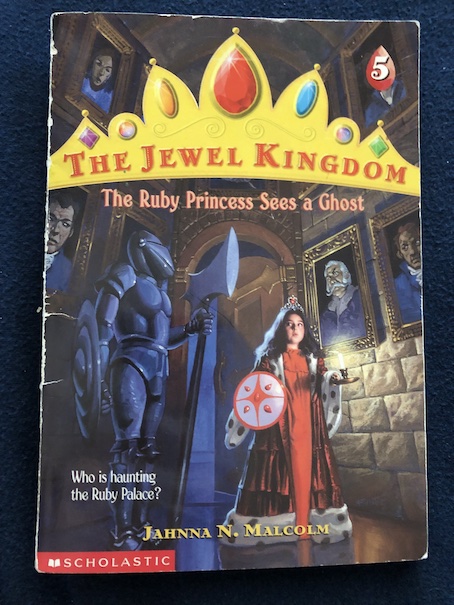
The Ruby Princess Sees a Ghost

Jewel Kingdom Series

The Ruby Princess Sees a Ghost by Jahnna N. Malcolm, 1997.

Princess Roxanne lives in the Ruby Palace in the Red Mountains, and each of her sisters live in and rule over a different part of the Jewel Kingdom. The sisters visit each other from time to time, but Princess Roxanne has noticed that her sisters seem reluctant to visit the Ruby Palace. She finds out why the first time her sisters come to visit her.

Princess Sabrina tells her that she saw someone in white waving from a tower as she approached the Ruby Palace, but Roxanne knows it wasn’t her and there shouldn’t have been anyone in the tower. That’s when her sisters tell her that there are rumors that the Ruby Palace is haunted.

Roxanne says that she’s never noticed anything strange about the Ruby Palace that would make her think it was haunted. But, almost immediately, strange things begin to happen. The cook sees a ghost in the kitchen. A picture falls off the wall, and the princesses hear mysterious laughter.

To Roxanne’s dismay, her sisters are all too scared to continue their visit. After the other princesses leave, Roxanne hears the ghost threatening to come get her, but as she tries to get away, she picks up a ring dropped by the ghost.

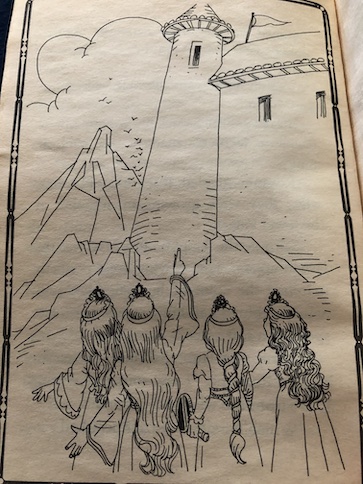
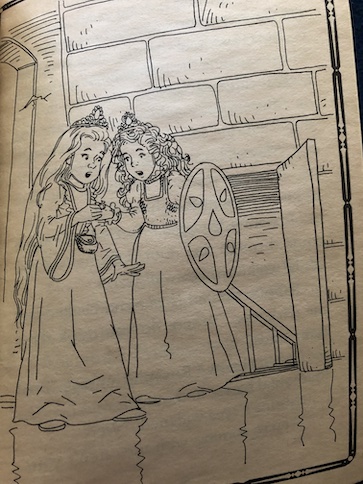
Roxanne knows that she has to get to the bottom of this mysterious haunting or she’ll never feel comfortable in the Ruby Palace again. Fortunately, Sabrina decides to return to the Ruby Palace to help her, and she recognizes the crest on the ghosts’ ring as the crest of Lord Bleak, their arch-enemy. Roxanne and Sabrina also discover a hidden door and secret passage in the Ruby Palace. Is Lord Bleak responsible for this haunting? Did he somehow send the ghost, or is this ghost more than just a ghost?

The book is available to borrow and read for free online through Internet Archive.

My Reaction and Spoilers

I thought this was a cute story. I didn’t read this series when I was a kid, although I saw books for sale. This is the first book in the series I read, and fortunately, it provides enough backstory to explain who Lord Bleak is and why he might be staging a haunting in the Ruby Palace. It’s a pretty easy read, just a short chapter book, and I think the mystery is probably not too difficult to figure out if you already know the backstory of the series and who Lord Bleak is. Still, I think a young child would still enjoy the suspense and atmosphere of the story and how the princesses turn the tables on the fake “ghost.” There is also a twist at the end of the story where there is actually a ghost who haunts the Ruby Palace, but it’s not the one they think, and she’s on Roxanne’s side.

I think the setting is the most fun part of the Jewel Kingdom stories. The Jewel Kingdom is divided up into different regions, each with its own terrain and magical creatures. Each princess rules over a region that fits her personality. The Ruby Palace is described as being made of stone and rather drafty and mysterious compared to the other princesses’ palaces, but Roxanne loves it.

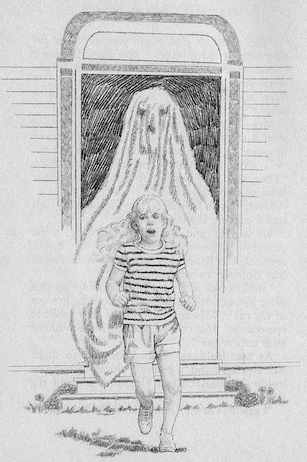
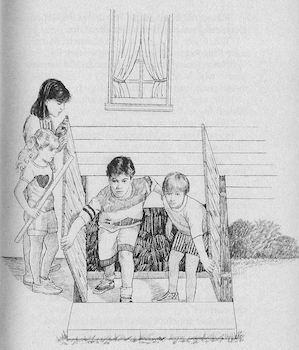
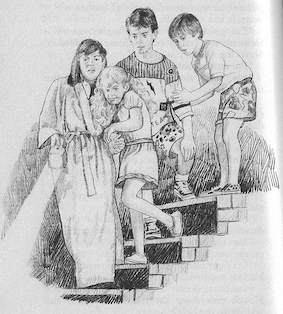
The Shimmering Ghost of Riversend

Kathy Wicklow is going to visit her Aunt Sharon at their old family home over the summer. The old family home, Wicklow Manor, is in Riversend, California, which is in an area where gold was found years ago. Kathy isn’t happy about the trip. She has to leave her dog behind because her aunt owns a cat. She doesn’t even really know her aunt very well. Aunt Sharon is her father’s sister, and her mother has said that she’s weird (which was not a good thing for her to say, both because it’s insulting and because that’s not something to make her daughter glad about spending time with her). Kathy blames her mother for going back to work. Because her mother is working and won’t be home with her, Kathy has to leave her home, her friends, and her dog for a month!

Although Kathy loves to draw, she doesn’t think that she’ll want to do that in a place she is sure she’s going to hate. She also thinks maybe her parents don’t trust her at home because of the weird dreams she’s been having. Kathy has dreams about things that later happen, although she doesn’t know why.

Her father has nostalgic memories of the old family home where he and Sharon grew up. Sharon has only recently returned there after living on the East Coast. Kathy’s father says that Sharon is looking forward to seeing Kathy again and getting to know her because she hasn’t seen Kathy since she was a baby.

Right from the first, Wicklow Manor gives Kathy the creeps. There’s even a small graveyard nearby where Kathy’s father says their ancestors are buried because people used to be buried close to their homes. When she can actually see the house, Kathy is also shocked to realize that she has drawn that house before! She thought that she had invented the house she drew from her imagination, but somehow, she had a vision of the real house. Her father thinks that she must have seen a picture of it somewhere or maybe was inspired by his descriptions of the place. However, Kathy has also done a drawing of Aunt Sharon’s pet cat, without knowing what it looked like before. When they meet Aunt Sharon, she mentions that she’s glad Kathy is there because the house has been lonely, especially at night. Kathy’s dad starts to ask her if something is still happening, but Aunt Sharon quickly denies it before he can finish the thought. Kathy can tell there’s some kind of secret between them.

Aunt Sharon has turned the family’s manor into an inn, and she’s expecting guests soon. It also turns out that part of the reason why Kathy’s mother says that Sharon is weird is that she’s into health food, and Sharon is aware that Kathy’s mother thinks that she’s a weird health nut. Kathy’s father volunteers her to help in the kitchen, although Kathy is a little worried that she won’t like the health food, although the lemonade that she makes with maple syrup instead of sugar is pretty good.

Still, Aunt Sharon gives Kathy a beautiful room with a balcony. Kathy also meets a boy named Todd who lives nearby with his great-grandfather, who is called Upstream Mike. Todd and his great-grandfather pan for gold in the nearby river, and Mike also takes his burro called Nugget into town so tourists can pay for rides on him and pictures with him. Todd is just a little older than Kathy, and he tells Kathy that he likes to write down stories that his grandfather tells him, especially scary stories about the old Wicklow Manor. Kathy asks if there are ghosts there, and Todd tells her to ask his great-grandfather about it. Kathy asks her aunt about ghosts, and Aunt Sharon tells her that Mike has told scary stories about the place for years that were apparently passed down in his family. Mike’s family lived in the area when the first Wicklows arrived.

Aunt Sharon shows Kathy some of the things in the house that belonged to their ancestors, including a portrait of a pretty young woman, who Aunt Sharon says was Jenny Wicklow, who died young by drowning in the river and was buried in the old family graveyard. One of their ancestors, James Wicklow, made his fortune as a banker during the Gold Rush days, and Jenny was his daughter. There is one room in the house where Kathy isn’t allowed to go, which is the old room in the tower. Aunt Sharon says that the staircase is broken, and she can’t have it fixed yet.

On her first night at the manor, Kathy sees a woman in a cloak with a lantern. When she asks Mike about it, he says that it’s a ghost or spirit of some kind that usually appears to young ladies at the manor, possibly a banshee or similar spirit that is a harbinger of death. Kathy worries about that, and Mike tells her the story about Jenny Wicklow. Jenny was one of three children of James Wicklow. She also had a sister named Lora and a brother named Daniel, and Kathy is a descendant of Daniel. After their parents died, Daniel went to work in the city and left the running of the manor and family farm to his sisters. The two young women hired a handsome young drifter to help them, but he started flirting with both of the sisters. The sisters seemed to develop a rivalry for him and argued with each other about it. Rumor had it that Lora was the one who pushed Jenny into the river so she could have not only her own inheritance but her sister’s as well and get the man they both wanted. After Jenny was dead, it seemed like all of their gold disappeared, and so did Lora. People assumed that Lora ran off with her lover and took the money. Mike thinks that the ghost is dangerous, and that Sharon is the one who’s in danger!

Kathy soon begins to learn that Mike is both right and wrong about the ghost. The ghost is Lora, but she’s not trying to hurt Sharon or anyone else. Something tragic happened at Wicklow Manor years ago, and Lora is trying to tell someone about it, if she can find anyone brave enough to listen … and to discovered what actually happened to Lora herself.

The book is available to borrow and read for free online through Internet Archive.

For a good part of the story, I wasn’t sure exactly what Lora’s ghost was attempting to accomplish, keeping me in suspense. I did have the sense that Lora wasn’t the one who had murdered Jenny and that she had probably been murdered herself, which was why nobody saw her after Jenny’s body was found.

Mike is correct that Lora is the ghost, but she was not Jenny’s murderer. Like Kathy, Lora was psychic. She has been trying to communicate with different girls in the family over the years to clear her name, but the other girls have all been frightened of her. Sharon claims not to believe Kathy at first about how Lora is trying to communicate with her, but she later admits that it was because she was frightened. She also saw Lora when she was young, and that’s part of the reason why she was afraid to return to the old family home for so long. She was afraid to admit that the house was really haunted and that she was afraid of the ghost. It was a long time before she could even tell her own mother and brother about seeing Lora because she was afraid of being different from everyone else in the family. Sharon is also psychic, and like Kathy was initially, she was afraid of her gift.

Kathy and Todd use the messages that Lora communicates through Kathy’s drawings and Lora’s old diary to learn the truth. Jenny was murdered by the man she loved. Lora didn’t actually love him at all. She saw that he was a violent person and tried to warn Jenny about him, but Jenny wouldn’t listen because she thought Lora wanted him for herself. Lora saw the murder that was going to happen in a dream, and she wanted to stop it by using her own inheritance to pay the man to leave her sister alone. However, Lora was unable to save her sister. After he killed Jenny, the man came after Lora and murdered her, too. Then, he stole both of their inheritances. He hid Lora’s body, which was why everyone thought she must have run away with him.

After Lora’s ghost leads Kathy to where her body is buried in the cellar and she is given a proper burial in the family graveyard, the haunting ends. However, Kathy learns to appreciate her psychic gift because of this experience. She finds it reassuring that she shares her abilities with other people in her family. When she reads in Lora’s diary that Lora thought of her own psychic abilities as a gift, Kathy also comes to think of being psychic as a gift rather than a weird defect or something to fear.

The mystery in the story was good, and I also liked the information about panning for gold that Mike gives to Kathy when he gives her a gold panning lesson. There is also a tie-in with real children’s literature because Kathy mentions that she is reading Down a Dark Hall by Lois Duncan. I’ve reviewed Down a Dark Hall on my site, and it is about girls with psychic abilities at a haunted boarding school who channel the spirits of famous people to complete their unfinished works. The channeling and spiritual possession in that book are dangerous and harmful to the girls doing it, but in this book, Kathy becomes reconciled to her psychic abilities and Lora’s gentle spirit, who needs her help.