Mystery of the Pirate’s Ghost

Mystery of the Pirate’s Ghost by Elizabeth Honness, 1966.

Abby and Kit Hubbard’s mother has just received a letter telling her than her half brother, Jonathan Pingree, has died and left her the old Pingree mansion.  He has left over bequests to other family members as well, and money to be held in trust for Abby and Kit.  It’s exciting news, and the family may move to live in the mansion they have inherited, although it partly depends on Mrs. Hubbard’s other relatives. 

Mrs. Hubbard, who was born Natalie Pingree, has never met her half-brother or half-sister.  They were her father’s children, from his first marriage.  She doesn’t know much about her father’s early life because he died when she was very young, and all that she knows about him is what her mother told her.  Apparently, her father’s first marriage was not a happy one.  He stayed in that marriage long enough for his first two children, Jonathan and Ann, to become teenagers.  Then, he made sure that his first wife and children were settled comfortably enough in the family home and left them to move to Philadelphia to start a new life by himself.  Sometime later, his first wife died and he married Natalie’s mother, who was much younger.  After his death, Natalie and her mother moved in with her mother’s sister, Aunt Sophie.  When Natalie got married, Aunt Sophie sent a wedding invitation to Johnathan and Ann, but they never came to the wedding or made any reply.  Natalie assumed that they felt uncomfortable about their father’s remarriage and didn’t want to see her, which is why she’s so surprised about Jonathan leaving the family home to her.  The only reason she can think of why he would do that is that neither he nor his sister ever married or had children of their own, so there was no one else to leave the house to.  Both of them were more than 30 years older than Natalie, and Ann is now an elderly woman, still living in the house.  Jonathan’s will has made provision for her as well, and the Hubbards go to see her at the Pingree mansion.
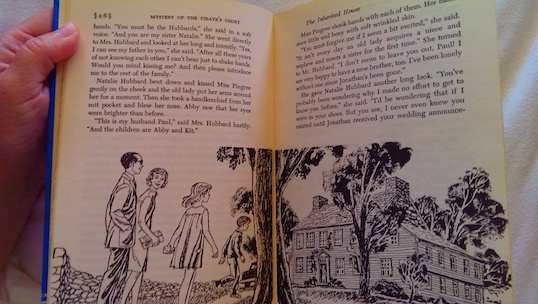
Mrs. Hubbard is pleasantly surprised that Ann is actually happy to see her.  Ann Pingree explains that the reason why she and Jonathan never replied to the wedding invitation was that, until that invitation arrived, neither of them had known that their father had another child, and they felt awkward about it.  However, Ann has been lonely since Jonathan’s death, being the last of the Pingrees, and she is glad to have Natalie and her husband and children with her and is eager to have them move into the mansion and live there. (Ann doesn’t live in the old mansion itself, but she does live nearby.)

Aunt Ann shows the family around the old mansion and explains more about its history and the history of the Pingree family. It turns out that the house, which has existed since Colonial times, although it has been burned, remodeled, and expanded over time. The house also has a number of secrets. Apparently, there used to be a tunnel running from the basement of the house to the beach that was used to bring in smuggled goods during the Colonial Era. There is also a hidden room behind a fireplace upstairs where the children of the family could hide during Indian attacks. (It doesn’t say how often that happened.) To the family’s surprise, Ann also tells them that the mansion is supposed to be haunted. The kids think it all sounds exciting, although Ann doesn’t explain much about the ghost the first time she mentions it. (Kit uses the phrase, “Honest Injun?” when asking Aunt Ann if she really means it when she says that the house is haunted. This isn’t a term that people use anymore because it isn’t considered appropriate.)

Mr. Hubbard is able to get his job transferred to a different branch of the company he works for, so the Hubbard family decides that they will move into the Pingree mansion. The kids like living by the beach, and their parents tell them that they can use the old ballroom of the house as a kind of rec room. Soon, they meet a couple of other children who live in cottages nearby, Chuck and Patty, and make friends with them. Chuck and Patty have already heard that the Pingree house is supposed to be haunted, although they’ve never seen anything really mysterious, just a light in the house once when they thought that the house was supposed to be empty.

The next time Aunt Ann comes to visit, the four children ask her to tell them about the ghost, and she tells them the story of the first Pingree to live at Pingree Point. This ancestor, also named Jonathan Pingree, built the original house in the late 1600s. He was a shipbuilder who owned several ships of his own, and he wanted to live near the sea. Later, he also became a privateer. When the kids call Jonathan a pirate, Aunt Anne agrees and explains that, unlike a pirate, Jonathan’s position as privateer was all perfectly legal because he had a Letter of Marque. (Yes, privateers operated within the law, but yes, they were also essentially pirates who raided other ships for their goods. In other words, they did the same things, but privateers did it with permission whereas ordinary pirates didn’t get permission. Historically, some privateers continued their pirating even after permission was revoked, so as Aunt Ann says, “the line between that and piracy was finely drawn.”) His son, Robert, was sailing on one of his father’s ships when it was taken by other pirates, and Robert was forced to join their crew. The family never saw Robert again and only found out what had happened from a fellow crew member who was set adrift and managed to make it back home. What happened to Robert is a mystery. His family didn’t know if he had really taken to the life of a pirate and couldn’t return home because he couldn’t face his family, if he had been killed in some fight, if he had been hung for piracy because he had gotten caught and couldn’t prove that he was forced into it. However, members of the family claimed that Robert’s spirit did return to the house and that he knocks at doors and windows, begging to be let back into his old home. Aunt Ann says that she’s never seen the ghost herself, but old houses can make all kinds of noises on windy nights, and that’s what she thinks the “ghost” is. As Chuck and Patty leave, they say, “we hope that old ghost doesn’t show up to frighten you.” Of course, we all know that it will because otherwise this book would have a different title.

One day, Kit is bored and starts playing around in the secret room, pretending that he’s hiding from American Indians. While Kit is in the secret room, he overhears the servants, John and his wife Essie, who have worked for the family for years, talking. Essie seems very upset and wants John not to do something that might risk their home and jobs, but John says that it’s too late and that they’re already “in it” and “can’t get out.” Kit tells Abby what he heard. That night, Abby hears banging and wailing during a storm and fears that it’s the ghost. Soon, other strange things happen, like a desk that mysteriously disappears and a cupboard that also mysteriously appears in its place. The children like John, and they don’t want to think badly of him, but he’s definitely doing something suspicious. One night, the children try to spy on him, and Abby once again hears the wailing and sees a mysterious, cloaked figure in the fog. Is it the ghost?

There are some interesting facets of this story that make it a little different from other children’s books of this type. For one thing, the children confide their concerns to their parents almost immediately, and the parents immediately believe them. In so many children’s mysteries, either the children decide to investigate mysterious events on their own before telling the parents or the parents disbelieve them, forcing the children to investigate on their own. It was kind of refreshing to see the family working together on this mystery. It actually makes the story seem more realistic to me because I can’t imagine that I would have been able to keep worries about mysterious things secret from my parents as a child, and they would have noticed if I was sneaking around, trying to investigate people, anyway. Abby and Kit do something dangerous by themselves before the story is over, but they also confide what they’ve done to their parents at the first opportunity and do not take the same foolish chance again.

The truth of John’s activities comes to light fairly quickly, although it takes a little longer for the family and the authorities to decide how to handle the situation. Investigating John brings to light some of the Pingree family secrets, and Abby and Kit soon discover the fate of Robert the pirate and the truth of his ghost. I’ll spoil the story a little and tell you that the ghost that Abby sees is apparently real, but it isn’t very scary. Once they learn the truth of what happened to Robert and see that his body gets a decent burial, the ghost appears to be at peace.

One thing that bothered me was the way that the characters talk about Native Americans in the book. It’s not the talk about Native American sometimes abducting children because I know that happened. It’s more how they picture that would happen. In the scene where Kit was hiding in the secret room, Kit imagines that the Indians were attracted to the house by the smell of his mother’s cooking and that he went into hiding while his mother fed them to avoid being abducted. As part of his scenario, he imagines that his mother would have wanted to “hold her nose against the Indian smell.” What? Where did that come from? There are all kinds of tropes about Native Americans in popular culture, from the “noble savage” image to that silly “Tonto talk” that actors did in old tv westerns, but since when are they supposed to smell bad? I’ve never seen characters in cheesy westerns hold their noses before, so what’s the deal? I tried Googling it to see if there’s a trope that I missed, but I couldn’t find anything about it. I’m very disappointed in you, Elizabeth Honness.

This book is currently available online through Internet Archive.

The Mystery of the Crimson Ghost

The Mystery of the Crimson Ghost by Phyllis Whitney, 1969.

Janey Oakes loves horses and wishes that she had one of her own.  Her family lives on Staten Island in New York, so they don’t have room to keep a horse.  The only horses that she has ridden are rented ones.  However, her parents are now considering moving to the countryside in northern New Jersey, where Janey’s Aunt Viv lives.  If they do, there will be room for Janey to keep a horse, so she is hopeful.

Janey’s parents take her to visit Aunt Viv during the summer, while they decide if they want to move.  Along the way, they stop to ask directions at a half-ruined house.  The people there, Mrs. Burley and her grandson Roger, aren’t too friendly, and when Janey thinks that she hears a horse there, they seem oddly resentful and say that she should ask her aunt about it.

Aunt Viv seems oddly evasive on the subject of horses when Janey asks, saying that she doesn’t ride anymore.  She does tell Janey more about the strange, half-ruined house.  It was once a hotel for people who came to take the spring waters.  However, it eventually lost its popularity and was partly destroyed in a fire.  Mrs. Burley’s husband died in the fire, but she has remained living in the part of the house that is still standing, raising a couple of grandsons there after the death of her younger son.  Her older son is a doctor in New York City.  Aunt Viv says that she used to be friends with the younger of the two grandsons, Denis, but that ended when she did something wrong and something bad happened which she doesn’t want to talk about.

Aunt Viv introduces Janey to a girl who lives nearby named Coral, in the hopes that they will be friends.  Coral isn’t interested in horses, but when Janey questions her about the Burleys, she confirms that they do have a horse called the Star of Sussex.  She takes Janey up to the Burleys’ house again (partly in the hopes of seeing the older Burley boy, Roger, who she has a crush on).  There, Denis and Roger each explain to Janey that their grandmother had hoped to train Star as a racing horse.  Star is an excellent horse and had a lot of potential for racing, but Denis allowed Aunt Viv to ride her one day, and the horse stepped in a woodchuck hole and injured her leg.  The leg has healed, and the horse is able to gallop, but she still limps and can’t run at the same speeds she used to, ending Mrs. Burley’s racing hopes.  Since then, Mrs. Burley has been very bitter, especially toward Aunt Viv.  She behaves strangely, driving people away, and is also angry toward Denis for allowing Aunt Viv to ride the horse in the first place.  It was just an accident, but she blames them both.  Roger realistically thinks that they should sell Star for breeding because she has a good bloodline, and Denis’s real interest lies with airplanes, which fascinate him in the same way that horses fascinate Janey.  Their differing interests seem to support what Aunt Viv says about how the family should move and that the boys would probably have a better life away from the old, ruined hotel and Mrs. Burley’s obsession with the past.

Coral also tells Janey about a ghost dog that supposedly appears on nights when a strange red light appears on the Burleys’ property.  Later, Janey hears the howling at night. Aunt Viv doesn’t think it’s a ghost.  She says that people have tried to talk to Mrs. Burley about her dog, but she denies having one and gets really angry with people for accusing her of having one.  Yet, the howling does seem to come from the Burleys’ property, and Denis even says that he’s seen the ghost dog, that it seems to be covered in flames.  He claims that it’s the ghost of his grandfather’s dog, who died in the fire years ago.  Aunt Viv thinks that Denis is just saying that to try to protect his grandmother and because he can’t handle what other people have come to believe about her: that she’s losing her mind.  Mrs. Burley’s behavior is undeniably odd, and she’s prone to sudden mood swings.  People are worried that she’ll drive newcomers away from the area and drive down property values, and they think that she might need professional help.

Janey doesn’t think that Mrs. Burley’s mind is gone as much as people believe.  When she sneaks over one day to visit Star, Mrs. Burley is angry but notes that she has a good manner with horses.  To Janey’s surprise, Mrs. Burley agrees to let Janey ride Star.  Denis almost ruins things by making Janey believe that Mrs. Burley has changed her mind about the invitation and also by not telling his grandmother that Janey asked to meet at a later time.  Janey isn’t sure why Denis seems to have a grudge against her, although it might have to do with his own guilt for allowing the horse to be ridden and injured in the first place; his own grandmother still seems to have a grudge against him for that.  Neither one of them tells Janey that Star has a particular trick for throwing riders, even though she had specifically asked if there was anything that she should know about the horse or if it had any tricks.  After she’s thrown by the horse, however, Janey gets back on and proves to both the Burleys and to Star that she’s not intimidated and not going to fall for the trick again.  (The Burleys have deep, personal hurts, but I wouldn’t call them nice people.  There are people who would probably view this is a test of Janey’s skills and her ability to stick with a challenge, but I think that their lies and deliberate deception when Janey was asking the right questions show only their immaturity.  It may not bother some readers as much as it did me, but I have a very low threshold of patience for such things, and the characters lost a lot of my sympathy right there.)

Mrs. Burley warms up to Janey after that and confides in her some of the reasons why she has been so unfriendly, trying to drive people away, and why the horse meant so much to her.  Years ago, she and her husband made quite a lot of money, raising racing horses.  Star is from the same bloodline as their original horses.  Mr. Burley lost quite a lot of their money on various business ventures that didn’t work out, even before the hotel fire that killed him, but for a long time, Mrs. Burley was always able to keep one horse from that bloodline, hoping to get at least one last racing horse.  Star is an excellent horse who really would have made a good racing horse, but Mrs. Burley’s hopes were destroyed when Star was injured.  Mrs. Burley thinks that she’s too old now to raise another, that she wouldn’t live to see any of Star’s offspring become racers.  Janey still thinks that Star has the potential to be a racer, but Mrs. Burley says that the effects of her injury won’t let her get the speed she once had.  Mrs. Burley resents outsiders hanging around because she fears their “interference” in her life, and the injury of Star while Aunt Viv was riding her seems to prove that her fears are justified.

Janey tries to talk to Mrs. Burley about the ghost dog, but she gets angry with Janey for believing the things that people have been saying about her.  Worse still, Roger tells her that Mrs. Burley will probably sell Star soon.  She needs money badly and has been refusing to let anybody help her, even her son in New York.  Her pride at her independence may be her undoing.  Now that Janey has ridden Star successfully, she can’t bear the thought that the horse might be sold and sent away.  If only she could unravel the mysteries surrounding the Burley family, the strange red light, and the ghost dog!

My Reaction and Spoiler

Toward the end of the story, one of the characters talks to Janey about Mrs. Burley’s attitude, saying that “it’s important in life to have something to fight for.  Something we care about and want.  I don’t mean fight for with our fists, but something to try for, struggle for.  Something we can do that uses whatever we are to win the fight.”  He means that people need a purpose in life, something like a cause to believe in or a way of life to pursue that is suited to their talents. Janey says that she doesn’t like struggles, but the person points out to her that everything in life that you want involves a struggle, including the horses Janey loves. Janey has focused mostly on the struggle of getting her parents to agree to let her have a horse and Mrs. Burley to agree to let her ride Star, but even if she ended up owning a horse, including Star, there would still be the struggle of caring for the horse, devoting time to keeping the horse happy and healthy. Janey might enjoy that kind of struggle because it appeals to her talents and interests, but it would still require time and sacrifice on her part. Mrs. Burley loves horses as much as Janey does, and she loves the area where she lives to the point where she can’t image living anywhere else. All of her efforts focus on allowing her to continue living in the place she loves, although she feels like her horse dreams are lost.

Much of the emphasis of the book is placed on Mrs. Burley’s determination to maintain her independence as part of the lifestyle she loves, but I wish that there was a little more emphasis on the methods that people use to get what they want in life because that is central to the secret of the “ghost.”  That the “ghost” isn’t really a ghost isn’t too much of a spoiler, but while people in the area think that Mrs. Burley is faking the ghost because she’s mentally unbalanced, the real culprit is someone who wants Mrs. Burley to leave because there’s something that he wants very badly and doesn’t think that he’ll get it otherwise.  Once his scheme is exposed, the others make sure that he doesn’t get what he wants because, after what he has done, he doesn’t deserve a reward.  However, I wish that they had explained a little more plainly that there were other ways of getting what he wanted besides the scheme he planned.  The culprit thinks that no one was listening to him and what he wanted, but from my perspective, what he wanted was simply a matter of time, and he wasn’t willing to wait.  His scheme would have ended with Mrs. Burley being declared mentally incompetent and being put away in a home, which is a cruel thing to do to someone.  The other characters tell him that, but I wanted someone to explain to him that harming others for his own benefit would make him no better than someone who robs a bank because they want money.  That is, crime and fraud are still wrong even if they succeed because the ends don’t justify the means.  In some ways, I think that Mrs. Burley was selfish, but she still didn’t deserve to be labeled as crazy, and even if people weren’t listening to the culprit and taking him seriously as much as they should, the scheme still wasn’t his only option. 

To say more would be to tell you who the culprit is, and it’s not as obvious as it might seem. It was one of my favorite suspects, but I changed my mind a few times, going back and forth between suspects up until the end. In the end, Mrs. Burley is prepared to forgive the culprit and start over again, and there are hints that he may get what he wants in the future if he behaves better.  Personally, I think he probably would have gotten it eventually, anyway, so his situation is relatively unchanged, although he is now under pressure to prove his behavior to everyone. 

As for Star, she does become Janey’s horse as a gift from the one person who is in a position to give the horse to her while making sure that Mrs. Burley gets the money she needs.  Because of Janey’s help in revealing the culprit to Mrs. Burley and because of her devotion to the horse, Mrs. Burley is fine with the arrangement.

The Court of the Stone Children

The Court of the Stone Children by Eleanor Cameron, 1973.

Nina and her parents have recently moved to San Francisco from Nevada.  Nina doesn’t like living in the city, but the move was necessary because her father has been ill and in need of a job.  Still, Nina misses her friends, and her parents don’t understand how difficult Nina has found it to make friends in their new home.

One of the most popular girls, Marion Charles, nicknamed Marnychuck, and her friends like to tease Nina at every opportunity. Nina doesn’t think that she even wants to try to be friends with them because hanging out at Marnychuck’s house would mean always having to be on her guard about every little thing she says, knowing that they would twist every innocent comment she makes into some sort of joke so they could laugh at her.  They could never be friends because there would be no way that Nina could ever open up to them about anything.  (Sadly, I know the type all too well.)  For example, one day, while the girls are walking home from school, they start talking about things they want to be when they grow up.  Nina says that she wants to be “something in a museum,” momentarily forgetting the word “curator”, until a boy nearby helpfully supplies the word. Of course, Marnychuck and her friends ignore the helpful word and just laugh about “something in a museum” as they walk away.

However, the boy who was listening turns out to be genuinely curious about why Nina wants to work in a museum, saying that it sounds like an unusual ambition.  Nina tells him that, until she had come to San Francisco, she’d never been in a big museum before, and she describes how the one in the park impressed her.  She used to work in a small one in her home town. The boy understands the way she feels and shares her love of the past.  He tells her about Mam’zelle Henry, a local woman who owns a private museum called the French Museum.

Nina visits the French Museum and loves the rooms with old-fashioned furniture.  They give her a strange feeling of timelessness, and before she knows it, she finds herself in a room with another young girl who says, “I knew you’d come.”  Nina isn’t sure who this mysterious girl is, but she asks her to come back another time.

When Nina returns to the museum the next day to return an umbrella that she borrowed from Mrs. Staynes, the registrar at the museum, she speaks to the girl again in the museum courtyard.  The courtyard is full of stone statues of children, and the girl tells Nina that when she was young, she used to wish that they would come to life.  The girl’s name is Dominique, although she says that people usually call her Domi. The two girls begin talking about their lives, although Domi oddly talks about her past in the present tense. Domi tells Nina about her emotionally-distant grandmother and her loving father, who was imprisoned and shot.  The news of Domi’s father being shot comes as a shock to Nina.  Domi tells Nina that, after her father was (“is”) imprisoned and shot, she had a dream about Nina in which her father said that Nina would help them.  Domi also says that the rooms at the museum are from her home in France, which was taken apart to be “modernized”and some of the pieces were sent to the museum. Nina finds Domi’s story confusing, but Domi says that they will talk more later.

Nina meets up with the boy who introduced her to the museum, whose name is Gil, at the cottage of Auguste, who lives on the museum property.  As she talks with the two of them and Mrs. Staynes, Mrs. Staynes brings up the subject of the ring that Nina saw Domi wearing and which also appears in a painting in the museum.  Earlier, Mrs. Staynes had told Nina that she couldn’t possibly have seen anyone wearing that ring, and Mrs. Staynes now explains that the reason why is that she owns the ring herself.  At first, Nina thinks that she must own a ring which is similar to Domi’s, since the two of them couldn’t have the same ring,but then, it turns out that the cat that Domi said was hers also belongs to Auguste.

The answer, as Nina discovers the next time she meets Dominique, is that Domi is a ghost.  Mrs. Staynes does own Domi’s ring now because Domi died a long time ago. Nina faints when Domi’s hand goes right through hers.  When Nina recovers, Domi is gone, and Mam’zelle Henry gives her a ride home.  The two of them bond as they discuss Nina’s ambition to become a curator.

Mam’zelle lets Nina borrow a journal that she found in the garden that belonged to Odile Chrysostome in 1802.  Odile was one of the names of the stone statues in the courtyard, according to Dominique, and Nina learns that the others are also named after members of the Chrysostome family.  The people at the museum say that they don’t know which of the statues is supposed to have which name, but thanks to Dominique, Nina does.

Gil becomes Nina’s first friend her own age, and he’s been working on a project involving time.  Someday, he wants to write a book about the concept of time. Time is important because Domi needs Nina’s help to resolve problems that occurred in the past.

Domi was young during the time of Napoleon.  Her mother had died in childbirth along with Domi’s younger sibling.  After her mother died, her grandmother moved into the house to oversee things and help care for Domi.  However, Domi’s father had protested some of Napoleon’s policies of conquest, and it led to his downfall.  One day, Domi discovered her father’s valet,Maurice, murdered in her father’s bedroom. She had thought that her father was there the night before, having returned from being away for a time, but he was nowhere to be found.  A short time later, her father was charged with conspiring against Napoleon and executed. Domi knows that her father was innocent of the charges, and she suspects that Maurice was killed because he knew something important, but she needs Nina’s help to find the missing pieces.  Domi knows that Mrs. Staynes is working on a book about her father’s life, and she doesn’t want the false accusations against him to be printed.

This book is available to borrow and read for free online through Internet Archive.

My Reaction and Spoilers

I thought that the book started out a little slowly.  It takes quite a while before Nina discovers that the boy’s name is Gil or learns anything about him, and it’s about halfway through the book before Nina learns that Domi is a ghost, although there are hints before it.  I knew that Domi was from the past, although I thought at first that she might be a time traveler of some kind.  Even after Nina learns that Domi is a ghost, it takes a while before Domi tells Nina her full story and what she really needs her to do.  The first part of the book dragged a little for me, and I was a little confused at first about why Odile’s diary was so important, but it turns out to contain the vital clues that Domi needs.  Domi’s father was with the Chrysostome family at the time that he supposedly murdered his valet and was conspiring against Napoleon. There is a piece of physical evidence that proves it, and finding it convinces Mrs. Staynes to change her book. 

One of Nina’s strengths is her power of imagination, and she helps Mrs. Staynes not only to see the truth about Domi’s father but to see him as a living, breathing person.  Before, Mrs. Staynes’ book was mostly facts with little sense of the feelings of the living people behind it, but Nina’s discoveries and imagination help breathe life into the work.  At the end of the book, the past remains unchanged (Domi’s life and that of her father are what they were before), but having the truth known gives Domi peace. Nina also makes peace with her new life in San Francisco, having discovered new opportunities and friends there as well as a nicer apartment for her family to live in.

Cam Jansen and the Ghostly Mystery

Cam Jansen

CJGhostlyMystery

Cam Jansen and the Ghostly Mystery by David A. Adler, 1996.

CJGhostlyMysteryGhostCam Jansen’s Aunt Molly takes her and her friend Eric to buy tickets for a Triceratops Pops concert.  Triceratops Pops is a singing group that dresses up like dinosaurs, and many of the fans buying tickets also wear dinosaur costumes.  While they’re standing in line, someone dressed as a ghost starts sneaking up behind people and scaring them by yelling, “Boo!”  At first, it seems like a mildly annoying prank, but then one old man standing nearby seems to have a heart attack when he is startled.

The guards standing near the ticket booth rush to help the man and call for an ambulance for him.  However, while they are distracted, the person in the ghost costume robs the woman selling tickets, taking all the ticket money and her own money from her purse.

Cam is convinced that the old man who collapsed was part of the thief’s plan and that his “heart attack” was just an act to distract the guards.  She noticed that he seemed to be wearing a wig to make himself look older.  But, there are two other clues that are important: the magazines that the man dropped when he fainted, and the fact that the ghost costume was found in the ladies’ restroom.  Once again, Cam helps the police with her amazing memory!

The book is currently available online through Internet Archive.

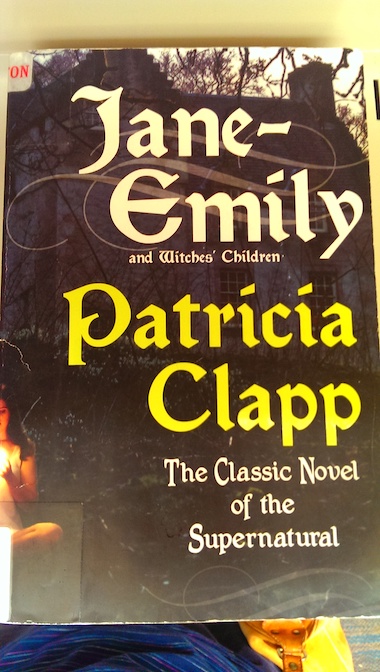
Jane-Emily

JaneEmily

Jane-Emily by Patricia Clapp, 1969.

Louisa is a young woman around the turn of the century.  She is only 18 years old and unmarried, but she is in love with a young man named Martin.  However, her parents think that she is becoming too serious about Martin too soon, so they insist that she spend the summer taking her young niece, Jane, to visit her other grandmother.  Jane has lived with her maternal grandparents, Louisa’s parents, since the death of her parents.  Louisa loves her niece, but she resents her parents changing her summer plans in order to keep her away from her boyfriend.

However, this is not just a love story but a ghost story.  Jane’s parents were killed in a strange buggy accident, which is why she lives with her grandparents and young aunt.  Her other grandmother has lived alone since the death of her son (Jane’s father) and her husband, some years earlier.  She had another child, a daughter named Emily, but Emily died young many years ago of a sudden illness.

As Louisa soon learns, Emily was a pretty and clever but seriously disturbed child.  Her father idolized her, coming to love her even more than he loved his wife.  He thought she was absolutely the most perfect child in the world and could never forbid her anything.  He gave her everything she ever asked for and refused to allow his wife to discipline her for any reason, even when she needed it.  It would be enough to spoil any child, but Emily was extremely callous, cold, and manipulating by nature.  Her father’s catering to her only fed her selfishness and ruthlessness.

Emily was known to resort to extreme measures to get her way, and in the end, it led to her death.  She fell in love with the son of the local doctor, deciding (without his consent) that they would get married one day.  However, he didn’t really care for her at all, seeing her extreme selfishness.  In a bid to get his attention and sympathy, Emily decided to make herself ill.  One cold night, she soaked her nightgown in water and deliberately sat by an open window.  Unfortunately, it worked too well, and she became so ill that she died.

However, Emily’s selfishness and determination to get her way seem to have lasted beyond the grave, and young Jane’s presence in her old house, in the very room that used to be Emily’s, seems to have awakened Emily’s wrathful spirit.  Jane becomes fascinated with the reflecting globe in the garden, which Emily declared was hers alone and that no one else could ever look into it.  Jane claims that she can see Emily’s face in the globe, but people don’t believe her at first. Jane bears a close resemblance to Emily, although the two of them are very different in character.  Jane seems to develop an unhealthy obsession with her dead aunt, and she seems to know things that only Emily could have told her.  Emily seems to be slowly taking over Jane.

Jane’s grandmother confides that she has believed that Emily caused the sudden deaths of her husband and son because they both died under unexplained circumstances and Emily could never let go of anything or anyone she thought belonged to her.  Now that Emily seems to be showing an interest in Jane, her grandmother begins to fear for her.

Meanwhile, Louisa is falling in love with Adam, the young man Emily had planned to marry and who is now a doctor himself.  Adam also loves her, wanting her to marry him.  However, Louisa has become convinced of Emily’s evil presence and the threat that she poses to young Jane.  When Emily forces Jane to go out in a freezing rain, making her become ill in the way she did before she died, Louisa must help Jane to fight for her life.

Emily’s presence centers around the gazing globe in the garden, and the only person who can end her evil influence and save Jane is her grandmother, who finally finds the courage to stand up to her daughter and tell her that there are some things that she can’t have.

The book is currently available online through Internet Archive.

My Reaction

Parts of the story feel a bit preachy on the subject of parents who spoil their children, but Emily and her family are presented as an extreme case of that.  At times, characters wonder what Emily would have been like if her father hadn’t constantly catered to her every whim and had given her the discipline she needed.  They all agree that she would have lived a longer life, as would other members of her family.  However, Emily was already a naturally selfish person and apparently incapable of empathy.  Her father’s worship of her was seriously unhealthy and, in a way, a reflection of his own selfishness; Emily represented all the qualities that he loved in her mother but she was a creation of his (well, you know, 50%, genetically speaking), making her infinitely more perfect and more worthy of his love than his own wife.  One of the other characters comments that his wife was the real victim in the end because her husband blamed her for their daughter’s early death (which was definitely Emily’s fault alone) and subjected her to years of guilt over it, rejecting all the love they had once had for each other.

The story ends happily but on a somewhat ambiguous note because Louisa realizes that there are many things that she doesn’t understand, and although Emily seems like she’s finally gone, the memory of her will haunt them all.

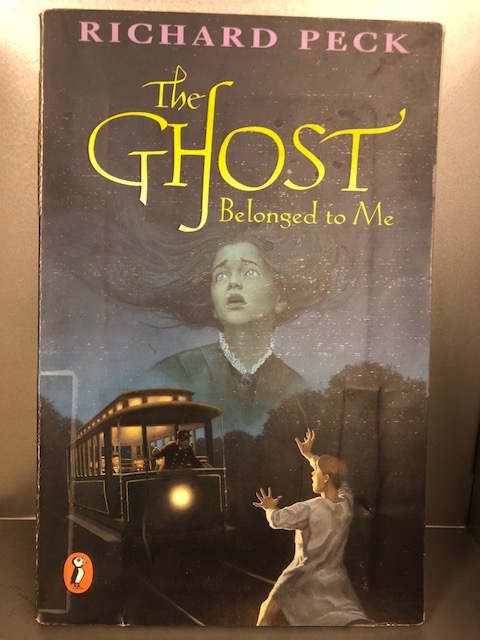
The Ghost Belonged to Me

GhostBelongedToMe

The Ghost Belonged to Me by Richard Peck, 1975.

The book takes place in the 1910s in a small town on the Mississippi River. Alexander Armsworth, a boy in his early teens, is approached by a girl from his class who tells him that the barn on his family’s property is haunted and that Alexander himself has the ability to see the “Unseen.” The girl, Blossom Culp, is a poor girl from a family of outcasts who has been known to tell tall tales, so Alexander isn’t sure he believes her at first. However, he can’t help but be curious, and when he sees a light coming from the barn at night, he decides to investigate.

Inside, he finds the ghost of a young girl who warns him of danger on the trolley tracks near his house and tells him that he must act fast to save everyone. Frightened, Alexander gets the trolley to stop and learns that by doing so, he has saved the lives of everyone on board from a disaster at the bridge further on. Naturally, everyone wants to know how Alexander knew to warn them. When Alexander explains, he is met with skepticism from his social-climbing mother and sister and unwelcome attention from news people and curiosity-seekers from town.

The ghost, who tells Alexander that her name is Inez Dumaine, is also in need of help before she can rest peacefully. Alexander will need the help of those who believe in him and the ghost to find Inez’s body and return it to her home in New Orleans.

In this first book in of the Blossom Culp series, Alexander is the main character, but the other books focus more on Blossom, who discovers that she also has the ability to see ghosts.  The book is available to borrow and read for free online through Internet Archive.

This is the movie that the Disney movie Child of Glass was based on, and the movie is available on dvd. Sometimes, you can also find it on YouTube, at least clips and reviews of it.

My Reaction

The story has sad and scary points, but those are balanced out by humorous situations. Alexander’s sister’s turmoil over the fiasco at her coming-out party is hilarious, and his mother’s change in attitude when she realizes that, instead of making them social outcasts, the ghost business actually attracts attention from one of the town’s leading citizens is a hoot. Blossom, of course, is wonderfully nosy, elbowing her way into Alexander’s life and selling tours of the haunted barn.

I was very young when I saw the Disney movie based on this book, Child of Glass (a live action movie that aired on television), and I was afraid of ghosts. However, years later, I took another look at the movie and decided to read the book that it was based on. When I did, I saw things I didn’t appreciate when I was young. The dialog and depiction of life in the early 20th century in the book are wonderful. It conjured up memories of Meet Me in St. Louis, especially the Halloween scene (which took place only about a decade earlier than this story). Unfortunately, this early 20th century setting wasn’t present in the movie version of this book because Child of Glass was placed contemporary with the time it was made, during the late 20th century.

The Disney movie was also different from the original book because it added the feature of the “child of glass” which didn’t exist in the original book. The “child of glass” was mentioned in a poem at Inez’s grave that explained how to lay her ghost to rest. At first, the Alexander and Blossom in the movie don’t know what it means, but it turns out to be Inez’s doll, which was lost when she was murdered by her wicked uncle. In the book, Inez died under different circumstances. However, the discovery of the doll in the movie uncovers the secret motive behind her murder, which is similar to the reason why Inez’s body was hidden in the book after she died in a riverboat accident.  In the book, Inez’s spirit finds rest after her body is found and taken to her family’s cemetery in New Orleans.  The Disney movie also turns this story specifically into a Halloween story, which wasn’t the case in the original book.

Who’s Haunting the Eighth Grade?

Junior High Series

JHHaunting

#13 Who’s Haunting the Eighth Grade? by Kate Kenyon, 1988.

A group of eighth graders are going on a field trip to see a Shakespeare play in another town, but right from the start, everything seems to be going wrong. The teachers who are accompanying them on their trip are in a foul mood and spend a good part of the trip arguing with each other, which bothers the kids because they know that the teachers have recently become engaged to each other. Then, the bus breaks down in a small town before they can reach their destination.  The entire class is going to have to spend the night somewhere in the small town.

At first, things look like they’re going to improve when the group decides to spend the night at a local bed and breakfast in a big, beautiful, old house. However, their spirits are almost immediately dampened again when they are told that the house is haunted and that anyone who tries to stay there is scared away by the ghost. Still, they proceed with their plan to stay there in order to avoid staying at the dumpy local motel, the only other choice of accommodation.

Needless to say, before the night is over, the ghost puts in an appearance, and strange things start to happen.  By then, the students have come to feel sorry for the owner of the bed and breakfast, a nice older lady who grew up in the house but can’t really afford to keep it unless she can make her inn a success. Can the eighth graders catch the ghost, stop the hauntings, save the bed and breakfast from having to close, patch up the relationship between their feuding teachers, and still make it in time to see the play?

The book takes place in the 1980s, and the kids in the story are 14 years old. They mention the decade somewhere during the course of the story, and the descriptions of the clothes and some pop culture references make the time period fairly obvious. It also has some of the stock characters that books for pre-teens and early teens in the 80s have (ex. a boy-crazy space cadet, a level-headed health nut, a class clown, and a couple of young punks). Still, even though there are some things about the book that are a bit dated, it is still pretty enjoyable. The author has a sense of humor, and she plays with the characters’ stereotypes a bit. The class clown is secretly quite sensitive and even a bit perceptive. There are also a couple of fun scenes when the girl who is only interested in boys is shocked to discover that the boys are more interested in the mystery than in her.

The Haunting of Cabin 13

Cabin13The Haunting of Cabin 13 by Kristi D. Holl, 1987.
Thirteen-year-old Laurie is looking forward to her family’s vacation. They’ve rented a cabin for a week, Cabin 13, by the lake at Backbone State Park (It’s a real state park in Iowa. Link repaired 10-19-22.), and her friend Jenny is staying there with them. Laurie’s mother isn’t looking forward to the trip. She hates dirt and bugs and doesn’t like the cabin when they arrive. As everyone starts unpacking, Laurie looks around the cabin and finds a note that warns them to leave because the cabin is haunted. Supposedly, it was written by the ghost herself. The note is signed “Eleanor.” Laurie’s mother thinks that they should leave right away, but Laurie and the rest of the family persuade her that it’s just a joke. At first, Laurie’s sure that’s all it is.

Then, the park ranger tells the family that the other families who have tried to stay in that cabin this summer also found similar notes. It might be just a prank, but it might not. He also tells them that a girl named Eleanor, the same age as Laurie and Jenny, drowned there the summer before, and strange things have been seen there since, like lights around the lake. Laurie’s brother, Ricky, thinks it sounds cool that they’re staying in a haunted cabin by a haunted lake. Like others, Laurie thinks that the notes are the product of a prankster, but what would be the point behind it?

The girls meet a pair of brothers who are staying nearby, Kevin and Matt. When they tell them about the note, Matt is eager to investigate. Jenny enjoys flirting with boys, and she’s mostly interested in flirting with good-looking, athletic Kevin. Matt is in a wheelchair, so Jenny doesn’t pay much attention to him. She just makes an awkward comment about cripples being able to contribute to society that makes everyone feel uncomfortable. Although Laurie knows that Jenny’s comment was inappropriately personal and callous, Laurie also underrates Matt’s ability to help with their note mystery at first, and she’s shy about talking to him because she’s often shy around boys. However, needing someone to confide her thoughts in when Jenny isn’t interested, Laurie talks to Matt about her theories about the mysterious notes. Matt turns out to be easy to talk to, helping Laurie get over her nervousness about talking to boys.

At first, Laurie tells Matt that she thinks that the prankster is trying to drive people away from Cabin 13 because something important is hidden there. However, as she starts asking questions about Eleanor, she learns that the notes haven’t just been directed at Cabin 13. Staff at the park have also received notes from “Eleanor.” Laurie also sees a figure in black sneaking around the park, who she is sure is not a ghost.

It isn’t long before Laurie receives more notes from “Eleanor,” hinting that she might be in danger, and she and Jenny see the mysterious lights that people have been talking about. Then, when the children are out in a canoe together, it develops a leak and sinks. Matt panics because his legs are paralyzed, and he can’t swim, but Laurie saves him with the help of some people in another boat.

Was that accident just an accident, or could it have something to do with Eleanor’s “accident” last year? There are plenty of suspects who might have reasons for playing ghost and stirring up trouble at the lake. Matt’s father blames the park ranger for the accident that paralyzed Matt. At a previous visit to the lake, Matt was crossing a road with his father and brother and was struck by a speeding car. Matt father says it wouldn’t have happened if the roads had been policed properly. Laurie realizes that he might have a motive for revenge. Then again, some people have been coming to the lake, drawn by the ghost stories and hoping to see the mysterious lights. Could the ghost be a publicity stunt to drum up business?

The book is available to borrow and read for free online through Internet Archive.

My Reaction and Spoilers

When Laurie discovers that Eleanor’s half sister has come to the lake to investigate Eleanor’s death herself, she thinks that she has the mystery solved, but she’s only half right. It’s true that Eleanor’s sister has been responsible for some of the things happening at the lake, but not all of them.  She explains to the kids that Eleanor loved mystery stories and was always playing detective games, but she thinks that perhaps the game got too real for Eleanor the summer that she died.  There is something sinister going on at the lake, something that Eleanor also realized before her death, and there is more to Eleanor’s death than most people know.

At the end of the book, Matt gets a chance to be a hero and stop the bad guy from escaping, using his wheelchair to his advantage because a person on wheels can sometimes move faster than a person on foot.  Even before that, Laurie had gained an appreciation for Matt and his sensible thinking, realizing that a person who is impaired in one way can still have great abilities in other areas of life.  She also comes to think of Matt as being brave for coming back to the site of the accident that made him a paraplegic.  Matt says that he had to come in order to prove to himself that there was nothing inherently bad about the  place and to stop the nightmares he was having about his accident.  Matt and Eleanor’s sister both make Laurie realize that everyone has something difficult or frightening that they have to deal with in their lives; it’s just that some people’s problems are more obvious than others.  Everyone can see what Matt’s dealing with at first glance because he’s in a wheelchair, but no one knew about the pain and fear that Eleanor’s sister was carrying around with her until she admitted it.

I consider this story a pseudo-ghost story because the obvious parts of the haunting were caused by living people, for reasons of their own.  However, Laurie seems to feel that Eleanor’s spirit was there with them, waiting to see the mystery of her death solved.  It’s left open to interpretation, but if Eleanor was there, it was only seen in the odd feelings that Laurie had from time to time, not in any more obvious or physical way.

Something that confused me a little in the book is that, at one point, Jenny tells someone that Laurie already has a reputation for being an amateur detective, having discovered that Jenny herself had been kidnapped when the authorities thought that she had run away from home. Jenny gives full details of the time when she was kidnapped, including who kidnapped her and why and how Laurie figured out where she was. When I read that section of the story, I thought at first that the author was talking about a previous book that she had written with these two characters, but I had trouble figuring out which it was, if any.

Interesting fact: some of the children in the story are named after the author’s own children.

The Haunting at Cliff House

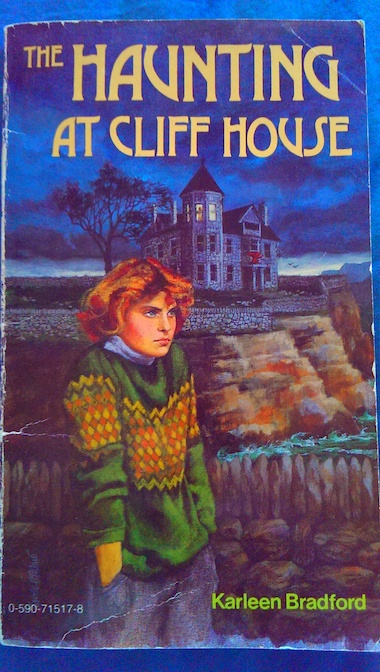
HauntingCliffHouseThe Haunting at Cliff House by Karleen Bradford, 1985.

This is a relatively short chapter book, but suspenseful, thoughtful, and well-written.

When her father inherits an old house in Wales from a distant relative, Alison, a young teenager, finds out that he plans for the two of them to spend the summer there.  Alison’s father is a university professor and is writing a book, and he thinks that the house in Wales sounds like a great place for him to get some writing done while he and Alison have a look at his new inheritance.  Alison isn’t enthusiastic about the trip, but she and her father are very close, especially because she lost her mother at a very young age.  Besides, the only place she could stay in Canada would be with her grandmother, and her grandmother didn’t seem enthusiastic about having her.

From the moment they arrive at the old house, called Pen-y-Craig or Cliff House by the locals, Alison has a bad feeling about it.  It stands on a lonely cliff by a small town.  The carved dragon over the door gives her the creeps, and there is something disturbing about a particular room in the house.  Sometimes, she can almost hear a voice calling out to her, and she has visions of another girl, about her age.  At first, she tries to tell herself that it’s all her imagination, but it soon becomes obvious that it’s not.

Some of the local people know that the house has an unhappy history, and Alison eventually learns that the great-aunt that her father inherited it from even refused to live there during her last years because it disturbed her too much.  A little more examination of the room that had disturbed her helps Alison discover the reason why.  After having a vision of a young girl hiding something behind a brick in the fireplace of one of the bedrooms, Alison searches the spot and finds a diary dating from 1810, written by a girl named Bronwen, who was the same age as Alison.  Like Alison, Bronwen was brought to the house by her widowed father and was unhappy about it, but those aren’t the only parallels between Bronwen’s life and Alison’s.

Alison becomes uncomfortable with her father’s new friendship with a Welsh neighbor, Meiriona.  Alison likes Meiriona’s younger brother, Gareth, but when it looks like her father’s friendship with Meiriona is turning into romance, Alison becomes jealous and fears changes in her close relationship with her father, a situation that mirrors Bronwen’s life when her father falls in love with her governess, Catrin.  Although Meiriona tries to be nice to Alison, Alison can’t bring herself to like her, and she argues with her father about it.

The only person who seems to understand her feelings at all is Gareth, and Alison confides her worries in him, both about Meiriona and about Bronwen, whose spirit keeps calling out to Alison to help her, although Alison doesn’t know how.  She struggles to read through the diary, whose pages are not all legible anymore because they’re damaged with age, to learn what happened to Bronwen and what Bronwen wants her to do now.  Gareth tries to reassure Alison that her father’s relationship with Meiriona will not be as bad as Alison thinks.  He thinks that the relationship would be good for both Alison’s father and Meiriona because they are both lonely, and he doesn’t think that Alison should worry about losing her father because he’s not worried about losing his sister, even if she goes to Canada to study and spend more time with Alison’s father.  At first, Alison isn’t comforted by these reassurances.  However, Gareth agrees that the matter of the ghost is serious, and he can feel her presence as well. Gareth warns Alison to be cautious about the ghost but to try to help if she can and to call out to him if she’s ever in danger.  Alison would really rather just go home to Canada, run away from her father and Meiriona, and forget the whole thing about Bronwen, but history seems to be repeating itself, and Bronwen’s voice calls out to her insistently for help that only Alison can give.

It’s a bit of a spoiler, telling you this, but although Alison at first thinks that the diary ends with Bronwen killing herself in despair, thinking that her father only loved Catrin and not her and that there was nothing left for her to live for, the truth is that Bronwen’s suicide attempt didn’t succeed and that she made another mistake that she wants Alison to help her to change.  Bronwen attempted to kill herself by going to a cave by the sea during a terrible storm, planning to allow herself to drown, but when the water started rising, she became too frightened and decided to leave by a secret entrance to the cave.  Not knowing that Bronwen was safe, Catrin attempted to save her and drowned in the cave herself.  As Bronwen was climbing to safety, she heard Catrin calling for her but was too frightened of the storm and angry at Catrin to go back for her.  Although Bronwen lived on after the incident, she could never get rid of her guilt at Catrin’s death, realizing that, even in the middle of her resentment toward Catrin, Catrin loved her more than she knew, even to the point of giving up her own life while attempting to save hers.

Now, the anniversary of Catrin’s death is approaching, and so is a storm very much like the one that killed her.  At the top of the cliff by the cave, Alison finds her time merging with Bronwen’s, and she will only have one chance to help Bronwen make the right decision the second time around.  Helping Bronwen to prevent the worst mistake of her life and to make a better choice also helps Alison to reconsider her own choices and future.  Just as Bronwen misjudged Catrin, Alison may have also misjudged Meiriona. Instead of losing her father or being forced to accept a poor substitute for her mother, Alison may be gaining a kind of sister who will love her more than she realizes.

A Ghost in the House

GhostInTheHouseA Ghost in the House by Betty Ren Wright, 1991.

At first, Sarah Prescott enjoyed her family’s new house.  The house wasn’t really new.  Other members of Sarah’s family had lived there before, but it was the first place where Sarah hadn’t had to share a room with her younger brother.  Then, Sarah’s Great-Aunt Margaret came to live with them, and everything changed, in more ways than one.

Aunt Margaret is the one who actually owns the house where Sarah and her family are living.  She’s is elderly and sick and has been living in a nursing home.  The rent that Sarah’s parents pay her pays for her care at the nursing home.  However, Aunt Margaret has been doing a little better, and she would like to come and live with the family.  Having her move in with the family would not only be good for her but for them because Sarah’s father has been in and out of work, and Aunt Margaret wouldn’t charge them rent or at least not much if they all lived together and they helped to take care of her.  However, it would mean some sacrifice on Sarah’s part.

Aunt Margaret had once slept in the beautiful room that Sarah has been using, and Sarah must give it up for her now that she will be living with them.  It’s difficult for her to deal with, but Sarah is also restricted on when she can have friends over because Aunt Margaret needs her rest, and the family’s lack of money means that Sarah won’t be able to go to the concert that everyone at school as been talking about.  These family problems and teen angst could be bad enough, but from the moment that Aunt Margaret moves in, strange and frightening things start happening that only Sarah and her aunt ever witness.

Whenever Sarah and Aunt Margaret are alone in the house, rooms get cold, and Sarah hears weird things like footsteps walking around when no one should be there and a girl’s voice singing that particularly unnerves her aunt.  Sometimes, Aunt Margaret’s things are moved around or broken, and there is something mysterious about an old painting that has been in the house for years.  Over time, Sarah begins to notice that the painting darkens, and sometimes she can see a man in the painting who wasn’t there before.  The presence of the painting also upsets Aunt Margaret, although she refuses to say why.  Although Aunt Margaret at first suspects that Sarah is the cause of some of the weird things that are happening, Aunt Margaret is the actual cause, and she is afraid to admit the dark secret from her past that has come back to haunt her.

A long time ago, when she was young, Aunt Margaret had a best friend called Anne, whose father painted the mysterious painting.  Anne had a very unhappy home life, and when the opportunity arose for Margaret’s family to adopt her, Margaret wasn’t sure if she wanted to share her home with her friend, although she cared for her a great deal.  Because of her hesitation, her parents decided not to adopt Anne.  In her old age, she admits that she was a spoiled girl.  Unfortunately, her friend went to live with other relatives and ended up dying in a fire, so Margaret never had a chance to make things right with her.  Although Anne’s death was a freak accident, Margaret felt guilty because Anne would have lived if her family had adopted her.  Anne’s father also blamed Margaret and her family for not doing more for his daughter, although it was his drunkenness and violence that ruined his home life and led him to give up his daughter in the first place.  Before he died, he threatened revenge against the family in some way.  Now, his vengeful spirit has found a way to use the old painting to reach Margaret once again, and unless Sarah can find a way to stop him, he will make sure that Margaret joins Anne in death . . . and possibly Sarah, too.  However, there is also Anne’s spirit to consider.  In life, Anne was the only person who ever stood up to her father.  Would she be willing to do it one more time for Margaret’s sake?

Part of the story is about being willing to sacrifice for the ones you love.  Years ago, Margaret hesitated to give up some of her pampered life for her best friend, and she regretted it forever after.  Sarah also comes to see how her earlier worries about giving up her room and about sleepovers and concerts were petty when compared to helping a relative who loves her.  She also sees how it’s important to do the right thing when there’s time because sometimes there is no opportunity to do it later.

In a way, I felt like the problem was solved rather easily, but there were some pretty scary incidents in the story and a failed attempt to get rid of the painting that brought some suspense.

The book is currently available online through Internet Archive.