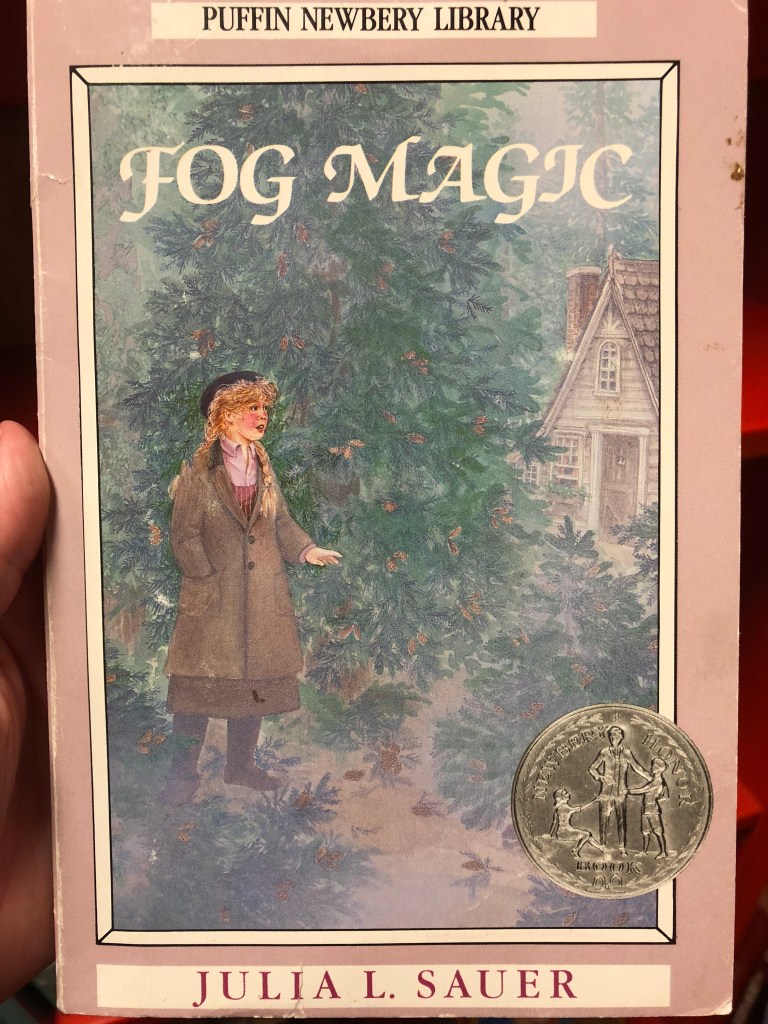
Fog Magic by Julia L. Sauer, 1943.
Greta
loves fog and always has, although other people can’t understand it. When she is ten years old, she begins to get
the sense that there is something in the fog that she should find. One day, when she goes looking for a lost cow
from her family’s farm, she sees a house in the fog that isn’t there when the
fog is gone. Apparently, there used to
be a house on that site, but it’s gone now.
Except when there’s fog.
From
then on, Greta loves to walk in the fog.
When she does, she meets people from the past. One day, she meets a woman named Laura Morrill,
who recognizes her as being from the Addington family and says that her name
must be Greta. According to Laura, there’s
always a Greta in every generation of Addingtons and that there’s always a
child in every generation who has a great love of fog. Greta’s ability to use the fog to travel back
in time and see her town as it once was is apparently inherited.
Greta
makes friends with Retha Morill, Laura’s daughter. However, when Mrs. Morrill gives her a piece
of pie to take home, it disappears, making Greta realize that she can’t bring
things from the past to the present.
Retha’s parents seem to realize it, too.
When Retha offers her a little silver egg cup to take home, Mrs. Morrill
suggests that perhaps it would be better for Greta to leave it at their house
and use it when she comes. Greta also
has the feeling that, when the fog starts to lift, she needs to go home, and
Mrs. Morrill agrees.
On another day, Greta and Retha spot an older girl in the woods. Retha seems to know who she is and calls out to her, but she runs from them. They try to catch up to her, but she gets away, and Retha is upset. It turns out that the girl is named Ann, and she was falsely accused of theft. When it was discovered that she hadn’t stolen anything, the townspeople had tried to find her, but she’s been hiding from them ever since, too afraid to come back. At first, people had thought that maybe she had gone to another town to find work, but now that they know that she’s been living alone in the woods, they’re worried about her. The story also upsets Greta because she has heard a local ghost story about a girl who haunts the woods after being falsely accused, and Greta takes that to mean that Ann will die. The Morrills assure her that they will look out for Ann.
Greta
is tempted to talk to Retha about her mysterious time traveling in the fog, but
Retha stops her from talking about it. Retha
says that even her mother doesn’t want to talk about where Greta goes while she’s
not with them, only saying that both men who go to sea and the women who wait for
them on shore “have to learn to be content and at peace shut in by their
horizon.” To Greta, that means that she
should be content with wherever she is while she’s there and with the fog that
allows her to see her friends in the past.
The
more Greta visits the Morrills, the more she gets caught up in the lives and troubles
of the people living in the past. At one
point, Greta and Retha talk about some of the sad things that have happened to
people the Morrills know, and Retha asks Greta if there is sorrow where she
lives. Greta has to admit that there
is. People generally do have their
troubles, no matter when they live.
Retha says that her mother says that living and dying are both natural
things, so there is no use being sad about them, except when the death is an
unnatural one, like in a war. There is
no war going on in Retha’s time, but Greta lives during the time this book was
written, in the middle of World War II.
Greta is aware of the war and says that sometimes people have to fight
whether they want to or not, but Retha doesn’t think so. Greta realizes that she can’t make Retha
understand the circumstances of the world in the future.
However,
as Greta’s twelfth birthday approaches, she has the feeling that things are changing. Her birthday will be the last time that she
can visit her fog friends, but they give her a special present to remember them
by. Greta’s father seems to know what
Greta has been doing in the fog, and he reveals to her, without actually saying
it, that he once did the same thing himself.
He says that when people grow up, they leave the things of childhood
behind, but each of them is able to keep a special birthday gift from the past
as a reminder that some things do last.
The ending of the story implies that, although Greta’s adventures in the fog were real, not purely imaginary, she has to give them up to make room for the new things that will enter her life as she grows up. Her life lies in her present and future, so she can’t keep going back to the past. However, her experiences with her friends in the past are part of what has made her more mature, and they will stay with her forever.
The book is a Newbery Honor Book. It is available to borrow and read for free online through Internet Archive.
My Reaction
The idea of magic and magical adventures ending at a certain age, as the person begins to grow up, is a classic idea in children’s literature. Sometimes, in other books, it’s implied that the reason this happens is because the “magic” was all imaginary, and the child in the story grew out of that particular kind of imagining, but that isn’t the case in this story. The explanation in this book for why the magic has to end is simple but makes sense. The characters don’t really analyze the issue too deeply, simply taking it in stride. We never find out why this particular family seems to have this tradition of going back in time in the fog as children, and the characters seem to decide that there is no reason to find out why.
Unlike in some modern books, there doesn’t seem to be any particular mission for Greta (or her father or any other generations before her) to fulfill in her time traveling. Greta is mostly an observer of the events in the past, not really participating in them directly or changing them in any way. She doesn’t even seem to influence the thoughts or attitudes of people in the past much. When she talks about the concept of war with Retha, she doesn’t try to change Retha’s mind about it or tell her about World War II and other future events because she realizes that each of them really belongs to two different times and sets of circumstances, and each of them needs to live in their own time, dealing with their own situations. It is their differing situations which give them their attitudes. The Morrills seem to be aware that Greta comes from the future, but they treat the subject carefully, never directly stating where she is from, just hinting at it. From they way they act, it seems as though they’ve met other members of Greta’s family before, but again, the ties between their two families (if any) are never explained, and none of them seems to want to delve too deeply into the matter. For the most part, they just seem to take the whole situation as being a natural part of life in their families and in the area where they live, something just to be enjoyed and not questioned. In fact, some of their attitudes seem to imply that they fear questioning too deeply, as if that in itself might end the magic too soon.
Although the story leaves the reasons behind the time traveling very open and unresolved (probably, other children in Greta’s family will be doing this in the future, also not really knowing why), it is really a very calm story. Not having a special mission to complete in the past leaves Greta free to simply enjoy the company of the people in the past, observing their lives without the stress of needing to solve their problems for them, and readers can similarly enjoy the ride without worrying that anything really bad will happen. You do end up being interested in what happens to some of the characters, like the woman who is in danger of losing her family’s home, but events unfold in the way Greta knows they will. She’s sad when she knows that certain people are going to die (not the woman whose home was in danger, that works out well) and there is nothing she can do about it, but it all seems to be part of the natural circle of life, something that matures Greta when she realizes it.
One of the fun things that I liked about the book were some of the unusual first names of the characters, like Retha, Eldred (Retha’s father), and Ardis (Mrs. Stanton).



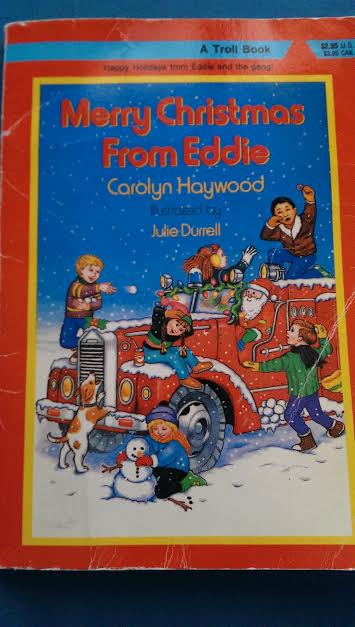
 Eddie’s Christmas Card
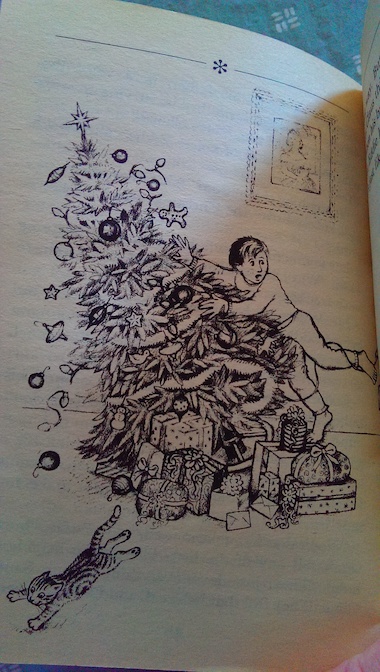 How the Christmas Tree Fell Over
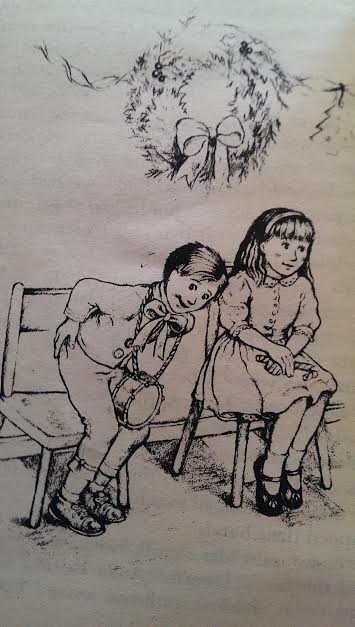 The Christmas Concert
 Jestress's Forgotten Books and Stories