Run Away Home

Run Away Home by Elinor Lyon

Run Away Home by Elinor Lyon, 1953.

When I first read this book, I didn’t have a copy of it because copies are collector’s items, and many of them are too expensive for me to afford, but after I read this book online, I managed to find a physical copy at an affordable price! I didn’t read this book as a child, but it’s exactly the kind of book I would have loved with atmospherically magical places (although no real magic), mysterious memories, and an orphan with a hidden past. This book was my introduction to the the Ian and Sovra series, although it’s the third book in that series. It’s available to borrow and read for free online through Internet Archive.

Thirteen-year-old Cathie lives at St. Ursula’s Home for Female Orphans in Birmingham, England. She has lived there ever since she was a young child and was found wandering the streets of London after a bombing raid during World War II. When she was found, she was wearing only a nightgown and clutching a locket that held a picture of a dark-haired woman and some dried flowers. She was unable to tell anyone her full name, only calling herself something that sounded like “Cathie.” (Hint: It “sounded like” Cathie. It wasn’t actually “Cathie.”) There was a label attached to her clothes, but it was torn. It only had the first part of her name (“Cat”) and the words “Passenger to” followed by what looked like the beginning of a place name that started with the letter “K” followed by “via” and what looked like the beginning of King’s Cross. If the label had been intact, there would have been no trouble identifying the child at all. The authorities made inquiries for her family or anyone who could identify her, but no one came forward. The conclusion was that her parents must have been killed in the bombing raid and that she had no other living relatives. Her family, whoever they were, was probably not from London because she was found near some railway station hotels, which had been destroyed. Most of the people staying there were killed, and the hotel records were also destroyed, leaving no further clues to Cathie’s identity. Cathie was sent to the orphanage and given the full name of Catherine Harris, but she knows that isn’t her real name. She has no recollection of the traumatic night of the bombing, but she has a vague sense that she has a real home and family somewhere else and a desperate need to discover her real identity.

One day, while reading a poem by Wordsworth aloud, a description of the seaside awakens a memory in Cathie of her early childhood. She’s had dreams of the seaside before, but she’s never been to the seaside since coming to the orphanage. Her memory of it is so clear that she’s sure that it’s not a dream but a place she’s actually been in the past, perhaps even the place where she used to live. She clearly remembers playing in the white sand on the beach, but she just can’t remember where the beach is.

When Miss Abbott, the headmistress of the orphanage, chides her for stopping her reading of the poem aloud, Cathie is upset that she disrupted her vision and her attempts to remember and screams, throwing the book across the room. Later, when she is called to the headmistress’s office to explain her fit of temper, she explains about the memory. The headmistress once again tells her the story of the night when she was found and shows her the locket and label that were found with her. The authorities honestly tried everything to locate her family and learn her original name, but since all attempts failed, the headmistress tells Cathie that she’s going to have to reconcile herself to not knowing. They’re not even completely sure whether the locket is Cathie’s or not because she was carrying it instead of wearing it, so it might have been something that she just found in the rubble after the bombing and picked up.

The headmistress says that she’s known other girls before whose birth names and parents were unknown, and it’s common for them to imagine some grand past or wealthy relations, pretending that they’re the long-lost daughters of a duke or something, but she wants Cathie to be more practical than that. Her parents are almost certainly dead, and if Cathie had any living relatives, Miss Abbott thinks they would have claimed her before. Miss Abbott thinks it’s unlikely that Cathie will ever get the full story of her past, no matter what she may or may not remember from a seaside holiday. Even if she somehow managed to locate the beach she’s thinking about, Cathie’s parents are dead, and there would be no one waiting for her there. Miss Abbott wants Cathie to focus on the here and now, applying herself to making a future for herself and making friends with other girls. Miss Abbott says that family isn’t everything because even blood family members aren’t always supportive to each other, but learning how to make and keep supportive friends will ensure that Cathie won’t be lonely. She says that Cathie will have a much easier time making and keeping friends if she improves her attitude and learns to keep her temper. It’s actually not bad advice if it’s really impossible for Cathie to learn about her past or if she genuinely has no relatives, but Cathie has a strong sense that isn’t the case for her.

Cathie can’t stop wondering about her memory of the sea and her mysterious past. She’s sure that the locket really did belong to her, but she can tell that the picture in it is much too old to have been her mother because of the woman’s hairstyle, which looks like styles from about 100 years earlier. The woman is standing in front of some mountains, and Cathie wonders if those mountains are a real place as well. She keeps thinking that, if she can get away from the orphanage and see other places, maybe she could find the place she remembers and learn who she really is.

As punishment for her temper tantrum, Cathie is sent to do some mending work for Miss Langham, who owns a big house nearby, instead of going to the pictures with the other girls. Cathie doesn’t mind too much because they were going to see a movie that she didn’t really want to see, and she also likes sewing and Miss Langham. While the two of them have tea in Miss Langham’s garden, Cathie brings up the topic of mountains, and Miss Langham mentions that she likes mountains, too. When she was younger, she used to go for mountain hikes. Cathie shows Miss Langham some embroidery work that she’s been doing with a floral design based on the little flowers in her locket, which look like silver buttercups. Miss Langham recognizes the flowers as Grass of Parnassus, which grows in marshy places, but not in Birmingham. She says that she used to see those flowers when she was younger and went hiking in the mountains in Scotland.

For the first time, Cathie realizes that she might not be English at all. If she had come from somewhere else, that might explain why no one in England knew who she was. The place that she’s remembering might be somewhere in Scotland. If she had really been a passenger from King’s Cross station in London, the train that brought her there might have been the Flying Scotsman, which Cathie knows comes to that station. Cathie tries to think of a place in Scotland that starts with ‘K’, which might have been where she was originally from. Feeling increasingly stifled by the strict rules of the orphanage, the lack of privacy at the orphanage, the bleak city, and Miss Abbott’s attempts to get her to stop dreaming about her past, Cathie begins plotting how she can run away to Scotland and start looking for the secrets of her past.

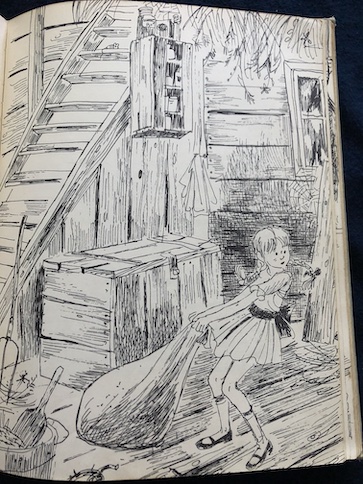
The next time she sees Miss Langham, she shows her the locket with the flowers, and Miss Langham confirms that the flowers are Grass of Parnassus. She also notices something that no one else who has looked at the locket has noticed – the little ribbon that’s holding the flowers together has a tartan pattern (a special kind of plaid pattern). When Cathie looks closer, she sees that the woman in the picture in the locket is wearing the same tartan. Cathie is excited because she realizes that this is confirmation that she was originally from Scotland. Even better, Miss Langham tells her that there are tartans that are specific to certain families or clans. Miss Langham doesn’t know enough about tartans to recognize which clan’s tartan is in the locket, but Cathie realizes that if she can find someone who can identify tartans, she has the key to learning who her family is! (Yes, the tartan pattern in the story is a real tartan, and it is one of the tartans shown on the tartan site page I linked. I checked after I knew what family to look for. But, it’s tricky to figure it out based only on the description in the book because some clan tartans share color combinations. To really identify which is which, you’d have to actually see and recognize the patterns of the colored lines and squares in the tartan. There are no pictures in the book.)

Miss Langham begins to like Cathie and sends an invitation to the orphanage to invite her to spend a few days with her in her home. Since Cathie has been pretty well-behaved lately, Miss Abbott decides to let her visit Miss Langham for a few days, although she has some misgivings because she can tell that Cathie has been acting oddly, as if she were keeping a secret. This visit to Miss Langham is critical because it gives Cathie the means to go to Scotland and try to find her home and family.

When Cathie goes to Miss Langham’s house, she isn’t there. Instead, Mrs. Riddle meets her and apologizes to her on Miss Langham’s behalf. The visit is canceled because Miss Langham’s brother is ill, and Miss Langham has gone to see him. There was no time to inform the orphanage of the change in plans before Cathie left because they don’t have a telephone. Cathie is bitterly disappointed because she had been looking forward to the visit, but Mrs. Riddle gives her some tea and cake and a note that Miss Langham left for Cathie. The note tells Cathie where to find some money that Miss Langham left for her to pay for purchasing the embroidered place mats that Cathie had been making with the Grass of Parnassus design. Suddenly, Cathie realizes that she now has money that no one else knows about. Her clothes already packed in her luggage for a few days away, including some holiday clothes that are different from the orphanage uniform, and no one is expecting her back at the orphanage for days because they all think that she’s with Miss Langham. Her opportunity to escape has come!

Feeling obligated to let everyone know that she isn’t dead when they discover that she’s missing, she adds a note of her own onto Miss Langham’s note that asks her to tell Miss Abbott that she has gone back to the place where she came from. Cathie thinks that, when the message reaches Miss Abbott, Miss Abbott will assume that Cathie has gone to London, the place where she was found as a young child. But, she has a few critical days to reach Scotland before her disappearance will even be discovered. She changes into her plain holiday clothes and goes to the train station in Birmingham. After she gets on the train, she uses her sewing things to remove the distinctive red trim on her coat so it won’t look like it’s part of an orphan uniform anymore.

The first place she goes is Derby, and she decides to hitchhike further north from there to save some money. She gets a ride from a truck driver (lorry driver, this is a British book), but he gets concerned that she might be a runaway or in some kind of trouble. He notices that the name she gives him isn’t the same as the one written on her luggage, a detail that Cathie had forgotten. At least, the driver has no bad intentions toward her and is kind enough to be genuinely concerned for her welfare. He tries to take her to a police station in Sheffield, but Cathie slips away from him and hides in the back of his truck, so he’s tricked into taking her further. When she gets the chance, she gets out and hides in the back of another truck that takes her almost to the border of Scotland. When this driver discovers her, she makes up a story about hitching rides to Scotland because she’s going there for a job in Edinburgh. She decides to take a train the rest of the way to Edinburgh, but by this time, Miss Abbott has already discovered that Cathie is not with Miss Langham. At first, Miss Abbott does think that Cathie might be going to London because of her note, but the police report of a possible runaway in Sheffield gives Miss Abbott the idea that Scotland might be Cathie’s intended destination. Cathie narrowly avoids being picked up by the police as she falls asleep in the waiting room of the train station because they think that she’s already left on an earlier train.

Once Cathie successfully reaches Edinburgh, she isn’t quite sure what to do next, but she enjoys being in the city, feeling like Scotland is the right place for her to be. Then, she spots a boy and a girl who are about her age, noticing that the boy is wearing a tartan kilt (but not the tartan in Cathie’s locket). When the boy, Ian, trips and drops the parcels he’s carrying, Cathie helps him. She makes friends with Ian and Sovra (the girl), and they invite her to come with them to see Edinburgh Castle. They notice that she speaks with an English accent and ask her about where she’s from. She confides in them about running away to find where she’s from, hoping that the answers lie in Scotland. Ian and Sovra are thrilled by Cathie’s story.

Ian and Sovra Kennedy don’t actually live in Edinburgh but on the west coast of Scotland. They’re only in Edinburgh temporarily to help their Aunt Effie. The name of their town is Melvick, and they live in a house called “Camas Ban”, which they tell Cathie means “White Bay” because of the white sand on the beach there. More than ever, Cathie is sure that she’s headed in the right direction!

Ian and Sovra catch the train home while Cathie returns to the cafe where she ate breakfast, searching for her locket, which she lost earlier. By the time she finds it and returns to the station, they are already gone, but Cathie asks about other trains to Melvick. There is going to be another train to Melvick early in the morning, and Cathie is told that it goes straight through to Melvick via Kinlochmore, with no changes necessary. Kinlochmore is the first Scottish place name Cathie has heard that starts with a ‘K’, and from the description of the area that Ian and Sovra gave her, which include a beach with white sand and mountains, Cathie is convinced that is where the secrets of her past can be found!
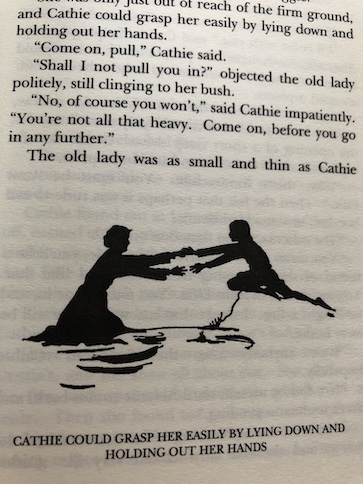
Cathie is on the right trail for finding the answers that she seeks, but getting caught is still a concern. The police and Miss Abbott are still looking for her, and she’s running out of money. Ian and Sovra help her and hide her in their secret hidden cottage (from the first book in the series), but unbeknownst to all of them, they’ve actually met Cathie before. Cathie really is remembering the beach near their home, and while she doesn’t remember the two of them, there was a time when they were all there, back before Cathie’s parents were killed in the Blitz and Cathie was known by her real name … Catriona, or as her parents used to call her, Catri.

My Reaction and Spoilers

One thing that I appreciated about this story is that there are no evil characters in it. None of the strangers Cathie meets wish her harm, and they even try to help her, although she dodges some of their help because it would take her back to the orphanage instead of allowing her to move forward on her mission. The orphanage where Cathie lives isn’t terrible. It’s kind of like a boarding school, so she is being educated, and she is not starved or beaten there. The worst Cathie can say about it is that the discipline is somewhat strict and she never has real privacy from the other girls.

Miss Abbott is the closest that Cathie comes to having an antagonist, and she does give Cathie punishments early in the story for the emotional and discipline problems she has while trying to revive her memories and reconnect with her past. In modern times, I think most caregivers would recognize the emotional turmoil Cathie is experiencing and be more patient and supportive to help her work through her feelings and memories, but Cathie’s orphanage doesn’t seem to offer professional counseling. Miss Abbott isn’t trying to harm Cathie. She does repeat the story of Cathie’s past when she asks her to, and when she lectures her on her behavior or gives her punishments, it’s not blind, unfeeling discipline; she explains her reasons to Cathie and tells her not just what she doesn’t want her to do but how she wants her to act and why. Miss Abbott is strict, but she actually does care what happens to Cathie and is trying to do what she thinks is best for her. The only reason why she doesn’t want Cathie to pursue the past in the beginning is that she thinks that it’s hopeless, and she’s pretty clear about that. She’s seen other girls pine for families they just don’t have or who are never going to reclaim them, for whatever reason. She thinks that there just isn’t enough information for Cathie to reconnect with her past and that she has no living relatives to find. Thinking about what she’s lost and will never find could just lead to more frustration, anger, and depression for Cathie. Even if she could find the beach she once visited as a young child, what would she do if there’s no one there waiting for her? Miss Abbott wants Cathie to reconcile herself to her loss and focus on the present and the future, building skills and relationships with the people around her, because she thinks that is what will lead Cathie to a better life. Cathie admits that Miss Abbott is nice, but she likes to plan other people’s lives, and she didn’t like the life that Miss Abbott had planned for her. In some books, that might actually be the moral of the story, learning to reconcile with the past and move forward without getting all of the answers, but this is is a sort of mystery/adventure story, so Cathie is on the path to finding the answers she seeks. It is a pretty calm, relaxing sort of adventure story, though, because no one is trying to harm Cathie, and the only threat is that they will put an end to her inquiries and take her back to Birmingham.
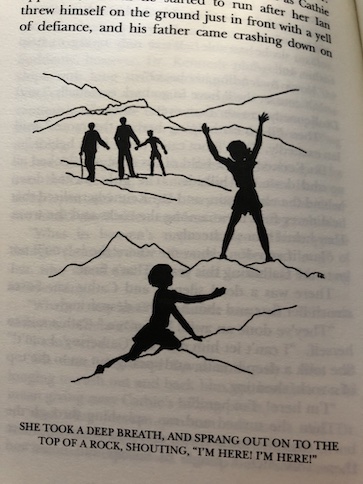
I liked the part of the story where Ian and Sovra are talking about which of the adults in their family and community would be most likely to give Cathie away to the authorities if they found out about her, and Ian says that even the two of them might turn Cathie in if they were a lot older. Cathie demands to know what he means by that, and Ian explains that it has to do with priorities. Kids and adults have different priorities. The biggest concern for the adults would be that Cathie is running around unsupervised and might get into all kinds of dangerous situations on her own, with no adult to supervise and take care of her. They would feel like they have to reign her in for her own good, and they’re also probably angry with her for causing them worry about her. However, Ian says, explaining the priorities that he and Sovra share with her as children, “You see, we know what’s more important. It doesn’t matter a bit if people are worried about you and rushing around looking for you. It does matter a lot for you to find out who you are.” Maybe he and Sovra would feel differently about it if they were older than Cathie and directly responsible for her safety, but as friends and equals in age, they put their concentration on helping her to accomplish her mission instead. It’s not that the kids and adults have different understandings of the situation. Both understand what Cathie is trying to do and both know know that there are risks involved in what Cathie is doing, but the main difference between them is that the children think that it’s still possible for Cathie to accomplish her mission to find out about her past, and the adults in Cathie’s life have already given up on that possibility and are just concerned with keeping her safe.

One of my early thoughts about the book was that Cathie’s parents might not necessarily be dead, since we don’t know in the beginning why Cathie was in London during WWII or how she got there. However, they really were killed in the bombing attack the night that Cathie was found, and they really are dead. For a long time, Cathie’s other relatives have assumed that Cathie/Catri died with them because the place where she was found wasn’t the place where they expected her to be and where they had been making inquiries for her and her parents. When they never heard from any of them again and they found out that there also had been a bombing in the area where they were supposed to be around the time when they disappeared, they had assumed that the whole family had been killed. Not everyone who died in bombing raids was able to be identified, so there were times when families weren’t notified of deaths and had to assume them from the circumstances and lack of contact from their relatives.

Stories about mysterious orphans with unknown pasts are staples of children’s literature and make great topics for mystery stories, but one of the fascinating things about this particular story is that it’s the kind of thing that could and did happen around the time of WWII. The time period really makes this story because it’s not only plausible that an orphan could go unidentified for a long period of time, but this is just the time and place where that would actually make sense. England was a war zone in World War II. It wasn’t actually invaded, but it was bombed frequently. People were killed, and children were separated from their parents in the chaos. In this era of chaos and sudden death, children were sometimes born out of wedlock to parents having a wartime fling and grew up without knowing who their parents were, or at least not knowing who their fathers were. That could account for some of the other children at the orphanage with unknown parents, but not Cathie. Some children were abandoned by desperate parents or were accidentally left when arrangements for unofficial adoptions suddenly fell through. Those are all things that really happened around that time, but that isn’t Cathie’s story, either.

In modern times, DNA evidence can help solve mysteries of this type, and it has helped to solve some past mysteries for people who were adopted as children, but back in the 1940s and 1950s, that wasn’t an option. Also, in modern times, Internet news stories and televised communication methods would also have helped the story of the found girl travel further, making it more likely that it would reach her relatives or someone who knew them. During this time, they would have been relying solely on newspapers and radio, and there might not have even been a picture to accompany a news story about the found child that would help someone recognize her. Modern methods don’t always solve every mystery, but they can help a great deal. That’s why this story really only works for this time period – a time when chaotic events happened that separated families and orphaned children and when modern investigative tools were unavailable.

Early in the story, I had thought that Cathie might have been about to head on her way out of London to somewhere else at the time of the bombing as a child evacuee because many children were sent away from London for safety from the bombings around that time. That wasn’t the case with Cathie, but it would have been a plausible explanation for the tag on her clothes. Child evacuees were known for having tags with their names attached to their clothes, and some children never returned home to their families when the war ended because their parents had died or had abandoned them. However, that’s not the case in this story, either. At the time her parents were killed, young Catri was actually traveling with her parents en route to another destination. The stop in London was unplanned, and they never made it to the place where they were supposed to be because of the bombing. It was just a case of bad luck and being caught up in the larger chaos of the war happening around them. The story does provided details of exactly how that happened, but since the book is available online, I decided not to include some of that information to preserve some suspense for people who want to read the story.

The special magic of this book isn’t just that Cathie discovers her identity, but how she does it. Readers know that when Cathie sets out on her journey, she’s likely to find some answers or at least a new home that will be better for her than the orphanage because the title of the book is “Run Away Home.” But, in the beginning of the story, readers are not quite sure how Cathie will do it and exactly what waits for her at the end of her journey. It’s the journey toward the truth and her special connection to the other children who help her that make the story satisfying. Little by little, Cathie uncovers pieces of the past. There are some lucky coincidences where she connects with people who were already connected to her and who can explain the past to her. When she comes to Melvick, Ian and Sovra hide her in a shieling or hut that they found hidden behind a waterfall in the first book of this series, which is a magical place to stay. For the first time in her life, Cathie has time alone where she can explore the beach and nearby mountains, and she enjoys the peace and serenity of the countryside more than the big city where she had been living. The characters in the book mention that, during WWII, parts of the west coast of Scotland were blocked off to visitors, except people who lived there or had relatives in the area, due to military exercises. The fact that Cathie definitely remembers being there during that time tells her and others that she either lived there or had family there, and it wasn’t just a one-time beach holiday.

At one point, Alastair Gunn and Dr. Kennedy figure out that Cathie is some sort of runaway, and Ian is physically punished for hiding her. I thought at that point in the book, Alastair handled the situation clumsily, saying too soon that Cathie can’t stay hiding there without first questioning her more closely about what she’s doing there and where she came from. I habitually ask a lot of questions, and it seemed to me that the adults in the book act too soon without finding out what they need to know about the situation. In their place, I would have wanted to get the situation straight before declaring anything or punishing anyone. At that point, the adults hardly know what the kids have been up to. By the time Miss Abbott arrives in Melvick, there is no need for her to return to the orphanage. Just when Cathie is thinking that she’ll have to reconcile herself to not knowing about her past and build a new future in the new home she’s been offered, the final pieces of the puzzle of her life fall into place, and Cathie gets the answers she’s been looking for. Even Miss Abbott is satisfied that Cathie has finally found the home she’s been looking for. After this book, Cathie becomes one of the major characters in this series.

I also liked this book for explaining the meanings of some Gaelic terms and place names. The Scottish characters do use some words that American readers might not be familiar with, like “dreich” and “havering,” but their dialogue is still easy to understand. The book doesn’t go overboard with trying to write to show the characters’ accents, which can get confusing and annoying in some books. The Scottish characters use “och” as an expression sometimes, but they don’t overdo it.
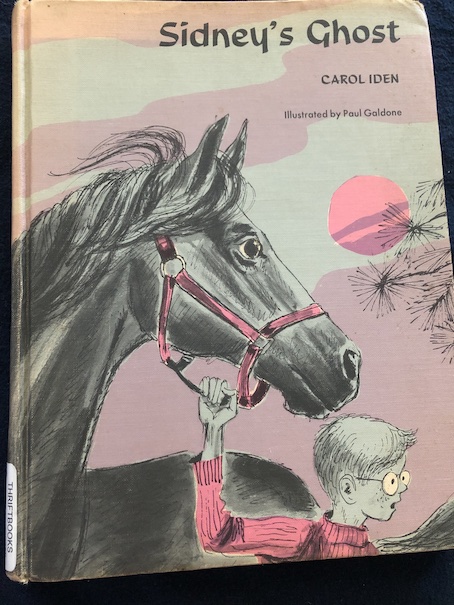
Sidney’s Ghost

Sidney’s Ghost by Carol Iden, illustrated by Paul Galdone, 1969.

Nine-year-old Sidney Robinson’s best friend is a girl named Megan McKenna. The two of them have many interests in common, including fishing, cars, ghost stories, and horses. Megan’s father owns a stable, and Sidney envies Megan for having her own pony. Because Megan’s father sells horses to other people, the kids are used to seeing horses come and go. When Megan’s father can’t find a buyer for a horse, he’ll try to sell it at public auction. However, if he can’t sell a horse at auction at all, he sometimes sells it to the slaughterhouse, where they use the horse parts for glue and dog food. It’s sad, but the kids accept this as part of life until Megan’s father acquires a retired police horse whose former owner died, and Sidney realizes that he can’t let this beautiful black horse suffer this terrible fate.

The horse, officially named Sergeant O’Hara but called Uncle Charley by Megan’s family is a beautiful animal with a gentle temperament. Sidney wishes that he could persuade his parents to buy the horse for him. He is easy to ride and obeys commands, and he has an excellent history of his time as a police horse.

Megan’s father isn’t completely honest as a horse seller. The book goes into some detail about how he prepares horses for sale, painting on dapples and filing their teeth down to make them seem younger than they really are. Even Sergeant O’Hara gets this treatment, although Sidney worries that it hurts the horse. (I looked it up, and it turns out that it can be beneficial to file the sharp points off of a horse’s teeth, which is called teeth floating. However, this is something that should only be done by someone who has been trained to do it because it can hurt the horse to file the teeth down too much.)

Sidney and Megan love to watch the horse auctions and pretend they’re bidding on the horses, but Sergeant O’Hara is auctioned off as planned. Megan’s brother Michael let him loose in the paddock when he was supposed to be watching him, and he got all dirty, so he isn’t fit to be shown. Then, to Sidney’s shock, Megan tells him that her father is planning to just sell Sergeant O’Hara to the slaughterhouse instead of trying again at the next auction. If Sidney and Megan are going to save poor Sergeant O’Hara’s life, they’ve got to do something, fast!

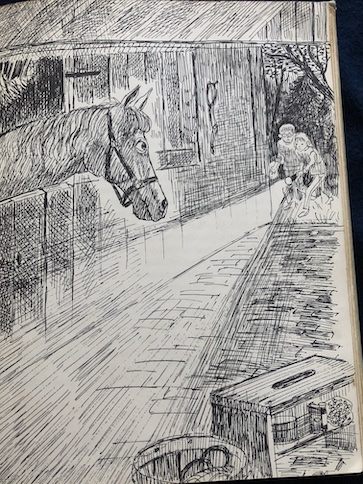
Megan tells Sidney that she’s thought of a plan to save Sergeant O’Hara. The two kids sneak out and take the horse in the middle of the night and hide him in an old barn. As they go to hide the horse, they see a shadowy figure near the barn. Megan is afraid, and Sergeant O’Hara wants to chase the figure because of his police training, but Sidney stops him.

However, even with the horse safely in the barn where hardly anybody ever goes, there is the very real worry that they’ll be caught. The horse will need exercise, so Sidney will have to go ride him at night or when they’re sure nobody else will be around. Still, they feel like they need to come up with an additional plan in case the horse is spotted. Then, Sidney takes a hint from the way Mr. McKenna painted dapples on a horse earlier and suggests that they could paint Sergeant O’Hara a different color so he won’t be recognized. Megan thinks that’s a great idea, and they decide to paint him white, like the Lone Ranger’s horse, Silver.

They get the painting supplies from Sidney’s father’s hardware store, but Sidney grabs a can of paint labeled “Super Glo – White.” It turns out that it’s not just a really bright white; it’s a glow-in-the-dark white. The kids don’t figure it out until they’ve already painted half of the horse. When Sidney sneaks out to feed and exercise Sergeant O’Hara again, he’s frightened when this big, glowing thing comes out of the darkness at him. Somehow, the horse got out of the barn and scared him by running out in the dark, glowing. Sidney realizes after a moment of panic that’s what happened. Because they only painted half of the horse before they stopped, one side of Sergeant O’Hara is glowing white, and the other is pitch black. When the horse gallops back and forth, he looks like a glowing ghost that vanishes with each turn. It’s a neat effect, but having a ghost horse certainly isn’t inconspicuous.

One night, Sidney accidentally frightens his old teacher, Miss Winthrop, when she’s walking home from visiting a friend. Soon, she spreads the story of her ghost sighting all over town. Most people think that she’s getting a touch of senility in her old age, but Mr. McKenna thinks it over and notices Sidney’s comings and goings in the area. When he goes to the old barn to investigate what Sidney’s been doing. Seeing the horse and the glow-in-the-dark paint, he realizes what happened. He appreciates that Sidney and Megan wanted to save the horse and sees the humor in their unintentional ghost act.

Since the kids feel that strongly about wanting the horse and are taking good care of him, Mr. McKenna decides to let them continue to do so, but there’s still one thing that nobody has answered: Who was that mysterious figure they saw around the barn? The answer comes when this mysterious person sets fire to the McKenna’s stables and Sergeant O’Hara has the opportunity to show his skills as a police horse.

My Reaction

When I first read this book as a kid, I was expecting it to be a mystery. It kind of is, but the mystery isn’t about the horse or about any ghost. There are hints from the very beginning of the story that there is a thief in the area, but the story doesn’t really focus on that until near the end. Sidney and Megan hear people talking about a prowler, and they do see the mysterious prowler around the barn, but they’re too busy with their plans to save the horse to pay too much attention. Fortunately, their horse and his ghostly appearance help them to catch the the thief, and the reward money for catching him straightens out a lot of problems so Sidney can keep Sergeant O’Hara.

The gimmick of the “ghostly” painted horse has stayed in my mind for years since I first read this story, but it’s not the only memorable part of the book. One of the things that I remembered best about this book from when I read it as a kid was the difference in Sidney and Megan’s homes and families. The book puts some emphasis on the difference in their family lives, and it’s shown when each of the kids has dinner at each other’s home. Megan has several siblings, and their house is always noisy and boisterous. Sidney is Sidney is a fussy eater at home, but he just eats what’s put in front of him at the McKennas’, like the other kids do. Megan gets a rap on the knuckles from her father for starting to eat before Grace is said. One line from the book that stuck with me for years was when Megan’s brother, Frank, says Grace with this joking prayer: “We thank the Lord for the next meal – we’re sure of this one.” I still think of this whenever someone says Grace aloud.

By contrast, dinner at the Robinson house is much calmer, quieter, and more formal. Sidney is an only child, and his father owns a hardware store, so the Robinsons can afford nicer things. Megan is impressed at the nice tile in the bathroom, and the table is set with embroidered placemats and matching cloth napkins. Megan accidentally bites into one of the cloves in the ham, and when it burns her mouth, she spits the bite of food into her cloth napkin, feeling terribly guilty about it because the napkin really seems too nice for that sort of thing.

I could identify with the feelings the children have about being in houses where people have different habits. There were times when I was young when I felt a little out of place because they were either more formal than I was accustomed to being or more boisterous than I feel comfortable being. People always feel more comfortable with what they’re used to.

The Mystery of the Other Girl

The Mystery of the Other Girl by Wylly Folk St. John, 1971.

It’s a rainy Saturday in Florida for the Barron family when Stevie (short for Stephanie) gets a strange phone call from Mobile, Alabama that’s meant for her ex-boyfriend, John Henderson. Stevie just broke up with John, who likes to call himself “Ian” because he thinks it sounds classy, the day before, and she has no idea who the strange girl on the phone is or why she’s trying to reach John/Ian at her number. Stevie asks the girl for her name, and she says that she’s Morna Ross, but suddenly, the girl screams and is cut off, like someone put a hand over her mouth, and then someone hangs up the phone at her end. Stevie is disturbed by the call, fearing that something bad happened to the other girl, but she doesn’t know what to do about it because she doesn’t know Morna Ross and doesn’t know exactly where she was calling from or why she wanted to talk to Ian.

Since Stevie already has a date to go dancing with friends at a place where Ian and his band are performing that night, she tells her friends about the weird phone call and asks them what she should do. They say that they’ve never heard of Morna Ross and tell her that she should talk to Ian about it. However, Stevie feels too awkward about the breakup to talk to Ian and asks a couple of her friends to do it for her.

That evening, Stevie and her friends run into Stevie’s old friend, Hope. She and Hope haven’t seen too much of each other lately because she’s not interested in dancing and dating and other things that Stevie wants to do. This evening, though, Hope is out with a visiting cousin from Mobile, Alabama named Phil Walters. Stevie is glad that Phil is getting Hope to come out of her shell a bit. Stevie and Phil say that the style of dancing popular with teenagers today is better than older styles of dancing because they don’t have to take any lessons to learn it – it’s just moving to the music, like everyone else. On impulse, she asks Phil if he’s heard of Morna Ross, but he says he hasn’t. Stevie’s friends say that when they asked Ian, he claimed not to know Morna Ross at first, but then he said something about her being a girl who’s “crazy about him.” Apparently, he dated her before he dated Stevie, and since he and Stevie broke up, he decided to invite her to the Old Seville Festival that’s happening next week, a local celebration of the history of their town. Stevie thinks it’s strange that Ian didn’t mention that Morna lives in Mobile, since that’s the place she was calling from. Stevie’s friends think maybe Ian was lying about Morna being crazy about him and that he probably doesn’t really know her because Ian is always bragging about things, like how great his family is. Hope thinks Ian makes up things to brag about because he wishes they were true even though he knows they really aren’t. After she thinks it over, Stevie thinks that’s true, that Ian likes to keep up appearances and a superior attitude because, underneath it all, he’s actually a very insecure person. But if he made up his relationship with Morna, and he doesn’t really know her, why was Morna trying to call him?

Before the evening is over, Ian confronts Stevie and reminds her that their first date was almost a year ago, at the last Old Seville Festival and that he’s planning to see her there again this year because they promised each other that they would see each other during the festival every year. In return, Stevie confronts Ian about Morna. Ian says that she’s just another of the girls who have come to see his band perform and likes him. When Stevie asks why nobody’s met Morna at any of the teenage hangouts in town, he says that they like to hang out at the more adult spots. He begins spinning a story that Stevie is sure is at least half fiction about how he and Morna order non-alcoholic drinks at adult nightclubs but they sneak in some gin to mix in with it and how they’ve tried marijuana. (Keep in mind that marijuana was illegal everywhere in the US at this time.) Ian says that he and Morna don’t really want to become potheads, but they see trying these things as part of growing up, “to experience everything and then make a choice.” Stevie pauses to wonder about the word “everything.” (That is always a good thing to wonder about when someone talks about wanting to try “everything.” Define “everything.”) Stevie asks him where Morna lives, and he says that she lives across town, but her family has moved around a lot because her father deals in real estate and sometimes even sells their own house and moves his family to a different one. (Ian sounds like he thinks that’s clever. I thought it sounded really suspicious, like maybe Morna’s family is actually involved with the mafia or something and has to keep on the move.) Stevie doesn’t really believe any of this, but she pries a few more details out of Ian about what Morna looks like. Although she thinks that Ian made up most of the things he said about Morna, there is still the girl who called her earlier and screamed like she was in trouble. She was a real person, even if what Ian said about her wasn’t all true.

When Stevie gets home, she tells her mother what Ian said about Morna and how Ian likes to make up things. Stevie is still concerned about the girl who called and wants to find out who and where she is and if she’s okay. Her mother says that her father will be coming home from a business trip the next day, and they can ask him what to do about it. Stevie’s father is a fingerprint expert at the police department, so he knows about police procedures and can make inquiries. Stevie wishes that she had Morna’s fingerprints so her father can analyze them himself, and in another weird development, she gets that opportunity.

The next day, Stevie gets a letter from Morna. The letter is addressed to her and not Ian. Morna didn’t know her home address, so she addressed it to the high school she attends, and the letter was forwarded to her from there. Stevie handles it carefully so she won’t disturb any fingerprints. The letter even has Morna’s return address, so she knows where she lives in Mobile. The contents of the letter are strange. Morna talks about her school band and how they’re always short of instruments. She says that she’s liked Stevie since she saw her playing with her school band in a competition (Stevie really is in her school’s band) and wonders if her school would be willing to sell spare instruments. The letter is oddly worded, the word “see” is underlined twice, and there are doodles all over page. Also, the specific instrument Morna says that she wants is written in French and doesn’t sound at all familiar to Stevie. Stevie looks up the term Morna uses, and it turns out to be a French horn. But, if Morna meant “French horn”, why didn’t she just say that? Also, the price she mentions for the French horn is far less than what an actual French horn would cost. It seems like Morna is either crazy or trying to say something else in her letter.

Stevie has a younger brother named Lyle who is really smart, and he suggests that the letter might be in some kind of code. As they talk it over, Stevie realizes that the French horn refers to Ian because he plays the French horn in her school band. Lyle wants to study the letter more to see if he can figure out other parts of the code, and Stevie decides to invite her friends over to see it, too, because most of them are also in the band and might notice something else in the message that’s music-related. Little by little, the kids begin working out the real meaning of Morna’s message. First, the amount of money that didn’t make sense is meant as a clue the reader that there’s more to this message than just an inquiry about musical instruments. Second, Morna phrases sentences oddly in order to work certain words into the message and put them in the right order for her hidden message. Third, the doodles around the message are the beginnings of pieces of music. Stevie and her friends providing their musical knowledge and Lyle coaches them through code-breaking techniques. After awhile, Lyle goes to his room to work on the code alone because he finds it easier to think by himself and likes surprising people with his discoveries. When he returns, she has the final solution.

Morna’s message says that she has to get in touch with Ian. She says that she is being watched and her mail is being read, which is why she has to communicate in this way. Morna asks Stevie to write to her in the same way, promising to explain the situation later. Stevie remembers that Ian wanted to see her at the Old Seville Festival, so she decides to tell Morna when and where to come if she wants to see Ian. Shortly after Stevie mails the letter, Morna calls again, saying that she needs to warn Ian because someone might try to kill him. Then, she screams and someone hangs up the phone again.

At first, Stevie’s father thinks that Morna is some kind of prankster or maybe having some kind of paranoid fantasy because she’s into drugs or something, but Stevie is sure that Morna really is scared. The danger is real, and Stevie’s family realizes it when Lyle is kidnapped at the Old Seville Festival.

The book is available to borrow and read for free online through Internet Archive.

My Reaction

I was pretty sure, for much of the early part of the book, that the whole thing with Morna’s mysterious phone calls and messages was just an act that Ian dreamed up and got someone to do for him as one of his dramatic bids for attention. It seemed weird to me that Morna second phone call ended exactly the same way as her first, like it was part of a rehearsed routine. Also, someone who wanted to interrupt Morna’s phone calls and keep her from talking could do it in easier ways that wouldn’t involve dramatic screams that would get attention. They could have just unplugged the phone or held down the hang up button. (Remember, this is the early 1970s. Morna’s using an older style of telephone that has to plug into the wall, and there are buttons where the handset rests that hang up the phone. That was the first type of phone I ever used as a kid, and I know that you can push those buttons down with your hand to end a call even if someone is still holding the handset.) I would think that if a sinister person was watching Morna, they would cut her off that way rather than try to put a hand over her mouth while she screams. Also, if they really didn’t want her to communicate with anyone, I don’t think they’d let her write any kind of letter, not even one that just seems to be about band instruments. Even if they couldn’t figure out the code, I doubt that they’d want to take the chance that she might communicate something to the wrong person. It all just seemed too theatrical and not realistic. So, I couldn’t really blame Stevie’s father for initially thinking that the whole thing might just be some kind of prank. However, I did wonder why he didn’t just phone the Mobile police department and ask a colleague to do a welfare check on the girl at the address on the envelope to find out if it was a prank or not. Better safe than sorry, and if it turned out to be just a prank, knowing that the police knew about it would probably be enough to get the girl to stop.

As it turns out, it’s not just a prank. There is something genuinely sinister going on, although I wasn’t sure what it was for quite awhile. I thought it might have something to do with drugs because there were repeated references to drugs in the story, but that’s not what’s going on. It turns out that Ian/John has been having trouble with his self-image and even self-identity because he’s adopted. He’s aware that he’s adopted, which is why he secretly worries that he doesn’t really fit in with his family or friends and makes up fantasies about himself to impress people while being inwardly insecure. However, there’s quite a lot that Ian/John doesn’t know about his past, not even his birth name, and the truth of Ian’s past is even stranger than anything that he’s ever imagined. His blood relatives love him and didn’t forget about him, even though they couldn’t take care of him when he was a baby, and now, they’re trying to protect him from a very real threat. Finding out the truth comes as a shock to Ian, but it’s an important step in making peace with himself and realizing just how important he is just for being himself, not only to his adoptive family but to the family who gave him up for adoption and to the friends who cared about him even when he was a bit of a poser and who took great risks to protect him and help him find the truth.

Lyle is fun as an eccentric genius character who has a pet walking catfish. I hadn’t actually heard of a walking catfish before reading this book, but that’s part of the fun. I enjoy stories that bring up interesting facts that I didn’t know before. Walking catfish can actually survive out of water for long periods of time and move across land. The walking catfish ends up playing a role in catching the bad guys in a way that actually makes sense, which is nice. I also like that, although Lyle is pivotal in solving the mystery, he didn’t get all the answers too easily, like some geniuses in stories, and he needed some specialized knowledge from other people. That makes him a more realistic character.

I would like to discuss the costumes that the characters wear to the Old Seville Festival, though. They explain that it’s common for people attending the festival to dress in historical costumes from different time periods in the town’s history to get into the spirit of the event. Ordinarily, I would think that’s fun and be completely supportive, but there’s one exception that I think crosses the line a little. Some people, including Lyle, dress in Native American costumes. I’m not Native American myself, but I know that real Native Americans are usually not too happy to see traditional forms of dress being used as costumes. I would cut the characters more slack for it if they confined themselves only to wearing clothes like traditional Native Americans, but what pushes it over the line for me is that Lyle is described as darkening his hair and his skin as part of his costume. He also does some kind of warpaint on his face, but it’s the skin coloring that he does that I think is unacceptable. I think that’s going too far, and that’s what pushes this costume into the realm of the tasteless and offensive. A little more restraint, just sticking to the clothes might have been okay, but looking like one of those white actors trying too hard with makeup to pass for a minority in an old black-and-white movie is just too much. It’s one of the things that really dates this book because fewer people today would be willing to take it that far, at least not without some embarrassment or criticism from other people. It was published in the early 1970s, and may possibly take place a little earlier, in the 1960s, because no exact year is given. I’ve heard some people claim that it was normal for them to wear racial face makeup as part of costumes when they were kids, and never having seen that even once when I was a kid in Arizona during the 1980s and 1990s, I’ve wondered just when and where kids did that of their own free will when they were given the opportunity to wear literally anything else, and I think I have at least a partial answer here. Lyle carries a tomahawk as an accessory to his costume and gives war cries. He also comments about how hippies are bringing Native American style headbands back into style, which further dates the story.

I should also explain that Lyle is not just dressing as any random Native American; he is trying to be a real historical figure. He is specifically trying to be William Weatherford, a mixed-race plantation owner known for his involvement in the Creek War in the 1810s. I like the part where Stevie wonders about the authenticity of Lyle’s costume. Apparently, Lyle got some help from someone at the local museum, but Stevie realizes that nobody else at the festival is going to know (or care) whether Lyle’s war paint designs are accurate or not, and even if he’s dressed accurately as a Native American of the area, the real William Weatherford probably typically dressed in the British style favored by other plantation owners of the era because he was living in the same manner as fully white plantation owners and going by his English name rather than his Native American name. I’m not actually sure how the real William Weatherford dressed because this isn’t a part of history that I know much about, but Stevie’s logic makes sense. My guess is that he probably wore a variety of different clothes in his life, depending on his circumstances at the time. (After all, various other historical figures did. Emperor Hirohito was photographed at various times wearing traditional Japanese ceremonial clothing, Western-style suits, and military uniforms, depending on the event.) One thing I could state with confidence is that William Weatherford probably didn’t have a pet walking catfish on a leash, which Lyle does because he insists on bringing his pet to the festival with him.

It’s part of the plot that Lyle is wearing an outlandish costume and has his walking catfish with him when he’s kidnapped, but I still think that there are equally outlandish historical costumes that he could have chosen that could have chosen that would have worked. It’s important that Lyle dyed his hair for the costume, so he had the same hair color as Ian on the day he was kidnapped when his ordinary hair color is much lighter, but I think there could be other ways around that or maybe he could have worn a hat so his hair wasn’t visible at first. I wouldn’t mind if he just dyed his hair, but the skin coloring is just too much.

Personally, I prefer the costumes that Stevie and her friends wear to the festival. They decide to dress as Gibson girls from the late 1800s and early 1900s. They basically wear old-fashioned-looking skirts and blouses and put their hair in the typical Gibson Girl hairstyles. Historical costumes that are based on wearing different clothes and hairstyles are the type of costumes I favor.

Aside from the costume issue, I really liked the story. I honestly wasn’t sure what the real problem was until the very end of the book. I had several theories, but Morna really surprised me when she explained who she really was and why Ian was in danger. I thought that she might turn out to be a relative, but the situation wasn’t what I expected.

Patty Paints a Picture

Patty Paints a Picture by Laura Bannon, 1946.

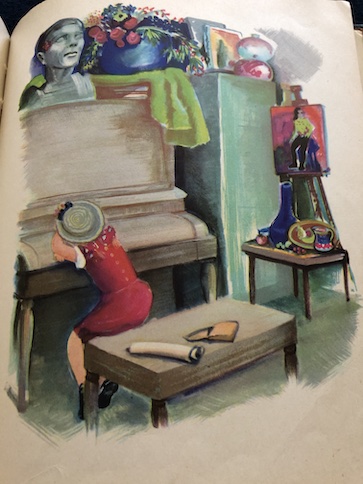
Patty wants to paint a picture of her kitten, Happy, to hang in her room. However, she has trouble creating a painting that truly satisfies her. Her first attempt doesn’t really look like her kitten. Patty is taking an art class at a local museum, and her mother suggests that she take her picture of Happy to her teacher and ask her how to make it better. Through Patty’s efforts to paint a realistic picture of her kitten, she comes to learn more about art.

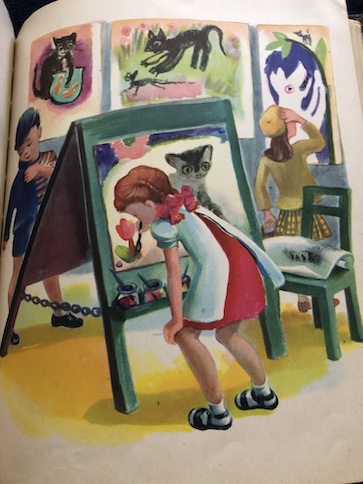
Patty’s teacher suggests that Patty actually bring her kitten to class so that everyone can observe and paint him. When Patty takes her kitten to her art class, the whole class looks at Happy, pointing out parts of the the cat, like his whiskers and his little padded feet with retractable claws. Every part of Happy, including the shape of his eyes and his powerful back legs that are good for jumping, is suited to making him a good hunter because cats often hunt for their food. Studying the form of the cat helps the children understand how to draw him.

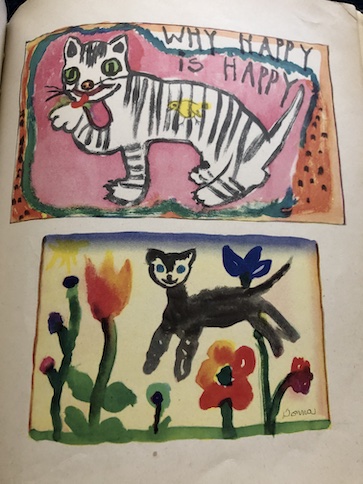
The fun part of the book is when Patty studies all of the different ways her friends in class draw the kitten, seeing how everyone looks at the kitten differently and uses different art styles, some drawn better than others because all the artists are children. The children’s pictures in the book look like pictures that would be painted by real children.

The children in the art class paint the cat in different ways and different imagined settings, indoors and outdoors, depending on their interests and how they see the cat and his personality. The boy who drew Happy in a cartoon style, with a bird in his stomach and a caption, wants to be a cartoonist, which is why his style was a good choice for his painting. Patty, on the other hand, wants her painting to be realistic for the way she sees her kitten.

The book explains how Patty learns new art techniques to make her painting look more realistic. She studies the lines that people use in their paintings and compares them to her cat, seeing that curved lines for the cat’s body make him look more realistic. Patty’s teacher points out that one of the mistakes that she’s made in her first efforts is giving Happy a body more the size of an adult cat than a kitten. A kitten’s body looks smaller when compared to the size of the head. To make her picture more realistic, Patty has to learn to draw her kitten’s body parts and features in the right proportions. Patty also notices that the edges of another girl’s cat painting look fuzzy because she’s painting in watercolor and the edges of her painting are wet and running. Patty likes the fuzziness of that painting, so she decides to use that technique on purpose to make more realistic, fuzzy fur. Her teacher shows her how to use that technique with more control by putting a wet blotter under her paper. I like how the book describes Patty’s observations of both her kitten and other people’s pictures and how she uses them to improve her own painting.

At one point in the story, Happy disappears from the art class, and Patty is afraid that she’s lost her kitten forever. Fortunately, she finds Happy hiding in the art room, taking a nap, and he is fine.

In the end, Patty produces a painting that satisfies her because it really looks like her kitten, the way she sees him.

This is one of those vintage children’s books that I would like to see in print again! It’s a nice story, and I really liked the way the book examines the different ways that people look at art and the styles they use. There’s no wrong way to paint something, but the book explains how learning different techniques can help artists to express themselves and their vision the way they want. Patty knows when she’s doing well at her painting when the picture she paints looks more like the vision she has of her kitten.

You can read this book online in your browser through the HathiTrust Digital Library.

Sammy Keyes and the Hotel Thief

Sammy Keyes

Sammy Keyes and the Hotel Thief by Wendelin Van Draanen, 1998.

Samantha “Sammy” Keyes lives with her grandmother in her apartment because her mother (who she calls “Lady Lana”) left her with her grandmother a year before, when she left to pursue an acting career. Much of the time, Sammy doesn’t have much to do at her grandmother’s apartment, so she spends her time watching people and nearby buildings with her binoculars. Technically, Sammy isn’t supposed to be living in her grandmother’s apartment because the apartment building is for seniors only, so they have to keep her presence a secret. Sammy only keeps a few belongings that are easily hidden, and she has to hide in a closet when people they don’t know and trust come to the door. She can’t come and go as often as she wants because her grandmother’s nosy neighbor will notice and report her. One day, while looking at a seedy hotel nearby, she witnesses someone with black gloves stealing money from someone’s purse. As she watches, this man looks directly at her and can tell that she’s watching. Sammy has the strange feeling like she’s seen the man somewhere before, but she can’t think where, and she’s nervous that he saw her, too.

A little later, Sammy’s friend, Marissa, comes to the apartment and asks Sammy to help her find her younger brother, who’s missing. Sammy knows that the best place to look for Marissa’s brother is at the pet store, so the two girls hurry off to find him. On her way back to her grandmother’s apartment, Sammy sees that there are police at the hotel, so the theft has been discovered. There are other kids standing around and watching, so Sammy decides to take a look, too. She sees the police interviewing the woman whose money was stolen. As she listens to them talk and mention looking for fingerprints, she can’t help but comment that there won’t be any fingerprints because the thief wore gloves. When the police and victim all hear her say that, they realize that she’s the only witness to the crime. As they question her, she describes what she saw while giving them as little personal information as possible so her secret of living with her grandmother won’t be exposed. When the police take down her name and address, she gives them her real name but Marissa’s address in a wealthy part of town.

The next day, both Sammy and Marissa have their first day of junior high school. Sammy immediately gets the attention of the school mean girl, Heather Acosta (who becomes her school nemesis for the rest of the series). When Heather jabs Sammy in the butt with a sharp pin, Sammy punches her in the nose. Of course, the vice principal shows all kinds of sympathy to poor Heather and punishes Sammy because he claims that nobody saw Heather jab Sammy in the butt with a pin. He makes her sit alone in a tiny closet that the school calls “the Box” to think about what she’s done. Even when Marissa tells the principal what really happened, supporting what Sammy said, the principal just says that there’s never any excuse for punching anybody and that Sammy is suspended. The vice principal expects Sammy to shake hands with her rotten abuser and make peace when she returns to school. (Ooh, I hate that. I’ve got a rant for later.)

After Sammy’s suspension, she and Marissa walk home together, and Sammy tells Marissa about what she witnessed at the hotel. When the two girls stop at the store, they see the woman whose purse was robbed and learn that she’s an astrologer called Madame Nashira (real name Gina). Surprisingly, she admits that she doesn’t really believe in fortune-telling, but she does it anyway because she needs the money. She likes drawing up astrological birth charts for people, though. There’s an interesting scene in the book where she does one for Sammy and explains how it works. (I’ve never been serious about astrology, and I doubt it even more since I took an astronomy class and my teacher showed us how to use a star globe and used it to explain why people’s birth signs aren’t their real birth signs, but it was still kind of fascinating just to think about. I’ve never actually seen a real birth chart before.)

When Sammy gets back to her grandmother’s apartment, Sammy’s grandmother’s nosy neighbor, Mrs. Graybill, tries to find evidence that Sammy is living there against the rules, or Sammy has to pretend like she’s only visiting and leaves to visit a nearby friend, Hudson Graham, an old man who has a lot of books. The two of them talk about other robberies that have happened in the area recently. When Sammy gets back to the apartment, she finds Mrs. Graybill angrily telling her grandmother that Sammy wrote her a threatening note and slipped it under her door. Of course, Sammy didn’t do any such thing. When Sammy sees that the note says, “If you talk, you’ll be sorry,” she knows that the threat is actually from the thief. The thief knew that someone from the apartment building was watching him, but he accidentally delivered the threat to the wrong apartment. With a threatening thief wanting to keep her quiet, Heather and the school principal wanting her butt to suffer at home, the nosy Mrs. Graybill wanting her sent away from her grandmother’s apartment, and the police wanting Sammy at her friend Marissa’s house, Sammy’s witnessing of the theft threatens to expose her own secrets.

The book is available to borrow and read for free online through Internet Archive (multiple copies).

My Reaction

One of the things that stands out to me is that neither Marissa nor Sammy really live in the best homes. Marissa’s family has a lot more money, and they live in a big house, but her parents are busy business people who spend most of their time working and traveling, often leaving Marissa alone with her younger brother, fending for themselves with Pop Tarts and tv dinners. Marissa feels neglected, and she really is. She also doesn’t have many real friends. A lot of the other kids who play up to her, like Heather, are trying to get her to give them money because they’re aware that her parents give her a lot of spending cash, and Marissa has had trouble saying “no” to them in the past. One of the thing Marissa likes about Sammy is that she’s never asked her for money. Sammy likes Marissa for herself.

Sammy is surprised when she finds out that Marissa actually envies her because her grandmother is always there for her in ways her parents aren’t. Sammy doesn’t feel lucky because, even though her grandmother cares about her, she always lives on the edge, having to pretend like she’s not really living with her grandmother, keeping only a few belongings that are easily hidden, and ducking into a closet to avoid being caught. She can never be completely at home in her grandmother’s apartment because she isn’t supposed to be there at all. Sammy’s mother occasionally calls, but Sammy always feels uncomfortable and neglected by her mother’s abandonment of her, which is why she refers to her as “Lady Lana” instead of as her mother.

I thought at first that Sammy’s housing situation might be solved by the end of the book, but it wasn’t. At the end of the story, she’s still secretly living with her grandmother and lying to the police about being Marissa’s foster sister. However, there are hints in this book about another possible place for Sammy and her grandmother to live in the future, so that situation might change. At no point in the story does anyone mention who Sammy’s father is, where he is, or why he didn’t take Sammy when her mother left. The identity of Sammy’s father is actually an over-arching mystery in this series, something that they discuss later.

As for the book’s introduction of “Rear” Admiral Heather the Butt Poker, the book doesn’t use the phrase “rotten abuser”, but that’s my take on it. Get ready for another one of my anti-bullying rants, or skip the rest of this long paragraph and the next two after that. I always find bullying in books stressful, especially when adults take the side of the young bully. It’s not as bad when a bully is punished or at least called out for their bullying, but when adults refuse to believe the victim, it’s awful. I know from long, bitter experience how the worst, most twisted mean kids provoke fights so their victims end up looking like the bad ones when they finally snap. The abusive kids know that the adults like them and will favor them every time. I’ve seen it happen before, and the fact that situations like this end up in books like this shows that it’s a sadly common experience that many people relate to. The abusers’ behavior never changes because they never experience consequences. The adults delude themselves that the abusers are either “normal” kids or will change (somehow, magically) as they get older and gaslight the victims that the situation is their fault and that it’s possible to be friends with the abuser without the abuser changing their behavior and continuing to act the same mean way they always act. I appreciate that the book shows the unfairness of the situation by adults who just want the situation easily resolved and make the kid they don’t like as well take the brunt of it. I know that Sammy’s use of physical retaliation is what put her in trouble, but honestly, I feel more inclined as an adult to think that sometimes physical force is necessary when dealing with a physical abuser. I’ve never heard of anyone who stopped being physically or emotionally abusive because they were asked politely, and when people in authority refuse to do anything, there sadly isn’t much recourse. Heather should not be touching anyone else’s butt, not with a sharp object, not with her hands, and not with anything else. It’s someone else’s butt. Heather should NOT be touching anyone else’s butt for any reason at all, let alone inflicting pain to someone else’s butt by penetrating it with something sharp. At her age, she should be old enough to understand that sort of thing has connotations other than a kid’s prank, and if she isn’t, someone needs to have a long, serious talk with her to explain why. I know that Heather’s meant to be just a thoughtless mean kid and not molester or something, but she’s still young and someone should put a stop to this before it goes any further. Understanding of these things has to come at some point in a person’s life. If there’s any lesson that’s difficult to carry too far, it’s the concept that no one should mess with someone else’s butt and cause pain. If Heather is allowed to mess with people’s butts in this school, understand that there is absolutely nowhere else in this society where she would be allowed to do that without repercussions. There’s no shame in having some weirdo you don’t even know assault your butt, but there’s a whole world of shame for being that weirdo who can’t leave someone else’s butt alone. Also, Heather jabbed Sammy with something sharp that penetrated her skin. Am I the only adult thinking about tetanus and blood poisoning?

Kids who are bullies in school are more likely to engage in aggressive, anti-social, and criminal behavior in adulthood. Shrugging and saying “Kids will be kids” while doing nothing is one of the worst possible things to do. Bullies don’t magically get better when they hit a certain age. If no one intervenes and teaches them that there are some forms of behavior that are never acceptable and really enforce the rules, they will continue their bullying for the whole rest of their lives, seeing the whole rest of the world as being in the wrong for complaining about their behavior, causing workplace stress, family turmoil, and failed relationships. It’s a serious problem. It’s not harmless. It seems like decades past time for the school vice principal to have this explained to him as well. A school can have all kinds of anti-bullying rules, but if they never enforce them for all parties involved, they’re completely useless because it’s like they don’t even exist at all. Kids are pretty good judges of who’s a pushover and what they can get away with, so anyone who’s worked with them should realize that the only rules that matter are the ones that actually get enforced. Unless the vice principal is one of those grown-up bullies himself who never got a clue and can’t stand to realize the reality about himself, which is always a possibility. I just have no sympathy for that.

I wonder if the vice principal considered how his reaction to what Sammy told him about being jabbed in the butt by a sharp object, actively punishing Sammy for what she said and for her physical retaliation to the violation of her body, might be teaching her some terrible lessons about how to respond to a sexual assault, including the one that people in authority will never believe her and will actively punish her because it’s the easiest thing for them to do and that’s all that matters. That happens quite a lot in real life, as the #MeToo movement has shown. This video, which is rather explicit in its descriptions and not for kids, explains about university officials who act like this vice principal and the harm they do when they let sexual violators go unpunished and even rewarded, while their victims are sent jumping through hoops for justice they never plan to give them because they just want them to shut up, go away, and not make trouble for the bullies they really like. At their core, bullying and sexual violence are both about power and control over other people and using people for the perpetrator’s purpose. It’s not really surprising that there is a connection between the two and that young bullies can turn into perpetrators of sexual violence. I wonder if the vice principal’s response would have been different if it had been a boy who jabbed Sammy’s butt instead of a girl. Actually, I don’t really wonder. I’m sure he would never think of that and would spend a lot more time coming up with reasons why this situation is different is different from any form of sexual assault, so harmless, and how he shouldn’t have to think of it if someone asked him. I liked the part where Sammy offered to show him the mark from the pin if he refused to believe her, an offer the vice principal didn’t accept. I know he’s just taking the easy way out here, punishing the person who didn’t lie and deny throwing a punch and maybe sympathizing with Heather because she got noticeably hurt in a place that isn’t covered by pants and underwear, but as an adult who remembers kids like Heather, I have absolutely no respect for this vice principal for his hard-line punish-the-bullied stance. I don’t feel for Heather at all because she got what she provoked, and there was repeated provocation followed up by a physical attack before Sammy finally broke. Every human on Earth has a breaking point, anyone might snap when pushed too far, and nobody is clever for exploiting someone’s human emotions to the point where they break. Learning that is a valuable life lesson. Of course, I know Heather sticks around as a bully for other books, so she’s not learning a thing.

While Sammy is suspended, Heather and her friend Tenille start a scheme at school to get money from other students by milking their sympathy for her “broken nose” (what they call the “Help Heal Heather Fund”). Of course, her nose isn’t really broken. Sammy realizes it because she’s seen someone with a broken nose before, and the bandaging on Heather’s isn’t right. (The book doesn’t mention it, but people with a broken nose also typically get two black eyes or at least dark, obvious bruises under the eyes from the broken blood vessels. I didn’t know that as a kid, but someone told me about that as an adult, so that’s one of the first things I’d look for.) When Sammy realizes that Heather is faking a broken nose and putting bandages on herself, she figures out how to expose her scheme. She calls the office of the doctor Heather mentioned to someone else, pretending to be Heather, and has the doctor’s office call the vice principal to explain that she doesn’t really need to wear bandages, implying that the vice principal is forcing her to wear them against her will out of an abundance of caution. After the vice principal gets the call from the doctor, who chewed him out for forcing a girl to cover her nose in bandages over just a little nose bleed, he marches into the cafeteria and tells Heather to take her bandages off in front of everyone, exposing her fraud. He tells her that they’re going to have a talk in his office about her lies, and Heather tries to hit Sammy, accidentally hitting the vice principal instead. Heather gets suspended for much longer than Sammy was, and the other students are angry with both her and Tenille for taking their money. The vice principal never apologizes to Sammy for his earlier implication that she was lying and for making her sit in that little closet called “the Box” to think about it, but her reputation is restored at school.

The Double Disguise

Kay Tracey

The Double Disguise by Frances K. Judd (Stratemeyer Syndicate), 1952 (revised from 1941 edition), 1980.

Kay and her friends, Betty and Wendy, stop to help a woman who was knocked down at the train station. As they help the woman up, a man who claims to be the woman’s son picks up the woman’s suitcase and takes her purse away from Kay. However, the man is not the woman’s son and runs away with her things while Kay and the other girls focus on the woman. The woman, Alice Janey, is very distressed when she finds out that she’s been robbed, and Kay invites her to come stay at her house with her mother and cousin, who is a lawyer, while the police try to find her missing belongings.

The invitation to stay at the Tracey house turns out to be fortuitous because Alice Janey is actually an old friend of Kay’s mother, Kathryn. Kathryn Tracey tells Miss Janey that she’s sure Kay and her friends can help her because they’ve solved mysteries before. (Even though my copy of the book numbers this as the first book in the series, when the series was published for the first time, it was much further along in the series. The order of the books was changed in different reprintings, so the girls have had other adventures before this.) Miss Janey used to live in their town, Brantwood, and she has now returned in order to finish some work that her late father was doing. Her father’s old papers were in the suitcase that was stolen. Miss Janey thinks that the person who stole her suitcase was after those papers.

The next day, Kay takes Miss Janey to the house that she’s purchased on the edge of town, but the house is somewhat lonely and isolated. Miss Janey is a bit nervous about being there alone, so she asks Kay if she’s willing to stay with her until she can get a housekeeper. During the night, Kay wakes up because she hears voices, and she discovers Miss Janey talking to a woman who looks like a witch and seems to be some kind of medium or fortune-teller, telling her where to find her missing suitcase and purse. The next day, Miss Janey claims that she a dream about where to look for the purse and suitcase, not saying anything about the witch woman. Kay knows that Miss Janey is hiding something, but she’s not sure why.

When Miss Janey goes to the empty old house that the witch woman described as the place where she would find her bags, Kay and her friends follow her. The bags are there, but they’re empty. Miss Janey disappears, apparently taken away by a couple of men, and she later turns up at her own house.

As Kay befriends Miss Janey, Miss Janey opens up to her and explains a few things. She admits to Kay that she’s been consulting with the fortune teller, Nanna, for some time. Although Kay is suspicious of Nanna, Miss Janey trusts her. Miss Janey also explains that she used to help her late father in his chemical research and that she now has a laboratory set up in her house. Specifically, she’s trying to finish a formula that her father started working on for a substance that is like glass but which has more uses. She was carrying the formula in her bags when they were stolen, and that’s what the thief must have wanted. This technological development would be very valuable, at least when it’s finished, and the thieves might not have realized that the formula was incomplete.

The situation becomes more complicated when Kay discovers that the men who removed Miss Janey from the old house before are detectives who are investigating her because they suspect her of participating in a fraud that has robbed widows of their money. Kay knows that Miss Janey would never take part in such a thing, but this fraud has a connection to the theft of Miss Janey’s formula.

My Reaction

I found this book rather meandering and disjointed. It started off with a pretty strong premise – a lady has her bags stolen at a train station, and it turns out that she’s carrying an unfinished chemical formula that may be worth a lot of money once it’s finished. The fact that the formula is incomplete adds a complication to the story. Are the people who stole the formula capable of completing it on their own or will they have to trick or force the original owner to finish it for them?

Then, the plot is further complicated by a mysterious fortune teller who turns out to own the house where she told the lady her bags would be found. Is she in the plot to steal the formula? There’s a pretty case for it because it would explain how she seems to know things that she shouldn’t know otherwise, and also it turns out that the thieves have actually been renting her house and using it as a base for their plots without her knowledge, so that plot angle doesn’t really go anywhere in the end.

But, then, the plot is further complicated by a couple of detectives who suspect Miss Janey of being part of a fraud to steal money from widows. A widow’s son is briefly arrested breaking and entering because he entered the mysterious old house for his mother’s money, while various other people have entered and left that same old house with no complaints from anyone. Kay and her friend Ronald see a couple of men at the house who dress as women, and realizing that they must be part of the fraud, try to turn them over to the police only for them to drag Kay with them as a hostage when they go rob a train like bandits from a old western movie, resulting in her being temporarily accused of being their accomplice. Then, a vial marked “POISON” (not any specific poison, mind you, just “POISON” – why a chemist would have something with such a vague label is beyond me) is stolen from Miss Janey’s laboratory and ends up in the hands of the widow’s son. However, they don’t really explain why he had it or what he meant to do with it, he doesn’t use it on anybody, and he tells Kay that the fortune teller make him hand it over to her before Kay even reaches him, so that plot point doesn’t go anywhere, either. All the while, the school mean girl and Kay’s nemesis, Chris Eaton, competes with her to solve the mystery in a vague sort of way and spreads various wild rumors about her at various times that don’t really do anything and also don’t really go anywhere but provide temporary distractions from the plot.

Why would people who steal chemical formulas and have the connections to sell them also perpetrate financial frauds targeting widows and also rob trains? This criminal group is quite diversified. The book also has the criminals speaking a foreign language at times because, with such diversified skills, why wouldn’t they also be from some exotic foreign country? It never even leads anywhere. At first, I thought that they were setting it up for the thieves to also be spies, but that is also never explained and doesn’t go anywhere. The “double disguise” part of the story is that the two thieves are men who also periodically disguise themselves as women, but Kay actually sees them putting on their disguises at one point, so that isn’t a plot twist for very long.

The scene with the sleigh crash happens toward the end of the book, and they get one of the thieves from the wreckage. Kay locates the thieves’ apartment and finds the items they stole there, but she doesn’t get the other thief herself. The other thief gets away from her, and a detective just tells her that they caught him at the hospital, visiting his partner in crime. The end. It ends happily, but it was a confusing ride with a lot of points that didn’t really go anywhere along the way.

Susannah and the Purple Mongoose Mystery

Susannah and the Purple Mongoose Mystery by Patricia Elmore, 1992.

This is the third book in the Susannah Higgins mystery series.

It’s summer, and Lucy has been helping Susannah practice for the Black Poetry Recitation contest. She’s not expecting the summer to get any more exciting than that because her father has told her that he can’t afford summer camp for her this year.

One day, Lucy and Susannah go to visit a friend of Susannah’s grandmother, Mrs. Quigley. Mrs. Quigley, often called Quiggy, says that she has a surprise for them. The “surprise” turns out to be that Quiggy has taken in a foster child, a girl named Theresa. Theresa is about the same age as the other girls and will be going to school with them in the sixth grade. Theresa tells the other girls that she likes Quiggy, but she doesn’t like Ruth, Quiggy’s cousin who lives with her. Ruth is a fussy woman who doesn’t like kids much, and Lucy tells Theresa that she’s like that with everyone. The only people Ruth really seems to like are Quiggy and her dog, Pipsqueak.

However, the girls are also shocked when they see that Quiggy’s garage has burned down. Fortunately, the fire didn’t spread to her house, but the garage is destroyed, and it looks like arson. Susannah tries to question Theresa about the fire, but Theresa says that she was asleep until Quiggy smelled smoke and woke her. Lucy thinks that the fire reminds her of when a girl she knew in second grade tried to set fire to a storage shed on the playground. Then, Lucy suddenly realizes why Theresa looks so familiar to her – Theresa was that girl from the second grade. Susannah doesn’t remember Theresa or the shed incident because she was going to a different school then.

Lucy is quick to suspect that Theresa is the one who set the garage on fire because of her firebug past, but Susannah is more doubtful. She wants to learn a little more about Theresa’s past since the second grade, where she’s been living, and whether she’s continued her firebug habit in other places she’s lived.

However, Theresa falls under suspicion again when another fire destroys Quiggy’s back porch, deliberately set by lighting a pile of newspapers on fire. Quiggy and Ruth were out at the time, and Theresa was home, but she says that she went to the park and didn’t know about the fire until she got back. Ruth is quick to accuse Theresa, saying that she knew that she’d be trouble from the beginning.

Mrs. Weinberger, the woman who called the fire department, said that she noticed the smoke right away because she was working in her garden around the time the fire started. When Susannah asks her if she was in the garden the whole time, she says that she did leave for awhile because she got an unexpected delivery of roses from a secret admirer, and the delivery boy even sang “You Are My Sunshine.” It sounds suspicious, like someone who knew Mrs. Weinberger’s normal habits deliberately tried to distract her so she wouldn’t see the arsonist arrive. Mrs. Weinberger describes the delivery boy, saying he looked about 18 years years old, he was blonde, and he had a tattoo on his arm. Also, both his shirt and his bicycle were purple. All she can remember about the name of the florist is “Mongoose”, which is a pretty odd name for a flower shop. The roses make it seem less likely that Theresa would have been the arsonist. Roses would be an expensive gift/distraction for a recently-arrived foster child to send.

When the girls learn from a boy Theresa used to live with in another foster home that she was sent away for trying to set a fire there, it looks bad for her. The girls talk to Theresa and suggest that she needs professional help, but Theresa denies ever setting any fires at all, at least, not on purpose. The fire at her last foster home was just a cooking accident, and Theresa wasn’t sad to leave there because the family wasn’t nice to her. As for the shed in the second grade, Theresa explains that she wasn’t actually trying to light the shed on fire. She was living in a foster home back then, too, and she’d just gotten a bad report card and a letter from her teacher that she was afraid to show to her foster family. She was trying to destroy them, and things just got out of control. Theresa insists that she would never want to do anything to hurt Quiggy or make her mad because she’s been nicer to her than any of her previous foster parents have, and she really wants to stay with her.

Theresa isn’t the only suspect for the arsonist, though. Could Ruth have somehow arranged the fires to get rid of the child because she didn’t want to share a home with her? What about Mr. Reid, the cranky next door neighbor who is annoyed about the sound of kids playing? There’s also Toby, Quiggy’s handsome nephew, who does handyman work for his aunt. He has access, but does he have a motive? What about George Peterson, who wants to buy Quiggy’s house? What about Arthur Featherstone from Theresa’s former foster home? Could he be holding some kind of grudge? It seems like the key to finding the real arsonist is finding the boy who delivered the flowers on the purple bike with the name “Mongoose” printed on it.

The book is available to borrow and read for free online through Internet Archive (multiple copies).

My Reaction

One of my favorite things about this series is that the author does a good job of making a number of people look like equally good suspects. In the beginning, I had multiple theories about who the real arsonist could be, and I honestly wasn’t sure who it was for much of the book. One of my early theories turned out to be correct, but I changed my mind two or three times along the way.

Something else that I’d like to mention is that, at one point, the characters go to the library to do some research, and they use microfiche to read some old newspaper articles. When this book was written, the Internet and the World Wide Web were just starting to evolve into something that the general public could use, but most people didn’t have access yet. Even libraries didn’t have the rows of Internet-capable computers they have now. Some may have been starting to get them by this point, but it was a gradual process, and I don’t think my local library had them until a few years later. In fact, I think this was around the time that my school’s library replaced the old card catalog with the new computer catalog, and it wasn’t an online catalog; it was just a database stored on the computer in the library. Remembering things like this makes me feel old, but I was part of that 1980s/1990s generation of kids (the very oldest of the Millennials) who were first taught to use more manual forms of data storage before being gradually trained in more digital forms as we moved up through the grades in school.

Because, in those days, in the 1980s and into the early 1990s, there was no ability for most public libraries and other institutions to scan documents, like newspapers, and upload them to the Internet for easy sharing, or just write them directly to the Internet in the first place, they would convert printed materials to microfiche, which are essentially smaller film images taken of the documents. In order to read them, you would have to use a microfiche reader, physically load the images you want on sheets of transparent film, and look at a magnified version of them on the screen, scrolling through them until you found the information you were looking for. There was no way to make the process go faster with a keyword search. It was a royal pain. I had to do it a few times for various school reports, and I never thought it was fun. If you look at this video of people demonstrating how to use a microfiche reader, you see how they have to turn the dial to get the image aligned properly so they can read it, and also when they physical move the piece of film in the opposite direction to the way the image scrolls on the screen. I always thought that was annoyingly counter-intuitive. I know why it does that, because it’s about where the viewer is positioned over the image, not where film is moving, but I remember being annoyed with it when I was a kid because I’d move it in the wrong direction and get mixed up. Maybe it’s just how my mind works. When you find the image/page you want on the microfilm, there is a way to print it out on paper. Some libraries still use microfiche (which is why this video exists), and it can be useful for looking at old records, but online archives are starting to replace this method of data storage. When my local library underwent renovations in the early 2000s, they decided to replace their old microfiche area with a new teen center and more computers. I think they sent the microfiche machines and archives to the local university library. I’m not even 40 yet, and I feel old.

Clifford's Christmas

Clifford

Clifford’s Christmas by Norman Bridwell, 1984.

Christmas is coming, and Emily Elizabeth and Clifford are ready to celebrate! Emily Elizabeth talks about how the Christmas season begins with Thanksgiving. (That’s not how everyone regards it, but it is a common way to mark the season in the United States. The day after Thanksgiving, Black Friday, is considered the start of the Christmas shopping season, with people looking for bargains on Christmas presents.)

When it starts to snow, Emily Elizabeth, Clifford, and their friends have fun playing in the snow. They get a Christmas tree, prepare their stockings, and participate in other holiday activities leading up to Christmas. Clifford even gets a kiss under mistletoe!

When Santa comes, he lands on the roof of Clifford’s dog house and accidentally falls into Clifford’s stocking, dropping his sack of toys. Clifford has to rescue him.

The toys fall into Clifford’s water bowl, but Santa fixes them with his magic. No harm done, and it’s a Merry Christmas after all!

This is just a cute Christmas story with a popular children’s books character. I loved the Clifford books when I was a kid, but I have to admit that they don’t look as good to be now as an adult. The entire plot of Clifford books revolves around Clifford’s enormous size, which is the very idea of the series. However, the plot of this is light, the problem is both caused and immediately solved by Clifford’s large size, and I think I’m just not interested in the usual trope of Famous Character Saves Christmas In Some Way anymore. I think that some Christmas stories with popular characters are still good, but for them to work, they usually have to have deeper, more clever, more interesting plots. This book isn’t bad, but I just didn’t think it was particularly great.

The book is available to borrow for free online through Internet Archive.

The Witch of Blackbird Pond

The Witch of Blackbird Pond by Elizabeth George Speare, 1958.

This is a book that is often used in American schools or recommended to students, but because of the complexity of the story and dark subject matter, I wouldn’t recommend it to young children. It’s more appropriate for middle school level children and older.

The year is 1687, and a sixteen-year-old girl named Kit (short for Katherine) Tyler is traveling by ship from Barbados to the Connecticut Colony. Kit was born in Barbados, where her grandfather owned a plantation, which he received in a grant from the king. However, Kit was orphaned at a very young age, and now, her grandfather has died, so Kit is on her way to live with her Aunt Rachel, her mother’s sister, who is married to a Puritan and is living in Connecticut.

In Barbados, Kit was part of a prominent, slave-owning family, but in Connecticut, she’s just another girl. The people in Connecticut are Puritans, which puts Kit on the opposite site of a political conflict. Her father’s side of her family in Barbados was on the side of the Cavaliers, who supported the king against the Puritans, or “Roundheads” in the English Civil War (1642-1651). Because her Aunt Rachel has married a Puritan, Kit’s Connecticut relatives are on the side of the Roundheads. When Kit first sets off on her journey, she has very little idea of the difference between the two and what it’s going to mean for her future life.

People in Connecticut do things differently, and from the very beginning, Kit strikes them as strange and unpredictable. She is impulsive, and even her grandfather used to warn her about thinking before she acts. Kit is accustomed to living in luxury, giving orders to slaves, and generally being allowed to do as she pleases. It comes as a shock to her that not only can she no longer do these things, but others may heap harsh judgement on her for behaving oddly, even when she does it in the name of a good cause.

Kit gets her first impressions of what life in Connecticut will be like when she talks to the ship captain’s son, Nat Eaton, and an aspiring clergyman named John Holbrook. John Holbrook is the son of a tanner who has had to work by day and study by night since he was young, and he struggles to complete his education because his family doesn’t have enough money to send him to college. Because Kit’s grandfather was wealthy, Kit has never really had to think much about money before. She never had to work or even do chores when she was young, and when she tries to talk to John Holbrook about the books that she’s read, he disapproves of her choice of reading material because he thinks that reading should be reserved for the serious study of religion.

Kit’s naivety and views of slavery are challenged when Nat Eaton talks her about the horrible conditions slaves endure when they are transported from Africa to the Americas and how many of them don’t survive the experience. Kit is accustomed to owning slaves and having them work for her, but just as she has never had to think about the cost of the fancy clothes and other luxuries that her grandfather gave her, she realizes that she’s never given a thought to where slaves come from and how. Kit learns that, while there are people in the North American colonies who own slaves, there are others who vehemently disapprove of the practice, including Nat Eaton. He says that if his family had dealt in slaves, they could have a lot more money, but they’re doing fine carrying more humane cargo and passengers.

Note: Racial issues are more of a side issue than the main part of the story, and this is the part of the story that addresses the issue the most. I can’t say that Kit ever comes to reverse her early view of slaves completely, but this is the beginning of a revelation to her, one of the first indications to her that the life she previously lived is actually the exception instead of the norm, and not everyone looks favorably on people who live the way she used to live. None of the main characters in the story are black.

Kit is dismayed that there seem to be few topics from her old life (politics, money, slaves, the luxuries she owned, the relative freedom she had, not having to work, having plenty of time to read whatever books she liked whether they were useful or instructive or religious or not, etc.) that don’t cause some awkwardness, discomfort, or disapproval from the people who live in the community she is about to join and who will now be playing significant roles in her life. People don’t seem eager to be friends with her, and they look at her suspiciously as a stranger.

As her ship nears its destination, a little girl on board loses her doll overboard and Kit jumps into the water to get it back, alarming everyone. Most of the other women and girls don’t know how to swim, and they think it’s strange when Kit says that her grandfather taught her how to swim when she was little. The sea around Connecticut is too cold for swimming, so they’re not used to the idea of recreational swimming. (This time period was part of the Little Ice Age, so the area was even colder then than it is today.) Some people also consider that one of the tests for witchcraft involves seeing if a woman could float in water, and they begin whispering that Kit might be a witch.

When Kit finally arrives at the town where her Aunt Rachel and Uncle Matthew Woods live, Wethersfield, she is disappointed to see that it’s much more rural than the community where she used to live. The streets are not paved. Kit is dressed in an overly-elegant way for the community and even for her own family. When she finally meets her aunt, she thinks that she must be a servant at first because she is dressed so plainly. Aunt Rachel is happy to see her, and Kit meets her cousins, Judith and Mercy. Judith is very pretty, and Mercy walks with crutches. Kit is surprised at the very simple way they live, and they are taken aback at her fine clothes and all of the possessions she brought with her in her trunks from Barbados.

Her relatives are stunned when they find out that Kit plans to stay with them. They had not even expected her to come for a visit, and they had not heard about her grandfather’s death. Uncle Matthew asks why she didn’t write to tell them that she was coming, and Kit admits that she was afraid to write to them because she didn’t want them to tell her not to come and she didn’t have any other choice but to come to them. After her grandfather’s death, the overseer of the plantation sold off the entire crop and kept the money for himself, and all of the other plantation owners in the area presented Kit with debts her grandfather had with them that needed to be repaid, so she was forced to sell off the slaves and almost everything else to pay them. (From Kit’s description about the sudden influx of supposed debts after her grandfather’s death, I wondered whether at least some of these supposed debts were fraudulent and if Kit was simply too young and naive to challenge them, being accustomed to her grandfather handling all of the family’s money and business arrangements, but I can’t really be sure. She doesn’t go into detail about what proof the creditors offered of the debts or if she simply took them at their word, and its only real importance is in helping to provide her with a reason for going to live with her relatives.) Aunt Rachel says that Kit did the right thing by repaying the debts and coming to them, but Uncle Matthew seems less sure. He disapproves of Kit’s grandfather for being a royalist and seems reluctant to take on a now impoverished relative accustomed to a luxurious life.

Kit tries to share some of her fancy clothes with her cousins when they admire them, and Judith and Mercy love the new clothes, but Uncle Matthew puts a stop to it. He disapproves of Kit’s clothes because they are just too fancy and he thinks they encourage vanity. Uncle Matthew is very direct with Kit, explaining to her that people in this family and in this community live a very different life from the one she is used to, and she is going to have to adjust to their ways if she wants to live with them. Adjusting to this new life, which is so different from everything she knew before, is a major struggle for Kit throughout the story.

Privately, Kit confides in Mercy that she had another reason for wanting to leave Barbados. There was a man there who was a friend of her grandfather’s. Her grandfather also owed money to him, but he would have forgiven the debt and paid the other debts if Kit had agreed to marry him. Other people in Barbados said that it was a smart match and that she should marry him, but he was fifty years old, and Kit couldn’t bring herself to marry someone so much older than herself. That’s why she wanted to leave Barbados in such a hurry and didn’t want to wait even long enough to write to her relatives. (The issue of the girls’ marriage options and what they mean for their family and future lives is a major focus of the story. It is taken for granted throughout the story that all of the girls will get married at some point and that their primary future occupation will be being someone’s wife. However, what being a wife means for them depends on who they marry, what their husband’s occupation and position in society are, and the type of lifestyle they can support.) Mercy says that Kit did the right thing by leaving Barbados and that her Uncle Matthew will get used to her being there if she can demonstrate that she can be useful (an important factor in the occupation of being a wife or daughter of a Puritan family).

Being useful is a problem for Kit, who is unaccustomed to doing work of any kind. She doesn’t know how to do even basic chores. People need to explain to her how to do everything, and even then, Kit is extremely clumsy and lacks the patience to follow their instructions properly. Judith loses her patience trying to teach her and isn’t happy to learn that they’re now going to have to share a bed. Kit appreciates Mercy for her understanding and her quiet strength. Even though some people disregard Mercy because of her disability, Kit knows that Mercy has valuable skills and that she can work as hard as anyone. Life with the Woods family is a monotonous series of chores that previously Kit would have thought of only as labor for slaves that she would never have to do.

Then, there are religious differences between her and her relatives. When Kit lived with her grandfather, they never attended regular church services, but Uncle Matthew’s Puritan household is strictly religious, so Kit is expected to go to church with the family. At the church services, she sees that other people in the community are wearing clothes that are about as fashionable as her own, so not everyone in the community is as strict in their dress as the Woods family is. However, Kit is bored by the services (which last all day), the other parishioners don’t seem very friendly, and it seems like word has spread that Kit is a charity case that her aunt and uncle have taken in. However, she does attract the attention of a young man named William Ashby, and Judith meets John Holbrook for the first time.

As Kit spends more time with her relatives, she discovers that Uncle Matthew is a local selectman but that he has political disagreements with some of the other men in town, and some of them think that he is less loyal to the king than he should be. Kit also becomes involved in the romantic interests of her cousins and confronted with some choices she needs to make about her own future. William Ashby is from a wealthy and socially prominent family, but Uncle Matthew dislikes the Ashby family for being Royalists. Kit learns that Judith was interested in William Ashby before she came, and she worries that Judith will be angry with her for attracting his attention, but Judith tells her not to worry about it because she is now in love with John Holbrook. Kit still feels uncomfortable at William’s sudden interest in her because she has only just come to live in the area, she knows very little about William, and the two of them don’t seem to have much to talk about during his visits with her. However, Aunt Rachel and her cousins encourage her to pursue the relationship because William Ashby’s family is prosperous and he can provide a good living for her. Kit is flattered by William’s attention because he admires her whether she is “useful” or not. With his family’s money and position, William Ashby could give Kit a life similar to the one she had before with her grandfather with nice clothes and relative freedom from routine household chores.

However, Kit’s views and ambitions in life begin to change when she starts helping her cousin Mercy to teach young children in the community’s dame school. Basically, a dame school was when a woman of the community would teach children basic lessons, such as reading and writing, informally in her own home for a fee. (For more information, see Going to School in 1776.) Mercy explains that after children learn to read in the dame school, they can go on to the more advanced lessons in the community’s formal grammar school. Kit always enjoyed reading and discovers that she likes working with the children. As a dame school teacher, Kit earns fees from the students and performs a useful service that she enjoys much more than weeding gardens, scrubbing floors, and other household chores. Kit was not raised to have a profession, but there is more than one kind of work in the world and even in this small community, and this particular kind of work suits her. It pleases Kit that the students appreciate her and enjoy her lessons and stories.

The girls’ romantic dreams and life decisions as they come of age and begin making lives for themselves in the community could make for an interesting historical novel by themselves, but there is more to this story. This is a witch trial story. Kit has already had people making witch comments about her because of her odd behavior, but through her work at the dame school, she demonstrates other odd habits that cause her to get on the wrong side of community members. When she gets the idea of having students act out the story of the Good Samaritan instead of simply listening to it, the situation gets out of hand. She is criticized for using the Bible for play-acting, and the dame school is temporarily closed. Then, Kit befriends Hannah Tupper, a somewhat eccentric widow who lives in an undesirable area near Blackbird Pond that often floods. Nobody understands why she wants to live out there, all alone with her cats, and people in the area say that she’s probably a witch. The truth is that she is known to be a Quaker, and the Puritan community doesn’t like to associate with her because of her religion. Kit likes Hannah because she is kind and understanding to her and calms her when she is upset, but her family doesn’t like her to associate with Hannah, saying that evil can seem innocent at first. Kit also realizes that, while William Ashby admires her, he is also scandalized by her behavior. Hannah, on the other hand, is supportive of Kit and helps her continue to secretly teach a young girl whose mother doesn’t want her to have reading lessons.

Kit’s friendship with Hannah gets her into trouble with community and even puts her life in danger. People in Wethersfield start to die from a disease that has struck the community, and Hannah is blamed. Kit risks her life to save her from an angry mob. Although she successfully gets Hannah to safety, Kit is also accused of witchcraft and put on trial.

I often find stories of people falsely accused frustrating, but this one has a good ending. There is a note in the back of the book that explains the historical background behind the story. Kit Tyler is a fictional character, but there are some real historical characters in the book, and the political situation involving the colony’s charter is real.

The book is a Newbery Award Winner. It’s available to borrow and read for free online through Internet Archive (multiple copies).

My Reaction

The time period of the story is a time of witchcraft suspicions, like those that sparked the infamous Salem Witch Trials in Massachusetts (1692-1693). Historically, suspicions of witchcraft and actual witch trials were more likely to occur in communities suffering from internal divisions and instability, especially when the community suffered some further calamity with no apparent explanation, such as a sudden epidemic of illness (possibly ergotism in Salem), heaping panic on top of existing community tension and anger. Then, the community would take out its feelings on someone who was generally disliked by a majority of community members, usually targeting someone who lacked resources to fight back against the allegations of witchcraft, like a poor woman or a widow. Basically, the community wanted someone who could serve as a convenient scapegoat (as described by the Salem Witch Museum) or whipping boy for the commu,nity’s roiling emotions and real problems that they either didn’t want to address or lacked the means to address. Even when it became obvious in hindsight that they had killed innocent people, most of those involved wouldn’t even suffer feeling guilty or bad about themselves for murder because there was always Satan and his trickery to blame for their own actions and decisions. No one could prove that they hadn’t been honestly deceived by the devil, so they would not be held responsible by their friends, who liked them personally and had been actively involved in the entire episode themselves. The community would already be accomplished at mental blame-shifting, so their minds would be relatively untroubled by personal responsibility. Knowing that they didn’t experience regret or remorse for their actions, that they felt right and good about their personal choices, doesn’t help the people they killed, the families of their victims, or people vicariously experiencing the injustice through history or historical novels. Miscarriages of justice are deeply frustrating, which is why I don’t normally like this type of story, although in the past, I’ve been fascinated by the historical background of this incidents, which is why I wrote a couple of papers on witchcraft trials, both American and European, in college, back when I majored in history. (Don’t make the mistake of saying anyone was burned at the stake for witchcraft in America. It’s not true, not even at Salem. The accused were hanged, and some were pressed to death with heavy rocks, but nobody was burned at the stake for witchcraft in the American colonies. That happened in Europe but not America, and it always annoys me when people get that wrong.)

In the book, the community in Wethersfield has all of the historical elements necessary for producing a witch hysteria. From the beginning, Kit notes the the political divisions in the community. Particularly, her uncle is at odds with other prominent community members about specific local issues and the amount of loyalty owed to the king, and there is also a conflict over the colony’s charter. Even though Kit would be the side of those favoring the king, more so than her uncle, the feelings that community members have about her uncle’s political position would give them a natural prejudice and suspicion toward what they would view as the strangest and most problematic member of her uncle’s family. Then, there is a sudden sickness that causes community members to die. The community also has an outcast who would make a convenient scapegoat, Hannah Tupper. When Kit first hears about her, her cousin Judith tells her that some people already think that she may be a witch. As both a widow and a Quaker outcast, she would have been unable to save herself from the townspeople without Kit’s help. When Kit provided that help, and the community lost their first choice of scapegoat, they picked Kit as their second choice, an acceptable substitute.

On the one hand, my own anger at the injustices of the past leads me to return the witch hunters’ judgement with some harsh judgement of my own. Some of the world’s most judgemental people are so unaware of any other emotions besides their own that they are shocked to discover that other people actually have minds and feelings and an equal ability to look back at them and assess what they see. I suppose that these people wouldn’t have guessed what future people would think when they looked back at them because their views of themselves wouldn’t match what independent observers, seeing their actions and the consequences across time, would see. Human beings often have internal fantasies about themselves where they are more brave, clever, attractive, and on the side of moral right than they actually are, and I think the witch hunters are a definite example of that. I don’t like people who wriggle out of personal responsibility, no matter why they do it, and if I’ve said it once, I’ve said it a thousand times, I only consider people as “good” as their own personal behavior and the way they affect other people around them. Nobody’s “good” simply because they say they are or like to think of themselves that way, especially if their real actions say otherwise. Actions speak louder than words. There are many things about the people in the community in this story (as well as in real historical communities) that don’t live up to my high personal standards. Offending me isn’t a criminal offense, and there aren’t many consequences for doing it, but it does provoke a lot of griping.

I think that there’s little point in having standards if you don’t actively live them, and although I think some of that sentiment would have been in the witch hunters’ thoughts, I further believe that everyone has an equal responsibility for both the standards they have and how they choose to demonstrate them. If people would give more thought to the “hows” of their actions and the consequences of what they do, I think there would be fewer problems in the world in general. I also think letting people get away with harmful behavior and not at least clearly criticizing it sets a terrible precedent that is likely to lead to further harm. In the book, once Kit’s name is cleared, she is inclined to forgive her accusers, although she is offered the opportunity to charge them with slander. I understand the reasons why Kit would decide not to pursue these charges, but at the same time, there is clearly one person in the story who was more responsible than the others for the charges brought against Kit and who has also been shown to be hostile toward her own innocent young daughter, and this person does not receive punishment for her actions in this story. I did feel better that the father of the child, realizing that his wife has been wrong about their daughter, falsely labeling her as a half-wit and keeping her from the education that she should have, stands up for the child and her continued education in the end, but I still kind of wanted to see the rest of the community give the mother more of a direct, official warning or censure to bring it home to her that there would be consequences for further misbehavior on her part because of the serious consequences, even possible death, that she almost imposed on others. Sometimes, I feel like this sort of conflict comes to an end too quickly and easily in stories with kind of an air of “We’re all good here now” without some of the underlying problems really being confronted or resolved. It happens sometimes like this in real life, but it’s not very satisfying, and just because some people say “We’re all good here now” doesn’t mean that everything is really fine and everybody involved is really fine. I’m never comfortable with pretending that things are okay that are clearly not. The mother of the child seems to have some mental issues of her own and some kind of emotional conflict over her own child that gives her a warped view of reality. That isn’t fully explained or resolved in the story, probably because the other characters don’t fully understand it, either.

Perceptions are important, but a person’s perceptions don’t stop reality from being, well, real. I know that, in real life, all or many of the supposed witch threats probably seemed real to the individual accusers in the middle of their personal panic, but the reality of the situation is that they did a great deal of harm to innocent people who were unable to stop them. In fact, they specifically targeted people they knew couldn’t stop them, which sounds pretty calculating. They did it because of their own personal problems and the demons that lived in their own minds, whether or not those mental demons had any supernatural help. It’s frustrating because you can’t communicate completely rationally with determinedly irrational people any more than you communicate can with dead people or fictional people and convince them to change their minds. There are times when there’s just nothing you can do when there is no way for the other person to receive new information or they’re just determined not to and no way to help someone who not only doesn’t want help but doesn’t think they need it and would be deeply offended and suspicious at the mere offer. On the other hand, the psychology of such incidents is kind of interesting.

Years ago, I attended a talk given by a team of professional ghost hunters where they said that people who call them to investigate hauntings in their homes tend to be people who are already troubled about something else in their life, such as money problems, marital problems, health problems (mental and/or physical), problems with their kids, or some combination of these. Then, when something happens that seems strange and inexplicable, they get startled by it because they’re already on edge. People who are more secure in their lives and are generally happy might brush off one or two odd things that happen as just rare oddities and forget about them, but people who are already upset about something else tend to seize on them. They become hyper-vigilant. They start noticing more and more odd things that they might otherwise have overlooked and draw connections between these things in their minds, actively looking for more. Soon, they have themselves convinced that they’ve got a full-blown haunting in their house, when at least some of what they’ve experienced is just the ghosts in their own minds. In one case, they said that a man was troubled by a mask he bought at a garage sale. He thought it was cursed because, soon after he got it, a bunch of bad things happened to him. (As I recall, his wife divorced him, he lost his job, and he had health problems.) The ghost hunters said, “To be fair, we don’t think that this mask was cursed when the man bought it. We think it became cursed because he bought it, and he continually blamed it for every bad thing that happened to him around that time, even though these things were probably going to happen anyway.” This is basically the same process that leads to witchcraft trials, except that in witchcraft trials, it happens on a larger scale. Witchcraft trials involve whole troubled communities instead of just a single troubled household.

This still happens in modern communities, but in places where people don’t believe in witches, it’s more likely to take the form of a kind of moral panic, where people get upset about a possible infiltration or excess of people seen as some kind of disruptive moral deviants, rather than a witch hysteria. In both cases, the community experiences extreme fear or paranoia about some perceived threat, but in moral panics, the perceived threat comes from some part of human society, like Communists during the Red Scare or some variety of criminal, not a supernatural force. Actually, I believe that we’ve been living in a state of moral panic in the US for at least the last few years, probably longer, on more than one front. I can’t help but notice that much of what’s been happening in modern times fits all the criteria and follows the typical stages of a moral panic, particularly the parts about the “hidden dangers of modern technology“, a belief in “a ‘hidden world’ of anonymous evil people“, and fear of an “evil stranger manipulating the innocent” (which, weirdly, is what I think is behind the willingness of some people to believe conspiracy theories in the first place as they accept stories that come from apparent “friends”, or at least people who look like people they might want to get a beer with or something – some people use them as their primary source of media, thus checking another box in the requirements for a moral panic and leading up to the final point). In my experience, the fear is particularly about evil people who want to “control” others and tell them what to do, the ultimate community boogeymen where I live. I’ve heard a lot about it for years from real people who habitually like to tell me what to do and how I should feel about things themselves.

This is kind of a digression from the story, but I put it here to illustrate that we might not have to question how people can get themselves into community hysteria over perceived threats, most of which prove to be not that threatening in the long term. Most people might not believe in witches anymore, but they’ve found plenty of creative substitutes for the same basic process over the years. A complete list would take too long to compile, but if you spend any amount of time on social media, you can come up with several “evil” or “deviant” groups or ideological concepts that people hate and fear in the space of a few minutes. Thanks to modern technology, you don’t have to wonder what’s going on in people’s heads. You can Google it. Many people will just tell you right up front what boogeymen are lurking in their minds, and they’ll gladly share that information with untold numbers of total strangers through Twitter, Facebook, and Quora, feeling validated and supported if faceless usernames agree and spread their stories, no matter why they do, and often raging against sinister forces trying to spy on them at the same time. It’s not rational, but it is recognizable. I put it to you that a few moments of honest self-reflection, considering not how you feel but what you’re actually going to do and what it’s going to mean in real terms, can be the stitch in time that saves nine. There are dangers to modern technology, but I don’t think they’re really that hidden. They’re the same dangers human society has caused itself in the past, just much faster, and they come mostly from the demons in the minds of the people involved. There is nothing online that wasn’t designed, written, promoted, spread around, and ultimately accepted by individual humans. It’s when people lose touch with the realities of the situation and the consequences that their actions have for real people around them in the real world that I really worry. It seems to me that blaming the Internet or the media for the things people have decided to do themselves has become the 21st century version of “The devil made me do it.”

Clifford's Halloween

Clifford

Clifford’s Halloween by Norman Bridwell, 1986.

Halloween is Emily Elizabeth’s favorite holiday! Emily Elizabeth talks about the various holidays that she and Clifford enjoy, but Halloween is the one they enjoy the most.

Last Halloween, she considered various costumes for Clifford, but Clifford decided that he wanted to be a ghost, covered with a giant sheet. (I love how they say that nobody could guess who the giant ghost is, like there could be someone else in the neighborhood that big.)

When you’ve got a giant dog, bobbing for apples doesn’t go the way you expect.

However, when you’ve got a giant dog, nothing else is very scary, either.

The book ends with Emily Elizabeth considering different costumes for Clifford for this Halloween, inviting the reader to think of other possible costumes.

I like the idea of letting kids consider which Halloween costumes they like the best from the ones that Emily Elizabeth considers. Kids like making choices, and trying to think of costumes that would work on a gigantic dog presents a creative challenge. When Emily considers dressing Clifford as a knight, they don’t consider where she’s going to get a suit of armor that size, but the books in this series don’t worry much about the logistics of caring for a dog the size of Clifford.

When I first read this book back in the 1980s (I was four years old when the book was new, although I can’t remember exactly how old I was when I first read it), I didn’t think too much about the Indian (Native American) costume with a pipe, although I wouldn’t think of suggesting that as a costume for anyone now. It’s partly because there’s something of a stigma against Native American costumes now. It’s not enough of a stigma to get people to stop wearing them and major costume retailers from selling them, but enough that some people raise eyebrows at them because of some of the connotations attached to them. If you read some of the reviews of Native American costumes on Amazon, like I did, it seems that more of them were purchased for school plays and projects or Thanksgiving plays than for Halloween. However, the part about this costume that particularly jumped out at me was the ceremonial pipe. Kids sometimes dressed as American Indians for Halloween when I was young, although the practice is discouraged now, but with all of the anti-smoking campaigns aimed at children when I was young, most of our parents wouldn’t have even considered giving us a peace pipe as part of a costume, even ignoring the social and cultural implications of that. I think that idea shows the age of the book’s creator. I grew up in the American Southwest, but I didn’t grow up on old western shows where peace pipes were a common feature. I didn’t see those shows until I was older, and by then, they looked pretty cheesy. I think that the book’s author was from the generation that was raised on those westerns and had nostalgic associations with them.

The book is available to borrow for free online through Internet Archive.