The Most Wonderful Doll in the World

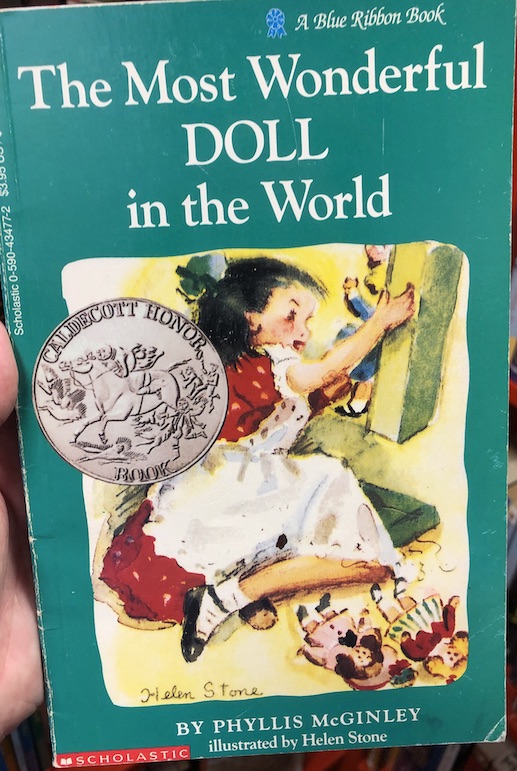
The Most Wonderful Doll in the World by Phyllis McGinley, 1950.

Dulcy is a little girl who is rarely satisfied by anything. She has a big imagination, and is always wishing for something better than what she has. Dulcy has an impressive collection of dolls, but even though she loves all of her dolls, she can’t help but think sometimes that some of them would look better with a different hair color or with different clothes or with some other small detail changed. No matter how good something is, it’s never completely perfect.

Then, one day, an elderly friend, Mrs. Primrose, gives Dulcy a doll named Angela. Dulcy likes Angela, although her immediate thought is that Angela would be even better if she had dark hair instead of blonde, finding a tiny fault as she always does. But, by accident, Dulcy loses Angela on the way home. She sets Angela’s box down when goes to help rake leaves into a bonfire, and when she goes to retrieve her, she can’t find her.
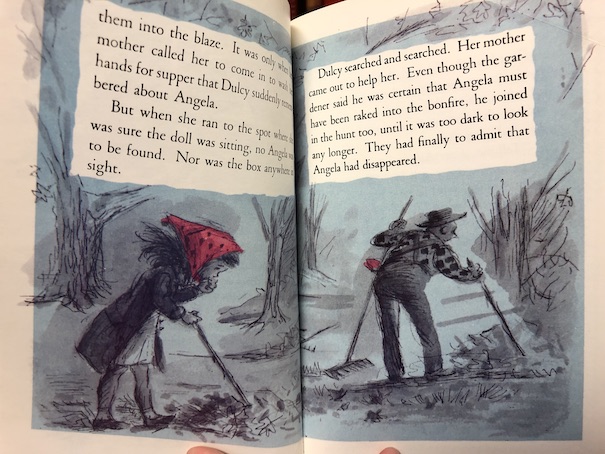
Once Angela is gone, Dulcy’s attitude changes. Dulcy is upset about the loss of Angela, realizing that Angela really was a precious and special doll. Her mother offers to get a replacement doll that looks like Angela, but Dulcy can’t imagine that any doll would be as special as Angela. As Dulcy describes the doll to her mother, she says that Angela was blonde with a blue dress and pinafore and eyes that could open and close. Those aren’t terribly unusual qualities for a doll, but Dulcy also adds that Angela had shoes with heels and could say “Mama” and “Papa” and sing Rockabye Baby. Those are more unusual, and Dulcy’s mother agrees that she probably won’t be able to find a doll that does all that.

However, readers soon begin to notice that Angela becomes increasingly wonderful each time that Dulcy describes her. When her father offers to buy her another doll, Dulcy adds that Angela could also walk and wave her hand. Dulcy tells her teacher about Angela’s little purse and gloves. She tells her friend Margery about Angela’s raincoat and umbrella.

The more Dulcy thinks about and talks about her wonderful doll, the less satisfied she is with her other dolls. None of them can compare to the amazing Angela! When her Aunt Tabitha gives her a skating doll, suddenly the missing Angela acquires the ability to skate as well. No doll that Dulcy has or ever could have could compare to the missing Angela!

Other children at school are fascinated by Dulcy’s descriptions of Angela and all of the marvelous things Angela had and Angela could do, which get more and more wonderful every time Dulcy tells the story. Then, people start getting tired of hearing about Angela. Dulcy’s friends don’t like hearing that their dolls aren’t as good as Angela, and people stop giving Dulcy dolls as presents because she always says that they’re not as good as Angela.

Then, one day, when Dulcy is playing with a new girl in the neighborhood, they find the box with the missing Angela. When Dulcy sees how the real Angela compares to the one that she dreamed about and imagined when she was lost, Dulcy comes to a greater understanding of the power of her imagination and the need to appreciate things being just the way they are.

Dulcy doesn’t completely give up imagining things and dreaming of perfection, but she does learn that part of growing up is remembering the difference between what she imagines and what is real. She realizes that when she was moping about the doll she didn’t have, she kept herself from having fun with the dolls she did have and discouraged people from giving her other nice dolls. Dulcy saves all the of the amazing qualities that she dreamed of for Angela and gives them to an imaginary doll called Veronica. Dulcy keeps Veronica as her perfect doll in her imagination, and she knows that Veronica is imaginary. As long as she can have her imaginary doll to be as amazing and perfect as she wants, she can be happy with her other dolls being just the way they are, and they make her happy, too.

The book is a Caldecott Medal winner. It is available to borrow for free online through Internet Archive.

Blueberries for Sal

Blueberries for Sal by Robert McCloskey, 1948.

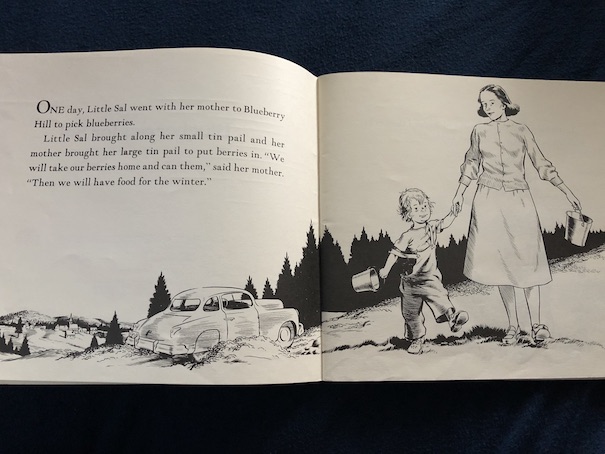
Sal is a little girl whose mother takes her to pick blueberries one day. The mother wants to can the blueberries for winter.

Sal gives in to temptation and eats the blueberries as she picks them.

Meanwhile, a mother bear and her baby come to eat blueberries.

Both Sal and the Little Bear lose sight of their mothers, and when they go looking for them, Sal accidentally finds the mother bear, and the little bear accidentally finds Sal’s mother.

Eventually, the mother bear realizes that Sal is following her when she hears the blueberries plunking into Sal’s pail. Sal’s mother realizes that a small bear is following her when he eats blueberries out of her pail.

Fortunately, nothing bad happens. The mothers just look around for their respective children and figure out where they are by the sounds they make. Then, the mother bear leaves with her baby, and Sal and her mother take their blueberries home.

At first, I was worried about Sal being with the mother bear and how Sal’s mother would react to the mother bear when she saw it, but the two mothers never meet in the story, and the children are fine.

The book is a Caldecott Honor Book. It is available to borrow for free online through Internet Archive (multiple copies).

Clifford Goes to Hollywood

Clifford

Clifford Goes to Hollywood by Norman Bridwell, 1980.

Clifford the big, red dog gets an offer to be in a movie. He passes a screen test where he has to act out different emotions, and he gets the part in the movie, so he has to go to Hollywood to accept the role, while Emily Elizabeth and her parents stay behind.

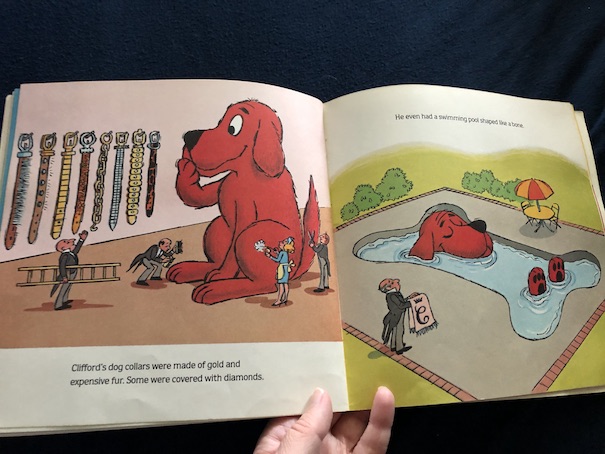
In Hollywood, Clifford is given a big, fancy doghouse and all sorts of fancy collars to wear.

However, Clifford quickly gets overwhelmed by all of the fans who mob him.

He misses Emily Elizabeth, so he runs back home to be with her.

The idea of someone going to Hollywood and missing friends back home is kind of cliche. Actually, I think the best part of the book was the screen test, where Clifford has to show different emotions. There are many books that demonstrate different types of emotions to kids, and I thought that was a nice addition to this book. The part where they show all the fancy collars that Clifford has to choose from was nice, too, because kids like to make choices, and this page is an opportunity for kids to decide which of the collars they like best.

The book is available to borrow for free online through Internet Archive.

Clifford's Family

Clifford

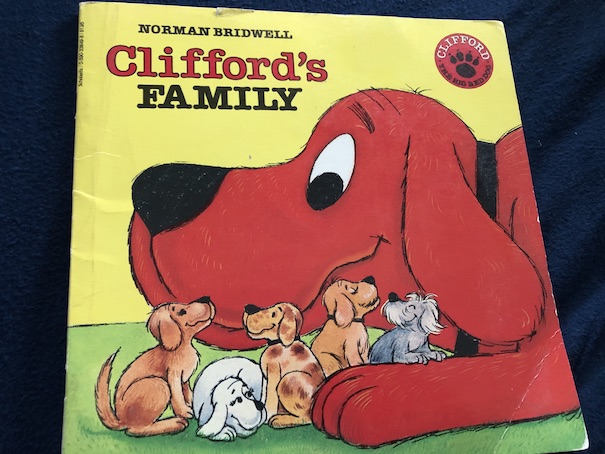
Clifford’s Family by Norman Bridwell, 1984.

Emily Elizabeth and her enormous dog, Clifford, were both born in a big city, although they live in a smaller town now. They decide to go back to the city and visit Clifford’s mother, who is still there.

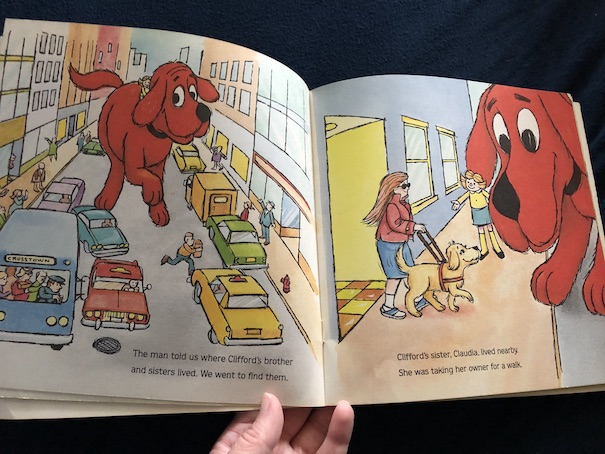
Clifford’s brothers and sisters all live with different people now, so they decide to visit them, too. Clifford’s sister, Claudia, has become a seeing-eye dog.

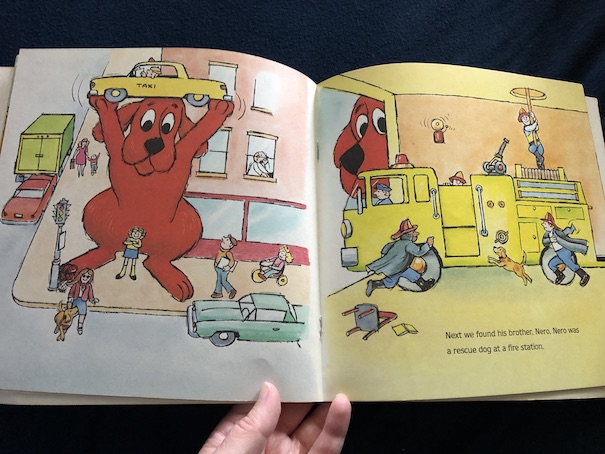
His brother, Nero, is now a fire rescue dog.

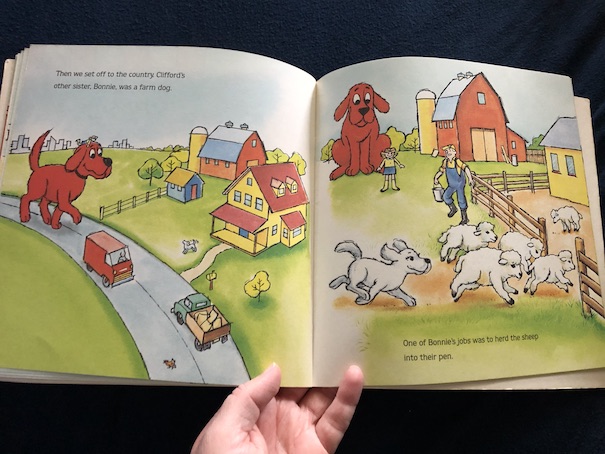
Clifford’s other sister, Bonnie, lives on a farm and herds sheep.

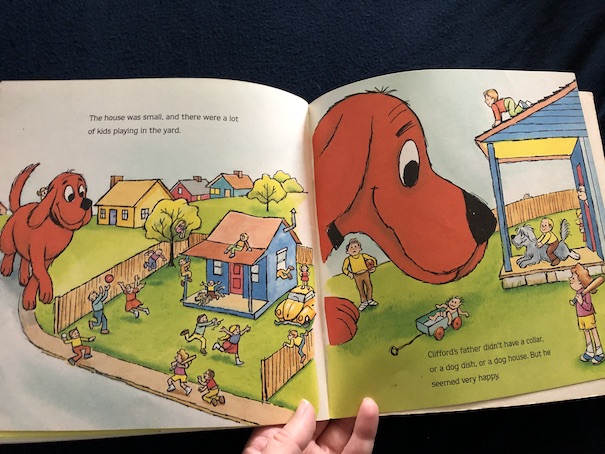
Clifford’s father doesn’t live with his mother. He lives in a house in another town with a lot of children, and he loves playing with them.

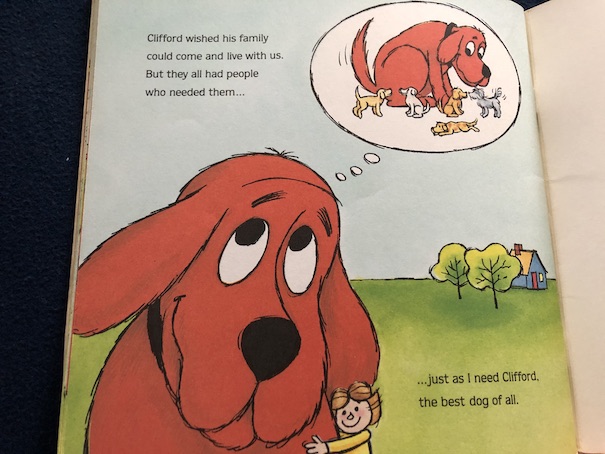
Clifford wishes that his family could live together, but he understands that every member of his family has other people who also need them.

I thought that this book did a good job of pointing out some of the jobs that dogs do, like seeing-eye dog, rescue dog, and herding dog. Clifford and his parents are all companions animals, like most pet dogs, but his siblings all have specific jobs to do for their owners.

The book is available to borrow for free online through Internet Archive.

Clifford the Big Red Dog

Clifford

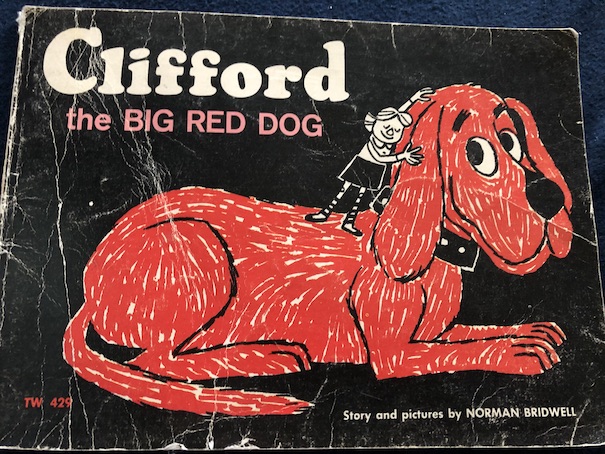
Clifford the Big Red Dog by Norman Bridwell, 1963.

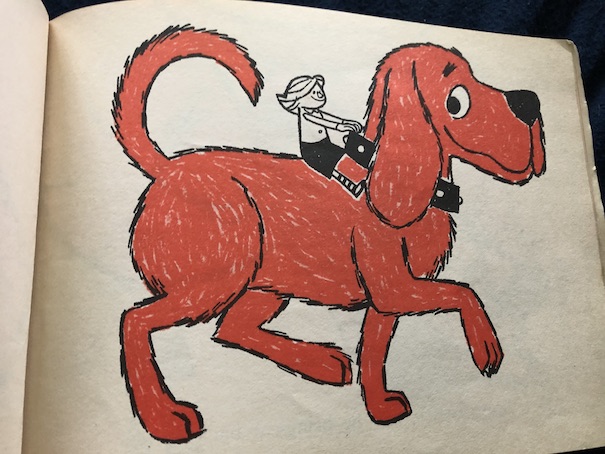
Emily Elizabeth introduces readers to her big, red dog, Clifford. Clifford isn’t just big; he’s humongous.

Like other kids, Emily Elizabeth likes to play with her dog, but playing even the usual games of fetch have unpredictable results because of Clifford’s size. When they play hide-and-seek, there aren’t many places where Clifford can hide, and even then, he’s not too difficult to find.

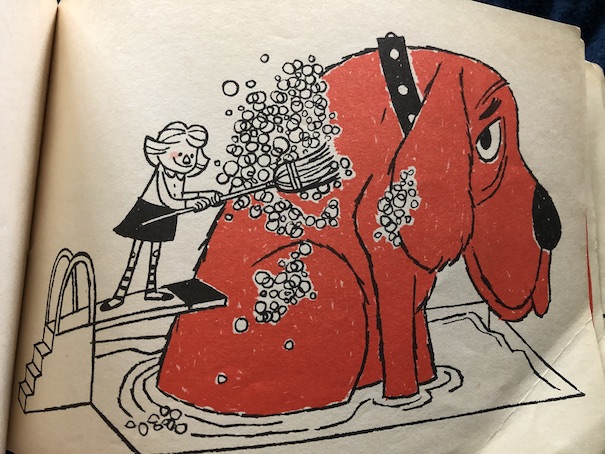
He also requires a lot of food and special accommodations because of his size. His baths aren’t like those of normal-sized dogs.

Clifford’s doggy bag habits, like chasing cars, can be even more unpredictable. Other dogs might chase cars, but Clifford has a real chance of actually catching them.

However, there are good sides to having a big dog. For one thing, bullies never bother Emily Emily Elizabeth.

Emily Elizabeth loves Clifford and wouldn’t trade him for any other dog.

The book is available to borrow for free online through Internet Archive. The edition that I have is the older edition of the book, but there is also a newer edition with full color pictures.

Will It Be Okay?

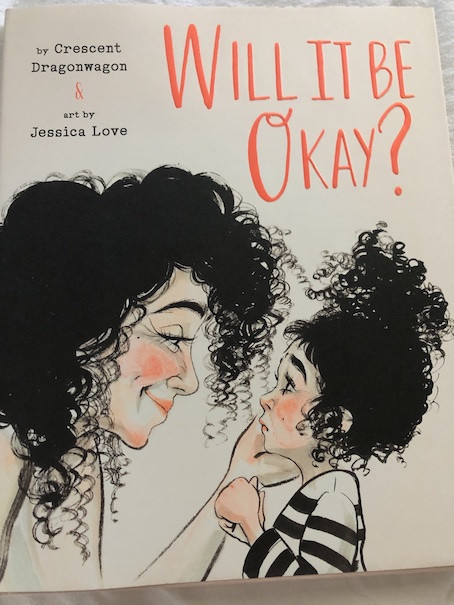
Will It Be Okay? by Crescent Dragonwagon, 1977, 2022.

I like to tie my book reviews into current events when I can, and I first wrote this review around the beginning of the coronavirus pandemic. It just seemed like the right time for this one. It’s a picture book, and, when I first wrote the review, my local libraries were closed because of the pandemic, so I couldn’t go find a copy to get pictures. However, the book is available to read online through Internet Archive, which is where I first encountered it.

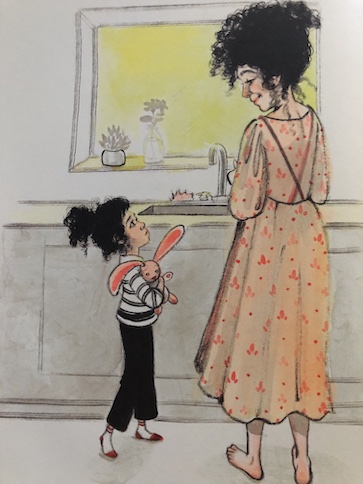
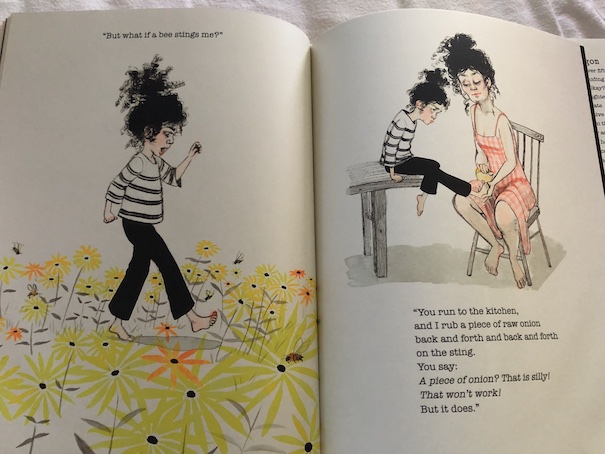
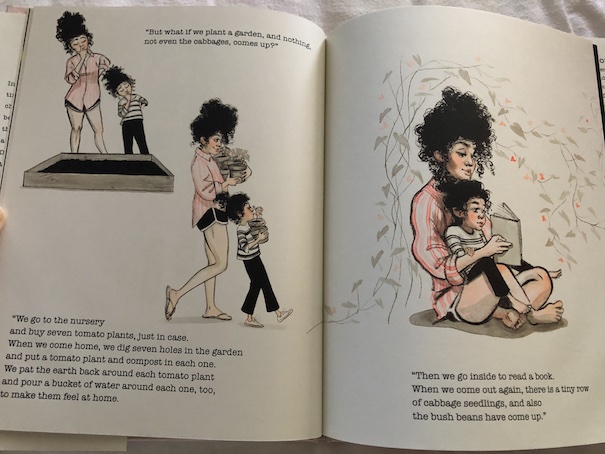
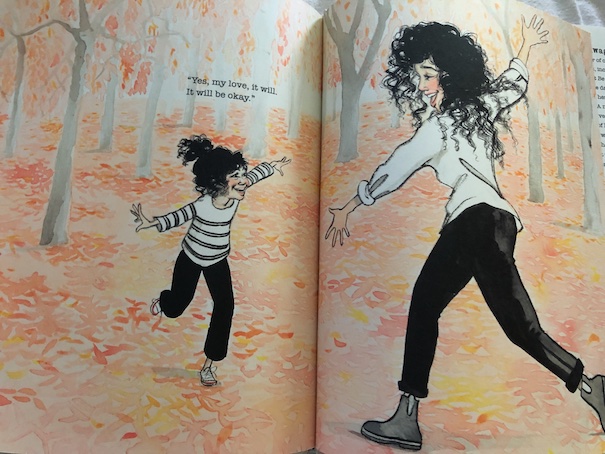
The version on Internet Archive is the older printing of the book, with its original pictures. Since then, the book has been reprinted with a set of new pictures. The pictures that appear here are from the new version. The older version of the book showed a blonde girl with a blonde mother, and the new version has a mother and daughter with black hair. Between the two, I prefer the newer illustrations, but readers can decide for themselves. I was surprised, but some of the text of the story was also changed between the versions of the book.

A young girl keep asking her mother about various types of problems that she might encounter, everything from storms to bee stings to forgetting her lines in the school play, and asking her what she would do if each of these things happen.

The mother gives her calm, reassuring answers. Some of them are based on common sense, like if their cabbages don’t come up, they’ll go get some tomato plants and plant tomatoes, and then their cabbages will likely come up anyway.

All of the answers have a poetic quality and answer the girl’s emotions, not taking all of the situations exactly literally, but capturing the feeling that the girl would need to have to get through life’s fears and uncertainties. When the girl asks what if no one likes her dancing, her mother describes how she can dance alone until she meets a new friend, who will dance with her and then come to her house to draw pictures and drink cocoa. I take this to mean what if people don’t like the girl instead of just her dancing, and her mother’s response to mean that she just needs to keep living her life, and she will meet people who will like her.

The last question that the girl poses to her mother is “But what if you die?” This is probably the fear that the girl has more than any of the other fears that she’s mentioned, but the mother still has a calm reply.

The mother tells her daughter that if she dies, her love will stay with her and she’ll have so much that she’ll have to give love away to other people. Her daughter will make new friends and dance with them and she’ll even come to love things like bees and thunderstorms and the other things that have frightened her. The girl will love other people in her life, and they’ll love her, too. Everything will be okay.

My Reaction

Life has many uncertainties, and bad things can happen, but there are other things that can make life better so that, in the end, we will be okay, in spite of the bad and scary things that come along. It’s not easy to believe that in the middle of scary situations, when you don’t know how it’s all going to work out, but I appreciate the sentiment. It’s always possible for things to improve. Bad things might happen, but we can handle them. It’s important to believe that we can handle situations and approach them with confidence.

The hardest, scariest thing to accept is when people die. Death is permanent. When someone has died or is facing death, it’s hard to believe that it could ever be okay because you can’t undo death. The mother in the story doesn’t try to deny that she could die at some point, but what she says is that her daughter will go on with her life and that she will always have her love. It’s what she leaves behind and what her daughter will continue to do after she is gone that will make things okay. The mother doesn’t want her daughter to focus on the sad and scary parts but to look forward with hope and confidence. As long as we can continue to move forward and love one another, things will be okay.

The last picture in the original version of the book is of the mother and daughter in the bathtub together, but they’re largely concealed by bubbles in the bath. Personally, I prefer the newer version of the book, which has the mother and daughter dancing in the leaves together under the trees.

Some of the situations in the book were changed between the old version and the new version of the book. In the old version of the book, the girl worries about what to do if she meets a big dog or if snakes come in the middle of the night, and neither of those were included in the new version of the book. Some answers in the old book are as improbable as the problems that the girl poses, like suggesting that the girl play a flute to charm snakes if snakes come. Both versions of the book have the scene where the girl worries that someone might hate her and her mother says that a frog will tell her that she’s lovable.

Amazing Grace

Amazing Grace by Mary Hoffman, 1991.

Grace loves stories, both hearing them and acting them out. She is imaginative, and likes playing games of pretend and acting out adventures.

When Grace’s teacher tells the class that they are going to perform the play Peter Pan and will be holding auditions for parts in the play, Grace wants the title role of Peter Pan. A couple of the other kids think that it’s odd for her to want to be Peter Pan because she is both a girl and black, which is exactly the opposite of how they usually see the character.

However, Grace still wants to play Peter Pan. When she tells her mother and grandmother what the other kids said, they reassure her that she can get the part if she really wants it and puts her mind to it.

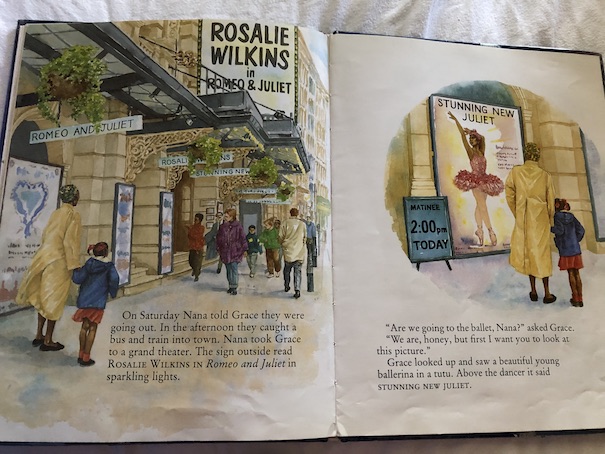
To prove to Grace that a young black girl can get starring roles, her grandmother takes her to see a ballet where the granddaughter of a friend of hers from Trinidad is playing the role of Juliet in Romeo and Juliet.

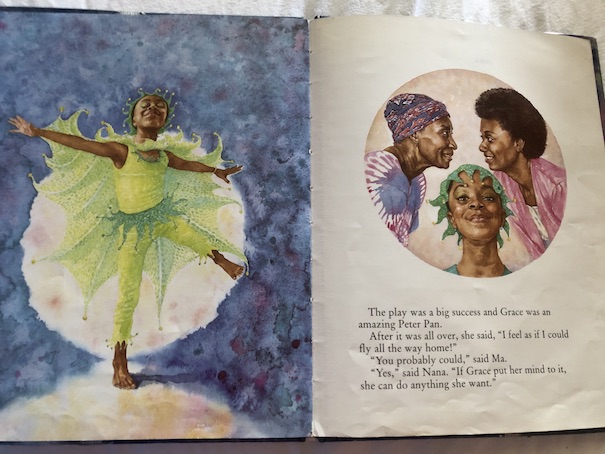
Seeing the performance cheers Grace up and gives her the confidence to audition for the part of Peter Pan. When her classmates see how good she is when she performs, they all agree that Grace should have the role of Peter Pan.

The message that young girls like Grace can do what they set their minds to, even if the roles they want in life aren’t quite traditional, is a good one. As I read the story, I was also thinking that the objection that Grace can’t be Peter Pan actually doesn’t make much sense if you know that Peter Pan, of all roles in plays, is one that is often played by a female. I remember that when I was a kid in elementary school, there was a girl who played the part of Peter Pan, and one of the teachers explained that women sometimes play Peter Pan, especially when the actors are all adults, because women have the higher-pitched voices that the part really needs. I would liked it if the teacher in the story also mentioned that. Also, acting is about capturing the spirit of the character in the story, thinking and feeling like they would think and feel and acting the way they would act. I would have liked it if they had mentioned that. Grace may not look quite the way people might picture Peter Pan, but if she can capture the character in her performance, she’s a good actor.

I liked the pictures in the book for their realism. In a couple of the pictures which show how Grace like to act out fantasies, she is shirtless, but she is very young and it isn’t possible to really see anything, so I don’t consider it inappropriate, but I thought that I would mention it.

This is a Reading Rainbow Book.

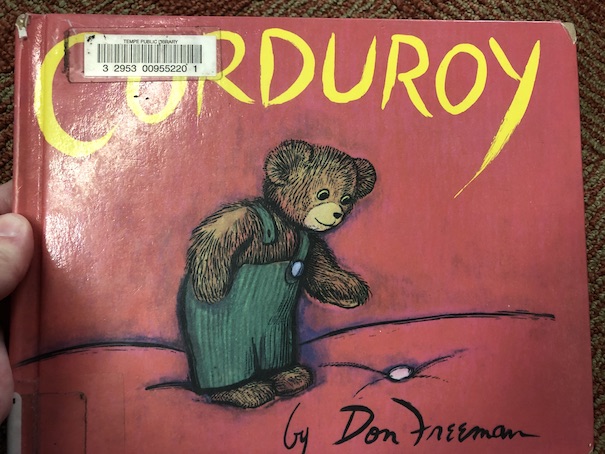
Corduroy

Corduroy by Don Freeman, 1968.

Corduroy is a small teddy bear who lives in a department store, waiting for someone to buy him and take him home. However, he is missing one of the buttons on his overalls, and it makes people reluctant to buy him.

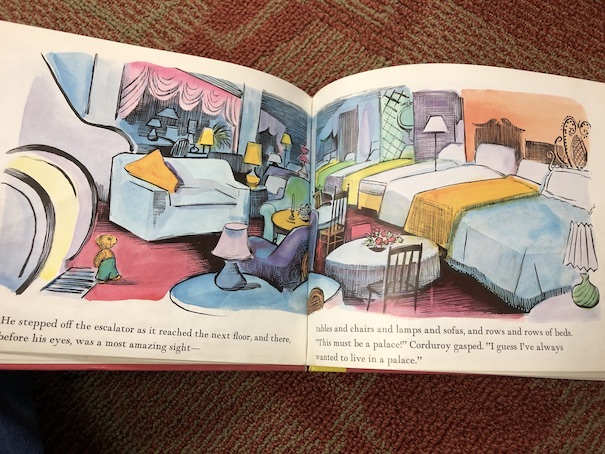
One night, after the store is closed, Corduroy sneaks out of the toy department to go looking for his lost button. After a trip up the escalator, he finds himself in the furniture department. To Corduroy, it’s like climbing a mountain and finding himself in a palace.

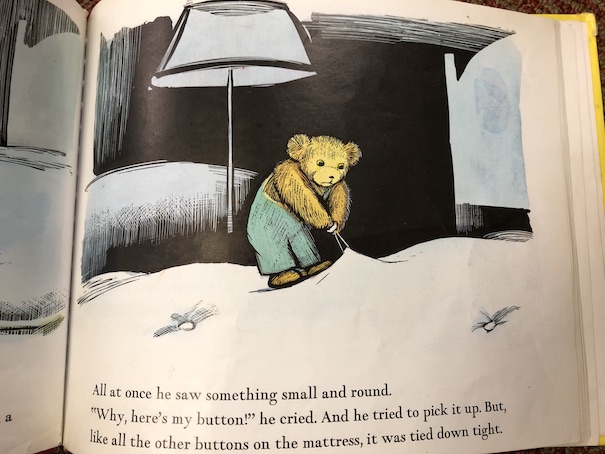
When he spots a button on a mattress, he thinks it might be his and pulls it off. By accident, he knocks over a lamp, which attracts the attention of a night watchman, who spots him and returns him to the toy department.

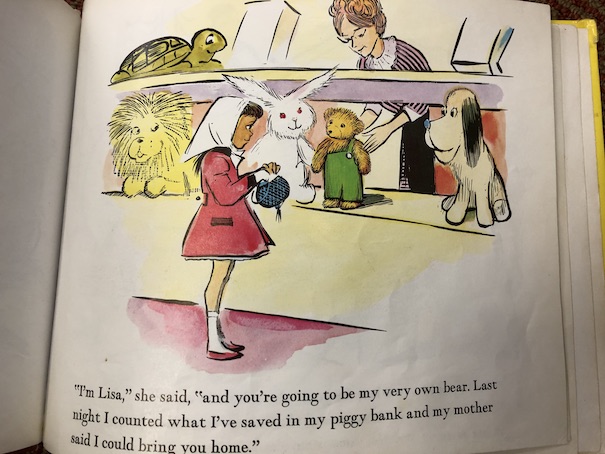
The little girl who wanted Corduroy before, Lisa, returns to the store and buys him. Lisa takes Corduroy home and sews a new button on Corduroy’s overalls. Corduroy is happy because he’s always wanted a home and a friend, and now he has both.

At first, this book was a stand-alone story, but later, the author wrote a sequel called A Pocket for Corduroy. Later, other authors continued the series.

The book is available to borrow for free online through Internet Archive.

The Silver Slippers

Magic Charm Books

The Silver Slippers by Elizabeth Koda-Callan, 1989.

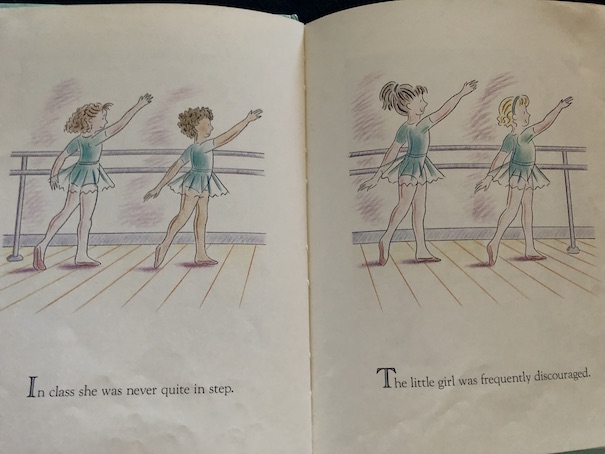
A little girl (unnamed, like the other girls in this series) wants to be a ballerina. She takes ballet classes, but she never seems quite good enough, like the ballet posters on the walls of her room. She feels discouraged because she is not perfect.

When her ballet teacher tells the class that there is going to be a dance recital and that one girl in class will be chosen to be the prima and lead the others, the girl doesn’t think that she has a chance to be chosen because her dancing isn’t good enough.

The girl tells her mother about the recital and her doubts about being chosen to be prima, and her mother tells her that it depends on how much she wants to be prima and how much she is willing to practice to improve. If the girl is willing to put in extra practice, she still has a chance to be prima. To remind her of her goals, her mother gives her a silver charm in the shape of a pair of ballet slippers.

In order to improve her dancing, the girl has to focus on her goal and give up participating in other activities to find more time to practice. However, her practicing pays off, and she gets the role of prima. On the night of the recital, she is nervous, but her silver slippers charm reminds her of her dream of being a real ballerina and gives her the courage to go on with her performance.

All of the books in this series originally came with charms like the ones described in the stories. This book originally included a little silver slippers charm for the reader to wear. The hole in the cover of the book was where the charm was displayed when the book was new. The books in the series often focus on the unnamed main character (who could represent any girl reading this story – the books were aimed at young girls) developing new self confidence, and the charms were meant to be either a sign of their new self confidence or inspiration for developing it. In this case, the charm is a reminder of the girl’s goals and how much she really loves dancing, giving her the inspiration she needs to persevere even when learning is difficult.

The book is available to borrow for free online through Internet Archive.

Rapunzel

Rapunzel by Paul O. Zelinsky, 1997.

This retelling of the classic fairy tale is a Caldecott Medal winner.  The illustrations are beautiful!  A note in the beginning of the book explains a little more about the author’s sources for the story as well as his view about it.  Instead of focusing on an evil witch who holds a young girl captive, he presents “a mother figure who powerfully resists her child’s inevitable growth.”

A couple who have wished for children for a long time are excited to realize that they are finally going to have one!  However, the wife finds herself with an irresistible craving for the Rapunzel (an herb) that grows in the nearby garden of a sorceress.  She is so desperate to have some that she is able to persuade her husband to steal some for her.  But, even having some causes her craving to grow.

When the husband returns to the garden to get more Rapunzel, the sorceress catches him.  He explains the situation, saying that his wife’s craving is so intense that he fears she will die if she doesn’t get some Rapunzel.  The sorceress agrees that the wife can have the Rapunzel she needs, but in exchange, she demands the child when it is born.  Not knowing what else to do, the husband reluctantly agrees.  When the wife gives birth to a baby girl, the sorceress comes, names the baby “Rapunzel”, and takes her away from her parents.

The sorceress cares for the girl and raises her.  When the beautiful young girl turns twelve, the sorceress takes her to live in a tower in the forest.  The tower is magical, looking narrow on the outside, but containing many beautiful and comfortable rooms. The only way in or out is through the window at the very top.  The witch has Rapunzel let down her extremely long, beautiful hair so that she can climb up.

Rapunzel lives alone in the tower for years, until a prince happens to ride by and hears her singing.  The prince is enchanted by the singing and asks questions about the tower at the nearest houses, learning about the sorceress and the young woman in the tower.

One day, he sees the sorceress visiting Rapunzel and sees how she gets into the tower.  So, later, he calls to Rapunzel himself, asking her to let down her hair.  Rapunzel is surprised and frightened at first, when she sees that her new visitor isn’t the sorceress, but he speaks nicely to her, and they become friendly.  The prince proposes marriage, and Rapunzel accepts.  After that, he visits her every night, without the sorceress’s knowledge.

However, Rapunzel eventually gets pregnant, and when her clothes no longer fit her, the sorceress realizes it.  She calls Rapunzel a “wicked child” and says that she has betrayed her.  She cuts off Rapunzel’s long hair and exiles her into the wilderness, alone.
The sorceress uses Rapunzel’s long hair to trick the prince into climbing into the tower.  When he comes, she tells him that Rapunzel is gone, and he will never see her again.  The prince falls from the tower, injuring his eyes.  Blinded, the prince wanders alone for a year, lamenting for his lost wife.

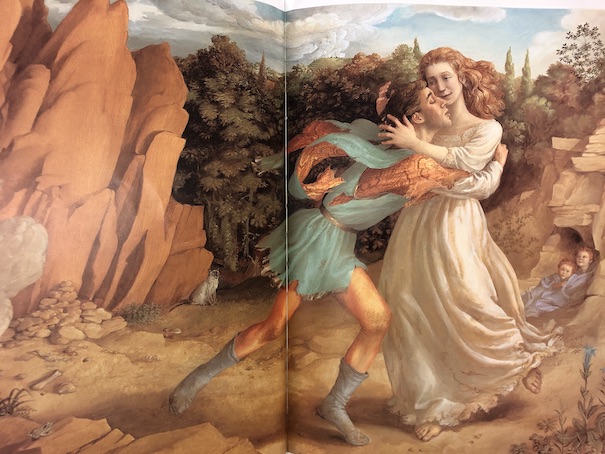
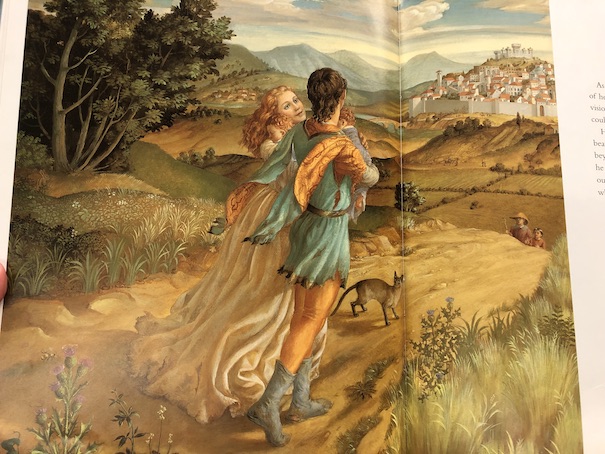
Eventually, he finds Rapunzel in the wilderness, recognizing her singing.  She has given birth to twins.  Rapunzel’s tears heal the prince’s eyes, and he is able to see again.  Realizing that they are near to his kingdom, he takes Rapunzel and the twins home.

The book is available to borrow for free online through Internet Archive.