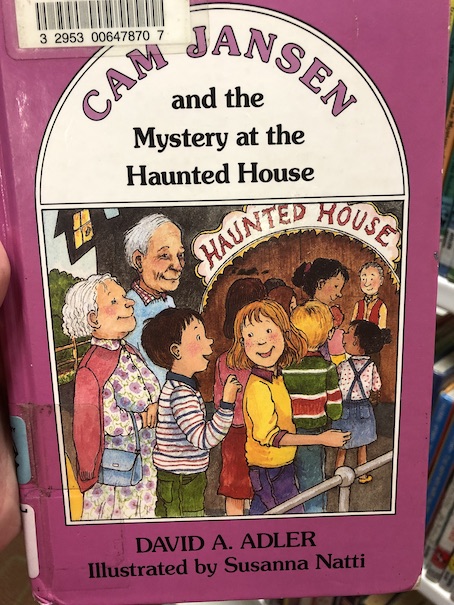
#13 Cam Jansen and the Mystery at the Haunted House by David Adler, 1986, 1992.
Cam’s Aunt Katie and Uncle George take Cam and her friend Eric to an amusement park. When they stop to buy food at the refreshment stand, Aunt Katie realizes that her wallet is missing. She isn’t even sure exactly when it disappeared. Cam thinks that someone stole her aunt’s wallet. Who could have taken it?
Cam thinks at first that it might have been a couple of boys on roller skates who ran into her aunt earlier, but it wasn’t them. Cam notices that another woman is complaining about a lost wallet and realizes that she had gone through the haunted house just before they did. Someone in the haunted house is taking people’s wallets!
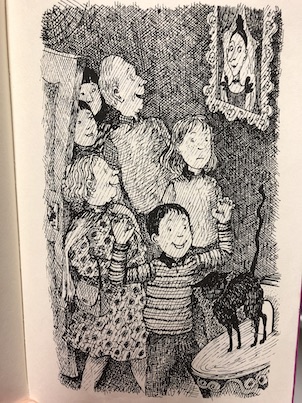
When they all go through the haunted house a second time, Cam figures out that a man dressed in black has been stealing people’s wallets. When they went through the haunted house the first time, he jumped out at them, and they thought that he was just a part of the attraction meant to scare them. She spots the man leaving the haunted house and tells the park’s security guards. Everyone gets their wallets back, and the park’s owner gives Cam four free passes to the park for a month.
The book is currently available online through Internet Archive.
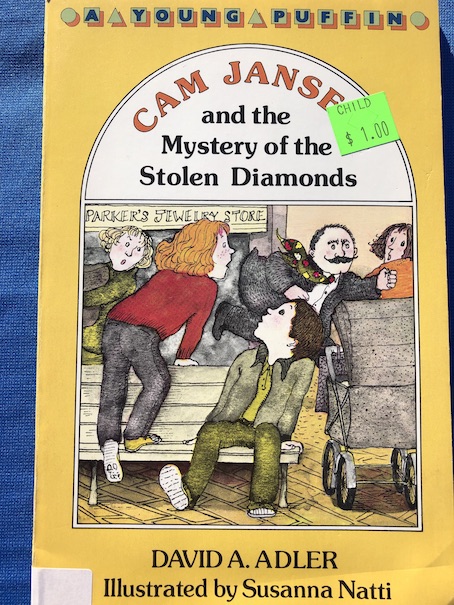
#1 Cam Jansen and the Mystery of the Stolen Diamonds by David A. Adler, 1980.
This book is the first in the Cam Jansen series, introducing readers to her amazing photographic memory. Cam’s real name is Jennifer, but when people discovered her photographic memory, they started calling her “The Camera,” which was later shortened to Cam. When Cam wants to remember something, she says “click,” which she says is the sound that her mental camera makes.
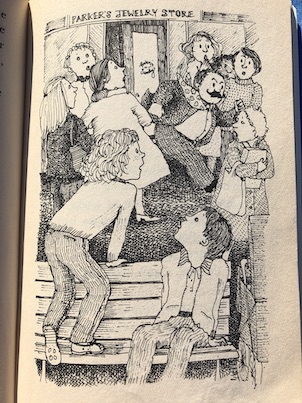
While Cam is at the mall with her friend, Eric, and his baby brother, Howie, a jewelry store is robbed. The thief got away with some diamonds. Although the police caught the man who ran away from the scene of the crime, the people who witnessed the crime say that he was not the thief. As Cam goes over the pictures in her mind, she realizes that something strange is going on.
Partly, Eric and Howie give Cam the clue that she needs to solve the mystery. Cam is an only child, but as she watches Eric taking care of Howie, she realizes how much stuff a baby needs. Howie has an entire diaper bag full of supplies. However, a couple who left the jewelry store earlier appeared to have only a baby in a blanket and a rattle. Cam realizes that a couple with a real baby should have been carrying more than that.
The man and woman with the “baby” were the running man’s accomplices. It was that man who actually committed the crime. The other man who ran was a distraction. The couple carried a doll and pretended it was their baby. They hid the diamonds in the baby’s rattle. Cam realizes that they were strange because they didn’t have a diaper bag or anything else with them that parents would normally carry around for their baby, like the bag that Eric’s mother has for Howie.
Cam and Eric follow the thieves to their hideout and then get the police, although there is a tense scene where Cam is caught by the thieves, and she must hide with Howie until the police arrive.
The book is currently available to borrow online for free through Internet Archive.
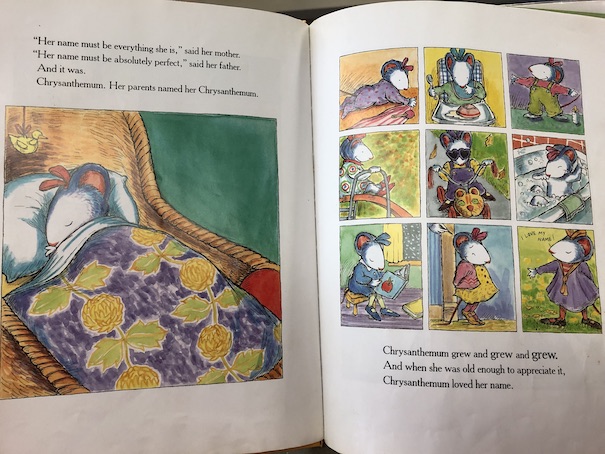
When little Chrysanthemum was born, her parents chose Chrysanthemum as her name because it just seemed perfect, as perfect as their little girl. As Chrysanthemum grew up, she loved her name, and she thought that it was perfect, too.
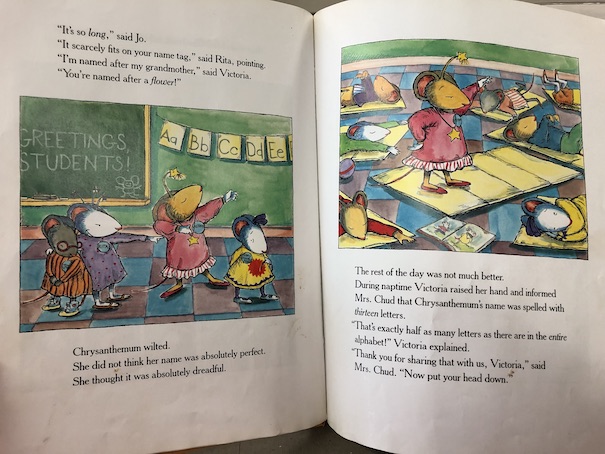
However, when Chrysanthemum starts school, the other kids point out how unusual her name is. Most of them have much shorter names. Chrysanthemum’s name is so long that it doesn’t really fit on her name tag. One girl, Victoria, is particularly mean about Chrysanthemum’s name, making fun of her whenever she can and encouraging other children to make fun of her.
For the first time in her life, Chrysanthemum starts hating her name. She wishes that she had a much shorter name, like Jane. Her parents comfort her and tell her that the other kids are probably just jealous, but their repeated teasing really bothers her.
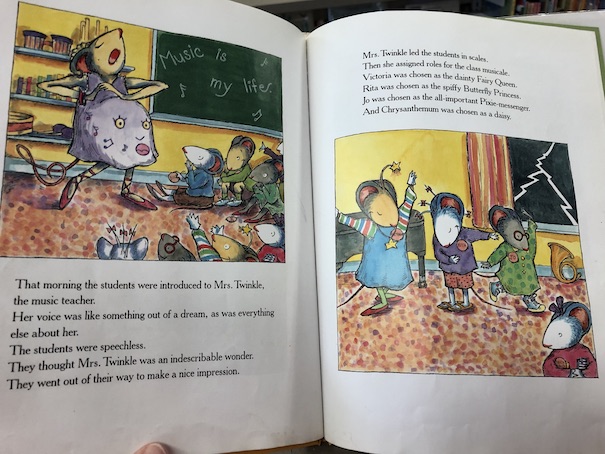
Then, the children have music lessons at school with Mrs. Twinkle. Mrs. Twinkle is a fun teacher, and the kids are excited about her class. She gives the children roles to play in a class musicale, and Chrysanthemum is cast as a daisy. When the other kids laugh about her playing a different type of flower, Mrs. Twinkle asks them what’s so funny.
The other kids explain about Chrysanthemum’s name and that they think it’s funny because it’s so long and weird. That’s when Mrs. Twinkle tells them that her first name is Delphinium – another long, unusual flower name! She says that she really likes the name Chrysanthemum, and since she’s expecting a baby, she might name the baby Chrysanthemum if it turns out to be a girl. Suddenly, the other girls in class envy Chrysanthemum and wish they had flower names, too!
In the short epilogue at the back of the book, the baby does turn out to be a girl, and Mrs. Twinkle names her Chrysanthemum. Chrysanthemum also gets a laugh at Victoria’s expense when the class puts on their musicale, and Victoria completely forgets her lines.
It’s a nice book, and I appreciate some of the messages now even more than when I first read it when I was a kid. Now that I’m an adult, I know that Chrysanthemum’s name isn’t the real reason why Victoria picks on Chrysanthemum. Victoria is mean basically because Victoria is a mean person. Kids who want to bully others make the decision to bully first and then pick something to bully about second. From what I’ve seen, they’re usually out to make fun of someone or make someone mad just to do it, and they don’t really care how or why. Chrysanthemum’s unusual name was just a convenient thing for Victoria to single out and use for her bullying. If she hadn’t had that name, Victoria would have picked on her (or maybe some other, more convenient target) for something else. Maybe it would have been someone’s clothes. Maybe it would have been the way someone walks or the way someone talks or their hair or their eyes or the fact that they have fingernails or breathe air or take up physical space … you get the idea. Victoria is the way she is because that’s what she is and what she wants to be, and she doesn’t see any need to change until the end of the story. (Even then, she may be back to bully again over something different because she hasn’t yet learned not to bully in general, just not over that particular thing.)
My point is that the way Victoria is has nothing to do with Chrysanthemum and her name. I’ve heard parents who are considering names for their children working hard to pick names that can’t be used for teasing, and sometimes, it can help. However, at the same time, bullies are basically going to bully because that’s who they are and what they do, and most importantly, it’s what they want to do. They’ll find something to bully about anyway because they’re always intentionally looking for something to bully about.
For a time, because of Victoria’s meanness and bullying, Chrysanthemum’s enjoyment of her name is ruined. She even feels like Victoria is destroying her sense of identity. At one point, she has a nightmare that she is actually a Chrysanthemum flower and that Victoria plucks her petals, picking at her and picking at her and picking at her until there’s nothing left. That’s the kind of effect that bullies have on people, which is why I have such contempt for them. They ruin things, even really fun and cool things like a colorful name, and make people unhappy just by being the kind of people they are. (If you’ve read my other reviews of books with bullies, you’ve already heard that I have very strong feelings about this subject and absolutely no patience or sympathy for bullies.)
But, fortunately, the book takes a very positive tone and points out that Chrysanthemum’s name is not really ruined by Victoria’s meanness. Chrysanthemum’s music teacher also has a really unusual flower name, and naming her baby Chrysanthemum as well gives Chrysanthemum new status among the kids at school, to the point where some of them, including Victoria, wish that they also had flower names of the kind that might inspire someone to name their baby after them. Mrs. Twinkle is a fun and different kind of teacher, and her fun and different name fits her personality. Although it hasn’t occurred to the other kids yet, the world would be a pretty drab place without colorful and unusual people. The Victorias and Janes of the world may have very proper names and are reassuringly ordinary, but the Delphiniums and Chrysanthemums are the ones who bring color and excitement to life. So, although I wouldn’t deliberately give a child a name that might leave them open to teasing, I don’t see a need to go overboard and reject some of the fun names that are just a bit unusual. Different is good, and it should be appreciated for what it is, not for what a bully may or may not be able to say about it when they’re trying to be mean. (They’ll find something else to bully and complain about two seconds later anyway, so why bother considering them for longer than that?)
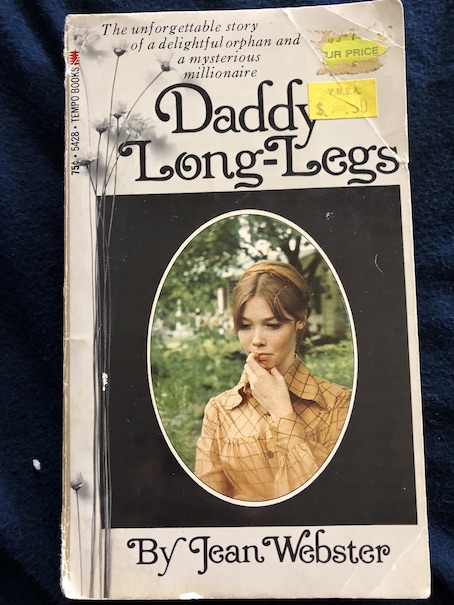
Seventeen-year-old Jerusha Abbott has spent her entire life at the John Greer Home for orphans. She has no memory of her parents and no experience of life outside the orphanage. Usually, when an orphan has not been adopted and has finished his or her education at the basic level provided by the orphanage, which does not always include high school, the orphanage and its trustees arrange for the child to be placed in a job so he or she can begin earning a living. Jerusha Abbott has stayed longer than most. She is bright and finished her studies early, so she was allowed to attend the local high school, helping out with some of the younger children at the orphanage to help earn her keep. However, now that she is about to graduate from high school, the orphanage and trustees have been trying to decide what to do with her. After the most recent meeting of the trustees, the matron of the orphanage calls Jerusha into her office to tell her what they have decided.
Jerusha has done well in high school, and her teachers have given her excellent reports. In particular, Jerusha has excelled in English class. One of her essays for English class, entitled “Blue Wednesday,” is a humorous piece about the difficulties Jerusha has preparing the young orphans in her charge for the monthly visits of the trustees: getting them nicely dressed, combing their hair, wiping runny noses, and trying to make sure that they all behave nicely and politely to the trustees. Jerusha hadn’t expected the matron or the trustees to ever read it. The matron thought that the essay was too flippant and showed ingratitude toward the orphanage that raised her, but one of the trustees in particular appreciated the quality of writing and the humor of the piece. This particular trustee is one of the wealthiest, although he usually prefers to remain anonymous about his donations and uses the alias “John Smith.” “John Smith” has helped some of the boys leaving the orphanage by funding their college educations, but so far, he has not done the same for any of the girls, not apparently thinking much of girls or their continued education. Jerusha Abbott and her essay cause him to change his mind. He thinks that Jerusha Abbott could make a great writer, and he is willing to fund her college education. Although the matron thinks that he’s being overly generous with Jerusha, this benefactor has arranged to pay for her college tuition and boarding at an all-girls college and will even provide her with a regular allowance like the other students at college will have from their parents. In return, he still wants to remain anonymous and doesn’t want to be embarrassed with too much thanks, but he does insist that Jerusha write monthly letters to him, updating him about her progress in school and what is happening in her daily life. Not only is he interested in her progress, but he also thinks that the letters will provide her with good writing experience.
Most of the book, aside from the early part that explains about Jerusha’s past and how she is able to attend college, is in the form of Jerusha’s letters to her mysterious benefactor. (This is called epistolary style.) They cover her entire college education, from her arrival at the campus to her graduation and what happens after. The letters in the book are only Jerusha’s, with no replies from her benefactor shown because her benefactor does not write to her until almost the end, only sending money and an occasional present (like flowers, when she was sick).
In spite of the matron’s instructions to keep her letters basic and to show proper respect and gratitude, Jerusha’s lively personality comes through and is often a bit irreverent, just the style that her benefactor prefers. In her first letter, she describes her very first train ride to the college and how big and bewildering the college campus is to her. She also confides the matron’s final instructions to her about how she should behave for the whole rest of her life, including the part about being “Very Respectful.” She says that she finds it difficult to be Very Respectful to someone who goes by the alias of “John Smith.” It bothers her that it’s so impersonal. She’s been thinking a lot about who “John Smith” really is and what he’s really like. She has never had a family, and no one has ever taken any particular interest in her before, and now she feels like her benefactor is her family. She tells him that all she knows about him is that he is rich, that he is tall (from a brief glimpse she had of him as he was leaving the orphanage), and that he doesn’t like girls (from what the matron told her). Based on these qualities, she chooses the one that yields the best nickname, that he is tall and has long legs, and gives him the more personal nickname of “Daddy-Long-Legs.” All of her letters to him from this point forward are addressed with this nickname. At one point, she says that she hopes that the comments she makes about her previous life at the orphanage don’t offend him, but she knows that he has the advantage of being able to stop paying her tuition and allowance if he decides that she’s too impertinent. That knowledge doesn’t stop her from making occasional jokes or flippant comments about life at the orphanage.
Jerusha loves college and begins making new friends, particularly a girl who lives in the same dorm, Sallie McBride. Sallie is very friendly, and but her roommate, Julia Rutledge Pendleton, is more stuffy and standoffish. Julia comes from a very wealthy family, one of the oldest in New York. Julia doesn’t notice Jerusha right away. She is too wrapped up in her family’s prestige, and she seems to be bored by everything going on around her. By contrast, Jerusha is excited by everything because everything is a new experience to her. Sallie gets homesick, but Jerusha doesn’t because she doesn’t have a regular home to miss. For the first time, she gets new clothes, not hand-me-downs or not the standard gingham that the orphans wear. Jerusha also gets a room to herself, for the first time in her life. Jerusha realizes that she can be completely alone whenever she wants to and spend time getting to know herself without other people.
One of Jerusha’s first moves to get to know herself and establish her personal identity is to change her name to Judy. Jerusha was a foundling who came to the orphanage without a name and was named by the matron. Jerusha knows that the matron chooses children’s last names from the phone book, and she picked Abbott for her right off the first page. The first names that the matron gives are random, and she happened to notice the name “Jerusha” on a tombstone once. Jerusha has never liked her name, and she thinks that “Judy” sounds like a girl “without any cares,” which is the kind of girl she would like to be and wishes she was. She is also pleased and amazed when her teachers praise her creativity and originality because, at the orphanage, the 97 children who lived there were dressed and trained to behave as if they were 97 identical twins instead of 97 individuals. Creativity and nonconformity were not generally encouraged.
One of the most difficult and embarrassing parts of college for Jerusha/Judy is that the other girls there know many things that she does not because the orphanage never thought it was important to teach her those things. Most of them are cultural references, like who Michelangelo was or that Henry VIII was married multiple times. (That part actually surprises me. Jerusha did attend a public high school, and my high school covered these subjects. We also read some of the books that Jerusha says that she never read, and we are told that she did well in English class. It makes me wonder if, by “English,” they mean that the class focused only on writing the English language and did not study literature at all.) At the orphanage, Jerusha was never introduced to the childhood classics that the other girls know, like Mother Goose rhymes, fairy tales like Cinderella, or stories like Alice in Wonderland or Little Women. She has not read any of the popular novels or classics like those by Charles Dickens, Robert Louis Stevenson, or Rudyard Kipling. Before she came to college, she didn’t even know who Sherlock Holmes was. Sometimes, when the girls make jokes about certain things in popular culture, Judy doesn’t understand, and she can tell that people notice when she misses the point of the discussion or doesn’t get the joke. Sometimes, she feels like she’s visiting a foreign country where people speak a language she doesn’t understand. Some people may say that studying things like art, history, and literature are not important, but there are benefits to understanding history and a shared culture, and Jerusha feels the lack of that in her life.
Jerusha/Judy is afraid to tell the others that she grew up in an orphanage because she doesn’t want to seem too strange to them. Instead, she just says that her parents are dead and that a kind gentleman is helping her with her education. Later, when Julia begins to take an interest in her and to press her for details about her family, Judy makes up a name for her mother’s maiden name because she doesn’t want to have to explain her past to Julia while Julia brags about her own pedigree. One of the reasons why Judy doesn’t show much gratitude toward the people who raised her at the orphanage and its trustees is because she has been raised differently from other children. The orphanage fed, clothed, and educated her in a basic way, but their care for her was minimal. She wasn’t really loved there, and in some ways, they have not adequately prepared her for the outside world. Outside of the orphanage, she feels like something of an oddity and just wants to be like the other girls.
At one point, a local bishop visits the college and gives a speech, saying that the poor will always be with us and the reason that there will always be poor people is to encourage people to be charitable. Although Judy can’t say anything, she gets angry at the speech because it implies that poor girls like her are basically like “useful domestic animals,” that they exist for no other reason than to be of use to other people to improve their character by enabling them to be charitable to someone lesser than themselves. Judy wants to be thought of as her own person, someone who is deserving of the good things in life because she is a person, not just someone who serves a purpose for someone else to show off their largesse. The fact that she feels comfortable enough to let even her benefactor, who is giving her largesse, know how she feels about these things shows how deeply Judy feels these issues and how much she needs someone to understand her feelings. Since no one else knows about Judy’s background, she feels compelled to tell her benefactor what she can’t tell others. Judy is grateful for her benefactor’s help and generosity, enabling her to attend college, but her gratitude has limits. At no point does the money she receives change her personality, her personal feelings about poverty, or her feelings about her benefactor himself. Judy knows that the benefactor’s generosity will end with her graduation, and she is mindful that, from that point on, she will be expected to be her own person, make her own way, and manage her own life.
At various points in the book, Judy becomes philosophical and discusses serious issues and the way that she sees life, offering her views and remarks on topics like socialism, the vanity and burden of fashion (yet the need women have to consider it and how it can make a difference in a woman’s life and attitude), the concept of wealth and the narrower topic of personal finances and debts, family lineage and what it can mean for individuals, self-determination and personal freedom, education and culture, and toward the end of the story, romance and marriage. When Judy meets her benefactor (without knowing at first that he is her benefactor) and gets to know him, she finds that they have similar attitudes about many of these topics, although there are times when he tries to tell her what to do and she rejects his orders, acting on her own initiative. As I said before, Judy is aware, increasingly so throughout the book, that she is her own person, and while she is grateful for her benefactor’s help, she has limits on that gratitude, feeling that there are some things that her benefactor has no right to insist on. Her independence grows particularly toward the end of the book, when Judy must seriously consider her life after graduation, when she expects that her benefactor’s generosity will end. One of the purposes of a college education is to expose students to new ideas and experiences, opening new channels of thought and giving them the chance to establish their identities and views on particular subjects. For Judy, everything is a new experience, but she learns quickly and establishes definite views and her own strong personality.
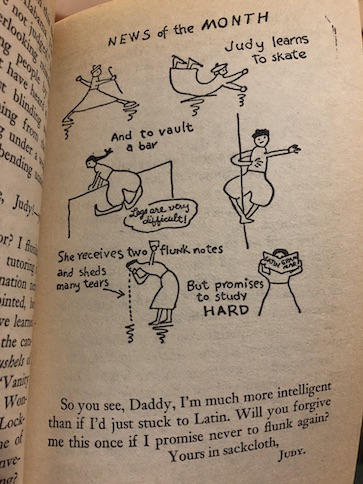
Judy’s letters are full of humor and are often accompanied by little sketches of her activities. She discusses her classes and her joy at being accepted on the girls’ basketball team. (There were women’s and girls’ basketball teams back in the early 1900s and 1910s, when this book was written. These pictures show what their uniforms looked like.) She catches up on all the books that she has missed reading before, and she loves reading them. The more she reads, the more she understands what the other girls are talking about when they mention their childhood favorites or make jokes about the things they’ve read. When Judy reports what she’s studying in her classes, she often does so in a creative way, like when she describes Hannibal’s battle against the army of Ancient Rome as though she were a war correspondent. She does very well in English and gym classes, but fails her Latin and mathematics courses and needs tutoring.
Over Christmas, Judy stays at the school with a fellow student named Leonora. They treat themselves to a lobster dinner at a restaurant, Judy buys herself a few presents with the Christmas money sent by her benefactor, and they have a molasses candy pull (people used to make that kind of taffy candy at parties with other people) with some other students.
Gradually, Judy begins being more friendly with Julia, even though she still thinks that Julia is a snob, and she becomes friendly with Julia’s uncle, Jervis Pendleton, who comes to visit the college. Jervis is Julia’s father’s youngest brother, a handsome, wealthy, and good-natured man. He is very kind to Judy when they meet, and he later sends Julia, Sallie, and Judy some candy. His age is never given, but Judy comments in one of her letters that she imagines that he is much like her benefactor would have been 20 years earlier, believing her benefactor to be a much older man, although she has not been told his age.
When it’s time for her first summer holidays, Judy actually tells her benefactor that she cannot face going back to the John Grier Home and would rather die than go back for the summer, even though the matron has written to say that she will take her if she has nowhere else to go. Judy loves being free from the orphanage and can’t stand the idea of going back and being pressed into service to take care of the younger children again. Instead, her benefactor arranges for her to spend the summer at a farm owned by Mr. and Mrs. Semple in Connecticut. The Semples tell her that the farm used to belong to Jervis Pendleton and that Mrs. Semple was his nurse when he was a child. He gave the farm to her out of fondness for her. If you haven’t guessed already, this is an important clue to the identity of Judy’s mysterious benefactor.
Recounting all of Judy’s adventures during the rest of her college education would take too long, but she does become roommates with both Julia and Sallie during her sophomore year. This gives Judy more opportunities to see Julia’s Uncle Jervis. She visits Sallie’s family at Christmas, getting a taste of happy family life, and she meets her brother, Jimmie. Jimmie seems fond of Judy, but Judy’s mysterious benefactor doesn’t allow her to spend the summer with the McBride family, where she would be going to dances with him and his college friend. Instead, he insists that she go to the farm in Connecticut again, so she is there when Jervis Pendleton drops in for a visit. (Another important clue.) Judy does disobey her benefactor’s orders and gets a job and goes to see Jimmie the following summer instead of going on a trip to Europe that he had originally arranged for her.
Judy also furthers her writing ambitions, winning a writing contest and sending stories and poems that she writes to magazines, eventually selling some and writing a novel that will be published in volumes. She is a published author by the time she graduates from college.
At the end of the book, Judy’s benefactor reveals his true identity, which Judy had not guessed, only after Judy reveals her feelings regarding him in her letters. Initially, before she knows the identity of her benefactor, she turns down the offer of marriage he makes to her in person, but as she reveals in her letters to Daddy-Long-Legs, the reason is that she thinks that he knows nothing about her past, and she doubts that a wealthy man like him would marry a poor orphan if he knew. The book ends with Judy’s letter to her benefactor/fiance after she goes to meet him at his home and he tells her the truth. When she realizes that he does know all about her past and has loved her all along for the person she really is through her letters and his periodic visits, she agrees to marry him.
This book is available to borrow and read for free online through Internet Archive. The book has been adapted for stage and screen many times over and in different countries around the world. There is also a sequel called Dear Enemy, which focuses on Sallie McBride and what she does after graduating from college.
My Reaction and Spoilers:
I realized that I couldn’t give my full opinion about the book without revealing the identity of Judy’s benefactor, although probably most people would have guessed it already. Judy’s benefactor throughout the book is Jervis Pendleton, Julia’s uncle. I’ve read other reviews of the book where people find the romance between Judy and Jervis to be somewhat creepy, both because of the difference in their ages and because of the benefactor relationship between them. It is a relationships of two people who are not equals, and that can create some awkwardness, but I don’t think that it’s quite as bad as some reviewers suggest for several reasons.
As I said, Jervis’s age is never given in the book. Judy is in her late teens in the beginning of the story, and by the end of her college education, she is in her early 20s. Judy is old enough to get engaged and married by the end of the book, so it’s not a case of an adult taking advantage of a minor. From the descriptions of Jervis, the fact that he is older and more mature than Jimmie, and Judy’s estimate on meeting him for the first time that he is like how she imagines her benefactor might have been 20 years before (because she imagines her benefactor as a middle-aged or older man), my guess is that he is probably somewhere in his 30s. He could be as young as late 20s, a few years out of college, but I’m inclined to think that he’s older because he is very well-established in life and has apparently been making donations to the orphanage for at least several years. He could be as old as his 40s, but I’m thinking that he’s probably younger than that because he is supposed to be much younger than Julia’s father, and I think that Julia’s father is probably in his 40s, based on her age. It makes sense to me if Jervis is in his 30s, perhaps 10 to 15 years older than Judy. It’s a significant age gap, but not as creepy as a 50-year-old man being interested in a 20-year-old girl. From the descriptions given, Jervis is definitely older than Judy but not old enough to be her father.
Some people in other reviews wondered if Jervis was specifically grooming her to be his wife from the very beginning by funding her education, which would be creepy, but I don’t think that’s the case. Jervis is supposed to be something of an eccentric, which is why he doesn’t seem particularly close to the rest of his family, like Julia. He is given to acting on whims, and since the matron at the orphanage said that he’s never shown any particular interest in the female orphans before, I don’t think he’s the kind of man who is attracted to young girls in a creepy way. I think all that the story was trying to portray was that Jervis, as an eccentric, just really enjoyed Jerusha’s essay in the beginning, that it appealed to his odd sense of humor, and since he was there to bestow a donation on the orphanage anyway, decided to make Jerusha the beneficiary of his donation because the oddity of the situation appealed to him. People don’t usually fall in love on first acquaintance, so I doubt that he started thinking about that just by reading a funny school essay. More likely, that idea evolved later. My guess is that he thought that the whole thing was funny at first, paying her way through college while occasionally showing up as Julia’s uncle, maintaining his secret identity as “Daddy-Long-Legs.” It probably started out as a kind of game for a rich eccentric, but it turned into something more serious along the way, as he really got to know Judy. Judy’s letters are humorous, but they also have their serious side, and they discuss some very serious subjects. As I said, Judy and Jervis discover that they actually have some similar attitudes about a number of serious things in life, and that is one of the factors in a good, long-term relationship.
Because their relationship is one of unequals, particularly early in the story, there could be the concern that Judy might feel obligated to agree with Jervis and even love him out of gratitude, but Judy’s irreverent attitude and belief that gratitude has limits make that less of a concern. Jervis is older than Judy and definitely richer, but he doesn’t always call the shots in her life, even though he sometimes tries. Judy resents when he tries to keep her from associating with Jimmie (presumably, Jervis had started developing some romantic feelings toward her at that point and was trying to separate her from a rival), and she actively defies his orders when she refuses to go on a trip to Europe her benefactor had arranged and gets a job instead. Remember that Judy was not expecting her benefactor to support her after college. Getting a job and establishing friendships and romantic relationships in her life were perfectly natural steps for a person preparing herself for an independent life. Judy sees these things as being more practical to her future than a trip to Europe, which is actually reasonable. Jervis was disappointed, but I think that he probably had to acknowledge, partly through Judy’s explanations in her letters and some internal reflection that we don’t get to see because we never hear his thoughts in the story, that Judy is being reasonable, especially because at that point, she doesn’t know his real identity or how he is beginning to feel about her. I think Judy’s acts of defiance also help to make her more of an equal to Jervis by the end of the book, although not completely because he is still older and richer. What puts Judy on a better footing with Jervis is that she has come to realize the benefits of her education and that she is now her own person. She doesn’t have to marry Jervis because of his money because she is starting to establish her own life. She has become a published writer and has had independent employment experience, and there are young men who find her interesting. She could have chosen to pursue Jimmie instead, but at that point, she really didn’t want to. Choosing Jervis was a real choice for her because she did have other options, and when she made that choice, she was unaware of his status as her benefactor, making that not a factor in her choice.
One other thing that I’d like to mention is that, at no point in the story, does Judy ever discover her parents’ true identities. When I read a book that features an orphan with an unknown past, I often find myself wondering who her parents are and if that backstory will be revealed in the course of the story. In this book, it is not revealed, and Judy never expects that it will be. She has always lived at the orphanage, and at her age, she has no expectations that her parents will suddenly come looking for her. She feels the absence of family and relatives in her life because it makes her different from other people, and she wants someone close to her to confide in, but she has no expectations of meeting any blood relatives. She makes no attempt to find them and doesn’t spend much time speculating about who they are. Jervis has no more idea who Judy’s parents are than Judy does, and it doesn’t matter to him. In the end, the story isn’t about what Judy came from or who her family was but about the person that Judy becomes.
Samantha and her family are spending the summer at their summer home at Piney Point. Besides Grandmary, Uncle Gard and Aunt Cornelia will be there. Cornelia has also brought her younger sisters, a set of twins named Agnes and Agatha. They are close in age to Samantha. Grandmary’s friend, Admiral Archibald Beemis, is also visiting from England.
The family’s summer home isn’t just a single house. They have a lodge in the style of a log cabin and separate guest cottages. This summer, Samantha and the twins will get a cottage to themselves with no adults. The girls have fun exploring the area around the lake together. However, there is one place that Samantha is afraid to go, the island in the lake called Teardrop Island. The only way to get to the island is by boat, and there are sharp, treacherous rocks in that part of the lake. That was where Samantha’s parents had their boating accident and drowned during a storm. To Samantha, Teardrop Island is a place of sadness and danger.
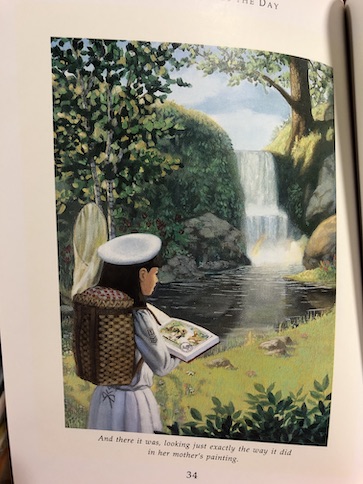
One rainy day, the three girls go up to the attic of the lodge to look for more paintbrushes so they can paint pictures. In the attic, they find old clothes and pictures of Samantha’s family. They also find Samantha’s mother’s old sketch book, labeled “Happy Memories of Teardrop Island.” In the sketch book, she drew pictures of Samantha and her father as they had picnics and played by a waterfall. Samantha was a very young child at the time, and she has no memories of having been on the island with her parents. From the pictures, it looks like it used to be her family’s favorite place.
Seeing the pictures makes Samantha want to visit the island once more, hoping to bring back memories of her earlier visits and her parents. The next day, the three girls go out to the island and try to find the places that Samantha’s mother drew in her book. Teardrop Island turns out to be a beautiful place, and Samantha loves it. The more time she spends there, the more she feels like she has been there before, although her memories are vague and dream-like.
However, the girls forgot to tie up their boat, and they find themselves stranded on the island! A storm comes, and the girls are afraid. When the Admiral tries to come out to the island to help them, he is injured, and the girls realize that they are going to have to find a way to save him! Can they make it home through the storm, or will they meet the same fate as Samantha’s parents?
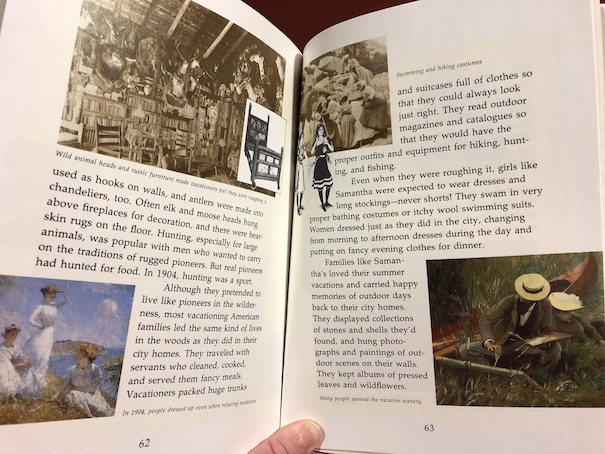
In the back of the book, there is a section with historical information about how people would spend their summers during the early 1900s. Wealthy families like Samantha’s would go to summer homes in the countryside to escape the heat of the cities.
The book is currently available to borrow for free online through Internet Archive.
Everyone
dreads the day that Prince Raphael will rule the kingdom instead of his
father. Prince Raphael is good-looking
and highly educated, but he’s also selfish and greedy. His one outstanding characteristic is that he’s
arrogant. He assumes that no one knows
as much as he does about anything and no one is as deserving as he is . . . of
anything. Knowing that, as the old king
lies dying, he makes his final decree that the prince will not wear his crown
until he is married to a woman who is his equal.
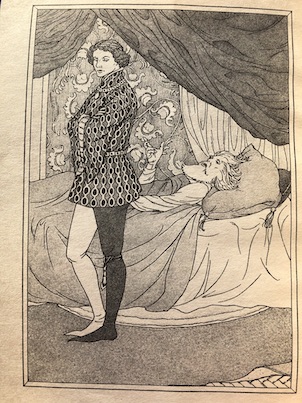
When the prince hears that, he immediately becomes angry, saying (as his father guessed he would) that there could not possibly be any woman in the world who is his equal, who is as rich, intelligent, or beautiful as he is. After his father dies, the prince immediately begins looting the kingdom for his own gain and generally abusing his subjects (as they had also guessed he would). Still, he doesn’t have the one thing he really wants: his father’s crown.
The prince orders his councilors to find him an appropriate bride but (as the councilors feared), the task proves impossible. No matter what options they place before the prince, the prince finds something about them to nit-pick. Princesses of fabulous wealth are not beautiful or intelligent enough for him. Princesses who have amazing beauty either aren’t beautiful enough or don’t know enough. Princesses with amazing knowledge are still lacking in some area of knowledge or are just plain ugly in the prince’s eyes. One by one, he dismisses them all.
Meanwhile, a farmer in the prince’s kingdom, has sent his daughter, Rosamund, to live in the mountains with their goats to avoid having the prince confiscate their only livestock, which he has done with everyone else. During the winter, Rosamund and the goats almost starve, but they are saved by a magical Wolf.
The Wolf assures Rosamund that her father is alive and well, and Rosamund says that she is worried about what is happening in the kingdom. The Wolf tells Rosamund that the kingdom would be saved if the prince finds the princess that he is looking for and that she should go to the capital and present herself as that princess. Rosamund doesn’t see how she can do that because she is definitely not as wealthy as the prince, and she doesn’t think of herself as particularly beautiful or clever. However, the Wolf tells her that her mother, who died when she was born, had blessed her, that she would be a king’s equal. To fulfill her dead mother’s wish, Rosamund does as the Wolf tells her.
To Rosamund’s surprise, the prince falls in love with her beauty at first sight. She also impresses him with her intelligence when she tells him that she knows what no one else does, that he is actually very lonely. (Which is natural, since he thinks that no one can be his equal or true companion.) Although she cannot demonstrate that she possesses great wealth, she can demonstrate that there is nothing in particular that she wants while the prince still feels like he is lacking things he needs (like his father’s crown). The prince is satisfied that Rosamund has passed all the necessary tests to be his equal, but Rosamund turns the tables on the prince by pointing out that his description of her has made her more than his equal, challenging him to prove to her that he is worthy of marrying her.
It is in meeting Rosamund’s challenge, taking care of her goats in the mountains for a year, Raphael learns humility from the Wolf. While he’s away from the palace, Rosamund tends to the kingdom, ruling more compassionately than Raphael had. When Raphael returns, he is humble enough that he doesn’t think that he is worthy of marrying Rosamund, but his humility is precisely what makes him worthy, and they do marry.
My Reaction
Overall, I liked the story, although I wish that we could see a little more of the conversation between Rosamund and Raphael when she explains to him who she really is. They still get married, so whatever Rosamund told Raphael must have persuaded him, but it’s left to the imagination how she explains it. How I picture it is partly based on the fact that, during the last year, Rosamund has lived as a princess, even though she was originally a goatherd, and Raphael has lived as a goatherd, even though he is really a prince. By the time the year is over, they have each lived in the other’s place, and that is what really makes them each other’s equal. Raphael was callous and arrogant because he never thought about how other people lived until he tried it himself.
I don’t know if Rosamund really learned anything from her experiences as a princess, which bothers me a little because I think that she really should have because it was so far outside of her experience. We don’t really hear about that because the focus is on Raphael’s changing character. Personally, I’d like to think that part of what Rosamund may have learned is that running a country is a big, difficult job, and that, while her rule was better than Raphael’s for being more compassionate, it’s not a job that she would like to do alone, emphasizing that she and Raphael would be better ruling as a team than either of them would be by themselves. If Rosamund and Raphael really both need each other, it would be fitting for a story about equals.
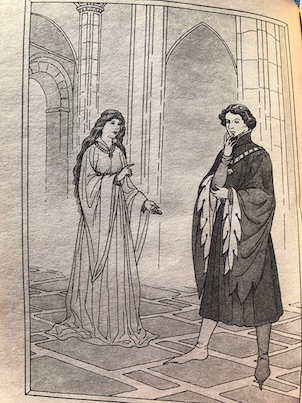
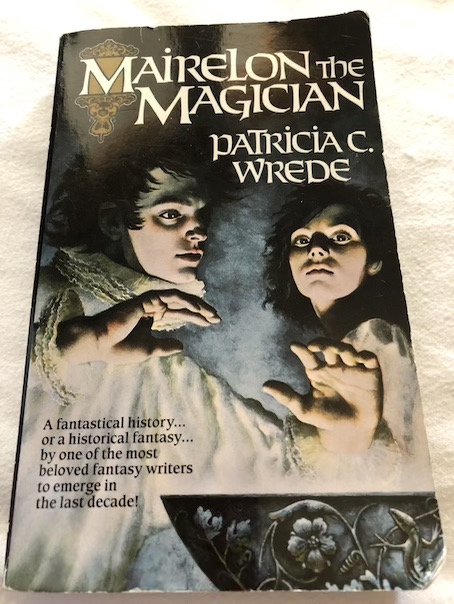
This young adult book takes place in an alternate history version of Regency England. In this world, magic is a normal and accepted part of society. “Wizard” is an accepted profession, and there is even a Royal College of Wizards dedicated to magic. Not everyone can be a wizard because not everyone has the ability to use magic. It is a skill that people are either born with or born without, similar to people who have an innate talent for art or music, compared to people who are born tone-deaf or color-blind.
In this early 19th century world, there is a teenage girl, Kim, who lives on the streets and survives by her own wits, taking whatever jobs she can and committing a little petty thievery whenever she needs to. She has spent most of her life dressing like a boy and pretending that she is one because life on the streets is even more precarious for a girl. For a time, she was part of a gang of child thieves run by a woman call Mother Tibb. As far back as Kim can remember, Mother Tibb was the only one who took care of her as a child. Kim has no memory of her parents or any knowledge about what happened to them. She doesn’t even have a last name. However, before the story begins, Mother Tibb was caught and hanged for her crimes. Some of the other child thieves were apprehended and put in prison or exiled to Australia, but Kim managed to escape. Since then, she has been on her own. So far, she has managed to avoid being pressured in to joining up with other gangs or turning to prostitution to survive, but the fear of that haunts her. Her future is uncertain.
At the
beginning of the book, Kim is hired to sneak into the wagon of a traveling magician
who is performing in the market and to see what he keeps among his
belongings. The man who hired her doesn’t
want her to take anything, but he is particularly eager to see if the magician
has a particular silver bowl in possession.
It’s a strange request, but the money that the man offers Kim is too
good to pass up.
However,
the magician, who calls himself Mairelon, isn’t quite what he seems. He is not just an ordinary traveling
entertainer using some sleight of hand to amuse people in the market. Kim discovers that he can do real magic as
she searches his wagon and is knocked unconscious by a real magical spell that
Mairelon uses to protect his belongings.
When Kim wakes up, Mairelon and his servant, called Hunch, have tied her up. Unlike Hunch, Mairelon has also realized that Kim is actually a girl, not a boy. The two of them question Kim about why she sneaked into the wagon, and she tells them the truth about being hired to do it. When she describes the man who hired her, it seems that Mairelon recognizes the description. The part about the silver bowl also unnerves him.
Surprisingly, Mairelon makes Kim an offer to come with him and Hunch when they leave London. He is fascinated by Kim’s skills in picking locks, even the lock on the booby-trapped trunk that knocked her unconscious, and he thinks that Kim might be useful to him and Hunch, perhaps helping with the magic act. In return, he offers to teach Kim some of his magic tricks. Hunch is dubious about Kim because she has obviously been a thief, and Kim also isn’t sure what to make of Mairelon. She knows that he’s hiding something, but she isn’t sure what. No one with real magical abilities like him would ordinarily be making a living with simple magic tricks in the market.
However, Kim does accept the offer because she’s been worried about one of the major criminals in the area, Dan Laverham, who has been showing too much interest in recruiting her. He is heavily involved with a number of criminal activities, and he knows that Kim is a skilled lock pick. If he found out that she was a girl, he would probably also press her into prostitution. Dan Laverham would be a good reason to get out of London for a while. Also, Kim realizes that if she learns a few magic tricks from Mairelon, she might be able to set herself up as an entertainer and make an honest living, safe no matter who finds out that she’s female. Besides, Kim realizes that if she’s not satisfied with the situation, she could always run away later.
Before
leaving London with Mairelon, she returns to the man who hired her, at Mairelon’s
suggestion, and tells him that she didn’t see a silver bowl in Mairelon’s wagon
(which is true because she was knocked unconscious and didn’t see anything in
the trunk). The man is angry, but Mairelon,
who followed her in disguise, helps to create a distraction so that she can get
away from the man. They leave London in
the middle of the night because Mairelon says that he was spotted by someone who
recognized him when he went out to get magic ingredients.
On the
journey, Kim gradually gets to know Mairelon and his situation. The silver bowl, which Mairelon does have, is
actually part of a set of magical objects which, when used together, can compel
people to tell the truth without interfering with their ability to answer
questions intelligently. Mairelon’s real
name is Richard Merrill, and he is, or was, part of the Royal College of
Wizards. Years earlier, the Royal
College of Wizards was analyzing this particular set of magical objects and the
unique spell that they control, when they were suddenly stolen, and Merrill was
framed for the theft. At the time, Merrill
was unable to prove his innocence (at least not without sounding as if he had
done something inappropriate with a lady, which he also did not do – they were
just together at the time of the theft because she was helping him and another
friend with a magical experiment), but he was also recruited by his friend in
the government to be a spy against the French, so the story of his supposed
theft gave him a plausible reason for wanting to leave the country. In the time since then, he and his friend
have continued to look into the matter of the theft, and they have made some
progress in tracking down the other pieces of the magical set. At the time that Kim met him, he was on his
way to the next piece of the set, a silver platter.
To
their surprise, however, they soon discover that someone has been making copies
of the platter. The copies are not
magical, but they do confuse the issue.
Who is making the copies and why would they want copies, since they do
not have the powers that the original has?
As Kim and Mairelon investigate, they crash a house party at a lavish
country estate and spy on a meeting of a rather inept society of druids. All the while, they are getting closer and
closer to finding the original thief.
I loved the combination of mystery, fantasy, history, and humor in this book! It’s one of my all-time favorites. It has a happy ending with Mairelon’s name cleared and the thief caught. They also discover that Kim has the ability to use magic, and Mairelon offers to take her on as his apprentice, saving her from the streets forever. There is a sequel to this book called Magician’s Ward, about Kim’s life and adventures as Mairelon’s student. The hints of romance in this book are also much stronger in the next one. There are only two books in this series, which is disappointing because the characters are so much fun, and I think that there is a lot more room for their development. By the end of the next book, Kim’s future is looking more certain, but her past is still murky. Originally, I had expected that there would be secrets revealed about Kim’s past because of her ability to use magic, possibly something that was passed on to her by her parents. However, by the end of the second book, Kim still doesn’t know who her parents were/are, and it doesn’t look like there’s any chance that she will ever know. Perhaps it doesn’t really matter. Sometimes, secrets are more tantalizing when you imagine the answers than when you actually find out.
The book is currently available online through Internet Archive.
Ten-year-old Ann Hamilton hasn’t been very happy since her family decided to move West. Her family lives in 18th century Pennsylvania, and moving West means homesteading in an area where there are few other families, none of which have girls Ann’s age. Her father and brothers love the adventure of starting over in a new place on the western frontier (what is considered the frontier for their era), but Ann is lonely, surrounded by boys, and missing their old home. When her father built their cabin, he purposely placed it so that the door faces to the west because he says that’s where their future lies. Ann’s brothers, Daniel and David, also make up a rule that no one can complain about the west (partly because Ann had already been doing a lot of complaining), saying that anyone who does so will get a bucket of water poured over their head, and they make a game out of trying to catch each other complaining about something. So, there is nothing Ann can do but suffer in silence and write in her diary, a present from her cousin Margaret when the family left Gettysburg.
There’s
a boy close to her age who lives nearby, Andy McPhale, but Ann doesn’t think
much of him. He makes jokes about her
being “eddicated” because she can read and write. Sometimes, he seems like he wants to play
with her, but she’s a girl, and he doesn’t want to play girl games.
Andy McPhale also worries about his mother. His father believes in hunting and trapping more than planting. Rather than grow some of their food, Andy’s father goes off for days at a time on hunting expeditions, leaving his family with very little while he’s gone. Ann’s family thinks that this is a sign of poor planning for the future and don’t think highly of Andy’s father for it.
Later, they
meet a young man named Arthur Scott who has just arrived in the area and is
looking for land to settle on. When Mr.
Scott first arrives, he meets Ann on the road. Ann has allowed the hearth fire to go out, and
she is on her way to her aunt and uncle’s house to borrow some from them
because she doesn’t know how to start a fire by herself. Understanding her problem, Mr. Scott gives
Ann a ride home on his horse and helps her to restart the fire, promising not
to tell her parents. They invite him to
stay for lunch, and he talks about his time at Valley Forge with Washington’s
soldiers when he was only 13 years old.
He was too young to fight, but he volunteered to drive an ammunition wagon. Ann thinks of George Washington as a hero,
and she finds it thrilling that Mr. Scott served with him.
Arthur Scott becomes a friend of the Hamilton family, and Andy McPhale seems jealous of him and the attention that Ann pays to him. Then, Andy tells her that his family has decided to go back to town for the winter. In the spring, they will return to the area and try farming, persuaded by their experiences working with the Hamiltons. To Ann’s surprise, Andy offers for Ann to come with them. She could visit Gettysburg and stay with her cousin Margaret again. Ann has been lonely, being the only girl in the area, and it’s a tempting offer. However, Ann feels like she must stay for her family’s sake and so she won’t feel like a deserter. When a storm destroys a good part of her family’s crop, she feels terrible and wonders if it’s all really worth it.
In the end, there is a great surprise coming for Ann: she gets to meet her hero, George Washington, when he comes to see some land that he has purchased nearby.
I first read this book when I was a kid in elementary school. As the cover of the book says, the author won the Laura Ingalls Wilder Medal, which honors authors and illustrators for children who have made long-term contributions to children’s literature. Laura Ingalls Wilder was the author of the semi-autobiographical Little House on the Prairie books, but because those books contain uncomfortable racial language and situations, her name were removed from the award in 2018. The award still exists, but it’s now called the Children’s Literature Legacy Award, which is more descriptive of its purpose.
I liked this book as a kid, although I had forgotten many of the details before I reread it as an adult, and I’m not sure if I fully understood the history behind the story when I was a kid. I think stories actually become more interesting when you know the background, so I’d like to discuss the history a little.
The story is based on the real life of Ann Hamilton, the great-great-grandmother of the author of this book, who did get to meet George Washington in 1784. The author is essentially retelling an old family story. The real Ann Hamilton married Arthur Scott when she grew up. The place where they lived, called Hamilton Hill in the story, is now called Ginger Hill. In fact, it seems that a member of the Hamilton family caused the name change, although that story isn’t really one for children.
One of the parts of the story that I always remembered from when I read it in school as a kid was the part where Ann talks about “mother’s fried wonders”, basically describing a fried donut. People in the 18th century did make various types of fried pastries, varying in style and name depending on where they lived. For an example of early American donuts, see this video by Townsends about 18th century doughnuts, where they make doughnuts and talk about the history and evolution of American “dough nuts” (they talk about the name and how it seems to come from the original shape – nut-shaped pieces of dough).
The Ravenmaster’s Secret by Elvira Woodruff, 2003.
Forrest Harper is the son of the Ravenmaster of the Tower of London in 1735. The story begins by explaining the tradition of keeping ravens at the Tower of London because of the superstition that the Tower would be conquered by its enemies if the ravens ever abandoned it. This superstition led to the creation of the job of Ravenmaster, who looks after a flock of ravens that live at the Tower with wings clipped so that they can’t fly away.
Forrest Harper lives at the Tower with his parents and sisters, training to become a Ravenmaster, like his father. He likes the ravens, and they like him. He is pretty good at caring for ravens, but there is something that bothers him: he thinks that he isn’t brave enough and that others think that he is a coward, too. He is smaller than the other boys and is often teased. He has trouble cutting up the squirrels that the rat catcher’s boy (his only real friend, although his mother doesn’t approve of him) brings to him to feed to the ravens. Even though it’s necessary, Forrest doesn’t like the sight of blood and feels kind of sorry for the squirrels. Worse still, when Forrest’s family attends the public hangings (which were treated as a kind of festival day with music and entertainment in Forrest’s time), Forrest is unable to look at the criminals who are being hanged. The one time he does try it, he throws up, and again, the other boys tease him mercilessly for it. Forrest’s problem, as readers will see, isn’t so much that he’s a coward as he has more empathy than the other boys, both for animals and people, and that isn’t really as much of a problem as he believes. His father tells him to ignore the bullies because they are foolish, and their foolishness will show in time.
Forrest sometimes dreams of going out into the wider world, beyond the Tower, where he could do something brave that would impress everyone. The rat catcher’s boy, whose real name is Ned although most people just call him Rat, also dreams of running away because he is an orphan, treated harshly by his master and always in danger of being turned over to the chimney sweep to be used as a climbing boy. He doesn’t think that Forrest has a real problem because his life at the Tower is pretty good, living comfortably at the Tower with his parents, whatever the local bullies say. Still, the two boys often imagine what it would be like to go to sea together and have adventures. When there is an announcement that a new prisoner will be arriving at the Tower, a Scottish Jacobite rebel, Forrest thinks that helping to guard a dangerous rebel will make the Tower bullies respect him.
To Forrest’s surprise and embarrassment, this rebel actually turns out to be a girl. She is the daughter of the rebel Owen Stewart, who is being held in a different tower at the Tower of London (the Tower of London is actually a fortress with multiple towers – she is imprisoned in Bloody Tower and her father is in Bell Tower). She has been charged with treason, along with her father and uncle. Forrest isn’t happy about being given the task of taking food to a girl prisoner.
However,
Madeline McKay Stewart, the girl prisoner, is pretty tough in her own right. Although Maddy’s been separated from her
father and uncle and all three of them are likely to be executed, she is being
pretty brave about it. She talks to Rat
and Forrest. She is interested in
Forrest’s pet raven, Tuck, and tells him about how she used to feed baby owls
back home. She talks about her life and
family in Scotland, and Forrest realizes that he’s starting to think of her as
a friend instead of an enemy to be guarded.
While
Forrest is used to hearing English people criticize the Scots for being “savage,”
he is astonished and a bit offended when Maddy talks about English people being
“evil.” For the first time, it makes him
think of the situation from the other side.
He knows that not all English people are evil and realizes, having seen
that Maddy actually has refined manners, that Scottish people aren’t “savage.” One day, at Maddy’s request, he takes a
message to her father in exchange for her ring, which he plans to sell in order
to buy Ned back from the chimney sweep after the rat catcher loses his term of indenture
to the chimney sweep in a game of cards, sparing him from the horrible life and
health problems that the young climbing boys suffer. Then, Owen Stewart gives Forrest a message to
take back to Maddy. Without really
meaning to, Forrest realizes that he has suddenly become a go-between for the
rebels and could be considered a conspirator under English law.
As
Forrest considers the fate that lies ahead for Maddy and the nature of war
between England and the Scottish rebels, it occurs to him that the adults in
his life have often done the opposite of the things that they have always
taught him were important. His father
always emphasized fairness, yet the war and Maddy’s possible execution are
unfair. Maddy shares Forrest’s feeling
that the world might be a better place if people didn’t become adults and
abandon their values.
Then,
Maddy’s father and uncle are shot while attempting to escape, and Maddy is left
completely alone. Forrest feels badly for
Maddy. Soon after, he is unexpectedly
approached by a carpenter who seems to know that he has become friends with
Maddy. The carpenter, who is a stranger
to Forrest, tells him that Maddy will soon be executed by beheading but that he
has a way to save her life. Forrest has
to decide if he is willing to trust the stranger and save Maddy, knowing that
doing so would make him a traitor himself.
One of the parts of this story that interested me was how Forrest noted the hypocrisy in the adults around him as he was trying to decide what he should do. Qualities that adults often praise and try to instill in their children are often ignored in the way that the adults live and even in how they treat other children, like Ned and Maddy. Abandoning values, even the ones that they really want their children to have, isn’t something that adults have to do as they grow older, but it is something that some adults do if they think they must in order to live as they want to live or accomplish something that they want to accomplish. The adults who think that Maddy should be beheaded would probably say that they were doing it for the greater good in promoting their cause against the rebels. However, treating Ned as a piece of disposable property is something that they mostly do because they can and because they know that there is nothing that Ned can do to stop them. Ned actually tries to repay his indenture legally with money that Forrest gives him, but although the sweep accepts the money, he refuses to let him go, saying that no one will take Ned’s word over his and that he could always use the money to make sure that Ned is hung as a thief if he tries to make trouble. It is this type of attitude and situation that make the children realize that they are on their own to solve their problems and that working within the law is not going to be an option for them because the law is not just and it is not on their side. It’s a frustrating situation, and I often feel frustrated when I encounter this type of thing in books, but fortunately, things do turn out well in the end.
This is one of those coming-of-age stories where a boy must decide what he stands for and where he really belongs. Through Maddy and the inscription on her ring, which means “Face Your Destiny,” Forrest comes to understand the destiny that is right for him as he helps both Maddy and Ned escape to a better life elsewhere.
The book also includes some interesting historical information. There’s a map of the Tower of London in the front of the book, and in the back, a short history of the Tower with information about famous prisoners and escapes. There is also a glossary of English and Scottish words that modern children (especially American children) might not know, such as breeches, wench, loch, and tattie-bogle (scarecrow).
The book is currently available online through Internet Archive. (To borrow a book through Internet Archive, you have to sign up for an account, but it’s free, and then you read the book in your browser window.)
Spoiler: In the last chapter of the book, it explains what happened to the characters after the story ends. Forrest does become the Ravenmaster after his father, realizing that it is the right kind of life for him and that he no longer desires to have adventures outside the Tower. He has a wife and daughter, and years later, he receives a message from Ned, who says that he has become a captain in the Royal Navy and that Maddy has gone to live in the colonies with other Stewarts (something that my own Jacobite ancestors did, which is how I got to where I am now).
Poor Mouse works as a scullery maid in a castle in Medieval England. She has lived there all her life, since someone abandoned her at the castle as a baby. She has no idea who her parents are, when her real birthday is, or exactly how old she is (the cook once said she was about eleven, but he wasn’t sure). She doesn’t even have a real name; Mouse was simply the name given to her by the cook, who makes her work hard and beats her if she makes a mistake. Mouse’s life is hard, but then one day, she makes a big mistake, and the cook gets in a rage and attacks her with a meat hook. Mouse escapes from him and flees the castle. She knows that she cannot go back, but she doesn’t know where to go.
For the first time in her life, Mouse’s fate is in her own inexperienced hands. For a time, she joins up with a group of travelers, who take her to the city of York. However, none of them can adopt Mouse, and she must struggle to make a life for herself. In York, Mouse sees a puppeteer performing, and she is inspired to learn to be a puppeteer herself. Through a mixture of trickery and pleading, Mouse convinces the puppeteer to take her on as an apprentice.
Although Mouse makes many mistakes at first, and the puppeteer gets angry and threatens to leave her behind, the two eventually learn to get along with each other. Mouse gains skill at making and manipulating the puppets, and her confidence grows. However, danger still lurks in the future, for the puppeteer also has a dark past and dark secrets which pursue the two of them in their travels.
The book is currently available online through Internet Archive.
My Reaction and Spoilers
Stories with abused and neglected children are always sad. Mouse is failed by various adults who are mainly focused on their own lives and securing their own positions in life before she finally becomes independent. We don’t know why Mouse was abandoned as a baby, although it was probably because her parents were poor and maybe unmarried, which would have been a stigma at the time. We can be pretty sure that, whatever happened, Mouse’s parents’ position in life was too precarious to take care of her themselves. The castle cook she lives with is mainly worried about his own job and is more of an unwilling employer to Mouse than a parent. In fact, employment is more of a theme in Mouse’s precarious life than family. Even the puppeteer is more of an employer to Mouse than a parent. Mouse learns from the puppeteer, but it’s as an employee, and Mouse is well aware that she can be abandoned at any time if she fails to please her employer. In the end, Mouse gains an independence that pleases her, but I still found it a little sad because it seems like the one and only person who can’t abandon Mouse is Mouse herself and that there is little or no security in trusting or relying on others. The eventual goal turns out to be employing herself so she doesn’t haven’t to rely on someone who can dump her. I suppose that can be true in real life, too, but it’s one of hard, dark sides of life.
Although, the adult characters’ focus on securing their own lives and positions first is also a testament to the nature of the time when the story is set. Opportunities are limited by social level, and there are few sources of support for those who suffer unfortunate circumstances. Although it seems like the adults in the story are cruel and neglectful, there’s also a desperation to their own situations. The one person in the story who is willing and able to offer more generosity to Mouse than other characters is able to do so because of his privileged position in life. Even the puppeteer, while seeming more free than other characters, is living under danger and threat, and there is genuine risk to sharing in her life that Mouse doesn’t come to understand until later.
The puppeteer always dresses in loose-fitting clothes to cover up the fact that she is a woman. Although there is no reason why women cannot be puppeteers, she finds it necessary to disguise herself because she is pursued by an enemy from years ago. Once, her father, who was a master puppeteer, saved the life of a young Duke who was attacked by a man named Ordin. Ordin was trying to steal some of the duke’s lands. The old puppeteer and his daughter stood witness against him, and he was thrown into prison. Later, when he got out of prison, he attacked the party on the road, killing the old puppeteer and his companions. Only the daughter escaped alive, and she became a puppeteer to support herself. Ordin escaped, and she was forced to disguise herself to protect herself. She even refuses to tell Mouse or anyone else what her real name is through most of the book.
However, Ordin recognizes her one day while she and Mouse are giving a performance. He and another highwayman follow them on the road and attack them. The puppeteer kills the other highwayman but is gravely wounded herself. Mouse fights back against Ordin, knocking him into the fire, and he burns to death. They are not far from the duke’s castle, so the puppeteer sends Mouse there to get help. Mouse tells the duke what happened to the puppeteer, and he has her brought to his castle. The puppeteer, realizing that she will not recover from her wounds, finally tells Mouse her story and offers her name if Mouse wants it for herself. The duke offers to let Mouse stay at his castle. Mouse stays the winter, but in the spring, she decides to leave. She has come to love life on the road, and she promised the puppeteer that she would take care of the puppets. Mouse decides to take the puppeteer’s name, Sabine, as her own and sets off on a journey to find a place to perform her new puppet play, one telling the puppeteer’s story.













 Jestress's Forgotten Books and Stories