The Little Indian Basket Maker

BasketMaker

The Little Indian Basket Maker by Ann Nolan Clark and illustrated by Harrison Begay, 1957.

By “Indian,” the author means Native American.  This book specifically focuses on the  Papago (Tohono O’odam) who live in the Southwestern United States, specifically Arizona.  The story is about a young girl who is starting to learn the traditional art of basket-making, and the book goes into the process involved in making baskets, step by step.   Although the use of “Indian” instead of Native American is somewhat antiquated, and Tohono O’odam is really the proper name for the Papago people, the book has something of an interesting history and the picture it provides of the practice of traditional crafts is fascinating. There is a section at the beginning of the book which explains a little about the history of the Papago (Tohono O’odam) people and where they live.

BasketMakerGrandmother

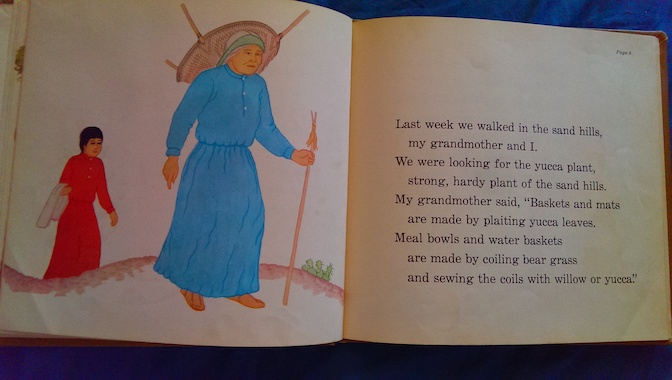
A young girl explains how her grandmother teaches her the traditional craft of making baskets.  They start by gathering the types of plants that they are going to use.
BasketMakerPlants.jpg

They also need special plants for the dye they will need in order to decorate the baskets.  The girl’s grandmother explains about the different types of decorations they traditionally use.

BasketMakerDesigns

Making baskets is a long process that includes cleaning the plants and tearing them into long strips, bleaching them, soaking them to soften them, dyeing strips used in the design, and weaving them together.

BasketMakerSoftening

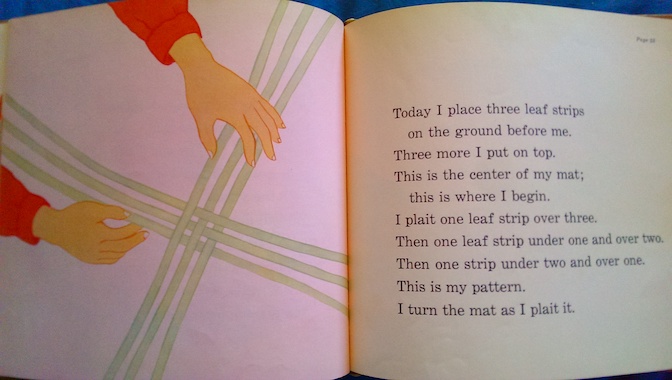
The girl weaves a mat that takes days to finish.  It is the first one that she’s made herself.
BasketMakerWeaving

She is very proud of herself when the mat is finished, and she is pleased with the quality of her work.

BasketMakerFinishing

I’ve owned this book since I was a young child, and it was my introduction to traditional crafts.  Later, I found a related book at a thrift store, The Little Indian Pottery Maker.  Until then, I hadn’t realized then just how old the books were and that there were more of them by the same author.

The book, which was written in the 1950s, was one of a group of stories (not exactly a series because they didn’t have a specific set of characters in common and the themes varied somewhat) written by a woman who was a teacher with the United States Indian Service.  The other books that she wrote, including The Little Indian Pottery Maker, focus on members of different Native American tribes.  She was not Native American herself, and the modern view of Indian schools is not favorable (for good reasons), so one might be a little suspicious of a book written about Native Americans by an Indian school teacher. However, these books interest me because of their explanation of traditional crafts. There are no white people in the stories at all, and they have a timeless quality to them.  Reading them, it’s hard to get a sense of exactly when the stories take place because it’s never mentioned, and there aren’t many clues (no mentions of modern technology, it’s all about the crafts).  I haven’t found any of the other books that the author wrote, but these two are very respectful in their tone, and they begin with explanations of the history of the tribes involved in the stories.  According to Andie Peterson in A Second Look: Native Americans in Children’s Books, the author was deliberately trying to write books that her Native American students could relate to.

The art style of the books vary because they had different illustrators.  The illustrator for this particular book was a Navajo painter.

The book is available to read for free online through Internet Archive.
The Little Indian Pottery Maker

PotteryMaker

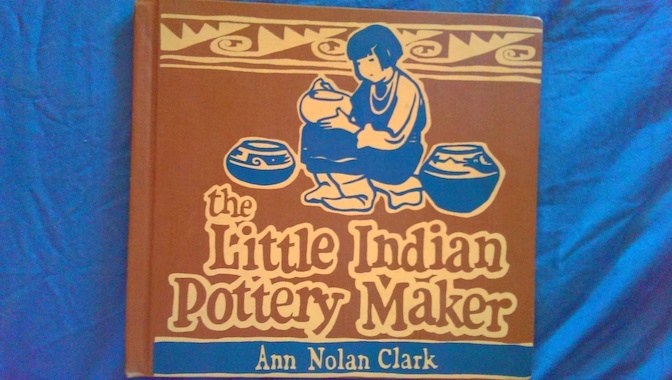
The Little Indian Pottery Maker by Ann Nolan Clark and illustrated by Don Perceval, 1955.

By “Indian,” the author means Native American.  This book specifically focuses on the Pueblo Indians who live in the Southwestern United States, specifically New Mexico and Arizona.  The story is about a young girl who is starting to learn the traditional art of pottery-making, and the book goes into the process involved in making pottery, step by step.   Although the use of “Indian” instead of Native American is somewhat anitquated, the book has something of an interesting history and the picture it provides of the practice of traditional crafts is fascinating. The beginning of the book explains a little about Pueblo Indians, their history, and where they live.

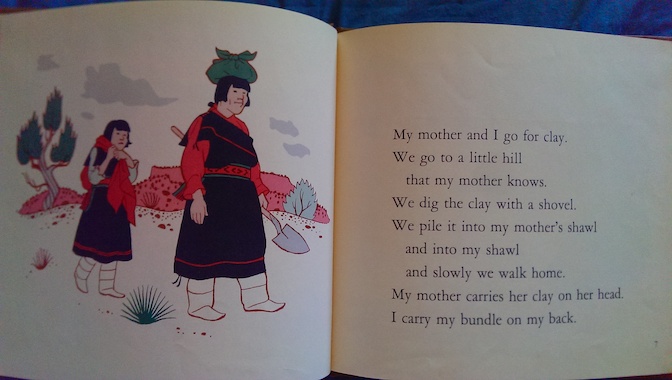
PotteryMakerGettingClay

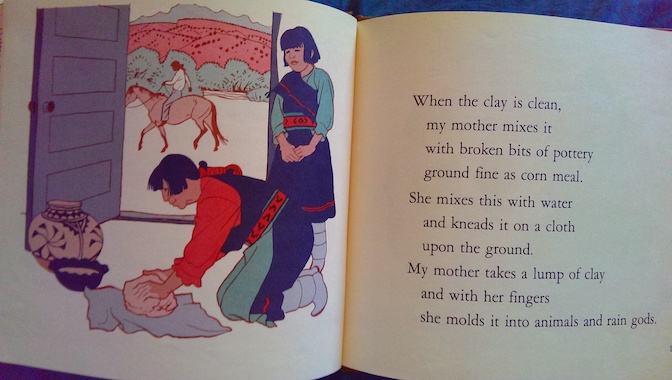
The young girl tells the story of how her mother introduces her to the traditional craft of making pottery and teaches her how to make her first pot.  She describes every step in the process, from when they collect the clay themselves from a hillside until the pot is finally complete.

PotteryMakerMixingClay

The girl’s mother explains about the different methods used to make pots, and pictures show how pots are shaped.

PotteryMakerRollingClay
PotteryMakerMakingPots

Making pottery is a long process that takes days to complete, including shaping, scraping and smoothing the sides, drying, decorating, and finally firing the pottery.  The girl is proud of the first pot she has ever made.

PotteryMakerFiringPots

I found this book at a thrift store a number of years ago and recognized it because I already owned a related book, The Little Indian Basket Maker, that I liked when I was a young child.  I hadn’t realized then just how old the books were and that there were more of them by the same author.

The book, which was written in the mid-1950s, was one of a group of stories (not exactly a series because they didn’t have a specific set of characters in common and the themes varied somewhat) written by a woman who was a teacher with the United States Indian Service.  The other books that she wrote, including The Little Indian Basket Maker, focus on members of different Native American tribes.  She was not Native American herself, and the modern view of Indian schools is not favorable (for good reasons), so one might be a little suspicious of a book written about Native Americans by an Indian school teacher. However, these books interest me because of their explanation of traditional crafts. There are no white people in the stories at all, and they have a timeless quality to them.  Reading them, it’s hard to get a sense of exactly when the stories take place because it’s never mentioned, and there aren’t many clues (no mentions of modern technology, it’s all about the crafts).  I haven’t found any of the other books that the author wrote, but these two are very respectful in their tone, and they begin with explanations of the history of the tribes involved in the stories.  According to Andie Peterson in A Second Look: Native Americans in Children’s Books, the author was deliberately trying to write books that her Native American students could relate to.

The art style of the books vary because they had different illustrators.  The illustrator for this particular book was not Native American (unlike some of the illustrators of other books), but he was adopted into a Hopi tribe, apparently as an adult because of his accomplishments in representing Hopi culture in art.

The Legend of the Bluebonnet

LegendBluebonnet

The Legend of the Bluebonnet by Tomie dePaola, 1983.

This is a story about the Comanche People in what is now Texas, based on an old folktale.

There has been a severe drought and famine in the land for a long time, and many people have died.  The survivors pray to the spirits for help in ending the drought, and they receive a sign that it will not end until someone among the Comanches makes a sacrifice of the thing that is most dear to them.

LegendBluebonnetShaman

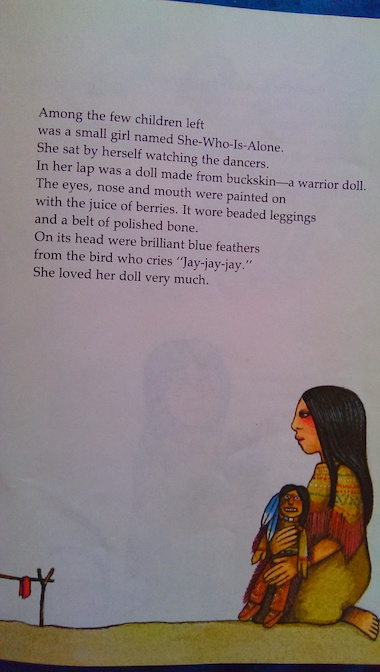
The people debate about who is supposed to make the sacrifice and what object the spirits could want, but one young girl thinks that the spirits are talking about her and her doll.  The girl is called She-Who-Is-Alone because she is the last of her family.  Her parents and grandparents are dead, victims of the famine.  The only thing she has left to remind her of them is her doll, a warrior with blue feathers in its hair, that her parents made for her before they died.

Desperate to end the drought and famine and to save her people, the girl makes the difficult decision to sacrifice her doll by burning it.  Her sacrifice is rewarded not only by the end of the drought but by the sudden appearance of a field of flowers as blue as the feathers in her doll’s hair.  The girl receives a new name from her people, acknowledging her sacrifice on their behalf.

LegendBluebonnetFlowers

A section in the back of the book explains a little about the Bluebonnet flower, which is the state flower of Texas, and the origins of the story in the book, which is based on a folktale.  This is also a little information about the Comanche People.

The book is currently available online through Internet Archive (multiple copies).

Meg Mackintosh and The Mystery at the Medieval Castle

Meg Mackintosh Mysteries

MMCastle

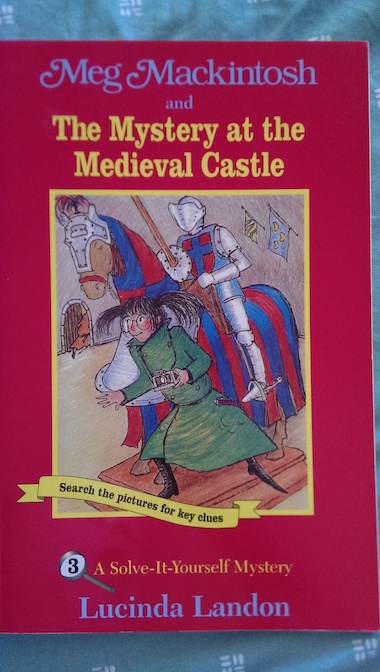
Meg Mackintosh and The Mystery at the Medieval Castle by Lucinda Landon, 1989.

Meg is visiting Dundare Castle with her teacher and some other students.  Dundare Castle is a special museum where people can learn about life in Medieval times, although it used to be a private home.  The owner’s family came from Scotland, and they built their home to look like their ancestors’ castle there.  Eleanor, the owner, now calls herself the Duchess of Dundare, and with her staff, dresses up to recreate the lives of people from the 1300s.

MMCastleTour

One of the Duchess’s prized possessions is a silver chalice studded with jewels that has been in her family for generations.  She keeps it on display in the castle’s “abbey,” guarded by the actor playing the part of a knight, Knight Henry.  But, when Meg and her classmates get to the abbey, the chalice is gone, and Knight Henry is lying on the floor, unconscious!

MMCastleTheft

Not long before they found Knight Henry, the kids had seen a robed figure run across the courtyard.  Monk William falls under suspicion, although the Duchess doesn’t really believe that he is guilty because he’s been with her family for a long time.  There are other possible suspects, and Meg believes that both the thief and the chalice are still in the castle.

The book is currently available online through Internet Archive.

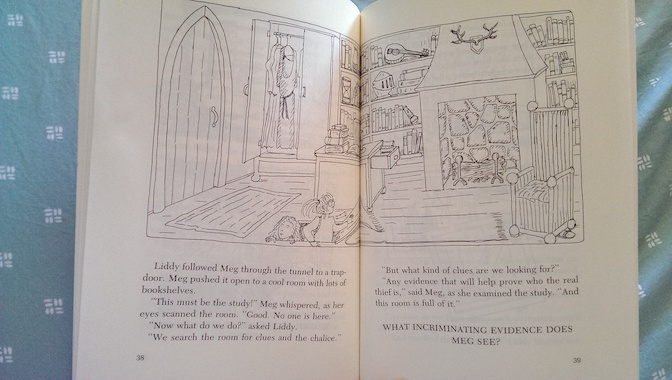
MMCastleSearch

My Reaction

I love this series because the books are interactive, giving readers the opportunity to figure out the clues and solve the mystery along with Meg. As Meg interviews the other actors in the castle and explores every room, readers are invited to study the pictures and consider the evidence to see if they can solve the mystery before Meg can.  At various points in the story, there are questions for the reader to consider, giving them the chance to pause and see if they’ve noticed what Meg has seen. I recommend that adults who are introducing children to the mystery genre read a couple of these stories along with them and discuss the clues as they go, helping children to learn how to notice details, solve puzzles, and think critically. It’s a good learning opportunity as well as a fun mystery!

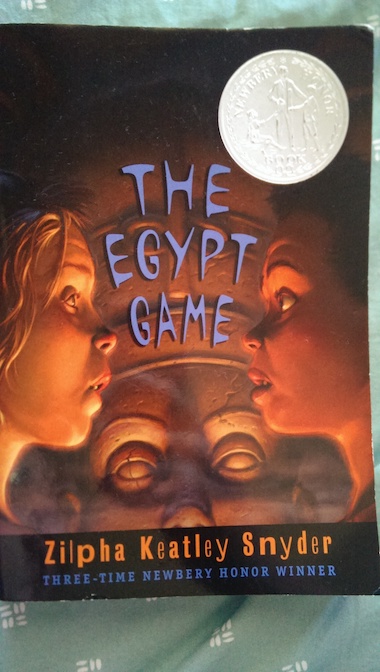
The Egypt Game

EgyptGame

The Egypt Game by Zilpha Keatley Snyder, 1967.

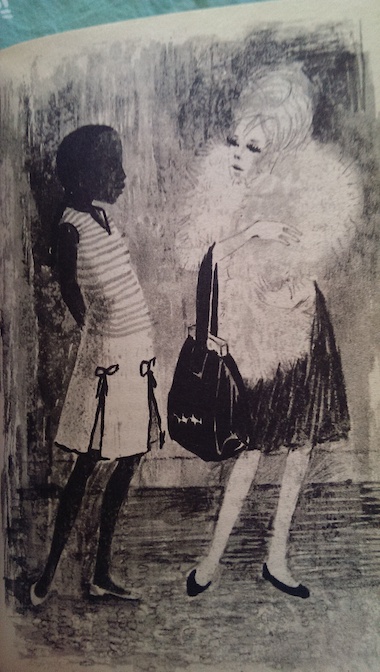
EgyptGameGirlsApril Hall has come to live with her grandmother (the mother of her deceased father) because her actress mother is touring with a band as a singer.  April’s mother isn’t a big star, although April likes to brag about her and their Hollywood life.  Really, her mother is mostly a vocalist who occasionally gets parts as an extra, hoping for that big break.  April is sure that when her mother gets back from her tour, she will send for her, and they will live together in Hollywood again. Although, from the way her grandmother behaves, it seems as though April may have to prepare herself for living with her for the long term.  April resents her grandmother’s apparent belief that her mother has dumped her because she is unwilling or unable to take care of her.

April is homesick and misses her mother.  To hide her feelings, she tries to act grown-up and ultra-sophisticated, which makes most people regard her as a little weird.  In spite of that, she makes friends with a girl named Melanie, who lives in a nearby apartment and sees through April’s act to her insecurity and creative side.  April has never had many friends (partly because of her mother’s chaotic lifestyle), but Melanie appreciates April’s imagination.  The two girls realize that they both like playing games of pretend and they both have a fascination with Ancient Egypt.  They go to the library and read everything they can find about Egypt, and it sparks the best game from pretend they’ve ever played.  Along with a few other friends, they start pretending to be Ancient Egyptians, building their own Egyptian “temple” and holding rituals in the old junk yard behind a nearby antique shop.

On Halloween night, the adults try to keep the children together in groups for safety, but the “Egyptians” sneak off alone to conduct one of their “rituals.”  It’s a dangerous thing to do because a child has been murdered in their area.  A young girl who was apparently abducted was later found dead, and people are frightened that other children could be in danger.  Fortunately, the only thing that happens on Halloween is that the Egyptians recruit a couple of new members when some boys from school find out what they’re doing.

However, the game starts taking on a life of its own when it seems that some other, unknown person has also joined in.  As part of their game, the children make up a new ritual and write messages to their “oracle,” asking questions that they want answered. To their surprise, someone starts writing replies.  Whoever is playing oracle and answering their questions, it doesn’t seem to be a child.

EgyptGameRitual

EgyptGameCostumesThe children are uneasy about this unexpected game player because frightening things are happening in their neighborhood.  The kids wonder if the mysterious messages could be from the crazed killer who murdered the young girl. People have been looking suspiciously at the loner who owns the antique store, an older man who everyone calls the Professor.  However, the kids have become too enmeshed in the Egypt game to give it up in spite of their fears.

When April slips out one night to retrieve a text book she left in “Egypt,” she comes frighteningly close to being the killer’s next victim.

This is a Newbery Honor Book.  It is currently available online through Internet Archive (multiple copies).  There is a sequel called The Gypsy Game.

My Reaction

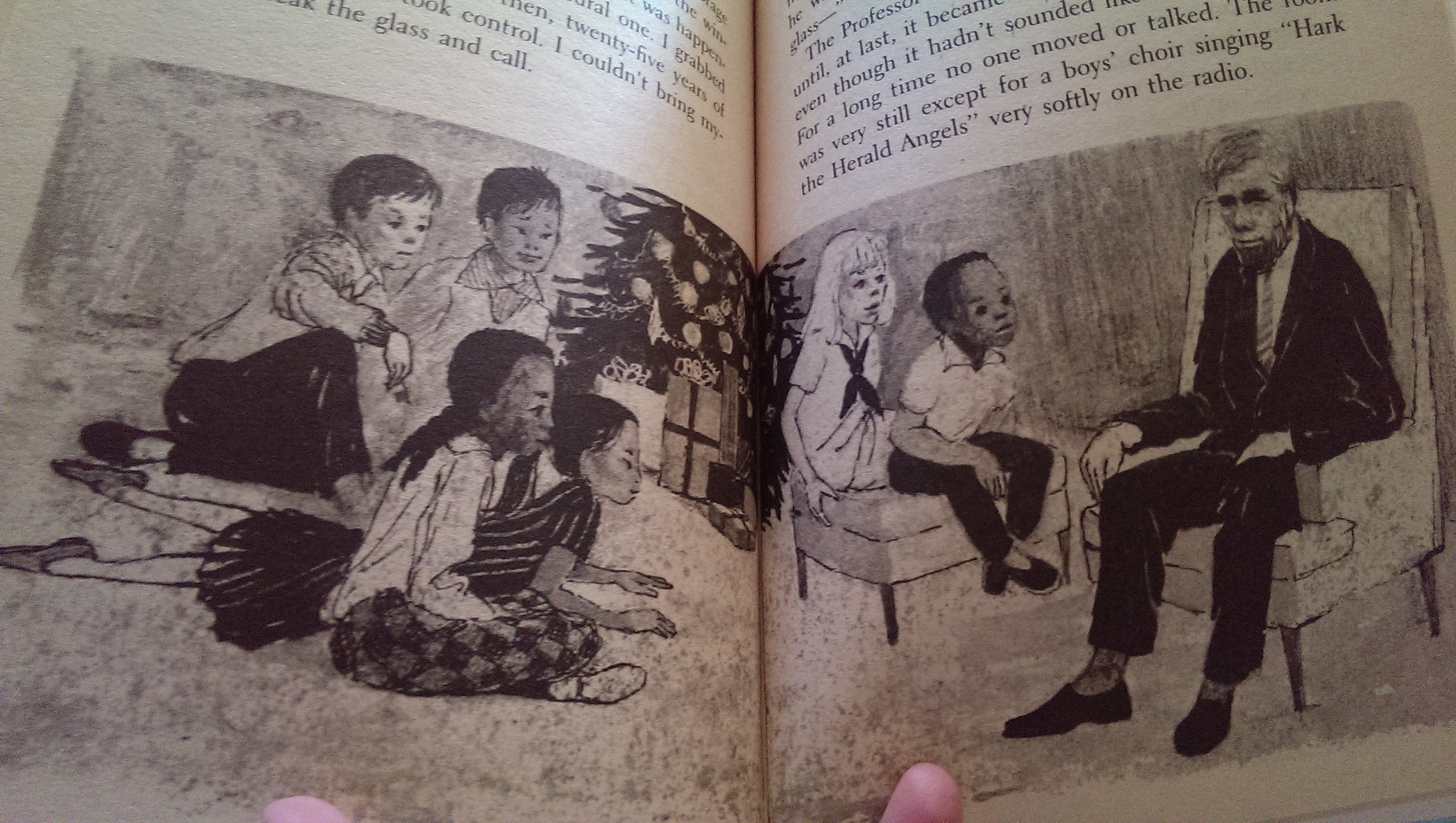
Although there are mysteries in the story (who killed the girl and who the unknown player of the Egypt game is), the development of the characters, especially April, is really at the heart of the story.  All through the story, what April wants most is for her mother to come for her and take her home again.  April fears that her mother doesn’t love her or want her, and at first, that keeps her from even trying to love the grandmother who took her in and really wants her.  However, she finds comfort when she realizes that she is creating a new life with her grandmother and friends, who really care about her.  Her mother does write to her later about coming to stay for a brief visit with her and her new husband (her acting manager, who she married on short notice without even telling April or inviting her to come to their wedding), but by then, April has started to feel at home in her new home and wants to share Christmas with the people who have been sharing in her life and adventures more than her mother has.  She never even tells her mother about her brush with death.

EgyptGameChristmas

The characters in the book are diverse, representing different racial backgrounds, ages, and family situations.  Melanie and her younger brother are African American.  Melanie understands more about human nature and how the world works than April does, partly because her mother talks to her about people and explains things.  Melanie realizes from the way that April behaves and how she doesn’t understand certain things, like the fact that there disturbed, dangerous people in the world, that her mother never really talked to her much or explained things when they were living together.  Melanie helps to ground April’s more flighty, insecure personality.  She joins in her imagination games eagerly, but she also helps to bring April more into sync with reality and other people.

The first new player they add to the game, Elizabeth, is Asian and lives with her widowed mother and other siblings.  Like April, she is a little lonely and looking for new friends in her new home.  Each of the kids, like April, have their own inner lives and personalities.  The Egypt game binds them together and provides them with friendship and insights into their lives.

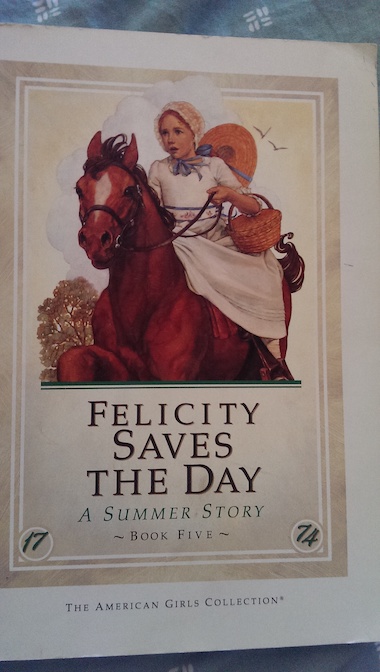
Felicity Saves the Day

American Girls

FelicitySummer

Felicity Saves the Day by Valerie Tripp, 1992.

This is part of the Felicity, An American Girl series.

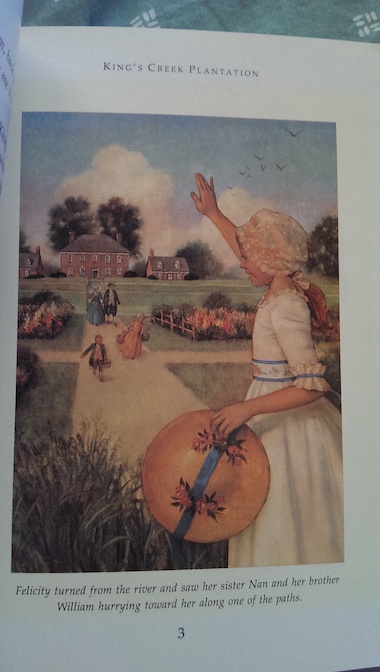
FelicitySummerPlantationFelicity’s grandfather is a wealthy man who owns the Kings Cross Plantation.  Every summer, Felicity and her family go to visit him there, and Felicity loves it.  Her grandfather teaches her a lot of things, like which plants can be used for food and medicine, and takes her for horse rides around his estate.

This year, while Felicity’s father and his apprentice Ben are minding the store at home,  Felicity has a special surprise.  As her grandfather inspects a group of horses that a friend wants to sell him, Felicity is stunned to recognize Penny, the horse she freed from an abusive owner in the first book of the series.  Penny is a little thin and dirty but otherwise well, to Felicity’s relief!  Her grandfather purchases Penny for Felicity and promises to keep her safely at his plantation so that Felicity can visit her and ride her regularly.

Felicity is happier than she’s been in a long time and writes an enthusiastic letter home to tell her father and Ben, but soon, she learns that Ben is not at home with her father.  Felicity and her siblings have set up a bird bottle, a special bottle that acts like a bird house for birds to nest in, and she checks it daily to see if there are any birds to show to her little brother.  One day, she finds a message in the bottle from Ben, pleading for help, along with a map to a place in the woods and Ben’s whistle.  When Felicity goes to the spot in the woods and blows the whistle, Ben comes out of hiding.

FelicitySummerBountyHuntersBen tells Felicity that he ran away from his apprenticeship to join the revolutionary army.  He wants badly to fight for the colonies’ freedom from England, but he had a bad fall while traveling and hurt his leg.  Felicity tries to convince Ben to let her get help for him and to return to her father to finish his apprenticeship, but Ben doesn’t want Felicity’s grandfather to find out that he’s there or why he ran away because he knows that he disapproves of the revolutionaries.  Because Ben kept her secret when she used to sneak out to see Penny, Felicity reluctantly agrees to keep Ben’s presence a secret for awhile, sneaking him some food and supplies.  She tells Ben that, while she thinks that standing up for what he believes is good, he’s going about it in the wrong way because breaking his apprenticeship was dishonest.

Then, Felicity learns that her father has placed an advertisement in the newspaper with a reward for anyone who can find Ben, and some rough-looking bounty hunters show up at the plantation to inquire about it.  Felicity knows that she must try to convince Ben to return on his own before he gets hurt worse than he already has!

A large part of the Felicity books is about taking responsibility and whether or not it’s right to break rules in the name of a good cause.  Felicity herself broke the rules to befriend Penny and later free her from a master who would probably have killed her.  This story raises the question of whether Ben’s form of rule-breaking is similar to what Felicity did or not.  Their situations and the reasons for their rule-breaking are different.  In her situation, Felicity had tried to behave as lawfully as she could until it became apparent that the only way to save Penny’s life was through rule-breaking.  In Ben’s situation, although he wants to help what he sees as a good cause, his rule-breaking isn’t strictly necessary, and he never tried to discuss his feelings with Felicity’s father and to work out an arrangement before running away because he thought that he already knew what Mr. Merriman would say.  Felicity points these things out to Ben, along with the fact that Ben is not in any real position to help the cause that he supports because he is injured, wanted, and in hiding.  He started on this venture ill-prepared and inconsiderate of the other people who depend on him back home and his own future, and while his belief in the revolutionary cause is genuine, he is also afraid of admitting his mistakes and needs to be urged to make things right.

In the back of the book, there is a section that talks about what people in Colonial America would do during summertime.  The weather in Virginia is hot and humid during the summer, and not everyone would get a chance to travel to the countryside, like Felicity’s family did.  The book talks about various ways colonists would use to cope with heat (keeping the kitchen with its fire separate from the house, eating in an open breezeway in the house, wearing lighter clothes, boys would go swimming although girls didn’t, etc.).  It also talks about life on Virginia plantations, including slavery.

Meet Felicity

American Girls

MeetFelicity

Meet Felicity by Valerie Tripp, 1991.

MeetFelicityPennyThis is the first book in the Felicity, An American Girl series.

Felicity, or Lissie as her family sometimes call her, is the daughter of a prominent store owner in Williamsburg, Virginia in 1774.  Sometimes, her father allows her to help in the shop, which is something that she enjoys.  However, that has happened less since her father took on a new apprentice named Ben Davidson.  Ben is fairly quiet and shy, and Felicity is only just getting to know him.  She sometimes envies boys for the more exciting opportunities they have while she has to help with more routine chores, like sewing, at home.

One thing that Felicity loves more than anything else is horses.  One day, she goes with Ben while he makes a delivery to Jiggy Nye, the tanner.  Jiggy Nye has a new horse that he says he won at gambling.  However, Jiggy Nye is cruel to any animal he gets, and Felicity fears for the beautiful horse he now has.  When Felicity tries to see the horse, which she calls Penny because of the color of its coat, Jiggy Nye drives her away.

That the horse is a fine animal and that Jiggy Nye is treating it badly are obvious, but at first, there doesn’t seem to be anything that Felicity can do about it.  Then, Jiggy Nye shouts at the horse one day that it’s worthless because he can’t handle it and that he’d give it to anyone who can ride it.  Taking Jiggy Nye at his word, Felicity sets out to tame Penny.

MeetFelicityRidingEvery morning for about a month, Felicity sneaks out of the house early, dressed in a pair of breeches that she borrowed from Ben without his permission.  She goes to visit Penny and gradually gains her trust.  When Penny finally allows her to ride her, Felicity thinks that she has won ownership of her, but Jiggy Nye accuses her of theft and takes back the horse.  He denies that he ever promised to give her to anyone who could ride her, although Felicity’s younger siblings agree that they heard him say so.

Felicity fears more than ever that Jiggy Nye will kill Penny, but now that she no longer has a chance of getting her from Jiggy Nye for herself, can she find another way to give Penny her freedom?

There is a section in the back of the book that describes life in Colonial America, particularly in Williamsburg, Virginia.  It also mentions the Colonial Williamsburg living history museum.  Another book about life in Colonial Williamsburg, with photographs from the living history museum, is Mary Geddy’s Day.

This book is currently available online through Internet Archive.

Thunder Cake

ThunderCake

Thunder Cake by Patricia Polacco, 1990.

A girl talks about how her grandmother, who she likes to call “Babushka” because she originally came from Russia, cured her of her fear of storms by teaching her to make a special kind of cake, Thunder Cake.

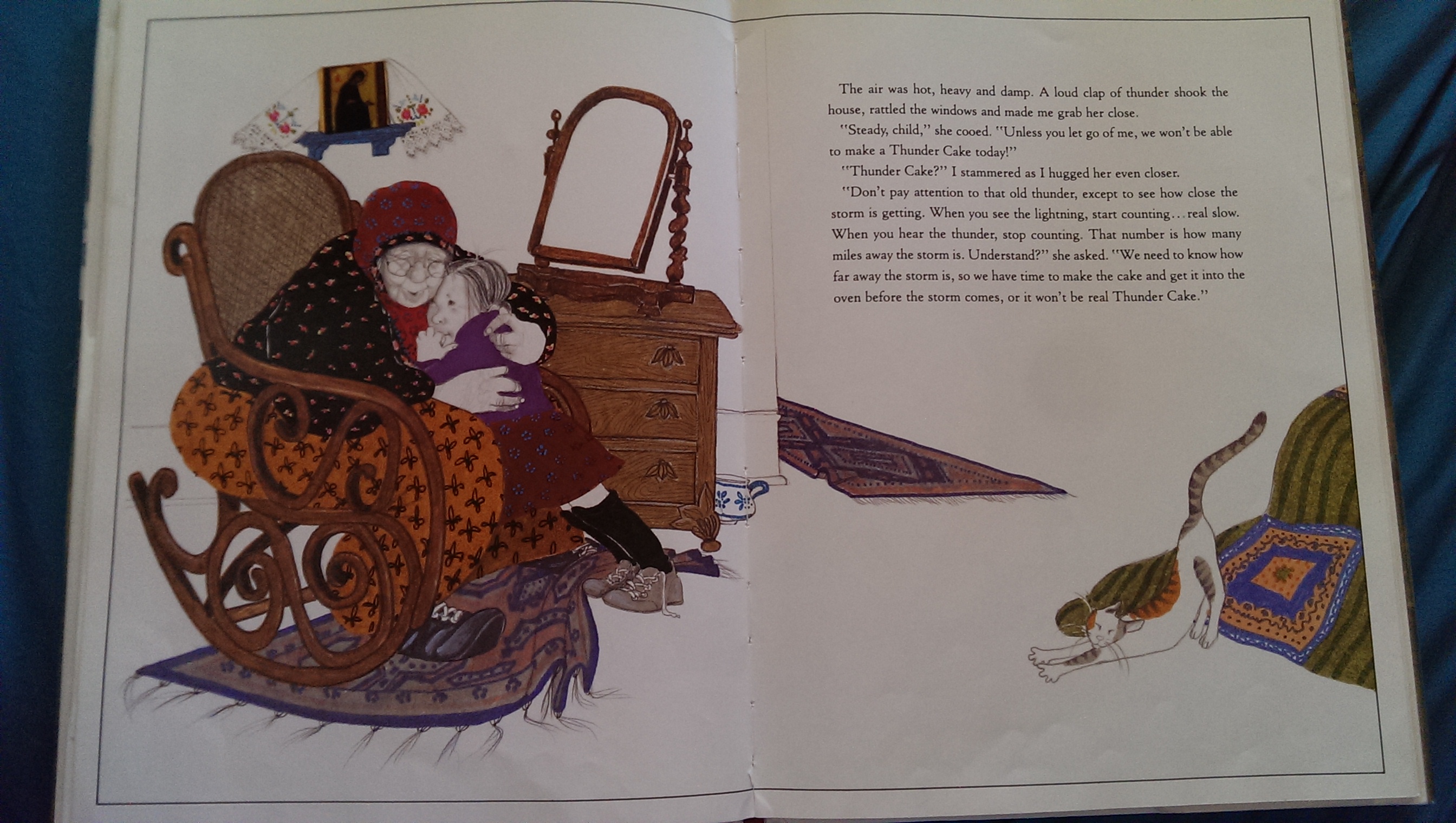
The girl is staying with her grandmother on her farm in Michigan during the summer, and the sound of thunder terrifies the girl so much that she just wants to hide under the bed.  However, her grandmother insists that the girl come out and help her gather the ingredients for her Thunder Cake.

ThunderCakeGrandma

The grandmother explains to the girl how to tell how far away a storm is by counting the seconds between when she sees a flash of lightning and when she hears the sound of thunder.  She also says that they need to get the cake ready by the time the storm actually arrives, so they’d better hurry.

ThunderCakeIngredients

Keeping track of how close the storm is and getting all the ingredients together to make the cake helps to keep the girl busy, and by the time the storm actually arrives, she is no longer afraid.

ThunderCakeFinished

The pictures are an interesting combination of pencil drawings and bright colors.  The faces and hands of the girl and her grandmother are completely in pencil, but their clothes and everything around them are painted.

I didn’t include the recipe for Thunder Cake here because the book is still in print, and I have kind of a rule that I don’t include recipes from books that are still in print.  However, this recipe is one of the more well-known ones from children’s literature, and it’s pretty widely available on the Internet, some with pictures of the cakes people made from this recipe.  For example, this blog has a nice article about this book with helpful notes for those who want to try to make the cake.  This site also has the recipe along with some comments from others who tried it.  I was surprised the first time I read it that one of the ingredients in the chocolate cake was tomatoes, but the consensus seems to be that they are really necessary to make this cake properly.

The book is currently available online through Internet Archive.

Miss Rumphius

MissRumphius

Miss Rumphius by Barbara Cooney, 1982.

From the time she was young, Alice Rumphius wanted to travel and see the world.  She planned to return home to live by the sea when her travels were over.  However, her grandfather, an artist, gives her one more mission in life: to make the world more beautiful.  Although Alice isn’t quite sure how she will accomplish that, she agrees.

RumphiusPainting

When she grows up, she lives out her dream of traveling, seeing all the places that she read about while she working in a library.  However, she ends up hurting her back while getting off of a camel she was riding, so she decides that it’s time to retire and find a home by the sea, as she planned.

RumphiusCamel

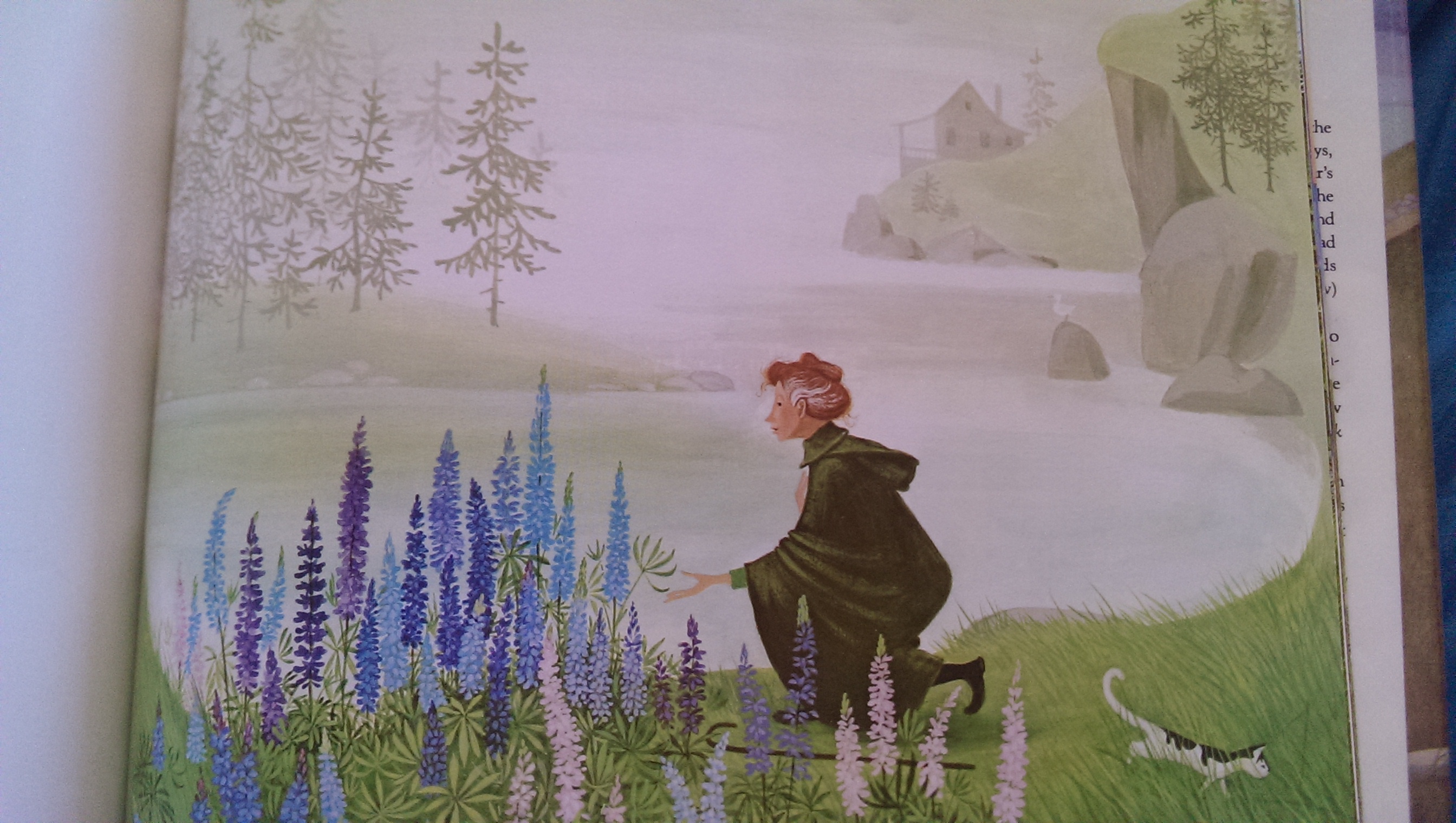
As she recovers from her injury, she thinks about her mission to make the world more beautiful.  At first, she still doesn’t know how to accomplish that, but some flower seeds she planted and her particular love of lupines give her the inspiration for her final legacy of beauty.

RumphiusLupines

Her gift of spreading seeds of beautiful flowers gives her a reputation as an eccentric, the Lupine Lady, but it also inspires a new generation to undertake their own missions to see the world and to create beauty in their own way.

RumphiusChildren2

One of the things that fascinates me about Miss Rumphius and her story is that she leads a very non-traditional life.  She has very definite goals from childhood and sticks to them throughout her life, but they are not quite the common goals of most people, like marriage and career.  She remains unmarried throughout her life (the book never says anything about whether she had any romances in her life because that wasn’t one of her main life goals and therefore not really important to the story), and her only listed career was that of working in a library, which allowed her to have some money and to read about the places where she wanted to travel.  In the end, she is not wealthy and has no husband or children of her own, but she is happy because she has achieved the things that always meant the most to her.  She has had rich life experiences, she has made the world a little better for her presence, and she encourages her nieces and nephews to see the world, to enjoy their experiences, and to leave their own mark of beauty.

Apparently, parts of the story are based on the author’s own life and on the life of Hilda Hamelin, the original Lupine Lady.  The book is currently available online through Internet Archive.
Kat the Time Explorer

KatTimeExplorer

Kat the Time Explorer by Emma Bradford, 1998.

KatTimeExplorerTrain.jpgTen-year-old Kat is going to be living with her Aunt Jessie for the next year.  Her parents are botanists, and they are spending a year in South America, studying rain forest plants.  Aunt Jessie lives in a house in the same town as Kat and her parents so, by staying with her, Kat can continue going to the same school and see her friends.

Like Kat’s parents, Aunt Jessie is also a scientist and teaches physics at the same college where her parents teach when they’re not doing research abroad.  She inherited her house from their Great-Uncle Malcolm, who was an inventor.  Malcolm never invented anything that made much money or got much attention, but Jessie has been going through his things and discovered something interesting among his unfinished projects: a time machine.  The time machine seems to be nearly complete, although Jessie isn’t quite sure how to operate it or what should power it.  There is a drawing of a strange medallion in Malcolm’s notes, and Jessie found one with the same markings among Malcolm’s belongings, but it’s unclear whether this medallion is supposed to play any role in the time machine’s function or if it’s completely unrelated.

Then, Kat discovers another medallion in Malcolm’s old room, one with identical markings but made out of a different type of metal.  There is a space on the time machine for each of the medallions to fit.  When Kat experiments with how the medallions can fit into the machine, she activates it, transporting herself and Jessie back in time to England in 1851.

They find themselves on a train with other travelers heading to The Great Exhibition in London where people from around the world will be displaying new developments in industry and technology.  No one notices Jessie and Kat’s sudden arrival because the train is packed with people and the time machine has somehow altered their clothing and other small objects in their possession to ones that are appropriate to the period.  They also seem to be able to understand people speaking other languages neither of them knew before.  The time machine itself is packed into an ordinary-looking bag.  The two of them decide that they can’t use the time machine on the train where everyone will see them, and besides, they are both curious about the time they find themselves in.  After a temporary mix-up where they are separated at the train station, they find each other again and manage to locate a woman who will rent a room to them for a couple of days.

Unfortunately, when they start unpacking in their room, they discover that their bag was accidentally switched at the station for an identical one.  They no longer have the time machine and can’t get home!  Inside the bag they have, they find articles of men’s clothing, a small spring of some kind, an incomplete sketch of some kind of invention, a ticket to the Exhibition, and a letter written to someone named Edward from his brother Sidney about the Exhibition and the invention they plan to demonstrate there.  The brothers are very concerned about the success of their demonstration and are depending on results to make some money and save their family’s estate.  With those clues, Jessie and Kat must track down these inventors and find their time machine, saving not only themselves from being stuck in the past but the future of the two brothers!

There is an educational section in the back that explains about the Victorian Era and the Great Exposition.  It also discusses Victorian manners and tea parties.  There are tips for making little sandwiches of the kind people would eat at tea parties.

This book is part of the Stardust Classics series.