The Haunting at Cliff House

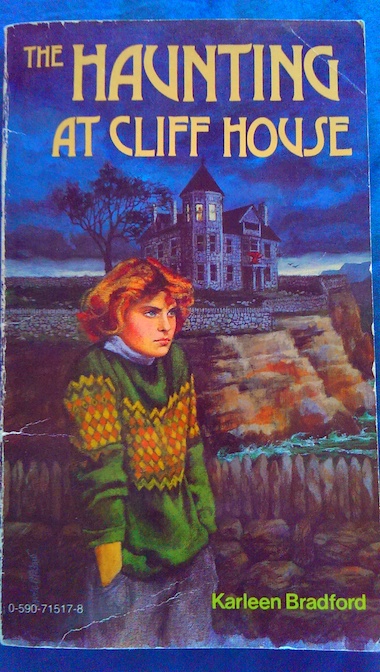
HauntingCliffHouseThe Haunting at Cliff House by Karleen Bradford, 1985.

This is a relatively short chapter book, but suspenseful, thoughtful, and well-written.

When her father inherits an old house in Wales from a distant relative, Alison, a young teenager, finds out that he plans for the two of them to spend the summer there.  Alison’s father is a university professor and is writing a book, and he thinks that the house in Wales sounds like a great place for him to get some writing done while he and Alison have a look at his new inheritance.  Alison isn’t enthusiastic about the trip, but she and her father are very close, especially because she lost her mother at a very young age.  Besides, the only place she could stay in Canada would be with her grandmother, and her grandmother didn’t seem enthusiastic about having her.

From the moment they arrive at the old house, called Pen-y-Craig or Cliff House by the locals, Alison has a bad feeling about it.  It stands on a lonely cliff by a small town.  The carved dragon over the door gives her the creeps, and there is something disturbing about a particular room in the house.  Sometimes, she can almost hear a voice calling out to her, and she has visions of another girl, about her age.  At first, she tries to tell herself that it’s all her imagination, but it soon becomes obvious that it’s not.

Some of the local people know that the house has an unhappy history, and Alison eventually learns that the great-aunt that her father inherited it from even refused to live there during her last years because it disturbed her too much.  A little more examination of the room that had disturbed her helps Alison discover the reason why.  After having a vision of a young girl hiding something behind a brick in the fireplace of one of the bedrooms, Alison searches the spot and finds a diary dating from 1810, written by a girl named Bronwen, who was the same age as Alison.  Like Alison, Bronwen was brought to the house by her widowed father and was unhappy about it, but those aren’t the only parallels between Bronwen’s life and Alison’s.

Alison becomes uncomfortable with her father’s new friendship with a Welsh neighbor, Meiriona.  Alison likes Meiriona’s younger brother, Gareth, but when it looks like her father’s friendship with Meiriona is turning into romance, Alison becomes jealous and fears changes in her close relationship with her father, a situation that mirrors Bronwen’s life when her father falls in love with her governess, Catrin.  Although Meiriona tries to be nice to Alison, Alison can’t bring herself to like her, and she argues with her father about it.

The only person who seems to understand her feelings at all is Gareth, and Alison confides her worries in him, both about Meiriona and about Bronwen, whose spirit keeps calling out to Alison to help her, although Alison doesn’t know how.  She struggles to read through the diary, whose pages are not all legible anymore because they’re damaged with age, to learn what happened to Bronwen and what Bronwen wants her to do now.  Gareth tries to reassure Alison that her father’s relationship with Meiriona will not be as bad as Alison thinks.  He thinks that the relationship would be good for both Alison’s father and Meiriona because they are both lonely, and he doesn’t think that Alison should worry about losing her father because he’s not worried about losing his sister, even if she goes to Canada to study and spend more time with Alison’s father.  At first, Alison isn’t comforted by these reassurances.  However, Gareth agrees that the matter of the ghost is serious, and he can feel her presence as well. Gareth warns Alison to be cautious about the ghost but to try to help if she can and to call out to him if she’s ever in danger.  Alison would really rather just go home to Canada, run away from her father and Meiriona, and forget the whole thing about Bronwen, but history seems to be repeating itself, and Bronwen’s voice calls out to her insistently for help that only Alison can give.

It’s a bit of a spoiler, telling you this, but although Alison at first thinks that the diary ends with Bronwen killing herself in despair, thinking that her father only loved Catrin and not her and that there was nothing left for her to live for, the truth is that Bronwen’s suicide attempt didn’t succeed and that she made another mistake that she wants Alison to help her to change.  Bronwen attempted to kill herself by going to a cave by the sea during a terrible storm, planning to allow herself to drown, but when the water started rising, she became too frightened and decided to leave by a secret entrance to the cave.  Not knowing that Bronwen was safe, Catrin attempted to save her and drowned in the cave herself.  As Bronwen was climbing to safety, she heard Catrin calling for her but was too frightened of the storm and angry at Catrin to go back for her.  Although Bronwen lived on after the incident, she could never get rid of her guilt at Catrin’s death, realizing that, even in the middle of her resentment toward Catrin, Catrin loved her more than she knew, even to the point of giving up her own life while attempting to save hers.

Now, the anniversary of Catrin’s death is approaching, and so is a storm very much like the one that killed her.  At the top of the cliff by the cave, Alison finds her time merging with Bronwen’s, and she will only have one chance to help Bronwen make the right decision the second time around.  Helping Bronwen to prevent the worst mistake of her life and to make a better choice also helps Alison to reconsider her own choices and future.  Just as Bronwen misjudged Catrin, Alison may have also misjudged Meiriona. Instead of losing her father or being forced to accept a poor substitute for her mother, Alison may be gaining a kind of sister who will love her more than she realizes.

The Root Cellar

RootCellarThe Root Cellar by Janet Lunn, 1981.

Rose Larkin is an orphan, living with her grandmother, a stern businesswoman.  Her grandmother travels frequently on business, so from the time Rose came to her when she was three years old, she just took Rose with her wherever she traveled, tutoring her in school subjects in the evening after work.  Rose’s early life is largely one of travel to strange places and isolation.  When her grandmother is working, Rose is pretty much left to her own devices, often either reading alone in their hotel rooms or exploring strange cities by herself.  Not going to school, she has no friends her own age and doesn’t really know how to behave around other children or live as part of a normal family.

When her grandmother dies suddenly of a heart attack in Paris when Rose is twelve years old, her remaining relatives have to decide what to do with her.  She temporarily stays with aunts who are into fashion and high living before goes to live with another aunt and uncle and their boys on an old farm.  Aunt Nan (Rose’s father’s sister) and her husband are better suited to caring for Rose and can give her a more settled family life, but Rose’s other relatives don’t seem to think much of Aunt Nan, who is an author of children’s books.  Rose has heard that Aunt Nan has no sense and that the family has just moved to a shabby little farm house in Canada.  Rose is prepared not to be happy there, on a dumpy little farm, miles from anywhere, with a bunch of strange people.

Her new life gets off to a bad start when there is no one to meet her at the house when she arrives.  As she waits for her aunt and uncle to return, a strange old woman appears who seems to know her.  She calls herself Mrs. Morrisay and acts like she belongs to the house.  But, when Rose’s relatives arrive home, Mrs. Morrisay suddenly disappears, and none of them seem to know anything about her.  Later, Rose sees a girl making a bed upstairs, but her relatives just laugh when Rose asks them about the maid, which is who Rose thought the girl was.  There is no maid in this house, and Rose is the only girl.  To Rose’s annoyance, her relatives think she imagined the whole thing.

Actually, life in her aunt and uncle’s house in the country isn’t as bad as her other aunt has lead her to believe, but becoming part of their household isn’t easy because Rose is used to a very different kind of life.  The house is definitely old and in bad need of repair, and her relatives are noisy and disorganized, at least more so than Rose is accustomed to.  Rose isn’t used to the chaotic life of a family with a lot of children, and Aunt Nan has another on the way.  Also, tourists who are fans of Aunt Nan’s books sometimes stop by the house, and Rose doesn’t like dealing with their scrutiny and questions.  Sam, one of the older boys in the family, seems to resent Rose’s presence in the house, and Rose overhears him saying a lot of bad things about her to her aunt, calling her snobby and criticizing her appearance.  Rose takes his attitude as further evidence that she doesn’t really belong in their house and that she’ll never fit in.  If they think badly of her, why should she think any better of them?

Rose also becomes increasingly aware that there is something not quite normal about her relatives’ house, especially the old root cellar, and the people she saw on her first day in the house are part of it.  Sam thought that he might have seen a ghost in the house one day, an old woman, and Rose recognizes his description as that of the Mrs. Morrisay she saw on her first day there.  She sees Mrs. Morrisay in her bedroom later, suddenly walking through a wall.  Rose thinks Mrs. Morrisay is a ghost, but Mrs. Morrisay tells her that she’s not dead, just “shifting” through time and that she wants Rose to stay in the house and help restore it to its former glory.  Rose doesn’t know why or how she can possibly help Mrs. Morrisay.

Rose learns that her aunt’s house was once an old farm house that belonged to the Morrisay family, and there is still an old root cellar on the property, a relic from the time when people had to store certain kinds of food underground to keep them cool and prevent them from spoiling.  One day, Rose goes down into the root cellar and meets a mysterious girl dressed in old-fashioned clothes, the same girl she saw earlier, making beds.  Although Rose and the other girl don’t realize it immediately, Rose has gone back in time.  The girl was someone who lived on the farm in the past, during the 1800s.

Rose and the girl in the past, Susan Anderson, become friends, and Rose is grateful for another girl to talk to.  Susan is an orphan herself, living with the Morrisay family as a servant girl.  She and Will Morrisay, old Mrs. Morrisay’s son, are friends, and both of them are sympathetic to Rose when she tells them about her new life with her relatives and the problems she has. Rose finds herself wishing that she could stay in the past with them forever.  However, once they realize that Rose is traveling through time when she goes in the root cellar, they also discover that it isn’t reliable about exactly when Rose will reappear in the past.  Although at first there are only days between Rose’s visits from her perspective, months or years pass in her friends’ lives between her visits.  They eventually manage to solve this problem through a friendship pact where they exchange favorite objects.  It’s at a good time, too, because soon Rose’s friends need her help as much as Rose needs them.

After a terrible fight with her relatives in which her aunt slips and falls and Rose worries that her aunt and the baby might die, Rose runs away to the root cellar and goes to see her friends, discovering that in their time, Will has gone away to fight in the American Civil War alongside his favorite cousin and has not returned.  It’s been awhile since Susan has heard from him, and she fears the worst.  Rose suggests that they go to look for Will at his last known location, but it’s a difficult, perilous journey. At first, they’re not sure whether they’ll find Will alive or not.

When they finally find Will, he is a changed man from the war, and Rose and Susan have to help him to remember who he really is and where he really belongs.  In helping Will to remember where he comes from, his life before the war, and how much Susan needs him, Rose comes to realize some important things about herself and where she really belongs.

The book is available to borrow and read for free online through Internet Archive.

My Reaction and Spoilers

As difficult as the choice is, Rose realizes that she must return to her own time, face the consequences of her earlier actions, and do what she can to become a real member of her new family.  After she returns home and the root cellar is destroyed in a storm, it seems as though she might never see her friends from the past again, but friendship can transcend many boundaries, including time.

I didn’t realize this the first time I read the book, but it’s actually part of a loose trilogy.  I say loose because none of the main characters from each story appear in the others (except, perhaps, for one who is in both the second and third books), which also take place in different time periods.  What binds the stories together is the location where the stories take place and also some distant family relations, particularly focusing on the Anderson and Morrisay families.

It is something of a spoiler, but it seems that the time travel in this story may not be so much a matter of the house being special or magical, but because Susan is special.  It is revealed in one of the other books, Shadow in Hawthorn Bay, that her grandmother was psychic.  Will and Susan briefly refer to Susan’s grandmother and her stories about ghosts when talking to Rose.  Susan seems to have little control, especially later in life, over her ability to shift through time, but it may be her special attachment to the Morrisay house and her need for Rose’s friendship and help that makes Rose’s time travel possible.  It’s never explicitly stated that Susan inherited her abilities from her grandmother, but I think that it is implied during the course of the books.

Hester the Jester

HesterJester

Hester the Jester by Ben Shecter, 1977.

This cute picture book takes place in a Medieval kingdom.  Little Hester’s father is the court jester.  Then, Hester decides that she wants to be a jester, too.  At first, Hester’s parents tell her that she can’t because she’s a girl.  (If you’re thinking that you know where this story is headed, wait.)

One day, the king is so sad that Hester’s father can’t cheer him up, no matter what he does.  When Hester starts putting on her jester act for her father and makes him happy, he decides to go ahead and have her perform for the king.  Hester does cheer the king up, but that isn’t the end of the story.

Hester tells the king that she has discovered that she doesn’t like being a jester after all because it makes her feel too silly.  So, the king, now in a much better mood, asks her what she would like to do instead.

This starts a sequence where the king allows Hester to try out various roles and see if she likes them.  She tells him that she wants to be a knight because knights are important, but she ends up not liking that when she learns that knights have to go into battle.  Then, Hester decides that being a king is even more important, so the king decides to let her try it.  But, Hester isn’t good at giving other people wise advice, as the king does.

HesterJesterKnight

In the end, when Hester’s mother is sad and doesn’t know what to do now that her daughter has become a king, Hester decides that what she most wants to do is to go home and be her little girl again.

In a way, this book seems like two little stories in one.  First, there’s Hester proving that she can be a jester even though she’s a girl, and then, there’s Hester trying to decide what she really wants to be the most, now that the king is letting her try anything she wants.  What she decides that she wants most is to be herself and go home.

So, is this little book anti-feminist, saying that girls are better off just forgetting about the other stuff they might want and staying girls?  I don’t think so.  Basically, this is just a silly little story about a little girl, one too young to have a profession of any kind, who is allowed to see the realities behind some of the things she’s been wanting to try.  Some parts, she likes, and some she doesn’t.  But, she’s too young and inexperienced for all of them (and some, she will never want to try again because she’s learned that they’re not what she really wants after all), so she’s just going to be what she is: a little girl with plenty of time to grow up, who needs her mother and whose mother needs her.  All throughout the book, Hester speaks her mind about what she wants and is honest about the things she doesn’t like, admitting when she changes her mind.  As for what might happen when Hester grows up and finds something else she might want to do . . . who knows?  By then, she may be willing to try new things again.  But, she knows what she wants for now and has a little better idea of some things that she won’t want in the future.
The book is currently available online through Internet Archive.

The Surprise Doll

SurpriseDoll

The Surprise Doll by Morrell Gipson, 1949.

Mary is a little girl who lives by the sea. Her father is the captain of a ship, and he travels to different countries all over the world. Sometimes, he brings presents for Mary from his voyages. So far, he has brought six dolls for her:

SurpriseDollTeresaSusan – from England, with rosy cheeks

Sonya – from Russia, with a cute turn-up nose

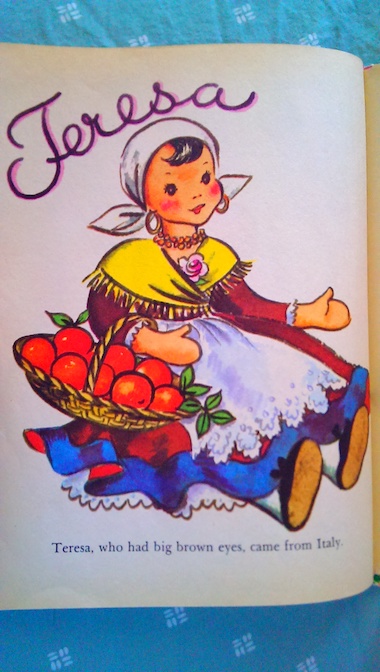
Teresa – from Italy, with brown eyes

Lang Po – from China, with raised eyebrows

Katrinka – from Holland, with blonde hair

Marie – from France, with a smile that brightens her whole face

Mary loves her dolls, but she realizes that if she had a seventh doll, she would have a doll for each day of the week. She asks her father if he will bring her another, but he says that she already has enough dolls.

When her father refuses her request, Mary pays a visit to the local dollmaker. She takes along her six dolls and explains to the dollmaker why she wants one more. After studying Mary and her dolls, the dollmaker agrees to make one for her as long as she’s willing to leave her other dolls with him for a week. At the end of the week, Mary returns to collect her new doll and receives a surprise!

SurpriseDollDollmaker

The “surprise” isn’t much of a surprise to the readers because the “surprise doll” is shown on the cover of the book, but it’s a cute story about how people around the world have many things in common. What the dollmaker notices about Mary and her dolls is that Mary shares certain qualities with each doll, the ones listed in the dolls’ descriptions above. So, he makes a doll for Mary that looks just like her by using her other dolls and their shared features as models. Her new doll, Mary Jane, is an American doll, but she has features in common with Mary’s other dolls from around the world, just like children in America can share qualities with children in other places. It’s a soft message about diversity and finding common ground.

SurpriseDollSeventhDoll

Felicity’s Surprise

American Girls

FelicityChristmas

Felicity’s Surprise by Valerie Tripp, 1991.

FelicityChristmasBenProtestThis is part of the Felicity, An American Girl series.

Christmas is coming, and Felicity is excited. She and Miss Manderly’s other students, Elizabeth Cole and her older sister, Annabelle, have all been invited to the Christmas party at the Governor’s palace! Miss Manderly is a friend of the dancing master who has been giving the governor’s children dancing lessons, so she was able to get invitations for her students. There will be a special dance lesson for all the children who come. With food, music, and dancing at the party, Felicity and Elizabeth are looking forward to dressing up like grown-up ladies going to a ball.

However, Ben, her father’s apprentice is against the idea of Felicity going because the Governor sides with the King and the Loyalists against the Patriots. He can’t understand why Felicity would want to attend a party with people who have treated the colonists so badly and have even boycotted her father’s store because he refuses to sell the taxed tea. However, Felicity’s father understands that the invitation was meant kindly and that it would be a special event for Felicity, so he tells her that she can go if she likes. Christmas should be a time for peace and enjoyment.

FelicityChristmasMotherIllAt Miss Manderly’s the girls start having dancing lessons, and Felicity wishes for a new gown, like the one on the elegant doll at the milliner’s shop. Since Felicity is usually not very interested in clothes, her mother decides to grant her wish.

When Felicity’s mother falls ill, not only do Felicity’s Christmas dreams seem dashed, but she worries about whether her mother will recover from her illness. Everything that Felicity was concerned about before, the dress, the dancing, the party, all suddenly seems unimportant and silly in the face of something more serious. However, miracles come to those who work for them, and Felicity receives some unexpected help from friends.

There is a section in the back with historical information about how Christmas was celebrated in Colonial America.

The book is currently available online through Internet Archive.

The Little Indian Basket Maker

BasketMaker

The Little Indian Basket Maker by Ann Nolan Clark and illustrated by Harrison Begay, 1957.

By “Indian,” the author means Native American.  This book specifically focuses on the  Papago (Tohono O’odam) who live in the Southwestern United States, specifically Arizona.  The story is about a young girl who is starting to learn the traditional art of basket-making, and the book goes into the process involved in making baskets, step by step.   Although the use of “Indian” instead of Native American is somewhat antiquated, and Tohono O’odam is really the proper name for the Papago people, the book has something of an interesting history and the picture it provides of the practice of traditional crafts is fascinating. There is a section at the beginning of the book which explains a little about the history of the Papago (Tohono O’odam) people and where they live.

BasketMakerGrandmother

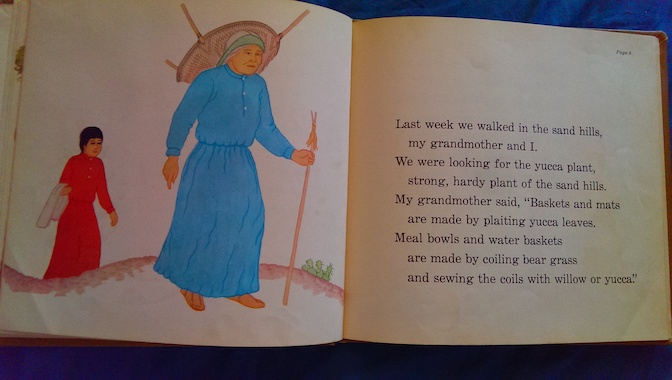
A young girl explains how her grandmother teaches her the traditional craft of making baskets.  They start by gathering the types of plants that they are going to use.

BasketMakerPlants.jpg

They also need special plants for the dye they will need in order to decorate the baskets.  The girl’s grandmother explains about the different types of decorations they traditionally use.

BasketMakerDesigns

Making baskets is a long process that includes cleaning the plants and tearing them into long strips, bleaching them, soaking them to soften them, dyeing strips used in the design, and weaving them together.

BasketMakerSoftening

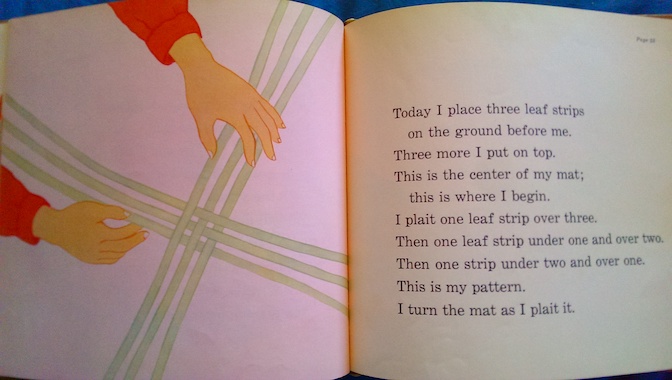
The girl weaves a mat that takes days to finish.  It is the first one that she’s made herself.

BasketMakerWeaving

She is very proud of herself when the mat is finished, and she is pleased with the quality of her work.

BasketMakerFinishing

I’ve owned this book since I was a young child, and it was my introduction to traditional crafts.  Later, I found a related book at a thrift store, The Little Indian Pottery Maker.  Until then, I hadn’t realized then just how old the books were and that there were more of them by the same author.

The book, which was written in the 1950s, was one of a group of stories (not exactly a series because they didn’t have a specific set of characters in common and the themes varied somewhat) written by a woman who was a teacher with the United States Indian Service.  The other books that she wrote, including The Little Indian Pottery Maker, focus on members of different Native American tribes.  She was not Native American herself, and the modern view of Indian schools is not favorable (for good reasons), so one might be a little suspicious of a book written about Native Americans by an Indian school teacher. However, these books interest me because of their explanation of traditional crafts. There are no white people in the stories at all, and they have a timeless quality to them.  Reading them, it’s hard to get a sense of exactly when the stories take place because it’s never mentioned, and there aren’t many clues (no mentions of modern technology, it’s all about the crafts).  I haven’t found any of the other books that the author wrote, but these two are very respectful in their tone, and they begin with explanations of the history of the tribes involved in the stories.  According to Andie Peterson in A Second Look: Native Americans in Children’s Books, the author was deliberately trying to write books that her Native American students could relate to.

The art style of the books vary because they had different illustrators.  The illustrator for this particular book was a Navajo painter.

The book is available to read for free online through Internet Archive.

The Little Indian Pottery Maker

PotteryMaker

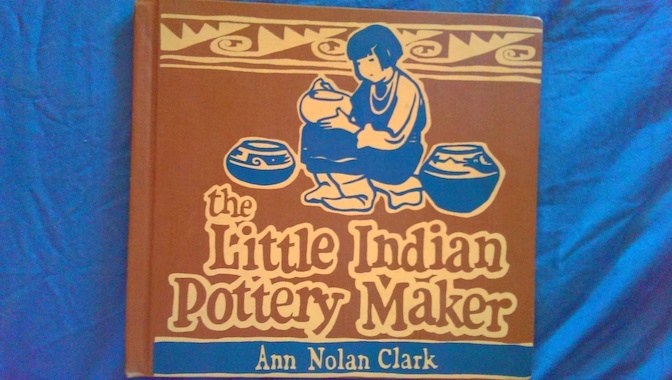
The Little Indian Pottery Maker by Ann Nolan Clark and illustrated by Don Perceval, 1955.

By “Indian,” the author means Native American.  This book specifically focuses on the Pueblo Indians who live in the Southwestern United States, specifically New Mexico and Arizona.  The story is about a young girl who is starting to learn the traditional art of pottery-making, and the book goes into the process involved in making pottery, step by step.   Although the use of “Indian” instead of Native American is somewhat anitquated, the book has something of an interesting history and the picture it provides of the practice of traditional crafts is fascinating. The beginning of the book explains a little about Pueblo Indians, their history, and where they live.

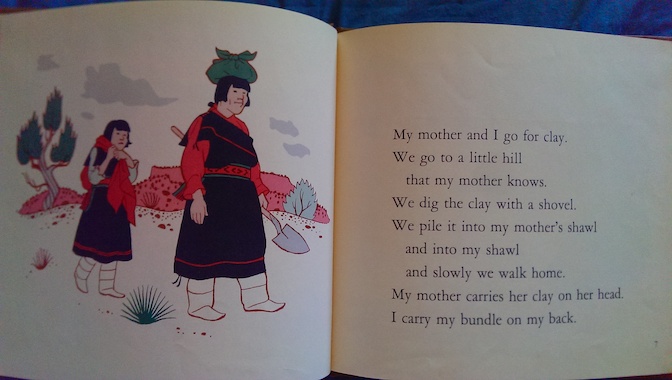
PotteryMakerGettingClay

The young girl tells the story of how her mother introduces her to the traditional craft of making pottery and teaches her how to make her first pot.  She describes every step in the process, from when they collect the clay themselves from a hillside until the pot is finally complete.

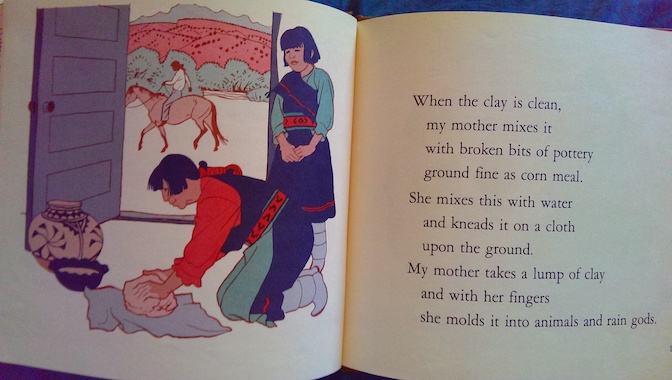
PotteryMakerMixingClay

The girl’s mother explains about the different methods used to make pots, and pictures show how pots are shaped.

PotteryMakerRollingClay
PotteryMakerMakingPots

Making pottery is a long process that takes days to complete, including shaping, scraping and smoothing the sides, drying, decorating, and finally firing the pottery.  The girl is proud of the first pot she has ever made.

PotteryMakerFiringPots

I found this book at a thrift store a number of years ago and recognized it because I already owned a related book, The Little Indian Basket Maker, that I liked when I was a young child.  I hadn’t realized then just how old the books were and that there were more of them by the same author.

The book, which was written in the mid-1950s, was one of a group of stories (not exactly a series because they didn’t have a specific set of characters in common and the themes varied somewhat) written by a woman who was a teacher with the United States Indian Service.  The other books that she wrote, including The Little Indian Basket Maker, focus on members of different Native American tribes.  She was not Native American herself, and the modern view of Indian schools is not favorable (for good reasons), so one might be a little suspicious of a book written about Native Americans by an Indian school teacher. However, these books interest me because of their explanation of traditional crafts. There are no white people in the stories at all, and they have a timeless quality to them.  Reading them, it’s hard to get a sense of exactly when the stories take place because it’s never mentioned, and there aren’t many clues (no mentions of modern technology, it’s all about the crafts).  I haven’t found any of the other books that the author wrote, but these two are very respectful in their tone, and they begin with explanations of the history of the tribes involved in the stories.  According to Andie Peterson in A Second Look: Native Americans in Children’s Books, the author was deliberately trying to write books that her Native American students could relate to.

The art style of the books vary because they had different illustrators.  The illustrator for this particular book was not Native American (unlike some of the illustrators of other books), but he was adopted into a Hopi tribe, apparently as an adult because of his accomplishments in representing Hopi culture in art.

The Legend of the Bluebonnet

LegendBluebonnet

The Legend of the Bluebonnet by Tomie dePaola, 1983.

This is a story about the Comanche People in what is now Texas, based on an old folktale.

There has been a severe drought and famine in the land for a long time, and many people have died.  The survivors pray to the spirits for help in ending the drought, and they receive a sign that it will not end until someone among the Comanches makes a sacrifice of the thing that is most dear to them.

LegendBluebonnetShaman

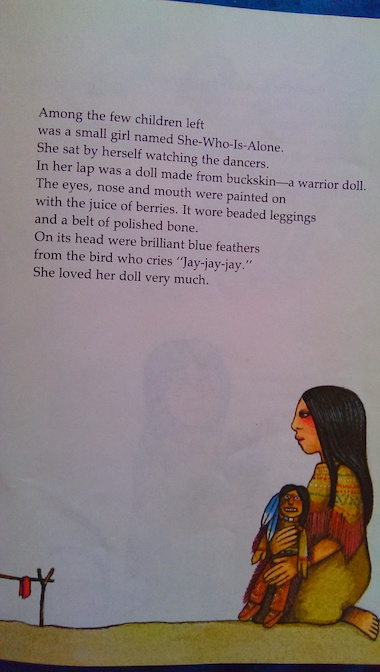
The people debate about who is supposed to make the sacrifice and what object the spirits could want, but one young girl thinks that the spirits are talking about her and her doll.  The girl is called She-Who-Is-Alone because she is the last of her family.  Her parents and grandparents are dead, victims of the famine.  The only thing she has left to remind her of them is her doll, a warrior with blue feathers in its hair, that her parents made for her before they died.

Desperate to end the drought and famine and to save her people, the girl makes the difficult decision to sacrifice her doll by burning it.  Her sacrifice is rewarded not only by the end of the drought but by the sudden appearance of a field of flowers as blue as the feathers in her doll’s hair.  The girl receives a new name from her people, acknowledging her sacrifice on their behalf.

LegendBluebonnetFlowers

A section in the back of the book explains a little about the Bluebonnet flower, which is the state flower of Texas, and the origins of the story in the book, which is based on a folktale.  This is also a little information about the Comanche People.

The book is currently available online through Internet Archive (multiple copies).

Meg Mackintosh and The Mystery at the Medieval Castle

Meg Mackintosh Mysteries

MMCastle

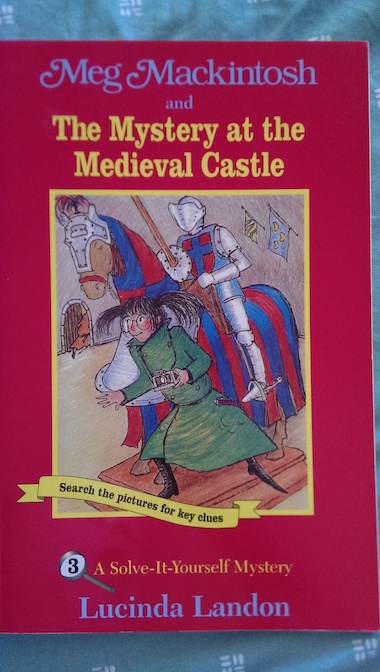
Meg Mackintosh and The Mystery at the Medieval Castle by Lucinda Landon, 1989.

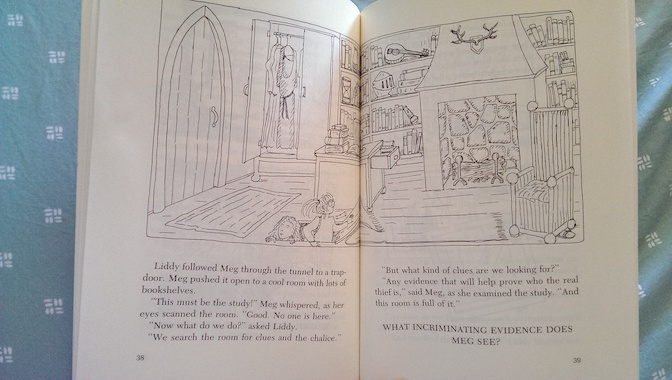
Meg is visiting Dundare Castle with her teacher and some other students.  Dundare Castle is a special museum where people can learn about life in Medieval times, although it used to be a private home.  The owner’s family came from Scotland, and they built their home to look like their ancestors’ castle there.  Eleanor, the owner, now calls herself the Duchess of Dundare, and with her staff, dresses up to recreate the lives of people from the 1300s.

MMCastleTour

One of the Duchess’s prized possessions is a silver chalice studded with jewels that has been in her family for generations.  She keeps it on display in the castle’s “abbey,” guarded by the actor playing the part of a knight, Knight Henry.  But, when Meg and her classmates get to the abbey, the chalice is gone, and Knight Henry is lying on the floor, unconscious!

MMCastleTheft

Not long before they found Knight Henry, the kids had seen a robed figure run across the courtyard.  Monk William falls under suspicion, although the Duchess doesn’t really believe that he is guilty because he’s been with her family for a long time.  There are other possible suspects, and Meg believes that both the thief and the chalice are still in the castle.

The book is currently available online through Internet Archive.

MMCastleSearch

My Reaction

I love this series because the books are interactive, giving readers the opportunity to figure out the clues and solve the mystery along with Meg. As Meg interviews the other actors in the castle and explores every room, readers are invited to study the pictures and consider the evidence to see if they can solve the mystery before Meg can.  At various points in the story, there are questions for the reader to consider, giving them the chance to pause and see if they’ve noticed what Meg has seen. I recommend that adults who are introducing children to the mystery genre read a couple of these stories along with them and discuss the clues as they go, helping children to learn how to notice details, solve puzzles, and think critically. It’s a good learning opportunity as well as a fun mystery!

The Egypt Game

EgyptGame

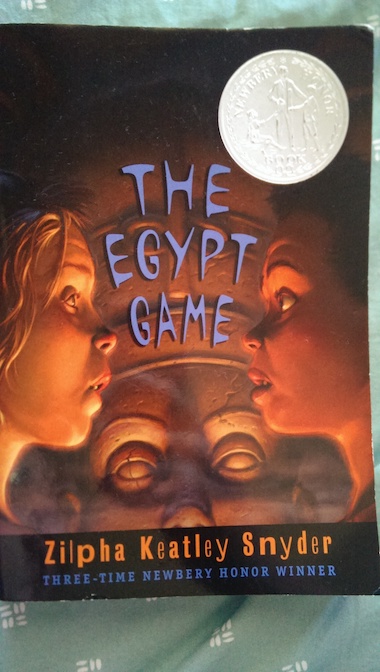
The Egypt Game by Zilpha Keatley Snyder, 1967.

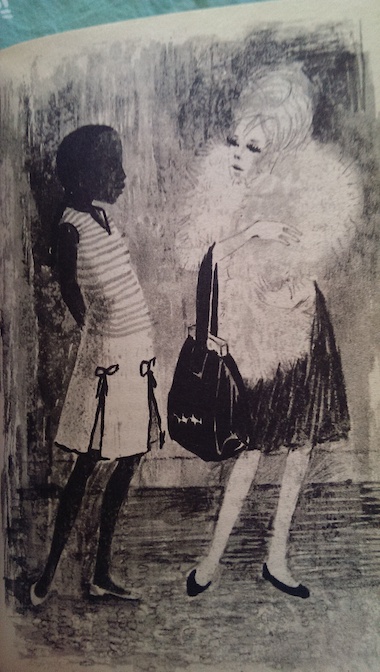
EgyptGameGirlsApril Hall has come to live with her grandmother (the mother of her deceased father) because her actress mother is touring with a band as a singer.  April’s mother isn’t a big star, although April likes to brag about her and their Hollywood life.  Really, her mother is mostly a vocalist who occasionally gets parts as an extra, hoping for that big break.  April is sure that when her mother gets back from her tour, she will send for her, and they will live together in Hollywood again. Although, from the way her grandmother behaves, it seems as though April may have to prepare herself for living with her for the long term.  April resents her grandmother’s apparent belief that her mother has dumped her because she is unwilling or unable to take care of her.

April is homesick and misses her mother.  To hide her feelings, she tries to act grown-up and ultra-sophisticated, which makes most people regard her as a little weird.  In spite of that, she makes friends with a girl named Melanie, who lives in a nearby apartment and sees through April’s act to her insecurity and creative side.  April has never had many friends (partly because of her mother’s chaotic lifestyle), but Melanie appreciates April’s imagination.  The two girls realize that they both like playing games of pretend and they both have a fascination with Ancient Egypt.  They go to the library and read everything they can find about Egypt, and it sparks the best game from pretend they’ve ever played.  Along with a few other friends, they start pretending to be Ancient Egyptians, building their own Egyptian “temple” and holding rituals in the old junk yard behind a nearby antique shop.

On Halloween night, the adults try to keep the children together in groups for safety, but the “Egyptians” sneak off alone to conduct one of their “rituals.”  It’s a dangerous thing to do because a child has been murdered in their area.  A young girl who was apparently abducted was later found dead, and people are frightened that other children could be in danger.  Fortunately, the only thing that happens on Halloween is that the Egyptians recruit a couple of new members when some boys from school find out what they’re doing.

However, the game starts taking on a life of its own when it seems that some other, unknown person has also joined in.  As part of their game, the children make up a new ritual and write messages to their “oracle,” asking questions that they want answered. To their surprise, someone starts writing replies.  Whoever is playing oracle and answering their questions, it doesn’t seem to be a child.

EgyptGameRitual

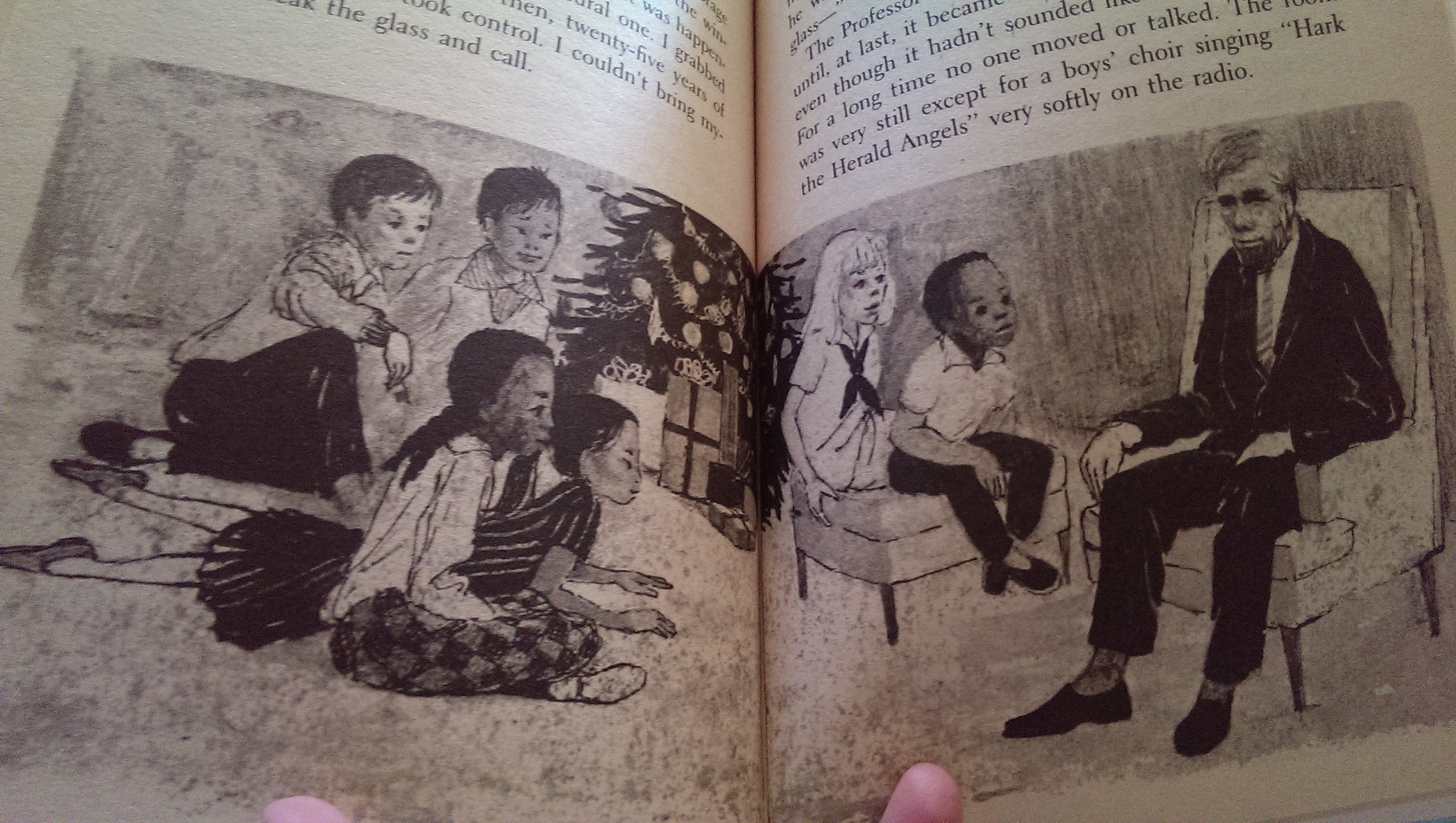
EgyptGameCostumesThe children are uneasy about this unexpected game player because frightening things are happening in their neighborhood.  The kids wonder if the mysterious messages could be from the crazed killer who murdered the young girl. People have been looking suspiciously at the loner who owns the antique store, an older man who everyone calls the Professor.  However, the kids have become too enmeshed in the Egypt game to give it up in spite of their fears.
When April slips out one night to retrieve a text book she left in “Egypt,” she comes frighteningly close to being the killer’s next victim.

This is a Newbery Honor Book.  It is currently available online through Internet Archive (multiple copies).  There is a sequel called The Gypsy Game.

My Reaction

Although there are mysteries in the story (who killed the girl and who the unknown player of the Egypt game is), the development of the characters, especially April, is really at the heart of the story.  All through the story, what April wants most is for her mother to come for her and take her home again.  April fears that her mother doesn’t love her or want her, and at first, that keeps her from even trying to love the grandmother who took her in and really wants her.  However, she finds comfort when she realizes that she is creating a new life with her grandmother and friends, who really care about her.  Her mother does write to her later about coming to stay for a brief visit with her and her new husband (her acting manager, who she married on short notice without even telling April or inviting her to come to their wedding), but by then, April has started to feel at home in her new home and wants to share Christmas with the people who have been sharing in her life and adventures more than her mother has.  She never even tells her mother about her brush with death.

EgyptGameChristmas

The characters in the book are diverse, representing different racial backgrounds, ages, and family situations.  Melanie and her younger brother are African American.  Melanie understands more about human nature and how the world works than April does, partly because her mother talks to her about people and explains things.  Melanie realizes from the way that April behaves and how she doesn’t understand certain things, like the fact that there disturbed, dangerous people in the world, that her mother never really talked to her much or explained things when they were living together.  Melanie helps to ground April’s more flighty, insecure personality.  She joins in her imagination games eagerly, but she also helps to bring April more into sync with reality and other people.

The first new player they add to the game, Elizabeth, is Asian and lives with her widowed mother and other siblings.  Like April, she is a little lonely and looking for new friends in her new home.  Each of the kids, like April, have their own inner lives and personalities.  The Egypt game binds them together and provides them with friendship and insights into their lives.