Secret of the Tiger’s Eye

tigerseyeSecret of the Tiger’s Eye by Phyllis A. Whitney, 1961.

Benita Dustin’s father is a writer, just like she hopes to be one day. When her father announces that they will live for a year in South Africa with his Aunt Persis so that he can do research, it sounds like a grand adventure. The trouble is that her father’s editor has given permission for her son, Joel, to accompany them because she thinks the experience would be good for him, too. Benita’s little brother, Lanny, gets along well with Joel, but Benita and Joel fight and tease each other almost constantly. Benita gets annoyed with Joel’s obsession with facts and information, and Joel thinks that Benita’s stories and flights of fancy are silly.

Aunt Persis’s house is wonderful with a beautiful tower room where Benita is allowed to stay. There is even a fantastic story about the ghost of a tiger that Aunt Persis’s husband shot years ago in India haunting the grounds of the house and the little cave in the garden. Although Joel scoffs at the idea of a tiger ghost, Benita is captivated by the story, especially when strange things begin to happen around the house. Benita learns about the tragic death of Aunt Persis’s adopted son, Malcolm, and the strange theft of the emerald diadem that Aunt Persis received from the rajah that her husband saved from the tiger years ago. However, she will need Joel’s help to make sense of the situation, a difficult prospect at the best of times but almost impossible to ask for after Joel plays a cruel joke on Benita and tries to get Lanny to help gang up on her.  Then, Benita’s father tells her something that changes everything, and all the time, someone with sinister intentions is watching and waiting . . .

The book is available to borrow and read for free online through Internet Archive.

My Reaction

Besides the mystery, there is also a subplot about the nature of hate and prejudice. In South Africa, at the time the story was written, apartheid was still in force. Benita makes friends with a girl of mixed race called Charis, and they talk about racial issues in South Africa and the U.S. during the 1960s. Although Benita wouldn’t think of being prejudiced against anyone on the basis of race, she finds it harder to understand people with different personalities, like Joel.  Although the story focuses on Benita and the lessons she learns, I personally found Joel and his mistakes harder to accept.  Both Joel and Benita need to learn to be more understanding of each other, but in a way, I think Joel is worse because of his deliberately cruel pranks and because he already knows a couple of things that Benita doesn’t which should have influenced his behavior. Joel is deliberately trying to pick fights, and the book never really explains what he expected to accomplish by that.  Everyone needs a motivation, and Joel never really explains his, so he comes off seeming like he’s just there to be a mean character for no real reason.

I also wish that the parents in the story had more frank and straight-forward discussions with the kids.  As a professional writer and a professional editor, they should have been able to settle the kids’ arguments about imagination vs. facts or at least put the situation into perspective by explaining what they do in their jobs.  After all, Benita’s father is going to South Africa specifically to do research.  In other words, even fiction writers need to have a nonfiction background and real facts to use as a basis for their fictional stories.  Realistic backgrounds give stories the grounding they need in order to feel real to readers.  (Although that does depend somewhat on the type of story.  Fantasy stories don’t need to be based on real life, although they do have to have a consistent logic within the story so readers feel like they can understand the world in which the stories take place and the rules by which the magic in the story works.  If the story is meant to be surreal, the internal logic can be more loose.)  Editors, like Joel’s mother, fact check stories as well as ensuring that they are compelling for readers, helping to make decisions about where fictional stories need to be factually correct and where the author can depart from the facts for the sake of the story.  I think that Benita and Joel really should have had a better grasp of their parents’ professions and the balance between fact and imagination in fiction.  Of course, if they did, there would be less conflict in the story.

Fortunately, Benita and Joel work out their differences while confronting the mysterious situation and become friends when they learn to allow each other to be themselves and to appreciate each other’s good points.
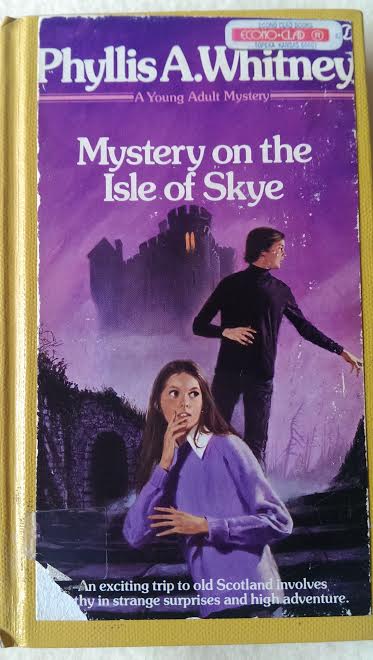
Mystery on the Isle of Skye

mysteryisleskyeMystery on the Isle of Skye by Phyllis Whitney, 1960.
Cathy MacLeod has lived with her grandmother for years, ever since her parents died when she was very young.  Now, her grandmother is very ill and will probably have to live in a nursing home.  Cathy needs to find a new place to live, and her relatives are debating about who is going to take her.  So far, the only relative who has offered her a home is Aunt Bertha.  Cathy isn’t enthusiastic because Aunt Bertha only has a tiny apartment where she lives alone, and she’s only offering Cathy a home out of duty, not real affection.  Aunt Bertha hasn’t spent much time around children and doesn’t really understand them.

But, there is one other prospect.  Cathy’s other relatives, the Corbins, are taking a trip to the Isle of Skye, where Cathy’s grandmother came from originally, and her grandmother has arranged for Cathy to go with them while Aunt Bertha is on a business trip.  Uncle Jerry (Cathy’s mother’s brother) and Aunt Lila Corbin have two boys of their own, Don (who is about Cathy’s age) and Humphry, who goes by the nickname of Punch.  Cathy is happy about the chance to go with them to visit the island that her grandmother has told her so much about.

At first, Cathy feels a little awkward around the Corbins because she doesn’t really know them, and they don’t know her.  Aunt Lila is warm and welcoming to Cathy, but Uncle Jerry is a tease.  Don is a tease as well and very impatient with the whole idea of the trip.  He doesn’t care about the history or legends of Skye as much as Cathy does.  His only real interest is in photography.  Young Punch is friendlier, sharing the excitement of the trip with Cathy.

Before they left on the trip, Cathy’s grandmother gave her a mysterious box to take with her.  Cathy doesn’t quite understand it at first, but the box contains several smaller packages with instructions to open them at different times during the trip.  Some of the instructions are vague and force her to rely on other people to tell her when to open them and what to do with the contents.  The packages are part present, part “spell.”  Thanks to them, Cathy makes new friends in Skye and goes on an adventure that she will never forget.

My Reaction

There is no real magic in this story, no real magic spells, and there actually isn’t much mystery either, except for the mystery Cathy initially feels about what’s in the packages and what their real purpose is.  Cathy’s grandmother has a love of legend and mystery, and these special gifts are meant to serve special purposes: to acquaint Cathy more with her past on the Isle of Skye and share some special memories, to heal Cathy’s sadness, to help draw her closer to her other relatives, and perhaps, to help her find her way to a brighter future than the one she currently thinks is waiting for her back home.

The packages help Cathy to bond with her aunt, uncle, and cousins.  They’re meant to be a shared activity.  She has to open certain packages with certain relatives, and they have to take her to certain places to do certain things with the contents.  These shared experiences help draw them closer to each other.

Although this story doesn’t follow the traditional mystery format and it can’t even be called fantasy or pseudo-fantasy, it’s enchanting because of the subtle hints of mystery and fantasy surrounding Cathy’s surprise packages.  Readers get to wonder alongside Cathy what’s in them and where they’re going to lead her.  It’s a little slower and more subtle than most modern children’s books, but I find it refreshing and magical for those reasons.

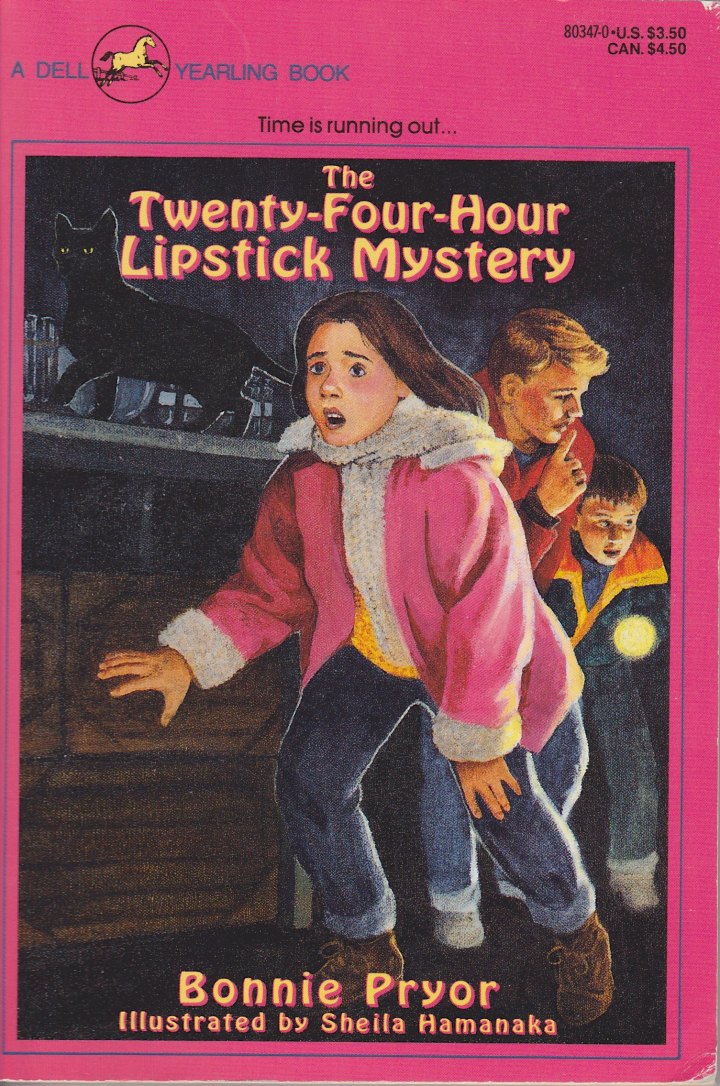
The Twenty-Four Hour Lipstick Mystery

24hrlipstickmysThe Twenty-Four-Hour Lipstick Mystery by Bonnie Pryor, 1989.
Cassie Adams, who is eleven years old, has never been happy with her looks, and now that her friends are starting to shave their legs and get interested in boys, she feels plainer than ever. One day, she sees an ad for Mrs. DuPrey’s School of Beauty and Charm and thinks that it might help her improve her appearance and develop confidence. The only problem is that she doesn’t have the money for it, and her parents won’t give her any. She decides that she needs to look for odd jobs in the neighborhood to help raise the money that she needs.

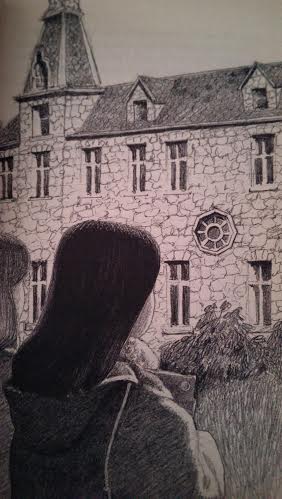
By coincidence, old Mr. Murdock’s granddaughter has recently moved into the old family house, which is huge and reputed to be haunted. In spite of the creepiness of the old place, Cassie finds a job there, helping Miss Murdock with cleaning and unpacking. Miss Murdock’s father made his money in cosmetics, and Miss Murdock employs a secretary named Victoria Presser, who used to be a model. Cassie admires Vicky for her beauty and elegance and looks forward to picking up some beauty tips from her. She also makes friends with Jason, a new boy in town, who also works for Miss Murdock, helping the gardener fix up the grounds. However, it isn’t long before Cassie, Jason, and Cassie’s younger brother, Danny, begin noticing that there is something odd about the old Murdock house.

lipstickmysterypicDanny is the first to notice that there is an octagonal window in the wall of the house, but none of the rooms has a window in that shape. Sometimes, lights can be seen through this window at night. Also, Cassie finds what looks like lab equipment among Miss Murdock’s boxes. Is Miss Murdock involved in something illegal? Does it have something to do with the burglaries that have been occurring around town? Why is the grumpy old gardener sneaking around? Just what is in that hidden room?

The book is currently available online through Internet Archive.

My Reaction

This is a good mystery for tween and early teen girls, who can identify with Cassie’s worries about being beautiful and popular. The moral of the story is that appearances are deceiving, and in the end, Cassie reconsiders what beauty really is and develops more confidence by appreciating the good qualities she already has and developing new interests.  While some of the other girls try to show how grown-up they are by looking grown-up, Cassie really grows up by taking responsibility for her life and the direction she wants it to go, making decisions about what she wants and who her real friends are.

Mystery at Camp Triumph

camptriumphMystery at Camp Triumph by Mary Blount Christian, 1986.

A year ago, sixteen-year-old Angie was blinded in a car accident.  It was shocking and devastating for her, especially since she was planning to become an artist.  She loved painting, and she feels like all of her dreams have died since she became blind.  Many of her friends no longer speak to her (partly because she has become angry and bitter and they don’t know how to cope with it), and she refuses to return to her old school, partly because of her fears of not being able to cope and largely because she doesn’t want to be the subject of ridicule or pity because of her new disability.  Her mother has been tutoring her at home, and her parents argue frequently about what’s best for her.

On the advice of a psychologist who has been trying to help Angie during her difficult adjustment, Angie’s parents have decided to send her to a special camp for children with disabilities called Camp Triumph.  Angie makes it plain that doesn’t want to go.  She feels that going to the camp with other disabled kids will just a painful reminder that she’s no longer “normal”, and she can’t imagine that there will be anything fun that she can do at a camp now that she can no longer see.  She knows that she’ll never be able to paint again, so she thinks arts and crafts are out, and how can she possibly ride a horse or go on nature walks?  However, her parents are firm with her, telling her that this is for the best.  There are things Angie needs to learn that they can teach her at camp.

Angie’s first days at the camp are miserable.  The other campers try to make friends with her, although she tries their patience with her bitterness and complaining that she doesn’t want to be there.  Then, someone messes with the guide ropes put up to help the blind children find their way around, sending a frightened Angie plunging into the river on her way back to her cabin.  Although she isn’t hurt, she becomes convinced that the camp is dangerous.  Everyone else thinks it was just a mean-spirited prank by one of the other campers.

Then, while visiting the doctor in town, Angie overhears a conversation between people she whose voices she doesn’t recognize, learning that what happened to her wasn’t just a prank.  Someone is deliberately committing acts of vandalism and sabotage at the camp, trying to get it shut down.  But why?   Angie flees the scene when she realizes that the people who were talking have heard her.  Unfortunately, she drops her cane as she flees.  Her cane has her name and address on it, and Angie later finds it lying on her bed in her cabin at camp.  Whoever these mysterious people are, they know who she is and can find her at any time.  Can Angie convince the other campers of what she heard and find the culprits before something worse happens?

Angie is terrified as she tries to solve the mystery, feeling helpless against her unknown enemies, who can see her while she can’t see them.  But, with the help of her new friends at camp, she comes to realize that she isn’t as helpless as she thinks she is.  Her experiences give her a new perspective on her life.  It’s true that things will never go back to being as they were.  Her life won’t be an easy one, and there are certain things that she can no longer do.  But, she comes to realize that there are still many things she can do, and there are other types of art that are still open to her.  In the end, Angie has friends she can count on, a life that’s worth living, and a better future ahead of her than she thinks.

Along with the story, the book describes some of the techniques that Angie has to learn to cope with her blindness: picturing a “clock” to remember the positions of objects around her (ex. “Your suitcase is at two o’clock.”), following the guide ropes with notches in them to know which path she’s on, listening for clues about her surroundings (she and other blind people recognize the sound of clinking from the flagpole at the center of camp and use that to orient themselves when things get confusing), putting notches in the tags of her clothes so that she knows which pieces of clothing match, using her sense of touch to make clay sculptures, etc.

Besides addressing Angie’s feelings and how she copes with them, the story also touches on how disabilities affect the people who are close to the disabled person.  At first, Angie’s parents don’t know how to help her, struggling themselves with coming to terms with what’s happened.  Her mother feels guilty because she was driving the car when they had their accident, and she wasn’t as badly hurt.  Her guilt leads her to baby Angie more than is good for her.  Angie’s father is a stern businessman with high ambitions, failing at first to understand and accept Angie’s feelings and the way her life has changed, reacting with impatience while Angie struggles.  Angie’s parents also had marital problems before the accident, which only added to the tension between them.  In the end, coming to terms with what has happened to Angie not only helps Angie to improve but helps her parents to improve their relationship with each other.

The book is currently available online through Internet Archive.

Cousins in the Castle

cousinscastleCousins in the Castle by Barbara Brooks Wallace, 1996.

Young Amelia Fairwick is living a happy life in London with her father and her father’s fiancée, Felicia, when her father leaves on a business trip and word reaches her that he has been killed in a hotel fire. Now, the poor orphaned girl must go live with her deceased mother’s cousins in New York. Amelia leaves behind everything that is familiar to her when she accompanies her stern and gloomy Cousin Charlotte on the ship to New York.

On the ship, she makes only one friend, a young actress and singer named Primrose Lagoon, whom Cousin Charlotte forbids her to see. Although the future looks gloomy for Amelia, there are far stranger and more sinister events in store for her. As soon as they reach New York, Cousin Charlotte abandons Amelia on the docks. A kind woman named Nanny Dobbins and her son offer help her, only to steal her luggage and make her a prisoner in a small cellar in a bad part of town.

When her jailer, the drunken Mrs. Shrike, falls asleep, leaving the door open, Amelia escapes and attempts to find Primrose, her only friend in the city. Throughout Amelia’s adventures, she doesn’t know who to trust, and every step she takes seems to bring her closer to the mysterious Cousin Basil, who is supposed to be her guardian, and his castle-like home.

The time period for this story is never exactly defined, but it appears to take place during the 1800s because of the gaslights in use.  Like many of Wallace’s books, things and people are not what they seem, but in spite of the villain’s sinister intentions, it all ends happily.

Ghosts in the Gallery

ghostsgalleryGhosts in the Gallery by Barbara Brooks Wallace, 2000.

Eleven-year-old Jenny was raised in China by her mother and stepfather, who ran a dance studio. She has no memory of her real father, who died when she was a baby. When her stepfather dies and her mother becomes deathly ill, her mother writes a letter to her real father’s father, a grandfather that Jenny never even knew existed before. In the letter, her mother explains that she is dying and that she will be sending Jenny to live with her grandfather. Then, Jenny starts the long journey from China to the East coast of the United States alone.

Leaving her dying mother to head to a strange country to live with her previously unknown relations is frightening enough, but there is still worse to come. When Jenny arrives at her wealthy grandfather’s home, no one is expecting her or knows who she is. Her uncle, Winston Graymark, insists that her mother’s letter never arrived. Worse still, he believes that Jenny is an imposter, and that her mother merely made up the story about his long-lost brother being her father.

At first, he angrily threatens to send Jenny back to China, but Madame Dupray, a servant who cares for Jenny’s ill grandfather, suggests that she be taken on as a household servant. Jenny is given a dreary little room in the cellar and embarks on the drudgery of household chores. Could the Graymarks really be her relatives? If so, what happened to the letter that Jenny’s mother sent? Something sinister is happening in Graymark House, and Jenny will have to face suspicious servants and attempted murder before she finds the truth.

The “ghosts” in the title are the portraits of Jenny’s ancestors, which hang in the gallery. They appear grim and frightening at first, but when Jenny begins to recognize them as her relatives, they no longer frighten her.  Like many of Wallace’s books, this book contains sinister characters with hidden motives, but ends happily.  The story takes place at some point during the Victorian era.

Peppermints in the Parlor

peppermintsparlorPeppermints in the Parlor by Barbara Brooks Wallace, 1980.
Newly orphaned Emily Luccock journeys to the home of her Aunt and Uncle Twice in San Francisco. She has not seen her aunt and uncle in years, but they are the only family she has now, and she hopes that she will soon feel at home in their lovely mansion, Sugar Hill Hall.

Upon arriving in San Francisco, however, she is met by her Aunt Twice, who seems to be a pale shadow of the woman she once was. Sugar Hill Hall is now owned by the sinister Mrs. Meeching, and Aunt Twice is forced to work as a cook and housekeeper. Aunt Twice seems very frightened of something, but she refuses to say exactly what she fears, and Uncle Twice is nowhere to be found.

Aunt Twice tells Emily that her wealthy parents lost all their money before they died, and she is now poor, too. Emily is quickly put to work as a housemaid alongside Tilly, another orphan girl. Her only real friend is Kipper, a fishmonger’s son who is paid to do chores around the mansion sometimes. The house is being run as a home for elderly people, but the elderly people are treated badly, fed rotten food, and punished severely for even so much as taking a single peppermint from the bowl in the parlor. Emily tries to do little things to make the old people happier, but all the time, she is right at the center of all the sinister events surrounding Sugar Hill Hall.

The book is available online through Internet Archive.

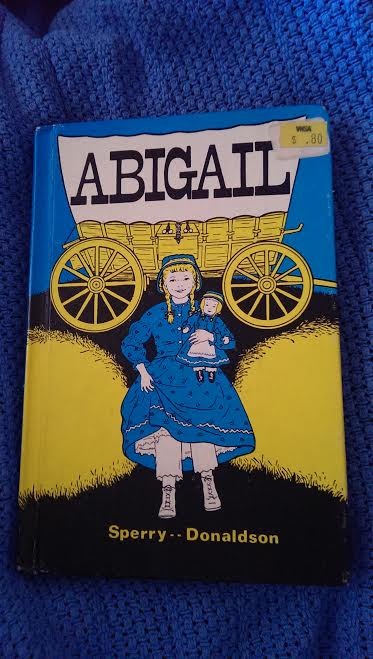
Abigail

abigailAbigail by Portia Howe Sperry and Lois Donaldson, 1938.

Susan is a little girl living on a farm in Kentucky during the 1800s.  Her family has recently decided to move to Indiana, which is the new frontier of the United States.  Her uncle and his family are already living there, and he has persuaded Susan’s parents of the opportunities that await them.

As the family packs up to leave, Susan’s grandmother gives her a special present that she and Susan’s aunt made for her: a new doll.  Unlike Susan’s old wooden doll, this doll is a soft rag doll that she can sleep with.  They made the doll to look like Susan herself, but Susan names the doll Abigail after her grandmother.

Abigail accompanies Susan on her adventure as the family heads west to Indiana in their covered wagon.  Susan is sad and a little afraid at first, but when she thinks of what Abigail would say to her about her need to be brave and to explain to her all the strange things they will encounter on the journey, Susan regains her courage.

The family does have adventures on their two-week trek to Indiana.  They have to cross rivers, face down a bear, and worry about whether they will encounter unfriendly Indians (Native Americans).  Even after they arrive in Indiana, joining their other relatives, they will still have to get used to life in a new place.

Throughout the book, there are little side-stories, poems, and hymns that the family sings and tells each other.  Through it all, Abigail is Susan’s constant companion, helping her to feel at home in her new home.  I loved this book when I was a child because I always loved dolls.  This book was a bigger part of my youth than the Little House on the Prairie series, but it would probably appeal to Little House on the Prairie fans.

The book is available to borrow and read for free online through Internet Archive.

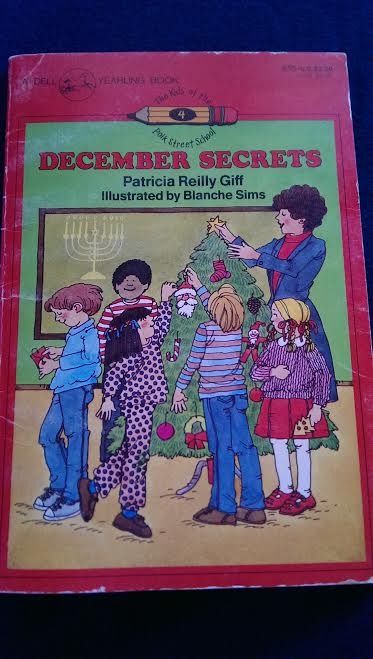
December Secrets

The Kids of Polk Street School

decembersecrets#4 December Secrets by Patricia Reilly Giff, 1984.
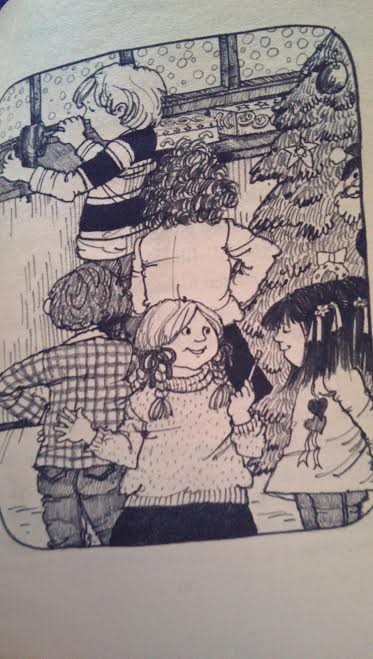
It’s December, and the kids in Ms. Rooney’s class at Polk Street School are learning about Christmas and Hanukkah.  To get everyone in the holiday spirit, Ms. Rooney has everyone choose someone else in class as their “Secret December Person,” kind of a Secret Santa-style activity.  The kids will give small presents and do nice things for the person they pick.

Emily would have picked her friend Dawn for her person, but they’ve been fighting since Emily wouldn’t let Dawn cut in front of her in line when the fire truck came to school and the kids who were first in line were allowed to actually get in the front seat.  Emily tries to pick someone else to be her Secret December Person, but her other favorite choices are taken.  When she asks Ms. Rooney who is still available, Ms. Rooney suggests Jill Simon.

decembersecretspicEmily doesn’t think much of Jill Simon because she’s fat and a crybaby.  Whenever the least little thing goes wrong, Jill tears up.  She hardly ever smiles.  But, although Emily isn’t thrilled at first to have Jill as her Secret December Person, she then thinks that she can use this as an opportunity to help Jill.  Maybe her presents will help Jill to become a happier, maybe even thinner person.
The book is available to borrow and read for free online through Internet Archive.

My Reaction

Although Emily wants to help Jill, her first attempts fall flat because she’s focusing too much on correcting Jill’s faults instead of thinking about what would really make Jill happy.  Jill becomes a happier person when Emily notices the good things about Jill and helps her to see them for herself.  The project helps Emily to become a more thoughtful person, and she also makes a surprising discovery about the Secret December Person who has been leaving thoughtful presents for her.

The reason why it has to be “Secret December Person” instead of “Secret Santa” is because there are both Christian and Jewish children in the class.  That’s why the kids learn about both Christmas and Hanukkah.  They don’t want anybody to feel left out.  The name “Secret December Person” is a little cumbersome next to “Secret Santa”, but the sentiment is nice.  I don’t recall doing anything like this as a class activity when I was in elementary school.  I remember that I was in first grade when a Jewish girl and her mother explained Hanukkah to the class.  They gave everyone small plastic dreidels to play with, and I spent the Christmas holidays that year playing dreidel with my brother for peanuts and M&Ms.  They were just little party favor dreidels, but I had a lot of fun with mine, and I still have it.  Sometimes, little presents do mean a lot.

The Bogeyman Caper

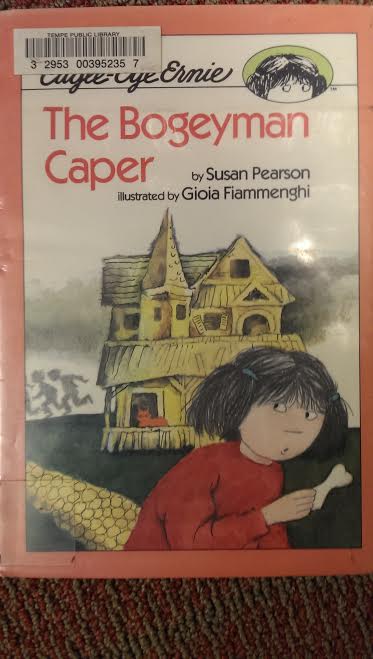
eeebogeymanThe Bogeyman Caper by Susan Pearson, 1990.

This is part of the Eagle-Eye Ernie  mystery series.

Everyone says that the old yellow house in their town, White Bear Lake, Minnesota, is inhabited by a bogeyman, but Ernie doesn’t believe it. She decides to prove to her friends that there is no bogeyman in the old house.

Ernie finds ways for her and her friends to keep an eye on the house.  At first, all they see is a creepy-looking old cat. Then, William finds a strange bone in the yard, and Ernie sees a red glow inside and hears tapping sounds. Are her friends right about the bogeyman, or is there another explanation?

Ernie uses her powers of observation to determine that many of the spooky things about the house and its new owner are actually familiar, both to herself and her friends.

The book is available to borrow and read for free online through Internet Archive.