Five Secrets in a Box

This story is about Virginia Galilei (1600-1634), the eldest child of Galileo Galilei, and her perception of his work and equipment as a young child. The book has sections of historical information about Galileo and Virginia in the front and the back inside cover, although the story itself is just about Virginia exploring Galileo’s study.

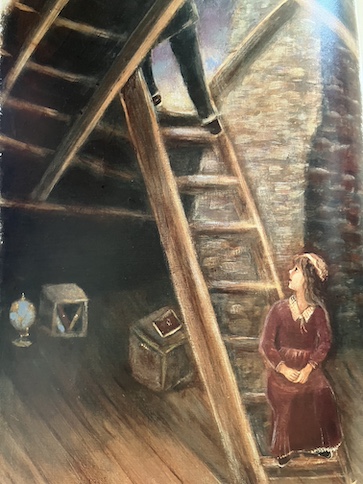
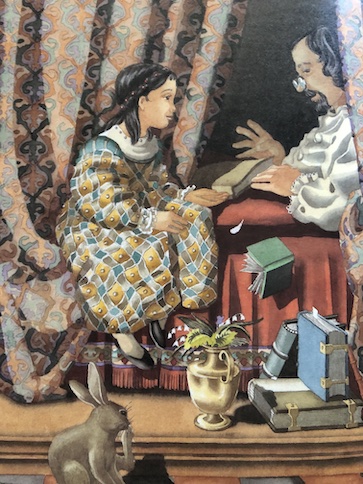
Virginia, as a young child, knows that her father stays up late at night, studying the night sky, while she is asleep. During the day, she must be quiet to let him sleep. She is not really supposed to touch his scientific instruments, but she can’t resist the temptation to take a look. In her father’s study, she finds a box with five mysterious objects in it, and she investigates what they do.

One of them is a lens that makes small things look bigger. Another is a lens that makes things that are far away look closer. There is another lens that makes everything look blue and another that makes everything look red. Then, there is also a plain, white feather.

Virginia wonders what the purpose of the feather is, and she asks her father about it. He tells her that it is important to his work.

The book is available to borrow and read for free online through Internet Archive.

According to the historical information provided, little Virginia’s mother left Galileo and married someone else while Virginia was still young. Virginia remained living with Galileo and was close to her father. When she was 12 years old, her father sent her to a convent, which was a fairly common way for upper-class girls at that time to get an education. However, Galileo probably intended for his daughters to join the Church as nuns rather than marrying when their education was complete. The book doesn’t explain this, but Virginia and her younger brother and sister were born out of wedlock. Because they were illegitimate (born outside of a legally-recognized marriage – the word “illegitimate” literally refers to someone born outside of the law and legal standing with implications about both the legal status of their parents’ union and the child’s possible future inheritance, depending on the laws of that particular society), their social status was compromised from birth. Galileo believed that it would be difficult for his daughters to find husbands, so joining a convent and becoming nuns would provide the girls with stable lives and careers as well as an education, which is what both of them did. Virginia remained at the convent as a nun, taking the name of Sister Maria Celeste, and unfortunately, died relatively young at the age of 34. The book doesn’t say why, but it was because she contracted dysentery, which is caused by consuming tainted water or food.

The story itself doesn’t really explain the purpose of the five special objects that Virginia examines in her father’s study. Some of them are obvious because readers will recognize what they are and the way they work. The purpose of the feather is left a little mysterious at the end, but readers get the full explanation by reading the section of historical information. Galileo was studying gravity, and apparently, he dropped objects off of the leading tower of Pisa to study how long it took them to fall. A feather will take longer to reach the ground than a stone, but that’s because of air resistance. One of Galileo’s premises was that, if there were no air to produce that air resistance, the stone and the feather would fall at the same rate of time due to gravity. I think I would have preferred to have Galileo explain some of this to his daughter when she asks him about the feather, but the story ends kind of abruptly at that point, with Virginia just playing with the feather. I felt like the ending isn’t exactly an ending without that explanation.

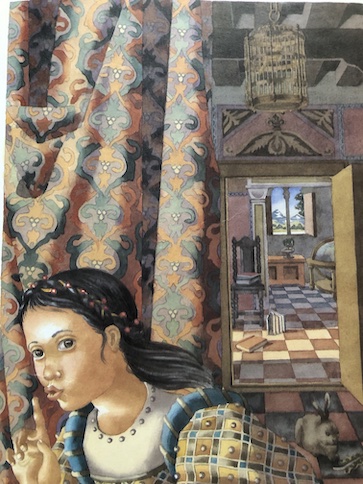
The pictures are the main reason why I really liked this book. They are colorful and realistic, and I thought they did a great job of showing the scientific instruments of the past. I also liked some of the little details of the house included in the backgrounds of the pictures. There is a crucifix hanging on the wall behind the telescope in Galileo’s study because this is a religious household, even though some of Galileo’s assertions about the way the world works clashed with Church teachings and got him placed under house arrest. (The book says that he was “sent to prison”, but he was actually placed under house arrest rather than being sent to a prison because he was elderly and in bad health by that point in his life.)

The book doesn’t go into detail about Galileo’s arrest because that happened later in his life, but he was basically considered a heretic for his belief in Copernicus‘s theory that the sun is the center of the solar system instead of the Earth. That sounds like a rather petty charge, and you might wonder why it matters or what different it could make to religion. It wasn’t a new idea because others had reached that conclusion long before him. Copernicus was never arrested for his ideas, partly because he didn’t live very long after he published them, but his book was placed on the restricted list by the Inquisition.

The reason why the relative positions of the sun and the Earth mattered depend on whether particular Biblical passages are meant to be interpreted literally or figuratively. Under a strict literal interpretation, which was the interpretation approved by the Church at that time, the conclusion was that the Earth was the center of the solar system, so saying otherwise would be to go against the Bible and Church teaching, making it a heresy. It wasn’t so much that the relative positions of the sun and the Earth were that important by themselves so much as the act of apparently contradicting the Bible. The Renaissance era was also the era of the Reformation, where Protestants were breaking away from the Catholic Church, partly because of the questions of literal interpretation of the Bible and Church doctrine. The Catholic Church’s response to that during this period was to become more strict in enforcing moral and doctrinal standards in the Counter-Reformation, so anything that seemed to challenge these aspects of the faith was taken far more seriously during this period. This stance would shift again later in history.

The background and aftermath to this story is far more complex than the story itself, although I think part of the charm of the story is it’s simplicity. This is one particular day and a small incident, seen through the eyes of a child, even though adult readers know that there are bigger events surrounding it.

Moonflute

One night, a little girl named Firen can’t sleep. It’s a hot summer night, the moon is full, and Firen feels like the moon has taken away her sleep, so she must go out into the night and look for it.

Outside, Firen raises up her hands to the moon and asks for her sleep back. The magical moon sends her a moonbeam, and when Firen touches it, she realizes that it’s solid. It’s actually a flute. When Firen plays the flute, it makes magical music that doesn’t sound like any normal flute, and it brings all sorts of wonderful smells of things that Firen loves. As she continues to play, she feels light and tingly, and she realizes that she is rising into the air!

Firen flies over the countryside, looking for her sleep. As she journeys through the night, she sees various animals and wonders if they have her sleep. She sees cats in a patch of catnip, whales playing in the ocean, and bats and monkeys in a jungle.

When Firen sees a couple of monkeys soothing a baby monkey to sleep, she thinks about her own parents and uses the flute to return home. Is the moonflute helping her find her sleep at home with her parents, or has she actually been asleep all the time?

The book is available to borrow and read for free online through Internet Archive.

This book follows the “It was all a dream” theme, where the main character experiences something fantastic, but they were dreaming all the time. While Firen was wondering where her sleep was, she apparently fell asleep. It isn’t definite that’s what happened, but it’s implied when her parents go to her room, and she’s in bed, without the flute. If readers would like to think of it differently, that Firen really did have her flying adventures, it’s possible to read it that way, too.

The pictures really make this book! The illustrations are oil paintings, and they are beautiful and ethereal. Firen witnesses some stunning scenes, like whales leaping in the ocean, with everything bathed in glowing moonlight.

I was intrigued by the name “Firen” because I don’t think I’ve heard it before, and I like unusual names. I couldn’t find much information about the name online, so it seems like it isn’t very common. I thought at first that it might be a modern, invented name, although one name site says that it has Arabic origins.

The Girl in the Castle Inside the Museum

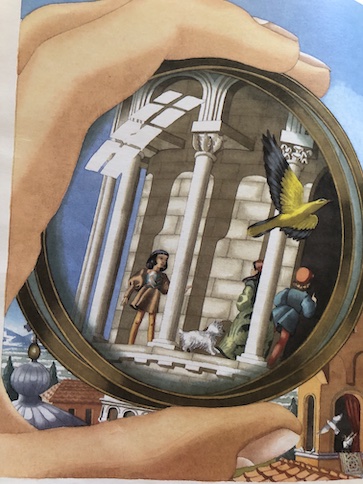
In this story, there is a little girl who lives in a castle in a museum, inside a big, glass globe.

Children love to come to the museum and look at her in her castle. The girl also likes it when the children come to see her.

Although the girl in the castle has other creatures to play with and things she likes to do, like making music, she sometimes gets lonely when the museum closes, and all the children go home.

When the girl in the castle dreams, she dreams of the children who come to visit her at the museum, imagining their journeys to come see her.

When the children are visiting or when she’s dreaming about them, the girl isn’t lonely, but when she wakes up from a dream and there aren’t any children, she gets lonely again.

However, the girl gets an idea. If you, the reader, want to be her friend, you can give her your picture. When she looks at your picture, she won’t be lonely anymore!

I love the surreal, fantasy pictures in this book! We don’t know exactly what the girl is or why this tiny girl lives in a miniature castle in a museum. The book says that people claim “she’s lived there forever.” She is alive and has feelings, but she seems to be surrounded by fantasy creatures as companions in her castle rather than other people. She doesn’t seem to have parents or family. My theory is that she is a magical, living toy because the museum seems to be filled with other toys, the fantasy creatures in her castle seem to be toys with little wind-up keys in their backs, and the castle itself incorporates little toys and odd-and-ends, like buttons and marbles. However, the girl’s backstory is left up to the imagination of the readers.

This book breaks the fourth wall of the book, with the girl inviting readers to put their own pictures into the book and saying that the girl can see them through the book when they read it. Readers looking at the book keep the tiny girl company when she doesn’t have visitors to her museum. It’s not the first book that I’ve seen that uses the concept of readers keeping a book character company through their books. There is a book from the 1930s called The Tale of Corally Crothers, where a lonely girl with no brothers and sisters goes in search of a friend and finds you, the reader. (I haven’t found a copy of it myself, but you can see some pictures of this book on this site.) Books that involve the reader and invite the reader into their world are charming, and I found the fantasy elements of this particular book delightful!

Mrs. Gigglebelly is Coming for Tea

Elizabeth Ann tells her mother that Mrs. Gigglebelly is coming for tea today, but her mother says that she’s in the middle of her spring cleaning and doesn’t have time to prepare for Mrs. Gigglebelly today. In fact, she suggests that Mrs. Gigglebelly might be busy today, but Elizabeth Ann says that Mrs. Gigglebelly always has time for tea with her.

Since her mother is busy with chores and can’t prepare tea or a cake for Mrs. Gigglebelly, Elizabeth Ann fixes some lemonade and crackers with grape jelly for their “tea.” While Elizabeth Ann waits in the garden for Mrs. Gigglebelly, her mother dashes about, doing her chores.

At first, it seems like Mrs. Gigglebelly isn’t going to come, but she eventually arrives because she always has time for Elizabeth Ann … so does her mother.

This is a cute story about a mother who makes time for her child, even when she’s busy. “Mrs. Gigglebelly” seems to be a game of pretend the mother and daughter play together when they have their tea parties. On this particular day, the mother is very busy, but she still throws together a costume for their game. The book doesn’t say that “Mrs. Gigglebelly” is Elizabeth Ann’s mother, but it’s implied in the story, and in the last picture, readers can see pieces of “Mrs. Gigglebelly’s” improvised costume around the room.

I thought it was sweet that the mother in the story took time for a little fun and silliness and a special moment with her daughter, even though she had work to do. Some mothers might just lecture their child about how they’re busy and the child just has to accept that, but this mother understands that her attention is important to her child. Sometimes, it’s the little moments that mean a lot, even if it’s just pausing to share a snack. She does make her daughter wait because there are things she has to do, but the wait is worth it because the mother follows through and makes the effort to make time for her daughter.

Elizabeth Ann also doesn’t nag her mother about hurrying up or try to convince her mother to drop everything she’s doing and play with her instead of doing her cleaning. Instead, she waits patiently, confident that her mother will have time for her eventually because her mother has already established that her daughter is a priority and that she will make time for her. It looks like this mother-daughter pair understands each other well and that they have a good relationship with each other, and I like that.

Isabel’s House of Butterflies

The story begins by explaining that the forests of Michoacan, Mexico are a sanctuary for monarch butterflies, but that sanctuary is in danger because of logging activities. The large-scale industry is a major threat, but sometimes poor people living in the area also chop down trees because they need to sell the wood. The author notes that there have been efforts to preserve these trees, but it’s difficult to enforce laws protecting them, and no one is sure what will happen to the monarch butterflies if the trees disappear.

Isabel is an eight-year-old girl living with her family on a small farm, and the tree outside their house attracts butterflies on their migration route. She calls it, “La casa de las mariposas,” which means “The House of Butterflies.” Her family is poor, but they can’t bring themselves to chop down their special butterfly tree, like other families in the area have done. They love it that the butterflies appear there every autumn, and they think it’s a beautiful miracle to see them return every year. Sometimes, tourists come to the area to see the butterflies, and that brings the family a little extra money.

However, one year, there is very little rain, and they have a very bad harvest. The family sells their pigs and continues on as best they can, but their money is running low. They don’t have many resources left for money, and Isabel’s father is reluctantly considering cutting down their butterfly tree. He doesn’t want to do it, but he doesn’t know what else to do.

Isabel is distressed at the loss of the tree and the butterflies, so she suggests another plan to her parents. She often helps her mother to make tortillas, so she tells her mother that maybe they can set up a stand selling tortillas to the tourists who come to see the butterflies. The family decides to give Isabel’s plan a try.

The book is available to borrow and read for free online through Internet Archive.

The story ends on a somewhat hopeful note, but it bothered me a little because it’s not definite that Isabel’s plan is going to work. Isabel is hoping that they’ll be able to make enough money that they won’t need to cut down the tree, but we only see them getting set up, so we don’t know if they’re successful or not. I would have preferred to see them succeeding so we would know that things are going to get better, but the story just ends at that point, and it’s left up to the minds of the readers whether they were successful or not.

I think that hopeful but slightly worrying note at the end of the story is meant to reflect how people trying to preserve natural resources often feel – they have ideas and plans to help preserve natural areas and resources, but nobody knows for sure what will work or how well their plans will work. It’s realistic, if a little bit of a let-down. However, while nothing is guaranteed to be successful and life has its uncertainties, there is hope in the people who are willing to try different approaches to problems rather than simply giving up. The book does speak to the concerns that modern people, even children, have about the environment and the search for systems that work better than the ones that we already have.

The pictures in this book are soft, colorful, and lovely. Although the family is poor, they appreciate the small pleasures in their lives, like making the tortillas and the yearly appearance of the beautiful butterflies. I did also feel a little sorry for the butterflies the pigs ate, but the story doesn’t dwell on that part too much.

This book was published by Sierra Club Books for Children, and there is a small note with the publishing information about the origins of the Sierra Club, which is dedicated to protecting scenic and ecological resources.

Flossie and the Fox

Little Flossie Finley’s mother asks her to take a basket of eggs to Miz Viola because a fox has been troubling her chickens, and they’re too scared to lay eggs. The fox is a sly creature, and he always seems to outwit the hounds.

Flossie doesn’t remember ever seeing a fox before, and her mother tells her that foxes will do just about anything to get eggs. Flossie isn’t sure what she’ll do if she meets the fox, but she remembers what her mother says about how “a fox be just a fox.” She decides that doesn’t sound too scary.

On the way, Flossie does meet the fox. The fox talks to her, and Flossie can tell that he wants the eggs she’s carrying. However, Flossie refuses to be impressed by the fox and tells him that she doesn’t even believe that he’s a fox because she’s never seen one before. The fox is surprised that she isn’t intimidated by him and tries to prove to her that he’s a real fox.

For everything the fox says to try to prove his identity, Flossie has an answer to deny it. He points out his thick fox fur, but Flossie says that rabbits also have thick fur. His pointed nose also doesn’t mean that he’s a fox because rats also have pointed noses. A cat they meet verifies that the fox is a fox, citing his yellow eyes and sharp claws, but since the cat also has yellow eyes and sharp claws, Flossie says that isn’t proof of being a fox. Even his characteristic bushy tail isn’t firm proof because squirrels also have bushy tails.

There is one being who knows for certain that the fox is a fox – the hounds that chase foxes. Flossie knows that as well as the fox does.

The author’s note in the front of the book says that the author enjoyed listening to stories told by her family when she was young, and the story in this book is one that she remembered from her youth. She particularly wanted to tell this story in a rural Southern dialect, like the one her grandfather used when he used to tell stories.

I enjoyed this fun story where a clever girl tricks a classical trickster. She knows that the fox is really fox, but she uses the similarities between the features of a fox and the features of other animals to pretend like she doesn’t and to keep the fox attempting to convince her until she reaches a point where the fox can no longer pursue her. Knowing the author’s connection to this folk tale style story adds an element of coziness, imagining the author hearing the story as a little girl herself.

The time period of the story is indefinite, but from the characters’ clothes, it looks like it might be some time during the late 19th century or early 20th century.

The Talking Eggs

There was a poor widow who lived on a small farm with her two daughters, Rose and Blanche. Rose was the widow’s favorite daughter because she was so much like her mother. They were both mean and bad-tempered, and they had grand dreams of becoming rich someday, although neither of them had the slightest idea how to accomplish that. Blanche, on the other hand, was a sweet girl, and her mother made her do all the work while she and Rose just sat on the porch, talking about all of their grand dreams.

One day, when Blanche goes to fetch water from the well, an old woman approaches her and begs her for a drink. Blanche gives her some water, and the old woman thanks her, telling her that she will be blessed for her kindness.

However, when Blanche gets home, her mother and sister yell at her for taking so long. They hit her, and Blanche runs away into the woods. Then, she meets the old woman again. She explains to the old woman what happened, and the old woman invites her to come to her house. However, she cautions Blanche not to laugh at what she sees there. Blanche promises that she won’t laugh.

The old woman is no ordinary woman, and everything at her house is strange. Some of these strange things are amusing, some are amazing, and some are just plain weird and a little alarming. The animals are all strange, with chickens of different colors and cows with curly horns. Then, inside the house, the old woman removes her head and puts it in her lap to brush her hair. Then, the woman produces a fancy stew from just one old bone. After supper, they go outside and watch rabbits in fancy clothing dance.

In the morning, the old woman tells Blanche to go out and gather some eggs before she goes home. Blanche is allowed to take any that tell her to take them and to leave ones that say not to take them. Blanche does as she is told, although the ones that tell her to take them are the plain-looking eggs, and the others are covered in jewels. The old woman tells Blanche to throw the eggs over her shoulder, one at a time, and when she does so, the eggs break and wonderful things burst out of them – fancy clothes, coins and jewels, and even a horse and carriage.

By the time Blanche gets home, she has many beautiful clothes, money, and luxurious things. Blanche’s mother pretends to be nice to her when she returns, but it’s only so Blanche will tell her where she got all the rich things. That night, when Blanche is asleep, her mother talks to Rose, telling her that she should also befriend the old woman and get the same rich rewards as Blanche. Then, they will steal all of Blanche’s things and head to the city to live the rich life that they’ve always dreamed of.

Of course, lazy and bad-tempered Rose isn’t as kind or hard-working as her sister. She ignores the old woman’s instructions and does everything she shouldn’t do. When she tries to force the old woman to give her riches, the old woman’s magic gives her and her mother their just desserts.

This book is a Reading Rainbow Book. It is available to borrow and read for free online through Internet Archive.

There is a note at the beginning of the book that this story comes from a Creole folktale that appeared in a 19th century collection of folktales from Louisiana by Alcee Fortier. It resembles folktales from Europe was probably adapted from fairy tales brought to Louisiana by French immigrants. It reminds me of the Mother Holle story, where a kind, well-behaved, hard-working girl is rewarded for following Mother Holle’s instructions, while her spoiled sister is punished for laziness and disobedience.

The old woman in this story is a similar figure to Mother Holle, with strange powers and magical objects, but there is no explanation of who she might be. The fact that she can remove her head just to brush her hair shows that she’s supernatural, but we don’t know if she’s supposed to be a witch or some other supernatural creature.

Personally, I don’t think I would laugh at any of the things in the old woman’s house. I think the strange animals sound more amazing than comical. I think I’d really be impressed by the different-colored chickens and the cows with the weird horns. I have to admit, though, that if someone takes off their head, my first reaction would probably be to run for it.

Mirandy and Brother Wind

It’s springtime, and “Brother Wind” (the wind personified) is striding through the valley. Young Mirandy is getting ready for the junior cakewalk, and she imagines that, if Brother Wind was her partner, she would be sure to win the cakewalk. Her mother says that anyone who can catch the Wind can make him do whatever they want, so Mirandy decides that she’s going to catch Brother Wind before the cakewalk and make him dance with her!

That’s easier said than done. Mirandy doesn’t know how to catch the Wind, and her grandmother doesn’t think such a thing is possible. She asks different people what to do, and she tries different ways of catching him. She tries catching him in a quilt, but he gets away.

Then, Mirandy tries visiting Mis Poinsettia, the conjure woman (a sort of witch or woman with magical knowledge), and she asks her if she has a potion that would help. Mis Poinsettia’s advice is to trap the Wind in a bottle of cider, but that doesn’t work, either.

Eventually, Mirandy manages to trap Brother Wind in the chicken coop. Once she has Brother Wind, he has to give her a wish. However, on the night of the cakewalk, Mirandy realizes that there is someone else she wants for a partner besides Brother Wind, and she asks Brother Wind for help in a different way from the one she had planned.

I thought this was a charming picture book, with bright, colorful illustrations that really conveyed that sense of lightness and air in the presence of Brother Wind! The old-fashioned clothing of the characters is part of the charm, and I like this sweet introduction to the concept of a traditional cakewalk. Cakewalks were a kind of traditional African American dance contest with a cake as a prize for winning. The people participating are dancing as they parade around the room, which is a little different from the cakewalks or candywalks that some modern people do at school or church carnivals as a kind of raffle game. In the game version, the players are just walking, not dancing, and they stop on numbered spots whenever the music stops, winning prizes if the number of their spot is drawn. For Mirandy, winning the cakewalk isn’t a matter of stopping in the right place but actually dancing well.

All through the book, there is a boy who likes Mirandy, but Mirandy doesn’t think of him as a dance partner because she has her heart set on Brother Wind as the perfect dance partner, and the boy is kind of clumsy. Mirandy really wants to win the contest, so it’s important to her to have the best partner she can. However, when one of the other girls at the cakewalk talks badly about the boy and his clumsiness, Mirandy can’t stand to hear him being insulted. She boldly declares that the boy will be her partner, and they will win in the contest together … with a little help from Brother Wind.

The Girl Who Loved Caterpillars

The Girl Who Loved Caterpillars adapted by Jean Merrill, illustrated by Floyd Cooper, 1992.

This story is a rendition of a 12th century folktale from Japan.

Izumi is the daughter of an important man, a provincial inspector who serves the emperor in Kyoto. Court life is full of elegance, and Izumi is a pretty and clever girl. Her parents have high hopes that she might become a lady-in-waiting or marry a nobleman, but she is mainly known for one thing: her peculiar love of caterpillars.

A beautiful and elegant woman who lives nearby is known for her love of butterflies, and she is considered to be The Perfect Lady. She has all of the skills that a noblewoman could aspire to, and Izumi’s parents think of her as a great role model for their daughter.

However, Izumi doesn’t see the appeal of beautiful butterflies. After all, they come from caterpillars, and caterpillars are much more interesting. Izumi also loves worms, toads, insects, and other things that most people would find unappealing. She likes to keep them as pets and observe how they live and grow. Izumi’s parents don’t approve of the lower-class boys who bring Izumi new creatures for her collection, and nobody else understands her fascination with these creatures.

Izumi just loves the natural world. To her, court life and the beauty standards for women there are too artificial. She also believes in reincarnation and the idea that any person might have been one of these unusual creatures in a past life or could be one in the next. Her parents love her, and they understand how she feels when she explains her reasoning to them, but they also worry about her future. If she doesn’t conform more to the standards of the court and develop more “normal” interests, will she ever make a desirable marriage? People at court gossip about Izumi and her odd tastes.

However, the rumors about Izumi reach a young nobleman who is as clever as Izumi, and he is fascinated at the idea of a pretty girl who isn’t afraid of the creeping creatures of the Earth.

The book is available to borrow and read for free online through Internet Archive.

My Reaction

I remember this story from when I was a kid! When I was a kid, I didn’t bother to read the Afterword of the book, which explains more about the origins of the story. Izumi’s story actually seems to be part of a much longer story about court life in Medieval Japan. The original author of the story is unknown, and Izumi’s part of the story is incomplete. It ends with the promise that what happens next will be revealed in the next chapter, but the rest of the story is unknown. We don’t know if she ends up marrying the nobleman who has developed a fascination with her or not.

I have a theory, based on a comment that Izumi made, comparing caterpillars to their adult forms and asking why people are only interested in the adult forms, that Izumi’s love of caterpillars is based both on her young age and perhaps a hidden affinity for children. Perhaps Izumi will grow to love butterflies as well as she grows up and be viewed as more of a butterfly herself, or maybe the nearby lady who loves butterflies will admit to a secret love of caterpillars as well. None of us stay young, and we all evolve as we grow, but part of us always remembers being in those early, awkward stages. Maybe everyone has a secret soft spot for the young, even when they’re fuzzy or grubby crawling things, and a desire to see them become the best form of themselves.

Whatever her future brings, readers get the impression that Izumi is happy and at peace with herself as she is, whether anyone else agrees or not. We can hope that the young nobleman will also love her for the person she is, but Izumi seems to believe that being true to her own nature is the way to achieve inner peace.

In other times and places, as the Afterward observes, Izumi might have been a scientist, naturalist, or philosopher. The traits that make her seem odd for her time and place are actually desirable ones that could make her more successful in other circumstances. In the early 21st century, Izumi’s sense of individualism and her value of the natural world would probably win her many friends. People who enjoy the aesthetic of Goblincore would probably relate to her feelings about caterpillars and other crawly creatures.

Emma in Winter

This is the second book in the Aviary Hall Trilogy. Each of the books in the series could be read independently of each other, but this book in particular makes more sense if you have read both the first book, which is The Summer Birds, and the third book, Charlotte Sometimes before reading this one. People in this book directly reference events in The Summer Birds, something with Charlotte Sometimes does not. Although Charlotte Sometimes was written and published after this book, it actually takes place during the autumn before this story and it does inadvertently contain a spoiler for Charlotte Sometimes because Charlotte appears at the beginning of the book. It’s just my own preference that it’s better to read this book after Charlotte Sometimes because it makes Charlotte Sometimes more suspenseful. Like Charlotte Sometimes, this book also involves time travel, and the characters do some research on the subject of time and how it works.

At the beginning of the story, Emma Makepeace is upset because her older sister, Charlotte, will be leaving early for the new term at her boarding school after Christmas. At this point, Charlotte has already had her first term at boarding school (which is where and when Charlotte Sometimes takes place, although there are no references to the events of that story here), and she has been invited to visit one of her new friends from boarding school before they return to the school together. All through Charlotte’s first term at boarding school, Emma has been lonely without her and has been finding life at their home, Aviary Hall, increasingly difficult. 

The girls are orphans (although the books never explain what happened to their parents) who live with their grandfather and his housekeeper. Between the two of them, Charlotte is the more serious and responsible and Emma is the more mischievous and thoughtless. Up to this point in their lives, Charlotte has acted the part of the caring older sister, trying to teach Emma to behave herself and covering for her when she doesn’t. Charlotte has realized that their grandfather has little patience for misbehaving children and that Emma pushes the limits, so she has frequently intervened and smoothed things over when Emma tries his patience. 

Emma has often thought of Charlotte as a kind of spoilsport for trying to act grown-up and mature, but during Charlotte’s absence at boarding school during the previous term, Emma has suddenly come to see how much Charlotte has been helping her and saving her from the consequences of her own actions and the realities of their home life. Without Charlotte there to be the motherly big sister, providing some warmth and affection and acting as a buffer between Emma and the adults, the grandfather has become more impatient with Emma’s immaturity. Both he and the housekeeper have been more direct with Emma about her behavior and bad habits, and there’s no one there to shield Emma from it. Emma is lonely for Charlotte’s company and feels picked on by the adults, so when Charlotte cuts her time with Emma short after her first visit home to go visit one of her school friends, Emma is angry and resentful. Charlotte is tempted to back out of her friend’s invitation for Emma’s sake, but she feels like she can’t, and their grandfather tells her that she must go ahead with the visit.

Emma is in a state of emotional turmoil through most of the story, adjusting to Charlotte’s absence, the new expectations of the adults in her life for her to mature and improve her behavior, and her own resentment about these things. While all this is happening, something else strange happens. Emma begins having strange dreams about flying. They remind her of the children’s flying adventures from two years previously, as described in The Summer Birds. It has been so long since she last flew that she struggles to remember how in her dreams, and when she wakes up, her muscles feel sore from the effort. However, at first, she can’t remember what happened in her dreams.

At school, when the new term begins, Emma is made head girl because she is the eldest girl in the class. A boy called Bobby Fumpkins is made head boy because he is the eldest boy. Emma is embarrassed and uncomfortable about being the head of the class in partnership with Bobby. She hates Bobby because he is fat, awkward, and spoiled. Before his mother gave birth to Bobby’s younger sister, who is still a baby, she babied Bobby more than she really should have at this age. Their family also has their own tv set, something most of the other children’s families don’t have at this time, and which Bobby bragged about when they got it. For these reasons, most of the other children in the class don’t like Bobby, either, and they’ve teased him mercilessly for years. They think he’s a sissy and a baby because of his mother’s attention and because he’s milder-mannered than they are and never stands up to them. Because of his awkwardness, they like to call him Jemima Puddle-Duck after a character from a children’s book by Beatrix Potter. Bobby tells himself that his classmates mean all this teasing good-naturedly, but they don’t really. Emma is particularly adamant within herself that she genuinely hates Bobby.

However, like it or not, Emma’s life has become intertwined with Bobby’s. Their teacher expects the two of them to work together at school during the day, and at night, she gradually begins to realize that he is sharing in her same dream of flying. Other children at school tease Emma about being friends with Bobby, particularly one girl who really wants to cause trouble for Emma because, as the next eldest, she would be next in line for the head girl position herself. Emma denies being Bobby’s friend, partly because he still gets on her nerves and partly because she’s still lonely without Charlotte and is worried by being shunned by the other children at school. However, she gradually begins to feel guilty about the way she and others have been treating Bobby, and she begins to feel the impulse to try to be nicer to him. 

As her relationship with Bobby improves, Emma begins remembering more of their shared dream, and the two of them talk about the dream together. Bobby was one of the children at school who shared in their flying adventures two years before, and the two of them discuss their past adventures with each other and how they compare to the dream they’re now having. There are a few things that they begin to notice that are different from their past flying adventures. One is that they both have the feeling that someone is watching them. It seems to be a stern or hostile presence, a pair of eyes that belong to some unknown person, but they don’t know who it is. They also begin to notice that it looks like plants are growing backward as they fly over the countryside. That is, grown plants seem to be returning to small plants and seeds. They gradually notice that the land seems to be going back in time. Eventually, they start seeing dinosaurs in their dreams, and it looks like they might be going back to the beginning of the world. What will happen to Emma and Bobby in their dream when they eventually reach the beginning of everything?

The book is available to borrow and read for free online through Internet Archive.

I’ve already explained my reasoning about the reading order of the books. The Summer Birds is the first book in the trilogy, and you really have to read it before you read this book because the characters directly reference events from that story. Actually, I thought that was a really interesting choice, to have Emma and Bobby talking openly with each other about the summer when they learned to fly. They just accept that event as a common event in their lives that they shared and that everyone who shared it with them openly acknowledges. Sometimes, in children’s fantasy stories, the characters later downplay magical events, feeling like they were dreams they had or games of pretend they played because they seem too strange to have really happened, but no, in this book, the characters all know what happened to them and just accept it as a part of their lives. I thought it was interesting that this book acts as a bridge between the theme of flying and the themed of time travel in Charlotte Sometimes, although I still think that Charlotte Sometimes keeps more of its suspense if you don’t know that Charlotte safely returns to her own time before you read it. 

I still think that Charlotte Sometimes is the best book in the trilogy. It is the best known, and unlike this book, it can be read independently of the others in the trilogy. It doesn’t reference either of the other two books at all. There are no references to Charlotte having participated in any previous magical adventures in that story. That may be partly because she is among strangers at her new boarding school who wouldn’t know anything about her flying adventures, but even her private thoughts don’t give any hint to that. What I think that The Summer Birds and Emma in Winter add to Charlotte Sometimes are some further insights into Charlotte and Emma’s personalities and the relationship between them. I still think that Charlotte Sometimes is the best book in the trilogy. It is the best known, and unlike this book, it can be read independently of the others in the trilogy. It doesn’t reference either of the other two books at all. There are no references to Charlotte having participated in any previous magical adventures in that story. That may be partly because she is among strangers at her new boarding school who wouldn’t know anything about her flying adventures, but even her private thoughts don’t give any hint to that earlier adventure. What I think that The Summer Birds and Emma in Winter add to Charlotte Sometimes are some further insights into Charlotte and Emma’s personalities and the relationship between them. Emma in Winter also adds some thoughts about the nature of time and time travel, which add some further insights into Charlotte’s time travel experiences.

Emma and Bobby do some research about time in her grandfather’s study, a room where Emma is usually forbidden to go. One of the theories they find is that time moves in a coiled pattern, like a spring, and that the coils of the spring can be pushed together so different points on the coils can touch each other. This theory really relates better to Charlotte Sometimes than to Emma in Winter, but what is more relevant to this story is the idea that human thought can be the force that pushes the coils together and makes them touch. This is also a part of Charlotte Sometimes, and I explain in my review of that story about how Charlotte and Clare having many similarities and being in a similar state of mind as well as sharing the same physical space at different times allowed them to switch places with each other. However, the emphasis in Emma in Winter is Emma and Bobby realizing that their own thoughts and feelings influence their dreams and, therefore, their time travel.

This story is rather metaphysical and a little difficult to follow during the dream phases. I noticed that some other reviewers seemed confused about the point of the time traveling. I found it a little confusing, too, but it seems like this is a coming-of-age story, like the other books in the trilogy. The Summer Birds focused on Charlotte and how her more mature outlook helped the other children make an important decision that would alter their lives forever. Charlotte Sometimes raises the question about what defines a person’s identity and how a person’s identity can be tied to someone else’s even when they’re separate people. Emma in Winter focuses on emotional understanding.

Both Emma and Bobby are going through major changes in their lives, particularly ones that require them to become more mature than they once were. Bobby has been somewhat spoiled and coddled by his mother, but he’s no longer the center of attention at home, now that he has a little sister. At first, Bobby finds it hard to cope with his mother no longer giving him the attention she used to give him, but it does give him the opportunity to become more independent and mature. Emma despises Bobby for being babyish because he was spoiled and overprotected by his mother when he was younger, but the truth is that Emma is also babyish. She’s not accustomed to being accountable for her own behavior and bad habits because Charlotte usually takes responsibility for her and shields her from some of the reactions of the adults and other people. 

When Charlotte goes away to boarding school, Emma is left on her own for the first time to deal with the consequences of her actions and other people’s reactions to them. It’s a bit of a shock for her at first, and she realizes that she hasn’t fully appreciated what Charlotte was doing for her for the whole time. She also comes to the disquieting realization that, even thought she feels like the adults are picking on her over her behavior, she doesn’t like the way she behaves, either. She comes to feel guilty about the way she treats Bobby, and when she draws some nasty pictures of her teacher, she is startled to realize how much she has hurt her teacher’s feelings and how badly she feels about doing that. For the first time in her life, Emma has to face her own behavior and see how her behavior truly affects other people. She is shocked and troubled when she realizes that she doesn’t like what she sees and it’s her own fault. Only Emma can decide how nice or how mean she is and who she really wants to be.

The children’s time traveling adventures that they have while dreaming lead them to explore their relationship with each other. Emma realizes that she has to be nice to Bobby and learn to get along with him for them to be able to function with each other in the dream. Their final dream together is confusing and rather surreal, but it also involves the two of them confronting aspects of themselves, their lives with other people, and their own behavior. 

When they move all the way back in time as far as they can go, they’re confronted by a vision of their teacher, not as she actually is, but as Emma drew her in a mean drawing. Emma has to remind herself and tell the figure that it’s only a drawing she made; it’s not reality. They also see visions of other people in their lives and even of themselves at their worst and most frightening, but they have to hold on to the reality of themselves, as they are now, the people they’re becoming, not who they used to be or how other people see them. I took it to mean that neither of them can go backward in their lives anymore, to their old habits and who they were or how they were as younger children, but they have to accept the changes taking place in their lives and in themselves to return to the real world, their own time, and the lives they have ahead of them. They discover that the key to traveling through time is thinking, so they have to think themselves out of their time travel dreams, focusing on their real selves and the real lives, accepting and even loving themselves as they are. Change has been coming for both of them, but they have to make the decision to face it and embrace it and to let go of their past selves to move on in time and in their lives.