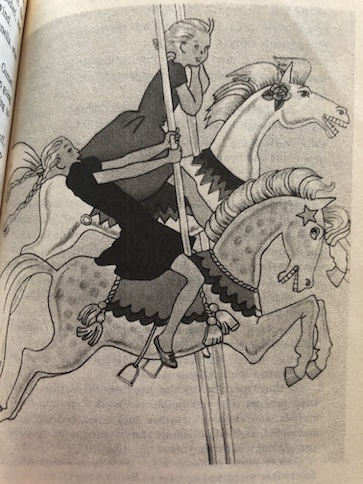
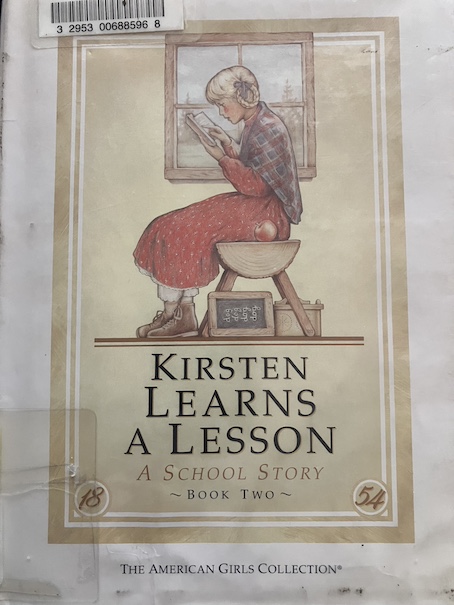
Kirsten Learns a Lesson

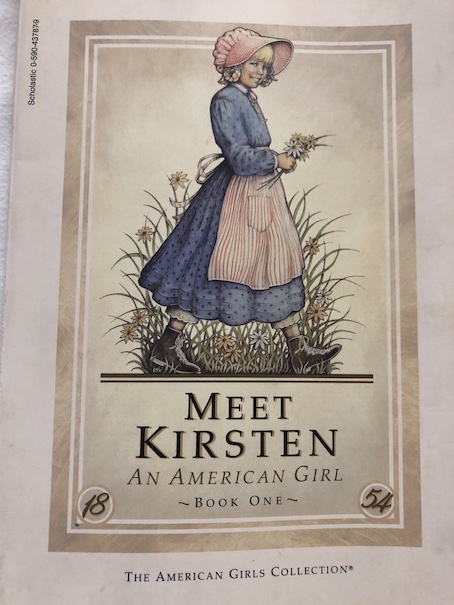
Kirsten, An American Girl

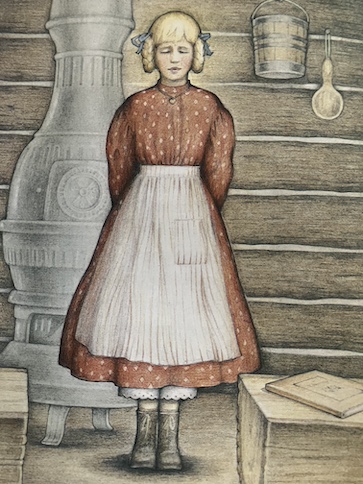
It’s November, 1854, and now that nine-year-old Kirsten’s family has settled in their new home in Minnesota and the harvest season is over, it’s time for the children to go to school. Kirsten and her brothers, Lars and Peter, will go to the small local school with their cousins, Lisbeth and Anna. Powderkeg School is a one-room schoolhouse in a little log cabin. Lisbeth and Anna’s stories about what Powderkeg School is like worry Kirsten. They talk about how strict their teacher, Mr. Coogan, is. Sometimes, the boys in class get rowdy and fight, and Mr. Coogan uses physical punishment on them. However, the girls tell Kirsten that she probably won’t have any problems with Mr. Coogan because he likes children who are well-behaved, and Kirsten is well-behaved. Still, Kirsten is nervous about what her new school will be like.

When they get to school, they learn that Mr. Coogan was injured in a fall from his horse, so they will have a replacement teacher, Miss Winston, who has only recently arrived from Maine. When one of the mean boys in class says he hops the horse also stepped on Mr. Coogan, Miss Winston tells him that nobody talks out of turn in her class and, although they live in the country, “we are not savages like the Indians.” (This is a 19th century attitude toward Native Americans, but this concept is challenged later in the story.)

Miss Winston has each of the children in class introduce themselves so she can get to know everyone. When it’s Kirsten’s turn to say her name, she forgets to address her teacher as ma’am, like the other students. Miss Winston insists that she say “ma’am”, and when she sees Kirsten struggling with the language, she asks Kirsten if she speaks English. Kirsten says that she speaks a little, and her cousins explain that her family just came from Sweden and that they speak Swedish at home. Miss Winston says that “practice makes perfect”, so Kirsten will practice her English in school. For now, she will have the easiest lessons and share seven-year-old Anna’s schoolbook.

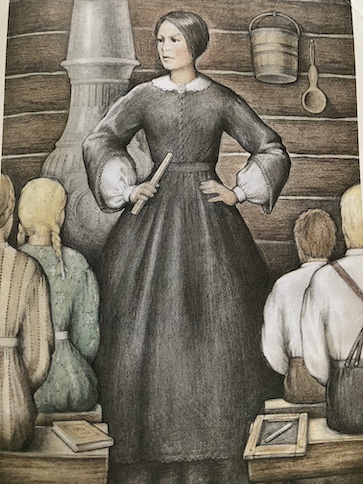
When the mean boy, Amos, laughs at Kirsten, Miss Winston glares at him and strikes the school’s iron stove with her ruler, startling the students. Miss Winston says that her father was a ship’s captain, so she knows how to be in charge of her students, like he was in charge of his crew. Then, she deconstructs the sentence “Miss Winston hit the stove”, pointing out which words are the subject, verb, and direct object of the sentence. Then she warns the class to “Be careful that the direct object of hit isn’t the student.” The implication is that Miss Winston is just as willing to use physical punishment against her students as Mr. Coogan was.

When Amos introduces himself to Miss Winston, we learn that he is nineteen years old, the same age as the new teacher, but the new teacher says that, in spite of being the same age, she’s still the teacher, and he’s the student. In spite of being more a young man than a boy in age, Amos has only just finished the third reader, and Miss Winston says her role is to help him read and do math like a man would, embarrassing Amos. (He can’t use his age to put himself on an equal footing with the new teacher because they are not intellectual equals. She’s the same age, but she has graduated from her own school and become a teacher, and he’s still struggling along with low level math and reading.)

Anna helps Kirsten with her lessons, and Miss Winston praises her for helping to teach Kirsten, but she doesn’t praise Kirsten for doing a good job. At the end of the school day, Kirsten and her cousins talk about the new teacher. Anna thinks that Miss Winston seems nice, but Kirsten thinks that Miss Winston doesn’t like her and that she seems very strict. She asks if that was what Mr. Coogan was like, and Lisbeth says he was worse. The best part of the day for Kirsten was lunchtime, when the children were allowed some play time. When she ran around and played tag with the other children, it didn’t matter if she didn’t speak much English.

When the girls play school with their dolls, Anna imitates Miss Winston and her comment about “savages.” Kirsten asks the other girls what that word means. They say it means “wild.” Kirsten asks them if the Indians (Native Americans) are really like that, and they say that some people say they’re kind and will help people if they need food but others day that they’re “cruel and bloodthirsty.” They’ve seen an Indian man before. He came to their house when their mother was roasting meat, and he left when their mother gave him some. They thought he looked pretty “savage” because his face was painted, and he had eagle feathers in his hair. The girls say that Native Americans also wear knives and live in tents. As a farmer, their father is concerned about the Native Americans. He knows that, if the farmers take too much of their usual hunting grounds for farming, it will drive away the animals, and the Native Americans will be starving and angry. While he is happy that he has been able to secure some farmland for his family (I explained a little about the famine conditions and lack of farmland in Sweden around this time that caused people like the Larsons to leave their country when I covered Meet Kirsten), he is aware that the Native Americans also need land for their survival.

At school, Miss Winston announces that each student will memorize a poem and recite it for the class. When they recite their poems, she wants them to say them with feeling and show the emotions their poem is trying to convey. Kirsten worries about this assignment because she’s still learning English. It’s hard enough for her to learn to read anything in English and understand the meaning of the words. She doesn’t know how she can also learn to memorize an entire poem and say it in front of everyone. Miss Winston gives Kirsten a short poem to learn, but having even a short one doesn’t seem to help Kirsten.

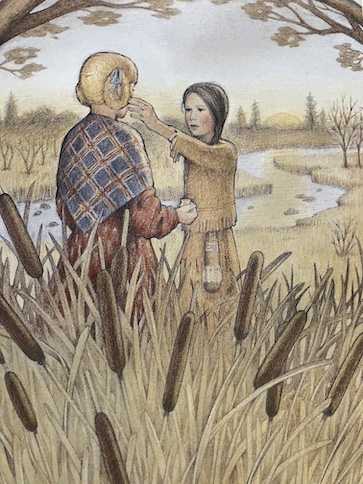
Meanwhile, Kirsten has her first encounter with a Native American when she spots an Indian (Native American) girl watching her while she’s getting water from the stream. The girl runs away, but Kirsten finds a blue bead that she dropped. Kirsten takes it and leaves her a little pretend cake that she and her cousins made for their dolls. Later, she finds that the cake is missing and that there’s a green duck feather in its place. She and the Indian girl trade little objects in this way, gradually becoming friends.

Kirsten’s secret friendship with the Native American girl becomes a comfort to her when school is stressful. Frontier teachers often board with families who live near the school, and when Miss Winston comes to stay at Kirsten’s aunt and uncle’s house, Kirsten feels like school is following her home. What’s worse is that Kirsten’s family will be joining them for dinner, and they will practice English during the meal. Kirsten knows that the meals, instead of being comfortable family time, will now be like lessons, and they will struggle to say things they would want to say because her family still hardly knows English. Worse yet, Miss Winston is cross with Kirsten because she can’t seem to memorize even her short poem.

Sneaking away to visit the Native American girl, who is called Singing Bird, gives Kirsten an escape from her struggles with English. Somehow, Kirsten and Singing Bird manage to communicate well enough with each other, even though neither of them speaks each other’s language. Then, Singing Bird takes Kirsten to see her village. To her surprise, Kirsten realizes that she has been gradually teaching Singing Bird English words without realizing it. However, Singing Bird’s people are going to be moving on soon. Kirsten’s uncle is correct that farming is driving away the animals the Native Americans depend on for food, and they’re suffering for it. Singing Bird invites Kirsten to come with her tribe when they leave, and it’s tempting to think of living an exciting life, traveling with Singing Bird and not going to school. But, is that what Kirsten really wants?

The book ends with a section of historical information about frontier schools in the mid-1800s.

The book is available to borrow and read for free online through Internet Archive (multiple copies).

Along with the first book in the series, this is the book that I remember the best of the Kirsten books. I think I either didn’t read the others or didn’t finish them because there are some sad things in the Kirsten stories that I didn’t like. In the first book, Meet Kirsten, another child Kirsten befriends on the journey to Minnesota dies of cholera. It’s historically accurate that some children died of disease on the journey west, but it was still hard to take. I also talked about how the reason why families like Kirsten’s wanted to come to America was that Sweden was experiencing famine around this time. The first book didn’t say much about that, but in this book, Kirsten remembers experiencing hunger in Sweden when her father’s crops failed and how her little brother cried from hunger.

Kirsten understands the plight of the Native Americans when they have to move to a new area when their food supplies run low. However, when Singing Bird invites Kirsten to come with them, she realizes that would mean leaving the rest of her family, and she can’t do that. While it’s tempting to go with her friend and escape the problems in her life, Kirsten can’t do that without also giving up the good things in her life and trading the problems in her life for a different set of problems. Although there are appealing aspects to their lives, the Native Americans also have their own struggles. To use an old adage, the grass isn’t always greener on the other side of the fence. People say it in different ways, but just because someone else’s situation is different doesn’t always mean that it’s better.

In this book, we also see what it’s like for Kirsten’s family as they begin learning English, so they can communicate with other people in their new country, and the children begin going to school. The little frontier school is different from other schools they’ve experienced before, and the teachers are strict. They have to be strict because some of the students are rough and fight with each other physically, and they have to make it clear that they’re not going to put up with that. This is a real-life aspect of schools from this time period. Fortunately, we never see the teacher actually using physical punishment against anybody. She just threatens to do it so her students will think twice about misbehaving.

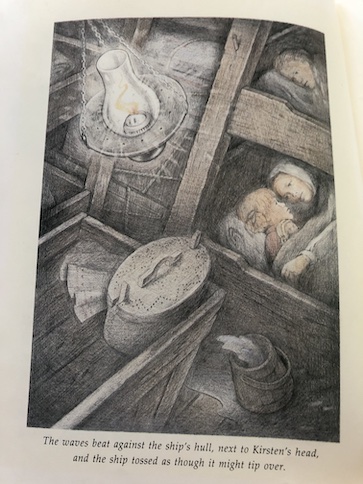
When Miss Winston comes to board with Kirsten’s relatives, Kirsten thinks that everything is going to be worse, that she’s constantly going to be bombarded with lessons and the problems she’s been having at school. However, it turns into an opportunity for Kirsten and Miss Winston to get to know each other better. At first, Miss Winston can’t understand why Kirsten is having such a difficult time remembering her poem, even though it’s pretty short and easy. It’s partly because she’s still having difficulties with her English, but also, the content of the poem has no relation to anything currently happening in Kirsten’s life. It doesn’t interest her, and her mind is preoccupied with all the changes happening in her life, making it difficult for her to focus on the poem and remember it. When Miss Winston shows Kirsten a model of her father’s ship, it brings back memories of the ship Kirsten’s family traveled on when they came from Sweden. Miss Winston realizes that Kirsten has strong memories of the ship, so she gives her a different poem to memorize, one about a ship. Kirsten finds this poem easier to remember because it connects to memories she already has.

Although Miss Winston can be tough, she genuinely does care about Kirsten and looks for ways to help her learn. It just takes time to figure out the best way to help her, and Kirsten also needs time to adjust to her new language and new home. Once Kirsten sees that it’s possible for her to learn and for her new home to begin feeling like home, she begins to feel better about her new life in Minnesota.

I enjoyed the realistic aspects of the story and the references to historical events and real life conditions on the frontier. I think I liked this story better as an adult because I understood more about the historical background than I did when I was a kid. Parts of this series are still sad. Kirsten remembers people being sick and dying on the journey to America, and although she doesn’t go into detail about it, her family did suffer genuine hardship in Sweden.

Meet Kirsten

Kirsten, An American Girl

It’s the summer of 1854, and Kirsten Larson is traveling by ship to America from Sweden with her family. There have been storms during the voyage, and the sailing has been rough. It’s crowded on the ship, and people have been seasick. On board the ship, Kirsten makes friends with another girl her age, Marta. The two girls play with their dolls together and talk about the things they’ll do when they finally reach America. The reason why the Larsons are traveling to America is that Kirsten’s Uncle Olav is already there. He has established a farm in Minnesota, and he has married a widow with two daughters. He wrote to the Larsons and asked them to join him and his new family in Minnesota and help on the farm.

When their ship finally reaches America, it docks in New York. No one is allowed to leave the ship until the health inspector declares that they are healthy. Health inspectors will not allow anyone with a serious, contagious disease, like cholera or typhoid, to go ashore. When they are allowed ashore, Kirsten’s father finds an agent to help them change their money at a bank and buy train tickets for their trip west. The agent, who is also from Sweden, will even accompany the family to the Mississippi River as a guide. The family needs help because they can’t speak English yet.

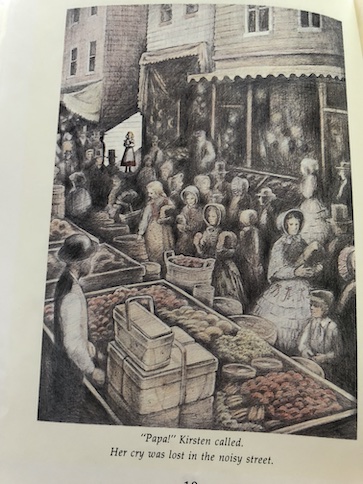
When they go to buy food in New York, Kirsten is accidentally separated from her father and gets lost. Because she can’t speak English, nobody understands what she’s saying, so Kirsten can’t ask for directions. Kirsten is frightened, but a kind lady sees her distress and tries to ask her what’s wrong. Kirsten can’t tell her, but then, she realizes that she can draw a picture, so she draws a picture of a ship. The lady leads Kirsten back to the dock, and she manages to find the rest of her family in the nearby Battery Park.

The next day, Kirsten says goodbye to Marta because the Larsons are leaving the city before Marta’s family. Because Marta’s family is also going to Minnesota, they hope that they will meet again there or somewhere on the way.

Kirsten has never seen a train before, and her first ride on one is frightening at first. The trip lasts for days, but finally, they arrive in Chicago. There, they will meet up with other pioneers heading to the Mississippi River. At the boarding house in Chicago, Kirsten reunites with Marta, whose family will also be traveling with them!

The pioneer families take wagons to the Mississippi River, and then, they board a riverboat. Kirsten’s mother worries because, when they boarded the riverboat, she was sailors burying a passenger who died of cholera. (A disease caused by ingesting contaminated food and water.) Cholera is a serious risk, and her worries are justified. On their third day on the boat, Marta becomes ill with cholera and dies from it.

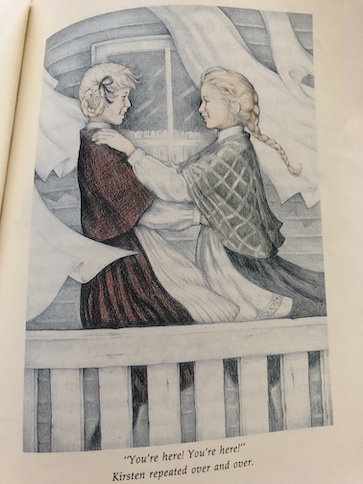
Kirsten is distressed at Marta’s sudden death, but fortunately, the Larsons all make it to Minnesota. All along, Kirsten has been struggling with homesickness and is still grieving the loss of the only friend she had in America, but she is cheered when she is greeted by her new cousins, Anna and Lisbeth. With her cousins as her new friends, Kirsten thinks that Minnesota might come to feel like home after all.

The book ends with a section of historical information about immigrant families, like Kirsten’s.

The book is available to borrow and read for free online through Internet Archive (multiple copies).

Although I liked the American Girl books when I was a kid, I didn’t like the Kirsten books, partly because of Marta’s death. I don’t think any of the other American Girl books has a child death in the first book. In fact, I don’t even remember any other children dying in any of the series, unless it happens in one of the newer books I haven’t read yet. It is realistic for a child to die while traveling west. Diseases like cholera were a real-like risk to pioneers. I’ve visited places along the old Oregon Trail, and I’ve seen the graves of real pioneer children who died of disease. There’s also a doll at one of the local historical museums in my area that once belonged to a little girl who died on the trip west. I know that children died on the journey west in real life, but it’s still depressing to read about, which is what bothered me about the Kirsten books. For this reason, I don’t think I read all of the Kirsten books when I was a kid, or at least, I don’t remember much about most them.

Reading this book again as an adult, I found it easier to deal with Marta’s death. I knew it was coming, so there was no shock to me. Marta’s illness is only a small portion of the book, and Kirsten doesn’t see Marta dead. We do get a picture in the book of the riverboat sailors carrying Marta’s coffin away for burial.

I always appreciate the sections of historical information in the back of American Girl books. This one discusses immigrants, the reasons why they wanted to move to a new country, and the conditions they encountered during their journey.

Earlier, when I covered Rasmus and the Vagabond, I mentioned that the characters hide in an abandoned village, and Oscar tells Rasmus that the reason that the village is abandoned is because, years before, the people in the village all decided to emigrate to America together, specifically Minnesota (a popular destination for Scandinavian immigrants).  The Library of Congress has more information about Swedish immigrants and the major periods of immigration.  Around the time that Kirsten’s family emigrated to the United States, Sweden was suffering problems from overpopulation, lack of adequate tillable farm land, and famine. We don’t hear the Larsons describe any particular problems they had in Sweden or suffering. We are told that they had a farm in Sweden with a house with a maple tree near the door and a barn, but we don’t know if the family was suffering in spite of owning the farm. The important point is more that conditions in general were bad in Sweden, so the promise of rich farm land in Minnesota was attractive to them. The historical information included in the back of Meet Kirsten doesn’t cover this information about conditions in Sweden. Instead it focuses on what immigrant families might pack to bring with them on such a journey and what the traveling conditions would have been like.

Kirsten’s Cookbook

Kirsten, An American Girl

This cook book is one of the activity books that was written to accompany the Kirsten series that is part of the American Girls franchise. The American Girls books were written to help teach American history (as well as sell the accompanying dolls and accessories), so this book has recipes of the type that people would have eaten on the American frontier during the mid-1800s, when the character of Kirsten lived, and some historical information.

The book begins with some historical information about cooking on the frontier. Pioneer families like Kirsten’s family ate what they grew themselves and things they could gather from the woods around them. They ate certain foods only in the season when they could get them, and it was hard work to produce food and process it before using it in recipes. There were certain types of food that they had often because the ingredients were simple and often available, like potatoes and bread, and they rarely had time to prepare special or elaborate meals. However, they would take the time to make some special treats for holidays.

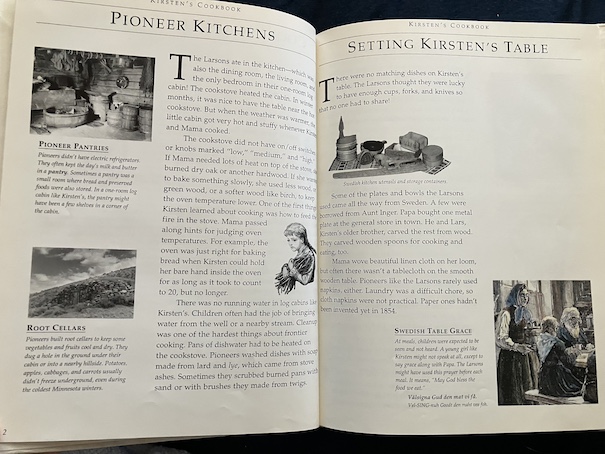
There are special sections that describe what pioneer kitchens were like and the dishes and table settings they would use. Pioneer families like Kirsten’s lived in one-room cabins, so her family cooked, ate, and slept all in that one room. They had a wood-burning cookstove, but stoves like that did not come with temperature settings. (This is why you don’t see temperatures specified in old recipes from the 19th century, although this book does include that information for modern readers.) People learned to judge roughly whether the temperature was right to bake bread or cook other recipes by feel, and could regulate the approximate temperature through the type or amount of wood they burned.

There is also a section of cooking tips and kitchen safety tips for modern child readers. Then, the recipes are organized by type of meal with a section of Kirsten’s favorite recipes. Each section and recipe is accompanied with additional historical information and trivia.

  • Pork sausage patties
  • Hard-boiled eggs
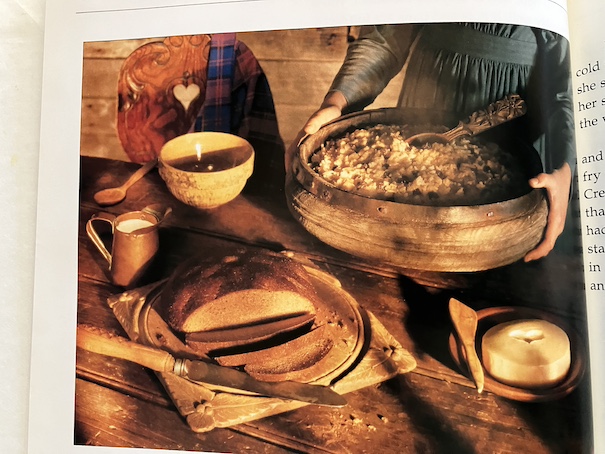
  • Swedish rice porridge
  • Round rye bread
  • Homemade butter
  • Ginger cookies – Although cookies seem like an odd thing to see at breakfast, a pioneer family might have them and save some for a snack in the mid-morning, before lunch, or as they called it, dinner.

“Dinner” is usually the biggest meal of the day, but depending on when and where you live, that might be either the midday meal or the evening meal. In modern times, it tends to be the evening meal, after a family or individuals are home from work or school and have more time for a large meal. Modern people sometimes use the terms “dinner” and “supper” (the evening meal) interchangeably for that reason. In Kirsten’s time and, sometimes, in rural areas even in modern times, the biggest meal is the midday meal, what most of us would call “lunch.”

  • Baked ham slice
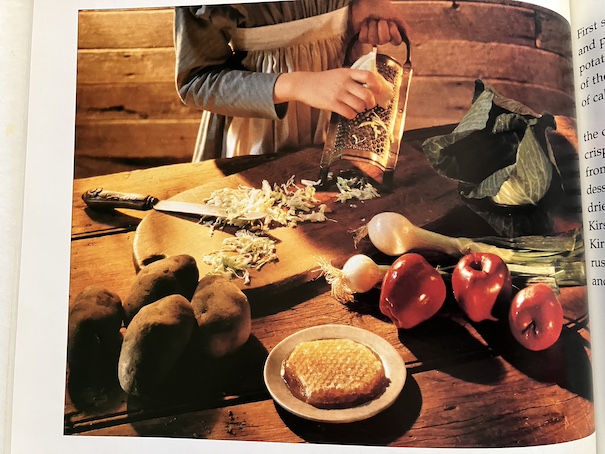
  • Swedish potatoes
  • Cabbage and apple salad
  • Fruit Soup
  • Swedish Almond Rusks – Swedish rusks are crunchy sweet breads, a little like biscotti.

This section just has an assortment of recipes for Kirsten’s favorite foods. Some of them are traditional Swedish foods, and others are more American. There is a mention in this section that pioneers learned how to make maple syrup from “Indians”, meaning Native Americans.

  • Potato soup – Soup with bread and cheese was a popular supper meal for farming families in the 19th century.
  • Swedish meatballs
  • Fresh applesauce
  • Swedish pancakes – These thin pancakes are rolled and filled with jam.
  • St. Lucia buns – These special buns are topped with raisins, and it’s a tradition in Sweden and other Scandinavian countries to serve them on St. Lucia Day, December 13.
  • Pepparkakor cookies – These are thin, spicy cookies that are cut into shapes and served at Christmas.

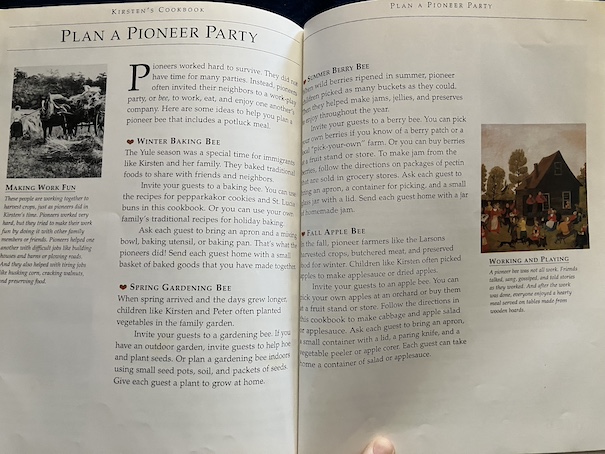
The book ends with a section of tips for having a pioneer-themed party. When real pioneers had parties, they were often organized around chores they had to do or tasks to accomplish. They called these work-play parties “bees”. Besides accomplishing a task, friends and neighbors would also bring food and share a meal, talk, and have fun. The suggestions in this section are organized seasonally. A Winter Baking Bee could involve everyone getting together to bake holiday treats, like the ones included in this book for St. Lucia Day and Christmas, or whatever the guests want to bake. At a Spring Gardening Bee, guests can get together to plant a garden or potted plants, with plants for guests to take home themselves. For a Summer Berry Bee, guests can pick berries (if they grow locally or at a “pick-your-own” farm) or make jam, with some for everyone to take home. For a Fall Apple Bee, guests can pick apples and make recipes with apples, like applesauce.

The book is available to borrow and read for free online through Internet Archive.

Samantha’s Cookbook

Samantha, An American Girl

This cook book is one of the activity books that was written to accompany the Samantha series that is part of the American Girls franchise. The American Girls books were written to help teach American history (as well as sell the accompanying dolls and accessories), so this book has recipes of the type that people would have eaten during the early 1900s, when the character of Samantha lived, and some historical information about cooking and dining during that period.

The first section in the book discusses innovations that made cooking easier in Samantha’s time than it had been in earlier time periods. The kitchen in Samantha’s house had running water, a gas stove, and an icebox for refrigerating food. Because Samantha comes from a wealthy family, who can hire people to cook for them, Samantha’s education focuses more on learning how to be a good hostess, meaning that she would be more likely to be in the dining room, helping to entertain guests, rather than in the kitchen, preparing food. However, Samantha would have been familiar with cookbooks, discussing new recipes and studying sections of cookbooks that offered advice about dining etiquette. There are sections in this book that discuss the role of servants in shopping for and preparing food and the proper way to set a table for an elegant dinner party.

After that, there is a section of cooking tips and kitchen safety tips. The recipes in the book are divided into sections based on meals, followed by a section of Samantha’s favorite recipes. The recipes are also accompanied by historical information.

The book explains that, because Samantha is from a wealthy family, her family’s cook begins making breakfast before Samantha wakes up in the morning, so it will be ready for her as soon as she’s awake and dressed. In her time, breakfast was typically the lightest meal of the day, but wealthy households had a variety of foods at breakfast. Breakfast was typically served with hot drinks. Adults usually had coffee or tea, while children might have hot chocolate.

  • Strawberries with cream
  • Ham slice
  • Cheese omelet
  • Saratoga potatoes – These are fried potato chips, which were a relatively new innovation in Samantha’s time. The book explains that potato chips were invented by a Native American cook at a resort in Saratoga Springs, New York in 1853 after a customer complained that the fried potatoes should be thinner.
  • Blueberry muffins

“Dinner” is usually the biggest meal of the day, but depending on when and where you live, that might be either the midday meal or the evening meal. In the past and in rural areas, “dinner” was often lunch. By Samantha’s time, as it typically is in modern times, it was the evening meal, after a family or individuals are home from work or school and have more time for a large meal. For wealthy families, like Samantha’s family, dinner was a very formal meal. They would often dress up for dinner, and at formal dinner parties, there would be name cards on the table to tell everyone where to sit. At a formal dinner in a household with servants, individual dishes and parts of the meal would be served in “courses”, but the number of courses could vary. Samantha’s family followed the English style, with fives courses at dinner. The book mentions Samantha’s family having soup, salad, appetizers, a main course with roasted meat, and dessert and coffee at the end of the meal. Some larger, fancier dinner parties could have many more, some as many as 18 courses!

  • Cream of carrot soup
  • Roasted beef tenderloin
  • Mashed potatoes
  • Fresh green beans
  • Corn oysters – These are fried corn patties.
  • French salad
  • Dressing
  • Ice cream snowballs – These are scoops of vanilla ice cream coated in shredded coconut.

This section has an assortment of recipes for Samantha’s favorite foods. The book explains that, while Samantha was being trained to be a hostess more than a cook, even wealthy girls like her would taught some basic cooking skills. Sometimes, Samantha would help the family’s cook in the kitchen and make some simple recipes.

  • Apple Brown Betty
  • Jelly biscuits
  • Cream cheese and walnut sandwiches
  • Chicken salad sandwiches
  • Gingerbread
  • Lemon ice

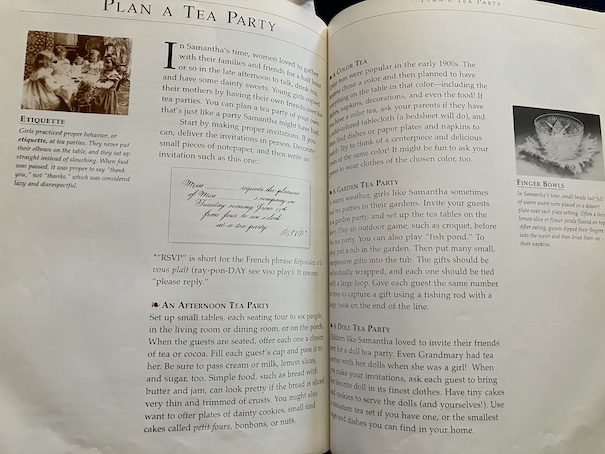
The book ends with a section about how to plan a tea party, like girls in Samantha’s time might have. The suggestions include themed tea parties, like afternoon tea, a color tea (a popular concept in the early 1900s, where everything at the party, from decorations to food, would be themed around a particular color), a garden tea party, and a doll tea party (girls would bring their dolls, and there would even be tiny treats to serve to the dolls).

The book is available to borrow and read for free online through Internet Archive.

Lady Margaret’s Ghost

Felicity, An American Girl

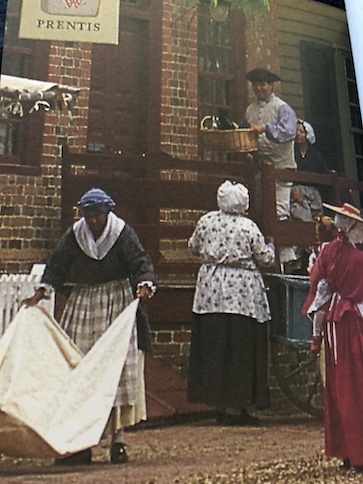
This book is one of the mystery stories published to accompany the American Girl series of historical books. The main character of this book, Felicity Merriman, lives in Colonial era Williamsburg, Virginia, around the beginning of the American Revolution.

Felicity’s mother is going on a trip to visit a relative, along with Felicity’s younger siblings. As the oldest girl in the family, Felicity will be in charge of the household while her mother is gone and her father and his apprentice, Ben, are working in the store her father owns. It’s a big responsibility and an honor that Felicity’s mother considers her capable of managing the household, but because Felicity is still young and some household tasks involve heavy work that is difficult for her to do alone, her mother has hired a temporary cook, Mrs. Hewitt, to help her. Because Felicity is known as a daydreamer who doesn’t always pay attention to what she should be doing, her mother reminds her to focus on the task at hand while she’s minding the house, although she has faith in Felicity and is sure that she will do a good job.

Soon after her mother leaves, a crate arrives at the house for Felicity’s father, along with a letter. The letter explains that a cousin of Felicity’s father has died and that the crate contains some family heirlooms that his cousin left to him. These heirlooms once belonged to a common ancestor of theirs, Sir Edward Merriman, a wealthy nobleman and the first member of their family to live in the colonies, more than 100 years earlier. Felicity’s father didn’t know his cousin well because they never lived very close, and his cousin was much older, but he does know the history of the heirlooms. The heirlooms include a lady’s silver vanity set and a silver cup and rattle for baby. The story is that Sir Edward’s wife, Lady Margaret, owned the vanity set, and the rattle and cup were for their infant son. Unfortunately, the baby was stillborn, and Lady Margaret died shortly after the birth. After her death, her husband and the household servants believed that she still haunted the house. The haunting may have been part of the reason why Sir Edward decided to leave his home in England and go to America, but even though he later remarried and had other children, he could never bring himself to part from the things that belonged to his first wife and child. Even before Felicity’s father tells her about the ghost story, Felicity gets a strange feeling from the vanity set, and she wonders if the objects could be haunted.

However, Felicity soon has to turn her attention to household issues. Mrs. Hewitt, the temporary cook arrives, and she is a brusque and unpleasant woman. She is rude and condescending to Felicity when they are working in the kitchen together. Because Mrs. Hewitt is so rude, Felicity is nervous and makes mistakes, making her look like more of a fool to Mrs. Hewitt. They can’t easily replace her because cooks are in demand right now because this is Publick Times in Williamsburg, and there are many visitors to the city. Everyone is busy tending to them. Mrs. Hewitt was the best they could find available. Felicity’s father does speak to her about her rudeness to Felicity. After that, Mrs. Hewitt is sullen and resentful, and she is even more pleased whenever she sees Felicity doing something wrong.

There is also an exciting event taking place. Felicity has entered her horse, Penny, in a horse race at the fair in town! Ben, her father’s apprentice, will ride her. The day of the race, Penny seems to be doing well, but then, she suddenly develops a problem during the race. When Felicity and Ben check her out to see what was wrong, they discover that someone put burrs under Penny’s saddle! Worse still, the wounds caused by the burrs become infected. Felicity is very upset and worried about Penny, and she wonders who would have hurt her horse. There were a couple of men looking at her before the race. There was also a boy named Dawson and a girl called Anne.

Dawson turns out to be a runaway, but he also has some knowledge of horses. Although Felicity is a little suspicious of him at first, Dawson helps to heal Penny’s wounds. He also says that he saw Anne gathering burrs, but it was probably on behalf of someone else.

When Felicity realizes that her treasured coral necklace, which her mother also wore as a girl, has disappeared, Felicity questions whether she carelessly lost it or if someone has stolen it. Felicity has been doubting herself and her ability to manage the household because of all the mistakes she has made since her mother left, and the clasp of the necklace was a little loose. This could just be another disastrous mistake, but it is suspicious that Anne seemed so friendly to her at the race and then ran away from her later. Anne also literally bumped into Felicity at the race. Could she have taken the necklace? Dawson seems to think so, but then again, can Felicity really trust everything he says?

Felicity still gets an odd feeling from Lady Margaret’s heirlooms, and she thinks that she sees something white moving around at night. At first, she thinks that it could be Lady Margaret’s ghost, but then, strange things begin happening around the house. Things disappear, and Felicity worries that maybe she carelessly mislaid them. Then, her necklace unexpectedly turns up, and Lady Margaret’s vanity set vanishes! Are these strange things part of the haunting of Lady Margaret or the work of a thief? If it’s a human thief, is it the work of the runaway Dawson, mysterious Anne, unpleasant Mrs. Hewitt, or the mysterious person who arranged for Penny to be hurt?

The book ends with a section of historical information about Colonial era Williamsburg. The story is set during Publick Times, which was when court was in session in Williamsburg. People would gather in Williamsburg during Publick Times to see the trials in court and attend a public fair in Market Square. The fair offered various kinds of entertainment, games, and races, like the horse race in the story.

The story leaves it a little ambiguous at the end about whether Lady Margaret’s ghost exists, but if she does, she is not harmful and has nothing to do with the thefts in the story or what happened to Penny at the horse race. As the section of historical information explains, there are many new visitors in Williamsburg during Publick Times. This was a good setting for the story because there are many strangers to the city with unknown pasts and motives, and crowds at the fair might harbor thieves.

Part of the story and part of the section of historical information in the back focuses on the subject of orphans. Both Dawson and Anne are orphans, and neither of them is really being cared for. Dawson admits that he used to steal to support himself after his father died, but he is seriously looking for work. Anne technically has a guardian, but her guardian is abusive and uses her as a servant rather than taking care of her.

When the thefts occur and mysterious things start happening around the Merriman house, both Dawson and Anne look like the best suspects, but there are also possible adult suspects. Even after Felicity realizes Anne’s situation, she isn’t entirely sure which of the men at the fair that day is Anne’s guardian. Mrs. Hewitt also looks suspicious because she is so unpleasant and seems to be trying to make trouble for Felicity. I though the book did a good job of supplying an array of suspects to consider. The solution to the mystery was one of the possibilities I thought was most likely, but there were enough other possibilities to make the story interesting.

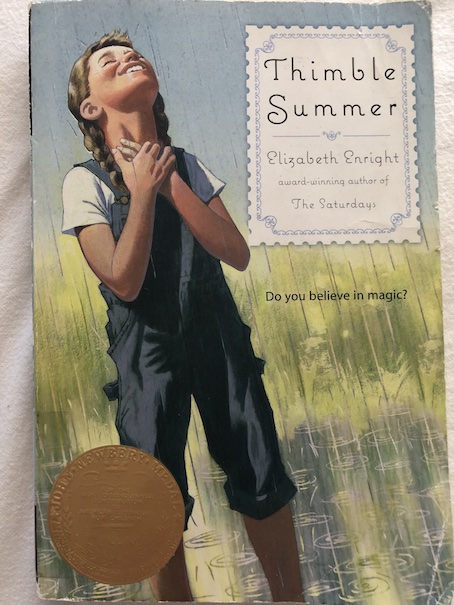
Thimble Summer

Thimble Summer by Elizabeth Enright, 1938, 1966.

It’s summer, and Garnet is a 9-year-old girl living on a farm with her parents and brothers in a rural community in Wisconsin. The story is episodic, with each chapter describing things that happen to Garnet over the course of one magical summer when she found a silver thimble down by the river. Garnet thinks that the thimble itself is magic, but maybe the magic is just in the happy summer adventures that follow.

The book is a Newbery Medal winner. It’s available to borrow and read for free online through Internet Archive (multiple copies, including one in Chinese).

The chapters in the book are:

The Silver Thimble

It’s been hot and rainless, and the crops are in danger of being ruined if they don’t get some rain soon. It’s a real worry because, if the crops are bad, Garnet’s family won’t be able to pay their bills. When Garnet and her brother Jay go swimming in the nearby river, Garnet finds a silver thimble. It’s a lucky find, and Garnet becomes convinced that the thimble is magic and that something wonderful is about to happen. Jay thinks that’s silly, but that night, the rain they’ve so badly needed comes! Garnet and Jay are so overjoyed with the rain that they go out running in the rain in the middle of the night, until they are frightened by lightning striking something, and their mother calls them back.

The Coral Bracelet

Garnet’s best friend is a girl name Citronella, who lives nearby. Citronella’s great-grandmother lives with her, and she tells the girls stories about what it was like when she was young. She tells them about Indians (Native Americans) who would sneak into her family’s house in bad weather to get warm and leave them presents as thanks. (I don’t know if any Native Americans ever did this in real life, but she says it like it really happened.) Then, she tells the girls about a special coral bracelet that she wanted at the general store when she was young and some foolish risks she took to get it.

The lucky thing that happens in this chapter is that Garnet’s father gets a government loan to build a new barn.

The Lime Kiln

The family needs to make lime for building their new barn. The kiln needs to burn for three days straight, and they all need to take turns tending it, day and night. Jay and Garnet are allowed to stay up all night there with their father. Friends help them, and neighbors come to visit and talk with them. Garnet brings along a picnic with sandwiches and apple pie that they eat at midnight.

The Stranger

While they’re tending the kiln, a strange boy comes along and asks them for food. His name is Eric, and he’s a parentless boy who travels around and makes his living from odd jobs. He tells them about his life and travels, and Garnet’s father hires him to help the family build the new barn.

Locked In

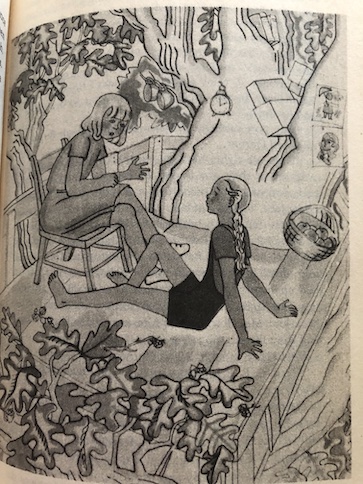
Garnet likes having Eric at the farm, but she’s also a little jealous that Jay wants to spend more time with Eric now than with her. Garnet starts spending even more time with Citronella, and the two girls build a tree house together. The girls tell stories in their tree house, and because it’s going to rain again, Garnet suggests that they go to the library in town. They get so engrossed in their books that they lose track of time and get locked in the library. Garnet thinks this is a fabulous adventure until Citronella points out that it’s Saturday, and the library is closed on Sunday. If they can’t find a way out, they could be there for the rest of the weekend!

Journey

It’s harvest time, and everyone is occupied in picking crops and canning foods. Garnet helps, and she is temporarily put in charge of the threshing machine. Unfortunately, she falls asleep and lets the straw stack pile up until it falls over and makes a mess. Eric tells her not to worry about it, but Jay yells at her and tells her that she had no business helping out as a girl and that she should be at the house with the women. Garnet is so upset at the way Jay has been critical of her lately that she decides to run away and hitchhike around, like Eric used to do.

“As a Ragpicker’s Pocket”

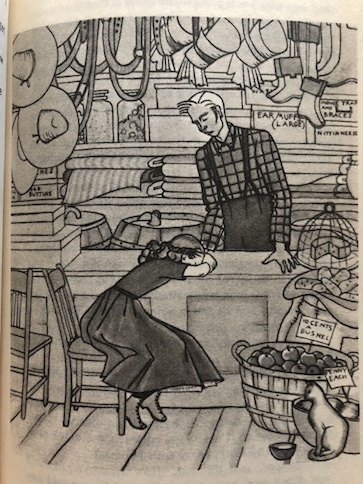
Garnet is still running away, and she takes a bus to the next town. By the time she has explored the town and looked at all the store windows, she isn’t so upset and can see the funny side of what happened with the thresher, and she’s about ready to go home. She buys a few things for her family at the dime store and a hot dog to eat. Then, she has a horrible realization: she’s out of money. How is she going to get back home?

Fair Day

Garnet goes to the fair with her family and neighbors, and she enters her pig, Timmy, in a contest. Timmy was the runt of his litter, but Garnet has taken special care of him, and she thinks that he has a good chance of winning a prize.

Ice-Cream Cones and Blue Ribbons

Garnet and Citronella enjoy the wonders of the fair while Garnet is waiting for the pig contest. They spot the lady sword-swallower darning her socks, they ride the rides, and they have snacks. The girls get stuck on the Ferris wheel when it stops working, and Garnet worries about getting down in time for the judging of the pig contest.

The Silver Thimble

The silver thimble hasn’t been mentioned since the first chapter, but when Garnet looks back on all the good things that have happened this summer, she’s still sure that it’s magic. All the good things that have happened started right after she found it. She shows the thimble to Eric, and the kids talk about what they want to do with their futures.

My Reaction

This story is more like a collection of stories, some of which continue each other. The book is somewhat episodic, leading up to the fair at the end of the summer. The stories are pretty gentle, slice-of-life adventures. Eric has had a hard life, but he doesn’t want to dwell on it too much, and things improve for him when he decides to stay with Garnet’s family. There are hints that Eric might marry Garnet someday, and the two of them might stay on the family’s farm. Eric has had enough of traveling in his young life, and he wants to be a farmer and thinks that he would like to save up money and buy land near the family’s farm. Jay wants to be a sailor or something else that will let him travel and see the world, although he thinks that he might want to come back to the farm when he’s done traveling and farm it with his father and Eric.

The book fits with the Cottagecore genre, and it would make good bedtime reading. Foodies will enjoy the mentions of old-fashioned treats, like apple pie, griddle cakes, and vinegar candy. Garnet also imagines that each of the kitchen things have their own personalities.

I liked Garnet’s name, which is very unusual in the early 21st century. Citronella is an even more unusual name, but I prefer Garnet. I think it’s charming, and it’s one of the less-common gem names used for girls. In the story, Garnet mentions that the librarian frequently gets her name wrong because gemstone names are popular in her time and area. There are other girls in town named Ruby, Pearl, Opal, and Beryl, and the library usually calls her Ruby, the most popular of the gemstone names.

There are some stereotypical mentions of Native Americans in the story. They’re not derogatory, and they’re minor parts, but there were a couple of things that struck me as being a little stereotypical, like the kids saying that they’re Comanche Indians doing a rain dance when they’re running around in the rain. I also didn’t care for the way the characters kept pointing out which people were “fat” or “fleshy.” They’re not really shaming these characters, just sort of remarking, but I just felt like it was rude and unnecessary. You see this sometimes in older children’s books. Fortunately, none of the fat characters are considered bad characters in this story, as they sometimes are in other books. There aren’t really any bad characters in the story in general. Jay is annoying at times and says things that put down his sister and girls in general in a bratty, macho kind of way, but nobody in the story is a villain.

The Enchanted Castle

Two brothers and two sisters spend most of their time at boarding schools. The boys go to a school for boys, and the girls go to schools for girls, so the only times when they are together are when they are home for school holidays or visiting at the house of a kind, single lady who lives near to their schools. Although the children’s parents are grateful for their single friend for hosting the children as guests from time to time, the children find it difficult to play at her house because everything is so neat and proper, and they don’t feel quite at home. Then, during one school break, one of the sisters, the one who makes it home first, comes down with measles. With their sister sick, the other siblings can’t go home, which is a great disappointment, and their parents have to make other arrangements for them. When the children tell their parents that they don’t want to visit the single lady for the entire school holiday, the parents arrange for the boys, Gerald and James (called Jerry and Jimmy), to board at their sister Kathleen’s school. It will be fine for them to be there because Kathleen (called Cathy) is the only student remaining at the school during the holiday, and there will only be one teacher there to supervise them, the school’s French teacher.

This arrangement suits them better than going to the single lady’s house, although they think that they ought to find something special to do during the school holiday. Kathleen suggests that they write a book, but the boys aren’t thrilled by the idea. They would rather do something outdoors, like playing bandits. However, they are a little concerned about the French teacher’s supervision. Fortunately, Gerald is good at charming grownups, when he wants to. Through a combination of flattery and small, thoughtful favors to the teacher, he gets on her good side, and he manages to convince her that he and his siblings would like to have some time to themselves to play and explore outside, maybe in the woods. The French teacher understands that what they really want is some freedom from supervision, but she agrees to give them some time to themselves.

The children don’t actually know if there are any woods in the area, but they decide to do some exploring and see if they can find an adventure of some kind. They end up getting lost during their exploring, but they find it exciting. When they sit down to rest, they find a cave and decide to explore it. The cave turns out to be a tunnel that leads them to a beautiful garden with a lake with a decorative waterfall and swans. The children imagine that it’s the garden of a magical castle. Going a little further, they find a thimble with a crown on it and a thread tied to it. It looks like the kind of thimble that might belong to a princess.

When they follow the thread, they find a young girl in a beautiful dress who looks like she might be a princess. She looks like she’s asleep, so she looks like an enchanted princess or Sleeping Beauty. Jimmy doesn’t really believe that she’s a princess, but the others aren’t so sure, and anyway, it makes a fun game to pretend that she is. Since Jerry is the eldest of the children, Cathy thinks that Jerry should kiss her to wake her up. Jerry refuses, so Cathy says Jimmy should do it. Although Jimmy is sure that she’s really just an ordinary girl dressed like a princess, he says he’ll kiss her to prove he’s braver than Jerry and that he should be the leader for the rest of the day.

When Jimmy kisses the girl’s cheek, she opens her eyes and says that she has been asleep for 100 years. She insists that she’s a real princess and asks them how they got past the dragons. Jimmy still doubts that, even though she shows them a mark where she pricked herself on a spindle, just like in the Sleeping Beauty story. She invites them to come back to the castle and see her beautiful things. The children say that they are hungry, so they go with her go get something to eat.

When they get to the “castle”, the princess brings them bread and cheese to eat with some water. This seem depressingly ordinary, and the princess apologizes, saying that was all she could find. However, she claims that the food in the castle is magical, so it can be whatever they want. The children imagine that it’s roast chicken and roast beef, but all they get is bread and cheese. Cathy doesn’t want to admit at first that it’s just bread and cheese because (like with the Emperor’s New Clothes), there is an implication that there is something wrong with her if the magic doesn’t work for her. Jimmy isn’t discouraged by that, so he asks the princess if it’s a game, but the princess denies it, insisting that the food is magical.

Then, the princess takes the children to a hidden door behind a tapestry. The room inside has paneled walls and blue ceiling with stars painted on it. The princess calls it her “treasure chamber”, but the room is completely empty. The princess acts surprised when the children say that they can’t see any treasure, and they refuse to believe it’s because they’re magical or invisible. The princess has the children close their eyes while she says some magic words. When they open their eyes, suddenly, there are shelves with jeweled objects on them. The children have no idea how the princess accomplished this trick, so they start to believe that maybe she can do magic.

The princess suggests that they all put on some of the jewels and be princes and princesses, too. It’s amusing for a while, but the boys start getting tired of dressing up, and they’re still a little skeptical about who the princess is. They suggest that they go play outside, but the princess insists that she’s actually grown up and doesn’t play children’s games, and she has the others help her put all the treasures back in their proper places. She tells the children that various pieces of jewelry have magical property. Jimmy asks her if that’s really true or if she’s kidding, but the princess insists that it’s true. Jimmy asks her to demonstrate how the magic works. The princess says that she will try on the magic ring that makes her invisible, but only if everyone closes their eyes and counts first.

When the children open their eyes, all of the shelves of jewels are gone and so is the princess. Jimmy says that it’s obvious that the princess just went out the door of the room. When they close their eyes and count again, Jimmy keeps his eyes open and sees the princess hiding behind a secret panel. When he tells the others, the princess says that he cheated. The weird thing is, even though they hear the princess say that he cheated, they still don’t see her. They tell her to stop hiding and come out, but she says that she already has. She says that if they want to pretend like they can’t see her, that’s fine, but the children seriously can’t see her. When the princess realizes that they’re serious that she’s actually invisible, the princess suddenly gets scared. She tries to shake the boys and get them to say that she’s not invisible, and Jerry catches hold of her, still unable to see her. She tells them that it’s time for them to go because she’s tired of playing with them.

Jerry makes the princess look in a mirror to prove that she’s invisible, and the princess gets very upset. Cathy sensibly tells her to just take the ring off, but the princess says it’s stuck. She admits that the whole thing, up to this point, was just a game of pretend. She says that the treasure shelves were hidden behind some paneling, and she just moved it with a hidden spring. She never expected that any of it was actually magical. The truth is that the girl’s aunt works at the house as a housekeeper and that her name is Mabel. She was just playing at being an enchanted princess because the rest of the household is away at the fair, and she happened to hear the other children coming through the hedge maze, so she roped them into her game.

Since one of the objects that Mabel claimed was magical was a buckle that would undo magical spells, Cathy suggests that she try the buckle. Mabel says that’s no good because she only made up that it was magical, but Cathy points out that she also made up the part about the ring being magical, and it turned out to be true, so she might as well try the buckle. Mabel would, but they accidentally locked the key inside the room and can’t get in now.

The children sit down to think about the situation. Since they can’t think what to do, the other children think maybe they should leave and go get their tea, but Mabel insists that they can’t just leave her invisible like this. Instead, she suggests that she go with them to tea and leave her her aunt a note. While they have tea, maybe they can think of something else to help Mabel. In her note, Mabel says that she’s been adopted by a lady in a motorcar and is going away to sea. The others say that’s lying, but Mabel says that it’s fancy instead of lying and that her aunt wouldn’t believe her if she said that she was invisible.

When they return to Kathleen’s school, they have tea and supper. They let Mabel have one of the three plates laid out for them, and Jerry and Cathy share one between them. Fortunately, the French teacher isn’t eating with them and doesn’t see an invisible person eating, but the children don’t know how they’re going to handle breakfast the next morning. They say that Mabel can stay the night with them, sharing Cathy’s bed and borrowing a nightgown. Mabel says that she can get some of her own clothes from the house tomorrow because no one will be able to see her and that she’s starting to see some possibilities for being invisible.

In the morning, the maid who comes to wake Kathleen sees Mabel’s discarded princess dress on the floor and asks Kathleen where it came from. Kathleen makes an excuse that it’s for playacting, which means that she and her brothers will have to figure out some kind of play to put on with it. Mabel thinks that acting sounds exciting, but Kathleen reminds her that she’s still invisible, so no one can see her perform anything.

The children feel bad about Mabel’s lies in the note to her aunt, and they insist that they should go and tell her the truth. Mabel doesn’t think this is a good idea because her aunt won’t believe her, but she reluctantly agrees. When they try to talk to her, the aunt doesn’t really want to listen to them, thinking that it’s just another one of Mabel’s pranks. She says that maybe Mabel was changed at birth and that her rich relatives have finally claimed her. They try to tell her that Mabel is with them, only invisible, and the aunt tells them not to lie to her. They ask about Mabel’s parents, and the aunt says that she’s an orphan. The children think that Mabel’s aunt is crazy because she doesn’t seem concerned about her and doesn’t want to hear anything they have to say, but Mabel says that she thought that her aunt might act that way because she spends so much time reading novels and can imagine anything.

In the meantime, Mabel has had some thoughts about what she can do. She says that she might be able to continue living in the house where her aunt works because the place is supposed to be haunted, so she can play ghost herself. However, the others think that she should stay with them. They just need a way to get some money to buy extra food for her.

Sine the fair is still going on, Mabel suggests that Jerry put on a magic show at the fair to get some money. The others say that Jerry doesn’t know any magic tricks, but Mable points out that it doesn’t matter when he has an invisible friend who can move things around, unseen, and make things disappear. Jerry dresses up as a conjurer from India (in a way that would be considered equal parts cheesy and offensive by modern standards because it involves black face), and he puts on the magic show with Mabel’s help. It’s incredibly successful, and toward the end of it, Mabel feels the ring coming loose. She takes it off and gives it to Jerry, who ends the act by vanishing himself.

Now, Mabel is visible again, and it seems like they’ve solved their problem, but now, they have a new one. The ring is now stuck on Jerry’s finger, and he is the one who’s stuck being invisible. Although Mabel can now go home, she insists on staying with the other children and taking part in their next invisible adventure.

Jimmy says that, if he was invisible, he would turn burglar. The girls point out that would be unethical, so Jerry decides that he will be a detective. There are advantages to a detective being invisible. Then, Mabel remembers that the treasure room is still locked from the inside, and they have to do something about it. Jerry says that, as an invisible person, he can sneak in easily enough through a window. When he does this, he ends up foiling a robbery by actual burglars, although he also ends up letting them escape from the police because he knows that conditions in prisons are horrible and can’t bring himself to send anyone there.

After his adventure, the ring comes loose from his finger while he’s in bed, and the maid at the school, Eliza, finds it and decides to “borrow” it for an outing with her fiance. When her fiance can hear Eliza’s voice but not see her, he thinks that he’s taken some kind of strange turn or fit, possibly because he’s been in the sun too long. The children convince him to go home and lie down while they deal with Eliza. They take Eliza on a little adventure of her own because they’re beginning to see that the ring doesn’t come off someone’s finger until its purpose is fulfilled. Afterward, they manage to convince Eliza that it was all a strange dream that she had because she felt guilty about taking the ring without permission. The children also think that the ring’s power might be diminishing and could be completely spent because it seems like its effect has been lasting shorter and shorter amounts of time every time it’s used. However, this is really just the beginning of the ring’s magic, and it can do much more than they think it can.

At this point, they feel a little guilty that they haven’t spent much time with the French teacher, who is supposed to be looking after them, so the buy her some flowers. She is pleased with the gift, and they have a little party with Mabel as their guest. They find out that the French teacher has artistic abilities, although she rarely has time to draw these days because she’s so busy teaching. Mabel also tells them more about the man who owns the house where her aunt works. Although the house is grand, the man who owns it doesn’t really have enough money to support it and live there full time with a full staff because his uncle wrote him out of his will for falling in love with a girl he didn’t approve of. It’s sad because he also never married the girl because she was sent away to a convent, and although he did try to find her, he never did. Mabel, whose knowledge of convents comes from the scandalous gothic novels that she and her aunt read (much like the kind the main character reads in Jane Austen’s Northanger Abbey), speculates that the girl might be bricked up in a wall by now because that’s the kind of wicked thing that happens in books. The French teacher tells her that real convents aren’t like that and that the women who live there are good and take care of girls without parents, although they can also be strict, and the girls aren’t allowed to leave. She says it in a way that implies that she was one of those girls raised in a convent.

Since the children had claimed earlier that they were going to put on a show of some kind with the princess outfit, they decide to go ahead and perform for the French teacher and Eliza. To fill out the audience for their performance, they make a bunch of stuffed dummies, which the French teacher finds amusing. The children use the ring as a prop in their play, although none of them put it on, and Kathleen wishes that the dummies were alive so they could have better applause from the audience. To the children’s amazement and the French teacher’s and Eliza’s terror, the dummies (which the children think of as “Ugly-Wugglies”) do come to life and start clapping. In a panic, the children debate what to do. Jerry realizes that the ring is actually a wishing ring and is responding to the children’s wishes, so he wishes on the ring that the dummies were not alive, to undo Kathleen’s wish, but it doesn’t work.

To Jerry’s surprise, the dummies begin speaking to him, although their speech isn’t clear because they don’t really have proper mouths. They ask him for a recommendation to a good hotel or suitable lodgings. The dummies don’t seem to know what they are, and they are behaving like respectable, aristocratic people. Jerry tells them that he can show them to some lodgings, if they will wait for him a little. He makes some excuses to give himself time to reassure the French teacher and Eliza that the effect with the dummies was just a trick pulled by the children with string, and he recruits Mabel to help him find a place for the dummies. He does this in an insulting and condescending way, and Mabel tells him off for that, but she agrees to help him. They decide to hide the dummies somewhere on the grounds of the big house where Mabel and her aunt live, thinking that the magic will wear off eventually and that the dummies will turn into dummies again by morning. The dummies turn nasty when Jerry and Mabel try to shut them away, and they are helped by a strange man.

The strange man demands an explanation from the children about the angry people they’ve shut away, but the children don’t want to explain. The man says, if they won’t tell him what’s going on, he’ll simply have to let the people out and ask them, but the children are afraid of what the dummies will do if they’re released. The man assumes that the imprisoned people are other children and this is all some children’s game, so Jerry and Mabel decide that they have to tell him the truth, even though they know it all sounds crazy. They can tell that the man doesn’t really believe him. The man thinks maybe Jerry has a fever or something, and he says that he’ll see the children home. Jerry can tell that the man plans to open the door after the children are gone, and he warns him not to do that. He insists that the man wait until tomorrow to open that door and to wait for them to meet him to see it opened because, by then, they’re sure that the dummies will just be dummies again. The man reluctantly agrees.

When the children arrive the next day, they discover that the man didn’t wait for them to open the door, and he is now lying unconscious and injured, apparently attacked by the dummies. The dummies are gone except for the most respectable dummy, who seems concerned about the unfortunate man on the ground. Mabel runs for smelling salts to revive the unconscious man, and Jerry looks around to see where the other dummies are. They find that the other dummies have turned back into piles of old clothes, and only the one living dummy is left. He seems to be becoming far more real. The children revive the unconscious man, who turns out to be the new bailiff. The bailiff assumes that the strange visions he had were because he was injured accidentally. After the children are sure that he’s all right and send him on his way, they try to figure out what to do with the remaining living dummy.

The remaining dummy seems to have developed a life of his own and is quite a wealthy man, although the children aren’t sure that this will last because the ring’s magic never seems to last very long. Jimmy says that he wishes he was wealthy, and the other children are horrified to see him age quickly, turning into an elderly, wealthy man. Jimmy doesn’t seem to remember who they are, and he refuses to turn the ring over to them when they ask for it, trying to stop his wish. He acts like the dummy is an old acquaintance of his, and he just wants to go to the nearest railway station with his dummy acquaintance.

Jerry sends the girls home to make some excuses for his and Jimmy’s absence, and he follows the now-elderly and wealthy Jimmy on the train to London. There, he learns that Jimmy and the living dummy have somehow acquired business offices, staff, and backstories. Other people seem to have somehow known the two of them for years (a warping of reality that makes Jerry’s head swim because neither of them existed in their current state before) and say that they are business rivals. Jerry pumps a boy who works at one of the offices for information, claiming that he’s a detective and is trying to reunite the elderly Jimmy with grieving relatives. The boy’s advice is that it will be difficult to get through to elderly Jimmy but that he might use the living dummy’s rivalry with elderly Jimmy to arrange things. The living dummy (now known as U. W. Ugli) helps Jerry to get control of the ring, and he wishes himself and Jimmy back to the house where Mabel lives.

Jimmy is restored to his younger self, and the children debate about what to do with the ring. They can see that it has some dangers. Mabel says that she ought to put it back in the treasure room, where she found it. However, while they’re in the treasure room, they begin to wonder if any of the other pieces of jewelry are magical, since the ring became an invisibility ring after Mabel pretended it was. Mabel can’t remember exactly what she said any of the other pieces of jewelry did because, at the time, she was just playing pretend and making things up. Then, something occurs to Mabel. She realizes that the ring only became an invisibility ring because she said it was one, and it turned into a wishing ring when they started calling it that. She says that proves that the ring does whatever they tell it to do, changing its powers to match whatever they say. To prove the point, she declares that the ring will now make people tall, and when she puts it on her finger, she is suddenly unnaturally tall.

Mabel’s experiment did prove the point, but they now have to hide Mabel until the effects wear off. The children get a picnic from Mabel’s aunt and go to hide out in the woods overnight. However, Mabel complicates things when she turns the ring into a wishing ring, and then, she accidentally turns herself into a statue. The children have a nighttime adventure with some living statues, learning that all statues apparently have the ability to come to life at night. They can also swim, so they have a nice swim and a feast. The statue of Hermes tells the children that “‘The ring is the heart of the magic … Ask at the moonrise on the fourteenth day, and you shall know all.'”

Then, the children learn that Lord Yalding, the man who owns the big house, is planning to come, and that he is thinking of renting the house to a wealthy American. Mabel’s aunt is busy, getting the house ready for Lord Yalding and the American. However, it turns out that the children have already met Lord Yalding without realizing it, and with the ring and the treasures in the hidden treasure room, they have the power to secure his future and reunite him with his lost love … if only they can figure out how to manage the ring’s power without causing any more chaos.

The book is now public domain and available to borrow and read for free online through Project Gutenberg and Internet Archive (multiple copies), including an audio recording from Librivox. The story was made into a BBC television miniseries in 1979, but it’s difficult to find a copy these days. As of this writing (April 2024), the only dvd release was in Australia in 2013. Sometimes, clips of it appear on YouTube.

For the first part of the book, it isn’t obvious that there will be any real magic in the story. At first, the children are all just playing pretend with each other, and even when Mabel turns invisible, it’s possible to believe that the children might still be playing pretend and letting their imaginations run away with them. Because the adults don’t seem that concerned about Mabel, I thought that they might have been humoring the children in their game, but the children later realize that the ring has the effect of muting people’s concerns for the one wearing it, even if they’re doing something bizarre or dangerous. That ends when the person takes off the ring, and people become more concerned about them and where they’ve been. The magic in the story is real, and as the story continues it involves too many other people, even adults and various bystanders, for it to just be a game.

Throughout the book, various adults experience the effects of the magic ring and witness things that the children do with it. They come up with various explanations for what they’ve witnessed, so they can disregard it, but they unquestionably experience magical events along with the children and have some consequences from the children’s adventures. While Jerry retrieves Jimmy from London when he accidentally turns himself old and wealthy, they never do retrieve the living dummy, so U. W. Ugli remains doing business there until his magic finally wears off. His employees don’t seem to know what he is and have memories of having worked for him for years, so they report him missing when he finally disappears, and the notice appears in the newspaper.

There’s a lot of humor in the story as the children experiment with the magic, deal with the consequences of their adventures, and try to invent excuses to explain away the inexplicable. There are times when they do try to tell adults the truth about what they’ve been doing and what’s happening, but most of the time, the adults don’t believe them. Sometimes, they feel a little bad about lying to adults and making up stories, but they have to resort to that because nobody really believes the incredible truth.

When the children start telling Lord Yalding the stories of their magical adventures and about the treasures they’ve found in the house, they are unable to prove what they say at first. Lord Yalding gets a chance to experience the magic himself, he thinks that he’s going crazy. At the proper time, the ring’s magic reveals itself to Lord Yalding, his love, and the children so they can all see the true magic and learn the ring’s history, which is a story of magic and tragic love. Lord Yalding comes to understand that he is not crazy and that the magic is real. His lover makes one final wish that turns the wishing ring into a wedding ring. The magic ends, and the castle and grounds are changed because of it, becoming less grand and more ordinary, but Lord Yalding and his bride are able to have their happy-ever-after.

I thought it was interesting that the author provided a backstory for the magic ring, explaining where it came from and its effect on the house and its grounds. I didn’t think there were many clues to that backstory provided along the way, and some buildup to the explanation would have been nice. However, I recognize that the author didn’t have to provide any explanation for the magic at all. Many other fantasy stories don’t offer explanations for magical objects, leaving that up to readers’ imaginations, because the focus is more on the effects of the magic rather than its origins.

As far as we know, the children’s other sister, the one who was sick with measles in the beginning, never finds out what her siblings have been doing during this particular school break. The children remain close to Lord Yalding and his wife, and they host them at their house during school breaks afterward. In fact, it sounds like they spend more time with Lord and Lady Yalding than they do with their parents.

Overall, I enjoyed the story. E. Nesbit’s fantasy stories are children’s classics, and they have influenced other children’s fantasy books that came after them, especially Edward Eager’s Tales of Magic series.

Although the original story is now public domain, there are different versions of this book because there are simplified forms of the story for younger children, and some newer editions have removed some of the problematic parts of the story. Some of E. Nesbit’s books contain problematic racial language or stereotypes or have children doing things that would be unacceptable by modern standards. In this book, such incidents are relatively mild, and their absence wouldn’t materially change the character of the story.

For example, when Jerry dresses up an conjurer from India, he uses black face as part of his costume. In the 21st century, use of black face is considered derogatory toward people with dark skin. In a way, Jerry’s costume is played for comedy because it’s made from pieces of his school uniform, and someone points out that he’s left out spots in his skin makeup. Nobody believes that he’s a real conjurer from India, although they are impressed by his act because they can’t figure out how he accomplishes his tricks.

There is also some anti-Catholic sentiment, although the children seem to say certain things because they’ve gleaned them from sensational novels or things other people have said, and the author does correct for it. The first instance of this comes from Mabel’s concept of the dark deeds done in convents, which she has apparently learned by reading gothic novels. I’ve read some old gothic novels myself, and the idea that sinister things happen in secrecy in convents and abbeys was a popular concept from 18th and 19th century literature. It’s partly due to anti-Catholic sentiment and, probably, because the idea of a closed society that isn’t open to the general public makes for a compelling setting for dark secrets, somewhat like the way secret societies and boarding schools have become the setting for sinister happenings and dark deeds in Dark Academia literature. However, the other does have the character of the French teacher contradict this view of convents with a more benevolent and realistic one, that the people in them are caring but strict. There is one other comment that Jimmy makes in the story when he’s arguing with Mabel, when he seems to be implying something about Jesuits, a branch of Catholic priesthood:

“If you’d been a man,” said Jimmy witheringly, “you’d have been a beastly Jesuit, and hid up chimneys.”

I wasn’t entirely sure what this comment meant, although I think it might be a reference to the ways Catholics hid priests in priest holes, little hidden rooms, when they were at risk for arrest, torture, and even execution in Elizabethan England. Some of these little hiding places were in fireplaces, which I think is what the reference to hiding in chimneys means. At the time, the children were arguing about bravery, so I think Jimmy is implying that Mabel is the type to run and hide in the face of danger. (That might actually be the best option when there’s real danger. Just saying.) If I’ve understood his meaning, that makes Jimmy’s comment more of a slur against Mabel’s bravery than against Jesuits, although he does still call the Jesuits “beastly”, and he’s implying that’s a bad thing to be.

When you read public domain versions of the story online, they will have these elements in the story because they were part of the original book. However, if you find a physical copy in a library, it may or may not have these elements, depending on the printing. If it was printed during the late 20th century or any time during the 21st century, there is a good chance (although not completely guaranteed) that it’s a revised version and may have these parts written out or at least toned down.
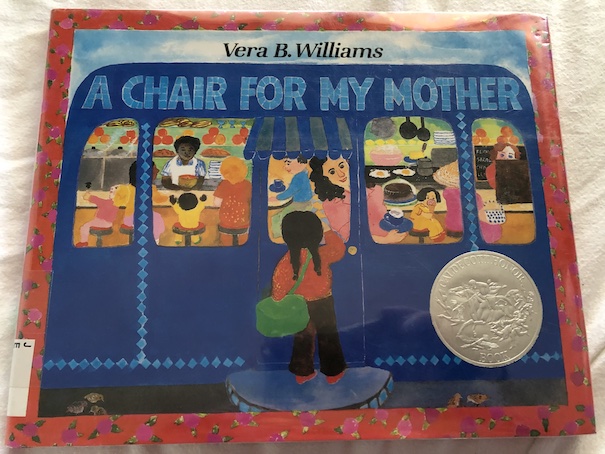
A Chair for My Mother

A girl explains how her family is saving up for a new chair after a fire destroyed all the furniture in their old home. The fire happened before the story really begins, but the girl explains how she and her mother returned from a shopping trip and discovered that their home was on fire.

The girl’s grandmother and the family cat escaped from the fire, but everything they had in the house burned.

The girl, her mother, and her grandmother all moved in with the girl’s aunt and uncle until they could move into a new apartment. However, they didn’t have any furniture in the apartment. Their relatives, friends, and neighbors all helped them by giving them food and pieces of furniture they didn’t need anymore.

It was a big help, however, a year later, they still don’t have a sofa or comfortable armchairs. The girl’s mother works in a restaurant, and when she comes home, she’s very tired from being on her feet all day. She wishes that they had a comfortable armchair where she could rest after work.

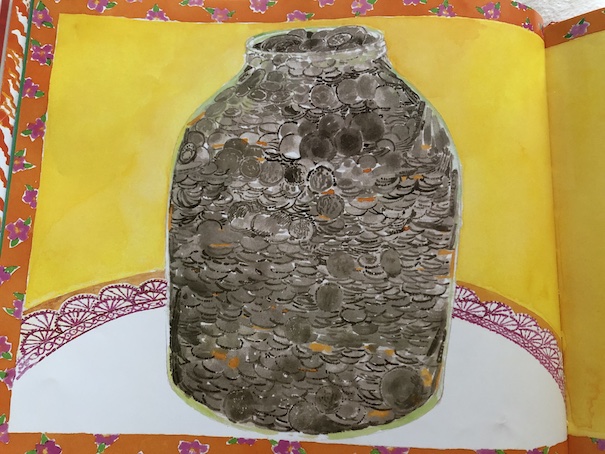
The mother starts saving part of her tips from the restaurant in a coin jar to save up for a new chair. Sometimes, the restaurant owner even pays the girl to do little chores, and she saves part of her money for the chair. Whenever the girl’s grandmother saves money on food she buys, she also puts the savings into the jar. They say that when the jar is full of coins, they will buy the new chair they want.

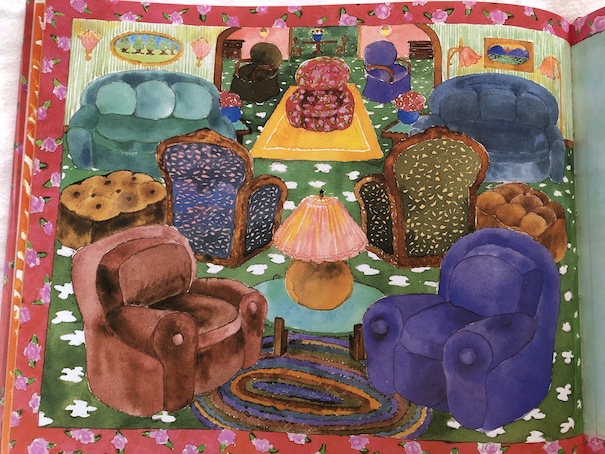
Eventually, the jar is completely full. They count the coins, roll them in coin wrappers, and take them to the bank to change them for ten-dollar bills. Then, they go shopping for a new chair! There are many chairs to choose from, but they know exactly what kind of chair they want.

The book is a Caldecott Honor Book. It’s available to borrow and read for free online through Internet Archive (multiple copies, including one in Spanish).

I remember this book from Reading Rainbow when I was a kid! The pictures are bright and colorful, and the story offers comfort and hope.

The people in the story have been through a tragedy where they lost almost everything they had, but the book shows how they recover. Although the fire was sad, the story starts after the fire happened, and the girl talks about the help they’ve received and what they’re doing to make their new home more comfortable. They’re over the initial shock of the fire and concentrating on improving their situation from there. This book felt both comforting and very real. I liked how it showed the family recovering from their ordeal through a combination of help from relatives and friends and their own efforts. Other people help them with some basic household items as they move into a new apartment, and they also save up their money for the chair they want to make their new place feel more like home.

Linnea in Monet’s Garden

Young Linnea loves plants and flowers. Linnea’s upstairs neighbor, Mr. Bloom, used to be a gardener before he retired. He knows all about plants, and she likes to talk to him about them. Mr. Bloom has a particular book that Linnea likes about the French artist Claude Monet and his garden. Monet was famous for his paintings of the flowers and water lilies in his garden, and the book also has photographs of him, his wife, their children, and their garden. When Linnea looks at that book, she likes to imagine that she really knows the Monet family and that she’s visiting their garden.

One day, Mr. Bloom tells her that it’s possible to really go visit the garden because it still exists. Monet’s house had become run down and the garden was overgrown, but they have since been restored and turned into a museum. They could visit the garden if they go to Paris. They live a long way from Paris, but Mr. Bloom arranges with Linnea’s family for her to go on the trip with him.

Linnea and Mr. Bloom stay at a tiny, old hotel on the River Seine in Paris that was built in 1640. They can see the Notre-Dame Cathedral from the hotel, and it reminds Linnea of The Hunchback of Notre-Dame.

On their first day in Paris, Linnea and Mr. Bloom go to the Marmottan Museum to see Monet’s paintings. Monet’s youngest son left his father’s paintings to the museum when he died because he had no children of his own to inherit them. Mr. Bloom explains to Linnea that Monet painted in the impressionist style, which means that he tried to capture the rough images and impressions of the moment rather than creating detailed, completely realistic paintings. (I’m nearsighted, so impressionist paintings always look to me like what I see when I’m not wearing my glasses. I see colors and rough shapes, but everything is fuzzy with no sharp lines or fine details. I can still tell what objects are without my glasses, but nothing is distinct. I have impressions of things.) Mr. Bloom says that Monet particularly liked to show how light reflects off water and other objects in his paintings.

The next day, they take a train to the town of Vernon, and from there, and from there, they take a taxi to Giverny, where the Monet house and garden are. Along the way, they also buy some food for a picnic. Then, they go to see Monet’s garden.

When Linnea sees the garden in person for the first time, it’s much bigger than she had imagined from the pictures in the book. Mr. Bloom tells Linnea all the names of the different flowers, and they take pictures of them. Then, they go inside Monet’s house. They’re not allowed to take pictures inside the house, but they get some postcards of the house’s interior.

One of the best moments for Linnea is that she is able to stand on the Japanese bridge in the garden, over the lily pond, as she always imagined she could do when she looked at the pictures in Mr. Bloom’s book! Monet painted pictures of that bridge multiple times. Each painting looks different because he painted them at different times and in different weather, so had different impressions of the bridge each time. The book shows Monet’s paintings of the bridge and how different they are from each other, and Linnea tries to capture her own impressions of the bridge.

They aren’t allowed to have their picnic lunch inside Monet’s garden, so they have lunch by the nearby river. Then, they return to Paris.

Back in Paris, they visit the Jeu de Paume museum to see more impressionist paintings. At the Orangerie, they try to see Monet’s giant water lily painting in the Water Lily Rooms. At first, they are told that the exhibit is closed for repairs, but when Mr. Bloom explains that they have come a long way to see them and Linnea starts to cry, the museum staff decide to make an exception.

For the last day of their trip, Linnea and Mr. Bloom decide that they want to return to Giverny. When they make their second visit, a man recognizes them as return visitors, and he turns out to be a member of Monet’s family, his step-great-grandson, Jean-Marie Toulgouat. He lives nearby, and he is also an artist, although his art style is very different from Monet’s. He talks to them about Monet’s life and family, and it also turns out that his wife was the author of the book about Monet that inspired Linnea and Mr. Bloom to take this journey!

When they return home, Linnea and Mr. Bloom go through all the pictures they took in France, and Linnea puts up a bulletin board with postcards and pictures from their trip. She also has a little wooden box with other souvenirs.

In the back of the book, there is a family tree for the Monet family and a timeline of events from Monet’s life. There is also a section of information about museums and sites in Paris and a list of books about Monet.

The book is available to borrow and read for free online through Internet Archive (multiple copies, including one in Chinese). The book was originally written in Swedish and published in Sweden in 1985. The English translation was published in 1987.

This is a lovely book about travel, art, and the beauty of nature and plants. Initially, Linnea becomes interested in Monet because of her love of plants and flowers, and when her neighbor says it’s possible to visit the garden Monet painted, she becomes interested in Monet’s life and work. I grew up learning about art and famous artists because my mother used to teach art lessons through a special program at my school. I don’t remember seeing this book at that time, although it is old enough that I could have. I found it by accident at a thrift store, and it reminded me of the art books that my mother kept around the house when I was a kid.

I enjoyed how the book brought a historical person to life, explaining Monet’s life story as well as his art and showing child readers that it’s possible to see the setting of his paintings in person. The book shows pictures of Monet’s art and photographs of the garden and flowers he painted so children can see the connection between the artwork and the real places and objects. Although not everyone can go to France just on a whim, the book does show what such a trip would be like, and it also shows kids how they can delve deeper into subjects that interest them and even go to places connected with their passions. The journey in the book is a magical trip that even adult armchair travelers can enjoy!

Magdalena

Magdalena is switching classes at school. She’s happy about it because she found her old class too chaotic. She thinks she will be happier in her new class. Her friend in her current class at school, a boy named Saul, tells her that she must be an IGC, an Intellectually Gifted Child, in order to get transferred to that class because that class only takes gifted children. However, she is told that she will also have to wait a little for them to give her a desk in the room. When months go by without her being told that there is a spot ready for her and she can make the switch, Saul thinks that they were probably lying to her about her being able to switch classes.

Finally, in January, she is able to switch to the new class, but right away, she runs into trouble with the class bullies. A boy named Andy and his friend start calling her “Miss Two-Ropes” because of her long braids, and the name sticks. Magdalena wishes that she didn’t have to wear her hair in braids, but her grandmother, Nani, insists on it. She loves Nani, who is from Puerto Rico and has looked after her for last two years, ever since her mother died when she was nine years old, but Nani has some old-fashioned ideas about how girls ought to be raised.

Magdalena’s father is a sailor, and he spends much of his time away at sea, so Magdalena and her grandmother are alone most of the time. Nani speaks Spanish to Magdalena at home because she thinks that’s proper for a Puerto Rican family like theirs, although Magdalena speaks English at school. She thinks that her grandmother probably knows more English than she pretends. Nani also keeps a portrait of Great-Grandfather Mendez, which she brought from Puerto Rico. Although he has been dead for years, the portrait always feels like a living person to Magdalena.

After some further teasing from the boys in her class, Magdalena decides to tell her grandmother that she doesn’t like her braids. Nani says that not unusual, that many children don’t like their braids, but they get over it. Magdalena doesn’t think she’s going to just get over it. Like a lot of kids, she would rather just look like everyone else so she won’t get teased, but Nani doesn’t approve of the short hairstyles that are popular among American girls at Magdalena’s school. She says that Magdalena’s braids are a mark of pride and a caring grandmother who brushes and braids her hair. She thinks the American girls wear their hair short because their mothers can’t be bothered to spend time on caring for long hair, and they don’t have grandmothers to nurture them. When Magdalena tells her that the boys at school are calling her names because of her braids, her grandmother decides that she should talk to the teacher about it. Magdalena thinks that having her grandmother talk to the teacher might be more embarrassing than having the boys call her names, so she persuades her grandmother to forget about it for now and let her handle it.

Then, Magdalena is called to the principal’s office at school. At first, Magdalena is upset because it sounds like she’s in trouble, and she can’t understand what she could have done to cause that. She is calmed a little when a black boy in the office, who is also waiting to talk to the principal, is nice to her. It turns out that Magdalena isn’t really in trouble. Instead, the principal wants to talk to her about one of her classmates, a girl named Daisy Gonzales, who is also transferring into her new class.

Madgalena is surprised because Daisy hasn’t struck her as a gifted child. Most of the other students call her “Spook” because she tends to lurk around the school and suddenly jump out at people to scare them, and she is known to frequently skip classes. The principal says that Daisy might be gifted, but it’s difficult to tell. The teachers think that she’s at least bright, but she’s an “under-achiever.” The principal explains that means that Daisy could do better at school than she does, but for some reason, she doesn’t seem motivated to do better. That’s why they’ve decided to transfer her to the class with the gifted students. They think that she isn’t being challenged enough in the class where she is. The teachers are also concerned that Daisy has no friends at school. They’ve noticed that the other girls at school seem to be afraid of Daisy, although they don’t seem to understand about Daisy’s “Spook” act. They do know that Daisy has behavioral problems and an unhappy home life. The reason why the principal is telling Magdalena about this is that she wants Magdalena to try to be Daisy’s friend when she transfers into her new class. The reason why she selected Magdalena to be Daisy’s new friend is because Daisy’s family is also Puerto Rican, like Magdalena’s family, so she thinks that the girls might understand each other better than their other classmates. The principal thinks that Daisy might settle down at school if she had a friend to help her feel more comfortable there. Magdalena isn’t comfortable with the idea of trying to be Spook’s friend because she also finds Daisy spooky, but the principal persuades her to try but not to let on that the principal asked her to do this.

Magdalena has no idea how to approach Daisy/Spook to be friends, since she’s not the easiest person to approach about anything. Then, Sue Ellen, the most popular girl in class tells Magdalena that she wants to be friends with her. She says that she’s been feeling empathy for her since the first day that she came to class and the boys started teasing her, and she felt it again when she got called to see the principal. She asks her what the principal wanted, and Magdalena explains that she asked her to do something, but it’s something really hard, and she isn’t supposed to talk about it. Sue Ellen offers to help her with whatever the principal’s task is. Magdalena thinks maybe making friends with Spook won’t be so bad if Sue Ellen helps, so she takes Sue Ellen into her confidence. Sue Ellen agrees with Magdalena that making friends with Spook would be hard because she’s so weird and spooky. Both girls admit that they’re a little afraid of her, but Sue Ellen agrees to try to be basically nice to Spook along with Magdalena and see what happens. Sue Ellen says that the principal ought to have more empathy for the students and see just how hard it would be to get along with someone like Spook.

Their first attempts at making friends with Spook are clumsy. Sue Ellen tries offering her advice, pointing out that she wore the wrong thing to the school assembly, but criticism and advice aren’t the best ice-breakers. Then, to Magdalena’s surprise, Spook approaches her in the school library, when she is trying to find a specific book for her grandmother. The school library doesn’t have the book she wants, but Spook says that she knows where to find it. However, she will only help Magdalena if she plays hooky and goes with her right now. Magdalena hesitates because she doesn’t really want to skip class and get in trouble, but Spook says that Magdalena will have to come with her because she’s “emotionally disturbed” and might do crazy things if she doesn’t get her way. Magdalena points out that school will end in only 20 minutes, and she asks Spook to wait for her. Spook makes her promise that she won’t change her mind and let her down in that time.

When Magdalena waits for Spook, she doesn’t show up at first, but Spook jumps out at her just when she’s giving up waiting. Spook says that she just wanted to see if Magdalena was serious about wanting to come with her. The place where Spook knows they can find the book turns out to be the Brooklyn Public Library. Along the way, Magdalena begins to learn more about Spook. The reason why she wasn’t dressed right this morning was that the sweater she was wearing was the only thing she had to wear that was clean. She skipped out during the school assembly to go home and see if her mother was back from the laundromat so she could put on something else. Also, Spook isn’t completely friendless. She is friends with a strange woman named Miss Lilley, who wears an unusual, large hat. When Daisy tells Miss Lilley that she got put into the class at school with the smart kids, Miss Lilley congratulates her and tells her that she knew she was smart. Daisy admits that she’s been trying not to let her teachers know that she’s smart because she knows that they will expect more of her and insist that she do all her homework. People don’t expect so much of kids who aren’t bright. There is method to Daisy’s madness. All of her weird and spooky acts are tools that she uses to get her, get out of things that she doesn’t want to do, cover up for problems that she has, and keep people she doesn’t like or doesn’t think would understand her at a distance.

Daisy introduces Magdalena as one of the smart kids from her class, but Miss Lilley thinks that Magdalena’s manners aren’t very polite because she keeps staring. Magdalena has trouble getting over the large hat, which looks like a large pumpkin. Miss Lilley begins evaluating Magdalena’s appearance, and Magdalena comments about how she hates her braids, but her grandmother makes her wear them. Miss Lilley says that she understands that her grandmother likes the quaintness of the braids, but she knows how to deal with that. She also knows where to find a good barber. The black boy who was nice to Magdalena earlier, Samson Shivers, makes money after school by shining shoes outside the library, and when Miss Lilley asks him if he would be willing to lend them money for the haircut, he joins the others at the barber shop. Miss Lilley takes the kids to the barber shop, and Magdalena gets a haircut. Magdalena feels wonderfully free after he haircut, although she saves the braids as a souvenir and worries about what her grandmother will say when she gets home.

Nani is very upset when she sees Magdalena’s short hair and worries that Magdalena is rejecting her care for her and her Puerto Rican heritage. Magdalena says that’s not the case and explains about going to the library and meeting Miss Lilley. Magdalena’s grandmother thinks that she’s bewitched and says that she knows how to deal with that. She uses herbs on Magdalena to break the bewitchment.

Getting the haircut changes things for Magdalena. The boys stop teasing her, which is a relief. However, Sue Ellen is annoyed that Magdalena didn’t tell her that she was going to get her hair cut. Magdalena explains that it was a sudden decision and a possible bewitchment by Miss Lilley. Sue Ellen thinks that Spook is probably the one who bewitched Magdalena because she’s so spooky and that maybe Magdalena would rather be best friends with her. Magdalena says that’s not the case and that she doesn’t see why she can’t be friends with both girls. Sue Ellen still expects that Spook is going to do something to ruin the class, but Magdalena notices that Spook is becoming less spooky in their class. She stops skipping classes, does more of her homework, and cuts out some of her previous spooky behavior.

Samson, often called Sam, is a practical boy, and when Magdalena tells him how her grandmother thinks Miss Lilley is a witch and bewitched her, he says that she can’t be a witch. Sam sees her often because he shines shoes by the library, and he realizes that Miss Lilley is actually just a poor, old woman. She goes to the library all the time because she can’t afford proper heating for her apartment. She often has little to eat, and she partly survives off of candy that he gives her. Like Spook, she seems spooky because she looks odd and behaves oddly, but there are explanations for what she does that show that she’s actually unfortunate.

Magdalena’s grandmother meets Spook for the first time when Spook hangs out with Magdalena at her apartment after school. Nani isn’t home at the time, but the girls talk to each other about their lives and families. Magdalena gets to know more about Spook, and Spook admires the place where Magdalena lives. Spook’s family lives in a much poorer apartment, and it’s crowded with Spook’s younger siblings. Spook admires the nice bathtub that Magdalena and her grandmother have and says that she wishes they had one at her apartment. Part of the reason why she looks so strange is that she doesn’t get the opportunity to take baths often. Magdalena tells her that if she wants a bath, she can go ahead and take one. Nani arrives home before Spook is finished with her bath, but Nani stops her when she tries to get out and get her clothes. Nani can see how badly Spook needs some care, so she insists that she finish the bath, clean the tub, and let her shampoo her hair. When she’s done, Nani has Magdalena loan her some clean clothes, and the girls are amazed at the transformation.

After the bath incident, Spook avoids Magdalena for a while, and she can’t understand why, but it’s about Spook realizing what’s been lacking in her life and envying what Magdalena has: someone who really cares for her. She was so emotional when she looked at herself in the mirror that she spit at the image and then was embarrassed that she had done that. Nani surprisingly understands Spook’s behavior. She can see that Spook lacks impulse control and the ability to understand and manage her feelings. Nani comments that she’s angry with Spook’s mother because she can tell that the girl has been badly neglected. Having been a mother and grandmother herself, she knows exactly how to deal with this.

Meanwhile, Sam is correct about Miss Lilley. Miss Lilley is poor and not in very good health, but she also knows what Magdalena and Spook/Daisy need. She is eager to help the girls, but she also needs some help and attention herself. When Miss Lilley decides that it’s time to have a word with Nani about the needs of modern girls and her fears about her granddaughter becoming too American, a number of things get better.

The book is available to borrow and read for free online through Internet Archive.

The heart of this story is understanding and empathy. By the time it’s over, many of the characters come to a better understanding of each other and maybe themselves. Although Spook’s transformation is the most dramatic, the other characters are also changed after their experiences in the story.

Magdalena’s changes come with her admission to her grandmother that she really doesn’t like her braids and then with her decision to have her hair cut against her grandmothers wishes. She knew that her grandmother wouldn’t like it when she said that she didn’t want braids because her grandmother is a traditionalist, and she knew that Nani wouldn’t react well to the haircut. At first, it was easier for Magdalena to buy into the idea that Miss Lilley was a witch who bewitched her into doing it, but that’s not really the truth. It wasn’t even that Magdalena was getting her hair cut just because of the teasing. When Magdalena and Spook are talking about whether or not they truly understand the reasons why they do things, Magdalena acknowledges that she has reasons for the things she does, and the truth is that she got the haircut because she herself really hated wearing braids. If she had really loved her braids, she could have kept them in spite of the teasing, and she could have turned down the offer of a haircut, but she really wanted to change her hairstyle, and she just took advantage of the opportunity to do it.

Nani understands from the first time she meets Spook that she has not had nearly the level of care and attention that she has needed in life. Spook doesn’t even really understand all of the motivations she has for the things she does. Her behavior is odd partly because she acts on impulse, not fully thinking about the consequences or the affect her behavior has on others. She initially doesn’t have much self-awareness because she has not had caring adults in her life to teach her how to behave, how to understand her feelings, and how to control herself. Because she hasn’t really had any friends before, she hasn’t really had anyone to talk to about these things and help give her some perspective. When Spook and Magdalena talk about why she spit on the mirror, Spook says at first that she isn’t sure why she did it. As they continue to talk about reasons for doing things, though, Spook admits that she did it because, while she was stunned at how nice she looked, she quickly became upset because she didn’t think that nice look could last.

Nani is the nurturing type of person, and she quickly sees that Spook is in dire need of some nurturing and guidance. She also recognizes that Spook doesn’t have much confidence in herself. She is bright, but she has grown used to hiding it. She also thinks, because she doesn’t really understand her feelings or behavior, that is can never really control herself. She thinks that she will always be a “stinker” who does things that she shouldn’t and acts weird. Nani has a frank talk with her and tells her that she can be herself without being a “stinker”, and the first step is believing that she can. Even if she’s not in the habit of understanding and controlling herself, she can learn. People have different sides to their personalities and different ways of expressing themselves, and Spook can learn how to show the best sides of herself in the best possible ways.

Magdalena appreciates that Nani is understanding and helping Spook, but she also has a frank talk with her grandmother about why she doesn’t understand her own granddaughter as well. When Magdalena tries to tell her what she wants or doesn’t want, Nani contradicts her or ignores her feelings. Nani is understanding with Spook because she can tell that Spook is a disadvantaged child, but she doesn’t see her granddaughter the same way, so she doesn’t try to understand why Magdalena sometimes does things she doesn’t like. Nani admits that she wanted her granddaughter to be “perfect”, but maybe she doesn’t really know what “perfect” actually is. She wants the traditional ways for her granddaughter because she really thinks that’s what’s best, but even grandmother doesn’t always know what’s best.

Miss Lilley is concerned about the girls and offers them attention and support. When she goes to see Nani and open her eyes to her grandmother’s needs and the ways of modern girls, she collapses because of her bad health. Fortunately, Nani is a nurturing person, and she nurtures Miss Lilley, making sure that she gets the treatment she needs and even looking after her when she gets out of the hospital. Miss Lilley’s health improves, and the two of them become friends. Although they are both older ladies, they each admit that they have things to learn in their lives, and they can learn from each other. Nani helps her to make changes to her living arrangements so she will be healthier and more comfortable, and Miss Lilley helps her understand what modern American life has to offer for girls like Magdalena.

Samson is always a very understanding character because he is genuinely interested in people, and he meets many different types of people through his shoe-shining business. Although Sue Ellen is the first person who brings up the topic of empathy, she is really the one who understands it the least. I think her relatively narrow view of empathy is because of her relatively narrow life experiences. She feels some empathy for Magdalena because she sees Magdalena experiencing something she understands, but she doesn’t seem to know what to do when she encounters something she doesn’t understand. Admittedly, Spook’s spooky act is off-putting, partly by design and partly because Spook has issues she herself doesn’t know how to handle. However, because Sue Ellen only wants to stick to the familiar and understandable, she doesn’t notice when Spook begins to change and doesn’t see how some support from her could influence her for the better. Sue Ellen’s attempts at friendliness and helpfulness often involve offering some kind of criticism, like pointing out that Spook isn’t dressed right. Magdalena can tell that Sue Ellen is trying to be helpful, but she’s also kind of snippy and smug in the way she does it, and that gets on Magdalena’s nerves, too. Sue Ellen kind of fades out of the story toward the end, so we don’t know if she continues being friendly with Magdalena or not or if she ever recognizes Spook’s transformation.

There is also a subplot that I haven’t mentioned about the literary magazine that the girls’ class starts. Their teacher has some thought-provoking descriptions about what good writing is and does, and the girls’ choices of what to write about are based on their experiences and the changes in their lives.

The book doesn’t shy away from the harsh realities of life. Magdalena’s mother is dead, and her father is away most of the time, so she is being raised by her grandmother. Her father never even makes an appearance in the story. Miss Lilley is a poor and lonely old woman who needs help and friends. It is acknowledged that Spook is a neglected child, and she even tells Magdalena that her favorite brother died at age three because he was asthmatic, and they were living in bad conditions. We don’t know exactly how her family came to be living in such bad conditions, but Spook says that, if she wrote a story about her family, the teacher would think she had a filthy mind.

Since the story is about understanding other people, one could consider whether we might view Spook’s neglectful mother more sympathetically if we knew her past and what led her to the situation they’re now in, but we do not see Spook’s mother at any point in the story. I think it’s also important to note that understanding does not equal approval. You can know a person’s history and reasons for doing things and still not agree with them. Maybe Spook’s mother is another unfortunate soul who needs some help, but if she is, she doesn’t seem to be looking for that help. Her vulnerable children are suffering for it, and one has died. Empathy doesn’t mean saying that things are okay when they really aren’t, and this mother’s neglect of her children is not okay.