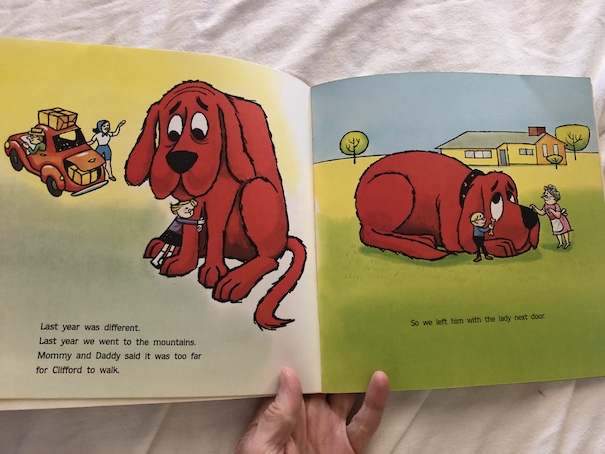
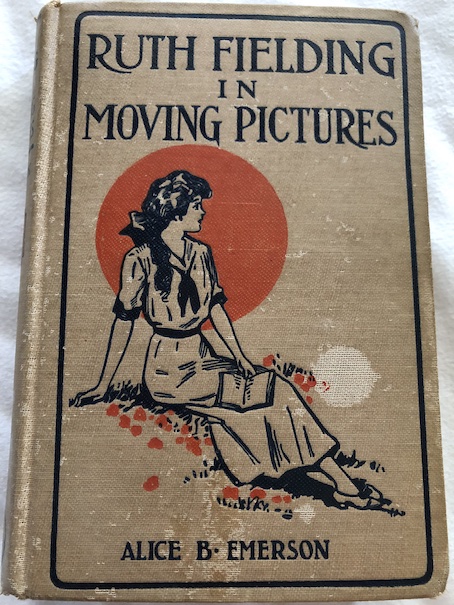
Gone Away

I haven’t found a copy with its dust jacket intact.

Gone Away by Ruth Tomalin, 1979.

Time flies?
Ah no.
Time stays.
We go.

Sundial motto from the beginning of Gone Away

Francie is an only child living on a farm called Goneaway Farm in Sussex in the 1930s. It’s a very old farm, and there’s a story about it that, hundreds of years before, another family once lived there, another couple with only one child. One day, this family went to a fair in another town, Alchester, and for reasons nobody understands, they never returned to this farm. The farm stood empty for a long time before it had a new owner. Because this old family went away with no explanation, the farm came to be called Goneaway. In spite of this strange story and the age of the farm, Francie has never felt that the farm was haunted or that there was anything sinister about it. Then, Francie finds herself staying in a real haunted house.

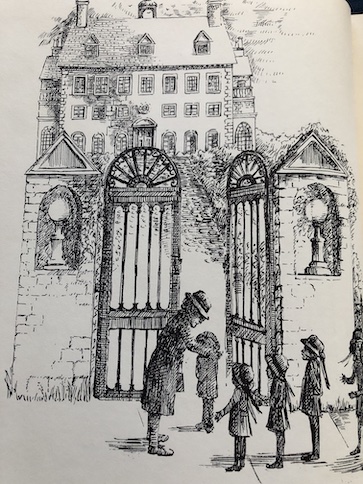
There are no illustrations in the book. It starts with this quote.

Because the farm where Francie lives with her parents is far away from local schools, Francie studies her lessons at home with her parents’ help, but she often gets distracted by the animals on the farm and doesn’t focus on her lessons. Francie’s great-aunts, Aunt Berta and Aunt Fanny, live in Scotland, but when they come to visit the farm, they see how Francie isn’t getting her schoolwork done. The aunts are also concerned at how isolated Francie’s life is. There are no other children living nearby to be friends with Francie, and they think that her life must be lonely. They talk to Francie’s parents about sending her to boarding school, but they say that they can’t afford it. They can’t even afford a car, which is why they can’t drive Francie to school in town. The aunts remind Francie’s mother that she used to board in a private house with a nice family so she could attend school when she was young. Boarding with a family wouldn’t cost as much as a fancy boarding school, and she could come home on weekends. Still, Francie’s parents are reluctant to send her away because they think she’s too young, and they’re not ready to part with her.

When the aunts leave after their visit and her parents don’t bring up the subject of school again for a while, Francie is relieved. She loves her life on the farm, and she doesn’t want to leave. Yet, she also finds herself oddly disappointed, too. She’s read stories about children at schools, and their adventures do sound exciting. She thinks it would be ideal if she could go to school during the day and come home afterward, like other children do, but that just won’t work with her family’s circumstances. Her parents’ attempts to find friends for her just aren’t working, either. Her parents start inviting other farm families to visit on Sundays, but Francie doesn’t get along with their children. The reasons why she doesn’t get along with them are largely because the other children don’t behave well, but these incidents convince Francie’s parents that maybe the aunts were right and that Francie could benefit from going to school and meeting a wider range of other children.

Her parents write to the high school in Alchester and inquire about registering Francie. They arrange for Francie to take entrance exams, but Francie has mixed feelings about it. On the one hand, the idea of boarding and going to school, with the knowledge that she will come home on the weekends, seems exciting, but on the other hand, she worries that the children at the school won’t be any more friendly than the children of the nearby farm families. Her mixed feelings continue through the day when she and her mother visit the school. At first, Francie thinks that maybe she’ll flunk the entrance exams on purpose so she won’t have to leave her farm. Then, after the initial tour of the school, Francie thinks that going there may be exciting after all, so maybe she’ll try to pass the exams. The exams are difficult, and she expects she’ll fail them after all because she really can’t do the work. Her parents tell her not to worry because, if she fails this year, she can always study more and try again next year. However, it turns out that she did pass. The arithmetic portion of the exam really was too difficult for her because the person giving her the exam accidentally gave her a higher level test instead of the basic entrance exam, but Francie did an excellent job on the writing portion of the test.

Since Francie will be attending the school in Alchester after all, she and her mother begin shopping for her school uniforms and other supplies. Francie is still worried about the prospect of boarding with strangers in town, and her mother isn’t sure how to find a house or family willing to take her. A boarding prospect turns up because Francie is too small and skinny for even the smallest available size of the school uniform, and she and her mother have to visit a professional tailor. The tailor, Mrs. Majendie, also has a few rooms that she rents out to boarders. Francie isn’t sure that she’ll like boarding with Mrs. Majendie at first because she and her house seem a bit grand, her dog seems oddly bored and unresponsive to Francie’s friendliness, and her other boarder is the headmistress of another school in town, the Chantry School. However, the available room is beautiful, with a four-poster bed and tapestries, and the room has a view of the nearby churchyard, where the children from the Chantry School are playing among tombstones in the old graveyard. Mrs. Majendie says that the Chantry School was once a chapel, and her own house was once an old inn. She also says that a new housekeeper will be moving in soon with her daughter, who will attend the Chantry School. It all seems like a fairy tale kind of place to Francie, and she is reassured that there will be another girl living in the house with her, so she tells her mother that she would like to board there.

When she actually starts school, it goes pretty well. The classes aren’t too hard, the subjects are interesting, and she gets along well with the other girls. There is an older girl called Trixie who likes to play pranks on the younger students, and some of the girls tease Francie about her height, but the older girl who is assigned to look after her, Verity, tells Francie not to take any notice of those girls. At first, Francie is able to use her bicycle to get from school to the train station, so she is able to go home every night, but then, as the days grow shorter, and it gets dark sooner, she can’t do that anymore, so she starts to board in town with Mrs. Majendie.

Her boarding experience turns out to be different from what she first thought, though. It turns out that the new housekeeper isn’t very friendly, and her daughter decided to stay with her grandmother instead of coming to town with her mother, so the house is lonelier than Francie had expected. The atmosphere is also different in the winter than in the summer, when Francie first saw her room. The room seems colder, darker, and a little more sinister in the winter, and in the evening, there aren’t any children playing in the churchyard outside. At night, she hears strange sounds, like a tapping and a wailing. When Trixie learns that the place where Francie is boarding is Falcon House, she implies that there’s something really wrong with the place, but Francie assumes it’s just another of Trixie’s tricks. Then, when other students try to get Trixie to shut up and remind her that they all promised not to talk about it in front of Francie, Francie realizes that there really is something weird about the house. She tries to get Verity to explain it to her, but Verity refuses, which just makes Francie angry and more scared. Now, she knows there is a real secret about the house, but she doesn’t know exactly what it is.

A strange man comes to visit Falcon House, and Francie sees that his card says he is Dr. D. Bone Fane from the Circle for Psychical Research. Francie doesn’t know what it means, so she asks some of the other girls at school if they know. One of them, Bryony, says that she’s met this man before. He’s a ghost-hunter from the United States, investigating supposedly haunted places. Bryony’s father teaches in the Abbey choir school, and this man has been pestering him about stories of a haunting there, although Bryony’s father thinks it’s all boring nonsense. From this information, Francie realizes that Dr. D. Bone Fane is interested in Falcon House because he thinks it’s haunted. She confronts Verity about it, and Verity admits that there are stories of hauntings at Falcon house. Nobody’s ever actually seen the ghost that haunts the house, only heard things, and the only people who have heard the ghost are children. According to the stories, Mrs. Majendie’s own children were the last children to be haunted by the ghost, and they were so scared of the house that they begged their mother to send them to boarding school so they could get away from it. Francie is the first child to live in the house since the Majendie children grew up. Francie realizes that this is why the housekeeper didn’t bring her own daughter to the house and why she seems uneasy about Francie’s presence in the house. Mrs. Majendie even gave her nightlights as a gift because she was expecting Francie to be frightened. The headmistress at Francie’s school told everyone not to talk about the ghost stories, not because she believes in them, but because she was afraid that Francie would believe them and get scared. Everyone but Francie has known about the ghost stories from the beginning, and they’ve all been waiting to see what she will experience in the house, if anything.

The more Francie thinks about it, the more she realizes that she sensed the presence of the ghost on her first visit to the house. Besides the noises she’s been hearing at night, the dog in the house reacted to something at the top of the stairs, as if an invisible hand was petting him. When Francie returns to Falcon House after visiting Verity, it’s a stormy night, and she’s terrified about what might be waiting for her at the top of the stairs. However, when she gets there, and she realizes that it’s just her, the dog, and the ghost, she suddenly realizes that the ghost isn’t a menacing presence. The dog likes it, and it seems a little teasing, but it doesn’t mean Francie any harm. Strangely, its presence begins to feel reassuring to Francie because she’s no longer alone in the house, the only child among adults. The ghost is a child, too. In fact, it’s the ghost of the child from Goneaway, the one who disappeared hundreds of years ago, along with its parents.

The more that Francie investigates, the more she comes to realize that the ghost needs her help. Helping the ghost means learning the truth about the family who once lived on the farm that Francie calls home.

This book was originally published in the UK. The book is available to borrow and read for free online through Internet Archive. There is a sequel to this book called Another Day.

My Reaction and Spoilers

This book fits well with the Dark Academia aesthetic, and it could also be considered Dark Cottagecore because of the farm and countryside themes. When Francie is on the farm, she describes the animals and plants in the countryside. Francie’s school isn’t a boarding school, but she does have to board in a spooky place to go there. There are many literary references throughout the story, and there’s a note in the beginning of the book about the poetry references. Francie reads The Story of the Amulet by E. Nesbit for fun, and her class at school reads Treasure Island. She uses stories she’s read to help her understand what is happening around her. When she makes friends with a girl named Geraldine at school, Geraldine also uses story references to explain what she thinks is happening with the ghost.

When Francie first begins to interact with the ghost, she is only able to sense its presence but not really see it. As the ghost begins to interact with her, it gradually begins becoming more visible. At first, Francie can’t even tell whether the ghost is a boy or a girl, only that it’s a child about her size. She wonders why the stories she’s heard about this child and its parents never mention whether the child is a boy or a girl or what its name and age were. She thinks it’s sad that so many little piece of history get lost.

What she eventually realizes is that the child and its parents were probably plague victims because they disappeared around the time that the plague came through this area in the Middle Ages. She thinks that they probably caught the plague when they came to town for the fair and were buried in one of the unmarked mass graves she’s heard about, and that’s why they were never able to return home. When she talks it over with Geraldine, Geraldine realizes that the children who have been able to see the ghost were all suffering from homesickness when they first arrived at Falcon House. The ghost is awakened by feelings of homesickness in other children because that’s what the ghost has been feeling the entire time. What it wants is to go home to the farm, and Francie has to find a way to help bring it home with her. There is a twist in the ghost story later that leaves Francie wondering how much of what she’s perceived about the ghost is her imagination and another girl, the housekeeper’s daughter, sneaking around the house. However, there really is a ghost, and Francie does figure out how how to help it. It comes home for Christmas with Francie.

During the story, Francie struggles with the difficulties of being away from home and going to school for the first time, and she also starts to consider what it’s going to mean for her future. She still thinks of herself as living at Goneaway Farm, but then, the wife of a farm hand refers to her as becoming a “visitor.” Francie feels uneasy about that because she knows that the woman’s son also went away for school and decided that he would rather do something other than farming, so he now lives somewhere else. Francie still thinks of the farm as her home, and it upsets her to think of the farm without her or her life without the farm in her future. But, is that really what she wants? Before her great-aunts raised the issues of school and friends, Francie was content with her life and didn’t realize that either of those things was something she was missing or might want. Now that she’s going to school in town, meeting new friends, and experiencing some independence to explore the town on her own, what else might she discover that she wants and never knew she could experience before? Will the new things she learns and wants to experience mean giving up her old life, which she still loves? These are all questions that people have as they’re growing up and pursuing an education.

Nobody really knows where life will lead them when they’re just starting out, and that can be scary, but at the same time, growing up does mean change. The changes that Francie experiences are ones that she would have experienced anyway, eventually. Her mother understands some of how Francie feels because she also boarded as a child so she could go to school, but at the same time, Francie realizes that her mother doesn’t understand everything that she’s going through because she isn’t there with her every day. Her mother doesn’t fully know what her classes or teachers are like or what the other people she meets and lives with at Falcon House are like. For the first time in Francie’s life, she and her mother are starting to live different lives, and there are some things that Francie must experience and make decisions about on her own.

The practice of children from rural areas boarding at a private house to attend a day school in town is a real part of history, both in the UK and in the US. I covered that earlier when I reviewed Sixteen and Away From Home, a book set in the 19th century Midwestern US, and The Secret School, when a teenage girl named Ida wants to go to high school in the 1920s. Anne Shirley did the same in Anne of Green Gables, which is set in 19th century Canada. This is what children from rural areas in different countries have had to do if they wanted more schooling than they could get in their area.

There is a scene in the story with some gyspies. The book calls them both “gypsies” and “travellers.” One of them tells Francie’s fortune, which gives her hints about what to do. There is also a scene where girls from Francie’s school put on a performance, and there is a dancing dragon and a student who is dressed as a “Chinese boy” for part of it. The “Chinese boy” costume is only mentioned briefly and not described in detail. It’s the sort of thing that is discouraged now in school, people dressing up as people from other races.

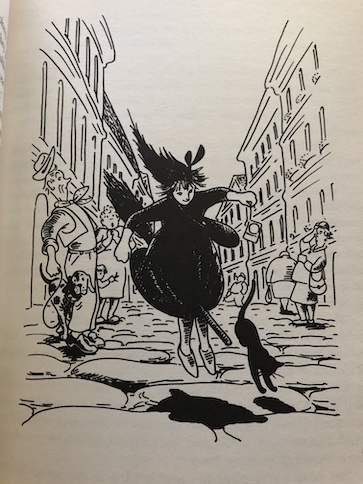
Kiki’s Delivery Service

More Americans would probably recognize the title as the title of a Studio Ghibli animated film for children than as a book title, but the book came before the movie, and it is actually the first in a series, which continues the story about Kiki’s life and adventures, although I don’t think the later books in the series have been translated into English (at least, I haven’t found them in English). The original Japanese version of this book was written in 1985, and I read the English translation from 2003.

Kiki is a young witch, and in keeping with the traditions of young witches, she is expected to leave home at age 13 and live for a year in a city with no other witches.  It will be a test of her developing skills and a coming-of-age experience, helping her to recognize her talents and find her place in the world.

When Kiki sets out for her journey with her cat, Jiji, she doesn’t know exactly where she is going to go or what she will find when she gets there. Some young witches know early on what their talents are and how they plan to support themselves during their year away from home, but Kiki is less sure (like so many of us who “don’t know what we want to be when we grow up”).  The term “witch” just refers to a person’s ability to do magic.  It’s not a job title by itself, and witches are expected to develop a specialization, such as brewing potions or telling the future. Kiki’s mother has tried to teach Kiki her trade, growing herbs and making medicines from them, but Kiki hasn’t had much patience with it.  The only major ability Kiki has is flying, which is something that witches are expected to do anyway.  Still, she has an adventurous spirit and is eager to set out and see what life has to offer.

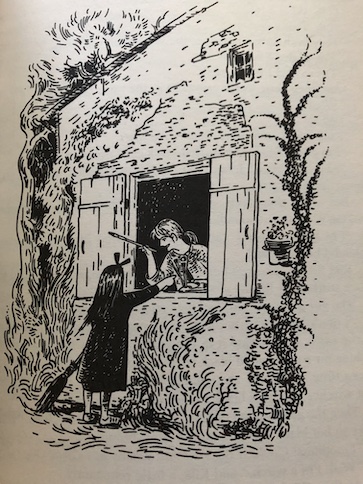
Once Kiki locates a city with no other witches, she has to find a place to stay and a job to earn money. She finds a city by the sea, which seems exciting to her.  As she explores the city, she meets Osono, a woman who owns a bakery with her husband. When she helps deliver a baby’s pacifier to a bakery customer who left it behind, flying to the customer’s house on her on her broom, Osono offers to let her stay in a small apartment attached to the bakery. Kiki feels a little overwhelmed by the big city at first, but she realizes that, in a large city like this, there are probably a lot of people who have small delivery errands that wouldn’t be covered by ordinary parcel delivery services.

Kiki opens a delivery service, delivering small packages and running errands for people around the city.  At first, business is slow, and some people are afraid of her as a witch. During a trip to the beach, a curious boy borrows her broom and breaks it. Kiki is distressed, and the boy apologizes. The boy’s name is Tombo, and he is part of a club of other kids who are interested in flying. He has made a study of flight and had hoped to learn more about how witches fly by trying Kiki’s broom, but Kiki expains that only witches can fly with brooms and that the ability is inherited. Kiki has to make a new broom, and it takes her a while to break it in, but it actually works to her benefit. People who were initially afraid of her for being a witch become less afraid of her and more concerned about her when they see that she is just a young girl, clumsily trying to master a new broom. Kiki gets some additional support and business from people who feel moved to help a struggling young witch. Tombo also makes it up to her and becomes a friend when he helps Kiki to figure out a way to carry a difficult object on her broom.
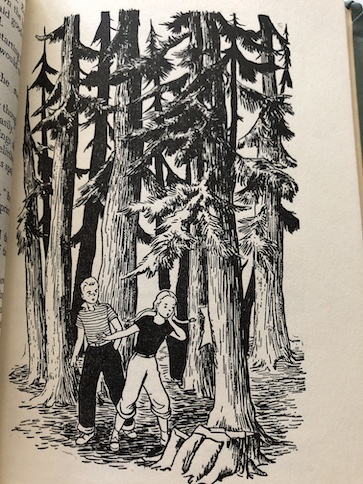
During her very first delivery assignment, Kiki was supposed to carry a toy cat to a boy who was having a birthday, but she accidentally dropped it. When she searched for it, she met a young artist, who was enchanted by Kiki as a young witch and painted a portrait of Kiki with Jiji. When the artist asks Kiki to take the painting to the place where it will be on exhibit, Kiki isn’t sure how to carry it at first. It’s kind of a bulky object to carry on her broom. Remembering that Tombo has made a study of flying, she asks him for help. Tombo ties balloons onto the painting to make it float and tells Kiki that she can now pull the painting along on a leash, as if it were a dog. The idea works, and when people see Kiki pulling a painting of herself along through the sky with balloons tied to it, it acts as advertising, bringing her more business.
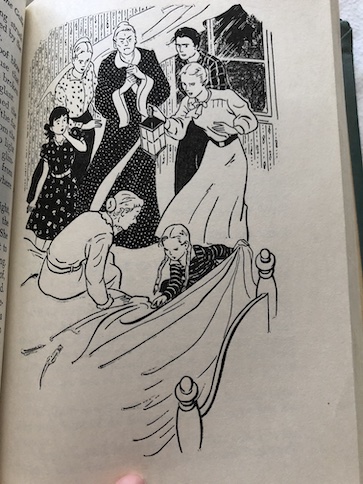
Some of Kiki’s new jobs are difficult or awkward, and some customers are more difficult to deal with than others. There are times when Kiki finds herself missing home or trying to remember how her mother did certain things, wishing that she had been better at watching and remembering what her mother did. Still, Kiki learns many new things from her experiences and acquires new skills.

Kiki’s experiences also help her to realize a few things about herself and life in general. Like other girls, Kiki worries about how boys see her. When Tombo makes a comment that he can talk to her when he can’t talk to other girls, Kiki worries that he doesn’t see her as a girl at all. A job delivering a surprise present to a boy from another girl her age helps Kiki to realize that everyone is a little shy and uncertain about romance and even people who act confident feel a little awkward about first relationships.

As her first year away from home comes to an end, Kiki wonders how much she’s really changed over the year. Although she has successfully started a new business and done well living away from her parents, she still experiences a sense of imposter syndrome, where she doesn’t quite feel like she’s really done all of the things she’s done. Her first visit home to her parents reminds her that her new town has really become her new home. She has become a part of the place, and she feels her new business and friends calling her to return.

In 2018, the author, Eiko Kadono, was awarded the Hans Christian Anderson for her contributions to children’s literature.

My Reaction

I think of this story as one of those stories that takes on more meaning the older you get.  Young adults can recognize Kiki’s struggles to make her own way in the world and establish herself in life as ones that we all go through when we start our working lives and gain our first independence.  It can be a scary, uncertain time, when we often wonder if we really know what we’re doing. (Life Spoiler: No, we don’t, but no one else completely does, either, so it’s normal and manageable. Some things just have to be lived to be really understood, and that’s kind of the point of Kiki spending a year on her own, to see something of life and how she can fit into it.) However, it’s also a time of fun and adventure as we try new things, build new confidence, make new friends, and learn new things about ourselves. Like so many of us, Kiki doesn’t always do everything right, but she learns a lot and endears herself to the people of her new town.

The Miyazaki movie captures the feel of the story well, although the plot isn’t completely the same. There are incidents and characters that are different between the book and the movie. Tombo appears in both the book and the movie, but there are other characters who appear in the book who weren’t in the movie. In the book, Kiki makes friends with a girl named Mimi, who is her age, and the two of them discuss crushes on boys and how each of them was a little envious of the other because, while each of them is struggling with their own uncertainties in life, they each thought that the other acted more confident. The movie version developed the character of the young artist more. Kiki also didn’t lose her powers during the book, although that might be a part of one of the other books in the series, since I haven’t had the chance to read the others yet.

The Secret Language

The Secret Language by Ursula Nordstrom, 1960.

“Sooner or later everyone has to go away from home for the first time. Sometimes it happens when a person is young. Sometimes it happens when a person is old. But sooner or later it does happen to everyone. It happened to Victoria North when she was eight.”

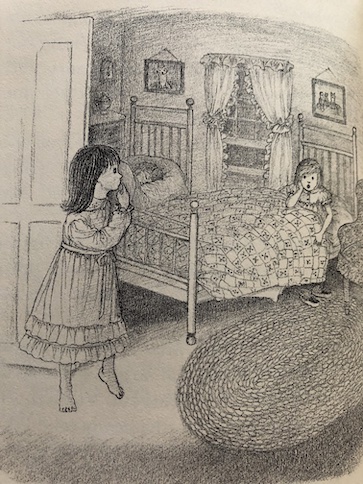
Victoria North is attending boarding school for the first time at the Coburn Home School. Victoria is only eight years old, and this is her first time being away from home at all, so she is very nervous and shy. When she arrives at the school, she is met by an older girl named Ann, who shows her where her room is in the dormitory. Ann shares a room with Victoria and is supposed to show her around and tell her the rules, but she doesn’t really explain much. Victoria still feels lost and has trouble even finding the table where she is supposed to sit at dinner.

At dinner, one of the other girls, Martha Sherman, starts uses funny words, and she tells the other girls that they are part of a secret language that she made up. However, she refuses to tell anybody what they mean. Martha is moody and rude to the other girls at dinner, so the housemother sends her to her room before the meal is over.

Overcome with homesickness, Victoria cries at dinner and during the songs they have to sing afterward. No one has any patience with poor Victoria. Ann tells her that she’s being a crybaby. Other girls laugh at her when they see that she’s been crying. Victoria doesn’t know how she’ll be able to handle boarding school if every day is going to be like this!

The other girls in the dormitory say that Miss Mossman, the housemother, is strict. She blows her whistle at them and makes them line up for inspection every morning. Miss Blanchard, another teacher, is nicer, and she tries to reassure Victoria that things will get better when she gets to know the other students and makes some friends. However, nobody seems to want to be friends with Victoria. Nobody except Martha.

Martha is the only girl who seems interested in talking to Victoria. Martha doesn’t like Coburn Home School, either. More than anything, Martha wants to live at home and just go to an ordinary day school instead of being boarder. Victoria knows just how Martha feels! The other girls are surprised at how well Martha seems to get along with Victoria because Martha doesn’t usually want to be friendly with anyone.

The two of them start to talk about their homes and families. Martha’s father is an importer. She keeps saying that her parents are going to let her come home from boarding school and just go to day school, but it quickly becomes apparent that it isn’t likely. Victoria only has her mother, who works and sometimes needs to travel for work. She doesn’t even remember much about her father. Martha likes math, a subject which Victoria finds hard, but Martha says that she doesn’t reading, which is Victoria’s favorite subject. The two complement each other well.

Although Martha misses home, like Victoria does, and doesn’t really want to be a boarder, she is more experienced about boarding school life, and she helps Victoria to adjust to the school. Martha starts teaching Victoria about pieces of boarding school lore, like school rhymes and the traditions made up and passed down by students, and she also begins teaching her the secret language that she made up. There are only three words in Martha’s secret language, but Martha explains to Victoria what they mean, and the girls decide that they’ll make up more together. Martha becomes Victoria’s best friend all through the rest of her first year at boarding school.

Being friends with Martha makes boarding school feel better to Victoria. Martha still constantly talks about hating boarding school and how she definitely won’t come back next year, although Victoria realizes that’s just a wish of hers. Victoria also comes to realize that many other kids at the boarding school feel the same way. Even the ones who like the school admit that they’d really rather be at home with their parents. They daydream about just going to school during the day and coming straight home afterward, where they can just relax at home and eat what they want and not have to answer to whistles or line up for inspections. When Ann’s family decides to bring her home, Martha and Victoria ask Miss Mossman if they can share a room, and she agrees as long as the girls behave themselves.

Victoria is fascinated at the things that Martha knows about life at boarding school. Martha teaches her about “pie beds.” (I always heard it called “short-sheeting” when I was a kid, although I was never good at making beds the normal way in the first place, so I never fully grasped how to pull off the trick, and I didn’t go to summer camp or boarding school, where people typically did this anyway.) The girls argue about what costumes to wear to the school’s Halloween party, but the school’s handy man helps them make ice cream cone costumes that win a prize for the most original costume. The costumes are uncomfortable to wear, but Victoria is pleased and thinks that Martha should get the credit because the costume concept was her idea. Martha says that, next year, they’ll start planning their costumes earlier and come up with an even better idea. That’s the moment when Victoria realizes that Martha is no longer talking about how she’s definitely not coming back next year.

After the girls come back from Christmas vacation, Victoria is homesick again, but it turns out that their old, strict housemother has left to take care of her father, who is ill. Instead, they get a new housemother, Miss Denton, who is much nicer. She doesn’t blow whistles at the girls to wake them up. Victoria likes Miss Denton right away, and even the other girls in the house start calling her “Mother Carrie” as Miss Denton requests, even though the name strikes them all as silly at first. Martha finds Miss Denton to be overly sweet (“ick-en-spick” in the secret language), although she admits that she’s better than Miss Mossman.

Martha also finds herself liking Miss Blanchard, who teaches math. Miss Blanchard was nice to Victoria in the beginning, but Victoria can’t bring herself to like her much because she has so much trouble in math. Victoria has a fanciful imagination and likes to imagine that certain numbers are boys and others are girls, and Martha finds it frustrating because the idea doesn’t make sense to her, and Victoria doesn’t even follow an exact pattern, like odds vs. evens in her designation. Meanwhile, Victoria is confused by the math tricks that Miss Blanchard teaches Martha. Martha thinks they’re fun, but Victoria isn’t as good at math and has trouble following them.

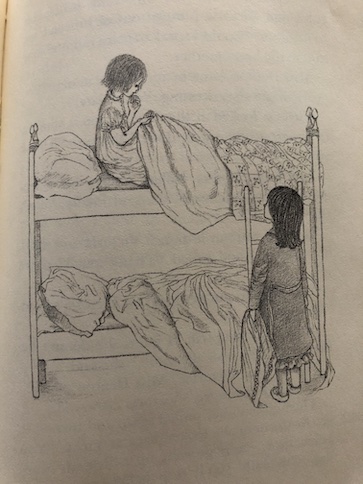
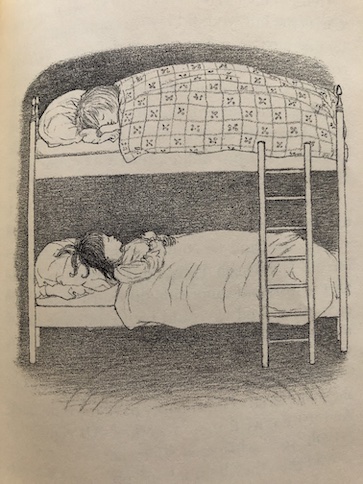
The two girls find themselves arguing sometimes because of their different preferences, but they remain friends. It’s more that, now that they’re getting comfortable with each other and their school, more of their individual personalities are coming out. Victoria is also surprised to realize that, while she still frequently misses her mother, she no longer agrees with her mother about certain things. When her mother comes to visit the school, she worries about Victoria sleeping in the top bunk of their bunk bed, but Victoria herself loves it and has to assure her mother that she likes the top bunk. One thing that boarding school has done for Victoria is to give her a sense of independence and room to develop her own identity and preferences. She no longer has to get her mother’s permission for everything she does, as long as her housemother approves.

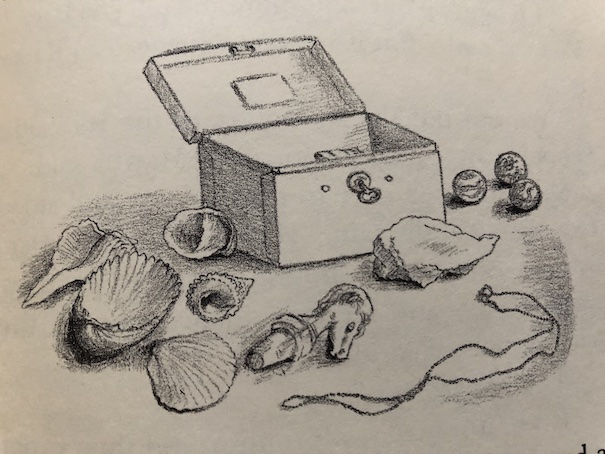
Victoria and Martha are both imaginative, and they begin enjoy their shared adventures at school. They try to hold a midnight feast in their room and search for hidden passages or secret compartments in the dormitory because Martha has heard or read that these things happen in boarding schools. Neither of those adventures goes as planned, but Miss Denton allows the girls to build a little play hut of their own with help from the school’s handy man. Miss Denton also gives the girls a little lockbox to keep some of their treasures in, and they hide it so they can have a buried treasure.

As the year comes to an end, Victoria knows that she’ll be coming back to boarding school next year, and the prospect doesn’t seem so bad as it did before. Martha isn’t sure whether she will or not, talking sometimes about what they’ll do next year but still hoping to live at home with her parents. But, if Martha doesn’t come back to school, it just wouldn’t be the same for Victoria!

The book is available to borrow and read for free online through Internet Archive.

My Reaction and Spoilers

One of the things I found interesting about this book is that it is set in the US. The iconic boarding school stories for children tend to be British stories, but the Coburn Home School is in New York state. The girls’ parents live in New York City.

Most of the story focuses on the girls’ relationship with each other and their growing sense of self-identity and confidence at their boarding school. They talk about classes they take and how they each feel about the other’s favorite subject, but they aren’t shown in classes themselves. The school is also a co-ed school, with both boys and girls, but the boys don’t enter into the story much because most of the action takes place around the girls’ dorm. The boys live in a different dorm. There is only one instance where a boy is shown talking to Victoria, with a hint that he might have a crush on Victoria, another new development in Victoria’s life at school. The little developments in the girls’ lives and attitudes through the school year and each little experience and adventure they have are the main focus of the story. These are the things that are helping the girls understand and develop their identities, self-confidence, and sense of independence.

Toward the end of the book, Miss Denton encourages the girls to think about all of the things they’ve learned this year, and not just the ones they’ve learned in class. The girls don’t fully understand and appreciate that Miss Denton is talking about personal growth and development, but they do consider things they’ve learned, like how to make beds, that midnight feasts aren’t as fun as they sound, and how Victoria learned not to be homesick. These are some of the little things that are part of their school experience and that are slowly making them more grown up and independent than they used to be.

Although Martha is a little older than Victoria and sometimes chides her for being babyish about some things (like putting a lose tooth under her pillow) or still homesick, the truth is that Martha has been just as homesick the entire time. Martha doesn’t appear to be as upset about boarding school as Victoria because she is not a new student in this book, like Victoria. She already went through her first year at boarding school before Victoria got there, so she no longer openly cries about being away from home. Still, the reason why she keeps talking about going home and living with her parents all the time is that she misses them. While the girls’ adventures during the school year and Victoria’s realizations about how boarding school gives her the opportunity to do things and be with people she wouldn’t at home make her feel better about coming back next year, Martha still feels uncertain about it. Martha has also come to love being friends with Victoria and even loves Miss Denton, but her feelings of homesickness leave her feeling torn about what she really wants.

There are hints that Martha will probably return to boarding school anyway, but Miss Denton reassures Victoria that she will be fine at boarding school even if Martha decides not to come next fall, reminding Victoria that she is now one of the “old girls” instead of a scared new one, like she used to be. Victoria also starts to feel that way herself. Martha will probably be back the next year to be with Victoria, Miss Denton, and Miss Blanchard, but readers can be reassured that, even if she doesn’t return, Victoria will be all right with her new sense of identity and independence. This first year at boarding school with Martha may be the beginning of a lifelong friendship or just one step to Victoria finding herself and building other friendships. Maybe it’s both. Victoria’s future life will be fine in general as she continues growing up and finding her way, learning to manage her life one step at a time.

There is a modern 21st century documentary about young children going to boarding school for the first time at 8 years old, What’s Life Like in a Private British Boarding School? | Leaving Home at 8 Years Old, on YouTube. The school in that documentary is British, but I was struck by the common feelings in the documentary and the book, even though they take place decades apart in different countries. There are just some parts of the human experience that last through the generations. The documentary also shows the parents’ side of the boarding school experience, the reasons why they choose to send their children to boarding school, and how they cope with their feelings about sending their children away and being separated from them.

Boarding school isn’t always easy for parents in terms of emotions, and there are hints of that in The Secret Language. We never see Martha’s parents in the book, so we don’t know what’s going on with them, but Victoria’s mother fusses over Victoria when she gets the chance, and she talks about how great it would be if she could arrange things so that Victoria can be home with her all the time again, too. If Victoria’s mother wasn’t a working single mother who has to travel for work, she probably wouldn’t have sent her away to boarding school at all. Miss Denton is very in tune with people’s feelings, and I think that she’s aware of all the complexities in the lives of the girls and their parents. She does her best to look after the girls emotionally, and that’s part of her urging the girls to consider other people’s feelings, to be thoughtful about each other, and to think about the ways they’ve been changing inside as well as outside. I think that the universal nature of the girls’ and adults’ feelings in the book are a sign of the author’s emotional awareness, understanding of how different types of people feel.

Ursula Nordstrom, the author of the book, was actually a famous children’s book editor. She is credited with helping to transform mid-20th century children’s literature to have more of a focus on children’s feelings, experiences, and imagination instead of being morality tales, focused on what adults want children to know or understand. The Secret Language was the only children’s book that she wrote herself. This YouTube video explains about her life and career.

Mandy

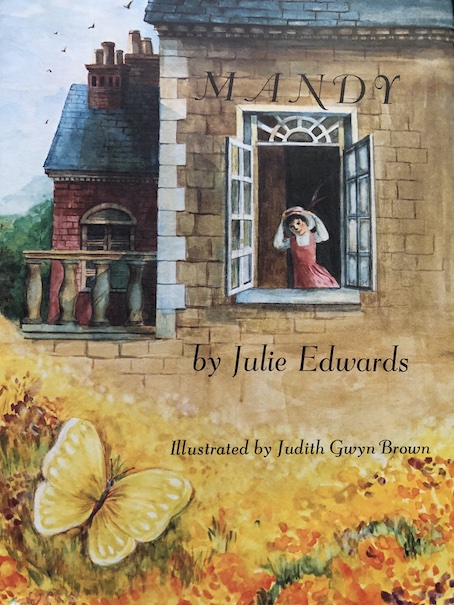
Mandy by Julie Andrews Edwards, 1971.

At St. Martin’s Orphanage, there are usually about 30 children at a time, and the matron does her best to nurture her parentless charges. Mandy is a ten-year-old girl who has lived in the orphanage her entire life. She is intelligent, and she loves reading and daydreaming. She is allowed to work part time at a grocery store, and she spends most of her money buying books. She also loves nature and taking walks by herself. She enjoys spending time alone because she likes to daydream and admire flowers and other beauties of the natural world.

However, Mandy isn’t really happy, either. Even though the orphanage is kind to her, she gets along well with the other orphans, and she has her books and other things to keep herself busy, she is lonely and still misses having parents and the family life she’s never known. Because she has no memory of these things, it’s difficult to say whether she truly understands what she’s missing, but she definitely feels the lack of them in her life. As she gets older, she begins to feel more and more melancholy about it. She knows only that something is missing from her life, and she becomes more desperate about it. She craves a place that she can call her own, a place where she really belongs.

There is a wall behind the orphanage, and Mandy, with her vivid imagination, becomes increasingly curious about what’s on the other side of the wall. She asks Ellie, the maid at the orphanage about it, but as far as Ellie knows, it’s just more of the countryside. She’s never actually explored it herself. Mandy likes to imagine that there might be a castle and a unicorn beyond the wall.

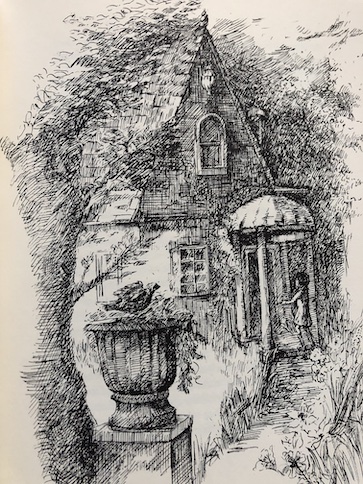
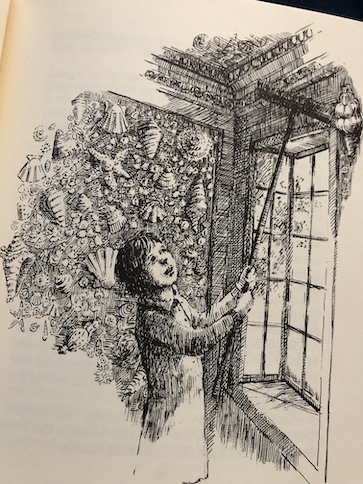
One day, Mandy decides to try climbing over the wall to see for herself. What she sees is an apple orchard and a path through it. When she climbs down from the wall and follows the path, she finds an old, disused cottage with the remains of a garden. The cottage is empty of furniture. Mandy lets herself into the cottage and finds it dusty and in need of repair, and there’s no sign than anyone has been there for years. However, there is a marvelous room in the small house that is decorated with real seashells! Mandy is fascinated, and she wonders who used to live there.

The idea comes to Mandy that she could “adopt” the house and care for it as if it was her own. Obviously, nobody has been there for a long time, and nobody would know or care if she cleaned it up, but she would feel good, having a place of her own and something to care for. When she returns to the orphanage, Ellie tells her that she asked the matron what was on the other side of the wall, and she says that it’s a large, old estate, where nobody lives anymore. Mandy is pleased with that because, if no one lives on the estate where the cottage is, there will be no one to notice when she goes to visit the cottage.

She asks for gardening advice from the gardener at the orphanage without telling him exactly why she wants to know, and he even lets her borrow some tools. Mandy loves tending to her very own garden, and she uses some of her pocket money from the grocery store to buy seeds for the garden and some things for the house. Mandy loves seeing how the cottage and garden improve under her care, but her roommate, Sue, begins to wonder where she keeps disappearing to, and the adults begin to wonder what she is doing with the things she buys and borrows.

The matron tells Mandy that she’s worried about what Mandy is doing because it could be dangerous for her to go off alone where nobody knows where she’s going. Mandy lies to her, saying that she had a project of making a garden for herself but that she gave it up because it was too much work. The matron says that she understands why she would want to have a place to call her own and offers her a spot in the orphanage garden to tend as her own. Mandy feels terrible about lying to the matron, but the thought that the matron might make her give up the special place she’s found because it doesn’t really belong to her or because it’s too dangerous for her to go there alone is just too much.

As the seasons change, Mandy enjoys slipping away to her cottage whenever she can, working in her garden and watching the animals that live nearby. However, the matron has become increasingly suspicious of Mandy’s odd behavior, Sue is angry with her for keeping secrets from her, and there are signs that someone has been at the cottage while she wasn’t there. There are footprints outside the cottage and the hoofprints of a horse, and there are signs that someone has been fixing things. Fortunately, this mysterious person doesn’t seem to mind her being at the cottage. Her mysterious friend leaves little presents and notes for her. More and more, Mandy fears that her secrets will be discovered, but when she becomes ill and needs help at the cottage, she becomes grateful for the help of a friend who knows where she is. Having a place to call your own is good, but having friends and a family who care make a place a real home.

The book is available to borrow and read for free online through Internet Archive (multiple copies).

Update: A site reader pointed out that I should have explained that Julie Andrews Edwards is the same Julie Andrews who played Maria Von Trapp in The Sound of Music, Mary Poppins in the Disney musical, and the queen in The Princess Diaries movies. When I was younger, I didn’t realize that she also wrote children’s books. She is also known for writing The Last of the Really Great Whangdoodles, which I haven’t covered yet. Julie Andrews’s early life was difficult because her parents divorced and each married other people during WWII. At various times, Julie Andrews lived with each of her parents and stepparents and traveled around as she began performing with her family as a child. Her family was poor, and she later described her stepfather as being a violent alcoholic. Her chaotic early life may have been a factor in this story about a lonely girl looking for a place to belong and a real sense of family.

My Reaction and Spoilers

This is a sweet story about having a place to call home and a real family. Mandy craves for these things, even before she truly understands what it means to experience them. Parts of the story are sad and sentimental, but others are just enchanting. This book fits well with the Cottagecore aesthetic. The cottage in the orchard is charming, and Mandy’s care for it reminds me of other children’s books, like Dandelion Cottage, where children have their own secret places to fix up and care for.

Mandy gets wrapped up in her special secret place, tending the garden and watching the animals there, but it gets her into trouble with her friend and roommate, Sue, and with the matron of the orphanage because of the secrets she’s keeping and the way she keeps helping herself to things she really shouldn’t take and slipping away to spend time at the cottage without telling anyone where she’s going. Mandy loves the cottage because she can imagine it as her own home, a place that belongs to her and where she belongs, but Mandy needs people, too. Sue’s friendship for her helps her when she gets into trouble, the matron turns out to be more understanding than Mandy feared, and Mandy’s adventures with her cottage bring her into contact with people who become the family Mandy really needs. Once Mandy has the family she needs, she no longer feels compelled to keep the cottage all to herself, and she decides to share it with the other girls at the orphanage. Mandy’s new home with her new family is every bit as charming and magical as her cottage. It’s a big, old house with secret passages that she explores with her new brother.

However, I think that it’s important to note that not everything in the story is easy and happy for Mandy. All through the story, she struggles with her emotions, experiencing sadness and loneliness and trying to understand what they mean. Her new family doesn’t fully accept her immediately, either. They are never mean or rejecting of her. They are friendly and helpful people from the first time they meet Mandy, but it takes some time of them getting to know her before they decide that they want her to be a permanent part of their family. There isn’t a lot of high drama, and her new brother is never jealous of her or mean to her. However, the family does take some time to make their decision after Mandy spends Christmas with them, and that adds to Mandy’s inner distress.

There are points in the story when Mandy’s fate seems uncertain, and she considers running away from the orphanage. The headmistress becomes concerned about Mandy because of her melancholy and tells the family considering her that Mandy has begun asking her questions again about her parents and how they died, something that she hasn’t done for years, showing that she has become preoccupied with the concept of family life and her lack of it. The family is concerned for Mandy and understanding of her feelings, but I thought that having the family take time to get to know Mandy and to consider what having her join their family would mean was realistic. I think the drama was softened a little to keep the gentle feel of the story, but there’s enough emotion and inner turmoil that it doesn’t feel like Mandy’s problems resolve too easily.

Sue and Mandy bring up the question about whether Mandy’s discovery of the cottage and her new family was a matter of luck. Sue is envious because it seems like everything happens to Mandy. Mandy asks her new father if that’s a matter of luck, but he says that Mandy is special and that things happen to her because she is brave and goes looking for them. She is a quiet person, but she takes her life into her own hands and pursues what she wants, where other people might be too timid to do it. Technically, Mandy broke rules and took some risks to care for her secret cottage, but she did it because it was important to her, and it worked out in the end. Her new father seems to appreciate Mandy’s spirit and determination.

Mystery by Moonlight

One moonlit evening, as Gail Foster walks home from the movies with her brothers, a pair of twins named Ted and Tim, and their friend, they pass the old house called Morgan’s Green. The old house was ruined by fire years before. The house hasn’t been repaired since the fire, but the owner, Miss Morgan, pays someone to maintain the grounds and to keep trespassers away. The old ruin bothers people in the neighborhood because Miss Morgan seems to have no intention of ever repairing it so anybody can live there again. For some reason, she seems to want it to just stand there, a ruined and empty eyesore.

As the children pass the house, Gail suddenly hears a knocking or rapping sound. She stops the boys and gets them to listen, but by the time they do, the sound has stopped. The children debate about what the sound could have been. One of her brothers worries that maybe someone has wandered into the old house and gotten hurt, but the other one thinks that maybe Gail just imagined the sound because she likes to write stories and recently wrote a scary one about a ghost. The brothers’ friend, a boy named Conan, has a job helping the groundskeeper at Morgan’s Green, and he says that he’ll check everything over when he goes to work there the next morning.

Gail feels uneasy about the idea of some unknown person being at the old house because the truth is that she has been secretly trespassing on the grounds herself. She went there one day when she was chasing her brothers’ dog, and she found an old, disused tool shed with a workbench inside. This forgotten shed struck her as a good place to go and write in secret. Her brothers have been teasing her about the stories she writes, so she could use a little privacy. Actually, she could use any privacy. Her brothers routinely sneak into her room, read her stories and her private diary, and even deface the diary and tell their friends what she wrote. Their father always tells Gail that the boys’ teasing and bullying is her fault because she makes it too easy and fun for them by showing her emotions, and her parents refuse for punish the boys for any of it or allow Gail to have a lock on her bedroom door to keep them out. It’s no wonder Gail feels the need to escape. Now, Gail worries that maybe someone (or some thing?) knows about her trespassing and that the knocking sound was some kind of warning for her to stop.

The next day, she reconsiders that idea, remembering that she has heard about thefts in the area lately. Maybe what she heard was actually thieves! Miss Morgan still has some furniture stored in part of the old house that might tempt a thief. Conan’s father is the local sheriff, and he hasn’t had leads on the robberies yet.

The next time that Gail goes to write in the old shed, Conan comes to talk to her. At first, she is worried that her secret hiding place has been discovered, but Conan tells her that he’s known about it for a while because he’s seen her going there before. Gail tells him how badly she needs a place with some privacy. He hasn’t told Gail’s brothers about it, and he says that he doesn’t care if Gail wants to continue using the shed.

Conan is also the only one who’s really taken the rapping that Gail heard seriously. Conan tells Gail that he’s looked around Morgan’s Green, but he hasn’t found any sign of whatever made the noise. However, he has some worse news. The groundskeeper at Morgan’s Green, Mr. Hopkins, has fired Conan, and he won’t even give Conan a reason. They’ve always gotten along well enough before, and Mr. Hopkins has never had any complaint about Conan’s work. Conan feels badly about getting fired, but all he can think of that’s changed lately is the rapping sound and the way he looked over the old house to see if he could find a source. It makes Conan wonder if Mr. Hopkins knows something about what caused the noise and wanted to keep him from finding out about it.

Gail wonders if Miss Morgan could be involved with the local thieves and told Mr. Hopkins to get rid of Conan to keep him from finding their secret hideout or something. The kids pause to consider what they really know about Miss Morgan. She does seem to have odd feelings about the old, burned house. It used to belong to her aunt and uncle, who didn’t used to socialize with the people in town much. After they died, Miss Morgan only lived in the house for a few years before it burned. Now, she doesn’t seem to want to either fix it up or sell it, and no one knows why or what she plans to do with it. However, the kids conclude that she has too much money of her own to get involved with thieves. Still, Conan wants to investigate the situation more because he’s sure something strange is going on at Morgan’s Green, and he wants to find out what it is and if it has something to do with him getting fired.

Gail volunteers to help him investigate, and Conan says that he wants to investigate with just her and not the twins. The twins don’t take things seriously and would be less likely to keep quiet about the whole operation. Conan and Gail do involve Gail’s friend, Lianne, because visiting her gives Gail a reason to walk past Morgan’s Green, both on her way to Lianne’s house and on her way back.

The kids see a strange young man hanging around Morgan’s Green with a sketch pad, and Gail learns that his name is Steve Craig. He’s an art student who makes custom Christmas cards to fund his education at design school. Even Gail’s parents have hired him to make a set of Christmas cards for them with a drawing of their own house on them. When Steve comes to talk to Gail’s parents about the sketches he’s made of their house, Gail mentions that she saw him at Morgan’s Green earlier and asks him why he was there. He says that he was fascinated by the house, but he doesn’t think it will do for his paintings. Gail asks Steve if he has a studio, and he says yes, that he has a room in the attic at his house where he had do his work and that it’s important to have a private place to work. Tim and Ted take this opportunity to jump in and publicly tease their sister about her writing again, the reason why she wants and needs some privacy (from them, specifically). Fortunately, Steve isn’t having any of that, and he makes it clear. The dinner guest speaks to the boys more severely than their father ever did, telling them the plain truth, for once, “You two boys don’t sound very understanding. I can see why your sister would need a place of her own for her writing. But then, you’re rather young. Gail will have to be patient with you.” (Oh, thank God! I hope those useless, idiot parents listened, too. I hated them by this point in the story.) The twins are stunned and embarrassed by this response because no one has ever said anything like this to them in their entire lives. (They would have if the parents weren’t useless twits with obvious favorites among their children. I enjoyed seeing someone tell the twins what they’re really like.) The parents say absolutely nothing. (Again, useless.)

Later that evening, Conan walks Gail home from Lianne’s house, and as they pass Morgan’s Green, they hear voices. They can’t catch everything the voices say, but they do hear one talking about “a few more days.” Who was it, and what’s happening for “a few more days”? When Gail tells Lianne what they heard, Lianne is afraid that maybe the place is haunted.

From Lianne’s parents, they learn that Mr. Hopkins has been moving furniture at the old house. Lianne’s parents think that Miss Morgan might have decided to sell the place after all. However, when Conan mentions that to his father, he talks to Miss Morgan, and Miss Morgan says that she didn’t know Mr. Hopkins was moving anything around at Morgan’s Green. She also doesn’t know anything about Conan being fired.

Mr. Hopkins looks kind of sinister when they hear this, but there are still other suspects and an interesting twist that reveals a secret that Miss Morgan herself has been trying to keep for years. There is a reason why she hasn’t wanted to sell Morgan’s Green, and the revelation of one mystery also reveals the other.

The book is available to borrow and read for free online through Internet Archive (multiple copies). This book is also still in print and available on Kindle through Amazon.

I liked the layers of mystery in the story and range of possible suspects. First, there is the mystery of why Miss Morgan doesn’t want to fix up and sell the house, why she’s left it empty and ruined for years. There is a reason that is revealed toward the end of the book. I liked the reason, which opens up some intriguing elements in the story and a device that the kids themselves use, although I felt like there could have been a little more priming for the reason if people had talked a little more about the aunt and uncle’s history. They were involved in something that Miss Morgan didn’t want to reveal, but surely at least some people in the area should have known about their interests in spiritualism and seances. A good book along some similar lines is The Talking Table Mystery.

Then, there is the question of who, aside from Gail, has been sneaking around Morgan’s Green and why. There are some thieves active in the area, which provide logical suspects, and there are some valuable pieces of art in the possession of the Morgan family that could make targets for thieves. However, Mr. Hopkins has also been acting strangely, and Steve Craig, as an art student, would have a special interest in art. Even though Mr. Hopkins and Steve are usually nice, they behave suspiciously enough to give readers more suspects to consider, and each of them turns out to know more about the Morgan family than they initially let on. Overall, I really liked the setting and mysteries in the story.

I have very strong feelings on the subject of teasing, and I was appalled at the way Gail’s parents allowed her brothers to treat her and her personal belongings. It wasn’t just that the boys were ribbing her a little about liking to write stories. They kept going into her room and not only reading her stories and making fun of what she says in them, but they also read her diary, actively deface her diary, and tell all of their friends about things in her private diary to invite public teasing. This is a serious privacy violation, and when she asks if she can have a lock on her door to keep them out, not only do the parents not punish the boys for any of this, her father says, “They only do it because you get so excited about it. You’re just too teasable, Gail.”

Oh, I see. It’s all Gail’s fault for having emotions and caring about her privacy and the fact that her parents are refusing either to help her or punish the boys for what they’ve done. Her parents always promise her that they’ll punish the boys “next time”, but each time “next time” arrives, they don’t! They’ve repeatedly broken promises, refused to actively parent their children, and enabled the twins’ bad behavior and abuse of their sister. They’re also gaslighting Gail, trying to make her think she is in the wrong for being a human. The father’s basically saying that it’s right for people to victimize others in any way they want as long as it’s easy and fun to do, and that the way bullies act is 100% the fault of the victim and 0% the responsibility of the bullies themselves. That’s the level of personal responsibility he teaches his sons. It’s the level of parental responsibility he shows for teaching his sons how to act and treat other people.

As I was reading, I couldn’t help but think that the father would probably be the first to holler if someone just walked into his room and started going through his drawers and finding those embarrassing things that adults often have hidden away from kids, and I can just imagine his response if that person told him they did it because he made it “too easy”, so it was all his own fault. I don’t know what things he might have hidden away specifically, although as an adult, I think I could make some decent guesses. (Just for starters, a search of the parents’ room would probably reveal what kind of birth control they use, if any, and whether or not they have any private reading material that would be unfit for kids and not safe for work. Should we also count the number of pairs of underwear the father has that have stains or holes?) I just know that everyone has something that they wouldn’t want the general public to see, whether it’s a private diary or clothes that we just can’t get rid of even if they might be embarrassing to wear or something that indicates much more personal habits that might change the way other people might see us if they were made public. The parents are either unable or unwilling to see how they would feel in Gail’s place and take an active role in teaching their sons how to act, imposing consequences for bad behavior.

Gail’s parents say that they worry that she spends too much time alone writing as it is to let her have privacy or a lock on her door, but privacy is also about trust. The fact is that Gail can’t really trust either her brothers or her parents, not with her private belonging and not even with her personal feelings. They repeatedly and deliberately disrespect and violate both and try to gaslight her like it’s her fault, and that’s deeply damaging to personal relationships. They say that they’re worried about her, but how can they be if they’re not in tune with her feelings and continually allow and support the boys in making her feel uncomfortable, embarrassed, disrespected, violated, and abused? The fact that they can’t figure that out or maybe do know it and just don’t care just makes me angry with them.

I don’t think the twins are bad for doing this kind of thing to their sister once, but I do think that they’re bad for doing it repeatedly, knowing that it causes her distress, because they enjoy her distress. Kids do act up and tease siblings, but it’s the parents’ job to lay down the house rules and enforce them and teach the children standards of behavior that they will carry out into the rest of the world with them. These parents are very deliberately not doing that and dodging every opportunity to do it, giving the twins the impression that what they’re doing it fine and fun and there’s no reason to ever stop. This father makes me sick because I can tell that he’s not stopping the boys from teasing their sister and violating her privacy because he identifies with them and is secretly enjoying his daughter’s distress himself.

Pain-in-the-butt people raise pain-in-the-butt kids, and if those boys don’t somehow get some personal awareness or get someone else to make them shape up, they’d be hashtag material in their later years and deeply offended that anyone sees a problem with their behavior because they’ve never had anybody give them consequences for their behavior in their entire spoiled lives. At every single misbehavior, they’ve experienced only excuses, justifications, and free passes from their parents. I’ve always hated this kind of attitude from people and every single person who does this because it does not get better with age alone. Without something to make them realize that there are reasons to restrain themselves, it just escalates until someone finally hits them with a consequence, and then, they’re stunned because it’s never happened to them before, just like the twins are stunned when Steve points out at dinner that they’re behaving badly and that they should think of their sister’s feelings. You can tell that nobody, certainly not the parents, has ever mentioned it to them before, ever. Just imagine them at age 50, explaining to a police officer, a set of angry parents, and a distraught teenager, that the 14-year-old girl they up-skirted made it “too easy”, they were “just having fun”, it was all her fault for being pretty and wearing the wrong clothes, and phones wouldn’t be equipped with cameras if there were any restrictions on how they could use them, no clue why everyone’s mad at them, because that’s the level of morality and personal responsibility, they were raised with. It’s good for people to get feedback on their behavior when they’re young and learning how to be around other human beings. If they don’t get any rules for behavioral standards or an emphasis on considering other people’s feelings during their formative years, they won’t have any basis for understanding behavioral standards, consequences, or human empathy later in life. The older they are when someone finally gives them a consequence for inappropriate behavior of any type, the angrier they typically get because they think they know what they’re entitled to as adults, and they just want the free passes and apparent tacit approval they always get.

The key is confrontation, facing behavior and the consequences of misbehavior directly and honestly. Maybe Gail’s parents are afraid to punish the boys because they think that punishing them would be a reaction to them and the volatile boys will just act up more, but that’s not really the case. The boys take their nonreaction as approval for what they’re doing and, in the father’s case, I think that might really be it. He strikes me as one of those awful people who thinks that nothing should matter when the boys are having fun, and it’s everyone else’s responsibility to deal with the situation because the people having fun shouldn’t be bothered. The mother at least says once that they shouldn’t be messing with Gail’s things, even though she does absolutely nothing at all about it, but I noticed that the father never says that even once and didn’t say anything to agree with his wife that the boys were doing something they shouldn’t.

The twins are shocked and embarrassed whenever anybody says something negative about the way they’ve behaved or even just calls it into question. They don’t know what to do when that happens because, apparently, nobody has ever said anything negative to them about their behavior or questioned them about it … certainly not their own parents. Even when Lianne is careful not to react much to one of the boys repeatedly taking her hat and throwing it in the gutter and in the street, the boy keeps on doing it three times in a row. The nonreaction doesn’t stop him. What finally stops him is Lianne asking him calmly what he’s trying to do. The boy is again shocked and embarrassed. It’s like he’s never had to think about his own actions before in his life. He probably hasn’t because his parents have never taught the twins that they should think about their actions, the consequences, and other people’s feelings before. It’s not just when people don’t react to them (like “Don’t feed the trolls”), it’s when someone actually says something to them that makes them take a hard look at what they’re doing that makes them realize that they’re just being mean and stupid and how that looks to everyone who sees them, and then, they get embarrassed. These are things that they need to hear from somebody, and they’re sure as heck not going to hear them from the people who are supposed to be raising them and teaching them how to function in life. The twins’ parents never say anything about how they should behave, never make them stop and think, and never talk to the twins about thinking of other people or thinking before they act. They let near strangers and other kids do that important piece of parenting for them, and at no point do they present any follow-up to these comments from other people to support the idea.

I found the twins and their parents to be the most stressful parts of the book. It’s partly by design because they represent obstacles for Gail to overcome and reasons for Gail to look for privacy and support outside of the family home. Her need to get away from them helps to move the action forward, but I still found them stressful because of how awful mean people and irresponsible parents are in real life. Like I said, they’re the kind of people who end up getting called out in hashtagged social media messages later and getting angry about it, like people haven’t been trying to deal with them for years, even decades, leading up to it.

The twins never become really great people by the end of the book, either. People are giving them direct messages and hints about their behavior, and there are brief moments when they show some effort to understand why peoples’ reactions to their bad behavior are embarrassing to them, but they never fully get the message, probably because the parents are still enabling them. They’re still kind of mean little twits at the end of the book. They also almost poison their dog by feeding her 21 pieces of chocolate, and they don’t seem very concerned about that, either. Apparently, that’s another thing that their parents never talked to them about. Gail is the one who is concerned about the dog and looks after it, not the boys or the parents. I get the feeling that even the twins’ friends are getting fed up with their babyish meanness, partly because Conan starts preferring to hang out with their more serious sister instead.

Fortunately, at least some of the other adults in the story are starting to get the idea that maybe Gail needs a little privacy, even though the parents aren’t caring enough and are deliberately ignoring Gail’s direct requests and other adults’ comments. Gail’s grandparents give her a diary with a lock on it, so they seem to know how much she likes to write and how much she needs a little privacy and protection from her brothers. She also finds a way to get a desk with a lock, so she can at least lock her work in her desk so the twins can’t get in the desk, even though they can still get in her room.

Mystery of the Angry Idol

Mystery of the Angry Idol by Phyllis A. Whitney, 1965.

Janice Pendleton is sad and nervous because the rest of her family will be moving overseas for at least a year, and she is staying in the United States to go to school. Her father is a consultant to the government, and his latest assignment is in Saigon in Vietnam. (This book is set contemporary to the time when it was written, in the 1960s. The Vietnam War lasted from 1955 to 1975, which is probably why Jan’s father is going there, although he is going as some kind of government consultant instead of an ordinary soldier. This book was written after the Bay of Pigs Invasion and President Johnson’s continuing escalation of the conflict in Vietnam.) However, things are dangerous in Saigon, so Jan’s mother and younger brothers, a pair of twins, will be living in Okinawa, Japan, so her father will able to visit them sometimes. (There’s a US Air Force base in Okinawa, Japan, and I know it existed and was in operation during the 1960s because, coincidentally, my older cousin was born there while my uncle was stationed in Japan in the 1960s. The book doesn’t mention this, but I thought I’d tell you that there’s an American presence there, including civilian relatives of military personnel, so Jan’s mother and brothers will likely be among other Americans during their stay there.) Twelve-year-old Jan could have gone to Japan with them, but she is much more advanced in school than her young brothers. They are so young than their education won’t be disrupted much by living in another country for a year or two, but Jan is older, and her family was worried about her losing her place in school.

Instead of going to Japan, Jan will be living with her grandmother and great-grandmother in Mystic, Connecticut and attending school there while her family is gone. It’s summer now, so until school starts, she will be spending her time adjusting to her new living situation and getting to know her relatives. Jan doesn’t know her grandmother very well, and she’s never even met her great-grandmother before. At least when she’s with them, she will be with family. However, her grandmother is a little worried about her great-grandmother’s health. Great-grandmother Althea doesn’t really leave her upstairs rooms anymore, and although she was much more lively and interested in people when she was younger, she doesn’t seem to have much stamina for meeting and talking to people these days. Jan is told that she will have to be careful and behave herself because, if she upsets her great-grandmother too much, she won’t be allowed to stay with them in Connecticut anymore. Instead, she would have to attend a boarding school in Boston. If she goes to Boston, she will be there alone, without any friends and family nearby, and she is nervous about that. She already knows that, by going to Connecticut, she will be removed from her parents and siblings and her friends in California, where she grew up.

To help her feel better, her father tells her more about her family’s history and great-grandmother Althea. When she was younger, Althea traveled through Asia because her father, Jan’s great-great-grandfather, was a merchant dealing in Asian art. (This is very similar to what the author’s father did for a living and why she spent most of her youth in Asia. More about that below.) Althea spent years living in China with her parents while her father bought and commissioned pieces of Chinese art and sculpture that he could sell and collect for himself. However, after her mother died, Althea was sent to a boarding school in Boston. Her father was later killed during the Boxer Rebellion. Althea was in China at the time when they realized that trouble was coming. She survived and escaped to the United States because her father sent her to stay with some friends of his. She took some of the smaller pieces from his collection with her.

Now, Great-grandmother Althea has an impressive collection of Asian art herself, including some of the pieces that she managed to smuggle out of China when she had to flee. There is one piece in her collection that seems particularly mysterious, an ugly statue in the style of a Chinese idol that she keeps turned to the wall. (The “idol” was never used as an object of worship, for those worried that Althea’s father may have looted a temple or appropriated a Chinese national treasure of some kind. Althea says that one of his artist friends made the statue specifically for him. It’s important to the story that it is in the style of an idol but that it is also genuinely ugly and of little intrinsic value.) Jan’s father implies that there is some kind of mystery surrounding that statue, but he doesn’t really explain what it is. Jan’s father worries a little about Althea because she always used to be such a lively woman, and he says that, in her old age, she has become a kind of hermit who has shut herself away from the world and lives like a “vegetable.” He hopes that Jan’s youthful presence in the house will help her become more interested in life again, although Jan doesn’t see how that can happen when she risks being sent away to boarding school if she “bothers” Althea too much.

When Jan arrives in Connecticut, everything is awkward because she doesn’t get her own room in the house. Instead, she has to sleep on a cot in the living room. Her great-grandmother doesn’t even want to see her right away. There is a storm that night, and Jan has trouble sleeping. The next day, she sees a neighbor boy outside and decides to try making friends with him because she really needs someone her own age to talk to. The boy, Neil, doesn’t seem entirely friendly, but he does talk to her down by the nearby boat dock. He tells her that, the night before, he noticed a strange, suspicious-looking man hanging around her family’s house, and he wonders if anything from the house was stolen. Jan says that she doesn’t think so and that she didn’t hear anyone come in, but because of the noise from the storm, it’s hard to say for sure if someone tried to get into the house. Neil points out that the mysterious stranger is still hanging around the house, and Jan sees a man with a beard hanging around nearby.

Their conversation is interrupted by the arrival of a boy in a boat. Neil and the boy in the boat don’t seem to like each other, and the boy in the boat seems to immediately resent Jan for talking to Neil. He tells her that she’d better not try to get into his boat because Neil tried to get in uninvited earlier. Jan is insulted by this rude boy and returns to her relatives’ house. There, she learns two surprising things. The first is that the boy with the boat, Patrick, is actually the son of Mrs. Marshall, the housekeeper, so they will be seeing a lot of each other. Jan’s grandmother had hoped that Jan and Patrick would be friends. (So far, they haven’t gotten off to a good start.) The second is that it looks like something may have been stolen from the house last night. The mysterious statue is missing. Jan tells her grandmother and Patrick about the strange man that she saw and what Neil said. Her grandmother has trouble believing that a theft really occurred. She thinks that great-grandmother Althea may have just moved the statue and forgotten, but Patrick is interested in the mysterious man.

When Jan goes upstairs to meet her great-grandmother for the first time, she discovers that Althea is not the “vegetable” that she’s been lead to expect. Althea is physically feeble and stays upstairs because her knees are bad and can’t handle stairs anymore. However, she is mentally sharp and highly observant. She talks to Jan about her family’s past and her own past. She understands that Jan didn’t really want to come to Mystic and be separated from her family, but her father wanted her to come and learn more about her family’s history. Althea explains that she spent a large part of her youth living in Shanghai until her mother’s death, when her father sent her to a school in Boston, and she really hated it. This is reassuring because Althea is less likely to send Jan away, remembering her own youth.

Althea also explains that she isn’t unhappy with her relatively isolated life in the upper rooms of the house, surrounded by the pieces of Asian art in her collection. She says that it’s just another phase of life. Life moves in phases, and a person knows when they’re ready for the next phase. When she was a little girl, she loved paper dolls and couldn’t imagine life without them, but as she got older, playing with paper dolls became dull, and she was ready for new activities. Similarly, when she was young and active, she couldn’t imagine a life without travel and meeting other people. Now that she can’t get around as well as she used to, she has entered a new phase of life where she enjoys quiet time alone and thinking and remembering. She is still somewhat in touch with the world because her rooms have a nice view of the Mystic Seaport, but she no longer has to deal with crowds and traffic and bothersome household chores and schedules. Jan is still young and active, so she has trouble fully understanding Althea’s isolated life of reflection, but Althea says that she will understand someday, when she’s ready for that phase herself.

Jan is interested in the objects in Althea’s collection, and Althea shows her some pieces and explains a little about their history. There are some pieces of scrimshaw that Jan’s great-grandfather carved himself, like a carving of a woman’s hand that Althea says was originally meant as a paperweight but which she had mounted on the head of one of her canes. Her other cane has a carved cat. Althea also owns a chess board with red and white pieces made of ivory and cinnabar, with the figures carved in an Asian style. Jan notices an empty shelf in the room and wonders if that’s where the missing statue is supposed to be.

While Jan and her grandmother are standing on an upper porch, looking at the view, they look down and see the mysterious man talking to Mrs. Marshall, who seems worried and upset. Mrs. Marshall and the man notice that they’re being watched, and the man waves to Althea and greets her. Even though the greeting is friendly, the man seems to upset Althea. When Jan asks about him and tells Althea what Neil said, Althea says that the man’s name is Eddie. She loved Eddie when he was a little boy, but she thinks he’s become a scoundrel. She says that Eddie came to see her the night before, but she didn’t want to see him and sent him away. Althea thinks he probably took the missing Chinese idol, but she also says that she always hated that statue. It had such a reproachful expression on its face that she turned it to the wall so she wouldn’t have to see it. Rather than dealing with Eddie or discussing the situation further, Althea says that she would rather just forget about it all.

Jan spends more time with Althea, until Althea gets tired. Althea shows Jan other pieces from her father’s collection of jade objects, explaining the different colors of jade and their relative values and the connections the pieces in the collection have to Chinese folklore and mythology. She says that her daughter-in-law, Jan’s grandmother, worries about robbers breaking into the house to steal these things, but Althea prefers to keep her collection close rather than locked away somewhere. The pieces in the collection bring back happy memories for her.

Jan’s grandmother owns a book store in a local historical district. When Jan goes to see the book store, her grandmother allows her to explore the area and tells her to be sure to visit Patrick’s grandfather at the rope walk (the place where they make rope). Jan goes there and encounters Eddie again. Eddie seems to want to speak to her, but Jan is afraid of him and avoids him. Grandfather Marshall had just been arguing with Eddie, and he’s in a bad mood when Jan darts inside. At first, he snaps at her when she rushes in. When Jan introduces herself and explains that she was startled by Eddie, Grandfather Marshall calms down and apologizes for snapping at her. Jan tries to ask him more about Eddie, but all he says is that he doesn’t want to talk to him, and he advises her to keep avoiding him. He shows her around the rope walk and explains to her how rope is made, and he also shows her a model ship he’s making for Althea that looks like the sailboat her husband used to own called the Happy Heart.

On her way back to her grandmother’s book store, Jan meets Eddie again. He explains to her that he’s actually Patrick’s older brother and the black sheep of their family. He also used to be friends with Jan’s father when they were both young, although Jan’s father was older than he was. Eddie badly wants to communicate with Patrick. He asks Jan if she’ll take a message to Patrick for him, and he hands her a note, leaving quickly before she can say anything. Jan shows the note to her grandmother and asks her what she should do about it. Without going into specifics, Jan’s grandmother says that Eddie was always a wild child, and years ago, he did something that was very scandalous, and he had to leave town. That’s why most people in town don’t want to see him or talk about him in public, although there’s been plenty of private gossip about what he did. The Marshalls have been friends with the Pendletons for years, and Jan’s grandmother thinks that it’s probably time to forgive and forget what Eddie did, which is why she doesn’t want to pass on gossip about him and make things harder for him and his family. She tells Jan that it’s fine to give Patrick the note from Eddie.

Jan’s delivery of the note thaws her relationship with Patrick a little, and he gives her a ride back across the river to her family’s home in his boat. There, Mrs. Marshall tells Jan that, because her meeting with her great-grandmother went well, Althea has decided that she can be trusted, so she will now have a room upstairs in the house. Jan just needs to be quiet whenever she’s upstairs because Althea likes to nap. Jan begins to feel a little more at home and less like an awkward visitor.

However, strange things are still happening in and around the house. Eddie is still lurking around, and nobody wants to tell Jan what he did to turn himself into such a black sheep. She overhears a late night conversation between Althea and Eddie where the two of them seem to be discussing secrets and playing cat and mouse with each other. Yet, Althea gives Eddie a job doing yard work and seems to be trying to help him redeem himself. He returns the statue that Althea never liked but seems to take other things. Althea tries to send him away when he causes problems, but he insists on hanging around and claims that he’s trying to help Althea. Like others, he believes that there is a secret behind the ugly statue that seems to make Althea nervous, although Althea doesn’t think that the statue contains any real mystery.

As Jan struggles to understand what’s happening around her, she risks getting on the bad side of the reclusive and temperamental Althea just as her great-grandmother seems like she’s becoming fond of her. The Pendleton house isn’t entirely a happy one, and the reasons why are buried in Althea’s past as well as Eddie’s. The clues have been right in front of Althea the entire time, but although Althea is intelligent and thinks she understands everything, there’s something critical that she’s overlooked all along, which changes everything.

My Reaction and Spoilers

Background of the Book

Many of the themes of Phyllis A. Whitney‘s juvenile mysteries come from her own life. When she was young, she lived with her family in Japan and other countries in Asia because her own father was working overseas. She was born in Japan, and her middle initial stands for Ayame (the Japanese form of the name Iris). Whitney’s parents were American, but she didn’t live in the United States until she was a teenager. Both of her parents died while she was a teenager, and she went to live with an aunt in Chicago, so she understood the feelings that kids could have, moving around, living in different countries, being separated from parents, and living with relatives. Because of her upbringing in Asia, many of her books, even those set in the United States, include some mention or aspects of Asian art or culture, especially Japan.

I think both Jan and Althea are reflections of the author and her life. They both share some aspects of their lives with the author, but Jan is probably more like the author in her youth, and Althea is the older version, looking back on her life and remembering what it was like to be young with the knowledge of what it’s like to be old.

The Atmosphere

I really liked the atmosphere of the story! It’s a lovely, old-fashioned house. Althea’s museum-like collection room is fascinating, and the room that she gives to Jan is cozy. Jan’s upstairs room has rosebud wallpaper and a four-poster bed and rocking chair. The room is a little worn and shabby, but Jan loves it. Her grandmother gives her milk and gingerbread on a china plate decorated with violets as a bedtime snack, and she reads old-fashioned children’s books, like A Little Princess by Frances Hodgson Burnett. Jan doesn’t usually read older children’s books, but there’s a collection of them in the house, left by the generations of children in her family who had grown up there.

Relationships

When Jan first meets Neil and Patrick, she realizes that neither of them is really the ideal friend for her. She continues to associate with them partly because she can’t help it. They’re both always around because Patrick’s mother is the housekeeper at Jan’s relatives’ house, and Neil’s family lives next door. Also, Jan doesn’t have anyone else her own age to talk to, although she is realistic and thinks that she should look for other friends in this town because both of the boys are difficult in different ways. Patrick is impulsive and temperamental (a bit like his grandfather the day Jan meets him – snapping at her just because he’s in a bad mood at someone else), and he has a chip on his shoulder because of his brother’s troubles.

However, Neil is even more temperamental. Jan quickly notices how Neil’s mood can abruptly shift from pleasant to irritable and how he doesn’t seem to have much compassion for other people. She later realizes that he’s most charming when he wants something from her or someone else. Neil’s ambition in life is to be a radio interviewer. His uncle is a radio announcer and has encouraged Neil’s ambition. Neil’s hobby is interviewing people and recording his interviews for practice. Some of his teachers have found his interviews fascinating and have played them in class because, while he has never interviewed anyone famous, Neil has interviewed people who have done some really interesting things, like the janitor who was once a prisoner of war during WWII. Neil’s also a little sensitive about his interviews because his father doesn’t think much about his ambitions and would rather that Neil go into his business when he grows up, and sometimes, other kids tease him. Part of the reason why Neil is interested in being friends with Jan is that he would love to interview her great-grandmother because she had a fascinating early life in China. He is also aware that there is some secret about the angry-looking idol in her collection, which she has always felt compelled to keep even though she doesn’t like it. Neil is obsessed with his life’s ambition and is willing to do just about anything to promote it. He also has a chip on his shoulder toward Patrick and Eddie and others who have made fun of what’s important to him and tried to discourage him from doing what he wants to do.

In the end, as Jan comes to know the two boys better and both confronts them over their behavior and helps them through the troubling situations they have, the relationships between the three of them improve. After everything that happens, they all come to realize that each of them has done something wrong or misjudged someone else. This doesn’t completely absolve any of them from things they’ve done because some of them could have had serious consequences for other people as well as themselves. There are things that each of them has to do to make things right, but because each of them has something they need to do to fix things, something to learn, or something they need to apologize for, they realize that they are willing to let each other make amends and to accept each other’s efforts to change. These feelings also extend to others in the story, especially Althea and Eddie. Everyone in the story has misjudged someone or the situation, and everyone has something they need to learn, understand, and change.

Happiness and Redemption

Themes about happiness and redemption run all the way through the story. Eddie’s part of the story focuses on redemption. Part of his troubles are of his own making, but Jan learns that he’s also been falsely accused and badly misjudged. Like others in his family, he has a quick temper and needs more impulse control, and he used to be pretty wild and hung out with a bad crowd. What others know about him and are initially reluctant to tell Jan is that Eddie went to prison for being involved in a robbery and is now out on parole. However, as both Patrick and Eddie explain, Eddie wasn’t actually involved in the robbery. Some of the friends he used to hang out with did it, and they implicated him out of spite when they got caught because he refused to go along with their plan. Althea believed him when he said he didn’t do the robbery and paid for his legal defense, but he was convicted anyway because of his history with the people who committed the crime and because witnesses misidentified him as one of the people who was there.

Althea still doesn’t really believe Eddie was involved in the robbery, but she does know that he causes trouble because he lacks self-control and has lingering resentment about the way people look at him because of the trouble he’s been in. Eddie later says that he’s unfriendly to other people because they’re not friendly with him, although I think it’s fair to point out that people believe badly of him because he’s lived the kind of life where everything he’s been accused of doing are completely credible. That means that, even before he was falsely accused of robbery, the way he lived and the way he treated other people made almost everyone he knows in his home town willing to believe that he was a criminal. There seem to have been significant lifestyle and behavioral choices on Eddie’s part that created his bad boy image and led up to this situation. He may not look at it this way, but he kind of set himself up almost as much as his supposed friends did because of the choices he made with his life, his choice of friends, and his neglect of people who once might have believed in him. Even his own parents believe the worst of him at the beginning of the story, and the way he’s been acting ever since he reappeared in Mystic supports the view that he’s still the kind of person he used to be and people think he is.

As my grandfather used to say, it’s easier to keep a good reputation than to redeem a bad one. It’s not impossible to redeem a bad reputation, but it takes both work and time, and Eddie doesn’t have much patience with the people whose patience he’s already exhausted. He’s only just reappeared in town, but he’s already angry that people are looking at him suspiciously for just showing up. He’s upset that other people aren’t giving him a chance or instant forgiveness and acceptance, but at the same time, he really isn’t giving them much of a chance to see that he’s changed or giving himself enough time to demonstrate that change. Fortunately, some people, like Jan’s grandmother, are willing to drop the matter and give Eddie the chance to prove that he’s changed, and Althea tries to help Eddie by giving him jobs and letting him stay with them in the house for a while.

For a while, Eddie tries to prove that he’s a hard worker and a steady person, but, when Eddie loses his temper with Neil for carelessly wrecking his yard work while trying to catch his runaway dog and turns the garden hose on Neil, Miss Althea starts to think that she’s made a mistake. She craves peace and solitude, and Eddie is one disaster and temper explosion after another. At one point, she tries to send him away, telling him that it would be easier for him to start over somewhere else, where people don’t know his history, and he can cultivate a completely new life and image. Eddie moves out of her house, but he refuses to leave town. He has another job now, thanks to Althea’s recommendation, and he refuses to leave town as if he’s in disgrace when he hasn’t done anything wrong. I didn’t really like Eddie, particularly in the beginning, because he doesn’t really see the way he has made his own reputation and provoked other people, but I think his redeeming characteristics are his determination and perseverance. His attempts to change his reputation are clumsy and impatient. I think he expects too much of other people too soon as he tries to rebuild his relationships with the people he’s offended and pushed away before, but I appreciate that he still cares enough to keep trying until he gets it right.

In facing up to the situation with Eddie and with Jan’s clumsy efforts to figure out what’s going on and make things right, Althea also comes to some realizations about herself and the way she’s been living. Enjoying some solitude and a slower pace of life is fine as a person gets older, but Althea comes to the realization that the way she’s been going about it has been selfish and has cut her off from the people around her. She is out of touch with the lives of people who were once close to her and has failed to understand them and appreciate what they’re going through because of her determination to avoid becoming involved with other people’s problems or deal with anything unpleasant.

The reason why she doesn’t like the ugly statue is because her father carved a message in the back of it, telling her to find a “happy heart.” The theme of happiness used to be one of her father’s favorite topics of discussion when he was alive, and he often lectured her on how to be happy. Althea never liked it when he would lecture that happiness is based on the way a person lives and the choices they make, pointing out times when her own choices or priorities were making her unhappy. She always thought that her father sent her that ugly statue with the “happy heart” message before his death because he wanted to tell her, yet again, to be happy, and she felt like the statue’s ugly snarl was like a rebuke every time she wasn’t happy or made bad decisions. Being lectured and rebuked doesn’t make a person feel good when they’re already feeling bad, as Eddie knows from his experiences. However, Jan and Althea both come to realize that Althea has misunderstood her father’s message and intentions on multiple levels for most of her life.

Althea gets extremely upset one day when Jan says that someone tried to steal one of her most precious jade statues. At first, Jan’s grandmother thinks that Jan’s imagination is running away with her and that her presence in the house is too disturbing for Althea to handle, talking again about sending Jan to boarding school, but Althea later explains that Jan isn’t the reason why she’s upset. She’s upset with herself. She realizes that Jan was wrong about the person taking the statue because she herself had given the statue to Eddie, telling him to sell it to get money to start over somewhere else. However, part of the reason Eddie wants to stay in town is to help Althea, to pay her back for paying his legal bills when he was in trouble. When she sees that either Eddie or Patrick returned the statue because Eddie cares more about struggling to restore his reputation and relationships than about money, she feels terrible that she tried to bribe Eddie to leave out of her own selfish desires.

Happiness and peace of mind can’t be bought, either with money or precious objects, and it doesn’t come from avoiding the parts of life that are unpleasant. Happiness comes from embracing life, all of it, even the parts that are hard, and from maintaining meaningful relationships with people you love, even through their struggles. You have to take the bad with the good to experience life fully. Once Althea comes to these revelations about the life that she’s been living and the life she really wants to live, she feels the peace of mind she’s been seeking and no longer fears the gaze of the statue or the rebukes that she thought that her father was giving her through the statue. Her life doesn’t have to be perfect, every choice she makes doesn’t have to be perfect, other people don’t have to be perfect, and her happiness doesn’t have to be perfect and constant for it to be real happiness. However, there are a couple of other mysteries surrounding the story that Jan manages to clear up, including the fact that Althea’s father had something else in mind with his last message. Althea was so sure she knew what her father was telling her that she didn’t look deeper, but Jan does and discovers the treasure that Althea has been ignoring the whole time.

The Mystery of the Gulls

The Mystery of the Gulls by Phyllis Whitney, 1949.

Taffy Saunders and her mother are heading to Mackinac Island for the summer while Taffy’s father is in the hospital, recovering from a car accident. Taffy’s mother’s Aunt Martha has recently passed away, and she left the hotel she owned to Taffy’s mother. It’s a strange bequest because Aunt Martha hadn’t gotten along with her niece for years because she had disapproved of her marriage. There is also a condition on the inheritance. In order to retain ownership of the hotel, Taffy’s mother has to run it herself for a summer. Taffy thinks that it all sounds strange and mysterious, but her mother says that her aunt was an eccentric, and it was often difficult to understand why she did some of the things she did.

Taffy’s mother worries that something will go wrong over the summer that will prevent her from owning the hotel. It isn’t really that Taffy’s mother wants to be a hotel keeper, but since Taffy’s father’s accident, they’ve spent most of their money on medical bills. When he gets out of the hospital, he won’t be able to do his old job, which involved a lot of travel, so they’re going to have to settle down in a new city. Taffy is happy about living a more settled life than they used to live, but they’re going to need all the money they can get to buy a new home. Taffy’s mother is hoping to sell the hotel to pay their bills and buy a new home, but she can’t do that unless she can prove that she can manage the hotel first. Mrs. Saunders is hoping that her aunt’s long-time housekeeper, Mrs. Tuckerman, will help her make this summer a success, while Taffy is hoping that Mrs. Tuckerman’s daughter, Donna, will be a friend for her. Because their family has moved a lot, Taffy hasn’t had many opportunities to make and keep friends.

On the boat ride to Mackinac (which they point out is pronounced “Mackinaw” by locals), Taffy meets a boy about her age, David Marsh, who is going to Mackinac to visit his grandmother, and they talk about the sights to see on the island. There is an old fort on the island that is now a historic site for tourists, and David offers to show Taffy around. He tells her where his grandmother’s house is and says that she can come see him there, or he’ll come to the hotel, Sunset House, to see her.

When Taffy sees Sunset House, she thinks it’s charming. The hotel is a large, old house with turrets, cupolas, and a widow’s walk. Mackinac Island in general seems charming. Cars are not allowed on the island, so people get around with horses, carriages, and bicycles. Taffy’s mother talks about wanting to “wake this place up”, but Taffy thinks that the calm, sleepy atmosphere is right for the house and doesn’t want to disturb it. Since Taffy has moved a great deal with her parents because of her dad’s job, she has lived in many hotels and apartments, and she finds the old-fashioned and comfortable furniture at Sunset House to be homey. Taffy thinks that the home-like atmosphere of Sunset House is a nice change and that she will like it there. The room she shares with her mother is beautiful, also filled with old-fashioned furniture and a charming alcove with a lovely view.

It seems like Aunt Martha’s usual guests prefer the place quiet, too. The first guests that they meet are the Twig sisters, a pair of elderly ladies who are at first concerned about a new child in the house. Until Taffy arrived, the only child at Sunset House was Donna, who is described as a quiet child. Aunt Martha only rented rooms to adults with no children. Taffy learns that Donna, who is about her age, is usually never even allowed to bring other children to visit her. Taffy feels sorry for Donna and hopes that she will want to be friends as much as she does.

Besides Mrs. Tuckerman, the housekeeper, there is also a cook named Celeste. When Taffy and her mother first arrive, they are told that Celeste hasn’t prepared lunch because she’s been seeing “omens.” Apparently, this is something that she does periodically, and Mrs. Tuckerman thinks that, this time, it’s just because she’s upset about Mrs. Saunders arriving. There are three other people who also work in the kitchen, but they all seem pretty useless without Celeste’s direction. Fortunately, Mrs. Saunders is a woman of action, so she immediately takes charge of making sandwiches for lunch. To speed things up, she even offers to let guests come to the kitchen to make their own sandwiches, any kind they want, if they wish to. Although Mrs. Tuckerman isn’t sure that will work, lunch turns out fine. However, Taffy has a strange encounter with Celeste in the garden.

In the garden, Celeste asks Taffy what word the gulls are saying. Taffy did have the feeling before that the gulls are saying a word, and it sounds like the word “help” to her. Celeste says that’s what she thought, and she says that’s a sign that a storm is coming. Her fear of the bad storm coming is why she feels like she can’t cook, and it bothers her that nobody else seems to understand, implying that there is impending doom. Taffy shows Celeste a map that David drew to his grandmother’s house, which she is having trouble understanding. Celeste explains to her how to get to the house, and she also mentions a shortcut, but she warns Taffy not to take the shortcut after dark because it goes through a “goblin wood.”

Taffy meets Donna for the first time at lunch. Donna is a shy girl, but she is glad that Taffy is there because she has spent much of her time alone since children are not usually allowed at Sunset House. Taffy asks Donna about Celeste and what she means about the “goblin wood.” Donna explains that Celeste and her family have lived on Mackinac for a long time because they are descended from fur traders (this is why Celeste has a French name, although the book doesn’t mention it directly) and Native Americans (the book uses the word “Indians”). Because of this heritage, Celeste has a lot of superstitions about the island and the spirits that supposedly inhabit it. Taffy doesn’t believe in spirits, but she can’t resist taking the shortcut to David’s grandmother’s house, just to see what it’s like. She has an odd encounter in the woods with a Native American boy (called an “Indian”) wearing overalls, who refuses to speak to her and seems hostile toward her.

When Taffy sees David, she tells him everything about Celeste and her encounter in the “goblin wood.” David says that he’s taken the shortcut through the woods many times without a problem, and he never had any reason to think that it might be haunted. Taffy is a little insulted at his comment that maybe girls get scared easier than boys, and David explains that the boy might not have been as unfriendly as she thought because her imagination might just have been fueled by Celeste’s stories, so she was primed for something scary or sinister to happen. They reconsider that theory when the two of them walk back through the “goblin wood” and find a note left on a tree, telling her that she’s not wanted on the island and that her presence makes the “manito” angry. David says that the “manito” is one of the Native American gods or spirits who supposedly inhabit the island. (This is a real concept in Native American lore, but I’ve seen it spelled “manitou.”) Whoever wrote the note was trying to scare Taffy, but why?

David is intrigued by what Taffy has told him about Celeste and her “omens” and the “goblin wood”, the note left for Taffy, and the unfriendly boy in the overalls (who Taffy sees again, talking to Donna, when she and David try out his grandfather’s binoculars), and he says he is willing to help her investigate further. The two of them work out a code, where Taffy can hang things of different colors in the window of her bedroom to send him messages.

The mystery deepens when Taffy’s mother tells her that there are two vacancies in the hotel after Taffy heard Mrs. Tuckerman turn away a man who wanted a room. There is also a locked room off of Aunt Martha’s old office that Donna says no one is supposed to enter. She says that they can’t even find the key, that no one has seen it since Aunt Martha died. When Taffy talks to her mother, she says that the locked room is a library and that the boy in overalls she’s been seeing is named Henry and that he does odd jobs for the hotel. Taffy tells her mother that it seems like people don’t want them on the island, including Henry, Celeste, and Mrs. Tuckerman. Even Donna has been acting strangely. Even though she said that she was glad Taffy was there, she’s been strangely unfriendly, and she’s been telling her mother that Taffy is the unfriendly one! Taffy thinks that’s really unfair, but her mother thinks that it’s just because everyone is adjusting to the changes since Aunt Martha died. Donna isn’t used to being with other children, and Celeste and Mrs. Tuckerman may be worried about their jobs since the ownership of the hotel depends on how well Mrs. Saunders manages it this summer and what she plans to do with it when she takes full ownership. Taffy and her mother don’t even know what will happen to the hotel if Mrs. Saunders can’t prove that she can manage it well enough. Aunt Martha’s will deliberately keeps the alternate heir secret until the end of the summer.

This is only the beginning of the mysteries and puzzles. Taffy learns that the man Mrs. Tuckerman turned away from the hotel was actually an old friend of Aunt Martha who has worked in hotels in Asia and says he would like to own a hotel of his own. The storm that Celeste predicted comes, and a baby seagull crashes into the window of the Twigs’ room. Celeste thinks that’s another bad omen and that Taffy and her mother should leave. Then, someone leaves a bat skeleton in Miss Twig’s bed. Donna says that Aunt Martha used to collect things like that and that maybe her spirit put the skeleton in the bed because she’s not happy. Of course, Taffy doesn’t believe that. Too many living humans seem unhappy that she and her mother are there. Donna admits that Aunt Martha was originally going to leave the hotel to her mother before the two of them had a quarrel, and Aunt Martha changed her will. Whether Mrs. Tuckerman might still be the alternate heir to the hotel is still unknown. Donna thinks the alternate heir might be some bird society because Aunt Martha was an amateur naturalist with a fondness for birds. Could there be another heir who is hoping to drive Taffy and her mother away so they can have the hotel? Could Donna and her mother still be hoping that the hotel will come to them? Could Celeste or Henry be trying to drive them away for their own purposes?

The book is available to borrow and read for free online through Internet Archive. Like other Phyllis Whitney books, this book is something of a collector’s item now, and copies are not cheap through Amazon.

My Reaction and Spoilers

I’ve been to Mackinac Island before, when I was in my teens, and I didn’t know about the pronunciation until I read this book. I had even forgotten about the horses and carriages since I’ve been there (which might seem odd, but I only spent one day there and I was obsessed with the fudge), but Mackinac Island is still car-free today. Reading this book revived some old memories for me, and it makes me want to go back and spend more time there! I didn’t stay overnight while I was there last time, but there are plenty of hotels there, including ones that resemble the one in the story, with turrets, cupolas, and widow’s walks.

Culture and Folklore

The book mentions that there are many Native Americans living on Mackinac Island, but it doesn’t mention a specific tribe. Even though some of the spooky and ominous things that happen in the story appear to have their roots in Native American folklore and superstition, I’m not completely sure how accurate the descriptions of the folklore aspects are. From what I’ve read, it seems that manitous (or manitos) really are a part of Native American folklore in that region, but there are a couple of aspects of it in the story that I haven’t been able to verify. As a slight spoiler, we eventually learn that Aunt Martha used to collect not only animal skeletons but dead birds, which she would turn into taxidermy. Celeste didn’t think that this was fully respectful to the spirits of the creatures, although she did seem to think that Aunt Martha had some kind of special connection to the spirits of birds because she was so good with them, living, injured, or dead. Because the author, Phyllis A. Whitney spent her youth in Asia because of her father’s job, she also has a habit of introducing Asian elements to most of the books she wrote at some point. In this one, although the main focus is on aspects of Native American folklore, there is also an Asia folklore story about a Chinese gong in the hotel, which seems to have a connection to birds or winged creatures, and that complicates the situation. The effect is that Taffy sometimes feels like she is dealing with forces that she doesn’t understand, which adds some suspense, although she is also sure that there’s a person behind it all because she doesn’t really believe in all the folkloric superstitions and physical objects are being used for the strange things that are happening.

One thing that I like about Phyllis A. Whitney’s juvenile mysteries is that they do frequently include history and folklore of different places and people around the world, and they do seem generally well-researched and presented with empathy. This book and other she wrote were published in the middle of the 20th century, around the same time that other books I’ve read were also published. Some mid-20th century books for kids lean into racial or cultural stereotypes, but Whitney’s book often subvert that or show characters rethinking some of their preconceived notions. The book does use the word “Indian” instead of Native American, which isn’t preferred, but apart from that, Taffy’s attitudes and ability to look at things from someone else’s point of view are good. Taffy is characterized as a very imaginative girl, and one of the ways she uses her imagination is to picture what other people think or how they would feel about different things. At one point, David says that Celeste is crazy for all of her superstitious talk, but Taffy defends her, saying that she’s not crazy. Taffy doesn’t believe in Celeste’s superstitions, but she recognizes that Celeste believes and acts the way she does because she has spent her whole life being steeped in stories of the history of spirits. These stories don’t make sense to Taffy and David, but Taffy recognizes that they make sense to Celeste. Celeste is wrong about the spirits being responsible for everything weird that’s happening, but being wrong about something isn’t the same as being crazy.

Later in the story, the kids form a club for exploring the island and giving hotel guests tours of some of the scenic spots. Taffy, David, and Donna ask Henry to be their “Indian guide” for the tours, and Henry sarcastically asks if they’re expecting him to wear feathers. The others quickly reassure him that they’re not asking him to be the guide because they want him to put on a kitschy show for the tourists or anything embarrassing like that. They just think he would make the best guide because he knows the island better than the rest of them and all the history and stories of the island. They want to call him an “Indian guide” to emphasize his Native American heritage and provide a credential for his knowledge for the sake of the tourists, but they say they would still want him to be part of the tours even without that, just because they want to be friends and include him. This explanation satisfies Henry, and he joins their tour club. For those who would like to learn more about the history of real Native American life on Mackinac, I recommend the Biddle House Native American Museum.

Time Period and Atmosphere

This book is set contemporary to when it was written, the in late 1940s. Readers will notice that Taffy periodically mentions whether or not women are wearing slacks instead of skirts, and that’s because that was a modern fashion trend in her time. Taffy’s mother is very much a modern woman, and she wears slacks from the beginning. However, Taffy can see that many women who stay at Sunset House (although not all) are older and more old-fashioned women, who wear skirts, like the Twig sisters. At first Taffy worries about whether her mother is dressing appropriately for her new job, managing the hotel, but it works out fine.

Taffy and her mother have different views on the hotel from the beginning. Taffy thinks that the old-fashioned hotel is charming and that the quiet atmosphere really suits the place. However, Taffy’s mother thinks that the place seems depressing and wants to “wake it up” a little. Taffy worries that her mother’s attempts to “wake it up” might ruin the quietness and quaintness that appeals to their customers. This is one of the reasons why people who work at Sunset House are concerned about what Taffy’s mother plans to do with the hotel. On the one hand, they didn’t always like the way Aunt Martha did things, but Taffy’s mother is a newcomer, who might not understand which parts of the hotel’s atmosphere should be preserved.

It’s true that people often visit places like this hotel specifically for their atmosphere, and the kind of people who choose to stay at Sunset House are looking for exactly that quiet and quaint atmosphere. When she was alive, Aunt Martha cultivated that time of atmosphere and a client base who likes that. With Aunt Martha’s death, Sunset House is at a transition point, where the new ownership will set the tone for its future. I think Taffy is right that the old-fashioned charm of the house should remain because even modern people like to visit quaint and charming places that are very different from the places where they live the rest of the time, but at the time time, Aunt Martha’s ways were unnecessarily strict, and there is some room for relaxing the atmosphere without ruining the quaintness. Allowing families with children wouldn’t be bad, and when Taffy’s mother learns that Donna’s passion in life is dancing (something that Aunt Martha disapproved of), she arranges for Donna to do an evening show for the guests, which Donna and the guests love. A little live music and dancing is a way of adding some life to the old house without ruining the charm because Donna’s ballet and tap dance are also charming and tasteful.

For some context between Taffy’s mother and her Aunt Martha, I’d like to point out that, because this book takes place in the late 1940s, Taffy’s mother’s youthful visits to her aunt’s Mackinac Island hotel took place before her marriage, which was probably in the mid-1930s, given Taffy’s age. That means that she was there as a kid during the 1920s or early 1930s. Culturally, the 1920s and 1930s, post-WWI, was the beginning of the modern era, with flappers pushing the boundaries of women’s dress and behavior, and women needing to take on greater roles in working and supporting their families during the Great Depression and WWII. Taffy’s mother would have been growing up, coming of age, and marrying and having a child of her own during all of these changes, and I think this helps explain her practical, modern outlook on life and personal habits. (Remember, she wears slacks. Other women don’t, especially the older and more traditional ones.) As a member of the previous generation, Aunt Martha would have been a product of the late 19th century and early 20th century, which I think helps explain the Victorian/Edwardian style of her home and her apparent attitude that children should be seen and not heard, an attitude which seems to be shared by the Twig sisters. Not all Victorian era adults felt this way, and many parents genuinely loved and indulged their children whenever they could, but it seems like Aunt Martha clung to the strict aspects of Victorian upbringing. In fact, her resistance to listening to the needs of the young people is a central part of the mystery. In fact, it is the reason for the mystery, and we learn that Aunt Martha’s behavior wasn’t solely a matter of her upbringing but her own mercurial personality and moods.

Aunt Martha (Spoilers)

Understanding Aunt Martha is key to understanding the entire mystery because she is literally the one who set everything up. Although she is dead before the story begins, we actually do get more explanations of her thinking in her own words than almost anyone else, except for Celeste, because she left behind journals that explain everything. I got angry with Aunt Martha when I realized that her manipulation of everyone was deliberate and planned. Aunt Martha wasn’t just strict; she was controlling and vindictive. She expected everyone to consult her about everything going on in their lives and to do everything she said, just based on her say-so. Whenever anybody resisted that control because their lives were their business and not hers, she would get angry, and that’s when she would withdraw affection and support and renege on promises she had made, seeking to punish them for their resistance. As Taffy later observes, Aunt Martha was not a nice person, and in her journals, she even said that she distrusted people who were too nice and too liked by other people because she never was herself. Her hotel was charming, but she wasn’t.

The terms of Aunt Martha’s will were not so much designed to benefit someone as to punish them all. She didn’t leave the hotel to Mrs. Tuckerman, as she had originally planned, to punish her for not following her orders on how to raise Donna, even though Mrs. Tuckerman had previously let her control things for both her and Donna. Leaving the hotel to her niece wasn’t meant as a nice gesture, either. She thought her niece was an idiot whose decision to marry a man she didn’t approve of was a sign of ingratitude for all that she had done for her (whatever that was – apart from letting her visit during summer, we don’t know of anything else she did), so she expected that she would fail at managing the hotel and would be publicly embarrassed by the failure. Aunt Martha purposely set up a situation where some people would have to ensure that others would lose in order to “win” something because she liked the thought of them fighting among each other and having problems because of her.

While understanding other people’s thinking is important, I also think that it’s important to recognize that understanding does not equal approval. We can understand that Celeste’s superstitions make sense to her without believing that everything has a supernatural cause, and we can also understand why and how Aunt Martha decided to use her will to get back at everyone for defying her in some way while recognizing that everything she did was toxic and done out of malice. What eventually stops it all is the revelation of Aunt Martha’s thinking and the understanding of the motives of the people doing all the strange things at the hotel. Taffy and one other person realize that, in spite of Aunt Martha’s manipulation, there is still a way for everything to work out well for everyone, with no “losers” in the situation. Once they figure that out, they are able to explain things to the others and get them to cooperate.

There is a theme in the story about good people who do bad things, but that applies more to the people Aunt Martha manipulated than Aunt Martha herself. Aunt Martha was good to birds and helped them heal when they were injured, but she wasn’t so kind to her fellow human beings. Some of the characters in the story think that they have no choice but to do what they’re doing because of the way Aunt Martha set things up, and it’s very hurtful to Taffy because she thought they liked her and she liked them, yet they were plotting against her and her mother the whole time. Taffy’s mother says that they did like them and feel badly about what they did, that they just felt trapped. I was bothered by some of the characters talking about how likeable these characters were because I don’t like people letting others off the hook for doing harmful things just because they can be pleasant and charming sometimes. There are serious abusers who too frequently get off the hook for those reasons. Heck, people let Aunt Martha get away with many of the things she did because she was nice to birds and could be charming and helpful sometimes, but her journals explain detail how little she thought of other people and how she schemed to manipulate and control them. Her last act was to do something she knew would hurt and embarrass the people close to her and cause them problems with each other.

Fortunately, even though the offenders are otherwise nice and likable, the book doesn’t let them off the hook for their behavior. I was gratified that Taffy’s mother and other characters say that people need to take responsibility for their choices, even if they’re “all mixed up inside”, and that doing things that harm others can’t be excused. Even the miscreants just saying that they understand now that they were wrong about what they were thinking and doing doesn’t get them completely off the hook. Instead, the characters make the offenders each pick a way to punish themselves and make amends for the trouble they’ve caused, to show everyone that they’re genuinely sorry and really mean to make things right. I like it because, as Taffy points out, their behavior makes her wonder about their entire relationship. How much of their previous likeability was just an act while they were scheming against them behind their backs, and what is their relationship going to be now? Can they still be friends, or is that all over because they were plotting harm the entire time? The punishments they give themselves are a gesture to show that they really do regret what they did and that they are going to follow through on that regret and change for the better. Nobody gets away with causing problems just because they put on an outward show and come across as likeable. In the end, they’re not trying to insist on everyone letting them go because that’s what they want, and they’re not acting as though they’re entitled to anything or deserving of being treated as special exceptions. It’s just them, taking responsibility for themselves and owning their feelings and motivations, as Aunt Martha never fully did outside of her journals. As Mrs. Saunders says, “like anyone who does wrong, they’ll have to take their punishment.” Their willingness to do that and to admit that they were wrong and make amends is what paves the way to repairing their relationships with the others.

I was disappointed, though, that we don’t really get to see the miscreants explain themselves. The Taffy’s mother and others talk to them without Taffy being present, saying that they want to handle the matter privately, even though Taffy is the main character and the one who was investigating the mystery all along. It’s sort of weird that the main character was shut out of the final discussion. Because she’s not there, readers don’t get to “see” exactly what happened or hear the miscreants’ explanations in their own words. Taffy’s mother just tells her about it afterward, and that feels like a cheat. “Show” is generally better than “tell.”

A Touch of Cottagecore

I think this mystery story about a summer spent in an enchanting place, with an old-fashioned hotel and an island with horse-drawn carriages, might appeal to fans of the Cottagecore aesthetic. The kids in the story have some independence in where they go and what they do. Taffy is allowed to spend some time exploring the island with David, seeing the sights and enjoying the beauty of the island. The garden around the hotel has pretty flowers, and Taffy starts learning some of their names. She never had the opportunity before to learn much about flowers because she’s been living in hotels and apartments. She thinks that, when her family finally has their own house, she also wants her own garden with flowers.

Some characters in books make up their own special words which are only used in their story, and the word for this book is “exasper-maddening”, which Taffy and her father use to describe her mother’s behavior at times. The mother is a woman of action, which can be good when someone needs to take charge of the situation. However, she is also impulsive and stubborn, given to doing things as soon as she gets the notion to do them and sweeping everyone else along with her, and she also has a tendency to focus on whatever seizes her attention in the moment instead of what’s concerning someone else.

Hilda’s Restful Chair

Hilda’s Restful Chair by Iris Schweitzer, 1981.

One hot morning, Hilda finishes watering her garden and decides that she needs to rest for a while.

When Hilda needs to rest, she has a special place she likes to go – an old armchair that she keeps in a shed. She calls the chair her “restful chair.”

Hilda is joined in her restful chair by Osbert the wombat and Cadbury the cat. However, Osbert and Cadbury aren’t the only animals who enjoy the restful chair. Soon, a pair of rabbits ask to join the others in the chair.

As Hilda and her animal friends sit in the restful chair, other animals come to join them. As the chair becomes more loaded with animals, it starts to creak and groan.

Eventually, the chair just can’t take it anymore, and it falls over, dumping everyone onto the floor.

Still, all the animals decide that they had a good rest. As the animals leave, Hilda sets the chair up again, and she and her animal friends go inside to have some watermelon.

The book is available to borrow and read for free online through Internet Archive.

My Reaction

This is a cute, fun story about animals who enjoy a comfortable chair as much as a little girl. Kids like stories with repetition, and they would probably enjoy seeing the parade of animals who come to join Hilda in her chair. They would probably also see the ending coming, that the chair won’t be able to hold everyone. It’s just a question of which animal is going to be the last straw for the chair. Fortunately, no animals were harmed by this experience, and even the chair seems okay, even though it fell over.

Because there is a wombat in the story, I assumed that the story takes place in Australia. It probably does, but from the publication information, it looks like it was first printed in Great Britain. The author was originally from Israel, but she was living in London at the time the book was published.

Clifford Takes a Trip

Clifford

Clifford Takes a Trip by Norman Bridwell, 1966.

Emily Elizabeth and her parents don’t usually take long trips during the summer because it’s too difficult to bring Clifford along. He’s just too big to go on trains or buses. One summer, Emily Elizabeth’s parents decide to go camping in the mountains. They can’t take Clifford, so they leave him behind with a neighbor.

However, Clifford misses Emily Elizabeth too much, so he decides to go find her! A gigantic red dog can create a lot of chaos on a cross-country trip.

Along the way, he does help a man with a broken-down grocery truck, and the man is grateful enough to feed him.

He also arrives at the family’s campsite just in time to save Emily Elizabeth after she thought it would be fun to play with some baby bears she found.

The family considers that next year, they may find a way to take Clifford with them somewhere else.

The book is available to borrow and read for free online through Internet Archive (multiple copies, including one in Spanish).

My Reaction

Like all Clifford books, the humor is based around Clifford’s enormous size. Even though the family thought that it would be too far for Clifford to walk to come to the mountains with them, he tracks them down there anyway. Then, after he rejoins his family, he sleeps with Emily Elizabeth, his ear propped up to be her tent. The idea they’re considering next for transporting Clifford is a flat-bed truck. I could well imagine my own dog trying to track me down if I went on vacation without her, but fortunately, when your dog is about the same size as Toto in the Wizard of Oz, traveling with a dog isn’t as difficult.

Ruth Fielding in Moving Pictures

Ruth Fielding

One day, while Ruth Fielding is out with her friends, Helen and Tom, they see a film crew working by the river. (Because this is the 1910s, they are making a silent film and using the kind of old-fashioned movie camera that needs to be cranked, like the one shown in the picture to the right.) They talk about whether to not they would like to be in movies themselves. The girls think it sounds exciting, but Tom thinks that they’re too young. The girls say that they are not too young because the actress who is being filmed looks like she’s about their age. As they watch, the young actress accidentally falls into the river, which is freezing cold because it’s winter. Ruth and her friends hurry to help pull her out before she drowns. When they get her out of the river, Ruth is appalled at how unconcerned the director is for the actress’s health while she’s clearly suffering from the cold. Ruth and her friends take the actress, Hazel Gray, back to the Red Mill where Ruth lives, where she can warm up and recover.

While Hazel is resting at the Red Mill, she and Ruth tell each other about themselves. Like Ruth, Hazel is also an orphan. Her parents were actors, and some friends raised Hazel to be an actress after her parents died. Ruth tells Hazel that she has been thinking about writing a movie scenario (script) just for fun, and Hazel offers to show it to the director if she does. Ruth isn’t sure she likes the idea because she didn’t like the director, Mr. Grimes. Hazel explains that, while the director can be callous and abrasive, he is a famous director who really knows his business and can help actors and scenario writers make their careers.

The next day, Mr. Hammond, the manager of the film company, comes to the Red Mill to see how Hazel is and to ask Ruth about how the accident happened. He seems concerned about whether or not Ruth’s description of what happened matches what Mr. Grimes told him. Ruth explains what she saw to Mr. Hammond, and she also tells him what she thinks about Mr. Grimes’s lack of concern about Hazel’s welfare. Mr. Hammond says that it’s impossible to change other people, indicating that he knows how callous and unpleasant Mr. Grimes can be, but he promises to make sure that Hazel gets a fair deal for her acting and the accident she suffered.

While he is there, Mr. Hammond becomes fascinated by the quaintness of the Red Mill. He thinks that it would make an excellent setting for a movie. Ruth says that she would love to write a scenario about the Red Mill herself. Mr. Hammond asks her if she’s ever written a scenario before, and Ruth admits that she hasn’t, but there has to be a first time for everything. Mr. Hammond is amused and says that he would be very interested in any scenario that Ruth might write. However, he suggests to her that, before she writes a scenario about the Red Mill, she write a short story about something else, something exciting, so he can see what her writing is like. Ruth happily agrees, and after she returns to boarding school with her friends, she starts writing.

Ruth and Helen are now seniors at their boarding school, and they are starting to think nervously about their lives after graduation. They know that they want to go on to college, but they find the prospect intimidating, too. Neither of them is quite sure what they want to do with their lives. The idea of growing up in general sounds frightening.

The girls aren’t the only ones showing signs of growing up but feeling awkward about it. Ruth finds herself getting unexpectedly jealous about Tom having a crush on Hazel. Helen says that Ruth simply hasn’t been paying attention to the things the boys are doing. All of Tom’s friends at his school have crushes on actresses, and they’ve been collecting pictures of them from the newspapers and pinning them up in their rooms. At the same time, Tom seems oddly sullen that other people are starting to treat Ruth and his sister as young ladies. It’s one thing for him to have a crush on Hazel, who is a couple of years older than they are, but he doesn’t seem to like the idea of Helen and Ruth seeming too grown up.

These things are in the back of Ruth’s mind as she finishes writing her story. After she sends her story to Mr. Hammond, a fire breaks out in one of the dormitories at the school because of a neglected candle. The dormitory that is destroyed is the one where Ruth lives with her friends. Ruth is tempted to try to save their belongings, but the teachers tell her that it’s just too dangerous. They’re just thankful that all the girls are safe.

After the fire, there is the question of rebuilding the dormitory. At first, they think that the insurance money will pay for a new dorm, but it turns out that the school’s forgetful headmaster accidentally let the insurance policy lapse. Some of the girls at the school are from wealthy families, and they are sure that their parents would be willing to contribute to the building of a new dorm, but Ruth sees a couple of problems with that. First, while the wealthier students’ families would certainly be able to contribute sizable amounts toward the building project, the families of poorer students may hesitate to contribute at all because they may be embarrassed that they cannot possibly match the donations the wealthier families can contribute. Second, the girls are overly relying on their parents. While the parents may be glad to help, Ruth thinks it would be better to find a way that the students themselves can contribute to the building fund. The other students agree that they would all like to find a way for everyone to contribute.

An idea for a group project the entire school can participate in comes to Ruth when Mr. Hammond sends Ruth a check to pay for her first story. He thinks that Ruth has a great talent for writing, and he’s going to make her story into a short, one-reel movie! That makes Ruth realize that, if she can write a short story for a short movie, she can write one for a long, five-reel picture. If she can write a long scenario for a movie, all of the girls in the school can be in the film! She thinks that she can persuade Mr. Hammond to produce the picture and distribute it to the surrounding town, and the royalties from the movie can pay for the dorm reconstruction.

Mr. Hammond agrees to help Ruth and her friends make a movie on behalf of the school, and the school’s headmistress agrees to allow the students to participate in the project. The donations that the school has already received from the parents have paid for the removal of the ruins of the old dormitory and the beginning of the construction of the new one, and the money the girls earn from the movie can pay for the completion of the building project. Ruth already has an idea for the plot of the movie, one about girls at a boarding school, so they can film the movie on their own campus. Mr. Grimes turns out to be the film director, and he is still temperamental, but he shows more patience when dealing with the students than he had before.

There are complications, of course. Hazel Gray is one of the professional actresses helping with the movie, and Ruth is still jealous about how fond she seems of Tom. Then, there is drama when the other girls learn which girl left the candle unattended and vent their wrath on her. The girl, Amy, was already a troubled student with an unhappy home life. Then, Amy gets upset when the boy she likes seems to be getting too friendly with Ruth, and she runs away. Ruth and the other girls have to search for her, and they learn the embarrassing secret behind the dormitory fire and some other secrets that Amy has been hiding from them.

This book is now in the public domain and available to borrow and read for free online through Project Gutenberg.

Not exactly a mystery, but there are some things that Ruth and her friends discover some secrets about their prickly fellow student, Amy, and when she runs away, the other girls have to figure out where she went and rescue her. Although Ruth and the other girls are unhappy with Amy because of the dormitory fire and because Amy frequently has a sour attitude, but they become more sympathetic when they learn more about some secrets that Amy is hiding. The embarrassing secret behind the dormitory fire is that Amy is afraid of the dark. She doesn’t want to admit it to the other girls because she doesn’t want to be teased, but that’s why she left a candle burning in her room; she was afraid of returning to her room after dark. The school has electric lights, but she grew up in a more old-fashioned town and isn’t used to them.

Worse still, Amy is terrified that her father will find out that she caused a fire at school. He is already harsh with her, and it has gotten worse since he remarried. He seems to view the child from his first marriage as a nuisance, and it seems like he sent her to boarding school to get her out of the way as he starts a new life with her stepmother. Actually, Amy’s father’s reasons for sending her to boarding school were not just to get her out of the way. Ruth and the others learn that part of Amy’s difficulties with her stepmother have partly been because Amy behaved badly toward her because her aunts disliked her and were a bad influence on Amy. It wasn’t just that the boy she liked seemed to like Ruth that made her run away; she had gotten an angry letter from her father that not only accused her of doing something bad before she left home but also saying that he has heard rumors about her involvement with the fire. He is coming to the school to find out for himself what she’s been doing there, and Amy is terrified of what he will do when he gets there.

To find Amy, the girls and Curly (the boy Amy likes) have to think of all the things they know about Amy and the places she could have gone. Curly knows more than the girls do because Amy confides in him. I appreciated that Ruth and the other girls are much more active in this story in solving the problem of Amy’s disappearance than they often are in other books. In the earlier books in this series, Ruth and her friends frequently rely on chance and coincidence to reveal hidden information and other people to carrying out the final action, but this time, they use their own reasoning to figure out where to look for Amy and go after her themselves. In some ways, I think that the more active roles that Ruth and the others play in the story are because they are growing up. Amy is younger than Ruth and her friends, and they feel responsible for her. In earlier books, adults and others were looking after them and helping them, but now, they are older than someone else. I’m looking forward to seeing how this develops in other books in the series.

When they find Amy, she has had a bad reaction from poison oak or poison sumac, and everyone feels sorry for her. Amy gets the first sympathy that she’s had for some time. Amy straightens out her relationship with her father when he comes and realizes that she was unfair to her stepmother. The other girls at school forgive Amy for the fire when they find out what she’s been through, and her father makes a generous donation to the building fund.

One of the most unique features of this book is that the characters are growing up, and it’s part of the story. That’s something that doesn’t happen in other, later Stratemeyer Syndicate books. In this book, Ruth and her friends graduate from their boarding school. As the girls think about their graduation and going on to college, they’re a little intimidated because they don’t know what they want to do with their lives, but Ruth discovers her talent for writing movie scripts/scenarios. (These are silent films in her time, so there’s no dialog for the “script.” Any dialog that the audience needs to understand would have been shown in text in the intertitles. I think that’s why they call this form of script a “scenario” in the book.) There is some awkwardness in the way the boys and girls in the story start looking at each other because they realize that they’re becoming young ladies and young men. They’re not used to thinking of themselves and each other in that way, and they’re developing crushes.

You won’t find this sort of thing much in the on-going Stratemeyer Syndicate book series, like Nancy Drew and the Hardy Boys. Those characters are frozen in age on purpose, and the Ruth Fielding series was part of the reason why. In early Stratemeyer Syndicate book series, like Ruth Fielding and the Rover Boys, the characters did age. They grew up, graduated from school, got married, and eventually, had kids of their own. The problem for the Stratemeyer Syndicate was that, when their characters got married and became parents themselves, they were starting to get too old to be teen detectives and young adventurers. Their child audiences wanted to read about kids like themselves or teenagers or young adults, not people who were more like their own parents. So, whenever characters started getting too old for the target audience, they would have to end that series and start a new one. After going through the Rover Boys and Ruth Fielding and some of their other popular series in this way, they realized that they could keep a book series going much longer if they just didn’t let the characters age.

That’s why Nancy Drew and the Hardy Boys are frozen in age somewhere in their late teens or early 20s, and the books typically leave it vague which it is. It’s mostly important that readers know that the characters are young but old enough to travel and have adventures by themselves. Nancy Drew is not going to school, and if she takes any classes in individual books, she isn’t studying for a degree. If she did, her series would eventually end because she would graduate and move on to adult life. Similarly, the Hardy Boys are learning to be private detectives by working with their father, who is a private detective, but they will always be in that apprentice phase, so their series can continue. There are times when the characters date other characters or have crushes, but their romances don’t progress to anything serious because that would also age the characters. Every decade or so, the books in those series get revamped or the characters get a new, updated series that incorporates modern technology and culture, but the characters stay roughly the same age throughout. It’s basically what happens with new Scooby-Doo cartoon series, but with books, and the Stratemeyer Syndicate did it with their characters first.

Part of the reason that I wanted to read the Ruth Fielding books was that I knew the characters would age, and I also knew that she was a kind of prototype for Nancy Drew. The Nancy Drew series started around the time Ruth Fielding’s series ended, as a replacement for Ruth Fielding. Fortunately, we’re not at the end of Ruth Fielding’s series yet. The series doesn’t end with her boarding school graduation. It continues through her time in college and into her career in the movies.