Cold Chills

Fourteen-year-old twins Ryan and Chris Taylor are on a ski trip in Colorado with their parents, their eight-year old sister Lucy, and their friend, Billy Maguire. Although Billy is a friend of both of the twins, he’s really closer to Chris because the two of them are interested in sports. Ryan is more of an intellectual than either of them, and they tease him about not being as good at sports as they are. When the three of them get together, Ryan often feels left out, although he argues with them that he can do decently well at physical activities; he just cares more about other things.

The ski resort where they will be staying is called Moosehead Lodge. It used to be a very exclusive resort, but it’s fallen on hard times in recent years. The reason why they’re going there is that the current owner is an old friend of Mr. Taylor’s from college, and he’s asked Mr. Taylor to write a travel article about the lodge for a magazine to attract new customers.

It turns out that Dede and Wendy, two girls who attend the same school as the boys, will also be staying there over winter break. The twins have crushes on the girls, but they’re also at the age where they still think girls are weird or likely to spoil their fun, so they have mixed feelings about the girls joining them on the ski trip. The boys consider trying to avoid the girls for the entire trip and make them wonder what happened to them, but Ryan thinks that sounds like something a little kid would do. Billy says that, if the twins are going to hang around with girls, he wants a girl for himself, too.

When they arrive at the lodge, the girls greet them right away, so the hiding scheme definitely won’t work. The girls are enthusiastic that there will be a lot of fun things for them all to do. The lodge includes several stores for the guests to shop in, which the girls and Mr. and Mrs. Taylor find intriguing. However, the boys think that the lodge looks haunted. With all the old-fashioned furniture and paintings, it reminds them of something from a movie.

At their first ski lesson, Chris brags that he doesn’t really even need lessons because he’s such an athlete. However, skiing doesn’t come as naturally to him as soccer does. In spite of his bragging, he is clumsy at his first attempts. He apologizes to the instructor, saying that he’s just eager to get going because he knows that they’ll only be staying there a short time. The instructor says that he understands but that the instructions he’s giving them are important for keeping them safe while they have fun.

When the boys return to the lodge, Mrs. Taylor is very upset because a pearl necklace that’s a family heirloom is missing! When Mr. Taylor and the boys go to the manager to report the loss of the necklace, they find out that other pieces of jewelry have been stolen from other guests. The manager has hesitated to contact the police about it because he’s been hoping that the jewelry was merely misplaced and would turn up. The lodge is suffering financially, and if they have a bad season, they might have to close down. Mr. Taylor likes the lodge and wants to help his old friend, but the thefts have to be cleared up for the lodge to continue functioning. The twins decide that they’re going to be the ones to find their mother’s necklace, bring the thief to justice, and save the ski lodge!

The book is available to borrow and read for free online through Internet Archive.

I liked this book better than the last book I read in the series. It’s more of a mystery than the last one, although there’s still plenty of excitement and adventure. Unlike the other book I read, where the boys know right away who the villains are, in this story, the boys have no idea who the thief is for much of the book. They have to investigate different suspects, and their first suspects turn out to be completely wrong. The boys undertake a deliberate investigation into their suspects, moving from person to person. There are enough potential suspects with apparent odd behavior to keep readers guessing along with the amateur detectives. A skiing accident and a blizzard and avalanche add excitement and adventure to the story.

When the girls argue with the boys about one of their subjects, the boys say that girls would be more likely to fall in love with a jewel thief than to either be a jewel thief or catch one themselves. The kids turn their investigation into a contest, boys against girls, to see which of them can solve the mystery first. The competition between boys and girls gets carried over to the adults, and it even influenced some of my theories about the identity of the jewel thief. Part of what I suspected turned out to be true, but saying what it was would be a spoiler. 

The boys do solve the mystery before the girls, although the solution does disprove some of what the boys said earlier. Considering some of what they said, I would have liked to see more acknowledgement about that, but the book ends a little abruptly after the final solution is revealed. Overall, I liked the story, but I could see some room for improvement in the ending. Although I understand that part of the premise of this series is that the twins can sense each other’s thoughts, that doesn’t really enter into the story, either, which was also a disappointment.

Ruth Fielding and the Gypsies

Ruth Fielding

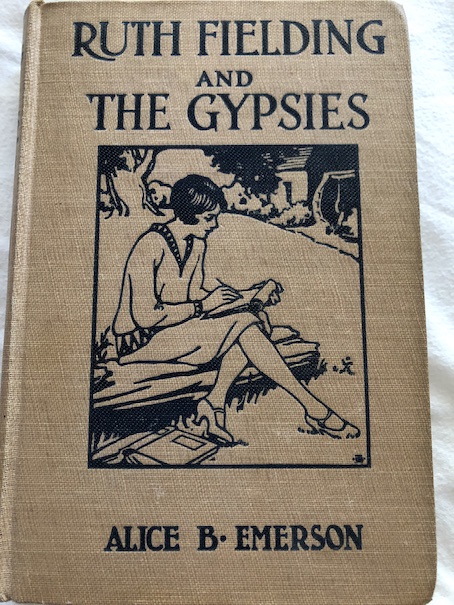
Ruth Fielding and the Gypsies; Or, The Missing Pearl Necklace by Alice B. Emerson (Stratemeyer Syndicate), 1915.

Just as a quick note before I begin to describe the plot of this book, this book is part of the Ruth Fielding series, an early Stratemeyer Syndicate, before they started writing some of their more popular and best-known series, like the Hardy Boys and Nancy Drew. Some books in early Stratemeyer Syndicate series are awkward because they use racial terms that polite people would not use now. During the mid-20th century, around the time of the Civil Rights Movement, the Stratemeyer Syndicate revised the books it had in print, updating the technology and slang terms in the stories to be more modern and removing or altering some questionable racial terms and attitudes. Unfortunately, the Ruth Fielding series had already ended by that time, and these books were not among those that were revised and updated. I’ve explained this before on the pages for some the Stratemeyer Syndicate book series and individual book reviews, but I have to explain it again here because some people might object to the word “gypsy.” I know that’s not really the correct or polite way to refer to the Romany or “Travelers”, as they’re sometimes called, but it can’t be helped here because the Stratemeyer Syndicate put it right in the title. This is one of those books where I just can’t avoid it, and it’s all through the book. Some of the attitudes and stereotypes around the characters are also likely to be objectionable, but I’ll address that further in my reaction section.

The Ruth Fielding series is interesting because it was kind of a precursor to Nancy Drew, with a similar type of heroine, but one that, unlike Nancy Drew, grew up, went through school, and had a career during the course of the series. There are some aspects of this series and the development of the characters that I think were better done in this series than in the Nancy Drew series. There are also times when the books are surprisingly thoughtful about the conditions of life and society in the early 20th century, when they were written, and this book and the next one begin to mark a turning point in the main character’s life. Ruth is a poor girl, and before her education is over, she will have to seriously consider her career options, which is something you don’t see much in the Stratemeyer Syndicate series that are still in print because those characters never age. The characters in the earlier series did, which is why those series ended. There are some things in the series that I don’t like, like the racial terms and attitudes and when the stories are more adventure than mystery because I really prefer mystery, but this is what the books are like. In these reviews, I’m just explaining what the books and characters are like. On the bright side, if you don’t like what the books are like, you can consider that I read and reviewed them, so you don’t have to. You can find out what they’re like from my reviews and save yourself some time.

The Plot

Ruth Fielding is with her Uncle Jabez in a boat on the river near the Red Mill where they live when the boat overturns. Uncle Jabez falls out and hits his head. He almost drowns, but Ruth holds his head above water. She can’t pull him out of the river by herself, but she calls for help and attracts the attention of a passing gypsy boy. The gypsy boy, called Roberto, pulls Uncle Jabez out of the water.

Uncle Jabez is grateful, but the incident brings back an earlier argument about whether boys are more useful than girls. Uncle Jabez argues that boys are more useful than girls because they are stronger and can do heavier work, and he thinks that his near-drowning proves that. Of course, Ruth, Aunt Alvira, and Ruth’s friend Mercy are all offended by that assessment. Aunt Alvira points out that the boy who helped Uncle Jabez wouldn’t have been able to do that if Ruth hadn’t already been holding his head above water and calling for help. Ruth says that not all work is heavy work. Uncle Jabez says that girls are costly because they need money for education, and they’re not likely to have careers afterward, like men do. Ruth says that the reason why she wants an education is so that she can have a career and support herself.

Ruth knows that a poor orphan like her is lucky that she can attend boarding school with her friends. Her friend, Helen, is from a wealthy family, who is willing to fund her education in anything she wants to study, whether it eventually produces money or not, but Ruth doesn’t have that luxury. Eventually, she will have to get a job of some kind. Aunt Alvira says that, when she was young, most girls got a basic education and then got married, which is probably what Uncle Jabez is expecting Ruth to do. However, Aunt Alvira knows that modern girls have more ambitions. (Keep in mind that this story is set around 1915, contemporary to the time when it was written.) Ruth’s music teacher at school thinks that Ruth has a promising voice, and she wonders if she can train as a singer, although that’s not the kind of thing that her uncle would think of as something useful.

Before returning to boarding school with her friends, Ruth goes on a car trip with Helen and Helen’s twin brother, Tom. It turns out to be an unexpectedly eventful trip. Not long after setting out on the trip, they meet up with Roberto again and begin talking with him. The others ask Roberto about being a gypsy and if he wouldn’t prefer a more settled life with a regular job. Roberto says that, while he could work as a farmhand easily enough, few people would hire him for other jobs because he’s a gypsy, and people don’t trust gypsies. Besides, he sees little use in such a life. Tom says that he could afford better food and better clothes if he had a better job. Roberto says that he does well enough traveling around with his family, taking odd jobs, and helping his uncle at horse trades. He tells the others a little about his family and his life with them. After he leaves, Tom makes jokes about the rumors of gypsies kidnapping people.

Further down the road, Tom accidentally hits a lamb in the road with his car. The lamb is still alive, but its leg is broken. The farmer is angry, says that the lamb is useless now, and demands that Tom pay for the lamb. The price he demands is about twice as high as it should have been, but Tom pays it anyway to avoid further trouble. Then, they learn that the farmer, who doesn’t want to be bothered nursing the lamb until it heals, plans to simply kill it and feed it to his dogs. The girls are upset about the poor little lamb, and they plead for its life. Ruth is sure that the lamb can be healed. The farmer says that the lamb is his to do with as he pleases, but Helen points out that the lamb isn’t his anymore because Tom just paid for it. The farmer protests, but they take the lamb anyway. At first, Tom says that he doesn’t know what else to do with the lamb except take it to a butcher, but the girls persuade him to let them keep the lamb and try to help it.

Later, there is a storm, and the group seeks shelter in an old, empty house. The girls go inside while Tom parks their car in an old shed. The girls find the house spooky and wonder if it could be haunted. In some books, investigating a haunting in an old, abandoned house like this would be the main mystery, but in this one, it’s just one episode that gives them a clue to something else. While the girls are exploring the upstairs rooms and Tom is still outside, two strange men enter the house. The girls don’t let the men know they’re there. They’re not sure of who the men are or what their intentions are, so they listen to their conversation. They can’t understand everything the men say because half of their conversation is in an unfamiliar language, but from what the girls understand, they have either committed a theft or are going to be involved in one. The girls don’t want the men to find them or Tom, so they scare them out of the house by spooking some bats, which take flight and frighten the men away.

All of this would be exciting enough, but as they all travel further, Tom’s car breaks down. Tom leaves the girls and sets out on foot to get some help. The girls wait at the car for him, but it starts getting dark, and they start to get worried. A group of gypsies passes by with their wagons, and although Ruth isn’t sure it’s a good idea, Helen asks the gypsies if they can give her and Ruth a ride to her parents’ house. The gypsies ask the girls some questions, and then, they agree that the girls can come with them. Helen leaves a note for her brother that they’ve gone with the gypsies, but when she isn’t looking, one of the gypsies takes the note and destroys it.

It turns out that Ruth’s concerns about the gypsies were justified. The leader of this gypsy band is an elderly woman, who the girls recognize from Roberto’s stories as his grandmother, although Roberto is not currently among the group. The grandmother is a greedy woman, and she has realized from the girls’ car that at least one of them is from a wealthy family. To her, that means that they have relatives who would be able to pay a ransom for the girls. The girls become captives of the gypsies. The old woman also has an ability to hypnotize people with her eyes, and Helen seems particularly susceptible to it. During the night, while spying on the old woman, Ruth also learns that she is involved with the thieves they saw in the empty house.

The girls try to escape from the gypsies, and Helen gets away, but Ruth is caught. The old woman makes Ruth disguise herself as one of the gypsies so no one will notice her among the others. Can Ruth find a way to escape, or will Tom, Helen, or Roberto manage to help her?

This book is now in the public domain and available to borrow and read for free online through Project Gutenberg.

My Reaction and Spoilers

The Mystery/Adventure

The story covers not only Ruth’s adventures but the adventures of Ruth’s friends while she is captive, including Tom’s encounter with a suspicious farm couple and Helen’s frightening experience on a whitewater river. In the end, Roberto does help Ruth to escape. By the time Ruth returns to her friends and is able to tell her story to the authorities, the gypsies are well out of the area.

However, there is still something that bothers Ruth. She knows that Roberto’s grandmother had a valuable pearl necklace in her possession, apparently the spoils of the theft that the men in the empty house were talking about. Ruth wonders who they robbed and where the necklace came from. At first, it seemed like this plot line was going to be left hanging, but when Ruth returns to boarding school with her friends, she gets the answer. A new student is joining the school, Nettie Parsons, and she is the daughter of a multi-millionaire who made his money in sugar. She is the one who was robbed of the pearl necklace, which really belongs to her aunt, and there is a $5,000 reward for its return. $5,000 would be a pretty decent reward even in the 2020s, but it went much further in the 1910s. Ruth realizes that she knows who has that pearl necklace, and if she can get it back for Nettie, she would not only be doing a good turn for a classmate but getting the much-needed reward for herself. $5,000 would be enough to give Ruth some monetary independence and could fund her continued education.

Like other early Stratemeyer Syndicate books, the story is more adventure than mystery, although there are some mystery elements. Ruth gets some of the clues to the theft that the gypsies committed, but it’s more by coincidence than investigation that she discovers who the pearl necklace belongs to. Ruth does get the reward in the end, which allows her to finish at Briarwood Hall and go on to college in later books. However, while the old woman was apprehended with the necklace on Ruth’s information, I think it’s important to note that Ruth does not chase her down and apprehend her herself. Ruth is still at boarding school when others do that on her behalf, and she is then summoned to identify the apprehended suspect. On the one hand, this would never happen that way in a modern, 21st century book. In modern books, the girl heroines are much more active and would insist on catching the bad guys themselves. On the other hand, I have to admit that the way the book did it would actually be the more likely way this situation would play out in the real world, with the boarding school kid just providing information and being kept at boarding school while others apprehend the criminals. I think if the book was rewritten in the 21st century, Ruth would be more active in catching the criminals and retrieving the necklace, but there is some realism in the way the book actually ends.

Ruth’s career ambitions are not resolved in this story but are addressed more directly in the next book in the series.

Stereotypes and Racial Attitudes

I was curious about the notion that gypsies kidnap people because I’ve read about that in other books, and I wondered where that idea came from. According to an article that I found, it seems to come partly from traveling gypsies being used as scapegoats for missing or murdered children (like in old movies, where the small-town sheriff is anxious to blame a “drifter” for a crime) or as “bogeymen” in stories parents told to scare their children into not wandering away from home and also partly from people noticing children among traveling Romany groups who did not seem to resemble the people raising them, particularly if the children seemed to be lighter-skinned or have lighter hair or eyes than the adults. The reasons for the children not looking like the adults have been proven in modern times to be because the children were either adopted or were simply biological children who didn’t look like their parents through quirks of genetics, which sometimes happens. Light-colored eyes and light-colored hair are recessive traits, while dark eyes and dark hair tend to be more dominant traits, but even a dark-eyed, dark-haired person can carry the recessive genes for light hair and eyes, and those recessive traits can come out in the next generation. Basically, the children resemble previous generations in the same family, such as grandparents or great-grandparents, and if observers could see all the generations of the family together, it would be more clear how the traits were handed down to the children. (People also used to think that it was impossible for two blue-eyed parents to have a brown-eyed child, but that also happens sometimes because genetics can be complicated, eye color can be influenced by combinations of multiple genes together, and genetic mutations sometimes take place.) Basically, some people overreact when they see a child who doesn’t match the adults they’re with and start imagining kidnapping, but often, there are other, logical explanations, and being too quick to scream “kidnap!” causes problems. Some people do this to families who have had interracial adoptions. Personally, my brain would be more likely to consider possible divorces or previous relationships or possible affairs or maybe that the adult was actually a hired caretaker rather than a parent to be the next most-likely explanations after adoption for children who don’t look like parents, and I wouldn’t be eager to publicly ask questions about the sexual or reproductive history of total strangers. Unless the child appeared to be in immediate physical danger or was screaming, “Help!” or “This isn’t my daddy!” or something similar, I would be unlikely to interfere. “If you see something, say something” can be helpful, but it also helps if what you see is the big picture.

I also noticed that the gypsies in the story are described as being non-white people because they have darker skin, and even Ruth seems to dislike them and be suspicious of them for that alone. Granted, these particular people are actually criminals in the story who kidnap Ruth and Helen, but Ruth was thinking that just from looking at them. While I would have understood Ruth being reluctant to trust them because they’re strangers and because they know from the men in the empty house that there are thieves in the area, it’s their darker skin that bothers Ruth first. When Ruth first meets Roberto’s grandmother, Ruth thinks that the gypsy woman is too dark and strange/foreign to be trustworthy, and she later hates that her gypsy disguise involves bare feet and her skin dyed darker. She is ashamed of the way she looks in that disguise and thinks that she would be embarrassed for Tom to see her looking like one of the gypsies. Ruth’s prejudices bothered me more than if another character had done it because, while the older Stratemeyer Syndicate books do have inappropriate racial language and attitudes, the characters who are outright racists are typically the ones the stories show to be unfriendly antagonists or outright villains. From what I’ve seen so far, it’s rare for a friendly main character to be outright disparaging of racial appearances even if they have stereotypical notions about other people.

It’s really an irony that Ruth has prejudices against non-white people because the beginning of the story involves an argument with her uncle about his prejudices about girls. If this book had been written, or at least revised, during the 21st century, the rest of the story would have involved overturning both sets of prejudices. In the book as it is, nobody’s prejudices seem to be proven wrong.

Uncle Jabez’s assertions about girls’ usefulness go largely unchallenged. The girls are kidnapped when they’re by themselves, after Tom leaves them alone. Ruth copes decently with her captivity by helping Helen escape, but she needs help to escape herself, and men apprehend the criminals in the end, not Ruth herself. If Ruth’s uncle has any rethinks about the relative usefulness of boys and girls, he doesn’t mention it, and he isn’t presented with any strong evidence in favor of girls. Ruth is just content that she got the reward money for the return of the necklace, so she isn’t solely dependent on miserly Uncle Jabez’s grudgingly-given support.

There are no prejudices about gypsies proven wrong in the story. While I’m sure that most real-world Romany are not kidnappers, the gypsies in the books are criminals and kidnappers. Roberto is fond of his family and their traveling lifestyle, but at the end of the book, he accepts a new job as a gardener at Ruth’s school. He cuts his hair more like mainstream American styles of the time, and he starts wearing more mainstream American clothes. Ruth notes that his skin is still darker, but she is happy about these other changes. It is revealed that Roberto’s family came from Bohemia (a region now part of the Czech Republic) about ten years before, and his grandmother will now be deported back there, but Roberto wants to stay in the United States. He Americanizes his name and starts having people call him Robert. That’s quite a conversion from his attitudes much earlier in the book. Granted, having relatives arrested for theft and kidnapping can have an effect on a person, but from his earlier descriptions of his grandmother, I’m pretty sure that these sort of situations are not new to Roberto’s grandmother and the rest of their group. Maybe getting caught is new, but there is an implication that his greedy grandmother has done shady things before for the sake of money. But, part of the happy ending of this story is that Roberto gets assimilated into mainstream American society and becomes less ethnic, which is bound to leave a bad taste in the mouths of modern Americans.

So, Did I Like the Book?

I liked parts of it. As I pointed out, there are things in this book that are highly problematic for modern people, and I think the book as it is would be more suitable to adults who are interested in nostalgic children’s literature or the evolution of children’s literature. However, there are parts of the book I did find interesting, and I can see ways in which the book could be rewritten to make it both more exciting and more acceptable to modern people. For example, I really liked the part with the empty house where they overheard the thieves talking and the way the girls scared the thieves with the bats. If I were rewriting the story, I would extend that scene and leave out the part with the lamb, which didn’t contribute much to the rest of the story.

Of course, I would just have the criminals be part of a random criminal gang, not Romany. (How common were traveling caravans in the early 20th century anyway? I’ve never seen even one in real life. Was that really a common thing at one point so that it ended up in so many children’s books? From what I’ve read about Romany populations and migrations in the United States, some of the stereotypes about them had some basis in fact, like that some of them occasionally resorted to stealing to survive, but were exaggerated in the press for the sake of sensationalism, so I’m thinking that the prevalence of gypsy caravans and fortune tellers were probably also greatly exaggerated in literature.) I picture the criminal gang organized with the two guys who hide out in the old house being the thieves, and the others being a seemingly-ordinary and pleasant-looking couple who act as the fences of their stolen goods. Then, the girls could hitch a ride from this nice-looking couple after their car breaks down. At first, they wouldn’t know there was a connection between the “nice” couple and the thieves, but they would later accidentally see the couple talking with the thieves and the thieves handing over their goods. The girls would get caught spying on them, so the criminals would kidnap them because the girls now know too much.

Later, after the girls get away from the criminals, Ruth could find out that the necklace they saw being handed over wasn’t among the thieves’ belongings when the police caught up with them. Thinking about the place where the thieves were caught and something she may have heard them say, she could then realize that the thieves doubled back on their trail after the girls escaped from them, returning to their hideout in the abandoned house to hide the necklace because they still don’t know that the girls were in the house when they were talking there before. Then, Ruth could sneak away from her boarding school for a day to go back to the house and look for the necklace, finding it in a clever secret hiding place. I think that arrangement of events would make Ruth more active in solving the mystery, better justifying her acceptance of the reward at the end.
The Silver Spoon Mystery

The Silver Spoon Mystery by Dorothy Sterling, 1958.

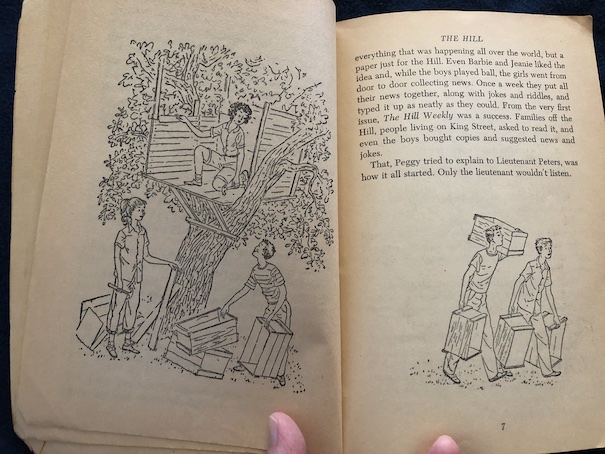
A group of families move into the new suburb built on The Hill overlooking the town of Dwighton. The kids in the new neighborhood become close friends, visiting each other’s houses, playing games, and running around town together. It’s idyllic, but then the boys in the group start playing baseball together, and they begin excluding the girls from the group, even though they’ve all played baseball together before and the girls are good at it. The boys also stop working on the tree house that the kids were all making together, taking some of the tools and materials and building themselves a clubhouse near the baseball field with a sign that says, “NO GIRLS ALLOWED.”

The girls are offended at suddenly being shunned by the boys, so they decide that they need to have some special project, something that will show the boys that girls are just as good as they are and that the girls don’t have to rely on the boys to have some fun. They decide to start a neighborhood newspaper, writing about local events and having fun stuff, like jokes. The newspaper is a success, and adult neighbors buy copies. Then, the boys decide to start a competing newspaper themselves. One of the girls, Peggy, is upset because she’s sure that the boys’ newspaper will be more successful. Some of the boys are older than the girls so they might write better, there are more boys than girls in the group so they have more people to gather news and sell papers, Davey is better at drawing cartoons than the girls are, and worst of all, the boys splurged to buy a hectograph, which uses a gelatin substance for making copies of writing and drawings (as in this video) and will allow the boys to print papers by the hundred (“hecto” means one hundred, and that’s how many copies a hectograph makes at a time). (This is before home computers, so the characters have to rely on manual printing methods. People used hectographs to make copies before modern copy machines, but modern hectographs still exist, and some people use them for artwork or tattoo stencils.)

Peggy’s afraid that the girls won’t be able to compete with the boys’ advantages and thinks that the boys are mean for trying to steal their business. Peggy’s mother tells her that she shouldn’t worry about being better than the boys but focus on being different. She says that the girls should make sure that their paper has different content from the boys’ paper so people will still have a reason to buy theirs even if they’ve already bought the boys’ paper. If the boys’ paper has cartoons, the girls’ paper should have things the boys wouldn’t think to include, like recipes, poems, and fictional stories that could be written and submitted by local people.

Peggy gets an idea from what her mother says, but it’s not a good one. Peggy still wants to show up the boys, and she thinks that the best way to do it is to get a “scoop”, meaning printing an exiting news story that the boys won’t have in their paper. The problem is that the girls don’t know where they’re going to get an exciting news story that the boys don’t know anything about. Nothing that exciting is happening in their town anyway. There haven’t been any shocking events, no murders, no robberies. Peggy tells the other girls that means that they have write about something that hasn’t happened yet. Peggy poses the idea of writing about someone stealing the silver on display at the local library that was made by the silversmith who was the founder of their town. Of course, the problem with that is that the silver hasn’t actually been stolen. One of the girls, Ellen, objects to writing a story about something that hasn’t happened because that’s not actually “news.” However, Peggy talks the other girls into it by saying that they would be writing about it as fiction because people write fictional books all the time, and that’s allowed. Ellen still isn’t convinced, but Peggy goes ahead and writes the story anyway. (Basically, she’s turning the girls’ newspaper into a tabloid, although the kids don’t seem to quite get the difference, even though Ellen can tell that this isn’t right for a newspaper.) The girls all discuss how they would go about stealing the silver spoons from the library, if they were going to do it, and Peggy writes the story from their speculations.

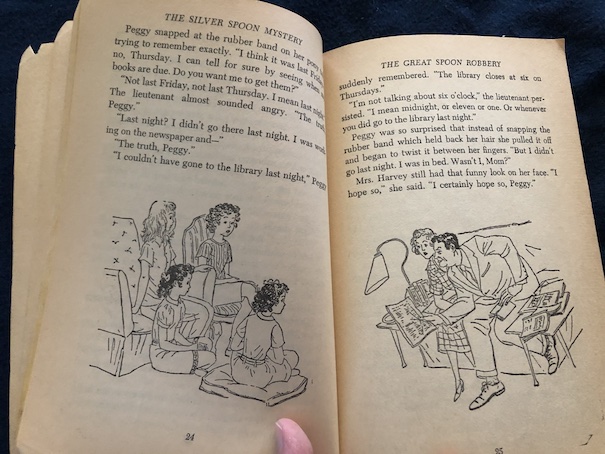
You just know that there’s going to be trouble with Peggy trying to sell a story that everyone knows didn’t happen, but what actually happens is even stranger. After the girls sell their paper with the spoon theft story, Peggy gets home to find a policeman, Lieutenant Peters, waiting for her with her mother. Lieutenant Peters wants to talk to Peggy about the robbery at the library because it turns out that the very night when Peggy was writing her big fictional scoop about silver spoons being stolen from the library, someone was in fact stealing silver spoons from the library, and this thief apparently did it the way Peggy described in her story. Lieutenant Peters wants to know everything that Peggy knows about the theft, and he won’t believe that Peggy wasn’t there to witness it because her description of what happened is so accurate. She even has a description of the thief in her story. Since the theft happened in the middle of the night, Peggy points out that she was asleep in bed, but even Peggy’s mother isn’t sure that Peggy didn’t sneak out. When Peggy’s friends show up at her house, Lieutenant Peters questions them too and comes to the conclusion that Peggy and maybe also her friends stole the spoons themselves to make their story true. Lieutenant Peters says that they’ll be forgiven if they give the spoons back, but the girls can’t do that because they don’t have them.

As Lieutenant Peters and Peggy’s mother continue to question the girls about their story, the girls admit that they made up the whole thing as a fictional story just to attract attention to their paper. Lieutenant Peters catches the boys listening in on their conversation and questions them about what they know about the situation. The boys don’t really know anything about the theft, either, but they were pretty sure that Peggy made up the story she wrote, and they’re fascinated that she might be about to be arrested and taken to “children’s jail.” Peggy’s mother believes her that she just made up the story and it’s all a coincidence that someone happened to steal the silver spoons from the library around the same time, but Lieutenant Peters isn’t convinced.

Word of the spoon theft spreads across town quickly, partly because of Peggy’s story in the neighborhood newspaper and partly because of the story in the regular news. People call Peggy’s house to ask for details, and kids at school look at Peggy and her friends suspiciously, wondering how much they had to do with the theft. Peggy is especially offended when Davey says that his father thinks that it’s an unlikely coincidence that Peggy would write a story about the theft and then the theft would just happen. Before the boys started their “no girls allowed” stuff, Peggy and Davey used to be close friends. However, Davey assures her that he doesn’t think that she’s responsible for the theft. He also tells her that he and the other boys are sorry about pushing the girls by trying to compete with their paper, and they’ve decided to give up theirs and let the girls use the hectograph. The kids discuss trying to investigate the crime themselves because, until the real thief is found, people are going to keep looking at the girls suspiciously.

Most of the neighborhood kids, both boys and girls, join the investigation as the “Hill Detective Club”, except for one of the older girls who is studying for exams and Davey’s older brother, Allen, the only boy who’s mad at the other boys because they don’t want to play baseball now. (Allen is apparently the one who started all the “no girls allowed” stuff because he didn’t make the high school baseball team and he’s been ultra-serious about practicing during the neighborhood games. He’s trying to organize a game between the boys in the neighborhood and their fathers. The book doesn’t explicitly say so, but there might also be an element of embarrassment for him that some of the girls play better than he does. Peggy is described as being the fastest runner in the neighborhood, and Ellen is a good batter.) As they begin their investigation, the kids visit the scene of the crime and study the ways the thief could have gotten into the library, starting to separate the made-up details from Peggy’s fictional story from the real facts and circumstances of the case. Peggy admits that her mind is biased because she still thinks of her story as the way things happened and her fictional suspect as the type of thief they’re looking for, but the truth is that they don’t know for sure how the crime actually happened or what type of person they’re looking for.

When the kids talk to one of the librarians, Miss Bancroft, they learn that the police did find a few sets of fingerprints on the case that held the silver spoons: Miss Lowell, the head librarian; Mrs. Simpson, a descendant of the town’s founding father and part of the local antiquarian society; and Mr. Weatherspoon, who owns a local antique store. Could one of these people be the thief?

The book is available to borrow and read for free online through Internet Archive.

My Reaction

To begin with, this book seems like it’s meant for fairly young elementary students. It tries to teach readers the meaning of some of the words in the story because some of the characters don’t know the meanings of various words the other characters use or words that they encounter in various places, like “descendant” or “optometrist.” The kids in the story are a variety of ages even though they all play together in the neighborhood, and I could understand why some of the younger kids would struggle with bigger words, but there were times when I thought that they were carrying it a little far. Peggy is twelve years old, so it seems like she should have been old enough to know what an optometrist is. Has she never had her eyes checked before? Actually, maybe she never has. If her vision is good or seems good, maybe her family just doesn’t bother. I guess it’s educational for young readers just branching out into chapter books.

I like books that bring up interesting historical topics. The parts about older printing/copying techniques and Mrs. Simpson’s old electric car with the steering stick instead of a steering wheel (possibly a Baker Electric, like the one Jay Leno owns, or something very similar – this video explains the history of the Baker Electric and shows what it’s like to drive it) were interesting, and one of the characters in the story explains more about the history of the town’s famous silver spoons to the kids. Although the town, its founder, and the spoons are all fiction, spoons of this sort did exist in real life. The silver spoons are specifically christening spoons. It used to be traditional to give presents made of silver to new babies and their parents for the child’s christening. One of the most popular presents of this type was small silver baby spoons, especially with special designs or engravings to remember the child’s birth. The character explains why this particular set of spoons is so distinctive, talking about their unique design, how antique dealers would be able to look them up in a reference book and learn their history, and how each of the of the spoons is marked with the maker’s hallmark, the special symbol that the maker would use to identify himself.

Part of the mystery hinges on the coincidence of the theft occurring just when Peggy decides to write a sensational story about an imaginary theft to get attention for her neighborhood newspaper. For readers, the question is whether the timing of the actual theft is really just coincidental or if there’s a direct connection between the story of the theft and the theft itself. I would have been very disappointed in the book if it was just a coincidence, so I immediately approached the story with the idea that the timing of the theft was a clue. I enjoyed considering different possibilities. My first thought, when the theft happened mysteriously immediately after Peggy and her friends invented their theft story, was that someone overheard the girls talking about how they would commit a theft like that and decided to use their imaginary scheme as their own. However, the conversation between Peggy and her friends took place in Peggy’s room, which was pretty private. For someone to overhear them, it would have to be someone in Peggy’s own house, possibly family or a neighborhood friend, or someone listening in from outside, probably one of the neighborhood kids. Those possibilities didn’t seem likely. Then, I remembered the Nero Wolfe murder mystery story Not Quite Dead Enough. What if the theft didn’t occur when the police thought it did (mostly because they believed Peggy’s original story) but actually at the point where the theft was supposedly discovered? The person who claimed to discover the theft was one of the people with the strongest motives to commit it, and this person could have done it after reading the fake news story, seeing an opportunity to make it true and cast suspicion on Peggy’s fictional suspect. The mystery is simple enough to figure out for an adult who likes mystery stories, but probably much more mysterious for kids. Once the kids realize who has the spoons, there is also the additional challenge of proving it and getting the spoons back without getting everyone in trouble.

I thought it was interesting that the story shows some of the problems with sensationalist or tabloid style “news” stories, or “yellow journalism“, as it used to be called. It’s the sort of “news” that relies on flashy and misleading headlines, buzzwords and catch phrases that appeal to its fans and rile them up emotionally, hyperbole and emotionally-charged language, conspiracy theories, pseudoscience, and poorly-qualified or debunked “experts”, to draw readership and advertising money. Basically, they aren’t really “news.” They don’t try to describe things as they actually happened for informative purposes. These are “news” stories that are less about fact than about entertaining their audience or shocking people and stirring up strong emotions to grab people’s attention. That’s basically what Peggy was trying to do with her fake news story, even if she wasn’t quite thinking about it in those terms. Just like tabloid or sensationalist news, Peggy’s story was almost a kind of fan fiction based on the real world. That is, she took real things and situations that she knew existed (the silver display at the library) and wrote an exciting conspiracy story around them that didn’t actually happen (the made-up theft) as a shocking, attention-getting entertainment piece to encourage people to buy the paper she and the other girls were selling. She thought what she was doing was like harmless entertainment, but it wasn’t because it was based on something real, and her made-up story had real consequences. Not only is there a direct connection between the fake story and the real theft, but Peggy’s fake story confuses people, including the local police and insurance investigator, because they have trouble telling how much of Peggy’s story is false, and it biases their minds and the direction of their investigations. Even Peggy herself sometimes gets confused during the investigation, mixing up details from her made-up story with real events. Even though she wrote the fictional story herself, knowing it was fictional, she gets hung up on the way she imagined things would happen when she invented the story and needs to be occasionally reminded to look at the situation as it actually exists, not as she imagined it would be. If the author of the fictional news story can’t even keep her own fiction and the real facts straight in her mind at first, how can the police or anyone else?

Sensationalist journalism can and has led to real problems in real life, setting up dangerous situations by stirring up the emotions of people who may already be unbalanced and suggesting unrealistic events or courses of action that interfere with people’s sense of reality and ability to make informed, reasoned decisions (something else that ties in with the story). In a famous real life case from the early 1900s, the famous newspaper publisher William Randolph Hearst had his own reputation seriously damaged when he published articles written by two of his columnists smearing President McKinley’s reputation and seemingly recommending his assassination. (“If bad institutions and bad men can be got rid of only by killing, then the killing must be done.”) These articles were published only months before President McKinley was actually assassinated. Hearst had used yellow journalism in his papers for years to manipulate public opinion to further his political causes and gain readership. (“War makes for great circulation,” Hearst said after successfully urging public opinion in favor of the Spanish-American War.) After the assassination of the president, people made a connection between the assassination the articles in Hearst’s papers seemed to be advocating (although they called it a “mental exercise” and a joke) and the assassination that actually happened. Whether Hearst actually wanted McKinley to be killed by someone or whether the man who assassinated McKinley was directly inspired by those sensationalist articles is questionable, but the suspicion that was what happened, in a sort of “Will no one rid me of this turbulent priest?” kind of moment, did seriously damage Hearst’s own political ambitions. Hearst did intentionally want to smear McKinley’s reputation, but his lack of consideration for the possible results of his stories, which seemed to be advocating an actual murder that did occur soon after, caused the public to turn against Hearst himself.

We frequently caution people to be careful of what they read because you can’t trust everything, which is sensible advice, but I’d go a little further and say, be careful of why you choose to read what you’re reading and why believe what you read. Was it because the information was presented logically and authoritatively, or is it because you decided ahead of time what you were going to read because of something you already believed or something you already knew you really wanted to do? Picking the right information source is good, but it may be even better to ask yourself what you, as an individual, plan to actually do because of the news sources you’re following. Is it a good thing to do that’s going to help someone or something that’s going to hurt people? Take a look in the mirror once in a while and question your motives as one of your own primary sources of information. You are the one who chooses what news sources you consume. You are the one who decides what you believe because you always have the choice to accept or reject anything you hear from someone else. You are the one who decides what your standards are and where your limits are set. You are the one person who knows exactly what you’re willing to do to accomplish your goals. You are the one who moves your body to the locations you decide to go and makes your mouth say the things it says and your body do the things it does. You are the one who has ability to say “yes” or “no”, not only to other people but yourself when necessary. Anything you may decide to do involves not just a single choice but multiple choices along the way that can only be made by you, so you’re going to have to be your own fact checker at every step, not just about what other people are telling you but what you’re telling yourself and why.

Sensationalist news stories are intentionally emotionally manipulative in order to get people hooked on reading that source, but you’re the only one who gets to decide if you’re hooked and what you’re going to do about it. The next time you read something that makes you really mad at somebody, before you do whatever you’re considering doing about it, pause a moment to ask, not just whether the source you just read might be wrong, but “What if I’m wrong? What if I’m wrong about this situation, and I’m about to do the wrong thing? Am I prepared to face the consequences for my actions if this turns out to be serious?” The reason for asking these questions is, if the consequences of what you’re planning to do are serious, there will be a point where people won’t want to hear about what you believed or thought you believed or what someone else told you earlier. If you’re the one who did the thing, you’re the one who’s going to be facing the consequences for that thing. There’s a point where everyone has to accept the consequences for themselves all by themselves. (To put a finer point on it, riot and people will riot with you, but you’ll be tried as an adult alone.)

Kate’s Camp-Out

Sleepover Friends

#6 Kate’s Camp-Out by Susan Saunders, 1988.

Kate’s family is spending the weekend at a cabin at Spirit Lake, and Kate is allowed to bring her Sleepover Friends with her.  However, what promised to be a fun and exciting weekend soon comes with complications.  First, Kate discovers that the Norwood family will be in a cabin nearby.  Dr. Norwood is a colleague of her father’s, but his two sons, Sam and Dave, are pests who like to play practical jokes.  When they arrive at the cabin, there is also no electricity (a problem that they fix the next day), and they learn that the reason the lake is called Spirit Lake is because there are some scary stories about the place.  Kate’s father tells the girls a story before bed about an old fur trapper who murdered another fur trapper for his money.  The ghost story is interrupted by Dr. Norwood, who comes over to see if everything is all right because there have been some break-ins in the area recently.

The girls are spooked by the ghost story, but the next day, they also encounter the Norwood boys and realize that they’re every bit as awful as Kate remembers them.  First, Sam and Dave trick a couple of the girls into wading out into a deeper area of the lake so that they’ll fall in and get wet.  Then, when the families meet for a barbecue, the boys give a couple of the girls worms in a bun instead of sausages.

Because of their bad experiences with the boys, the girls are allowed to go back to their cabin while the others finish the barbecue.  While the girls are at the cabin, they accidentally find a secret hiding place in the fireplace with a pouch of old coins inside!  The girls wonder if that could be the stolen money from the ghost story, but Stephanie, who has been reading a book about ghost stories from the area, says that the dates on the old coins are later than the story took place.  According to the book, a ghost child was once seen around their cabin, but the girls can’t figure out why a child would have hidden so much money.

While the girls wait for the adults to return from the barbecue, they fix dinner for themselves and decide to hold a séance to contact the spirits.  They don’t really believe that the séance will work when they try it, but without any tv or radio, they don’t have anything else to do, and they can’t get their minds off the ghost stories. 

To the girls’ surprise, they actually hear strange knocks in reply to the questions that they ask the spirits.  Then, a child’s giggle convinces them that it’s just the Norwood boys, spying on them and trying to scare them again.  It’s the last straw, and the girl plot how to get even with the Norwood boys!

The book is currently available online through Internet Archive.

My Reaction and Spoilers

This is one of those stories that has a somewhat ambiguous ending. When the girls try to catch the Norwood boys playing ghost, they instead discover the identities of the people behind the recent break-ins at the cabins. Later, they learn that Sam and Dave actually have alibis for the time that they heard the ghost noises, leaving them wondering if the knocking and giggling could have actually been a ghost. The girls do manage to play a prank on the boys before the end of the story, but they never learn the story behind the old coins.

I liked the part where they never firmly establish whether or not there was a ghost because it’s fun to leave people wondering. People who like ghost stories can imagine that the girls did hear a ghost, but if you don’t like the scary explanation, you can imagine that there’s another explanation for the noises. However, I found the lack of resolution behind the presence of the coins a little disappointing. The owner of the cabin they were using lets each of the girls keep a single coin as a souvenir (and the coins really are valuable collectors’ items) and gives the others to a local museum. I think I would have liked the story better if the girls found an explanation for the presence of the coins at the museum, so at least part of the story would be resolved.

There are two main theories that I have behind the events in the story. One is that the thieves in the area hid some stolen coins in the cabin for some reason and they were the ones trying to scare the girls during their seance. The other is that the mystery of the coins ties in with the child ghost in some way, hinting at dark unknown deeds from the past. Alas, there is no confirmation about which of these theories, if any, is true.

Under Copp’s Hill

UnderCoppsHill

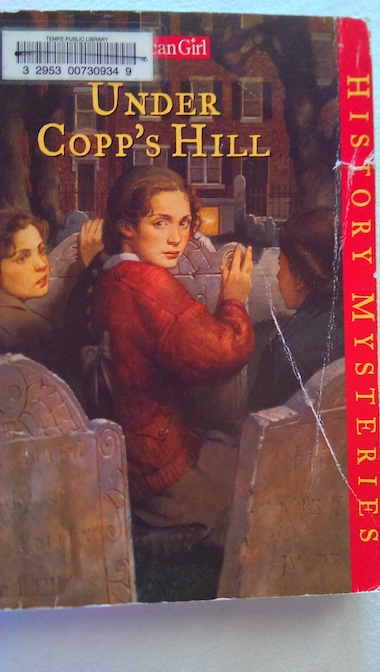
Under Copp’s Hill by Katherine Ayres, 2000.

This book is part of the American Girl History Mysteries series.

The year is 1908, and eleven-year-old Innocenza Moretti lives with her relatives in Boston.  They are immigrants from Italy.  Innie, as her family calls her, is an orphan.  According to the story that her grandmother told her, she was the only one of her parents’ children to survive infancy, her siblings being born prematurely and dying shortly after birth.  Innie’s mother was so grateful that Innie survived that she promised her to the Holy Mother at her baptism.  Then, Innie’s parents died in a fire in their tenement building when she was about two years old.  Innie and her grandmother, Nonna, survived the fire only because little Innie had started crying in the night, and she took her outside to walk her around so that she wouldn’t wake her parents.  Because of that experience, Nonna is deathly afraid of fire and also has become convinced that the Holy Mother must have spared Innie (as well as herself).  She thinks that Innie is destined to become a nun and has continued to promise her to the Holy Mother in prayer, repeating the promise regularly.  Although Nonna thinks that the miracles surrounding Innie’s life are signs of a future life in the Church for Innie, her grandmother’s promises in prayer terrify Innie.

Innie feels trapped by her grandmother’s expectations for her, expectations that the rest of her family don’t even know about.  She doesn’t want to be a nun, but her grandmother is sure that she will be.  Because of her fears that her grandmother may force her to become a nun when she grows up, Innie is never on her best behavior.  She thinks that if she gets a reputation as a trouble-maker, the Church will decide that she is unsuited for a religious life.  Unfortunately, Innie’s long-practiced habit of ignoring rules and her problem child reputation lead her to be suspected of something worse than just minor misbehaving.

Innie’s family owns a boardinghouse where they provide food and lodging for young immigrant men.  Innie and Nonna live on the ground floor, and Innie’s aunt, uncle, and cousins live above them.  Innie spends a lot of time with her cousins, especially Teresa, who is about her age.  Her older cousin, Carmela, persuades both Teresa and Innie to join a library club at a new settlement house with her.  The settlement house helps girls and young women from immigrant families by teaching them work skills and aspects of American culture that they can use as they become American citizens in exchange for some of the work that the girls do on behalf of the settlement house.  Carmela has taken a new job as a pottery painter there and tells her parents that it will be good for Teresa and Innie to go there as well because they will receive help with their schoolwork and they will also have classes to teach them skills like sewing, knitting, and pottery, that they can use to make money later.  However, the real attraction of the club for the girls is that they get to listen to music, have dancing lessons, read books, and socialize with other girls about their age.  The prospect of sewing classes isn’t appealing for Innie, but she loves books and looks forward to borrowing some from the settlement house library.

At the settlement house, Innie meets a variety of girls from other immigrant families, not just Italian ones.  In particular, Innie makes friends with a girl named Matela, who is a Jewish girl from Russia.  As the girls talk about a recent, large fire in town, Matela talks about the czar’s soldiers burning things back in Russia and how she misses her grandfather, who is still there.  Innie understands Matela’s feelings because she knows what it’s like to miss someone.  She doesn’t really remember her parents, but she feels the lack of them in her life.  Teresa also becomes friends with Matela, but the three girls agree to keep their friendship secret because each of their families prefers them to associate with girls from backgrounds similar to their own.  Innie’s uncle wants the girls to spend time with other Italians, and Matela admits that her father prefers her to spend time with other Jewish girls.  The adults don’t really understand the cultural mix at the settlement house.

However, from the very first day that the girls begin going to events at the house, strange things start happening.  Things disappear or are oddly moved about.  Food disappears.  A silver teapot belonging to the ladies who run the settlement house is stolen.  Then, someone steals some pottery and a shawl.

To Innie’s horror, she ends up becoming the prime suspect for the thefts because she was caught snooping in an area of the house where she didn’t belong and because she accidentally broke one of the pieces of pottery that the others girls made and tried to sweep it up without telling anyone.  When she and her friends snoop around and try to find the missing objects, Innie discovers one of the missing pottery pieces.  However, instead of being happy for the clue, the ladies who run the house just think that Innie must have broken more of the pottery and tried to cover it up, like she did before, by hiding the rest of the set.  After all, if she was doing some things she shouldn’t have been doing, it’s plausible that she could be a thief, too.

If Innie is going to remain a member of the library club (and continue to have access to books that she can read), she’s going to have to prove her innocence.  In fact, proving her innocence may also be important for Carmela, who is supposed to have a citizenship hearing soon.  If Innie’s bad reputation causes problems for her at work, she may lose her job and be denied American citizenship!

Matela thinks that the thief could be a ghost from the nearby Copp’s Hill graveyard, but Innie is sure that it must be a human being.  There are secrets at the settlement house that even the ladies who run it are unaware of and someone who desperately needs help and can’t ask for it.

Teresa and Matela continue to help Innie, and in the process, Innie confesses to Matela her fears about becoming a nun.  It is Matela who helps Innie to find the solution to her problem, urging her to step outside of the small community of Italian immigrants that her family clings to and to seek advice from a priest in the Irish area of the city.  As a priest, he has the knowledge that Innie needs to understand her faith, and because he doesn’t know Innie’s family personally, he has the objectivity to help Innie to see her grandmother’s promise in a new light and to understand that her future destiny is still in her own hands.  No one can speak for another person or make important promises on their behalf.  A religious vocation is a serious decision that only a mature adult can make for herself, or not make, as the case may be.  The priest tells her that, as young as she is, Innie should focus on learning to be a good person, and then she will see what direction life leads her.  With that knowledge, of course, Innie realizes that she will have to put more effort into behaving herself, but it’s a relief to her to realize that she doesn’t need to purposely misbehave in order to control her life.

Eventually, Innie’s aunt also learns about the grandmother’s promise and Innie’s worries and reassures her that, although her grandmother can be an intimidating woman with what she wants, Innie’s family loves her and that she shouldn’t be afraid to come to them with her questions and concerns. Innie has thought of herself as parentless, at the mercy of her grandmother’s wishes and expectations, but her aunt says that she loves Innie like she does her own daughters and that Innie is as much a part of their family as they are.  If Innie has problems, her aunt will be there for her, helping her find whatever answers she needs.

There is also a subplot about how girls in immigrant families (at least, in ones like Innie’s family) aren’t as highly-regarded as boys.  When the family is discussing important matters, Innie often tries to comment on what she thinks, but her grandmother keeps telling her to be quiet because it isn’t a girl’s place to comment on business that men should handle and her male cousins sneer at her because they don’t think she knows anything.  However, when Innie’s uncle is worried about the legal papers he has to sign in order to open his new grocery business because his English still isn’t good enough to understand them, Innie points out that Carmela’s English is the best of the family because of all the books she had to read and the paperwork she had to complete when she was applying for citizenship and that she would be the best person to study the paperwork.  At first, her grandmother makes her try to be quiet and her male cousins laugh, but Carmela speaks up and says that she can help her father, if he wants her to, and her father agrees, on the condition that she act as translator and adviser and let him make the final decisions about the business.  Carmela is happy because the arrangement allows her to use her skills without taking her away from the pottery painting that she loves.  The point of this part of the story is about acknowledging the talents that people possess and not disregarding them because they are outside of the usual roles and expectations.  It fits in with the subplot about the grandmother’s expectations for Innie’s future, which are not really in keeping with either her talents or character.  The young people in the story are growing up under different circumstances than their parents, and they will have to learn to find their own way in life, using the abilities they have and the education they can find.

In the back of the book, there is a section with historical information about Boston in 1908.  The fire that happens around the time that the story takes place was a real event.  The settlement house with its library club was also real, and the ladies who run the settlement house, Miss Brown and Miss Guerrier, were also real people.  The book explains more about what life was like for immigrant families like Innie’s and about what the future held for girls like her.  Many of the girls who attended the library clubs later became librarians and teachers themselves, which may be Innie’s eventual destiny when she grows up.  The book also mentions that the area of Boston where Innie’s family lived still has many Italian restaurants and groceries that were started by immigrant families like Innie’s, so we can imagine that the grocery store that Innie’s uncle wants to open will be successful.

The book is currently available online through Internet Archive.

Meg Mackintosh and The Case of the Missing Babe Ruth Baseball

Meg Mackintosh Mysteries

MMBaseball

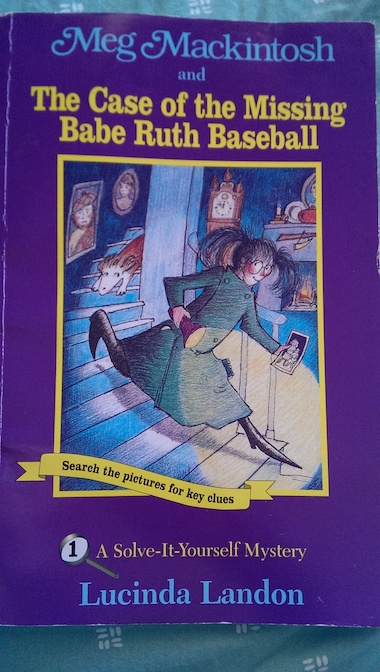
Meg Mackintosh and The Case of the Missing Babe Ruth Baseball by Lucinda Landon, 1986.

MMBaseballAlbumThis is the first book in the Meg Mackintosh series, and it was the first mystery story that I ever read, when I was about seven years old.  It started a life-long love of mysteries!

Meg’s grandfather shows Meg and her friend Liddy some old family photographs and tells them about the time when his cousin Alice took his prize possession: a baseball autographed by Babe Ruth.  Alice was a bossy girl who always liked to tease him, and so she created a kind of treasure hunt, challenging him to solve it in order to get the baseball back.  Unfortunately, he could never figure out the clues and still doesn’t know what happened to the baseball.

Meg’s brother, Peter, has a Detective Club, but he refuses to allow Meg to join, saying that she needs to prove that she can solve a mystery.  Seeing this as her chance, Meg decides that she’s going to solve this old puzzle and find the Babe Ruth baseball!  However, she also has competition from Peter, who thinks that he’s the better detective and tries to send Meg off in the wrong direction.

The book is currently available online through Internet Archive.

My Reaction

All of the books in the Meg Mackintosh series allow readers to try to solve the mysteries along with Meg, stopping periodically to ask them if they’ve noticed a clue that Meg has noticed or if they know what the significance of a clue is.  There are pictures to help, and readers are invited to stop and study the details before moving on. I think this is a good way to introduce children to puzzle-solving and help them develop critical thinking skills and an ability to notice details. I would recommend adults reading these books, or at least the first one or two along with children, so they can discuss the stories and clues with them, helping them spot clues as they begin to get used to the format of the books.

This is an excellent series for introducing children to the mystery genre for the first time! When I was young and just learning what mysteries were, I was fascinated to discover that I already had all of the knowledge I needed to solve this mystery along with Meg because all of the clues to Alice’s treasure hunt had to do with nursery rhymes. If you can recognize the rhymes in the book, you’re well on your way to solving the mystery!

The Gatehouse Mystery

Trixie Belden

TBGatehouseMystery#3 The Gatehouse Mystery by Julie Campbell, 1951.

One day, Honey and Trixie decide to explore the old gatehouse on the property of Honey’s mansion. It hasn’t been used for years, and it is overgrown with vines. However, it looks as though someone has been there recently, and the girls find a diamond on the floor inside. There are signs of a scuffle, and the diamond looks like it was accidentally wedged into the floor. Have thieves been hiding out in that old cottage?

Honey thinks that they should turn the diamond over to the police, but Trixie wants a chance to investigate the crime first, just the two of them, and to prove to Jim and her brothers that she and Honey can be detectives as good as any man could. However, the boys become involved when someone attempts to enter Honey’s room at night to reclaim the diamond.

With their suspicions divided between the new gardener and the new chauffeur, the kids form a club they call the Bob-Whites of the Glen to investigate the matter and to trap the thieves.  This club continues for the rest of the series.

The book is currently available online through Internet Archive.

TBGatehouseMysteryPic

Valentine Blues

valentinebluesValentine Blues by Jeanne Betancourt, 1990.
This book is part of the Aviva Granger Stories series.  (It’s the only one I have in the series right now.)

In the last book, Aviva’s best friend, Josh, came to live with her, her mother, and her step-father.  Josh was living in an orphanage before that, and since he and Aviva were close, her mother and stepfather thought that it would be natural to invite him to be part of the family.  At the time, Aviva thought that it was a good idea, but being friends with someone doesn’t mean that it will be easy living with them, and Aviva’s family life is already complicated!

Aviva’s parents are divorced, and both her mother and father are already in new relationships.  Her mother has remarried, and Aviva not only has a stepfather but a half-sister (college age) and half-brother (baby) living in the same house.  Aviva’s father has a girlfriend, Miriam, and Aviva doesn’t get along well with her.  Miriam would like it if she and Aviva’s father had a child of their own.

When Josh comes to live with Aviva’s mother and her family, Aviva realizes that sharing a family and house with him makes things even more complicated.  He takes too long in the bathroom and makes her late to school.  He’s one more person for her mother to pay attention to, so Aviva gets less attention.  Even her dog seems to like Josh better now!

Then, shortly after Valentine’s Day, Aviva overhears Josh and his friend Ronnie Cioffi talking about girls and giving them ratings based on their looks.  Out of 10 points, Cioffi rates Aviva as a 2, and Josh agrees.  Josh has a crush on Louise, a girl they know from school, and she has a much better figure.

It isn’t that Aviva is in love with Josh, who she sees more as a friend/brother, but it hurts that he seems to be taking her place in the family and doesn’t even really appreciate her, joining in with his friend in making fun of her body.  With her time divided between two households, two parents who hardly seem to have time for her these days, and Josh moving in and taking over, Aviva worries that maybe she doesn’t really belong anywhere or to anybody.

It takes a night when Aviva sleeps out in the barn without telling anyone where she is to make the people closest to her realize how much she needs them.  A sleepover at Louise’s house (where the girls candidly discuss their own ratings for the boys they know) and Aviva’s anonymous question in sex ed class also help to put the rating system into perspective for all the kids.

The book has some Christian themes because the children go to a Catholic school, although this book mostly focuses on family life and girls’ and boys’ perceptions of each other.  The kids are eighth graders, and there is also some talk about sex ed.

The Zucchini Warriors

zucchiniwarriorsThe Zucchini Warriors by Gordon Korman, 1988.

One of MacDonald Hall’s former students, Hank “the Tank” Carson, has made it big with his zucchini stick snack company.  As a former football player, he also wants to create a winning football team for his old school, funded by his zucchini fortune.

Mr. Sturgeon isn’t happy to see Hank again.  He was in Mr. Sturgeon’s math class, before Mr. Sturgeon became the school’s headmaster.  Hank was always a loud, obnoxious student, and against his morals, Mr. Sturgeon gave him a passing grade even though Hank actually failed the class.  He only did it because he couldn’t stand another year with Hank as his student, although he’s felt guilty about it ever since.

The boys aren’t thrilled about the new football stadium and team, either.  What they really wanted was a new rec hall.  But, when Bruno gets up the nerve to tell Hank about it, Hank makes the kids a deal: if they get a football team together and make a decent showing with it, he’ll fund a rec hall for them, too.  Bruno, as the one who wanted the rec hall the most, becomes the driving force behind the new football team, talking the other guys into playing and even eating Hank’s zucchini sticks even though everyone at school actually hates them.

The biggest stumbling block that the MacDonald Hall Zucchini Warriors faces is that they know nothing about the game.  In fact, the only one around who’s really into football is Cathy, one of the girls across the street at Miss Scrimmage’s Finishing School for Young Ladies.  But, football is a man’s game . . . right?

This book is part of the MacDonald Hall Series (or Bruno and Boots series). It is currently available online through Internet Archive.