Dandelion Cottage

Dandelion Cottage by Carroll Watson Rankin, 1904.

The small cottage used to be a church rectory, but it when Dr. Tucker was hired as the new minister, his family with eight children was too large to fit in the old cottage. By that point, the old cottage was in disrepair anyway, so the people of the church decided it was time to build a new, bigger rectory. Some people consider the small, old rectory to be an eyesore, but Bettie, the only daughter of Dr. Tucker, is fascinated by it. It’s true that the old house is run-down and that some of the windows are broken, but to Bettie, it looks almost like a little playhouse.

One day, Bettie suggests to her friends Jean, Marjory, and Mabel that it would be great if they could have the old cottage, now known as Dandelion Cottage for all of dandelions growing around it, as their own special place to play. All of the girls have noticed that, when the four of them play together, they tend to get on the adults’ nerves, making too much noise or seeming to be underfoot. Marjory is an orphan who lives with a strict aunt, and Bettie has seven older brothers. There just never seems to be enough room for the girls anywhere or adults willing to put up with them for very long. Marjory thinks that the chances of them being able to use Dandelion Cottage for themselves are slim, but she suggests that maybe they could arrange to rent the cottage somehow. None of the girls has very much money, so they aren’t sure how they can rent the place.

Mr. Black, the church warden, sees the girls looking at the cottage and asks them what they’re doing. They explain that they want to rent the cottage so they’ll have somewhere to play. They tell him how Marjory’s aunt won’t let her make paper dolls because cutting paper in the house makes a mess, and Bettie says that her brothers like to play Indians and pretend to “tomahawk” her dolls. (The books in this series sometimes get criticism for racial stereotypes and language, and this is one example. I do understand the part about brothers and dolls, though. My older brother once held one of my dolls for ransom when we were kids.) Not having any money to rent the cottage, the girls offer to clean it up in exchange for being allowed to use it. Mr. Black knows that some of the neighbors have been complaining about how the place has been overgrown with weeds. The church could hire someone to take care of the weed problem, but that would cost money, and they don’t have a lot to spare. Mr. Black tells the girls if they’re willing to pull all the weeds, he’ll let them play in the cottage all summer. The girls aren’t enthusiastic about pulling weeds, but they’re very enthusiastic about having their own playhouse, so they agree to do it. Mr. Black says that he’ll turn over the cottage key to them after they’ve pulled the weeds.

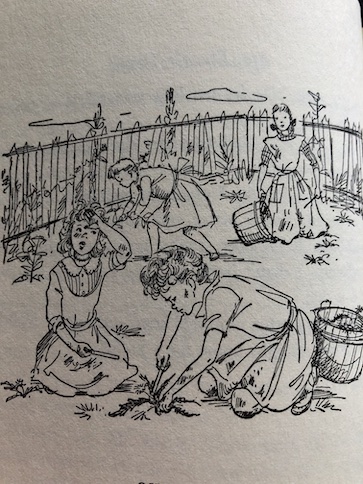
While the girls are pulling weeds, some of them play pretend games, like they’re fighting soldiers or Indians (as in Native Americans, another one of the objectionable points), and finally, they get the job done. Mr. Black is satisfied with the job they’ve done and pleased with their willingness to sow grass seeds and flowers where the weeds once were, so he gives them the key to the cottage for the summer.

The girls are thrilled at having a whole house to themselves all summer, although it needs serious cleaning before they can really use it. Mr. Black, a lonely widower with a fondness for children, (especially Bettie, who reminds him of his own daughter, who died young) stops by to see how the girls are doing. When he finds them exhausted from cleaning and trying to decide if they can manage to clean the floor before they give up for the day, he gives them some peanuts to eat and finishes the cleaning himself. He tells the grateful girls that they can thank him by inviting him to dinner at the cottage some day.

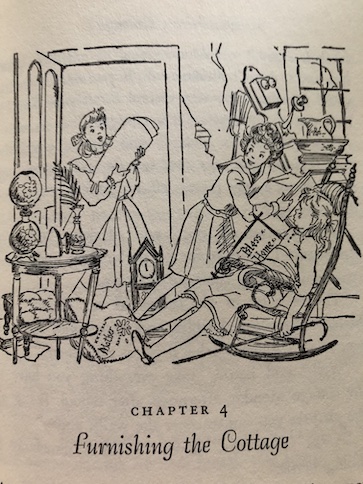
The girls’ parents completely support them playing in the playhouse because it does mean less noise and mess at home, although they refuse to allow the girls to stay in the cottage overnight for safety reasons. They let the girls have some old furniture to furnish the house, including chairs that are missing legs, beds that sometimes have the slats falling out of the bottom, and six clocks, four of which don’t work. The little cottage soon begins to look cheerful and lived-in, although the girls have to warn their visitors about which chairs are unsafe to sit in.

The girls worry at first that they won’t be able to afford to buy food to give Mr. Black dinner as they promised. They know that they could ask their parents for supplies, and even nice Mr. Black would probably provide something for them to cook if he knew that they couldn’t afford anything, but they feel like they really should find a way to buy the supplies for dinner by themselves. They try holding a lemonade stand, which works for a little while, but then, they misplace the money they earned.

Fortunately, their money problems are soon solved when they receive a request for a room to rent from a nice young lady. She is the daughter of the traveling organ tuner who is working on the organs at some local churches. She has arranged to take her meals at the boarding house where her father is staying, but she was unable to get a room there herself, so she is looking for somewhere inexpensive to stay nearby. She will only need the room for three weeks. The girls explain their arrangement regarding the cottage to her, and they show her their best bedroom. Miss Blossom, their new boarder, says that it will suit her just fine. Because the furniture is old and the house is still not in very good repair, they only charge her half rate to stay there, but that’s still more money than the girls have ever earned before! When Dr. Tucker learns who their lodger is, he approves of the arrangement, and Mrs. Tucker and the other parents give the girls some proper bedding and a few other supplies for their boarder. Miss Blossom turns out to be a nice boarder, who sometimes joins the girls in their games, delighting at her stay in their playhouse.

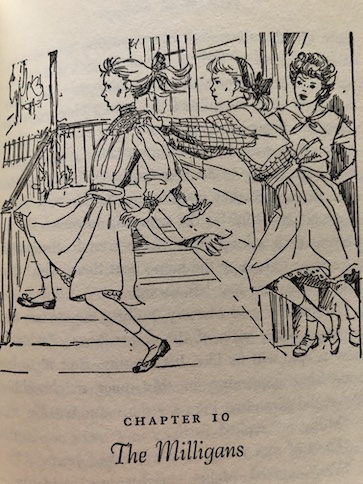
Then, an older woman who lives nearby moves away, and a new family moves into the house next door to the cottage. The Milligans aren’t a very good family. Mr. Milligan swears (the girls’ mother tells them not to listen and to keep the windows of the cottage closed while he’s chopping wood because of the things he says), and Mr. and Mrs. Milligan argue frequently. Laura, the daughter of the family, is the same age as the other girls, and she plays with them for a time, but the other girls stop playing with her because she’s mean to them. She teases them meanly, tries to boss them around, and eventually, steals from them. The stealing ends their friendship. Laura lies to her mother about what happened, blaming the other girls for slapping her and her baby brother and throwing them bodily out of the cottage. Mrs. Milligan comes to the cottage to lecture the girls about their behavior and refuses to believe them when they tell her the truth about Laura. To get revenge on the girls, Laura kills a plant in the girls’ cottage garden. The girls hadn’t purposely planted the plant, and they had been looking forward to seeing what it was as it grew.

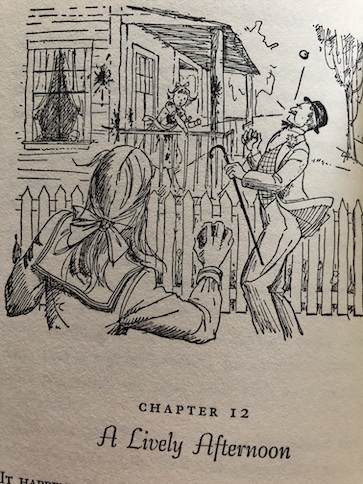
Laura continues to do horrible things to the girls, breaking a window of the cottage, throwing dirt through the window, messing up their porch, spreading molasses on their door, and sending her dog through their flower beds. One day, Laura starts a fight with the girls by yelling mean and insulting poems at them. Laura throws tomatoes at the girls, and Mabel throws apples back at Laura. Mabel isn’t normally good at throwing anything (something that Laura taunted her about), and she accidentally hits Mr. Milligan. Mr. Milligan, for once, sees his daughter misbehaving and is angry at her for throwing the tomatoes and wasting food, but he also threatens to have the other girls thrown out of the cottage for their misbehavior. Mrs. Milligan lies to their landlord, Mr. Downing, telling them that the girls have been playing with matches in the cottage. Mr. Downing manages the books for the church, so he evicts the girls from the cottage while Mr. Black is out of town.

The girls go to see Mr. Downing and argue that they’ve already paid their rent in full for the summer with their labor, but Mr. Downing says that their agreement with Mr. Black didn’t make good business sense and it’s “not binding”, so he’s breaking it. He wants to rent the cottage to a paying tenant, and Mr. Milligan himself has offered to rent it while someone else rents the house the Milligans are currently in.

The girls are heartbroken, but they have no choice but to move out. Although, the Milligans’ scheme backfires on both the Milligans and Mr. Downing. Mr. Downing wouldn’t believe the girls when they said that the cottage wasn’t in good enough condition to be anything more than their playhouse, and they were telling the truth. The cottage looked nice when the girls had their things there, but when they take them back and the girls’ brothers strip the house of some repairs that they had made for the girls’ sake, its real condition shows. The Milligans are stuck with a cottage that leaks in the rain, and they can’t move back into their own house because the new tenants have already moved in and don’t want to leave. The Milligans are forced to move out of the neighborhood entirely, so the girls never have to see Laura again. Mr. Downing, angry at the hassle the Milligans gave him over the whole issue, even blaming him for their furniture being ruined by the leaking roof, yells at the girls when they ask if they can move back into the cottage, which is now empty. However, when Mr. Black returns to town, he gives the girls the second key to the cottage, tells them that they can move back in, and has a talk with Mr. Downing about his treatment of the girls and their agreement about the cottage. The girls’ grateful families fix up the cottage even better than it was before, and Mr. Downing gives the girls an embarrassed apology and a peace offering, admitting that they are far better tenants than the Milligans.

The girls have made friends with a lonely older woman who lives near the cottage, Mrs. Crane. Mrs. Crane is a widow who has very little money, and she offers the girls friendship and sympathy during the time when they were evicted from the cottage. The girls feel sorry for her, having no children or other family to look after her. They try to help look after her themselves, and they become increasingly concerned about her when her boarder moves out. She relies on keeping a boarder for income, and she doesn’t know what she will do when he leaves. The girls wish that they were old enough to take her in themselves. One of the best things they do for her is to invite her to the dinner that they finally give for Mr. Black to thank him for all his help. The girls don’t know that Mrs. Crane and Mr. Black have a history with each other, but their parents realize that the two of them having dinner together is something that would be good for both of them.

The book is now public domain, so it is available to read online through Project Gutenberg and Internet Archive (multiple copies). There is also a LibriVox Audiobook on YouTube.

My Reaction

My copy of this book was a present from my grandmother, who told me that she had read it and liked it when she was young. My grandmother was born in November 1918, so the book was already about 20 years old or more by the time she could read it. She grew up on a farm in Indiana, so she was accustomed to small town life in the Midwest, much like the girls in this story. It was very different from my own childhood in a city in the Southwest, but I thought the story was charming, and I wished that my friends and I could have a house all to ourselves!

The books in this series receive some criticism for racial terms. I haven’t read all the books yet, but the issues I’ve spotted in this particular book relate to stereotypes about Native Americans when the children in the stories are playing pretend. The issues I’ve seen so far seem pretty tame compared to some parts in the Little House on the Prairie series, so anyone who is okay with Little House on the Prairie would probably be okay with these books, but since I haven’t read all the books yet, I can’t be completely sure how the rest of the books are. I recommend that adults read through the books first before giving them to children and be prepared to talk about things with child readers. As long as child readers understand that they shouldn’t imitate everything that they read in old books, I think they will be fine. There are also instances of bullying and fat-shaming in the mean things that Laura says to the girls, which kids should know not to imitate, either.

Apart from that issue, this book is a pretty calm, charming story. The book fits with the Cottagecore aesthetic that has been popular in the early 2020s. Modern kids and adults may still enjoy the girls’ sense of independence in their own cottage and how they fix it up and give it new life.

The cottage in the stories is based on a real cottage in Michigan, in the author’s hometown, Marquette. My copy of the book has an About The Author section on the back, with a picture of the author. The girls in the story and their adventures are fictional, but the town did once have a dandelion problem that may have been the inspiration for this story.

Little House in the Big Woods

Little House on the Prairie Series

Little House in the Big Woods by Laura Ingalls Wilder, 1932.

The story begins “60 years ago”, in a little house in the woods in Wisconsin, where a little girl named Laura lives with her parents and her two sisters, Mary and Carrie. Mary is older than Laura, and Carrie is younger. Their father hunts for meat for the family in the woods, and although Laura worries about the wolves in the woods, she and her family are safe in their little house.

Much of the family’s time is occupied with getting and preserving food. Food preservation is important because not every hunting trip is successful, and they need to make sure that they make the best use of every animal they get, as well as dairy products and produce. Laura and Carrie like to play among the food being stored in the attic. One of their favorite chores is helping their mother mold butter into shape with their butter mold, and often, the highlight of their day is getting something special to eat.

The story begins in winter, and Christmas is coming. The girls help their mother to prepare some special foods and treats, like apple pie and vinegar pie. They make candy by pouring a molasses syrup over snow to freeze it. The girls’ aunt, uncle, and cousins come to visit, staying overnight. The children have fun playing in the snow, making what they call “pictures” by throwing themselves down in the snow and seeing what type of shapes they can make with their bodies. The family has a feast, during which the children are not allowed to talk because “children should be seen and not heard”, but they don’t really mind because the food is really good, and they can have as much as they like. The children believe in Santa, and they are happy with the simple presents they receive: a pair of red mittens and a peppermint stick each.

Laura also receives a very special present: her first real rag doll. Her older sister already has a rag doll, but up to this point, Laura didn’t. Her only doll was made from a corn cob. Children of their time don’t get many presents, and the youngest children don’t get any at all or only have improvised toys. The other children aren’t angry or jealous because Laura has received this extra present because she is younger than they are. Only the babies in the family are younger than Laura, and the older chidren know that Laura didn’t already have a doll, like they do. Laura isn’t being favored; it’s just that she is now old enough to get this kind of present.

Although the family is safe when they’re in their log cabin, there is a genuine risk of attack from wild animals when they’re outside. Members of the family talk about close encounters they or other people had with panthers or bears. Laura’s Pa has a humorous encounter with a tree stump that he mistakes for a bear in the snow, while Ma actually slaps a bear because she mistook it for the family cow.

As the seasons change, the family activities change. They help relatives make maple syrup, and they have a dance. The girls have their first trip to town with their parents. Pa gathers honey, and Ma makes straw hats. Pa helps a relative with his harvest, and a cousin who plays mean tricks instead of helping gets his comeuppance.

I couldn’t find a copy of this book to read online, probably because of the racial language in the story, but there are shorter books on Internet Archive based on individual incidents in this story, like the winter and Christmas scenes. I thought those were the best parts of the story anyway. I would recommend those shorter books and picture books over the original for young children.

My Reaction

Things I Liked and Didn’t Like

It’s been a long time since I first read this book, and honestly, I didn’t like it as much as I did the first time. I remembered kind of liking it when I was a teen. I can’t remember exactly how old I was the first time I read it, I might have been a young teen or tween, but I know I didn’t read Little House on the Prairie books as a young child. My mother wasn’t really into the series herself, so she didn’t read them to me or recommend them much. (She preferred Nancy Drew, and really, so did I.) I know I lost interest in the series after reading only one or two more books because it seemed like that poor family was always getting sick everywhere they moved, and I found that depressing. This book series is one of the reasons why I don’t believe that exercise and organic food by themselves keep a person from being sick. This family had both, and it never helped them. During the course of the series, they catch everything from malaria to scarlet fever or meningoencephalitis, whichever it was that eventually made Mary go blind. It’s like all of the diseases my characters died from in the Oregon Trail computer game but in book form. Come to think of it, people on the Oregon Trail were also exercising and eating organic, and I’ve seen the real tombstones of pioneer children. I believe in sanitation and vaccinations.

As an adult, I found much of the first half this particular book boring or frustrating. That’s surprising because I usually like books with details about life in the past, and many of the details in this particular book echo stories passed down in my own family. (I also had ancestors with strict traditions about not working on Sundays, and they also ate cold meals on Sundays because they had to do all the Sunday cooking the day before.) I found some of the early parts of this story grating. The main reason is that this book is not actually a single story. There is no real, over-arching plot. It’s basically a collection of episodic reminiscences and family stories. I found some of them interesting, but not the early parts.

The book isn’t bad because the writing quality is pretty good, but in the first part of the book, there are long descriptions of hunting and food. I hated the descriptions of how they processed animals they hunted and butchered. I’m sure they’re true-to-life, but I’m the squeamish type. The parts where they talk about foods they like are better. They have kind of a cozy feel, with homemade meals and goodies that have kind of a nostalgic feel. However, I’m not that much of a foodie, and I’m not into “food porn” or long detailed descriptions of things other people are eating. There are limits to how much of that I can take before I start wanting more plot to happen. I think food descriptions are good when used to add color and atmosphere to a story, but it’s too much when they start turning into the story itself. Ideally, a good food description in the book will make me think of a story I liked the next time I eat that particular food. When it’s too overwhelming, there isn’t much of a story to be transported to. Part of the reason why Laura dwells on the subject of food is that this family has to struggle and work hard to get it. It’s not always guaranteed, and when there is something extra, there’s reason for celebration. They are poor, and treats are rare. I think that part of the reason why this book was so popular during the 1930s, when it was first published, was that many other children were growing up in a similar situation during the Great Depression.

When there is more action in the first part story, it’s typically that someone has a close encounter with a dangerous wild animal, like a panther or a bear. Most of this isn’t something that little Laura witnesses directly, but people will tell her stories about family members who had this happen to them. It happens repeatedly throughout the book. One really exciting encounter with a wild animal who wants to eat someone makes for a good adventure story, but when it happens repeatedly, the novelty goes out of it. It starts to become more like, “Oh, another animal attack incident story. Everybody’s got one.” Ma slapping the bear was something special, though. After the other descriptions of animal attacks, Pa’s mistaking a stump for a bear and Ma actually slapping a real bear felt like the punchline of a joke.

People in Laura’s family carry guns with them whenever they go out both for hunting purposes and because they are living in a real wilderness full of dangerous animals, and there is always a real possibility that they might have to defend themselves from a bear, panther, or wolf. They also eat bear when they can get one, and Laura likes the way it tastes. One of the chores that the kids find fun is when they help their father make his own bullets using molten lead in a bullet mold. I actually know someone who does this in modern times. Some modern gun hobbyists do, but I’m not into guns myself, so I didn’t find that as interesting as other types of home crafts. As the book continued and the seasons changed, there was more variety in activities for the family, and I started getting more interested.

The books in this series are semi-autobiographical, based on the real life and childhood of the author, Laura Ingalls Wilder. Laura Ingalls Wilder is actually the Laura from the book. That’s partly why the book isn’t structured liked a story so much as a collection of reminiscences, because this is just about what she remembers from her early life and family. I appreciated some of the small details of daily life, like the log cabin where the family lives, the butter mold with the strawberry shape, the trundle bed where the girls sleep, the lanterns they use for lighting, the family’s Sunday traditions, how the ladies prepared for their dance, and how they made maple syrup and straw hats. The parts of the story that I didn’t like so well were the parts where she goes on about the parts of life in the past that interest me the least. I don’t like hunting, I have no interest in guns, I don’t like hearing about butchering animals, and I’m not the kind of person who gets excited about animal attacks. (I never liked watching them on National Geographic, and I refuse to watch Shark Week or anything like it.) The parts I liked better were about using items that people just don’t use anymore and often don’t even have in their homes and the things the family did for fun and entertainment or celebrating holidays.

One of best scenes in the book, which is probably many people’s favorite, is the Christmas episode. It’s charming how Laura and her family make candy by pouring molasses syrup over snow. People can still do this today if they want to try an old-fashioned treat. It’s also heart-warming that they spend Christmas with visiting relatives, playing outside in the snow and enjoying a few simple presents, mostly handmade. They take great pleasure in simple activities and small presents because much of the rest of their lives were about chores and basic survival, and special treats and presents of any kind were rare. I thought about this book during the covid pandemic, when many people couldn’t safely visit with family or friends for Christmas. This is just one household of people, with just a few relatives visiting for a day, enjoying a few simple pleasures and homemade food and fun. It can be possible to enjoy very simple, homemade activities if you take the time to fully appreciate them and really throw yourself into making the most of them. The Christmas scene was the one that really stayed with me from my first reading when I was young, and it was the main reason why I wanted to read it again. I forgot most of the rest of the book.

Racial Language Issues

One thing that many people find distasteful about the Little House on the Prairie books these days is that books in the series have inappropriate racial language. This sort of thing went completely over my head when I was a kid because I didn’t know what some of these words meant, but it really jumps out at me now. At one point in the story, Laura’s father plays his fiddle and sings a folk song called Uncle Ned (that link is to a page from Missouri State University with words and music), which is about a black man who dies and uses the word “darkey” repeatedly. To be completely honest, I listened to the entire recording of this song, and I have no idea why anybody would like it. It’s not the only song Pa sings in the story about someone dying, and I can’t figure out why he thinks any songs like that are fun. They just sound depressing to me. But, Uncle Ned stands out from the other songs because of the racial slur.

I want to stress that it definitely is a slur. “Darkey” was not a polite term even during the time the story was set. People said it, but it was rude and insulting slang, not a word for polite conversation. Black people did have feelings about racial terms, and there were terms that were preferred and polite and terms that were considered demeaning and insulted and were known to be deliberately condescending. This particular term belongs to the second category. Black people weren’t always able to openly express their real feelings about the rude terms because of threatened violence for anything they might say, but their inability to speak openly about the issue doesn’t change the reality of the issue. There were 19th century white people who were well aware of what terms were polite and which were impolite, and they made active efforts to teach children to speak politely, such as the editors of this 19th century children’s magazine and Rev. Jacob Abbott, author of the Stories of Rainbow and Lucky (1859-1860), among other children’s books. Both of those sources are older than Laura Ingalls Wilder, pre-Civil War. Abbott made it a point to include a conversation between a grandfather and grandson in one of his Rainbow and Lucky stories to teach children the polite way to address black people of their time (“black” was one of the less preferred terms until the Civil Rights era, when people wanted to distance themselves from older racial terms and their accompanying emotional baggage, but the advice to care about others’ feelings and what they want to be called still holds true):

“I don’t know who they are, grandfather,” said he, after gazing at Handie and Rainbow a moment intently. “One of them is a black fellow.”
“Call him a colored fellow, Jerry,” said the old man. “They all like to be called colored people, and not black people. Every man a right to be called by whatever name he likes best himself.”
“But this is a boy,” replied Jerry.
“The same rule holds good in respect to boys,” added the old man. “Never call a boy by any name you think he don’t like; it only makes ill blood.”

True politeness requires consideration for others’ feelings, not denial of them, which would be the exact opposite of politeness by literal definition. Politeness is about avoiding what would offend others and emphasizing behaviors others find pleasant, not about doing only what pleases oneself or choosing to take personal offense at the idea of considering another’s feelings.

So, what’s the deal with Pa Ingalls? If other white adults of this era cared and tried to teach their children to care, why doesn’t he? Some people might point out that he’s just singing a song and that he didn’t write the song, which is true. In this particular instance, he’s effectively quoting someone else. That being said, this is just the first instance of questionable racial terms and attitudes in this series, and some of the later ones are worse. After thinking it over, I think what it comes down to is that the Ingalls family has little need to consider how people of other races feel specifically because of the way they live. Most of the time, there are simply no “others” in their lives to consider.

Nobody thinks anything of this type of language in the story or comments on it because, remember, this family lives in a log cabin in the woods with no close neighbors. They rarely go to town, and when they visit with other people, it’s usually other relatives, like the children’s aunt and uncle or grandparents. What I’m saying is that, when you live alone much of the time or surrounded only by people like you, especially close relatives, you don’t have to put much energy or thought into how to live with other people. The Ingalls family doesn’t have to think about any of this, so they just don’t think about any of this. But, when it comes right down to it, that’s certainly not the kind of life I’ve lived or the kind of life modern 21st century children live.

Since my first encounter with this book, I grew up in a city, in multicultural society full of people to interact with every day, and I got a higher education with a heavy focus on cultural issues. Some of the words in this book went over my head the first time, but I grew up. This book did not grow with me, and the racial language is one of the parts that not only doesn’t hold up but feels worse when you’re older and know better. This is not a book that has greater depth and provides more insight when you go back and read it as an adult with more life experience, as some children’s books do. Instead, it brings out some uncomfortable realizations about characters you liked before and the lives they live.

I’ve read that some newer printings of these books have changed the problematic parts, which is actually very common with older classic children’s books that are still in print. The same thing was done to old Stratemeyer Syndicate books like the Bobbsey Twins, Mary Poppins books, and various books by Enid Blyton. I was surprised when I found out what some of the original editions of those books were like. However, I haven’t seen a new copy of any of the Little House on the Prairie books to know how much has changed. There are parts of this series that I remembered from reading them the first time, mostly the Christmas scenes, but I’m just not really into this series. There are others I like better. Overall, I really prefer the Grandma’s Attic series to the Little House on the Prairie series because it also has details of daily life in the past, but I feel like it has more variety and warm humor to the stories in those books, and there are no inappropriate racial terms. My own grandmother grew up on a farm in Indiana, and she specifically recommended the Grandma’s Attic series to me, saying that it reminded her of her youth. She never mentioned or recommended Little House on the Prairie books, so I suppose she wasn’t as into those, either.

Stepping on the Cracks

Stepping on the Cracks by Mary Downing Hahn, 1991.

This is the first book in the Gordy Smith series, although the book really focuses on a girl named Margaret. Gordy Smith is the neighborhood bully and her nemesis. The series shifts to focus more on Gordy after the full story behind his awful behavior is revealed. This story begins in August 1944 because, although they don’t mention the year, the characters talk about seeing the story about the Liberation of Paris in Life Magazine.

Eleven-year-old Margaret and her best friend, Elizabeth, both have brothers who are fighting in World War II. Margaret’s brother is in the army in Europe, and Elizabeth’s brother is in the navy in the Pacific. The two girls have their own special ritual of stepping on the cracks in the sidewalk to “break Hitler’s back”, in a twist on the old stepping on a crack childhood superstition. Margaret knows that the war is Hitler’s fault, and she blames him personally for her brother, Jimmy, having to go away and fight and for the changes in her household since then. Since the war started and her brother went away, Margaret’s father has been very grim, and she knows that her mother sometimes cries when she thinks that Margaret can’t hear her. Her parents are happiest when they imagine what life will be like when the war finally ends. Margaret keeps a scrapbook of letters Jimmy has written to her and war-related news clippings and cartoons that she’s saved that remind her of things her brother has told her about his time in the army. Margaret hates Hitler and the Nazis with a vengeance.

At the same time, Margaret thinks about how odd it is that the war doesn’t seem entirely real. She knows that people in her community have already been killed in the war overseas, and her parents are worried about Jimmy. However, apart from the missing people in the community, like Jimmy, and the stars in people’s windows to signify people who are in the armed forces or who have been killed in battle, there are few outward signs that there is a war happening. They hear about battles, but their own town of College Hill, Maryland, is peaceful. There are some shortages of things because of war rationing, but otherwise, Margaret’s life has been continuing very much as before. She’s seen pictures of starving children in war zones, and she sometimes wonders why they suffer so much, and she doesn’t.

A neighborhood bully, Gordy Smith, gives the girls trouble, and Margaret thinks of him has being like a Nazi because he’s so mean. He calls Margaret and Elizabeth “Baby Magpie” and “Lizard”, pulls their hair, and gets his friends to gang up on them. At one point, he tries to force Elizabeth to kiss him. (One of those weirdos who are clearly interested in girls but have no idea how to be charming to girls.) Gordy brags about his brother in the army, saying that his brother has killed more Nazis than the girls’ brothers and that he’s going to join the army and kill Hitler when he’s older.

Margaret tells her mother about Gordy and says that she hates his guts. However, her mother tells her that young ladies shouldn’t say words like “guts” and that she should have some sympathy for Gordy because of the kind of family he lives in and what his father is like. (Personally, I don’t think sympathy alone is what’s called for to fix Gordy’s problems, but more about that later.) Elizabeth’s father is a policeman and has arrested Gordy’s father more than once for being drunk and disorderly. People in the community think of the Smith family as being “poor white trash” and wish they would move away. The other kids in the family are as nasty and troublesome as Gordy. Margaret doesn’t think Gordy’s family circumstances should excuse his awful behavior and still hates him.

One day in late summer, before school starts, Gordy and his two friends chase the girls out of the treehouse they built. They steal the comic books they like from the girls and rip up the ones they don’t like, tossing them from the top on the tree on top of the girls. Then, they start ripping up the boards from the platform in the tree so they can use them themselves, saying that girls can’t build anything well. It takes much less time and effort for them to destroy what the girls built than it did for the girls to build it. (This is always true of any kind of destruction, so that doesn’t mean anything complimentary about the destroyers, especially if they aren’t smart enough to realize that and think they’ve got some kind of special talent that’s better than building abilities – just saying because it’s true. All this stuff from the boys is just bluster and gaslighting to intimidate the girls into letting them have what they want by implying that they never deserved the things they actually owned and built themselves.) Margaret yells for help from her mother, but her mother doesn’t hear her. Elizabeth tells the boys that their act of sabotage makes them traitors and worse than Nazis, but they laugh it off.

Elizabeth tells Margaret that they’ll get even with Gordy and the other boys for this, but Margaret can’t imagine what they could do. She would rather stay away from Gordy. That’s easier said than done because Gordy steals the next set of boards the girls try to use to rebuild their tree house, too. One day, the girls see the boys going into the woods. They know that the boys have built a hut to use as a clubhouse with the boards they’ve stolen from the girls, and Elizabeth suggests that they follow the boys to find out where their hut is. Elizabeth thinks that it would be great revenge to find their hut, take it apart, and reclaim the stolen boards. After all, they have a right to their own boards. Margaret is more hesitant because they’re not supposed to cross the train tracks into the woods, and the woods are lonely. The boys have air rifles, and if the boys caught the girls trying to take back the boards, they could do all sorts of horrible things to them with no one around to save them. However, Elizabeth impulsively dashes off into the woods, and Margaret feels like she has no choice but to go with her.

The boys catch the girls spying on them at their hideout when Margaret accidentally sneezes. At first, Margaret is sure that the boys are going to kill them when they catch them. Instead, Gordy tries to scare the girls with a story about how he and his friends have actually saved the girls from the crazy man who lives in the woods. There’s an experimental farm near the woods used by the agricultural department at the local university, and Gordy spins a story about how the army was using the farm for an experiment on soldiers, using chemicals to try to make them stronger and braver. Gordy insists that the man they used in the experiment went crazy and broke out of the farm and has been hiding in the woods ever since, ready to attack anybody who finds him. Elizabeth says the story is a fake because she never heard anyone else say that, but Gordy insists that he saw the crazy man standing behind the girls with a knife. Gordy tells the girls that they better stay out of the woods or the crazy man might get them next time.

Elizabeth knows that Gordy must be lying, but Margaret is sure that the story must be true when she sees a wild-looking man with shaggy hair behind the boys in the woods. Margaret screams and runs for home with Elizabeth behind her. Unfortunately, Elizabeth didn’t see the wild-looking man herself. She thinks that Margaret was just being a chicken, falling for Gordy’s story and imagining that she saw something, and she teases Margaret about it. Margaret asks her mother about the experimental farm and Gordy’s story, without admitting that she was in the woods, and her mother says that it’s nonsense, that the farm is only used for agriculture. Her mother thinks that, if there is a strange man in the woods, it’s probably just some old tramp.

It does seem like a logical explanation, that maybe there was just some old tramp hanging around the woods who didn’t know that Gordy was going to tell some wild story about a murderous crazy man and just happened to wander by at the right moment to look scary. However, Margaret just can’t convince herself that’s all there is to it.

When the girls finally get up the nerve to go back to the boys’ hut, there are unmistakable signs that someone has been living there. There is also a knife, like the one Gordy said the crazy man had. Who is staying in the boys’ hut, and what are the boys really hiding?

My Reaction and Spoilers

I mostly think of Mary Downing Hahn for her ghost stories, like Wait Till Helen Comes and The Doll in the Garden, but this was actually the first book that I ever read by this author. I think I read it when I was in elementary or middle school. Because of some of the serious subjects of the book and some of the language used, this isn’t a book for young kids. It’s probably best for middle school.

America in the 1940s

This book is a realistic portrayal of life on the American home front during the war. I enjoyed the mentions of little things that were common in 1940s America, like the popular radio programs that people liked to listen to (like the Lone Ranger, the mystery horror show Inner Sanctum, and the children’s program Let’s Pretend), comic books and newspaper cartoons, magazines like Life and The Saturday Evening Post, and “Kilroy was here” graffiti. Sometimes, characters mention 1940s celebrities. After Gordy tries to make Elizabeth kiss him, she tells Margaret that a star like Joan Crawford would slap any guy who got “fresh” with her. Later, the girls overhear the boys talking about which pin-up girls they think are the most sexy, mentioning Betty Grable and Rita Hayworth.

Note: The boys’ “sexy” talk is at a realistically juvenile level, laughing over pictures of pin-up girls with big breasts and using the word “hubba-hubba.” An adult hearing a conversation like this knows that the boys probably feel grown-up for secretly smoking cigarettes at their hideout while talking about sexy women, but at the same time, they plainly sound like little boys who use words like “hubba-hubba” because that’s as sophisticated as they know how to be. They have nothing else to say on this subject. As Elizabeth and Margaret could attest, these boys have never successfully kissed a girl at this point in their lives because they’ve been making themselves unappealing to the girls in their vicinity by the mean and obnoxious ways they act. When the girls later go inside the boys’ hut, they see that the boys have defaced their pin-up pictures by giving all the girls beards and blackened teeth. They are definitely not young Casanovas.

This was the first book that introduced me to the concept of putting banners with stars in the window as a sign that someone in the family is in the armed forces. A blue star indicated (and still indicates) a living service member or veteran. A gold star means that the service member died in action. That’s important to the story because, even at the beginning of the book, Margaret knows what the blue stars and gold stars mean, and she already knows people in her community who were killed in the war. One of the people in the community who has died in the war was a young man called Butch who was killed only months after he got married. His widow, Barbara, gave birth to their son after his death, so Butch never saw him. Margaret is sad when she thinks about Butch and his family because she can remember when Butch was a local hero as quarterback on the high school football team. Later, Margaret’s brother, Jimmy, is also killed in the war, and the family replaces his blue star with a gold one, while Elizabeth’s family still has a blue star because Elizabeth’s brother, Joe, is still alive.

Danger and Safety

There are a lot of themes about safety and danger in the story, both real and perceived. When Margaret thinks about the crazy man Gordy says is living in the woods, she thinks that she would feel safer if Jimmy was home because Jimmy would protect her. Yet, when she thinks about Butch getting killed, Margaret realizes that, when big, strong, young men can be suddenly killed, nobody is ever really safe. Even the strongest men she knows are not completely invulnerable, and there are big, frightening, unpredictable things happening in the world.

At one point in the story, the girls talk about what they would do if girls were sent away to war like their brothers. Elizabeth brags about how brave she would be, but Margaret freely admits that she’s a coward and everyone knows it. Margaret imagines that, if she were out on a battlefield, she would probably drop to the ground and play dead until it was all over.

Later, when the girls learn the truth about Gordy, it brings the full realities of the war home to them and challenges everything that Elizabeth thinks about bravery and cowardice. The truth is that Gordy built the hut to hide his brother, Stuart. While one of Gordy’s brothers really did become a soldier and Gordy brags about him, Stuart became an army deserter. When Elizabeth finds out, she’s furious because her brother and Margaret’s are risking their lives, and she thinks that Stuart is a coward, letting others die for him and their country because he’s too afraid to fight. However, when the girls confront Stuart, Gordy, and the other boys about the situation, they learn that it’s more complicated than that. It takes Elizabeth longer to see how complicated the situation really is, but Margaret understands when Stuart describes his feelings.

Stuart is a pacifist. He’s not a coward or a Nazi sympathizer, as Elizabeth first accuses him. His logic is that two wrongs don’t make a right. While Hitler might want to take over the world and send people out to kill others, Stuart knows that the men who get sent away to be soldiers mostly don’t want to be soldiers at all and have no real desire to kill anyone else. If they had their choice, they would just be living their own lives and minding their own business at home. His speech makes Margaret really think for the first time about the war from the point of view of the soldiers on the ground. When her brother was drafted, Margaret never asked him how he felt about going away to war, just assuming that he’d want to defend his country and beat the Nazis. Now, she regrets not asking him about his feelings and wonders if he was scared or if he went reluctantly. For the first time, she also has to confront the reality that her brother has been actively killing or helping to kill other people. Stuart deserted because he simply couldn’t face the prospect of killing someone. He shows the girls a letter he got from their other brother, Donald, the one who became a soldier, telling him how horrible the war is and how they’ve sometimes killed civilians and even allies because of mistakes they’ve made. Stuart also introduces the girls to the poem The Man He Killed by Thomas Hardy. Margaret wonders how Jimmy felt about the idea of killing other people and if it’s really sane to be okay with the idea of killing. Margaret has always looked up to her older brother, seeing him as a protector, never thinking of him as a killer, but yet, he is actively engaging in killing. He doesn’t tell Margaret that part of things in his letters to her, but she realizes that’s what actually happening in Europe.

Finding out about Stuart creates a real problem for the girls. Because army desertion is illegal, the girls know they should tell someone about Stuart, but Gordy tells them that the hard reality is that deserters either get arrested or shot. If they report Stuart, they could be sending him to his death. Elizabeth, being the more brash and hard-hearted one, says that she doesn’t care because it would be no more than what he deserves (although she later takes that back). Instead, she settles for blackmailing Gordy and his friends into stopping their bullying of the girls and helping them rebuild their tree house.

However, the kids soon realize that Stuart can’t stay their secret forever. Stuart has gotten sick, and if he doesn’t get help, he could just die in the woods. Stuart was hoping that the war might just end, and people would stop caring about whether he’d joined the army or deserted, but nobody in 1944 knows when that’s going to happen. From their perspective, it could be months (close to the reality) or years. The war has been going on for years already. Stuart won’t survive in the woods for that long.

The kids also confront the reality that, while two wrongs don’t make a right when it comes to fighting, just standing back and doing nothing while other people are doing wrong is also wrong. Elizabeth is the first of the children to point out that the entire reason why desertion is illegal is that, if everyone just decided to opt out of fighting, people like Hitler would run overrun everyone because no one would put up a resistance. Leaving aside what the characters decide to do about Stuart for the moment, that brings me to the problems with Gordy and the people who should be responsible for him and aren’t.

Gordy’s Problems

I’m frequently the first to say, as Margaret does in the story, that just coming from a bad background shouldn’t allow a person to get a free pass on being a bully themselves. Two wrongs really don’t make a right, and to my way of thinking, people who bully others because they’ve been bullied themselves are bad because they’re doing to completely innocent people what they already know they hate being done to themselves. However, unlike what Margaret’s mother said earlier about how she wishes Margaret would have more sympathy for Gordy, I quickly realized that, first, sympathy is insufficient in situations like this, and second, Margaret’s mother is not really motivated by sympathy for Gordy. She has other, less admirable reasons for looking the other way, even when she knows exactly what’s going on in Gordy’s family and that he is actively abusing her own daughter.

Gordy frequently gets away with his bullying because people are afraid of both him and his father. On the way to school, when Gordy rips up Elizabeth’s homework and stomps on her school supplies to break them, and the crossing guards see it happen. However, even though it’s part of their duty to report things like this, they don’t want to do it. When Elizabeth asks them if they’re going to report it to their teacher, they make excuses about how that might be tattling and make their teacher mad and how it would be just their word against Gordy’s (ignoring the evidence of the ripped papers and broken school supplies). The reality is that they’re afraid of Gordy doing something to them in revenge. Elizabeth asks them if that means that she’s just going to have to suffer what Gordy does to her while Gordy gets away with it because they’re too afraid to said anything. The crossing guards are further afraid to give her a straight answer because everyone involved knows that the answer is, yes, that’s exactly what’s going to happen, and that’s exactly the reason why it’s going to happen. The crossing guards know that Gordy is going to continue being an abusive bully, and they know they’re going to let him do it without saying a word, and they know the reason why they’re going to do that is because they are scared. They’re not willing to put themselves on the line to protect Elizabeth even though that is a part of their job. Elizabeth, knowing all of this, tells them they’re cowards, and it’s the truth. Unfortunately, there are times when apparent cowardice can also be necessary self-preservation from a greater insanity, and much as I hate to admit it, this might be one of those situations.

There is the underlying problem in this community, and that’s the behavior of the adults. Part of the reason why the young crossing guards are so cowardly about the class bully is that they know darn well that no adult in their community is likely to act on anything they tell them about Gordy. Even if their teacher punishes Gordy temporarily by suspending him from school, Gordy will come back, mean and horrible as ever, with revenge on his mind. No adult is going to get to the real root of Gordy’s problems and solve them, so Gordy will continue to be a problem. It appears to be common knowledge in the community that Gordy’s father is an abusive drunk. Elizabeth and Margaret know it, and I think his teacher probably knows it, too. Gordy comes to school with a black eye. Barbara talks about it with the girls, saying that Stuart used to help protect Gordy from the worst of his father’s abuse and that Gordy needs someone to take care of him. Nobody can avoid knowing that the Smiths are an extremely troubled family. After Margaret and Elizabeth go to Gordy’s house to find him and witness Gordy’s father’s behavior for themselves, Margaret tries to talk to her mother about it, and her mother just says that what people do in their own houses is their business and they can’t interfere. That, right there, is part of the root of Gordy’s problems. The first root is his father’s drunken abuse, the second root is knowing that the adults in his community are aware of the situation and are deliberately looking the other way, and the third root are his own choices that prevent other people from getting close enough to help.

For the moment, I’d like to focus on Margaret’s mother and her non-interference policy when it comes to child abuse. A major part of the reason why Gordy continues to be abused by his father and why Gordy is able continue bullying and abusing other kids is exactly this policy of looking the other way. I think all of the adults in this community feel similarly, and I think a major part of the reason they do it is because the adults are scared of Gordy’s father and what he might do to them. Letting him beat his wife and children probably doesn’t feel great, but these adults excuse themselves for allowing that to repeatedly happen with their full knowledge by saying out loud that it’s none of their business while quietly thinking that letting a kid be beaten is better than being beaten or killed by this crazy man themselves. Apart from occasionally arresting Mr. Smith for getting publicly drunk and disorderly, after which he is released when he sobers up, nobody in the community, not even Elizabeth’s police officer father, does anything. The kids are the most active characters in the story, and the adults, like Margaret’s mother, want to shut them down from talking about it so they won’t have to feel like they should be doing something when they’re not. It doesn’t make the problem go away, but it does allow the adults to lie to themselves and pretend like it’s not a problem that they will have to deal with eventually, which is almost the same in the adults’ minds.

It is fitting that this is a World War II story because the situation with Gordy has parallels within the war itself. The United States initially didn’t want to become involved with the war because they saw what Hitler was doing as a European matter. People in the US didn’t want to become involved in the war because they knew it would mean risking their lives, and it wasn’t something they wanted to do if it wasn’t their problem and if it could be resolved without them. Self-preservation is a sign of sanity, but the problem with that mindset is that it doesn’t take into account the larger picture and the full, hard realities of the situations. Sometimes, even when you don’t go looking for trouble, trouble can come looking for you. The US wasn’t officially involved in the war effort except as a supplier until Pearl Harbor. That attack on the US naval fleet brought it home to the American public that it didn’t matter whether they wanted to be involved or not if another country decided to actively involve them.

It’s a similar situation with Gordy. Nobody wants Gordy to bully them, but he does it anyway. It doesn’t matter if the girls are in their own tree house in Margaret’s front yard, minding their own business; Gordy comes after them to destroy the tree house and steal the boards. Margaret’s parents know what happened, but they do nothing. All through the book, Margaret has times when she feels unsafe, but her parents don’t protect her from the closest and most obvious dangers, even when she tells her mother about them. Margaret’s parents don’t protect her because they are scared themselves and don’t want to get involved, even though they are already involved because it’s their daughter being abused … not unlike a deserter who flees the army to avoid fighting when his country is attacked.

Margaret would be the first to admit that she’s not the bravest person around, but yet, she is braver than many others around her because she can and will take action even when she’s scared. For most of the book, Margaret only gets into scrapes when she’s goaded into them by Elizabeth, but even Elizabeth observes that Margaret follows through once she starts something or sees that something needs to be done. The adults in the community can’t say the same. The abuse going on in the Smith household hasn’t stayed privately in the Smith household at all. It’s gone out into the community through Gordy and the other Smith children. It’s a public matter because Mr. Smith is repeatedly drunk and disorderly and intimidating to every adult in the community. It’s everyone’s business because everyone is suffering the results. However, the adults find it easier to keep telling themselves that they don’t need to do anything about it because they can’t deal with the discomfort that would come from a professional community intervention (or tell themselves they can’t deal with it, which isn’t quite the same thing), which is the one and only thing that could probably save the Smith family at this point, and by extension, everyone who’s been suffering from the second-hand bullying and abuse delivered by Gordy. While one person alone would genuinely be in danger from standing up to Gordy’s father, a concerted community effort including the police, local medical professionals, and the principal and teachers from the school showing a united front would be a safer and saner option. There is safety in numbers, provided that the “numbers” can get up the nerve to join the numbers.

I think Gordy should be held accountable for the things he’s done, and I think some reasonable adult should also point out to him that he’s been a fool to cultivate enemies instead of allies. Although Margaret and Elizabeth eventually become his allies for this adventure, sympathetic to the abuse that Gordy has suffered and to Stuart’s situation, if he had been nicer to them from the beginning, he would have gotten help for himself and his brother much sooner. Gordy is bitter toward other people in the community because he’s fully aware that they all refer to him and his family as “white trash”, although I think he should also be aware that it’s their behavior that causes people to look at them that way. Gordy himself has partly caused and perpetuated that image because of everything he does on a daily basis. While Gordy can’t help that his father is an abusive drunk, he can help being a bully himself, and as long as he acts like that, people will treat him as the bully he is and try to avoid him rather than give him the help he really needs. His father is his worst enemy, the adults in this town are largely useless, and Gordy is not only hurting others but sabotaging himself. Even when the girls try to help Gordy, they find it hard because he’s still mean to them and fights them every step of the way.

One final note I have is to point out that, while I’ve heard many kinds of insults and racial slurs in my life, the term “white trash” is possibly the only term I know that’s both an insulting slur to the people it’s used against and to an entire group of people who aren’t explicitly mention in the slur at the exact same time. That didn’t occur to me when I was a kid, but as an adult, I realize now the reason why the modifier “white” is added to the insult. The modifier implies a comparison. The implication is that the person using the term thinks that non-white people are “trash”, and they’re telling another white person that they’re also a kind of “trash” like that, as bad or maybe worse because, as a white person, they should be able to help their situation but aren’t helping themselves because they’re somehow inferior. It’s true that Gordy and others in his family haven’t been helping matters because they make it difficult for other people to help them, but it’s still a very weird dual insult.

Two Are Better Than One

Two Are Better Than One by Carol Ryrie Brink, 1968.

This is a gentle coming-of-age story about two thirteen-year-old girls in Idaho during the early 1900s, but it’s told in a interesting format, as the reminiscences of one of the girls as an old woman and focusing on a story that the girls were writing together as teenagers. It’s like a story about a story within a story.

One Christmas, elderly Chrystal Banks receives a special present from her old friend, Cordelia Crump. The package contains two miniature dolls (she calls them “pocket dolls”) that Chrystal gave to Cordelia 60 years before. At first, Chrystal doesn’t remember giving her friend Cordy” these dolls but admits that her memory is starting to fail her. As she studies the little china dolls and their exquisite details, she begins to remember them and when she gave them to her friend. The dolls’ names are Lester and Lynette, and Chyrstal remembers how Cordy used to say that the little dolls were magical because any day she carried them seemed to become special and exciting. Even when Chrystal and Cordy grew older, supposedly too old for dolls, they still continued to love and believe in the magic of their special pocket dolls.

Before young Chrystal Reese (as she was known before her marriage) gave the dolls to Cordy, they were a Christmas present to Chrystal from her Uncle Dick. That was the Christmas when the girls were in seventh grade and were early thirteen years old. Uncle Dick had acquired a number of interesting presents for Chrystal on his trip to Europe. He doted on his niece because she had no parents or siblings, living only with her grandmother and Aunt Eugenia and their dog, Rowdy. All of the presents are wonderful, but the little dolls are something special. As she unwraps them, they are hidden within a small box inside another box inside of another box (not unlike the story itself). Chrystal loves the elegant, detailed, jointed dolls immediately and names them Lester and Lynette because they just seem like the right names for the dolls.

Immediately, she goes to see if the little dolls will work well in the dollhouse that she’s made out of orange crates. She has spent considerable time and most of her allowance money putting paint and wallpaper into the little house and making furniture for it. She made all of the dollhouse furniture to fit two small dolls that she already has, Elsie and Eileen. However, Elsie and Eileen are four inches tall, and Lester and Lynette are only about two-and-a-half inches tall, so they won’t work in the house. At first, Chrystal is unsure what to do with the tiny dolls. She loves them, but she’s going to have to figure out where to put them and how to play with them if they won’t fit into the doll house. Then, she gets the idea to give the little dolls to her best friend, Cordy. It’s a sacrifice to part with such a lovely present so soon after getting it, but she wasn’t satisfied that the little bottle of perfume she was going to give Cordy was really a good present. Besides, the girls are so close that they already share everything with each other, and as they like to say “Two are better than one.” Giving the dolls to Cordy won’t be like giving them so much as sharing them with someone who can help to make them even more fun.

Cordelia Lark (her maiden name) grew up in a well-off family with mostly boys. Her father was president of the local bank and president of the school board and a civic leader in other ways, and Cordy had four brothers and no sisters. Cordy and Chrystal are kind of like the sisters neither of them ever had. They like to call each other “Tween”, which is their special pronunciation of “Twin.” They justify being twins because their birthdays are only two weeks apart, so they’re almost exactly the same age.

On the way to Cordy’s house to give her the special Christmas present, Chrystal passes by the courthouse. When she and Cordy pass the courthouse, they can see the barred windows of the jail, and they make up stories to spook each other about how one of the prisoners might escape. On this particular day, Chrystal sees one of the prisoners gripping the bars of his window and looking out. He’s the first prisoner Chrystal has ever actually seen. She’s a little afraid of him, and when he starts talking to her, she doesn’t know what to say at first. The man first asks her what she’s staring at, and then he wishes her a Merry Christmas, even though he’s not having one. Not knowing what else to do, Chrystal murmurs “Merry Christmas” back and hurries on.

When Chrystal gets to Cordy’s house, the two girls exchange presents. It turns out that each of them almost got the other some perfume, but each of them changed their mind at the last minute and decided on something better. Cordy’s present to Chrys (as she sometimes calls her) is a book, which makes Chrystal happy because she loves books and didn’t get any for Christmas this year. But, it’s not just any book. This is Chrystal’s first grown-up novel instead of a children’s book. (They mention the Oz books, the Little Peppers, and the Little Colonel series as books they’ve read.) It makes Chrys feel grown-up. It’s a romantic story about a Southern girl during the Civil War who falls in love with a Northern soldier and eventually marries him. Chrys says that Cordy shouldn’t have told her the ending before she’s read it, but she’s still thrilled at having her first grown-up book.

Chrys worries that, since Cordy gave her a grown-up present, she’ll think that the little dolls are babyish, but Cordy loves Lester and Lynette immediately. She says nobody gave her a doll this year, and she felt disappointed because she loves dolls, and it just didn’t seem like Christmas without one. Chrys explains that these are pocket dolls, and they’re meant to be carried around in pockets, so they can go everywhere with the owner. Cordy says that they’re so tiny and perfect that they must be magic, and she decides to keep the names that Chrys gave them, Lester and Lynette. Cordy thinks that the little dolls are perfect to take along on adventures.

When Chrys tells Cordy about the prisoner, the two of them are nervous, although they don’t really think he can escape. Chrys asks Cordy to walk her home, but after they pass the courthouse, Cordy realizes that she’d have to walk past the courthouse alone on her way home. So, Chrys and Cordy turn around and walk the other way again, but then, they realize that they still have the same problem. No matter which way they go, they have to pass the courthouse, and no matter who walks who home, one of them will have to go alone at least partway. After they go back and forth a couple of times, they pause in front of the courthouse, and Cordy has an idea. She gives Chrys the Lester doll, keeping the Lynette doll for herself. That way, each of them will have someone to keep them company, and it will be like they aren’t alone. It gives each of them enough courage to go the rest of the way home, and it’s the beginning of their adventures with the dolls.

Chrys is inspired by her first grown-up book, and she thinks that maybe she’d like to write novels when she grows up. When the girls are in school, they like to write notes and funny poems with each other when they’re supposed to be studying, and Chrys suggests to Cordy that they start writing a novel together. Cordy agrees, and they decide to take turns writing chapters. They decide that the story will be about Lester and Lynette, and Chrystal writes the first chapter. Chrystal calls the story “The Romantical Perils of Lester and Lynette.”

However, the girls get in trouble for goofing off and not paying attention in class. Their strict teacher, Miss Hickenlooper, decides that the two girls can’t sit together anymore, and she confiscates Lester and Lynette and locks them in her desk. The girls are devastated. If the teacher wanted them to move desks, that was disappointing but justified, but she had no right to just take the dolls. The girls think that they’ll have to wait until the end of term to get them back, but they continue writing the story about the dolls. Chrystal had been going to write the first chapter about an elopement, but because the dolls are now imprisoned in the teacher’s desk, she decides to write it as a prison escape instead.

In the new version of the first chapter of the story, Lester and Lynette are brother and sister, and they are imprisoned in a castle overlooking the Rhine river in Germany (part of the the girls’ geography lesson in school) by their evil guardian, Baron von Hickenlooper. Lynette is rescued/kidnapped by a Viking pirate named Oskar, who carries her away from her brother, who still remains in the castle.

From this point on, the events in Chrys and Cordy’s lives alternate with new chapters of their tandem story about Lester and Lynette. Pieces of the girls’ lives work their way into the story. When the girls are ready to trade turns writing the story, they give each other what they’ve written so far and say “Muggins!” (The word comes from playing games like Dominoes and Cribbage where, if one player spots that another has missed a score or failed to count something properly, they can call “Muggins!” and add the overlooked points to their own score. I think what they’re implying is that this story is a game where one person picks up whatever the other one has left unfinished.) The girls also continue adding verses to an unflattering poem that they started writing about their teacher.

By accident, the girls loose track of the mean poem about their teacher, and Miss Hickenlooper finds it. At first, the girls are terrified that Miss Hickenlooper is going to be furious with them and do something horrible in punishment, but to their surprise, she starts crying. Miss Hickenlooper end up having a heart-to-heart talk about the girls’ experiences in Miss Hickenlooper’s class, what Miss Hickenlooper hoped for when she started teaching, and why she took Lester and Lynette from them. Miss Hickenlooper had wanted to be a teacher for a long time and was looking forward to it, but she had been away from it for a long time because she had to take care of her mother during a lengthy illness. Since she started teaching again, she can tell that her students haven’t been happy with her, but after reading the poem, she realizes that it’s worse than she thought. Even strict teachers can be respected by their students as long as they’ve taught their principles well and the students are learning valuable lessons. Miss Hickenlooper feels like she’s failed as a teacher because she hasn’t managed to connect with her students at all, and she’s making them miserable. The girls come to the surprising realization that their teacher really does care about her students and what they think of her.

The talk between the girls and Miss Hickenlooper was a little uncomfortable because the girls realize that they’ve done an injustice to Miss Hickenlooper by writing the mean poem about her, but I actually liked this part of the story because it’s the kind of honest communication that I often find missing in stories. Rather than anyone blustering or dodging or trying to save face, the girls and their teacher honestly discuss what happened and how they feel, and everyone involved learns something from the experience. The girls appreciate having this “human” communication with their teacher, and it earns their respect, more than any angry tirade or show of strength on their teacher’s part ever would have. It’s this very kind of open honesty and humanity with real feeling behind it that’s been missing from the class so far, and it’s what has prevented Miss Hickenlooper from really connecting with her students.

The girls apologize to Miss Hickenlooper about the poem, and Miss Hickenlooper admits the justice of some of their complaints. Miss Hickenlooper admits that maybe she went a little far in making Cordy turn out her pockets and taking her dolls from her for an extended period of time. Getting into someone’s pockets and taking personal possessions is a kind of invasion of privacy, and Miss Hickenlooper says that she only did it because the girls weren’t paying attention in class, which is true. In return, Chrys and Cordy acknowledge that they only wrote the poem to blow off steam because they were angry, but they also went too far, and they really should have considered their teacher’s feelings. The girls promise not to write any more poems like that, and Miss Hickenlooper gives Lester and Lynette back to them. Miss Hickenlooper says Cordy can keep the dolls in her pocket if she wants as long as the girls pay attention in class from now on. To further apologize, the girls make cards for their teacher and give her the two bottles of perfume that they almost gave each other for Christmas (“Two are better than one.”), and they start going out of their way to be nicer to her.

The girls’ talks with Miss Hickenlooper through the rest of the school year give her feedback that helps her to improve as a teacher. Later, when the girls are watching a lightning artist (someone who paints pictures very fast, not the more modern definition of someone who works in animation) at work and happen to see Miss Hickenlooper in the store as well, they point out that one of the artist’s pictures reminds them of the Rhine that they studied in class. Miss Hickenlooper doesn’t think much of the quality of the painting, but she admits that it does look like the Rhine and that another painting the artist did reminds her of Switzerland when she was there. The girls are amazed that Miss Hickenlooper has been to Europe because, other than Chrys’s Uncle Dick, they don’t know anyone who has. They ask her why she never talked about it in their geography lessons because that would have made them much more exciting, hearing about other countries from the perspective of someone who was actually there. Miss Hickenlooper is surprised. She says that she was only focused on teaching the lessons that she was assigned to teach and just never thought about including anything personal because she didn’t think her students would be interested in her personal stories. Again, it’s that personal element that Miss Hickenlooper needs if she wants to connect with her students on a personal level.

As the story continues, the girls also start to consider their attitudes about boys and men and future husbands. So far, most of their knowledge of boys has come from the boys at school and Sunday school and Cordy’s brothers, all pretty immature and rowdy. But, the girls are growing up, and so are some of the boys. New young men also come into the girls’ lives.

A friend of Chrystal’s grandmother asks her if she would be willing to rent a room to her 19-year-old son, who is looking for a place to stay as he takes his first teaching job at the local college. (That sounds young for a college teacher. In modern times, a nineteen-year-old would be a college student himself. Remember, this is the early 1900s, and education in the United States was very different then. Back then, teachers didn’t need to have the advanced degrees that they do now, and Mr. Banks later explains that he skipped grades when he was younger to get through school faster.) Chrystal’s grandmother agrees, although Chrystal isn’t anxious to have a teacher living in her house after her problems with her own teacher at school. Chrys also isn’t sure what to expect from a man living in the house because there’s never been a man in this house before. Cordy’s brothers are pretty rowdy. However, their new lodger, Mr. Banks, turns out to be quiet, polite, and very nice. (His last name is an indication that he’s going to be Chrystal’s future husband. There’s six years’ difference in their ages, but as times goes on, and Chrystal gets older, that’s not going to seem like as much of a gap.) He is the first person to ever address Chrystal as “Miss Reese”, which makes her feel grown-up.

Cordy’s family also has a boarder, Mr. Crump, who is attending the local college (obviously, Cordy’s future husband, based on her future last name). Mr. Crump is working his way through college by selling pots and pans, and Cordy goes with him to help carry things, bringing along Chrys because “Two are better than one.” The girls end up giving him some advice on his sales patter that helps him make more sales.

Meanwhile, the girls’ Sunday school class, which calls itself the Dorcas Club, decides to host a masquerade party with the boys’ class (who have dubbed themselves the Armored Knights) as their guests. Chrys and Cordy think of the boys as immature and uncouth and roll their eyes at the older girls who are boy-crazy. Then, because the party is on Presidents’ Day, all of the girls in the group want to go dressed as Martha Washington, and there’s a big argument about it. Originally, Chrys and Cordy wanted to be Martha Washington, too, but since that’s what all the others want, they decide that they want to do something completely original. Inspired again by the dolls, they decide to go dressed as dolls. However, because they don’t want to be like the prissy girls trying to be pretty and impress the boys, they decide not to go as elegant dolls but as old rag dolls in patched clothing.

The girls do win prizes for both the funniest and most original costumes at the party because they’re the only girls who don’t show up as some version of Martha Washington. However, the triumph turns against them because the girls who are in charge of the main entertainment for the evening have decided to turn it into the girls’ very first dance party with the boys, something that Cordy and Chrys weren’t expecting. Rag doll costumes are good for fun and games, but not so much for serious dancing and the possibility of budding romance. While all of the boys are wearing various fanciful costumes themselves, like pirates and clowns and cannibals, it turns out that they’re only interested in the girls who dressed in pretty clothes as Martha Washington, and none of them want to dance with the rag dolls. Chrys and Cordy were proud of themselves for being more original than the other girls, but it seems that the boys prefer “pretty” to “original.” At the end of the evening, none of the boys even want to walk Chrys and Cordy home. Chrys and Cordy feel embarrassed because their efforts to be “original” seem to have strayed a little into the outlandish at a time when the other girls and boys are starting to seriously get interested in each other.

Fortunately, their families guessed that something of the sort might happen and asked the young men boarding with them to go to the house hosting the party and walk the girls home if they had no one else to walk with them. Mr. Crump confirms to the girls that boys would prefer to walk with girls who made an effort to look pretty instead of girls who look like rag dolls. Mr. Crump says that there will be other parties, and next time maybe they’ll go as something more elegant, like Martha Washington, but the girls aren’t too thrilled about doing this type of party again. Mr. Banks takes a different view and says that he actually thought that the rag doll costumes were rather clever and that it was really better for the girls to be different instead of trying to be like every other girl in order to not stand out. “Sometimes it may hurt, but I think it’s better to be original.” Mr. Banks the college teacher is more mature than Mr. Crump the college student, and I think he has the right idea. Looks and clothing styles change, and people have different priorities when they get older, but original thinking and an interesting personality are hard to replace and never go out style. When Chrystal says that she doesn’t even know how to dance, Mr. Banks offers to teach her, so she can be more confident at future parties.

Having the boarders walk them home actually turns out to be an unexpected victory for Chrys and Cordy because, while the other girls were making fun of them for not having any of the boys dance with them or walk them home, Chrys and Cordy ended up being escorted by young men. Getting boys is all well and good for young girls, but being escorted by young men makes Chrys and Cordy look like young women, putting them on a higher level than mere girls. Chrys and Cordy don’t see it that way at first because Mr. Crump and Mr. Banks are just their families’ boarders and friends and treat them like younger sisters (at this point in their lives, anyway), but the other girls notice that the young men are more mature than the Sunday school boys, and it causes them to look at Chrys and Cordy with a little more respect for having their attention. In some respects, Chrys and Cordy might seem less mature than the girls who are excited about wearing makeup and getting boys because they’re into outlandish costumes and dolls and “romantical” stories, but in other respects, they may actually be a little more mature than the other girls for being confident in their individuality and the new awareness they’re acquiring of other people’s feelings. In the end, girls want to marry men, not little boys, anyway.

Through the spring, the girls have other adventures and continue writing their story with their dolls. Along the way, there are other signs that the girls are growing up. They notice that this is the first year when they’re more interested in getting new Easter bonnets than they are in their Easter eggs. Cordy’s family is heavily involved in the social life of the local college because two of their boys are students there, and Cordy even gets to go to some of the campus parties. She helps to serve punch there and sometimes gets to dance. She eventually arranges for Chrys to come with her to help with serving and have her first dance, too. Miss Hickenlooper also discusses the girls’ future with them, suggesting that they take exams to see if they can skip the eighth grade and go straight into high school because she thinks they’re smart enough to pass. The girls are uncertain if they want to go on to high school so quickly. They know they’re growing up, but they haven’t thought about high school yet (and this is a time period when not everyone even attended high school). There is also the horrible thought that one of them might pass the test while the other didn’t, and they might end up going to different schools and being in different grades. Miss Hickenlooper says that they don’t necessarily have to go on to high school yet, if they feel that they’re not ready, even if they’re offered the opportunity, but she urges them to take the tests anyway to see if they have the option. It makes the girls start questioning their future lives, what they really want, and where their education will take them.

At one point, Cordy’s brothers find their unfinished novel in Cordy’s room, steal it, and use it to make fun of the girls. The story isn’t really very well written because Chrys and Cordy are only thirteen years old. As readers will have noticed, there are spelling mistakes all through the story, and the girls also get mixed up about geography because they’re just focused on making the story exciting instead of really thinking about the setting. After their characters’ adventures on the Rhine, the girls send them floating in a boat to a tropical island with coconuts and palm trees because they don’t think about just how far away the tropics actually are. (Being shipwrecked on an island is also a common trope of vintage and antique children’s books, so they’ve probably read this type of story themselves. Just scroll through my lists of children’s books from the 1900s and earlier, and you’ll see what I mean.) Although Mr. Crump was laughing at the girls, too, he rescues the story from Cordy’s brothers and gives it back to them when he sees that the joke is going too far. However, the girls are somewhat dispirited, thinking that their story might be deeply flawed. At first, they don’t know if they really want to continue writing it, but in their desperation, they turn to the one person they know will be honest with them about what they’ve written and can not only tell them whether or not the story can be fixed but how to do it – their teacher, Miss Hickenlooper.

The book is available to borrow and read for free online through Internet Archive (multiple copies).

Themes, Spoilers, and My Reaction

The story is one of those gentle, calm stories with a few funny episodes and some genuinely touching moments. Fans of slice-of-life historical books like the Betsy-Tacy series will like this book. It is a coming-of-age story for Chrys and Cordy, as they begin to develop new attitudes and come to a deeper understanding of themselves and other people and start thinking about the future. However, the girls’ adventures also teach other people around them some lessons.

One of the themes of the book involves how people let their personalities show. Although the girls were originally thought silly for their outlandish rag doll costumes at the party, they were more bold and creative than the girls who just wanted to look like everyone else. Even though their creativity wasn’t fully appreciated at first, it ends up working in their favor in the long run.

One of the biggest developments in the story is the relationship between the girls and their teacher, and the keys to that relationship are learning how to see other people as people, how to be open about showing their personal sides, and how to appreciate people with different personalities. The girls begin as thoughtless students, and their teacher is a strict disciplinarian with little patience for their goofing off, which is why the girls see her as their antagonist. However, the girls’ eventually realize that, through their mean and complaining poem, they’ve hurt their teacher’s feelings as much as she’s hurt theirs, maybe more. It leads them to see her in a new light, as a person and just just their jailer (the role of her alter ego in the girls’ story). The honest talks between the girls and their teacher not only helps the girls to become more thoughtful and considerate of others’ feelings but also show their teacher that the key to improving her teaching and developing a better relationship with her students is to be a little more personal with her students. She gradually learns that letting her students see her as a person with interesting life experiences earns their respect more than just acting like an unfeeling drill sergeant enforcing discipline. Inspired by the girls’ interest in her travels when she was younger, Miss Hickenlooper starts bringing postcards and souvenirs from her travels to class to show during geography lessons. The students are fascinated by her souvenirs and stories and start thinking of her as an a kind of intrepid explorer or sophisticated world traveler instead of a dull woman who focuses on dry memorization and gets mad at them for daydreaming in class. As she tries new ways of approaching her lessons and adding in personal experiences, Miss Hickenlooper takes on a whole new role in the children’s lives and sparks all of their imaginations. All of the students, not just Chrys and Cordy, start behaving better because they become genuinely interested in what Miss Hickenlooper has to say and show them. They don’t want to make her angry because she’ll stop telling the interesting stories if they don’t get their work done. Just because she’s gotten more interesting and personal doesn’t mean she’s gotten soft. Don’t be afraid to be interesting and different!

The girls never actually show Miss Hickenlooper their story because they’re a little embarrassed by what they’ve gotten wrong, but they ask her questions about some of the things that they put in their story to find out what’s right. They do end up finishing the story and giving Lester and Lynette a grand wedding, but they also acknowledge that they are getting too old and busy with other things to continue playing with dolls, even Lester and Lynette. They plan to put Lester and Lynette away for now as souvenirs of their childhoods. Later, they do tell Miss Hickenlooper about their novel, and while she hasn’t read it, she has the feeling that she knows what it’s like from knowing the girls and their writing. (The girls wrote about scenes from their novel when asked to describe places they know for their high school entrance exams.) She tells them that she appreciates their imaginations but that they should remember to focus on the real world around them and gaining real experiences to write about in the future.

There are also themes that focus on what growing up and maturity mean. Because the story focuses on one school semester in the girls’ lives, there are many questions that the book leaves unresolved about what happened in the girls’ later lives, but it seems that their lives turned out well, and they look back on their experiences with Lester and Lynette as a turning point when they really started growing up. Toward the end of the story, the girls begin appreciating some of the possibilities of life and the wider world that they never considered before. Through it all, there is also the girls’ constant friendship. At the very end, elderly Chrys writes a letter to elderly Cordy, thanking her for sending the dolls and reminding her of this special time in their lives.

The author of this book, Carol Ryrie Brink, was also a child around the time that Chrys and Cordy were children. There is a picture of her as a child above her biography on the dust jacket of the book. She is also the author of Caddie Woodlawn, which is better known than this book.

I love books that contain details about life in the past, and there are a lot of fun details included in this story. I’ve mentioned some above, but that’s just scratching the surface. At one point, Chrystal says that the only paper she has that’s good for painting pictures is the pieced of paper that separate pieces of Shredded Wheat in the box. The lined paper from the notebooks she uses for school isn’t as good. When she’s out of those pieces of paper, she has to eat more Shredded Wheat to get more. I don’t remember seeing any similar kind of paper in shredded wheat boxes in my lifetime, so this must be something that existed before modern packaging.

At the college dances, the girls have dance cards for the young men to write their names and initials in to secure spots for dances. There are also occasional mentions of food, and Chrys mentions having floating island pudding for dessert, which I’d never heard of before. It’s a kind of meringue that floats on a base of vanilla custard.
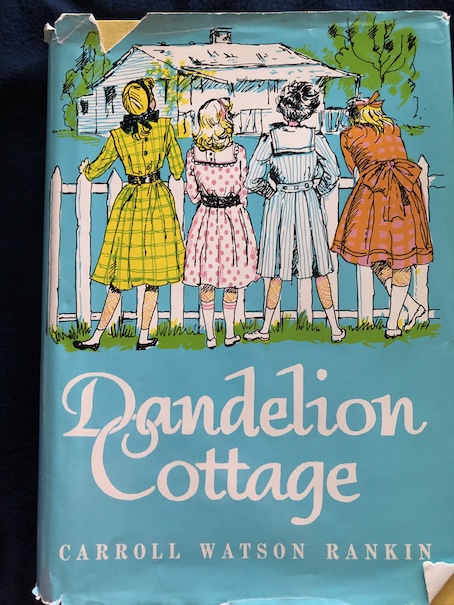
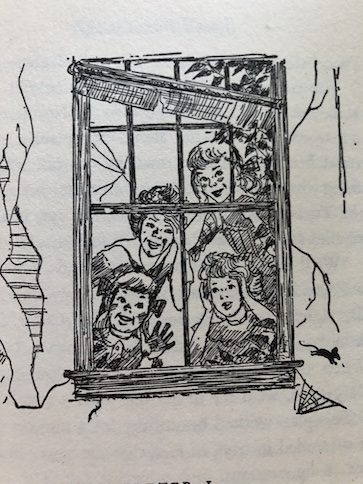
The Witches of Hopper Street

The Witches of Hopper Street by Linda Gondosch, 1986.

Kelly McCoy and her friend, Jennifer, are offended that another girl from school, Rae Jean, is having a Halloween party and didn’t invite them. Jennifer says that they could just throw their own party on Halloween, but Kelly says that’s no good because everyone else they know is going to Rae Jean’s. It isn’t so much that Kelly really likes Rae Jean; it’s more that she hates being excluded.

The girls talk about what they want to dress as for Halloween, and Kelly suggests that they be witches because she’s fascinated by the witches she saw in a play of MacBeth. Kelly also has a book called “Magic and Witchcraft”, and she says that they could study the book and become real witches. Jennifer doesn’t see the attraction of becoming a witch, but Kelly promises that they’ll only perform white magic, where you use magic to perform good deeds, instead of black magic, which involves cursing people. Although, she might make an exception for just a few little black magic spells against Rae Jean. Jennifer says that Kelly can’t be serious, but Kelly says that she is because it’s awful being the only ones in the sixth grade not invited to Rae Jean’s party. Jennifer points out that Adelaide also wasn’t invited. The girls know that Adelaide isn’t popular because she’s overly tall and awkward and much smarter than the other kids. Then, Kelly gets an idea – there were three witches in MacBeth, so maybe they should invite Adelaide to become a witch with them.

When the girls see Adelaide on her way to Rae Jean’s house to help her with her math homework, they stop her and suggest to her that she join them as witches. Kelly tells her that Rae Jean is dangerous and that dangerous things will happen at her party. Adelaide says that she’s not going to the party anyway. Then, Kelly pretends to tell the future with a deck of cards, predicting that there will be a mysterious death in 24 hours. Her prediction comes shockingly true when Rae Jean’s cat kills her pet parakeet.

Kelly knows that the parakeet’s death was partly her fault for taking him out of his cage when Rae Jean brought her cat around, showing off her prize-winning pet, but she also blames Rae Jean for bringing her cat to her house in the first place, and the reason why they took the bird out of his cage was that Rae Jean was goading them about how dumb the bird was. (I think that the kids’ mother shouldn’t even have let Rae Jean bring her cat into the house. The other kids said that they didn’t want to talk to her, but the mother insisted that they let her in because she’s a “nice” girl. That was an irresponsible thing for the mother to do, and she’s not a good example to her children. When you have a pet in the house, you have to make the pet’s safety a priority, especially over being polite to someone who is rude and insulting anyway. Rae Jean shouldn’t have been allowed to bring a predatory pet into their house, uninvited, simply because she wanted to and the mother didn’t have the guts to say no and enforce some house rules. Of course, this is one of those annoying incidents in books that’s used to move the plot forward. If the parents acted anything like mine, it wouldn’t have happened, and this would be a different story.) Adelaide is impressed that Kelly’s prediction came true, and she agrees to be a witch with Kelly and Jennifer.

Kelly walks the others through rituals for being a witch, like signing their names in a Black Book (really, it’s an old brown science notebook), preparing their broomsticks (they’re supposed to be rubbed with the fat of a newborn piglet and belladonna, but the best they can do is strips of bacon and dieffenbachia), and preparing magical rings to protect themselves from evil creatures (Kelly got hers at an estate sale so she’d have one that belonged to a dead person, but the others just got their rings from the quarter machines at the supermarket). The girls pledge to keep their “coven” secret, but then someone leaves a message for them that says, “Midnight is the witching hour. Then you shall be in my power.” All of the girls deny having written it. So, who did? Who else knows about their witchy activities?

Kelly still hasn’t given up her plans to use this witch business to ruin Rae Jeans’ party. She soon acquires a new pet, a skunk, from her brother Ben’s friend Buster, whose father is a veterinarian. She calls the skunk Cinnamon and declares that he is her familiar. To keep the boys quiet about their activities, they have to let Ben and Buster join the coven as warlocks. As an initiation, all of the witches and warlocks have to drink salt water and eat beef liver. Kelly’s mother is perplexed by some of the odd things that they do, but she doesn’t question them too much, and none of the adults ever discover that the kids sometimes sneak out at night to perform rituals. (I could never have gotten away with this sort of stuff as a kid because my mother was always the type to ask a lot of questions about everything and get specific answers.)

Kelly gets the idea of making a voodoo doll of Rae Jean, using an old sweater of hers that Rae Jean’s mother gave her because she helped to get a box of old clothes down from the attic for a sale and because Rae Jean told her that the sweater was scratchy. To get Rae Jean’s hair and nails, the witches open a “spa” business at Kelly’s house. They succeed in getting hair and nail clippings, but Rae Jean gets scared away when their “spa” treatment involves mud that they just dug up in the backyard and has a worm in it. After they make the doll, they decide it looks really awful and sticking toothpicks in it is creepy, so they take the toothpicks out and get rid of it. Instead, they decide to focus on giving Rae Jean the “evil eye” – basically staring at her to make her feel uncomfortable. (That one works whether you’re a witch or not.) When Rae Jean and some others in class get sick, some of the other kids start to believe rumors that the girls have spread about a “poison plague.”

Eventually, Halloween comes, and Kelly gets the idea for her, Jennifer, and Adelaide to use their witch act while passing out candy to the trick-or-treaters. They put the candy in their “cauldron” (an old camping pot), give themselves fantastical names, and perform chants while handing out candy. They have fun with that, but they still feel left out of the party, so they decide to try one last witchy trick on Rae Jean. They decide to brew up a love potion (just apricot juice with honey, and they even think it tastes good themselves), sneak into the party as fortune tellers, and slip the potion into the party punch. Rae Jean’s mother is amused by their fortune telling act and lets them into the party, although Rae Jean isn’t happy to see them.

When Kelly’s new pet skunk gets loose in the party, there is some momentary chaos before Kelly manages to explain that the skunk is deodorized and can’t spray. During their time at the party, the girls learn the true identity of their mystery message writer and have an honest talk with Rae Jean about their feelings and apologize for the witchy things they’ve been doing. Rae Jean also tells them the reason why she didn’t invite them and how left out she felt when she didn’t get invited to a big party that Kelly had soon after she moved to the neighborhood. Rae Jean comes to realize how much she has provoked the other girls into hating her with some of her behavior, and she apologizes bringing cat to Kelly’s house and killing her parakeet. However, Kelly is also forced to acknowledge that she’s also provoked Rae Jean with her quick temper and attempts at revenge. All of the girls owe each other some apologies, and they make up. Kelly and her friends promise to give up all the witch stuff.

However, before they cut it out entirely, they have one last thing to do. Adelaide read about an old superstition that explains how to see a real witch at midnight on Halloween night, and before Halloween is over, the whole “coven” decides that they have to try it. What they see is a bit startling, and although it has an apparently logical explanation, gives the kids an appropriately witchy scare. Could there possibly be a real witch in their neighborhood?

I didn’t like the parts of this story about dead animals. I hated the part where the parakeet was killed, and later, I felt sorry for a cat that died (of natural causes, and it was a sickly stray, not Rae Jean’s cat). I never like stories where animals die, especially through human cruelty or carelessness. Yet, I have to admit that I have a particular attachment to this book, which I remember reading when I was ten years old. Some of their rituals are a little gross, but as I a kid, I think I was attracted to the idea of having a secret, mysterious club and intrigued by the identity of the mysterious message-writer. At the end of the story, they think they know who wrote the note, but their last midnight ritual causes them to have second thoughts.

This book is available to borrow for free online through Internet Archive.

My Halloween Story About My History With This Book:

This particular book and I have a history. This book was important to me as a kid because it sparked something formative, but to tell you what that something was, I have a confession to make: When I was a kid, I wanted to be a witch. I was in high school before the first Harry Potter books appeared, so it wasn’t about that. No, my introduction to witches was The Wizard of Oz, my favorite movie when I was five years old. I liked Glinda, the Good Witch of the North. Dorothy was my favorite character, but I liked Glinda, too. Later, when I saw the movie of Bedknobs and Broomsticks, my interest in witches increased. I also read The Blue-Nosed Witch when I was young, and I was hooked. For a portion of my early childhood, my favorite Halloween costume was a traditional witch costume.

I didn’t want to curse people or be an evil witch, like the Wicked Witch of the West, in spite of my traditional witch costume with the pointy hat. No, I wanted to be a Good Witch and maybe ride a broom and bring suits of armor to life and maybe defeat Nazis in a way that is far less gross than melting them, like in Indiana Jones and the Raiders of the Lost Ark. I had discernment. I had standards. I also had a fear of heights after falling off the monkey bars when I was four, so that probably should have been a clue that broomstick-riding was out for me, but when you’ve got magic, I guess these things aren’t much of a problem. I can’t say that I was really ambitious about wanting magical powers because I didn’t really do anything to acquire them, it was just that I kind of liked the idea … except for that one time, and that’s what this little side story is leading up to.

When I was about ten years old, I read this book with a friend, and we were both enchanted with the idea of making up our own rituals and becoming “witches” and maybe trying some spells on Halloween, just to see if magic works. I only had sort of a vague notion of what kind of spells that we could do. I guess I was picturing something like Bedknobs and Broomsticks, where you recite a rhyme and something is supposed to happen, but I didn’t know any real spells, just movie stuff, and I was clever enough to realize that the stuff in movies probably wasn’t real. Naturally, being a bookish person, I decided that the best way to learn more was at the library. PSAs on tv always told you to “Read more about it“, whatever “it” was. (This was the early 1990s, and I didn’t have access to the Internet yet. That wasn’t even an option.) If anybody had some real spells books, especially ones placed at a convenient height on shelves that a not-very-tall ten-year-old could reach, it would be my local public library, right? I was actually surprised myself when I found one in the library catalog. I really didn’t think it was going to be that easy. That wasn’t the hard part. The hard part was when I actually picked up the book and opened it.

Now, I have to admit here that I didn’t read the whole book, and years later, I can’t remember the title or even what the cover looked like. I kind of wish I did because there are people I would like to show this book to just to prove that it actually exists. When I told my mother about it later, she thought that I dreamed the whole thing, but I swear I didn’t.

This book did have “spells” of various kinds. I picked one from the table of contents (I forget what, but something that sounded like something two ten-year-old girls might want to do on Halloween) and looked at the instructions. It was disgusting. It involved things like animal entrails, which I wouldn’t have known where to get and wouldn’t have wanted to touch even if someone handed me a free bag full. There were other things about animal parts on different pages that disgusted me, too. Under no circumstances was I going to kill cute animals just to do some dumb trick on Halloween, and I wouldn’t have wanted these animals parts even if someone else had done the dirty work of getting them. I wasn’t a vegetarian, but these were definitely not things I could just buy at the grocery store, or better yet, cooked and yummy with a side of fries and a plastic toy.

As I was staring at this book, I suddenly realized that I had no desire to do anything it described and that I was never going to do anything it said. Then, I had a worse thought: someone else must have thought this was a good idea, or they wouldn’t have written it down. Maybe I didn’t want to mess with animal entrails and body parts to gain magical powers, but someone else obviously would. What kind of person would do such a thing? Whatever kind it was, it wasn’t me, and I knew it. The image of the type of person I would have to be in order to do any of this, in order to take any of this seriously, disturbed and repulsed me more than just what was written in the book itself. I slammed the book shut, shoved it back on the shelf, and ran away. I never saw it again, although I did try to find it again once to show it to my mother so that I could prove that I wasn’t dreaming. It wasn’t even in the catalog anymore then.

My guess is that, whatever this book was, either someone stole it from the library (it is the sort of thing an aspiring evil witch might do) or lost or damaged it or some parent or librarian realized that this might not be the best book for children and had it removed from the shelves. Since then, I’ve wondered who put that in the kids’ section in the first place. I’m not fond of censorship, but I have to admit that this book was pretty dang gross and creepy. Was that spell book really serious, or did I miss some introductory part that would have explained that it was all part of some larger ghost story or something? What was the point of the book? I’ve often wondered. All I really remember now is that it was in the first row of children’s non-fiction books at the library, probably the 100 or 200 section of the Dewey Decimal System.

I’m actually glad I did look at it, though, because it made me realize a few things about myself. I realized that there were limits to the things that I was willing to do and that I had the power to say no when something was beyond my limits. My friend was disappointed and thought I was a bit of a wimp for chickening out on our witch experiment so soon and not even showing her the book, but I didn’t care that much. I was firm. I also came to realize that sometimes, it’s the things we don’t do or won’t do that define who we really are. In the end, it may not matter what that book actually was so much as that it left me with a stronger sense of who I was. I should have paid more attention to the part in the Bedknobs and Broomsticks movie where Miss Price said that she realized a long time ago that she could never really be a witch because nobody who felt the way she did about “Poisoned Dragon’s Liver” could be a real witch. I came to appreciate the sentiment.

This experience didn’t completely scare me away from stories with witches in them, as evidenced by the Halloween stories I cover here. I was born close to Halloween, and I like the holiday because I enjoy the imaginative costumes and playing pretend. (Not to mention chocolate. I also enjoy chocolate.) I enjoyed the Harry Potter books, too. But, I know where the dividing line is between pretend and real. It doesn’t trouble me now because I already put the book back on the shelf and said no when it was asking too much, and some decisions stick for life. I don’t worry too much about giving fantasy books to kids, either. Everyone has decisions to make in life about who and what they want to be, and I figure that the younger generations might as well learn where the dividing line between fantasy and reality lies early in life. A bit of a scare now and then might even help them to think more deeply about life’s consequences and make better choices.

If that spell book had been less scary and disgusting, like something that Wiccans use that involves pretty things like crystals and herbs instead of entrails, I actually might have tried a few spells as a child, probably raiding the spice drawer in the kitchen or dismantling my rock collection for spell ingredients. However, Jenny Nicholson did a YouTube video, demonstrating how that typically goes for the aspiring witch. I thought it was hilarious, especially after my childhood escapade. I doubt that I would have had quite the range of objects that Jenny describes, and my parents would have been mad at me if I tried to throw eggs at trees, but I probably would have achieved similar levels of results if my friend and I had actually gone through with our experiment that Halloween. As an adult, I mostly think that things like that are more psychological tricks than anything else, and I find descriptions of them amusing now.

Anyway, that’s my creepy experience with “real” magic. If anyone thinks that they know what that creepy spell book was, feel free to tell me. I don’t feel like I have anything to prove magic-wise, but I still have people I’d like to convince that I didn’t just imagine that the book exists.

Ramona Forever

Ramona is in third grade now, and there are new changes coming in her life. At the beginning of the book, she and her sister Beezus still go to Howie’s house every day after school so Howie’s grandmother can look after them because both of their parents work, although lately Beezus has been finding other places to go after school, like her friend’s house and the library. That’s how Ramona knows from Howie that his rich Uncle Hobart, who has a job in the oil industry, will be coming to visit soon from Saudi Arabia. Ramona mentions it one night at dinner when her Aunt Beatrice is visiting. Aunt Beatrice says that she remembers Hobart from when they were kids and went to the same school, but she hasn’t seen him in years.

When Uncle Hobart comes, he brings a couple of small camel saddles for Howie and Willa Jean to play with. He also gives Howie a unicycle and Willa Jean a small accordion. When he meets Ramona, he embarrasses her by calling her Howie’s girlfriend and singing a verse from an old song about a woman named Ramona (links repaired Nov. 2023), and Ramona takes an instant dislike to him. She flat out tells him that she doesn’t like adults who tease (Neither do I, and I’m in my 40’s.), and he promises to reform, although Ramona thinks that he’s still joking around and isn’t satisfied.

Uncle Hobart takes Howie outside to learn to ride the unicycle, and Willa Jean and Ramona try the accordion. When neither of them can figure out how to use it, little Willa Jean gets frustrated and sits on it, breaking it. Howie’s grandmother, Mrs. Kemp, gets angry at the girls, and Ramona thinks that the accordion was a dumb present to give to a little girl who wouldn’t be able to use it properly for years. Mrs. Kemp tries to shame Ramona to Uncle Hobart, blaming her for the incident. (As if Ramona was the babysitter instead of Mrs. Kemp, who incidentally, is being paid by Ramona’s parents to watch her as well as watching her own grandchildren. Ramona didn’t think of this, but I certainly did.) Ramona never really liked being watched by Mrs. Kemp, but the blaming and shaming makes her realize that Mrs. Kemp actually doesn’t like her and wants to make her feel bad, which is a disturbing feeling from someone who is supposed to be taking care of her. Ramona decides right then that Mrs. Kemp will never look after her again.

When the family talks about the situation at dinner that night, Beezus supports Ramona’s assertion that Mrs. Kemp doesn’t like them, saying that’s the reason why she’s been trying to find other places to go after school. Ramona’s mother asks her if she ever thought that maybe Mrs. Kemp would rather not be a babysitter at all, for either her grandchildren or Ramona, but women of her generation were only brought up to take care of their homes and children, and that’s all she knows how to do, whether she likes it or not.

Personally, I think this is true, but also irrelevant. Mrs. Kemp has a job to do, one that she’s being paid for, and if she’s taking the money, she also needs to take responsibility. Mrs. Kemp blames Ramona for not watching Willa Jean when that was her job, not Ramona’s, and Mrs. Kemp also has a responsibility to Ramona herself because that’s what she’s being paid for. Ramona is Mrs. Kemp’s babysitting charge. She’s a child, the child of paying customers who are specifically paying Mrs. Kemp for childcare. Ramona is not Mrs. Kemp’s personal servant or the babysitter for her granddaughter. Ramona is especially not Mrs. Kemp’s personal therapist or caregiver, who needs to help her manage her emotions or life decisions. Ramona is a child who is only with Mrs. Kemp for the purpose of being cared for by her, so let’s keep it straight who has a responsibility to whom in this situation. Besides not liking adults who tease like bratty children, I also don’t like adults who try to make kids be responsible for things that they should be responsible for themselves. Seeing Mrs. Kemp accepting money in exchange for irresponsibility and a bad attitude about her own general life choices that she takes out on her childcare charges is that much worse. Mrs. Quimby’s insights, while probably true, are also completely unhelpful to the situation. Mrs. Kemp is what she is, and what she is does not make her a good caregiver. Ramona and Beezus are correct to call her on it. Mrs. Quimby is concerned about hurting Mrs. Kemp’s feelings, but I think that should be the least of her concerns in this situation since Mrs. Kemp doesn’t seem to care about the children’s feelings and she’s in a position of trust over them. She is demonstrably not doing the very thing she is supposed to do, which care for the children she is paid to provide with childcare. You have one job, Mrs. Kemp, just one job! Mrs. Kemp is an adult, more than old enough to know better about how to behave and take responsibility for herself and the young children in her care, and she should choose to act like it or be prepared to face the consequences, not continue to get paid and thanked for work she’s not even willing to do, making her young charges miserable every single day. She’s taking advantage of the Quimbys’ desperation for child care, and that’s not right. I wished Mrs. Quimby would step up and support her daughters’ efforts to stand up for their well-being instead of enabling Mrs. Kemp’s bad behavior and making excuses for it, as if it were somehow Ramona’s fault that Mrs. Kemp doesn’t like being a babysitter and that eight-year-old Ramona actually has the power to solve Mrs. Kemp’s life problems. I can only suppose that the reason why Mrs. Quimby doesn’t is that she just doesn’t know where else to find someone willing to watch the girls after school.

Mr. Quimby asks Ramona what she thinks she should do about the situation, and Ramona hates being asked that because she wanted help from the grown-ups, not the responsibility of figuring out the problem with her adult caregiver by herself. Again, I really have to side with Ramona here. It’s not her job to be the adult in this situation, and the older I get, the less patience I have for irresponsible adults. I hated them when I was a kid Ramona’s age (and I ran into plenty of them, too), and I don’t feel any better about them 30 years later. If you want the authority of saying that you’re an adult, you have to take the responsibilities that come with that authority, taking the adult actions and making the adult decisions, not expecting the kids to do your job for you. That’s my attitude. I honestly don’t know what response Mr. Quimby was even looking for from Ramona, either. What can Ramona do if Mrs. Kemp is unhappy about her life choices and doesn’t treat her well because she doesn’t want to be her babysitter? Get some books on psychology from the library and turn into a therapist or career counselor at the age of eight to help Mrs. Kemp work through her emotional issues? Invent a magic potion that will age her to 58 so she can be Mrs. Kemp’s new best friend and they can go out for champagne brunches together instead of Mrs. Kemp babysitting her? What solution are you imagining here, Mr. Quimby? Ramona is an eight-year-old, and what what she thought she should do about this bad situation was talk to her parents, who hired Mrs. Kemp to take care of her in the first place, and get their help. How was she supposed to know that you didn’t want to help her, either? If I were one of the parents in this situation, I’d say that I understood the problem and that I’d think over some other after school possibilities for the girls, maybe look into some temporary care for the girls, possibly in the form of some kind of after school lessons in art or music or sports, paid for with the money that I would have given Mrs. Kemp for babysitting, especially since I already know that the Quimbys are already considering some coming changes for their family that will change their childcare situation. Of course, all of this is setting the stage for what happens next in the story.

Ramona asks if she can just stay home alone after school because some kids do, but her parents don’t like that idea. Beezus says that she could stay with Ramona because she’s in middle school and old enough to babysit. Ramona worries a little that Beezus will be bossy and that they’ll fight with no adults around, but Mr. and Mrs. Quimby agree to let the girls try it for a week while Uncle Hobart is visiting so Mrs. Kemp can spend more time with her son. If the arrangement works and the girls behave themselves, they can keep doing it after Uncle Hobart leaves.

Ramona asks Beezus why she’s so willing to look after her after school, and Beezus explains that things haven’t been to pleasant at her friends’ houses lately. Mary Jane needs to spend a lot of time practicing her piano lessons, and she got into a fight with Pamela because Pamela was acting like a snob and giving her a hard time about her dad’s work situation. Mr. Quimby has had a series of different jobs, and now, he is working only part time and going back to college to train to become an art teacher. Pamela has been bragging to Beezus that her father has a real job and that Mr. Quimby should “stop fooling around and really go to work.” (This is one of those snide kids’ comments that you can tell really came from Pamela’s parents and that she’s just repeating what they say to sound big. Pamela’s parents have probably been bad-mouthing the Quimbys behind their backs to talk themselves up because their employment has been more stable and some people need to look down on someone in order to feel good about themselves. I’ve seen that type before, too. By this point in the story, I had the feeling that the Quimbys seem to know a lot of people who are real jerks in one way or another, and I think it’s time that they made some new friends.) Beezus can’t take it anymore, so she’s stopped speaking to Pamela, which is about all you can do in a situation like that.

Beezus worries about their family’s future because she’s heard that schools are laying off teachers, and she fears that her father might not find a job when he’s done with his degree. She also think that their mother is probably pregnant because of the way that Aunt Bea keeps asking her how she’s feeling and a few months ago, she seemed to be suffering from morning sickness. If that’s true, she probably won’t be able to work much longer because she’ll have to take time off to have the baby and look after it. It make things difficult when the family is already concerned about money, although Beezus says that she wouldn’t mind helping to look after a baby because she likes babies. Ramona worries about the new baby and why their parents would want another child when they already have her and her sister, and she doesn’t like that the adults seem to be keeping important secrets.

The girls try to be extra good and responsible when they’re home alone together so they’ll be allowed to continue staying home alone, but they get into a fight one day when Howie comes over and offers to let Ramona ride his bike because he’s going to practice riding his unicycle. Beezus is afraid that Ramona will get hurt riding the bike and she’ll be considered responsible, but Ramona wants to go ahead and do it anyway because she’s been waiting for Howie to agree to loan her his bike. Ramona likes riding the bike, but she does fall off and scrape her elbow. Beezus refuses to help Ramona clean up afterward because Ramona insulted her before she went bike riding, and Ramona is angry with Beezus. In spite of that, the girls decide not to tell their parents about what happened because they don’t want to go back to Mrs. Kemp and their father specifically tells them not do anything to worry their mother, another sign that she’s probably expecting a baby.

Then, one day after school, the girls discover that their cat, Picky-picky has died, probably of old age. At first, they don’t know what to do, but remembering that they’re not supposed to upset their mother, they decide to bury the cat themselves. The girls are upset, but they manage to bury the cat, and they also make up with each other after their earlier fight. When their parents come home and find out about the cat, they feel badly that the girls had to handle the situation on their own. Mrs. Quimby says that, after they handled this difficult situation, she knows that they can be trusted on their own and that there’s no need for them to go back to Mrs. Kemp.

The girls’ mother finally admits that she’s going to have a baby, and the family begins talking about the new changes that they’ll have to make when the baby comes. The girls wonder who will have to share a room with the new baby, and they come up with ideas for names. Ramona worries about being a middle child now and not the youngest, but her mother reassures her that she still loves her. The Quimbys also consider that they may have to move in order for Mr. Quimby to find a teaching job, although Beezus and Ramona don’t like the idea of moving.

However, there are still more changes to come. Aunt Bea and Uncle Hobart announce that they are getting married! Ramona still doesn’t like Uncle Hobart and doesn’t really want him for an uncle, and after they’re married, they’re planning to move to Alaska because Uncle Hobart will be working in the oil industry there.

Changes aren’t always easy, but the girls enjoy taking part in their aunt’s wedding, and at the end of the book, their mother has the new baby, who turns out to be a girl. They call her Roberta, for a twist on her father’s name. Ramona begins to feel happy and comfortable with the changes in her life because she realizes that she’s growing up.

The book is available to borrow and read for free online through Internet Archive (multiple copies).

How to Snoop in Your Sister's Diary

How to Snoop in Your Sister’s Diary by Janet Adele Bloss, 1989.

Lately, Haley has been jealous because her older sister, Lauren, has a new boyfriend and is spending all of her time with him. Haley feels neglected because Lauren doesn’t want to spend time with her any more. Haley resents the new boyfriend and worries about what Lauren and her boyfriend are doing together, so she begins regularly snoops in her sister’s diary to learn the details of Lauren’s relationship with her boyfriend.

However, Haley soon reads something shocking in her sister’s diary. Lauren might be about to do something disturbing and dangerous. But, what can Haley do about it when she wasn’t even supposed to know anything about it? If she reveals what she knows, Lauren will know about her snooping.

It turns out that Lauren already knows about the snooping and is angry with Haley about violating her privacy. Lauren isn’t actually doing anything wrong or even thinking about doing something wrong. She only wrote the shocking section in her diary to scare Haley, sort of like proving the old saying about how people who eavesdrop might hear things that they wish they wouldn’t (although the original saying is about how eavesdroppers might hear bad things about themselves). When Haley finally goes to plead with Lauren not to do what she thinks Lauren is about to do, Lauren reveals the truth, and the girls have an honest talk about what’s really been happening between them.

Personally, I didn’t think that the characters in the book acted in a very realistic manner. The main character didn’t react to certain situations in the way I would have expected, given her age. This is one of those stories which depends on characters holding things back and not communicating with each other openly for much of the story because, if they did, the story would have been resolved right away.

Aria Volume 6

Aria Volume 6 by Kozue Amano, 2005, English Translation 2011.

This is the sixth volume of the second part of a fascinating manga series that combines sci-fi, fantasy, and slice of life. The series takes place about 300 years in the future, when Mars has been terraformed and renamed Aqua (because of all the water on its surface). The human colonies on Aqua are designed to resemble old-fashioned cities on Earth (called Manhome here). The people of Aqua prefer a much slower pace of life than people on Manhome, and aspects of life on Aqua more closely resemble Earth’s past.

The series is divided into two parts. The first two books are the Aqua volumes and introduce Akari Mizunashi, the main character, a young girl who came to Aqua to learn to become a gondolier in the city of Neo Venezia (which resembles Venice). Female gondoliers, called Undines, give tours of the city, giving Akari plenty of time to admire the beauty of her new home and meet interesting people. The two Aqua books are the prequel to the main series, Aria. Aqua covers Akari’s arrival on the planet, her introduction to life on Aqua, and the beginning of her training. The main Aria series show Akari’s continuing training, her progression to becoming a full Undine, her evolving relationships with her friends, and as always, her delight in learning more about her new home and admiring its beauty.

The series has received some criticism for being slow and lacking danger and adventure, but that is not really the point of the series. The main purpose is to show people how to appreciate the small pleasures of life. The sci-fi and fantasy elements (the spaceships, advanced environmental controls, intelligent Martian cats, and even the occasional appearances of the legendary Cait Sith) are mainly background to the stories about the magic of friendship and simple pleasures. Each volume contains a few short stories about Akari and her friends and the little adventures they have on a daily basis and the life lessons they learn. It’s a great series for relaxing when you’re stressed out.

Unfortunately, although this book is only about halfway through the series, this is the last book of the series that I actually own because the others haven’t been printed in English yet, although I think that additional volumes will be published in English.

The stories included in this volume are:

Orange Days

Athena comes to visit Alicia at Aria Company, and the trainees’ mentors reminisce about how they first met when they were trainees.

Akira was just as prickly and competitive when she was young as she is as an adult. Although trainee Akira said that she was just observing the “losers” at Aria Company, she kept coming around and became friends with Alicia. When she heard about a new trainee at Orange Company with an amazing singing voice, Akira wanted to seek her out, worried about the competition.

While she was telling Alicia about it, the two of them accidentally had a collision with young Athena’s gondola, which is the first time either of them had seen her. Athena was knocked over by the collision, so the other two girls treated her to lunch, partly to make it up to her and partly because Akira wanted to pump her for information about the new trainee at Orange Company, not knowing that Athena herself was the new trainee.

However, Athena didn’t answer their questions about the new trainee. Even back then, she was a person of few words, and she just made a drinking straw crawly snake to amuse President Aria. Still, Athena became friends with Alicia and Akira, joining them in their practice sessions, like Akari, Aika, and Alice share their practices together. Alicia and Akira only discovered that Athena was the trainee with the amazing voice when they decided to practice singing canzones one day.

The mentors end their reminiscences by saying that it seems hard to believe that, now that their training is over, they are so busy that they hardly have time to see each other. When they were trainees, it felt like they would always practice together every day, but now, their lives are different. These comments make the present trainees uncomfortable because they realize that the same thing is likely to happen to them when their training is complete. Alice, Aika, and Akari have come to value each other’s friendship and companionship, and they find it difficult to imagine being without each other.

However, Alicia and Athena tell the girls to not worry too much about it. Time is always moving forward, and it’s true that things will change for them, but that’s not entirely a bad thing. Even though they sometimes miss their training days when they spent so much of their time together, they are also happy with their current lives. They enjoy their careers, and they like helping to train new Undines. In fact, helping to train the next generation of Undines helps them to connect to their own pasts because the young Undines remind them of their own training days. Alicia’s advice is to enjoy where you are and what’s currently happening around you as much as you can. Life will eventually move on, and things will change, so you might as well make the most of where you are now and enjoy it to the fullest, so you will be ready to move on to the next stage of your life and enjoy that as well. Athena says, “Fun times really aren’t meant to be compared. Just enjoyed.”

The young trainees are still affected by the story of their mentors’ friendships and the changes in their lives. Aika points out to Akari that their lives aren’t changing just yet, but the girls have come to a greater realization that their lives will eventually change.

It’s just like how, when people are young and in school, surrounded by the same other students every day, it can be hard to imagine that there will come a day after you graduate when you won’t all be working at the same place and you won’t all be eating lunch together every day. As you get busy building careers and families, it will be harder to see each other and keep in touch. However, that’s not entirely a bad thing. As some people like to say, “You can’t begin the next chapter of your life if you keep rereading the last one.” There are many things in life to enjoy and accomplishments to be made, and like Alicia and Athena explain, you might as well enjoy where you are right now and make the most of it so you won’t look back with regret when it’s time to move on.

Venetian Glass

Akatsuki’s elder brother comes to Aria Company to hire Akari to transport some delicate Venetian glass. Akari is excited because this is the first time that anyone has specifically hired her, although, because she isn’t a full Undine yet, Alicia will have to accompany her on her errand.

When they go to pick up the glass, Akari sees glass-blowing and Venetian glass for the first time.

One of the workers from the glass factory seems kind of surly, but he accompanies them while they transport the glass and explains the history of Venetian glass and what makes it so special.

The reason why the glass worker is so surly is that he feels like a lot of people don’t appreciate his craft. He and his master put their heart and soul into their work, but people say that their “Venentian glass” is fake because it’s made in Neo-Venezia, not in the real Venice, which sank beneath the ocean years ago. The worker laments that the craftsmen who left the sinking city were scattered across Earth before making their way to Neo-Venezia and that details of their craft have been lost over time. Neo-Venezian glass will never be quite the same as the original Venetian glass, and people will never look at it the same way, which the worker finds depressing.

However, one of Akari’s great strengths is finding the beauty in everything and bringing it out for other people to see. She tells the worker that the glass is kind of like Neo-Venezia itself. It’s true, it’s not the original Venice, only re-created in its image. Some aspects of it are the same, but it’s also a different place, on another planet. To some people, that might make it seem like a fake city, just an imitation of the original, but Akari doesn’t think that the real vs. fake concept matters because she loves the city for the beautiful treasure it is. Similarly, Akari thinks that Neo-Venezian glass is a treasure by itself and likes it for what it is, regardless of what the original was or what others say about it.

The worker finds Akari’s viewpoint inspirational and is enchanted by Akari herself, remarking that she’s also a unique treasure. Akatsuki’s brother jokes that Akatsuki might have a rival now for his affection for Akari. Akari knows that Akatsuki has had an unrequited crush on Alicia, so she doesn’t think too much about it. Although it’s true that Akatsuki has a crush on Alicia, Akatsuki’s brother is also correct that Akari inspires greater feelings in others than she realizes and Akatsuki values Akari more than he lets on, maybe more than even he realizes himself. Akari is unique because of her unusual way of looking at things, and her optimistic point of view influences others.

Snow White

One day, while they’re practicing together, Akari asks Aika what kind of adult she wanted to be when she was a kid. Aika, who has admired and even hero-worshipped Alicia ever since Alicia was kind to her when she was a young child, says that she’s always wanted to be an elegant woman like Alicia. Akari says that she wants to be like Alicia, too, but Aika criticizes her for wanting to copy her ambition and says that it’s not likely that Akari would ever be as elegant as Alicia because she still does kid-like things, like collecting stuffed animals.

Their discussion causes Akari to wonder what sort of adult Alicia wanted to be when she was a little kid, and she asks Alicia about it while they’re out walking one day. Instead of answering her directly at first, Alicia demonstrates by starting to build a snowman and pointing out how the people around them react to it.

Each time Alicia and Akari start to make a large snowball for the base of the snowman, different adults stop and help them to make it a bit bigger.

Alicia says that she noticed people like this when she was a child. There are always adults who, when seeing a young girl making a snowman, feel compelled to help her because she can make a much bigger snowball with their help. That’s the type of adult Alicia always wanted to be.

Alicia genuinely enjoys not only her career as an Undine but her role as a teacher and mentor in Akari’s life and in the lives of her friends, helping them to develop in their trade and to become better Undines because of her influence.

Stray Cat

Alice finds a tiny stray Martian cat one day while waiting for Akari and Aika to meet her for practice. The cat’s mother doesn’t seem to be around, and Alice doesn’t know whether the little cat is lost, orphaned, or abandoned. When Aika arrives for practice, she finds both Alice and Akari lying on the ground next to the cat because it looks so happy lying in the sun that Alice thinks they should also try it.

Although Aika warns Alice that she won’t be able to keep the cat because she lives in a dorm at Orange Company and isn’t allowed to keep pets, Alice becomes attached to the cat, names it Maa, and hides it in her room.

At first, she is afraid that her mentor, Athena, will be angry with her, and Aika scares her by saying that Athena will probably kill the cat because she doesn’t like cats. However, Alice loves Maa because she misses the previous president cat of Orange Company, who recently passed away, and Maa reminds her a little of him.

When the secret gets out, and Alice is confronted by Athena about the cat, Alice is scared because Athena is holding a knife for slicing fruit and runs away to leave the tiny Maa where she found him, thinking that it might be the only way to save his life. However, she finds herself unable to abandon Maa and returns to get him, only to find him missing from the box where she left him. In a panic, she spends all night searching the city with her friends to try to find Maa.

However, when they finally give up the search, they discover that Athena has Maa. When she had tried to talk to Alice before, she wasn’t angry. She followed Alice to the place where she left Maa and retrieved him and has been waiting for Alice to return to Orange Company. In Alice’s absence, Athena has persuaded Orange Company to keep Maa as their new company president. Like the other cats used as the presidents/mascots of gondola companies, Maa also has blue eyes.

A Night on the Galactic Railroad

When Akari hears the sound of a train at night, she imagines that it’s a magical train like one she read about in a book, A Night on the Galactic Railroad by Kenji Miyazawa.

Aika has a more practical explanation for what it is, that the sounds of freight trains are more noticeable at night, when everything is quiet, but Akari discovers the truth when President Aria gives her a special train ticket.

It turns out that the mysterious train is a train of cats. (Guess who the conductor is?) Akari could use the ticket from President Aria to ride the train, but instead, she gives it to a sad little kitten who lost his ticket.

Because Akari doesn’t board the train, she never finds out where the train was going. The next morning, it all seems like a strange dream, except both Akari and President Aria have the stamps on their foreheads that Cait Sith gave them.

A Parallel World

President Aria accidentally finds a parallel world in which all the people he knows who are girls are boys and vice versa. Frightening!

President Aria has always wanted to find a gateway to another world, but everything seems so strange that all he wants to do is get back to his world.

He ends up returning to the world he knows when someone tosses him too high in the air while playing with him. Did any of it really happen, or was he just dazed from when he fell?

This one isn’t one of my favorite stories in this series because I think that the premise is kind of goofy. The characters don’t really look all that different when their genders are switched. Most of the difference is in hair styles, and the uniforms of the Undines have pants when they’re normally just long dresses.

Aria Volume 5

Aria Volume 5 by Kozue Amano, 2004, English Translation 2009.

This is the fifth volume of the second part of a fascinating manga series that combines sci-fi, fantasy, and slice of life. The series takes place about 300 years in the future, when Mars has been terraformed and renamed Aqua (because of all the water on its surface). The human colonies on Aqua are designed to resemble old-fashioned cities on Earth (called Manhome here). The people of Aqua prefer a much slower pace of life than people on Manhome, and aspects of life on Aqua more closely resemble Earth’s past.

The series is divided into two parts. The first two books are the Aqua volumes and introduce Akari Mizunashi, the main character, a young girl who came to Aqua to learn to become a gondolier in the city of Neo Venezia (which resembles Venice). Female gondoliers, called Undines, give tours of the city, giving Akari plenty of time to admire the beauty of her new home and meet interesting people. The two Aqua books are the prequel to the main series, Aria. Aqua covers Akari’s arrival on the planet, her introduction to life on Aqua, and the beginning of her training. The main Aria series show Akari’s continuing training, her progression to becoming a full Undine, her evolving relationships with her friends, and as always, her delight in learning more about her new home and admiring its beauty.

The series has received some criticism for being slow and lacking danger and adventure, but that is not really the point of the series. The main purpose is to show people how to appreciate the small pleasures of life. The sci-fi and fantasy elements (the spaceships, advanced environmental controls, intelligent Martian cats, and even the occasional appearances of the legendary Cait Sith) are mainly background to the stories about the magic of friendship and simple pleasures. Each volume contains a few short stories about Akari and her friends and the little adventures they have on a daily basis and the life lessons they learn. It’s a great series for relaxing when you’re stressed out.

The stories included in this volume are:

Mailman-San

When Akari’s mailman friend has a hole in his gondola, he tries to hire Alicia to help him deliver the mail. However, Alicia is busy, so she allows Akari to help him instead, even though she’s only a trainee.

Akari gets to visit the post office and spends the day helping the mailman deliver the mail. During the course of the day, Akari thinks about the number of letters that people in Neo Venezia send and wonders why they send physical letters instead of e-mail. The mailman explains to her that physical letters feel different from e-mail, and Akari understands.

People in Neo Venezia like the feel of doing things the old-fashioned way, often because the old-fashioned ways have more of a personal touch. The mailman tells Akari that she has really become a part of Neo Venezia.

Canzone

Alice’s mentor, Athena, is also one of the three greatest Undines on Aqua, the Three Water Fairies, like Akari’s and Aika’s mentors. However, Alice has little patience for her because she is clumsy outside of a gondola. Alice hates clumsiness and weakness, even punishing her own left hand for not being as strong as her right.

Akari is concerned about Alice when she sees what she’s doing to her left hand, and she has a sleepover with Alice to learn more about what’s happening with her. That’s when she meets Athena for the first time, although she had earlier seen her in her gondola, singing an enchanting canzone. Athena’s singing ability is one of the reasons why she is so famous as an Undine.

Akari observes the little things that Athena does for Alice, like singing to her at night, and points out to Alice that her left hand helps her more than she realizes.

Alice doesn’t believe it at first, but the next day, she begins to notice that Akari is right. While Alice eats with her right hand, her left hand holds her bowl. When she writes with her right hand, her left hand is holding the page. Her left hand isn’t inactive or useless; it’s been providing support that allows the right hand to do its job.

This revelation also causes Alice to see her mentor in a different light. Like her left hand, clumsy Athena has also been giving Alice quiet support that Alice often fails to notice. Alice reflects on how Athena’s singing comforted her when she first arrived at Orange Company and was homesick. Alice asks Athena why she sings to her, and Athena tells her that she’s just singing as she pleases, that she doesn’t need a reason to sing, that songs don’t really need to be noticed or thanked, and that she should just let the song do its work. However, Alice gains a new sense of gratitude toward her mentor and begins to treat her much better.

The Night of the Meteor Shower

Akari and her friends find out that there is going to be a meteor shower, and Aika suggests that they invite Al the Gnome to watch it with them.

Of all the boys the girls know, Aika likes Al the best. Al isn’t temperamental like Akatsuki or spacey like Woody. Aika is kind of fascinated by how he looks younger than they are even though he’s older and also talks like an old man or an old-fashioned gentleman.

Plus, after living in the underground city, Al has really good night vision, which is helpful as the girls search for a good place to view the meteor shower, away from the lights and crowds of the public square.

Aika finally suggests that they go up on the roof of one of the Himeya Company buildings, which has an excellent view.

Akari explores the rooftops a little on her own, leaving Aika and Al alone together. When Al, whose work as a Gnome is managing the gravity of Aqua, talks to Aika about gravity and attraction and how the gravity of Aqua pulls, the meteors in, she understands a little more about the attraction she feels for Al.

Margherita

Aika’s mentor, Akira, is tough, but she genuinely cares about her students. After a day of training in which many things go wrong, she finds a way to show the trainees how much she appreciates their hard work.

Akira has Aika, Akari, and Alice show her how they would handle a real customer, from helping them into the gondola to giving them a pleasant tour with interesting information. However, she is critical of the way they do things and particularly, some of the safety regulations they forget, like speed limits, not warning other approaching boats of their presence, and allowing themselves to be stuck when high tide comes and makes it impossible for them to pass beneath certain bridges.

Akira says that the reason why she’s being tough is that, when the girls become full Undines, they will be completely on their own in their boats with their customers, with no one else to help them. When there’s a problem or when they make a mistake, it will be their job to fix the situation themselves with their own skill and ingenuity.

When they become stuck on a section of canal because of the rising tide, Akira challenges them to find a way to solve the problem themselves. They find a side waterway that’s been closed off, and take the gondola through that way.

Akira rewards the trainees by taking them to a pizza parlor for a Margherita pizza. (Named for a queen, it’s topped with tomatoes, basil, and olive oil.) The trainees ask her why she didn’t punish them for making a serious mistake in their practice, and she tells them that there would be no point in punishing them because they realized what they did wrong and made an effort to improve, learning from their experience.

I quibble a bit with the teaching method just telling the students to find a way to fix the problem themselves without guidance. It kind of works here because Aika and Akari are now journeyman Undines and have had basic training and experience of the waterways of Neo Venezia to call on, but you can’t do this sort of thing with real beginners who haven’t had that grounding. I’ve had teachers who have tried, and I know the frustration of having them expecting me to call on a grounding I hadn’t received. When I was a kid, I felt terrible about those situations, like I was an idiot, but as an adult, who has since had gaps in my early education filled, I’ve come to realize that the fault wasn’t with me but with the teachers who had not taught me what to do but still expected me to somehow already know. I couldn’t figure out what to do because I didn’t know enough about what I could do yet. You can’t progress well in your education or training for anything without having someone explain the basics to give you the right grounding to build on. You can’t do algebra without knowing your basic operations. You can’t understand how to cook from memory or improvise a dish without first learning how to follow basic recipes. Akira’s approach to letting the students figure out the solution to a problem themselves calls attention to what the girls already know and encourages them to use it, but when that doesn’t work in real life, when you just don’t know what to do at all, it’s time to take a step back and reacquaint yourselves with the basics. You can figure out what to do if you know what’s possible to do, but I’d like to point out that if you don’t know what’s possible, you need some help and guidance to learn.

Shadow Chasing

Akari never minds waiting for people because there are always interesting things and people to watch. One day, when Alicia has to attend a Gondola Association meeting at a famous cafe, Akari says that she and President Aria will just wait for her instead of heading home.

Akari drinks lattes and watches the people going by, just enjoying the ambiance of the square.

There is a man there who seems familiar to Akari, and the two of them begin talking to each other about people watching in the square. The man introduces Akari to the custom of “shadow chasing”, where the restaurant employees move the cafe’s tables into the shade as the shadows move.

Akari reflects on the history of the cafe, Caffe Florian, which she says is actually the same cafe that once stood in the original Venice (which, in Akari’s time, is now submerged beneath the ocean), having been dismantled and moved years ago.

It turns out that her new friend is actually the manager of the cafe.

Aria Volume 4

Aria Volume 4 by Kozue Amano, 2004, English Translation 2008.

This is the fourth volume of the second part of a fascinating manga series that combines sci-fi, fantasy, and slice of life. The series takes place about 300 years in the future, when Mars has been terraformed and renamed Aqua (because of all the water on its surface). The human colonies on Aqua are designed to resemble old-fashioned cities on Earth (called Manhome here). The people of Aqua prefer a much slower pace of life than people on Manhome, and aspects of life on Aqua more closely resemble Earth’s past.

The series is divided into two parts. The first two books are the Aqua volumes and introduce Akari Mizunashi, the main character, a young girl who came to Aqua to learn to become a gondolier in the city of Neo Venezia (which resembles Venice). Female gondoliers, called Undines, give tours of the city, giving Akari plenty of time to admire the beauty of her new home and meet interesting people. The two Aqua books are the prequel to the main series, Aria. Aqua covers Akari’s arrival on the planet, her introduction to life on Aqua, and the beginning of her training. The main Aria series show Akari’s continuing training, her progression to becoming a full Undine, her evolving relationships with her friends, and as always, her delight in learning more about her new home and admiring its beauty.

The series has received some criticism for being slow and lacking danger and adventure, but that is not really the point of the series. The main purpose is to show people how to appreciate the small pleasures of life. The sci-fi and fantasy elements (the spaceships, advanced environmental controls, intelligent Martian cats, and even the occasional appearances of the legendary Cait Sith) are mainly background to the stories about the magic of friendship and simple pleasures. Each volume contains a few short stories about Akari and her friends and the little adventures they have on a daily basis and the life lessons they learn. It’s a great series for relaxing when you’re stressed out.

The stories included in this volume are:

Neverland

Alicia and Akira arrange a special, surprise trip to the beach for the trainees, a happy day that reminds Akari of Neverland. It starts out with an invitation for each of the trainees that supposedly comes from Peter Pan, inviting them to Neverland, but it turns out to be a fun day at a beach that President Aria found.

Akira wanted the day to be a day of training, but Alicia convinced her that a day of rest and relaxation would benefit the trainees more. The girls put on their swimsuits and enjoy a day of swimming.

Akari thinks that the beach and their day there really is like Neverland, and Alicia realizes that it is because of the way that Akari looks at things. Akari’s strength is the ability to enjoy the simple pleasures in life for what they are, finding the magic in daily life.

This story emphasizes the theme of the series, which is that the most important thing is to choose to be happy.

Traveling Water

Summer on Aqua is very hot, and Akari experiences her first mirages. People on Aqua sometimes call them “traveling water” because they can look like water that you can never reach. (I grew up in Arizona, and I grew up seeing that. On a straight road, the heat waves will look like distant water, waving and reflecting the scenery, but they appear to dry up or move further away as you go toward them.)

On a very hot day, Akari sets out to buy a night light chime and, oddly, seems to find herself all alone, except for President Aria. She follows President Aria, hoping that he will lead her to a place where she can cool off.

Akari finds herself at a mysterious cafe, which is nice and cool. The server gives her and President Aria ice cold milk, and Akari feels better, but the cafe is no ordinary cafe.

It turns out that the cafe is a secret hangout for cats and their king, Cait Sith. Humans do not ordinarily find their way there. They give Akari a special night light chime and urge her to go on her way …

Unless it was all just another mirage.

I love this story for its “was it all a dream” theme and for the cat-shaped chime that helps confirm that it all really happened. I also like the idea/warning that the server offers to Akari, that maybe it’s a good thing not to completely catch up to a mirage. Akari is sometimes a special guest of the magical characters that inhabit their world, going to places and seeing things that others don’t, but she can’t stay among them because her life is in the human world, and she has to let the fantasy elements slip away to return to her ordinary life that is a little less ordinary for the experiences she’s had.

Flying Fish in the Sky

Akari notices that some of the professions on Aqua relate to the four elements: water, fire, earth, and air. The Undines represent water because they spend their time rowing their gondolas, the Salamanders represent fire because they control the heat levels in the atmosphere to control the weather, and the Gnomes represent earth because they work underground to control gravity. The fourth element-based profession is Sylph, which represents air. They are flying deliverymen.

Akari helps a sylph called Woody, a flying deliveryman with a poor sense of direction, after he falls off his flying bike and loses the map he depends on in order to make his deliveries. It’s kind of a scary ride, but it’s also exciting, and Akari gets a bird’s-eye view of her city.

Woody also appears in later stories.

The Legendary Major Fairy

The trainees go to meet the founder of Aria Company, who is considered the Legendary Major Fairy, the grandmother of the younger Undines. She now lives in the countryside, and as the girls help her with some chores and enjoy other activities, Aika keeps looking for hidden tests of their skills or lessons slipped into the activities.

When hidden tests and lessons don’t seem to be in these activities, and the activities just are what they appear to be, Aika gets impatient and worries that maybe the older woman thinks that they’re hopeless and not worth teaching. She asks the Legendary Fairy, who asks them to call her “Grandma”, directly for some advice about being a great Undine, and what she tells them is both simple and yet something that is easy for people to forget.

Grandma’s advice is another repetition of the themes of the entire Aria series, but it’s worth repeating. She tells the girls to enjoy themselves in everything they do (the activities she gave them earlier were for them to enjoy, nothing more), remember that the world and life itself is full of things to enjoy, give yourself credit for your hard work, and when you encounter pain and sadness, try to turn it into something better.

The Redentore

The Undines celebrate Rendentore, a special festival of thanksgiving, with a party on a boat for all of their friends, organized by the trainees. In keeping with the tradition, the trainees invite special guests and use the opportunity to improve their hostess and entertaining skills, designing invitations and planning the meal and entertainment.

The party is a success, and one of the best parts is that the girls have brought together a group of people who otherwise would not have spent time together, except they are tied together by their roles in the lives of the girls.