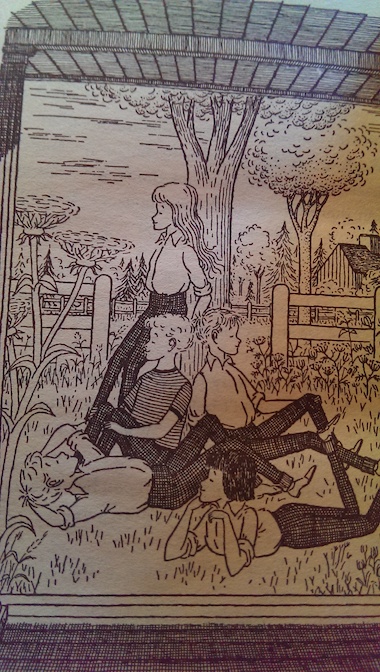
The Wouldbegoods

The Wouldbegoods by E. Nesbit, 1901.

“We are the Wouldbegoods Society,
We are not good yet, but we mean to try,
And if we try, and if we don’t succeed,
It must mean we are very bad indeed.”

By Noel Bastable

The previous book in the Bastable Children series, The Story of the Treasure Seekers, ended with the children and their father going to live with their “Indian uncle.” The uncle isn’t identified by name, but he is apparently their real uncle, and he had only recently returned from living in India in the previous book, when he invited the Bastables to come live with him at Christmas. Since then, he has been helping the children’s father with his business, and the children are once again going to school, but not boarding school because their father doesn’t believe in boarding schools. However, the six Bastable children are still motherless and not accustomed to being supervised much in their free time.

During the spring, the children of one of their father’s friends come to stay for a visit. The Bastable children don’t like the other children much at first because they seem too timid and too well-behaved. The imaginative Bastable children decide that what these other kids need is a good game of pretend to get them out of their shells. One of the Bastables’ favorite books is The Jungle Books by Rudyard Kipling, so they decide to make their own jungle and act out scenes from the book. They give their guests the book to read, pointing out parts that they want to act out, while they go set up the jungle. They use the garden hose to create a waterfall, and they haul a bunch of their uncle’s taxidermy animals out of the house to set the jungle scene. They also set loose some guinea pigs and a pet tortoise and cover their dog in coal dust so he can be a wolf. Their father’s friend’s son, Dennis (called Denny), starts really getting into the game, but his sister, Daisy, prefers just to read the book. Matters come to a head when the boys frighten Daisy too much with their tiger costumes, and she faints. It is at that moment that their father and uncle arrive with some friends, seeing the children all gathered around Daisy, whom they first fear has died of fright. Some of the boys are nearly naked, their skin covered in brown dye so they’ll look like Mowgli from the book (no modern children should dye their skin for a costume like that, and that should be something adults explain to them, if they read this book), the taxidermy animals are all wet from the hose, the coal-covered dog is on the sofa inside, and the tortoise and one of the guinea pigs are never seen again.

Naturally, the adults are angry at the situation, and the children admit that their game went too far. The uncle swats the boys with his cane (not the girls because it would be ungentlemanly to hit a girl), and all of the children are sent to their rooms and put on a temporary diet of bread and water as punishment. Their father briefly talks of the possibility of boarding school, which shocks the children because they know how he feels about it. What the adults decide to do instead is to send the children to the country for the summer. Their friend from the previous book, Albert’s uncle, is an author, and he has rented a house in the country, where he will be writing. He always appreciates the children’s imagination and playacting, and he agrees to take all eight children, both the six Bastables and Denny and Daisy. (Albert isn’t there, so he’s probably somewhere with his mother.) Of course, since Albert’s uncle (who is never identified by any other name) will be writing much of the time, readers can guess that the children will have little supervision in the country.

The old manor house that Albert’s uncle has rented is a fascinating place. It has a moat around it, and a secret staircase, although it’s not really secret anymore because people already know about it. The eight children immediately begin doing things wrong in the country because they don’t know what they’re supposed to do and what they aren’t supposed to do, and adults usually only tell them what they’re not supposed to do after they’ve already done it. They ring a bell that is only supposed to be rung in emergencies, and they play in some hay that the horses are supposed to eat. Then, the girls in the group bring up an idea they’ve had.

The girls are still feeling guilty over the earlier bad behavior that got them sent to the country in the first place, so they’ve decided that it’s time for them all to reform their characters. Daisy in particular suggests that they form a society to do it because she knows that when people are serious about undertaking a good cause, they form a society for it. The boys aren’t as enthusiastic about the idea of forming a society around just being good, which doesn’t sound very fun or interesting, but the girls talk them into it. Oswald wants to know how it will be organized and who will be in charge, so they begin setting out some rules. Basically, all of the children are in the society, and nobody is allowed to leave it without telling the others. As long as they are in the society, they must always try their best to be good, and every day, they must try to do some good deed, which they will record in special book. After a debate about the name of their society, they decide to call it the Society of the Wouldbegoods. They also decide that this society must be kept secret from the adults, which is a major reason why their efforts turn out the way they do.

The first evening after they form the society, the children are unusually well-behaved but glum because they’re working so hard to be good. Albert’s uncle notices their odd mood, but they can’t explain to him why they feel this way, and he doesn’t press them. They also quickly have trouble finding good deeds to do, especially ones that are fun or interesting.

Dicky’s first good deed effort is to try to fix a window that seems broken to him, but it turns out that he doesn’t understand the reason why the window is the way it is. Because he changes it, a milk pan accidentally falls out the window into the moat. Oswald decides that the only good deed they can do is to retrieve the milk pan and fix Dicky’s mistake. They immediately recruit the other children to help them drag the moat, but none of them really knows how to do that, and by the terms of the society, they can’t ask the adults or tell them what they’re
trying to do. The only thing they can find to use for dragging the moat is a bed sheet, which they ruin by getting it dirty and tearing it, and it still doesn’t help them retrieve the milk pan. Failing that, they decide to make a raft and use it to reach the pan. This works better, but when they reach for the pan, the raft overturns and dumps everyone in the water, and Dora hurts her foot badly on an old tin in the water. Fortunately, the cook sees them fall in the moat, and she hurries to get Albert’s uncle, who gets the boat from the boathouse and rows out to rescue the children. (Apparently, the kids didn’t know there was a boat before they built the raft.)

Their next good deed goes better, although they don’t entirely think of it as a good deed. The children become fascinated with some soldiers who are training nearby. They like to watch the soldiers as they ride by and have their drills and exercises. When they wave to the soldiers, the soldiers blow kisses to the girls, which gives them a thrill. The kids dress up as soldiers and ask Albert’s uncle if they can borrow the old armaments that are decorating the walls of the old manor house as their weapons, and he says yes. (Oh, Good Lord, why? Nothing bad happens to the kids because of those old weapons, and they apparently don’t damage any of the antiques, but given their track record, this was taking a real risk.) The soldiers are amused by the children, and the next time they pass by, they stop and take a rest with the children. The captain of the soldiers takes some time to explain the soldier’s weapons to the children and tells them that they will soon be sent to the front overseas. (This is way too early to be World War I, and they refer to the Southern Hemisphere, so I think they’re talking about the Second Boer War, which was happening while this book was being written and published.) Before the soldiers leave, the children decide that they want to give them a parting gift, so they get some money from their father and give each of the soldiers a pipe and some tobacco, because the soldiers were all smoking during their rest break. Modern children’s books wouldn’t have the kids encouraging their smoking habit, but in this turn-of-the-century book, the gift goes over well. Sadly, the children never see any of the soldiers again after they leave for the front and don’t know what happened to them. Still, they did something nice for the soldiers.

The children’s experiences with the soldiers sets up their next attempt at a good deed, with mixed results. Part of it gets very uncomfortable, but it has a happy ending. The children notice an older woman who also watches the soldiers and seems to get very emotional when she sees them. They find out that her son is also a soldier who is already at the front, and she is very worried about him. The children decide that they should do something nice for her, so they try to weed her garden without permission. The problem is that the children
don’t know how to tell the difference between vegetables and weeds, so they also pull up her turnips and cabbages. The woman is angry with them, but they apologize and say that they’ll talk to their father about making things right with her.

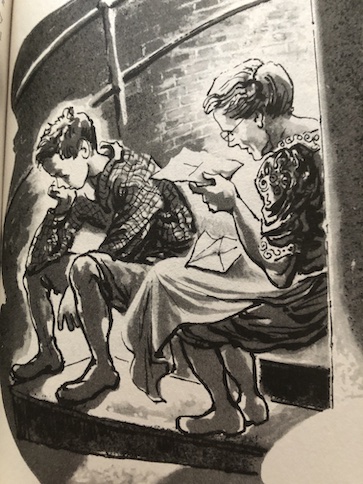
Then, the children have to bring her a postcard addressed to her that was accidentally delivered to them with the mail for the manor house. They don’t even read it ahead of time although they could because they don’t want to do anything else wrong. This is a rare serious moment in this series because the postcard is from the army, and it says that the woman’s son is dead. The woman is very upset, and the children sympathize with her.

Then, the children decide that they can do something else nice for the woman by making a tombstone for her son. They know that he must have been buried at the place where he was killed on the battlefield, so he won’t have a normal tombstone in England, and they think it would be nice to make a memorial for him. The concept of making a memorial for someone who is buried elsewhere is actually a real thing. It’s called a cenotaph (although I don’t think these children know that word because they keep calling it a “tombstone”), and they are commonly done for soldiers who are killed overseas and buried there or whose bodies can’t be retrieved. (The musician Glenn Miller has one because his plane went down in the English Channel during WWII, and his body was never recovered.) Making a memorial of this type for the grieving family of a soldier would be a nice gesture, if it was done well and with the input of the soldier’s family. The kids do the best they can, carving a wooden tombstone and inscribing a beautiful message on it, but they don’t tell the soldier’s mother about it until after they’re finished. At first, the older woman thinks that they’re making fun of her grief, but Alice persuades her that’s not the case and convinces her to take a look. They decorate the tombstone with flowers and offer a lovely message about the soldier’s service to his country. The soldier’s mother is touched, and she appreciates the sentiment, although she has the children move the memorial to a more private spot. She likes it that the children continue to put flowers on the memorial, and she becomes friendly with them.

This episode also has a happy ending because it turns out that the reports of the soldier’s death were wrong. He was actually missing and injured, not killed. His mother and the children learn the truth when he comes home and sees the children decorating his “tombstone.” Fortunately, he is amused by the memorial and the touching sentiment expressed by the children, and his mother is overjoyed at his return. The children celebrate by chopping up the tombstone and using it for a bonfire.

Around this time, the children realize that they don’t have very many good deeds to record in their book, so they decide that they can make notes about any good thing that they notice someone else doing. Nobody is allowed to write about themselves or to persuade someone else to write something about them because bragging about their own good deeds wouldn’t be good or noble. It’s a fortunate decision because many of the children’s other adventures in the country aren’t directly related to the Society of the Wouldbegoods or their good deed efforts, but they count some of the things that certain children do during their adventures as good deeds (and Oswald gripes about things he did which he thought should have been counted but weren’t).

One day, the children are sent out on a long walk because Albert’s uncle has a headache and the children are making too much noise in the house. They decide to check out a tower that has some spooky local legends about it because it contains a tomb about halfway up the tower. The others credit Denny for a good deed because he offers to go first into the spooky tower. (This tower is somewhat based on a real landmark, but the
author took some creative liberties with it. The man who is supposedly entombed there, Richard Ravenal, isn’t a real person. He was created for this book, but he gets a mention in the lore of The League of Extraordinary Gentlemen.) The children have a frightening encounter there with a beggar. They give him a coin as a good deed, but he sees that the children have more money with them, so he locks them in the tower from the outside, telling them that he won’t let them out until they give him the rest. Oswald notices that there are bolts on the inside of the tower door as well as the outside, so he quickly locks them to make sure that the beggar can’t get inside. This turns out to be a good decision because, when the children toss the rest of their money to him, it isn’t as much as he thought they had, and he pounds angrily on the tower door. (Oswald thought that the others should have counted his locking the door as a good deed because it saved them, but they decide not to because it was really more “clever” than “good.” Oswald thinks that’s an unfair technicality.) The children are safe inside the spooky old tower until the beggar leaves, and they are able to signal to someone else to unlock the door from the outside. This incident wasn’t the children’s fault (for a change), but the adults insist that, from this point on, they take the dogs with them when they go very far from the house.

The children make some other attempts at doing good deeds on purpose, but again, they go horribly awry because the children don’t know what they’re doing, and they don’t talk to anybody else about their ideas before they do them. After they cause a disaster that ruins a fishing contest and wrecks a barge full of coal, which costs their father a lot of money to fix, Albert’s uncle explains to them the full consequences of what they did and how much trouble they caused for a lot of people. The children feel terrible about it, and Alice starts to cry. She doesn’t fully reveal the existence of their society to Albert’s uncle, but she does say that they’ve been working so hard at being good and doing good things, but nothing they do works out. She says that they must be the worst children in the world and dramatically says that she wishes they were all dead. Everyone is shocked by this, and Albert’s uncle calmly tells her that they’re not the worst children in the world. He says that he knows they’re all feeling bad about what they’ve done, and he does want them to feel badly because they have seriously caused some real problems, and he doesn’t want them to do these things again. However, he says that he doesn’t want them to give up on the idea of being good because that’s something that they will learn better how to do over time. Also, he notes that, in all the time he’s known then, none of them have ever done anything intentionally mean or wicked, they’ve never lied about what they’ve done, and they’ve always been sorry when things have gone wrong. Being truthful and genuinely regretful for causing harm are worthy qualities.

Oswald feels bad abut that part because he has realized that there’s one thing he’s done that caused a disaster, and he hasn’t admitted it to the others yet. What he did was unintentional, and he didn’t know the incident was his fault at first, but he’s been trying to work up the courage to confess since he realized what he did. Albert’s uncle’s kind words make Oswald confess right away, and Albert’s uncle is appreciative of his honesty for that, too. The others call credit Oswald’s confession as a good deed. He doesn’t think it is, but they say it counts because it was a difficult thing for him to do, and technically, he didn’t have to do it. At that point, nobody had guessed that he was responsible for one of the problems, and if he had kept quiet, it wasn’t likely that anybody would have found out. He had been honest because he simply wanted to be honest and do the right thing, even knowing that people might get mad at him or punish him for what he did.

Albert’s uncle forgives the children, although he still expects them to learn from their misadventures. At this point, the children also begin to consider just how far the Society of the Wouldbegoods will go. So far, it hasn’t been a great success, but they do appreciate what Albert’s uncle says about not giving up on the idea of trying to be good. Still, the children (especially Oswald), decide that it’s time to set an ending point for the society. They decide that each of them will try to do one more good deed of some kind, and when each of them has
one more deed to their name to put in their book, they’ll dissolve the society. From that point on, if any of them want to be good, they’ll do it on their own, when and how they choose do it. (The boys in the group are particularly relieved at this idea, although they’ve all been feeling some strain from the society.)

The children’s escapades still continue, some related to good deed efforts and some just part of summer activities that they do for fun. They try to hold a circus with some farm animals, which get loose. There’s a bonfire that gets out of control and burns a farmer’s bridge (although the children put it out themselves before it gets worse). Dora finds a baby who’s been left alone in his carriage and kidnaps/cares for it. At first, she thinks that maybe he’s the long-lost heir of a noble house who was kidnapped by gypsies, like in books,
and has been abandoned, so she must adopt him and care for him until he can be reunited with his family. Like many of the children’s good deeds, it has mixed results, but this one ends up being more on the side of good. She shouldn’t have just taken the baby from its carriage, and he technically wasn’t kidnapped until she took him. However, it turns out that his nanny was neglecting him, leaving him all alone while she flirted with her boyfriend. When the adults discover that the children have the baby and why they have him, the nanny’s neglect is exposed, and she gets fired.

A couple of the boys later buy a pistol, which they make all the children promise not to tell the adults about. (I thought at first that it was a toy pistol, but it apparently fires real bullets. God only knows why anybody thought it would be a good idea to sell these boys a real gun.) The boys were thinking at first that it would be handy to have if there was a burglar, but one of the boys accidentally shoots a fox with it and kills it. The other children, although they were pretending to be fox hunters, are upset at finding a real dead fox and bury it with a proper funeral before they know that it was one of the other boys who killed it. They get into some trouble over it from the master of fox hounds. The boy who shot the fox explains that, at the time he shot it, it was caught in a metal trap, and it bit him when he tried to let it loose, which is when he accidentally shot it. Albert’s uncle confiscates the pistol because none of this would have happened if the boys hadn’t been playing with a gun, and Oswald thinks that it would serve him right if they really did get a burglar in the house and were unable to fight him off. (I’m pretty sure that they’d be more likely to accidentally shoot one another or one of their own dogs before they shot anybody else.)

Toward the end of the summer, Albert’s uncle agrees to be a host for an antiquities society that wants to see the old manor house and investigate a nearby site for possible Roman ruins. Albert’s uncle is beside himself when he discovers that, rather than being host to a small club, more than 100 people show up to accept his invitation to have tea before touring the grounds. The children, inspired by a book called The Daisy Chain, decide that it would be amusing to bury some pottery that they made themselves, just so the antiquarians will definitely have something to find. That part turns out fine because the antiquarians can easily tell the pottery made by the children from actual antiquities, and they are amused by the children’s “relics.” The problem is that the children also decide to bury some pottery they found in the library along with their own pottery, and those were real relics. The antiquarians get excited when they find those, but Albert’s uncle realizes that those pieces of pottery belonged to the real owner of the rented manor house. The children have to go to the head of the antiquarian society to admit what they’ve done to get the antique pottery back.

From there, the children are inspired by something a tramp says to them to open up a stand offering free drinks (lemonade and tea), but it goes wrong when some people take advantage of their kindness. They also take part in some war games without realizing that it’s all a game or training exercise. Then, while acting out the pilgrimage from The Canterbury Tales, they meet a kind lady, who turns out to have a romantic past with Albert’s uncle! They’re not sure that they like the idea of Albert’s uncle getting married, but they’re willing to try to help him reconnect with his lost love if it will make him happy and for goodness’s sake!

THE EPITAPH

‘The Wouldbegoods are dead and gone
But not the golden deeds they have done
These will remain upon Glory’s page
To be an example to every age,
And by this we have got to know
How to be good upon our ow—N.’

by Noel Bastable

The book is now public domain, so it is available to read online through Project Gutenberg and Internet Archive (multiple copies, including audiobooks). There is also a LibriVox Audiobook on YouTube.

My Reaction

This book reminds me of a couple of more modern books, The Adventures of the Red Tape Gang by Joan Lowery Nixon from the 1970s and Why Did the Underwear Cross the Road? by Gordon Korman from the 1990s, which are both books about kids trying to do good deeds with unintentional and hilarious results.

Just as in the first book in the Bastable Children series, much of what the children do in this story is due to the children’s naivety and imagination and a lack of adult supervision. Oswald makes it a point to say that they were not entirely neglected by the adults while they were in the country. Although Albert’s uncle frequently had to spend time writing, he did spend plenty of time with the children, and their father and Denny’s father came to see them regularly, along with some other adults. The children enjoyed spending time with the adults and doing things with them, but Oswald doesn’t describe much of what they did with the adults because the things they did on their own were the most interesting. (In the sense of dangerous and disastrous, but also exciting.) At various times in the story, they meet up with adults who are happy to talk to the children and explain things about their business or how things work, but the children also like acting on their own initiative, without asking adults for advice or opinion or taking time to really prepare for things they want to do, like when Oswald didn’t want to take the time to actually train an animal to do something when the children decided that they wanted to have a circus with animals. The children’s innocence and ignorance are played for comedy, but child readers would probably appreciate the children’s sense of independence. Few modern children would be given even half of the opportunities the Bastables have to do things on their own and cause as much trouble as the Bastables do.

Racial Issues

In the first book of the series, I talked about some racial issues in the story, and there are also issues with racial language and attitudes in this book. I don’t know whether or not this book has been reprinted with altered language, like the first one. Some of the incidents in this book might take more editing than the first one, like where the kids darken their skin for acting out scenes from The Jungle Books or giving pipes and tobacco to the soldiers.

There is an instance of the use of the n-word in this book, and this time, it’s something Oswald says rather than something the adults say. Basically, he was talking about hard the children were working, and he was trying to imply that they were working like slaves, but instead of saying the word “slaves”, he says the n-word. Children’s word choice is influenced by the books they read reads and the things adults say around them, and we’ve already established that adults around them use the n-word in a casual way.

Again, this brings up the question of whether or not the author herself this that using the n-word is acceptable or if she’s just trying to portray the way some people around her talked. In a way, I think she does address this topic indirectly, although that might be unintentional. There is a point in the story when the children talk about unpleasant things found in poetry, like death and the devil, and they note that a person doesn’t always have to like the things they read or write about. It struck me that, perhaps, the author was trying to explain that she doesn’t always like, advocate, or believe in things that occur in her stories. This conversation isn’t directly related to the use of the n-word, so I’m not sure whether that would be one of the things that the author didn’t really like or not. It might have been a more general notion, like when authors write about sad things that happen or the things the children do that they really shouldn’t. It is a reminder, though, that characters are not exactly the same as their characters, and they may differ in important ways. The nature of the characters suits the story, but may not be a reflection of the author’s life and attitudes.

There is also one instance of an anti-Catholic attitude, but it’s played for humor. The kids are on a tour of Canterbury Cathedral, and their tour guide says, “This is the Dean’s Chapel; it was the Lady Chapel in the wicked days when people used to worship the Virgin Mary.”

(I’ve heard this accusation about Catholics worshiping the Virgin Mary before, all too many times, mostly from my Protestant grandmother. I belong to a family of mixed religions, and I had experiences like this from a very young age. Catholics don’t worship Mary. Catholics honor Mary, which is different. We also have a sense that those who were bound together by faith never lose that spiritual connection to the living members of the church when they die, so living Catholics can still communicate with the departed spiritually through prayer, which is what the whole thing about praying to saints is about. It’s about communication and spiritual support rather than worship. Catholics don’t have to do this if they don’t want to, but it’s always an option, if they feel the need of spiritual support from another soul who might understand their situation, because there is a sense that the spiritual connection is always there. Mary and the other saints are not substitutes for God or Jesus but rather part of an extended spiritual family that supports its other, younger, and more vulnerable living members in a spiritual way as they all, living and dead, serve and worship the same God. I suppose a simpler way of putting it is the concept that those who love us never leave us, or as C. S. Lewis put it in the The Chronicles of Narnia, once a king or queen of Narnia, always a king or queen of Narnia. Some bonds are unbroken by death. The punchline to the tour guide’s comment is in H. O.’s response.)

When the children think about the connotations of changing the name of the chapel from Lady Chapel to Dean’s Chapel because of changing worship styles, H. O. speculates, “I suppose they worship the Dean now?” You can imagine how well that question is received. Yeah, do they worship the Dean, or is the Dean just someone they’ve honored by naming something after him? You tell me if there’s a difference.

War and Soldiers

The scenes with the soldiers and war games remind me of something that the author couldn’t have known when she wrote the book. In the following decade, Britain would be involved with World War I (called the Great War before WWII), and many boys, like the kids in this story, would end up going to war. Oswald thinks that it would be exciting to be a soldier, but real war isn’t a game, and he might have many of his illusions shattered. Knowing what I know about this generation’s future, I have some real concern for the children in this story. There’s a very real risk that they could be killed in battle, just as the young soldier in this book that they built that tombstone for in this story could have died in the war that was being fought during his time. This story doesn’t go that dark because the Bastable Children series is a humor series, but there are moments of real sentimentality in the stories. E. Nesbit couldn’t have known about the war that was coming, but she did know about wars that existed during her lifetime. Introducing the children to the soldiers in this story introduces some serious concepts to the children, who are largely naive about many aspects of life, still thinking of many dangerous things as sources of excitement and adventure. We don’t know what happened to any of the soldiers the children befriended, but the knowledge that the old woman’s son almost died brings it to the children’s awareness that death is a very real possibility in that type of “adventure.” It’s a lesson that will accompany them into their future.
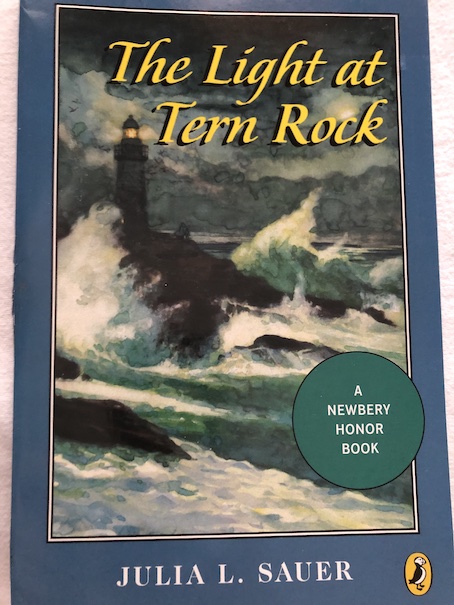
The Light at Tern Rock

The Light at Tern Rock by Julia L. Sauer, 1951.

Not long before Christmas, the lighthouse keeper at Tern Rock, Byron Flagg, approaches Martha Morse, asking her if she would be willing to temporarily take the job of tending the lighthouse while he takes a vacation. The lighthouse can never be untended because ships rely on that light, and it can be difficult for Mr. Flagg to find someone to take over his duties for an extended period of time, especially so close to Christmas. Mr. Flagg wants to hire a substitute with experience tending the lighthouse. Mrs. Morse lived there for 14 years while her late husband was the lighthouse keeper. Although many people would be daunted by the isolation of the lighthouse, Mrs. Morse actually loved it because she enjoyed the beauty of the sea and nature. She knows that she would enjoy staying there again. However, she hesitates to take the job of temporarily tending the light because she is caring for her young nephew, 11-year-old Ronnie. Ronnie might enjoy the adventure of staying in a lighthouse, but he would have to miss some school.

Mr. Flagg appeals to Mrs. Morse’s sense of nostalgia about the lighthouse and points out that Ronnie could bring along some of his schoolwork to study during their stay. Mr. Flagg says that their stay will only be for two weeks, and that he’ll return and relieve them on December 15th. Mrs. Morse points out that the weather around Tern Rock can be unpredictable and that he might not be able to return when he says he will, but Mr. Flagg says he is confident that he can. They talk to Ronnie about it, and Ronnie says that he would like to see the lighthouse, but he wants to be home for Christmas. Mr. Flagg assures them that won’t be a problem and that they will enjoy their stay at the lighthouse, so they agree to go.

When they arrive at the lighthouse, Ronnie is awed by rugged environment of Tern Rock and daunted by the isolation of the lighthouse. His Aunt Martha says that she understands how he feels, that he wonders if they’re up to the task, but she assures them that they are. The job they will do is a necessary one because, without the light, the rocks in this area are a danger to ships.

As they settle in, Ronnie becomes fascinated with the lighthouse. The interior is comfortable and designed to be compact, almost like the interior of a ship. His Aunt Martha establishes their schedule, teaching Ronnie what they need to do. She turns off the light at sunrise and lets it cool down while they have breakfast. Then, they clean the lamp, polish its lens, and do other chores to keep the light in working order. Ronnie does his schoolwork in the afternoon, and they turn on the light when the sun goes down. They spend their evenings doing quiet activities, like reading and playing games. Although Aunt Martha wasn’t sure that the quietness and monotony would appeal to an active boy like Ronnie, Ronnie finds the newness of the environment and the change in his usual routine fascinating.

Ronnie’s feelings change when December 15th arrives, and Mr. Flagg doesn’t. The weather is good, so there’s no reason why a boat shouldn’t approach Tern Rock, but Aunt Martha says that there may have been some other problem that delayed him. She doesn’t think an extra day or two at the lighthouse will hurt them, but the days go by, and still, Mr. Flagg doesn’t come. They are still comfortable in the lighthouse and there haven’t been any problems with the light, but Ronnie is angry because he realizes that Mr. Flagg lied to them. Christmas is approaching, and it becomes clear that Mr. Flagg never had any intention of being back at the lighthouse in time for Christmas.

Ronnie has trouble understanding and excepting Mr. Flagg’s lies and broken promises. Ronnie and Aunt Martha discuss the importance of honesty and the meaning of broken promises. Ronnie thinks that Mr. Flagg has been wicked. He has certainly been unfair, but Aunt Martha says that there are worse kinds of wickedness, and before they jump to conclusions about what has happened, they need to know the reasons for it.

Aunt Martha says that the Christ Child visits every home on Christmas, and no place is too distant for Him to reach, so they should make the lighthouse ready and prepare for Christmas. Ronnie doesn’t see how they can because they didn’t bring any decorations or anything for Christmas. Ronnie considers firing the cannon that would signal an emergency to bring someone out to the lighthouse, but Aunt Martha firmly tells him no. The cannon is only for serious emergencies, when there are lives in danger, not for mere disappointment and self-pity. However, Mr. Flagg has left some special surprises for them.

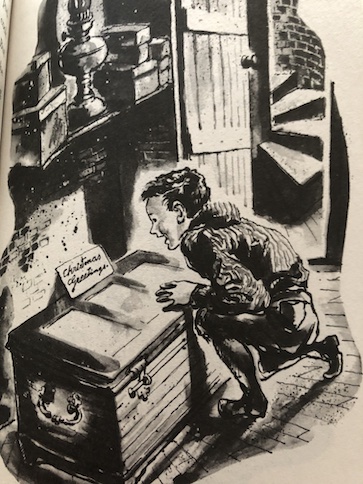
It is true that he intentionally deceived them about being back in time for Christmas. When Ronnie finds a sea chest with a Christmas message, he knows for certain that Mr. Flagg was lying to them the entire time, which makes him angrier. However, a letter that Mr. Flagg left explains his reasons, which earns their sympathy. To soften the blow of his deception, he has also left them some special presents and treats gathered from exotic places. This still isn’t the Christmas that Ronnie and Aunt Martha had originally planned, and being lied to doesn’t feel good. Still, in the end, this Christmas is pretty special and memorable, and they both realize that they are exactly where they need to be.

The book is a Newbery Honor book. It is recommended for ages 8 to 12 years old. It is available to borrow and read for free online through Internet Archive. The author, Julia L. Sauer, also wrote Fog Magic.

My Reaction

I wasn’t familiar with this story when the Coronavirus Pandemic started, which is a pity because this would have been a great book for the type of Christmas we had in 2020. Still, this is a lovely Christmas story, and the pandemic isn’t quite over yet. Things have improved considerably since 2020 because people have been vaccinated, but for those who still need to be cautious and are disappointed that things aren’t completely back to normal or anyone who has hard feelings toward someone or is having a rough Christmas for any other reason, this story is a useful reminder that disappointments are still temporary, and sometimes, the place where you find yourself is exactly where you need to be. Also, disappointments and inconveniences can come with compensations, if you’re open to experiencing them.

Mr. Flagg shouldn’t have lied to Mrs. Morse and Ronnie. He acknowledges in his letter that this was a hurtful thing to do, and he explains his reasons. Basically, he was lonely and desperate. As a lighthouse keeper, he is what we might call an “essential worker”, someone who can’t easily take time off from his work because he does a necessary job that can only be done in a particular place. People’s lives depend on the light from the lighthouse, so Mr. Flagg can’t leave his job for any length of time unless he finds someone qualified who is willing to take his place. This story is set during a time before lighthouses became automated, so there must be a human in this role.

Mr. Flagg is in his 60s, and he explains in his letter that he has spent most of his Christmases either alone or with other adults because of his life as a sailor and lighthouse keeper. He has a niece who has several children and who would be happy to have him for Christmas, but he has never managed to find anyone who was willing to relieve him from his duties during Christmas before. He was desperate to spend at least one Christmas with his family, so he resorted this deception out of desperation, but he left all the presents and special treats for Aunt Martha and Ronnie because he didn’t want them to be miserable.

Aunt Martha is getting older herself, and she understands how Mr. Flagg feels, having lived a similar sort of life. When she lived at the lighthouse, she and her husband were together, but Mr. Flagg has never married, and he was desperately lonely. Ronnie has more trouble understanding the feeling because he is younger and hasn’t experienced this type of loneliness before. Aunt Martha points out that Ronnie will have many more Christmases before him, more than either she or Mr. Flagg have left. One disappointing or just bizarre Christmas won’t mean that much to him in the long term. With maybe 50 or more future Christmases to come as well as the ones he’s already experienced, this strange Christmas in the lighthouse is just one more memory or story to tell other people in Christmases to come.

Part of this story is about forgiveness, but they don’t use that word at all in the story. People have different views about what forgiveness entails, but I think it’s important that Aunt Martha and Ronnie don’t excuse Mr. Flagg’s actions. They come to understand his motives, and they feel pity or sympathy for him for the kind of rough and lonely life he’s lived, but that doesn’t make lies to them good or right. He did something hurtful by betraying their trust, and there will probably be some kind of reckoning between them when Mr. Flagg eventually shows up. Mr. Flagg acknowledges that in his letter, that the knowledge that he betrayed their trust will keep him from fully enjoying Christmas with his family, even when he’s finally getting the kind of Christmas he has wanted, and he can’t blame them for whatever they’re feeling as they read his letter. So, the story never says that what Mr. Flagg did was okay or that it didn’t hurt that he lied to the people who were helping him. Lying was wrong, and it was hurtful, and the characters are honest about that. They don’t try to pretend that they’re not hurt, which I think would have made their feelings worse in the long run. Instead, it’s about looking past that hurt to something better and finding things to be happy about even in a situation where they didn’t want to be.

Aunt Martha sees that what’s really preventing Ronnie from enjoying Christmas as they happen to have it is his anger, disappointment, and bitter feelings and the way he broods about them. Brooding about the angry things he wants to say to Mr. Flagg when he sees him isn’t making his Christmas any better. Aunt Martha compares cleaning out negative emotions to cleaning house before the holiday. You have to clear out all the dust and negativity to let in something better. They will eventually see Mr. Flagg, and there will probably be words between them, but those words can wait while they enjoy themselves as best they can for this Christmas. By then, each of them will probably have a better sense of just how they really feel about the situation and what they want to say about it anyway.

Once Ronnie works through his feelings and is able to put aside his anger, he realizes that this Christmas is something special. He does miss the class Christmas party the rest of his school is having, but in return for that sacrifice, he is experiencing something truly unique that his school friends will probably never experience. He doesn’t fully consider how unique this experience actually is at first, but he senses that there is a unique feel to Christmas in the lighthouse, with its giant light. Ronnie considers the tradition of putting candles in windows at Christmas, to guide the Christ Child or other travelers. (They emphasize candles as welcoming the Christ Child in the story, but when I first heard of the tradition, it was to welcome travelers or absent family members.) He realizes that, by tending the lighthouse, he and his aunt are doing the same thing, but they’ve got the biggest candle of anyone!

Whatever your Christmas happens to be this year, wherever you’re spending it, and whoever you’re spending it with (even if it’s just yourself), don’t forget to do the little things to make it special and enjoy it for whatever it is! Merry Christmas!

The Fourth Question

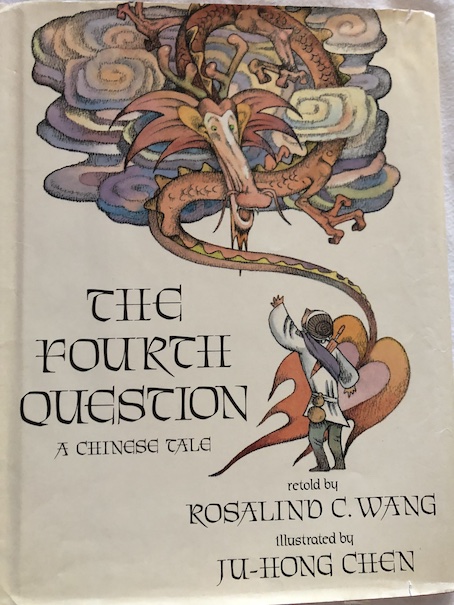
The Fourth Question retold by Rosalind C. Wang, illustrated by Ju-Hong Chen, 1991.

This is a retelling of a Chinese folktale.

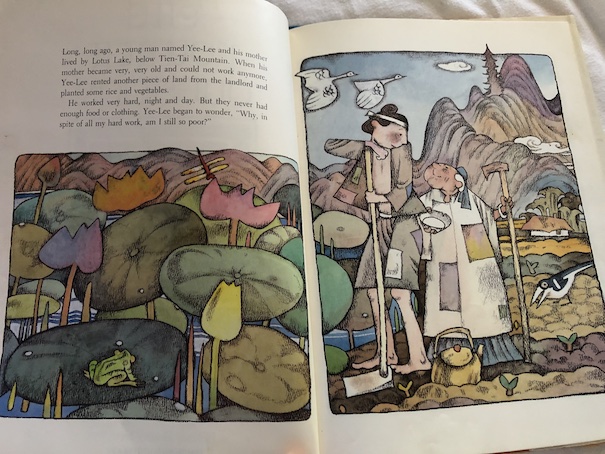
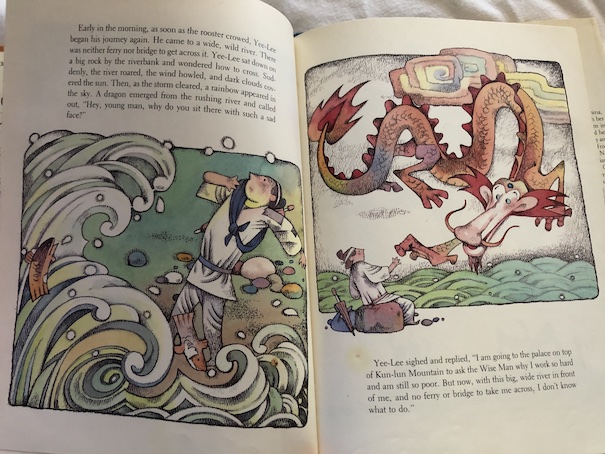
There was once a poor young man, Yee-Lee who lived with his mother. Even though Yee-Lee works very hard, he can barely make enough money to keep him and his mother alive. He wonders why he has so little money even though he works so hard and decides to go to the Wise Man of Kun-lun Mountain to seek the answer and his advice so he and his mother can have a better life.

It’s a long way to reach the Wise Men, and along the way, he encounters other people who also needed help. A kind old woman who gives Yee-Lee some water and food has a daughter who is unable to speak and wants to know how to help her. An old man has a tree in his orchard that won’t bear fruit, and he can’t figure out why. A dragon who helps Yee-Lee to reach the mountain cannot manage to fly to heaven even though he has lived a good life. Yee-Lee has sympathy for all of these people and the dragon and appreciates the help they give him, so he promises that when he reaches the Wise Man, he will seek the answers to their problems as well.

However, when Yee-Lee finally reaches the Wise Man, he is told that he is only allowed to ask three questions during his visit. It’s a problem because Yee-Lee now has four questions to ask, the three that he promised to ask for others plus the original question that he wanted to ask for himself. He has to decide which of the questions will go unanswered.

Yee-Lee’s question is important to him, but when he thinks about the other people who are now depending on him to come back with answers for him, he reluctantly decides to forget his own question and answer theirs. However, in solving the problems of others, Yee-Lee finds the solution to his own problem. Like the heroes of other folktales, Yee-Lee is rewarded for his good deeds!

The book is available to borrow and read for free online through Internet Archive.

The Well-Wishers

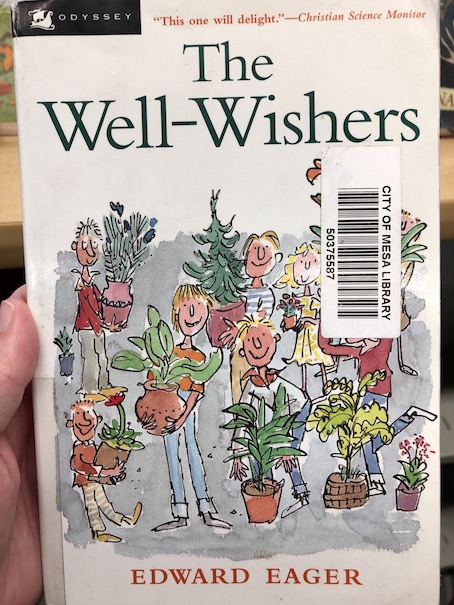
The Well-Wishers by Edward Eager, 1960.

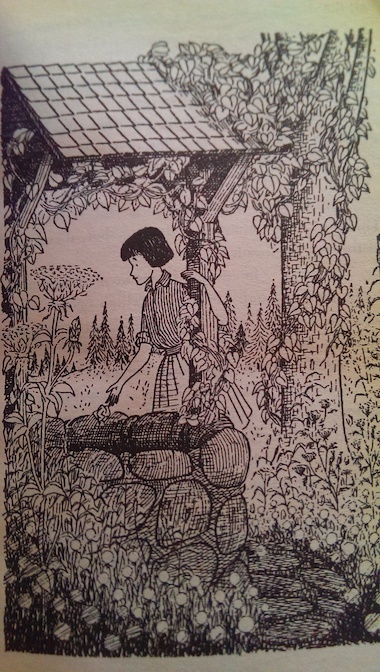
This book starts up after the events in the previous book in the series, Magic or Not?, but one of the interesting features of this book is that each of the characters takes a turn in telling the story from the first person. As with the previous story, it’s ambiguous about whether or not there’s any magic involved, although the story implies that there is. In the previous book, the characters came to believe that an old well on the Martins’ property was a magic wishing well, leading them and their friends on a series of adventures over the summer. At the end of the summer, they were still uncertain about whether the well was really magic or if their adventures were just coincidence and maybe some playacting on the part of the adults around them. In this book, they investigate the well more, starting the process of making wishes again, partly because they’re bored and need some excitement, but also to find out whether the well really is magical or not.

When I give my opinion of this story, I’m going to do much o it within the summary itself because there are things that I really need to address within each section of the story. In particular, there are some historical circumstances that I need to explain.

The book is available to borrow and read for free online through Internet Archive (multiple copies).

The Story

James Martin begins the story in this book, starting by saying that he and his twin sister Laura normally can’t stand books told from the first person because they often contain characters lamenting “If only I had known …” or “If only I had” done this or that, and they think that the characters sound dumb for not thinking ahead more, realizing the significance of things happening when the reader can, and not taking appropriate actions like a real person would. However, they’ve decided that it’s okay to tell their story in the first person because they do realize the significance of things as they happened to them, and it’s Laura’s idea that each of their friends should tell their part of the story themselves because they all experienced what happened in a different way.

James Begins

James explains that he and his sister are in the same class at school, the one for more advanced students, along with their friends Kip and Lydia. Their other friend, Gordy, is in a different class at the same school because he’s a slower learner. It wasn’t easy for them to start being friends with Gordy in the previous book, but since then, they’ve tried to be especially nice to him … to varying degrees. (They don’t seem very nice to me.) Sometimes, they say that they still have to be firm with him on some things. In the previous book, he was a bit of a troublemaker because he is often thoughtless about his actions and has some rough tendencies. He comes from a wealthy family, and his mother is a fussy queen bee type, which has caused some awkwardness hanging out with him, which continues into this book.

In the previous book, James and Lydia moved to a smaller town from New York City, and they discovered that their new house has an old well on the property that the girl living nearby, Lydia, told them was a magic wishing well. James never believed that it was, but Laura did, and even James had to admit that the “wishing well” did give them and others things that they were wishing for. Or, at least, they got what they wanted in meaningful ways. It’s still questionable whether it was because of the well or not.

Since their previous adventures, the kids have settled back into ordinary life. They’re all getting used to their new school, and Kip and James try out for the football team. However, the kids soon start to feel that life is getting dull. The four main friends who are all in the same class start getting in the habit of leaving Gordy out of some of their activities, partly because he’s in a different class and partly because it gives them an element of secrecy that they feel like they’ve lacked since their previous adventures. They still do some things with Gordy and let him join them when he comes looking for him. Gordy isn’t the kind of guy to hold grudges, and that makes the others feel guilty about the times when they leave him out, which perversely makes them leave him out more because having him around reminds them that they feel guilty for excluding him earlier. James acknowledges that none of this is right or fair but says that it’s just a part of human nature and can’t be helped. He also says that they all genuinely like Gordy, but he often seems a bit childish, and there’s “something about him that makes people want to pick on him.”

(I genuinely hate people who have this attitude about taking advantage of others just because there’s “something” about them that just makes them want to, like it’s not self-entitled to feel and act that way. Besides, I know exactly what this “something” is, and that’s Gordy’s niceness. Other people might yell or complain at someone who’s being mean to them and tell them right to their face that they’re being a jerk, which can help put a quick end to their jerkiness or at least cause them to dump it on some other poor person instead. Unfortunately, the buck tends to stop with Gordy because he doesn’t lose his temper, doesn’t complain, and doesn’t tell others off when he should, and they’re the type who won’t change until someone does tell them off. They take advantage of Gordy’s niceness because he doesn’t stop them from taking advantage, and deep down, they know that’s what’s happening. That’s why they feel guilty, but not enough to stop what they’re doing. This really annoys me because it seems like they’re almost blaming Gordy for not stopping them from being mean to him, but yet, they totally know what they’re doing and could just stop it themselves. If you don’t like or respect what you’re doing, whose fault is that? You could just decide to do something different anytime you want. I found them annoying when they acted like this in the last book, and I thought that they’d learned something by the end of that story, but I guess not. It’s annoying when characters don’t seem to learn anything, especially when they’ve just been mocking characters in other books for being slow on the uptake. I also don’t like it when this type of character is one of the main characters in a story because, as readers, we’re expected to identify and sympathize with the main characters of a story, and in this case, I don’t want to do either. They’re just getting on my nerves at this point, and we’re not very far into the story. Fortunately, this does get better.)

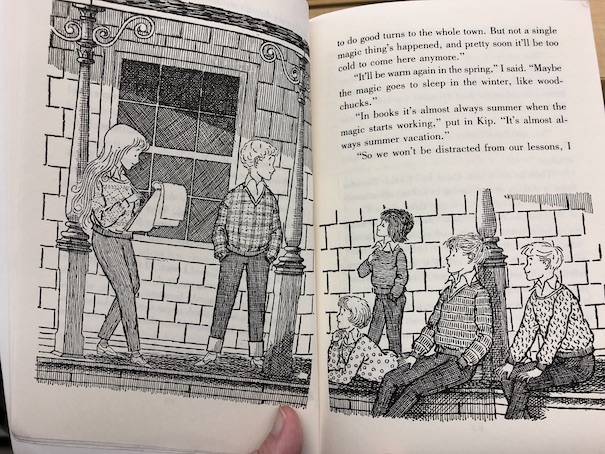
One day, when the kids are sitting around on the porch of the cottage that they use as their clubhouse without Gordy, talking about how Halloween is coming but nothing feels exciting since their adventures with the wishing well, they start to consider wishing on the well again. They’ve thought of doing this before, but they hesitate to do it because they’re afraid of using up the “magic” (even though James claims he doesn’t really believe in it) or cause the well to become angry with them for making frivolous wishes. They decide to swear an oath to each other in blood not to wish on the well until the well gives them a sign that it’s time, although they don’t know what kind of sign they’re expecting. However, Gordy does not swear the oath because they left him out.

When Gordy comes along, he’s giving a piggyback ride to Deborah, James and Laura’s younger sister. Gordy is always nice to little Deborah and enjoys indulging her in small ways. Gordy’s niceness and the way Deborah gushes about it make the rest of them feel uncomfortable. (Enough to change your behavior and quit being such jerks about this? Hmm?) Then, Deborah happily tells the older kids that Gordy has “fixed the well” so it will give them “magic wishes all the time.” Laura, who is particularly protective of the well, demands to know how he “fixed” it, and Deborah says that he put a wish down the well, writing it down on her spelling paper, which had a gold star on it. When they ask Gordy what his wish said, he says that he wrote, “Get going, or else. This means you.” (That doesn’t sound like a “wish” so much as a threat. Admittedly, this heavy-handedness about Gordy is off-putting. I wouldn’t have blamed the others as much for avoiding him sometimes if that was their main motivation, but it’s not, so I still blame them.)

Laura is angry about that tasteless threat, feeling like it’s going to ruin everything. However, James reminds her that Gordy didn’t know about the oath that they’d just taken together and that he only did it to please Deborah. Besides, they’ve all also been more rude to the well in the past than Gordy was. However, Laura completely loses her temper, saying that the well and the magic belongs to them and not to Gordy. She tells him right to his face that he’s a pest, they never wanted him around, and he should just go home. James and Kip redeem themselves to me at this point by standing up for Gordy against Laura. The boys acknowledge that, although they’ve fought before, sometimes physically, Gordy isn’t a bad guy and doesn’t deserve this treatment. Gordy apologizes, saying he’s sorry if he’s caused trouble, but he felt like someone should do something, Deborah wanted him to, and nobody else seemed willing to do it.

(I liked the part where James says, “Stick and stones may break your bones, but names and plain truths and meanness can go much deeper and cut you to the quick.” I like that because I never approved of the usual saying that words can’t hurt you. Yes, they do. They’re often meant to. That’s the whole reason why people say mean things in the first place, to hurt or embarrass someone else in order to relieve their own feelings or settle a score which may or may not really exist outside of their own minds, and it’s just gaslighting to pretend otherwise. It’s just something that teachers and parents say when they want to ignore a situation instead of dealing with it or confronting someone else’s uncomfortable emotions directly.)

Laura goes into the clubhouse, upset, but Gordy and the others follow her inside. Gordy simply and directly tells her that he’s sorry, and if he did something wrong, it’s because he didn’t know better. James can tell that Laura really feels worse about her own behavior than about Gordy’s. She also apologizes, saying that the “magic” can’t be good if it makes her say mean things like that, and she doesn’t really mean what she said. (Nothing “made” you be mean but you, Laura. That’s just honest. It came from you, and that’s why you’re angry with yourself. Deep down, you know it. Now, learn to help it, so I can stop feeling like I need to explain it. Nobody can change your behavior but you. I do appreciate that the kids are now speaking more honestly and trying to work things out, though.)

James clarifies the situation for Gordy, who isn’t into reading fantasy stories like the other kids are. In fantasy stories, magic always operates by certain rules. If you break the rules, something bad might happen, and if it does, it would be his fault. To her credit, Laura says that if something bad does happen, they’ll all be in it together, but if the adventure goes well, Gordy should be the one in charge of it because he’s the one who started it. It pains Laura to admit that because the truth is that she had really wanted to be the one to make the wish herself, and that’s what’s really behind her temper tantrum. Gordy offers Laura the opportunity to be in charge, if she wants, but everyone agrees that it should be Gordy because it’s only right and in keeping with the “magic.” Gordy isn’t quite sure what being in charge means in this type of adventure, but the others say that they’ll be with him through the whole thing.

At that moment, somebody knocks on the door of their clubhouse, which never usually happens. The kids take that as a sign that the wishing well’s magic is starting, and they tell Gordy that he’d better answer the door as the leader of this adventure. The perspective of the story shifts to Gordy at this point.

Gordy’s Story

I actually enjoyed hearing Gordy’s perspective more than James’s. I hadn’t expected that at first because Gordy can be kind of rough and thoughtless, but he’s deeper than he lets on. Part of his difficulty is that he’s actually a very shy and nervous person, and that’s why he sometimes says dumb and awkward things; he just blurts things out from time to time because he’s nervous. Yeah, I’ve been there, too, kid. He’s worried about his friends seeing how scared he often is inside because he thinks that they won’t like him if they knew. His loud and rough manners are a cover for his shyness and nervousness. It pains him sometimes that he says or does things he shouldn’t, but he’s fully aware of what he’s doing and why. Like the others when they’re rude or mean to him, he can’t seem to stop himself. (There’s a lot of that going around.) He’s brighter than he pretends, and he knows that Laura lied to him earlier about having a dentist appointment so that the others could hang out without him. Even though he hasn’t confronted the others about that, he is hurt that they do these things and make him feel left out, and that’s part of what inspired him to make the wish on the wishing well. Even though they aren’t always as nice to him as they should be, he thinks they’re fun to be with, and he admires them for knowing what to do in different circumstances.

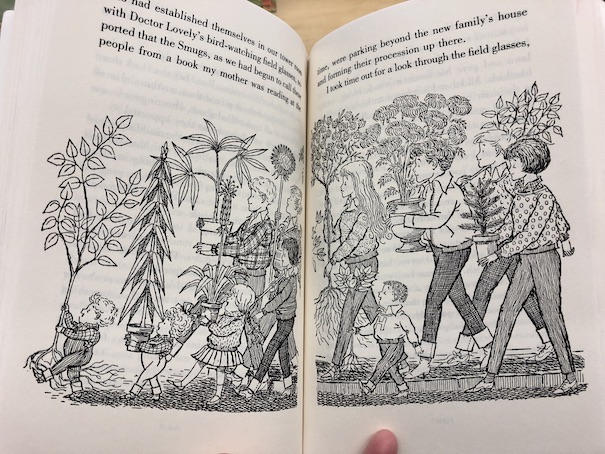
Gordy is nervous when he goes to answer the door of the clubhouse, not knowing who or what to expect. When Deborah sees who’s at the door, she screams, “Witches!” It’s a little old lady in a black cloak. She has gnarled hands and straggly white hair, and she does look kind of like a witch. For some reason, she’s also holding a bunch of branches and plant stalks. Gordy says the only thing he can think of, which is, “How do you do?”

It turns out that the old lady wants directions to Hopeful Hill. Gordy takes that as a bad sign because Hopeful Hill is a mental hospital. As Gordy describes it, it’s “a place where unhappy people come for the experts to make them hopeful again.” People from this mental hospital often walk up and down the road nearby for exercise, and mean kids from the area sometimes yell insults at them, calling them “loonies.” Gordy privately admits that he used to do that, too, when he was younger, but he’s ashamed of it now, and he hopes that his friends never find out about that, either.

Since Gordy knows that the wishing well magic is supposed to be based around doing good deeds, and he’s supposed to be the leader on this, he offers to show the little old lady the way to Hopeful Hill. As he walks with the lady, the others follow a little way behind them, which makes Gordy feel better. All the way, the woman creepily mumbles strange words to herself. Gordy isn’t sure whether she’s speaking in a different language that he doesn’t recognize, whether she’s a witch who’s casting spells, or whether she’s just a crazy person who’s mumbling gibberish. However, as he calms down a little, he starts to recognize what the woman is saying as the names of different plants. Relieved, Gordy starts talking to her about plants, and he starts liking her. Feeling a little bad that the lady would have mental problems, he politely asks her if she’d like to talk about her problems. However, the lady laughs and tells him that she’s not a patient. She’s one of psychologists. She’s also an amateur naturalist, and she likes to teach her patients about plants and birds. Gordy actually likes bird watching, but he doesn’t like to talk about it to other kids because he’s been teased about it before.

By the time they’ve arrived at Hopeful Hill, Gordy and the psychologist have become friends, bonding over their love of birds and nature. Before they part ways, the psychologist mentions that she has a patient named Sylvia who could use some help and maybe Gordy could be the person to help her. Sylvia is a little girl who recently lost both of her parents in an accident and has been having difficulty coping with the shock of it. Gordy understands, remembering how he felt when his father died. The psychologist thinks that maybe Sylvia needs other children to talk to, and she asks Gordy if he would be willing to talk to Sylvia. Gordy is often nervous talking to people, but he agrees to try.

There is an interlude in Gordy’s story where Laura explains how she and the others are still following behind Gordy and the old lady, still worrying about the old lady being a witch and what she’s going to do with Gordy. When he goes into the asylum with her, they’re still able to see them through a window, and they watch as the old lady introduces him to a pretty girl with blonde hair. Because they don’t know who Sylvia is and why Gordy is there, they think maybe the girl is under a spell.

Meanwhile, Gordy is surprised at what the asylum looks like on the inside. It sort of reminds him of a hotel. He meets Sylvia’s aunt, who is now her guardian and is an unsympathetic person. The psychologist, whose name is Doctor Emma Lovely, introduces Gordy to Sylvia. Sylvia is younger than Gordy (a sixth-grader) but older than Deborah (a first-grader). Gordy estimates that she would be in the third grade. At first, Gordy doesn’t know what to say to Sylvia, so he tells a dumb joke. He knows it’s a dumb joke, but it always makes him laugh, and it makes Sylvia laugh, too. The aunt is worried that Sylvia is becoming too excited, but Doctor Lovely says to let the children talk. Gordy later finds out that, up to this point, Sylvia had not spoken aloud for weeks, but she can’t resist asking him what “the third” at the end of his name means. Gordy explains that he was named after his father and grandfather, which is why he’s the third person to have that name. He tells her that his father is dead, too. He isn’t sure if he should say that, but he thinks it might be good for her to know that she’s not the only person who lose a parent. Then, he tells her a little more about his life, how he lives down the road, and what his friends are like. When it’s time for Gordy to go home, Sylvia doesn’t want him to leave, but Gordy says he has to go but maybe he can come back. Doctor Lovely says that she’d like him to come back.

It seems like their first good deed has gone well, and the kids go back to Gordy’s house for supper and to talk about what they should do next. However, while they’re talking, Sylvia suddenly shows up. She slipped away from the asylum and came to see Gordy because he mentioned to her where he lives. The kids invite her inside, although they’re concerned about what to do with her because she’s a runaway. Lydia’s impulse is to keep her, but James realizes that they’d have to make some special arrangements to do that. They consider keeping her at one of their houses, but they either don’t have the room or don’t think that their parents would let them. Gordy and his mother have the most money and space, and he’d like to have Sylvia stay there, but his mother is absorbed in all of her social activities and committees, and he doesn’t think that she’d have time or interest in Sylvia. (They also have a cottage that they use as a clubhouse, and I expected that they would consider keeping her there, but they don’t.) They end up calling Doctor Lovely and letting her take Sylvia back to Hopeful Hill, but Gordy doesn’t feel good about it because he doesn’t think Sylvia can really get better there.

The next day at school, Gordy is distracted, worrying about Sylvia, and does poorly in class. His teacher, Miss Wilson, keeps him after school to ask him why he’s been so distracted all day, so he explains the entire situation to her. Miss Wilson is moved by Sylvia’s story, so she gives Gordy a ride to Hopeful Hill, stopping by her house on the way to pick something up. When they get to the asylum, Miss Wilson gives Sylvia the box she got from her house, which contains a beautiful doll that Miss Wilson used to play with when she was young. Sylvia loves the present, and Miss Wilson invites her to come see her other dolls and dollhouses sometime.

While Sylvia plays with the doll, Gordy listens to Miss Wilson talking to Doctor Lovely, offering to take Sylvia. Miss Wilson has been teaching for many years and loves children. She’s wanted a child of her own, although she’s never had one, and she has the time to care for Sylvia because she works at a school, and her working hours would mean that she would only work when Sylvia herself is in class. Doctor Lovely says that could be arranged, if Sylvia is willing, and Sylvia agrees that she would like to stay with Miss Wilson for awhile and see if she likes it with her. (Sylvia’s aunt isn’t really discussed much, but since she doesn’t seem to want to be responsible for Sylvia, it seems that she’s willing to let someone else adopt her.)

Gordy is pleased because it seems like this little adventure is wrapping up nicely, and Miss Wilson even tells Gordy that she’s thinking of transferring him from her class to his friends’ class at school. His friends’ class is the more advanced one at school, and Gordy is a little more academically slow than they are, but Miss Wilson thinks that he can handle it and that being with his friends might motivate him to work a little harder and learn better. Gordy likes the idea, but he’s also starting to like Miss Wilson a little better now, so he says that he’d like to finish the semester with her before deciding. He hurries to meet his friends and tell them what happened with Sylvia, and Laura takes the story from there.

Laura’s Story

When Laura and the others hear Gordy’s story about Miss Wilson taking Sylvia, they’re a little disappointed because they had been planning to break her out of the asylum, and living with a teacher doesn’t seem like much fun, but Gordy says that Miss Wilson is really nice. Lydia is also dissatisfied because it seems like everyone was skipped over in this adventure but Gordy. Laura says that might be because she was so mean about it when they first found out about Gordy’s wish.

For a few days, things are pretty calm. They continue to visit Sylvia and are happy to see that she’s getting along well with Miss Wilson. Then, one day, James is reading a local paper, and he spots a letter to the editor that gets their attention. The letter wishes good luck to the new railroad station, and it’s signed “A Well-Wisher.” The kids are confused because they haven’t heard anything about a new railroad station in the area, and they wonder if it could be some kind of code. Then, they start thinking about the word “well-wisher.” It occurs to them that they are also well-wishers, both because they have a “magic” wishing well and because they wish everyone well.

The kids start wondering if anyone else in the area also has a magic wishing well, and if that’s what the “Well-Wisher” means. They start asking other people in the area who have wells if their wells are wishing wells, and they get a variety of responses, but nobody who sincerely says that their well is a wishing well. Since that doesn’t seem to lead anywhere, they decide to go down to the town’s railroad station and see what the letter means by “new railroad station.” They don’t learn anything there, either.

The kids stop to buy apples from a man selling them from a nearby orchard, and the man tells them that the orchard has been condemned, and this is his last crop. The town is forcing him to sell his property to the town so they can use the land for the new railroad station. The farmer is upset about having to move and seeing his beloved trees cut down.

At first, the kids think that their next wishing well mission is to prevent the new additions to the railroad station and save the orchard, but Kip points out that many commuters, like his father, rely on that railroad station, and the station has been getting more crowded and has insufficient parking. Just like the school the community decided to build in the last book, there is a community need for this expansion of the railroad station. Then, the kids wonder if there is a way to help the farmer keep his orchard even though he has to move it from its present site.

Fortunately, there is someone else who has an orchard and who could use an experienced farmer to help her manage it, and there might even be some romance in it!

Lydia’s Story

Dicky LeBaron has always been a rotten bully at school, particularly liking to pick on Gordy, although Lydia has had some bad experiences with him, too. The whole group has had a couple of run-ins with him just during the course of this book, and when it’s Lydia’s turn for a good deed, the first thing she thinks of is taking care of Dicky. Laura doesn’t think that the wishing well should be used for revenge, but Dicky keeps following them around, spying on them, and spreading mean rumors about what they do in their clubhouse. Lydia decides that she’s had enough of Dicky and is going to do something about him.

Lydia tells Dicky that what she and the others really do in the clubhouse is talk to ghosts, and she invites him to come see for himself. Dicky accepts the invitation, and Lydia feels a little guilty because she’s actually planning a trick on him. However, because Dicky has been so mean, she decides to go through with the trick anyway. There’s a hole in the floor of the clubhouse where an old furnace used to be. Normally, the kids keep the hole covered by an old chest so nobody falls into the basement, but Lydia moves the chest and covers it with a rug instead. Her idea is to trick Dicky into stepping on the rug and falling onto a pile of pillows in the basement. Then, while he’s trapped in the basement, she plans to scare him with spooky ghost noises, and then, when the rest of her friends come, they can all tell off Dicky for all the mean stuff he’s done to them and tell him that they won’t let him out of the haunted basement until he promises to behave better.

Of course, none of this goes according to plan. Instead, Lydia accidentally falls into her own trap, and when she falls into the basement, she hurts her ankle. When Dicky comes, she still puts on a ghost act, calling out from the basement in a ghostly voice and making a horrible face when Dicky looks down the hole. At first, Dicky really is scared, but then his older friends, who are even meaner, come along, realize that it’s a trick, and show him that it’s just Lydia in the basement. Dicky is mad at Lydia for tricking him, and he and the mean older boys talk about what they’re going to do to get even. However, when the older boys talk about doing something to little Deborah, Dicky draws the line because Deborah’s just a little kid. He and the other boys argue about it, and the older boys shove Dicky down the hole with Lydia.

Trapped in the basement together, Lydia and Dicky have a few honest words about what they’ve each done. Lydia apologizes for the trick, and Dicky reveals that he’s only been doing the stuff he’s been doing and sneaking around because he felt left out. Lydia asks him why he didn’t just ask to join in and be friends instead of acting like a creep, but Dicky cuts the discussion short while he figures out how to get out of the basement.

Dicky manages to climb out of the basement through a chimney, and when his “friends” try to stop him, they accidentally disturb a hornets’ nest, which drives them off. Dicky gets out and frees Lydia. Then, they go and rescue Gordy and Deborah from where the big boys had them tied up. Dicky gets a few hits from Gordy and from James and Kip when they come along because they all think he was one of the boys who attacked Deborah. Fortunately, they get the whole situation straightened out, and Deborah isn’t traumatized from the experience.

James admits that Dicky turned out better than he though under the circumstances, but he’s not sure he really wants him around because of the way he’s been acting toward them for a long time (a valid concern) and because he dresses like a juvenile delinquent (kind of shallow). Lydia tells James off for being a snob and not giving people a chance when they try to improve themselves (also a valid criticism). They all sit down with Dicky and explain to him what their group is really about, telling him about the wishing well and the good deeds and letting him decide for himself whether or not he’s interested in joining them. Even though Dicky is a bit superstitious, he thinks the wishing well sounds kind of childish and turns down the offer to join them. However, he thanks them for offering to let him join and seems to be fond of Deborah, and Laura thinks that he might help them out at some later point, if they need him.

Kip’s Story

Kip’s story in particular requires explanation because it’s topical for the time period when the book was written.

James and Laura’s family misses church next Sunday because they oversleep, but Kip is there, and he hears the minister giving the congregation a stern talk about a local issue. Apparently, there is a new family moving to the area, and some of the current residents disapprove and have been putting together a petition against the family. The minister tells the congregation that he disapproves of the petition and has written a letter of welcome to the new family, inviting members of the congregation to sign it as well.

The minister doesn’t say why people are against this new family, and this is the first that Kip has heard of it, but his parents are among those who sign the welcome letter. After church, Kip overhears some women talking about the minister, saying that he shouldn’t have brought up this issue in church and he “doesn’t know his place.” A couple of men are also talking, saying, “Once one gets in they’ll all come. We have to draw the line.” As far as lines go, I’m pretty good at reading between them, and I know that this book was published in 1960.

Even though nobody has openly said it, I knew at this point in the story that these people are talking about a black family moving to the area. The situation is like that of the Myers family in Levittown, Pennsylvania in 1957. I wouldn’t show the video I linked to kids because of some of the language involved, but the woman about 6 to 10:30 minutes into that video pretty much sums up her entire issue with having new neighbors who are black. She just “could never” accept them socially, like the snobbiest mean girl at the cool kids’ table in the middle school cafeteria, who thinks it’s weird and wrong that “uncool” kids want to be treated like human beings, too. She speaks like these people outside the church. I don’t know who the woman in the video is/was, but if she felt like she wasn’t being heard, I think that the way the characters talk in this book from 1960 show that people definitely heard her and others like her and noticed how they felt and what they said. Just because people don’t agree with you or even like you as a person doesn’t mean that they didn’t listen, hear, and understand. Understanding does not equal approval. It’s completely possible to understand someone else’s position yet not identify with it or approve of it, just like I felt irritated by the main characters in this story when they were being jerks to Gordy at the beginning, even though, as a reader, I was seeing the situation through their eyes. Seeing it through their eyes didn’t make me like it better. Sometimes, what you come to understand about a person is that they’re in the wrong or just being a jerk and you don’t want any part of their issues. That might sound harsh, but it’s true. It’s the risk we all take when expressing opinions, that when we get someone else’s attention, it won’t be the kind of attention we wanted but the kind that other people think we deserve.

In the story, Lydia’s grandmother calls the people against the new family “Philistines.” The kids don’t know exactly what that means although Kip vaguely remembers that the Philistines had “the jawbones of an ass”, which he thinks sounds like the situation here. (Actually, Samson killed Philistines with the jawbone of an ass, but I like Kip’s explanation because of the imagery.) Kip’s mother tells him that she doesn’t want to talk about the issue because it makes her “too angry”, so he talks it over with his friends instead. They still don’t openly say what the issue is with the new family because little Deborah is with them, and the older kids are careful about what they say around her, but Kip implies that he’s figured it out. They just refer to the disapproving townspeople as “snobbish”, which is true, although adults will recognize that it’s a particular kind of snobbishness.

I’d like to say here that I found it interesting that they never actually refer to the new family as black at any point in the story. I kept expecting that they would, but they never did. It’s all implied, and if you’re old enough to understand what’s going on, you get it. Deborah doesn’t get it at first, although she does when she actually sees the new family in person for the first time. They are never actually described, but the fact that their appearance makes Deborah immediately see the issue settles the matter.

The kids think that this issue with the new family in town might be their next mission and that Kip should be in charge of it, but Kip questions whether there’s anything for them to do because the minister has already been taking steps to deal with the situation. They consider signing the minister’s letter, if he’ll accept signatures from children, but they also wonder whether magic and their wishing well would go well with a church activity. They decide to go to the minster and ask him about it and if there’s anything they can do.

The minister is pleased that the children care and want to help, and he’s not overly concerned if they’re motivated by “wishing well” magic to do so. From the way he says it, it sounds like he regards the “wishing well” as a harmless children’s game or the product of overactive imaginations, which it might be, since the story never firmly settles it. The minister just appreciates that the children’s hearts are in the right place and uses the reference to fountains in Proverbs 5:16 as proof that a wishing well’s help is acceptable here. (Although, that verse is actually a metaphor for marriage and adultery, which completely goes over the heads of the children. He’s just humoring them here. Personally, I would have picked a reference to the story of Jesus and the Samaritan woman at Jacob’s well because that has an actual well in it and “living water”, but it’s not a detail that’s really important to the story. The important point is the minister is happy to accept whatever help these imaginative children are willing to offer.) He says that, since the new family also includes children, it would be fitting if they could collect a page of children’s signatures to add to the letter. The kids are all happy to sign the children’s page and say that they can get some other signatures as well. They also get more signatures from other adults, not just children.

When the children go back to James and Laura’s house, Kip’s parents are talking to James and Laura’s parents. The adults are worried about the children hearing about the problem, although James’s father says that they might as well know that the world isn’t a perfect place and has its problems. The kids walk into the room and tell them that they know what’s happening already. James’s father says that he’s not really worried about whether can get enough people to sign the welcome letter. He’s pretty sure that the majority of the people in the community will be willing to accept the new family into the community. What worries him is that the people who are unhappy about the new family might escalate their behavior into some kind of demonstration if they don’t get their way. The kids say that they’ve wished on the wishing well, and they’re sure that will take care of it. Their parents know what the kids think about the wishing well, but they urge them to be careful here because this is a situation that makes people emotional, and it could get out of hand. Still, the kids have faith in the wishing well and in the friends they’ve made through their various adventures.

I found it interesting how the kids describe the way other children at school have heard about the issue from their parents. If their parents haven’t all talked to them directly about it, they’ve at least talked about it in front of them. The kids at school generally side with whatever their parents say about the issue, and the ones that are against the new family are described as being “stuffy, hopeless, purseproud ones” (“purse proud” people are people who are especially proud of their wealth because they have little else to be proud of, basing their self-esteem on monetary wealth) or “feckless goons who’ll do anything for a little excitement.” They also mention that there are “mindless ones who never have any opinion of their own and have to borrow other people’s,” and those people are up for grabs for either side, so they manage to sway a few of them. At one point, a bully tries to take their paper and tear it up, but Dicky stops him. Dicky orders the bully and some of the other kids to sign the paper, too, so he’s finally using his powers for good. Gordy’s mother is very influential in the community, and the “intolerant ones” (as the book describes them) try to recruit her to join their cause, but she turns them down. She doesn’t sign the welcome letter either, though, because she considers the entire situation tasteless and undignified and doesn’t want to get involved in any way.

It’s a little worrying when they hear that the “intolerant ones” are planning some kind of demonstration, but Kip comes up with a good idea for a demonstration of welcome: they recruit a bunch of friends to do a nice garden for the new family. People bring all kinds of plants for the garden, and many children help. The presence of the children gets the demonstrators to back out of their demonstration. The new family loves the new garden, and it turns into a big community celebration.

Before Kip’s story ends, he gets curious about who originally owned the new family’s house. After some research, he finds out that the original owner was an escaped slave who traveled through the Underground Railroad. Not only does it seem right that a black family should move to the property, but the original owner had a reputation for growing herbs in her garden that she used for magical cures, which seems to fit with the magic of the wishing well.

Deborah’s Story

I partly expected the story of the new family in town to be the climax of the book, but it’s not. They’ve safely moved in, but now, they’re going to have to live in the community, and there are still people who have bad feelings about that. This is where little Deborah gets a story in the book. The others hadn’t expected Deborah to get an adventure from the wishing well because she’s just a little sister of a couple of the main characters, but she’s in a unique position to do some good for the new family. Because Deborah is still only in the first grade, she dictates her story to another character, who doesn’t identify himself at first but who plays an important role in her adventure.

The three children in the new family are younger than most of the characters in the book so far, but the oldest, a boy named Hannibal, is six years old and in Deborah’s first grade class. Hannibal’s first day at school does not go well. He’s surly to his teacher and the other kids, making it clear that he doesn’t want to be there, and he doesn’t want to play with them. Hannibal’s behavior seems to confirm to the children whose parents didn’t want his family to move there in the first place that they were right not to want them, and some of the kids start teasing Hannibal on the playground at recess, making fun of his unusual name.

Dicky’s teacher has recently made him a playground monitor for the younger children in order to teach him some responsibility. Dicky (the other narrator who shares Deborah’s story and writes it down for her) knows that’s why he was given the job of playground monitor, but he finds that he actually doesn’t mind the job. When the other kids start teasing Hannibal and Deborah can see that he’s getting more upset, she runs to get Dicky. The mean kids are intimidated by Dicky and run away when he comes. At first, Dicky admits that he doesn’t quite understand the situation. Thinking that the other kids didn’t want to play with Hannibal, he calls one of his younger brothers over and tells him to play with Hannibal instead.

However, Hannibal says that he doesn’t want to play with anybody. He tells Dicky flat out that he doesn’t want to be there at this school and that the other kids don’t really want him. Dicky says that people do want him here, and that’s why they fixed up the garden and had that welcoming party. Hannibal is pretty sharp for his age, though, and he says that he knows that there are people here who didn’t want him or his family and the flowers in the garden aren’t going to fix that. He says he also knows that even people who do nice things often do them for their own sake, so they feel good, not because they really like or want to help someone else. Hannibal is also homesick for where they used to live in New York, and he wants to go back there.

Dicky can’t deny that a lot of what Hannibal said is true, but he also recognizes the emotional state that Hannibal is in. Dicky’s family has had a lot of problems, and even he realizes that’s why he’s often acted the way that he has. His family is poor, he has a lot of brothers, and social workers who have come to visit his family are often unhelpful because they don’t really understand the family or their situation. In the past, Dicky has often taken out his frustrations through vandalism and being mean to other kids, especially kids like Gordy, who have more than his family does. However, Dicky is now old enough to understand that breaking things and being mean don’t help anything and often make problems worse. He explains to Hannibal that making friends requires some effort from him as well as the other kids because they can’t be his friends if he won’t let them be, and even though he wishes he were back where he used to live, he lives here now, and he might as well make the most of it. Hannibal is too upset to listen, though, and when Dicky tells him to play with the other kids, he just starts shoving people around, pretending that he’s playing tag. Hannibal is so angry and surly all day that he really gets on everyone’s nerves, and when school’s out, he runs away from the other kids, some of whom are planning to get back at him for how he’s been treating them.

Deborah is worried about Hannibal, so she persuades Dicky to give her a ride on his bike while they go looking for him. Dicky is sympathetic and agrees. Deborah thinks that Hannibal is her mission from the wishing well, and even though Dicky doesn’t believe in it and thinks all the wishing well stuff is corny, he lets Deborah talk him into doing a ritual by the well where they wish that Hannibal would behave better and get along with others. Dicky does the ritual with Deborah to make her happy, although he worries that someone else might see them, and it will ruin his cool, tough guy reputation.

The person who sees them doing the ritual is Hannibal, who is hiding nearby. He is fascinated by the ritual that the others are doing and by Deborah’s “magic” wishing well. When Deborah tells him that they were wishing about him, Dicky expects that Hannibal will get mad again, but he doesn’t. Instead, Hannibal wants to make a wish of his own, wishing that he could be just like other kids.

Dicky tells Hannibal that he should learn to like himself and appreciate himself for being different because everyone is a unique person, and there will never be another person just like him again. Hannibal says that he likes himself just fine, but other people don’t, and that’s why it’s a problem. Dicky says that he can make the other kids behave themselves and play with him, but Deborah realizes that what Hannibal needs is someone to be nice to him for his own sake, because they want to, not because they have to.

Deborah invites Hannibal to come inside for some water, and when Hannibal notices that he’s ripped his clothes and worries about what his mother will say, Deborah suggests that her mother might be able to fix the rip. Seeing that someone is genuinely trying to be nice to him and that people will take care of him here softens Hannibal. The first grade teacher tells the other students to be nice to Hannibal on his second day because his first day was just really hard for him and that’s why he was behaving badly. The second day goes better, and Hannibal starts playing with the other kids and settling in.

The adventure does seem to do Dicky some good, too. He somewhat comes to believe in the magic of the wishing well, although he doesn’t like to admit it openly, and helping another troubled kid who reminds him a little of himself helps him to settle some of his own problems, teaching him the leadership and responsibility that his teacher hoped he would learn. He starts becoming more friendly with the other kids and hanging out with them more, although he also spends time with other friends or just by himself because he still likes being a kind of lone wolf. His personality grows and changes, but he also realizes that he can still be himself and his own man.

James’s Story

By this point, everyone has had an adventure of some kind except for James. Part of the reason why James is last is because he both believes in the magic of the wishing well and doesn’t. He likes fantasy stories and magic as much as Laura, but he also notices that everything that they’ve accomplished so far could also just be accomplished through kindness and thoughtfulness and that there doesn’t really need to be any magic. James likes facts and being sure of how things work, so for the last wish of the wishing well, he asks the well to give him some kind of evidence of whether or not there really is any magic.

One Saturday, the kids go on a long bike ride to just explore the area, finding a sign post that points to a place called Journey’s End Road. Curious about who would live on a road with such a strange name, they decide to check it out. At first, they’re expecting that they’ll find little cottages with elderly people in them, people who are at the end of life’s “journey”, so to speak. Instead, they find a mansion that looks like a castle.

While they’re admiring this castle-like mansion, a blonde girl in a blue dress steps out onto a balcony and calls to James for help, saying that she’s locked in and needs to get down. Laura thinks this is wonderfully romantic, rescuing a princess from a tower, and even James thinks that it seems pretty magical and romantic. Laura asks the girl if she’s being held prisoner by a wicked ogre, and she says yes. James doesn’t really believe that, but he’s more than willing to help. The girl tells him where to find a ladder, and he helps her to climb down from the balcony.

Once the girl is on the ground, she asks them to take her into town so she can get some important papers to the police and stop some international spies. James is still happy to help her, even though it’s weird that she’s now talking about spies. Gordy recognizes the girl as an older, teenage girl named Muriel who he’s seen at dance classes. Muriel tells them that her name is not her real name because she was stolen by the spies as a baby.

Her story gets weirder and more unbelievable, but James is enchanted by her because she’s pretty and gives her a ride on the handlebars of his bike, even leaving the others behind because she’s eager to get back to town quickly. She says that she needs to get to the town hall with the “papers”, but then, she says that they’re being followed, so they have to duck into a movie theater.

Of course, it turns out that she actually wants to meet another boy at the theater. She had a date with him to see the movie, but her father didn’t approve, and that’s why she was locked in her room. James is offended that she lied to him, let him pay for the tickets, and even referred to him as a “little boy.” Angry and humiliated, James hangs around in the theater’s lounge, afraid to face his friends and feeling let down by the “magic.” Then, he smells a gas leak in the lounge and warns the ticket seller. Seeing it as his opportunity to rescue Muriel from something that’s actually dangerous, James also goes back into the theater and makes Muriel leave with him.

Muriel is angry with James for interrupting her date, and then, he’s confronted by Muriel’s angry father, who mistakes him for Muriel’s date. Fortunately, James’s sister and friends come and explain all of Muriel’s lies to her father. Then, the movie theater is evacuated, and the ticket-seller and police praise James in front of Muriel’s father for saving everyone, pointing out that he personally saved Muriel and calling him a hero. Muriel’s father admits that he made a mistake thinking that James was the hoodlum that he didn’t want his daughter to date and says that they can see each other any time they want. James isn’t interested in seeing Muriel again, but he’s pleased at being a hero. He and his friends get their picture in the local paper.

James’s conclusion is that the wishing well proved that there is magic. His reasoning is that, if all he was supposed to do was to find the gas leak and be a hero, there were other ways he could have done it. He thinks that the wishing well directed him to Muriel so he could have the experience and excitement of rescuing a “princess” (or as close an approximation as they could get).

However, James does feel a little disillusioned, thinking about what “princess” Muriel is actually like, and he sees the need to grow up and see people and things for what they are. On the bright side, James has started to see the appeal of girls, and he’s learned to recognize that there are better girls than Muriel. He starts seeing a girl named Florence, and he sees his relationship with her as a kind of magic, so he’s satisfied, even though he now doesn’t have as much time for secret meetings with his friends and the “magic” wishing well.

The End

The book ends around Thanksgiving, with some final comments from everyone about how their adventures affected them and what they’re thankful for after their experiences.

The Mystery of the Silent Nightingale

Three Cousins Detective Club

#2 The Mystery of the Silent Nightingale by Elspeth Campbell Murphy, 1994.

Sarah-Jane’s baby-sitter and friend, Kelly, is graduating from high school. Soon, she will be going away to college. Sarah-Jane is sad that she is leaving, but she is happy her family was able to find her a nice graduation present.

After they pick out their present, Sarah-Jane sees a locket with a nightingale on it in a store window. The nightingale is a Christian symbol for joy, and Sarah-Jane thinks that it would have made a nice present for Kelly if they didn’t already have one.

To everyone’s surprise, someone else buys the locket and leaves it at Kelly’s house. Sarah-Jane feels a little strange that someone else took the idea that she’d had for Kelly’s present. However, it is even more mysterious that there is no note or card with it to say who it is from. Kelly asks the cousins to help her find out who gave her the locket so that she can thank them. As it turns out, the present isn’t just an ordinary graduation present. It’s actually a thank you from someone who has been grateful to Kelly for a long time for a kindness she wasn’t even aware that she had done. Sarah-Jane even had a hand in it herself although she also wasn’t aware of it. Sometimes, it’s the smallest good deeds that can make the biggest difference in someone’s life.

The theme of the story is joy.

The book is available to borrow for free online through Internet Archive.

Themes and Spoilers:

The person who left the present for Kelly is Janice, who works for Kelly’s father. The kids had wondered why she seemed to recognize them when they stopped by Kelly’s father’s office early to show him Kelly’s graduation gown. It turns out that Janice has been grateful to Kelly for years for something kind that Kelly did for her when the cousins were very young. Kelly always used to read to the cousins when they were small, particularly Sarah-Jane. She took Sarah-Jane and the others to the library the day that Sarah-Jane got her first library card. That same day, Janice was also at the library.

Janice had never learned to read and was unable to finish her education. For a long time, she was ashamed to admit to anyone that she couldn’t read. Then, she heard about classes at the library for adults who had never learned to read and decided to go there. When she got to the library, she didn’t know where the classes were being held. She couldn’t read the signs, and she was too embarrassed to ask the librarian. There were some people she knew in the library, and she was so afraid of any of them finding out why she was there that she almost left. Then, Janice saw Kelly with Sarah-Jane and the boys. She saw how happy Sarah-Jane was to get her new library card, and she decided that she really wanted to learn to read, too. Janice knew that Kelly wouldn’t look down on her like some adults would, so she asked Kelly to help her find the class. Kelly helped her, even though she forgot about it later, and Janice was grateful to her for keeping her from backing out.

After Janice learned to read, she was able to finish her education. When she realized that the girl who had helped her years ago was her boss’s daughter, she wanted to give her a present. She wanted it kept secret at first because she was still embarrassed that it took her so long to learn to read. She was worried about what her boss would think of her. However, Kelly’s father doesn’t hold it against her, and Janice’s strict supervisor, Dorothy, even asks her to help tutor her grandson, who has been having learning difficulties.

Magic or Not

MagicNot

Magic or Not? By Edward Eager, 1959.

Laura and her twin brother, James, are practical children who are fond of useful facts, but still have imaginations and appreciate fantasy stories. In this part of the Tales of Magic series, all of the previous books in the series are fictional books that the characters have read and enjoyed, and real magic may or may not exist, as the title suggests. All throughout their coming adventures, the children are never quite sure how much of what happens is magic and how much isn’t, but they’re bound for an amazing summer.

Laura and James’s family has recently bought a house in the country, and the story begins with the twins taking the train to their new town while their parents follow in the car with their luggage and their baby sister, Deborah. Laura and James haven’t seen the new house yet, but they know that it’s pretty old, and they speculate if it could be haunted or maybe even magical, like something from a fantasy story. James doesn’t think so.  He thinks that magic, if it existed, is a thing of the past. Then, a strange girl on the train tells them that magic does exist. She insists that her grandmother is a witch and makes a comment about how they should “drop a wish in the wishing well, and wait and see!”

MagicNotWishingWell

Laura and James don’t know what she means, but it turns out that there is an old well on the property of their new house. James ignores it, but Laura can’t resist giving the wishing thing a try. After struggling to come up with something appropriate to wish for, she finally writes a note that says, “I wish I had a kitten” and tosses it into the well. The next day, when they meet the boy next door, Kip (short for Christopher), they find a basket with two kittens in it sitting on the edge of the well. Kip figures that Lydia found the note that Laura wrote in the well bucket and decided to make her wish come true by leaving a couple of stray kittens for her.

It turns out that the girl from the train is Lydia Green. Kip says that she lives nearby with her grandmother. Lydia’s grandmother is an artist, and both of them are eccentrics. Lydia is kind of a wild child who likes to spend her time riding around on her black horse. She’s something of an outcast in the community, and she knows it. When the other children go to see her to ask about the kittens, Lydia seems prepared for them not to like her and for her not to like them, either. However, when she finds out that Laura’s names for the kittens were inspired by the book The Midnight Folk, she warms up to them because she also likes fantasy stories, and Laura offers to share the magic of the well with her.

MagicNotLydia

James is more skeptical about Lydia and insists that she prove that there’s magic around, if her grandmother is really a witch. Lydia is reluctant at first, but then she shows the other children her grandmother’s garden. She insists that one of the plants in the messy garden (which does look like it might belong to a witch) can bring visions when it’s burned and maybe even a visitor from another world. (Sounds trippy.) The others want to see it work, so they decide to burn some. Nothing happens, and when James demands to know how long they have to wait, Lydia gives a vague answer that it might not be the right time or that maybe she just made the whole thing up. James believes the second explanation, but Laura is willing to give Lydia (and magic) more of a chance.

The two girls bond over their shared love of fantasy stories, and Laura invites Lydia to come to their house the next day. The boys admit to Laura that they kind of like Lydia, although she’d be easier to get along with if she didn’t have such a chip on her shoulder. Kip says that she’s always like that, and that’s why kids at school don’t get along with her either.  Even so, Lydia is an interesting person.

When Kip gets home, he finds more of the strange plant that Lydia burned growing around his house, and his mother tells him that it’s an ordinary wildflower. Still, the next day, something happens which makes it seem like Lydia’s notion that it “makes unseen things appear and seen things disappear” has come true – the old lawnmower that came with the house is now missing, and there’s a young tree on the property that wasn’t there before. Coincidence? Maybe, but Lydia had also said that it could “transform people so they’re unrecognizable overnight”, and suddenly little Deborah has a new, weird haircut. When Deborah happily announces that she’s been transformed by magic, James realizes that it’s a trick and that Kip arranged everything. Lydia is angry that Kip was playing a joke, but he says that it isn’t really a joke, that he just wanted to keep the game going. Lydia says that it isn’t really a game to her, although she finally admits that she left the kittens.

Laura turns on the boys and says that it’s obvious that Lydia only did those things because she wanted to make friends. Lydia tries to deny it at first, but then admits that it’s true, but that she is never able to make friends and that she doesn’t know how. Laura says that she is Lydia’s friend, and the boys are, too. James agrees, saying that he just likes “to get the facts straight,” but now that the facts are known, he hopes that they can all start over again. The children each apologize to one another for the awkwardness, and Laura says that she is a little disappointed that there isn’t any real magic.

MagicNotIsabella

This part could be a story all by itself, but, not so fast! Just as the children are making amends with each other, a strange woman comes up to them in a horse-drawn carriage, looking like a visitor from another world in strange, old-fashioned clothing. They ask her if she came because they wished for her, and she says it’s difficult to say, but wonders why they would think so. The children say that they were playing a game and wished for a visitor from another world. The woman says that, in a way, she is from another world. She says that when she lived in this same valley, when she was young, life was very different, so it’s like she has come from the past to the present. The woman, Isabella King, lives in a house by the old silver mine. She invites the children to come and visit her sometime to have some of her silver cake and see the old mine. After she leaves, the children debate whether Isabella was brought to them by magic, but James says that it doesn’t matter because it looks like they’re going to have an adventure, magical or not.

Isabella King really does like to live in the past, maintaining her house and the old, disused silver mine that her father left her in the way that she’s sure he would want them to be maintained. However, her house and mine are threatened when the bank announces that it will foreclose on the mortgage. The children badly want to help Miss King, so they decide to go see the banker, Hiram Bundy, about it and try to persuade him to give her some leniency. Before they go to see him, Laura decides to make another wish on the wishing well because, in spite of Lydia’s earlier confession, she thinks that the well still might be magic.

Hiram Bundy agrees to talk to the children partly because he enjoys Lydia’s grandmother’s paintings, but he tells them that money isn’t the only concern about Miss King. Her family has a reputation for getting “peculiar” as they get older, and people have voiced concerns to him that Miss King is no longer capable of handling her own affairs and that she might be better off living in a nursing home. The children angrily deny that Miss King is mentally incompetent, giving him some of the cake that Miss King had baked for them as proof that she is still capable of doing things. Miss King is an excellent baker, and Mr. Bundy admits that he is impressed. Lydia also finally speaks up about the way the people in town, including Mr. Bundy himself, look at her and other people who are eccentrics. Lydia’s grandmother is allowed to be eccentric because she’s a talented artist and people make allowances for her, but those same people look at Lydia as if she’s terrible just because she likes to spend time by herself, riding her horse around. Adults in town are always saying that she’s a disgrace and that “somebody ought to do something” about her just because she doesn’t like things that other people like and wants to live her own life, doing her own thing. It’s not that there’s really anything wrong with either Lydia or Miss King so much as some of the people in town simply don’t like them and the way they do things. Because they aren’t the town’s little darlings, they are unfairly characterized as being worse than they really are and ostracized. Mr. Bundy admits the hypocrisy, which he is also guilty of, and assures her that he will take responsibility and straighten things out with Miss King.

When the children later see Mr. Bundy having cake and talking with Miss King at her house, Laura remembers that part of her wish at the well had been that Miss King would have Mr. Bundy eating out of her hand, and once again, the wish seems to have come true, literally. Although it still isn’t positive proof that Mr. Bundy’s change of heart was due to the well’s magic, the children think it might have been.  They start considering that perhaps the well came through for them because they were doing a good deed, and perhaps they ought to try to do the same for others, thrilling in the apparent power they have to change people’s lives.

MagicNotLostHeir

Testing out their theory proves difficult at first because they have trouble finding another person with a problem for them to solve. At first, the only person who seems to want their help is the woman downtown who asks them to help with setting up for a local art show to encourage amateur artists. The art show is open to anyone in town, and the kids think that maybe they should enter it, too.  However, the only art supplies that they can afford are paper and crayons, and only Lydia manages to draw something that’s any good.  Lydia doesn’t particularly like her drawing, saying it’s just a doodle, but Laura stops her from throwing it away. Then, the clerk at the store asks them if the small boy in the store is their little brother. It appears that the little boy is lost, so they decide that their good deed for the day will be helping him to get home.

They do find the boy’s home, and he turns out to be the child of a wealthy family who wandered off while his nurse was talking to a friend in town and ignoring him. The nurse at first blames the children for kidnapping the boy when they come to return him. The boy’s father doesn’t believe that, but he does reprimand the children for taking all day to return him because they had wanted to find his house themselves with the help of the wishing well instead of the police and allowed themselves to be sidetracked with something else they had also wanted to do. In the end, the children question how much they really helped the “lost heir”, as they think of him, because he might have been found sooner without their interference. However, one good thing does come out of their adventures: Lydia wins a prize in the art contest because Laura entered her picture on her behalf.

Lydia (as Laura had expected) is at first angry that Laura entered her in the contest without her permission, but Laura explains to her that she’s realized something about Lydia: Lydia prefers to think that no one cares about her or will ever appreciate her because she fears their rejection too much to risk trying to do anything that might earn their approval. Laura points out that their interest in her art proves that people really do appreciate her. Lydia’s grandmother even apologizes for not realizing before that Lydia has artistic talent. Lydia is amazed because she never really thought of her doodles as being anything special before. Kids at school had always made fun of her “crazy pictures,” and her teacher had always insisted that she “paint from nature” instead of drawing what she really wanted to draw.

MagicNotFriends

But, the children aren’t done with the wishing well yet. Mrs. Witherspoon, the head of the local garden club and self-appointed arbiter of all that’s right and what everyone should think and do, has set herself against the new school that is planned for the area. She doesn’t like the idea of more traffic, more kids running around, and the possible risk to property values. However, many families with children live in the area, and they really want the school for their kids. Mrs. Witherspoon has set herself against them because she’s accustomed to people simply agreeing with what she wants (often just out of habit). She’s one of the big voices that enforces conformity in their town. She’s so awful that the kids consider making a voodoo doll of her, but then, it occurs to them that she might be much worse if she were actually in pain instead of just busy being one. They decide maybe she really needs people to be extra nice to her in order to make her more agreeable, but she refuses to accept any of their gestures of kindness because she thinks that they just want money from her, and she calls them juvenile delinquents. Can the power of the wishing well do anything to change her mind? Or, do they really need it?

A surprising friendship with Mrs. Witherspoon’s son, Gordy, leads the children on one last adventure that may (or may not) involve a ghost from the past and answer the question of whether or not the wishing well is really magic (unless there’s another explanation).

All through the book, there are other explanations besides magic for everything that happens. In fact, the wishing well may not do anything aside from acting as a source of inspiration for the children. Mr. Bundy might have been influenced by the children’s arguments even without the well, but the well is what influenced them to become friends with Isabella King and try to help her in the first place. Similarly, Lydia was always talented in art; it was just that no one recognized it until Laura was inspired to enter her drawing in the art show. The strangest episode takes place at the end of the book, when the children supposedly meet the ghost of the woman who may have made the well magic in the first place, but even then, the children realize that the “ghost” may have been the work of someone else, perhaps part of a conspiracy on the part of the people they’ve been helping all summer. However, it’s never established one way or the other, so it’s up to the readers’ imaginations to decide.

Much of the story is about fitting in and finding friends. In the beginning, Lydia was the main outcast in the community, but it turns out that many others, including Gordy, in spite of his mother’s social status, don’t quite fit in, either. In fact, it seems that perhaps more people in town would have liked Lydia more and encouraged her in her art if she had ever felt confident enough before to let people really get to know her. However, here I have to say that it was really the townspeople’s fault for driving her away in the first place. For a long time, Lydia had lost confidence in other people and in her ability to make friends because of the way people treated her. That was why Lydia sometimes purposely acted strange and didn’t try to get people to like her; she was already pretty firmly convinced that they didn’t and never would. It was just the message that everyone seemed to be sending her, and it kind of turned into a vicious cycle that was pushing Lydia further and further away from other people.  Lydia really needed intervention from a third party to end the cycle. When Laura accepts Lydia and convinces the others to accept her as well, it opens up new sides of Lydia’s character and new possibilities for her.

The drive that some people have to assert control over others, enforce conformity within a group, and maintain an “us vs. them” mentality with non-conformists is responsible for many social problems and behavioral issues. Mrs. Witherspoon is an example of this, although it turns out that even our heroes are somewhat guilty in the way that they view Mrs. Witherspoon’s son Gordy at first.

This book taught me a new vocabulary word, purse-proud, which is used to describe Mrs. Witherspoon and her friends. Basically, it means pride in having money, especially if the person lacks other sources of pride. Mrs. Witherspoon and her friends are all wealthier members of the community, which is why they feel that they’re entitled to dictate to others what they should do and how things should be. They think that because they have more, they know best. (I’ve seen this before, but now I have a new word to describe it.) Initially, Mrs. Witherspoon is unconcerned with how local children are educated because she’s wealthy enough to send her son to private schools.  Other people’s needs are of no concern and possibly a source of inconvenience for her. Gordy is the one who changes her mind when he realizes that he has a chance at making real friends with the neighborhood kids if he goes to public school, like they do, and convinces his mother that it’s what he really wants.  Although his family is pretty privileged, Gordy never really made any friends at the private schools that he has attended and has actually been rather lonely. In a way, Gordy receives the final wish of the wishing well (for this book, anyway) in getting the new friends that he has needed and learning that there are other, more imaginative ways to have fun than what he’s been doing.

Gordy is a nice surprise as a character.  At first, he seems to be a kind of clueless trouble-maker, but his friendship with the other kids brings out better qualities in him.  Perhaps a better way to put it is that the others’ acceptance of him encourages him to show more of what he’s truly capable of.   When James and Laura are introduced to Gordy, he doesn’t seem very bright, and he does things he shouldn’t, like swimming in the reservoir instead of the river and throwing rocks at windows to break them just because he can.  In some ways, the other kids are right, that Gordy is thoughtless and doesn’t behave well. However, when they end up agreeing to hang out with Gordy one afternoon after failing to win over Mrs. Witherspoon with kindness, they realize that part of the reason that Gordy acts the way he does is that no one ever suggests to him that he do anything different.  Gordy lacks somewhat for positive influences in his life.  His mother thinks that she knows best in everything but isn’t always aware of what her son thinks and feels.  Other people try to avoid talking to Gordy because they see him as an annoyance or source of trouble, so no one explains to him how his behavior is keeping him from making friends.  However, Gordy does have good points.  Unlike Lydia, Gordy doesn’t seem to hold any grudges in spite of experiencing similar problems with fitting in and making friends.  Even when the other kids are less than enthusiastic about hanging out with him at first, he still keeps trying to be friendly and is quick to forgive their earlier coldness.  Gordy knows that he really wants friends and that part of the key to getting them is to remain open to the possibility of being friends, even when those friends aren’t perfect.  In the end, he is really good at showing the acceptance of others that is part of the theme of this story.  Acceptance of others and willingness to be friendly improves things for everyone.

Another thing that I really liked about this book is the children’s attitudes toward people’s conventional views of art and literature. Many people are eager to tell others what art or writing should be and how it should be done. Lydia said that people had criticized her drawings before for being “crazy” or not from real life. They couldn’t see the imagination and talent that it took to make them because they weren’t what people expected. Even Lydia’s grandmother complains about always having to paint scenes with maple trees in them because that’s what grows where they live. She’d rather paint something else, but people expect maples trees, so that’s what she paints. Kip says that he kind of understands because his teachers always tell him to “write what he knows”, but really, he thinks that the things he doesn’t know well are much more interesting. They all want the freedom to explore new ideas, and that type of exploration is what makes fantasy stories so interesting. There may be magic, and maybe not, but considering the possibilities is half the fun!

The book is currently available online through Internet Archive.

The Best School Year Ever

BestSchoolYearThe Best School Year Every by Barbara Robinson, 1994.
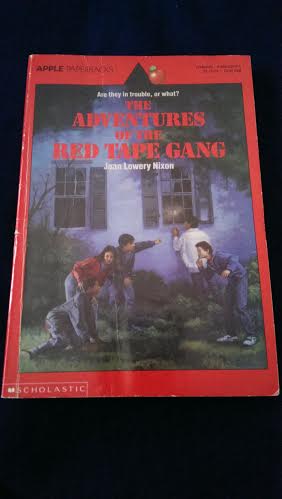
This year at school, Beth’s teacher has assigned everyone a year-long project to think about good points about their classmates, but it’s difficult when one of your classmates is Imogene Herdman.  The Herdmans are generally awful.  They lie, steal, set things on fire, bully other kids, and have been kicked out of almost every building in town for one reason or another.

Mr. Herdman deserted the family years ago, and Mrs. Herdman works long hours at the shoe factory, so the six awful Herman kids are left to do pretty much anything they want most of the time, even if what they want to do is to walk off with Louella’s baby brother Howard and draw pictures on his bald little head and charge other kids a quarter to see the amazing “tattooed baby” like some kind of sideshow freak.  It’s difficult for the adults in town to tell them off because they never listen or punish them because no punishment ever seems to stick.  Mostly, when the Herdmans are around, the adults seem to focus on damage control.

So, Beth struggles to find anything good to say about awful Imogene, the oldest girl in an awful family, but throughout the school year, Beth does begin to notice that Imogene does have other sides to her personality.  The book is more of a collection of short stories about the Herdmans’ various antics and escapades and Imogene’s role in them than one single story as Beth thinks about the things Imogene does.  Imogene can’t really be called “nice,” and she definitely causes her share of chaos, but she does have occasional moments when she’s helpful or does something in the name of justice, like giving her old blanket to Louella’s little brother to replace the one he lost so he wouldn’t be sad.

Some of Beth’s compliments to Imogene at the end are somewhat generic because Beth struggles to get around some of Imogene’s genuinely awful behavior, but when she considers what Imogene’s best trait is, she finds something that really captures Imogene’s spirit, a quality that Imogene genuinely admires and may lead her on to better things in her life.

This is the second book in The Herdmans Series.  The books are funny because of the chaos that the Herdmans cause wherever they go, although you can’t help but feel a little sorry for them at times, too.  It’s part of that awful dilemma when you think that someone deserves a good spanking for what they’ve done but, at the same time, you see that it wasn’t entirely their fault.  While the Herdmans are responsible for the things they do, they’re also victims of neglect.  Their parents aren’t really raising them, and the other adults have mostly given up on them.  They do what they do because they can and because no one is there to make sure that they’re doing the right thing.  No one even really expects them to do the right thing, so if they do something right, it’s completely up to them.

Beth’s observations about Imogene show that there is hope for her.  Imogene has some good traits as well as bad ones, and occasionally, she does do good deeds as well as bad.  Beth realizes that Imogene could do some great things in her life because of her resourcefulness (a quality that Imogene likes when Beth points out that she has it), but she realizes that what Imogene eventually turns out to be is still in her hands, whether she uses her abilities to rob banks or run for President.  Adults will know that Imogene’s reality is likely to be something in the middle, but the point is that Imogene has more good points than it appears at first and more possibilities in her life than just being a trouble-making Herdman.

As in the first book in the series, there is also something of a contrast between Imogene and Beth’s friend Alice.  Alice is the perfect child (at least in her mother’s eyes, and her mother lets everyone know it), but she is also often shallow, bragging up her looks, talents, and perfect behavior to get attention and feel important (which is what Beth thinks is really the best compliment to give Alice because it’s the one she would most value).  When Alice is nice, it’s not so much because she is a nice person as she likes the praise she gets for doing it.  Really, neither Alice nor Imogene are especially nice; they’re just not nice in different ways and for different reasons (although both have good points, too, which is the point of the story).  When Alice gets a compliment, she sees it as merely her due for her perfection, but for Imogene, compliments come as a surprise because she doesn’t hear them much and she knows that she is far from perfect.

The book is currently available online through Internet Archive (multiple copies, actually).

The Adventures of the Red Tape Gang

RedTapeGangThe Adventures of the Red Tape Gang by Joan Lowery Nixon, 1974.

Hardcover editions of this book are called The Mysterious Red Tape Gang.

Mike’s father loves to read the newspaper every morning and rant about the stories that make him angry.  It annoys him how little gets accomplished because there’s so much “red tape” involved.  Take the case of their neighbor, Mr. Hartwell.  He has a large bush that’s dangerously close to the corner of their street and has caused several accidents. The city wants him to cut it, but he refuses to do so out of meanness and stubbornness.  Now, the city has to go through all kinds of red tape to make it happen.

His father’s rants give Mike an idea.  Why not put the new clubhouse he and his friends are working on to good use and form a club to right the wrongs of their neighborhood and make all of that red tape unnecessary?  Besides, cutting the Hartwells’ bush in the middle of the night would be a great joke on Mr. Hartwell’s nosy daughter, Linda Jean, who’s always hanging around, getting in the way of Mike and his friends.

Mike’s friends love the idea of being secret neighborhood heroes, but of course, it turns out to be harder than they expected.  After trimming the Hartwells’ bush as best they can, they decide that instead of just cutting the bush, it would be better to move it to a completely different spot so there will be no need to cut it again when it grows out.  But, Mr. Hartwell almost catches them in their midnight landscaping, and when Linda Jean finds Mike’s shears, they’re forced to let her into their club.

Their next project, boarding up the doors and windows of an abandoned house so that curious children won’t wander in and get hurt, also comes with complications.  It seems that the house wasn’t quite as abandoned as everyone thought.  Still, the Red Tape Gang accomplishes something even greater than just keeping kids out of the house and successfully keeps their identities secret.  But while they’re congratulating themselves on the wonderful job they’ve been doing, they discover that their neighborhood contains far more serious problems than they originally thought. Their activities are also starting to come to the attention of the wrong people.  And, for one member of the group, these problems hit dangerously close to home.

This was one of my favorite books when I was a kid.  The descriptions of the kids’ midnight excursions are hilarious and make you want to cheer them on!

This book is currently available online through Internet Archive.