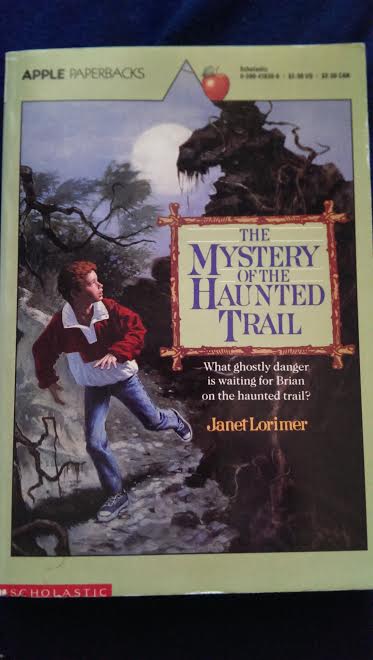
The Mystery of the Haunted Trail

MysteryHauntedTrailThe Mystery of the Haunted Trail by Janet Lorimer, 1989.

Brian Kelly wasn’t too excited at first when his teacher assigned his class to write letters to students at a school in Hawaii.  He doesn’t really like to write, and the whole thing sounded boring, but it turned out to be pretty fun when his new pen pal, Alani, wrote back.  Brian discovered that he and Alani had a lot in common, and he even got to meet Alani when his family came to California on a trip.  Then, best of all, Alani’s family invited Brian to spend part of the summer with them in Hawaii!

Brian loves Hawaii from the moment he arrives.  Alani’s family lives in a rural area near Kalawa.  All of the families in the area raise their own vegetables and keep animals.  They depend on what they earn from selling food although some of them, like Alani’s mother, who is a nurse, have other jobs as well.  Alani’s father, like Alani’s grandfather, is primarily a farmer.  Alani’s grandfather lives with him on land that the family has owned for generations.

Alani and his family enjoy showing Brian around their island and talking about the history of the place.  Brian particularly likes the stories that Alani’s grandfather, who they call Kupuna, tells them, although some of them are frightening.  At the luau that the family and their friends have to welcome Brian to Hawaii, Brian overhears people talking about the Night Marchers.  They say that the Night Marchers have been seen recently and that bad things have been happening in the area, like crops dying and the nearby stream starting to dry up.  Some people seem to think that it’s a sign of bad luck and that maybe they should move away from the area.

According to Kupuna, the Night Marchers are a ghostly parade of the ancestors of the people who have lived there for generations.  Sometimes, it’s just ordinary people and sometimes it’s the souls of warriors.  Sometimes, Hawaiian gods may even walk among them.  But, when they march, any living person must either flee from them or, if that is impossible, they must lie down and hide their eyes.  At the head of the Marchers is a ghostly spearman who will strike down any living person who sees them, unless that person is related to one of the Marchers themselves.  They spare members of their own families.  People who are struck by the spear of the Marchers appear to have died of a heart attack.

The place where the Marchers supposedly walk is an old trail that leads to a sacred place where Alani’s ancestors are buried.  Brian is curious to see the place, but Alani warns him away, saying that they are not allowed to go there because it’s too dangerous.  However, Brian soon sees the Marchers himself one night in Alani’s family’s fields, and the next day, their crops are dead.  When Brian notices strange footprints in the fields as well, he realizes that some living people may be responsible for the awful things that have been happening in the area, but the only way he can prove it would be to explore the haunted trail himself and track the “ghosts” to their lair.

Janet Lorimer’s books are interesting because they are often a combination of mystery and ghost story.  There are logical explanations and living villains who are responsible for the things that are happening to Alani’s family and their neighbors, but there is also a definite supernatural element to the story as well.  Telling you where one ends and the other begins may be saying too much.  It may be more fun to let you find out yourself.

The book is currently available online through Internet Archive.
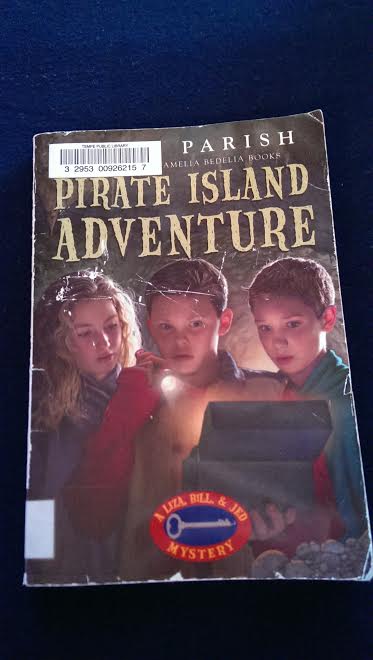
Pirate Island Adventure

pirateislandPirate Island Adventure by Peggy Parish, 1975.

The Roberts kids must solve another family treasure hunt! This time, they are staying with their grandparents at the family’s vacation home on Pirate Island. It has been many years since the family has been able to go there during the summer. For years, they rented the house out to a couple who lived there most of the time, and the grandparents could only go there when the couple left to visit relatives at Christmas. Now, the house is vacant again, and the grandparents have decided to take the Liza, Bill, and Jed there for the summer.

The last time that their grandfather spent the summer there as a child, his older brother decided to take something from every member of the family and make a treasure hunt just like the old family treasure hunt that the kids solved in Key to the Treasure. Just like that treasure hunt, other circumstances arose that kept the treasure hunt from being solved, so no one ever got back what grandfather’s brother hid. The only clue they have to the treasure now is a picture that grandfather’s brother drew. Since the children were able to solve the last treasure hunt, their grandfather is hopeful that they will be able to solve this one, too.

Unlike other treasure hunts that the Roberts kids solve, this treasure hunt does not involve codes and word games.  The clues are given in the form of drawings, most of which (unfortunately) are not shown to the readers.  The readers wouldn’t have a chance to solve the puzzles anyway because the objects in the drawings are things which the children’s grandfather has to recognize, places where he and his brother went as kids.  This book also introduces Hermit Dan, who appears in another book.

This book is part of the Liza, Bill, and Jed Mysteries series.

Key to the Treasure

keytreasureKey to the Treasure by Peggy Parish, 1966.

When twins Liza and Bill and their older brother Jed visit their grandparents for the summer, their grandfather tells them the story of a treasure hidden somewhere on their farm. Over a hundred years ago, their great-great-grandfather was friends with an Indian (Native American) woman. When she died, she left her belongings to him, including a feathered bonnet, a leather shield, a mask, and a doll.

When he grew up, he went away to fight in the Civil War. Before he left, he hid three of the items (the shield, the mask, and the doll) and made up a series of clues to help his children find them.  Unfortunately, the first clue was lost, and he never returned to tell his children where he hid the treasure. The only clue that was left was a picture of the feathered bonnet, a little pot, and a strange-looking key.  From then on, each generation in their family has tried to solve the puzzle. Since so many generations of their family have failed to find the treasure, Liza, Bill, and Jed don’t have much hope for success until they accidentally stumble on something that gives them their first clue.

keytreasurepic1Together, the three children quietly work on the clues, following each to the next.  They hope to surprise their grandfather with the solution to this old family mystery.  But, can they?

The clues to the treasure take the form of word games and codes (the first is a simple substitution code, and the other two are word games). Young readers will find it challenging to solve the codes along with the children in the book (Liza, Bill, and Jed walk readers through their solutions as they work on the puzzle, even showing how they correct for mistakes along the way), although older readers may find them rather easy.  It’s a good book for introducing children to codes and word games if they haven’t really encountered them before.  For the challenge of it, you can stop reading at each new puzzle and attempt to solve it before the kids do!

This is the first book in the Liza, Bill, and Jed Mysteries series.  It is currently available online through Internet Archive.

Ghosts in the Gallery

ghostsgalleryGhosts in the Gallery by Barbara Brooks Wallace, 2000.

Eleven-year-old Jenny was raised in China by her mother and stepfather, who ran a dance studio. She has no memory of her real father, who died when she was a baby. When her stepfather dies and her mother becomes deathly ill, her mother writes a letter to her real father’s father, a grandfather that Jenny never even knew existed before. In the letter, her mother explains that she is dying and that she will be sending Jenny to live with her grandfather. Then, Jenny starts the long journey from China to the East coast of the United States alone.

Leaving her dying mother to head to a strange country to live with her previously unknown relations is frightening enough, but there is still worse to come. When Jenny arrives at her wealthy grandfather’s home, no one is expecting her or knows who she is. Her uncle, Winston Graymark, insists that her mother’s letter never arrived. Worse still, he believes that Jenny is an imposter, and that her mother merely made up the story about his long-lost brother being her father.

At first, he angrily threatens to send Jenny back to China, but Madame Dupray, a servant who cares for Jenny’s ill grandfather, suggests that she be taken on as a household servant. Jenny is given a dreary little room in the cellar and embarks on the drudgery of household chores. Could the Graymarks really be her relatives? If so, what happened to the letter that Jenny’s mother sent? Something sinister is happening in Graymark House, and Jenny will have to face suspicious servants and attempted murder before she finds the truth.

The “ghosts” in the title are the portraits of Jenny’s ancestors, which hang in the gallery. They appear grim and frightening at first, but when Jenny begins to recognize them as her relatives, they no longer frighten her.  Like many of Wallace’s books, this book contains sinister characters with hidden motives, but ends happily.  The story takes place at some point during the Victorian era.

Mystery Up the Winding Stair

Harry Hunter and his mother have been living with his grandfather in his big mansion while his father is in Japan doing work for the government. His family has owned the mansion for a long time, and it has a small museum in it containing Native American artifacts and things relating to pioneer life, including a small log cabin built in a large room up a winding staircase.

When Harry’s mother goes on a trip to see his father, Harry and his grandfather invite Harry’s cousins to visit them: Ned and his sister Lou, and Carol, whose family has only recently moved to the area.  When the children try to decide what they would like to do together, Carol suggests a treasure hunt.  Their grandfather sends them on a treasure hunt to find something that he hid himself a long time ago: a set of silver spoons made by Paul Revere and a diamond. The explanation is that the grandfather is rather absent-minded and has forgotten where he hid the treasure, although he knows that it’s somewhere in the house.

A storm leaves them all snowbound in the mansion, but they are not alone. There are mysterious footsteps, someone using a secret staircase to the attic, and signs that the bed in the cabin has been slept in. The children begin to realize that someone else is in the house with them, and this person wants the treasure for himself!

This book is out of print, but you can borrow and read it online for free through Internet Archive.  Internet Archive requires you to sign up for an account to borrow books, but the account is free, and you read the books directly in your browser.  There are no overdue fees because the books simply disappear from your virtual loan list when your time is up.  You are allowed to re-borrow books as long as copies are available (not being “borrowed” by other people).

The house the mansion in the book was based on was the old summer home of Governor Washington Hunt, located in Lockport, New York. (I learned about the house from an article about the story behind the book and an event related to the book that was held at the library in Lockport, but the site that had the article doesn’t have it up anymore. I think I saved a copy somewhere, but I’m having trouble finding it right now.)  It was called Wyndham Lawn and later became a children’s home. It’s now a private school called the Henrietta G. Lewis Campus School.  When the author, Helen Fuller Orton, was young, some of her relatives rented Wyndham Lawn from its owner, and she lived with them for a time.  In the article, the author noted that the house had been changed somewhat since the time when she lived there in the 1880s in order to accommodate the needs of the children’s home.

When I first read this book, I thought that the part about the grandfather simply forgetting where he hid an important treasure was a little cheesy, but the treasure hunt in a mansion with its own museum is fun. It’s a little spooky when the kids realize that there’s an intruder in the house with them while they’re snowbound, although it’s pretty obvious to readers of the story who the intruder was. The house really makes the story because it is a fantastic setting! It’s a very cozy mystery for winter.

I enjoyed the story and learning about the history of the real house. I also considered what Harry’s father is doing in Japan because this book was published just after WWII. I don’t think they ever explain why Harry’s father is in Japan on government work, but I’m sure he’s involved with the occupation and reconstruction of Japan after the war. It’s a subtle reference to current events at the time this story was written that’s not part of the main story but is used as part of the reason why the main story is happening.