Sammy Keyes and the Hotel Thief

Sammy Keyes

Sammy Keyes and the Hotel Thief by Wendelin Van Draanen, 1998.

Samantha “Sammy” Keyes lives with her grandmother in her apartment because her mother (who she calls “Lady Lana”) left her with her grandmother a year before, when she left to pursue an acting career. Much of the time, Sammy doesn’t have much to do at her grandmother’s apartment, so she spends her time watching people and nearby buildings with her binoculars. Technically, Sammy isn’t supposed to be living in her grandmother’s apartment because the apartment building is for seniors only, so they have to keep her presence a secret. Sammy only keeps a few belongings that are easily hidden, and she has to hide in a closet when people they don’t know and trust come to the door. She can’t come and go as often as she wants because her grandmother’s nosy neighbor will notice and report her. One day, while looking at a seedy hotel nearby, she witnesses someone with black gloves stealing money from someone’s purse. As she watches, this man looks directly at her and can tell that she’s watching. Sammy has the strange feeling like she’s seen the man somewhere before, but she can’t think where, and she’s nervous that he saw her, too.

A little later, Sammy’s friend, Marissa, comes to the apartment and asks Sammy to help her find her younger brother, who’s missing. Sammy knows that the best place to look for Marissa’s brother is at the pet store, so the two girls hurry off to find him. On her way back to her grandmother’s apartment, Sammy sees that there are police at the hotel, so the theft has been discovered. There are other kids standing around and watching, so Sammy decides to take a look, too. She sees the police interviewing the woman whose money was stolen. As she listens to them talk and mention looking for fingerprints, she can’t help but comment that there won’t be any fingerprints because the thief wore gloves. When the police and victim all hear her say that, they realize that she’s the only witness to the crime. As they question her, she describes what she saw while giving them as little personal information as possible so her secret of living with her grandmother won’t be exposed. When the police take down her name and address, she gives them her real name but Marissa’s address in a wealthy part of town.

The next day, both Sammy and Marissa have their first day of junior high school. Sammy immediately gets the attention of the school mean girl, Heather Acosta (who becomes her school nemesis for the rest of the series). When Heather jabs Sammy in the butt with a sharp pin, Sammy punches her in the nose. Of course, the vice principal shows all kinds of sympathy to poor Heather and punishes Sammy because he claims that nobody saw Heather jab Sammy in the butt with a pin. He makes her sit alone in a tiny closet that the school calls “the Box” to think about what she’s done. Even when Marissa tells the principal what really happened, supporting what Sammy said, the principal just says that there’s never any excuse for punching anybody and that Sammy is suspended. The vice principal expects Sammy to shake hands with her rotten abuser and make peace when she returns to school. (Ooh, I hate that. I’ve got a rant for later.)

After Sammy’s suspension, she and Marissa walk home together, and Sammy tells Marissa about what she witnessed at the hotel. When the two girls stop at the store, they see the woman whose purse was robbed and learn that she’s an astrologer called Madame Nashira (real name Gina). Surprisingly, she admits that she doesn’t really believe in fortune-telling, but she does it anyway because she needs the money. She likes drawing up astrological birth charts for people, though. There’s an interesting scene in the book where she does one for Sammy and explains how it works. (I’ve never been serious about astrology, and I doubt it even more since I took an astronomy class and my teacher showed us how to use a star globe and used it to explain why people’s birth signs aren’t their real birth signs, but it was still kind of fascinating just to think about. I’ve never actually seen a real birth chart before.)

When Sammy gets back to her grandmother’s apartment, Sammy’s grandmother’s nosy neighbor, Mrs. Graybill, tries to find evidence that Sammy is living there against the rules, or Sammy has to pretend like she’s only visiting and leaves to visit a nearby friend, Hudson Graham, an old man who has a lot of books. The two of them talk about other robberies that have happened in the area recently. When Sammy gets back to the apartment, she finds Mrs. Graybill angrily telling her grandmother that Sammy wrote her a threatening note and slipped it under her door. Of course, Sammy didn’t do any such thing. When Sammy sees that the note says, “If you talk, you’ll be sorry,” she knows that the threat is actually from the thief. The thief knew that someone from the apartment building was watching him, but he accidentally delivered the threat to the wrong apartment. With a threatening thief wanting to keep her quiet, Heather and the school principal wanting her butt to suffer at home, the nosy Mrs. Graybill wanting her sent away from her grandmother’s apartment, and the police wanting Sammy at her friend Marissa’s house, Sammy’s witnessing of the theft threatens to expose her own secrets.

The book is available to borrow and read for free online through Internet Archive (multiple copies).

My Reaction

One of the things that stands out to me is that neither Marissa nor Sammy really live in the best homes. Marissa’s family has a lot more money, and they live in a big house, but her parents are busy business people who spend most of their time working and traveling, often leaving Marissa alone with her younger brother, fending for themselves with Pop Tarts and tv dinners. Marissa feels neglected, and she really is. She also doesn’t have many real friends. A lot of the other kids who play up to her, like Heather, are trying to get her to give them money because they’re aware that her parents give her a lot of spending cash, and Marissa has had trouble saying “no” to them in the past. One of the thing Marissa likes about Sammy is that she’s never asked her for money. Sammy likes Marissa for herself.

Sammy is surprised when she finds out that Marissa actually envies her because her grandmother is always there for her in ways her parents aren’t. Sammy doesn’t feel lucky because, even though her grandmother cares about her, she always lives on the edge, having to pretend like she’s not really living with her grandmother, keeping only a few belongings that are easily hidden, and ducking into a closet to avoid being caught. She can never be completely at home in her grandmother’s apartment because she isn’t supposed to be there at all. Sammy’s mother occasionally calls, but Sammy always feels uncomfortable and neglected by her mother’s abandonment of her, which is why she refers to her as “Lady Lana” instead of as her mother.

I thought at first that Sammy’s housing situation might be solved by the end of the book, but it wasn’t. At the end of the story, she’s still secretly living with her grandmother and lying to the police about being Marissa’s foster sister. However, there are hints in this book about another possible place for Sammy and her grandmother to live in the future, so that situation might change. At no point in the story does anyone mention who Sammy’s father is, where he is, or why he didn’t take Sammy when her mother left. The identity of Sammy’s father is actually an over-arching mystery in this series, something that they discuss later.

As for the book’s introduction of “Rear” Admiral Heather the Butt Poker, the book doesn’t use the phrase “rotten abuser”, but that’s my take on it. Get ready for another one of my anti-bullying rants, or skip the rest of this long paragraph and the next two after that. I always find bullying in books stressful, especially when adults take the side of the young bully. It’s not as bad when a bully is punished or at least called out for their bullying, but when adults refuse to believe the victim, it’s awful. I know from long, bitter experience how the worst, most twisted mean kids provoke fights so their victims end up looking like the bad ones when they finally snap. The abusive kids know that the adults like them and will favor them every time. I’ve seen it happen before, and the fact that situations like this end up in books like this shows that it’s a sadly common experience that many people relate to. The abusers’ behavior never changes because they never experience consequences. The adults delude themselves that the abusers are either “normal” kids or will change (somehow, magically) as they get older and gaslight the victims that the situation is their fault and that it’s possible to be friends with the abuser without the abuser changing their behavior and continuing to act the same mean way they always act. I appreciate that the book shows the unfairness of the situation by adults who just want the situation easily resolved and make the kid they don’t like as well take the brunt of it. I know that Sammy’s use of physical retaliation is what put her in trouble, but honestly, I feel more inclined as an adult to think that sometimes physical force is necessary when dealing with a physical abuser. I’ve never heard of anyone who stopped being physically or emotionally abusive because they were asked politely, and when people in authority refuse to do anything, there sadly isn’t much recourse. Heather should not be touching anyone else’s butt, not with a sharp object, not with her hands, and not with anything else. It’s someone else’s butt. Heather should NOT be touching anyone else’s butt for any reason at all, let alone inflicting pain to someone else’s butt by penetrating it with something sharp. At her age, she should be old enough to understand that sort of thing has connotations other than a kid’s prank, and if she isn’t, someone needs to have a long, serious talk with her to explain why. I know that Heather’s meant to be just a thoughtless mean kid and not molester or something, but she’s still young and someone should put a stop to this before it goes any further. Understanding of these things has to come at some point in a person’s life. If there’s any lesson that’s difficult to carry too far, it’s the concept that no one should mess with someone else’s butt and cause pain. If Heather is allowed to mess with people’s butts in this school, understand that there is absolutely nowhere else in this society where she would be allowed to do that without repercussions. There’s no shame in having some weirdo you don’t even know assault your butt, but there’s a whole world of shame for being that weirdo who can’t leave someone else’s butt alone. Also, Heather jabbed Sammy with something sharp that penetrated her skin. Am I the only adult thinking about tetanus and blood poisoning?

Kids who are bullies in school are more likely to engage in aggressive, anti-social, and criminal behavior in adulthood. Shrugging and saying “Kids will be kids” while doing nothing is one of the worst possible things to do. Bullies don’t magically get better when they hit a certain age. If no one intervenes and teaches them that there are some forms of behavior that are never acceptable and really enforce the rules, they will continue their bullying for the whole rest of their lives, seeing the whole rest of the world as being in the wrong for complaining about their behavior, causing workplace stress, family turmoil, and failed relationships. It’s a serious problem. It’s not harmless. It seems like decades past time for the school vice principal to have this explained to him as well. A school can have all kinds of anti-bullying rules, but if they never enforce them for all parties involved, they’re completely useless because it’s like they don’t even exist at all. Kids are pretty good judges of who’s a pushover and what they can get away with, so anyone who’s worked with them should realize that the only rules that matter are the ones that actually get enforced. Unless the vice principal is one of those grown-up bullies himself who never got a clue and can’t stand to realize the reality about himself, which is always a possibility. I just have no sympathy for that.

I wonder if the vice principal considered how his reaction to what Sammy told him about being jabbed in the butt by a sharp object, actively punishing Sammy for what she said and for her physical retaliation to the violation of her body, might be teaching her some terrible lessons about how to respond to a sexual assault, including the one that people in authority will never believe her and will actively punish her because it’s the easiest thing for them to do and that’s all that matters. That happens quite a lot in real life, as the #MeToo movement has shown. This video, which is rather explicit in its descriptions and not for kids, explains about university officials who act like this vice principal and the harm they do when they let sexual violators go unpunished and even rewarded, while their victims are sent jumping through hoops for justice they never plan to give them because they just want them to shut up, go away, and not make trouble for the bullies they really like. At their core, bullying and sexual violence are both about power and control over other people and using people for the perpetrator’s purpose. It’s not really surprising that there is a connection between the two and that young bullies can turn into perpetrators of sexual violence. I wonder if the vice principal’s response would have been different if it had been a boy who jabbed Sammy’s butt instead of a girl. Actually, I don’t really wonder. I’m sure he would never think of that and would spend a lot more time coming up with reasons why this situation is different is different from any form of sexual assault, so harmless, and how he shouldn’t have to think of it if someone asked him. I liked the part where Sammy offered to show him the mark from the pin if he refused to believe her, an offer the vice principal didn’t accept. I know he’s just taking the easy way out here, punishing the person who didn’t lie and deny throwing a punch and maybe sympathizing with Heather because she got noticeably hurt in a place that isn’t covered by pants and underwear, but as an adult who remembers kids like Heather, I have absolutely no respect for this vice principal for his hard-line punish-the-bullied stance. I don’t feel for Heather at all because she got what she provoked, and there was repeated provocation followed up by a physical attack before Sammy finally broke. Every human on Earth has a breaking point, anyone might snap when pushed too far, and nobody is clever for exploiting someone’s human emotions to the point where they break. Learning that is a valuable life lesson. Of course, I know Heather sticks around as a bully for other books, so she’s not learning a thing.

While Sammy is suspended, Heather and her friend Tenille start a scheme at school to get money from other students by milking their sympathy for her “broken nose” (what they call the “Help Heal Heather Fund”). Of course, her nose isn’t really broken. Sammy realizes it because she’s seen someone with a broken nose before, and the bandaging on Heather’s isn’t right. (The book doesn’t mention it, but people with a broken nose also typically get two black eyes or at least dark, obvious bruises under the eyes from the broken blood vessels. I didn’t know that as a kid, but someone told me about that as an adult, so that’s one of the first things I’d look for.) When Sammy realizes that Heather is faking a broken nose and putting bandages on herself, she figures out how to expose her scheme. She calls the office of the doctor Heather mentioned to someone else, pretending to be Heather, and has the doctor’s office call the vice principal to explain that she doesn’t really need to wear bandages, implying that the vice principal is forcing her to wear them against her will out of an abundance of caution. After the vice principal gets the call from the doctor, who chewed him out for forcing a girl to cover her nose in bandages over just a little nose bleed, he marches into the cafeteria and tells Heather to take her bandages off in front of everyone, exposing her fraud. He tells her that they’re going to have a talk in his office about her lies, and Heather tries to hit Sammy, accidentally hitting the vice principal instead. Heather gets suspended for much longer than Sammy was, and the other students are angry with both her and Tenille for taking their money. The vice principal never apologizes to Sammy for his earlier implication that she was lying and for making her sit in that little closet called “the Box” to think about it, but her reputation is restored at school.

Cassie Bowen Takes Witch Lessons

Cassie Bowen Takes Witch Lessons by Anna Grossnickle Hines, 1985.

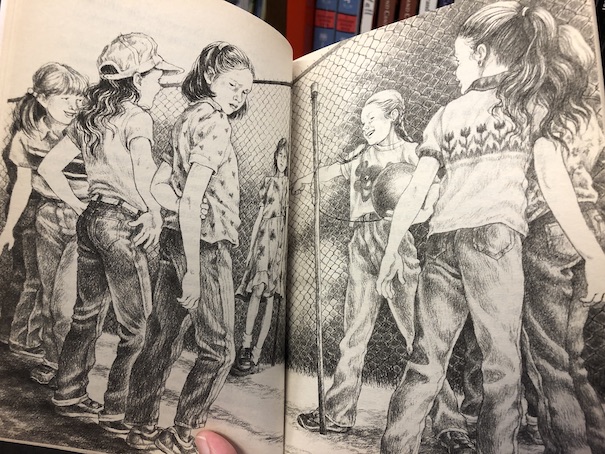
Cassie Bowen and Brenda Bolter have been friends for years, but lately, Brenda has been getting friendlier with Sylvia, another girl in their fourth grade class at school. Sylvia is a mean girl, and the favorite target of her meanness is Agatha Gifford, the new girl at school. Sylvia likes to call her “Saggy Aggy” and “Thrifty Gifford” because Agatha always comes to school wearing dresses that are too loose on her and Sylvia thinks that she probably got them at a thrift store. Most of the girls at school wear brand new jeans, not dresses. Agatha doesn’t bother to fight back when the other girls tease her, and Cassie doesn’t know what to say or do about it, even though the teasing makes her uncomfortable, too.

Even if the other girls are right about Agatha wearing used clothes, Cassie can understand. Cassie wears jeans like most of the other girls, but hers are actually hand-me-downs from an older cousin. (The story of my own youth, too. Thrift stores are the story of my present because I still don’t have much money, and anything I don’t spend on clothes is something I could potentially use to buy books, most of which will also be used because I like older books and because it maximizes my buying power. Life and budgets are about priorities.) Cassie’s mother hasn’t had money to buy new clothes since Cassie’s parents got divorced. The book is vague about what happened in Cassie’s family before the divorce, but Cassie’s father now lives in another state and doesn’t even write or communicate with the family, and he’s certainly not sending money. Cassie’s mother says that he’s got to sort out his life, and Cassie says that her father is kind of a “creep” now, but the book doesn’t go any deeper into it. It’s more important that Cassie’s family is now tight on money, and Cassie has mixed feelings about the divorce. On the one hand, she misses her father and wishes that the divorce had never happened, but on the other, she’s also angry with her father for his part in the divorce and the ways that he changed from the father she knew and loved before. Cassie’s mother says that everyone changes over time, and sometimes, when they change, they grow apart. Cassie will soon come to understand that better through her experiences with Brenda.

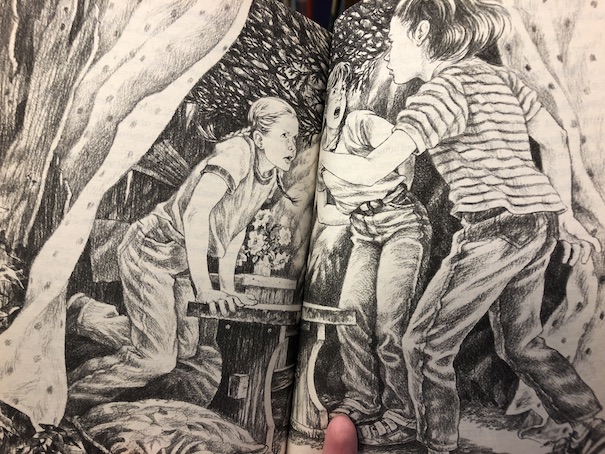
Cassie doesn’t like the ways that Brenda is changing, and she resents Brenda sharing the secret hideout they built with Sylvia without even talking it over with her. One day, when the girls are going to their secret fort, they pass the old house where Agatha lives with her grandmother. There are neighborhood rumors that Mrs. Gifford is actually a witch because her old house looks kind of creepy and she often does odd things, like talking to her plants. As the girls pass her house, they hear her talking to her flowers, and suddenly, Sylvia trips up Brenda so that she goes sprawling into the flower bed. As Mrs. Gifford laments about her flowers, Sylvia dramatically exclaims that they must pick some flowers and actually starts yanking more out of the bed until Mrs. Gifford angrily chases them off with a broom.

Cassie is appalled by the entire incident, although she admits that it was funny, watching Mrs. Gifford chase the other girls. Brenda is fascinated with Sylvia because of the daring way she likes to show off and grab attention, and it inspires her to do the same thing, finding ways to make fun of people or cause trouble. It upsets Cassie, who just wants Brenda to be the same Brenda she’s always known. Brenda also tells Cassie that Sylvia has amazing things in her room, like a collection of glass animal figurines. Sylvia even gives her one to keep. Also, Sylvia’s parents supposedly let her stay up as late as she wants, and she can usually get her way with them just by throwing a tantrum. Brenda thinks that all this is cool, which makes her different from the kids I knew growing up. Most self-respecting fourth graders were beyond tantrums and would have been called babies if they had admitted to having one at that age. Having great clothes and a lot of cool stuff in her room would have gone a long way, though.

When the children’s teacher, Mr. Gardner, assigns the kids partners to work on presenting a story to the rest of the class, Cassie hopes that she and Brenda will be partners so that things can be like they were before. However, Brenda and Sylvia end up being partners, and Cassie is assigned to Agatha. Cassie isn’t enthusiastic about it, and Agatha notices, but Cassie decides that she’s going to be as friendly as she can. She asks Agatha about which story she would like to present to the class because she doesn’t like reading that much, and Agatha says that she knows because she’s noticed that Cassie is better at math. Cassie is surprised that Agatha would know that, considering how new she is, and Agatha says that she envies her because she’s been having trouble with fractions. Agatha says that she really likes the story The Nightingale because it reminds her of a beautiful music box that her grandmother owns, and Cassie is fascinated.

One day, when Cassie’s brother is off playing baseball and Brenda and Sylvia are working on their project together, Cassie passes by Agatha’s house and is invited in. Cassie hesitates at first because the house is creepy, but she has to work on the project with Agatha, so she accepts. Agatha’s grandmother serves the girls rose hip tea and cookies. Cassie thinks that rose hip tea sounds weird at first, but it tastes nice. Mrs. Gifford is an eccentric lady, but rather sweet. She introduces Cassie to Roberto, her favorite plant. Part of the reason why she talks to plants is that she lived alone and was lonely before Agatha came to live with her. She is also a member of the same gardening club that Cassie’s mother belongs to. Cassie uses the cookies at tea to explain fractions to Agatha, and Mrs. Gifford shows Cassie her music box, which is beautiful. The music box is special to Mrs. Gifford because it was the last present her father gave her before his death, when she was about the age of the girls now. Cassie understands the feeling because she prizes the teddy bear that her father gave her before he went away.

The more Cassie learns about the Giffords, the less strange they seem, and she no longer believes that Mrs. Gifford is a witch. Agatha tells Cassie that she lives with her grandmother because her parents were killed in a car accident. The only other family she has is an older sister who is away at college, which is why Agatha can’t live with her. Cassie acknowledges that Agatha’s situation is worse than hers because, even though Cassie misses her father, she’s not an orphan. Agatha also explains that the reason why she wears those dresses to school is that her old school was a private church school, where all the girls were required to wear dresses. When Cassie explains to Agatha’s grandmother that there is no requirement about dresses at their school and that most of the girls wear jeans, Agatha’s grandmother is surprised and says that she didn’t realize, so she buys Agatha some new clothes, taking Cassie with them on their shopping trip.

The new clothes fit Agatha better, and Cassie hopes that they will help her fit in better at school, but Sylvia and Brenda won’t let up on the teasing. In fact, Sylvia seems irritated at Agatha dressing more normally and mocks her, saying, “What’s she trying to do? Act like a normal person?” Cassie tries to tell them that Agatha is normal, but they don’t believe her. Soon after, Brenda asks Cassie if she wants to hang out when she’s on her way to see Agatha again about their project. In an effort to get Brenda to ease up on Agatha, Cassie asks Brenda to come with her so that she can see for herself that Agatha and her grandmother are fine.

The Giffords are nice to Brenda, but during the visit, Mrs. Gifford’s special music box disappears. Agatha says that Brenda stole it, and Cassie gets offended by the accusation, saying that Agatha is making it up and telling her that she doesn’t want to be friends anymore out of loyalty to Brenda. Unfortunately … Agatha was right, and Cassie is shocked when she discovers the truth. Cassie retrieves the music box from Brenda, but with Brenda and Sylvia both angry at her for taking the music box back and Agatha and her grandmother probably mad at her for bringing Brenda to their house in the first place and siding with her over the theft, what is Cassie going to do?

I think the ending of the story is very realistic, although it does leave some things unresolved. Agatha does forgive Cassie for not believing her after Cassie returns the music box. Cassie doesn’t tattle on Brenda and Sylvia because they had accused her of being a tattletale earlier, but she does eventually tell her mother everything that has been happening with Sylvia and Brenda. Her mother reassures Cassie that she did the right thing, even if Brenda didn’t. She says that it sounds like Cassie is angry at Brenda for a lot of things besides this, and Cassie agrees that she doesn’t like it that Brenda is so mean sometimes. Cassie mother says that everyone changes, and sometimes, they change for the better and sometimes for the worse. Cassie doesn’t think she and Brenda will ever be friends again, and her mother says that someday Brenda will also get tired of Sylvia’s meanness, but even if she doesn’t, Cassie will find plenty of other friends. Cassie realizes that she and Agatha really do understand each other, and she’s glad when they make up. At school, Sylvia and Brenda both tease Cassie now, saying that she’s taking witch lessons from the Giffords. It hurts Cassie’s feelings to see her old friend turn against her, but she follows Agatha’s advice and ignores them.

Sylvia and Brenda are never punished for the things they’ve done, which is sadly the case for most of the little bullies I knew as a kid. However, it is nice that Cassie and Agatha realize that they are better friends for each other than either Brenda or Sylvia would have been. I noticed that there is also potential for them to be friends with other people in their class besides Brenda and Sylvia. When Cassie got to school at the end of the book, a girl named Stacy asked her if she wanted to play tether ball, which shows that other girls don’t think badly of her for hanging out with Agatha. I also wished that the book would show more of Pam, who had been Sylvia’s best friend at the beginning of the book before Sylvia and Brenda started hanging out. After being abandoned by Sylvia, perhaps she would also be open to making some new friends. Cassie and Agatha might have other options for making new friends.

There is no magic in the story or witchcraft of any kind. In fact, Brenda and Sylvia probably never really believed that Agatha or her grandmother are actually witches. It’s more that, for reasons of their own, Sylvia and Brenda were looking for someone to pick on, and the “witch” accusations were just their excuse. That’s why they were so irritated when Agatha started dressing like the other girls. If their excuse for bullying Agatha disappeared, they didn’t want to lose their ability to bully her. It was never about making Agatha dress or act like the other girls; it was always about Sylvia and Brenda’s need to have someone to victimize. The truth is that even if the Giffords had seemed less strange in the beginning, Sylvia and Brenda probably would either have picked on them anyway or maybe selected some other victim, perhaps going straight to Cassie as their first choice, because they were looking for a victim and would have found one eventually because that was always their goal.

William’s Doll

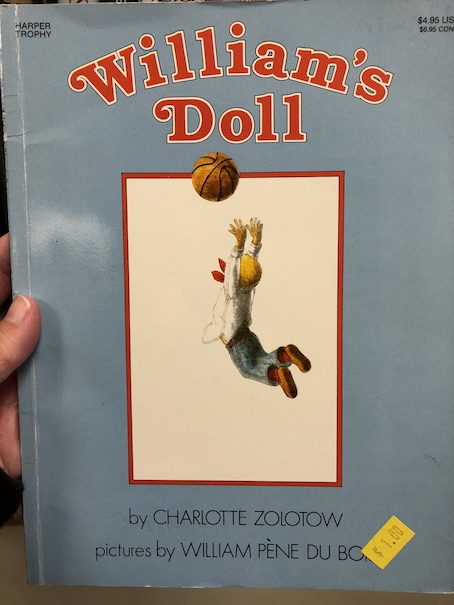
William’s Doll by Charlotte Zolotow, pictures by William Pene du Bois, 1972.

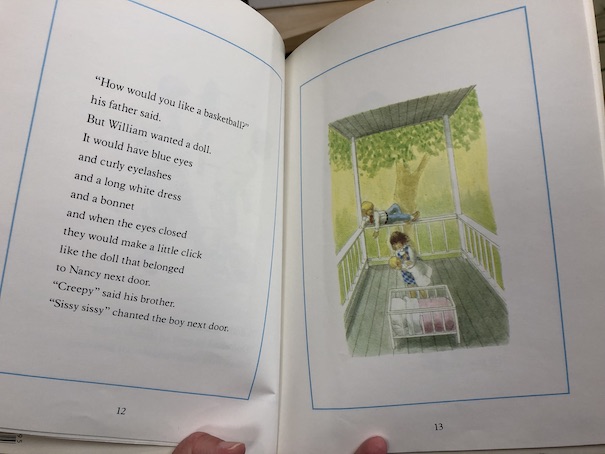
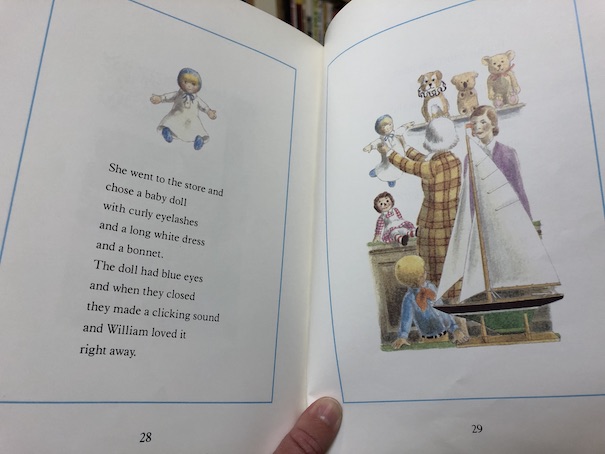
A boy named William wants a doll to play with, like the one the girl next door has.  Other boys make fun of him and think he’s a little strange, calling him a “sissy,” but he likes the idea of having a doll to love that he could treat like it was a real baby.

William’s father buys him toys that boys usually like, like a basketball and a train set.  William likes the train set and gets pretty good at basketball, but he still wants a doll of his own.

When his grandmother comes to visit, William tells her about wanting a doll, and she decides that it’s a good idea and gives him one.  William’s father worries about it, but the grandmother reassures him that there’s nothing to worry about.  William’s desire for a doll is a fatherly instinct, not because he’s a “sissy.”  William likes having something small to love and care for, like a father would for a real baby, and it’s a good thing for a boy to learn the gentleness and responsibility that he would need to know as a future father.

The book is available to borrow and read for free online through Internet Archive.

Further Thoughts and My Opinion

The book has two messages.  First, not everyone feels bound by gender when it comes to the things that they like, and there’s no reason to feel like they should.  Sometimes, people feel pressure to like what their friends like or what society think that they should like and to deny that they like certain things because they’re worried that people will think that they’re weird or uncool, which can be an uncomfortable position to be in.  Speaking as a childless adult who likes, collects, and reviews children’s books, I know how that is.  If it was going to stop me, I wouldn’t have maintained this blog for almost four years, and I wouldn’t have more than 600 books reviewed here, not to mention what’s hanging around my room right now. I’m not even halfway though my personal collection yet.

When you think about it, it does seem kind of unfair that even people who support a little girl’s right to play with traditional boys’ toys, like toy cars, can sometimes get uneasy about the idea of a boy playing with a doll.  People weren’t always so understanding when girls wanted to do “boy” things, like play sports, and there are times when they could be a little more understanding about boys who sometimes want to do “girl” things, too.  Some people might consider cooking to be more of a girl’s hobby than a boy’s hobby, but some of the most famous chefs in the world are men, and what woman wouldn’t be impressed by a boyfriend who can cook a romantic dinner?  People might think that sewing is a girl’s hobby, too, but many professional tailors and leather workers are men as well, and there are some guys who make their own costumes for historical reenactments.  To some people, poetry might sound girly and too sentimental for a boy, but try telling that to Shakespeare, Robert Louis Stevenson (who wrote, among other things, poems for children), Percy Shelley (“Look on my works, ye Mighty, and despair!”), and all of the other famous men who have been authors and poets.  Sometimes, people just aren’t looking at the big picture.  I think that, partly thanks to books like this, people have been loosening up a little on some of the “shoulds” in life – what they think people “should” do or “should” like.

No one in the story says anything about sexual orientation, although that may be part of the father’s worry and possibly the root of the “sissy” accusations. In the story, William is too young to be concerned about sexual relationships, and his wish for a doll has nothing to do with who he might want to date or marry in the future.  He has very specific reasons for wanting a doll, which he explains, and they have nothing to do with sex or romance. I’m not going to speculate about William’s potential orientation because it’s outside of the range of this story, and actually, I think that the story is stronger if his orientation is completely unrelated to his wish for a doll. If the other boys and William’s father think that the doll automatically points to homosexuality, they may be overstepping.  Part of the grandmother’s point is that emotions like love and caring go beyond the idea of sex, and gentleness and nurturing qualities are good things to encourage.  Also, William’s efforts to stand up for what he wants, even knowing that others don’t agree with him, could be seen as a first step to becoming his own man.  Who’s really more of a “sissy,” the guy who lets his friends lead him around by the nose and tell him what to think because he’s scared of being called a “sissy,” or the guy who will stand up and defend his baby, taking care of it no matter what?

The grandmother’s explanation leads to what I think is the second message, that having gentle, loving, and nurturing qualities doesn’t make a boy less of a boy or, by extension, a man less of a man.  These are human emotions, and all humans have some desire for these feelings.  These are the feelings that real relationships are built on: closeness, gentleness, and nurturing. These are qualities that women look for in husbands.  These are also qualities that make a man a good father, which is ultimately what William wants to be when he grows up.  Children have male parents as well as female parents, and it’s fine for William to want to be a good parent someday.

We don’t know, at the end of the story, how long William’s interest in the doll will last.  Children sometimes go through phases where they’re really interested in something, and a few months later (maybe sooner, depending on the kid’s attention span), they put it aside when something new comes along.  William is trying out a concept in his life, which is a large part of growing up, and once he’s tried it out, he may either build on it or move on to other things.  Given William’s interests and character, I think he will probably remember the feelings he’s had and the lessons he’s learned even after he puts the doll aside.  When he’s a little older, perhaps he’ll earn some extra money by babysitting younger kids in the neighborhood.  Maybe he’ll combine his varied interests and end up coaching a kids’ basketball class at the local community center.  He might end up being a teacher as well as a father, since he likes the idea of nurturing young children.

People who grew up in the 1970s may remember the story of William’s Doll from the cartoon and song on Free to Be… You and Me.  There was also a short live action film of the story. In the live action film, it was a grandfather who bought William a doll, and the grandfather reminds the father that he also had a doll for awhile when he was small, reminding him that children grow and change, and this phase in William’s life is just part of his path of growing up. The short film was later parodied on Rifftrax.

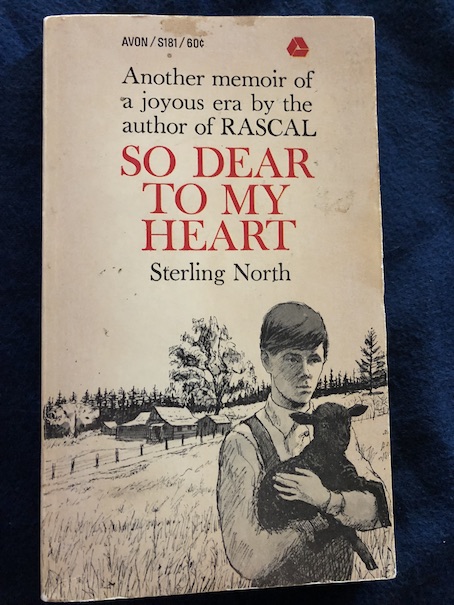
So Dear to My Heart

So Dear to My Heart by Sterling North, 1947.

The original form of this story was actually from 1943, when the book was called Midnight and Jeremiah. In that book, the black lamb was named Midnight, not Danny, and many of the subplots that came to dominate this edition of the book didn’t exist. This edition of the book was rewritten and published after the Disney movie of of the story, which is why it was given the same name. The Disney movie was half live-action and half animated, and it made some changes to the story that were reflected in this rewrite/reprint. Naming the lamb “Danny” after the race horse Dan Patch was Disney’s idea. I actually think that I would have liked the original book better because I didn’t like the way some of the characters were portrayed in this book.

I have to admit that I was really frustrated with one of the characters in the story, and because of that, I found it difficult to wade through the parts dealing with her. However, it is important to actually finish this story once you begin because, otherwise, you won’t get the full picture of the story. It’s not that the ending is particularly surprising, and I can’t say that I ever really became fond of the character I didn’t like, but the more you pay attention to how the story gets to the ending, the more you realize what the one of the points of this story really is. This story is about the love between a boy and an animal. It has Christian themes and themes about hatred, prejudice, and loss. However, what struck me the most in the end is that this is also a story about knowledge and perspective. Knowledge and being open to knowledge can change a person’s perspective, but also having a different perspective in the first place can give a person knowledge or leave them more open to gaining it.

I’ll warn you that this is going to be a rather long review, and parts are going to seem a little repetitive because the way my review is organized is based somewhat on the way this book was organized, giving bits and piece of information about the same underlying situation accompanied by reactions to it. At the end, I’ve also included some odd historical information that relates to things mentioned in the story.

Jeremiah Kincaid, called Jerry, lives with his grandmother on the Kincaid family farm in Cat Hallow outside of the small town of Fulton Corners, Indiana in 1903. His parents are dead, having died in a fire when he was young. The full circumstances behind their deaths are not explained until the end of the book, and there are a few things in the book about their deaths and some current happenings that seem a bit mysterious. This book is not really a mystery story, but in way, parts of it play out a little like a mystery because there are missing pieces of information that need to be filled in before you really understand what’s going on. Knowing exactly what happened to Jerry’s parents and why eventually helps Jerry and his grandmother to resolve some of their feelings about their deaths and their relationship with each other. For most of the book, Granny Kincaid thinks she knows what happened, but it doesn’t take long for readers to realize that she’s unreliable as a narrator. Jerry’s Granny Kincaid is a very strict and strongly religious woman, and she is the character I did not like, who almost discouraged me from finishing the book. It wasn’t being strict and religious that made me not like her. I wouldn’t have minded that so much by itself; it’s the rest of the story of what she is that got to me. In a way, that feeling of not wanting to look further also plays into the story and the desire of whether or not you want to know more about what is behind a bad situation. In an odd way, Granny actually did remind me of something, but I’d like to save what she reminded me of until near the end because it will make more sense then.

When the book begins, Jerry is angry with Granny for selling his beloved bull calf to a butcher. Jerry loved the calf because he had raised it himself, but to Granny, it was just part of the routine of farm work. To Granny, animals are meant for food unless they are specifically work animals. Jerry feels more of a personal connection to the animals, which is also important to the story. Jeremiah longs for an animal that he can actually keep and love. This is what guides Jerry throughout the story.

Jerry gets his chance of an animal to love when the new lambs are born and one of them is a black lamb, rejected by its mother. Granny would be content to let the little black lamb die, thinking of it as an evil omen. Her casual cruelty and callous attitude when Jerry points out that it’s just an innocent lamb who couldn’t help being born black and is scared and hungry and will surely die without care were, frankly, pretty disgusting from my perspective. Granny is very religious but without compassion or empathy. For her, animals are to be used, and whatever or whoever is meant to die isn’t something she’s going to bother herself about. Not only that, but part of her callous, unfeeling nature is based on bitterness toward events in her own past, which are clarified through the story. There is/was a bitter history between the Kincaids and the Tarletons, who owned the next farm over, and Granny knows that the little lamb was sired by the Tarletons’ old black ram. Even though I didn’t like Granny, I kept reading because the most compelling part of the book is learning the full history of the Tarletons and the Kincaids, which comes out bit by bit as the book goes on. The way that this knowledge of the family’s history is given to the readers, piece by piece, is important. Each time that Jerry learns a little more about his family’s history, the story changes a little, giving not only Jerry, but the readers, a slightly different impression of what happened and why.

To help explain it, I’ll give you a kind of summary of what Jerry learns in the first chapters of the book. In her youth, Granny Samantha Kincaid married David Kincaid, Jerry’s grandfather, who is now deceased. David’s rival for her affection was Josiah Tarleton. Before Samantha and David were married, the two men had a terrible fight over her which had left David the victor but permanently injured. Following the marriage of the Kincaids, Josiah settled on a farm near theirs. Over the years, the Kincaids experienced hardships of various kinds, while Josiah became a wealthier man and flaunted that wealth at the Kincaids to show Samantha what she had missed by not marrying him. Even after Josiah married a woman named Lilith, things were still bitter between the two families. Samantha became convinced that Lilith was a witch who cursed their sheep with illness, although David said that was only superstition. Although Lilith is now dead (as are Josiah and David), Samantha is still afraid of anything associated with the Tarletons, thinking of it as evil. That is Granny Samantha’s frame of mind, as it has been for years, and that is the basic reason why she regards the black lamb as evil, because of its association with the Tarletons. As far as the beginnings of the bitter Kincaid/Tarleton feud goes, it’s an accurate description of the situation. From this basic description, it sounds like the Tarletons were mean, greedy, and vindictive, lording their better fortune over the Kincaids and maybe even doing things to make life harder on them. However, that is not the entire story. That description barely scratches the surface of the real situation.

Granny is a callous person with some vindictiveness of her own. Jerry himself has been on the receiving end of Granny’s callousness, and the story mentions that his birth was “unwanted,” like the lamb’s, something that he senses from his grandmother (a major reason why I didn’t like her). Part of the reason why Jerry craves love in his life and shows it to the animals is because he doesn’t get it from family, what’s left of it. Jerry insists on taking care of the little unwanted lamb, naming him Danny. He persuades his grandmother that the lamb will give good wool. As the lamb grows and gets into trouble, Granny says that it’s proof that she was right to think of the lamb as evil. However, Jerry defends the lamb, saying that Danny is just an animal that doesn’t know what it’s doing and forbidding his grandmother to turn Danny into food, a sentiment echoed by Uncle Hiram.

“Uncle” Hiram Douglas is the local blacksmith, a family friend, not related by blood to anyone else in the story, although he acts as a father to Jerry, having no children of his own. Uncle Hiram knew both the Kincaid and Tarleton families for years, observing their feud from a different, more distant perspective, and his account of what happened is more reliable than Granny’s. He was careful not to involve himself directly in the families’ troubles because their situation was toxic, and he knew it. Early in the story, Uncle Hiram sees the parallels between Jerry and his lamb, both of which have been deprived of love and proper care through no fault of their own. He tells Jerry that both of them are from good stock and not to pay attention to the superstitious nonsense that Granny tells him. It is Uncle Hiram who suggests to Jerry that he should take Danny to the County Fair when he’s bigger and show him off because Danny has the potential to be a champion. Jerry seizes on the idea, and it gives him hope. For much of the story, saving his lamb from Granny and taking Danny to the fair are his main goals.

It is Uncle Hiram who tells Jerry more about his grandmother’s long-standing feud with Lilith Tarleton and how she blamed Lilith for an unexpected flood that almost drowned his grandfather and killed some of their sheep (one of many unrelated things that Samantha blamed on Lilith). Samantha had been so sure that Lilith was a witch and caused the disaster with a curse that she actually hid in a place where she knew Lilith would go and waited for her to come along so that she could throw rocks at her, stoning her as a “witch”, and this incident is generally known in the community. Josiah Tarleton may not have been a nice person, but for all of her Bible-quoting, Granny Samantha has a fierce temper and an unpredictable nature. The picture of what happened between the Tarletons and the Kincaids changes a bit with the added information of Samantha’s sneak attack on Lilith.

The book continues like that, shifting back and forth between things happening in the present and Hiram’s explanations of the past. As the descriptions of the past become more detailed, Granny’s views are increasingly shown to be wrong, and her behavior more erratic and hateful. I did not find Granny a likeable or sympathetic character, to say the least. She struck me immediately as callous and unhinged, and that image stayed with me throughout the story. She is unfair and has double standards for how she views the world and human behavior. When misfortune happens to someone else, like an innocent black lamb (as well as other people, as described later in the story), Granny says it’s just the will of God and she doesn’t care, but if misfortune happens to her, it’s evil black magic and she’ll stone the first person she doesn’t like as the one responsible for it. This is how her mind works. When Jerry interacts with the people of the nearby town, readers discover that Granny is hardly seen as a pillar of the community. In fact, she hardly interacts with the community at all. Even the men down at the general store joke about Granny Kincaid being a witch herself. Jerry hears them joking, and it leads him to talk to Hiram more about his family.

When Uncle Hiram explains about the jokes the men make that both of Jerry’s grannies were possibly witches, more of the conflict between the Kincaids and the Tarletons is revealed. Samantha Kincaid doesn’t like to talk about Jerry’s father, who is her dead son, or his wife and is often deliberately callous with Jerry because Jerry’s mother was actually Arabella Tarleton, Lilith’s daughter. Up until this point in the story, Jerry was completely unaware of this or the fact that Lilith was his grandmother, too. Now, Jerry knows that Samantha’s son, Seth, married Arabella, and both of them died in a fire, something which Samantha blames on Arabella. With this information, the story shifts again, looking a little like a Romeo and Juliet type of situation.

Uncle Hiram doesn’t believe in witches at all, and he explains the truth about his grandmothers to Jerry. He says that, whatever Granny Kincaid says, Lilith was never an evil person, and he doesn’t really think that Granny Kincaid is, either. I’m still a little less charitable toward Granny here. Granny’s behavior and attitudes show a definite sadistic streak. I’m not talking about the way she sees animals mainly as food because that’s just a natural side of farming. Samantha is a vindictive person, with an inability to put blame where blame is due, choosing instead to take it out on an innocent victim, possibly because the innocent victim is more vulnerable to attack or because she can’t handle the thought of what or who is really at fault for a situation. In her attacks, she frequently resorts to physical violence, even inflicting harsh physical punishment on Jerry and also some twisted psychology, when you consider some of the things that Granny says to him.

As even more of the history of these two families comes out, you learn that there are pieces of the story that Samantha is deliberately ignoring or distorting in her accounts of what happened. First, Samantha blamed Lilith for Josiah’s jealous vindictiveness, rubbing his successes and the Kincaids’ hardships in her face because she refused his “love.” At least, he did this up until he also suffered hardships and lost much of his money later in life. This is another part of the story that is revealed later. At first, the characters make it sound like Josiah was more prosperous overall and had less hardship than the Kincaids, but it was more the case that his hardships came a little later in life, something that changes his story a bit. The reality of the situation is probably that the families were more equal in terms of their wealth and luck than earlier described. Their farms are literally right next to each other, outside of a small town where nobody is truly rich. Also, one of the misfortunes Josiah suffered was the early death of his wife. It turns out that Lilith died much earlier in life than any of the older generation of adult characters, not even living to see her own children grow up. Samantha and Lilith actually knew each other for far less time than it would sound from the way Granny talks. After Lilith’s death, Josiah seemed to kind of give up on life and generally let his children run wild because he didn’t quite know how to deal with them. In spite of Lilith’s death, Samantha continued to blame Lilith for everything that went wrong in her family’s lives. None of it was Lilith’s fault, but Samantha decided it was because she could not or would not see Josiah, or even members of her own family, for what they really were and Lilith for what she was. Lilith was a gentle soul who died relatively young, but she remained the evil witch and lurking spirit that haunted Samantha’s own troubled mind.

So, what was Lilith really like, and how do I know that she was a gentler person? Uncle Hiram explains that, unlike Granny, Lilith actually loved animals, just like Jerry does. Her father in Kentucky knew the famous Audubon who studied birds, and Lilith was also something of an amateur naturalist. People in Indiana distrusted her because she was more educated than most, and they thought it was weird that she knew all the “fancy names” for different birds and plants. Hiram understands the names that Lilith was using because he actually interacted with Lilith as a friend, and hearing her explanations broadened his experiences. The people who just thought Lilith was strange and “witchy” never figured it out. If I had to live with people like that, I’d probably be more trusting of animals than my fellow human beings, too. Hiram suspects that Josiah may have harbored feelings for Samantha even after his marriage to Lilith (the fuel for his vindictiveness, wanting to see his former love suffer for rejecting him) and that Lilith indulged her love of nature as an escape from her husband’s uncomfortable preoccupation with a woman who never returned his affections (and who lived on the next farm over and liked to call her a witch and throw stones at her like a crazy person for things she never did and possibly knew nothing about before the sneak attack – no, I just can’t let that slide – going out into nature to escape from her husband and study the plants and animals was what Lilith was doing when Samantha violently attacked her), leading to Lilith’s reputation for being a bit strange and possibly a witch.

This picture of Lilith is vastly different from the picture that Granny had given Jerry and even what other townspeople say about her, and it is much more truthful. (There is also more evidence that supports it later in the story.) Lilith was a spirited and loving young woman who defied her father to marry Josiah. She was loyal to him in spite of his obsession with Samantha, and she ran a tidy household, educating her children herself as best she could and teaching her daughter to play the violin. This was the person Granny considers to be evil, even beyond the grave, in contrast to herself.

At one of the points in the story where they discuss Seth and Arabella’s wedding, Granny says that deceased Lilith’s spirit was angry because Josiah, who was still alive at the time, kissed her hand at the wedding. Josiah was a drunkard who had taken a liberty, by Granny’s description, but poor dead Lilith was still the bad one. (Another thing we learn along the way was that Josiah’s mind deteriorated in his final years, an apparent combination of drinking and stress from the early loss of his wife and other hardships his family suffered. This comes from Hiram, not Granny, whose own mind I found suspect from the first.) Possibly, Granny could not bring herself to fully label Josiah has the bad one because he always liked her. Granny is actually somewhat vain and self-centered, and although she was not in love with Josiah and would never return Josiah’s feelings, I get the impression that she was flattered by them. That two men fought over her, even though she had a clear preference for one of them, and that one of them continued to follow her and dwell on her made her feel good, if a bit awkward that Josiah was the more prosperous of the two for a time as well as somewhat vindictive. Lilith, as Josiah’s wife, took at least some of Josiah’s attention away from Samantha when she entered the picture, and I suspect this was probably the basis for her becoming the bad one in Samantha’s mind, for representing a competitor for Josiah’s feelings, even though Samantha was married to the man of her choice and wouldn’t have wanted Josiah anyway. Sometimes, even people who do not want something in particular for themselves still feeling strangely resentful when someone else gets it, especially if the other person seems to benefit from it. Early on in their marriages, Lilith seemed to have gotten the better deal by marrying the richer man … until more of the story is told, and you find out that wasn’t quite the case. It didn’t take that long for things to turn rough for the Tarletons, and Lilith’s life didn’t have a very happy ending.

Uncle Hiram says that he has tried to explain all of this to Granny for the last 30 years, but “She don’t listen, or she don’t understand, or she don’t want to know-cain’t quite figger it out.” (This is one of those books where the author uses misspellings to convey accent.) My theory is what I said before, that Granny blames the wrong person for the source of problems and that blame is based solely on personal dislike. Lilith got the man Granny could have had, even if he was a self-centered jerk who Granny didn’t really love, and a more comfortable, prosperous life (at least, for a time, in a way, on the surface), while Granny’s husband was injured by Josiah and constantly struggled to make a living in the face of repeated misfortunes that were mostly random chance. The longer Granny harbored that irrational hate, nursed it, and indulged it, the more difficult it was to let go of it, not only because it had become habit but because of what it would mean to her personally to admit that she had done something horribly wrong. If Lilith was really her opposite in everything, and it turned out that Lilith was a really good person and a good mother, educated and nature-loving, what would that make Samantha? It would mean that she was not “on the side of the angels” and righteousness, that she was the one causing harm to the innocent rather than being the poor, injured party herself. (I still remember that Samantha is the one who hides in bushes and throws rocks at unsuspecting people, not Lilith. Once you know certain things, you can’t un-know them.) It would be a difficult thing for her to take, the realization that she might be more witch than the supposed witch and hardly an angel. As I said, people in the community have noticed it, too. Lilith may have seemed “witchy” to them because, as Hiram said, she was a little different and they didn’t really understand her, but Granny is witchy for much more obvious reasons.

At one point, Hiram tells Granny directly that she’s being unfair to Jerry and not raising him with the love he really needs, and she angrily tells him that she has to be this tough to keep Jerry from going the way of his parents, whose souls she considers sinful. During the course of the story, she actually tells Jerry that his parents are not in heaven, making up a song about them and how their marriage lead to hell. This is a terrible thing to tell a child and a twisted upbringing to give an orphan! Hiram tells Granny that, while she’s had to struggle and work hard all her life, she’s not the only one who works hard, suffers hardship, and is a good person and that the way that she’s behaving is unfair, but she only responds by both complaining and bragging at the same time about how hard she works and how often she prays and how much she’s done for Jerry, as if that entitles her to behave the way she does. Samantha is stuck on herself but can’t see it because she phrases her vanity in terms of her hard work and personal suffering, which she considers virtues, ignoring the bad behavior she has indulged in and the suffering she herself has caused. The book calls it her “proud bitterness.” (Insert wordless scream of frustration here.)

Because Jerry is Lilith’s grandson as well as hers, Granny Samantha sees evil in him, like she does in the lamb, and Jerry senses that she does not really love him. That is the strongest reason why I dislike Samantha as a character, plus her vindictiveness toward the innocent and helpless and inability to establish limits on how she indulges her vindictiveness. Although I think the author meant us to see her more as sad and warped by sadness than bad, I didn’t really see her that way myself. To me, she was irrational and possibly dangerous, given her history of physical attack, not “purely on the side of the angels” as Uncle Hiram characterizes. Seriously, hiding in the bushes to throw stones at a “witch” is not a healthy coping mechanism. The guys down at the general store know this and that is why they make witch jokes, but Granny doesn’t seem to have grasped how this looks even to people in her own town. Living alone with her grandson on their isolated farm has kept her steeping in her own bitterness and out of touch with reality. Only Uncle Hiram’s influence has allowed Jerry to get in touch with the truth of his family’s past and situation, and this is a central part of the plot.

I’m down on Granny Kincaid a lot, as you can tell by my repeated rants against her, but part of what makes characters like this so frustrating is that they are so obvious as plot devices. If Granny were a kinder, more reasonable person, this book would both be much less frustrating and much shorter. She is deliberately uncaring and unreasoning because she has to be in order to complicate the plot. She is one of the obstacles that Jerry must overcome. There’s no use arguing with Granny because she will and must remain resistant to persuasion, providing necessary plot tension, until the point in the story where the other characters either find a way to get around her or she has a change of heart and redeems herself. Given that Granny is Jerry’s grandmother and that this story has religious themes, I guessed that we would be going the redemption route eventually. However, I also knew that, with about 200 pages in the book, I’d probably have had more than enough of Granny by that point, which made me wonder if it would be worth it. I wouldn’t say that the redemption was worth it for Granny’s sake because I still didn’t really like her at the end, but by the time I got through all of the information that I’ve provided so far about the Kincaid and Tarleton families, I began to notice how the story about the families shifts slightly with each new piece of information about them, as seen from Hiram’s more neutral perspective. There is a larger point to be made here as the story continues, and Jerry learns more about the circumstances of his parents’ deaths, clearing up some additional plot holes that have been left hanging.

What’s left to tell? Notice that, while I told you that Jerry’s parents died in a fire, the Kincaid farm is obviously still standing and so is the Tarleton farm. They have not burned to the ground. So, where was this fire that killed Jerry’s parents? Also, if Josiah, Lilith, and Arabella Tarleton are all dead, who is running the Tarleton farm? Remember, Danny the lamb was sired by the Tarletons’ old black ram. Who owns that ram? Keep these points in mind for a moment.

Getting back to Jerry’s goal of taking Danny to the fair to win a prize, Granny is naturally resistant to the idea of going to the fair at all, but Hiram starts to win her over by suggesting that she show some of her weaving there (a successful appeal to her vanity), and Jerry promises to earn the money they need to go. Earning the money to go to the fair provides another obstacle for Jerry to overcome. Jerry begins hearing violin music at times, although he’s not sure where it’s coming from. He begins to think that it might be his mother’s spirit, trying to encourage him in his goals. There is also a scare when Danny is lost during a storm, and Jerry fears that he will never see him again.

The loss of Danny during a terrible storm is the turning point in the story and the real beginning of Granny’s redemption. Jerry doesn’t know whether Danny is surviving the storm or not, and Granny becomes truly worried about how upset that Jerry is and how she is unable to comfort him. She tries to tell him that whatever happens to Danny is the Lord’s will, and Jerry stuns her by saying that the Lord can’t have his lamb. Granny chastises him for blasphemy, but he refuses to take back what he says. Granny worries that Jerry might feel the wrath of God for what he says, and she actually tries to say that it’s her fault that Jerry says these things, that maybe she hasn’t raised him right, in the hope of sparing him from God’s wrath. This is the most concerned that Granny has been for Jerry since the book began. Jerry says that love isn’t evil, and for the first time, Granny admits that it isn’t, unless a person loves himself more than God. When Jerry asks how he can love a God who took away both his parents and his lamb, Granny is at a loss for an answer. She tries to explain that God is both all-merciful and all-powerful, but Jerry says that if God was really all merciful, He wouldn’t have let his parents die, and if He was all-powerful, He could have saved them. This is part of the age-old problem of why bad things happen to good people. Was there something wrong with God, perhaps even his non-existence? There are some who would argue that. Or was the fault with the people involved in the story, that their fate was punishment for their sins or brought about by their wickedness, as Granny has always believed? Granny has always believed that her son died because of his sins and that Arabella was the one who led him into sin. This belief has been the basis of all of her harshness with Jerry. However, there is another possibility, that is it all more a matter of perspective, that there is more information missing from this story which would make the situation more clear.

Granny’s inability to answer Jerry’s questions about the nature of God and prayer and why bad things happen to good people are what bring about a change in her. The older I get, the more I think that a little uncertainty in life, and even in religious faith, can be a good thing. Uncertainty is what keeps people open to knowledge because they feel like there is more that they don’t know. People who think they know everything they need to know tend to close the books because they don’t feel the need to learn more. People who are sure that they are doing everything that God wants don’t ask themselves what more they need to do, whereas people who aren’t sure are open to improvement. Some of the least confident people in life are the ones who are actually doing the most and trying the hardest because they constantly question what they’re doing, check themselves, and are the most open to learning and improvement along the way, the exact opposite of the Dunning-Kruger Effect. There have been many famous people who have experienced severe self-doubt, and sometimes, that’s what pushes people on to greatness. Even saints, viewed by others as having a special relationship with God and providing others with help and a sense of peace, often experienced their own dark times, self-doubt, and even doubt in God and their service to them. The great thing about saints isn’t that they were superior humans without flaws and human troubles but that they didn’t let those things stop them from doing the great things that they were meant to do. Perhaps the key is in seeing doubt not as defect but as a tool and uncertainty not as a failing but as a guide to learning and improvement.

Up to this point in her life, Granny Samantha felt absolutely certain about everything. She was as certain of Lilith’s wickedness as she was of her own faith in God. She had thought of all of the family’s misfortunes only in terms of what had happened to her, and now she realizes that Jerry was the one who was truly punished by the loss of his parents while being just an innocent baby, with no sins that needed to be punished. Now, Granny is confronted by the fact that she really doesn’t know everything and that some things may not actually have a definite explanation, or at least not one that is easy to find. Granny experiences doubt for the first time. It affects her so deeply that she tells Hiram that she told God that it’s about time that He answered her prayers about something or she might stop believing in the power of prayer and that He should really let Jerry find his lamb. She feels a little odd about saying this to God, even though she felt strangely better after saying it, but Hiram tells her that he doesn’t think it’s so bad. He says that he’s experienced his own doubts over the years and that he thinks that prayer is basically a way of telling God how you feel and letting him share the burden of worries. It’s natural for human beings to feel things like doubt, worry, and anger when things are going wrong and everything seems unfair. Granny admits that she has felt better since she has admitted her true feelings to God, like she truly has left the problem with Him, instead of keeping all of those negative feelings to herself, as she has for years.

Fortunately, this story does have a happy ending. Jerry does find Danny again after he is lost, and they do manage to go to the fair. Danny does not win the livestock competition because, as a black lamb, the judges decide that he is in a class by himself, but noting his quality, they give Jerry and Danny a special award for being unique. But, what’s important happens while Jerry is still searching for Danny and how he learns the final pieces of the puzzle concerning his parents’ death.

While Jerry was searching for Danny, he also met and connected with his Uncle Lafe, Arabella’s brother and Danny’s only other living relative besides Granny. Lafe is somewhat slow mentally, what the other characters call a “moonling.” He is referred to in passing a few times earlier in the story, but no one explains much about him other than his mental slowness. His slowness was considered one of the misfortunes of the Tarleton family because it caused his parents some worry. Even though Lafe is still living on the Tarleton farm next door and is the owner of the black ram, Jerry has not seen or spoken to him up to this point. However, like Arabella before him, Lafe knows how to play the violin and has kept the violin that once belonged to his sister. Jerry had heard him playing at other times earlier in the story, taking comfort in the playing and believing that it was his mother’s presence, trying to communicate with him. Lafe doesn’t talk much, and although he can read and write a little, he’s not very good. He shows Jerry Lilith’s old collection of books, showing that she was an educated woman, as Hiram said. Lafe cannot read well enough to read all of the books, and Jerry admits that he can’t read that well yet, either. Lafe also shows Jerry where he recorded Jerry’s birth in their old family Bible, a common practice in old times, before modern birth certificates. Jerry realizes that, in spite of the rift between the Tarletons and the Kincaids and the fact that Jerry has never really met his uncle before, his uncle has always accepted him as a full member of his family, giving Jerry an unexpected feeling of belonging.

Before the story is over, Uncle Hiram tells Jerry the final truth about his parents’ deaths. Both Seth and Arabella were fed up with life in Cat Hollow. They were tired of their parents’ feud and the limited opportunities for life there. Arabella loved horses and had real skill with them, so they took a horse with racing potential and tried to start a life in horse racing in Kentucky, where Arabella’s grandfather lived, where both of their families had lived before coming to Indiana. Their involvement in horse racing and gambling was what made Granny decide that they were sinful people. They later died in a burning stable in Kentucky. Granny told Jerry that she believed that Arabella had sent Seth into the burning stable to kill him on purpose, using their race horse as an excuse. She said that they had been living apart before that and that Arabella probably just wanted to get rid of Seth. When Jerry asked her how Arabella managed to die in the fire as well, Granny says that she could never figure it out.

This final piece of the puzzle is solved when the man who managed Arabella’s grandfather’s horses explains the night of the fire to Granny and Jerry. Seth had temporarily gone to Chicago to find a job to support his wife and child, but he had returned to where Arabella was staying with her grandfather to visit her. The fire broke out at night, and when Seth realized that his wife’s beloved horse was in danger, he insisted on going into the barn to try to save it. Arabella actually tried to stop him, but he ran in anyway. Arabella ran into the barn after him to try to save him, and they were both killed. After her earlier humbling at Jerry’s unanswerable questions, admitting her true emotions about the family’s misfortunes, and the victories of both Jerry’s lamb and her quilts at the fair, Granny is finally in a state of mind where she is able to except the truth of her son’s death. It was not caused by his sinfulness, but his love and a set of unfortunate circumstances, and Arabella had tried to save him at the expense of her own life. This knowledge helps Granny to make peace with the ghosts of the past.

I do feel like Granny receives this new picture of what happened to her son with less comment and emotional release than I would have expected. For most people, this would have been a very emotional moment, perhaps with crying or a sense of guilt for having put all the blame in the wrong place for years. Granny even made a quilt depicting a demonic marriage and writing a song to sing to her grandchild about how his parents were wicked and in hell, for crying out loud! So, what does Granny actually say about this final revelation?

“Wal,” said Samantha, “it jest goes to show. Cain’t never tell about true love. Guess I’ll have to change the last few verses of my song ballad.  Burned to a crisp in each other’s arms, no doubt.  It’s a real sad story.”

And that’s her final word on the matter. Great. I guess it just “goes to show” why I really don’t like Granny: she doesn’t have much emotional range or empathy even after her redemption experience. All through the story, it was all about her: her husband who was hurt by the rival for her affections, her husband who was almost killed in a flood, her son who was taken from her, and her duty to raise her grandson. When it was all about her, she had her deepest emotions and was wrathful and vengeful, and after she is made to realize that it’s not really all about her and never was, all we get is, “it jest goes to show” and “it’s a real sad story.” On the plus side, she did demonstrate some real caring for Jerry’s welfare before the end, but she’s never going to really feel bad about all the bad things she did or show a sense of regret, and that’s all there is to it. It’s good for Jerry because the past finally seems to be dead and behind them, and Hiram comments that, one day, Jerry will also inherit the Tarleton properties from his Uncle Lafe as well as the Kincaid properties, which will put him on a much better footing in life. But, somehow, it just seems unfair that Granny never seemed completely sorry for her role in all of this misery that went on for years, and I was left feeling it more than she was.

Something that I didn’t mention earlier, that I was saving for the end and my final reaction, is that Granny’s obsession with the supernatural and her belief in Lilith as a witch/witch’s ghost may not be based not only on her upbringing and religious beliefs but also in an odd human phenomenon that even modern people experience. People expect the world to make sense, and we are all hard-wired to look for cause and effect. Granny has a long history of misinterpreting cause and effect, but she’s not the only one. A few years ago, I attended a lecture given by a group of ghosthunters in my home town. This group said that they are sometimes called in to investigate people’s homes when they think that they are being haunted. In one of their explanations, they implied, although did not explicitly state, that there are psychological roots in much of the haunting phenomena that they investigate. What they actually said was that most of that people who called them in to investigate hauntings were people who were already in very troubled circumstances in their lives. These were people who had suffered financial problems, work problems, marital problems, health problems, or problems with their children, and often some combination of these. Then, in all of these cases, something mysterious happened that they couldn’t explain, and it was just the last straw. People in a happier, healthier, and more stable frame of mind might shrug off something unusual that happened as just momentary bad luck or coincidence, but when someone is already on edge or paranoid, they begin to notice more and more odd things happening that they would otherwise ignore, drawing connections between them in their minds to the point where they become convinced that they are haunted and/or cursed. The ghosthunters did not call these people liars or delusional, and from the way they told their stories, they suggested that, because these people believed that they were haunted, in a way, they became haunted. For example, one man suffered a series of disasters after buying an odd mask at a garage sale to use as a wall decoration, and he became convinced that the mask was cursed. One of the ghosthunters actually said, “I don’t think this mask was cursed before he bought it. I think it became cursed because he bought it.” The disasters that befell this man would have happened to him anyway, with or without the mask, but because they happened around the time when he bought it, he kept attributing every bad thing to the mask, and it did take on a negative influence in his life. It even began to affect the ghosthunters in a negative way after they removed it from his house because they were influenced by the negativity that this man had associated with the mask, making them wonder if some problems they experienced around that time were also associated with it, even though they said that they really didn’t think so. In an odd way, the man actually became the curse on his own cursed mask because of his attitude, just as Granny may actually have been the witch that she always claimed Lilith was, even though she couldn’t see it herself. From this psychological perspective, Granny Samantha’s weird witch obsession becomes more understandable, and she does look a little more like a sad victim of circumstance. Josiah Tarleton set up a toxic situation in the beginning with his early rivalry with the Kincaids, rubbing his early successes and their misfortunes in their faces, so when bad things happened that might have happened anyway, whether the Tarletons had bought the farm next door or not, Granny developed an association between them and her misfortunes that she interpreted as cause and effect. Although, I kind of suspect that Samantha may have been a little unbalanced even before all that, making her more of a candidate for going superstition crazy than her husband, who tried to tell her that it was all just coincidence. Still, I can see that repeated misfortunes can have a negative affect on someone’s view of the world. I have to admit, even now, thinking about it from that angle, I still don’t like Granny for the way she affected innocent people around her and didn’t seem to show remorse for her actions, but this explanation for Granny’s thinking does make sense.

However, I think that the overall message of the story was a good one. Life doesn’t have convenient, tidy answers that can just be summed up in one brief paragraph of explanation. There is no short, easy answer to the question of why bad things happen to good people, and much of the time, we don’t get the full story of what actually happened in the first place because we can’t see it from every perspective, from all of the people involved. I had wondered how the Tarletons responded to Samantha throwing rocks at Lilith, but the story never said. Did they just let the matter slide because the townspeople had also been whispering that Lilith was a witch? Did Josiah actually stand up for his wife in some way? Did David tell Samantha to back down because he didn’t really believe in superstition, and she was acting crazy? At the end of the story, we still don’t know what actually caused the stable fire that killed Jerry’s parents. Was it a human accident or negligence, deliberate arson, or a lightning strike? Even the man who was there at the time doesn’t know or doesn’t say. By that point, it doesn’t matter, because what the characters were most concerned about was the relationship between Jerry’s parents and the character of the the Tarletons, especially Arabella. Having established that, they feel no need to inquire further into the matter. What happened in the past was a combination of bad luck, random chance, and personal choice on the part of the people involved, when they decided how to respond to the emergency. What mattered in the end was how everyone felt about it and what they decided to do because of it. When their feelings and circumstances changed, they were free to make a different choice of what they would do. Being open to new information is key to considering a situation from a different perspective, and a different perspective helped them to gain the new information they needed.

In the original book, Midnight and Jeremiah, the family’s money troubles and the fair are more the central plot than these family issues. Also, the lamb, Midnight, doesn’t get lost until after the fair is over. Uncle Hiram (who is apparently really Jeremiah’s uncle in the original book) and the town decide to celebrate the lamb’s victory at the fair, but the celebration startles the lamb, so it runs off in fright. Jeremiah eventually finds him near the nativity scene at the church on Christmas Eve.

The book is available to borrow for free online through Internet Archive.

As a historical footnote to this story, Jerry mentions early in the book that his family and some others in their little town have Scotch-Irish ancestry and that they migrated into Indiana from Kentucky. This is something that older families in Indiana did during the pioneering and homesteading days of the 19th century. Another book that I reviewed earlier, Abigail, is about a family who traveled to Indiana from Kentucky in a covered wagon, which is what both the Kincaids and the Tarletons did when the grandparents in the story were younger, actually around the time when Abigail takes place. Their circumstances would have been very much like the people in that story, and the girl in the story of Abigail, Susan, also learns how to weave using a loom very much like the one Granny uses in this book.

Scotch-Irish (sometimes called Scots-Irish) is not a term that is generally used outside of the United States because Scotland and Ireland are separate countries. Basically, what it refers to is people with ancestry from Scotland (largely Presbyterian) and Ireland (more specifically Ulster Protestants, who also had some Scottish and/or English ancestry) who came to the Americas in the 18th and 19th centuries, settling in the upper parts of what is now the southern United States but ranging as far north as Pennsylvania, generally covering the Appalachian region and states like Kentucky and Virginia. Regardless of which wave of immigration in which individual families first arrived or what mix of ancestries they had at that time, having settled in the same regions of the United States, families intermarried. If an individual has one of those factors in their background, it’s highly likely that they also have the other somewhere in their family tree. Even those with mostly Scottish or English ancestry tended to come to the Americas by way of Northern Ireland, which is why they and their descendants are often referred to by this combined name. Even though England isn’t mentioned in the term Scotch-Irish, these families also often have English ancestry, which you can see in many of their surnames. In fact, some argue that they may be ultimately more English in their origins than anything else. It would take closer examination of an individual’s family tree to mark their exact ancestry or combination of backgrounds, and in casual daily life in the United States, it wouldn’t really make a difference. The communities they formed in the United States lived basically the same sort of life, making them virtually indistinguishable and often interrelated. Sometimes, this name has been considered somewhat pretentious in its use, partly because one of the purposes behind its adoption was to distinguish people with Protestant ancestry from Irish Catholics who came to the United States later. Irish Catholics represent a different group of immigrants here. In spite of that, Scotch-Irish is a commonly-accepted description in the United States and gives a fair explanation of an individual’s family history when you understand basically what it means. Many of their descendants still live in the Appalachian region, but others have branched out to different parts of the country, as the families in this story did. They can be found everywhere in the United States in modern times.

Throughout the story, characters sing old folk songs and hymns, some that are traditional and some that they made up, sometimes accompanied by playing a dulcimer, a folk instrument found in many forms that is also used in Appalachian folk music. The Appalachian dulcimer is probably the one that the characters in the book used, given their background. One of the songs that stood out to me was Putting on the Style. This song comes in different versions, and I’d heard of it before seeing it in this book. It’s basically about how people play roles when they’re out in public and how the way they behave is partly because they’re fond of the image, not because it’s how they actually are in private. As the characters head to the fair at the end of the book, they sing this song and make up some verses of their own.

As another odd historical note, early in the book, when Jerry thinks about and describes the small town of Fulton Corners and how it is more exciting to a young boy than most people would think, he mentions the “haunted graveyard” because it looks old and creepy and is the kind of thing that a child might imagine to be haunted. He mentions that the monuments in the graveyard have different shapes and that the shapes mean things, like a lamb for a dead baby. This is true, and I’ve seen graves like that, even in Arizona, where I grew up. Modern American graveyards don’t do this and tend to have simpler markers, but in the 19th century, people used certain shapes to explain something about the deceased person. Lambs were for babies and very young children because they symbolized innocence and youth, and broken columns indicated a person who died unexpectedly in the prime of life. Jerry mentions other symbols in the story. Part of the reason why I know this is because I took a historic tour of the local pioneer cemetery in Phoenix, and also because there was an article in the local paper awhile back about some hikers who stumbled across an old graveyard that was once part of a ghost town, and they helped themselves to a lamb statue that they thought would make a good lawn ornament. At the time, they didn’t know the significance of the statue, but to anyone who realizes what they took, it’s horribly creepy. The author of the article told them to put it back. This is kind of an odd digression from the story, but since this is one of few books that mentions this odd historical detail, I decided to explain it here.

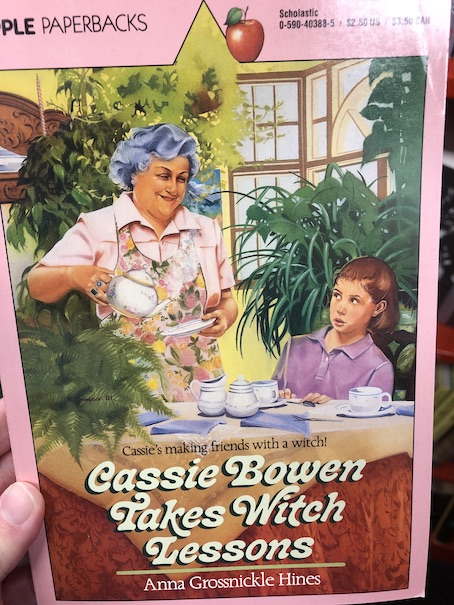
The Mystery of the Crimson Ghost

The Mystery of the Crimson Ghost by Phyllis Whitney, 1969.

Janey Oakes loves horses and wishes that she had one of her own.  Her family lives on Staten Island in New York, so they don’t have room to keep a horse.  The only horses that she has ridden are rented ones.  However, her parents are now considering moving to the countryside in northern New Jersey, where Janey’s Aunt Viv lives.  If they do, there will be room for Janey to keep a horse, so she is hopeful.

Janey’s parents take her to visit Aunt Viv during the summer, while they decide if they want to move.  Along the way, they stop to ask directions at a half-ruined house.  The people there, Mrs. Burley and her grandson Roger, aren’t too friendly, and when Janey thinks that she hears a horse there, they seem oddly resentful and say that she should ask her aunt about it.

Aunt Viv seems oddly evasive on the subject of horses when Janey asks, saying that she doesn’t ride anymore.  She does tell Janey more about the strange, half-ruined house.  It was once a hotel for people who came to take the spring waters.  However, it eventually lost its popularity and was partly destroyed in a fire.  Mrs. Burley’s husband died in the fire, but she has remained living in the part of the house that is still standing, raising a couple of grandsons there after the death of her younger son.  Her older son is a doctor in New York City.  Aunt Viv says that she used to be friends with the younger of the two grandsons, Denis, but that ended when she did something wrong and something bad happened which she doesn’t want to talk about.
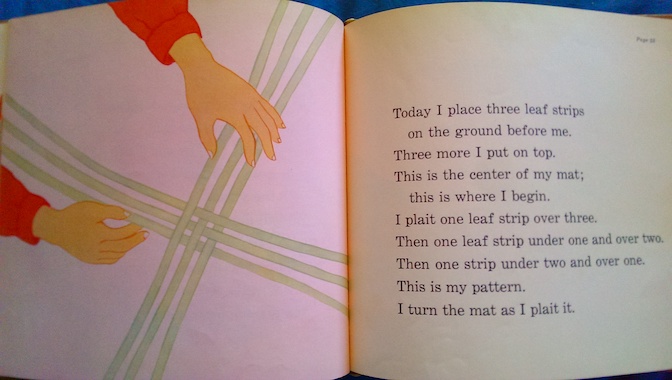
Aunt Viv introduces Janey to a girl who lives nearby named Coral, in the hopes that they will be friends.  Coral isn’t interested in horses, but when Janey questions her about the Burleys, she confirms that they do have a horse called the Star of Sussex.  She takes Janey up to the Burleys’ house again (partly in the hopes of seeing the older Burley boy, Roger, who she has a crush on).  There, Denis and Roger each explain to Janey that their grandmother had hoped to train Star as a racing horse.  Star is an excellent horse and had a lot of potential for racing, but Denis allowed Aunt Viv to ride her one day, and the horse stepped in a woodchuck hole and injured her leg.  The leg has healed, and the horse is able to gallop, but she still limps and can’t run at the same speeds she used to, ending Mrs. Burley’s racing hopes.  Since then, Mrs. Burley has been very bitter, especially toward Aunt Viv.  She behaves strangely, driving people away, and is also angry toward Denis for allowing Aunt Viv to ride the horse in the first place.  It was just an accident, but she blames them both.  Roger realistically thinks that they should sell Star for breeding because she has a good bloodline, and Denis’s real interest lies with airplanes, which fascinate him in the same way that horses fascinate Janey.  Their differing interests seem to support what Aunt Viv says about how the family should move and that the boys would probably have a better life away from the old, ruined hotel and Mrs. Burley’s obsession with the past.

Coral also tells Janey about a ghost dog that supposedly appears on nights when a strange red light appears on the Burleys’ property.  Later, Janey hears the howling at night. Aunt Viv doesn’t think it’s a ghost.  She says that people have tried to talk to Mrs. Burley about her dog, but she denies having one and gets really angry with people for accusing her of having one.  Yet, the howling does seem to come from the Burleys’ property, and Denis even says that he’s seen the ghost dog, that it seems to be covered in flames.  He claims that it’s the ghost of his grandfather’s dog, who died in the fire years ago.  Aunt Viv thinks that Denis is just saying that to try to protect his grandmother and because he can’t handle what other people have come to believe about her: that she’s losing her mind.  Mrs. Burley’s behavior is undeniably odd, and she’s prone to sudden mood swings.  People are worried that she’ll drive newcomers away from the area and drive down property values, and they think that she might need professional help.

Janey doesn’t think that Mrs. Burley’s mind is gone as much as people believe.  When she sneaks over one day to visit Star, Mrs. Burley is angry but notes that she has a good manner with horses.  To Janey’s surprise, Mrs. Burley agrees to let Janey ride Star.  Denis almost ruins things by making Janey believe that Mrs. Burley has changed her mind about the invitation and also by not telling his grandmother that Janey asked to meet at a later time.  Janey isn’t sure why Denis seems to have a grudge against her, although it might have to do with his own guilt for allowing the horse to be ridden and injured in the first place; his own grandmother still seems to have a grudge against him for that.  Neither one of them tells Janey that Star has a particular trick for throwing riders, even though she had specifically asked if there was anything that she should know about the horse or if it had any tricks.  After she’s thrown by the horse, however, Janey gets back on and proves to both the Burleys and to Star that she’s not intimidated and not going to fall for the trick again.  (The Burleys have deep, personal hurts, but I wouldn’t call them nice people.  There are people who would probably view this is a test of Janey’s skills and her ability to stick with a challenge, but I think that their lies and deliberate deception when Janey was asking the right questions show only their immaturity.  It may not bother some readers as much as it did me, but I have a very low threshold of patience for such things, and the characters lost a lot of my sympathy right there.)

Mrs. Burley warms up to Janey after that and confides in her some of the reasons why she has been so unfriendly, trying to drive people away, and why the horse meant so much to her.  Years ago, she and her husband made quite a lot of money, raising racing horses.  Star is from the same bloodline as their original horses.  Mr. Burley lost quite a lot of their money on various business ventures that didn’t work out, even before the hotel fire that killed him, but for a long time, Mrs. Burley was always able to keep one horse from that bloodline, hoping to get at least one last racing horse.  Star is an excellent horse who really would have made a good racing horse, but Mrs. Burley’s hopes were destroyed when Star was injured.  Mrs. Burley thinks that she’s too old now to raise another, that she wouldn’t live to see any of Star’s offspring become racers.  Janey still thinks that Star has the potential to be a racer, but Mrs. Burley says that the effects of her injury won’t let her get the speed she once had.  Mrs. Burley resents outsiders hanging around because she fears their “interference” in her life, and the injury of Star while Aunt Viv was riding her seems to prove that her fears are justified.

Janey tries to talk to Mrs. Burley about the ghost dog, but she gets angry with Janey for believing the things that people have been saying about her.  Worse still, Roger tells her that Mrs. Burley will probably sell Star soon.  She needs money badly and has been refusing to let anybody help her, even her son in New York.  Her pride at her independence may be her undoing.  Now that Janey has ridden Star successfully, she can’t bear the thought that the horse might be sold and sent away.  If only she could unravel the mysteries surrounding the Burley family, the strange red light, and the ghost dog!

My Reaction and Spoiler

Toward the end of the story, one of the characters talks to Janey about Mrs. Burley’s attitude, saying that “it’s important in life to have something to fight for.  Something we care about and want.  I don’t mean fight for with our fists, but something to try for, struggle for.  Something we can do that uses whatever we are to win the fight.”  He means that people need a purpose in life, something like a cause to believe in or a way of life to pursue that is suited to their talents. Janey says that she doesn’t like struggles, but the person points out to her that everything in life that you want involves a struggle, including the horses Janey loves. Janey has focused mostly on the struggle of getting her parents to agree to let her have a horse and Mrs. Burley to agree to let her ride Star, but even if she ended up owning a horse, including Star, there would still be the struggle of caring for the horse, devoting time to keeping the horse happy and healthy. Janey might enjoy that kind of struggle because it appeals to her talents and interests, but it would still require time and sacrifice on her part. Mrs. Burley loves horses as much as Janey does, and she loves the area where she lives to the point where she can’t image living anywhere else. All of her efforts focus on allowing her to continue living in the place she loves, although she feels like her horse dreams are lost.

Much of the emphasis of the book is placed on Mrs. Burley’s determination to maintain her independence as part of the lifestyle she loves, but I wish that there was a little more emphasis on the methods that people use to get what they want in life because that is central to the secret of the “ghost.”  That the “ghost” isn’t really a ghost isn’t too much of a spoiler, but while people in the area think that Mrs. Burley is faking the ghost because she’s mentally unbalanced, the real culprit is someone who wants Mrs. Burley to leave because there’s something that he wants very badly and doesn’t think that he’ll get it otherwise.  Once his scheme is exposed, the others make sure that he doesn’t get what he wants because, after what he has done, he doesn’t deserve a reward.  However, I wish that they had explained a little more plainly that there were other ways of getting what he wanted besides the scheme he planned.  The culprit thinks that no one was listening to him and what he wanted, but from my perspective, what he wanted was simply a matter of time, and he wasn’t willing to wait.  His scheme would have ended with Mrs. Burley being declared mentally incompetent and being put away in a home, which is a cruel thing to do to someone.  The other characters tell him that, but I wanted someone to explain to him that harming others for his own benefit would make him no better than someone who robs a bank because they want money.  That is, crime and fraud are still wrong even if they succeed because the ends don’t justify the means.  In some ways, I think that Mrs. Burley was selfish, but she still didn’t deserve to be labeled as crazy, and even if people weren’t listening to the culprit and taking him seriously as much as they should, the scheme still wasn’t his only option. 

To say more would be to tell you who the culprit is, and it’s not as obvious as it might seem. It was one of my favorite suspects, but I changed my mind a few times, going back and forth between suspects up until the end. In the end, Mrs. Burley is prepared to forgive the culprit and start over again, and there are hints that he may get what he wants in the future if he behaves better.  Personally, I think he probably would have gotten it eventually, anyway, so his situation is relatively unchanged, although he is now under pressure to prove his behavior to everyone. 

As for Star, she does become Janey’s horse as a gift from the one person who is in a position to give the horse to her while making sure that Mrs. Burley gets the money she needs.  Because of Janey’s help in revealing the culprit to Mrs. Burley and because of her devotion to the horse, Mrs. Burley is fine with the arrangement.

Jane-Emily

JaneEmily

Jane-Emily by Patricia Clapp, 1969.

Louisa is a young woman around the turn of the century.  She is only 18 years old and unmarried, but she is in love with a young man named Martin.  However, her parents think that she is becoming too serious about Martin too soon, so they insist that she spend the summer taking her young niece, Jane, to visit her other grandmother.  Jane has lived with her maternal grandparents, Louisa’s parents, since the death of her parents.  Louisa loves her niece, but she resents her parents changing her summer plans in order to keep her away from her boyfriend.

However, this is not just a love story but a ghost story.  Jane’s parents were killed in a strange buggy accident, which is why she lives with her grandparents and young aunt.  Her other grandmother has lived alone since the death of her son (Jane’s father) and her husband, some years earlier.  She had another child, a daughter named Emily, but Emily died young many years ago of a sudden illness.

As Louisa soon learns, Emily was a pretty and clever but seriously disturbed child.  Her father idolized her, coming to love her even more than he loved his wife.  He thought she was absolutely the most perfect child in the world and could never forbid her anything.  He gave her everything she ever asked for and refused to allow his wife to discipline her for any reason, even when she needed it.  It would be enough to spoil any child, but Emily was extremely callous, cold, and manipulating by nature.  Her father’s catering to her only fed her selfishness and ruthlessness.

Emily was known to resort to extreme measures to get her way, and in the end, it led to her death.  She fell in love with the son of the local doctor, deciding (without his consent) that they would get married one day.  However, he didn’t really care for her at all, seeing her extreme selfishness.  In a bid to get his attention and sympathy, Emily decided to make herself ill.  One cold night, she soaked her nightgown in water and deliberately sat by an open window.  Unfortunately, it worked too well, and she became so ill that she died.

However, Emily’s selfishness and determination to get her way seem to have lasted beyond the grave, and young Jane’s presence in her old house, in the very room that used to be Emily’s, seems to have awakened Emily’s wrathful spirit.  Jane becomes fascinated with the reflecting globe in the garden, which Emily declared was hers alone and that no one else could ever look into it.  Jane claims that she can see Emily’s face in the globe, but people don’t believe her at first. Jane bears a close resemblance to Emily, although the two of them are very different in character.  Jane seems to develop an unhealthy obsession with her dead aunt, and she seems to know things that only Emily could have told her.  Emily seems to be slowly taking over Jane.

Jane’s grandmother confides that she has believed that Emily caused the sudden deaths of her husband and son because they both died under unexplained circumstances and Emily could never let go of anything or anyone she thought belonged to her.  Now that Emily seems to be showing an interest in Jane, her grandmother begins to fear for her.

Meanwhile, Louisa is falling in love with Adam, the young man Emily had planned to marry and who is now a doctor himself.  Adam also loves her, wanting her to marry him.  However, Louisa has become convinced of Emily’s evil presence and the threat that she poses to young Jane.  When Emily forces Jane to go out in a freezing rain, making her become ill in the way she did before she died, Louisa must help Jane to fight for her life.

Emily’s presence centers around the gazing globe in the garden, and the only person who can end her evil influence and save Jane is her grandmother, who finally finds the courage to stand up to her daughter and tell her that there are some things that she can’t have.

The book is currently available online through Internet Archive.

My Reaction

Parts of the story feel a bit preachy on the subject of parents who spoil their children, but Emily and her family are presented as an extreme case of that.  At times, characters wonder what Emily would have been like if her father hadn’t constantly catered to her every whim and had given her the discipline she needed.  They all agree that she would have lived a longer life, as would other members of her family.  However, Emily was already a naturally selfish person and apparently incapable of empathy.  Her father’s worship of her was seriously unhealthy and, in a way, a reflection of his own selfishness; Emily represented all the qualities that he loved in her mother but she was a creation of his (well, you know, 50%, genetically speaking), making her infinitely more perfect and more worthy of his love than his own wife.  One of the other characters comments that his wife was the real victim in the end because her husband blamed her for their daughter’s early death (which was definitely Emily’s fault alone) and subjected her to years of guilt over it, rejecting all the love they had once had for each other.

The story ends happily but on a somewhat ambiguous note because Louisa realizes that there are many things that she doesn’t understand, and although Emily seems like she’s finally gone, the memory of her will haunt them all.

Seven-Day Magic

SevenDayMagic

Seven-Day Magic by Edward Eager, 1962.

John and Susan are brother and sister, living in a perfectly ordinary town in Connecticut. They are tall, good-looking, and good in school and at sports, so they are generally popular and are often chosen for positions like class president. However, their home life is unusual because they are orphans who live with their grandmother, who sometimes requires them to look after her as much as she looks after them. Their grandmother isn’t very strong, but she is spirited and is sometimes tempted to do things that she probably shouldn’t do at her age, like climbing trees. Because John and Susan feel like they have to look after their grandmother, it’s sometimes difficult for them to get out and do some of the things that other children their age are doing, like going to parties. They’re glad when Barnaby and his sisters move to a house nearby because they make life more exciting.

SevenDayMagicChildren

Barnaby and his sisters, Abigail (called Abbie) and Fredericka, become friends with John and Susan. Their father is a singer in advertisements, and their mother is a realtor. Because their parents work a lot to make ends meet, the children are often left to their own devices.  Barnaby is opinionated, stubborn, and sometimes hot-tempered, which causes him to get into fights at school, but John likes him because he’s imaginative and full of interesting ideas.

Barnaby wants to be a writer. He’s secretly writing a story of his own, and he encourages the others to read more. Before meeting Barnaby, John hardly read anything at all, and Susan was mostly into the Sue Barton books, about a young woman who becomes a nurse (a real series that was popular in the mid-20th century, realistic fiction). Barnaby introduces them to a whole new world of fantasy stories, full of adventure. One day, while visiting the library together, the children talk about the kinds of stories that they like and wish that they could find a really good book full of magic and kids that are like themselves. Their wish comes true in a peculiar way.

On impulse, Susan checks out a rather worn-looking book with a red cover, not really knowing what it’s about but thinking that it just looked kind of interesting. The librarian seems a little uneasy when she takes it and warns her that she can only keep that particular book for seven days, which is surprising because that’s the limit usually imposed on new books, not old ones.

On the way home, the children show each other what they got and read parts of their books aloud to each other. When Susan opens the red book, they are all startled to find out that the book is about them. It starts out just like the real life book and tells about their lives and backgrounds and has their conversation about books they like, word-for-word. The children can tell that this is a magic book, but even while the idea is thrilling, it makes them uneasy. There is nothing written beyond their conversation about books, and the book won’t let them turn pages to see what might come next or how their story will end.

As much as the children like the idea of being the stars of their own magical book, it’s worrying. They don’t know what they’re in store for, and they even worry briefly that maybe their entire lives are fictional, that they might just exist in someone’s imagination, although they don’t really believe that because they can remember their lives before the story began. Barnaby points out that the book specifically mentions that he and his sisters recently moved to the area, but he remembers having lived elsewhere before that.

The children carefully consider everything they had originally wished for in a book: that children, just like themselves, would be walking home from somewhere and a magical adventure would start before they even realized that it was happening and that they would have to figure out the rules of the magic in order to use it for their own purposes. Since the first part of their wish has literally (very literally) come true, they decide that they’re going to have to figure out what the rules of this magic are before they decide what to do next. Since looking ahead in the book seems to be against the rules, they decide that they will have to be very careful about anything they wish for next because their wishes seem to be what writes the story, and they need to discuss it first and come to an agreement about it.

SevenDayMagicDragon

Unfortunately, little Fredericka (the youngest of the children) is too impatient for discussion and immediately wishes for an adventure with wizards, witches, and magic, and she wants it to start right away so that they’ll know that the magic is really working. A minute later, a dragon suddenly appears and scoops up Fredericka, flying away with her!

The others try to figure out where the dragon came from, and it turns out that a stage magician who lives nearby was practicing his act at the time that Fredericka made her wish. When she wished for a magical adventure, the rabbit that the magician was supposed to pull out of his hat turned out to be a dragon. The magician, The Great Oswaldo, is mystified, but he’s destined to play the part of Fredericka’s requested wizard. The children ask him to help them, and he says he’ll try, although he’s not sure how.

As Oswaldo tries various tricks in his magic supplies, they don’t work in the way they usually do. Finally, he is able to make his landlady’s house fly after the dragon, much to the landlady’s horror (she’s cast in the role of the witch in Fredericka’s story). In the magical land where the dragon lives, the peasants inform them that the dragon is always carrying off girls and young women to eat them, and they have to think of something fast before Fredericka becomes his next meal!

This is where the children discover that the contents of the magical book change depending on who reads it. When the magician reads it, it’s full of magic spells. When the landlady, Mrs. Funkhouser, takes it from him, it has household hints. For the dragon, it’s all about dragons. Surprisingly, it’s Mrs. Funkhouser’s household hints that save the day, although it’s Oswaldo who gets most of the credit because one of his pet cats eats the dragon after Mrs. Funkhouser shrinks it.

Oswaldo and Mrs. Funkhouser decide to stay in the magic land (which the children think might actually be Oz, in its early days), where they are hailed as heroes, sending the children home by themselves with the help of Mrs. Funkhouser’s vanishing cream. As expected, this adventure is now written in the magic book when the children have another look at it (although Fredericka argues that the illustrations don’t really do her justice).

SevenDayMagicCoin

Susan, as the borrower of the book, says that she wants their next adventure to be calmer, the kind of everyday magic that just creeps up on you. This is the part of the story where it crosses over with the events in Half Magic (another book in the same series as this one). In these children’s world, Half Magic is a fictional book that they’ve read and liked. Susan’s requested adventure picks up where Half Magic left off, explaining what happened after the other four children (Jane, Mark, Katharine, and Martha) left their magic coin to be discovered by a new owner. Susan and her friends delight in explaining to the young girl who found the coin what it does. The girl says that she had thought that the coin might be magic, but was confused because she didn’t get her wish to go into the future and meet some other children. Because the coin only grants wishes by halves (interpreting that pretty liberally), Susan and her friends (who live in the future), came to meet her instead.

Once again (as is common in this series), it leaves the matter of what is fiction and what is reality open to question. Was it the girl’s wish that brought the other children to her, or their wish that took them into her story? Or Both? Was that fantasy story secretly real, or are Susan and her friends more fictional than they like to think? The author likes posing questions like this, but of course, you never completely know the answers, and in some ways, it hardly matters because the adventure doesn’t require anyone’s understanding for them to take place, which is something that, ironically, it has in common with real life – things frequently happen regardless of whether or not you understand the reasons why. Sometimes, figuring out how things work and to deal with them is about all you can do, never getting the complete “why” behind everything.  That’s pretty much how all the stories in this series go.

After the children explain to the girl what the coin is and how it’s supposed to work, she makes a more careful, doubled wish to go to the future with the other children. Unfortunately, when they get there, she panics when she realizes that she forgot to bring her one-year-old baby brother with her and makes a hurried half-wish for him to be there, too.   Because she didn’t wish right, what she gets is her brother at the age he would be in the other children’s time (about age 37) but still mentally the baby he was back in 1924 (the girl’s time). The “baby” is amazed when he realizes that suddenly he can walk and talk much better than he could before and that he’s suddenly much bigger and stronger than he used to be. He gets hold of the coin and refuses to give it back, telling his little “big” sister that he can do what he wants now, not what she tells him to do. Noting that he can even pick her up and carry her around now, he does that, with the others chasing after him to get the charm and bring him under control. (A somewhat similar incident, where a baby grows up too fast and is dangerously immature, happens in E. Nesbit’s Five Children and It – another instance of Edward Eager playing off her books.)

It’s chaos for awhile because a 37-year-old man who acts like a 1-year-old can’t help but attract attention, especially when he gets it into his head that he wants to drive a train. Eventually, they get the “baby” back under control and to his proper age, allowing his sister to take him back to their own time and plan her future adventures with the coin.

Then, Susan and John’s grandmother gets hold of the book, and it takes her and her grandchildren back in time, to when the grandmother was a young woman working as a prairie schoolteacher. Susan makes a wish for the other children to join them, and they help their grandmother and her students to survive a sudden blizzard. They come to appreciate their grandmother’s youthful personality and formidable spirit even more from the experience. They even get to meet their grandfather, who died before they were born, seeing him rescue their grandmother and her students when he was a young man.

SevenDayMagicPlaywright

Then, Abbie decides that she wants to try to help her father’s singing career. He typically has to work long hours and never makes very much money, just being part of the chorus on advertisements. She thinks things will be so much better if they can help him to be discovered as a great talent. The others are kind of doubtful about her plan because the book seems to send them on rather “bookish” adventures, related to other stories they’ve read or people’s memories, like in their grandmother’s case because her early life actually did somewhat resemble things from the Little House on the Prairie series (a series which the grandmother enjoys reading for that reason). The other children just don’t know what would happen if Abbie tries to use the book for something more modern and everyday, like their father’s career. She tries it anyway, with some unpredictable results.

During a recording at a television studio (which the children are present to witness), the magic makes their father sing wonderfully but he also does his singing part out of sync with the other singers. He’s sure that he is singing his part at the right time, but for some reason, the other members of the chorus are silent when he sings. The director gets mad at him for singing out of sync and messing up the performance, and the singer who was supposed to be the star gets mad about being upstaged, but the reviewers end up loving the performance. So, while at first it looks like the father is going to be fired, he ends up with more singing parts because of the episode. The only problem is that all the singing parts are silly jingles, like the typical advertising jingles he gets. While he’d welcome more money, he always dreamed of being able to get better parts. However, the magic isn’t quite done, yet. When Abbie meets a playwright who is looking for a new talent to sing in his play, it turns out that he has seen Abbie’s father on tv and likes his voice.

SevenDayMagicWings

Abbie’s wish is so great and does so much for their family that the kids start thinking that it might be the end of the magic. The seven days are really up, and the book has to go back to the library the next day. However, John and Barnaby haven’t had their chance to wish yet, and each of them wants to have a turn before the book goes back. Barnaby even suggests that perhaps they can keep the book an extra day, turning it in late. Surely a little late fee isn’t too much to ask for an extra day of magic, is it? Abbie is afraid, though, that keeping the book overdue would be breaking the rules and that the magic might go all wrong. She’s right.

Even with the idea of keeping the book for extra time, John and Barnaby argue over which of them will get to go first. The book’s magic, angry about not being returned to the library, turns sour on them, causing them to fight. John angrily tells Barnaby that just because he’s usually the group’s idea man doesn’t mean that he’s the only one who’s allowed to have ideas. (Which, in a way, is something that Barnaby needs to hear because that’s part of the reason why he often gets into fights – he always thinks he knows best.) John and Barnaby fight over the book, and the book gets torn. John ends up with a few pages, and Barnaby gets most of the book, which he uses to make a wish that he refuses to tell to the others. Barnaby disappears, and the others realize that the pages that Barnaby is holding are the last few pages from the end of the book, still blank. Without them, the book can’t end, and Barnaby could end up stuck in the book forever! Can the others find him and get him (and the book) back before it’s too late?

Before the end of the book, John does prove that, although he might not be as quick to come up with ideas as Barnaby is, he does get good ones. After he and the others find Barnaby, John uses his wish to get them back home and to return the book to the library in a most unusual way.  (Actually two unusual ways because he couldn’t quite make up his mind about which was best.  Both of them are homages to incidents in E. Nesbit’s books.)

The book is currently available online through Internet Archive.

A Hugga Bunch Hello

HuggaBunchHello

A Hugga Bunch Hello by Phyllis Fair Cowell, illustrated by Ron C Lipking, 1985.

Bridget likes having her grandmother living with her and the rest of her family. Her grandmother always has time for her and is willing to give her a hug. Her parents are often too busy, her brother thinks hugs are just for girls, and her Aunt Ruth is too fussy.

Then, Aunt Ruth tries to persuade everyone that Bridget’s grandmother should go live in a nursing home. Bridget doesn’t want her grandmother to leave, but she doesn’t know what to do about it.

While she worries, a strange little person steps out of her bedroom mirror. This little person is Huggins, one of the Hugga Bunch. She says that she knows about Bridget’s problem and thinks that she can help. She invites Bridget to come with her to Huggaland.

HuggaBunchHelloMirror

In Huggaland, the Hugga Bunch take Bridget to see the Book Worm, who may have the solution that Bridget seeks. Both the Hugga Bunch and the Book Worm say that aging can be slowed by affection and “the knowledge that they are needed,” but Bridget thinks that the only solution is to find a way to actually make her grandmother young again.

The Book Worm says that if that’s what Bridget wants, then her grandmother must eat fruit from the Youngberry Tree. Unfortunately, the tree is in the territory of the Mad Queen of Quartz. Although the Hugga Bunch are afraid of her, Bridget is willing to face her for her grandmother’s sake.

Getting there involves going through a few obstacles, including walking sideways on a sideways sidewalk and facing a frightening beast who turns out to be a baby elephant who was under a spell. When they reach the tree, the mad queen takes them prisoner and turns Bridget into a statue. Fortunately, the others manage to break free and save her.

HuggaBunchHelloTree

Bridget is happy at being able to bring the Youngberries to her grandmother, but as she passes through the mirror into her room, she accidentally drops them, and they disappear.

Not knowing what else to do, Bridget runs to give her grandmother a hug before she leaves, encouraging her brother to do the same. Bridget’s father wasn’t happy about her grandmother leaving, either, and seeing how much the children will miss her, he declares that she should stay.

This book was made into a made-for-tv movie.  It is currently available on YouTube.  It follows the plot of the book pretty closely.

Mailing May

MailingMay

Mailing May by Michael O. Tunnell, 1997.

Four-year-old Charlotte May lives in a small town in Idaho in 1914. May, as her family calls her, wants to visit her grandmother in another town, but travel during this time is difficult and expensive. With a lack of roads that are easy to travel, the only comfortable way to get to May’s grandmother’s town is by train. Unfortunately, May’s family can’t afford to buy a train ticket for her.

MailingMayParents

May wants so badly to go see her grandmother that she even asks at the local general store if the owner can hire her, but he doesn’t have any work that a little girl could do.  Then, May’s mother’s cousin helps the family to find a more affordable alternative. If May can’t travel as a passenger, is it possible for her to travel as . . . mail?

MailingMayPostOffice

It turns out that the rate for mailing a live package the size of May is much cheaper than the fee for a passenger ticket.  Because May’s mother’s cousin works in the mail car on the train, he could take responsibility for her during the trip.  So, with a label on her clothes, declaring her to be “baby chicks” and the proper postage stuck to her jacket, May undertakes the journey to her unsuspecting grandmother’s house.

MailingMayTrain
MailingMayMailCar

This story was based on a real incident. In fact, May wasn’t the only child to be sent through the mail when their parents couldn’t afford to send them as passengers. I also like the book for its glimpse at travel and mail services over 100 years ago.

The book is available to borrow and read for free online through Internet Archive.

MailingMayGrandmother

The Little Indian Basket Maker

BasketMaker

The Little Indian Basket Maker by Ann Nolan Clark and illustrated by Harrison Begay, 1957.

By “Indian,” the author means Native American.  This book specifically focuses on the  Papago (Tohono O’odam) who live in the Southwestern United States, specifically Arizona.  The story is about a young girl who is starting to learn the traditional art of basket-making, and the book goes into the process involved in making baskets, step by step.   Although the use of “Indian” instead of Native American is somewhat antiquated, and Tohono O’odam is really the proper name for the Papago people, the book has something of an interesting history and the picture it provides of the practice of traditional crafts is fascinating. There is a section at the beginning of the book which explains a little about the history of the Papago (Tohono O’odam) people and where they live.

BasketMakerGrandmother

A young girl explains how her grandmother teaches her the traditional craft of making baskets.  They start by gathering the types of plants that they are going to use.

BasketMakerPlants.jpg

They also need special plants for the dye they will need in order to decorate the baskets.  The girl’s grandmother explains about the different types of decorations they traditionally use.

BasketMakerDesigns

Making baskets is a long process that includes cleaning the plants and tearing them into long strips, bleaching them, soaking them to soften them, dyeing strips used in the design, and weaving them together.

BasketMakerSoftening

The girl weaves a mat that takes days to finish.  It is the first one that she’s made herself.

BasketMakerWeaving

She is very proud of herself when the mat is finished, and she is pleased with the quality of her work.

BasketMakerFinishing

I’ve owned this book since I was a young child, and it was my introduction to traditional crafts.  Later, I found a related book at a thrift store, The Little Indian Pottery Maker.  Until then, I hadn’t realized then just how old the books were and that there were more of them by the same author.

The book, which was written in the 1950s, was one of a group of stories (not exactly a series because they didn’t have a specific set of characters in common and the themes varied somewhat) written by a woman who was a teacher with the United States Indian Service.  The other books that she wrote, including The Little Indian Pottery Maker, focus on members of different Native American tribes.  She was not Native American herself, and the modern view of Indian schools is not favorable (for good reasons), so one might be a little suspicious of a book written about Native Americans by an Indian school teacher. However, these books interest me because of their explanation of traditional crafts. There are no white people in the stories at all, and they have a timeless quality to them.  Reading them, it’s hard to get a sense of exactly when the stories take place because it’s never mentioned, and there aren’t many clues (no mentions of modern technology, it’s all about the crafts).  I haven’t found any of the other books that the author wrote, but these two are very respectful in their tone, and they begin with explanations of the history of the tribes involved in the stories.  According to Andie Peterson in A Second Look: Native Americans in Children’s Books, the author was deliberately trying to write books that her Native American students could relate to.

The art style of the books vary because they had different illustrators.  The illustrator for this particular book was a Navajo painter.

The book is available to read for free online through Internet Archive.