
The Little Indian Basket Maker by Ann Nolan Clark and illustrated by Harrison Begay, 1957.
By “Indian,” the author means Native American. This book specifically focuses on the Papago (Tohono O’odam) who live in the Southwestern United States, specifically Arizona. The story is about a young girl who is starting to learn the traditional art of basket-making, and the book goes into the process involved in making baskets, step by step. Although the use of “Indian” instead of Native American is somewhat antiquated, and Tohono O’odam is really the proper name for the Papago people, the book has something of an interesting history and the picture it provides of the practice of traditional crafts is fascinating. There is a section at the beginning of the book which explains a little about the history of the Papago (Tohono O’odam) people and where they live.

A young girl explains how her grandmother teaches her the traditional craft of making baskets. They start by gathering the types of plants that they are going to use.
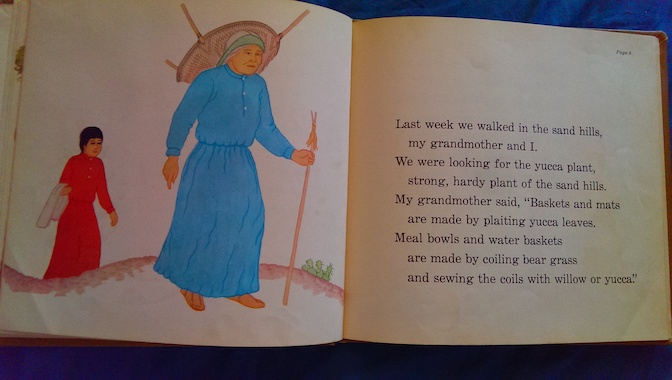
They also need special plants for the dye they will need in order to decorate the baskets. The girl’s grandmother explains about the different types of decorations they traditionally use.

Making baskets is a long process that includes cleaning the plants and tearing them into long strips, bleaching them, soaking them to soften them, dyeing strips used in the design, and weaving them together.

The girl weaves a mat that takes days to finish. It is the first one that she’s made herself.
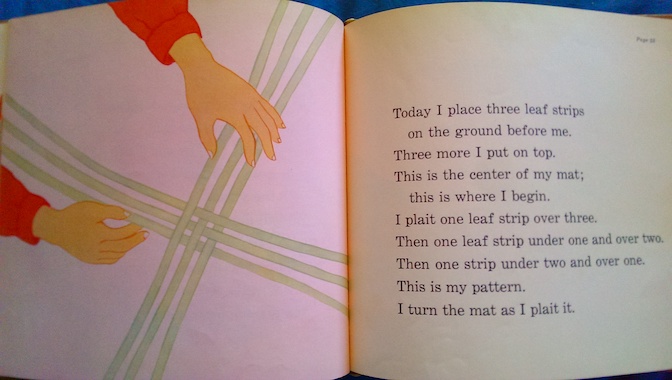
She is very proud of herself when the mat is finished, and she is pleased with the quality of her work.

I’ve owned this book since I was a young child, and it was my introduction to traditional crafts. Later, I found a related book at a thrift store, The Little Indian Pottery Maker. Until then, I hadn’t realized then just how old the books were and that there were more of them by the same author.
The book, which was written in the 1950s, was one of a group of stories (not exactly a series because they didn’t have a specific set of characters in common and the themes varied somewhat) written by a woman who was a teacher with the United States Indian Service. The other books that she wrote, including The Little Indian Pottery Maker, focus on members of different Native American tribes. She was not Native American herself, and the modern view of Indian schools is not favorable (for good reasons), so one might be a little suspicious of a book written about Native Americans by an Indian school teacher. However, these books interest me because of their explanation of traditional crafts. There are no white people in the stories at all, and they have a timeless quality to them. Reading them, it’s hard to get a sense of exactly when the stories take place because it’s never mentioned, and there aren’t many clues (no mentions of modern technology, it’s all about the crafts). I haven’t found any of the other books that the author wrote, but these two are very respectful in their tone, and they begin with explanations of the history of the tribes involved in the stories. According to Andie Peterson in A Second Look: Native Americans in Children’s Books, the author was deliberately trying to write books that her Native American students could relate to.
The art style of the books vary because they had different illustrators. The illustrator for this particular book was a Navajo painter.
The book is available to read for free online through Internet Archive.
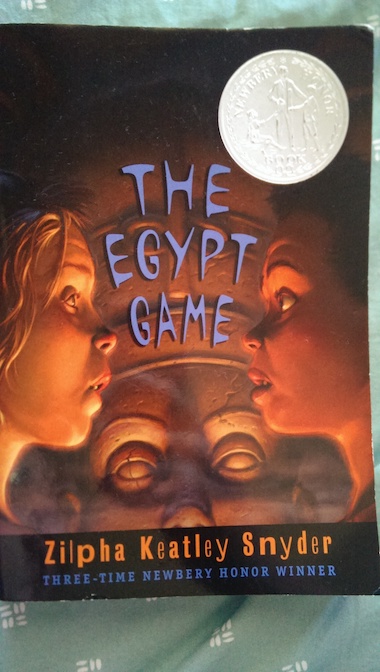
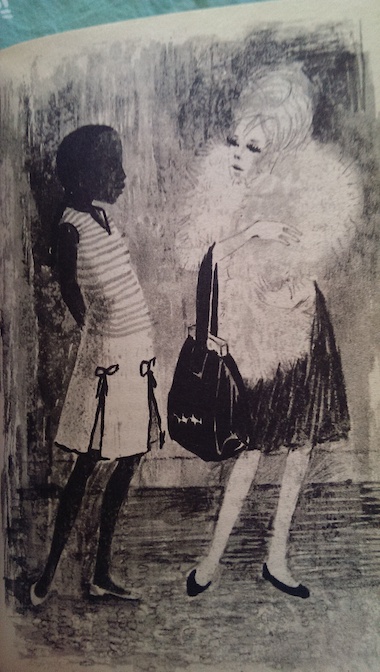 April Hall has come to live with her grandmother (the mother of her deceased father) because her actress mother is touring with a band as a singer. April’s mother isn’t a big star, although April likes to brag about her and their Hollywood life. Really, her mother is mostly a vocalist who occasionally gets parts as an extra, hoping for that big break. April is sure that when her mother gets back from her tour, she will send for her, and they will live together in Hollywood again. Although, from the way her grandmother behaves, it seems as though April may have to prepare herself for living with her for the long term. April resents her grandmother’s apparent belief that her mother has dumped her because she is unwilling or unable to take care of her.
 The children are uneasy about this unexpected game player because frightening things are happening in their neighborhood. The kids wonder if the mysterious messages could be from the crazed killer who murdered the young girl. People have been looking suspiciously at the loner who owns the antique store, an older man who everyone calls the Professor. However, the kids have become too enmeshed in the Egypt game to give it up in spite of their fears.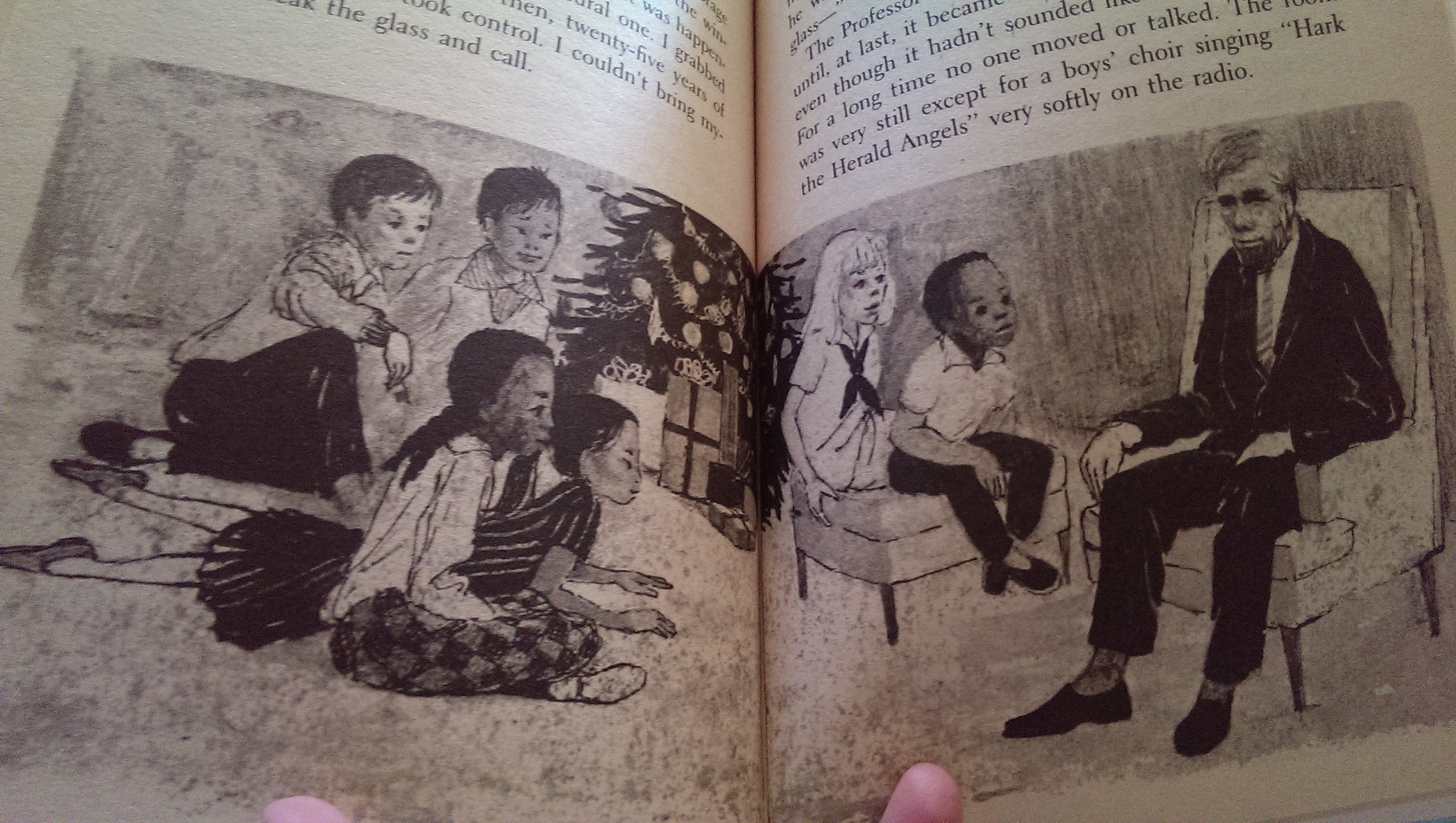



 Jestress's Forgotten Books and Stories