Princess Hyacinth by Florence Parry Heide, illustrated by Lane Smith, 2009.
For reasons nobody understands, Princess Hyacinth is not affected by gravity, and she floats upward anytime she is not restrained or weighted down.
It’s a real problem because, while it’s difficult enough when she floats up to the ceiling of the palace, if she were allowed out of the palace without something weighing her down, she would simply float away.
Princess Hyacinth’s parents go to great lengths to make sure that she is always secured to something or weighed down with special weighted clothes and a very heavy crown.
Of course, being weighted down all of the time makes life difficult for Princess Hyacinth, too. She wishes that she could go outside and play and swim with the other children, but she can’t because she can’t be outside without the weights. There is one boy in particular who comes by her window with a kite with a crown on it and says hello to her, but it would be difficult for her to go out and play with him.
Then, one day, when Princess Hyacinth is particularly bored and tired of being weighted down, she persuades a balloon man to tie a string to her and let her float among his balloons. At first, it’s fun, floating along as the balloon man walks through the park, but then, the balloon man is startled by a dog and accidentally lets go of her!
As Princess Hyacinth floats upward into the sky, she is thrilled because she has never felt so free in her life, but where will it end? How high can she go, and is there any way for her to get back? Fortunately, there is a way for her to get home, with the help of a friend!
The book is available to borrow and read for free online through Internet Archive (multiple copies).
My Reaction
This story reminded me of a much-older story from the 19th century, The Light Princess, but this picture book is much, much less serious than that book. In The Light Princess, the princess is cursed, and the story is about breaking this curse that has afflicted her all of life. In this book, there is never any explanation about why Princess Hyacinth isn’t affected by gravity, and she is never cured. Instead, she makes a friend who helps her find a way to live with her condition and enjoy it.
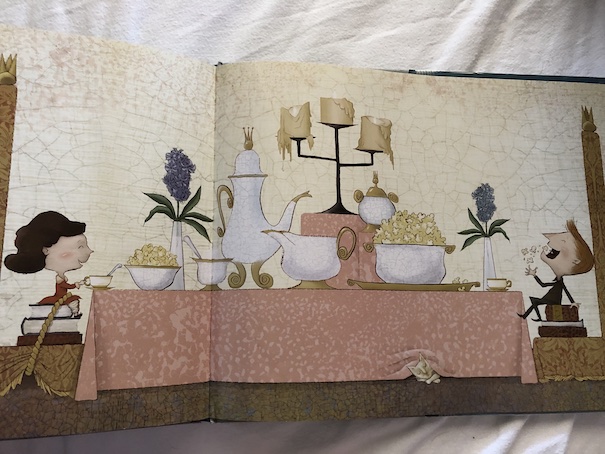
I liked the art style in this book. I found it amusing that the king, queen, and palace guards are drawn in the style of the face cards in a deck of playing cards. Princess Hyacinth is a cute little girl, and when she’s wearing her heavy princess gear, you can almost feel the weight of it on her. In the end, there are still times when she has to be tied down, but she seems more normal, less weighted down, because she has found someone to help her deal with her condition.
It’s late summer, and it’s very hot. The well is dry, so Anna Lavinia has to go to the spring whenever they need water, and the paw-paws are falling off the trees even though they’re not ripe yet. Anna Lavinia is spending most of her time outside, singing songs from her favorite book Songs from Nowhere, because her mother is making the green paw-paws into preserves, and it’s a smelly process. Nothing seems like it’s going right, and even Anna Lavinia’s animal friends are grumpy because of the heat.
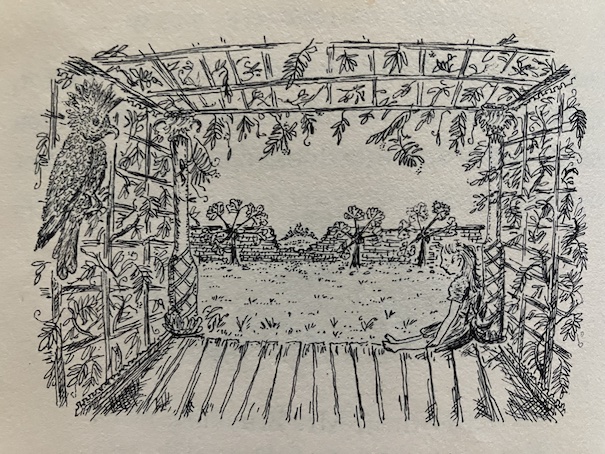
Anna Lavinia looks at Dew Pond Hill through the hole that her father recently made in the garden wall. He made it because he’s been thinking that Anna Lavinia has been too cooped up, and he wants to “broaden the horizon for her” and give her a new “point of view” in a very literal sense. Anna Lavinia thinks that she already has many points of views on many issues, but she does like the new vista that her father has opened up for her.
Things seem to improve on this very hot day when Uncle Jeffrey comes to visit. Uncle Jeffrey deals in spices, and he brings herbs and spices with him to replenish the family’s supply. Uncle Jeffrey also likes to collect samples of flowers and leaves, which he keeps pressed in a book with labels of their names (if he knows them) and the places where he found them. This time, Anna Lavinia notices a special purple flower in his book that she has never noticed before. There are no notes about it in the book, but she is sure that it is something special.
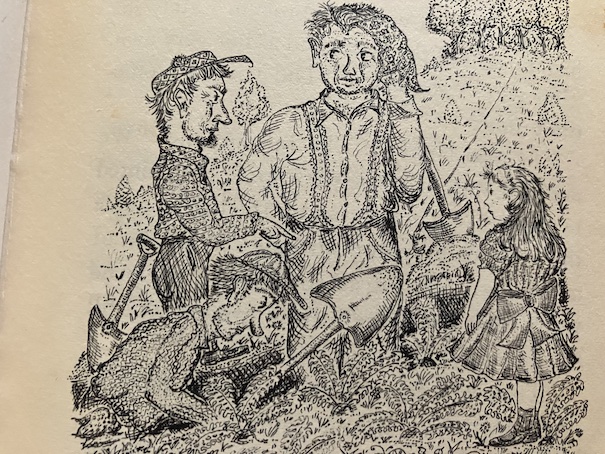
Then, she notices three men digging for something by the dew pond on the hill and decides to go see what they’re doing. Uncle Jeffrey warns her against going to the dew pond because he says that dew ponds are always bewitched. However, her mother thinks that’s nonsense and sees nothing wrong with Anna Lavinia going to look at the dew pond. When Anna Lavinia talks to the diggers, they joke with her at first that they’re digging a hole to go to exotic places on the other side of the world, but then, they admit that it’s just a ditch for water. They want to drain the dew pond! Anna Lavinia is upset about that, and they explain that they need the water to grow their parsnips. They say that this won’t be the end of the dew pond because they plan to fill in the ditch, and the pond will eventually fill up again. However, they really need the water now.
Anna Lavinia goes to look at the dew pond and enjoy it while she can, thinking how awful it is that it’s going to be drained just when her father created a new view of it for her. While she thinks about it, she tosses a few acorns in the water. Then, suddenly, one of them jumps back out of the water at her! Strangely, the acorn also seems completely dry. Curious, Anna Lavinia tosses in another acorn. This time, when it flies back at her, it has a note pinned to it that says, “Please don’t throw acorns at me.” When Anna Lavinia looks into the water, she doesn’t see her own face reflected back at her. Instead, she sees a blond boy in a green sweater. She looks around, but she doesn’t see anyone else by the dew pond but herself. When she calls out to the boy to ask where he is, he says that he’s on the other side of the pond – the underside!
The boy says his name is Tobias, and he’s playing with a boat on the pond. Anna Lavinia asks if he can come up to her through the pond, and he says he could but he promised his mother that he wouldn’t. However, she can come through the pond to him, if she likes. He says that, for her to get through, the water must be completely still, no ripples, and that she must jump in as hard as she can. Anna Lavinia asks what will happen if she doesn’t do it right, and Toby tells her that she’d probably just get all wet and get a scolding from her mother. Anna Lavinia debates about it because Toby is upside down compared to her, and she’s not sure how gravity will work on the underside of the pond. Toby says that the right side up depends on your point of view and there is no gravity where he is. He shows her a net in a tree where she can jump and teases her about being afraid. Deciding that it’s a small risk, Anna Lavinia jumps in along with her pet lizard, which she calls a thobby.
It works just like Toby said it would, and Anna Lavinia lands safely in the net. Once in Toby’s land, she experiences a strange sensation that they call “the tingle.” (It’s not a dirty thing, although I did raise an eyebrow at first.) This sensation is a kind of force that Toby says flows through the ground in his land, and it’s what keeps objects from just floating around all the time in the absence of gravity. If you lift an object off the ground, it will float around in the air because there is no gravity, but once it’s in contact with the ground or in contact with another object that’s in contact with the ground, it will stay where it is, held in place by this force, until someone or something else causes it to move. Toby describes it as being like a kind of magnetism.
With Toby’s help, Anna Lavinia experiments with this lack of gravity. Toby explains that people can’t fly in his land, although birds can fly through the air with their wings. People do lose contact with the ground if they skip or jump, but it’s usually not a big deal because they can sort of maneuver themselves in the air until they can get back down to the ground or grab hold of something that’s grounded. It’s impossible to fall.
All of Toby’s world is the underside of our world, and the ground they’re walking on is the inside of the ball that is the Earth. Because it’s the inside of the Earth, it’s dimmer than the outside world. The light that comes through comes through bodies of quiet water, like the dew pond. Toby says that, while people from this inside world can go to the surface area through any still pond, they typically don’t. For one thing, they find it difficult to deal with the gravity of the outside world, and it will turn them bandy-legged if they stay too long. For another, people who left used to be banished by their own people if they returned, so those who have gone to the outside world have often stayed. Toby’s Aunt Cornelia still misses the man she had planned to marry. After the two of them quarreled about his desire to see the world, he vanished, and Aunt Cornelia thinks that he probably went to the outside world, never to return. Things have changed now so that people who left are now allowed to return, so Aunt Cornelia hopes maybe her sweetheart will come back, but Toby doesn’t think there’s much hope of that.
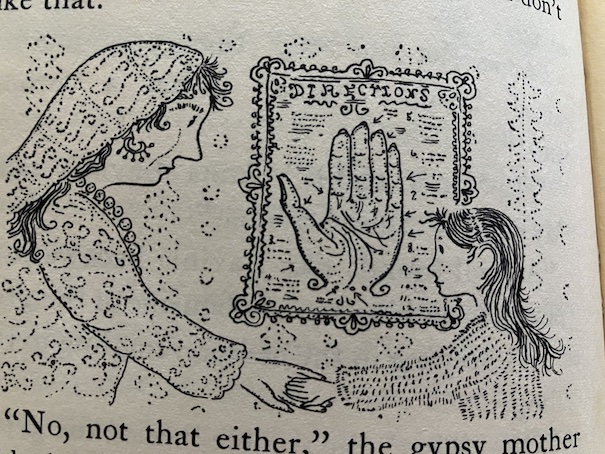
When the children hear a baby crying, Anna Lavinia insists on finding the baby and seeing why nobody seems to be tending to him. It turns out that the donkey pulling a gypsy wagon has pulled the wagon over a cliff, which isn’t as dire as it sounds, since nothing in this land can fall. However, the wagon is now stuck sideways on the side of a cliff, and things from the wagon have been tossed around and are hanging in mid-air, including the baby in his basket. Toby and Anna Lavinia rescue the baby, and his grateful mother offers them a reward for their help. She gives Toby a tambourine, and she tells Anna Lavinia’s fortune. The fortune comes out strangely backward because Anna Lavinia is from the outside world, but from what they gypsy sees, it looks like Anna Lavinia is going to do something to make an old man happy.
Anna Lavinia has a lovely visit with Toby and Aunt Cornelia, but then, she suddenly remembers that the men are going to drain the dew pond today! By the time she and Toby return to the dew pond, it’s dry! With the pond dry on her side, Anna Lavinia can’t get home … unless still waters run deep.
This book is the sequel to an earlier book called Beyond the Pawpaw Trees, which first introduced the character of Anna Lavinia.
My Reaction
The book is sweet and would probably appeal to fans of Cottagecore. The characters sing songs and recite rhymes throughout the story, which might appeal to young children. I was a little divided over whether I liked having the story interrupted by the songs and rhymes, but the songs and rhymes really are a part of the story and add to its charm. It’s a little like Alice’s Adventures in Wonderland, where a girl goes to a magical land, where things don’t work as they do in the ordinary world.
In Alice’s Adventures in Wonderland, there’s a lot of random nonsense, and that’s fun, but I liked that this particular story uses a kind of pseudo-scientific focus on magnetism and gravity. Neither the magnetism nor gravity works the way it does in the real world, and it adds a kind of science-fiction twist to the fantasy world in the story. Even with this almost science-fiction twist, we still have that old-fashioned, cottagecore style fantasy atmosphere that’s charming and whimsical rather than technical. I haven’t read the first book in this series, but I understand that it uses similar concepts. Nothing really stressful happens in the story, and it would make a nice bedtime story.
My one complaint is that there are some stereotypical gypsies and comments about gypsies in the book. They are always referred to as “gypsies” and not Romany or any other name, and for some reason, they make a point at the beginning of the story that gypsies always go barefoot. I’m not sure what the point to that was except to establish that gypsies have eccentric habits. It’s not unusual for children’s books from the mid-20th century to have stereotypical gypsies as characters, although it might rub people from the 21st century the wrong way.
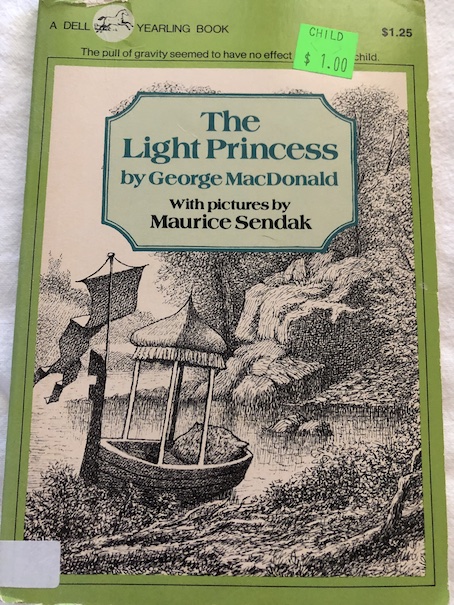
A long time ago, a king is irritated with his queen because they have no children. The queen tells him to be patient, and she eventually gives him a daughter. The king is very happy, but he makes a critical mistake. He forgets to invite his own sister to his daughter’s christening. It would be embarrassing for anybody to forget to invite a family member to an important event, but it’s a serious problem in his case because his sister is a wicked witch. She has a nasty temper and is vindictive. So, she decides to show up for the christening anyway and get her revenge by putting a spell on the baby princess. From that moment on, the baby is weightless, no longer bound by gravity.
It doesn’t take the little princess’s parents long to realize who has caused this strange malady in their child. It’s not all bad. Her nurses find her very easy to carry around, and people in the palace have fun playing ball with the princess as the ball, and the little princess herself seems to find all of this delightful. However, there is always the fear that she could blow away by accident, which does happen once, when she is blown out of a window and into the garden. Her parents continually worry about her future. At the queen’s urging, the king attempts to go to his sister and apologize about forgetting her invitation to the christening and ask her to lift the spell on the princess, but his sister denies all knowledge of the spell. The king knows she’s lying, but as long as she continues to deny it, there isn’t much he can do.
The problem goes much deeper than the princess having difficultly keeping her feet on the ground literally. She also has difficulty keeping her feet on the ground mentally. Her lack of gravity extends to an inability to see the “gravity” or seriousness in any situation. She laughs all the time, at everything, even when nothing is funny, although there is no real depth of feeling to her laughter. Even though she laughs all the time, she never smiles, leaving it open to question whether she ever really feels happiness or any emotion at all. She certainly doesn’t understand genuinely serious or catastrophic situations or other people’s emotions. When her mother cries, the princess just thinks that she’s making funny faces and odd sounds because she can’t seem to understand what crying means or the emotion behind it.
When the princess gets older, her parents talk to her about her condition, but the princess refuses to take it seriously. They try to ask her about what she feels. The princess says that she doesn’t feel anything, except that she sometimes feels like she’s the only one who has any sense, and then, she bursts into a wild, inappropriate fit of laughter. When they ask her if there’s anything she wants in life, all she can think of is to have someone tie a string to her and fly her like a kite, and then, she bursts into laughter again.
Since it’s useless trying to get through to the princess, the king and queen try consulting others, but nobody can agree on a solution. They consider metaphysics and philosophy. They recommend education and bloodletting. Her parents wonder if she would acquire some gravity if she fell in love, but the princess can’t seem to fall into anything … until the day she falls into the lake.
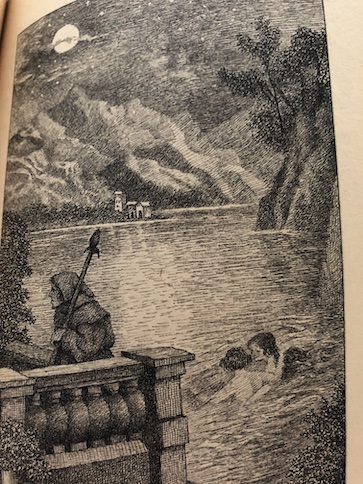
There is only one thing that the princess seems to love at all, and that’s the lake near the castle. When they take the princess out in a boat one day, she falls into the lake, and when she is in the water, she has gravity. She loves the water and loves swimming. She seems to have a better temperament when she is in the water, and she behaves better after a swim. Since water seems to affect the princess, they begin to consider that the cure to her problem might be to make her cry – a way of producing water that requires a grave emotion. However, nothing seems to make the princess cry. She is too flighty. (This book is full of puns related to gravity and flying, and they’re all given in a grave, direct manner.)
Then, one day, a prince tries to rescue the princess from the lake because he thinks she’s about to drown. When he pulls her from the water, she loses her gravity, and she angrily tells him to put her back in the lake. Unsure of how to do it when she’s weightless, the prince grabs hold of her and jumps into the lake with her. The princess is surprised and delighted because she has never truly fallen before. Now, she has fallen in with the prince … maybe in more ways than one.
However, even though the princess is starting to feel something for the prince, she has trouble understanding what she feels, not having felt much of anything for most of her life. When the lake suddenly begins drying up, the princess’s condition starts getting worse. The prince, who has truly begun to care about the princess, is willing to sacrifice himself to save the lake and the princess. It is only when the princess is confronted with the full reality of the prince’s sacrifice on her behalf that she is able to fully feel something and break free of her curse.
This book is now in the public domain, and you can read it online in your browser at Lit2Go. It is also accompanied by audio readings of each of the chapters.
My Reaction
Like other Victorian era children’s stories, there is a moral to this one, but it’s phrased in a unique and fun way. I remember liking this story the first time I read it as a kid, but I forgot about all of the puns involving “gravity”, which can refer to the force that makes things fall to earth or a state of serious emotion. The princess in the story lacks both, so she is very literally “flighty” and “can’t keep her feet on the ground.” Both of those terms are related to the idea that serious people have more emotional gravity, and unserious people lack it. For most of the book, the princess is an unfeeling air-head. I also missed the mention that the king doesn’t like puns, which may tacitly explain why his sister chose to make her curse in the form of a pun, knowing that her brother wouldn’t understand it.
The book notes that real happiness requires some emotional gravity because the person has to have enough emotional depth to understand their real emotional state and react appropriately to their emotions. That’s why the book describes the princess as never seeming happy, even when she laughs insanely at everything. She has no emotional depth or understanding. She doesn’t feel very much emotionally, and she has trouble understanding even her own limited emotional range. People often have trouble telling the difference between her laughing and screaming. Either way, it’s just a lot of loud noise with no real feeling behind it, and it’s pretty disturbing. It’s only when confronted with the apparent loss of the man she loves that the princess is able to feel a definite emotion. Fortunately, it all ends happily for our prince and princess. At the last minute, she decides to sacrifice her lake to save him, and finally, cries for the first time in her life, and that breaks her spell.
People don’t like to feel negative emotions, and some will use all kinds of defense methods to avoid what they’re feeling, but negative emotions (within reason, not taken to excess) are important to emotional health. People need to feel their full emotional range, and negative emotions often act as safety features in our lives. They tell us when we’re in an unsafe or unhealthy situation or when we’ve done something wrong, and they motivate us to do whatever is necessary to fix the situation. The princess’s habitual reaction to anything and everything is crazed and unfeeling laughter, but that’s not what she needs. She needs real feeling and honest tears to restore both her physical and emotional gravity. The princess, staring at the prince as he is about to die is literally staring death in the face and feeling the “gravity” of it. Contemplating the impending death of the prince and understanding for once the seriousness and finality of it, the princess experiences sadness and loss, and through that, she comes to understand love and sacrifice. Only when she has been through all of that is the princess truly able to be happy with her prince and his recovery. The princess has a difficult time adjusting to her new gravity, in more ways than one. She has to learn to walk for the first time because she always floated easily through life before, and sometimes, she falls down and hurts herself. She sometimes complains about it, but it’s still worth it because she has gained the ability to fully feel and to love and be loved.
During the story, none of the main characters actually have names. They are only referred to by their titles: king, queen, princess, and prince. Their names aren’t as important as their roles in the story.
There is a more modern story called Princess Hyacinth: The Surprising Tale of a Girl Who Floated from 2009 that uses the concept of a princess who is unaffected by gravity, but in a different way. It’s a picture book, and in that story, the princess isn’t cured of her lack of gravity. Instead, she learns how to make the most of it.









 Jestress's Forgotten Books and Stories