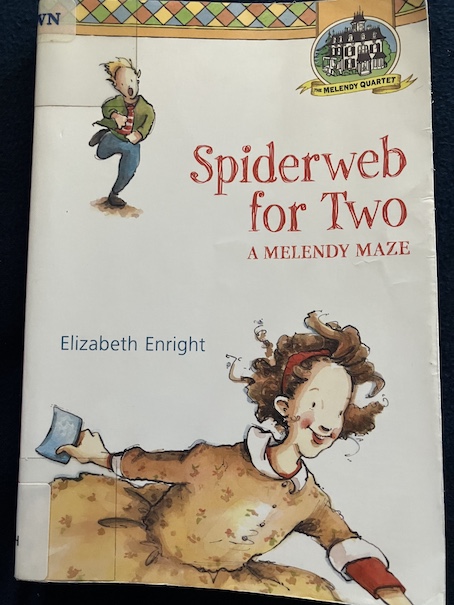
Spiderweb for Two

Randy Melendy is feeling morose because the three older Melendy siblings (Mona, Rush, and their adopted brother Mark) have all gone away to school. Rather than attending the local school as they used to, Rush and Mark have gone away to boarding school for the first time this year, and Mona is attending a school in New York City, where they used to live. Since Mona has started acting professionally on the radio, she’s been commuting back and forth from the family’s house in the country to her acting job in the city. This year, her father decided that, rather than continuing to commute back and forth, it would be best for her to remain in the city and go to school there, staying with a family friend, the wealthy Mrs. Oliphant, who is fond of the children. That leaves only Randy and her younger brother, Oliver, at the big Melendy house in the country, known as the Four-Story Mistake.

Since Randy is accustomed to having her very active siblings around her, always doing something interesting, Randy thinks that life is going to be boring and lonely from now on. She recognizes that the older siblings going away to school is just the first step in growing up and moving away from the family. She knows the next likely steps for them are college and marriage, and they will likely never really live all together again, at least not all the time. The housekeeper, Cuffy, tries to reassure Randy that she still has Oliver for company, but Randy isn’t reassured. Oliver is a few years younger than she is, and she doesn’t think they have much in common or much that they would like to do together. However, the two of them are about to be involved in a special shared adventure.

Cuffy sends Randy and Oliver to get the mail, and they are surprised to find an envelope addressed to the both of them in handwriting they don’t recognize. Inside the envelope is a poem that seems to be some kind of puzzle or riddle – the first clue to a treasure hunt! The mysterious letter writer tells them to keep it a secret, and the clue seems to point to a place where the shadow of a tree falls.

It takes Randy and Oliver a little time to decide which tree is supposed to cast the shadow, and their treasure-hunting is delayed by rain. However, when they dig in the correct spot, they find a tin box. Inside the box, there is a little golden walnut box with another clue. This time, the clue indicates that the next clue is being held by someone who loves them, although they don’t know it. It takes some effort for Randy and Oliver to solve this one. At first, they think it’s probably Cuffy or Willy, and searching their pockets or getting them to reveal what’s in their pockets without the kids explaining why they need to know is tricky. Eventually, it turns out that the next clue is hidden on the collar of Isaac the dog.

The treasure hunt continues in this way for the whole rest of the school year. The clues are written as poems on blue paper and send them various places around their own house, the houses of people they know, and various other landmarks, including a grave yard! Randy and Oliver figure out that this treasure hunt must be something their older siblings have created to keep them busy and entertained during their absence. The treasure hunt breaks off periodically when their siblings are home from school for Christmas before resuming after Christmas with another letter.

In between solving the riddles of the treasure hunt, Randy and Oliver do get to spend some time with their siblings. Over Christmas, the family decides to go caroling and visiting friends. For Easter, the girls make Easter bonnets, and Rush makes a special one for their horse. Randy and Oliver never discuss the treasure hunt with their siblings, though, because secrecy is part of the game.

Sometimes, Randy and Oliver get into trouble following clues, and sometimes, they accidentally make the hunt tougher than it has to be because they misinterpret where they’re supposed to go next. Eventually, the hunt leads them to a special surprise from an old family friend, and everyone shares in the surprise!

I liked the treasure hunt in this book because I always like books with treasure hunts that have riddles to solve and clues to follow. I’ve read other reviews of this book online, and other people remember this book fondly for the treasure hunt, although it does have a different feel from the other books in the Melendy Quartet, for several reasons. It’s partly because only two of the Melendy siblings are present for most of the story, although the others do appear sometimes and make their presence felt, even when they’re away. Readers will probably figure out before Randy and Oliver that their absent siblings have set up this treasure hunt for them to keep them busy and give them something to think about so they won’t be too lonely without the others.

This is also the only book in the series that doesn’t make references to WWII because it’s the only book in the series written after the war ends. The war wasn’t a main part of the plot of the other books, but it was always present in the other stories, with the children taking part in activities to help the war effort. The war also affected the attitudes of the children, making them want to do their parts for their family as well as their country. This book never mentions it once, and the focus is on how the children are growing up.

Randy knows that seeing her siblings go away to school is just the first step to them all growing up and moving away. When the older siblings come home for Christmas, they’re already showing signs that they’ve been doing more growing up during the few months they’ve been away from home. When Mona comes home for Christmas, she has a new haircut and is wearing lipstick, and Rush’s voice is starting to change. Eventually, Randy and Oliver will do these things, too, but for now, they’re the ones left behind as kids at home. Through their shared adventures with each other without their siblings, they grow closer to each other than they were before. Oliver was too young to join Randy and the older siblings on some of their previous adventures, but he is growing up, too, and he’s now able to join Randy in shared activities. During the course of their treasure hunt, they have adventures in the countryside, like the siblings did in other books.

Like other books in this series, there are also stories within stories. Sometimes, the main story departs from Randy and Oliver when other people tell them stories about exciting or interesting episodes from their own lives. This books has stories about how Cuffy saved a boy from drowning when she was young, their father’s search for a lost dog, and Mrs. Bishop remembering when she first noticed the patterns of snowflakes.

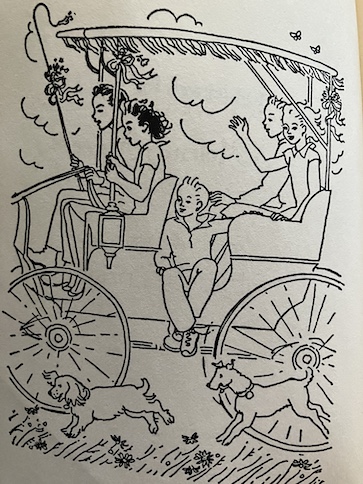
There’s only one full page picture in the book. The other illustrations are smaller ink drawings at the beginnings of chapters.

Two Are Better Than One

Two Are Better Than One by Carol Ryrie Brink, 1968.

This is a gentle coming-of-age story about two thirteen-year-old girls in Idaho during the early 1900s, but it’s told in a interesting format, as the reminiscences of one of the girls as an old woman and focusing on a story that the girls were writing together as teenagers. It’s like a story about a story within a story.

One Christmas, elderly Chrystal Banks receives a special present from her old friend, Cordelia Crump. The package contains two miniature dolls (she calls them “pocket dolls”) that Chrystal gave to Cordelia 60 years before. At first, Chrystal doesn’t remember giving her friend Cordy” these dolls but admits that her memory is starting to fail her. As she studies the little china dolls and their exquisite details, she begins to remember them and when she gave them to her friend. The dolls’ names are Lester and Lynette, and Chyrstal remembers how Cordy used to say that the little dolls were magical because any day she carried them seemed to become special and exciting. Even when Chrystal and Cordy grew older, supposedly too old for dolls, they still continued to love and believe in the magic of their special pocket dolls.

Before young Chrystal Reese (as she was known before her marriage) gave the dolls to Cordy, they were a Christmas present to Chrystal from her Uncle Dick. That was the Christmas when the girls were in seventh grade and were early thirteen years old. Uncle Dick had acquired a number of interesting presents for Chrystal on his trip to Europe. He doted on his niece because she had no parents or siblings, living only with her grandmother and Aunt Eugenia and their dog, Rowdy. All of the presents are wonderful, but the little dolls are something special. As she unwraps them, they are hidden within a small box inside another box inside of another box (not unlike the story itself). Chrystal loves the elegant, detailed, jointed dolls immediately and names them Lester and Lynette because they just seem like the right names for the dolls.

Immediately, she goes to see if the little dolls will work well in the dollhouse that she’s made out of orange crates. She has spent considerable time and most of her allowance money putting paint and wallpaper into the little house and making furniture for it. She made all of the dollhouse furniture to fit two small dolls that she already has, Elsie and Eileen. However, Elsie and Eileen are four inches tall, and Lester and Lynette are only about two-and-a-half inches tall, so they won’t work in the house. At first, Chrystal is unsure what to do with the tiny dolls. She loves them, but she’s going to have to figure out where to put them and how to play with them if they won’t fit into the doll house. Then, she gets the idea to give the little dolls to her best friend, Cordy. It’s a sacrifice to part with such a lovely present so soon after getting it, but she wasn’t satisfied that the little bottle of perfume she was going to give Cordy was really a good present. Besides, the girls are so close that they already share everything with each other, and as they like to say “Two are better than one.” Giving the dolls to Cordy won’t be like giving them so much as sharing them with someone who can help to make them even more fun.

Cordelia Lark (her maiden name) grew up in a well-off family with mostly boys. Her father was president of the local bank and president of the school board and a civic leader in other ways, and Cordy had four brothers and no sisters. Cordy and Chrystal are kind of like the sisters neither of them ever had. They like to call each other “Tween”, which is their special pronunciation of “Twin.” They justify being twins because their birthdays are only two weeks apart, so they’re almost exactly the same age.

On the way to Cordy’s house to give her the special Christmas present, Chrystal passes by the courthouse. When she and Cordy pass the courthouse, they can see the barred windows of the jail, and they make up stories to spook each other about how one of the prisoners might escape. On this particular day, Chrystal sees one of the prisoners gripping the bars of his window and looking out. He’s the first prisoner Chrystal has ever actually seen. She’s a little afraid of him, and when he starts talking to her, she doesn’t know what to say at first. The man first asks her what she’s staring at, and then he wishes her a Merry Christmas, even though he’s not having one. Not knowing what else to do, Chrystal murmurs “Merry Christmas” back and hurries on.

When Chrystal gets to Cordy’s house, the two girls exchange presents. It turns out that each of them almost got the other some perfume, but each of them changed their mind at the last minute and decided on something better. Cordy’s present to Chrys (as she sometimes calls her) is a book, which makes Chrystal happy because she loves books and didn’t get any for Christmas this year. But, it’s not just any book. This is Chrystal’s first grown-up novel instead of a children’s book. (They mention the Oz books, the Little Peppers, and the Little Colonel series as books they’ve read.) It makes Chrys feel grown-up. It’s a romantic story about a Southern girl during the Civil War who falls in love with a Northern soldier and eventually marries him. Chrys says that Cordy shouldn’t have told her the ending before she’s read it, but she’s still thrilled at having her first grown-up book.

Chrys worries that, since Cordy gave her a grown-up present, she’ll think that the little dolls are babyish, but Cordy loves Lester and Lynette immediately. She says nobody gave her a doll this year, and she felt disappointed because she loves dolls, and it just didn’t seem like Christmas without one. Chrys explains that these are pocket dolls, and they’re meant to be carried around in pockets, so they can go everywhere with the owner. Cordy says that they’re so tiny and perfect that they must be magic, and she decides to keep the names that Chrys gave them, Lester and Lynette. Cordy thinks that the little dolls are perfect to take along on adventures.

When Chrys tells Cordy about the prisoner, the two of them are nervous, although they don’t really think he can escape. Chrys asks Cordy to walk her home, but after they pass the courthouse, Cordy realizes that she’d have to walk past the courthouse alone on her way home. So, Chrys and Cordy turn around and walk the other way again, but then, they realize that they still have the same problem. No matter which way they go, they have to pass the courthouse, and no matter who walks who home, one of them will have to go alone at least partway. After they go back and forth a couple of times, they pause in front of the courthouse, and Cordy has an idea. She gives Chrys the Lester doll, keeping the Lynette doll for herself. That way, each of them will have someone to keep them company, and it will be like they aren’t alone. It gives each of them enough courage to go the rest of the way home, and it’s the beginning of their adventures with the dolls.

Chrys is inspired by her first grown-up book, and she thinks that maybe she’d like to write novels when she grows up. When the girls are in school, they like to write notes and funny poems with each other when they’re supposed to be studying, and Chrys suggests to Cordy that they start writing a novel together. Cordy agrees, and they decide to take turns writing chapters. They decide that the story will be about Lester and Lynette, and Chrystal writes the first chapter. Chrystal calls the story “The Romantical Perils of Lester and Lynette.”

However, the girls get in trouble for goofing off and not paying attention in class. Their strict teacher, Miss Hickenlooper, decides that the two girls can’t sit together anymore, and she confiscates Lester and Lynette and locks them in her desk. The girls are devastated. If the teacher wanted them to move desks, that was disappointing but justified, but she had no right to just take the dolls. The girls think that they’ll have to wait until the end of term to get them back, but they continue writing the story about the dolls. Chrystal had been going to write the first chapter about an elopement, but because the dolls are now imprisoned in the teacher’s desk, she decides to write it as a prison escape instead.

In the new version of the first chapter of the story, Lester and Lynette are brother and sister, and they are imprisoned in a castle overlooking the Rhine river in Germany (part of the the girls’ geography lesson in school) by their evil guardian, Baron von Hickenlooper. Lynette is rescued/kidnapped by a Viking pirate named Oskar, who carries her away from her brother, who still remains in the castle.

From this point on, the events in Chrys and Cordy’s lives alternate with new chapters of their tandem story about Lester and Lynette. Pieces of the girls’ lives work their way into the story. When the girls are ready to trade turns writing the story, they give each other what they’ve written so far and say “Muggins!” (The word comes from playing games like Dominoes and Cribbage where, if one player spots that another has missed a score or failed to count something properly, they can call “Muggins!” and add the overlooked points to their own score. I think what they’re implying is that this story is a game where one person picks up whatever the other one has left unfinished.) The girls also continue adding verses to an unflattering poem that they started writing about their teacher.

By accident, the girls loose track of the mean poem about their teacher, and Miss Hickenlooper finds it. At first, the girls are terrified that Miss Hickenlooper is going to be furious with them and do something horrible in punishment, but to their surprise, she starts crying. Miss Hickenlooper end up having a heart-to-heart talk about the girls’ experiences in Miss Hickenlooper’s class, what Miss Hickenlooper hoped for when she started teaching, and why she took Lester and Lynette from them. Miss Hickenlooper had wanted to be a teacher for a long time and was looking forward to it, but she had been away from it for a long time because she had to take care of her mother during a lengthy illness. Since she started teaching again, she can tell that her students haven’t been happy with her, but after reading the poem, she realizes that it’s worse than she thought. Even strict teachers can be respected by their students as long as they’ve taught their principles well and the students are learning valuable lessons. Miss Hickenlooper feels like she’s failed as a teacher because she hasn’t managed to connect with her students at all, and she’s making them miserable. The girls come to the surprising realization that their teacher really does care about her students and what they think of her.

The talk between the girls and Miss Hickenlooper was a little uncomfortable because the girls realize that they’ve done an injustice to Miss Hickenlooper by writing the mean poem about her, but I actually liked this part of the story because it’s the kind of honest communication that I often find missing in stories. Rather than anyone blustering or dodging or trying to save face, the girls and their teacher honestly discuss what happened and how they feel, and everyone involved learns something from the experience. The girls appreciate having this “human” communication with their teacher, and it earns their respect, more than any angry tirade or show of strength on their teacher’s part ever would have. It’s this very kind of open honesty and humanity with real feeling behind it that’s been missing from the class so far, and it’s what has prevented Miss Hickenlooper from really connecting with her students.

The girls apologize to Miss Hickenlooper about the poem, and Miss Hickenlooper admits the justice of some of their complaints. Miss Hickenlooper admits that maybe she went a little far in making Cordy turn out her pockets and taking her dolls from her for an extended period of time. Getting into someone’s pockets and taking personal possessions is a kind of invasion of privacy, and Miss Hickenlooper says that she only did it because the girls weren’t paying attention in class, which is true. In return, Chrys and Cordy acknowledge that they only wrote the poem to blow off steam because they were angry, but they also went too far, and they really should have considered their teacher’s feelings. The girls promise not to write any more poems like that, and Miss Hickenlooper gives Lester and Lynette back to them. Miss Hickenlooper says Cordy can keep the dolls in her pocket if she wants as long as the girls pay attention in class from now on. To further apologize, the girls make cards for their teacher and give her the two bottles of perfume that they almost gave each other for Christmas (“Two are better than one.”), and they start going out of their way to be nicer to her.

The girls’ talks with Miss Hickenlooper through the rest of the school year give her feedback that helps her to improve as a teacher. Later, when the girls are watching a lightning artist (someone who paints pictures very fast, not the more modern definition of someone who works in animation) at work and happen to see Miss Hickenlooper in the store as well, they point out that one of the artist’s pictures reminds them of the Rhine that they studied in class. Miss Hickenlooper doesn’t think much of the quality of the painting, but she admits that it does look like the Rhine and that another painting the artist did reminds her of Switzerland when she was there. The girls are amazed that Miss Hickenlooper has been to Europe because, other than Chrys’s Uncle Dick, they don’t know anyone who has. They ask her why she never talked about it in their geography lessons because that would have made them much more exciting, hearing about other countries from the perspective of someone who was actually there. Miss Hickenlooper is surprised. She says that she was only focused on teaching the lessons that she was assigned to teach and just never thought about including anything personal because she didn’t think her students would be interested in her personal stories. Again, it’s that personal element that Miss Hickenlooper needs if she wants to connect with her students on a personal level.

As the story continues, the girls also start to consider their attitudes about boys and men and future husbands. So far, most of their knowledge of boys has come from the boys at school and Sunday school and Cordy’s brothers, all pretty immature and rowdy. But, the girls are growing up, and so are some of the boys. New young men also come into the girls’ lives.

A friend of Chrystal’s grandmother asks her if she would be willing to rent a room to her 19-year-old son, who is looking for a place to stay as he takes his first teaching job at the local college. (That sounds young for a college teacher. In modern times, a nineteen-year-old would be a college student himself. Remember, this is the early 1900s, and education in the United States was very different then. Back then, teachers didn’t need to have the advanced degrees that they do now, and Mr. Banks later explains that he skipped grades when he was younger to get through school faster.) Chrystal’s grandmother agrees, although Chrystal isn’t anxious to have a teacher living in her house after her problems with her own teacher at school. Chrys also isn’t sure what to expect from a man living in the house because there’s never been a man in this house before. Cordy’s brothers are pretty rowdy. However, their new lodger, Mr. Banks, turns out to be quiet, polite, and very nice. (His last name is an indication that he’s going to be Chrystal’s future husband. There’s six years’ difference in their ages, but as times goes on, and Chrystal gets older, that’s not going to seem like as much of a gap.) He is the first person to ever address Chrystal as “Miss Reese”, which makes her feel grown-up.

Cordy’s family also has a boarder, Mr. Crump, who is attending the local college (obviously, Cordy’s future husband, based on her future last name). Mr. Crump is working his way through college by selling pots and pans, and Cordy goes with him to help carry things, bringing along Chrys because “Two are better than one.” The girls end up giving him some advice on his sales patter that helps him make more sales.

Meanwhile, the girls’ Sunday school class, which calls itself the Dorcas Club, decides to host a masquerade party with the boys’ class (who have dubbed themselves the Armored Knights) as their guests. Chrys and Cordy think of the boys as immature and uncouth and roll their eyes at the older girls who are boy-crazy. Then, because the party is on Presidents’ Day, all of the girls in the group want to go dressed as Martha Washington, and there’s a big argument about it. Originally, Chrys and Cordy wanted to be Martha Washington, too, but since that’s what all the others want, they decide that they want to do something completely original. Inspired again by the dolls, they decide to go dressed as dolls. However, because they don’t want to be like the prissy girls trying to be pretty and impress the boys, they decide not to go as elegant dolls but as old rag dolls in patched clothing.

The girls do win prizes for both the funniest and most original costumes at the party because they’re the only girls who don’t show up as some version of Martha Washington. However, the triumph turns against them because the girls who are in charge of the main entertainment for the evening have decided to turn it into the girls’ very first dance party with the boys, something that Cordy and Chrys weren’t expecting. Rag doll costumes are good for fun and games, but not so much for serious dancing and the possibility of budding romance. While all of the boys are wearing various fanciful costumes themselves, like pirates and clowns and cannibals, it turns out that they’re only interested in the girls who dressed in pretty clothes as Martha Washington, and none of them want to dance with the rag dolls. Chrys and Cordy were proud of themselves for being more original than the other girls, but it seems that the boys prefer “pretty” to “original.” At the end of the evening, none of the boys even want to walk Chrys and Cordy home. Chrys and Cordy feel embarrassed because their efforts to be “original” seem to have strayed a little into the outlandish at a time when the other girls and boys are starting to seriously get interested in each other.

Fortunately, their families guessed that something of the sort might happen and asked the young men boarding with them to go to the house hosting the party and walk the girls home if they had no one else to walk with them. Mr. Crump confirms to the girls that boys would prefer to walk with girls who made an effort to look pretty instead of girls who look like rag dolls. Mr. Crump says that there will be other parties, and next time maybe they’ll go as something more elegant, like Martha Washington, but the girls aren’t too thrilled about doing this type of party again. Mr. Banks takes a different view and says that he actually thought that the rag doll costumes were rather clever and that it was really better for the girls to be different instead of trying to be like every other girl in order to not stand out. “Sometimes it may hurt, but I think it’s better to be original.” Mr. Banks the college teacher is more mature than Mr. Crump the college student, and I think he has the right idea. Looks and clothing styles change, and people have different priorities when they get older, but original thinking and an interesting personality are hard to replace and never go out style. When Chrystal says that she doesn’t even know how to dance, Mr. Banks offers to teach her, so she can be more confident at future parties.

Having the boarders walk them home actually turns out to be an unexpected victory for Chrys and Cordy because, while the other girls were making fun of them for not having any of the boys dance with them or walk them home, Chrys and Cordy ended up being escorted by young men. Getting boys is all well and good for young girls, but being escorted by young men makes Chrys and Cordy look like young women, putting them on a higher level than mere girls. Chrys and Cordy don’t see it that way at first because Mr. Crump and Mr. Banks are just their families’ boarders and friends and treat them like younger sisters (at this point in their lives, anyway), but the other girls notice that the young men are more mature than the Sunday school boys, and it causes them to look at Chrys and Cordy with a little more respect for having their attention. In some respects, Chrys and Cordy might seem less mature than the girls who are excited about wearing makeup and getting boys because they’re into outlandish costumes and dolls and “romantical” stories, but in other respects, they may actually be a little more mature than the other girls for being confident in their individuality and the new awareness they’re acquiring of other people’s feelings. In the end, girls want to marry men, not little boys, anyway.

Through the spring, the girls have other adventures and continue writing their story with their dolls. Along the way, there are other signs that the girls are growing up. They notice that this is the first year when they’re more interested in getting new Easter bonnets than they are in their Easter eggs. Cordy’s family is heavily involved in the social life of the local college because two of their boys are students there, and Cordy even gets to go to some of the campus parties. She helps to serve punch there and sometimes gets to dance. She eventually arranges for Chrys to come with her to help with serving and have her first dance, too. Miss Hickenlooper also discusses the girls’ future with them, suggesting that they take exams to see if they can skip the eighth grade and go straight into high school because she thinks they’re smart enough to pass. The girls are uncertain if they want to go on to high school so quickly. They know they’re growing up, but they haven’t thought about high school yet (and this is a time period when not everyone even attended high school). There is also the horrible thought that one of them might pass the test while the other didn’t, and they might end up going to different schools and being in different grades. Miss Hickenlooper says that they don’t necessarily have to go on to high school yet, if they feel that they’re not ready, even if they’re offered the opportunity, but she urges them to take the tests anyway to see if they have the option. It makes the girls start questioning their future lives, what they really want, and where their education will take them.

At one point, Cordy’s brothers find their unfinished novel in Cordy’s room, steal it, and use it to make fun of the girls. The story isn’t really very well written because Chrys and Cordy are only thirteen years old. As readers will have noticed, there are spelling mistakes all through the story, and the girls also get mixed up about geography because they’re just focused on making the story exciting instead of really thinking about the setting. After their characters’ adventures on the Rhine, the girls send them floating in a boat to a tropical island with coconuts and palm trees because they don’t think about just how far away the tropics actually are. (Being shipwrecked on an island is also a common trope of vintage and antique children’s books, so they’ve probably read this type of story themselves. Just scroll through my lists of children’s books from the 1900s and earlier, and you’ll see what I mean.) Although Mr. Crump was laughing at the girls, too, he rescues the story from Cordy’s brothers and gives it back to them when he sees that the joke is going too far. However, the girls are somewhat dispirited, thinking that their story might be deeply flawed. At first, they don’t know if they really want to continue writing it, but in their desperation, they turn to the one person they know will be honest with them about what they’ve written and can not only tell them whether or not the story can be fixed but how to do it – their teacher, Miss Hickenlooper.

The book is available to borrow and read for free online through Internet Archive (multiple copies).

Themes, Spoilers, and My Reaction

The story is one of those gentle, calm stories with a few funny episodes and some genuinely touching moments. Fans of slice-of-life historical books like the Betsy-Tacy series will like this book. It is a coming-of-age story for Chrys and Cordy, as they begin to develop new attitudes and come to a deeper understanding of themselves and other people and start thinking about the future. However, the girls’ adventures also teach other people around them some lessons.

One of the themes of the book involves how people let their personalities show. Although the girls were originally thought silly for their outlandish rag doll costumes at the party, they were more bold and creative than the girls who just wanted to look like everyone else. Even though their creativity wasn’t fully appreciated at first, it ends up working in their favor in the long run.

One of the biggest developments in the story is the relationship between the girls and their teacher, and the keys to that relationship are learning how to see other people as people, how to be open about showing their personal sides, and how to appreciate people with different personalities. The girls begin as thoughtless students, and their teacher is a strict disciplinarian with little patience for their goofing off, which is why the girls see her as their antagonist. However, the girls’ eventually realize that, through their mean and complaining poem, they’ve hurt their teacher’s feelings as much as she’s hurt theirs, maybe more. It leads them to see her in a new light, as a person and just just their jailer (the role of her alter ego in the girls’ story). The honest talks between the girls and their teacher not only helps the girls to become more thoughtful and considerate of others’ feelings but also show their teacher that the key to improving her teaching and developing a better relationship with her students is to be a little more personal with her students. She gradually learns that letting her students see her as a person with interesting life experiences earns their respect more than just acting like an unfeeling drill sergeant enforcing discipline. Inspired by the girls’ interest in her travels when she was younger, Miss Hickenlooper starts bringing postcards and souvenirs from her travels to class to show during geography lessons. The students are fascinated by her souvenirs and stories and start thinking of her as an a kind of intrepid explorer or sophisticated world traveler instead of a dull woman who focuses on dry memorization and gets mad at them for daydreaming in class. As she tries new ways of approaching her lessons and adding in personal experiences, Miss Hickenlooper takes on a whole new role in the children’s lives and sparks all of their imaginations. All of the students, not just Chrys and Cordy, start behaving better because they become genuinely interested in what Miss Hickenlooper has to say and show them. They don’t want to make her angry because she’ll stop telling the interesting stories if they don’t get their work done. Just because she’s gotten more interesting and personal doesn’t mean she’s gotten soft. Don’t be afraid to be interesting and different!

The girls never actually show Miss Hickenlooper their story because they’re a little embarrassed by what they’ve gotten wrong, but they ask her questions about some of the things that they put in their story to find out what’s right. They do end up finishing the story and giving Lester and Lynette a grand wedding, but they also acknowledge that they are getting too old and busy with other things to continue playing with dolls, even Lester and Lynette. They plan to put Lester and Lynette away for now as souvenirs of their childhoods. Later, they do tell Miss Hickenlooper about their novel, and while she hasn’t read it, she has the feeling that she knows what it’s like from knowing the girls and their writing. (The girls wrote about scenes from their novel when asked to describe places they know for their high school entrance exams.) She tells them that she appreciates their imaginations but that they should remember to focus on the real world around them and gaining real experiences to write about in the future.

There are also themes that focus on what growing up and maturity mean. Because the story focuses on one school semester in the girls’ lives, there are many questions that the book leaves unresolved about what happened in the girls’ later lives, but it seems that their lives turned out well, and they look back on their experiences with Lester and Lynette as a turning point when they really started growing up. Toward the end of the story, the girls begin appreciating some of the possibilities of life and the wider world that they never considered before. Through it all, there is also the girls’ constant friendship. At the very end, elderly Chrys writes a letter to elderly Cordy, thanking her for sending the dolls and reminding her of this special time in their lives.

The author of this book, Carol Ryrie Brink, was also a child around the time that Chrys and Cordy were children. There is a picture of her as a child above her biography on the dust jacket of the book. She is also the author of Caddie Woodlawn, which is better known than this book.

I love books that contain details about life in the past, and there are a lot of fun details included in this story. I’ve mentioned some above, but that’s just scratching the surface. At one point, Chrystal says that the only paper she has that’s good for painting pictures is the pieced of paper that separate pieces of Shredded Wheat in the box. The lined paper from the notebooks she uses for school isn’t as good. When she’s out of those pieces of paper, she has to eat more Shredded Wheat to get more. I don’t remember seeing any similar kind of paper in shredded wheat boxes in my lifetime, so this must be something that existed before modern packaging.

At the college dances, the girls have dance cards for the young men to write their names and initials in to secure spots for dances. There are also occasional mentions of food, and Chrys mentions having floating island pudding for dessert, which I’d never heard of before. It’s a kind of meringue that floats on a base of vanilla custard.
Ramona the Brave

Ramona the Brave by Beverly Cleary, 1975.

Six-year-old Ramona Quimby thinks of herself as brave. Now that she’s going into the first grade, she’s no longer just a little kid. She even stood up to some boys on the playground who were making fun of her older sister, Beatrice, for being called “Beezus.”

However, Ramona soon discovers that not every sees her the way she sees herself. Beezus is embarrassed at the way her little sister told off those boys and is sure that they’re now going to make a much bigger deal of the incident at school because of it. Beezus says that she’s sick of her silly nickname, which rhymes with “Jesus” and just wants to be called “Beatrice.” Ramona agrees with her, both because she feels bad that she accidentally embarrassed her sister and because it’s her fault that Beezus got her nickname. When she was smaller, Ramona couldn’t pronounce the name “Beatrice” very well and ended up saying “Beezus” instead, and the mispronunciation stuck. Ramona is trying hard to be a big kid now, and she doesn’t like to remember that she used to not even be able to say her own sister’s name. Ramona agrees to call her sister Beatrice in public and to only use the Beezus nickname at home.

Ramona wants to be taken seriously, and she hates it when her mother is amused by some of the silly things she does. (I know the feeling, and so do many other people!) The last thing she wants is to just be a silly little kid that people laugh at, and nobody seems to understand how she feels. She especially hates it when her sister keeps calling her a pest.

Fortunately, their mother understands that part of the problem is that the girls are getting bigger, and they’re starting to feel cramped sharing a room with each other. Mr. and Mrs. Quimby have decided to add an extra room onto the house so the girls won’t have to share anymore, and Mrs. Quimby is going to take a part-time job to help pay for it. Before the girls can start arguing about who gets the new room, Mrs. Quimby tells them that it’s already decided that they will take turns, trading off rooms every six months and that Ramona will have the first turn in the new room.

Watching the workmen make a hole in the wall of their house and build the new room is fascinating, although Ramona doesn’t have the patience for planning, methodical work, and learning how different tools are supposed to be used, like her friend Howie. Ramona prefers playing their made-up game of Brick Factory, where she and Howie smash old, broken bricks with rocks. Ramona takes the opportunity to put her special initial, a Q with cat ears and whiskers, into the wet concrete for the floor of the room, and she can’t resist the opportunity to jump through the new hole in the wall of their house. The workmen cover the hole with a sheet of plastic when they go home for the day, but the girls think it’s kind of spooky having a hole in the wall of their house. They imagine that something horrible could sneak in through the hole, like a ghost, maybe one that looks like a gorilla. Ramona can’t wait to tell the other kids all about it when she starts first grade!

Unfortunately, the new school year doesn’t start out the way Ramona hopes. Instead of everyone being excited about her news and how she watched the workmen chop a hole in the side of her house, everyone laughs because the teacher had just made a joke about her being Ramona Kitty Cat because she drew the cat ears and whiskers onto the Q on her name tag the way she always does. Ramona hates being laughed at and made to feel like a fool. Worse still, her friend Howie doesn’t defend her because Ramona said that they “chopped” a hole instead of “prying” it open with crowbars. Because of Ramona’s technical inaccuracy, Howie makes her sound like she was lying about the whole thing!

Then, when the kids make paper bag owls for Parents’ Night, Susan copies Ramona’s design, and the teacher, Mrs. Griggs, praises Susan to the whole class for coming up with the idea of having the eyes looking to the side. She doesn’t even notice Ramona’s owl. Ramona, afraid that everyone else will think that she’s the copycat because of Mrs. Grigg’s public praise of Susan’s owl, just like they all thought she was a liar and laughed at her before because of what Mrs. Griggs and Howie said on the first day of school, crumples her owl up and throws it away before anyone can see it. But, that doesn’t help relieve Ramona’s feelings at the injustice of the situation. She’s owl-less because of Susan stealing her idea. In a fit of temper, she crumples up Susan’s owl, too, and runs away when Susan tells on her even though Mrs. Griggs repeatedly says that she doesn’t like tattletales. (Honestly, I’ve never understood why adults tell kids that. It just encourages kids to behave badly and label others as “tattletale” when they complain, even when the complaint is just. It just gives bullies more power to act with impunity. I also think kids should be encouraged to talk about things, especially some of the more difficult things to talk about, and the whole “I don’t want to hear from tattletales” shuts down conversations before they even start. I’ve guessed that it has something to do with not wanting to take the time to deal with a lot of petty complaints, but at least hear someone out before you decide what they’re going to tell you and how important it is!) Even when Ramona explains the situation to her mother, she can tell that her mother doesn’t fully understand how she feels, and she is forced to apologize to Susan. Mrs. Griggs makes it all the more embarrassing by forcing Ramona to apologize in front of the whole class. Ramona knows that Mrs. Griggs doesn’t understand her and is sure that Mrs. Griggs hates her.

Ramona’s new room isn’t much of a comfort, either. She finds it a bit spooky, and when she’s alone in it, her imagination runs wild, like it did the night that she and her sister were imagining what kind of ghost could get in through the hole in the wall. Ramona certainly doesn’t feel very brave and grown-up about having a room to herself, but she refuses to admit it because she doesn’t want anyone to think that she’s a baby for being scared.

Things come to a head when Mrs. Griggs sends home a progress report that says that Ramona needs to use more self-control and keep her eyes on her own work. Ramona knows that it’s totally unfair because she’s been very self-controlled since the owl incident, in spite of Mrs. Griggs’s inconsiderate lack of understanding, and the only reason why she sometimes looks at the paper of the boy next to her is that he’s been seriously struggling with his work, and she’s been trying to help him. When Ramona is so fed up that she tells her family that she needs to say a bad word and the worst word she can think of to say is “guts”, everyone laughs at her, and Ramona bursts into tears, unable to take it anymore.

Tears and anger serve a purpose, though. Sometimes, an outburst is the only way to make someone understand, and understanding is what Ramona most needs. The family has an honest discussion about Ramona’s feelings, and Beezus tells her that she understands what it’s like to be little and laughed at for doing or saying something silly, reminding her mother about the times when she laughed about things she did, back when Ramona was too little to remember it. Beezus says that her mother’s laughter hurt her feelings when she was Ramona’s age, too, and Mrs. Quimby apologizes. Beezus also says that she never liked Mrs. Griggs very much when she was her teacher, either. Ramona asks if she could switch to the other first grade class at school, but her mother is reluctant to arrange it because her schoolwork has improved and because some of Mrs. Griggs’s criticism was correct and that Ramona does need to improve on her self-control. Mrs. Quimby also says that she wants Ramona to learn to understand and work with different types of people. Mrs. Griggs might not be her kind of person, and she might not always understand Ramona, but Ramona isn’t always easy to understand.

Personally, I didn’t think that last comment was a very good way to put it. One of the great things about the Ramona books is that Ramona’s feelings are easy to understand and identify with. Beezus certainly understood what Ramona meant about what it’s like to be laughed at for just being a kid. It’s something many of us experienced when we were kids, and we identify with how Ramona feels about it. (Didn’t Ramona’s mother ever go through this herself, or does she just not think about it? I kind of wondered when she didn’t seem to understand what her daughters were talking about at first.) I think it would have been better to put more of the emphasis on the idea that different types of people need to learn to respect each other and get along even when they don’t fully understand each other. Other people aren’t always easy to understand, but that’s not because Ramona herself is difficult to understand. Ramona’s feelings aren’t any less understandable than Mrs. Griggs’s, it’s more that not all people have the same capacity for understanding others because they don’t have as much empathy as others or the imagination to consider circumstances they haven’t personally been in themselves or are too focused on their own priorities and don’t have the time or patience for understanding. Adults often don’t consider things from a child’s point of view because their adult priorities in their busy adult lives take precedence, they discount the validity of what children think and feel because children are less experienced in life and sometimes express themselves clumsily, and they don’t slow down and take a step back or a second look or listen when they should. But, they could show a little more consideration for the child’s feelings even they don’t fully understand them. My own first grade experience wasn’t any better than Ramona’s, and I had my own “Mrs. Griggs.” Adults forget that kids can feel and experience things beyond their ability to fully explain them to others. One of the difficulties of being young, at least for me, was not having the vocabulary necessary to make myself understood or ask all the questions that I wanted to ask, and I often had to deal with adults who were short on patience. I can see that Ramona also struggles with finding the right words to express what she’s feeling or what’s really happening, like when she used the word “chopped” instead of “pried” to describe how the workmen opened a hole in the side of her house. I think that learning words and new ways to communicate with different people is an important part of the story.

Fortunately, Ramona’s father is right that the bad things will blow over, and Ramona’s situation improves. Some of the other kids in class become sympathetic to Ramona because they recognize that Mrs. Griggs shouldn’t have made her apology to Susan an embarrassing public apology. Ramona, although frequently bored in class, learns to read better, and she enjoys reading, finding that she can read more interesting stories when she knows more difficult words. She also meets her older sister’s teacher, and he calls her Ramona Q instead of Ramona Kitty Cat, like Mrs. Griggs did, making Ramona realize that there’s life beyond first grade and that better, more sympathetic teachers are waiting for her. She also becomes less afraid of her new room.

A scary encounter with a dog on the way to school that causes Ramona to lose one of her shoes also brings some unexpected sympathy and understanding from Mrs. Griggs. Ramona comes to understand that Mrs. Griggs is trying to be helpful when she offers her one of the old boots from the lost and found to replace the shoe she lost, that Mrs. Griggs simply doesn’t understand Ramona’s feelings about those old boots (they’re old, dirty, and kind of yucky), and that she isn’t likely to understand because she has her own priorities. Instead of getting mad at Mrs. Griggs for her lack of understanding, this realization causes Ramona to come up with her own creative solution to the problem. Ramona gains a better image of herself because of her creative problem solving and her bravery in a difficult situation. Mrs. Griggs also begins to show signs of understanding that Ramona is a creative person who needs a little room to demonstrate her creativity.

The book is available to borrow and read for free online through Internet Archive (multiple copies).

Who Ran My Underwear Up the Flagpole

School Daze

It’s still just a few weeks into the first new school year at Plumstead Middle School, and Eddie still feels a little out of place. He still feels like he’s a grade school kid at heart and doesn’t fit in with the big kids at middle school. The most grown-up impulse that he has is to frequently stare and smile at Sunny Wyler, and she doesn’t even like him to do that.

Then, something horribly embarrassing happens. Mr. Hollis, the social studies teacher is so late that the entire class gives up on him arriving and decides to go to the locker rooms to change early for gym. Mr. Hollis storms into the boys’ locker room a minute later and barks orders at the boys to return to his class immediately. Eddie, scared to death of his angry teacher, follows this order to the letter – forgetting that he isn’t wearing any pants and is just sitting there in his underwear. Eddie is the only person who doesn’t get any punishment from Mr. Hollis, who is sympathetic to his plight, but that’s not enough to make up for everyone seeing Eddie in his underwear.

Eddie’s underwear has cartoon characters on it, which is just another thing that makes him feel like a baby in middle school. He enlists the help of his best friend, Pickles, to help him burn his old cartoon character underwear, planning to buy some new ones with money he was saving to buy comic books. Then, Pickles suggests to him that he do something else to see how grown-up he is: try out for the school’s football team.

Unbeknownst to the boys, Salem and Sunny are both trying out for the school’s cheerleading squad. Salem isn’t at all the cheerleading type, but that’s the very reason why she wants to join the cheerleading squad. She wants to be an author, and she’s trying to understand different types of people so she can create more realistic characters. Therefore, she sometimes does things that would otherwise be out of character for her just for the experience or to get inside the head of different types of people. However, Salem realizes that she isn’t a very good cheerleader, so she invites Sunny over to consult her on what to do.

In spite of her grumpy, prickly personality, Sunny is actually a very good cheerleader, but she can’t help Salem to improve enough to make the squad. The girls do see Eddie at the football try-outs, though. Eddie’s uniform is really too big for him, his helmet gets turned around, and he ends up with a nosebleed. The coach complains about everything that’s going on with the team and how little time he has to train them and says that what he needs is a manager, so Salem volunteers for the position. Salem is very good at organizing things. With Pickles as part of the school’s small marching band, the entire group of friends is now involved in the school’s football games.

The four kids still have lunch with the school principal once a week, having developed a friendship with him during their rocky first days of school. They tell the principal about their football involvement, and Sunny brings up the subject of Eddie’s Superman underwear that everyone in the class saw him wearing. Eddie denies having any Superman underwear (which is now true), and Pickles backs him up, saying that one pair was just an old pair that he had to wear that day because the others were in the wash. The principal tries to hint to Sunny that she should stop teasing Eddie, but she takes it too far, and Eddie ends up smashing a Devil Dog snack cake (link repaired Nov. 2023) into Sunny’s face. The principal is actually impressed that timid Eddie had to the nerve to do it, and oddly, Sunny doesn’t even seem upset afterward.

Thus begins Eddie’s first steps at learning to be more grown-up. However, it’s not going to be easy for him. His current reputation is going to be hard to live down. The other guys on the football team are all bigger than he is, and he’s been bullied by the big kids since school started. At one practice meet, his pants fall down because his uniform is too loose, and a big kid hoists him in the air to show everyone that he’s not wearing Superman underwear.

But, what Pickles had told Eddie when they were burning Eddie’s old underwear was correct: Eddie might be a kid, but so are all the other sixth graders at their school. Eddie isn’t the only boy on the football team who is new and small. He’s not the only one who is sometimes timid and awkward, either. As team manager, Salem soon begins helping the new football players tie the drawstrings of their pants more tightly because other players are worried about losing their pants like Eddie did. She also begins soothing their various injuries, fears, and ruffled feelings. Around their coach, the boys have to act tough and not cry, even when they’re scared or hurt, but since their team manager is an understanding girl, the boys can sometimes let down their guard and be more human with her. Salem gets a lot of insight into the emotions of football players, and in return, she helps the young players to understand and manage their emotions, too. Eddie resists most of Salem’s help because he’s trying to prove that he’s tough and grown-up, but without her support, many of the other boys would have quit the team.

As the season progresses, Eddie gets the chance to a football hero, the very first player to score a touchdown at their brand-new school, and Sunny realizes that she’d rather be a mascot than a cheerleader because she’s too grouchy to be a cheerleader and nobody tells a Fighting Hamster to keep smiling. However, even Eddie’s football victory doesn’t end the teasing, and somebody runs a pair of Superman underpants up the flagpole to mock him. In a desperate attempt to cheer him up, Salem promises to arrange the thing she knows that Eddie wants the most – a chance to kiss Sunny. Will it work?

The book is available to borrow and read for free online through Internet Archive.

The kids do some growing-up in this book, but not unreasonably so for eleven-year-olds. The party where Salem tries to arrange for Sunny and Eddie to kiss is suitably awkward. As the kids talk about the idea of kissing, they tease each other. I didn’t like the part where Salem called Sunny a baby for not wanting to kiss Eddie. It’s not that I don’t think that’s realistic for some eleven-year-olds, but I believe more in the modern idea of giving consent and respecting someone’s “no” when it comes to anything romantic. That didn’t occur to me when I first read this book as a kid, but that’s what real maturity does for you. The word “sex” does appear in the story when Salem challenges Sunny’s maturity, saying that she probably still giggles when someone says that word, to which Sunny quickly replies, “Don’t you?”
“‘No,’ said Salem, ‘as a matter of fact, I don’t. What’s there to giggle about? It’s nature. It’s as natural as trees and cows. Do you giggle when somebody says trees or cows?’
‘If the tree tries to kiss the cow,’ said Sunny, ‘sure, absolutely.'”

As part of their maturity talk, Salem points out that women do mature faster than men, and that’s why some young women marry older men. Well, that’s one explanation for that, although, as an adult, I can think of at least two more.

To her credit, Sunny thinks of a way to deliver a kiss to Eddie without exactly kissing him. She does it in a joking way as part of a game of Truth or Dare.

As a side plot, the kids were also trying to decide whether or not they want to go to the Halloween Dance at school. On Halloween, they all meet in their costumes, and Eddie is over his Superman underwear embarrassment enough to wear a Superman costume. At first, the kids think that maybe they’ll go to the dance, but on the way, they can’t resist stopping to trick-or-treat and end up changing their minds. They’re not really ready to be completely grown-up yet, any more than they’re interested in romance in any serious sense. What’s more, they’re all fine with that.

This is the book where Pickles makes himself a new skateboard out of an old surfboard that’s big enough to carry not only him but all of his friends, too. He calls it the Picklebus.

Aria Volume 6

Aria Volume 6 by Kozue Amano, 2005, English Translation 2011.

This is the sixth volume of the second part of a fascinating manga series that combines sci-fi, fantasy, and slice of life. The series takes place about 300 years in the future, when Mars has been terraformed and renamed Aqua (because of all the water on its surface). The human colonies on Aqua are designed to resemble old-fashioned cities on Earth (called Manhome here). The people of Aqua prefer a much slower pace of life than people on Manhome, and aspects of life on Aqua more closely resemble Earth’s past.

The series is divided into two parts. The first two books are the Aqua volumes and introduce Akari Mizunashi, the main character, a young girl who came to Aqua to learn to become a gondolier in the city of Neo Venezia (which resembles Venice). Female gondoliers, called Undines, give tours of the city, giving Akari plenty of time to admire the beauty of her new home and meet interesting people. The two Aqua books are the prequel to the main series, Aria. Aqua covers Akari’s arrival on the planet, her introduction to life on Aqua, and the beginning of her training. The main Aria series show Akari’s continuing training, her progression to becoming a full Undine, her evolving relationships with her friends, and as always, her delight in learning more about her new home and admiring its beauty.

The series has received some criticism for being slow and lacking danger and adventure, but that is not really the point of the series. The main purpose is to show people how to appreciate the small pleasures of life. The sci-fi and fantasy elements (the spaceships, advanced environmental controls, intelligent Martian cats, and even the occasional appearances of the legendary Cait Sith) are mainly background to the stories about the magic of friendship and simple pleasures. Each volume contains a few short stories about Akari and her friends and the little adventures they have on a daily basis and the life lessons they learn. It’s a great series for relaxing when you’re stressed out.

Unfortunately, although this book is only about halfway through the series, this is the last book of the series that I actually own because the others haven’t been printed in English yet, although I think that additional volumes will be published in English.

The stories included in this volume are:

Orange Days

Athena comes to visit Alicia at Aria Company, and the trainees’ mentors reminisce about how they first met when they were trainees.

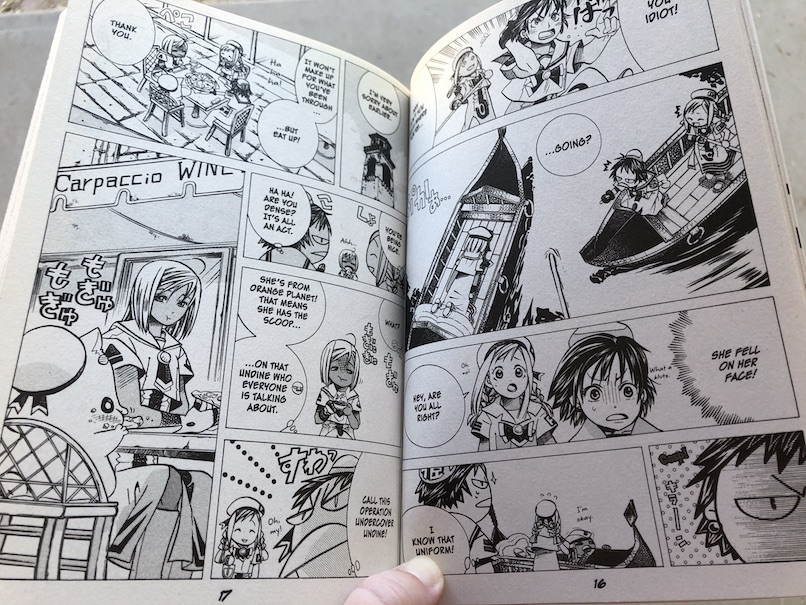
Akira was just as prickly and competitive when she was young as she is as an adult. Although trainee Akira said that she was just observing the “losers” at Aria Company, she kept coming around and became friends with Alicia. When she heard about a new trainee at Orange Company with an amazing singing voice, Akira wanted to seek her out, worried about the competition.

While she was telling Alicia about it, the two of them accidentally had a collision with young Athena’s gondola, which is the first time either of them had seen her. Athena was knocked over by the collision, so the other two girls treated her to lunch, partly to make it up to her and partly because Akira wanted to pump her for information about the new trainee at Orange Company, not knowing that Athena herself was the new trainee.

However, Athena didn’t answer their questions about the new trainee. Even back then, she was a person of few words, and she just made a drinking straw crawly snake to amuse President Aria. Still, Athena became friends with Alicia and Akira, joining them in their practice sessions, like Akari, Aika, and Alice share their practices together. Alicia and Akira only discovered that Athena was the trainee with the amazing voice when they decided to practice singing canzones one day.

The mentors end their reminiscences by saying that it seems hard to believe that, now that their training is over, they are so busy that they hardly have time to see each other. When they were trainees, it felt like they would always practice together every day, but now, their lives are different. These comments make the present trainees uncomfortable because they realize that the same thing is likely to happen to them when their training is complete. Alice, Aika, and Akari have come to value each other’s friendship and companionship, and they find it difficult to imagine being without each other.

However, Alicia and Athena tell the girls to not worry too much about it. Time is always moving forward, and it’s true that things will change for them, but that’s not entirely a bad thing. Even though they sometimes miss their training days when they spent so much of their time together, they are also happy with their current lives. They enjoy their careers, and they like helping to train new Undines. In fact, helping to train the next generation of Undines helps them to connect to their own pasts because the young Undines remind them of their own training days. Alicia’s advice is to enjoy where you are and what’s currently happening around you as much as you can. Life will eventually move on, and things will change, so you might as well make the most of where you are now and enjoy it to the fullest, so you will be ready to move on to the next stage of your life and enjoy that as well. Athena says, “Fun times really aren’t meant to be compared. Just enjoyed.”

The young trainees are still affected by the story of their mentors’ friendships and the changes in their lives. Aika points out to Akari that their lives aren’t changing just yet, but the girls have come to a greater realization that their lives will eventually change.
It’s just like how, when people are young and in school, surrounded by the same other students every day, it can be hard to imagine that there will come a day after you graduate when you won’t all be working at the same place and you won’t all be eating lunch together every day. As you get busy building careers and families, it will be harder to see each other and keep in touch. However, that’s not entirely a bad thing. As some people like to say, “You can’t begin the next chapter of your life if you keep rereading the last one.” There are many things in life to enjoy and accomplishments to be made, and like Alicia and Athena explain, you might as well enjoy where you are right now and make the most of it so you won’t look back with regret when it’s time to move on.

Venetian Glass

Akatsuki’s elder brother comes to Aria Company to hire Akari to transport some delicate Venetian glass. Akari is excited because this is the first time that anyone has specifically hired her, although, because she isn’t a full Undine yet, Alicia will have to accompany her on her errand.

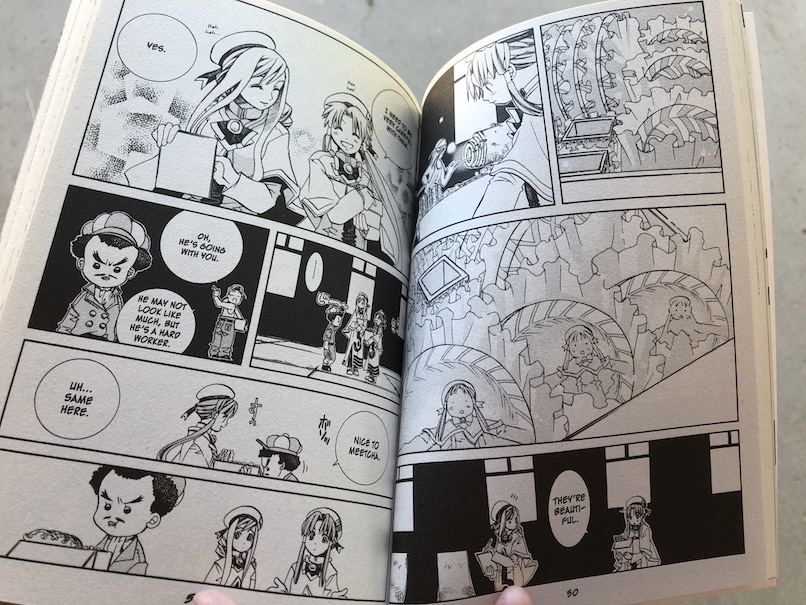
When they go to pick up the glass, Akari sees glass-blowing and Venetian glass for the first time.

One of the workers from the glass factory seems kind of surly, but he accompanies them while they transport the glass and explains the history of Venetian glass and what makes it so special.

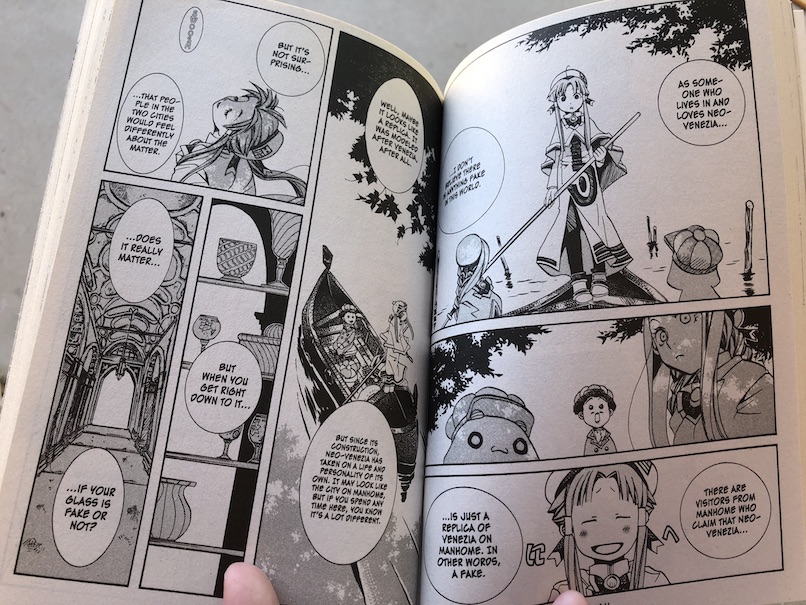
The reason why the glass worker is so surly is that he feels like a lot of people don’t appreciate his craft. He and his master put their heart and soul into their work, but people say that their “Venentian glass” is fake because it’s made in Neo-Venezia, not in the real Venice, which sank beneath the ocean years ago. The worker laments that the craftsmen who left the sinking city were scattered across Earth before making their way to Neo-Venezia and that details of their craft have been lost over time. Neo-Venezian glass will never be quite the same as the original Venetian glass, and people will never look at it the same way, which the worker finds depressing.

However, one of Akari’s great strengths is finding the beauty in everything and bringing it out for other people to see. She tells the worker that the glass is kind of like Neo-Venezia itself. It’s true, it’s not the original Venice, only re-created in its image. Some aspects of it are the same, but it’s also a different place, on another planet. To some people, that might make it seem like a fake city, just an imitation of the original, but Akari doesn’t think that the real vs. fake concept matters because she loves the city for the beautiful treasure it is. Similarly, Akari thinks that Neo-Venezian glass is a treasure by itself and likes it for what it is, regardless of what the original was or what others say about it.

The worker finds Akari’s viewpoint inspirational and is enchanted by Akari herself, remarking that she’s also a unique treasure. Akatsuki’s brother jokes that Akatsuki might have a rival now for his affection for Akari. Akari knows that Akatsuki has had an unrequited crush on Alicia, so she doesn’t think too much about it. Although it’s true that Akatsuki has a crush on Alicia, Akatsuki’s brother is also correct that Akari inspires greater feelings in others than she realizes and Akatsuki values Akari more than he lets on, maybe more than even he realizes himself. Akari is unique because of her unusual way of looking at things, and her optimistic point of view influences others.

Snow White

One day, while they’re practicing together, Akari asks Aika what kind of adult she wanted to be when she was a kid. Aika, who has admired and even hero-worshipped Alicia ever since Alicia was kind to her when she was a young child, says that she’s always wanted to be an elegant woman like Alicia. Akari says that she wants to be like Alicia, too, but Aika criticizes her for wanting to copy her ambition and says that it’s not likely that Akari would ever be as elegant as Alicia because she still does kid-like things, like collecting stuffed animals.

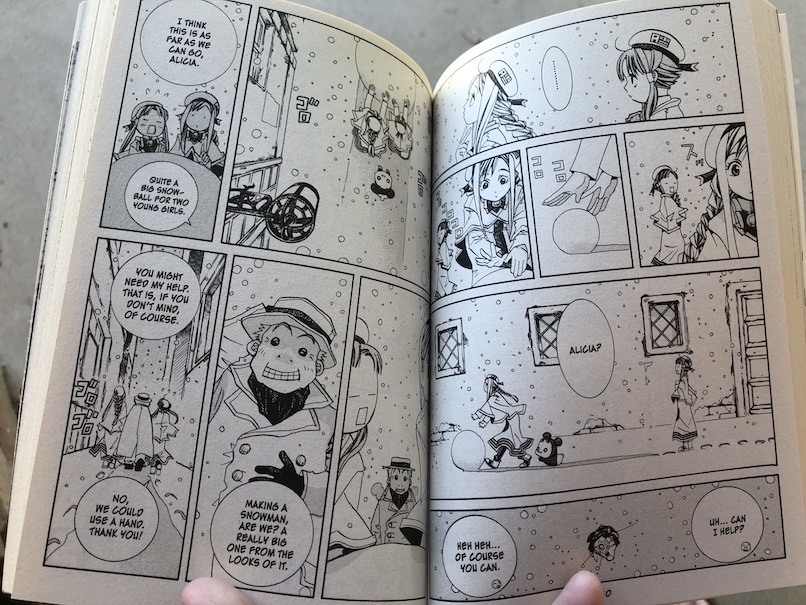
Their discussion causes Akari to wonder what sort of adult Alicia wanted to be when she was a little kid, and she asks Alicia about it while they’re out walking one day. Instead of answering her directly at first, Alicia demonstrates by starting to build a snowman and pointing out how the people around them react to it.

Each time Alicia and Akari start to make a large snowball for the base of the snowman, different adults stop and help them to make it a bit bigger.

Alicia says that she noticed people like this when she was a child. There are always adults who, when seeing a young girl making a snowman, feel compelled to help her because she can make a much bigger snowball with their help. That’s the type of adult Alicia always wanted to be.

Alicia genuinely enjoys not only her career as an Undine but her role as a teacher and mentor in Akari’s life and in the lives of her friends, helping them to develop in their trade and to become better Undines because of her influence.

Stray Cat

Alice finds a tiny stray Martian cat one day while waiting for Akari and Aika to meet her for practice. The cat’s mother doesn’t seem to be around, and Alice doesn’t know whether the little cat is lost, orphaned, or abandoned. When Aika arrives for practice, she finds both Alice and Akari lying on the ground next to the cat because it looks so happy lying in the sun that Alice thinks they should also try it.

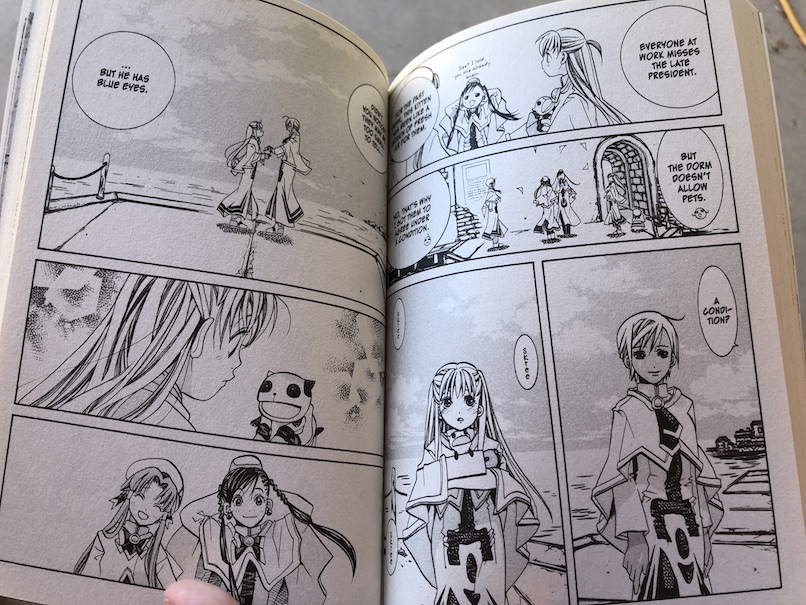
Although Aika warns Alice that she won’t be able to keep the cat because she lives in a dorm at Orange Company and isn’t allowed to keep pets, Alice becomes attached to the cat, names it Maa, and hides it in her room.

At first, she is afraid that her mentor, Athena, will be angry with her, and Aika scares her by saying that Athena will probably kill the cat because she doesn’t like cats. However, Alice loves Maa because she misses the previous president cat of Orange Company, who recently passed away, and Maa reminds her a little of him.

When the secret gets out, and Alice is confronted by Athena about the cat, Alice is scared because Athena is holding a knife for slicing fruit and runs away to leave the tiny Maa where she found him, thinking that it might be the only way to save his life. However, she finds herself unable to abandon Maa and returns to get him, only to find him missing from the box where she left him. In a panic, she spends all night searching the city with her friends to try to find Maa.

However, when they finally give up the search, they discover that Athena has Maa. When she had tried to talk to Alice before, she wasn’t angry. She followed Alice to the place where she left Maa and retrieved him and has been waiting for Alice to return to Orange Company. In Alice’s absence, Athena has persuaded Orange Company to keep Maa as their new company president. Like the other cats used as the presidents/mascots of gondola companies, Maa also has blue eyes.

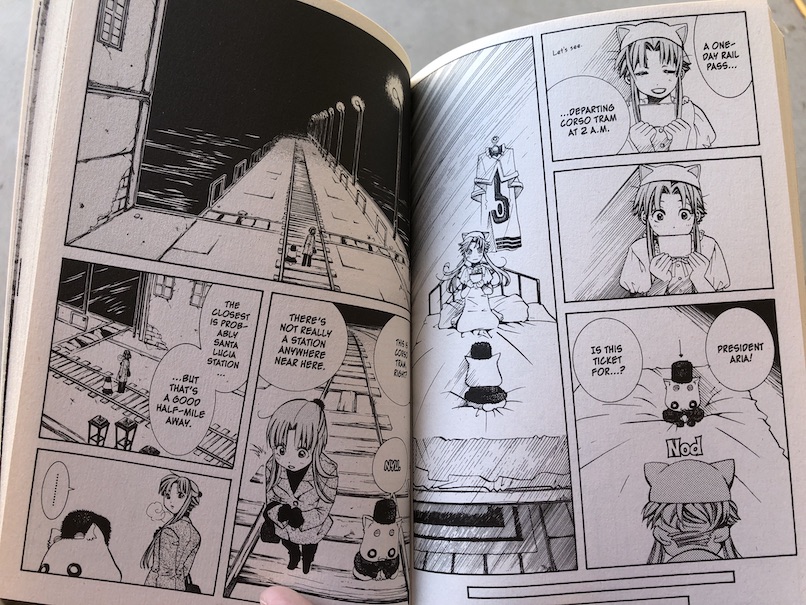
A Night on the Galactic Railroad

When Akari hears the sound of a train at night, she imagines that it’s a magical train like one she read about in a book, A Night on the Galactic Railroad by Kenji Miyazawa.

Aika has a more practical explanation for what it is, that the sounds of freight trains are more noticeable at night, when everything is quiet, but Akari discovers the truth when President Aria gives her a special train ticket.

It turns out that the mysterious train is a train of cats. (Guess who the conductor is?) Akari could use the ticket from President Aria to ride the train, but instead, she gives it to a sad little kitten who lost his ticket.

Because Akari doesn’t board the train, she never finds out where the train was going. The next morning, it all seems like a strange dream, except both Akari and President Aria have the stamps on their foreheads that Cait Sith gave them.

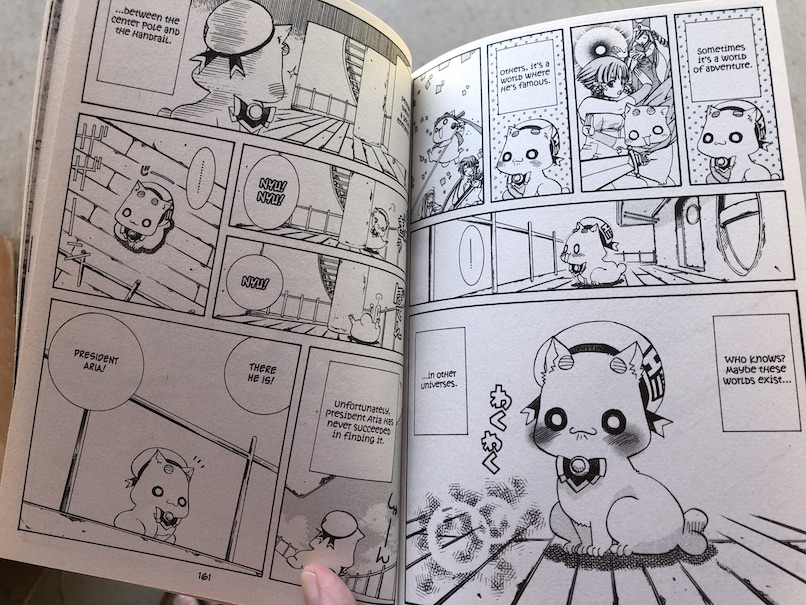
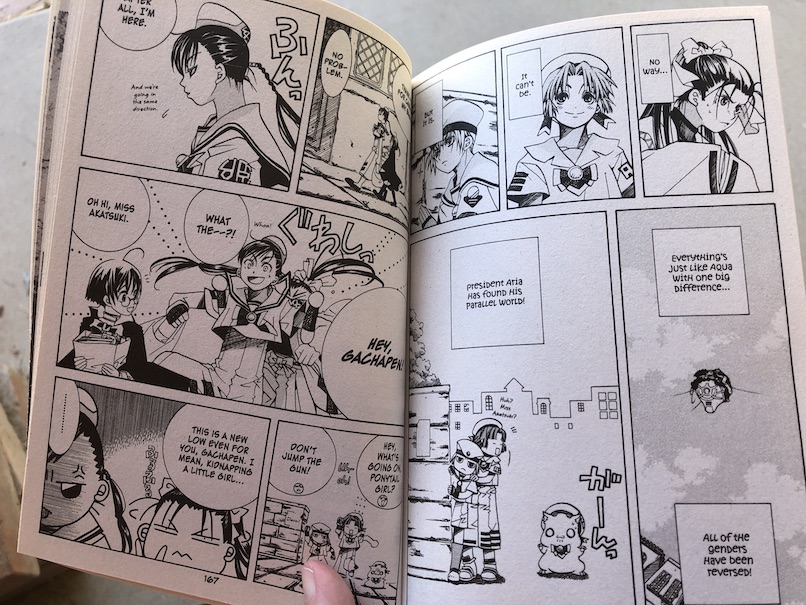
A Parallel World

President Aria accidentally finds a parallel world in which all the people he knows who are girls are boys and vice versa. Frightening!

President Aria has always wanted to find a gateway to another world, but everything seems so strange that all he wants to do is get back to his world.

He ends up returning to the world he knows when someone tosses him too high in the air while playing with him. Did any of it really happen, or was he just dazed from when he fell?

This one isn’t one of my favorite stories in this series because I think that the premise is kind of goofy. The characters don’t really look all that different when their genders are switched. Most of the difference is in hair styles, and the uniforms of the Undines have pants when they’re normally just long dresses.

Betsy-Tacy

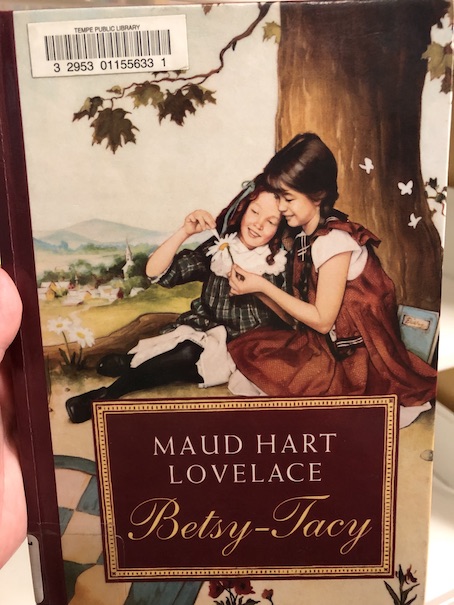
Betsy-Tacy by Maud Hart Lovelace, 1940.

This is the first book in a series about two best friends growing up in Minnesota around the turn of the 20th century. The stories in this book and the rest of the series are based on the author’s own childhood experiences with her best friend.

At the beginning of the book, Betsy meets her best friend, Tacy (short for Anastacia), for the first time after Tacy’s family moves into a house nearby when the girls are both about five years old.  Tacy is very shy and doesn’t want to talk to Betsy at first.  It isn’t until Betsy’s fifth birthday party, a short time later, that the girls really get to know each other and become friends.  After that, they are inseparable, almost to the point where people begin to think of them as one person, Betsy-Tacy. 

Each of the chapters in the book is a short story.  Some of them are about everyday things, like how Betsy would make up stories about her and her friend, how the girls would play dress up and paper dolls, or how they would have a “store” and sell bottles of colored sand to their friends.  Some of the stories are touching, as the girls help each other through some of the most important times of their young lives.  Betsy, the more out-going one, helps shy Tacy through the trauma of their first day of school.  Tacy, who has many brothers and sisters, reassures Betsy that everything will be alright when Betsy’s younger sister is born.  Both girls struggle to come to terms with the death of Tacy’s baby sister. 

At the end of the story, the girls make a new friend when a family moves into the chocolate-colored house with the stained glass window that the girls had always admired.

In the 60th anniversary edition of the book, there are pictures of the author and her best friend, Bick, who is the model for Tacy in the stories, and pictures of the author’s family.  There is also a description of the author’s early life and how the stories were based off her recollections of her own childhood.

This book is available to borrow for free online through Internet Archive.

Sawdust in his Shoes

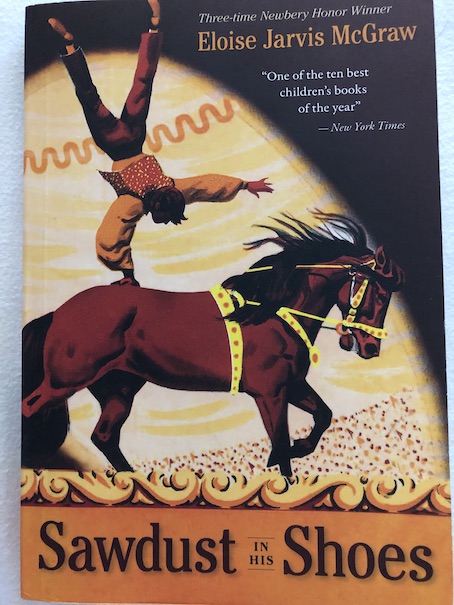
Sawdust in his Shoes by Eloise Jarvis McGraw, 1950, 1977.

Disclosure: I am using a newer edition of the book, published by Plough Publishing House.  Plough sent a copy to me for review purposes, but the opinions in the review are my own.

At fifteen years old, Joe Lang is a rising star in the circus, a trick rider. Circus life is the only life he’s ever known because his father is a lion tamer. Many of the children whose parents work for the circus also work for the circus, competing for the spotlight and top billing, and Joe loves that type of life, even though it means hard training, an element of risk, and constantly moving.

Unfortunately, things change for Joe when his father is killed during an accident in one of his performances. (Mercifully, the accident is not described in the book. Joe does not witness his father’s death. In the story, he hears screams from the circus patrons and is shortly informed that his father has been killed.) Because Joe is still only fifteen, his father’s death raises the question of who will have custody of Joe. Joe’s mother is dead, and his stepmother, who did not grow up with the circus herself, was never fond of circus life or of Joe. After the death of Joe’s father, his stepmother leaves to go live with her sister, and Joe never hears from her again. Mo Shapely, an older man who works for the circus as a clown, wants to assume responsibility for Joe, and Joe would be happy with that because Mo is an old family friend who helped raise and train him. However, the local authorities are not convinced that Mo is a suitable guardian for the boy because of his age, his unsettled lifestyle, and lack of savings.

Mo waits in town with Joe while the authorities make up their minds, but they soon run short of money, and Mo is forced to catch up with the circus and return to his job. Since Joe’s guardianship is still unsettled, the authorities send him to the County Industrial School for Boys, where he will stay until Judge Reynolds has completed his inquiries into Mo’s background. The boarding school offers vocational training, but Joe finds the place dull and bleak and the people unfriendly. When the other boys find out that he used to be with the circus, they are envious and tease him, and even the teacher mocks him. Only one boy tries to be friendly with him, and Joe asks him if any boys ever escape from the school. The boy tells him that some have tried, but no one has succeeded. However, Joe realizes that he just can’t stand life at the school, and all he wants to do is run away and try to rejoin the circus.

When Joe runs away from the school, he cuts across some farmland, loses his way, and ends up getting caught on some barbed wire, where he is found by the Dawson family. The Dawsons treat his wound, and Joe despairs, realizing that he has gone the wrong way and that he has no chance to catch up with the circus before they move on. The Dawsons ask Joe what his name is and offer to help him get home, but Joe is reluctant to tell them the full truth because he doesn’t want to be sent back to the horrible school. Instead, he tells them that he has no home or parents but that he’s worked before, since he was young, and that he hopes to find a job when he’s recovered from his wounds and exhaustion. The Dawsons are concerned about Joe and curious about his mysterious past and vague answers, but Mr. Dawson decides to offer Joe a position as farm hand. Joe is surprised at the offer and a little suspicious, and he asks Mr. Dawson why he’s so willing to take in a perfect stranger. Mr. Dawson answers him in an equally vague way, saying that if Joe really feels like he needs to steal their silver, he must need it more than they do, and he’s welcome to it. Joe decides to accept Mr. Dawson’s offer of employment.

Joe isn’t used to farm work, but he’s strong from his work with the circus (Mr. Dawson had noticed his athletic build), and he is good with horses and other animals. Although Mrs. Dawson is concerned that they know so little about Joe or his background, Mr. Dawson tells his family to allow Joe to have his privacy and not question him too much about his past. Still, Joe can’t resist showing off and trying one of his old tricks on horseback one day, accidentally making his injury worse because it isn’t healed yet. He begins to worry that the injury might be bad enough that he’ll never be able to be a trick rider again. By the time he has fully recovered, he is also long out of practice.

Eventually, Joe’s secrets are exposed, and he must make some choices about his future. Although Joe had lived many different places when he traveled with the circus, living on the Dawsons’ farm provides him with new experiences and broadens his horizons in unexpected ways. He had never had much respect for non-circus people before (partly because of his bad experiences with his non-circus stepmother). He still dislikes some of the Dawsons’ neighbors for their unfriendliness and suspicious toward him, but the Dawsons themselves are very different from most of the people Joe has met before. Joe comes to realize that he has not forgotten everything that he learned from his old life and that he can apply his old skills in new ways. He even starts to consider that there are more ways of living than he had previously thought, and he begins to see the appeal of non-circus life. Still, the circus is what he always loved first, and he feels torn between what he’s always wanted and the people who have loved and supported him when he needed it the most.

Children today probably don’t look at the circus in the same way as past generations. Some of the larger, mainstay circuses, like Ringling Brothers and Barnum and Bailey, have closed. People make jokes about how scary clowns are, and animal acts aren’t considered humane to the animals. Circuses still exist in the early 21st century, but they’re not quite what they used to be, and they aren’t looked at in quite the same way. Even when I was a young child, in the 1980s and early 1990s, I wasn’t particularly wild about the circus. A large part of that is temperament. I’m not fond of loud noises or large crowds, and I tend to avoid places where there are both. I’m very different from my grandmother, who absolutely loved circuses and parades and excitement of all kinds, dragging her children with her, even when they didn’t always feel like going. In my grandmother’s youth (1910s and early 1920s), there were few things more exciting than a circus coming to town!

However, this story isn’t just about love of circuses or a look back on the forms of entertainment that people used to enjoy. There’s always some nostalgia of that type to vintage books, but this book is about more than that. This is about a person finding his way in life and facing an unpredictable future, who has to decide what’s really important to him. I’m sometimes fascinated by people who seem to know what they want to do in life from an early age. They are born to parents with a profession they want to follow or who have connections to a profession they want to follow, and they start training very early for something they truly love. At first, that seems to be Joe’s situation in life. He loves the circus, he was born into that kind of life, he gets that early training, and there’s nothing else he would rather do. Some people like that become early success stories, just being lucky enough to be born in the right place and with the right connections for the life they want to live, and it all looks like smooth sailing. Most people aren’t that lucky, though, and even for people who think they know what they want, life has a way of throwing a monkey-wrench into their plans. That is what this story is really about.

Joe’s life abruptly changes when his father dies and his guardianship remains in limbo. Things often happen in our lives that we can’t fully control, taking us down paths we never thought that we’d travel. There are times when many of us start to question what we really want out of life, whether our first choices were really the best ones, or if there’s something else that we really want. Sometimes, these unexpected detours make us feel like we’re headed for a dead end, like when Joe fears that he has lost his skill and he’ll never live the life he once dreamed he would. However, sometimes, these things are just a temporary bend in the road. In some ways, an adult who has been through this sort of process would understand it better, but even children know what it is to have a dream and not know whether or not it will become reality.

Children need time to discover and develop their talents, and, as they grow and step into the wider world, they routinely discover that they have to make other decisions that they knew nothing about before. Children also know what it’s like to be at the mercy of adults who can either help guide them on their way or who stand as an obstacle to their dreams and efforts, like the judge who takes so long to decide what he thinks is best for Joe that Joe feels he must take his fortune into his own hands. Right up until the very end, Joe’s ultimate choice remains uncertain as readers wonder what he’s really going to decide to do and what his destiny is going to be. At first, Joe seems like he’s in a bad situation, with limited options, but his experiences show him that his options in life are broader than he thinks. It seems like saying yes to one of the choices confronting him means saying no to something else he cares about, but even that isn’t as straight-forward as it seems. I think this is one of those timeless books that can appeal to all ages because what it’s really about is a person finding his way in life and discovering that a difficult, unpredictable path may be just the path he needs to take.

In the end, it’s not just about what Joe chooses or where he ends up; it’s about what he does along the way. When Joe runs away from the school, he is the one who is injured and in need of help, but he also has a positive impact on the people who were kind enough to help him when he needed it. In fact, there are some situations that would have turned out much worse for everyone if Joe hadn’t been there and been able to help. Joe’s unexpected detour in life changed everyone else’s lives as well, and it was well worth doing, in spite of the struggle.

This book is available to borrow for free online through Internet Archive, but it’s also back in print and available for purchase through Plough. If you borrow the book and like it, consider buying a copy of your own!

Who Stole the Wizard of Oz?

One summer, Toby and his twin sister Becky see the police go to their local library. To the children’s surprise, Mrs. Brattle, the librarian, phones their house and asks Becky to come down to the library and bring one of her parents.  The children’s parents aren’t home, so Becky and Toby go.  Mrs. Brattle doesn’t seem to want to say much over the phone, only that The Wizard of Oz was stolen, and they need to talk to Becky.

As Becky and Toby walk down to the library from their house, which isn’t far, Becky says that shortly before school let out for the summer, Becky’s teacher for sixth grade next fall handed out a summer reading assignment.  The kids have to write two book reports over the summer, and the books can’t be mysteries, fantasies, or romantic adventures.  Miss McPhearson, the sixth grade teacher, believes in only factual books.  However, Becky decided that the best thing to do was to get the book reports over as soon as possible, so she went to the library.  (Toby wasn’t involved because he has a different teacher.)  While she was there, she decided that she’d check out The Wizard of Oz for Toby, knowing that he likes fantasy books, but she was told that it was already checked out.  Mrs. Brattle told her that there would be a book sale at the library tomorrow and that she had a copy of The Wizard of Oz that Becky could buy for five cents, but since the librarian wouldn’t sell her the book that day and Becky didn’t want to make a special trip to the library the next day, she turned down the offer.

When they come to the library, the policeman accuses Becky of stealing the copy of The Wizard of Oz that the librarian showed her as well as some other children’s books.  According to the librarian, the books were actually valuable collector’s copies, worth thousands of dollars.  Becky asks the librarian why she offered to sell her one for nickel if they were so valuable and Mrs. Brattle says that it was a mistake.  The policeman says that if Becky has the books, she can return them now, and there will be no problem, but Becky is insulted and insists that she didn’t take them.  In the face of Becky’s denial, the policeman says that there isn’t much that he can do because there is only the librarian’s word that the books were valuable, and she doesn’t deny that she earlier tried to sell them for five cents each.  Missing children’s books worth less than a dollar isn’t exactly a police problem.  (I’d like to say here that I was very glad that the policeman took that attitude. I hate those children’s books where adults not only falsely accuse children of doing things that they didn’t do but also make petty incidents seem like major crimes. The policeman is correct that there is no proof that the books were as valuable as the librarian says and that this evaluation of their worth comes only after their sudden disappearance and after she was offering to sell them very cheaply.)

Even though the matter seems to be dropped for the moment, it bothers Becky that the librarian still thinks that she might have taken the books.  She suggests to Toby that they could investigate and try to find out what really happened to the books.  The first thing that they decide to do is to look for the original owner of the books.  After inspecting other children’s books at the sale and looking at the names in the front covers, they decide that Gertrude Tobias is the most likely former owner because many of the other books at the sale belonged to her.  Unfortunately, Gertrude Tobias died a few months ago.  However, it turns out that her niece is Miss McPhearson.  Becky hurriedly finishes her book reports so that she and her brother will have an excuse to visit Miss McPhearson and ask her about the books.

When they ask Miss McPhearson about her aunt, she calls her aunt a “foolish woman” who “didn’t know any better.”  However, she refuses to explain any further what she means, and the children see her crying before they leave.

When the children speak to Mrs. Chesterton, they get a very different picture of Miss McPhearson’s aunt.  When Gertrude Tobias was a young woman, she was wealthy. She could have gotten married if she wanted to, but most of the young men didn’t like women who seemed too smart, and Miss Tobias prided herself on her intelligence and cleverness.  She resented the idea that adults seemed to want women to play dumb to get a husband, so she refused to get married and spent most of her time in the company of children.  Mrs. Chesterton remembers her saying, “Children like me smart. Grown-ups want me stupid.”  She liked to read children’s books, and she often volunteered to read books to children at the library.  The children liked her and often confided in her, just like she was their aunt.  She spent a lot of her money buying children’s books for her collection.  Mrs. Chesterton says that Miss Tobias and her niece never really got along well and that Miss McPhearson used to tease her aunt about her love of children’s books.  However, Miss Tobias was rich, and Miss McPhearson didn’t have much money at all.  Miss Tobias told her that she would leave her all of her “treasure.”  When she died, it turned out that she had left her niece five children’s books – the five that are now missing.  The others were willed to the library.

At first, the picture seems like it’s becoming more clear: Miss Tobias had one last joke on her niece by giving her valuable children’s books that Miss McPhearson thought were worthless simply because they were children’s books, and the person who took them recognized what they were worth as collectors’ items.  However, the situation is actually more complicated than that.  A series of strange break-ins have been occurring around town. Nothing else has been taken, but someone is clearly searching for something.  Miss Tobias was clever, and her books have an even deeper meaning than most people have realized.  To learn Miss Tobias’ secret, Toby and Becky have to learn the secrets of the books themselves.

The book is currently available online through Internet Archive.

I really loved the puzzle in this book! There were parts that I got before the kids did and parts that they realized before I did. It isn’t a kind of puzzle that readers call fully solve before the characters in the book because it requires knowledge of their home town to get the full answer.

As an unmarried, childless adult who also enjoys children’s books, I could kind of sympathize with Miss Tobias. Children’s books, like some adults, are often very clever but go unappreciated by people who underrate them for what they appear to be. For example, Through the Looking Glass, which was one of the books featured in the story, involves a game of chess. The author, Lewis Carroll (real name Charles Dodgson), was a mathematician. His books are full of word games and logic puzzles, and the chess game described in Through the Looking Glass is an actual chess game that can be played with real pieces on a real board with a definite ending square, where Alice the pawn becomes Alice the queen (one of the clues to solving the final mystery in this book). To many adults who only know the basic story of Alice, it might just seem like a silly, nonsense children’s story, but they miss the real, clever puzzles planted in the story, just like Miss McPhearson did with her aunt’s legacy.

In the end of the story, Miss McPhearson never learns the truth about her aunt’s legacy, just as her aunt knew she would miss it. Toby and Becky come to an understanding with the real thief about Miss Tobias’ treasure that allows the library to benefit from the legacy, which is something that Miss Tobias would have appreciated. Miss McPhearson decides to give up teaching and leaves town to find another job, working with computers, a very “adult” field indeed. It’s only a pity that she wasn’t mature enough to behave nicely with her aunt and not tease her, so that her aunt would be more generous with her. People who play childish games are sometimes surprised when they meet a better game player.

Like Miss Tobias, I have little patience for people who try too hard to be “adult” or are too concerned with whether certain things are right for adults to do, especially when they show their immature sides in other ways. In the story, Miss McPhearson makes a point of being “adult” in all situations, but she wasn’t above childishly taunting an older woman about her hobbies, still expecting that woman to leave her all of her money. It reminds me of the kids I knew in elementary school who liked to act really grown up at age ten. Kids go through a phase where they start talking about doing grown-up things like having first boyfriends and girlfriends and wearing makeup and watching adult tv shows and listening to adult music, but in between doing all of that, they still act like childish brats because what they’re doing is trying on the trappings of adulthood without the real substance. Until they get some real maturity and better behavior, they’re just kids playing dress-up. Sometimes, I think that some people never quite leave that phase, which is how I view the character of Miss McPhearson.

I think of this every time I hear some adult my age or older talking about how real adults drink alcohol or real women wear high heels and lipstick. To hear them talk, there are quite a lot of rules to being grown up that very few people I know actually follow. Alcohol is expensive, plenty of people abstain for health or religious reasons, and driving drunk certainly isn’t mature behavior. High heels damage your feet the more you wear them. I’ve forgotten how much makeup I’ve thrown away because, most days, I’m just too busy to even think about putting it on, and they eventually dry out and get gross. It would be a waste of money for me to buy more, knowing I’ll never use it all. To my way of thinking, if you really are an adult and you know who and what you are, you have nothing to prove. If you aren’t mature as a person, things like high heels and lipstick aren’t going to help you, and alcohol just lowers your inhibitions and makes the immaturity more obvious. Maturity is a way of looking at things, assessing situations, and acting accordingly. It can be difficult to define, but you know it when you see someone living it, not just looking the part. Real adults don’t need to “act” like adults at all times because they aren’t “acting”; they’re just being themselves, confident that they are mature enough to handle what life throws at them along the way.

The School at the Chalet

The School at the Chalet by Elinor M. Brent-Dyer, 1925.

This is the first book in the Chalet School Series.  This series is uncommon in the United States.  People from Britain or countries with heavy British influence would be more familiar with this series.  It’s considered classic!

When the story begins, Madge and Dick Bettany, who are brother and sister, a set of twins, are discussing their family’s situation.  Their parents are dead, and they have very little money and no family members they can rely on.  Madge and Dick are grown and are ready to begin making their own way in the world, but their younger sister, called Joey, is still a child, and her heath has been poor.  Dick has a job, but he really can’t afford to support his sisters.  However, Madge has had an idea: she wants to start a school.  Dick worries that they don’t have the capital necessary to start a school, but Madge says that she could start one in continental Europe instead of England, where they are from, because the costs would be lower.  She even has a specific place in mind, a chalet near a lake, close to a town called Innsbruck in the Tiernsee (Austria).  Joey could live with her at the school and continue her education in the company of the other students, and Madge thinks that the climate there might even be better for her than England.  She has already written a letter to find out if the chalet is available, and it is.  If they sell most of what they own in England, Madge thinks that they’ll have enough to buy what they need in Europe.  Madge says that she thinks she could handle about a dozen girls, between the ages of twelve and fourteen or fifteen.  She knows someone who could help her teach, Mademoiselle Lepattre, and between them, they are qualified to teach French, German, sewing, and music.  Dick is still a little concerned about whether or not Madge can pull off the school, but he agrees that she should go ahead with her plans (since she likely will anyway) and says that if she runs into trouble, she should contact him for help.

Madge even knows who her first pupil at the boarding school will be: Grizel Cochrane.  Madge has already had her as a student, and she is friends with her family.  She knows that Grizel has been unhappy at home since her father remarried because she and her stepmother do not get along.  Grizel’s stepmother has already been pressuring her father to send her away to boarding school, but he loves her and has been reluctant to part with her.  However, Grizel has been miserable, and her father decides would be more willing to send her away with someone he already knows.  Grizel is pleased at the idea of joining Madge and Joey at a school in Europe, and the Madge gains her first student.

Dick and Mademoiselle Lepattre go to the chalet first to take the larger trunks and belongings and begin getting settled, while Madge, Joey, and Grizel follow them.  Along the way, they see some of the sights of Paris.  By the time they arrive at the chalet, Mademoiselle Lepattre’s young cousin, Simone Lecoutier, has arrived at the school to be a pupil, and Madge has arranged to accept an American girl named Evadne Lannis, who will arrive later.  These four girls, Joey, Grizel, Simone, and Evadne, are the school’s first boarders.  The school soon acquires a few day pupils who live nearby: Gisela and Maria Marani (a pair of sisters), Gertrud Steinbrucke, Bette Rincini, Bernhilda and Frieda Mensch (also sisters).  Maria is much younger than the other girls, only nine, but her mother asked that she be admitted along with her older sister. There are public schools for children in Innsbruck, but the father of one of the new local pupils thinks that the Chalet School might be healthier for his daughter because, while he doesn’t think much of English educational standards (Grizel takes exception to that comment), they shorten the school day (compared to the average school day of Austria or Germany of the time) and encourage participation in sports and games. The local girls are curious to see what things are going to be like at an English style school, and if it will be like other English schools they’ve heard about.  The school also soon gains more students and boarders:

  • Margia and Amy Stevens – ages 8 and 11, their father is a foreign correspondent from London who needs to travel for his work, and the girls’ parents wanted to find a stable place for the girls to stay.
  • Bette Rincini’s cousins, who have come to stay with her family
  • A pair of sisters from another town across the lake
  • Two more children from a nearby hotel
  • Friends of Gisela from Vienna
  • Rosalie and Mary, two girls Joey and Grizel know from England

As the school grows and the girls settle into life at the school, they make friends with each other, although it’s awkward in some cases.  Madge notices that Simone is often by herself and she asks Joey if she and the other girls are being nice to her.  Joey says that they try, but Simone often sneaks off alone, and she doesn’t know where Simone goes.  Joey tries to ask Simone if she’s unhappy, and Simone tries to deny it.  The truth is that Simone is really homesick.  Joey finds her crying by herself later and comforts her, and Simone finally admits how much she misses her mother.  Simone also says that she feels left out because everyone else at the school has someone to be close to.  Other girls at the school share nationalities with at least some of the other students.  Simone is the only French girl at the school.  The Austrian girls are close to home, and Joey and Grizel already knew each other before they left England.  Seeing the other girls being such close friends makes her feel more left out.  Joey apologizes for making Simone feel left out and assures her that she will be her friend.  Simone asks her to be her best friend because she really needs someone to confide in, and Joey agrees, although she finds Simone rather needy and clingy. 

It turns out to be a difficult promise because Simone gets very jealous when Joey makes friends with other girls, and she tries to convince Joey to only be friends with her.  Simone is very dramatic, and she even ends up cutting off her long braid in an effort to impress Joey and get her attention when she learns about the other girls who will be coming from England.  Simone is so desperately lonely and finds it so difficult to make new friends that she is terrified that Joey will abandon her completely when she has other friends.  Joey gets fed up with her behavior and tells her that she’s being selfish. Joey knows that Simone would find it easier to make more friends herself if she would stop moping and being sad and gloomy.

After Juliet Carrick, another English girl, joins the school, Gisela is made head girl, and other girls are made prefects.  Bette is a sub-prefect, and one day, when she tells Grizel to put her shoes away, Grizel is rude to her, and Juliet laughs.  Gisela and the prefects discuss the situation and agree that Grizel, who wasn’t causing problems before, is now acting up because Juliet thinks that it’s funny.  When Gisela sends someone to bring Grizel to the prefects’ room to talk about it, Grizel refuses to come and see them, and she realizes that something needs to be done.  If the head girl and prefects let a girl get away with disrespecting them or not following the rules, the prefect system and student government would fall apart.  Grizel feels a kinship for Juliet because neither of them has a happy home life. Juliet has been raised to believe that the English are superior to everyone else, and she has no shame in showing it.  Juliet encourages Grizel to adopt her prejudices, but at a school in Austria with students of varying nationalities, that can’t be allowed.  Madge supports the prefects, and Grizel is punished for her behavior.

Juliet is still a bad influence, sometimes encouraging other girls to act up with her. When Madge refuses to allow the girls to pose by the lake for some film makers, Juliet convinces some of other girls to sneak away with her and volunteer to be filmed without Madge’s knowledge.  However, the father of one of the local girls catches them. He explains to the film makers that it would be inappropriate to film the girls because they don’t have permission from either the girls’ parents or teachers, and he takes the girls back to the school.  Grizel’s temper and excessive patriotism also get the girls into trouble when they encounter a German tourist who makes it plain that she is disgusted at the presence of the English girls. (This is after The Great War, World War I, so that may be the reason.)  While the German woman was being deliberately rude and insulting to the girls, Joey points out that Grizel’s hot-headed reply to her has now caused them more trouble.  Grizel does apologize for not using more restraint.

Juliet’s home life turns out to be even worse than the other girls know, but they learn the truth when Juliet’s father sends a letter to Madge saying that he and his wife relinquish their custody of Juliet to the school.  The letter says that Madge can do whatever she likes with Juliet.  If she wants to keep Juliet at the school and have her work for her future tuition, that will be fine, and she is also free to send Juliet to an orphanage.  The point is that her parents have left the country, they consider Juliet a burden that they would rather not bring with them, and while they might one day feel able to reclaim her, chances of that are not looking good.  When Juliet learns about the letter, she cries and says that she had been afraid that they would do something like this.  Her parents tried to abandon her at a different school once before, but the school had insisted that they take her back.  Madge now has no idea where Juliet’s parents are.  However, she can’t bear to turn Juliet over to an orphanage, so she promises Juliet that she will keep her and that she can help to pay for her tuition by working with the younger children at the school.  Although Juliet’s behavior hasn’t been very good up to this point, Juliet is grateful to Madge and does earnestly try to please her and to maintain her place at the school. Before the end of the book, Juliet’s parents die in an automobile accident, giving Madge and the school permanent custody of her. Most of the other students (except for Joey) do not know that Juliet’s parents tried to abandon her before they died.

Through the rest of the book, the girls have adventures together and forge the new traditions of their school.  They celebrate Madge’s birthday, get stranded in a storm and have to spend the night in a cowshed, start a magazine for the school, and play pranks on each other. When Grizel’s pranks and disobedience go too far and she is punished harshly for it, she gets angry and runs away from the school, becoming stranded on a nearby mountain. Joey goes after her to save her, and both girls are ill after their experience.

The book ends with Madge and a few of the girls caught in a train accident. Fortunately, they escape the accident without serious injury, and they also manage to help the German woman who had insulted the girls earlier. A man named James Russell helps them. The book ends at this point, and the story continues in the next book in the series. James Russell is a significant continuing character.

The book is currently available to borrow for free online through Internet Archive.

Peter’s Chair

Peter’s Chair by Ezra Jack Keats, 1967.

There is a new baby in Peter’s family, his little sister, Susie, and things are changing for Peter.  He is no longer the baby of the family.  He must play quietly to avoid disturbing the baby, and his father is painting all of his old, blue baby furniture pink for little Susie.

Peter feels badly, seeing the baby getting all of his old things.  Spotting his old baby chair, which hasn’t been painted yet, Peter runs off with it, taking along some of his other old things.

However, what Peter eventually realizes is that he has grown too big to fit into his old chair.  Nobody stays a baby forever, and Peter’s old baby things are of no use to him anymore.

Seeing that he is out-growing these old baby things helps Peter to be willing to let go of them and help his father repaint them for his little sister.

This is a cute story about change and growing up and the worries that children sometimes have about their siblings taking their place in the family. The art style of the book is also interesting because it includes pieces of patterned or textured paper for things like wallpaper, people’s clothing, the newspapers under the furniture being painted, and the baby’s lacy blanket. Other books by the same author also use this technique, such as Jennie’s Hat.