Arthur’s Halloween

Arthur Adventure

It’s Halloween, and Arthur’s already getting spooked! His family is putting up Halloween decorations, and his sister, D.W., scares him with her costume when he wakes up on Halloween morning. Arthur is supposed to take D.W. trick-or-treating, although he doesn’t really want his little sister tagging along.

At school, Arthur has trouble recognizing everyone in their costumes. There are Halloween treats and games, though.

That evening, Arthur and D.W. go trick-or-treating with Arthur’s friends. Arthur’s friend, Buster, warns them not to go to a big, old house because a witch lives there, and the last person who went in on Halloween never came out again.

Arthur and D.W. lag behind the other trick-or-treaters, and when Arthur turns around, he sees D.W. going into the witch’s house! What choice does Arthur have but to go in after his sister to save her?

This book reminded me of the Berenstain Bears Halloween book The Berenstain Bears Trick or Treat. It’s another instance of an elderly woman who seems witch-like and scary, but the children enter her house on Halloween, discover that she’s really nice, and get some special treats. Entering a stranger’s house is never a good idea because, in real life, that could be very dangerous. I get the theme that appearances can be deceptive and things that seem scary aren’t so scary when you understand them, but I do quibble that this might not be the best way to demonstrate that to young children. All the same, I do have nostalgia for both the Berenstain Bears and the Arthur books.

I remember reading the Berenstain Bears Halloween book as a kid, but I don’t remember reading Arthur’s Halloween until I was an adult. Because of the similarity in the themes of the stories, I checked the copyright dates. They’re both from the 1980s, but Arthur’s Halloween is the older of the two books. I don’t know if the Berenstain Bears took inspiration from the Arthur story or if they were both inspired by something older or if the similar theme is just a coincidence.

One other odd thing about this story is that old Mrs. Tibble is human. Everyone in the Arthur books is some kind of animal, but not Mrs. Tibble. There is no explanation for this. In the cartoon version of Arthur, Mrs. Tibble is an animal, just like everyone else.

Happy Haunting, Amelia Bedelia

Amelia Bedelia

When Amelia Bedelia arrives at the Rogers’s house just before Halloween, she is appalled by all the cobwebs. The house looks like a run-down haunted house, and Amelia Bedelia thinks someone wrecked it. Mr. and Mrs. Rogers reassure her that the house is just decorated for the Halloween party they are having that night. Amelia Bedelia almost forgot what day it was because she’s been busy, helping the local children make their costumes.

When Amelia Bedelia tries to help the Rogers get ready for the party, she demonstrates that she still takes everything way too literally. When Mr. Rogers asks her to both get the hammer and to crack a window, Amelia Bedelia assumes that he means her to use the hammer on the window and actually breaks it. When they ask Amelia to add an extra leaf to the table for the guests, she assumes they mean a tree leaf, and when Mr. Rogers asks her to hand him a witch, she asks him “Which what?”

Amelia Bedelia is enough to drive anyone batty, but she really does her best work in the kitchen. She is a good cook, and she and Mrs. Rogers have fun making a bunch of traditional Halloween goodies. Then Cousin Alcolu arrives with a bunch of pumpkins and a scarecrow for the party. They ask Amelia Bedelia what costume she will wear for the party that night, but she doesn’t have one. Mrs. Rogers says that she has an idea for her and for Cousin Alcolu.

The Rogers’s party that night is a success, and Amelia’s influence is obvious in the literal nature of some of the treats and the costumes she helped the children make. However, nobody can figure out where Amelia Bedelia is. At first, Mr. Rogers thinks that maybe Amelia is offended because he mistakenly called her normal outfit a costume, but then, he is sure that he recognizes Amelia Bedelia in her Halloween costume. Is he right? It certain seems something strange is going on! But, then again, Amelia Bedelia is there.

The book is available to borrow and read for free online through Internet Archive (multiple copies).

This is one of the newer Amelia Bedelia books, written after the death of the original author. Parts seemed a little cheesy to me, like Amelia Bedelia seeming confused about the Halloween decorations after helping the children make Halloween costumes. Amelia Bedelia is often a little mixed-up, but getting confused about the nature of the holiday just seemed to be overdoing it. Then again, even in the original books, she was confused about ordinary things associated with holidays, like what kind of “star” goes on top of a Christmas tree. It might be more in character than I thought at first, and it just seemed like overdoing it in this book because I read the original books when I was a kid wasn’t thinking that deeply about it back then.

I did like it that Amelia Bedelia’s tendency to be overly literal is going strong in this book. Besides the mistakes she makes while helping Mr. and Mrs. Rogers get ready for their party, I enjoyed seeing the costumes that Amelia helped the children make. They’re all puns and literal interpretations of common expressions. Amelia Bedelia’s own costume is a fun twist!

The Vanishing Pumpkin

An 800-year-old man and a 700-year-old woman live together in a little house. One day, they realize that it’s Halloween, and that means that it’s time to make pumpkin pie. However, when they go to get the pumpkin from their garden, it’s gone! Who could have taken it?

They set out in search of the pumpkin thief. The first person they meet is a ghoul, and they assume he’s the pumpkin thief. They demand to know where the pumpkin is. The ghoul looks all over the place, but doesn’t see any pumpkin. The old man threatens to do him a trick, and the ghoul says he wants to see him do one. The old man turns the ghoul so thin that he can look right though him, but the ghoul doesn’t have the pumpkin.

The old man and old woman set off again to look for the pumpkin thief, and the ghoul comes along to see more tricks. The next person they encounter is a rapscallion. When they ask him where the pumpkin is, the rapscallion looks around and can’t find any pumpkin, so he offers them a mushroom. The old man does another trick, turning the rapscallion upside down, but no pumpkin falls out.

The group, including the rapscallion, sets off in search of the pumpkin thief again. The next time, they encounter a varmint, and the old man turns him into a black cat with fleas. Yet again, the varmint doesn’t have the pumpkin, so they all set off again.

The pumpkin pursuit finally ends with the person who actually has the pumpkin. The wizard has turned the pumpkin into both a jack-o’-lantern and a pumpkin pie!

I remember someone reading this book to me when I was a little kid. I think it might have been the school librarian, but I’m not completely sure now. We don’t really know the story behind the 800-year-old man and 700-year-old woman, who is presumably his wife. They seem to be magical because of their ancient age and the fact that the old man seems capable of magic, but they aren’t described as being a witch and wizard or anything specific. It’s just left to readers’ imaginations. I think, when I was little kid, I assumed that they were witches or something similar.

The story is just for fun. It’s one of those repetition stories, where the characters encounter more people/creatures, similar things happen each time, and each new person/creature joins the group, until they finally figure out who has the pumpkin. Part of the fun of the story is the unusual people and creatures the meet. Most of them are not typical Halloween creatures, like a witch, a ghost, and a monster, although they are Halloween-ish. The words that describe them are real words – ghoul (which is a mythological creature), rapscallion, and varmint – but at the same time, it’s not entirely clear what type of creatures they are, and the book doesn’t explain. We can only go by what they look like in the pictures. The “varmint” looks like a large rat, the “ghoul” is a little green guy in a top hat, and the “rapscallion” is a little guy in a dark robe and hood.

Meg Mackintosh and The Stage Fright Secret

Meg Mackintosh Mysteries

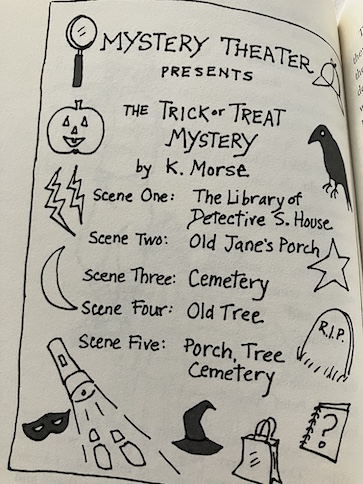
The mystery club at Meg’s school is putting on a play, and Meg’s friend, Liddy, says that they should try out for parts. The play is a Halloween mystery called The Trick or Treat Mystery with a detective called Sureluck House. Meg is nervous during the try-outs and rushes through her lines, so she doesn’t get the part of the detective. However, the club’s advisor, Ms. Morse, gives her the role of announcer. The announcer is like a narrator, introducing scenes of the play. Meg still wishes that she had a regular part in the play, but being the announcer gives her a chance to be involved.

The kids begin assembling costumes and props. Meg creates signs for each scene, including signs to invite the audience to figure out clues during the performance. Once the play gets started, the story takes the form of the play itself. All of the dialogue is presented as part of the play and other information as stage directions, and Meg’s signs invite readers to figure out clues to the mystery.

In the play, Sureluck House gets a letter from Old Jane, a woman who lives in a spooky cottage near a cemetery, asking him to find who stole her stuffed raven. The raven has glowing red eyes, and Old Jane likes to put him on her porch on Halloween to scare away trick-or-treaters.

Sureluck and his friend Witson visit Old Jane, who tells them that three trick-or-treaters have visited her: a witch, a mummy, and a pirate. Then, Old Jane got distracted, chasing one of her kittens, and when she returned to her porch, the raven was gone. She thinks one of the trick-or-treaters stole it. Sureluck and Witson interview the three trick-or-treaters and point out evidence that each of them left at the scene, but they all deny taking the raven.

Then, there is a spooky part of the play where the actors are scared by lightning and thunder, and the lights go out. Readers and the audience can tell that the actors are also confused at this part of the play, and the Ms. Morse sticks her head out from behind the curtain to say that they’re experiencing technical difficulties.

When the lights come back on and the curtain opens again, Sureluck is lying on the ground, having apparently fainted from fright, and only Witson and Old Jane are on the scene. Witson says he thinks he can solve the mystery and invites the audience to guess which suspect stole the raven and where it is. When the audience says where they think the raven is. They guess the correct suspect, but the raven isn’t where it’s supposed to be. Also, Meg has suddenly disappeared, leaving her sign behind. Now, everybody, audience, actors, and Ms. Morse seem really confused.

Has an actual raven theft occurred in the middle of the play? Is Meg the culprit? Where is she?

The book is available to borrow and read for free online through Internet Archive.

I liked the unusual format to this book, having most of the mystery be in the form of a play within the story. Like other books in this series, readers are given the opportunity to spot the clues and solve the puzzle along with Meg. Because of the play format, we are also like part of the audience, watching the play and trying to figure out where the mystery in the play leaves off and where the mystery that Meg needs to solve begins. The ending is a little unusual because Meg seems to disappear briefly. I didn’t think it was too hard to figure out where Meg went, but I still enjoyed the story, and I though a spooky mystery play was a nice idea for a Halloween story!

The Pumpkin Head Mystery

The Boxcar Children

The Aldens are getting ready for Halloween, and they go to the Beckett farm to get some pumpkins. Mr. Beckett has been having trouble this year because he broke his leg. He’s been letting a hired assistant, Bessie, handle the pumpkin patch, but she is short-tempered and not very good with customers. Mr. Beckett fired her once before, but he had to take her back this year because he was desperate for help.

Mr. and Mrs. Beckett’s daughter, Sally, has been trying to persuade them to sell their farm and come live near her and her children in Florida. She thinks they’re getting too old to manage the farm by themselves and that this recent injury of Mr. Beckett’s proves it. The Becketts say that they don’t want to give up their farm and that they’re not ready to retire. Then, one of the farm hands, Jason, says that Mr. Beckett broke his leg while chasing a pumpkin-headed ghost, but Mr. Beckett denies that it exists.

Later, someone trashes the pumpkin patch and smashes a lot of pumpkins, and for some reason, Bessie faints. The real estate developer who is pressuring the Becketts to sell their farm, Dave Bolger, shows up again and tries to persuade the Becketts to sell. Sally thinks her parents should take the offer, but they still refuse. The Aldens help clean up the pumpkin patch in time for the next hayride, so the Becketts won’t have to cancel it, and Sally tells them that the farm is haunted and that the stories Jason has been telling about the pumpkin-headed ghost are true.

A glowing pumpkin has been seen floating through the fields at night, seemingly with no body underneath it. When it appears, they hear scary voices, telling them to leave the farm and leave the spirits in peace. Mr. Beckett did injure his leg while trying to chase after it on his horse. The Aldens think this sounds scary, and they ask Sally if the farm was always haunted. Sally admits it wasn’t, but she is serious that she thinks her parents should sell the place and move closer to her and her family.

The Aldens want to help the Becketts, and they start doing some seasonal work at the farm, making flyers for their hayrides and dressing up in costumes as part of the spooky attractions. Then, someone steals the scarecrow that Benny made from the Aldens’ house, and a new pumpkin-headed ghost appears on the farm!

Are there actually any ghosts, or is someone pulling a trick on the Becketts? Is it one of the people trying to pressure the Becketts to sell the farm or someone else, for a different reason?

I enjoyed this spooky mystery! The author did a good job of making multiple characters look like good suspects for playing ghost on the farm. Mr. Bolger and Sally both want the Becketts to sell the farm, and scaring farm workers and visitors away from the farm would add pressure to the Becketts. Bessie isn’t very good at her job, but the Aldens discover that she needs money because her husband is sick. Could she have been paid to commit some sabotage on the farm or could she be trying to get back at the Becketts for firing her last season? Jason has worked on the Becketts’ farm for years and seems to love the place, but he’s been arguing with Mr. Beckett about the way he runs the farm. Maybe Jason wants the farm for himself! There are some good possibilities for suspects.

There were some clues that I thought were obvious, like the connection between the disappearance of Benny’s pumpkin-headed scarecrow and the sudden appearance of a new pumpkin-headed ghost on the farm, but child readers may find the mystery more challenging. Even though I thought some parts were obvious, because there were several suspects, each of which seems to be doing something sneaky that they want to cover up, I wasn’t sure whether some of them might be working together or not.

The book has the right amount of spookiness for a Halloween story without being too scary for kids. In some ways, like with all Scooby-Doo style pseudo-ghost stories, I thought that it was a little silly for the plot to frighten people away from the farm to succeed. My reasoning is that, since this story is set in the Halloween season and some parts of the farm are deliberately set up as haunted attractions with people running around in costumes, I would think most farm workers and visitors would just attribute the pumpkin-headed ghost to either a Halloween prank or just part of the act at a spooky attraction.

One of the possible motives that they never discuss in the story is that the ghost act could be a publicity stunt to draw more visitors to the park. While the premise of the story is that people are being scared away, in reality, there are a lot of curiosity-seekers who would want to go to a supposedly haunted attraction to see what all the fuss is about. Publicity isn’t the real motive of the fake ghost, but I’m just saying that it could have been a real possibility that was overlooked. There are a lot of places, like hotels and restaurants in historic buildings, that capitalize on any potential ghost stories to attract curious thrill-seekers.

Something I appreciated is that the real estate developer is Dave Bolger, which is a homage to Ray Bolger, who played the role of The Scarecrow in the 1939 movie of The Wizard of Oz. Is that a hint? I’ve decided not to spoil the solution of the mystery!

The Zombie Project

Boxcar Children

The Alden children are staying in a cabin at Winding River Lodge because their grandfather is friends with Maude Hansen, who owns the lodge. They’re enjoying the fall weather in the woods, and Violet is taking pictures and videos of their trip with their new camera.

There are other people staying at the lodge, too. A newspaper reporter named Madison can’t help but stay on top of the news while she’s there. She tells everyone about a wealthy businessman, Matthew Donovan, who vanished after apparently stealing millions of dollars from his company’s investors. Surprisingly, the charity golf tournament he sponsors is still taking place in his absence. Madison also has a blog about haunted places, and she tells Maude that she’d like to include the Winding River Zombie on her blog. Maud says that the zombie is only a story that her great grandfather made up and that it doesn’t really exist. Benny asks what a zombie is, and his older siblings reluctantly tell him that it’s an undead monster from the movies that eats people. They hope that the idea of the zombie won’t give Benny nightmares.

That evening, when people are telling stories around the campfire, Maude’s teenage grandson, Jake, tells everyone the zombie story. He says that there used to be an old hermit who lived in the woods, and one day, his great grandfather found the old hermit dead. He reported the death to the local sheriff, and they tried to locate the hermit’s family, but they never found out who he really was or where he came from. With no one else to make funeral arrangements, the Hansens arranged for the old hermit to be buried in a nearby cemetery. Then, not long after, a camper had a frightening encounter with a strange man who tried to grab him and bite his arm with bloody teeth! The Hansens found out that someone had dug up the old hermit’s grave and that the body was gone. People believed that the old hermit had turned into a zombie and still lurked in the woods. Jake’s teenage friends love the zombie story, and Jake claims that he’s seen the zombie before.

When Benny thinks he sees a zombie in the woods and lights in the woods at night, the Aldens wonder if the zombie story could be true or if something else is going on. Do the Hansens fake the appearance of the story to keep the legend alive? Could Madison be faking the zombie or getting someone to play zombie so she’ll have a more exciting story for her blog? Or is there something or someone scarier lurking in the woods?

I was a little surprised at the zombie theme of the story because, although The Boxcar Children series has other spooky stories, the lumbering, cannibalistic undead seems more gruesome than this series normally gets. The unusual darkness of the subject shows in Benny’s siblings’ initial reluctance to explain to Benny what zombies are, for fear that he’ll have nightmares. However, the story doesn’t get overly scary, considering the theme. They don’t explain, for example, that zombies in movies typically want to eat human “braaaaiiiiiiinnnnns!” It’s scary enough that they might just generally want to eat people. Maude is also careful to say from the very beginning that there was never any truth to the story. It was always just something her family made up for the benefit of the tourists.

As some readers might guess, the missing businessman has something to do with the appearance of the “zombie”, but that’s not the entire explanation. There are multiple people involved in the so-called zombie sightings, which confuses the issue for the Aldens. I thought the other people involved were obvious because of some of the things the characters said, but younger readers will probably still find the story thrilling. It’s very much a Scooby-Doo style pseudo-ghost story mystery, not too gory or gruesome, but exciting for kids who like things a little spooky.

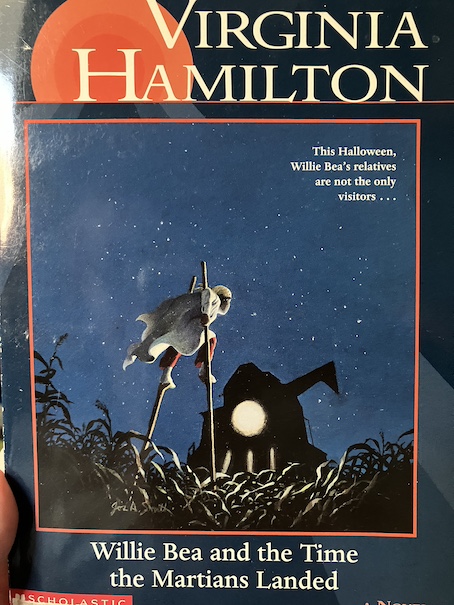
Willie Bea and the Time the Martians Landed

It’s Halloween 1938, and Willie Bea’s relatives have gathered at the old family farm, near where she lives. Money is tight because of the Great Depression, but one of her aunts lives and works in the city, making more money than the others, and is willing to help fund family dinners and provide a little extra for her nieces and nephews when they need something, like new clothes. The aunt is a little scandalous in their family for her multiple marriages, but the others appreciate her generosity, and the nieces and nephews like getting some extra attention and a few treats from her.

The family gathering is a bit chaotic with children running around and getting into trouble. One of Willie Bea’s cousins gets into particular trouble with her mother for using his bow and arrow set to shoot a pumpkin off of Willie Bea’s younger brother’s head. Their mother panics when she catches them doing it because he could have missed and killed the little boy, but Willie Bea tries to calm her mother. Willie Bea was less worried because she knows her cousin’s archery skill and that he wasn’t going to miss, but she understands that adults think of the risks and aren’t fully aware of what the kids are capable of doing. (I’m siding with the mother on this one. Even people who are very good at something can miss now and then, and it’s a big risk to take with someone’s life.) Willie Bea also realizes that the decision to use her little brother for the William Tell act actually came from another cousin because the cousin doing the archery wouldn’t have thought of it himself, and it’s not fair that her mother doesn’t know to blame this other cousin.

Willie Bea talks to her father about the incident, hoping that he’ll understand how unfair it is. However, her father tells her that what her cousin did was dangerous, no matter why he did it. Even though he has a reputation for being good with archery, even people who are good can still miss, and accidents can happen. (See?) Her father lets Willie Bea know that he’s aware that she and her cousins do risky things sometimes when they’re playing with each other, but as an adult, he and the other adults have a responsibility to tell them when something they’re doing is too risky and to put a stop to it. No matter how many times they’ve done some of these things without having an accident, some things are just accidents waiting to happen. They should never assume that an arrow can’t go wrong just because it hasn’t yet or that they can’t fall from a high place just because they haven’t fallen yet.

Willie Bea is a little embarrassed by the talk and feels like her father still doesn’t understand. However, Willie Bea herself has been starting to understand a few things about her relatives this Halloween, things that she either hasn’t noticed before or only half noticed. She can see that one of her cousins is too manipulative, noting the little tricks she uses to get her way and the things she says and does when she wants to be spiteful. She can see that her other cousin has trouble asking up for himself and is particularly vulnerable to manipulation.

Willie Bea also begins to notice things about the adults in the family and their relationships with each other. Aunt Leah, the aunt who has more money than the others and has been married multiple times seems glamorous and fascinating to Willie Bea. Aunt Leah is into horoscopes and fortune telling, and when she reads Willie Bea’s palm, she predicts something special for her. Although Willie Bea loves her own mother, she is intrigued by the family gossip that her father was seeing Aunt Leah before falling in love with her mother, and Willie Bea fantasizes about what it would be like to live with Aunt Leah in the city. She imagines that it would be exciting, and she asks her father why he chose her mother instead of Aunt Leah. Her father knows that Willie Bea doesn’t entirely understand what it’s like to make that kind of choice and what living with a woman like Aunt Leah would really mean. (It occurred to me that the multiple divorces Leah has had might be a clue.) He just explains to Willie Bea that his choice became clear after he got to know her mother as well as her sister, Leah. He knew her mother was the right choice because she was the kind of steady woman who would always be there for him.

That evening, while Willie Bea is putting together her hobo costume and the ghost costumes for her younger siblings and her parents are listening to the radio, Aunt Leah suddenly bursts in and starts having hysterics about it being the end of the world! It takes Willie Bea’s parents a while to get a clear answer from Aunt Leah about why she’s so upset. When she recovers enough to explain things, she says that she was listening to the radio, and she heard that Martians have invaded New Jersey! She describes the horrible, terrifying reports that the radio announcer made about the Martians destroying army troops with their deadly heat ray. Aunt Leah was so terrified by what she heard that she not only turned off the radio but unplugged it, and she says that she’ll never plug it in again, which might be a moot point, if aliens really are here to destroy the world. (If you know what was infamously broadcast on Halloween 1938, you know what Leah heard and that it’s not what she thinks it is.)

While Willie Bea’s parents are trying to decide what to make of Aunt Leah’s story, Willie Bea’s Uncle Jimmy arrives. He says that the rest of the family has also heard what Aunt Leah heard and that they’re all gathering at the old family farm. Rumor has it that people have seen the terrible invaders over at the Kelly farm. Willie Bea’s mother gathers the children and heads to the family farm that Willie Bea’s grandparents own to be with the rest of the family, while Willie Bea’s father tries to see if he can find the station that Leah was listening to and hear the reports for himself. It occurs to him that it might not be an invasion of the Martians but could actually be Germans and German war machines because they’ve all heard about the Nazi takeover of Germany, and he remembers the horrible Hindenburg disaster. If Germans could make a blimp that explodes into a fiery terror like that, then he thinks maybe they could make something that resembles an alien invasion.

At her grandparents’ farm, Willie Bea watches as various relatives panic, cluster around the radio, trade rumors, and try to figure what’s going on. Rumor has it that there are Martians on the Kelly farm, so Willie Bea convinces young Toughy Clay to go over there and try to see them for themselves. At Willie Bea’s insistence, they use the stilts that the children like to walk on to give themselves longer legs, so they can get there faster. Nothing is as it seems this Halloween, and Willie Bea’s expedition to see the Martians definitely doesn’t go as planned.

The book is available to borrow and read for free online through Internet Archive (multiple copies, including a short picture book version).

Almost of the characters in this book are African American. I don’t think it’s ever stated directly because there’s no need in the story to describe them, compared to anyone else, but I think it’s subtly implied. There is only one point in the story where race is mentioned at all, and that’s when Willie Bea is hurt, and the doctor comes to see her. Willie Bea describes the doctor as an old man who delivered most of the babies in her family and knows everybody in the community, and she says that he visits everyone, black or white, rich or poor. Willie Bea’s family is at the poorer end of the community because the doctor knows that people like them don’t normally call the doctor unless it’s something that they really can’t handle by themselves.

I found the family relationships in the story confusing at first. The kids are all referred to by nicknames, and when they are first introduced, it’s difficult to keep it straight who is whose sibling and who is a cousin, and who is older and who is younger. At least, that’s how it seemed to me. Relationships are explained gradually as the story continues, along with characters’ real names as well as nicknames, but it takes some time to get to the explanations.

The story has a slow start, and the real adventure doesn’t begin until about halfway through the book. In some ways, it’s a coming of age story for Willie Bea because she finds herself seeing her family in ways that she never has before, becoming more aware of different sides of their personalities and gaining more insights into their relationships with each other. She also comes to see firsthand what her father means about the stunts that she and her cousins pull and how she should never assume that they can’t get hurt just because they haven’t before. Much of this book is what I would call “slice of life”, a sort of glimpse into Halloweens of the past in a rural community, especially one particular Halloween that would have been memorable for anyone who was alive at the time in the United States.

The radio broadcast that has Willie Bea’s family and others in the community panicking over an alien invasion is The War of the Worlds, a play based on the novel of the same name by H. G. Wells. This type of panic over this particular radio performance was a real, historical incident because the radio play was presented in the format of news broadcasts at the time, and some people who tuned into the program late misunderstood what they were hearing and thought that it was a real news broadcast about an actual emergency. It wasn’t a widespread panic because, first, people who started listening to the broadcast from its beginning knew what they were listening to, and second, not everyone was listening to the broadcast at all. Still, there was enough panic over the radio performance that it became newsworthy and has become a piece of American history and lore.

I enjoyed the historical details in the story, particularly all the radio play references throughout the story. Willie Bea’s family likes to listen to radio shows, and I’m familiar with some of them because I also enjoy old radio plays. Her family likes to listen to The Shadow and Little Orphan Annie. Willie Bea likes to amuse her siblings by imitating people from the radio, singing theme songs and reciting jokes from Jack Benny, like the famous “your money or your life” joke.

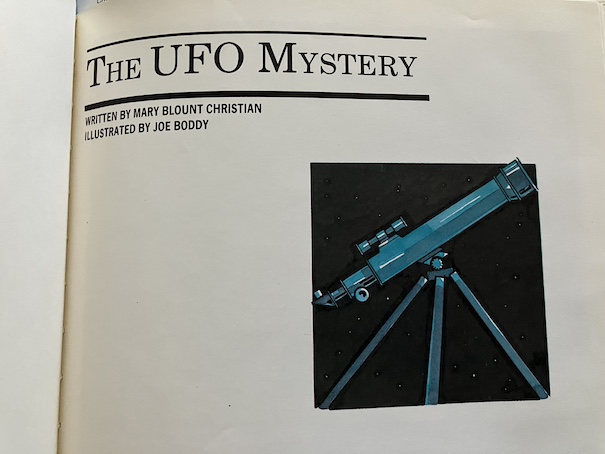
The UFO Mystery

This book is part of the Sherlock Street Detectives series.

Halloween is approaching, and the Sherlock Street Detectives are talking about their costumes. David is going to be a bear, and he made his costume out of an old rug. Pedro is going to be a clown. Walter and Ann, who are twins, refuse to tell anyone what their costumes are because they want it to be a surprise.

Then, David says that he has to go home because it’s dinnertime, and after dinner, he’s going to look for a comet with his telescope. Pedro says that he’s never used a telescope before and asks if he can look, too. David says he can, and Pedro says that he will come back to his house when it’s dark.
When David and Pedro meet to use the telescope, David shows Pedro how to use a star map to find the constellations. While Pedro is looking through the telescope, he thinks that he sees a UFO! At first, David doesn’t believe him. It’s too early to see the comet, so he thinks maybe Pedro saw a meteor. Pedro insists that it was a UFO, and David points out that UFO stands for Unidentified Flying Object. That means that anything that “unidentified” can be a UFO. Pedro can’t identify exactly what it was he saw, but that only means that he didn’t recognize the object. It doesn’t have to be an alien spacecraft, just some normal thing he didn’t recognize, like a meteor, a comet, or even just a firefly.

Since David’s dad works for NASA, Pedro says that they should ask him if it could have been a comet other than the one they were expecting to see. However, David’s dad confirms that there should only have been one comet that night and that the comet should have been in a different part of the sky. The boys talk about getting Walter and Ann to help them investigate, but then, they see some strange creatures in the bushes!

What did Pedro really see through the telescope, and could those weird creatures really be aliens?

The book is available to borrow and read for free online through Internet Archive.

This is fun mystery picture book! Figuring out what/who the aliens are is the easiest part of the mystery, since this is before Halloween and the twins were being mysterious about what their costumes are, although it might seem harder to young children. The answer to what Pedro thought he saw through the telescope is revealed first, although I wasn’t entirely sure what to think of it myself. At first, I thought that the “aliens” might have been throwing around some glowing toy or something, but they would have to have thrown it really high to get it in front of the telescope because the boys were using the telescope on the roof. There’s a perfectly logical explanation behind the phenomenon, and David figures it out by noting where the object was and it was moving. David’s father confirms David’s guess with a call to NASA.

One of the nice things about this simple mystery story is that it introduces some real concepts for stargazers and amateur astronomers. There is a vocabulary list and glossary in the back of the book.

This series also offers good representations for racial diversity. Racial issues don’t enter into the story. The kids are just a bunch of kids who happen to live in the same neighborhood and are friends and like to solve mysteries, but they are a mixed racial group, and that’s nice to see. David is black, Pedro is Hispanic, and the twins are white. The children’s races are not referred to in the text of the story, but they are shown in the pictures.

The Halloween Play

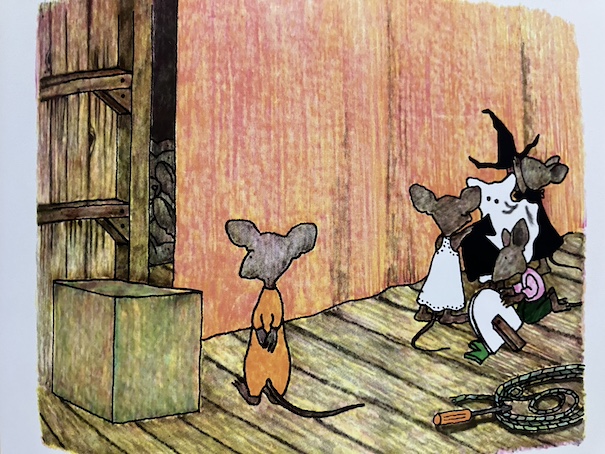
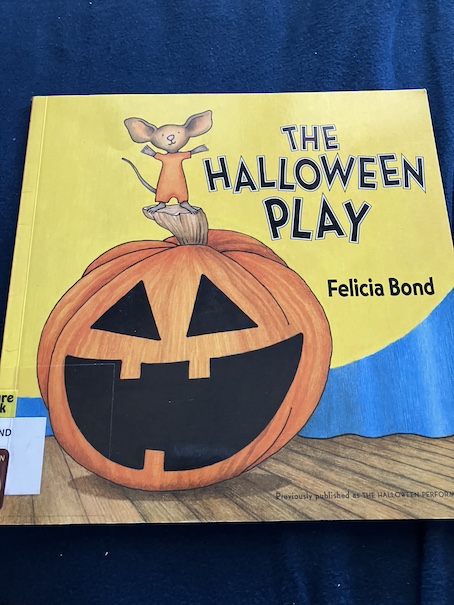
Halloween is coming, and the students in Roger’s class at school are preparing for their Halloween play. The class rehearses their play every day, and they make invitations to the play to send out to people in town.

On the night of the play, the school’s auditorium is full of people waiting to watch the play, and Roger waits backstage for his turn to go on stage. He doesn’t have a big role in the play, but his role is important.

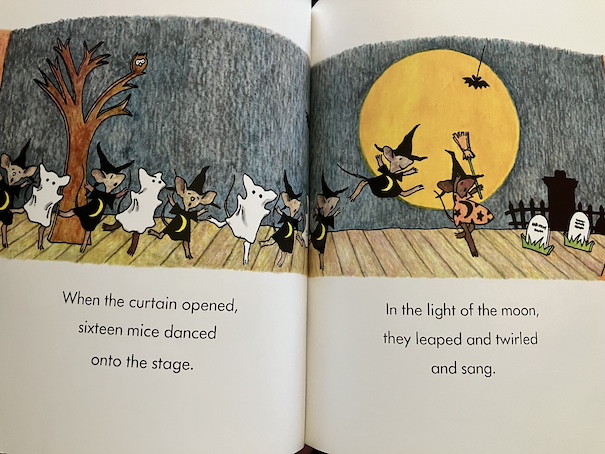
The other students in Roger’s class go on stage, dressed as witches, ghosts, and skeletons. They perform the songs and dances they’ve rehearsed. The audience laughs at the funny parts, and everyone is enjoying the play.

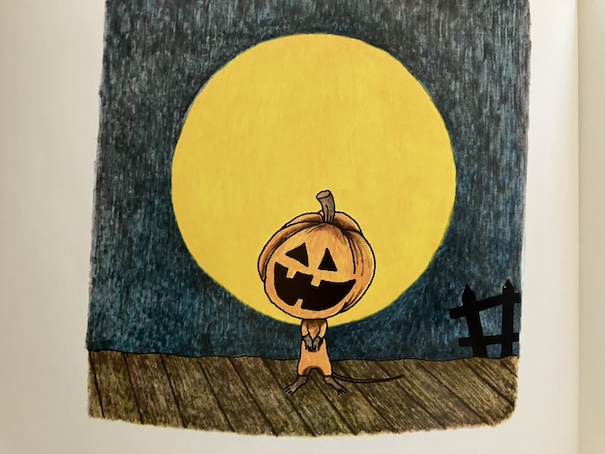
All the time, Roger is backstage, listening and preparing for his part. He counts down the lines until the moment comes when Roger steps on stage for the play’s finale!

The book is available to borrow and read for free online through Internet Archive (multiple copies).

I remember reading this book when I was a little kid, and it was a Halloween favorite of mine! Felicia Bond is better known today as the illustrator (but not the author) of If You Give a Mouse a Cookie, which was originally published two years after this particular picture book. The art style between the two books is noticeably similar, but the book about the Halloween play is different because this is about mice who live like people and do not interact with humans. I was also amused that one of the student mice in this book was dressed in an orange shirt with a black zig-zag and black shorts, like the cartoon character Charlie Brown, who wears a yellow shirt with a black zig-zag and black shorts. The tv special It’s the Great Pumpkin, Charlie Brown was known for popularizing the concept of Halloween tv specials, and Roger the mouse plays a large pumpkin in his class’s Halloween play, although Roger isn’t the mouse wearing the Charlie Brown style clothes. Roger is the one in the sweater with an R on the front. I was just amused by this little detail in the pictures of his class.

This picture book is a sweet little story about a mouse boy and the Halloween play given by his class. School plays on a wide variety of themes are a common experience for human children attending both public and private schools, and they are often memorable points in children’s school experiences. They can also be very emotional experiences. Students can be nervous about plays and being on stage in front of an audience, and sometimes, there are conflicts about which students get the best parts. This cute little picture book doesn’t have any drama in it and doesn’t talk about stage fright, although there are other children’s books that address these issues.

Instead, the story is more about a magical evening and the small but important role played by one particular student. Much of the story shows the build-up to the play, and when the play begins, Roger only appears on stage at the end of the play. The rest of the time, he’s listening to the other students from back stage, waiting for his cue to step into the spotlight. We don’t know exactly what the play is about, but it’s not that important. Those quiet moments of anticipation backstage are magical, and Roger will never forget how exciting this evening has been!

Everyone Goes as a Pumpkin

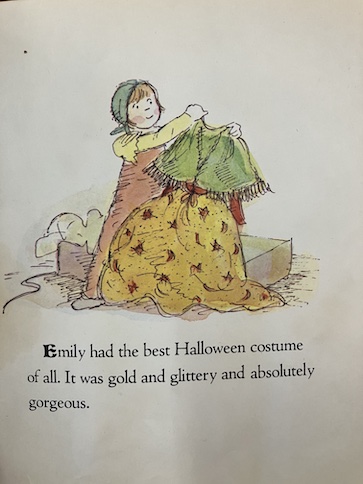
Emily thinks that she has the best costume for the upcoming Halloween party! It’s a beautiful dress that makes her feel elegant and magical.

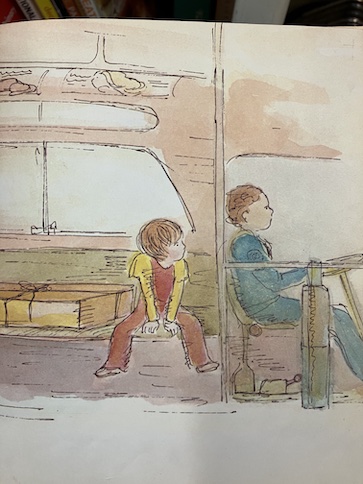
Emily takes the costume on the bus to show her grandmother, but somehow, the box with the costume in it disappears during the ride. Emily is upset at losing the costume and doesn’t know what to do. She doesn’t want to go to the party as something ordinary, like a pumpkin.

Then, her grandmother suggests that she just go as herself. As herself, Emily is truly unique!

I liked the grandmother’s unorthodox solution to the problem of the missing costume. I can understand a kid loving a particular costume so much that it seems like nothing else will do, but showing Emily that she’s just fine going to the party as herself is a good way to show her that she is just fine as she is, just being herself. Emily would have liked going with the costume she loved, but she doesn’t need any costume in particular because she is good enough by herself.