Spooky Sleepover

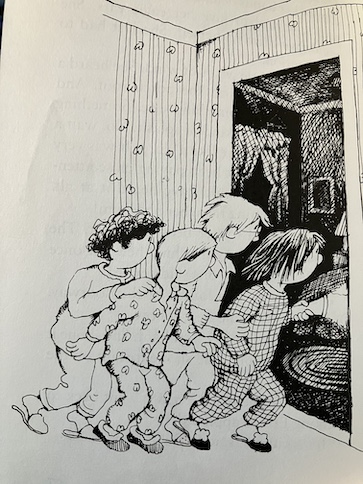
A couple of weeks before Halloween, Ernie decides to have a sleepover party for her friends. The kids enjoy scaring each other with ghost stories, and a thunderstorm adds to the spooky atmosphere.

Michael, in particular, keeps insisting that an old witch called Mrs. Maloney used to live in Ernie’s house with a bunch of cats. When spooky things happen during the course of the evening, Michael says that Mrs. Maloney and her cats have returned to haunt Ernie’s house. The kids try to stay up until midnight because ghosts are supposed to appear at midnight, but there’s no telling what they might actually see.

The kids fall asleep, but they wake up around midnight when they hear a crashing sound from the basement. Although they are afraid, they take their flashlights and go down to see what it is. Will they find a ghost?

The book is available to borrow and read for free online through Internet Archive.

This is one of those stories that has a pretty simple explanation, but the adventure seems bigger to the kids because their imaginations run away with them. I remember liking this series when I was a kid, and I think this is one of the books I read back then. I liked the creepy-cozy atmosphere of the story. Even though the kids have been scaring each other with ghost stories, they’re still just at a sleepover in an ordinary, safe house, and there’s nothing there that is harmful. It’s that kind of safe scariness that Halloween represents to young kids. They can enjoy the spookiness, knowing that there’s a logical explanation for everything. Adults and older kids will figure out pretty quickly what’s really going on.

The Mystery of the Missing Mummy

The Bobbsey Twins

Bobbsey Twins The Mystery of the Missing Mummy cover

Before I begin, I’d like to acknowledge Sean Hagins, for supplying me with photos of this book! Usually, I take pictures of books myself, but I just couldn’t find a physical copy of this one. Sean is a big fan of the Bobbsey Twins, particularly the New Bobbsey Twins mysteries, and you can see some of his video reviews as well as videos about his photography work on his YouTube channel, SJHFoto. Thanks, Sean!

It’s only two days before Halloween, and the Bobbsey Twins are getting their costumes ready. Flossie is going to be a black cat, Bert is dressing as Frankenstein (the monster, not the scientist, for purists), and Nan is a traditional witch in a pointed hat. Only Freddie isn’t sure what he’s going to be yet. He could just put a sheet over his head and go trick-or-treating as a ghost, but that doesn’t seem exciting enough. He wants to be something really scary, but he doesn’t have much time left to decide.

The children’s mother offers Freddie some inspiration when she tells them that she will be writing a story about a new museum exhibit for the local newspaper. The new exhibit is an ancient Egyptian mummy. She asks the kids if they want to go to the museum with her to see the mummy, and they eagerly accept. Freddie thinks that a mummy would make a great costume idea, so he will be a mummy for Halloween.

The museum curator, Mr. Foxworth, gives the Bobbseys a special tour of the exhibit after hours, when there are no other visitors. The Bobbsey Twins are fascinated with the exhibit, and they talk about Egyptian hieroglyphics and the reasons why ancient Egyptians wanted their bodies preserved as mummies for the afterlife. Mr. Foxworth says that the mummy belongs to a wealthy woman named Mrs. Truesdale, who is also there to see the exhibit with her fifteen-year-old nephew, Lex.

The kids notice that Lex seems nervous, and he tells them that there’s a legend about the mummy coming to life. He even says that he’s heard strange noises coming from the mummy case. Mrs. Truesdale thinks that’s nonsense. The mummy has belonged to their family for 60 years. However, when the case is opened, Flossie is certain that she hears the mummy sigh. Then, when Freddie takes a closer look after the others leave the room, he sees the mummy breathing, and it tries to grab him!

Freddie and Flossie try to tell everyone what they saw, but everyone assumes that it was just their imagination. The kids go to the library to do some research about mummies, and they learn that Lex was telling them the truth about the legends surrounding this particular mummy. Nan doesn’t believe that the legends are real, but when the kids walk home from the library, they see the mummy walking in the park!

The kids run home and tell their parents what they saw. Their parents remind them that it’s almost Halloween, and it could have been somebody in costume, on their way home from a Halloween party. It sounds like a reasonable explanation, but the next morning, they hear a news report on the radio that someone broke into the museum and stole the mummy from the exhibit! The kids wonder if the mummy could have really come to life and broke out of the museum itself rather than being stolen.

The Bobbsey Twins decide to report their mummy sighting in the park to the police. At they police station, they see the security guard from the museum. The security guard tells them that the mummy did come to life and that it knocked him unconscious before leaving the museum, but nobody believes him because it sounds too crazy. The kids believe the security guard, but it also occurs to them that their parents might be right, that it could have been someone dressed as the mummy rather than the mummy itself. But, why would someone want to dress up like the mummy to pull a stunt like that, and if that’s what happened, where is the real mummy now?

The book is available to borrow and read for free online through Internet Archive.

I was pretty sure I knew right away who one or two of the culprits was because I figured that a theft and stunt like this would have to involve more than one person. However, I figured that there had to be another confederate involved because my favorite suspects were accounted for the first time the mummy moved. It turned out that I was way off base because there were suspects I hadn’t considered. The motive behind everything was different from the one that even the kids believed. I was pleasantly surprised by the twists in the story. There is a clue later in the book that more than one person dresses up as the mummy at different times when the kids realize that the mummy looked thin one time and fat the next time they saw him.

I liked the pieces of historical information about mummies included in the story, although the part about tanna leaves bringing mummies to life and attracting them is fictional, a concept created for a movie called The Mummy’s Hand from 1940. That’s why it’s important that one of the books Freddie finds at the library is about mummies in movies. At one point, Freddie and Flossie use what they’ve learned to build their own trap for the mummy.

I also noticed that the mummy’s legend comes with curse that rhymes when it’s translated into English, sort of like how the clues on the old Spanish map rhyme in English in The Goonies. In real life, things translated from one language to another don’t maintain their rhyme scheme. That went over my head when I was a kid, but I hadn’t studied other languages at that point, so the idea didn’t occur to me.

At one point in the story, the kids receive a message from the “mummy” that is clearly written on modern paper that someone tried to make look old, and the kids notice right away. They realize that it’s modern computer paper that someone yellowed with a candle, and they see where the holes at the sides were torn off. Modern kids might not understand what they mean about holes being torn off at the sides of the paper, but this was a familiar feature of computer paper at the time the book was written in the 1980s. Modern computer paper doesn’t have holes at the sides, but when I was a kid in the 1980s, there were perforated sections on both sides of the dot matrix printer computer paper with a series of little holes in them. The holes were where the printer would grab the paper and feed it through the machine. They later became unnecessary when printer designs changed, which is why you don’t see paper like that any more. When I was a kid, we would tear off those perforated sections with the little holes after printing. We would also have to break the individual sheets apart at perforated points because the sheets of paper were all joined together to feed continuously through the printer. That’s the type of printer paper that the kids in the story have. I don’t know if everyone did this, but I’d sometimes use those edging strips with the holes for little craft projects, or make them into little chains or bracelets.

Little Witch's Big Night

Little Witch’s Big Night by Deborah Hautzig, illustrated by Marc Brown, 1984.

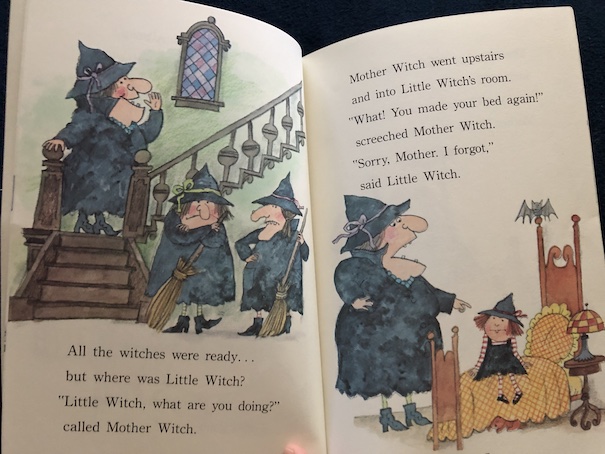
On Halloween night, all the witches in Little Witch’s family are busy getting ready for their big broomstick ride. However, when Mother Witch sees that Little Witch has cleaned her room and made her bed, something too nice for a witch to do, she punishes her by telling her that she will have to stay home.

Because Little Witch is left at home, she is there to answer the door for three trick-or-treaters dressed as an astronaut, a devil, and a pirate. Since she doesn’t have any treats to offer them, she offers to give them rides on her broomstick.

The trick-or-treaters have a great time as Little Witch has her broom do tricks and she shows the pirate a real pirate ship.

The trick-or-treaters have so much fun that they promise to come back next year. Little Witch resolves to be good all year so that her mother will punish her again and make her stay home from the Halloween flight, so she will be there to meet her new friends when they come back.

However, when the other witches come back, Mother Witch says that she missed Little Witch on the flight and that she will get to come on the flight next year. Little Witch asks if she can bring some friends with her, and Mother Witch says that will be fine, as long as Little Witch isn’t too good.

This was one of my favorite Halloween books when I was a child, and so is one of the other books in the series, Happy Birthday, Little Witch. The first time I read these books, I read them out of order, but you really have to read the books in order to understand Happy Birthday, Little Witch because it turns out that Little Witch still doesn’t understand the idea of trick-or-treating or that human children wear costumes on Halloween. She really thinks that she met a small astronaut, pirate, and devil on Halloween, and that makes it difficult for her to find them when she wants to invite them to her birthday party. The Little Witch in this series isn’t the same as the Little Witch in the Little Witch Craft Books.

The book is available to borrow for free online through Internet Archive.

The Grey King

The Dark is Rising Sequence

The Grey King by Susan Cooper, 1975.

This is the fourth book in The Dark is Rising Sequence, and it picks up not long after the previous book ends.

Will Stanton has been very ill with hepatitis, and the doctor ask advised his parents to send him somewhere to rest for a while and recover his strength. In the previous book, his sister Mary had gone to stay with relatives in Wales after she had the mumps, so his parents agree to send him there. Even after he recovers, Will has a nagging feeling that he’s forgotten something very important. What he’s forgotten are the clues that he and his friends discovered at the end of the previous book, but little by little, they come back to him.

Will calls his relatives Aunt Gem and Uncle David, but really, they’re distant cousins. On his way to stay with them on their farm, Will sees a mountain that locals call “the Grey King”, which begins bringing back Will’s memory of the clues to the next item of power that he and his friends are supposed to find. An encounter with a strange dog with silvery eyes brings back the rest of Will’s memory, reminding him that he is the youngest of the Old Ones and it is his mission to find a magical harp in Wales.

The owner of the dog is an albino boy named Bran, who surprisingly knows the clues that Will had been struggling to remember. Bran reveals that Merriman visited him before Will arrived, told him to keep an eye out for Will and help him, and taught him the first part of the clue rhyme as a show that he can be trusted. The boys talk about what the clues in the rhyme mean. Will is supposed to find the harp on “the Day of the Dead”, which Will thinks means Halloween and which is coming soon, but he’s confused because the rhyme also refers to the end of the year. Bran says that Halloween might have once been regarded as the time of the New Year (which is true, and I discussed it in the History section of my Halloween Ideas site), and the two of them discuss some old traditions and superstitions about Halloween.

On Halloween, Bran and Will go into the mountains, and Will’s knowledge and abilities are tested before they are given the harp. Yet, Will is not the one to play it because he doesn’t know how. Bran is the harper. He also seems to have a strange connection to one of the lords who guarded the harp in the mountains. On the way down, the boys have a frightening encounter with a fox who has been killing sheep in the area, but weirdly, nobody else else can see the fox but the boys. A disagreeable farmer shoots poor Bran’s brave dog because he thinks that the dog is the one killing the sheep, and Bran is inconsolable. (I hate books where the dog dies.)

However, their work is not yet done. Will has to use what he’s learned from Bran about playing the harp to wake the Sleepers, who will aid the Light in the upcoming battle against the Dark. Bran also comes to learn his true identity and that of his mother. Although he is not one of the Old Ones, Bran is special and will play a pivotal role in the battle between Light and Dark.

The book is a Newbery Medal winner. It is available to borrow and read for free online through Internet Archive (multiple copies).

My Reaction and Spoilers

Even though this book is the Newbery Medal winner in the series, I didn’t like it as well as the earlier books. It’s partly because the dog Cafall dies, and I always hate books where the dog dies. I love dogs, and also, I realize that it’s often a cheap way to give readers and emotional wrench, to kill off a beloved animal. Also, I missed the familiar characters from the earlier books. The Drew children are not in this story, and even Merriman doesn’t play much of a role. For most of the story, Will is alone, although he does make an important friend in Bran, whose past is more mysterious than most people know.

Although, Cafall also represents one of the innocent sacrifices in the name of the battle between good and evil. Bran is angry at Cafall’s death and says that neither he nor his dog were part of Will’s battle or quest, and it wasn’t fair for them to be dragged into it or for Cafall to be killed. He’s partly right, although he is actually much closer to the center of this battle than he knows. Another character in the book talks to Will about the apparent callousness of the Light for those who end up being sacrificed in the struggle. Will’s answer is that some things cannot be helped. They might want to protect everyone and make things work out well for everyone, but circumstances don’t always make it possible, and there are times when trying to save someone or make someone happy could cause something else to happen that would be worse for everyone. I’m not completely satisfied with that explanation because, in this particular instance, I don’t see why this sacrifice was necessary and I feel like it could have been avoided, like I felt that another tragedy in The Dark is Rising could have been avoided. I suppose the principle that avoiding one sort of bad thing could lead to something worse could be true, but I just don’t feel it in these stories.

I was more convinced and intrigued by the concept of people who aid the dark without knowing that they’re doing it. In the previous book in the series, the author addressed the idea of neutral parties in the struggle between good and evil, but this book introduces the idea of ignorant or deluded people who do bad things without realizing. In the story, they aren’t regarded as true agents of the Dark because they haven’t consciously joined the Dark side and don’t even know that there’s any Light/Dark struggle happening around them, but they are doing what the Dark wants them to do and hurting people and the cause of the Light either because they are being tricked and manipulated into doing it or because they have some other motive that allows them to do bad things because they don’t care as much about the concept of good and evil as much as accomplishing their own goal.

In this case, the unwitting helper of the dark is the farmer who shot Bran’s dog. He genuinely did think that the dog was killing his sheep, so he thought that he was just protecting his property by killing the dog. That could be seen as a good motive gone astray, but when Bran’s real history is revealed, it is also revealed that the farmer also has darker motives for his bad behavior that he has been trying to keep hidden. It’s not just about protecting his sheep but also his resentment against Bran and Bran’s father, so he enjoyed hurting them by killing their dog. The farmer’s resentment goes back to when Bran’s mother, Guinevere, brought him out of the past to be raised by his adoptive father in the 20th century. Bran’s real father is King Arthur, but by the time Bran was born, Guinevere had already betrayed Arthur and feared that he would reject his son because of what she did. She wanted Bran to grow up in a safe place, away from his parents’ struggles. At her request, Merlin (which is Merriman Lyon’s real identity), brought her forward in time to the 20th century to find a new home for Bran. Bran’s adoptive father is a good man, and Guinevere knew that her son would be safe with him. He loved her in return and wanted her to stay and marry him, but Guinevere knew she couldn’t stay, so she left secretly, leaving Bran behind. Her departure might have been hastened because the farmer was jealous of Bran’s adoptive father for having Guinevere. Although he didn’t know Guinevere’s true identity, she was a beautiful woman, and the farmer wanted her for himself. He apparently tried to attack her or maybe even force himself on her, and he was fought off by Bran’s adoptive father and a friend of his. Although the farmer is a married man, he still harbors possessive feelings about Bran’s absent mother and resentment toward the men who stopped him from taking her. By extension, he also resents Bran. In the end, he is driven mad by his obsessions and his manipulation by the forces of the Dark.

Sammy Keyes and the Skeleton Man

Sammy Keyes

Sammy Keyes decides that she wants to go trick-or-treating even though her grandmother thinks that she’s getting too old to do it. She’s still living secretly in her grandmother’s apartment in an apartment building that’s intended only for seniors, so she jumps at the chance to go out with friends on Halloween night. Dot (real name Margaret/Maggie), a new girl at school, invites her and Marissa to come over to her house to get ready before going out trick-or-treating, which works well for Sammy.

As Dot’s house, Dot is painting herself yellow as part of her bee costume. Sammy is going to color herself green so she can be a marsh monster (something she made up, but it sounds like a swamp monster from old movies). When Marissa comes, she brings Sammy a green sweater that she borrowed from her mother that would be good for a marsh monster costume, and the other girls help Marissa wrap herself in toilet paper for her mummy costume. As the girls set off to trick-or-treat, Sammy gets the idea to go by the old Bush House. The Bush House isn’t haunted, but it is a creepy place and there are stories about the crazy Bush Man who supposedly lives there and will jump out of the tangled bushes that surround the house and kill people. Sammy’s grandmother says that the stories are just stories and the old man who lives in the house is just a lonely old man, but Sammy thinks that it would be thrilling to visit the house and see it up close on Halloween.

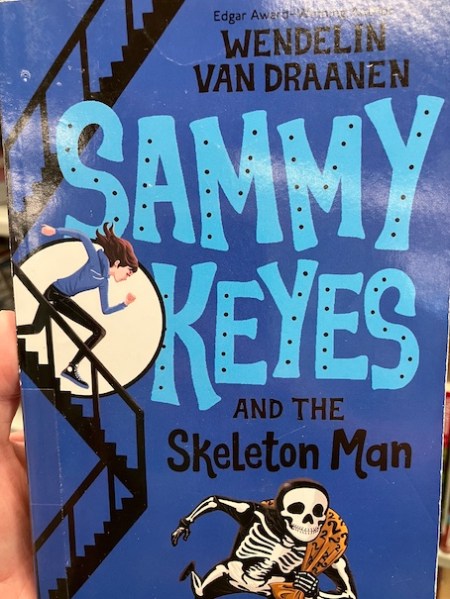
As the girls approach the house, they almost collide with someone in a skeleton costume who’s running away. He looks bigger than the girls are, and he’s carrying a pillowcase that looks pretty full. The girls are startled, but Sammy is determined to go up to the Bush House and just knock on the door once for the experience of it. What Sammy sees when she knocks on the door is even more startling.

The door of the house just swings open, and there’s a pile of newspapers on the floor inside that are on fire. Sammy calls out to see if there’s anybody in the house. There’s no answer, so Sammy rushes inside and manages to put out the fire by smothering it with her marsh monster sweater. As the girls are about to leave, Sammy sees someone in a Frankenstein costume in a chair, and they scream and run outside. Then, Sammy realizes that the Frankenstein mask was on sideways, and it’s not easy to breathe in a sideways mask, when the nose and mouth holes don’t line up, so she decides that she has to go back and see if the person wearing the costume is really alright. It’s definitely a human in a costume, and not a dummy. When Sammy removes the mask, she at first fears that the person in the costume is dead because he’s so still, but it turns out that the person under the mask is the Bush Man. He’s tied up, has a head injury, and is barely conscious. He begs the girls for help. The Bush Man is having trouble talking, so after the girls untie him, he writes a message down on paper, asking the girls to go next door and call the police. He also wants to know if the girls saw the skeleton man.

The Bush Man’s real name is Chauncy LeBard, and the reason he can’t talk is that he’s had surgery on his throat because of smoking-related throat cancer. He needs a device held up to his throat to really speak in an electronic voice (an electrolarynx, I’ve seen one used before). While Dot and Marissa run next door and call the police, Sammy stays in the house with him. When the police come, Sammy uncomfortably recognizes the police officer who knows her from the previous book in the series, Officer Borsch. Last time, she and Marissa told him that Sammy is Marissa’s foster sister so they wouldn’t have to reveal where Sammy is actually living. Dot is confused when Marissa refers to Sammy as her “sister”, but she doesn’t give them away.

Mr. LeBard explains that the man in the skeleton costume had forced his way into the house and tied him up, but he doesn’t know who the man is or why he did it. The girls can’t fully describe the man because he was wearing a full-body costume, although they agree that he seemed like a full adult, not just a tall teen. It seems like the skeleton man was a thief because Mr. LeBard’s wallet and a pair of candlesticks are missing.

After the night’s adventures are over, Sammy winds up spending the night at the house of an elderly friend, Hudson Graham, because her grandmother’s nosy neighbor is awake, trying to find proof that Sammy is illegally living with her grandmother in their apartment building. Hudson agrees to let Sammy stay with him, and it turns out that he’s also an old friend of Chauncy LeBard. Mr. LeBard used to be a political science professor at the local college, and Hudson was one of his students. The two of them liked to get together and have political debates. Then, Mr. LeBard’s mother died, leaving him her estate. The local rumors say that’s when Mr. LeBard went crazy and became the Bush Man. The reality is that he developed health problems because of his smoking and didn’t want his old friends to know. Chauncy also has a brother, who was disinherited by their mother because she disapproved of his wife, but nobody knows why the mother didn’t like her.

Sammy can’t forget about what happened with Chauncy LeBard, even if she wants to. She at least has to go back to the Bush House to get Marissa’s mother’s sweater, which turns out to be worth a lot more than either of them thought. Marissa tells her that, even though her mother never wears that old green sweater, she did notice that it was gone and was upset because it turns out that it was a designer sweater that she bought for $500. Sammy is horrified because, having put out a fire with that sweater, she’s pretty sure that it’s done for, and if she has to come up with $500 to replace it, so is she! When Sammy goes to see Chauncy about the sweater, she starts learning more about him and how his inheritance from his mother turned out to be more of a curse than a blessing. Sammy also starts to wonder whether theft was really the motive for what happened on Halloween. If Chauncy didn’t have that hole in his throat from his surgery, the sideways mask might have smothered him. Did the skeleton man want Chauncy dead?

The mystery of the skeleton man and the ruined $500 sweater aren’t Sammy only problems, though. At school, there’s a nasty rumor going around that Sammy has been calling a boy name Jared, trying to get him away from his girlfriend, Amber. Amber is angry with Sammy, and Sammy’s school nemesis, Heather, has been gleefully making sure that everyone in school knows about it in order to embarrass her as much as possible. Sammy knows that she has never called or even spoken to Jared in her life and doesn’t care about him, but it’s not easy to convince everyone else of that. So who really has been calling Jared? Sammy is sure that it’s really Heather, pretending to be her and saying embarrassing things to get her in trouble. It would certainly be in character for Heather to do that. The rumors are get so out of hand even in a day that one of Sammy’s teachers even suggests that maybe she should talk to a school counselor about her issues with Jared so it won’t affect her schoolwork.

Because the characters are middle school kids, Sammy decides that the best way to get evidence that Heather is her phone imposter is to crash her Halloween party. With everyone in costume and the whole class from school invited (except for Sammy, of course), Sammy, Marissa, and Dot are pretty sure that Sammy can sneak in with them, posing as Dot’s cousin “Nikki.” What could possibly go wrong?

The book is available to borrow and read for free online through Internet Archive (multiple copies).

There are characters in the Sammy Keyes series who smoke, which was becoming uncommon in children’s books in general when I was young in the 1980s and 1990s because adults didn’t want to set a bad example for children. In the last book, the fortune teller character smoked, and it kind of surprised me, but it seems that the series follows the unspoken rule for children’s books that include smoking, that the only characters who do it are either villains or oddballs, not cool people to be imitated. This book confronts the issue of smoking more directly, with Chauncy LeBard’s throat cancer. Mean girl Heather also turns out to be a secret smoker who bribes one of her friends to spy on Sammy and her friends by giving her cigarettes. Sammy later finds out that Chauncy’s mother was also a smoker who died of lung cancer. Between Chauncy’s throat cancer and his mother’s death, the story helps illustrate the hard realities of long-term smoking. Chauncy seems to be living in reduced circumstances, without heat or electricity in his house. My first thought was that his mother’s medical expenses and subsequent funeral and Chauncy’s surgery drained his funds. Medical expenses have wiped out people’s savings before in the US, and I remember that one of the stories they told us to discourage smoking when I was in school years ago was about a woman who was forced to sell her family’s heirlooms to cover her cancer treatment. When Sammy meets Chauncy’s brother, Douglas, she finds out that Douglas was trying to get his mother and brother to quit smoking, but neither of them would, and that’s part of the reason for the family rift. Douglas says that if Chauncy has suffered health problems and blown through the family’s money, it’s really his own fault. It’s true that Chauncy should have taken the hint and quit smoking a long time ago, and he might have spared himself a lot of pain and misery if he had, but it turns out that he didn’t sell the family heirlooms to pay for his medical expenses. There was something in his house that was worth a great deal of money, something that Chauncy couldn’t bear to part with even to improve his own living situation because of the sentimental value. The thief is one of the few people who understood what Chauncy had and how to take it without him even noticing that it was gone right away. In a way, what the thief really stole is as much of a mystery for most of the book as who the thief was. The skeleton man turned out to be one of the people I suspected, but not my first suspect, so I was actually in suspense for most of the book.

As for the side plot with Heather calling Jared as Sammy: Oh, criminy! This is one of those ridiculous tween problems that seems so impossibly complicated when you’re in middle school but pretty dumb when you’re not. I appreciate that the math teacher is concerned when Sammy seems distracted in class and her work suffers, but I have trouble believing that an adult teacher would really be interested in rumors about who at school is calling who. I can’t remember any of my teachers ever caring about that stuff because adults usually know that rumors are wrong and that this kind of school drama passes faster if you don’t feed it. I don’t recall any massive rumor campaigns getting the attention of teachers when I was a kid, and I can’t imagine any of my old teachers giving rumors much weight or interest. I think my teachers would have just told us to stop being drama queens, focus on our work, and save the gossip for after school. A few of the more outspoken and direct communicators on the faculty would have flat out told us that gossip isn’t worth anything, that most of it is wrong anyway (that was actually the subject of a play I was in at school once), and that everyone will have gotten bored of whatever it is and moved on in a week or two because nothing we were talking about was really that earth-shaking and we all had the attention spans of chihuahuas on a sugar rush.

If I had to say something to these kids about this situation, I might just tell Sammy not to go calling people who don’t want to speak to her (if I were to assume that she was doing that) because it’s just going to annoy everyone. As for Amber, it’s not really her business to control either her boyfriend or the person calling him, whoever it is. Her decision is whether or not she’s satisfied with how Jared is responding to the situation and if she wants to still be his girlfriend when he acts that way. I’d make it a point to tell Jared, as the center of this drama, that if he doesn’t want to talk to somebody on the phone, he should just hang up without saying anything. You don’t need to stay on the line with someone who’s bothering you. With today’s caller IDs and cell phones that identify everyone who calls, it’s even easier because you don’t have to pick up the phone in the first place if you recognize a number you don’t want to answer. I can’t remember if they had those in the late 1990s, or if that was more an early 2000s development, but I know we definitely had answering machines, and I knew people who would just let the machine answer most of the time, only picking up if they recognized the voice leaving a message. Either way, just because someone calls you doesn’t mean that you have to take the call. On the other hand, if Jared likes being called by a girl other than his girlfriend, it might be time for him to rethink his relationship and decide what he really wants. That seems to be where Jared is. The book describes him as not being too bright and going on an ego trip from whoever keeps calling him. Actually, if I were one of the teachers, the people I’d really want to talk to the most would be Jared’s parents because I think they’d have more power to stop the situation than anybody, no matter who the caller was. Jared’s a kid who still lives at home, so his parents could answer the phone first and find out who wants to talk to him or let the machine record a message that could be used as proof against a prankster who’s bothering him if it gets excessive. Most child pranksters would give up if they called a few times and only got the boy’s parents, especially if the parents sound annoyed or angry when they answer. If Jared’s family got the call on a landline (probable for the 1990s), an annoyed parent could also *69 to last-call return the prankster’s number or look it up on their phone bill if they want to confront the prank caller or talk to the prankster’s parents. It’s annoying to deal with a prank calling kid but not really that hard. I didn’t have access to my parents’ phone bill as a kid, but everyone knew how to *69. Of course, if people in the book handled the situation sensibly, the book would probably be less exciting, and we wouldn’t get the payoff of seeing Sammy get the best of Heather.

There are some laughs when Sammy finds a clever way to record Heather making one of her calls and play the recording for the whole school. It was the sort of victory moment that I would have loved when I was about twelve. However, Sammy’s secret life living in her grandmother’s apartment complicates any problems that Sammy has with the authorities and school administration. After she turns Heather into a public spectacle during a school assembly, the vice principal insists that Sammy’s mother attend a parent-teacher conference. Since Sammy’s mother isn’t available, her grandmother has to attend instead, risking the exposure of their secret.

There is a little more insight into Heather when Sammy sees what Heather’s home and mother are like, but understanding doesn’t equal approval. Heather’s life isn’t perfect, and she lets slip at her party that her mother is a 40-year-old who dresses really inappropriately and flirts with much younger men, possibly including some of her daughter’s teenage classmates. She doesn’t appear to know about Heather’s smoking habit or the truth about any of the other things Heather does. Knowing that her mother is odd and may have really inappropriate taste in men/boys doesn’t make Heather any more likeable, though. At the end of the book, Heather’s outbursts in front of the vice principal may lead to the school insisting on counseling for Heather, which is a hopeful sign, but since Heather remains a bully mean girl for the rest of the series, it’s not that hopeful. You can lead a person to professional help, but you can’t make them internalize it and make use of it.

For me, one of the best parts of this book was the further development of the relationship between Sammy and her grandmother and Hudson Graham. There are hints that Hudson is romantically interested in Sammy’s grandmother, and he treats Sammy like his granddaughter. He seems to be in on the secret of Sammy living with her grandmother and is one of Sammy’s best protections against getting caught. He willingly aids and abets Sammy’s investigations, giving her knowledge and guidance whenever she needs it, and at the end of the book, he gives Sammy and her grandmother a ride to the parent teacher conference.

The ending of the story sets up the beginning of the third book in the series with Sammy being given the assignment of completing some volunteer hours to make up for the disruption that she caused at school.

Susannah and the Poison Green Halloween

Susannah and the Poison Green Halloween by Patricia Elmore, 1982.

This is the second book the Susannah Higgins mystery series.

Halloween doesn’t start out well for Susannah’s best friend, Lucy. Her father accidentally threw out her costume, thinking that it was trash because it was mostly made out of tin foil. (She was planning to be the Death Queen character from a comic book.) As she desperately tries to put together a last-minute costume for Susannah’s Halloween party, her father tries to buy her a costume at the discount store. Unfortunately, all the discount store left was a Little Bo Peep costume. Lucy thinks that she’s going to be mortified, showing up in something so childish when she told everyone her costume would be really cool. When another girl from school, Carla, comes by and teases her about her costume, Lucy gets the idea to make it a kind of double costume, painting her face an evil green so she can rip off her sweet Little Bo Peep mask and be the sinister Death Queen underneath.

Carla says that the secret identity costume idea is pretty good, but before she can go to the party, she has to buy a costume of her own. She had to wait for her stepfather’s pay day because her parents bought a new dress for her older sister, Nadine, for a high school dance earlier. As Carla explains about her delay in getting her costume, she mentions her sister’s social worker coming to dinner. Susannah asks why Nadine has a social worker, and Carla says that her sister got into trouble with drugs a couple of years before, but she’s not really supposed to talk about it. Lucy and Susannah want to do some trick-or-treating before the party, and Carla asks if they’ll wait for her to get her costume first. The other girls aren’t willing to wait, but they say that they’ll get some extra candy for her when they start out, and they’ll meet her at her family’s apartment at the Eucalyptus Arms apartment house. In her recounting of that Halloween night, Lucy says right out that it was at the Eucalyptus Arms that someone gave them poisoned candy.

When they reach the Eucalyptus Arms, Carla isn’t home yet, but they meet up with Knieval Jones (Lucy’s nemesis and Susannah’s occasional helper from the previous book), who is dressed like a vampire, and get some stale granola bars from Carla’s sister, Nadine. A nice lady name Mrs. Sweet gives them homemade cupcakes, and Mr. O’Hare, who is a vegetarian and thinks that sugar is poisonous, gives them organic treats from the natural food store. However, the strangest experience they have is in Mr. Mordecai’s apartment. Mr. Mordecai is a strange man with whitish eyes. He insists that they come in and pay their respects to the deceased “Jeremiah.” There is a coffin in the room with a wreath on it. The kids are spooked, but Susannah notices something odd about the wreath, which gives her an idea of who/what “Jeremiah” is. Mr. Mordecai gives them popcorn balls, and they leave.

They meet up with Carla, and Susannah’s grandfather, Judge Higgins, drives all four children to the party. However, Knievel and Lucy get into a fight over their treat bags, spilling both of them into the gutter and ruining their candy. Lucy is mad at Knievel, but then Knievel suddenly gets sick. At first, Lucy thinks that he’s just eaten too much because he’s been sampling his treats and stealing some of hers. Knievel misses the party because he’s sick, but it turns out to be much worse than that. The next day, the police come to the school to tell them that Knievel was poisoned and to interview the children about everything that happened the night before.

Because Lucy and Knievel spilled and ruined their bags of candy, it’s hard to say exactly what Knievel ate before he got sick, and Lucy never ate any of it. Carla had the same treats as the others, and she is also ill and being examined by a doctor, just in case she was also poisoned. Susannah turns her treat bag over the police for analysis. She never touched her candy because she had more than enough to eat at the Halloween party.

By process of elimination, they determine that the poisoned treats had to come from one of the apartments at the Eucalyptus Arms, and that it must have been in something homemade or unwrapped, not wrapped, commercially-made candy. Lucy says that they really know better than to eat unwrapped treats from a stranger, but Susannah points out that Knievel was hungry and ate treats almost as fast as he got them, regardless of whether they were wrapped or not. There are only a handful of suspects who could have handed out the poison in homemade or unwrapped treats, but which of them did it and why?

The title of the book is based on the fact that the apartment house is painted an ugly shade of green and all of the questionable treats the kids received were colored green.

The book is available to borrow and read for free online through Internet Archive (multiple copies).

My Reaction

One of the best things about this book for me is that it was originally published in the year I was born, and it’s a Halloween story, and I happened to be born only a few days before Halloween. Even if I hadn’t already read and liked the first book in this series, that would have endeared me to this book right away. I originally read the first book in the Susannah Higgins series as a child in elementary school, but I think that’s the only book in the series that I read at the time. It might have been that the library didn’t have the full series and the first book was the only one I could find or that book was one of the many that I found at a used book sale and the others weren’t there. It’s been so long that I can’t remember. I just remembered one scene from the first book for years, and it took me a long time to figure out what I was remembering.

Because I was very young during the early 1980s, it was a long time before I understood that this was a period when people were especially worried about the possibility of poison and razor blades in Halloween candy. Like other kids of the 1980s and 1990s, I had to watch those Halloween safety videos that warn you to be careful and to inspect candy for signs of tampering before eating it. (Specifically, I saw this video, which I found one day on YouTube. I watched this 1970s film on reel-to-reel when I was in elementary school because they hadn’t yet installed TVs and VCRs in the classrooms yet and they had a library of old films that I’m pretty sure they bought when they originally built the school in the 1970s. The sound quality wasn’t any better when I saw it for the first time, but it still cracks me up that the ultimate solution to the girl’s unsafe Halloween costume turns out to be gradually changing it to be a different costume.) In 1974, a father murdered his own son for the insurance money, hoping that some random sadist would be blamed for the crime because there were already urban legends about such things. Even though it wasn’t long before the truth of the father’s crime came out, this incident added to the urban legends, seeming to confirm the stories of Halloween poisonings. Because of this, my early Halloweens were very different from the ones my parents had in the 1950s. I was allowed to go trick-or-treating, but I never received any homemade treats, like the popcorn balls and candy apples my parents sometimes got. By the time I was trick-or-treating, only fully-wrapped, commercially made candy was considered safe and acceptable.

At first, I thought that the solution to this mystery would be that Nadine had made marijuana granola bars because we were told right away that she was involved with drugs in the past. There have been real-life cases of children accidentally getting into drugs owned by family members, including cases that have become part of the Halloween urban legends. However, that’s not the case in this story. Susannah’s Aunt Louise, who is a nurse at the children’s hospital, tells Susannah that marijuana was one of the first things they ruled out when they were testing to see what had poisoned the children. The children were vomiting and hallucinating, so Aunt Louise says that it appears to be an overdose of some kind of medicine.

Aunt Louise wasn’t mentioned in the previous book in the series, but she comes to stay with Susannah because her grandparents have to go out of town. Again, Susannah’s parents are simply not mentioned in the story. It’s never clarified whether Susannah is an orphan or living with her grandparents for another reason, although I think it’s implied that she’s an orphan by the parents’ absence and the lack of any mention of why.

Carla is a new character who didn’t appear in the previous book, but again, children in these books do not live in conventional two-parent households. Nadine is actually Carla’s stepsister, and the two of them haven’t known each other very long and are having problems adjusting to their parents’ remarriage and living together. Books with divorced parents or blended families were becoming increasingly common in children’s literature during the 1980s and 1990s, and they were a regular staple of books that I read when I was young. It was pretty common for there to be at least one character with divorced parents in the books I read, but this series stands out to me because it seems like every kid in it so far is either from a divorced family or lives with relatives other than their parents, for some reason. A mixture of different family situations is to be expected, but an overwhelming number of kids in almost the same situation just seems a little odd.

The author does a good job of making everyone at the apartment house look equally suspicious. A number of people at the apartment house have secrets, and some of them are truly dangerous. One of the characters in the story, a man Nadine and Carla call “Uncle Bob” because he’s a friend of Nadine’s father, seems to be showing inappropriate attention to the girls. Carla is afraid to be alone with him, hinting that things that he does when she’s alone with him make her uneasy or even frightened. Uncle Bob isn’t the poisoner, but he does seem to have inappropriate sexual interest in the girls. There isn’t anything explicit described in the story, but the way that the characters refer to Uncle Bob and the dirty magazine that Lucy says she found in his trash can along with a bunch of empty liquor bottles imply what Uncle Bob is like when other adults aren’t watching. Carla says that she’s tried to tell her parents about it before, but nobody believed her because Uncle Bob has been such a good old friend of her stepfather, and he can’t picture him doing anything wrong. When she finally confides the problem to Nadine, Nadine confirms that she’s had the same experience with him and that her father didn’t believe her either, but she’s going to make sure that he listens this time. Susannah also says that they are going to tell the police about it and her Aunt Louise, and while Uncle Bob may not have actually done anything that would cause him to be arrested, he’s going to get some severe warnings and maybe some professional help.

The Red Room Riddle

The Red Room Riddle by Scott Corbett, 1972.

The story takes place during the 1920s. (It doesn’t actually give a date, but it references the early days of radio and silent movies, which helps place it.) Bruce Crowell meets the new kid in the neighborhood, Bill Slocum, shortly before Halloween. Bruce is afraid of Bill at first because he’s big and has a mean look. Bill does turn out to be a bully, picking on him and shoving him into mud puddles as they walk home from school. Then, one day, Bruce fights back and gives Bill a black eye. Bruce expects that Bill will be mad, but when he points out that Bill didn’t have to shove him into a puddle, Bill says that he guesses that they’re even now, and the two of them end up becoming friends.

Bruce and Bill spend a lot of their time playing outside with other neighborhood kids, and they start making plans for Halloween. During the 1920s, kids mainly celebrated Halloween with pranks. Even though Bill isn’t very good in school, he likes to read nonfiction books, and he starts reading folklore about ghosts. Bruce is more into fiction, and he starts reading books of ghost stories. Bill is really into hard facts and doesn’t believe in ghosts. His reading about ghosts is because he wants to figure out why people would believe in something so silly. He reads about how people have faked ghosts before, and he comments that he wishes that there was a haunted house nearby so he could do some research.

Bruce tells Bill about a house in a richer neighborhood that’s supposedly haunted. Bruce has seen the house before with another boy named Virgil. Virgil’s father says that there was a story about a dead baby being chopped up and buried in the garden of the house or something. Bruce isn’t completely clear about the details, but he says that the house has been boarded up for years because there’s some kind of long-standing dispute about who owns the property. Bill asks Bruce what he saw when he and Virgil went to the house, but Bruce says that they didn’t see much because the house is surrounded by a high wall, and they couldn’t get past the gates. It’s impossible to climb over the wall because there’s broken glass on top that’s cemented in place to stop people from getting in.
When it looks like it’s going to rain on Halloween, Bill suggests that they go check out the haunted house instead of running around the neighborhood, playing pranks. Bruce is reluctant, but Bill talks him into it. They have trouble finding the house at first, and they stop to ask a mailman where it is. The mailman gives them directions, amused that the boys are looking for a scare on Halloween. Bruce doubts that they’ll be able to get near the house because of the wall around it, but Bill discovers that there’s a door in the wall that’s unlocked.

Inside the wall, they find a messy, overgrown garden. The house itself is three stories tall and badly damaged on one side from a fire. In the garden, the boys meet another boy, Jamie Bly, who says that he also snuck onto the property. Jamie has his dog with him, and he says that he’s not scared of the ghosts in the house, daring the other boys to come inside with him.

Inside, the boys have a frightening encounter with the half-blind caretaker of the house, who menaces them with a broken axe handle. The boys run outside again, and Jamie says that the old caretaker wouldn’t really hurt them. Jamie says that he comes there from time to time to spook him because he thinks it’s funny. The caretaker knows it’s him because he calls him by name when he chases him. Jamie says that the caretaker won’t be there much longer, though, because the house is going to be torn down soon, and if the other boys want to see some real ghosts, they should come to his house later that night.

Jamie claims that he lives in a real haunted house. The other boys don’t believe him, and at first, they don’t want to show up to meet Jamie that night because they think he’s really annoying. However, their curiosity gets the better of them, and they decide to show up and see whatever Jamie has to show them. They think at first that they’re just calling Jamie’s bluff and that they’ll prove that he’s a liar, but they’re about to be in for the scariest Halloween they’ve ever had!

When they meet Jamie that night, he leads them through an unfamiliar neighborhood to a house that seems as big as the other old house. It’s difficult for them to see the outside because it’s raining heavily, but the inside is lit with gaslight and oil lamps instead of electricity, something that immediately strikes the boys as odd. They don’t see anyone else at first, and Jamie says that his parents are out for the evening. Bill expects that there are probably servants somewhere in the house because it’s such a big place, and he actually seems to be enjoying himself, looking forward to the challenge of debunking any “ghosts” that Jamie might show them.

The scares start slowly. Something scratches Bill on the cheek before they enter the house. They don’t know what it is, but they assume that it’s some trick that Jamie set up. There’s a creepy maid who doesn’t seem to see them or acknowledge them. Lights go on and off mysteriously. Jamie makes a peanut butter sandwich. (That wouldn’t be scary except that the boys are seriously starting to be creeped out by Jamie, so everything he does is creepy.) Then, Jamie takes them upstairs to see the Red Room.

The Red Room is a bedroom where everything is red. It has a picture of the Slaughter of the Innocents and a tapestry with the same theme outside. It has a red marble fireplace. Even the ceiling of the room is red … and it looks red and sticky. Then, Jamie locks them inside. The room has no windows, and Jamie says that there’s a secret staircase out … if they can find it.

The book is available to borrow and read for free online through Internet Archive (multiple copies).

My Reaction and Spoilers

Getting locked in what looks like a creepy murder room is scary enough, but there are other scares, and the boys do see what looks like real ghosts. After their experience, Bill thinks that he’s reasoned out a good explanation, but there is one more punchline to the story when the boys go back the next day to confront Jamie about all the creepy things that happened.

This is one of those stories where you never get a full explanation. In the end, we still don’t know what the deal was with the theme of the of Slaughter of the Innocents and the dead baby that was once supposedly found on the property. However, when the boys talk to an impartial person at the end, they do learn that the house is the same one that they visited before and that Jamie probably did live there at some point in the past, back when people used gaslights. The Bly family who once owned the house seems to have had a dark and sinister history, and while it’s still possible that there was some kind of trick being played by a person who knows about it, the boys come to believe that they really did have a supernatural experience.

Because of the scary subject matter, I would say that this book would be best for older elementary school children who really like a good scare.

Personally, the parts I liked the best were the references to things that kids don’t often encounter in modern times. I liked how Bruce gives an estimated time period for the story by talking about silent movies that are accompanied by piano playing and how he and Bill learned the term “yellow” for cowardly from western films. When they first meet Jamie and don’t want to tell him their names, they give the retort of “Pudding Tane. Ask me again and I’ll tell you the same.” I’ve seen/heard that retort used in old books (like Ruth Fielding at Lighthouse Point) and tv shows, but it’s one that went out of style before I was a kid myself. I had to get my parents to explain it to me the first time I heard it on a tv show as a kid.

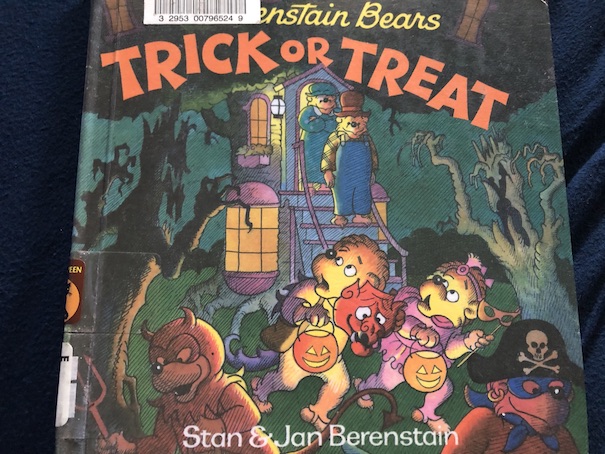
The Berenstain Bears Trick or Treat

The Berenstain Bears

The Berenstain Bears Trick or Treat by Stan and Jan Berenstain, 1989.

“Even little bears
expect a good fright
when they go out for treats
on Halloween night.”

Brother and Sister Bear are looking forward to trick-or-treating on Halloween night with their friends. Sister is going as a ballerina, and Brother is dressed as a monster. When Brother jumps out at Mama in his monster costume, she pretends to be frightened, and when he takes off his mask, Mama comments that “appearances can be deceiving.” Sister asks what that means, and Mama explains that “things aren’t always what they look like.”

This is the first year that Brother and Sister will be allowed to go out trick-or-treating without their parents. They plan to trick-or-treat with friends, and they talk about the houses that they plan to visit. The one house in the neighborhood that they don’t want to visit belongs to Miz McGrizz. Miz McGrizz’s house looks spooky, and the kids think that she might be a witch. Mama tells them that’s nonsense and that Miz McGrizz is a nice person.

As the young bears set out to trick-or-treat with their friends, some of the bigger, tougher cubs in the neighborhood try to talk them into joining them in some pranks. First, they want to decorate Miz McGrizz’s house with toilet paper.

However, before the cubs can do anything, Miz McGrizz comes out of her house, and seeing the cubs, tells them that she’s ready for them. Although the kids are frightened at first, it turns out that Mama really was correct about Miz McGrizz. Miz McGrizz is just a nice old lady who has a special treat for the cubs who are brave enough to visit her house.

In real life, trick-or-treaters shouldn’t go into the houses of people they visit unless they know them very well, but in this case, it’s not so bad because the cubs’ mother approves of Miz McGrizz and would be fine with the children visiting her.

The book is available to borrow and read for free online through Internet Archive (multiple copies).

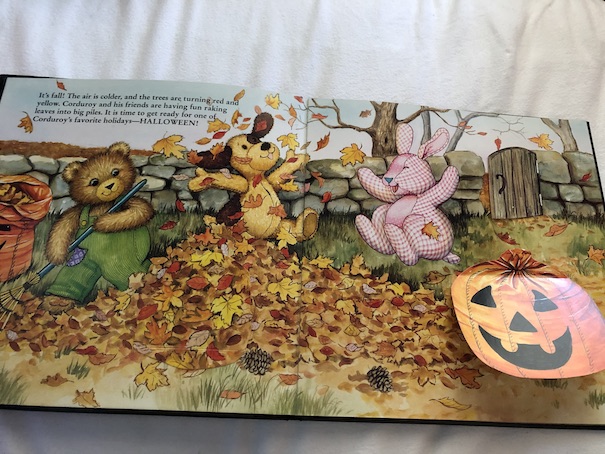
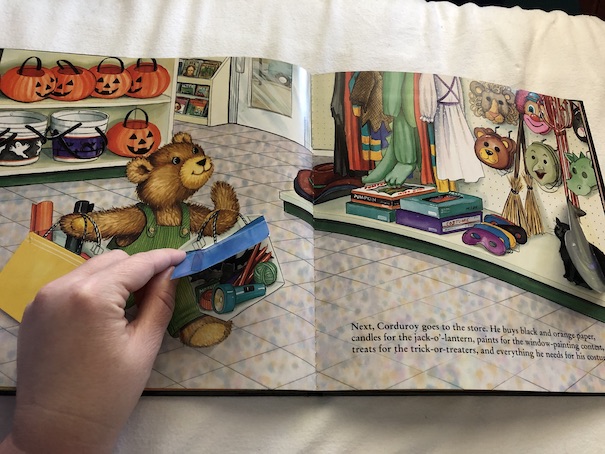
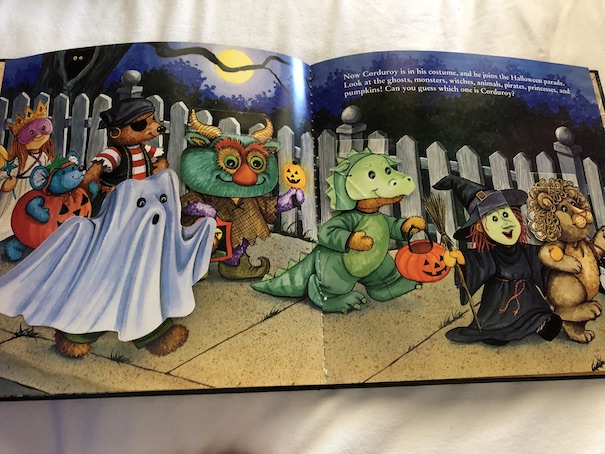
Corduroy’s Halloween

Corduroy’s Halloween, based on the character created by Don Freeman, pictures by Lisa McCue, 1995.

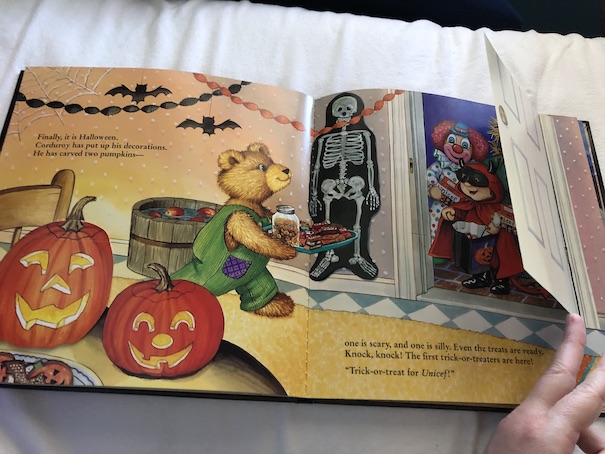
I’ve seen this book as both a regular picture book and a lift-the-flap book. The basic story is the same either way, and the illustrations are similar in either copy. I just happen to have the lift-the-flap copy. This is one of the Corduroy books where Corduroy lives on his own with his stuffed animal friends and no humans are present in the story.

Corduroy and his friends are excited because Halloween is coming! There are many things to do, like raking leaves, choosing pumpkins for jack o’lanterns, and entering a window-painting contest.

Corduroy shops for the supplies that he will need for his Halloween party.

By Halloween night, all of the decorations are up, and Corduroy gets his first trick-or-treaters, including some trick-or-treating for UNICEF.

Corduroy and his friends also take part in the Halloween costume parade. In the lift-the-flap copy, you can lift up character’s masks and see their faces. I think that makes this a good book for helping to explain to young children that people in scary costumes are just ordinary people beneath the masks.

Then, they return to Corduroy’s house to have their party and bob for apples. Happy Halloween!

Clifford's Halloween

Clifford

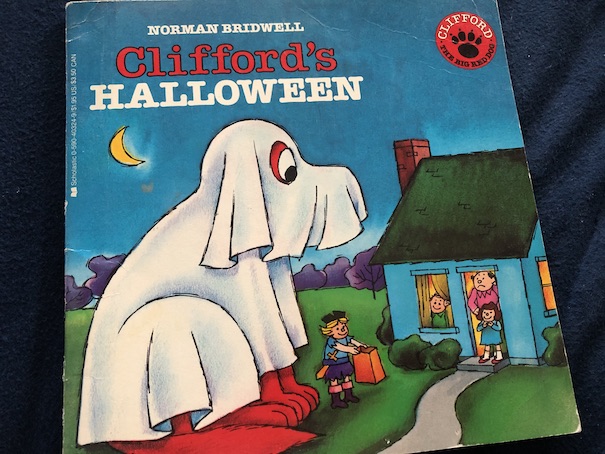
Clifford’s Halloween by Norman Bridwell, 1986.

Halloween is Emily Elizabeth’s favorite holiday! Emily Elizabeth talks about the various holidays that she and Clifford enjoy, but Halloween is the one they enjoy the most.

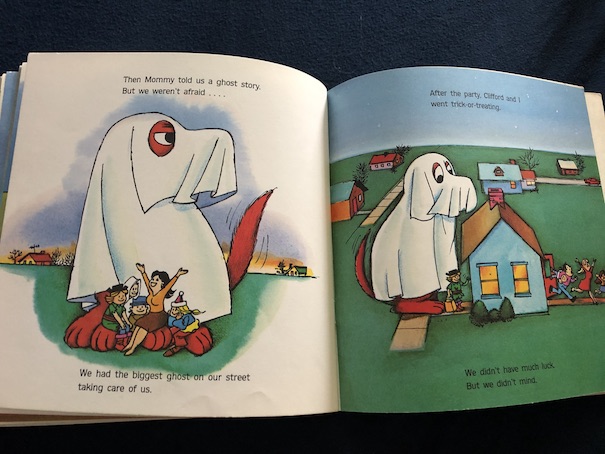
Last Halloween, she considered various costumes for Clifford, but Clifford decided that he wanted to be a ghost, covered with a giant sheet. (I love how they say that nobody could guess who the giant ghost is, like there could be someone else in the neighborhood that big.)

When you’ve got a giant dog, bobbing for apples doesn’t go the way you expect.

However, when you’ve got a giant dog, nothing else is very scary, either.

The book ends with Emily Elizabeth considering different costumes for Clifford for this Halloween, inviting the reader to think of other possible costumes.

I like the idea of letting kids consider which Halloween costumes they like the best from the ones that Emily Elizabeth considers. Kids like making choices, and trying to think of costumes that would work on a gigantic dog presents a creative challenge. When Emily considers dressing Clifford as a knight, they don’t consider where she’s going to get a suit of armor that size, but the books in this series don’t worry much about the logistics of caring for a dog the size of Clifford.

When I first read this book back in the 1980s (I was four years old when the book was new, although I can’t remember exactly how old I was when I first read it), I didn’t think too much about the Indian (Native American) costume with a pipe, although I wouldn’t think of suggesting that as a costume for anyone now. It’s partly because there’s something of a stigma against Native American costumes now. It’s not enough of a stigma to get people to stop wearing them and major costume retailers from selling them, but enough that some people raise eyebrows at them because of some of the connotations attached to them. If you read some of the reviews of Native American costumes on Amazon, like I did, it seems that more of them were purchased for school plays and projects or Thanksgiving plays than for Halloween. However, the part about this costume that particularly jumped out at me was the ceremonial pipe. Kids sometimes dressed as American Indians for Halloween when I was young, although the practice is discouraged now, but with all of the anti-smoking campaigns aimed at children when I was young, most of our parents wouldn’t have even considered giving us a peace pipe as part of a costume, even ignoring the social and cultural implications of that. I think that idea shows the age of the book’s creator. I grew up in the American Southwest, but I didn’t grow up on old western shows where peace pipes were a common feature. I didn’t see those shows until I was older, and by then, they looked pretty cheesy. I think that the book’s author was from the generation that was raised on those westerns and had nostalgic associations with them.

The book is available to borrow for free online through Internet Archive.