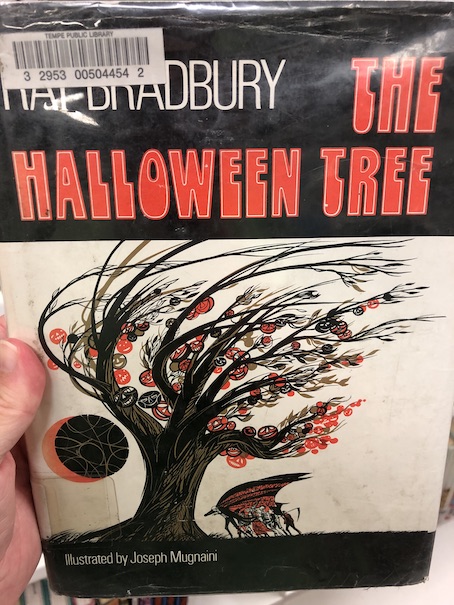
A group of neighborhood boys want to go trick-or-treating on Halloween night, but they’re upset because it looks like a friend of their, Joe Pipkin, won’t be coming with them. When they get to Pipkin’s house, he seems ill and is clutching his side. His friends worry that he’s sick, but he valiantly reassures them that he’ll be fine. He sends them on, telling them that he’ll catch up with them and that his costume will be great. Specifically, he tells them to “head for the House” which is “the place of the Haunts.”
The
house that Pipkin is talking about is the creepiest house in town. It’s large, so large that it’s hard to tell
how many rooms it has. The boys knock on
the creepy-looking door knocker on the front door, and a man answers the door. When the boys say, “trick or treat,” the man
says, “No treats. Only—trick!” Then, he slams the door without giving them
anything.
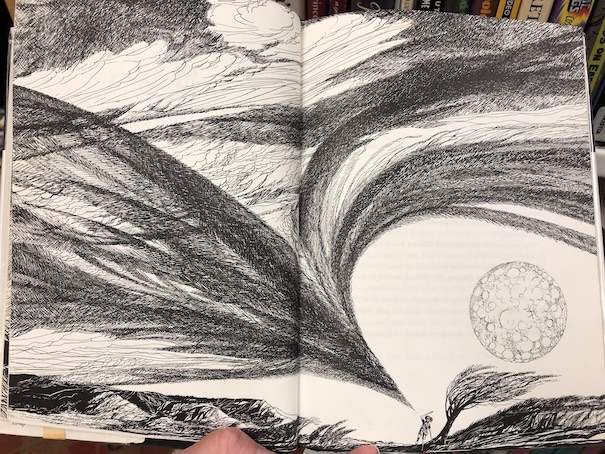
Not knowing what else to do, the boys walk around the side of the house and see a large tree, filled with jack o’lanterns. This is the Halloween Tree. The strange man they saw before rises up from a pile of leaves and scares the boys, giving them the “trick” that he promised them earlier. He finally introduces himself as Carapace Clavicle Moundshroud. He begins talking to them about the history of Halloween and asks them if they understand the real meanings behind the costumes they have chosen. The boys admit that they really don’t know the meanings behind their costumes, and Moundshroud points off into the distance, calling it, “The Undiscovered Country.” He says that out there likes the past and the history of Halloween and that the boys will learn the answers if they’re willing to go there. The boys are interested, but they say that they can’t go anywhere without Pipkin, who promised that he would come.
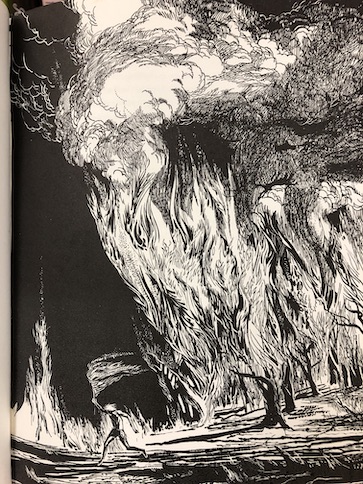
Pipkin suddenly appears in the distance, by a dark ravine, holding a lit pumpkin. He says that he doesn’t feel well, but he knew that he had to come. Pipkin trips and falls, and the light in his pumpkin goes out. From a distance, the others hear him calling for help. Moundshroud says that something bad has happened. Pipkin has been taken away to The Undiscovered Country by Death. Moundshroud says that Pipkin may not be taken permanently but perhaps held for ransom and that, if they follow Pipkin to The Undiscovered Country, they might be able to get his soul back and save his life.
Moundshroud has the boys build a kite that somewhat resembles a pterodactyl, and they use it to travel into the far distant past. The first place they arrive is Ancient Egypt, where the boys learn about mummies and how the Ancient Egyptians viewed the dead. They see Pipkin as a mummy, being laid to rest in a sarcophagus, surrounded by hieroglyphs, telling the story of his life. (Or, as Moundshroud says, “Or whoever Pipkin was this time around, this year, four thousand years ago,” hinting that Pipkin has been reincarnated before and what they are seeing during their journey are his past lives and deaths.) Pipkin calls out to his friends for help. Moundshroud tells the boys that they can’t save Pipkin now, but they’ll have a chance later.
They
continue their journey through time and around the world, seeing glimpses of
Halloweens past in Ancient Rome and the British Isles, where they learn about
druids, Samhain, and witches. Moundshroud
describes how the Romans supplanted druidic practices with their own
polytheistic religion until that was eventually replaced by Christianity. All along, they can still hear Pipkin calling
to them, and he seems to be carried off by a witch. As they pursue him, Moundshroud teaches them
the difference between fictional witches and real-life witches, which he
characterizes as being more like wise women, who don’t really do magic.
From there, they go to Notre Dame to learn about gargoyles. They continue to see Pipkin in different forms, even as a gargoyle on the cathedral. Pipkin tells them that he’s not dead, but that he knows that part of him is in a hospital back home.
In Mexico, the boys experience Dia de los Muertos and learn about skeletons and a different kind of mummy from the ones they saw in Egypt. They find Pipkin, held prisoner in the catacombs by the mummies, and Moundshroud tells the boys that the only way to save him is to make a bargain, both with him and with the dead: each boy must give one year from the end of their lives so that Pipkin may live. It is a serious decision, for as Moundshroud says, they won’t miss that year now, being only about 11 or 12 years old, but none of them knows how long they will actually live. Some of them who were destined to die at 55 would now only make it to 54, and as they reach the end of their lives, the year will seem that much more important to them. Even those who live longer will still want every day they can possibly have. However, each decides that he is willing to make the sacrifice because, without that sacrifice, Pipkin has no chance, and they can’t just let him die.
They
make the bargain and are soon returned home.
When they go to Pipkin’s house to check on him, they are told that Pip
is in the hospital because he had his appendix taken out, just in time to save
his life. At the end of the story, Tom
(who is the leader of the boys through most of the story), wonders silently who
Moundshroud really was, and he hears in his mind, “I think you know, boy, I
think you know.” Tom asks him if they
will meet again, and Moundshroud says that he will come for Tom many years from
now, confirming that Moundshroud was Death all along, which was why they had to
make the bargain with him.
I saw the animated movie version of this story long before I read the book, and it really gave me the creeps! Moundshroud is creepy because he is kind of two-faced. On the one hand, he seems somewhat helpful in helping the boys to find Pipkin and teaching them about the history of Halloween, but on the other, he does not admit to the children that he is Death until the very end, that he is the very thing that they need to save Pipkin from, and that they can only do it by offering a sacrifice of years from their own lives. Although it does occur to me that Moundshroud may not be quite as two-faced as he seems because Pip’s illness and potential death may not have been planned by him but simply the fated situation for Pip, and Moundshroud might have just taken it upon himself to provide a way for Pip’s friends to save him in the least painful way. By not telling them that a sacrifice of part of their lives would be necessary until the very end, after they had come to a better understanding of life and death in the history of Halloween, he may have made the choice easier for them to make. Also, he never says exactly how much time they bought for Pip with their sacrifice. The implication is that Pip is now free from his early appointed death date and will now live a full life, similar to what his friends will have. The exchange does not seem to be an even one, a year for a year, with the children needing to decide how many years they will donate to Pip. Although the kids still don’t know at the end how many years each of them will live, it seems that none of the rest of them is in danger of dying in childhood, and they will all live for many more years.
I wouldn’t recommend this book for young children (it still gives me the creeps, and I’m in my 30s), but it is interesting how they take a journey through the origins of Halloween. The book and the movie were somewhat different, partly because there were more kids in the group in the book and partly because the group of kids in the movie also had a girl in a witch costume. In the book, the kid in the witch costume was also a boy.
Both the book and the animated movie are available online through Internet Archive.
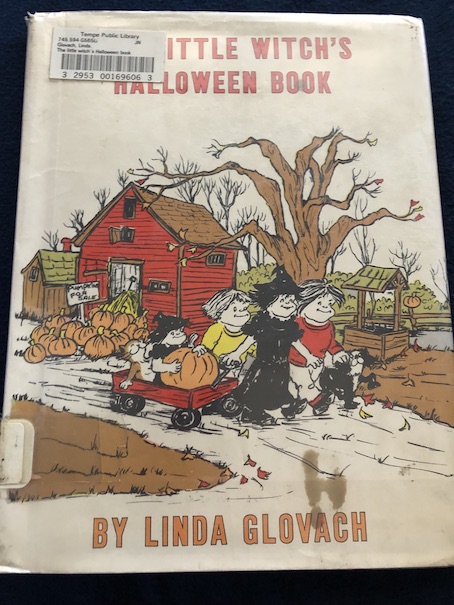
The Little Witch’s Halloween Book by Linda Glovach, 1975.
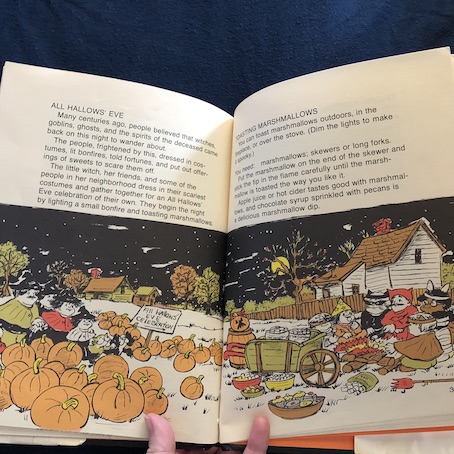
This book is part of the Little Witch series of craft and hobby books. This one is all about Halloween activities and suggestions for Halloween parties. The book is divided into sections for cards and decorations, parties and celebrations, and trick or treat. The Little Witch’s Code in the beginning has rules for Halloween safety such as having an adult inspect Halloween treats before the child eats them and going trick-or-treating in a group instead of alone. It also advises collecting for charities while trick-or-treating and not playing tricks on people.
The section about cards has Halloween card designs in different shapes. The party section also has a pumpkin card design to use as an invitation, but really, any of the cards could be invitations or party decorations.
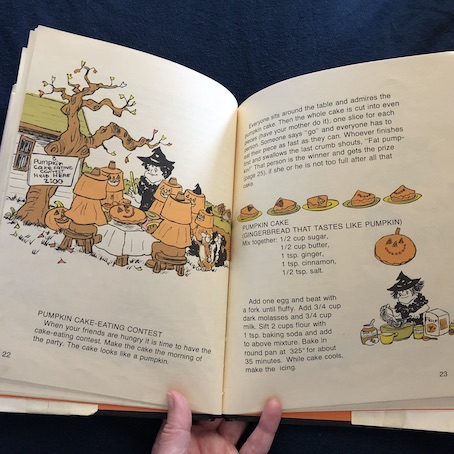
The party section has instructions for games and decorations. One of the games is a pumpkin cake eating contest and a recipe for a pumpkin cake, which oddly does not include any pumpkin, only the spices that are typically included in pumpkin pie. It’s more like a spice cake or gingerbread, and it’s decorated to look like a jack o’lantern face.
Other games and party treats include traditional ones, like dunking for apples and toasting marshmallows, but there are also some original games, like the Wicked Witch’s Candy House. That game involves party guests taking candy from a tray on top of a cardboard playhouse made from a large cardboard box while the “witch” inside tries to guess who they are. There is also a cute fortune-telling game.
The section about trick-or-treating has more recipes and instructions for making a treat bag and making jack o’lanterns out of oranges.
The book is available to borrow and read for free online through Internet Archive.
Nate the Great and the Halloween Hunt by Marjorie Weinman Sharmat, 1989.
Nate the Great gets a Halloween case when Rosamond asks him to help her find one of her cats. Rosamond and Annie show up at Nate’s house, trick-or-treating. They’re both dressed as Little Red Riding Hood, and Annie’s dog, Fang, is the wolf/grandmother.
Rosamond has several cats, all named “Hex”: Big Hex, Plain Hex, Super Hex, etc. But, she’s worried because she can’t find Little Hex. Every Halloween, her other cats like to go to an old house in the neighborhood that is supposedly haunted in order to help haunt it, but Little Hex is afraid on Halloween and apparently hid somewhere. Nate thinks that Little Hex will probably come out as soon as Halloween is over, but Rosamond is so worried that he agrees to look for Little Hex anyway.
Nate interviews kids in the neighborhood to see if they’ve seen Little Hex, but they haven’t. Then, he and his dog, Sludge, go to the haunted house to look around. He sees Rosamond’s other cats, but not Little Hex. There’s a scary moment when he realizes that he’s locked in the house, but Sludge helps him to escape.
Little Hex isn’t as far away or lost as Rosamond thinks, and Nate realizes that both Sludge and Rosamond herself have given him the clues he needs to solve the mystery. Sludge demonstrates what an animal might do when it’s frightened, and Nate suddenly realizes why Rosamund’s treat basket was so much heavier than Annie’s even though they had been to the same houses.
The book is available to borrow and read for free online through Internet Archive.
The Spooky Halloween Party by Annabelle Prager, illustrated by Tomie de Paola, 1981.
This book was an old Halloween favorite of mine when I was a kid. It’s funny, slightly spooky, and has a bit of a twist ending!
Albert’s friend, Nicky, is inviting all of their friends plus his cousin Suzanne to a spooky Halloween party at his new apartment on Halloween night. Albert hasn’t been to his new apartment yet, and Nicky says that it’s going to be really scary because he wants everyone to come in costume and to not tell anyone what they’re going to be so that everyone will be surprised when they take off their masks at the end of the evening.
Albert doesn’t think Nicky’s party is going to be all that scary because he’s pretty confident that he’ll know who his friends are right away, even in costume. Some of them have already given him hints. Nicky was practicing going, “Whoo, whoo!” in order to scare people, so Albert knows that, whatever his costume is, it’s something that makes that sound. Jan called up and asked Albert if he had an old mop that she could borrow, so he thinks that she’s probably going to be a witch and that she just got confused, thinking that witches carry mops instead of brooms. Dan told Albert straight out that he’s going as a pirate because he doesn’t see the point in keeping his identity a secret. So, Albert isn’t expecting any real surprises at Nicky’s party.
As for Albert’s costume, he’s tired of wearing the usual old clothes in the dress-up box, so he decides that this time, he’ll wear the box itself. He cuts holes for his eyes and arms and decorates it so that he looks like a robot. Almost completely covered by the box, he’s sure that everyone will have a harder time guessing his identity than he will theirs.
When Albert arrives at Nicky’s new apartment house, he meets a girl dressed like a princess in the elevator. She says that she’s going to the Halloween party on the fifth floor, and when Albert says that he is too, she suggests that they walk there together. Albert guesses that she is Nicky’s cousin, Suzanne, who he hasn’t met before.
The apartment is pretty spooky, lit by jack o’lanterns, and there are already some guests there. Albert is a little surprised that he doesn’t see a pirate, but there are a couple of witches and an owl, who could be Nicky. Yet, when Albert tries to talk to the other guests, they seem to be acting strangely, and he realizes that he’s not quite sure who is really who.
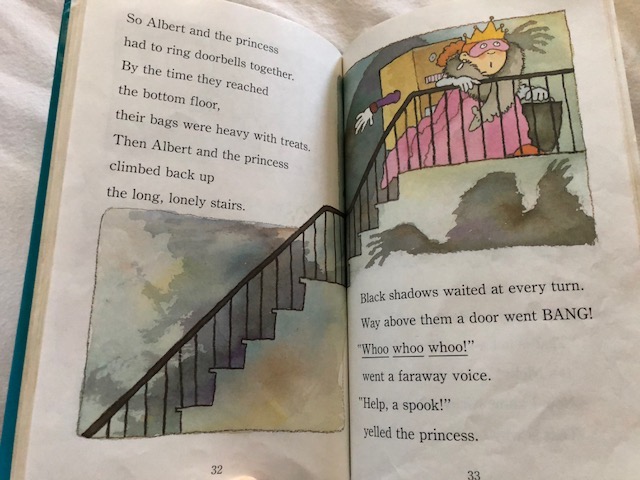
The princess is pretty spooked, and as the party goes around the apartment house, trick-or-treating, she kind of clings to Albert. When some strange noises and a far-away “Whoo, whoo” sound startle her, Albert reassures her that it’s only Nicky in his owl costume. Then, the princess tells him that she knows the owl, and it’s not Nicky. That’s when Albert really starts getting scared, wondering why he doesn’t seem to know his own friends.
The book is available to borrow and read for free online through Internet Archive.
My Reaction and Spoilers
The reason why Albert doesn’t seem to know anyone becomes apparent when they unmask themselves after trick-or-treating. Albert is really among strangers! The princess isn’t Nicky’s cousin at all, and he followed her to the wrong Halloween party! There were two Halloween parties on the fifth floor that night. Nicky lives in apartment C, and Albert accidentally joined the party in apartment B. Fortunately, Albert’s friends are also trick-or-treating around the apartment building and show up at that moment.
What started out as a potentially embarrassing mistake actually ends up making the evening more fun for everyone. Albert’s mix-up brought an element of real suspense to both of the Halloween parties, with him wondering who everyone really was, the guests at the wrong party wondering who he was, and all of Albert’s friends wondering where he was. Also, Albert gets some new friends out of this experience, and both parties end up combining into one big party at Nicky’s apartment.
Race isn’t important to the story and is never mentioned, but I’d just like to say that I appreciated the diversity of characters in the pictures. Albert is black and so is Jan (you can see that when she isn’t wearing her clown costume), and the boy in the owl costume looks like he might be Asian. I also really love that owl costume! I don’t think I’ve ever actually seen anyone dress as an owl for Halloween, but it looks awesome!
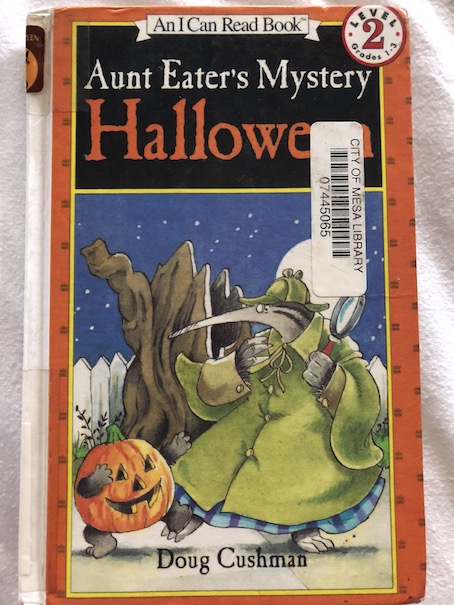
Aunt Eater’s Mystery Halloween by Doug Cushman, 1998.
This is a cute Halloween book for kids. There are actually four short mystery stories in the book as Aunt Eater, dressed as Sherlock Holmes, goes to a Halloween party and encounters various spooky happenings.
Aunt Eater Sees a Monster
While she’s on her way to the Halloween party, Wally stops Aunt Eater and says that there’s a monster in his kitchen and that it ate his father. When Aunt Eater takes a look, she sees a scary shadow in the kitchen and hears a terrible groan. Is it really a monster?
Aunt Eater Sees a Ghost
Aunt Eater continues walking to the party with Mr. Chumly, who is dressed as a turnip. Mr. Chumly points out a hollow tree that they pass and tells her that it’s supposed to be haunted by a headless ghost. Aunt Eater doesn’t believe in ghost, but then a scary jack o’lantern appears, moving by itself, and it’s followed by a ghost with no head! Fortunately, there is a logical explanation.
Aunt Eater Hears Some Music
Aunt Eater is glad to see all of her friends at the party. Miss Underbelly has brought her pet snake with her. Later, the piano suddenly starts playing strange music without anyone sitting at it, and the snake has disappeared! What do you suppose is happening?
Aunt Eater Dances a Jig
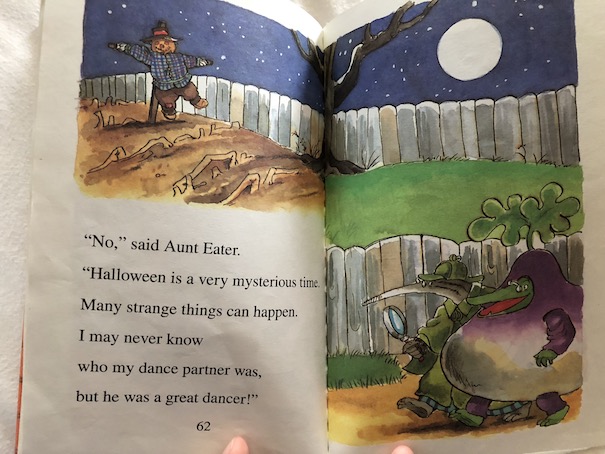
Mr. Fragg, a friend of Aunt Eater’s, is wearing a scarecrow costume, and he tells Aunt Eater that he’d like to dance with her later in the evening. She does dance with a scarecrow, but then learns that it wasn’t Mr. Fragg because Mr. Fragg hurt his foot. Who was that mysterious scarecrow? Aunt Eater never figures it out, but readers do.
The book is currently available online through Internet Archive.
Cranberry Halloween by Wende and Harry Devlin, 1982.
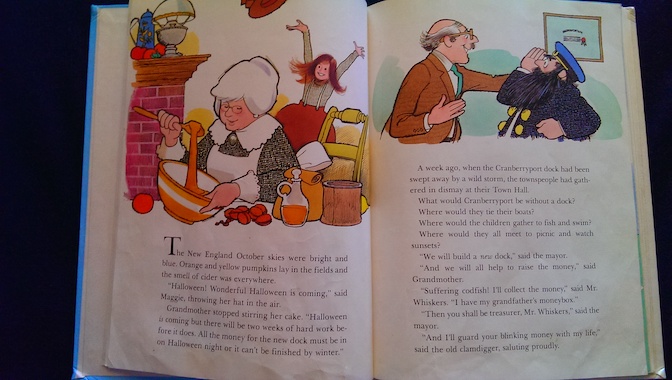
The citizens of Cranberryport need to raise money to build a new dock after theirs was destroyed in a storm. Almost everyone in town volunteers to help, and Mr. Whiskers volunteers to keep the money they raise in his grandfather’s old moneybox.
Mr. Grape, a rather cranky old man, not only refuses to donate money to the cause but he insists that it is a mistake to trust Mr. Whiskers with the money because he is a sloppy and careless person. However, Maggie’s grandmother speaks up for Mr. Whiskers, and he gets the job of treasurer for the fund.
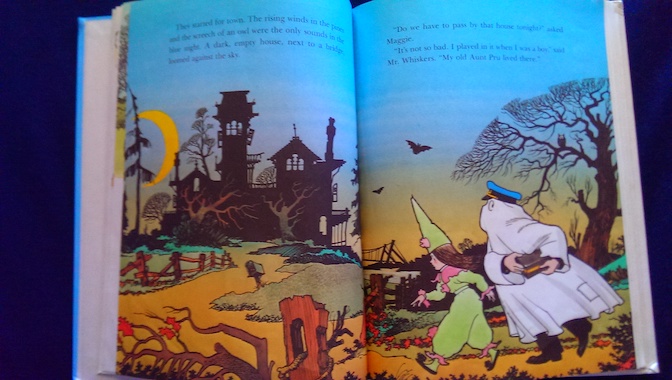
On Halloween night, Mr. Whiskers and young Maggie make their way to the town party, where Mr. Whiskers will present the money for the dock at the town hall. As they pass by the spooky old house where Mr. Whiskers’s aunt used to live, two men in pirate costumes try to steal the money from them.
Mr. Whiskers and Maggie hide in the spooky old house, but the pirates are still waiting for them outside. What are they going to do?
Mr. Whiskers uses his memories of the old house to find a way out, and it isn’t long before they uncover the villain who put the pirates up to the attempted theft.
The book includes a recipe for Cranberry Dessert in the back.
That Terrible Halloween Night by James Stevenson, 1980.
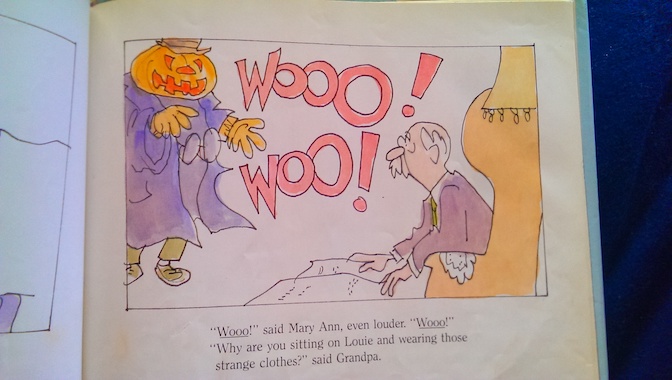
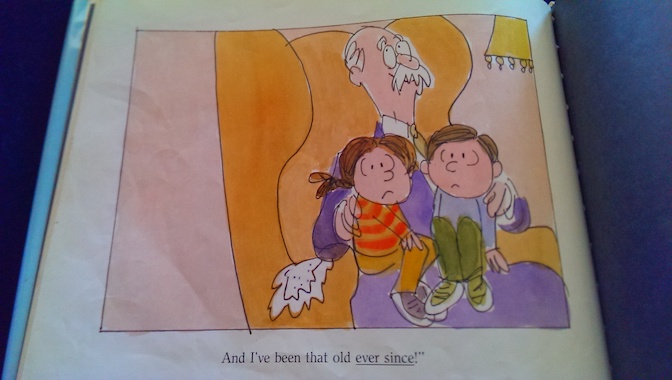
It’s Halloween, and Louie and Mary Ann think that it would be funny to play a joke on their grandfather and scare him. First, they try putting a scary mask on their dog, Leonard, but their grandfather just pats the dog on the head. Then, Mary Ann sits on Louie’s shoulders, and the kids put on a big, old coat and a pumpkin head. However, their grandfather still isn’t frightened.
When the kids ask him why he isn’t scared, their grandfather says that he doesn’t get scared much since “that terrible Halloween night.” When the kids ask him what he means, he starts telling them about a Halloween when he was a kid. He was out trick-or-treating when he saw a mysterious old house and couldn’t resist taking a look inside.
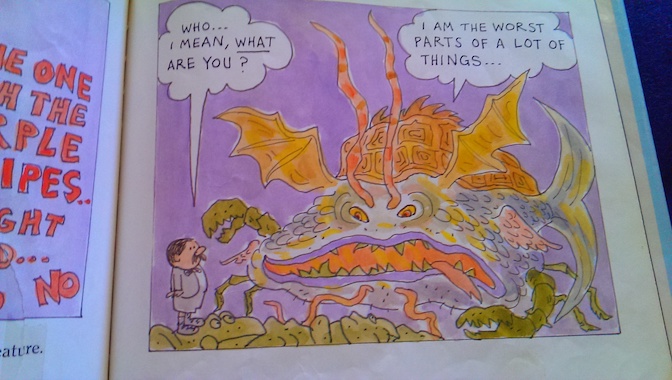
As the grandfather, as a kid, explores the house, he encounters all kinds of strange and frightening creatures. (My favorite is the one that’s “the worst parts of a lot of things” just for the description.)
But, nothing in the house is as scary as whatever is behind the final door in the house, the one that the monsters warn him not to go through . . .
You never see what’s behind the door, but the result is the punchline of the story. Typical grandfather way to frighten the kids!
One of the fun things about this story is that the grandchildren aren’t just listening to the story but are shown reacting to it as the grandfather tells the story, sometimes interrupting with questions or comments. The pictures are drawn in a comic style, and much of the dialog is contained in speech bubbles in the pictures.
The book is currently available online through Internet Archive.
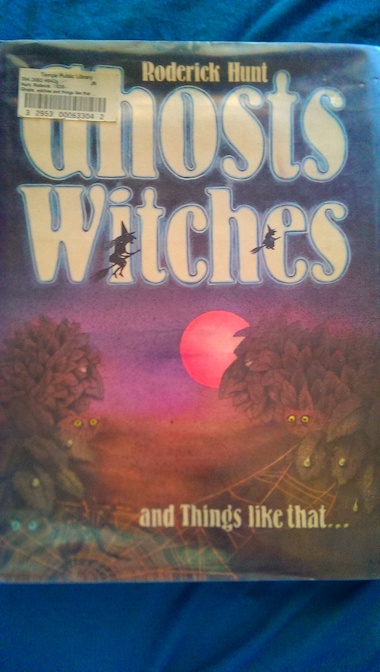
Ghosts, Witches, and Things Like That by Roderick Hunt, 1984.
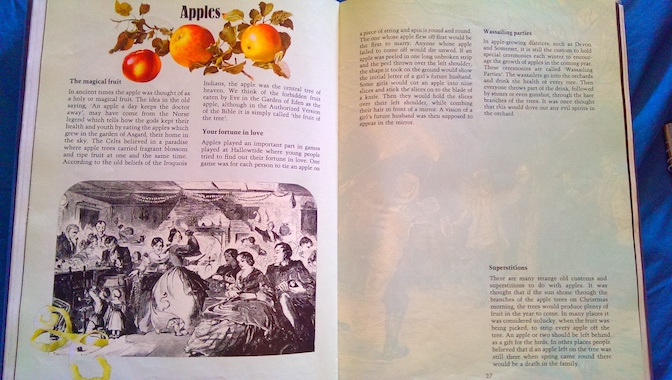
This is a collection of information about the history of Halloween and other things related to Halloween, like folklore, games, recipes, crafts, and poems. There are sections about specific topics, starting with the section about Halloween itself (spelled Hallowe’en, this is a British book). The section about Halloween talks about the origins of the holiday and has tips for holding a Halloween party, including how to make costumes and decorations, the rules for games to play (including some old traditional games), and recipes for various Halloween treats.
Other sections of the book focus on various monsters and mythical creatures associated with Halloween, such as witches, ghosts, fairies werewolves, and vampires. There is a section of ghost stories and some fascinating historical information about spiritualists and how people have faked ghosts in the past, including the Pepper’s Ghost illusion that is still used in the haunted house in Disneyland. The sections about witches, fairies, and monsters also include a mixture of history and folklore along with some jokes and poems about the various creatures.
This is a fun book to read around Halloween. It’s a mixture of historical background, folklore, party-planning tips, games, and recipes. I think that the information about traditional games is still my favorite part.
Molly McIntire misses her father, who is a doctor stationed in England during World War II. Things haven’t been the same in her family since he left. Treats are more rare because of the sugar rationing, and she now has to eat yucky vegetables from her family’s victory garden all the time, under the watchful eyes of the family’s housekeeper. Her mother, while generally understanding, is frequently occupied with her work with the Red Cross. Molly’s older sister, Jill, tries to act grown-up, and Molly thinks that her brothers are pests, especially Ricky, who is fond of teasing. However, when Molly and her friends tease Ricky about his crush on a friend of Jill’s, it touches off a war of practical jokes in their house.
Halloween is coming, and she wants to come up with great costume ideas for herself and her two best friends, Linda and Susan. Her first thought is that she’d like to be Cinderella, but her friends are understandably reluctant to be the “ugly” stepsisters, and Molly has to admit that she wouldn’t really like that role, either. Also, Molly doesn’t have a fancy dress, and her mother is too busy to make one and also doesn’t think that they should waste rationed cloth on costumes. Instead, she suggests that the girls make grass skirts out of paper and go as hula dancers. The girls like the idea, but Halloween doesn’t go as planned.
Everyone loves the girls’ costumes, and they collect a good number of treats in spite of the war rationing, but Ricky takes his revenge for their earlier teasing by spraying them with water and ruining their costumes and all of their treats. When the girls get home, and Mrs. McIntire finds out what happened, she punishes Ricky by making him give the girls the treats that he’s collected, except for one, which she allows him to keep. However, to the girls, this seems like light punishment, and they’re offended that he got off so lightly.
Because he laughed at the girls, saying that he could see their underwear after he sprayed them with water and ruined their skirts, the girls decide to play a trick that will give Ricky his just desserts. The next time that Jill’s friend comes to visit, the girls arrange to have Jill and her friend standing underneath Ricky’s bedroom window when they start throwing all of his underwear out the window, right in front of Ricky. Ricky screams at the girls that “this is war!” just as their mother arrives home.
Their mother makes it clear that war is a serious thing, not a joke. There is a real war on, and their childish pranks are wasting time and resources (like the food that Ricky ruined on Halloween – sugar is rationed, and some of their neighbors had gone to a lot of trouble to save their rations to give the kids a few treats). She also points out that this is how real wars start, with “meanness, anger, and revenge.” Faced with the reality of what they were doing, Molly and Ricky apologize to each other and clean up the messes that they each made under their mother’s direction.
In the back of the book, there is a section of historical information about what life was like for civilians in America during World War II. People with relatives overseas worried about them, but people in service had to be careful about what they said in letters home, in case those letters were intercepted by enemy forces. Some of the luxury goods that people were accustomed to having became more scarce, although the rationing wasn’t as bad in the United States as it was in Europe (this is covered more in a later book in the series) because certain types of materials had to be saved for the war effort (like the metals used to make cans for food, which is why victory gardens were important) and because factories that ordinarily made civilian goods were converted to make equipment for the armed forces. For example, they mention that car factories were making things like tanks and airplanes and clothing factories were making tents and uniforms. People referred to the efforts that civilians were making to save needed materials for the war as “fighting on the home front,” reminding themselves and others that the small sacrifices that they made each day, like driving their cars less to save gas or raising food for their families, helped to make a big difference for a larger cause.
The book is currently available online through Internet Archive.



















 Molly McIntire misses her father, who is a doctor stationed in England during World War II. Things haven’t been the same in her family since he left. Treats are more rare because of the sugar rationing, and she now has to eat yucky vegetables from her family’s victory garden all the time, under the watchful eyes of the family’s housekeeper. Her mother, while generally understanding, is frequently occupied with her work with the Red Cross. Molly’s older sister, Jill, tries to act grown-up, and Molly thinks that her brothers are pests, especially Ricky, who is fond of teasing. However, when Molly and her friends tease Ricky about his crush on a friend of Jill’s, it touches off a war of practical jokes in their house.
 Halloween is coming, and she wants to come up with great costume ideas for herself and her two best friends, Linda and Susan. Her first thought is that she’d like to be Cinderella, but her friends are understandably reluctant to be the “ugly” stepsisters, and Molly has to admit that she wouldn’t really like that role, either. Also, Molly doesn’t have a fancy dress, and her mother is too busy to make one and also doesn’t think that they should waste rationed cloth on costumes. Instead, she suggests that the girls make grass skirts out of paper and go as hula dancers. The girls like the idea, but Halloween doesn’t go as planned.
 Because he laughed at the girls, saying that he could see their underwear after he sprayed them with water and ruined their skirts, the girls decide to play a trick that will give Ricky his just desserts. The next time that Jill’s friend comes to visit, the girls arrange to have Jill and her friend standing underneath Ricky’s bedroom window when they start throwing all of his underwear out the window, right in front of Ricky. Ricky screams at the girls that “this is war!” just as their mother arrives home.

