Hanukkah at Valley Forge

It’s a cruel winter at Valley Forge, during the American Revolution, and George Washington is worried about the welfare and morale of his soldiers.
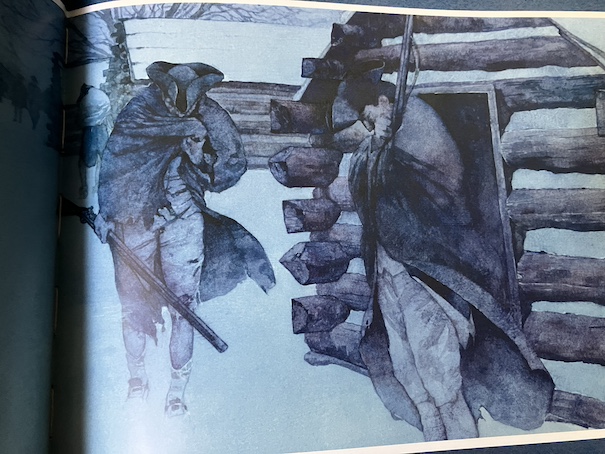
As Washington walks through the camp, he sees a young soldier lighting a candle and reciting something softly to himself.

Curious about what he’s doing, Washington stops to talk to him, casually remarking on how cold the night is. The young soldier says that he saw colder nights when he was young in Poland, and he is lighting candles for Hanukkah. Washington asks him what that means, and the soldier explains the meaning of the holiday.

The soldier recounts the story of how Israel was conquered by the Ancient Greeks, who forced Jewish people to worship Greek gods and tried to replace Jewish customs with Greek ones. Washington also says that he understands what it’s like to feel like you’re under the thumb of a king who lives far away and the desire for liberty. The Jewish soldier says his family left Poland for similar reasons, because they were not being allowed to practice their beliefs there.

Returning to the story of the ancient Israelites, the soldier explains that a priest named Mattathias refused the Greeks’ orders to bow to idols, and he fought back against the Greeks. Mattathias and his five sons, who were called the Maccabees, led a rebellion against the Greeks. They were a small group, and the odds were against them, but they were determined to continue the fight against their oppressors. Washington says that he understands the feeling because his army is in a similar position.

Continuing the story, the soldier recounts how Mattathias’s son, Judah, inspired their troops by reminding them that God was on their side, leading them to victory. When they finally managed to overthrow their Greek rulers, they took back their Temple and lit the Temple menorah. The menorah was supposed to be kept lit constantly, and they were worried because there was very little oil left. They only had enough to keep it burning for one day, and they weren’t sure when they could get more oil. However, they lit the menorah anyway, trusting that God would somehow provide them with more soon. It took them eight days to find more oil for the menorah, but to their surprise, the menorah continued to stay lit all the time they were searching, lasting eight times longer than they thought it would with the amount of oil they had. Hanukkah became the commemoration of this miracle.
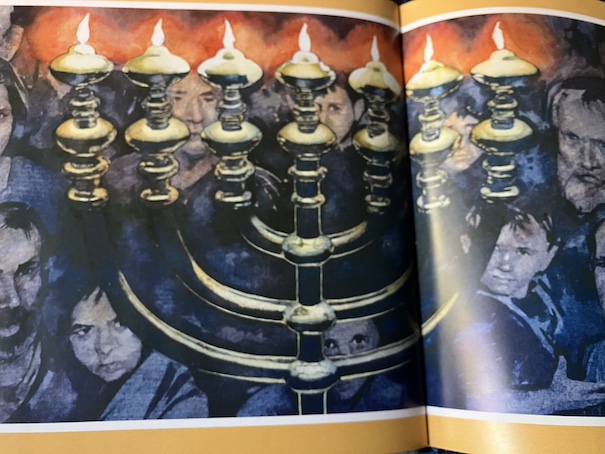
George Washington contemplates the story that the soldier told him, and he finds it inspiring. It reminds him that, even though their current situation in Valley Forge may seem bleak, there have been others before them who have also faced steep odds in their struggles and who still managed to succeed. He begins to think that, if they persevere, they may also be gifted with a miracle of their own.
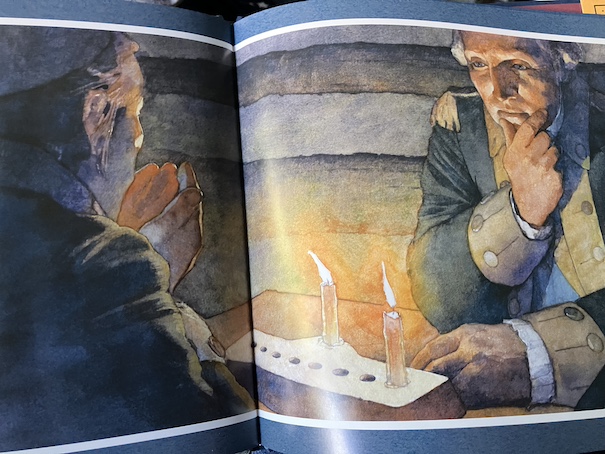
There is an author’s note at the end of the book that explains the inspiration behind the story. As the characters in the story do, the author draws parallels between the American Revolutionary War and the historical battle that began the tradition of Hanukkah. The author learned that George Washington may have learn about Hanukkah during the Revolutionary War, although there are no entries in his diary to confirm it, so he used excerpts from George Washington’s other writings to explain his sentiments. The author also offers commentary on bullies and the importance of standing up to oppressors, both in the context of war and in daily life.

This book won the Sydney Taylor award from the Association of Jewish Libraries.

I love books that include little-known or lesser-known events. Whether this one happened or happened in the way the author tells it is difficult to verify, and it seems likely that it’s more of a folk tale than an historical account. George Washington was a real, historical person, but so many legends have grown up around his life that it’s sometimes difficult to tell whether certain stories about him actually happened. As the author says, Washington’s own diary doesn’t offer any verification about this particular incident. Other reviewers of this book, including J. L. Bell, who specializes in Revolutionary War history in the Boston area, have attempted to trace the origins of this particular story about Washington learning about Hanukkah during the Revolutionary War. In his blog, J. L. Bell explains the known sources for this story, which vary in their description of exactly when the encounter between Washington and the Jewish soldier took place and what the soldier’s name was. The soldiers who have been credited with having this encounter with George Washington were real people, but there’s nothing that definitively proves that the discussion about Hanukkah actually happened with any of them. The story is probably more folklore than history, and Bell believes that it started to circulate during the 20th century, when there were more immigrants arriving from Poland with stories and experiences like the one the Polish soldier in the story tells about not being allowed to practice their religion openly. Even so, the parallels the story draws between the ancient rebellion of the Maccabees and the American Revolution are fascinating.

There are certain feelings that are universal among humans, and the author’s point that nobody likes being oppressed by a bully, whether that bully is another person or a government or an army, is true. No matter what you’re up against in life, perseverance in the face of hardship is important, and miracles can come to those who continue to stand up for themselves and what they believe in. It is also true that people who come from different sets of circumstances can help to inspire each other by sharing common feelings about their struggles.
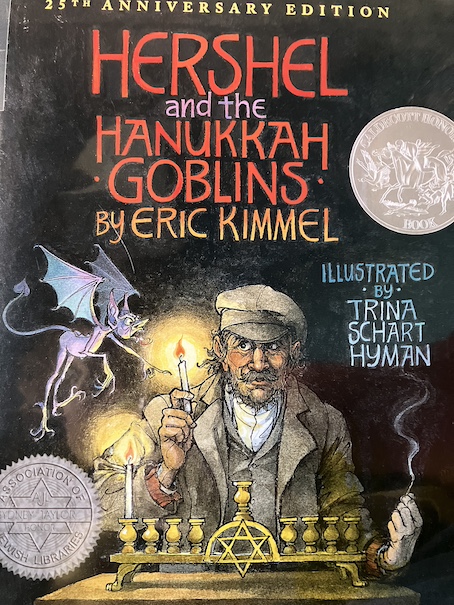
Hershel and the Hanukkah Goblins

On the first night of Hanukkah, a tired travel, Hershel, trudges through the snow on his way to the next village. There, he hopes to get something to eat and celebrate the holiday with the local villagers. However, when he reaches the village, nobody is celebrating.

When he asks the villagers why they’re not celebrating, they tell him that they can’t because there are goblins haunting the old synagogue on the hill. Every time they try to celebrate Hanukkah, the goblins come after them, blow out the candles on their menorahs, breaks their dreidels, and throw all the potato latkes on the floor.

Hershel decides that he isn’t scared of the goblins, and he’s going to put an end to their mischief. The village rabbi says that the only way to get rid of the goblins is to spend all eight nights of Hanukkah in the synagogue, lighting Hanukkah candles every night. Then, on the final night of Hanukkah, the goblin king must light the candles himself. Although this sounds difficult, Hershel is confident that he can do it. Although the villagers aren’t really expecting Hershel to succeed, they support Hershel in his mission, and they give him some food, a menorah, candles, and matches.

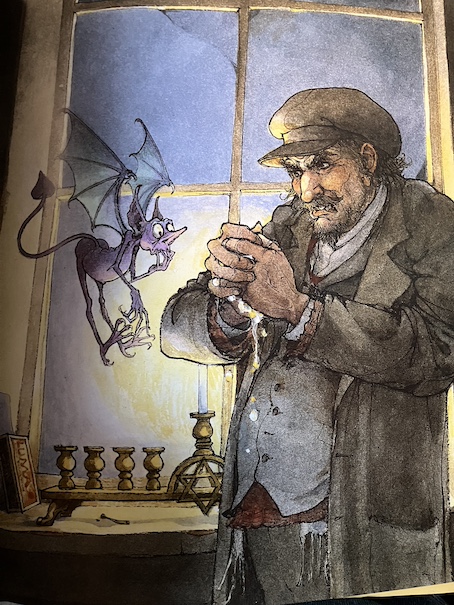
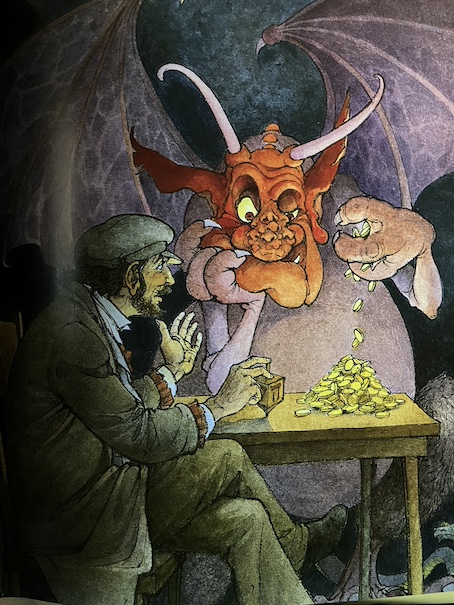
The old synagogue is creepy, and when Hershel lights his first candle, a small goblin appears to ask him what he’s doing. Herself isn’t intimidated by the little goblin, and he tricks the goblin into thinking that he’s strong enough to crush rocks in his hands by squeezing a hard-boiled egg in his hands until it breaks. The little goblins is scared away but warns him that bigger goblins than him will come later. The next night, a bigger goblin comes, but he isn’t very bright and gets his hand stuck in a jar of picks when he tries to take too many. The night after that, tricks the third goblin into playing dreidel with him and giving him all his gold.

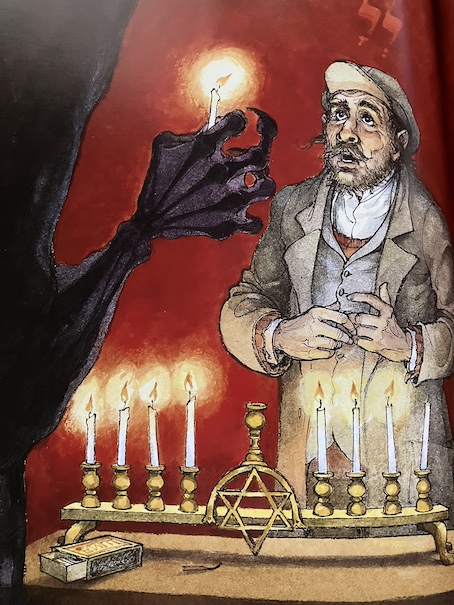
It continues like this, night after night, with Hershel tricking the goblins in various ways so that they’ll let him light the candles on his menorah. Finally, Hershel comes face-to-face with the most sinister goblin of all – the king of the goblins. Can Hershel find a way to trick him and get him to light the candles of the menorah himself?

The book is a Caldecott Honor Book and named a Sydney Taylor Honor Book by the Association of Jewish Libraries. It is available to borrow and read for free online through Internet Archive (multiple copies). It was originally published as a short story in Cricket magazine and later as a book, which is why the story has two copyright dates.

I’m not Jewish, and I admit that this isn’t a book I read as a kid, although I do remember that it was one that was often recommended when I was young. As an adult, I decided to try it, since I just never got around to it before. I really do like this story. I enjoyed the folklore elements, and I also appreciated that the main character saves Hanukkah, in much the same way that various characters had to “save” Christmas when I was a kid.

It makes me laugh to think about it now, but Christmas always seemed to be an extremely endangered holiday in Christmas television specials from my childhood. Some evil person or being was always out to destroy Christmas, for various reasons, with varying degrees of logic, and popular television characters always had to “save” it from being destroyed or canceled or whatever. It was fun and entertaining, but when you consider the entire canon of endangered Christmas holiday specials all together, it does seem like there isn’t a single year when Christmas isn’t in danger from somebody or something, making it weirdly routine for Christmas to almost not happen. At some point, I think my brother pointed out that Christmas was always in danger, but it seemed like Hanukkah was relatively safe. (At least, in the land of holiday-themed winter television specials starring well-known cartoon characters.) I figured that Christmas was likely a bigger target for the forces of evil due to its wide mass appeal because there were just more people who celebrated Christmas where I lived than Hanukkah (and also because of the all the related Christmas toy tie-in commercials and advertising sponsors for those shows).

So, I was delighted to see Hanukkah get saved from a band of comically nefarious goblins in this book. The goblin king is a sinister figure in the pictures, but fortunately, he’s not too much brighter than his cohorts. The book has been adapted as a stage play (you can sometimes find clips or trailers from performances on YouTube), and there is also an animated short film of the story. I think it would be fun to see a longer version, though, in video or movie form. The book skims over the details of what Hershel does to trick some of the other goblins after the third one, so there’s room to elaborate and make the story longer. I think I would have been a little scared by the final goblin when I was a little kid, but the goblins not being particularly bright and easy to trick does help remove some of the scare factor.

At first, I though that the story of Hershel might have been a folktale because it reads like one. In the back of the book, the author explains that he wanted to write a story that was somewhat like A Christmas Carol by Charles Dickens but about Hanukkah, and he took his inspiration from the folktale Invanko, the Bear’s Son (also known as Jean de l’Ours or John the Bear), which is includes the hero tricking a goblin, and he added in a Jewish folk hero, Hershel of Ostropol. The resulting story is sort of like a new folktale, remixed from old ones, which is fitting because that’s what happens with folk stories Overall, I thought it was a fun story.

December Secrets

The Kids of Polk Street School

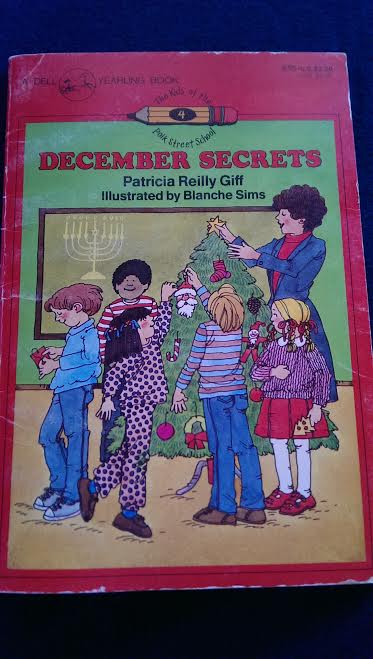
decembersecrets#4 December Secrets by Patricia Reilly Giff, 1984.

It’s December, and the kids in Ms. Rooney’s class at Polk Street School are learning about Christmas and Hanukkah.  To get everyone in the holiday spirit, Ms. Rooney has everyone choose someone else in class as their “Secret December Person,” kind of a Secret Santa-style activity.  The kids will give small presents and do nice things for the person they pick.

Emily would have picked her friend Dawn for her person, but they’ve been fighting since Emily wouldn’t let Dawn cut in front of her in line when the fire truck came to school and the kids who were first in line were allowed to actually get in the front seat.  Emily tries to pick someone else to be her Secret December Person, but her other favorite choices are taken.  When she asks Ms. Rooney who is still available, Ms. Rooney suggests Jill Simon.

decembersecretspicEmily doesn’t think much of Jill Simon because she’s fat and a crybaby.  Whenever the least little thing goes wrong, Jill tears up.  She hardly ever smiles.  But, although Emily isn’t thrilled at first to have Jill as her Secret December Person, she then thinks that she can use this as an opportunity to help Jill.  Maybe her presents will help Jill to become a happier, maybe even thinner person.

The book is available to borrow and read for free online through Internet Archive.

My Reaction

Although Emily wants to help Jill, her first attempts fall flat because she’s focusing too much on correcting Jill’s faults instead of thinking about what would really make Jill happy.  Jill becomes a happier person when Emily notices the good things about Jill and helps her to see them for herself.  The project helps Emily to become a more thoughtful person, and she also makes a surprising discovery about the Secret December Person who has been leaving thoughtful presents for her.

The reason why it has to be “Secret December Person” instead of “Secret Santa” is because there are both Christian and Jewish children in the class.  That’s why the kids learn about both Christmas and Hanukkah.  They don’t want anybody to feel left out.  The name “Secret December Person” is a little cumbersome next to “Secret Santa”, but the sentiment is nice.  I don’t recall doing anything like this as a class activity when I was in elementary school.  I remember that I was in first grade when a Jewish girl and her mother explained Hanukkah to the class.  They gave everyone small plastic dreidels to play with, and I spent the Christmas holidays that year playing dreidel with my brother for peanuts and M&Ms.  They were just little party favor dreidels, but I had a lot of fun with mine, and I still have it.  Sometimes, little presents do mean a lot.