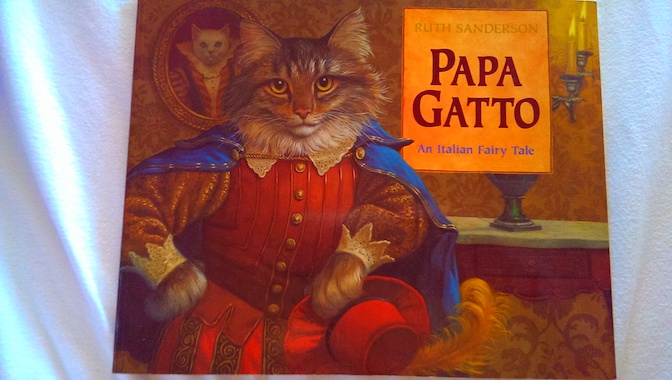
Papa Gatto

PapaGatto

Papa Gatto by Ruth Sanderson, 1995.

This beautiful picture book, set in a fairy-tale Italy, is based on several folk tales, as the author explains on the page with the publishing information.  Among the tales that served as inspiration for this story is The Colony of Cats, which is from Andrew Lang’s The Crimson Fairy Book.  In some ways, this story is similar to Cinderella and Mother Holle, with its wicked stepmother and stepsister.

In the distant past, so the story says, it was common for animals to talk, and one of the wisest cats was Papa Gatto, who served as an adviser to the prince.  Papa Gatto had a lovely wife and a beautiful mansion, but soon after the birth of their eight kittens, his wife died.  Needing someone to help care for the motherless kittens, Papa Gatto decides to advertise for someone to help.

PapaGattoAdvertises

In the town, there is a widow who has a daughter named Sophia and a stepdaughter named Beatrice.  As in many fairy tales, the widow favors her own daughter, who is lazy and spoiled, while giving all of the hard work to her stepdaughter, who is much nicer.  When they hear about Papa Gatto’s advertisement, Beatrice feels sorry for the young kittens and wants to help.  However, the widow, thinking of the generous fee that the wealthy Papa Gatto is offering, decides that she wants it for Sophia.  Sophia doesn’t want the job, but at her mother’s urging, she goes to see Papa Gatto anyway.

PapaGattoSophia

Papa Gatto gives Sophia the job tending his house and family while he’s away on a trip, but Sophia doesn’t know how to work hard and has no real intention of doing a good job.  She simply makes herself at home in Papa Gatto’s lovely mansion, trying on his dead wife’s jeweled collars as bracelets and neglecting the housework and kittens.  When Papa Gatto returns home and sees what she’s done, he sends her away in anger.

When Beatrice hears that Papa Gatto is once again looking for help, she goes to see him without telling her stepmother about it.  Papa Gatto sees how interested she is in the kittens and how gently she treats them, he gives her the job, reassured that she will do it well.

PapaGattoBeatrice

Sure enough, when he returns from his next journey, he sees that Beatrice has taken good care of the house and kittens and rewards her with the jeweled necklace/bracelet that Sophia had admired.  Needless to say, Beatrice’s stepmother and stepsister are angry with Beatrice when she returns home, and Sophia takes the bracelet for herself.

Meanwhile, Papa Gatto has told the prince about Beatrice.  The prince has been thinking about marrying, and he says that he would like to meet Beatrice.  Papa Gatto tells him that she will probably be at the coming fair in town, and the prince should attend and look for the girl with the bracelet.

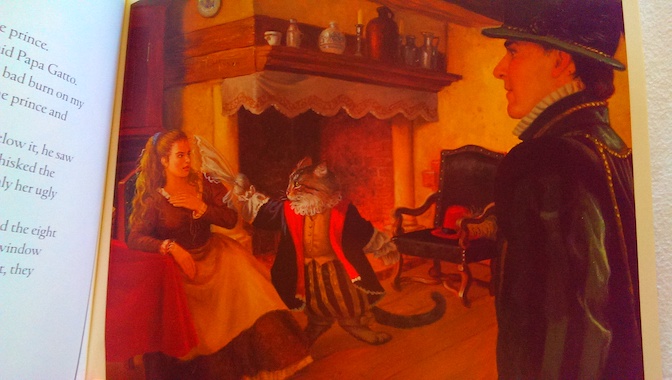
At first, the prince mistakes Sophia for Beatrice, a deception that she and her mother encourage.  However, when the prince speaks to Papa Gatto again, Papa Gatto realizes the deception and sets things right.
PapaGattoRevelation

The pictures in this book are beautiful!  And, of course, there’s a happy ending.

I liked it that Beatrice didn’t accept the prince’s offer of marriage immediately, saying that she’d like to get to know him first.  It’s more sensible than the fairy tales where they get married right away.

PapaGattoHappyEnding

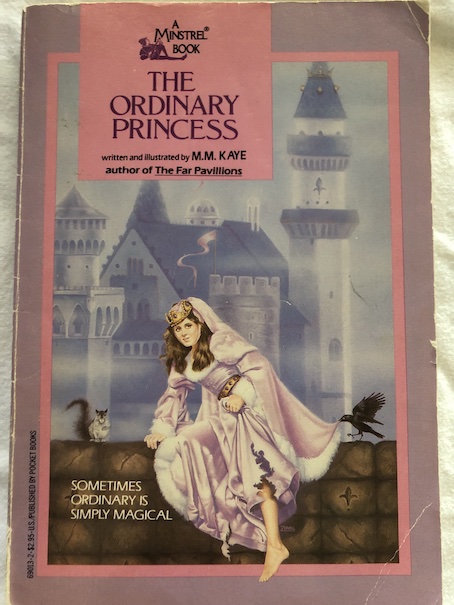
The Ordinary Princess

The Ordinary Princess by M.M. Kaye, 1986.

Lavender’s blue,
Rosemary’s green,
When you are king,
I shall be queen.

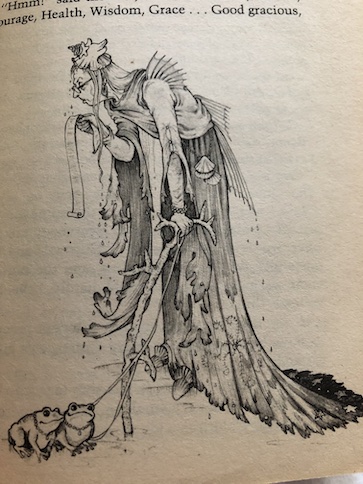
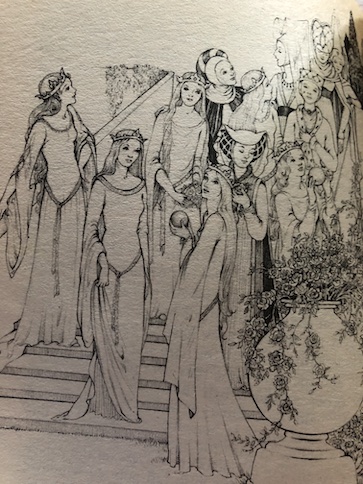
Everyone is excited when a seventh princess is born in the kingdom of Phantasmorania.  Everyone knows that seventh princesses are always the luckiest and the most beautiful.  Indeed, when Princess Amethyst Alexandra Augusta Araminta Adelaide Aurelia Anne is born, she is a beautiful baby who never cries and who has perfect blonde curls and blue eyes.  But, when one of her fairy godmothers, Old Crustacea, comes to the christening to give her blessing and sees all the perfect presents everyone has given her and little Princess Amethyst’s six perfect older sisters, she decides, “I am going to give you something that will probably bring you more happiness than all these fal-lals and fripperies put together.  You shall be Ordinary!”

Of course the king and queen are horrified, but there’s nothing to be done.  From that day on, Princess Amethyst becomes an ordinary baby who grows up to be an ordinary girl.  She cries when she’s hungry and tired.  Her golden hair darkens from golden blonde to a mouse brown and loses its curl.  She gets freckles!  Sometimes, she even makes spelling mistakes!

While everyone else is distressed at Princess Amethyst’s (now called Amy most of the time) lack of perfection, Amy realizes that Old Crustacea was right about it making her happier.  While her perfect sisters must behave themselves and keep their clothes clean, Princess Amy sneaks off to run and play.  She meets ordinary people, makes new friends, and has fun adventures.

But, eventually, all of her sisters grow up and get married.  When it’s Princess Amy’s turn, most of the princes aren’t interested because she’s not the beautiful, perfect seventh princess that she’s supposed to be.  Amy would be alright with that, but when her father and his advisors come up with an outlandish scheme to attract a prince that involves a dragon, Amy decides to put a stop to it by running away.

For a time, she lives a carefree life in the forest, but eventually, like all ordinary people do, she realizes that she’s going to need money to buy new clothes.  On the advice of Crustacea, she journeys to a neighboring kingdom and finds a job in the palace there as a kitchen maid. 

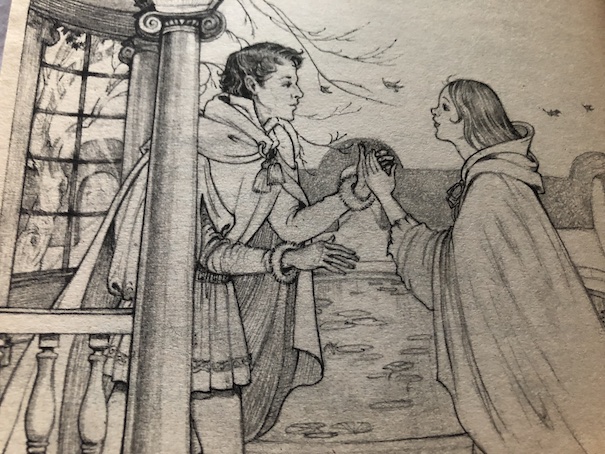
Actually, she finds more than that, finding her place in the world and someone who loves her for the ordinary princess that she is.

The book is divided into four parts, each of them titled after a verse from a version of the old folk song Lavender’s Blue (most versions say “lavender’s green” instead of “rosemary’s green”, although I do like saying “rosemary” better – this is the tune). The book also contains many small, black-and-white illustrations alongside the text.

It is available to borrow and read for free online through Internet Archive.

My Reaction

I think this is a beautiful book with a good message for girls. Being glamorous or trying to conform to someone else’s idea of perfection doesn’t bring as much happiness as knowing who you really are and finding someone who loves you and wants to live the same kind of life you do, imperfections and all. Not every “prince” out there is looking for the same type of “princess,” just the one that’s right for him. In the end, Amy finds a king who is just her kind of person.