#1 The Secret of Terror Castle by Robert Arthur, 1964, 1992.
In the first book in the series, Jupiter, Pete, and Bob form the Three Investigators, an organization dedicated to solving all kinds of mysteries. It was particularly Jupiter’s idea. They have been friends for a long time, and they used to have a club dedicated to solving puzzles. Now, they’ve decided that they want to solve more complicated problems and mysteries. Jupiter has won the use of a Rolls Royce and chauffeur for a month by entering a contest at an auto rental agency, so he thinks that it would be a good time to get started because they will have transportation to anywhere in the city.
Jupiter also has an idea for their first case, something that will help them get publicity for their new investigative organization. There is a rumor that a director, Reginald Clarke, is looking for a genuine haunted house to be the setting of his next movie. Jupiter manages, through some clever trickery, to get an interview with Reginald Clarke and persuades him to introduce this account of their first case if he and the other investigators can find a genuine haunted house right in town. Clarke takes them up on it, not because he thinks they will succeed, but because he sees it as the only way to get Jupiter to stop doing an unflattering impersonation of him.
Jupiter, however, is confident that they will be successful because he already knows the perfect place to investigate. Terror Castle is a large mansion that was built years ago by an old actor who was in silent films. All of his movies were scary ones, and since his death under mysterious circumstances, no one has succeeded in staying in the castle very long. Strange apparitions have been seen there, and anyone who tries to spend the night there is overcome by inexplicable terror. As far as Jupiter is concerned, all they have to do is prove that the castle is really haunted, and that means that the Three Investigators must visit it themselves.
In the original books, the director that Jupiter tries to find a real haunted location for was Alfred Hitchcock. Alfred Hitchcock introduced the early books in the series and played minor roles in some of them, and The Three Investigators capitalized on his reputation. When the series was re-released, however, Alfred Hitchcock was replaced by a fictional director, and his role in later books was taken by a fictional mystery author named Hector Sebastian. In the re-released version of the first book, Reginald Clarke refers the boys to Hector Sebastian at the end of the story so they can help a friend of his to find his missing parrot, which leads directly into the subject of the next book.
The haunting in this story (as with others in the series) has a reasonable explanation, not a supernatural one. In fact, one of the things that I always found memorable about this book was the explanation of how the inexplicable feelings of terror people experienced were created using sound waves which could be felt but which were beyond the normal range of human hearing. I’m not sure whether the book was completely correct about the science behind this technique, but I have heard about sounds being used to create odd or even harmful effects on human beings in real life. As for the reasons behind the haunting, they concern the original owner of the castle and the life he lived.
This is one of the books in the series which was made into a movie, The Three Investigators and the Secret of Terror Castle, but the movie was very different from the original book. In the movie, the owner of the castle was an inventor, not an actor. Part of the plot also concerned Jupiter’s deceased parents and a mystery that they had been investigating. Jupiter’s parents were not part of the original book at all. A villain who appears in some of the other books in the series also makes an appearance in the movie, although he had nothing to do with this particular story in the original series. Overall, I don’t recommend the movie for fans of the original series. The changes don’t seem to be for the better, and I think people who remember how the original story was and liked it would be disappointed in the movie.
There are multiple copies of this book available to borrow for free online through Internet Archive, both the original version with Alfred Hitchcock and the updated one.
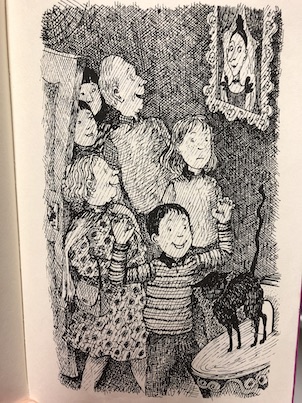
#13 Cam Jansen and the Mystery at the Haunted House by David Adler, 1986, 1992.
Cam’s Aunt Katie and Uncle George take Cam and her friend Eric to an amusement park. When they stop to buy food at the refreshment stand, Aunt Katie realizes that her wallet is missing. She isn’t even sure exactly when it disappeared. Cam thinks that someone stole her aunt’s wallet. Who could have taken it?
Cam thinks at first that it might have been a couple of boys on roller skates who ran into her aunt earlier, but it wasn’t them. Cam notices that another woman is complaining about a lost wallet and realizes that she had gone through the haunted house just before they did. Someone in the haunted house is taking people’s wallets!
When they all go through the haunted house a second time, Cam figures out that a man dressed in black has been stealing people’s wallets. When they went through the haunted house the first time, he jumped out at them, and they thought that he was just a part of the attraction meant to scare them. She spots the man leaving the haunted house and tells the park’s security guards. Everyone gets their wallets back, and the park’s owner gives Cam four free passes to the park for a month.
The book is currently available online through Internet Archive.
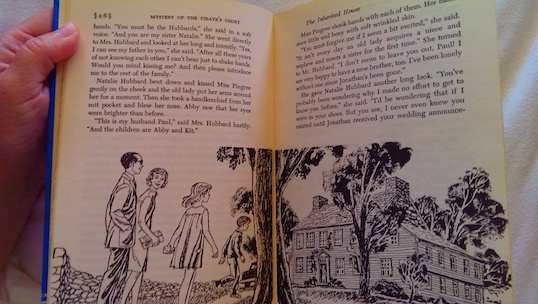
Mystery of the Pirate’s Ghost by Elizabeth Honness, 1966.
Abby
and Kit Hubbard’s mother has just received a letter telling her than her half
brother, Jonathan Pingree, has died and left her the old Pingree mansion. He has left over bequests to other family
members as well, and money to be held in trust for Abby and Kit. It’s exciting news, and the family may move
to live in the mansion they have inherited, although it partly depends on Mrs.
Hubbard’s other relatives.
Mrs. Hubbard, who was born Natalie Pingree, has never met her half-brother or half-sister. They were her father’s children, from his first marriage. She doesn’t know much about her father’s early life because he died when she was very young, and all that she knows about him is what her mother told her. Apparently, her father’s first marriage was not a happy one. He stayed in that marriage long enough for his first two children, Jonathan and Ann, to become teenagers. Then, he made sure that his first wife and children were settled comfortably enough in the family home and left them to move to Philadelphia to start a new life by himself. Sometime later, his first wife died and he married Natalie’s mother, who was much younger. After his death, Natalie and her mother moved in with her mother’s sister, Aunt Sophie. When Natalie got married, Aunt Sophie sent a wedding invitation to Johnathan and Ann, but they never came to the wedding or made any reply. Natalie assumed that they felt uncomfortable about their father’s remarriage and didn’t want to see her, which is why she’s so surprised about Jonathan leaving the family home to her. The only reason she can think of why he would do that is that neither he nor his sister ever married or had children of their own, so there was no one else to leave the house to. Both of them were more than 30 years older than Natalie, and Ann is now an elderly woman, still living in the house. Jonathan’s will has made provision for her as well, and the Hubbards go to see her at the Pingree mansion.
Mrs. Hubbard is pleasantly surprised that Ann is actually happy to see her. Ann Pingree explains that the reason why she and Jonathan never replied to the wedding invitation was that, until that invitation arrived, neither of them had known that their father had another child, and they felt awkward about it. However, Ann has been lonely since Jonathan’s death, being the last of the Pingrees, and she is glad to have Natalie and her husband and children with her and is eager to have them move into the mansion and live there. (Ann doesn’t live in the old mansion itself, but she does live nearby.)
Aunt Ann shows the family around the old mansion and explains more about its history and the history of the Pingree family. It turns out that the house, which has existed since Colonial times, although it has been burned, remodeled, and expanded over time. The house also has a number of secrets. Apparently, there used to be a tunnel running from the basement of the house to the beach that was used to bring in smuggled goods during the Colonial Era. There is also a hidden room behind a fireplace upstairs where the children of the family could hide during Indian attacks. (It doesn’t say how often that happened.) To the family’s surprise, Ann also tells them that the mansion is supposed to be haunted. The kids think it all sounds exciting, although Ann doesn’t explain much about the ghost the first time she mentions it. (Kit uses the phrase, “Honest Injun?” when asking Aunt Ann if she really means it when she says that the house is haunted. This isn’t a term that people use anymore because it isn’t considered appropriate.)
Mr. Hubbard is able to get his job transferred to a different branch of the company he works for, so the Hubbard family decides that they will move into the Pingree mansion. The kids like living by the beach, and their parents tell them that they can use the old ballroom of the house as a kind of rec room. Soon, they meet a couple of other children who live in cottages nearby, Chuck and Patty, and make friends with them. Chuck and Patty have already heard that the Pingree house is supposed to be haunted, although they’ve never seen anything really mysterious, just a light in the house once when they thought that the house was supposed to be empty.
The next time Aunt Ann comes to visit, the four children ask her to tell them about the ghost, and she tells them the story of the first Pingree to live at Pingree Point. This ancestor, also named Jonathan Pingree, built the original house in the late 1600s. He was a shipbuilder who owned several ships of his own, and he wanted to live near the sea. Later, he also became a privateer. When the kids call Jonathan a pirate, Aunt Anne agrees and explains that, unlike a pirate, Jonathan’s position as privateer was all perfectly legal because he had a Letter of Marque. (Yes, privateers operated within the law, but yes, they were also essentially pirates who raided other ships for their goods. In other words, they did the same things, but privateers did it with permission whereas ordinary pirates didn’t get permission. Historically, some privateers continued their pirating even after permission was revoked, so as Aunt Ann says, “the line between that and piracy was finely drawn.”) His son, Robert, was sailing on one of his father’s ships when it was taken by other pirates, and Robert was forced to join their crew. The family never saw Robert again and only found out what had happened from a fellow crew member who was set adrift and managed to make it back home. What happened to Robert is a mystery. His family didn’t know if he had really taken to the life of a pirate and couldn’t return home because he couldn’t face his family, if he had been killed in some fight, if he had been hung for piracy because he had gotten caught and couldn’t prove that he was forced into it. However, members of the family claimed that Robert’s spirit did return to the house and that he knocks at doors and windows, begging to be let back into his old home. Aunt Ann says that she’s never seen the ghost herself, but old houses can make all kinds of noises on windy nights, and that’s what she thinks the “ghost” is. As Chuck and Patty leave, they say, “we hope that old ghost doesn’t show up to frighten you.” Of course, we all know that it will because otherwise this book would have a different title.
One day, Kit is bored and starts playing around in the secret room, pretending that he’s hiding from American Indians. While Kit is in the secret room, he overhears the servants, John and his wife Essie, who have worked for the family for years, talking. Essie seems very upset and wants John not to do something that might risk their home and jobs, but John says that it’s too late and that they’re already “in it” and “can’t get out.” Kit tells Abby what he heard. That night, Abby hears banging and wailing during a storm and fears that it’s the ghost. Soon, other strange things happen, like a desk that mysteriously disappears and a cupboard that also mysteriously appears in its place. The children like John, and they don’t want to think badly of him, but he’s definitely doing something suspicious. One night, the children try to spy on him, and Abby once again hears the wailing and sees a mysterious, cloaked figure in the fog. Is it the ghost?
There are some interesting facets of this story that make it a little different from other children’s books of this type. For one thing, the children confide their concerns to their parents almost immediately, and the parents immediately believe them. In so many children’s mysteries, either the children decide to investigate mysterious events on their own before telling the parents or the parents disbelieve them, forcing the children to investigate on their own. It was kind of refreshing to see the family working together on this mystery. It actually makes the story seem more realistic to me because I can’t imagine that I would have been able to keep worries about mysterious things secret from my parents as a child, and they would have noticed if I was sneaking around, trying to investigate people, anyway. Abby and Kit do something dangerous by themselves before the story is over, but they also confide what they’ve done to their parents at the first opportunity and do not take the same foolish chance again.
The truth of John’s activities comes to light fairly quickly, although it takes a little longer for the family and the authorities to decide how to handle the situation. Investigating John brings to light some of the Pingree family secrets, and Abby and Kit soon discover the fate of Robert the pirate and the truth of his ghost. I’ll spoil the story a little and tell you that the ghost that Abby sees is apparently real, but it isn’t very scary. Once they learn the truth of what happened to Robert and see that his body gets a decent burial, the ghost appears to be at peace.
One thing that bothered me was the way that the characters talk about Native Americans in the book. It’s not the talk about Native American sometimes abducting children because I know that happened. It’s more how they picture that would happen. In the scene where Kit was hiding in the secret room, Kit imagines that the Indians were attracted to the house by the smell of his mother’s cooking and that he went into hiding while his mother fed them to avoid being abducted. As part of his scenario, he imagines that his mother would have wanted to “hold her nose against the Indian smell.” What? Where did that come from? There are all kinds of tropes about Native Americans in popular culture, from the “noble savage” image to that silly “Tonto talk” that actors did in old tv westerns, but since when are they supposed to smell bad? I’ve never seen characters in cheesy westerns hold their noses before, so what’s the deal? I tried Googling it to see if there’s a trope that I missed, but I couldn’t find anything about it. I’m very disappointed in you, Elizabeth Honness.
This book is currently available online through Internet Archive.
Who’s Afraid of Haggerty House? By Linda Gondosch, 1987.
Kelly McCoy is eager to begin selling greeting cards for the Bismarck Greeting Card company because she wants to earn extra money for Christmas shopping. Her best friends, Jennifer and Adelaide are selling cards, too, and Kelly is looking forward to teaming up with them. However, she soon finds out that Jennifer and Adelaide have already finished their selling. While Kelly was visiting her grandparents for a couple of days, the other girls hurried right out and started selling their cards. They were worried about other kids beating them to the neighborhood houses. By the time Kelly is ready to begin, the others are done and tired of going door-to-door, and many of the houses in the area have already bought all the Christmas cards they want.
Angry and hurt, Kelly has a fight with the other girls, and they mention that one house they didn’t visit was Haggerty House, which is supposed to be haunted. Although the house spooks Kelly, she decides to go there and try to sell her cards. When her brother, Ben, followers her and hits her with snowballs, further angering her, she dares him to come to Haggerty House, too. Ben might be annoying company, but he’s still company.
Usually, the only time that kids in the neighborhood go to Haggerty House is on Halloween, and old Mr. and Mrs. Haggerty give good treats for the kids who are daring enough to visit, usually candied apples and nickels. When Kelly and Ben approach the house to sell Christmas cards, Mrs. Haggerty invites them in for hot chocolate. Mrs. Haggerty buys one of Kelly’s cards, and Kelly and Ben learn that Mrs. Haggerty is very lonely. Her husband is ill and in the hospital. She invites the garbage men in for hot chocolate, too, but is disappointed that they can’t stay very long because they have to finish their rounds.
Kelly and Ben can’t stay very long, either, much to Mrs. Haggerty’s disappointment. However, Kelly later accepts an invitation from Mrs. Haggerty to visit again. Mrs. Haggerty shows her some Christmas cards that people have given her previous years and tells her about her son, Tyler, who is a filmmaker in Los Angeles. Tyler doesn’t visit very often because his work keeps him busy. Mrs. Haggerty plays the piano, and she’s writing a song for Tyler for Christmas. Mrs. Haggerty enjoys Kelly’s visit and wishes she could stay even longer.
Mrs. Haggerty becomes closer to Kelly’s family. Ben helps Kelly to take Mrs. Haggerty’s picture and record the song she’s writing for Tyler so she can send it to him for Christmas. Mrs. Haggerty also comes with the McCoys when they go shopping for a Christmas tree, and she comes to see Kelly as the Ghost of Christmas Past in her school’s A Christmas Carol play.
Then, while the kids are helping Mrs. Haggerty decorate at her house, an eccentric woman from the neighborhood, Malvina Krebs, comes to the house to ask if Mrs. Haggerty would like to participate in one of the seances that she holds regularly with friends. Actually, they are hoping that she will let them hold a séance at her house because her house has such wonderful atmosphere and “vibrations.” Mrs. Haggerty agrees because she’s never seen a séance before, and the séance group will be additional company. Kelly asks if she could come because she’s curious to see what a séance looks like as well, and the ladies agree.
The séance is a very strange experience, although Kelly later discovers that some of what happened was a prank by her brother and his friend. It occurs to Kelly that what she likes about visiting Mrs. Haggerty is that, unlike her friends right now, Mrs. Haggerty is always glad to see her and the interesting things that they do take her mind off of her fight with her friends. However, she has come to miss talking to people who really understand her. She can imagine what Jennifer would say about the séance and how she would find it interesting and how she would understand how Kelly felt about it. Kelly’s earlier anger at her friends wasn’t really about how they made money with their cards and left no customers for her so much as they were having a good time without her and how they no longer seem interested in spending time with her. She confides a little in Mrs. Haggerty how she feels about her friends, and she says that friends don’t always act like friends should. Mrs. Haggerty herself doesn’t have as many friends as she used to because many of them have passed away.
Kelly does make up with Jennifer and Adelaide, inviting them to a Christmas party at Mrs. Haggerty’s. There, she learns that some of their stand-offishness and secretiveness was because they’ve been planning a special Christmas present for Kelly. The Christmas party is fun with a lot of old-fashioned games, but the best part is when Tyler finally comes home for Christmas!
The book is available to borrow and read for free online through Internet Archive.
My Reaction
Friendship is a large part of the theme of this story. Kelly comes to understand Mrs. Haggerty’s loneliness partly through her quarrels with her friends. At this point in their lives, each of them needs the other because they don’t really have anyone else. Kelly’s time with Mrs. Haggerty gives her a new perspective on her relationship with her friends, and she also comes to understand some of the difficulties that Mrs. Haggerty faces because she is elderly. Mrs. Haggerty’s song for her son is what makes him realize that he needs to spend more time with his aging parents, and Kelly and her friends decide that they will continue to visit with Mrs. Haggerty regularly.
Nate the Great and the Halloween Hunt by Marjorie Weinman Sharmat, 1989.
Nate the Great gets a Halloween case when Rosamond asks him to help her find one of her cats. Rosamond and Annie show up at Nate’s house, trick-or-treating. They’re both dressed as Little Red Riding Hood, and Annie’s dog, Fang, is the wolf/grandmother.
Rosamond has several cats, all named “Hex”: Big Hex, Plain Hex, Super Hex, etc. But, she’s worried because she can’t find Little Hex. Every Halloween, her other cats like to go to an old house in the neighborhood that is supposedly haunted in order to help haunt it, but Little Hex is afraid on Halloween and apparently hid somewhere. Nate thinks that Little Hex will probably come out as soon as Halloween is over, but Rosamond is so worried that he agrees to look for Little Hex anyway.
Nate interviews kids in the neighborhood to see if they’ve seen Little Hex, but they haven’t. Then, he and his dog, Sludge, go to the haunted house to look around. He sees Rosamond’s other cats, but not Little Hex. There’s a scary moment when he realizes that he’s locked in the house, but Sludge helps him to escape.
Little Hex isn’t as far away or lost as Rosamond thinks, and Nate realizes that both Sludge and Rosamond herself have given him the clues he needs to solve the mystery. Sludge demonstrates what an animal might do when it’s frightened, and Nate suddenly realizes why Rosamund’s treat basket was so much heavier than Annie’s even though they had been to the same houses.
The book is available to borrow and read for free online through Internet Archive.
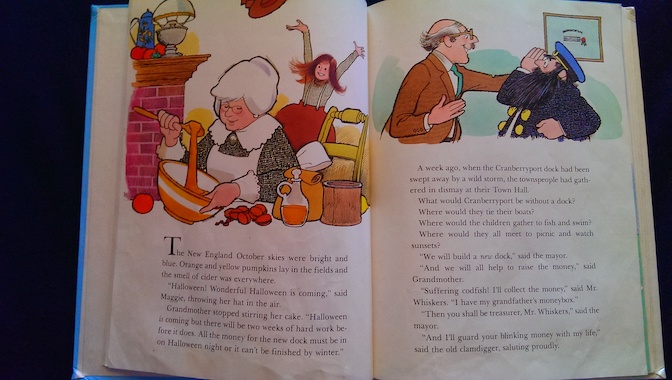
Cranberry Halloween by Wende and Harry Devlin, 1982.
The citizens of Cranberryport need to raise money to build a new dock after theirs was destroyed in a storm. Almost everyone in town volunteers to help, and Mr. Whiskers volunteers to keep the money they raise in his grandfather’s old moneybox.
Mr. Grape, a rather cranky old man, not only refuses to donate money to the cause but he insists that it is a mistake to trust Mr. Whiskers with the money because he is a sloppy and careless person. However, Maggie’s grandmother speaks up for Mr. Whiskers, and he gets the job of treasurer for the fund.
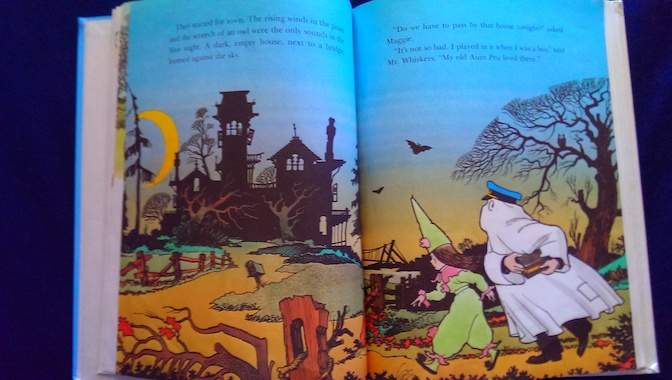
On Halloween night, Mr. Whiskers and young Maggie make their way to the town party, where Mr. Whiskers will present the money for the dock at the town hall. As they pass by the spooky old house where Mr. Whiskers’s aunt used to live, two men in pirate costumes try to steal the money from them.
Mr. Whiskers and Maggie hide in the spooky old house, but the pirates are still waiting for them outside. What are they going to do?
Mr. Whiskers uses his memories of the old house to find a way out, and it isn’t long before they uncover the villain who put the pirates up to the attempted theft.
The book includes a recipe for Cranberry Dessert in the back.
That Terrible Halloween Night by James Stevenson, 1980.
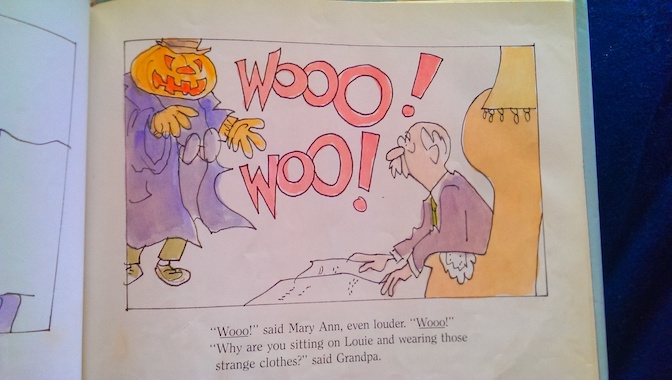
It’s Halloween, and Louie and Mary Ann think that it would be funny to play a joke on their grandfather and scare him. First, they try putting a scary mask on their dog, Leonard, but their grandfather just pats the dog on the head. Then, Mary Ann sits on Louie’s shoulders, and the kids put on a big, old coat and a pumpkin head. However, their grandfather still isn’t frightened.
When the kids ask him why he isn’t scared, their grandfather says that he doesn’t get scared much since “that terrible Halloween night.” When the kids ask him what he means, he starts telling them about a Halloween when he was a kid. He was out trick-or-treating when he saw a mysterious old house and couldn’t resist taking a look inside.
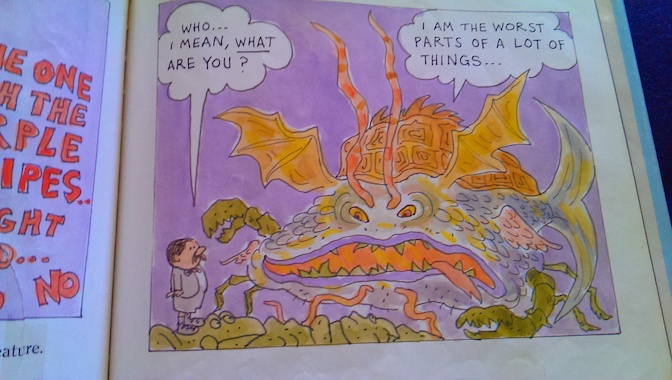
As the grandfather, as a kid, explores the house, he encounters all kinds of strange and frightening creatures. (My favorite is the one that’s “the worst parts of a lot of things” just for the description.)
But, nothing in the house is as scary as whatever is behind the final door in the house, the one that the monsters warn him not to go through . . .
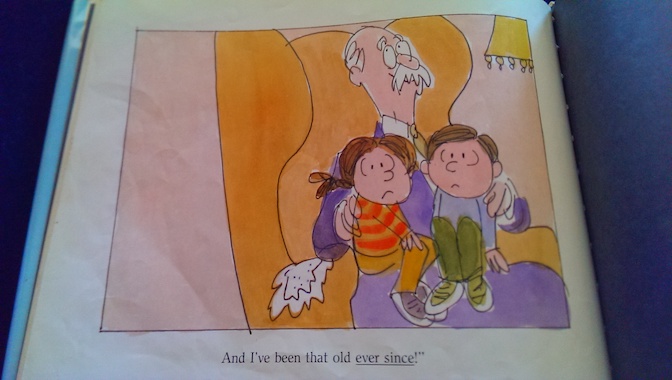
You never see what’s behind the door, but the result is the punchline of the story. Typical grandfather way to frighten the kids!
One of the fun things about this story is that the grandchildren aren’t just listening to the story but are shown reacting to it as the grandfather tells the story, sometimes interrupting with questions or comments. The pictures are drawn in a comic style, and much of the dialog is contained in speech bubbles in the pictures.
The book is currently available online through Internet Archive.
It’s 1914, and Blossom Culp is just starting high school. Although the principal of her old school tells her that this is a chance for her to make a fresh start, it looks like Blossom’s future is going to be very much a continuation of her immediate past. In high school, she’s still a social outcast, looked down on by girls from better-off families, like Letty, the class president. Also, despite her principal’s assertion that Blossom’s previous forays into the occult were imaginary, the product of the mental confusion that accompanies puberty, and that she is bound to grow out of them, Blossom knows that her psychic abilities are a natural gift and will not be ignored.
Blossom begins high school friendless because Alexander Armsworth has been ignoring her lately because of his important new position as class vice-president, his infatuation with Letty, and his friendship with a couple of local hooligans, Bub and Champ. Alexander is looking forward to his role in planning the school’s Halloween Festival, telling Blossom that he’s over their earlier, childish occult escapades and the Halloween pranks he used to pull. Meanwhile, all of the other girls in school are infatuated with their handsome history teacher, Mr. Lacy, and so is the girls’ gym teacher, much to Blossom’s disgust. Blossom thinks that Mr. Lacy is full of himself and denies that she has any such silly crush on Alexander.
Blossom makes an unexpected friend in a girl called Daisy-Rae, a girl from the country who has brought her younger brother into town to attend school and hoped to get an education herself but has been too afraid of the big town to actually attend classes. Daisy-Rae hides in the school during the day and lives alone with her brother at night in the old chicken coop at the abandoned Leverette house. It is through Daisy-Rae that she learns that Alexander and his friends aren’t so above childish pranks as they claim to be. Blossom also discovers that Mr. Lacy has been romancing her old principal. Mr. Lacy isn’t quite what he appears to be and has some unsavory secrets in his past.
Matters come to a head when Alexander (at Letty’s urging) tries to persuade Blossom to dress up and become the fortune teller for the haunted house that the freshmen class is doing for the Halloween Festival. The haunted house is also a fundraiser, and Letty figures that they can get extra money from people if they’re willing to pay to have their fortunes told, and who would be better for the job than Blossom? However, Blossom isn’t one to go out of her way to please others, especially Letty, and it turns out that they’re holding the haunted house in the Old Leverette place. For some reason, that old house makes Blossom’s mother uneasy. She seems to think that it’s haunted, but in an unusual way. Blossom tells Alexander that she will not agree to be their fortune teller until he agrees to check out the house with her before Halloween and find out what’s wrong with it. She figures that, since both of them are psychic, they can learn what’s so unusual.
As Blossom learns, her abilities don’t confine themselves to the past and people who have died but extend to the future and the people who haven’t yet been born. Inside the Old Leverette house, Blossom suddenly finds herself entering the distant future, the 1980s. In the 1980s, the Leverette house is once again lived in, and Blossom meets a boy named Jeremy who is a lonely social outcast, like herself. Jeremy is a computer nerd, living with his divorced mother. He takes Blossom on a tour of their town as it is in Blossom’s future, much larger than it used to be and with many familiar landmarks missing. However, what Blossom sees in the future gives her the inspiration she needs to solve her problems in the past and hope that things will improve. In return, she also proves to Jeremy that he is far from alone and has had a friend for longer than he ever imagined.
The time travel to the 1980s comes off as being a little corny (or so it seemed to me), but the writing quality of the book is excellent. The author has an entertaining turn of phrase, and the book, like others in the series, is humorous and a lot of fun to read.
Besides being a kind of fantasy story, there are some interesting tidbits of history in the book, showing how people lived in the 1910s. Blossom explains about the things she and her classmates did at school, like wearing beanies on their heads to show which year they were (freshmen, future graduating class of 1918). At one point in the story, Blossom takes Daisy-Rae and her brother to their first movie, a silent film with an episode of The Perils of Pauline serial. While Blossom worries about the future, readers can get a glimpse of the past!
As for what Blossom learns about her own future, she avoids finding out too much because she’d rather not know the details. However, there are implications that she and Alexander may eventually marry and live in his family’s old house.
The book is currently available online through Internet Archive.
#13 Who’s Haunting the Eighth Grade? by Kate Kenyon, 1988.
A group of eighth graders are going on a field trip to see a Shakespeare play in another town, but right from the start, everything seems to be going wrong. The teachers who are accompanying them on their trip are in a foul mood and spend a good part of the trip arguing with each other, which bothers the kids because they know that the teachers have recently become engaged to each other. Then, the bus breaks down in a small town before they can reach their destination. The entire class is going to have to spend the night somewhere in the small town.
At first, things look like they’re going to improve when the group decides to spend the night at a local bed and breakfast in a big, beautiful, old house. However, their spirits are almost immediately dampened again when they are told that the house is haunted and that anyone who tries to stay there is scared away by the ghost. Still, they proceed with their plan to stay there in order to avoid staying at the dumpy local motel, the only other choice of accommodation.
Needless to say, before the night is over, the ghost puts in an appearance, and strange things start to happen. By then, the students have come to feel sorry for the owner of the bed and breakfast, a nice older lady who grew up in the house but can’t really afford to keep it unless she can make her inn a success. Can the eighth graders catch the ghost, stop the hauntings, save the bed and breakfast from having to close, patch up the relationship between their feuding teachers, and still make it in time to see the play?
The book takes place in the 1980s, and the kids in the story are 14 years old. They mention the decade somewhere during the course of the story, and the descriptions of the clothes and some pop culture references make the time period fairly obvious. It also has some of the stock characters that books for pre-teens and early teens in the 80s have (ex. a boy-crazy space cadet, a level-headed health nut, a class clown, and a couple of young punks). Still, even though there are some things about the book that are a bit dated, it is still pretty enjoyable. The author has a sense of humor, and she plays with the characters’ stereotypes a bit. The class clown is secretly quite sensitive and even a bit perceptive. There are also a couple of fun scenes when the girl who is only interested in boys is shocked to discover that the boys are more interested in the mystery than in her.
The Haunting at Cliff House by Karleen Bradford, 1985.
This is a relatively short chapter book, but suspenseful, thoughtful, and well-written.
When her father inherits an old house in Wales from a distant relative, Alison, a young teenager, finds out that he plans for the two of them to spend the summer there. Alison’s father is a university professor and is writing a book, and he thinks that the house in Wales sounds like a great place for him to get some writing done while he and Alison have a look at his new inheritance. Alison isn’t enthusiastic about the trip, but she and her father are very close, especially because she lost her mother at a very young age. Besides, the only place she could stay in Canada would be with her grandmother, and her grandmother didn’t seem enthusiastic about having her.
From the moment they arrive at the old house, called Pen-y-Craig or Cliff House by the locals, Alison has a bad feeling about it. It stands on a lonely cliff by a small town. The carved dragon over the door gives her the creeps, and there is something disturbing about a particular room in the house. Sometimes, she can almost hear a voice calling out to her, and she has visions of another girl, about her age. At first, she tries to tell herself that it’s all her imagination, but it soon becomes obvious that it’s not.
Some of the local people know that the house has an unhappy history, and Alison eventually learns that the great-aunt that her father inherited it from even refused to live there during her last years because it disturbed her too much. A little more examination of the room that had disturbed her helps Alison discover the reason why. After having a vision of a young girl hiding something behind a brick in the fireplace of one of the bedrooms, Alison searches the spot and finds a diary dating from 1810, written by a girl named Bronwen, who was the same age as Alison. Like Alison, Bronwen was brought to the house by her widowed father and was unhappy about it, but those aren’t the only parallels between Bronwen’s life and Alison’s.
Alison becomes uncomfortable with her father’s new friendship with a Welsh neighbor, Meiriona. Alison likes Meiriona’s younger brother, Gareth, but when it looks like her father’s friendship with Meiriona is turning into romance, Alison becomes jealous and fears changes in her close relationship with her father, a situation that mirrors Bronwen’s life when her father falls in love with her governess, Catrin. Although Meiriona tries to be nice to Alison, Alison can’t bring herself to like her, and she argues with her father about it.
The only person who seems to understand her feelings at all is Gareth, and Alison confides her worries in him, both about Meiriona and about Bronwen, whose spirit keeps calling out to Alison to help her, although Alison doesn’t know how. She struggles to read through the diary, whose pages are not all legible anymore because they’re damaged with age, to learn what happened to Bronwen and what Bronwen wants her to do now. Gareth tries to reassure Alison that her father’s relationship with Meiriona will not be as bad as Alison thinks. He thinks that the relationship would be good for both Alison’s father and Meiriona because they are both lonely, and he doesn’t think that Alison should worry about losing her father because he’s not worried about losing his sister, even if she goes to Canada to study and spend more time with Alison’s father. At first, Alison isn’t comforted by these reassurances. However, Gareth agrees that the matter of the ghost is serious, and he can feel her presence as well. Gareth warns Alison to be cautious about the ghost but to try to help if she can and to call out to him if she’s ever in danger. Alison would really rather just go home to Canada, run away from her father and Meiriona, and forget the whole thing about Bronwen, but history seems to be repeating itself, and Bronwen’s voice calls out to her insistently for help that only Alison can give.
It’s a bit of a spoiler, telling you this, but although Alison at first thinks that the diary ends with Bronwen killing herself in despair, thinking that her father only loved Catrin and not her and that there was nothing left for her to live for, the truth is that Bronwen’s suicide attempt didn’t succeed and that she made another mistake that she wants Alison to help her to change. Bronwen attempted to kill herself by going to a cave by the sea during a terrible storm, planning to allow herself to drown, but when the water started rising, she became too frightened and decided to leave by a secret entrance to the cave. Not knowing that Bronwen was safe, Catrin attempted to save her and drowned in the cave herself. As Bronwen was climbing to safety, she heard Catrin calling for her but was too frightened of the storm and angry at Catrin to go back for her. Although Bronwen lived on after the incident, she could never get rid of her guilt at Catrin’s death, realizing that, even in the middle of her resentment toward Catrin, Catrin loved her more than she knew, even to the point of giving up her own life while attempting to save hers.
Now, the anniversary of Catrin’s death is approaching, and so is a storm very much like the one that killed her. At the top of the cliff by the cave, Alison finds her time merging with Bronwen’s, and she will only have one chance to help Bronwen make the right decision the second time around. Helping Bronwen to prevent the worst mistake of her life and to make a better choice also helps Alison to reconsider her own choices and future. Just as Bronwen misjudged Catrin, Alison may have also misjudged Meiriona. Instead of losing her father or being forced to accept a poor substitute for her mother, Alison may be gaining a kind of sister who will love her more than she realizes.
 #1 The Secret of Terror Castle by Robert Arthur, 1964, 1992.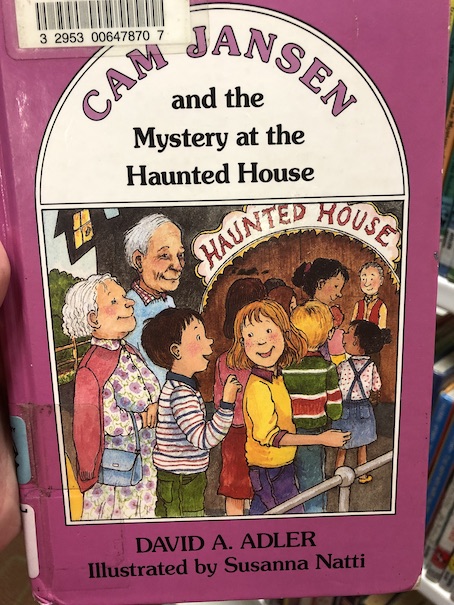








 The Dreadful Future of Blossom Culp by Richard Peck, 1983.
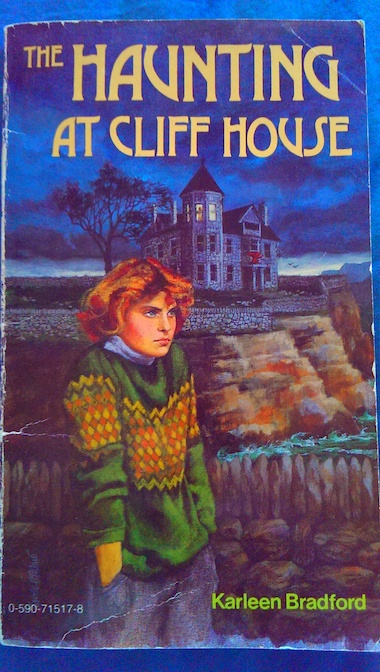 The Haunting at Cliff House by Karleen Bradford, 1985.
 Jestress's Forgotten Books and Stories