The Secret of the Haunted Mirror

The Three Investigators

TIHauntedMirror

Mrs. Darnley has collected mirrors for years, and she has some pretty impressive ones in her collection. Her strangest mirror by far is the goblin mirror that her friend in another country, the Republic of Ruffino sent to her. There is a legend surrounding the mirror that says it was once owned by magician who used it to communicate with goblins under the earth. Supposedly, the magician went inside the mirror himself and now haunts it.

A man called Sr. Santora has been pestering Mrs. Darnley to sell the mirror to him, claiming he’s a descendant of the magician who created it. He insists that the legends about the mirror are true and that terrible things have happened to previous owners of the mirror. Mrs. Darnley didn’t believe these stories at first, but now, she and her grandchildren have seen this ghost in the mirror and heard unearthly laughter in the night. That isn’t the only strange phenomenon they’ve experienced. Someone tries to steal the mirror from Mrs. Darnley’s house, and Mrs. Darnley, not knowing what to do, asks the Three Investigators to find out what the mirror’s secret really is.

The Three Investigators are pretty sure from the beginning that someone is faking the ghost, although they don’t know exactly how. At first, they think that Sr. Santora hired the man who tried to steal the mirror, but when they follow the attempted thief, Pete sees him attack Sr. Santora!

Jupiter spends a stormy night at Mrs. Darnley’s house and has an encounter with the “ghost” that reveals how the haunting was accomplished and reveals connections to another magician who once owned Mrs. Darnley’s house and to the president of the Republic of Ruffino. It seems that the mirror contains secrets that aren’t entirely magical. There are two competing forces trying possess these secrets.

When Mrs. Darnley’s grandson is kidnapped, the kidnapper demands that she turn over the mirror in an abandoned warehouse. The Three Investigators must hurry to find the kidnapped grandson, discover which side in this power struggle is responsible for the kidnapping, and what the real secret of the mirror is before it’s too late!

The book is available to borrow and read for free online through Internet Archive (multiple copies).

The part I enjoyed the most about this mystery was the creepy legend and haunting of the mirror. One of the features of the Three Investigators books that I like is that they have some spooky mysteries in the pseudo-ghost story fashion of Scooby-Doo, and some of their supposed ghosts and supernatural creatures are much more original than in other series. The idea of a haunted goblin mirror and Jupiter’s encounter with it on a spooky, stormy night are delicious to a Scooby-Doo style mystery fan!

There are echoes of the first Three Investigators book in this one because there are secrets to Mrs. Darnley’s house that she doesn’t fully understand, and the haunting is based on magic tricks. There is some political intrigue to the story, too. The Republic of Ruffino isn’t a real place, so readers find out about its circumstances along with the Three Investigators. There is also a secret room and a clever hiding place for something in the solution to the mystery.

The Mystery of the Haunted Lighthouse

Three Cousins Detective Club

Sarah-Jane’s parents have been planning a trip, and her cousins, Titus and Timothy are coming, too. At the request of an old family friend, Ned, they are going to visit him and take a look at an old lighthouse that he is thinking of buying. He wants to turn the lighthouse into a bed and breakfast.

However, strange things have started happening at the lighthouse. Someone has vandalized the outside, and Sarah-Jane sees a frightening face up in the tower. Could the old lighthouse be haunted?

The theme of the story is faithfulness.

The book is available to borrow and read for free online through Internet Archive.

Since this is a Christian-themed mystery, readers can guess that there won’t be any real ghosts. This is more of a light, pseudo-ghost story, like Scooby-Doo mysteries, with another explanation for what’s happening.

There’s more than one kind of haunting. People can be haunted by memories, and living humans are also attached to the places associated with their happy memories. There is someone who has an attachment to the lighthouse and is unhappy that it’s being sold. This person needs to reconcile their feelings to the situation.

Some Christians don’t like the concept of ghost stories at all. In the book, Sarah-Jane likes hearing ghost stories, although she admits that she doesn’t like remembering them later, when she’s alone at night. She enjoys a little spooky excitement, as long as she knows it’s just a story, and she’s hearing it in a safe setting.

The Ruby Princess Sees a Ghost

Jewel Kingdom Series

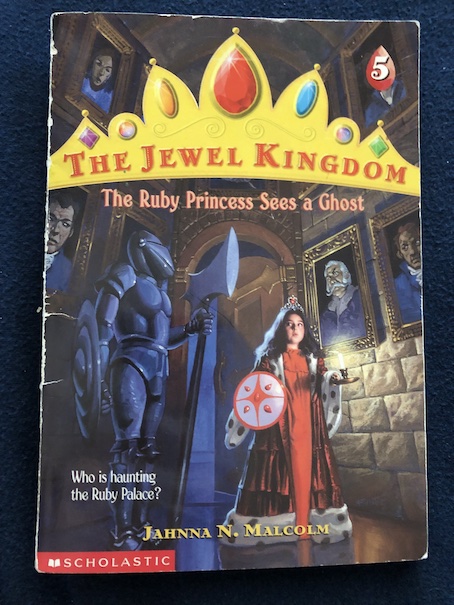
The Ruby Princess Sees a Ghost by Jahnna N. Malcolm, 1997.

Princess Roxanne lives in the Ruby Palace in the Red Mountains, and each of her sisters live in and rule over a different part of the Jewel Kingdom. The sisters visit each other from time to time, but Princess Roxanne has noticed that her sisters seem reluctant to visit the Ruby Palace. She finds out why the first time her sisters come to visit her.

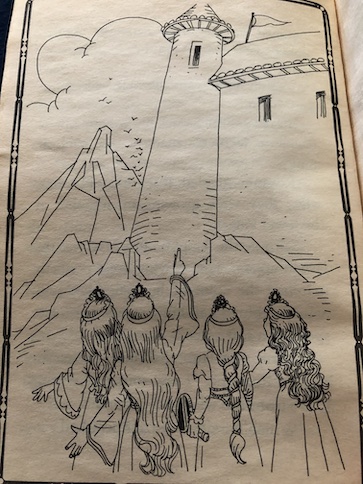
Princess Sabrina tells her that she saw someone in white waving from a tower as she approached the Ruby Palace, but Roxanne knows it wasn’t her and there shouldn’t have been anyone in the tower. That’s when her sisters tell her that there are rumors that the Ruby Palace is haunted.

Roxanne says that she’s never noticed anything strange about the Ruby Palace that would make her think it was haunted. But, almost immediately, strange things begin to happen. The cook sees a ghost in the kitchen. A picture falls off the wall, and the princesses hear mysterious laughter.

To Roxanne’s dismay, her sisters are all too scared to continue their visit. After the other princesses leave, Roxanne hears the ghost threatening to come get her, but as she tries to get away, she picks up a ring dropped by the ghost.

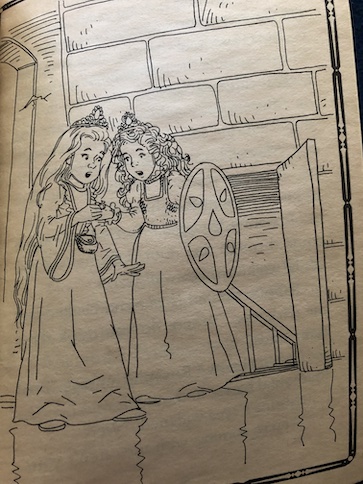
Roxanne knows that she has to get to the bottom of this mysterious haunting or she’ll never feel comfortable in the Ruby Palace again. Fortunately, Sabrina decides to return to the Ruby Palace to help her, and she recognizes the crest on the ghosts’ ring as the crest of Lord Bleak, their arch-enemy. Roxanne and Sabrina also discover a hidden door and secret passage in the Ruby Palace. Is Lord Bleak responsible for this haunting? Did he somehow send the ghost, or is this ghost more than just a ghost?

The book is available to borrow and read for free online through Internet Archive.

My Reaction and Spoilers

I thought this was a cute story. I didn’t read this series when I was a kid, although I saw books for sale. This is the first book in the series I read, and fortunately, it provides enough backstory to explain who Lord Bleak is and why he might be staging a haunting in the Ruby Palace. It’s a pretty easy read, just a short chapter book, and I think the mystery is probably not too difficult to figure out if you already know the backstory of the series and who Lord Bleak is. Still, I think a young child would still enjoy the suspense and atmosphere of the story and how the princesses turn the tables on the fake “ghost.” There is also a twist at the end of the story where there is actually a ghost who haunts the Ruby Palace, but it’s not the one they think, and she’s on Roxanne’s side.

I think the setting is the most fun part of the Jewel Kingdom stories. The Jewel Kingdom is divided up into different regions, each with its own terrain and magical creatures. Each princess rules over a region that fits her personality. The Ruby Palace is described as being made of stone and rather drafty and mysterious compared to the other princesses’ palaces, but Roxanne loves it.

Shadow in Hawthorn Bay

Shadow in Hawthorn Bay by Janet Lunn, 1986.

Mary (or “Mairi,” they spell it both ways) Urquhart and her cousin Duncan had always loved each other.  They were always close as children, feeling more like two parts of one person than separate people, and they always imagined that they would spend the rest of their lives together.  Then, Duncan’s parents, Mary’s Uncle Davie and Aunt Jean, decided that they wanted to travel to Canada, while Mary and her parents stayed at home in the Scottish Highlands.  Duncan hadn’t really wanted to go.  He was only eleven, and he promised Mary that when he was older, he would work hard to earn enough money to come back.  However, Duncan never came.  He only sent Mary a brief letter about the dark forest where he now lives.  Mary feels like the Duncan she knew is gone forever.

Four years later, in 1815, when Mary is fifteen, she has a strange feeling, like Duncan is calling to her from across the ocean.  All of her life, Mary has had a strange gift for seeing into the future or reading others’ minds.  The “gift of two sights,” people call it, but Mary doesn’t feel like it’s a gift.  It makes her uneasy, and she can’t control it.  She hears Duncan’s calls to her through her “gift,” but she is afraid because she doesn’t want to leave Scotland.  She wants Duncan to come to her.

However, she is unable to resist Duncan’s calls.  She asks her parents for help with money for her passage to Canada, but they tell her that she is wasting her time and that, even if they sold their family’s most precious heirloom to give her the money, there would not be enough for the return journey.  A family friend gives her the money instead, and although Mary doesn’t really want to accept it and doesn’t really want to go, she can’t help herself.

The journey to Canada is miserable, and when she finally arrives at the place where her aunt and uncle live, alone and without money, she learns something which she thought she had sensed during the journey: Duncan is dead.  Duncan committed suicide while Mary was still on the ship to Canada.  Mary has arrived too late.  To make matters worse, one of the family’s neighbors, Luke Anderson, tells her that her aunt and uncle gave up the idea of farming in Canada and have already begun the journey back to Scotland.  Mary has no money to follow them, and they have no idea that she’s now in Canada, alone.

Luke takes Mary to Mrs. Colliver, who tells Mary a little about her family and their life in Canada and why they decided to leave.  Mary is devastated by the loss of Duncan and tries to tell Mrs. Colliver about how she felt that Duncan had been calling out to her, but Mrs. Colliver tells her that she doesn’t believe in ghosts or things like that.  Although Mary knows that her “gift” is real and so are spirits, she learns that others in the community share Mrs. Colliver’s no-nonsense, disbelieving attitude toward such things.  Mary, in her despair, wants to rush straight back to Scotland, but Mrs. Colliver, with her practicality, points out that Mary can’t possibly get there without money.  She tells Mary that she can stay with her family, that she will give her room and board in exchange for help with chores and that she can earn extra money for weaving and spinning.  Mary is clumsy at household chores because she was always better with animals at home, but when Mrs. Colliver sees Mary’s skills with animals, she is appreciative.

Life is hard in the small farming community.  Mrs. Anderson, Luke’s mother, explains to Mary that most of the people who live there are refugees.  When they were young, their families moved there from the Thirteen Colonies that now make up the United States because they were Loyalists.  When the Revolution came, they couldn’t stay, and so had gone north to Canada, where they struggled to establish a new community for themselves with their small homesteads. During her time there, Mary witnesses the death of a baby and the hardships of this strange place, seeing why Duncan didn’t like it there.  They tell her that Duncan was a strange boy who would seem bright and happy one day, but black with depression the next, something Mary remembers in him even before he went to Canada. 

The people are kind and welcoming to Mary, although they find her a bit strange.  As Mary struggles to make a life for herself, hoping to earn enough money to return home, she slowly comes to appreciate Luke’s kindness and help.  She learns healing arts and the use of herbs from another woman in the community, developing new skills.  In helping others, she earns their appreciation and a place in their community.  Luke Anderson becomes very fond of Mary, but she still mourns for her lost Duncan.  In spite of his kindness, she doesn’t see how she can make this strange, hard, dark forest of Canada her home, where it doesn’t even seem like the spirits she believed in and that seemed to protect her when she lived in Scotland exist.

Mary is melancholy and feels like she doesn’t belong in Canada.  It distresses her that she can no longer feel Duncan’s presence . . . although she can oddly hear him calling to her sometimes.  Mary also unnerves people when she makes predictions that come true and speaks about ghosts and spirits.  When she almost gives in to her homesickness and depression and kills herself, lured to the spot where Duncan drowned himself by his ghostly calls to her, she finally sees Duncan’s death for what it really was and finds the courage to refuse to follow him down the dark path that he chose for himself and to fight for the life she has been building, the one she really wants to live.

The book is available to borrow and read for free online through Internet Archive.

My Reaction

This book is part of a loose trilogy, involving ancestors and descendants of the Anderson and Morrisay families.  All of the books take place in or near Hawthorn Bay in Canada, but at different time periods.  Some of the characters are psychic, like Mary, or have the ability to travel through time, like Susan in The Root Cellar, who is apparently Mary’s granddaughter.  The connection between Mary and Susan is never stated explicitly, but it’s implied by their last name, shared psychic abilities, and comments that a friend makes about Susan’s grandmother in The Root Cellar.  In this series, the characters from each of the books generally don’t appear in any of the others (except, perhaps, for Phoebe, who appears briefly in this book and is the main character in the third story).  Most of the time, you only know about the family connections by reading the books and taking note of the last names.  The books go backward in time as the series progresses, and the connection between the Anderson and Morrisay families is only obvious in The Root Cellar.

With the deaths that occur in the book, discussions of suicide, and the influence of Duncan’s selfish, malevolent spirit, this is not a book for young kids. I’d say that readers should be middle school level or older. There is also some implied sex and pregnancy out of wedlock when one of Luke’s brothers gets one of Mary’s friends pregnant. Her friend doesn’t give the details of what happened, but from what she says, it’s implied that Luke’s disreputable brother forced himself on the girl and that she went along with it because she didn’t know what else to do. The description of that incident is minimal, but older readers will understand what happened. There is a scandal in the community because of it, and the disreputable brother leaves rather than face the consequences of his actions.

Themes and Spoilers

I enjoyed the book for its references to Scottish folklore, which Mary believes in and seems to be in touch with through her “gift” and for Mary’s growing confidence in her abilities and more mature understanding of what her cousin was really like and what her relationship with him really was.  In some ways, I do feel sorry for Duncan because he seems to have been suffering from some kind of mental illness, possibly bipolar disorder or manic depression, which would explain how his moods could shift so abruptly and dramatically.  However, Duncan was also a selfish and controlling person.  Although Duncan’s death was sad, Mary realizes that his end was of his own making, and it’s not the future she wants for herself.  There are some disturbing scenes in the story.  Mary witnesses the deaths of others, including a baby, because it is a harsh environment, where people sometimes succumb to sickness or bad weather, although these deaths are not described in too much detail. 

There are also some frightening moments, like when Duncan’s ghost almost convinces Mary to kill herself and when he similarly lures a young boy, Luke’s younger brother, to the spot where he drowned and almost kills the boy because Mary finds the little boy comforting and Duncan doesn’t want her to be comfortable and happy.  In the beginning, readers see Duncan through Mary’s fondness for him, so the true darkness of his personality isn’t immediately apparent, although I had some misgivings about him from Mary’s first description of how they played together as children.  I didn’t like the way she described how he would tease her until she became angry or hurt and then he would sulk until she comforted him.  She says that wasn’t really fair, but to me, it was disturbing because I have seen that kind of selfish personality before, and it’s never a good sign.  It shows right from the first that Duncan doesn’t really care about Mary’s feelings.  He cares only about his own feelings, and he has no interest in changing his behavior out of consideration for her.  In fact, the very idea that he should consider her feelings seems somehow insulting to him, even though he supposedly loves her.  He just thinks that she needs to reassure him that everything he does is fine whether it is or not.  In his view, Mary is obviously wrong to feel hurt even when he tries to hurt her because he has more right to his feelings than she has to hers and he should be able to behave any way he wants with no consequences.  That’s what Mary’s first description of Duncan said to me.  As soon as I saw that, even though some might consider it just the actions of an immature child, I had some suspicions about him.

My suspicions were somewhat confirmed before Mary left home. Her mother told her that she didn’t think Duncan was worth chasing after, calling him sulky and thoughtless, but the full truth of that doesn’t strike Mary until she confronts his spirit where he died. Because people in Canada don’t like to talk about Duncan much, when Mary first hears about his death, it isn’t immediately clear that he killed himself or how.  At first, it’s just somewhat implied, but when Mary is almost lured to her death, she sees the full truth about Duncan. 

Mary comes to realize that, although everyone, including Duncan and herself, felt like the two of them were two parts of the same person, they really weren’t.  Mary sees that not only can she live without Duncan, she has been living without him for years.  She lived without him for a time in Scotland, and she’s been living without him in Canada, and she can continue to live without him wherever she chooses to live the rest of her life.  When she was younger, she had thought of Duncan as being the stronger of the two of them because he was not plagued by the same “gift” she was, but she realizes that she is actually the stronger of the two of them.  Duncan’s “love” for her had also always been a selfish one.  He couldn’t bring himself to work hard and return to Scotland for her sake, but he expected her to give up everything, even her own life, to join him in Canada and in death.

When Mary realizes all of this, Duncan’s spirit loses its hold over her, and she comes to see that the darkness in him was darker than the forests that had seemed so frightening to her before.  Free from the shadow of Duncan’s death and his selfish spirit, Mary is able to see the beauty of Canada and to be more open to the good people around her, forging a new future with a better man.

Twin Spell

This book was originally called Twin Spell but was renamed Double Spell in reprintings.

Elizabeth and Jane Hubbard, a set of twelve-year-old twins, can’t really explain what made them stop to look at the little wooden doll in the window of the antiques shop.  Ordinarily, they probably wouldn’t have noticed it at all, but something seemed to draw them to it while they were supposed to be going home to look after their little brother.  The woman in the shop wasn’t going to sell the doll to them, either, but for some reason, she said that she felt that she ought to do it because it seemed like the doll belonged with them.

Buying the old doll starts off a chain of mysterious events in the twins’ lives.  On impulse, still forgetting that they’re supposed to go home and baby-sit, the girls decide to visit their Aunt Alice and show her the doll.  Aunt Alice had been living in England, but she had recently moved back to Toronto to live in the girls’ grandmother’s old house.  Aunt Alice doesn’t know what to think of the doll, except that it might be worth something as an antique.  She shows the girls around their grandmother’s old house, but Elizabeth has a sudden fall down the stairs, breaking her leg.  Strangely, a week later, Aunt Alice suffers a similar accident, breaking her hip.

Because of her accident, Aunt Alice decides that the big old house is a bit much for her to handle, and she tells the twins’ parents that they can have it to live in instead.  With five children in the family, including the twins, they could really use the larger house, and the children are excited about going to live there.

The twins find themselves thinking of odd things, as if they were old memories.  They suggest taking a “sick basket” of goodies to their aunt, thinking that maybe their mother had done something like that for someone before or maybe they had dreamed something like it.  Their brothers can’t remember any such thing happening, and it would be pretty weird for both of the girls to have the same dream.

However, the children think that a basket of goodies for their aunt would be a good idea.  They put together some stuff from their kitchen and what they can buy with their money, and they decide to include a book that she can read while she’s recovering.  Unfortunately, the book they choose from their shelves turns out to be a rare copy of a book about the history of Toronto that their father was using for a research project, so they have to get it back.  They do, and Aunt Alice tells them that she enjoyed it and that she had forgotten that an uncle had written it.

As the family moves into Aunt Alice’s old house, the twins keep thinking that there is something strange about their doll, that it seems to be influencing them, giving them visions of the past.  Besides the “sick basket” dream they both had, they have visions of a house and a blonde girl in old-fashioned clothes.  They start to think that the doll, which they both have the impulse to call “Amelia,” might be magic or something.  Jane is the more sensible of the two, and she insists that there must be some other explanation, like imagination or coincidence.  Elizabeth, the dreamier twin, insists that it’s the influence of Amelia, that they’re somehow seeing Amelia’s memories of the past.

After the girls argue about the doll and the source of their odd visions, Jane starts ignoring Elizabeth.  Elizabeth continues thinking about what they’ve seen, and the blonde girl, who she is sure is called Hester and was the former owner of Amelia.  Eventually, Jane starts agreeing with Elizabeth about Hester being the doll’s former owner, but she is dubious when Elizabeth says that Amelia wants to find the house where she once lived with Hester.  Jane doesn’t know how the two of them can do that.

They ask their father for his advice, and he suggests that they start at the museum.  There, they learn by studying the styles of old clothes that Amelia is from the 1840s.  They find an area of town with houses similar to the one they’ve seen in their minds, where Amelia once lived, but they have trouble finding the exact house they’re looking for.

Jane becomes increasingly afraid, though.  More and more, she begins to feel like something is trying to take the doll away from them.  Something that is mean and doesn’t like her is in their attic.  Something like a ghost.  Jane has an awful feeling that something horrible is about to happen.

When the Jane looks at the history book her father has been reading, the one written by her great-great-uncle, Jane suddenly has a startling revelation. The house they have been seeking in actually their house, changed over the years by new additions. Amelia came from their house, and that is where she really belongs. Through the visions, they see an old tragedy in their family reenacted, a tragedy that puts Jane’s life in danger.

The book is available to read for free online through Internet Archive. There is no need to borrow this copy and no time limit; you can just read it in your browser.

The girls had made a mistake when they first started receiving their visions.  They had assumed that Hester was Amelia’s original owner, but she wasn’t.  The glimpses they got of Hester weren’t through the doll’s eyes, but those of the doll’s real former owner.  The doll was one of a set of two that originally belonged to another set of twins in the girls’ family, Anne and Melissa.  Hester was their cousin, and she was not a nice girl.  Both Jane and Elizabeth sensed it pretty early.  During an argument with Anne years before, Hester accidentally lit Anne’s dress on fire with a candle she was holding, causing Anne to die.  Hester hadn’t actually meant to harm Anne.  The whole thing was just an accident, but Hester’s guilt and Melissa’s anger and grief at her twin’s death had caused Hester’s spirit to linger in the house.  By learning the circumstances of Anne’s death and assuring Hester that they understand that she had not meant to kill her cousin, that it was all an accident, and that she couldn’t save Anne because she was just too frightened and didn’t know what to do, they help Hester’s spirit to finally rest and to reunite Amelia with her doll twin, which Hester had hidden years before.

The scene where the girls see Anne’s death is a little scary, but mostly sad.  Hester lived on after the incident, but it was not a happy life.  She ended up having to live in Anne and Melissa’s old room, where Anne died, because she never married and had to live with family.  Aunt Alice remembers knowing her as a young child, when Hester was a bitter old woman.  Perhaps if Hester hadn’t been carrying that guilt around for so many years, her life would have been much happier, although being a nice person had never particularly been her nature.  However, the twins’ acceptance of Hester’s tragedy and assurance that they understand and forgive her for what happened set her spirit at peace.

The genealogy in the story is a little confusing, partly because certain family names repeat through the generations, but there is a chart in the back of the book to help.  There are some other loose ends in the story which are also never completely clarified.  The girls admit that they will probably never know how the doll Amelia came to be in the antiques store, but it doesn’t particularly matter because Hester, Anne, Melissa, and Amelia all seem to be at peace now.

Mystery of the Pirate’s Ghost

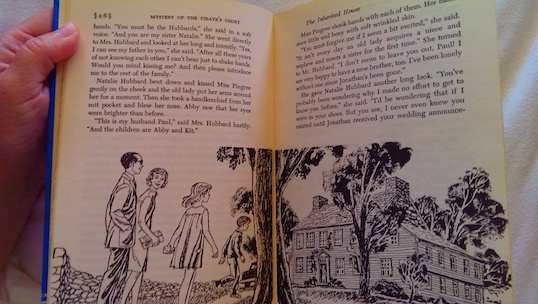
Mystery of the Pirate’s Ghost by Elizabeth Honness, 1966.

Abby and Kit Hubbard’s mother has just received a letter telling her than her half brother, Jonathan Pingree, has died and left her the old Pingree mansion.  He has left over bequests to other family members as well, and money to be held in trust for Abby and Kit.  It’s exciting news, and the family may move to live in the mansion they have inherited, although it partly depends on Mrs. Hubbard’s other relatives. 

Mrs. Hubbard, who was born Natalie Pingree, has never met her half-brother or half-sister.  They were her father’s children, from his first marriage.  She doesn’t know much about her father’s early life because he died when she was very young, and all that she knows about him is what her mother told her.  Apparently, her father’s first marriage was not a happy one.  He stayed in that marriage long enough for his first two children, Jonathan and Ann, to become teenagers.  Then, he made sure that his first wife and children were settled comfortably enough in the family home and left them to move to Philadelphia to start a new life by himself.  Sometime later, his first wife died and he married Natalie’s mother, who was much younger.  After his death, Natalie and her mother moved in with her mother’s sister, Aunt Sophie.  When Natalie got married, Aunt Sophie sent a wedding invitation to Johnathan and Ann, but they never came to the wedding or made any reply.  Natalie assumed that they felt uncomfortable about their father’s remarriage and didn’t want to see her, which is why she’s so surprised about Jonathan leaving the family home to her.  The only reason she can think of why he would do that is that neither he nor his sister ever married or had children of their own, so there was no one else to leave the house to.  Both of them were more than 30 years older than Natalie, and Ann is now an elderly woman, still living in the house.  Jonathan’s will has made provision for her as well, and the Hubbards go to see her at the Pingree mansion.

Mrs. Hubbard is pleasantly surprised that Ann is actually happy to see her.  Ann Pingree explains that the reason why she and Jonathan never replied to the wedding invitation was that, until that invitation arrived, neither of them had known that their father had another child, and they felt awkward about it.  However, Ann has been lonely since Jonathan’s death, being the last of the Pingrees, and she is glad to have Natalie and her husband and children with her and is eager to have them move into the mansion and live there. (Ann doesn’t live in the old mansion itself, but she does live nearby.)

Aunt Ann shows the family around the old mansion and explains more about its history and the history of the Pingree family. It turns out that the house, which has existed since Colonial times, although it has been burned, remodeled, and expanded over time. The house also has a number of secrets. Apparently, there used to be a tunnel running from the basement of the house to the beach that was used to bring in smuggled goods during the Colonial Era. There is also a hidden room behind a fireplace upstairs where the children of the family could hide during Indian attacks. (It doesn’t say how often that happened.) To the family’s surprise, Ann also tells them that the mansion is supposed to be haunted. The kids think it all sounds exciting, although Ann doesn’t explain much about the ghost the first time she mentions it. (Kit uses the phrase, “Honest Injun?” when asking Aunt Ann if she really means it when she says that the house is haunted. This isn’t a term that people use anymore because it isn’t considered appropriate.)

Mr. Hubbard is able to get his job transferred to a different branch of the company he works for, so the Hubbard family decides that they will move into the Pingree mansion. The kids like living by the beach, and their parents tell them that they can use the old ballroom of the house as a kind of rec room. Soon, they meet a couple of other children who live in cottages nearby, Chuck and Patty, and make friends with them. Chuck and Patty have already heard that the Pingree house is supposed to be haunted, although they’ve never seen anything really mysterious, just a light in the house once when they thought that the house was supposed to be empty.

The next time Aunt Ann comes to visit, the four children ask her to tell them about the ghost, and she tells them the story of the first Pingree to live at Pingree Point. This ancestor, also named Jonathan Pingree, built the original house in the late 1600s. He was a shipbuilder who owned several ships of his own, and he wanted to live near the sea. Later, he also became a privateer. When the kids call Jonathan a pirate, Aunt Anne agrees and explains that, unlike a pirate, Jonathan’s position as privateer was all perfectly legal because he had a Letter of Marque. (Yes, privateers operated within the law, but yes, they were also essentially pirates who raided other ships for their goods. In other words, they did the same things, but privateers did it with permission whereas ordinary pirates didn’t get permission. Historically, some privateers continued their pirating even after permission was revoked, so as Aunt Ann says, “the line between that and piracy was finely drawn.”) His son, Robert, was sailing on one of his father’s ships when it was taken by other pirates, and Robert was forced to join their crew. The family never saw Robert again and only found out what had happened from a fellow crew member who was set adrift and managed to make it back home. What happened to Robert is a mystery. His family didn’t know if he had really taken to the life of a pirate and couldn’t return home because he couldn’t face his family, if he had been killed in some fight, if he had been hung for piracy because he had gotten caught and couldn’t prove that he was forced into it. However, members of the family claimed that Robert’s spirit did return to the house and that he knocks at doors and windows, begging to be let back into his old home. Aunt Ann says that she’s never seen the ghost herself, but old houses can make all kinds of noises on windy nights, and that’s what she thinks the “ghost” is. As Chuck and Patty leave, they say, “we hope that old ghost doesn’t show up to frighten you.” Of course, we all know that it will because otherwise this book would have a different title.

One day, Kit is bored and starts playing around in the secret room, pretending that he’s hiding from American Indians. While Kit is in the secret room, he overhears the servants, John and his wife Essie, who have worked for the family for years, talking. Essie seems very upset and wants John not to do something that might risk their home and jobs, but John says that it’s too late and that they’re already “in it” and “can’t get out.” Kit tells Abby what he heard. That night, Abby hears banging and wailing during a storm and fears that it’s the ghost. Soon, other strange things happen, like a desk that mysteriously disappears and a cupboard that also mysteriously appears in its place. The children like John, and they don’t want to think badly of him, but he’s definitely doing something suspicious. One night, the children try to spy on him, and Abby once again hears the wailing and sees a mysterious, cloaked figure in the fog. Is it the ghost?

There are some interesting facets of this story that make it a little different from other children’s books of this type. For one thing, the children confide their concerns to their parents almost immediately, and the parents immediately believe them. In so many children’s mysteries, either the children decide to investigate mysterious events on their own before telling the parents or the parents disbelieve them, forcing the children to investigate on their own. It was kind of refreshing to see the family working together on this mystery. It actually makes the story seem more realistic to me because I can’t imagine that I would have been able to keep worries about mysterious things secret from my parents as a child, and they would have noticed if I was sneaking around, trying to investigate people, anyway. Abby and Kit do something dangerous by themselves before the story is over, but they also confide what they’ve done to their parents at the first opportunity and do not take the same foolish chance again.

The truth of John’s activities comes to light fairly quickly, although it takes a little longer for the family and the authorities to decide how to handle the situation. Investigating John brings to light some of the Pingree family secrets, and Abby and Kit soon discover the fate of Robert the pirate and the truth of his ghost. I’ll spoil the story a little and tell you that the ghost that Abby sees is apparently real, but it isn’t very scary. Once they learn the truth of what happened to Robert and see that his body gets a decent burial, the ghost appears to be at peace.

One thing that bothered me was the way that the characters talk about Native Americans in the book. It’s not the talk about Native American sometimes abducting children because I know that happened. It’s more how they picture that would happen. In the scene where Kit was hiding in the secret room, Kit imagines that the Indians were attracted to the house by the smell of his mother’s cooking and that he went into hiding while his mother fed them to avoid being abducted. As part of his scenario, he imagines that his mother would have wanted to “hold her nose against the Indian smell.” What? Where did that come from? There are all kinds of tropes about Native Americans in popular culture, from the “noble savage” image to that silly “Tonto talk” that actors did in old tv westerns, but since when are they supposed to smell bad? I’ve never seen characters in cheesy westerns hold their noses before, so what’s the deal? I tried Googling it to see if there’s a trope that I missed, but I couldn’t find anything about it. I’m very disappointed in you, Elizabeth Honness.

This book is currently available online through Internet Archive.

The Ghost Belonged to Me

GhostBelongedToMe

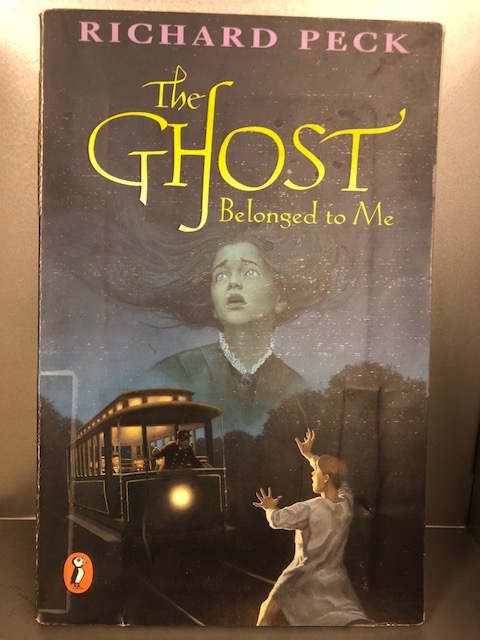
The Ghost Belonged to Me by Richard Peck, 1975.

The book takes place in the 1910s in a small town on the Mississippi River. Alexander Armsworth, a boy in his early teens, is approached by a girl from his class who tells him that the barn on his family’s property is haunted and that Alexander himself has the ability to see the “Unseen.” The girl, Blossom Culp, is a poor girl from a family of outcasts who has been known to tell tall tales, so Alexander isn’t sure he believes her at first. However, he can’t help but be curious, and when he sees a light coming from the barn at night, he decides to investigate.

Inside, he finds the ghost of a young girl who warns him of danger on the trolley tracks near his house and tells him that he must act fast to save everyone. Frightened, Alexander gets the trolley to stop and learns that by doing so, he has saved the lives of everyone on board from a disaster at the bridge further on. Naturally, everyone wants to know how Alexander knew to warn them. When Alexander explains, he is met with skepticism from his social-climbing mother and sister and unwelcome attention from news people and curiosity-seekers from town.

The ghost, who tells Alexander that her name is Inez Dumaine, is also in need of help before she can rest peacefully. Alexander will need the help of those who believe in him and the ghost to find Inez’s body and return it to her home in New Orleans.

In this first book in of the Blossom Culp series, Alexander is the main character, but the other books focus more on Blossom, who discovers that she also has the ability to see ghosts.  The book is available to borrow and read for free online through Internet Archive.

This is the movie that the Disney movie Child of Glass was based on, and the movie is available on dvd. Sometimes, you can also find it on YouTube, at least clips and reviews of it.

My Reaction

The story has sad and scary points, but those are balanced out by humorous situations. Alexander’s sister’s turmoil over the fiasco at her coming-out party is hilarious, and his mother’s change in attitude when she realizes that, instead of making them social outcasts, the ghost business actually attracts attention from one of the town’s leading citizens is a hoot. Blossom, of course, is wonderfully nosy, elbowing her way into Alexander’s life and selling tours of the haunted barn.

I was very young when I saw the Disney movie based on this book, Child of Glass (a live action movie that aired on television), and I was afraid of ghosts. However, years later, I took another look at the movie and decided to read the book that it was based on. When I did, I saw things I didn’t appreciate when I was young. The dialog and depiction of life in the early 20th century in the book are wonderful. It conjured up memories of Meet Me in St. Louis, especially the Halloween scene (which took place only about a decade earlier than this story). Unfortunately, this early 20th century setting wasn’t present in the movie version of this book because Child of Glass was placed contemporary with the time it was made, during the late 20th century.

The Disney movie was also different from the original book because it added the feature of the “child of glass” which didn’t exist in the original book. The “child of glass” was mentioned in a poem at Inez’s grave that explained how to lay her ghost to rest. At first, the Alexander and Blossom in the movie don’t know what it means, but it turns out to be Inez’s doll, which was lost when she was murdered by her wicked uncle. In the book, Inez died under different circumstances. However, the discovery of the doll in the movie uncovers the secret motive behind her murder, which is similar to the reason why Inez’s body was hidden in the book after she died in a riverboat accident.  In the book, Inez’s spirit finds rest after her body is found and taken to her family’s cemetery in New Orleans.  The Disney movie also turns this story specifically into a Halloween story, which wasn’t the case in the original book.

Who’s Haunting the Eighth Grade?

Junior High Series

JHHaunting

#13 Who’s Haunting the Eighth Grade? by Kate Kenyon, 1988.

A group of eighth graders are going on a field trip to see a Shakespeare play in another town, but right from the start, everything seems to be going wrong. The teachers who are accompanying them on their trip are in a foul mood and spend a good part of the trip arguing with each other, which bothers the kids because they know that the teachers have recently become engaged to each other. Then, the bus breaks down in a small town before they can reach their destination.  The entire class is going to have to spend the night somewhere in the small town.

At first, things look like they’re going to improve when the group decides to spend the night at a local bed and breakfast in a big, beautiful, old house. However, their spirits are almost immediately dampened again when they are told that the house is haunted and that anyone who tries to stay there is scared away by the ghost. Still, they proceed with their plan to stay there in order to avoid staying at the dumpy local motel, the only other choice of accommodation.

Needless to say, before the night is over, the ghost puts in an appearance, and strange things start to happen.  By then, the students have come to feel sorry for the owner of the bed and breakfast, a nice older lady who grew up in the house but can’t really afford to keep it unless she can make her inn a success. Can the eighth graders catch the ghost, stop the hauntings, save the bed and breakfast from having to close, patch up the relationship between their feuding teachers, and still make it in time to see the play?

The book takes place in the 1980s, and the kids in the story are 14 years old. They mention the decade somewhere during the course of the story, and the descriptions of the clothes and some pop culture references make the time period fairly obvious. It also has some of the stock characters that books for pre-teens and early teens in the 80s have (ex. a boy-crazy space cadet, a level-headed health nut, a class clown, and a couple of young punks). Still, even though there are some things about the book that are a bit dated, it is still pretty enjoyable. The author has a sense of humor, and she plays with the characters’ stereotypes a bit. The class clown is secretly quite sensitive and even a bit perceptive. There are also a couple of fun scenes when the girl who is only interested in boys is shocked to discover that the boys are more interested in the mystery than in her.

The Haunting of Cabin 13

Cabin13The Haunting of Cabin 13 by Kristi D. Holl, 1987.
Thirteen-year-old Laurie is looking forward to her family’s vacation. They’ve rented a cabin for a week, Cabin 13, by the lake at Backbone State Park (It’s a real state park in Iowa. Link repaired 10-19-22.), and her friend Jenny is staying there with them. Laurie’s mother isn’t looking forward to the trip. She hates dirt and bugs and doesn’t like the cabin when they arrive. As everyone starts unpacking, Laurie looks around the cabin and finds a note that warns them to leave because the cabin is haunted. Supposedly, it was written by the ghost herself. The note is signed “Eleanor.” Laurie’s mother thinks that they should leave right away, but Laurie and the rest of the family persuade her that it’s just a joke. At first, Laurie’s sure that’s all it is.

Then, the park ranger tells the family that the other families who have tried to stay in that cabin this summer also found similar notes. It might be just a prank, but it might not. He also tells them that a girl named Eleanor, the same age as Laurie and Jenny, drowned there the summer before, and strange things have been seen there since, like lights around the lake. Laurie’s brother, Ricky, thinks it sounds cool that they’re staying in a haunted cabin by a haunted lake. Like others, Laurie thinks that the notes are the product of a prankster, but what would be the point behind it?

The girls meet a pair of brothers who are staying nearby, Kevin and Matt. When they tell them about the note, Matt is eager to investigate. Jenny enjoys flirting with boys, and she’s mostly interested in flirting with good-looking, athletic Kevin. Matt is in a wheelchair, so Jenny doesn’t pay much attention to him. She just makes an awkward comment about cripples being able to contribute to society that makes everyone feel uncomfortable. Although Laurie knows that Jenny’s comment was inappropriately personal and callous, Laurie also underrates Matt’s ability to help with their note mystery at first, and she’s shy about talking to him because she’s often shy around boys. However, needing someone to confide her thoughts in when Jenny isn’t interested, Laurie talks to Matt about her theories about the mysterious notes. Matt turns out to be easy to talk to, helping Laurie get over her nervousness about talking to boys.

At first, Laurie tells Matt that she thinks that the prankster is trying to drive people away from Cabin 13 because something important is hidden there. However, as she starts asking questions about Eleanor, she learns that the notes haven’t just been directed at Cabin 13. Staff at the park have also received notes from “Eleanor.” Laurie also sees a figure in black sneaking around the park, who she is sure is not a ghost.

It isn’t long before Laurie receives more notes from “Eleanor,” hinting that she might be in danger, and she and Jenny see the mysterious lights that people have been talking about. Then, when the children are out in a canoe together, it develops a leak and sinks. Matt panics because his legs are paralyzed, and he can’t swim, but Laurie saves him with the help of some people in another boat.

Was that accident just an accident, or could it have something to do with Eleanor’s “accident” last year? There are plenty of suspects who might have reasons for playing ghost and stirring up trouble at the lake. Matt’s father blames the park ranger for the accident that paralyzed Matt. At a previous visit to the lake, Matt was crossing a road with his father and brother and was struck by a speeding car. Matt father says it wouldn’t have happened if the roads had been policed properly. Laurie realizes that he might have a motive for revenge. Then again, some people have been coming to the lake, drawn by the ghost stories and hoping to see the mysterious lights. Could the ghost be a publicity stunt to drum up business?

The book is available to borrow and read for free online through Internet Archive.

My Reaction and Spoilers

When Laurie discovers that Eleanor’s half sister has come to the lake to investigate Eleanor’s death herself, she thinks that she has the mystery solved, but she’s only half right. It’s true that Eleanor’s sister has been responsible for some of the things happening at the lake, but not all of them.  She explains to the kids that Eleanor loved mystery stories and was always playing detective games, but she thinks that perhaps the game got too real for Eleanor the summer that she died.  There is something sinister going on at the lake, something that Eleanor also realized before her death, and there is more to Eleanor’s death than most people know.

At the end of the book, Matt gets a chance to be a hero and stop the bad guy from escaping, using his wheelchair to his advantage because a person on wheels can sometimes move faster than a person on foot.  Even before that, Laurie had gained an appreciation for Matt and his sensible thinking, realizing that a person who is impaired in one way can still have great abilities in other areas of life.  She also comes to think of Matt as being brave for coming back to the site of the accident that made him a paraplegic.  Matt says that he had to come in order to prove to himself that there was nothing inherently bad about the  place and to stop the nightmares he was having about his accident.  Matt and Eleanor’s sister both make Laurie realize that everyone has something difficult or frightening that they have to deal with in their lives; it’s just that some people’s problems are more obvious than others.  Everyone can see what Matt’s dealing with at first glance because he’s in a wheelchair, but no one knew about the pain and fear that Eleanor’s sister was carrying around with her until she admitted it.

I consider this story a pseudo-ghost story because the obvious parts of the haunting were caused by living people, for reasons of their own.  However, Laurie seems to feel that Eleanor’s spirit was there with them, waiting to see the mystery of her death solved.  It’s left open to interpretation, but if Eleanor was there, it was only seen in the odd feelings that Laurie had from time to time, not in any more obvious or physical way.

Something that confused me a little in the book is that, at one point, Jenny tells someone that Laurie already has a reputation for being an amateur detective, having discovered that Jenny herself had been kidnapped when the authorities thought that she had run away from home. Jenny gives full details of the time when she was kidnapped, including who kidnapped her and why and how Laurie figured out where she was. When I read that section of the story, I thought at first that the author was talking about a previous book that she had written with these two characters, but I had trouble figuring out which it was, if any.

Interesting fact: some of the children in the story are named after the author’s own children.

The Haunting at Cliff House

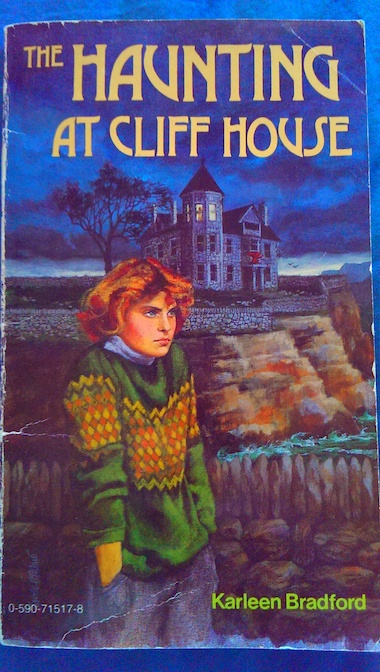
HauntingCliffHouseThe Haunting at Cliff House by Karleen Bradford, 1985.

This is a relatively short chapter book, but suspenseful, thoughtful, and well-written.

When her father inherits an old house in Wales from a distant relative, Alison, a young teenager, finds out that he plans for the two of them to spend the summer there.  Alison’s father is a university professor and is writing a book, and he thinks that the house in Wales sounds like a great place for him to get some writing done while he and Alison have a look at his new inheritance.  Alison isn’t enthusiastic about the trip, but she and her father are very close, especially because she lost her mother at a very young age.  Besides, the only place she could stay in Canada would be with her grandmother, and her grandmother didn’t seem enthusiastic about having her.

From the moment they arrive at the old house, called Pen-y-Craig or Cliff House by the locals, Alison has a bad feeling about it.  It stands on a lonely cliff by a small town.  The carved dragon over the door gives her the creeps, and there is something disturbing about a particular room in the house.  Sometimes, she can almost hear a voice calling out to her, and she has visions of another girl, about her age.  At first, she tries to tell herself that it’s all her imagination, but it soon becomes obvious that it’s not.

Some of the local people know that the house has an unhappy history, and Alison eventually learns that the great-aunt that her father inherited it from even refused to live there during her last years because it disturbed her too much.  A little more examination of the room that had disturbed her helps Alison discover the reason why.  After having a vision of a young girl hiding something behind a brick in the fireplace of one of the bedrooms, Alison searches the spot and finds a diary dating from 1810, written by a girl named Bronwen, who was the same age as Alison.  Like Alison, Bronwen was brought to the house by her widowed father and was unhappy about it, but those aren’t the only parallels between Bronwen’s life and Alison’s.

Alison becomes uncomfortable with her father’s new friendship with a Welsh neighbor, Meiriona.  Alison likes Meiriona’s younger brother, Gareth, but when it looks like her father’s friendship with Meiriona is turning into romance, Alison becomes jealous and fears changes in her close relationship with her father, a situation that mirrors Bronwen’s life when her father falls in love with her governess, Catrin.  Although Meiriona tries to be nice to Alison, Alison can’t bring herself to like her, and she argues with her father about it.

The only person who seems to understand her feelings at all is Gareth, and Alison confides her worries in him, both about Meiriona and about Bronwen, whose spirit keeps calling out to Alison to help her, although Alison doesn’t know how.  She struggles to read through the diary, whose pages are not all legible anymore because they’re damaged with age, to learn what happened to Bronwen and what Bronwen wants her to do now.  Gareth tries to reassure Alison that her father’s relationship with Meiriona will not be as bad as Alison thinks.  He thinks that the relationship would be good for both Alison’s father and Meiriona because they are both lonely, and he doesn’t think that Alison should worry about losing her father because he’s not worried about losing his sister, even if she goes to Canada to study and spend more time with Alison’s father.  At first, Alison isn’t comforted by these reassurances.  However, Gareth agrees that the matter of the ghost is serious, and he can feel her presence as well. Gareth warns Alison to be cautious about the ghost but to try to help if she can and to call out to him if she’s ever in danger.  Alison would really rather just go home to Canada, run away from her father and Meiriona, and forget the whole thing about Bronwen, but history seems to be repeating itself, and Bronwen’s voice calls out to her insistently for help that only Alison can give.

It’s a bit of a spoiler, telling you this, but although Alison at first thinks that the diary ends with Bronwen killing herself in despair, thinking that her father only loved Catrin and not her and that there was nothing left for her to live for, the truth is that Bronwen’s suicide attempt didn’t succeed and that she made another mistake that she wants Alison to help her to change.  Bronwen attempted to kill herself by going to a cave by the sea during a terrible storm, planning to allow herself to drown, but when the water started rising, she became too frightened and decided to leave by a secret entrance to the cave.  Not knowing that Bronwen was safe, Catrin attempted to save her and drowned in the cave herself.  As Bronwen was climbing to safety, she heard Catrin calling for her but was too frightened of the storm and angry at Catrin to go back for her.  Although Bronwen lived on after the incident, she could never get rid of her guilt at Catrin’s death, realizing that, even in the middle of her resentment toward Catrin, Catrin loved her more than she knew, even to the point of giving up her own life while attempting to save hers.

Now, the anniversary of Catrin’s death is approaching, and so is a storm very much like the one that killed her.  At the top of the cliff by the cave, Alison finds her time merging with Bronwen’s, and she will only have one chance to help Bronwen make the right decision the second time around.  Helping Bronwen to prevent the worst mistake of her life and to make a better choice also helps Alison to reconsider her own choices and future.  Just as Bronwen misjudged Catrin, Alison may have also misjudged Meiriona. Instead of losing her father or being forced to accept a poor substitute for her mother, Alison may be gaining a kind of sister who will love her more than she realizes.