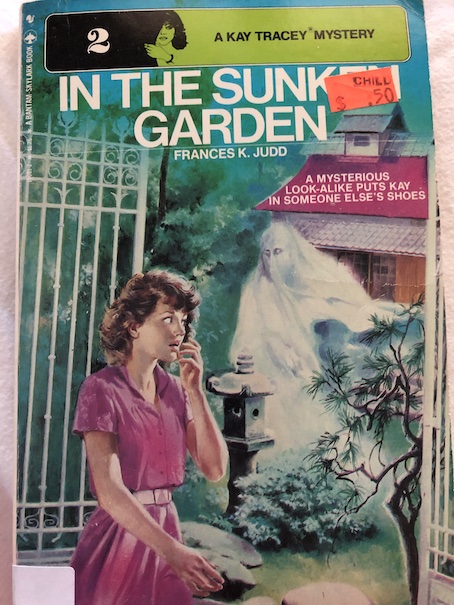
In the Sunken Garden by Frances K. Judd (Stratemeyer Syndicate), 1952 (revised from 1941 edition), 1980.
Kay Tracey discovers that she has a doppelganger when she’s running some errands for her mother and some people in town act like they know her even though she’s never seen them before. As she heads home, a dog even follows her car, as if it thinks that she’s his owner. Kay is bewildered by this, but she decides to take the dog home with her until she can figure out who really owns him.
This is just the beginning of Kay’s entanglement with her mysterious double. Ronald Earle, the boy who likes Kay, gets angry because he thinks that he’s seen her out riding with someone else in his car after turning down a ride with him to attend her mother’s luncheon party. Kay straightens Ronald out only to be confronted with her cousin, Bill, who returns home, very upset because he has heard that Kay was in a car accident and is now in the hospital. Bill is relieved to see Kay perfectly fine at home, but that still doesn’t clear up the question of who this mysterious double is.
According to the hospital, the girl who was in the car accident told them she was Jane Barton, but she checked herself out of the hospital because she only had minor injuries. That isn’t the end of the matter, though. A man named Joe Craken shows up and accuses Kay of wrecking his car in the car accident. He says that the police identified her as the driver of the other car in the accident based on her physical description. With Joe Craken attempting to sue her for damages and the injuries done to a passenger in his car, Kay needs to find her mysterious double!
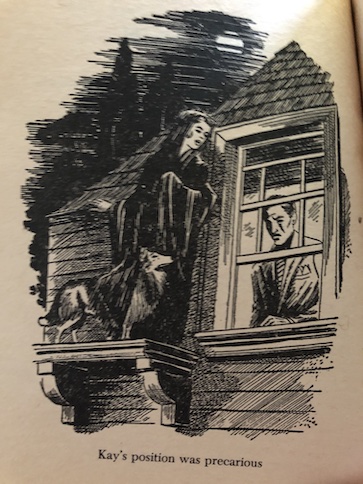
This mysterious double seems to have some connection to the old Huntley place, a mansion outside of town. The Huntleys were distant relatives of Ronald’s, and Kay learns about the family scandal from someone who used to work for the family. Years ago, Mrs. Huntley’s sister, Trixie Rue, was a dancer with a promising career, but she gave it all up to get married. Unfortunately, the marriage didn’t really work out, and she and her husband fell on hard times. Mrs. Huntley gave her sister some money to help her get by, but apparently, it wasn’t enough because the sister resorted to stealing to help support herself and her baby daughter and ended up having to leave town in disgrace. Does this local scandal have any bearing on the sudden appearance of Kay’s double? One night, while having a look at the old Huntley mansion, Kay sees a ghostly white figure dancing in the garden. Was it her mysterious look-alike or someone else? Before the mystery is over, Kay’s look-alike will need her help as much as Kay needs hers.
The book is available to borrow and read for free online through Internet Archive.
My Reaction
The various parts of this mystery fit together much better than the first Kay Tracey book I read. The first book I read in this series seemed rather awkward, but there is a more cohesive thread in this story. The mysterious double, the Huntley family scandal, and the ghostly dancing figure in the garden all fit together in a way that makes sense. However, there are two sets of villains in this story, and although Kay was not involved in the car accident, it turns out that, rather than her double trying to fob off responsibility on Kay, it’s actually the driver of the other car who was responsible for the accident and had always planned on trying to blame Kay for the accident to extort money from her. It was just his bad luck that he crashed his car into the car Jane was driving instead of Kay’s. This story also has a side plot involving a benefit show that Kay and her friends are putting on with others who are also taking dance lessons, and there’s more rivalry with Chris Eaton, the nasty snob they know from school.
I still find that the Kay Tracey books aren’t particularly good on readability, though. The language is a little old-fashioned, and at times, the plot seems to drag. I think this is one of the better books, plot-wise. The story felt more cohesive than the previous one and mystery stories with mysterious doubles, long-lost relatives, spooky mansions, and inheritance are pretty classic and compelling. However, I did get a little bored while reading it because I just didn’t find the writing style to be very engaging.
Mystery of the Witches’ Bridge by Barbee Oliver Carleton, 1967.
Thirteen-year-old Dan Pride is an orphan. His father was an international correspondent, and during his early years, Dan lived in different European countries, as his parents traveled around to his father’s assignments. However, three years ago, his parents died in a plane crash. Since then, Dan has been living in a British boarding school. Now, he has returned to the United States to live with his father’s brother, Uncle Julian. Dan doesn’t know what to think about his new town because it’s very different from everything that he’s known before, but he likes the idea of belonging to a family once again because he has been lonely since his parents died.
The Pride family lives in a New England seacoast town. They were one of the founding families of the town in Puritan times, but Dan discovers that the local people aren’t particularly friendly with the Pride family. Billy Ben Corey, a man who works for his Uncle Julian, explains that the Pride family has been rather stand-offish with the townspeople, and there are also rumors and stories about witches that go back to Puritan times. Billy Ben says that most of the modern locals don’t really know all the details of the witch incidents, but the vague rumors that have circulated about the Pride family have caused the townspeople to treat them with suspicion.
This sounds like a somewhat sinister beginning to Dan’s life in York, Massachusetts as he comes to understand how much of life there is governed by the past relationships between the oldest families of the area. Billy Ben tells him that the Coreys have worked for the Prides for generations, but relations between the Prides and the Bishop family haven’t been good and that Dan should avoid them.
Dan presses Billy Ben for more information, and Billy Ben tells him the story of how one of his ancestors, Samuel Pride, was accused of witchcraft back in Puritan times. Some unfortunate happenings at the time, which were probably just the result of bad luck and bad weather, were blamed on him because he was kind of an odd, temperamental person. He was known for playing the fiddle extremely well, and people said that he used it to summon up the devil in the form of a black dog out of the marsh. The person who made the accusation and who led the group that came to arrest Samuel Pride was an ancestor of the Bishop family. Samuel came out to meet the group that came to apprehend them on the old stone bridge that leads to the island in the marsh where the Pride family has their house and farm, Pride’s Point. The story goes that when Samuel met the mob on the bridge, he placed a curse on them, that doom would come for them out of the night, out of the fog, and out of the marsh. Samuel and his wife were executed for witchcraft, and not only after, there was a terrible fog and a sickness that killed many people in town. People said that it was the result of Samuel’s curse. That’s why the Prides and the Bishops have a bad relationship even though they’re neighbors, why the townspeople are still a little suspicious of the Prides, why the Prides are somewhat standoffish of the townspeople (When you think about it, who really wants to be outgoing and friendly with people whose ancestors not only killed yours but who are not welcoming or friendly themselves because they have continually looked at you and your family with suspicion for generations, like you’re the weird ones? The townspeople basically created this situation and have been perpetuating it ever since, yet they act like the problem is with the Pride family instead of themselves. Gaslighting is a relatively new term from the 20th century, but the concept has been around forever, used even by people who don’t know what it is and that it’s what they’re really doing.), and why people in the area are afraid of the stone bridge that they call the Witches’ Bridge, the place where the curse was supposedly delivered. Even into modern times, people in the area see strange lights in the marsh and hear mysterious fiddle music or dog howls that they think might be Samuel’s ghost.
There is still more to come because the mysterious misfortunes of the Pride family have continued even into modern times. Dan is named for his grandfather, Daniel Pride, who died suddenly under very mysterious circumstances, something that still haunts his Uncle Julian. Young Dan learns the story from Mrs. Corey, a relative of Billy Ben’s, who is Uncle Julian’s housekeeper. Daniel Pride had been working to change the family’s image in the eyes of the local people, debunk all the old ghost and witch stories, and lay past quarrels to rest. To try to make peace with the Bishop family and restore the Pride family’s former fortunes, Daniel had been trying to arrange to buy the shipyards that the Bishop family owned, which had formerly been owned by the Pride family. The Bishop family initially agreed to the sale, and one foggy night, Daniel went to see the Bishops to finalize the sale. What happened after that is still a mystery. Daniel was found dead the next day near the old chapel with a look of terror on his face. It’s known that he had a heart condition, so he apparently had a heart attack, but from the marks on the ground, it also appears that he had been running before he collapsed, possibly deliberately frightened to death. Also, there were marks on the ground nearby where his briefcase fell, but the briefcase containing the sale papers was never found. The superstitious people in the area think that Daniel’s death was another symptom of the family’s curse, but it might also have been deliberate murder and theft. The Bishop family insist that they never finalized the sale of the shipyard with Daniel before his death, but Uncle Julian believes that the sale was finalized and that the Bishops are lying to take advantage of his father’s sudden death, just like their ancestors arranged the execution of Samuel for their own advantage. Uncle Julian remains suspicious and bitter about what has happened, just as the townspeople continue to look at the Prides suspiciously.
All of this makes York seem like it’s not the best place to raise a sensitive young orphan, and that’s basically what Uncle Julian says to Dan when Dan arrives at Pride’s Point. Uncle Julian seems elderly and physically frail, and Dan senses that he is a deeply troubled man. Uncle Julian tells Dan that the family and the old family home have a troubled history. That’s why Dan’s father decided to go away and live his life traveling to different places, and that’s why Uncle Julian delayed sending for Dan for so long after his parents’ deaths. Uncle Julian doesn’t seem to think that Pride’s Point is a very healthy place, and he hints at buried secrets. However, he does say that, now that Dan is there, there are going to have to be some changes.
Dan doesn’t think this sounds too hopeful, and he’s lonely and disappointed that he hasn’t found the happy family and home he was hoping for and that he doesn’t even seem particularly welcome there. He can’t even really enjoy playing his violin because of the connection people there seem to have between “fiddle” music, witchcraft, and his supposedly sinister ancestor. As Dan is looking around his new bedroom that night, he suddenly spots a mysterious flashing light from his window, outside in the marsh. It’s creepy because it not only supports all the ghost and witch stories that Dan has just heard but because he recognizes the patterns in the flashes of light as Morse Code … and the message being sent is his own name: D-A-N P-R-I-D-E.
Dan doesn’t believe that any supernatural force was using Morse Code to flash his name at night. It was obviously some human person, but who would do that and why? What is the truth about his grandfather’s death? Is Uncle Julian right that the Bishops caused Daniel Pride to die and then lied about the sale of the shipyard to cheat the Pride family? Or is someone else responsible?
The book is available to borrow and read for free online through Internet Archive.
My Reaction
I stand by my earlier statement that there is basically inter-generational gaslighting of the Pride family going on. It’s gone on for so long that the townspeople have trouble recognizing what they’re doing or stopping themselves from doing it, even though some of them seem to have the feeling that it isn’t right. At one point, some of the townspeople who come out to Pride’s Point to help fight a fire make jokes about the Pride curse. I could sense tension in them, and I think it was an attempt to lighten the mood, but under the circumstances, it wasn’t really appropriate for them to joke around, especially not about something that’s been a sensitive topic for the Prides, something that has literally caused members of their family to die and others to be persecuted for generations. Keep your audience in mind, and learn how to read a room, people of York!
Uncle Julian hates the stories and rumors that have circulated about his family since before he was born, but he doesn’t know what to do to stop it, and he sometimes wonders if it wouldn’t be better for the family to simply leave their old family home and start up again somewhere else. Mrs. Corey tells Dan that every single time anything bad happens in the area, people either look at the Prides suspiciously or find a way to blame them, even though they didn’t have anything to do with whatever it was. Dan can tell that Uncle Julian is so accustomed to having people blame him and his family for things and repeat scary stories about them that he halfway believes the stories in spite of himself, and he’s overly sensitive anytime it looks like the townspeople might be trying to blame the Prides for something yet again. That’s what makes this situation gaslighting, because the community’s constant untrue stories have warped even the Prides’ sense of reality and views of themselves. The community of York as a whole has created a situation that makes it difficult for the Prides to make friends with other people and get reality checks, and the most dangerous part of it is that among the few people that the Prides are in the habit of trusting is someone who turns out to be the person they should fear the most.
I couldn’t help but notice that there was someone in the story that Dan trusted too much in the beginning. It’s partly because Dan is young and in a situation where he is just getting to know the circumstances and people involved, but even when this person says things that are untrue, contradictory, or just plain mean, he doesn’t call him on it or seem to question within himself why this person is talking like that, at least not until about the middle of the book. Gaslighters will do this to a person, playing mind games, lying, alternately being friendly and praising their victim and then putting down their victim and/or trying to blacken their name to other people, discouraging them from getting close to people who care about them and might actually help them, acting like normal things that the victim does or feels are somehow weird or abnormal, trying to keep their victims in a constant state of confusion, unsure of what the reality of the situation really is. Although I found myself angry with the people of York in a general way for perpetuating something awful that their ancestors did for generations and for being apparently oblivious to what they’re doing in modern times, there is a definite villain in the story who is both deliberately and concretely evil.
There is a parallel drawn in the story between Uncle Julian’s big, black dog, Caliban, who is disfigured from an old injury and the Pride family themselves. Dan is afraid of the big dog, and Billy Ben tells him that it attacked him once, but Uncle Julian says that Caliban is just distrustful because he was badly abused and injured in his earlier life. People are like that, too. I understand that because I used to volunteer at an animal shelter, and that’s where I got my dog, Betty. (If you look at my About page, you’ll see a picture of Betty.)
I’ll never know Betty’s complete history because she was found wandering alone without a collar before she was brought to the shelter. However, I’m pretty good at reading between the lines, and I can read at least part of the story from her behavior. Betty is afraid of anyone, even me, walking behind her, and I’ve noticed since her shelter days that sometimes, her back end looks a little off-center when she runs. Her tail has an odd, permanent bend at the very tip that we didn’t discover until we had the hair on it trimmed. I think she’s been kicked hard from behind before, hard enough to leave permanent injury. She’s not as scared of things as she used to be after having lived with my family for a few years, but she used to be terrified of newspapers or anybody standing over her with anything in their hands, so I think she’s been hit with things before. Betty also gets scared when people laugh. She’s not as scared as she used to be because she’s gotten used to us laughing at something funny on tv, but there are times when she’s cringed and slunk away with her tail between her legs from people when they laugh and she can’t figure out why they’re laughing. Betty’s fear of laughter actually disturbs me because I think I know why it scares her. Based on her reaction, I’ve think that it’s likely that whoever hurt Betty before laughed when they did it. I think Betty has an association between laughter and pain, and that’s why she takes laughter as a bad sign, reacting fearfully to it when she thinks it might be directed at her. Laughing while inflicting pain is a sick thing to do, the product of a sick mind. There are stories in Betty’s reactions, and I’m disturbed by the mental picture I have of the person who had Betty before.
I have to admit that my own history has also both colored/given me insight into Betty’s behavior. If it isn’t obvious from comments in my previous reviews, I don’t see teasing as a positive thing. I’ve reacted to it in the past much like Betty does to sudden, unexplained laughter, which is why I understand the feeling behind it. Some people say that they like to tease their friends and people they like, but I just don’t like it, and I’ve learned to be more open and honest about how I never will like it. I do not have good feelings about people who tease others for fun, and I deeply resent being told that I have to like it because the people doing it are “just having fun.” It’s not a bonding activity, not with me, no matter who says it is. I absolutely refuse to “bond” with anyone who does it. Anyone telling me that I have to change myself to like people who tease is 100% guaranteed to get on my bad side. I have a bad history with teasing and bullying, I have a bad history with the people who do it, and I just don’t want to be around it. Teasing involves getting a laugh at someone else’s expense, benefiting from their discomfort, and getting a good feeling from making someone else feel bad. I don’t think any of that is right, and it doesn’t take much for it to get way out of hand, especially when people have the impulse press harder to get the reaction they want to their “jokes”, like the other person just didn’t get it, instead of cutting it out when their “jokes” just aren’t funny. It’s always awkward when it comes from people who don’t know the sore spots that they shouldn’t poke at and try to act like they’re special friends who should be cut some slack when the reality is that we don’t really know each other that well, we’re not really close friends, and no such special relationship actually exists between us. Real friends understand and demonstrate respect for each others’ feelings, and they don’t intentionally poke at a friend’s sore spots, like the people of York did to Uncle Julian with their jokes in this story.
What ties all of this together is that Betty’s reaction to laughter is like Uncle Julian’s reaction to the townspeople and their jokes and comments; it’s a conditioned response from long-term negative association. The townspeople are uneasy because Uncle Julian doesn’t laugh with them, but Uncle Julian doesn’t laugh with the townspeople because none of it was actually funny. By perpetuating these witch stories, even in the form of “jokes”, they’re constantly feeding the myths and ghost stories and making the situation worse, and they don’t seem to care about how he or his family feels or how it affects their lives. You can tell who respects you and who doesn’t by seeing who tries to treat you the way you want to be treated. The people of York were making jokes to soothe their own feelings, sharing in-jokes that they’ve had with each other at the Prides’ expense, and they got really uncomfortable when suddenly confronted with Uncle Julian’s, feelings that they helped to provoke and didn’t want to deal with.
Don’t worry about Betty. It’s sad that she’s been afraid of things and it’s kept her from being more outgoing and friendly, but we’re working through it. In non-pandemic times, I take her to places where I know she’s welcome, and she has acquired a fan club of people who like to see her and say hi whenever we visit. Anytime she seems uneasy because we’re laughing about something, I sit next to her, pet her, and praise her for being a Good Girl so she knows that nobody is trying to be mean to her and that we value her. When someone has been programmed through negative reinforcement, positive reinforcement is needed for balance. I’m trying to build more positive associations for her. It’s working, and she’s improving. She behaves very well and is very happy little dog when she’s treated well. Don’t worry about me, either. I’ve had some bad experiences, but I’m not the only one who’s had to deal with this stuff. There are lots of different kinds of people in the world, and I’ve learned some things about finding the kind of people I want to be around and making it clear how I want to be treated. I just gripe and vent now and then because I don’t like mean behavior or seeing others in these situations, and I’m all out of patience for it. I’ve learned what to do to help remedy such problems, but that doesn’t stop me from resenting the people who create problems that need to be solved.
The way both people and animals behave offers clues about what’s been happening with them. Sometimes, they offer warning signs of people to avoid, and sometimes, they are signs that the person or animal is in distress and needs some outside help and support. Caliban’s behavior in the story is more defensive than aggressive. That is, Caliban is reacting, not instigating … and if I saw what Dan saw in the story, I would know immediately to be very suspicious of the person Caliban hates the most because it explains where the source of harm in his life is. In a similar way, the Pride family is mostly reacting, not instigating. They have been harmed, both physically and psychologically, for an extended period of time, and while they seem to have the sense that’s the case, they’ve been too close to the problem for too long to see what the source of the greatest harm really is. But, about halfway through the book, Dan does learn to correctly read the people around him and comes to realize who is really his friend and how isn’t, based not on how others talk about them but by how they each actually treat him. When you pay attention and think about people’s actions in context, you can see who really has your best interests at heart and who doesn’t.
Dan spends much of the story, particularly at the beginning, feeling like he is unwanted, both in York and at Pride’s Point. At first, he thinks that his Uncle Julian doesn’t want him, but he gradually realizes that’s not it. There is someone else who doesn’t want Dan there, for reasons of their own. As I was reading, I noted times when this person said and did things that manipulated Dan’s feelings, even actively trying to make Dan feel bad while carefully seeming “honest” or “helpful” so Dan would continue to listen. I felt so much better when Dan finally realized the truth about this person. I have to say that I was really angry with Uncle Julian when I discovered that he was fully aware of who hurt his dog and that he still trusted this person. For me, the first hint of that would have caused me to permanently sever the relationship because it’s sick behavior and a sign of a disturbed mind, but I can only suppose that he felt unable to because he had been dependent on this person for too long, largely shunned by the wider community, who could have given him a reality check if they’d had a firmer grasp on reality themselves.
Dan, who had never heard of the Bishops before arriving in York, finds himself becoming angry and resentful of them, hating them for what they’ve done to his family for generations. His uncle even warns him not to get involved with the family, but that’s exactly what the real villain wants. When Dan makes friends with a boy named Pip Cole and his twin sister, Gilly, he confides his anger at the Bishops and how he blames them for this whole mess and for perpetuating it for generations, but Pip knows more about the situation than Dan suspects, and he has seen a different side of the problem. Pip tells Dan his family would have less problems if they would just forgive the Bishops, but Dan doesn’t believe it at first because, the way he sees it, the Bishops are the villains, who have actively profited from their villainy all along. I appreciate Dan’s situation. Pip doesn’t fully appreciate that, for Dan and his uncle, it’s not just about the past because they’re still actively suffering from the townspeople’s stories, rumors, and suspicions about them. It’s hard and maybe impossible to forgive something that’s ongoing from people who see no problem with the situation and aren’t particularly sorry. On the other hand, the resolution of this situation requires at least one of the parties involved to make the first move. Dan’s grandfather was trying, but his mysterious death prevented his mission from being completed. Even Uncle Julian reveals that he had been prepared to forgive the Bishops and marry their daughter, but some of the circumstances of his father’s death led him to believe that his fiance actually had a hand in it, and that apparent betrayal is what has left him such a haunted man all of these years.
The stories that Dan has heard about his family are not the complete story. Dan eventually comes to realize that the Prides and the Bishops each have only half of the real story, and because of their reluctance to associate with each other, the Bishops partly out of continued superstition and guilt, not knowing how to deal with the Prides’ anger, and the Prides, because they are both justifiably angry and accustomed to unfair treatment and being shunned by the community. However, it’s important that they do talk to each other because it’s the only way for each of them to get the complete picture of what’s really been happening and learn the real villain’s true motives.
The key to establishing the truth is in the missing briefcase, and both Dan and his enemy are searching for it. Dan needs to make peace with his family’s past, and he finds some help from a mysterious hermit called Lamie, who lives alone in the marsh. Lamie is another outcast of the York community. People avoid him because he has a reputation for being weird. People in this community in general may be “normal” in the sense that their behavior is fairly uniform, but uniformity by itself isn’t a virtue. When you’ve got an entire community doing something they shouldn’t, being the odd one out can be a good thing. Lamie helps Dan when he needs it, and Dan discovers that Lamie is actually a very kind and understanding person. Lamie’s solitary lifestyle is rather unorthodox, but he’s actually happy in his solitude because he knows who he is, he takes care of himself, he’s comfortable with himself, and he’s living the kind of life he likes, in touch with the natural world. When Dan talks to Lamie, he realizes that Lamie is comfortable with his own identity and at peace in his own mind in a way that his uncle isn’t. Even more importantly, Lamie sees things from a different perspective because he isn’t part of the groupthink of this community.
Lamie was friends with Dan’s grandfather, and he tells Dan about a hidden chamber built by the Prides’ ancestors, where Dan’s grandfather kept important family papers. However, Lamie tells Dan that he isn’t sure that he should look for it if his only motive is revenge. Dan does have a desire for revenge after all of the stories of injustice toward his family that he’s heard and what he’s suffered himself since he arrived in this area. Lamie helps to calm Dan’s desire for revenge by quoting from St. Francis of Assisi, emphasizing the importance of forgiveness instead of revenge. The part about truth speaks to Dan, and he comes to realize that what he really wants, more than revenge, is to know the truth about what happened to his grandfather. Lamie tells him that he saw some of what happened the night his grandfather died, from a distance. Because of the fog, he couldn’t see everything, but he knows that the Bishops were telling the truth that Dan’s grandfather didn’t make it to their place that night to complete their deal, defusing Dan’s anger at them for their supposed lies. Lamie’s memories also give him clues about the true identity of his grandfather’s attacker and the location of the secret hiding place. However, to find it and to evade his enemy, Dan will need the help of the very people his uncle has forbidden him to associate with.
I found the parts about the gaslighting of the Pride family and the poisonous duality of their true enemy frustrating and anger-inducing, but once Dan speaks to Lamie (really, my favorite charcter in the story) and begins to sort out who he can trust and who he can’t, I felt a lot better. The story is very atmospheric, with a grand old house and property, surrounded by a foggy marsh, and even when the characters know who their enemy really is, they are kind of trapped with him in a dangerous cat-and-mouse situation as they both race to find what they’re really looking for. By the end of the book, all of the old mysteries are wrapped up, including the source of the the mysterious “fiddler” music.
Father’s Arcane Daughter by E.L. Konigsburg, 1976.
Winston Carmichael lives a very sheltered life during the 1950s. His family is wealthy. They live in Pittsburgh, and he attends a good school, but much of his free time is also taken up trying to entertain his sister, Hilary, called Heidi. He particularly has to look after Heidi every week on Thursday, while his mother leaves to get her hair done. Heidi has some developmental disabilities and is hard of hearing, so Winston’s overprotective family is especially overprotective of her. Because of that and because of her frustrations with her own limitations, Heidi is spoiled and frequently acts out when she doesn’t get her way, making her a pain for Winston to help care for. Even servants have often quit over Heidi’s behavior. However, Heidi’s disabilities are only part of the reason why the children’s parents are overprotective. The other reason is the mysterious disappearance of Caroline, Winston and Heidi’s much-older half sister, from their father’s first marriage. Winston is aware that Caroline was kidnapped years before he was born and is now presumed dead, a traumatic incident in their family. Then, one day, a woman claiming to be Caroline comes to the house to see their father.
The story is actually told in the form of flashbacks as Winston recounts it to a woman, who is at first unnamed. Winston explains how he knew about Caroline’s disappearance and how he wanted to know more about this mysterious woman claiming to be Caroline, partly in the hopes of reducing the shadow that Caroline’s disappearance has cast on all of their lives. The children’s father tells them the story of how Caroline was kidnapped 17 years earlier on her way home from the exclusive college that she was attending in Philadelphia. The kidnappers demanded a large ransom in cash, and it took longer than they thought for Mr. Carmichael to assemble that amount of cash because rich people don’t have all of their money in cash and getting large amounts of cash attracts attention from the authorities. Then, the ransom drop went badly and turned into a shootout between the police and the kidnappers at the house where the kidnappers were hiding. At some point, the house caught fire (no one is quite sure what started the fire), and everyone inside the house was killed. At the time, they assumed that Caroline was one of the people who was killed in the fire, but Mr. Carmichael was never sure because the kidnappers had said something earlier about moving Caroline. He always hoped that maybe Caroline wasn’t in the house and somehow survived, but having heard nothing from her for years, it has seemed likely that she died. After Caroline’s presumed death, her despondent mother died of alcohol-related causes. Mr. Carmichael remarried, and he and his new wife had Winston and Heidi. Still, Mr. Carmichael always hoped that maybe Caroline was alive and he would find her one day.
Caroline’s sudden reappearance, although happy for her father, is strange, and Mrs. Carmichael is suspicious that this woman’s real purpose is to claim the inheritance that Caroline was supposed to inherit from her mother’s family. The deadline for claiming the inheritance is approaching, so the woman claiming to be Caroline could be an imposter who is just after the money. Winston studies his mother’s scrapbook, containing all the known details of Caroline’s life, and he comes to understand his father and his family a little better. Caroline becomes more of a real person in his mind, not just a shadowy figure from the past, but he’s still not sure if the woman claiming to be Caroline is the real Caroline.
“Caroline’s” story is that she was rescued from her kidnapping situation by one of the kidnappers, who apparently had a change of heart, but that she had a kind of identity crisis and a sudden realization that she didn’t know who she wanted to be or what she really wanted out of life. She changed her name to Martha Sedgewick, using information given to her about a dead woman by the kidnapper who released her, and went to Ethiopia. There, she taught English for a time and then worked as a nurse. She says that she found it a very liberating experience. Winston, who feels trapped in his stifling, sheltered life understands that feeling. Caroline said that she fell in love for a time but never married the man she loved because there was a war and he died.
Caroline says that when she finally returned to the United States, she found a job as a nurse at the nursing home where her Grandmother Adkins was living. Caroline says that, at first, she wanted to see her grandmother again and get her opinion about whether or not to reveal herself to the rest of the family. However, Grandmother Adkins was senile when she finally saw her, and Caroline merely acted at her caregiver. Mrs. Carmichael thinks this is suspicious and continually quizzes “Caroline” about old acquaintances, trying to catch her slipping up and revealing herself as an imposter. Surprisingly, “Caroline” never seems to slip, and Winston finds himself becoming fond of her. Caroline has had a wide experience of life and is very well read, and she is a very interesting person to talk to. Winston blossoms intellectually under her influence.
I particularly liked the part where Winston realizes that many of his relatives have given him books to read as presents that they have never read themselves. They like to give him books that have a reputation for being “good” books, and it seems like the proper thing to do and something that will enhance their own reputations, but they never actually read the books themselves and can’t talk about them. Caroline hasn’t read all the books that have been deemed “good”, the kind that people read in order to become educated or have a reputation for being educated. However, Winston can tell by talking to Caroline that she has done a great deal of general reading just because she has a curiosity and a desire to know things. She has become a much more knowledgeable person than the people who collect all the “right” sort of books just to have them and never even open them. Many people in the Carmichael family are largely about appearance, but Caroline has substance.
However, Caroline’s presence in the house makes things uncomfortable for the family, not only because of their doubts about her true identity, but because she challenges the life the family is living and the habits they take for granted. Even though some of those habits have been making life uncomfortable for them, the changes that Caroline subtly begins to make also make them uncomfortable by bringing them out of their shells and forcing them to confront things that they have been trying not to confront. For example, Heidi is never scolded for bad habits like snatching things from others’ plates at dinner because she is young and has disabilities. Caroline doesn’t make those allowances, freely telling the family that she doesn’t like it.
Eventually, Caroline’s father is satisfied that she is his daughter and grants her the Adkins’ inheritance, although at his wife’s insistence, there is a proviso that the fortune will revert to the Carmichaels if any evidence surfaces in the future that Caroline isn’t the real Caroline. Caroline accepts those terms, but a battle of of personalities and wills still continues between her and Mrs. Carmichael over the children. Caroline insists that Winston be allowed more freedom, pointing out that Mrs. Carmichael has been using him as an unpaid babysitter while she goes to get her hair done every week. Caroline recognizes that Winston is young and needs to have some freedom and fun, and Mrs. Carmichael is pained that Caroline has caught on to the fact that her hair appointments are also a convenient excuse to get some freedom for herself.
At Christmas, Winston feels sorry for Heidi, watching other people at the family’s Christmas party, but not being able to understand what is being said around her, and knowing that she can’t understand them. On impulse, he gives her the book of poetry that he had intended to give Caroline. To his surprise, she really likes it. He knows that she can read, but he never thought of her as having the mental capacity to understand anything really complex because of her babyish behavior and fits when she doesn’t get her way on something. However, Heidi really does understand the poems and is able to read them to Caroline and tell her what they mean. At first, Winston refuses to believe it, jealous of the attention and coddling that Heidi has always received and not wanting to share Caroline and the intellectual discussions they have with Heidi.
Heidi continues to listen to their discussions and follow them as best she can. Gradually, in their company, Winston notices that her behavior begins to normalize and more of her true intelligence shows, although she reverts to her old habits around their mother. Hilary/Heidi has always been underestimated by her family because of her disabilities as well as being overprotected. Under Caroline’s influence, she learns that she is capable of more than anyone, including herself, believed possible.
Unfortunately, Mrs. Carmichael still distrusts Caroline, and in her determination to protect Heidi from her influence, will not allow her to spend time with her anymore. Caroline tells Winston that she is tired of all the Carmichaels’ pretenses, the way they try to ignore the real issues with Heidi, and she gives him an envelope, which she says will provide Winston with all the evidence he needs to decide whether she’s the real Caroline or not. Winston has to decide which is more important to him, learning whether the Caroline he knows (or thinks he does) is a pretense or accepting the realities of his family’s problems and the help Caroline can offer in learning to deal with them.
There is also a movie version of the book called Caroline? I saw the movie before I read the book, but I’ll explain the difference between the two below because it involves some spoilers.
The book is available to borrow and read for free online through Internet Archive.
Themes, Spoilers, and My Opinions
The everyone in the story, even the children, speak in a very educated and deep-thinking way, which I found interesting. At first, I thought that the children, especially Winston, should speak a little more colloquially, but then, I decided that it’s really right for him to speak in a more erudite way because of the school he attends and because much of the story emphasizes that he has been very sheltered and largely cut off from forming the sort of childhood friendships that children his age have, so he would probably use much less slang than most kids his age.
During the story, Winston is in the habit of thinking of Heidi by insulting terms, like “troglodyte”, because she is strange and awkward and her weird habits and temperamental fits cause problems for him, like preventing him from bringing friends to the house. At a couple of points, he thinks of her as a “golliwog”, which is an insulting racial term, based on a style of old dolls that look like black-faced minstrels, and later, even Heidi describes herself that way. (The term was actually coined in an old children’s book, where one of these dolls comes to life with some other toys. The doll character was actually a nice character, but since the dolls are considered ugly, its meaning has become an insult.) Winston doesn’t mean that in the racial sense here. He’s trying to convey that Heidi has an awkward, abnormal appearance.
As Winston opens up to Caroline, he finally admits to her that he knows that Heidi is “damaged”, not “special.” In other words, he understands that Heidi has disabilities and that she has been deliberately spoiled by their mother who wants to protect her from having to deal with them. Their mother herself has trouble facing the realities of Heidi’s disabilities and is actually ashamed of her daughter for not being normal, so she tries to ignore them, covering them up with cuteness, pretty dresses, presents, and indulgence. Heidi’s babyish behavior early in the story is not because her mind is infantile, but because of the coddling and overprotection she has received and poor socialization, and also because her family is afraid to face the difficulties that lie ahead for her because of her condition and underrates her capacity to do what other children can do and learn what they learn. It’s true that Heidi has some physical disabilities from birth, and she needs a hearing aid to help her hear (she reads lips up until the point that Caroline insists on her getting a hearing aid) and braces to help correct the way she walks, but her mind is excellent. Through Caroline’s attempts to help her, Heidi herself comes to realize how limited her life has been and the potential she has to expand it if she gets the help she really needs to learn how, and she eventually stands up to insist on what she wants for herself, asking her brother to kidnap her and take her to Caroline to get the help she needs and wants. Caroline acknowledges to Heidi, without being ashamed of her or trying to hide the truth, that she is not “normal” and never will be completely normal, but tells her that if she’s willing to work at it, she can realize her true potential in life, and ultimately, that’s what Heidi wants.
The movie followed the themes of the book very well, showing the effect that Caroline has on the lives of the Carmichaels, helping Hilary/Heidi to realize her true potential, helping her parents to realize what she is capable of and what she needs to make the best use of her real talents, and helping Winston to find his own sense of independence. There are some differences. In the movie, for example, Caroline wasn’t kidnapped. Supposedly, she was killed in a plane crash, although her body was never positively identified, and there was some doubt in her family about whether or not she got on the plane. In the movie, Caroline gives a similar story about feeling the need to go out and find herself, but I think she says that she became a nurse in India, not Ethiopia. (It’s been a while since I’ve seen the movie.)
One thing I am grateful for is that both the book and the movie do give a definite answer to the question of whether “Caroline” is the real Caroline or not. I’m often frustrated with movies and stories that leave loose ends like that, like Disney’s Candleshoe, where they never completely establish whether Casey/Margaret is really Margaret.
When Hilary/Heidi decides that she wants the help of Caroline and a friend of hers, who is a doctor, she asks Winston not to open the envelope. Winston keeps it sealed for years, but Hilary (who long since dropped her childhood nickname) is the women he’s talking to when he’s telling the story from his perspective, and at the end, they decide to open the envelope together and find out the truth.
Do you want to know the truth about Caroline?
The Real Spoilers
So, is Caroline actually Caroline, the same Caroline who was kidnapped and evidently killed years before? No, actually she’s not. She really is Martha Sedgewick, the identity that she supposedly took when she said that she was going off to find herself in Ethiopia. However, she is not posing as Caroline for the sake of the inheritance; she’s doing it for the sake of the family and the children. Grandmother Adkins put her up to it.
Martha really was a nurse in the nursing home where Grandmother Adkins lived before her death. She had lived in Ethiopia with her parents, who had died, and so had the man she loved, as she had said before. She had returned to the United States, alone, lonely, and depressed, before getting a job at the nursing home. Grandmother Adkins noticed her striking resemblance to Caroline, and in her confused stated of mind, sometimes thought that she was Caroline. She talked to Martha about the family all the time, which is how she knew all the right details for playing the part of Caroline. Grandmother Adkins knew that if Caroline never returned to claim her inheritance from her mother, that money would pass to Mr. Carmichael, and by extension to his new wife, whom Grandmother Adkins detested. Toward the end of her life, Grandmother Adkins urges Martha to go claim the Adkins inheritance as Caroline – revealing that, in spite of her supposed senility, she has been deliberately coaching Martha to be Caroline for that purpose. Martha decides to go through with the pretense, not because it was Grandmother Adkins’ dying wish or because she really wanted the money, but because she saw Mr. Carmichael at the funeral and was touched by how sad and lonely he looked. Martha didn’t have a family, so she decided to give Mr. Carmichael his daughter back.
In the end, she actually developed romantic feelings for Mr. Carmichael, but she could never admit to them because of their established relationship as father and daughter. Mr. Carmichael might have felt the same way, but he also couldn’t admit to those feelings without destroying the pretense that Martha was his daughter and admitting that Caroline was really dead. Martha came to love the children, and since she realized that they would never be her stepchildren, she did her best to be their big sister.
Miss Trollope, Caroline’s old headmistress, figures out the truth, and “Caroline” openly discusses the situation with her, including her desire to return to college and learn to educate children with disabilities, like Hilary. The real Caroline’s grades were never good enough to attend a university, but Miss Trollope approves of what “Caroline” wants to do and the good she is doing for the Carmichael children, so she does nothing to reveal the pretense or hinder Caroline’s education. However, Miss Trollope later admitted the truth to Hilary when she pressed her for answers.
The reason why Hilary and Winston are discussing this situation and telling the story in the book is that “Caroline” has just died. Hilary is now a business executive, and Winston is a writer. Hilary is a decisive person as well as intelligent, and she decides to put the papers proving Martha/Caroline’s true identity in her coffin, under her head, to be buried with her. Winston says that Hilary is mysterious and arcane, providing the title of the book. Caroline’s life was hidden and arcane, but Hilary’s true depths are also hidden and arcane because of the person she is.
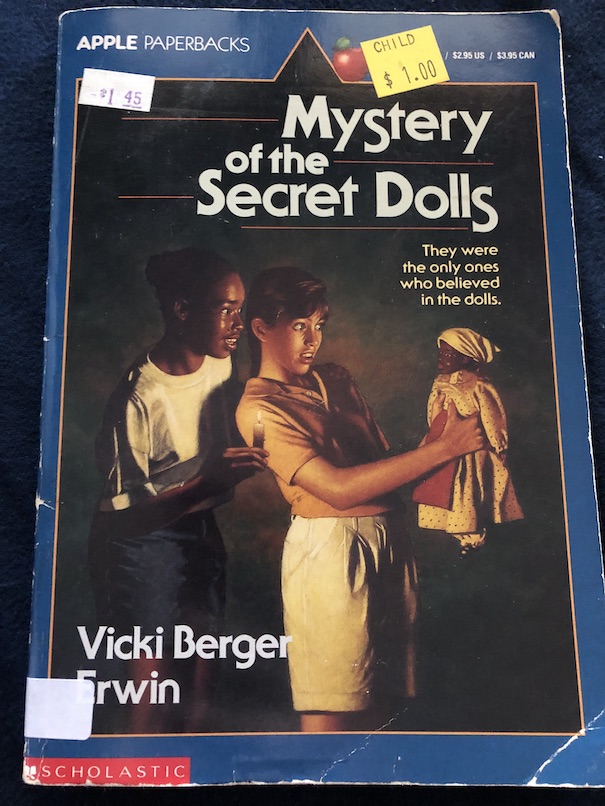
Mystery of the Secret Dolls by Vicki Berger Erwin, 1993.
Bonnie Scott is visiting her great-aunts, Nell and Mollie, in Callaway County over the summer. Aunt Nell invited her to come and help set up her new doll museum, but Bonnie also wants to take advantage of the trip to work on a project about family history. Aunt Mollie has a restaurant, and Bonnie wants to talk to her about old family recipes that she uses and make a book about them. Unfortunately, when Bonnie arrives in her aunts’ town, she learns that Aunt Mollie has closed her restaurant and is helping Aunt Nell with her doll museum. From Bonnie’s awkward arrival, when no one comes to meet her at the bus stop and Marc, the grandson of the local doctor, Dr. Allen, has to help her find her way to her aunts’ house, she begins to see that things aren’t quite what she thought they were in her family and in her aunts’ town.
The reason why no one came to meet Bonnie is that Aunt Nell accidentally injured herself when she fell off a table she was standing on in order to change a light bulb. She broke her leg and had to go to the doctor. Now that Aunt Nell is in a wheelchair, she says that she will especially need Bonnie’s help, although Aunt Nell and Aunt Mollie also have a young black girl, Lynette Key, staying with them and helping out. Lynette is the daughter of an old family friend, and her family’s history is intertwined with Bonnie’s family. Through her aunts and Lynette, Bonnie comes to understand a little more about her family’s history with dolls and the relationship between Aunt Nell and Aunt Mollie.
Aunt Nell is the older of the two sisters, and she’s been bossing Aunt Mollie around for years, and she’s apparently the one who convinced Mollie to close her restaurant and help her with the doll museum project. The old family home belongs to both of them, although Mollie lived in another house while her husband was still alive. Now that both women are childless widows and Mollie has moved back into the family home, Nell has gone back to her old ways of bossing Mollie around. Bonnie is alarmed when Mollie reveals that there has been a break-in, vandalism, and a fire, apparently deliberate, at the museum, and she thinks that Nell should put off the opening, but Nell is trying to ignore the situation and charge ahead with the project, dragging Mollie and Bonnie with her. The aunts are going to have a security system installed at the museum.
Aunt Nell says their family, the Scotts, have made dolls for about 150 years. She shows Bonnie her doll collection, including the portrait dolls, startlingly realistic dolls made of every member of their family, including Bonnie’s ancestors, like her great-great-great-grandfather who fought for the Confederacy during the Civil War. Aunt Nell apparently strongly identifies with the South and Confederacy because she keeps trying to blame the troubles at the museum on “some Yankee.” Not in a specific sense and not necessarily with any particular person in mind (although there is one person who is also labeled as a Yankee who is a suspect for awhile), it’s more that she just generally associates Yankees with bad stuff, and she says that she hopes that Bonnie hasn’t turned into a Yankee from living in a big city like St. Louis. Although the dolls belong to both of the sisters, Aunt Nell really thinks of the dolls as being hers, and she’s determined to make Bonnie’s family history project about the dolls, whether Bonnie wants it to be or not. Aunt Nell says that Lynette’s grandmother used to work for her, making dolls, and she’s pleased that Lynette shares her interest in dolls, but Lynette privately tells Bonnie that the situation goes deeper than that.
As you might have guessed, Aunt Nell’s mental version of history, including the history of her own family, isn’t entirely accurate. Marc lends Bonnie a history book about the area written by his grandfather, but Lynette tells Bonnie not to let Aunt Nell see it because she and Dr. Allen have very different views about history, and Dr. Allen is a “Yankee.” Bonnie asks her what she means by that, and Lynette says that the Scotts have never gotten over being on the losing side of the Civil War. Dr. Allen, by contrast, believes that the Civil War turned out just fine with the South losing, which makes him a Yankee. It matters because Aunt Nell’s interpretation and attitude toward the past is affecting life in the present.
Although Aunt Nell is mentally on the side of the Confederacy, she doesn’t say anything in support of the idea of slavery and doesn’t seem to have bad feelings about Lynette being black. Nell is actually very fond of Lynette, treating her almost like a young niece, and I suspect that Nell probably mentally replaces the word “slave” with “servant” in her head, as some of the other characters in the book do until Lynette reminds them that there’s a difference and it matters. Nell’s attachment to her family’s grand history (which may not be quite what she makes it out to be) and her feeling that the doll-making business must pass to a blood relative keep her from fully seeing the potential that Lynette has to continue the doll-making traditions that their families both share, something that Lynette really wants to do.
Lynette says that women in her family have worked for the Scott women for generations, making dolls. They were originally slaves belonging to the Scott family, and they even shared the same last name because slaves were sometimes given the surnames of their masters. (In my home town, I’ve met black people with the surname White, which might seem a little odd and contradictory, but this is the probable reason why they have that last name.) Some slaves changed their last names after Emancipation, but not all. Lynette says that even after her ancestors were freed from slavery, one of her ancestors, Rosa, chose to keep the last name Scott because of her connection to the doll-making business.
Lynette points out a section in Dr. Allen’s history book about the Scott dolls having a connection to the Underground Railroad because some of them seemed to have been used as signals for escaping slaves. Margaret Scott, an ancestor of Bonnie’s, used to make black dolls, each with a distinctive little red heart sewn on the chest, and after she made one, a slave would mysteriously disappear. She eventually had to stop doing it because people in the area were getting suspicious of her and put pressure on her to stop. In fact, Lynette says Margaret’s own father, the Confederate colonel, tried forced her to stop, saying that he’d close down her doll-making business if she didn’t, but that Margaret and Rosa actually continued making the black dolls in secret, something that Aunt Nell doesn’t believe. The history book notes that the dolls are rare and valuable collectors’ items. Lynette says that Aunt Nell only has one of these black dolls, and she keeps it locked up for safe-keeping, denying that there even are others, but Lynette is sure that there are more, possibly hidden somewhere. Lynette wants to find these dolls, not only because they are valuable but because they can help prove her family’s connection to the Scott doll-making business. Lynette says that her ancestors never got the credit for the beautiful dolls they made because they were only ever slaves or employees of the Scotts, and the entire doll business was in the Scott family name.
Lynette wants to become a doll maker herself, but Aunt Nell really wants Bonnie to take over the family tradition, even though Bonnie has never really been interested in dolls and would prefer to talk cooking and recipes with Aunt Mollie. The realistic dolls portrait dolls actually kind of give Bonnie the creeps, but Lynette has a sentimental attachment to them because she’s been around them all her life, since her grandmother was a doll maker. Once Bonnie understands the history between her family and Lynette’s and Lynette’s doll-making ambitions, she sees why Lynette seemed a little cold to her at their first meeting, but she isn’t interested in learning the doll business or competing with Lynette to be Aunt Nell’s successor. Even though Aunt Nell is bossy and doesn’t understand Lynette’s deep desire to be a doll maker and continue the Scott doll-making business, Lynette kind of likes her and wants to show her that she is just as attached to the doll-making traditions as she is. Lynette and Bonnie make a deal that Lynette will help Bonnie get the recipes she wants from Aunt Mollie if Bonnie will talk to Aunt Nell about the black dolls and try to get more information about them.
Bonnie thinks that hunting for the long-lost dolls sounds exciting. It occurs to her that the valuable dolls might be the reason why someone broke into the doll museum. The aunts’ old house is spooky, right next to a graveyard, and on Bonnie’s first night there, someone leaves Margaret’s portrait doll (which looks a great deal like Bonnie) in Bonnie’s room with a note that says, “Don’t believe everything you hear.” What does the note mean? Who left the doll, and is it connected to the other strange things happening around the doll museum? Is someone trying to scare Bonnie? Are the missing black dolls still somewhere nearby, and can Bonnie and Lynette find them? What is the real truth about the dolls and what happened in Callaway years ago?
The book is available to borrow and read for free online through Internet Archive.
My Reaction and Spoilers
Although this story doesn’t quite deal with racism in the sense of people hating other people because of race, there is a lot in here about the nature of prejudice, on several levels. Aunt Nell has many preconceived notions about her family and how things in her family ought to be. She assumes from the beginning, when Bonnie contacts her aunts to talk about family history, that Bonnie will do her project about the dolls and the family’s doll-making history and that Bonnie will help her with her doll museum and eventually take over the dolls from her. Aunt Nell started out their relationship with a lot of assumptions, and her assumptions about Bonnie have blinded her to the possibility that Lynette could be the successor to the doll-making business and doll museum that she really wants because they share a common love of dolls and skill in making them. Lynette has already started learning the doll-making business, first from her grandmother and then from Nell, because she loves it, and she is willing to work at developing her skills. She has a similar vision to Nell about the doll business and museum, and the two of them get along well, in spite of Aunt Nell’s bossy personality. It’s only Aunt Nell’s narrow vision of family and sense that the doll-making business should pass to family that keep her from considering the possibility at first. Meanwhile, Bonnie and Mollie are both being forced to go along with Nell’s plans because of what Nell thinks they should do as family, while they both have very different interests and would like the freedom to pursue them. Aunt Nell also has been assuming many things about her sister Mollie for years.
Over 100 years earlier, Margaret Scott also belonged to a family that did not share her interests and her vision of the future. Although she used slave labor in building her doll-making business, she and Rosa found a way to use their craft to help escaping slaves. The Scott family took pride in the doll-making business for generations, but there were sides to Margaret and the dolls that they didn’t understand and appreciate. Before the end of the book, Aunt Nell comes to understand that their family has more variety than she had ever considered and that her goals might not be everyone’s goals.
The ending of the story makes sense and is realistic, but I’ll admit that there were a couple of points that I might have clarified or done differently if I had written the ending. Sometimes, when I’m not entirely satisfied by the ending of a book, I like to say what I would have changed about it, but it’s difficult to do that here without giving too much away. Part that I can say is that I wished that Nell and Mollie had thought of more creative ways to combine their separate interests, like how Bonnie’s final family history project ends up being a combination of both – a cookbook of family recipes, illustrated with pictures of the portrait dolls that represent the people who invented or enjoyed the different recipes. In fact, a cookbook of historical recipes with pictures of historical dolls sounds like a book that many people would actually be interested in buying if they published it professionally and even sold copies through the doll museum, and I found myself wishing that one of the characters would mention that before the end of the book.
The story ends with the impression that Lynette will keep working with Nell and the dolls because, while Bonnie says that she’ll come back and visit, she doesn’t have the interest in doll-making that Lynette does, but I also kind of wished that they would clarify more definitely that Lynette would be continuing the doll-making business. The girls are young yet, so maybe they didn’t feel the need to decide their futures definitely, and it’s enough just to show that’s how things are looking at the end of the book. I had half expected that it would turn out that Lynette and Bonnie are actually related because sometimes slave owners did have children with their slaves, and I suspected that one of the Scott family secrets might have been that Rosa was actually a blood relative and that was part of the reason why she was so close to Margaret and why she kept the Scott family name. The story doesn’t bring up that possibility, focusing on a different secret relationship instead, but I’m still keeping it in mind as a private theory. I like the idea because, if it was true, then it would strengthen Lynette’s ties to the doll-making business she loves, and I think that Nell would appreciate the idea of bringing her more fully into the business as a relative. But, perhaps it’s enough that they just both share the same interest in life
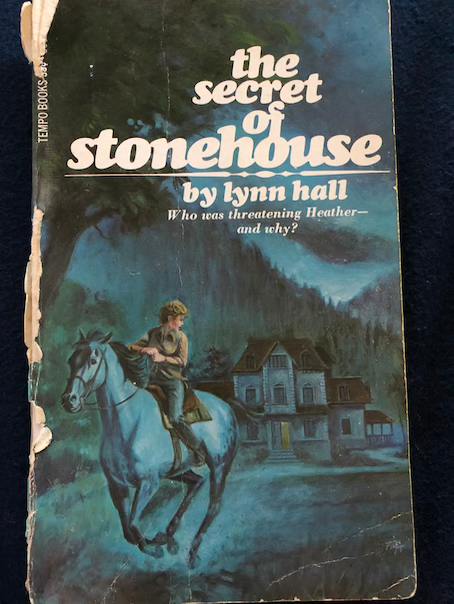
Heather has lived her entire life (as far as she can remember) in Scotland with her grandmother and her uncle, Donald. Donald has raised her since she was small. He’s been like a father to her, and she loves him like a daughter. However, he recently decided to move the two of them to the United States, taking them to a small town in Wisconsin. Heather can’t understand the reason for the move, and for the first time in her life, it seems like Donald is keeping secrets from her.
Donald seems oddly concerned that Heather shouldn’t tell people that she is adopted, something that he’s never seemed concerned about before. Heather has asked him about her parents before, but all he can tell her is that his wayward brother Ewen brought her to the family farm in Scotland, saying that she was his daughter and that her mother was dead. Ewen simply left her with Donald, never trying to see her or talk to her again and never sending her any money. Heather also knows that, although says that he’s going out to search for a new job, he’s been hanging out in other places, spending time with the mysterious Mr. Worley.
Heather makes friends with a boy named Gus who lives nearby. Gus lets her ride one of the horses that his family owns, Cloud, and invites her to go riding with him sometimes and participate in local riding events called “shodeos.” Heather loves horses and enjoys their rides together.
On one of these rides, the two of them go near a large, old, stone mansion that gives Heather a strange feeling. Gus’s family tells her the tragic story of the family who used to live there, the Selkirks. They were wealthy, but young John Selkirk was killed in an accident the day that his beautiful young wife, Molly, gave birth to their only child, a little girl named Hebron. John’s parents never recovered from the loss of their son and passed away soon after, leaving just Molly and the baby. However, when Hebron was only three years old, she was apparently abducted for ransom and later murdered, and her mother died soon after. The story makes Heather uneasy, and the house gives her a strange feeling, like she’s drawn to it.
However, other sinister things start happening. Someone in a car that looks disturbingly like Donald’s tries to run her and Cloud off a bridge. When Donald spends the night away from home “on business”, someone sneaks into the house. Heather begins to realize that someone is out to get her, some mysterious person means her harm. Memories, dangerous ones, are beginning to surface in Heather’s mind, and someone is determined to try to keep her from remembering.
Part of the mystery is pretty obvious (at least, I thought it was, and you might guess it from my plot description), but the part that I didn’t guess was who was behind it all.
The Bassumtyte Treasure by Jane Louise Curry, 1978.
When young Tommy Bassumtyte’s parents died, he went to live with his grandfather. However, his grandfather is now dead, and he is living with his 92-year-old great-aunt, who is in a wheelchair, and her 72-year-old daughter, who has recently had her driver’s license revoked due to her poor eyesight. Although the pair of them have taken good care of Tommy, neighbors have become concerned that they will not be able to do so for much longer because of their age and failing health. Rather than see Tommy sent to a foster home, they decide that he must go to the man who Tommy learns should really be his legal guardian, a distant cousin also named Thomas who lives in the family’s ancestral home, Boxleton House, in England.
The elder Thomas Bassumtyte, who should have taken Tommy when his grandfather passed away, has also since died, but his son, also named Thomas, agrees to take him. Tommy is quickly shipped off to England before there can be a custody hearing in the United States about him because the relatives fear that some official might try to prevent Tommy from being sent out of the country. Tommy is eager to go because he remembers fantastic stories that his grandfather told him about Boxleton House. The current Thomas Bassumtyte also lives there, although the place has become rather run-down, and he fears that he will not be able to keep the place much longer. Thomas was a mountain climber, but he was injured in a fall and hasn’t been able to work much since. He tells Tommy that the two of them might have to move when he is fully recovered and can do more work for the Foreign Office, but Tommy loves Boxleton House from the first moment he sees it and wants to stay.
According to the lore of Boxleton House, a distant ancestor of theirs hid a treasure there, but no one has been able to find it. If young Tommy and Thomas can find it, it would solve many of their problems, and they would be able to keep the house and restore it. All young Tommy has is the mysterious rhyme that his grandfather told him and the strange medallion that his great-grandfather brought with him when he went to the United States in the late 1800s. Thomas tells him that the treasure was supposedly hidden by a distant ancestor of theirs who was fond of riddles, called Old Thomas.
The Bassumtytes were secretly Catholic during the reign of Elizabeth I. Old Thomas was alive then and had a son called Tall Thomas. Tall Thomas traveled frequently and was mysterious about the places he went. One night, he returned to Boxleton House with a young baby, who he said was his son. He had married in secret, and his young wife had died shortly after giving birth. Tall Thomas also brought her body back to Boxleton for burial. However, that wasn’t Tall Thomas’s only secret. Although he remarried, giving his son a stepmother, and lived on for a number of years, he was eventually executed for smuggling messages for the captive Catholic queen, Mary, Queen of Scots. The family was stripped of its noble title and only barely managed to hang onto their house and land. If there was a treasure hidden during this time, it was probably something that the Bassumtytes were afraid would be confiscated by the queen’s soldiers as punishment for the family’s disloyalty or something that Mary had given to Tall Thomas to hide for her.
As Thomas tells Tommy more about the house and the family’s history, he points out Tommy’s uncanny resemblance to Small Thomas, Tall Thomas’s son, as shown in an old painting. Tommy feels a strange connection to Small Thomas, and begins seeing and hearing strange things. An older woman comforts him in the middle of the night, having him recite the same rhyme that his grandfather taught him. A small painting later reveals that this woman was Small Thomas’s grandmother. She appears to Tommy other times, giving him a glimpse back in time and clues to solve the puzzles of Boxleton House.
It is only when Thomas accepts the advice of a family friend who works for a museum that they come to understand the full significance of their family’s heirlooms and the hidden treasure. The treasure may not be quite what the Bassumtytes have always believed it was, but then, the Bassumtytes themselves aren’t quite who they always thought they were, either.
The book is available to borrow and read for free online through Internet Archive.
The Twin in the Tavern by Barbara Brooks Wallace, 1993.
Young Taddy has lived with his Aunt and Uncle Buntz in Virginia ever since he can remember. When they die during an epidemic, he is left completely alone and afraid that he will be sent away to a work house. Before his uncle dies, however, he tells Taddy something that gives him even more reason to be afraid. He tells Taddy that nothing is how it seems and that Taddy is not really their nephew. He says that Taddy will only learn the truth when he finds his twin, but he must beware because he is in danger. Unfortunately, he never says where Taddy’s twin is or what kind of danger he is in.
Before Taddy can decide what to do, a couple of thieves, Neezer and Lucky, come to rob the house because they heard that Mr. and Mrs. Buntz were dead. When they discover Taddy in the house, they bring him with them to Alexandria and make him work in their tavern. Taddy is only given scraps to eat and he must sleep under a table in the kitchen with another boy who works for Neezer called Beetle. However, by coincidence, Neezer and Lucky may have brought Taddy to the very place he needs to be to find the answers about his past and his true identity.
Danger seems to lurk around every corner in the city, and Taddy doesn’t know who to trust. Even when Neezer hires him out to work in the home of the wealthy Mrs. Mainyard and her two daughters, sinister characters surround him, from the suspicious Professor Greevy to the stern John Graves, who visits the family. At one point, Taddy thinks that he’s found his twin, but the boy mysteriously vanishes. Will Taddy find his twin and the secret of his past, or will the danger that his uncle warned him about find him first?
This book was a BOOKLIST Editors Choice Book in 1993 and won the 1994 Edgar Allan Poe Award. It is available to borrow and read for free online through Internet Archive.
My Reaction
This was one of my favorite mystery stories when I was a kid! Orphans with mysterious pasts are staples of children’s literature and make for compelling mystery stories, and the addition of a secret twin makes it even better! Secret twins can be somewhat cliche in stories, but this one is good because there’s an unexpected twist for Taddy that he never considered until the truth is finally revealed.
Many of Barbara Brooks Wallace’s mystery books involve sinister characters with hidden agendas and children who don’t know who to trust because they don’t fully understand the plot they’re caught up in. This book is like that because Taddy doesn’t know the real source of danger to him. Like other children in stories of this type, Taddy frequently depends on the help of other children because he doesn’t know which adults to trust.
The story is set at an unspecified time in the past, although it appears to be sometime in the 19th century.
At first, Sarah Prescott enjoyed her family’s new house. The house wasn’t really new. Other members of Sarah’s family had lived there before, but it was the first place where Sarah hadn’t had to share a room with her younger brother. Then, Sarah’s Great-Aunt Margaret came to live with them, and everything changed, in more ways than one.
Aunt Margaret is the one who actually owns the house where Sarah and her family are living. She’s is elderly and sick and has been living in a nursing home. The rent that Sarah’s parents pay her pays for her care at the nursing home. However, Aunt Margaret has been doing a little better, and she would like to come and live with the family. Having her move in with the family would not only be good for her but for them because Sarah’s father has been in and out of work, and Aunt Margaret wouldn’t charge them rent or at least not much if they all lived together and they helped to take care of her. However, it would mean some sacrifice on Sarah’s part.
Aunt Margaret had once slept in the beautiful room that Sarah has been using, and Sarah must give it up for her now that she will be living with them. It’s difficult for her to deal with, but Sarah is also restricted on when she can have friends over because Aunt Margaret needs her rest, and the family’s lack of money means that Sarah won’t be able to go to the concert that everyone at school as been talking about. These family problems and teen angst could be bad enough, but from the moment that Aunt Margaret moves in, strange and frightening things start happening that only Sarah and her aunt ever witness.
Whenever Sarah and Aunt Margaret are alone in the house, rooms get cold, and Sarah hears weird things like footsteps walking around when no one should be there and a girl’s voice singing that particularly unnerves her aunt. Sometimes, Aunt Margaret’s things are moved around or broken, and there is something mysterious about an old painting that has been in the house for years. Over time, Sarah begins to notice that the painting darkens, and sometimes she can see a man in the painting who wasn’t there before. The presence of the painting also upsets Aunt Margaret, although she refuses to say why. Although Aunt Margaret at first suspects that Sarah is the cause of some of the weird things that are happening, Aunt Margaret is the actual cause, and she is afraid to admit the dark secret from her past that has come back to haunt her.
A long time ago, when she was young, Aunt Margaret had a best friend called Anne, whose father painted the mysterious painting. Anne had a very unhappy home life, and when the opportunity arose for Margaret’s family to adopt her, Margaret wasn’t sure if she wanted to share her home with her friend, although she cared for her a great deal. Because of her hesitation, her parents decided not to adopt Anne. In her old age, she admits that she was a spoiled girl. Unfortunately, her friend went to live with other relatives and ended up dying in a fire, so Margaret never had a chance to make things right with her. Although Anne’s death was a freak accident, Margaret felt guilty because Anne would have lived if her family had adopted her. Anne’s father also blamed Margaret and her family for not doing more for his daughter, although it was his drunkenness and violence that ruined his home life and led him to give up his daughter in the first place. Before he died, he threatened revenge against the family in some way. Now, his vengeful spirit has found a way to use the old painting to reach Margaret once again, and unless Sarah can find a way to stop him, he will make sure that Margaret joins Anne in death . . . and possibly Sarah, too. However, there is also Anne’s spirit to consider. In life, Anne was the only person who ever stood up to her father. Would she be willing to do it one more time for Margaret’s sake?
Part of the story is about being willing to sacrifice for the ones you love. Years ago, Margaret hesitated to give up some of her pampered life for her best friend, and she regretted it forever after. Sarah also comes to see how her earlier worries about giving up her room and about sleepovers and concerts were petty when compared to helping a relative who loves her. She also sees how it’s important to do the right thing when there’s time because sometimes there is no opportunity to do it later.
In a way, I felt like the problem was solved rather easily, but there were some pretty scary incidents in the story and a failed attempt to get rid of the painting that brought some suspense.
The book is currently available online through Internet Archive.


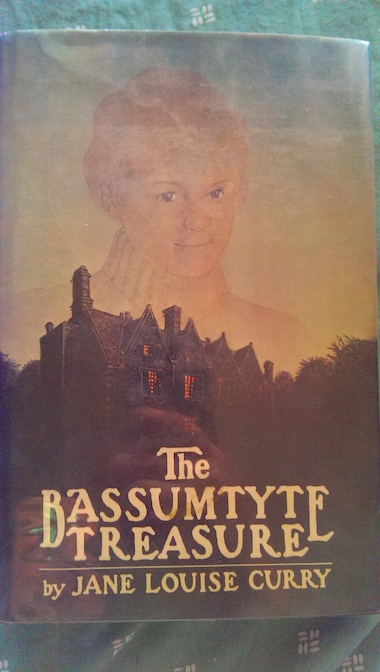 The Bassumtyte Treasure by Jane Louise Curry, 1978.
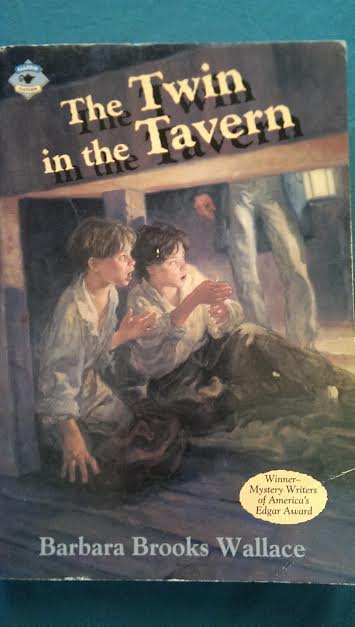 The Twin in the Tavern by Barbara Brooks Wallace, 1993.
 A Ghost in the House by Betty Ren Wright, 1991.
 Jestress's Forgotten Books and Stories