The Lives of Christopher Chant

This is the fourth book in the Chrestomanci series.  In this series, there are many different dimensions, and in each of those different dimensions, there are alternate versions of our world, and there are copies of every person in the world.  Different versions of our world can differ dramatically in their history, and individual people’s lives can differ dramatically between the worlds. There is one person in each generation who has no duplicates in any of the other worlds.  This person is called the Chrestomanci.  All of the talents, abilities, and lives that would have been spread across their duplicates in the other worlds are now centered on that one person, giving that person, literally, nine lives.  The Chrestomanci fills an important role, being better able than anyone else to travel across the dimensions and between worlds, and he acts to keep a balance between them and make sure that the different worlds keep their proper course. This book is about the childhood of the current Chrestomanci, Christopher Chant, and how he came to be the Chrestomanci.

Young Christopher Chant’s early childhood isn’t very happy. His parents have a very unhappy marriage, and his father never pays any attention to him at all. In fact, Christopher hardly even sees him and isn’t confident that he’d recognize him if he met him anywhere. Christopher later learns that his parents’ marriage was one of convenience. His mother has a great deal of money, and his father is from an important family. Christopher’s social-climbing mother wants him to be very important when he grows up. Christopher is mostly raised by a series of nannies and governesses, none of which stay very long. Servants in general don’t stay very long in the Chant household because the parents’ angry bickering and the passive aggressive notes that they force servants to pass to each other when they eventually stop speaking to each other directly make life unbearable. Christopher only learns that this is not how most households are when his nannies and governesses apologize to him before they leave.

Eventually, his parents’ relationship collapses entirely after his father loses a great deal of money, and his father either leaves his mother or is sent away in disgrace. His mother brings her brother, Christopher’s Uncle Rafe, to live with them instead, and she lets Uncle Rafe run the family finances and attend to Christopher’s education. Christopher enjoys having Uncle Rafe in the house because Uncle Rafe is a jolly man and actually pays attention to him, unlike his own father.

Something else that Christopher first thinks is normal but later learns isn’t normal at all are the strange dreams he has. Christopher often dreams of a strange place filled with valleys. Every time he enters one of the valleys, he has adventures there, and people give him presents. He often loses the presents before he returns home, but sometimes, he manages to keep them, waking up with them in his bed in the morning.

One day, the new governess Uncle Rafe hired catches Christopher playing with one of the strange objects and asks him where he got it. When he tries to tell her about his dreams, she doesn’t believe him at first. Thinking that he may have stolen the strange object from somewhere, she takes him before his mother and Uncle Rafe. However, Uncle Rafe does believe Christopher’s explanation. He says that Christopher seems to be a spirit traveler, having the ability to go to other worlds in his sleep, and he is amazed that Christopher was able to bring an object back with him.

Uncle Rafe asks Christopher to try a few tests of his abilities. First, he asks Christopher to look for a man in his dreams and to bring back a package from that man. Christopher does so successfully. The man is called Tackroy, and Tackroy explains more about the other worlds to Christopher. Every valley Christopher sees is a different world. There are series of worlds, and those series of worlds have numbers. The world where Christopher lives is number 12. At first, Tackroy thinks that there are only 12 worlds, but Christopher says that there are many more than that. Christopher can see better in the space between worlds because, as Tackroy realizes, he is actually there physically, where Tackroy can only be there mentally or in spirit. It is because Christopher can go to other worlds physically that he can bring back objects. Tackroy has hardly any substance in these other worlds, being almost like a ghost, until Christopher realizes that he can help make him more substantial. Both Tackroy and Uncle Rafe are excited by Christopher’s abilities.

Then, they decide to do a test of whether Christopher can carry something living from one world to another. Tackroy asks Christopher to get one of the cats from a temple in world 10. When Christopher enters the temple, he meets a young girl, just a little younger than he is. She says that she is the living embodiment of the goddess Asheth, which gives her special powers. However, she is not allowed to leave the temple except once a year to do a blessing, and she can’t interact much with anything or anyone from outside the temple. It’s a very boring life, and she isn’t very happy in it. When Christopher explains to her about wanting one of the temple cats for his uncle, she agrees to give him the most disagreeable cat in exchange for some books from his world because she is so bored. Christopher agrees, and she helps him to capture the cat. Unfortunately, the cat gives him away when he tries to leave the temple. Christopher is actually killed when a temple guard puts a spear through his chest! That is the first indication that Christopher has nine lives.

When Christopher wakes up, he is in his own bed at home, he has no injuries, and he still has the cat. At first, Christopher’s lack of injury makes him think that the other worlds might be a kind of dream after all, but that doesn’t explain how he still has the cat. Then, he has an accident while pursuing the cat in his room that brings down the curtain rod, which stabs him in the chest again! When he screams, the governess rushes in and tends him.

When Christopher wakes up again, he hears the governess and Uncle Rafe talking. The governess has placed healing spells on him, and she thinks he will recover. Uncle Rafe says that the cat from the Asheth temple is very rare and magical and that wizards would pay a lot of money for parts from the cat. Later, when Christopher sees that the cat is pleading for Christopher to let it go, he does so. As much as a he wants to please his uncle, it does seem cruel to kidnap an animal from its own world and take it to another to be killed and have its parts sold off, even if it’s a mean cat that almost got him killed. When the governess looks for the cat later and can’t find it, Christopher just reminds her that it is a magical cat, so she supposes that it just vanished.

Then, unexpectedly, Christopher’s worried father comes to see him without his mother’s knowledge. His father tells him that he had placed a spell on Christopher to monitor his life, and it seemed like the spell had told him that Christopher was dead. Christopher assures him that he’s fine. His father is relieved, but he is also still worried. He tells Christopher that he did Christopher’s horoscope and that the next year and a half will be dangerous for him. He also warns Christopher that his Uncle Rafe isn’t a nice person and that he should avoid getting mixed up in his business.

In spite of his father’s warnings, Christopher continues to participate in his uncle’s experiments in other worlds with Tackroy. Tackroy apologizes to Christopher profusely for the incident with the spear, saying that he would have felt horrible if Christopher had been killed. It becomes clear that Uncle Rafe’s “experiments” involves a business collecting and selling rare objects from one world to people in another. As Christopher helps Tackroy with it, the two of them become friends, and they enjoy exploring and learning about other worlds.

Things change when Christopher is sent to boarding school. He likes school and making his first friends with other boys. He does well in most of his subjects, although strangely, he can’t seem to do any magic in his magic lessons. It’s strange because Tackroy had told him that he’d probably be really good at magic because of his ability to travel through worlds. He hates to give up on magic studies because he really does want to learn more about magic.

Remembering his promise to bring some books to the goddess girl, Christopher asks a school friend with a sister for advice about what girls like. He buys a set of books about a schoolgirl called Millie. Unfortunately, he can’t seem to travel in his dreams at school, like he did at home. His uncle becomes impatient with him for not keeping his appointments with Tackroy, too. Christopher can’t think what’s wrong. Was there something special about his night nursery at home? Is he growing out of his old abilities?

When the school matron notices that Christopher is having trouble sleeping, she removes the new braces that he had put on his teeth, thinking that they’re causing him pain. Suddenly, Christopher is able to travel in his dreams again. He is able to deliver the books to the goddess girl and rejoin Tackroy in their work in the other worlds. Then, another accident that kills him again reveals his secret, extra lives to everyone, including his parents.

At first, it’s difficult to prove that Christopher has multiple lives, and his parents (of course) argue about what to do about it. After learning that Christopher’s mother secretly plans to take him abroad, Christopher’s father quickly removes him from his boarding school and takes him to Cambridge to be tested by an expert. In spite of his earlier apparent neglect, Christopher’s father does care about him, and for Christopher’s own good, needs to confirm a few things that he has already suspected about Christopher. The expert not only discovers the reason why Christopher was unable to perform magic in class (a sensitivity to silver that shuts down his powers whenever he comes in contact with it) but also proves that Christopher is a rare, nine-lived enchanter. Being one of those rare enchanters means that Christopher is destined to become the next Chrestomanci!

Christopher is shocked and dismayed when he is immediately made the ward of the current Chrestomanci, Gabriel DeWitt, and sent off to Chrestomanci Castle. It’s really the best place for him to learn about his new-found abilities, but Christopher fights it. DeWitt embarrasses him by telling him things about both of his parents and why neither of them is really suited to be his guardian. It’s all true, but that only makes it more embarrassing.

Christopher is lonely as the only child in Chrestomanci Castle, and while he is considered very important, nobody there seems to consider his feelings at all. Nobody cares that he would rather be a professional cricket player than a Chrestomanci! If it wasn’t for his natural abilities, which were just an accident of birth, nobody would have any interest in him at all. Also, even the heavy enchantments of Chrestomanci Castle can’t seem to stop the series of bizarre accidents that begin robbing Christopher of his extra lives. The only person who seems to understand Christopher is his secret friend, the goddess girl in world 10. Like Christopher, she is also a prisoner in her temple, being used by other people for her abilities but not really cared for as a person. More than anything, she wishes she could be an ordinary girl, like the girls in the books Christopher brings her, going to school and having friends.

Christopher wants to keep on working with Tackroy for his uncle because he loves exploring the other worlds and because it gives him some freedom from his life in Chrestomanci Castle, but Tackroy points out that his uncle has also been taking advantage of him. His uncle is getting rich off their activities, and he hasn’t even been paying Christopher for making them possible. Tackroy now knows that Christopher has died or nearly died more than once for his uncle’s business. Christopher has been getting deeply involved in something he doesn’t fully understand. The full truth is going to hurt, but Christopher needs to see it to save the lives he has left and realize his proper place in the world(s).

The book is available to borrow and read for free online through Internet Archive (multiple copies).

Some book lists place this book first in the Chrestomanci series because, if you follow a linear timeline of events in the stories, it does come before the other books, but it was originally the fourth book published, and I think it’s best to read the other books first, especially Charmed Life. The books in this series are fantasy, but they’re also mystery stories. There are secrets to be revealed in every book, and if you read this book first, it spoils some of the mysteries in Charmed Life.

It is a good book to read, though, because it provides some of the missing backstories of some of the other characters. At the end of Charmed Life, Christopher (as the current Chrestomanci) tells Eric/Cat about how he found out that he had nine lives and that he was going to be a Chrestomanci even though he couldn’t cast spells at first. His sensitivity to silver is a part of the story, and the way it is revealed in this book matches his earlier description in Charmed Life.

During the course of the book, we also learn a little more about the extended Chant family and get brief glimpses of Christopher’s cousins, who later go on to marry each other and become the parents of Cat and Gwendolyn Chant. The Chants are known for being a powerful magical family that produces enchanters, who are much more powerful than ordinary witches. Once every generation, they produce a disreputable one, which happens to be Christopher’s father in this generation. Christopher’s father is an enchanter, so he’s more powerful than general witches, but not nearly as powerful as Christopher. He has an over-reliance on the horoscope charts he draws, and they don’t always turn out right.

Christopher’s mother and his Uncle Rafe are part of the Argent family, which is also magically powerful but has a bad reputation. DeWitt doesn’t even specify at first what they are known for, only that he would never associate with them. It’s Christopher’s father, who does care about his son even though he doesn’t really know how to care for him, who points out that “Argent” means “silver”, and this is part of the reason for Christopher’s sensitivity to the metal. The Argent family, including his mother, and especially his Uncle Rafe, are toxic to Christopher in ways that he doesn’t fully understand and finds difficult to accept. Christopher’s mother doesn’t actually mean him any harm, like his Uncle Rafe does, but she is foolish and easily swayed by Rafe. Christopher comes to forgive her because he was also tricked by Uncle Rafe into doing his evil business when he was too young and naive to understand.

We also learn the origins of Christopher’s future wife, Millie, in this book. She is very powerful in Charmed Life, but this book explains why she is so powerful. One thing that I don’t think is adequately explained is how Christopher’s children, Julia and Roger, are not Chrestomancis themselves. After all, there is only one of their father, so I think it should be assumed that there are no duplicates of either of them in the other worlds, but they may be exceptions somehow because there was never a chance that they could have had duplicate selves or because their mother is actually the incarnation of a goddess.

The books in this series blend dark parts with some humor, which make the books lighter to read than they otherwise would be. Because of the dark parts, I wouldn’t recommend these books for anyone younger than the middle school level. Christopher does get killed multiple times in the book (although he still has extra lives left at the end), and there is trading in human lives and souls. The goddess girl, who takes the name of Millie, comes to realize that she is meant to be sacrificed when she gets too old to be the young incarnation of the goddess, which is a horrifying revelation. She runs away to Christopher’s world and begs him to help her go to a boarding school, like in the books she likes to read. Her goddess’s followers pursue her to Christopher’s world, and there is more bargaining for her life. Fortunately, the old priestess who has been caring for her is not as heartless as it seems at first. When she finally meets with the girl in front of Gabriel, she admits that she usually finds a way of sparing the young goddess incarnations, buying their lives with one of the nine lives from the temple cats. She has to do it in secret, but she has saved up enough money in jewels to pay for Millie’s education where she can be safe in this other world. To spare Christopher and the cats the children love from losing their lives, Gabriel kindly gives the priestess one of his own spare lives because he still has several lives left. He also accepts the responsibility of having Millie as his ward and arranging for her education.

Through his adventures and having to take charge as the Chrestomanci and rescue Gabriel when he is in trouble, Christopher comes to more fully understand what it means to be the Chrestomanci. He also comes to understand Gabriel a little better. He is surprised to realize that Gabriel has hated the job of Chrestomanci. Like Christopher, he also felt forced into the role and resented it, but he made himself do the job anyway because it is a vital job for the protection of his world and others. To Christopher’s even greater surprise, he realizes that when he does the job for real instead of just having boring lessons, he actually likes the job much better than Gabriel does and no longer resents being trained for it. Gabriel has also realized how lonely and isolated Christopher is, and he says that he is taking steps to bring other young magicians to the castle to work and be trained, so Christopher will have companions. The story ends happily, and there is even a reconciliation between Christopher’s parents.

Charmed Life

This is the first book in the Chrestomanci series.  There are many different dimensions with duplicate worlds, and in each of those duplicate worlds, there is a copy of every person.  People’s lives can differ dramatically between the different worlds, but there is one person in each generation who has no duplicates in any of the other dimensions or worlds.  This person is called the Chrestomanci.  All of the talents, abilities, and lives that would have been spread among the duplicates across the other worlds are now centered on that one person, giving that person, literally, nine lives.  Very often, the Chrestomanci doesn’t realize that he’s a Chrestomanci until he actually dies . . . and fails to die because he uses up one of his spare lives and continues living with the others.

When young Eric Chant’s older sister Gwendolyn gives him the nickname Cat at a young age, saying that he has nine lives, he doesn’t understand that it’s literally true.  Then, he and Gwendolyn are unexpectedly orphaned during a boat accident.  Their parents drown.  Gwendolyn doesn’t because she’s a witch, and the water rejected her.  Cat thought that he was saved because he grabbed hold of Gwendolyn.  Gwendolyn knows differently.

After their parents’ deaths, Cat and Gwendolyn live with their downstairs neighbor for a time, receiving support from the town. Their neighbor, Mrs. Sharp, is also a witch, and she recognizes Gwendolyn’s talent. When she goes through the children’s parents’ things, she finds three letters from someone called Chrestomanci, and she recognizes immediately that they are important. Cat doesn’t fully understand who Chrestomanci is, but everyone regards him as an important person, so much so that they even hesitate to say his name out loud. His signature is valuable, and Mrs. Sharp offers the letters as payment for witchcraft lessons for Gwendolyn from the best tutor in the area, Mr. Nostrum. Gwendolyn breezes through the early lessons easily, and everyone in the neighborhood recognizes her talents. They are sure that Gwendolyn is destined for great things, and they are all eager to ingratiate themselves with her. A local fortune-teller even says that Gwendolyn will be famous and may be able to rule the world if she goes about it in the right way. The fortune-teller also tells Cat’s fortune, but his fortune is a warning that he is in danger from two sides. Cat is frightened and unsure what to think of it.

However, there is still the question about how the children’s parents knew Chrestomanci and what their father argued about with him in their letters to each other. Mr. Nostrum is particularly curious to know what the children know about Chrestomanci, having apparently tried to learn things about him through his signature and failing, but neither of the children can tell him much. Cat still isn’t sure exactly who Chrestomanci is, so he suggests that Mr. Nostrum just write to Chrestomanci himself to ask. It’s such a straightforward approach that it never occurred to either Mr. Nostrum or Gwendolyn to do that before. Gwendolyn ends up writing the letter to Chrestomanci herself, exaggerating her plight as an orphan to gain sympathy, and implying that Cat also drowned in the boat accident. When Chrestomanci arrives to see Gwendolyn, he is initially surprised to see Cat.

Although their relationship to Chrestomanci isn’t explained at first, Chrestomanci takes custody of the children and brings them to live at his castle with his own wife and children, Julia and Roger. Everyone tells the children how lucky they are because living with someone as important as Chrestomanci means hob-nobbing with other important people. Cat realizes that the reason why Gwendolyn wants to go to Chrestomanci is that she is serious about becoming famous and ruling the world. She sees life with Chrestomanci as the first step. Cat is more intimidated and homesick.

Life in Chrestomanci’s castle is quite different from what Gwendolyn expected, though. There is some kind of enchantment over the castle that muffles Gwendolyn’s powers, and that drives her crazy. Gwendolyn is contemptuous of Julia and Roger for being plain and fat, but both of them turn out to be better at magic than she is and are fully capable of standing up to her magical tricks and bullying. Worst of all, nobody seems impressed by Gwendolyn or thinks that she’s special, and Gwendolyn is accustomed to people thinking that she’s special and impressive.

Chrestomanci makes it clear that none of the children are supposed to be practicing magic unless they are under the supervision of their tutor, Michael Saunders. When Gwendolyn and Cat begin having lessons with Michael Saunders along with Julia and Roger, it becomes apparent that Gwendolyn is far behind in her normal subjects, like math and history, even behind Cat, who is younger. Gwendolyn airily tells the tutor that she never paid attention to such things at their old school because she was concentrating more on learning witchcraft. Michael Saunders tells her that she won’t have any more magical lessons until she catches up in her normal studies, and Chrestomanci backs up the tutor. Gwendolyn is infuriated because, not only is nobody treating her like she’s special and impressive, for the first time in her life, they are treating her like what she really is: a spoiled and naughty child.

Gwendolyn’s parents didn’t fully have the ability to impose consequences on Gwendolyn when they were alive, although they were a restraining influence. After they died, nobody tried to restrain Gwendolyn, only trying to ingratiate themselves so she would help them or they could use her for their own purposes. Although Cat has idolized his older sister, there are dark sides to her personality that he has never realized before, and he soon discovers that she has sinister intentions that involve him.

One day, Gwendolyn vanishes and is replaced by one of her duplicates from another world, where magic doesn’t exist.  This other version of Gwendolyn, who is called Janet, has no idea where she is or how she got there.  It is from her that Cat learns that there is no duplicate of himself in her world.  While Cat struggles to figure out what is happening, he helps the new girl to pretend that she is the usual Gwendolyn, although she actually has a very different, much nicer, personality. The more Cat tells Janet about Gwendolyn, the less Janet likes her or the idea of being her, which makes Cat nervous.

When Cat and the new Gwendolyn realize what Cat’s Gwendolyn intends to do, they will need the Chrestomanci’s help to stop her and for Cat to claim his true destiny, the one that Gwendolyn has been attempting to conceal from him all along.

The book is available to borrow and read for free online through Internet Archive (multiple copies).

One of the best parts of the book for me was the setting at Chrestomanci Castle. The idea of living in a castle with magical playmates who can make toy soldiers move on their own is exciting! Cat and Gwendolyn’s rooms in the castle sound like the kind of bedrooms that any kid might imagine having. Even though the castle is strange and sinister things are happening, there is also a kind of coziness to the atmosphere. The children have hot cocoa every morning in the nursery. (I’m not sure why Cat, Gwendolyn, and Janet don’t like hot cocoa. Having hot chocolate for breakfast every morning would have made me happy as a kid, although I admit that, if Chrestomanci and Millie are concerned about their children’s weight issues enough to limit their marmalade intake, that’s not really the best morning drink they could have. I would have suggested tea instead. While we’re on the subject, I didn’t like the way they kept going on about the kids’ weight issues.) They have their own old-fashioned schoolroom in the castle with their own private tutor. When they get allowance money, they can walk to the charming, old-fashioned town nearby and buy candy and other small items. Millie is a doting magical mother, and even though Chrestomanci can be a little intimidating and fussy about appearances, he seems to genuinely care about the children and isn’t above sticking his well-dressed head into the nursery to say good morning and check on them.

During his time at Chrestomanci Castle, Cat learns things about his parents and his sister that he never knew before. His parents were actually cousins, and marriages between cousins in magical families are frequently dangerous, especially when they have children. Chrestomanci is also their parents’ cousin, and the argument he had with their father through their letters was about preventing the couple from having children any children with magical abilities, a suggestion that insulted and angered their father. Their father later came to regret that when young Gwendolyn first started using her powers, and even her parents started to see that she was dangerous. They weren’t quite sure how she was using Cat, but they had the sense that she was using him to do her magic somehow. Nobody thought to take Cat’s nickname seriously until Janet started questioning the reason why Gwendolyn started calling him that.

The truth is that Cat is a nine-lived enchanter. Gwendolyn realized this when he died at birth but didn’t actually die, and even though she was young herself, she found a way to hijack his powers. From the time when he was a baby, she’s been using his powers as if they were her own. That is how Gwendolyn appears to be unusually powerful for her age, even though she’s never really had the patience to go through any of her lessons by the numbers, just glossing over the beginning parts. Cat has been unable to use his own magical abilities because Gwendolyn has been keeping them all for herself, so for a long time, he assumes that he doesn’t have any magic at all. Since Gwendolyn has been doing this for his whole life, Cat has grown accustomed to how it feels and doesn’t notice it until Janet puts together the clues and realizes what’s been happening. When Gwendolyn does particularly powerful magic, she even sacrifices one of Cat’s extra lives, which she placed in a little matchbook for easy use.

Cat is appalled when he finds out about it, and he doesn’t want to believe it at first. However, when he tries to light one of the matches and instantly catches fire, he is convinced. What is even worse is that Gwendolyn and her magic tutor are planning to use him as a human sacrifice to open the gateway to other worlds so that they and the other evil magicians can use their powers to control these other worlds. Gwendolyn is a malevolent narcissist and always has been. Cat is devastated when he learns how little Gwendolyn cares about him, but he manages to finally summon enough anger to stand up to Gwendolyn and take his powers back from her. Like other victims of narcissists, he has always been the stronger and more powerful of the two of them, but he needed some help to see it.

Unlike Gwendolyn, Janet is not a narcissist and is capable of feeling empathy and caring for others. She’s even capable of selfless acts and personal sacrifices for the sake of others when necessary. When Gwendolyn escapes and permanently seals herself in another world where she is a queen, Janet is stuck in Cat’s world, unable to return to her own. It’s a terrible blow for her to be separated from her parents, who are alive in her world. However, when Chrestomanci asks her if she will be okay and if she wants him to try to return her to her own world, she refuses the offer because she has discovered that the double who replaced her in her world is an orphan who badly needs a family. While Gwendolyn was even going to volunteer Janet, one of her other selves as a sacrifice if Cat wouldn’t do, Janet is willing to sacrifice her former life in her world for the sake of one of her other selves. Janet is really the kind of sister that Cat has needed all along. She says that she was supposed to have a younger brother in her world but that he died at birth, and she is fascinated to find Eric/Cat alive in this new world and get to know the brother she lost. Janet learns to love her new brother and to get along with Julia and Roger, becoming the kind of girl Gwendolyn really should have been to her family. She doesn’t have any magical abilities, but she discovers that she can help help her new family because life in her usual world (which is supposed to be our world) has given her a different perspective from theirs. She is the one who suggests to Chrestomanci that he stop using silverware made of actual silver, which impedes his powers, and use stainless steel instead. When Gwendolyn played magical tricks at dinner, Chrestomanci always had trouble dealing with it because he was holding silver, but if he uses stainless steel, he won’t have that problem again. Chrestomanci and Millie admit that they never thought of that because stainless steel cutlery isn’t common in their world.

I remember finding this story fascinating the first time I read it as a kid. There are some dark themes with Gwendolyn’s narcissism, the threats to the children’s lives, and even Cat losing a few more lives. Cat’s growth is central to the story. Once Gwendolyn’s toxic influence is removed from his life, he begins to see the truth about himself and how Gwendolyn has treated him. Cat had always looked to her for comfort as his sister and his last living relative (so he thought), but all along, she was the one who was most dangerous to him, and that’s a terrible betrayal. Once Cat starts to understand the situation, he begins to see his own potential, and he also has some new people in his life who show him better treatment. The castle is charming, the world is fascinating, and the story is thought-provoking about the different ways a person’s life can go in different circumstances. Other books in the series go into more detail about how the different worlds in this universe function and how they split off from each other in different series, based on the outcomes of important events.

House of Many Ways

House of Many Ways cover

House of Many Ways by Diana Wynne Jones, 2008.

This is the third book in the Howl Trilogy. The Howl books are a loose series. Although the wizard Howl, his wife Sophie, and the fire demon Calcifer are the main characters in the first book and appear in all of the other stories, they are not the main characters in the other stories.

When her Great Uncle William, who is a wizard, has to go away for treatment for a health condition with the elves, Charmaine’s Aunt Sempronia volunteer her to house-sit for him. When Aunt Sempronia goes to tell Great Uncle William that Charmaine will be looking after his house, he asks whether Charmaine knows anything about magic. The aunt says that she doesn’t think so. Charmaine spends all of her time reading and doesn’t usually help much with the housework at home. Her aunt thinks this responsibility would do her good. Great Uncle William is a little concerned because his house is not an ordinary house, and he says that he had better take some precautions.

Although Charnaine could be annoyed at being volunteered for this chore without her permission, she is actually grateful for this opportunity to get away from her parents. Her parents are overprotective of her, and they never allow her to do anything that is remotely daring or doesn’t seem completely respectable. She feels stifled, and she wants the chance for a little independence. One of her first acts of independence is to write to the king, telling him that, more than anything, she would like to help catalog his library. She knows that the king is cataloging it himself with the help of his daughter, Princess Hilda (which was established in the previous book in the series), but Charmaine loves books more than anything and she has always dreamed of being an assistant librarian in the royal library. Her parents would think that she was being too cheeky by asking for this position.

In the meantime, Charmaine can prove herself capable and enjoy further independence in Great Uncle William’s house. When she arrives there, Aunt Sempronia tells her that living in a wizard’s house is serious business. Charmaine doesn’t know much about magic because her parents would never let her study it. They didn’t think magic was very respectable.

When Great Uncle William meets her, he seems pleased by her and starts to tell her that he has taken precautions for her stay in the house. Charmaine is about to tell him that she doesn’t know any magic, but they are interrupted by the elves, who come to take Great Uncle William away for his treatment. Charmaine asks the elves how long Great Uncle William will be gone, but they just say “as long as it takes.” Although Charmaine finds herself alone in the house, she hears Great Uncle William’s voice telling her that she will have to tidy the kitchen and apologizing for leaving so much laundry. His voice also says that there are more detailed instructions in the suitcase he left behind.

Before looking at the detailed instructions, Charmaine decides to take a look around the house and get herself unpacked. The kitchen is a horrible mess, and there are enormous bags of laundry. To her astonishment, there are no water taps in the kitchen sink, but there is a water pump outside. This is going to make her job harder. She is tempted to put her nose in a book and forget all her troubles and chores in the house, but she left the job of packing her own bag to her mother, and her mother didn’t include the books she had sitting out. Charmaine realizes that she should have packed her bag herself. This house-sitting job is going to be an education in responsibility as well as independence for Charmaine.

Charmaine also discovers that there’s a dog in the house that nobody told her about. Great Uncle William’s voice tells her that the dog is called Waif, that he used to be a stray, and that he’s afraid of everything. Charmaine was always afraid of dogs because of her mother’s worries about them, but Waif is so timid that she doesn’t worry about him and shares her food with him.

Charmaine realizes that she has led a very sheltered life, partly because of all of the things she was never required to do and also because of the things her parents wouldn’t let her do. It helps that anytime she asks a question out loud, Great Uncle William’s voice gives her the answer.

As Charmaine starts learning her away around the house, she discovers both that she has her work cut out for her and that it’s incredibly easy to get lost in the house. She also discovers that Great Uncle William’s study has many books in it. A note that her uncle left for her in the study says that he could be gone for about two weeks to a month and explaining more about the spoken instructions he left for her as well as the instructions in the suitcase. The note says that she can use the books in the study, but it warns her to be careful of the difficult spells. Charmaine is very appreciative for the books, although she finds them difficult to understand because they are all about magic. There are also many letters in the study written to her uncle by other wizards, including one from the wizard Howl. Many of the letters are from people asking Great Uncle William to take them on as apprentices. Charmaine thinks that her letter to the king probably sounded as pathetic as some of those letters to her great uncle.

Because Charmaine has never been allowed to try any magic before, she can’t resist trying one of the spells from one of her uncle’s books. She chooses one that looks pretty easy, but because the book’s pages turn every time she leaves to get more ingredients, she ends up putting bits and pieces of different spells together. Her spells does what she intends it to do, but the full results take some time.

Things get complicated when Charmaine has a terrifying encounter with a creature called a Lubbock while picking flowers in the mountains near the house. The Lubbock claims that it owns all the land around and everyone in it … including Charmaine. She has a narrow escape, getting away from the creature!

After she returns to the house, she meets a new arrival: Peter, Great Uncle William’s new apprentice. This unexpected guest gives Charmaine an extra responsibility. Peter is still pretty inexperienced with magic and often gets left and right mixed up, but even though he’s almost as inexperienced with everything as Charmaine, he is still company for her in this strange house. He recognizes that the reason why the house is so confusing and rooms seem to move around is that Great Uncle William has cast a spell on the house to bend space and include extra rooms in the house.

When Charmaine tells Peter about her encounter with the Lubbock, he is alarmed. The two of them research Lubbocks in Great Uncle William’s books, and what they learn is horrifying. Lubbocks need human hosts to reproduce, and those hosts die. The Lubbock offspring are also evil. While a full Lubbock looks like a purple insect, a human and Lubbock hybrid will have purple eyes. Charmaine and Peter reassure themselves that neither of them shows any sign of being part Lubbock. However, even with her aunt and mother coming to check on her, Charmaine isn’t prepared to let her fear of the Lubbock ruin her first experience with independence.

To her surprise, the king also accepts her application to work in the royal library! The cataloging work in the library isn’t quite as much fun as she had imagined it would be because much of it is routine documents, but Charmaine learns that the king and his daughter are searching for some very important documents. Before he went away, Great Uncle William was also helping them. Now, the princess has called in an old friend of hers, Sophie Pendragon, wife of the Royal Wizard Howl of Ingary. There is a plot against the royal family which has kept them poor. Not all of the royal family is what they seem to be, and some of the secrets of the past are hidden in Great Uncle William’s unusual house.

The book is available to borrow and read for free online through Internet Archive (multiple copies).

My Reaction

Some of the characters in this book other than Sophie, Howl, and Calcifer were introduced in the previous book in the series. The elderly princess was one of the princesses kidnapped by the djinn, which is how she met Sophie. The king’s cook, Jamal, and his dog were also introduced in Castle in the Air. However, Charmaine is definitely the main character of the story, along with Peter as her sidekick and main helper. The other characters are there for support. Howl and Sophie help Charmaine by providing her with information that she wouldn’t have had otherwise, and Calcifer destroys some of the threats because only a fire demon is powerful enough to do it. Howl is in the castle in disguise because, as one of the royal wizards of another country, it wouldn’t be right for him to seem to be working for the royal family of another country. Unlike in Castle in the Air, though, readers know right away what Howl’s disguise is, and it’s played for comedy. The villains of the story aren’t too difficult to spot once they appear. What is more mysterious is what the king is searching before and what happened to it.

Charmaine’s self-discovery is a major part of the story. Charmaine knows from the beginning that she has lived a very sheltered life because of her mother’s standards for what is “respectable” and proper for a young girl like her. She has already decided that she doesn’t agree with all of her mother’s ideas and that she wants some independence. To her credit, although she does resent some of the routine chores she has to do while taking care of Great Uncle William’s house, she is determined to learn what what she has to learn to achieve some independence and do some of the things she really wants to do. Peter knows more about some things than Charmaine does, like how to do dishes and laundry, so he is some help to her, but he has only recently left home to take up his apprenticeship, so there are things that he doesn’t know, either. Neither one of them knows how to cook, so they turn to Charmaine’s father for advice and recipes. Charmaine’s father is more broad-minded than her mother, so he is willing to help. Charmaine also gradually learns to get along with Peter, and they learn how to consider each other’s feelings and allow each other their own learning opportunities. At one point, Peter tidies up Charmaine’s room as a favor to her, but she is annoyed and tells him not to do that anymore because she wants to take care of her own things for herself.

From her own experimentation and from what her father tells her, Charmaine discovers that she has a natural talent for magic. She inherited her magical talent from her father, who admits to her that he has secretly been using his talent for making things in his bakery. He never tells his wife about his magic because she wouldn’t approve.

And This is Laura

And This is Laura by Ellen Conford, 1977.

Twelve-year-old Laura Hoffman feels out of place in her family. Her other three siblings are over-achievers. They all have particular talents and interests and earn awards for them or just have the ability to impress people. Laura gets good grades in school, but apart from that, she doesn’t seem to have any unique talents or interests. She doesn’t think there’s anything about her that would earn an award or impress anybody. Laura feels depressingly average next to the other members of her family.

It isn’t that her family is pressuring her to achieve anything in particular or to be like them or do what they’re doing. It’s just that Laura wishes that she had something more interesting and distinctive about herself. Other people who know Laura’s siblings keep comparing her to other members of her family. When she joins the drama club at school, one of her teachers seems a little disappointed that she’s not quite as good at acting as her older sister is. Laura’s friend, Beth, tells her that she’s good, but Laura feels like she’s never good enough, never as distinctive as she should be.

By contrast, Beth’s family is much more conventional. She only has one younger sibling, not three siblings, like Laura. Her mother is a lawyer, and their house is always neat and stylish. Laura’s house is noisy and chaotic, and she describes their household clutter as looking like a rummage sale. Laura thinks of herself as being a more ordinary, conventional person, and it occurs to her that she feels more at home in a conventional house. When Beth comes to visit Laura’s house, Laura worries at first that Beth will think her family is too weird. However, Beth is charmed by their eccentricity. In fact, Laura feels a little hurt at how interesting Beth finds the rest of her family. Laura worries that she’ll always be boring and ordinary compared to everyone else. However, Laura has a special talent that even she doesn’t realize that she has.

While Beth is having dinner with Laura and her family, Laura’s mind wanders from the chaotic conversation at the dinner table. She suddenly finds herself having a vision of her scientist father in his laboratory. She sees him meeting a man in a white shirt and then acting excited, like he’s just had an important discovery. The vision feels strange to Laura different from a daydream. When it’s over, she hears her father saying that he has a lot on his mind, and Laura absent-mindedly tell him that he’ll figure it all out tomorrow, after the man with the white shirt comes. Suddenly, everyone stops eating and stares at her, wondering what she meant, but even Laura herself isn’t sure. She’s aware that she knew her father was working on some difficult problem because he was juggling hard-boiled eggs earlier (something her eccentric father does whenever he needs to think), but she’s never had visions like that before and doesn’t know who the man in the white shirt is or what her vision really means. She just thinks it’s nice that everyone seemed to notice her.

There must be something to Laura’s visions because her father later tells her that he figured out his problem just like she said she would. Beth is intrigued by Laura’s apparent ability to predict things and tries to help her have another vision. Laura sees Beth on a stage with flowers at her feet and takes that to mean that she’ll be the star of the drama club play. However, Laura isn’t sure that her visions are always true because, when Beth tries out for the lead, she only gets the second best part in the play.

Another odd thing about Laura’s ability is that the girls realize that it doesn’t work well in a quiet environment, like Beth’s house. Laura gets visions when she’s surrounded by noisy chaos and starts to feel like she’s either outside of the situation or wants to be outside of it.

At first, Laura likes feeling special and noticed because of this unusual ability she seems to have, but it soon starts to worry her. She’s not sure that she can always trust her visions to be right or her ability to interpret them. She also begins to realize that it’s not so much that people are starting to notice her as a person but to pay attention to her ability, which is different. It starts to make her feel even more out of it than before.

Then, Laura has a terrifying vision where her younger brother, Dennis, is missing and her mother is frantic with worry. Is that vision real? Is something really going to happen to Dennis, or is there another explanation? The vision wasn’t clear on what would happen to Dennis, and if it is a real vision, can Laura do anything to protect her little brother?

The book is available to borrow and read for free online through Internet Archive.

My Reaction and Spoilers

This story starts off like many other kids’ books I’ve read, where a character feels out of place in their family or wishes that they had some talent that would make them stand out from their siblings. Then, it takes a turn for the mysterious when Laura begins to have visions that make it seem like she can predict the future. At first, Laura enjoys the feeling of being special and noticed, but then, her visions start to frighten her.

Another girl at school, Jamie, hears her talking about it with Beth, and she tells Laura that she’s fascinated by people with psychic abilities. She’s read about it before, and she points out to Laura that not being right all the time or not knowing what a vision means at first doesn’t mean that she isn’t gifted. When she explains to Laura how alarming visions can have perfectly innocent explanations because visions can be metaphorical, Laura feels better.

Jamie persuades Laura to give psychic readings to classmates for money, but the idea of turning her newfound ability into a business doesn’t feel right to her. Sometimes, she sees things that she doesn’t like, things that frighten her. It’s bad enough to predict that a classmate will fail a class, but another vision suggests that a classmate will die. He doesn’t die, but he does get into a car accident, and that’s bad enough. Laura realizes that it’s horrible to see that bad things will happen without having a way to do anything about it. Also, instead of being pleased and proud of her, her family finds the whole business unnerving and all of the kids who come to see her for psychic readings too chaotic, even for them.

There are also the disturbing visions that Laura keeps seeing about Dennis. She takes her friends and her old sister, Jill, into her confidence. Jill says that she will keep a close eye on Dennis to make sure nothing happens to him. Dennis does disappear during the story, and people worry about him, but nothing bad happens to him. Nobody in this story dies, and Laura uses her visions to figure out where Dennis is.

Toward the end of the book Laura talks to her parents about whether or not they’re proud of her because of her psychic abilities. They have a family talk about what it means to be proud of someone. The parents say that they’re not proud of their children for being talented because they don’t see themselves as being directly responsible for their talents. They love all of their children simply because they’re their children, and they’re good people, who do what they think is right and care about others. As far as talents and accomplishments go, the parents see their role as parents as making resources available to their children so they can develop whatever talents they have to the fullest, whether that means letting them have music lessons or encouraging them to try out for the school play. Whatever talents the children have are simply what they were born with, and their achievements are signs that they’re making use of what they have. The children accomplish what they work for themselves, and they’re doing it because they love doing it, not because the parents require it. What makes the parents proud of their children is when they find out what they’re good at and what they love doing. It doesn’t matter to them what their children’s talents are or how their talents compare to each other’s; they just want all of their children to find fulfillment in what they do.

In fact, her mother says that she thinks part of Laura’s trouble is that she’s good at too many things. She’s always gotten good grades in every class, so none of her subjects seems to stand out. If she only got mediocre grades in most subjects and good grades in just one, she would feel like she had a particular talent for that one subject. When she gets equally good grades for everything, nothing stands out to her as her special talent. Rather than being “boring” and “ordinary”, as Laura thinks of herself, she’s actually well-rounded and multi-talented.

Her parents have always been confident that Laura would find her own interests and talents in life. She just feels unaccomplished next to her siblings because, except for Dennis, her siblings are older than she is and have had more time to figure out what their interests are and build up accomplishments. Laura is also a good, caring person, who has been using her talent to help other people to the best of her ability. She looked into everyone else’s future but her own. Her parents say that having a lovable and loving daughter means more to them than any number of impressive accomplishments would be. Whatever anyone else in the world thinks about Laura and her abilities, her family loves her for who she is, not her abilities.

I like the parents’ attitudes, and it seems that the rest of Laura’s family feels the same way, especially her older sister, Jill. I enjoyed how supportive Jill was about both Laura’s psychic abilities and about her acting. When Laura tells Jill that she’s thinking about quitting the drama club because her teacher seems disappointed that her acting isn’t as good as Jill’s, Jill persuades her not to quit. Jill tells Laura that she would understand if she wanted to quit the drama club because she discovered that she really didn’t like drama after all, but she doesn’t want her to quit because she thinks she isn’t good enough. Jill says that Laura is good but that she just needs a little more coaching. She wants her sister to see that she is more talented and capable than she thinks and to make the best use she can of her talents, all of them.

There were a few instances of mild swearing in the book and one semi-dirty joke. When Laura thinks that she’s hopeless at acting because her teacher is disappointed that she’s not like her sister and says that she’s going to give up the drama club, Jill insists that Laura read the role for her so she can see what her performance is really like. Laura doesn’t really want to, but Jill insists that she stand up and read it properly because “You can’t act lying down.” Laura quips that “You can if you’re in an x-rated movie”, and Jill wryly tells her that she’s too young for that. The joke only works if the reader knows what an x-rated movie is, so it would probably go right over the heads of anyone too young to understand it.

One part of this book that I thought was amusing was when Laura explains about her mother’s writing career. When her mother was younger, she played bit parts in movies, and now, she writes gothic romance novels and westerns. Laura doesn’t like the westerns, but she’s read a couple of the gothic romances, and she has noticed that her mother’s gothic romances are very formulaic – “heroines who go to live in crumbling old castles where dark family secrets are buried and everyone acts strangely and the heroine finds herself in Terrible Danger.” That is a concise and accurate description of that entire genre of books. Her mother says that’s part of the challenge of writing gothic romance – writing the same story over and over in different ways so readers can hardly recognize that it’s the same story at all.

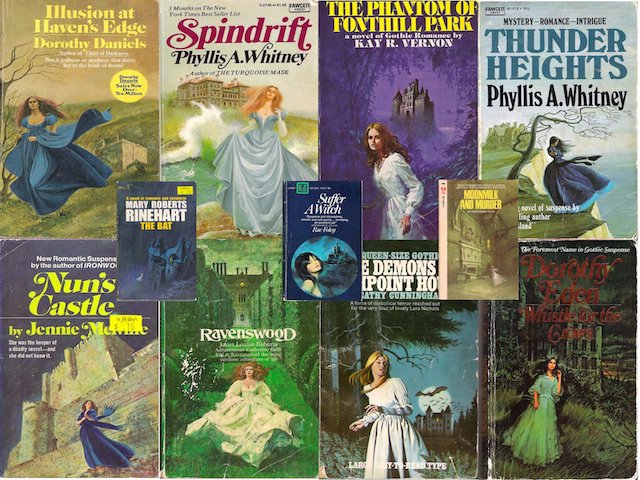
The reason why that’s funny to me is that, years ago, my brother and I were sorting through some old books, and we found our mother’s old collection of gothic romance books. I was immediately struck that all the covers on the books looked alike. They weren’t completely identical, but they all had young women in dresses running away from crumbling old manor houses or castles while looking scared. Sometimes, the heroine had a blue dress and sometimes a red one. (More often than not, the dress was blue, but sometimes, there would be a girl in red, pink, or white. Other colors were rare.) There were a few where it looked like it was even the same girl or the same castle viewed from a different angle. I thought it was so funny, I picked up a couple more with very similar covers from a thrift store and made a couple of digital collages with them that I turned into backgrounds for my computer screen. The same story, told over and over in different ways. You can’t judge a book by its cover, but these covers do explain a genre. I’m not saying it’s not a fun genre, only that I find it funny. Whoever did the covers for these books was undertaking the same sort of challenge that writers like Laura’s mother did in writing them.

Annie’s Promise

AnniesPromise

Annie’s Promise by Sonia Levitin, 1993.

This is the final book in the Journey to America Saga.  Annie, the youngest of the Platt girls, is more of a tomboy than her older sisters.  Her father thinks that she’s been growing up too wild in America, running around and climbing like a boy.  This summer, in 1945, while her best friend goes to visit their family’s farm in Wisconsin, Annie’s father wants her to stay home and help him with sewing for his coat business, and Annie’s mother has a list of chores for her to do.  It all sounds so boring and dreary.  Twelve-year-old Annie longs for excitement, but because of her recent appendix operation and her migraine headaches, her parents worry about her health.

Then, Annie gets the opportunity to attend summer camp.  She wants to go and do all the fun summer camp activities that other girls do, but her parents worry at first.  They worry about Annie’s health, and they don’t know who is running the camp or what they do there.  Annie’s older sisters, Ruth and Lisa, tell their parents that it’s normal for girls in America to go to summer camp and that the experience might do Annie some good.  When the family doctor says that Annie is healthy enough to go, her parents finally agree.

At first, camp is hard.  Annie faints soon after her arrival, and she worries that maybe her parents were right about her being delicate.  However, one of the counselors tells her that these things happen and that she was probably just overtired, overheated, and still suffering from the rough bus ride to the camp and that she will be fine after she rests.  Annie is physically fine, although one of the other campers, Nancy Rae, makes a big deal about the incident, calling Annie a “sickie” and other names.  Nancy Rae is a terrible bully, and Annie nearly drowns in the lake after accepting a dare from Nancy Rae to swim across it, in spite of not being a good swimmer.  Annie overhears the counselors saying that Nancy Rae should probably be sent home for goading Annie into a dangerous stunt, but they know that Nancy Rae comes from a bad home and that her father abuses her.  For her own sake, they decide to give her another chance.

However, even knowing Nancy Rae’s troubled history doesn’t help Annie when Nancy Rae keeps picking on her and a black girl named Tallahassee (Tally, for short).  Nancy Rae calls Tally and her younger brother (who is also at the camp) “nigger” and says that Annie is a “nigger-lover” when she tries to protect the younger brother from one of Nancy Rae’s tricks that could have really hurt him.  (Note: I’m not using the n-word here because I like it. I’m just quoting because I want you to see exactly how bad this gets.  Nancy Rae uses this word multiple times, and so do others when quoting her. This book is not for young children.  Readers should be old enough to understand this word and beyond the “monkey see, monkey do” kind of imitation some kids do when they learn about bad words.  The management assumes no responsibility if they aren’t.)  Nancy Rae is a thrill-seeker, who frequently does wild stunts to get attention and tries to make other girls hate Annie as much as she does.  At one point, she snoops through Annie’s things and tries to take her diary.  Eventually, she figures out that Annie is Jewish and makes fun of her for that, painfully reminding Annie of what it was like living in Nazi Germany and of her relatives, who died in the concentration camps.

Finally, Annie reaches the breaking point with Nancy Rae.  At a camp talent show, she arranges with other kids to dump horse manure on Nancy Rae’s head after she finishes singing a song.  Nancy Rae is so humiliated by the experience that she ends up leaving camp.  Annie is relieved that she is gone, but one of the camp counselors, Mary, makes her feel guilty about her revenge because she sees Annie as being stronger and more talented than Nancy Rae and wishes that she could have made Nancy Rae her friend instead, giving the bully a chance to improve herself.  (I disagree with what the counselor says, but I’ll explain more later why.)  Annie feels badly about how things turned out, but the incident blows over, and the rest of camp is a great adventure for her.

At camp, Annie mixes with different kinds of children from the ones she usually sees in her neighborhood and at school, and everything is a learning experience.  She becomes friends with Tally and gets a crush on a boy named John.  There is an ugly incident in which an assistant in the camp kitchen tries to molest Annie when he finds her alone (this really isn’t a book for kids), but the camp counselors dismiss him for what he did.  Annie and Tally talk about many things together, and Tally is very understanding.  The incidents with Nancy Rae and the kitchen assistant bring up the subjects of people who try to victimize others and how to deal with them.  Annie resents that people like that force others to be on their guard, limiting them in ways that they can behave in order to avoid being victimized, but Tally says that there’s no help for that.  As long as people like that exist, she says, protecting yourself is a necessity.  They also compare the way Annie feels when John gives her a little kiss to the repulsed and frightened way that she felt when the kitchen assistant tried to force himself on her.  Both incidents involved a kiss, but the way it was delivered and the person delivering it made each experience feel very different.  In the end, Annie’s crush on John turns into friendship rather than love as she realizes that the kiss was just a friendly gesture.  It is a little disappointing to her at first, but it is still a learning experience for her.

Annie learns that everyone at this camp has been through something bad in their lives.  Annie’s family are war refugees, but Tally’s father has been married three times, and she’s often the one to take care of the house and her younger brother, while her current stepmother cleans other people’s houses for money.  Other kids are poor or orphans or have fathers in jail.  The camp gives them a chance to get away from their problems for awhile, to make new friends, and to develop talents that they can be proud of.  Annie really blossoms at camp, learning to ride horses and work on the camp newspaper.  As Annie’s session at camp comes to an end, Mary offers Annie a position as a junior counselor for the final session of camp, helping the young children.  Annie is enthusiastic about the prospect, but family dramas at home threaten to derail her plans.  Ruth’s fiancé is shell-shocked from the war and has broken off their engagement.  Lisa is tired of arguing with their parents about every small piece of independence in her own life and has decided to move to a place of her own.  With all of this going on, and their parents upset about everything, what chance is there that they will sign the permission slip that Annie needs to become a junior counselor?

This book shows how much the lives of the girls in the Platt family have changed since they first left Germany for America.  It’s partly because they are living in a different country, partly because times and habits are changing everywhere, and partly because all of the girls are growing up and making decisions about what they really want to do with their lives.  The older girls in the family, Ruth and Lisa, are women now and thinking about careers and marriage.  As the girls suffer disappointments and changes of heart, their parents suffer along with them, and Annie realizes that she has to make up her own mind about what she really wants.  As Annie tries to decide what she really does want, her parents struggle to cope with all of the changes in their daughters’ lives and in the changing world around them.  They fight against it in a number of ways, and when things go wrong, whether it’s Annie’s illnesses or the older girls’ romantic problems, they tend to get angry or panic.  As the book goes on, it becomes more clear that what the parents really feel is helplessness.  More than anything, they’ve wanted life to be better for their daughters in their new country, and it upsets them when things don’t work out.  They want to help guide their daughters and make their futures work out for the best, but in the process, they often come across as too controlling or making the wrong decisions because they don’t fully understand the girls’ feelings or situations.

Ruth and Lisa each suffer romantic disappointment before they settle down.  Ruth had a fiancé, Peter, who went away to fight in World War II, but having seen the prisoners in the concentration camps, he has returned disillusioned and dispirited.  He was Jewish, but now comes to associate his religion and heritage with pain and suffering and wants to give it up, breaking off his engagement to Ruth in the process.  At first, Ruth is angry with him, saving that it’s like he wants to give up on his whole life, on the whole world.  The girls’ father says that he wants to kill Peter for leading his daughter on, but part of his feelings turn out to be his own feelings for somehow failing his daughter, that he is somehow to blame for allowing this disappointment.  When Lisa is upset because the young man that she’s been seeing says that he doesn’t want to get married, she argues with her parents about the course of her life and leaves home to live on her own.  Her parents see that as turning her back on their love and protection, but Lisa says that she just wants the independence that other girls have.  Even Annie feels abandoned by Lisa because Lisa was always there to comfort her as a sister and help her persuade their parents to listen to her, but Lisa says that she has to deal with problems on her own and that Annie will understand someday, when she’s in the same position.  Annie realizes that, in a way, she already is in the same position.

The one time that Tally comes to visit Annie at her house and the girls go to the beach together, Annie’s parents make a scene when she gets home because she’s left sewing all over the house and eaten more food than she should have.  Tally was going to apply for a sewing job with Annie’s father, which would have helped both of them, but Annie’s parents send her away, thinking that she’s a bad influence who encouraged Annie to goof off.  Then, Annie hears her own parents use the n-word.  It’s the final straw for Annie, and she runs away to camp.

The people at camp are glad to have her because they need her help, but being there, helping them, and thinking about her own life and future help Annie to realize what’s really important to her.  She’s been feeling bad about the hate she got from Nancy Rae and the hate that she felt from her parents with their insults to her friend.  However, her parents don’t really hate her, and in spite of what they’ve done, she doesn’t really hate them.  She realizes that, before she does anything more with the camp, she needs to go back and see them.

Annie rethinks what Nancy Rae was really about, how she was filled with hate for everyone, dealing out hatred because of all that she’d received from everyone else.  The counselors realized that she needed love more than anything, but Nancy Rae’s own hateful behavior pushed away the people who would have given her more positive attention and Annie’s revenge (although provoked) ended her camp experience.  Annie realizes that she doesn’t want to go down the same path and that she must mend her relationship with her family.

I said before that I disagreed with the counselor’s approach to the problem of Nancy Rae and what she said to Annie about her revenge.  I see what they were trying to do with giving Nancy Rae another chance, but what bothers me about it is that they act like Annie was in a much less vulnerable position to Nancy Rae and that she should have been strong enough to take what Nancy Rae dished out without hitting back, and I don’t think that’s true.  All of the kids at the camp were there because they had something troubling in their lives, some vulnerability, including Annie.  To say that Annie was more fortunate and more talented and that it should have been enough was to discount the harm that Nancy Rae was doing.  I know that the counselors were trying to make the camp experience positive for Nancy Rae, but she was making the camp experience more negative for everyone else around her and needed to be stopped.  Everyone suffers from something in life (as this book also demonstrates), but not everyone chooses to become a bully because of it.  Nancy Rae made that decision herself, within herself, and for herself alone.

Part of the problem, I think, was that there were no obvious consequences for Nancy Rae’s bad behavior, and therefore, she had no reason to stop doing what she was doing.  The lack of punishment and the inequity of the situation was what finally sent Annie over the edge with her.  Since the counselors didn’t make it obvious that Nancy Rae was in the wrong, Annie felt that she had to, and that says to me that there was a lack of responsibility and accountability.  I think that life is a balance and that both positive reinforcement (giving rewards to people who do good) and negative reinforcement (punishment for bad behavior) are necessary.  I believe in plain speaking, and if I were in the counselors’ position, I would make it plainly and specifically clear that no campers were to use the n-word, to mess with others’ belongings, or to do the other things that Nancy Rae was doing and that there would be consequences for doing so, telling them exactly what those consequences were so that no one could say that they were surprised.  I would also make it clear to Nancy Rae that I knew exactly what she was doing and why she was doing it and that it was unacceptable.  When we choose what we do and say in life, we all consider (or should consider) what we want to happen in life, and I would put it plainly to Nancy Rae how she really expects others to react to her and how their reactions would change if she did things differently.  Clearly, no one has ever told her that in her life before, and it was about time that she heard it from someone.  I suppose we could guess that the counselors may have said something of the sort to her out of hearing of the others, but I would also say the same thing to Nancy Rae’s victims.  Letting them know that I’d dealt with her adequately might head off their attempts to deal with her themselves and talking about what our behavior might lead others to do might also discourage revenge.

Also, the counselors were counting too much on the idea of friendship with Annie to get Nancy Rae to stop treating her badly, but that’s not at all the way that bullies work.  One of the primary reasons why people bully is that they know that there are a lot of people who like mean humor, and they use their bullying to bond with those people, not their victims.  Their friendships are formed on mutual contempt for the victim and the fun of humiliating that person.  They’re getting everything they want through their bullying, so there’s no reason for them to stop until someone else gives them consequences and puts an end to their bully support network.  I think that the counselors should have also talked to the people Nancy Rae was trying to bond with, explaining that they know what Nancy Rae is attempting to do and telling them that they would also be punished if they tried to help her, further cutting off one of Nancy Rae’s incentives to keep doing what she’s doing.

I’m not saying that it’s a perfect solution or that it would be guaranteed to work, just that I believe in being direct rather than letting things slide and just hoping that people will someday see the light.  Sometimes, people just need to have things spelled out for them in no uncertain terms.  If they chose to ignore what you say, then it’s on their own head, and they can’t say otherwise because you were clear and backed up your words exactly how you said you would.  I do think that the counselors were right that, in the long term, revenge never turns out well.  It often turns into a vicious cycle, as Annie later considers.  However, in this case, some proper handling in the first place, with consequences as well as words, might have headed off the situation before it got that far.

We don’t know what eventually happened to Nancy Rae by the end of the story, but I’m not sure that Annie is right to think that she wronged her.  In fact, she might have actually done her some good.  Sometimes, seeing others react badly to bad treatment can make a difference to someone’s future.  In my experience, people sometimes don’t realize that they’ve pushed another person too far until that other person finally reacts and says or does something.  Realizing that they’ve pushed someone too far can give them a reason to change because they realize that people won’t put up with their behavior forever.  Part of me thinks that maybe, at some point in the future, Nancy Rae might look back on this experience and quietly admit to herself that she had provoked it, being more careful the next time not to pick fights because she can be humiliated or excluded when people get fed up.  It might even help Nancy Rae to realize that she doesn’t have to put up with her father’s ill treatment forever because she also has the right to lose patience with bad treatment, too.  At least, I hope that this was a learning experience for her.

Annie realizes that both her parents and Nancy Rae are angry and hateful because of what they’ve suffered in their lives, but the problem is that both of them are taking it out on the wrong people.  Annie’s parents, at least, seem to realize that what they did was going too far and taking out their feelings on someone who didn’t deserve it.  By the time that Annie arrives home, they are also ready to make their peace with her and even support her return to the camp as a junior counselor, if that’s what she really wants to do.

The final days of World War II frame this story, beginning with the reports of Hitler’s death in the late spring of 1945 and ending with the bombings of Hiroshima and Nagasaki and the Japanese surrender in August.  With the end of the war comes a new chapter in the lives of the Platt family.  They’ve been through a lot together, but in spite of the girls growing up, moving out, and arguing with their parents, they still are a family.  There are no more books in the series, but Annie explains that Lisa gives up the dream she once had of being a dancer because she doesn’t think that she’s star material and because she decides that what she really wants is to get married and have children of her own.  In the end, she and her boyfriend get married, and she is happy with her life.  Similarly, Ruth, who is now a nurse, meets a new love when she visits Annie at camp and later marries him.  Annie realizes that she has found what she loves most in teaching young children, taking care of animals, and writing, and these things will form the basis of what she does with her future life.

Liars

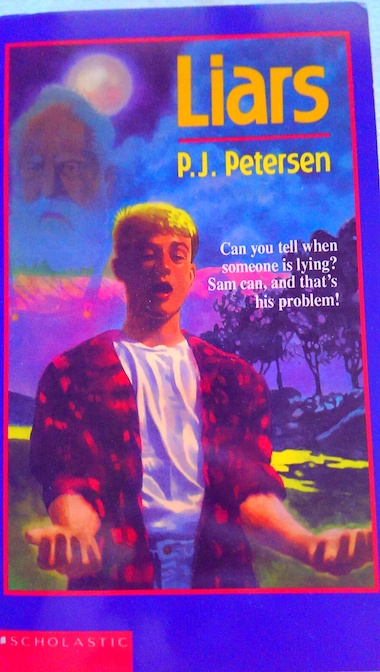
LiarsLiars by P.J. Petersen, 1992.

Sam lives in the small town of Alder Creek in California. The town is so small that they only have a one-room school (well, two rooms, if you count the library/storage room). Sam’s friend, Marty, describes most of what happens there as SOT (Same Old Thing) or MOTSOT (More of the Same Old Thing). However, their town contains some disturbing secrets, which they are about to learn.

Uncle Gene, an old man in town, has a reputation for being a “water witch.” He has the ability to find good sources of water when they need to dig a new well. He lets the local kids watch him when he’s using his dowsing stick and even lets Sam and Marty have a try. Sam has never really believed that Uncle Gene has any special abilities, even kidding Marty for believing in it. However, when Sam takes hold of the dowsing stick, he finds it drawn toward sources of water, like a magnet. Uncle Gene says that Sam has the gift and is a water witch, too. Sam is still somewhat skeptical, thinking that there’s probably something more scientific behind what he experienced, but from that time on, he finds himself sensing other odd things from the people around him.

In particular, Sam can sense when people around him are lying. It sounds like it would be a handy gift to have, but it has some drawbacks. Even when he can tell that someone isn’t telling the truth, he can’t tell exactly what they’re lying about. Some lies are obvious, like those of classmates bragging about things or Mr. Lopez saying that he enjoys living in the small town when, apparently, he really doesn’t. However, Sam can’t always distinguish between small lies or serious ones. Some lies seem to affect him more than others, possibly because the liars themselves feel more guilty about those, but by itself, that doesn’t tell him whether the lie is serious or not. He knows about Mr. Lawlor poaching animals in the forest, so that lie is also obvious to Sam, and he later realizes that his wife is lying about her teaching credentials. When he exposes Mrs. Lawlor’s lies, everyone becomes aware of Sam’s gift.

This ability becomes disturbing for Sam because it seems like everyone around him is lying about something. It’s also somewhat unsettling for some of his friends, like Carmen, who worries about what he’ll think of her if he catches her in a lie. Even Sam lies somewhat himself, saying that he knows that Carmen wouldn’t lie to him when he’s already caught her. But, Carmen sees right through his reassurance, even without sharing Sam’s gift. She’s the one who points out to him that the problem with his gift is that, even though he can tell when someone lies, he can’t tell exactly what they’re lying about or why they’re doing it. She mentions the little white lies people tell to spare someone’s feelings, like saying that they like a person’s clothes when they really don’t, but also how people sometimes lie when the truth is none of someone else’s business. The lie that Carmen told Sam earlier was about why the two of them couldn’t hang out together one day. She said that her parents were expecting company that evening, but the truth was that her parents have been fighting a lot, and she didn’t want Sam to see it because their personal problems are no business of his. This incident, along with a time when Sam has suspicions about an innocent person because the person falsely thought that she might actually be guilty of a crime lead Sam to worry even more about his gift.

However, there are real crimes being committed in his town, and Sam’s gift might be the only way to find who is behind it all. First, someone tries to break into Uncle Gene’s house. Uncle Gene thinks he knows why. Supposedly, there’s a hidden mine in the area, and he’s been looking for it for a long time. He thinks that he’s getting close and that someone was after his maps. Later, his house is set on fire.

But, is the lost mine the real reason why someone is after Uncle Gene? He’s been poking around in some out-of-the-way places during his search, and the kids know that he’s reported someone for growing illegal marijuana. Is the grower out for revenge? With Sam’s own father lying to him about his whereabouts, Sam worries that he may have something to do with what’s going on. It’s only a pity that his gift can’t tell him what his father, or anyone else, is lying about. It only tells him that they’re liars.

With more places making marijuana legally these days, this part of the story might not seem so serious as it did back in the 1990s, when schools were emphasizing that kids should “just say no” to drugs. Marijuana was viewed as being as bad as any other drug, and in this book, the grower doesn’t seem concerned about the possible medical uses.

Sam’s father is not the villain of the story, although he is engaged in something that he doesn’t want to reveal to his son or the rest of the town immediately. There is also a subplot about the death of Sam’s mother. She is already dead when the story begins, but Sam and his father haven’t completely healed. At the urging of Marty’s mother, who also helps Sam to explore his gift, the two of them begin talking about her more, when they had been avoiding discussing her for some time because talking about her was too sad for them.

In the end, Sam thinks that he’s found a way to stop sensing people’s lies (the less he pays attention to what he senses, the less he feels it, so he thinks that ignoring his gift will cause it to fade over time), which is a relief to him because he didn’t like always wondering what people were really lying about, and as Carmen said, some lies are for the best and should be none of his business. I think that’s true, especially the part about lying about things that should be no one else’s business. Some people can be rather pushy in wanting to know the details of other people’s lives, and if they won’t accept “I don’t feel like talking about it” or “I don’t want to tell you” for an answer, a lie of some sort might be a person’s only recourse. Depending on the circumstances, a lie might be harmful or it might protect. Like with Sam’s gift, it may not be immediately obvious which it is, either. Not that people should make a habit of lying, but there are times when it might be the best course of action for all concerned.

I’d like to add that there are many different ways of being truthful as well as lying.  If there are partial lies, and there are partial truths as well.  Some people think that politeness is a kind of lying, like in Carmen’s example of pretending that you like someone’s clothes when you really don’t, but that’s not necessarily so.  Being polite doesn’t mean that you’re pretending but perhaps you’re just choosing which of your thoughts are the most important to mention. Many, perhaps most of us, don’t just think one thing when someone asks us what we think about something.  For example, when someone asks your opinion of their clothes, you might think something like, “Well, I like the color, but I don’t like the style.  At least, I don’t like the way that style looks on you.  But, maybe that’s just because I’m not used to seeing you wear things like that.  I might change my mind later.  Actually, later on, I’ll probably forget that you ever wore that because I don’t care that much about clothes anyway.  Still a nice color, though.”  At least, that’s what goes on in my mind frequently.  There’s no point in telling anyone those random, meandering thoughts, so I just pick the most important part and tell them that I like the color.  Why bother being critical in an effort to sound truthful when the real truth of the matter is that clothes in general aren’t that important to me and I’ll probably just change my mind later, if it sticks in my mind long enough for me give it a second thought?

Then, there are the lies that some people label as the truth for their own purposes. I’ve seen plenty of people say harmful and insulting things to others and then hide behind the defense that they are “just telling it like it is,” when they actually aren’t. Usually, when people say that, they’re actually telling it like it isn’t: lies, exaggerations, or just plain insults disguised as truth. In those cases, their intentions were not to point out some important truth for the benefit of anyone.  Often, they were just trying to hurt someone’s feelings and then further hurt them by accusing them of not being able to handle the truth.  My rule of thumb for distinguishing between people who are really “telling it like it is” and liars who are just pretending is the same as the one I use with assessing advertisements: If a company has to shell out lots of money to tell you something about their product, it’s because what they’re saying isn’t something that you’d ever notice by actually using it.  If it were obviously true, there would be no need to put so much effort into telling you because you’d just know.  I think it’s the same with people who “tell it like it is.”  If someone has to actually say that they’re “telling it like it is,” it’s a strong hint that they’re probably not.  Similarly, anyone who brags about being truthful and trustworthy is probably doing it because they know that no one else would ever think to associate those qualities with them without being told.

The Cuckoo Clock

CuckooClockStolz

The Cuckoo Clock by Mary Stolz, 1987.

Erich was a foundling, taken in by the Goddhart family as a baby after he was found on their doorstep. Frau Goddhart has a reputation for kindness, but sadly, that reputation is really all she has. She is outwardly kind, participating in local charities, only to enhance her reputation. At home, she is selfish and cruel, ruling the house with an iron fist and having tantrums when things don’t go her way. She sees Erich as an unwanted responsibility, only grudgingly raising him along with her own children because if she refused, it would ruin her reputation. Her husband is kind to Erich, but Frau Goddhart treats him more like a servant.

Erich only comes to know real love when he becomes Ula’s assistant. Ula is the town clockmaker, a master in his craft. Ula teaches Erich his craft and how to play the violin.


When Ula dies, leaving Erich his carving tools and his violin, the selfish Frau Goddhart tries to take them away, thinking that such things are too good for a mere foundling, a charity case. Before she can get these precious things, Erich runs away to seek his fortune elsewhere, but he leaves behind something that convinces the town that, although he may be the ungrateful wretch that Frau Goddhart says that he is, he has a talent that will lead him on to greater things.


One of the fascinating things about this book is the pictures, which are charming pencil drawings in a realistic style.  There is also a note in the back about the unusual typeface of the book.

CuckooClockStolzType

The Best School Year Ever

BestSchoolYearThe Best School Year Every by Barbara Robinson, 1994.

This year at school, Beth’s teacher has assigned everyone a year-long project to think about good points about their classmates, but it’s difficult when one of your classmates is Imogene Herdman.  The Herdmans are generally awful.  They lie, steal, set things on fire, bully other kids, and have been kicked out of almost every building in town for one reason or another.

Mr. Herdman deserted the family years ago, and Mrs. Herdman works long hours at the shoe factory, so the six awful Herman kids are left to do pretty much anything they want most of the time, even if what they want to do is to walk off with Louella’s baby brother Howard and draw pictures on his bald little head and charge other kids a quarter to see the amazing “tattooed baby” like some kind of sideshow freak.  It’s difficult for the adults in town to tell them off because they never listen or punish them because no punishment ever seems to stick.  Mostly, when the Herdmans are around, the adults seem to focus on damage control.

So, Beth struggles to find anything good to say about awful Imogene, the oldest girl in an awful family, but throughout the school year, Beth does begin to notice that Imogene does have other sides to her personality.  The book is more of a collection of short stories about the Herdmans’ various antics and escapades and Imogene’s role in them than one single story as Beth thinks about the things Imogene does.  Imogene can’t really be called “nice,” and she definitely causes her share of chaos, but she does have occasional moments when she’s helpful or does something in the name of justice, like giving her old blanket to Louella’s little brother to replace the one he lost so he wouldn’t be sad.

Some of Beth’s compliments to Imogene at the end are somewhat generic because Beth struggles to get around some of Imogene’s genuinely awful behavior, but when she considers what Imogene’s best trait is, she finds something that really captures Imogene’s spirit, a quality that Imogene genuinely admires and may lead her on to better things in her life.

This is the second book in The Herdmans Series.  The books are funny because of the chaos that the Herdmans cause wherever they go, although you can’t help but feel a little sorry for them at times, too.  It’s part of that awful dilemma when you think that someone deserves a good spanking for what they’ve done but, at the same time, you see that it wasn’t entirely their fault.  While the Herdmans are responsible for the things they do, they’re also victims of neglect.  Their parents aren’t really raising them, and the other adults have mostly given up on them.  They do what they do because they can and because no one is there to make sure that they’re doing the right thing.  No one even really expects them to do the right thing, so if they do something right, it’s completely up to them.

Beth’s observations about Imogene show that there is hope for her.  Imogene has some good traits as well as bad ones, and occasionally, she does do good deeds as well as bad.  Beth realizes that Imogene could do some great things in her life because of her resourcefulness (a quality that Imogene likes when Beth points out that she has it), but she realizes that what Imogene eventually turns out to be is still in her hands, whether she uses her abilities to rob banks or run for President.  Adults will know that Imogene’s reality is likely to be something in the middle, but the point is that Imogene has more good points than it appears at first and more possibilities in her life than just being a trouble-making Herdman.

As in the first book in the series, there is also something of a contrast between Imogene and Beth’s friend Alice.  Alice is the perfect child (at least in her mother’s eyes, and her mother lets everyone know it), but she is also often shallow, bragging up her looks, talents, and perfect behavior to get attention and feel important (which is what Beth thinks is really the best compliment to give Alice because it’s the one she would most value).  When Alice is nice, it’s not so much because she is a nice person as she likes the praise she gets for doing it.  Really, neither Alice nor Imogene are especially nice; they’re just not nice in different ways and for different reasons (although both have good points, too, which is the point of the story).  When Alice gets a compliment, she sees it as merely her due for her perfection, but for Imogene, compliments come as a surprise because she doesn’t hear them much and she knows that she is far from perfect.

The book is currently available online through Internet Archive (multiple copies, actually).

A Plague of Sorcerers

PlagueSorcerersA Plague of Sorcerers by Mary Frances Zambreno, 1991.

Jermyn Graves comes from a family of sorcerers, but although he seems to have the talent, it takes him unusually long to get his familiar. Familiars, animals with a special link to a wizard, assisting them in their magic, come to their masters when they are ready to begin learning magic, and without one, Jermyn cannot really be a wizard.

When Jermyn’s familiar finally appears, everyone is surprised to find that it is a skunk. Some people make fun of him for having such a strange familiar. No one is quite sure what the meaning of his familiar is, and the exact nature of Jermyn’s magical talent is still unknown. Still, his aunt apprentices him to a theoretician, a man who does not actually practice magic himself, but who studies the theory behind it. He can assist Jermyn until Jermyn’s true talents become known and he can study with a master who shares his specialty.

Jermyn likes his new master and the young orphan girl who lives with him. However, disaster soon strikes the city. Sorcerers are falling victim to a strange disease that sends them into a coma. Despite their best efforts, none of the remaining sorcerers can discover the source of the disease or its cure, and all the time, there are less and less sorcerers to continue the work. Time is running out, and Jermyn and his unusual familiar may be the only ones capable of finding the answer.

Jermyn does have a special talent which he comes to fully understand, and he uses it to save the other sorcerers and put an end to the mysterious plague.  Although the others had laughed at Jermyn’s skunk, he later comes to realize that she was the one keeping him from getting the plague himself because of some unusual qualities of her own.  The combination of mystery and fantasy is exciting, and there is a mysterious villain who may not even be aware of their villainy because of their own hidden sides.

This book is currently out of print, but there are used copies still available, and you can also buy an electronic copy from American Fantasy Press.

There is a note in the beginning of the book that says that the first two chapters are based on a short story written by the author earlier.  The book is currently available online through Internet Archive.  There is also a sequel to this book, Journeyman Wizard.

The Dragon Charmer

DragonCharmerThe Dragon Charmer by Douglas Hill, 1997.

This is a great fantasy story about a girl who learns to face her fears and persevere in spite of them. It has a good moral and is encouraging to anyone who failed at something but wanted to try again.

Elynne Danneby is afraid of dragons, which is a shame because her family makes its living by dragon charming. Every year, the dragons stop by her family’s farm on their migratory path, and Elynne’s father puts on a show for people who come to see the dragons. By playing a special tune on his pipes, Dan Danneby can put the dragons into a trance and safely walk among them. Only certain people have the ability to charm dragons. Elynne possesses that talent, but she has been unable to use it since she made a mistake while trying to charm dragons when she was a small child. They tried to attack her, and her father had to save her from them. Ever since, the dragons have terrified Elynne, but she is still fascinated by them and desperately wants to conquer her fear in order to charm them like her father does.

DragonCharmerPicThen, one day, a rare crimson dragon comes to the farm and lays an egg. It is extremely uncommon to see a dragon’s nest or a baby dragon, and Dan is excited about trying to charm the baby after the egg hatches. However, Dan’s assistant is greedy and decides to steal the egg and sell it. Elynne overheard him talk about his plans before the egg was stolen, but because she wasn’t sure of what she heard, she didn’t tell anyone. Elynne feels guilty about not preventing the theft of the egg, and in spite of her fear, she is determined to get it back. In the process, she not only conquers her fear but learns about a talent that she never realized she had.

The book is full of black-and-white drawings in a sort of cross-hatch style.

The book is available to borrow and read for free online through Internet Archive.