Jamie and the Mystery Quilt by Vicki Berger Erwin, 1987.
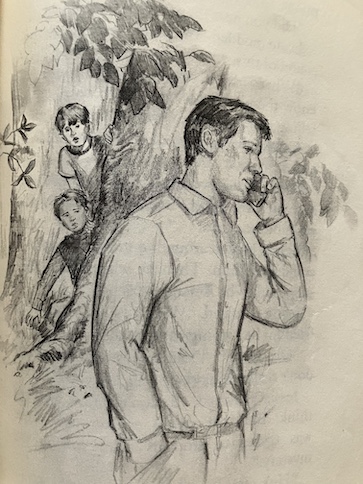
Money has been tight in the Huddleston family since Jamie’s father died. The family lives in a big, old house that’s been in the Huddleston family for generations, but it has gotten run down because the family doesn’t have enough money to fix it. The local historical society is interested in the house because of its age, but Jamie’s mother doesn’t know if the family will have enough money to hold on to it. Even heating the house has gotten expensive, and there are two girls in the family to raise and educate. Jamie’s mother is seriously considering selling the big house so she and the girls can move to a smaller, less expensive house, but Jamie can’t stand the idea of losing this house, which she loves. To help earn some extra money, Jamie takes on a part-time tutoring job, and she is thrilled when her first tutoring assignment is a popular boy from school, Kevin Parker.
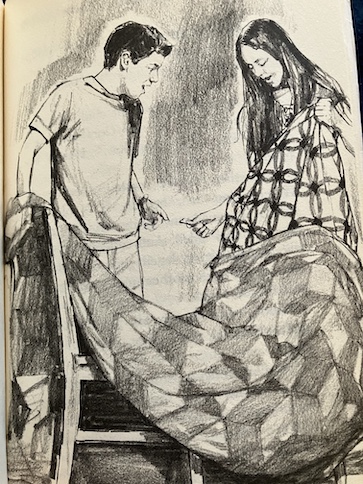
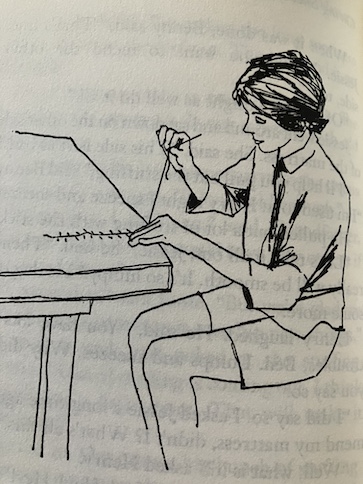
When Jamie discovers a chest of old quilts in the attic that were made by her great-grandmother, she is thrilled to find one that is actually a map of their house! She shows it to Kevin, who is fascinated. His mother has an antiques shop, and he has an interest in antiques because he helps his mother. Unfortunately, the realtor who is trying to convince Jamie’s mother to let him sell their house also sees the quilt and immediately becomes interested in its monetary value. Jamie tries to make it clear to him that the quilt is not for sale.
Then, one day, the quilt is stolen while it was hung out for an airing! Just about anybody could have taken it because it was outside, but when Jamie’s mother reports the theft to the police, the policeman who takes the report says that there have been other thefts of antiques in the area. Their case is a little unusual because the quilt is the only item missing, whereas the other thefts involved houses being completely cleaned out of truckloads of antiques.
There is something unusual about the quilt. Not only is it unusual to find a quilt that’s a perfect map of a house, but it seems like the quilt also contains a secret, hidden message. Was the quilt stolen for its monetary value or just because it’s a fascinating-looking quilt, or does someone else also have the sense that there’s a secret meaning in the quilt?
The book is available to borrow and read for free online through Internet Archive.
My Reaction
I remember liking this story when I was a kid. I remembered that the rainbow in the quilt was the clue to where the treasure was hidden, but I didn’t remember the story behind why the treasure was hidden. Jamie’s ancestors didn’t do anything illegal or unethical. It was more that they were going through hard times and resorted to an unappealing job that they didn’t really want to discuss with other people.
I didn’t think there was much secret about who the villain in the story was. There’s a person in the story who is both an unlikable character and who would have access to people’s homes to be able to steal from them. In some ways, I thought that the characters didn’t seem to realize that as soon as they should have. The mother in the story seemed a little too trusting.
The story seems a little slow, now that I’m rereading it as an adult, but I still have nostalgia for it. The quilt map is still a fantastic addition to a children’s mystery.
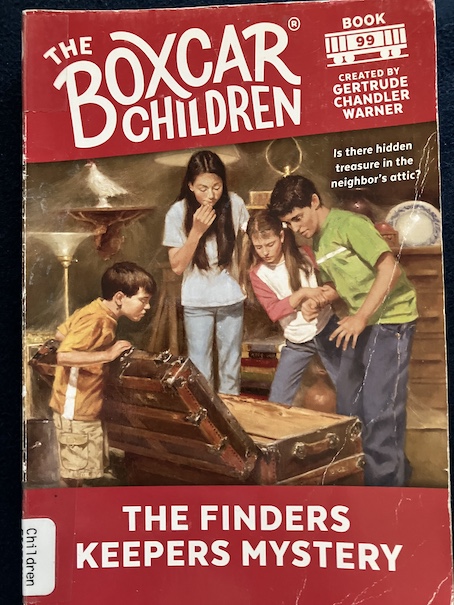
#99 The Finders Keepers Mystery by Gertrude Chandler Warner, 2004.
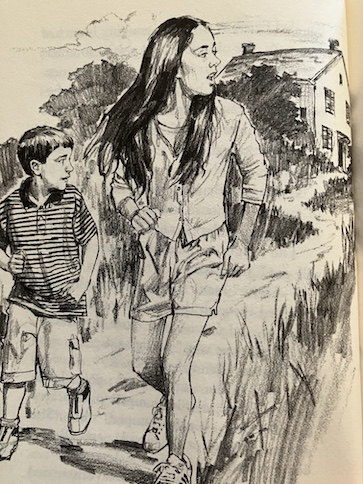
Jessie and Benny are returning from a trip to the post office when Jessie insists on taking a shortcut by the old Bidwell house, where no one has lived for a long time. Benny doesn’t want to take the shortcut at first because there are rumors that the old house is haunted. However, Jessie is eager to get home to dinner, so they take the shortcut anyway. Technically, they’re trespassing, but that’s how they find out that the house is no longer empty.
When someone bangs open one of the shutters of the house, the kids are frightened, thinking that maybe there really is a ghost in the house. However, they also notice that there’s now a broom on the porch. Thinking about it later, at home, they realize that a ghost wouldn’t be interested in sweeping. The next day, all of the Alden children go to look at the old house, and they notice a van in the driveway and that new flowers have been planted in the pots. The new owner of the house, Lina Diaz, introduces herself to the Aldens.
Lina recently inherited the house from a cousin. She’s an architect, and she’s looking forward to renovating the house. It used to belong to a great-great-aunt, Hope Bidwell, which is how the house got its name. The house is filled with antiques and family heirlooms, so Lina is going through things to decide what she wants to keep and what she might want to sell. She’s thinking of having a yard sale. The Aldens offer to help with cleaning and sorting items and setting up the sale, and Lina happily accepts the offer.
While they’re looking through things in the attic, they find a trunk with some beautiful old quilts. Lina says that they were probably made by Hope during the mid-1800s because she had a reputation for making beautiful old quilts. There is also a rumor that Hope left a treasure hidden somewhere in the house, although Lina doesn’t know what kind of treasure that’s supposed to be. She considers the quilts a kind of treasure because they’re beautiful and because of their family connection.
Lina tells the Aldens more about Hope. She was supposed to be married to a man named Robert, but sadly, Robert died of a sudden illness before their wedding. Hope supposedly made a beautiful wedding ring pattern quilt for her marriage, but nobody knows what happened to it since the marriage didn’t take place, and it doesn’t seem to be among the other quilts in the trunk. Each of them has a different quilt pattern, except for one that’s a plain gray and doesn’t seem to fit with the others, although it’s well-worn, showing that it was used a lot. A set of letters hidden in the lining of the trunk confirm the story about Hope and Robert and the existence of the wedding ring quilt Hope was making.
Almost from the moment they find those quilts, other people are interested in buying them from Lina, but Lina is reluctant to sell them because of the beautiful workmanship and sentimental value. She invites Edward Muncie from the state history museum to see the quilts because he’s an expert on quilts, he tries to persuade her to donate them to the museum. He thinks that they would make a wonderful exhibit, and he worries that they might get damaged if they’re simply left in the attic. If she isn’t willing to donate them, he says maybe he can persuade the museum to purchase them from her. Lina says that she’ll think about it, but she doesn’t really want to accept the offer.
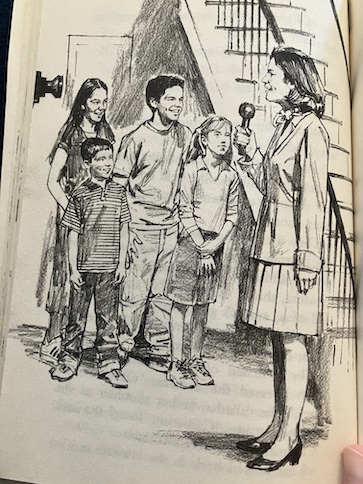
Although they tell Mr. Muncie not to discuss the quilts with anybody, it seems that he has told other people about them. Someone tries to break into Lina’s house during the night. Then, a reporter named Regina shows up at Lina’s house, insisting on interviewing her about hidden treasure and rare quilts in the house. They suppose that she heard about it from Mr. Muncie. Regina Lott does a news story about the quilts and Regina’s yard sale that gets collectors and antique dealers pounding on Lina’s door to be first to see what she has to offer … especially the quilts, although Lina still says they’re not for sale. One man who comes to the yard sale even tries to sneak into the house and look around, but the kids catch him.
A woman named Coral Weaver is the last to leave the sale. She’s interested in old clothes and cloth scraps. She explains that she owns a quilting store. She’s also interested in the antique quilts and the stories behind them. Lina doesn’t want to show her the quilts, but Coral invites her and the Aldens to come to her shop sometime so they can talk about quilts. Coral is the one who tells them that the man who tried to sneak into the house during the sale is Dirk Gray. He used to work for the state history museum, and he owns an antique store.
There is an obvious motive for many people to want the quilts because they have value as collector’s items. Collectors want them, and other people might want to sell them for the money. However, is it possible that the quilts are the key to the treasure that Hope supposedly left behind?
The book is available to borrow and read for free online through Internet Archive.
My Reaction
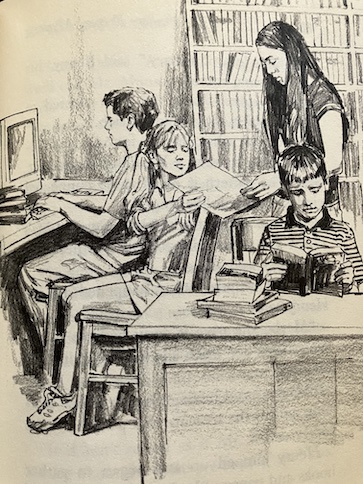
The mystery includes some interesting facts about quilts. At one point, the children go to the library and do some research about quilts to understand more about the quilts they found and why someone would want them so badly. The book explains that quilts can become collector’s items and that they can be worth a great deal of money.
The part I liked the best, though, was when they explained that quilts have different patterns, some more rare or intricate than others. Besides the wedding ring pattern quilt, the book also mentions patterns like flying geese and log cabin. The names of the patterns are based on what they resemble. Each of the patterns is a series of geometric shapes, but the shapes can resemble other things, sort of like the way basic shapes form pictures in tangrams.
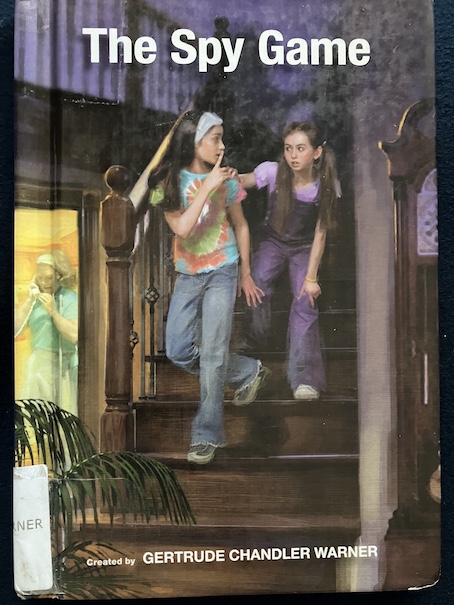
#118 The Spy Game by Gertrude Chandler Warner, 2009.
Mrs. Dawson, a friend of Mrs. McGregor, the Aldens’ housekeeper, stops by one day for a visit. Mrs. Dawson is also a housekeeper, working for Amanda Penner. She has been with the Penner family for years, although her ambition is to own a book store some day. Mrs. Dawson says that Amanda has injured her ankle falling over some loose stones in a walkway at the house she inherited from her grandfather. The Alden children are sympathetic, and they offer to help fix the walkway so nobody else will get hurt. Mrs. Dawson says that she’s sure Amanda would be grateful for the help, although they notice that she’s oddly evasive when Mrs. McGregor asks her if Amanda still likes writing.
When the Aldens go to see Amanda Penner, she tells them more about the house and her family. The house is over 100 years old, and she says that it was built by an ancestor of hers for his young bride, Pandora, who was called Dora. Amanda has many fond memories of the house because, even though she didn’t grow up there, she used to visit her grandfather there every summer.
When the children start fixing the stone walkway, they notice that there are letters engraved into the stones. They wonder if the stones are meant to spell something, and when they investigate, they find it leads to a riddle. They show it to Amanda, and she says that it looks like they’ve stumbled on her grandfather’s “Spy Game.” Her grandfather was a big fan of mysteries and used to play a kind of treasure hunt game with her. The game always started with a hint in the form of “I spy with my little eye …”, which is why she started calling it the “Spy Game.” Amanda says that, when her grandfather died, he left her one last “Spy Game” that supposedly leads to something gold, but she hasn’t been able to solve it. Naturally, the Aldens offer to help her find the hidden treasure!
However, they might not be the only ones looking for the hidden treasure. Amanda’s friend, Steve, is renting the room over the garage for the summer, and they overhear him talking on the phone about getting a “treasure.” They also hear Mrs. Dawson talking about opening “Pandora’s Box.” Are Steve and Mrs. Dawson also looking for the gold that Amanda’s grandfather left for her? All is not what it seems in this tale of treasure hunts and riddles!
The book is available to borrow and read for free online through Internet Archive.
My Reaction
There is a fun twist to this story that I don’t want to spoil! It’s hinted at throughout the book that the story behind the treasure hunt doesn’t quite add up, but the true purpose behind the treasure hunt makes a fun surprise! Actually, there’s kind of a double surprise, but I don’t want to spoil either one.
The setting of the story is charming, an old house where a grandfather used to play treasure hunt games with his granddaughter. I always loved treasure hunt stories as a kid, and this is the kind of book I would have loved back then. I liked how the clues in the story could have multiple meanings, like the clue about a tree and a “hollow” could refer to a tree in a place called a “hollow” or to a hollow tree. Readers are given enough information that they can try to figure out the clues along with the Aldens, but I thought that the room for interpretation in the clues made it an interesting challenge.
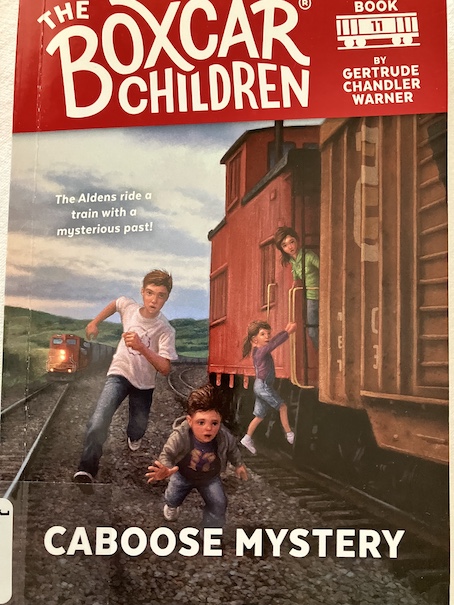
#11 Caboose Mystery by Gertrude Chandler Warner, 1966.
Grandfather Alden has a friend who owns a railroad, and he rents out cabooses to people who want to travel with the railroad. It’s a bit like traveling in a trailer, having a contained living area that includes a small kitchen, but the caboose is attached to a train and travels the rails, no need for driving. This story picks up after the Schoolhouse Mystery, with Grandfather Alden renting two cabooses so he can travel with his grandchildren. He will travel in the bigger caboose with Henry and Benny, and the girls, Jessie and Violet, will travel in the smaller one.
When Grandfather Alden takes the children to see the cabooses, the conductor, Mr. Carr, tells them that the bigger caboose has a history, but they’ll be hearing more about that later. A postman, Sid Weston, is at the station to deliver a letter for Mr. Carr, and he wants to have a look at the bigger caboose, but Mr. Carr doesn’t allow it. The Aldens wonder why he seems so curious about it.
When they embark on their trip, the Aldens are able to travel back and forth between the two cabooses to visit with each other. They enjoy watching the countryside going by while the train is moving. At every place the train stops, there is something interesting to see. At one stop, they get fresh corn to cook, and at another, they see beavers building a dam. There’s a man who lives by Beaver Lake who people call “Old Beaver.” Old Beaver is kind of a hermit, but he’s dedicated himself to protecting the beavers and their habitat. For some reason, when the Aldens tell him about the cabooses they’re traveling in and the number of the bigger caboose, 777, Old Beaver is disturbed and runs away.
Benny can’t forget about what Mr. Carr said about the bigger caboose having a “history,” and everyone wonders why Old Beaver had such a strange reaction to hearing the number of the caboose. They find out from a station master called Shaw that the caboose used to belong to a circus train. The circus owner’s wife lived there. A man who works for the station now used to be a clown with that circus, called Cho-Cho. His wife, Chi-Chi, was a tightrope walker and best friends with the circus owner’s wife, but she died suddenly when she fell during one of her performances. Cho-Cho left the circus after that.
There is a mystery surrounding Chi-Chi’s death because she used to own a beautiful diamond necklace that was given to her mother by royalty. She used to hide it when she wasn’t wearing it, and not even Cho-Cho knew where she kept it. After her death, nobody could find the necklace, and the police believed that it was stolen by the Thin Man who worked for the circus sideshow. Cho-Cho was friends with the Thin Man and didn’t want to think he had taken the necklace, but people had seen Chi-Chi showing him the necklace before she died, and nobody remembers seeing him give it back to her. After he was accused, the Thin Man ran away, and people thought that was an admission of guilt. The man called Old Beaver was the Thin Man’s best friend, and he blames the accusations for making his friend run away. Nobody knows where he is now.
It’s a sad story, but it confirms what Benny suspected, that there’s a mystery surrounding their caboose. Could the necklace be hidden there, or is there something there that could tell them where the necklace is?
My Reaction and Some Spoilers
Like many of the other early Boxcar Children books, there is often more adventure in the story than mystery. The mystery of what happened to the necklace is a definite mystery, but the Aldens end up finding the necklace more by accident than solving the clue that was left behind by Chi-Chi for Cho-Cho. Once they find the necklace, they understand what the clue was supposed to mean rather than figuring out what the clue meant to figure out where the necklace was. Still, it was a nice story. Finding the necklace also solves problems for the unhappy former circus performers they’ve met. Figuring out where the Thin Man is so they can tell him that his name has been cleared adds a secondary mystery for them to solve. The Thin Man’s name is cleared, Old Beaver feels better for knowing that the Thin Man is no longer a suspect, and Cho-Cho gets the necklace.
The idea of traveling in a caboose, or better yet, a pair of cabooses, sounds like the kind of fun adventure that many kids would enjoy! It’s a colorful way to travel, and while the kids travel by railroad, they learn a few things about the train and how it is run. At one point, they get to see the engine of the train and talk to the engineer. The things they see along the way are interesting, too. There is a point where Benny separates from the others to go see a talking horse from the circus while the rest of the family tours a glass factory and gets to pick out some pieces for themselves. The places they visit aren’t always the kinds of things families would seek out as destinations, but it’s charming that they get to travel this way on a train. They have fun along the way, and there’s always something interesting, wherever they stop.
There is a note from the author at the beginning of the book about the inspiration for this story, a trip that she took by caboose herself:
To My Readers The Little North Railroad is a storybook railroad, but the cabooses are real cabooses. With the help of six very kind trainmen, I myself took a trip by caboose, riding on the back platform and feeling just like Benny. I ran the Diesel engine, blew the whistle, rang the bell, and watched as the trainmen set off dynamite on the track, just as it says in these pages. As for the story, the adventures are wholly imaginary.
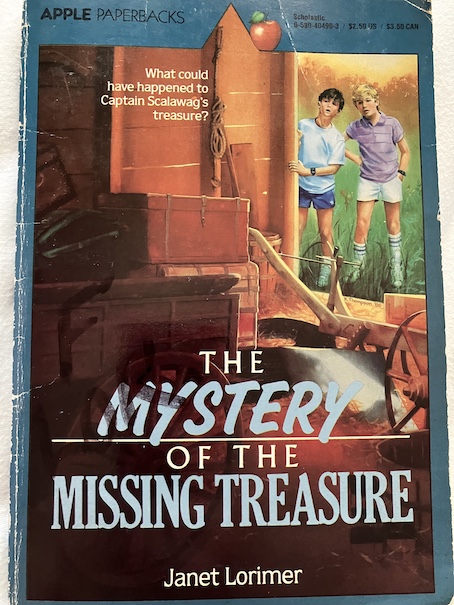
The Mystery of the Missing Treasure by Janet Lorimer, 1987.
Pete’s family has moved from the city to a small town because his father has taken a new job, and the move hasn’t been easy for him. Besides leaving his friends and his school, he’s had to give up roller skating because there’s no roller rink and judo because there’s nowhere to take lessons. So far, there are really only two things that Pete likes about his new town: his new friend Danny and the local legend of Captain Scalawag and his treasure.
When Pete asks Danny for details about Captain Scalawag and his treasure, Danny explains that Captain Scalawag (real name Seth Delaney) had been a captain the Confederate army during the Civil War. He was injured and invalided out of the service, so he became a traveling peddler, although he didn’t have much luck with that. Eventually, he came to their small town in California and took a handyman job with the woman who once owned the house where Pete’s family now lives. Many of the people who had settled the town had come from the South, and Captain Scalawag (as he came to be known later) told them stories about the suffering in the South because of the war. Sympathetic townspeople gave Captain Scalawag their jewelry and raised money for him to take back to the South to set up relief efforts. However, Captain Scalawag was a conman and had no intention of using any of that money for its intended purpose. When the townspeople confronted him about it, he refused to return the money and refused to tell anybody where he hid it. The angry townspeople hanged Captain Scalawag for his theft and deception, but they never figured out what he did with their money and jewelry.
Pete is intrigued by the story and says that he wants to find the treasure, but Danny doesn’t think he has much of a chance. Over the years, many people have searched for the treasure, and they’ve never found anything.
Danny takes Pete swimming in the nearby river with some other boys from the town. Pete gets irritated because one boy, Duffy, teases him about being from the city, and the two of them have a diving contest near some dangerous rocks to prove which of them is the best. They both succeed in making their dives, but although the are declared equals, Pete has the feeling that their problems with each other aren’t over.
After the swim, Danny suggests that they go into town and watch people setting up for the play that they have every Fourth of July, which is a reenactment of the story of Captain Scalawag. Pete is interested, but he feels strange and passes out.
When he wakes up, people are fussing over him, and he seems to be in some kind of old-fashioned general store. A woman in old-fashioned clothing, who calls herself his mother is worried about him, and for some reason she calls him Zeb. Then, Pete wakes up again and finds himself in the local doctor’s office. The doctor said that he had heat exhaustion from being out in the sun too long while swimming. Pete’s father is there, and Pete tries to tell him about his vision of being in the general store in the past. Pete’s father thinks he just had a strange dream, although the doctor says that his office is on the site of the town’s old general store, which burned down years ago.
Pete continues to have trouble fitting in with the local kids. One evening, Duffy and Danny take him on a “snipe hunt“, abandoning him in the woods. (This is an old prank, often played at summer camps, but I think this book was actually the first place I heard of it as a kid.) When Pete realizes that he’s been the victim of a joke, he tries to walk home, but gets lost and falls in the mud. Finally, dirty and disheveled, he makes his way to the road and hitches a ride from Bob, the local deputy his older sister is dating.
When Pete explains to Bob what happened, Bob offends him by laughing. Bob explains that it’s an old prank, and he’s amused that anybody is still doing that. Seeing how angry Pete is, he tries to tell him not to be too angry over the prank and to reassure him that the local boys aren’t so bad, in spite of the prank. He says that the boys are just trying to have fun. It’s almost like a kind of hazing or initiation, and although Bob doesn’t quite explain it this way, he seems to think that if Pete accepts it with good grace, it will put him on a better footing with the other boys. Bob thinks that, given time, Pete will start to see the humor in it, and the next time some other new kid moves to town, Pete might well be the first to suggest taking the newbie on a snipe hunt himself, having become one of the initiated.
In spite of Bob’s apparent indulgence for youthful pranks, he does seriously ask Pete who was involved because, as a responsible adult, he can see that there are more serious issues involved in the prank. It was bad enough that Pete ended up dirty and humiliated, but if he had gotten more seriously lost or had fallen in the river, trying to find his way home after dark, none of it would be funny at all. Bob thinks that he should have a word with the other boys about the the consequences of their actions and give them a warning against pulling pranks where people could get hurt. Pete refuses to say who exactly was involved because he thinks that would just make him a snitch and make everything worse for him socially than it already is. Bob decides to let it go for now, just taking Pete home.
That night, Pete has another dream, where he seems to be seeing things through the eyes of Zeb. He sees the house where he’s living now as it used to be in the past, and he sees the man called Captain Scalawag, persuading the people who live there to contribute to relief efforts in the South due to the war. Then, Pete feels ill and seems to pass out in the dream, waking up in modern times in his own bed. He could just shrug it off as a dream, brought on by the stories he’s been hearing about Captain Scalawag and the old things his parents have discovered around the house and the barn that hind at events in the past. However, when his mother shows him more old photographs she’s found, Pete realizes that the details in his dream were far too accurate for him to have simply imagined them, from the details of the house in the past to the faces of the people he saw talking to Captain Scalawag.
More and more, Pete comes to realize that his dreams are no ordinary dreams. For some reason, he is able to see the past through the eyes of Zeb, a boy who died young around the time that Captain Scalawag conned the local people out of their money and treasures and hid the loot somewhere. Is Zeb himself trying to tell him something or show him something that everyone else has missed?
The book is available to borrow and read for free online through Internet Archive.
My Reaction and Some Spoilers
I remember reading this book as a kid, although I had forgotten many of the details. I remembered Captain Scalawag stealing/scamming people out of valuables and then hiding them, but I had forgotten that the basis of his scheme was convincing people to donate to support the Confederacy during the Civil War. That was surprising because the story is set in California, and the concept of supporting the Confederacy is never appealing to me. I think I forgot that part because, as a kid, the important idea is that Captain Scalawag was a conman with a hidden treasure, and that’s all I cared to remember.
I remember finding it spooky that Pete was seeing things through the eyes of a dying/dead boy. Pete in the story does worry about getting stuck in Zeb’s body in the past, knowing that Zeb doesn’t have much time left to live. However, Zeb is trying to tell Pete something that he realized that indicates what Captain Scalawag did with the treasures he took from the townspeople. Zeb tried to tell people before he died, but because he was severely ill and delirious, nobody understood what he was really trying to say. It turns out that the treasures have been in the barn the entire time, but Captain Scalawag changed their appearance, so the townspeople have overlooked them the entire time. It’s a case of hiding in plain sight.
Pete’s confrontations with the local bully add a subplot to the story. Danny apologizes to Pete about joining in Duffy’s prank against him, and Danny admits that Duffy scares him, too. Eventually, Pete has to fight Duffy physically, but Duffy doesn’t know that Pete took judo lessons in the city, so he’s not as defenseless as Duffy thinks. During the course of their fight, Pete also saves Duffy from being bitten by a snake, so Duffy has to admit that he has some gratitude toward Pete. He’s also impressed by Pete’s fighting techniques. The two of them end up working out a compromise with each other, with Pete agreeing to teach Duffy some judo and Duffy agreeing to teach him some of the knowledge he has from living in the country, like how to kill a snake. (Pete warned Duffy about the snake, but Duffy is the one who killed it.) Because they were fighting out behind the barn, Duffy is also on hand when Pete has his final revelation from Zeb, so he gets to be part of the discovery of the treasure, along with Pete and Danny.
I wasn’t happy when Bob laughed off the kids’ snipe hunt prank against Pete at first. I don’t like pranks, and I think it should be more understandable that some people just don’t want to be part of them, especially when Bob has directly seen the aftermath of the prank. He did redeem himself a little for me when he realizes that the prank could have had much more serious consequences and that, as a responsible adult, he really should point that out to the boys involved. The potentially serious consequences of pranks is part of the reason why I don’t like them. There’s just too much potential with many of them to go horribly wrong. The way Bob seems to be looking at the snipe hunt is like it’s some kind of local initiation stunt for newcomers, although he doesn’t exactly use those words to describe it. However, the idea of it being a kind of initiation doesn’t really redeem it for me. Fraternity initiations and hazing often go wrong, and that’s why universities often crack down on them.
As I recall, this book was the first place I heard about the concept of a snipe hunt. Years later, I was on a church retreat in college, and someone joked about taking someone else on a snipe hunt. I’ll admit that I was briefly gleeful about knowing what that was when the other person didn’t. I almost did go along with it, but I just didn’t have the heart to let someone else in for a prank like that. I would have felt bad if something happened to that person in the woods at night, and I figured they would at least be upset. Since the person did seem worried and asked directly what a snipe hunt is, I told them, so I spoiled the joke before it really happened. I think I made the right decision, though.
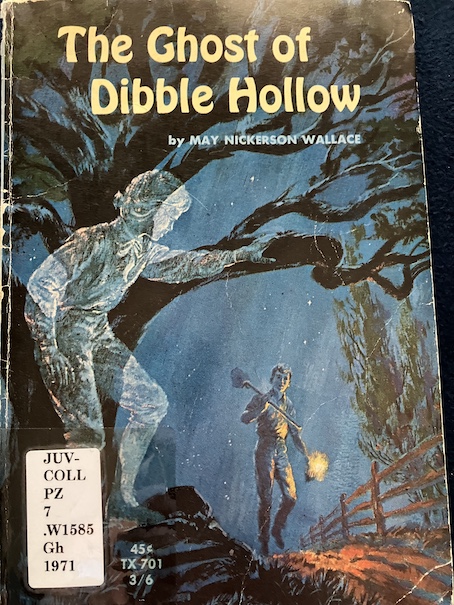
The Ghost of Dibble Hollow by May Nickerson Wallace, 1965.
Elisha Nathanael Dibble Allen, called Pug, is excited to be spending the summer at the old family house called Dibble Hollow that his mother inherited! The summer starts out awkwardly when he gets on the wrong side of old Mr. Smith because his dog, Ricky, chases Mr. Smith’s chickens. When people find out that his family are Dibbles and that they’ll be staying in Dibble Hollow, Pug and his sister Helen learn that the locals in the area are afraid of Dibble Hollow. There are rumors that the house is haunted.
Pug thinks that the house is charming. It was built in 1730, and Pug immediately claims a room for himself with a picture of a boy in old-fashioned clothes who looks a lot like him. It does seem odd, though, that Ricky is afraid to enter that room, no matter how much Pug tries to persuade him.
Then, it seems like the family won’t be able to stay at the house after all because the well is dry, and they can’t get water. Pug is upset about having to leave the house and abandon their summer plans, but things change during the night, when Pug meets the ghost who haunts his room. The ghost is Miles Dibble, the older brother of Nathanael, Pug’s grandfather. Miles died young and still haunts the room that he once shared with Nathanael.
The ghostly Miles explains to Pug that he’s been responsible for the rumors that Dibble Hollow is haunted. He does things to scare strangers away from the house. However, he really wants his relatives to stay at Dibble Hollow, so he explains to Pug that there is actually a second well at Dibble Hollow, and it is connected to the house with pipes, but Pug’s grandfather’s eldest brother, Ezra, turned off the water on purpose to fool people into thinking that there was no water at the house, so he could have the house all to himself. Miles explains to Pug how to find the right pipe in the basement and turn the water back on.
The next morning, Pug follows Miles’s instructions and finds the pipe so the plumber can turn the water back on. His family is amazed how he knew where to look, but Pug is vague about how he knew. He can’t tell them about Miles because Miles tells him that only boys under the age of 15 in the Dibble family can see him, and also one other person who is special to Miles, although Miles doesn’t explain who that is.
Pug is happy that his family will be able to stay at Dibble Hollow for the summer, but he also begins hearing about a feud between the Smith family and the Dibble family. People are unsure exactly how the feud started. The plumber, Mr. Potter, says that there are only a few people who really knew the beginning of it. One of them is Miles, who has been dead for more than 50 years at that point. Another is Eb Smith, who was once Miles’s best friend, and is now the elderly Mr. Smith who was angry that Ricky chased his chickens. Pug is interested in being friends with Eb Smith’s granddaughter, Priscilla, but he thinks that he needs to understand the feud between their families before he can do that.
Since Eb Smith doesn’t want to talk to the Dibbles, Pug and Helen go to see Miss Fanny Woodman, the other person Mr. Potter says would know what happened to start the feud. Miss Woodman explains that the feud started when she was 13 years old, after both the Dibble and Smith families made a lot of money at a fair by winning some prizes and selling livestock. The elder boys in the Dibble and Smith families were supposed to take the money home, but they paid Eb and Miles to do it for them because they wanted to stay longer at the fair. However, Eb thought some suspicious men were following them home, thinking that the younger boys would be easier to rob. To evade the thieves, the two younger boys split up. Eb was supposed to lead the thieves on a wild goose chase while Miles got the money safely home. Eb did manage to lose their followers, but Miles never turned up with the money. The Smiths suspected Miles of running away with the money, but the Dibbles suspected the Smiths of having done something to Miles to get all the money for themselves.
At first, Eb didn’t think the Miles stole the money. He thought maybe Miles was playing some kind of trick on him because the two of them had a rivalry over Miss Woodman. Both boys had a crush on her when they were all kids. Miles was a teaser and a prankster, so it would have been in character for him to pull a trick. However, nobody ever saw the thieves who were supposedly following the boys, and the more Eb thought about it over the years, the more he became convinced that Miles was the one who thought he saw them and was the one who suggested that the two of them split up. Nobody ever found Miles’s body, so there was no proof that he ever died. His family eventually decided that’s what must have happened, so they had a memorial service for him and put a marker for him in the local cemetery, but the Smiths still suspected that Miles just stole the money and ran away.
Eb’s feelings for Miles turned to bitterness when he came to believe that Miles took advantage of their friendship to steal from him and his family, and those feelings only got worse when he suffered a series of misfortunes in his life. Eb’s wife died young, leaving him to raise their son alone. Then, his son and his wife also died, leaving him to care for his granddaughter Priscilla alone. Eb has been struggling for money to help raise Priscilla, and the money that his family lost would have made a difference to him. In fact, it still would make a difference to Eb because he’s in danger of losing his family’s old home because he can’t pay the mortgage. Miss Woodman doesn’t believe that Miles was a thief, but without the town knowing what really happened to Miles, it would be difficult to prove that to Eb Smith.
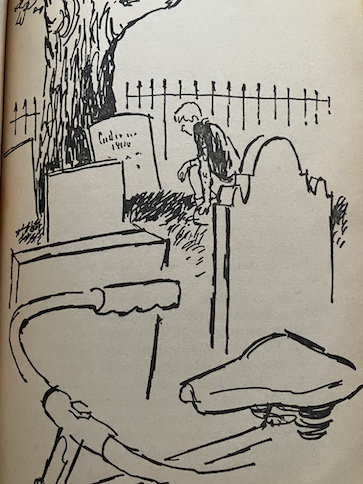
Pug knows that he has access to a source of information that nobody else does – he’s the only one who can talk to Miles himself about what happened! When Pug sees Miles again, Miles confirms what Miss Woodman said. He says that the thieves followed him instead of Eb that night. Miles tried to get away from them by crossing an old bridge, but he fell into the river and was killed. The thieves were alarmed that he was dead, so after searching him for the money, they pushed his body into the river again and got out of town as fast as they could. Miles says that a man called Mr. Miller later found his body down river and had him buried, but Mr. Miller didn’t know the boy’s identity, so he couldn’t notify his family. Instead, Mr. Miller buried Miles under the name of his own son, who died at sea as a cabin boy and whose body was never recovered. Mr. Miller felt that giving the nameless boy his son’s name and a resting place among his family was a kindness to the drowned boy and a fitting memorial to his own son, who was unable to return to rest with his family. People in the town where the Millers lived and live today know the story about the nameless boy buried with the Millers and Miles’s tombstone recounts it, but so far, nobody has made the connection between that nameless boy and Miles. (Except for one other person, who can’t explain how he knows where Miles is buried for the same reason why Pug can’t tell his family how he knew where the water pipe was.)
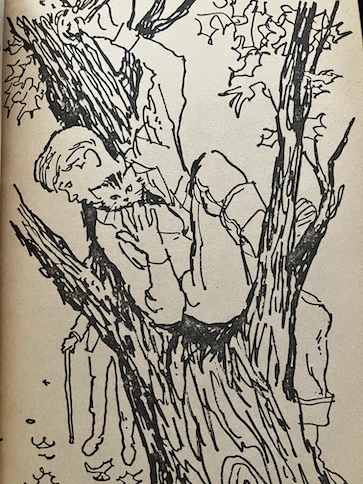
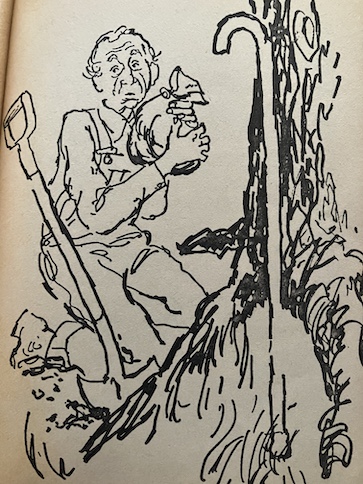
Pug asks Miles what happened to the money, and Miles says that he successfully managed to hide it from the thieves before he fell in the river. The problem is that he’s not exactly sure where he hid it. He knows he put it in a tree, but it was night, he was confused and in a hurry, his sense of direction was never good, and then, he died a sudden death. He’s been looking for the tree where he hid the money ever since, but he still can’t find it. He just knows that it’s somewhere around the old Smith place, Twin Maples … where Dibbles aren’t really welcome these days. Miles needs Pug’s help to find that hidden money and repair the relationship between the Smiths and the Dibbles!
The book is available to borrow and read for free online through Internet Archive.
My Reaction and Some Spoilers
Part of the theme of the story is about old grudges. Miss Woodman and Priscilla, among others, tell Eb Smith that the grudge that he’s been holding against Miles and the other Dibbles is only hurting him and that it’s time to let it go, but at the same time, they also understand why he has trouble letting the issue go. The money that Miles was carrying when he disappeared would make a major difference to Eb Smith because he’s been struggling for years to take care of his old family home and his orphaned granddaughter. With the mortgage coming due, the holder of the mortgage, Mr. Pratt, is planning for foreclose and have Eb Smith sent to a retirement home, but that would leave Priscilla without a home. Mr. Pratt says he and his wife would take Priscilla in as a nanny for their four children, but that’s a nightmare job! The Pratts have had trouble keeping a nanny because the children are so badly behaved. Priscilla would be little more than a captive domestic slave to the Pratts. With that much depending on the lost money that would secure the Smiths’ home and future, it’s understandable why Eb Smith has trouble letting the matter go.
Eb doesn’t know that Miles is definitely dead and that he died the night of the fair, when they were chased by thieves. If Miles’s body had been identified and returned to his family shortly after his death, Eb would have accepted years ago that Miles was just the unfortunate victim of the thieves. He would have mourned the loss of his friend and reconciled himself to the loss of the money as something that couldn’t be helped. It was not knowing the truth for years that caused Eb to doubt his old friend and convince himself that Miles was the one responsible for the loss of the money. The restoration of the money is key to helping the Smiths and settling the feud, but knowing the real truth of Miles’s death is also important. As long as Eb doesn’t know the truth, his family’s suspicions, his own suspicions and imagination, and the rumors of the local people are all that Eb has had to fill in the space of what he doesn’t know.
The inability of people to communicate with each other hampers the truth. Pug’s attempts to help the Smiths are hampered because he can’t let Eb Smith know that he’s helping at first. If he did, Eb Smith’s pride and the grudge he holds would probably cause him to refuse the help, even if it hurt him and his granddaughter. Miles refuses to say at first who else besides Pug can see him as a ghost, but Miles later learns that (spoiler) it’s the man who found his body and buried him. Gideon Miller is now a very old man, and he only saw Miles’s ghost once when he was seriously ill, about a year after he buried Miles. That’s the only way that Mr. Miller knows his name and that he is the boy he buried. However, Mr. Miller can’t go to Miles’s family or the Smiths and tell them the truth about Miles because he knows nobody would be likely to believe him. Everyone would just think that he was hallucinating. Mr. Miller and Pug can talk to each other about it because they’ve both experienced Miles and can understand each other’s experiences, but neither of them can convincingly tell anyone else. Pug can’t tell his sister or Priscilla about the things he’s doing to try to help the Smiths, so they think he isn’t really doing much, if anything, although Helen is suspicious that Pug knows things he shouldn’t know and seems to have a hidden source of information. Fortunately, Pug eventually finds a way to show his parents that the unidentified boy buried with the Miller family is Miles.
When Pug has problems with the eldest Pratt boy, Ernie, his father talks to him about grudges and expectations, bringing the story back around to the main theme. People have prejudices against the Dibbles because of what they’ve suspected for years about Miles and the missing money. Pug’s father points out that, while the Pratts definitely have some negative traits, people’s habits of expecting the worst of them just because their family has that reputation, can turn into a self-fulfilling prophecy. If people have the sense that nobody expects anything good about them, they won’t even try to do better. Pug and Ernie do end up getting into a fight, but once they’ve got their feelings out and impressed each other with their fighting ability, they make up and become friends. Ernie helps Pug to understand Mr. Pratt better. Mr. Pratt actually thinks he would be helping Eb Smith by sending him to the county old folks’ home because he genuinely thinks Eb Smith can’t manage his house by himself. It’s not just a ploy to get the property and make a personal profit.
When the truth is revealed and the money found, the adults in the story are mature enough to admit that they were wrong about things, and I thought that was a really good example to present to kids. Eb Smith apologizes to the Dibbles, particularly Pug, about how he treated them when they were only trying to help. He also expresses regret that he came to doubt his best friend, not understanding that something truly tragic happened to him all those years ago. Mr. Pratt, rather than being upset that he won’t get the Smiths’ property after all, is actually relieved that things have worked out well for the Smiths. He tells Mr. Smith that he didn’t mean to make things hard on him, that he really did think that what he was doing was best for him and Priscilla, but Ernie has been talking to him about their situation, and he’s changed his mind.
The time period of the story is dated. Miles’s tombstone and an old diary of his that Pug finds date the year of Miles’s death to 1900. Since he’s been dead for more than 50 years or almost 60 years, the story is set c. 1960, just a few years before the book was published.
#12 The Mystery of the Laughing Shadow by William Arden, 1969.
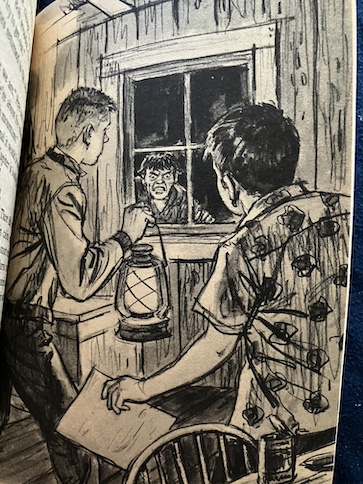
The mystery begins when Bob and Pete are bicycling by the old Sandow estate and they hear a call for help. Although it’s dark they can’t see who yelled for help, they can tell that the person threw something small that lands near them. They pick it up and discover that it is a small gold amulet. Then, Bob and Pete have to hide when a dark, shadowy figure comes looking for the amulet. The figure appears humpbacked and has a weird laugh that Bob and Pete have trouble describing.
They tell Jupiter what happened, and he joins them in searching for the person who called for help and figuring out the significance of the amulet. Someone steals the amulet from Jupiter, although Jupiter manages to save a message that was hidden inside the amulet. Then, they consult an expert in Native American languages and antiquities and learn that the amulet may be part of the Chumash treasure hoard, a treasure stolen from the Spanish settlers of the area many years ago by Chumash Indians (Native Americans) who once lived in the area. People have searched for the treasure for many years, but no one has found it. However, the message that was hidden inside the amulet is written in a language that belongs to the Yaquali Indians of Mexico (this is a fictional group, not the Yaqui), a remote tribe mostly living in isolation but known for their climbing skills. The expert is puzzled because he can’t figure out what the connection can be between the Chumash and the Yaqualis. The two group don’t live in the same area, their languages aren’t related, and the Yaqualis had nothing to do with the lost Chumash treasure hoard.
Jupiter says that their next move should be to investigate the Sandow estate. At first, they plan to make an excuse that they’re researching the Sandow estate for a school project, but to their surprise, Ted Sandow, grandnephew of Sarah Sandow, who owns the Sandow estate, shows up at Jupiter’s uncle salvage yard. Ted is just a few years older than the Three Investigators, and he explains that he came from England to visit his Great-Aunt Sarah after his father died. He says that his aunt wants to clean out a bunch of old things that have been in storage on the estate and that someone recommended the salvage yard to him. He invites the boys to the estate so he can show them some antiques that Jupiter’s uncle might want to buy. It seems like quite a coincidence that Ted Sandow would just come looking for them and give them an invitation to the Sandow estate just when they were planning to investigate the place, but the boys can’t pass up the invitation.
At the Sandow estate, the boys are amazed at the antiques that Sarah Sandow is offering to sell, and they’re sure that Jupiter’s uncle will be interested. They spend some time chatting with Ted, Great-Aunt Sarah, and Mr. Harris, a friend of the Sandows who has started a Vegetarian League with the help of Sarah Sandow. Sarah tells the boys that the reason she wants to clean out some of the clutter around the estate is that they recently had a burglary. They all explain to the boys that a small gold statue (the amulet) was stolen from the estate by an unknown boy. It was one of a pair that used to belong to Sarah’s brother, who was Ted’s grandfather. The boys explain that they are investigators and that they would be happy to help them recover the little statue, without telling them that they had it in their possession at one point or about the message they found with it. The Sandows hire boys to find it, promising them a reward if they’re successful, but some things about their offer don’t ring true.
For one thing, Ted Sandow asks the boys about the meaning of the question marks on their business card before he even looks at the card, indicating that he already knew about their investigation business and that he sought them out for that purpose rather than just to sell things to the salvage yard. It’s also strange that he stresses that they will reward the boys for the return of the amulet with “no questions asked” about how they found it. What are the Sandows hiding, and what is the meaning of the message that was with the amulet? Do they know the location of the Chumash hoard, or do they have it themselves? Who was the mysterious shadow with the weird laugh? Lives may hang in the balance as the boys struggle to learn the identity of the laughing shadow.
The book is available to borrow and read for free online through Internet Archive.
My Reaction
I like books that reference history, but this book bothers me a little because of the introduction of the Yaquali. The Chumash are real, but the Yaquali are a fictional group, and it just feels strange to have the book start with a real group of Native Americans and then incorporate a fictional group. It also makes the story feel a little contrived that the villain needs the Yaquali for their excellent climbing skills to reach the treasure when it doesn’t seem like the Yaquali had anything to do with placing the treasure where it’s hidden.
The explanation behind the laughing shadow also feels a little contrived. There’s a logical explanation but at the same time, it depends on the villain having a pet that makes a sound that sounds like a laugh, and this pet’s origins point to the villain’s origins.
The part of the story that I thought was most interesting was that, while the Three Investigators are suspicious of the Sandows, it’s implied that the suspicious is mutual. The Sandows offer the Three Investigators the job of finding the amulet with “no questions asked” about how they found it, and there is an implication that they suspect that the boys stole it. The implication that the “no questions asked” is actually an invitation to the boys to return what they took with a promised reward and no repercussions. However, at the same time as the boys accept the job from the Sandows, they have their own suspicions about what the Sandows are doing and what the meaning of the message in the amulet is. They see the investigation job as a way to learn more about what’s going on. The interesting part is that, while each of them has some reason to suspect each other, the real culprit in this situation isn’t either of them.
Spoilers
Although the boys suspect Ted at first, the real villain is Harris. Years ago, Sarah Sandow’s brother, Ted’s grandfather, learned that the Chumash hoard was located on their property, but for reasons that no one seems to know, he killed the only person who could tell him where it was and had to leave the country. Ted was born in England, and he has been visiting his Great-Aunt Sarah. He met Mr. Harris on the way here, and Harris introduced himself to Sarah on the pretext of getting a donation to help set up a society for vegetarians in the area. He had already figured out where the hoard was located on her property, and he had convinced some young Yaqualis from Mexico to come to the United States to help him get it.
The treasure is hidden in a cave which can only be reached by experienced climbers, and the Yaqualis are known for their climbing skills. One of the Yaqualis realized that what Harris wanted them to do was illegal and that he was planning to do away with them when it was all over. He managed to get word to his family, and he put the message in the amulet in the hopes that someone would find it later and help him and the others.
Jupiter figures out that Harris is the villain when he realizes that the mysterious laugh isn’t human; it was caused by a kookaburra, a pet of Harris’s from Australia. His shadow only looked humpbacked because the bird was sitting on him at the time. Jupiter gets the police to check with the Australian authorities, and they learn about Harris’s criminal past. By then Harris has taken Bob and Pete hostage, and they must stage a daring rescue to save them. For a while, Bob and the young Yaqualis are trapped in the cave with the treasure, but a couple of other Yaqualis who have been searching for them help to rescue them. At the end of the book, the ownership of the treasure still has to be determined, but many museums are hoping to acquire pieces for their collections.
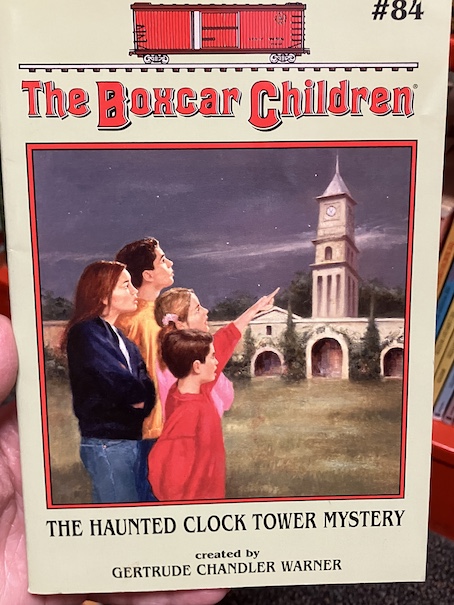
#84 The Haunted Clock Tower Mystery by Gertrude Chandler Warner, 2001.
Grandfather Alden is attending a reunion at his old college, Goldwin University, and he brings his grandchildren with him so he can show them where he went to school. The children are fascinated with the beautiful campus, especially with its clock tower. Their grandfather and Ezra Stewart, who works at the college and is responsible for maintaining the clock tower and playing its carillon bells. Ezra demonstrates to the Aldens how the carillon bells work, and he also shows them the smaller training keyboard, where he has trained his assistants. Ezra plays concerts for the campus on the carillon bells, but he gets irritated with his new assistant, Andrea Barton, because she never puts his music back where it belongs.
The Aldens run into Grandfather Alden’s old college roommate, Joel Dixon, who is also there for the reunion. Joel brought his son Don with him because Don has business in the area, and he’s been interested in the college since he started reading a book about it. At dinner, they also meet Grandfather Alden’s old history professor, Julia Meyer, who says that she’s working on a special project, but is mysterious about it.
That night, Benny sees a light in the clock tower. Ezra insists that nobody goes into the clock tower at night, and Benny wonders if it could be a ghost! Then, someone sabotages the carillon. Was it the mysterious night visitor, and if so, who could it be and why?
When the children look at the book Don has been reading, they learn that there may be a secret hidden treasure on the campus that dates from the Civil War. Is their mysterious “ghost”, looking for it, too? Is Don the one searching for the treasure, or is could it be the history professor or maybe Ezra’s new assistant?
The book is available to borrow and read for free online through Internet Archive.
My Reaction
I always like treasure hunt stories, and I enjoyed seeing the Aldens figuring out the clues to find the hidden treasure! They know that someone else is looking for the treasure, too, and I thought at least one person was a really obvious suspect. What I like about this book, though, it’s that it’s one of those stories where each of the potential suspects has something to hide. There isn’t just one person who’s been sneaking around the clock tower at night. Different people have been there for different reasons, not all of which have anything to do with the treasure. Part of the mystery involves figuring out who is doing what in the clock tower and why.
The addition of the carillon to the story is a fascinating and unique feature. I’ve seen carillon bells before, but I enjoyed hearing Ezra describe how they use the training keyboard for practice. I think, for most kids in the target audience for this book, this story be their first introduction to the idea of a carillon.
The Puzzling World of Winston Breen by Eric Berlin, 2007.
Twelve-year-old Winston Breen loves puzzles! He looks for puzzles to solve everywhere, and he also loves to make to give puzzles to other people to solve. Usually, on his sister’s birthday, he likes to set up some kind of puzzle or treasure hunt to lead her to her present. However, the year his sister Katie turns ten years old, Winston almost forgot about her upcoming birthday party, so he didn’t have anything planned. In fact, he was lucky to find a nice present in time for the party, buying a pretty box that he saw in a curio shop at the last minute.
When Katie opens his present at the party and sees an empty box, she’s sure that the empty box must be another of his puzzle tricks. Winston tries to explain to her that it’s just a nice box, and there’s no puzzle this time, but to his surprise, Katie finds a puzzle in the box that Winston didn’t make or put there. It turns out that there’s a secret compartment in the box that contains thin strips of wood with letters on them. It looks like the kind of puzzle Winston loves and one he might have made if he had planned better this year, but as Winston explains to everyone, this isn’t his work. So, whose puzzle is it, and what does it mean?
Everyone at the party tries to guess what the puzzle means, and Winston has to reassure everyone multiple times that it’s really not one of his puzzles. In the end, they all decide to let Winston try to solve the puzzle and tell them the answer. However, Winston can’t seem to solve the puzzle! When he’s unable to solve it, his relatives really begin to believe him that he didn’t make it. Winston’s cousin, Henry, questions him about who had access to the box and where he got it in the first place. When Winston says that it got it at the curio shop, Henry points out that the curio shop owner also likes puzzles and has shared puzzles with Winston before. It seems logical that he’s the original source of this particular puzzle.
When Winston talks to the owner of the curio shop, he says that he had no idea that there was a puzzle in the box that Winston bought. The box was part of a larger set of items that came from the estate of a woman who died recently. The lady was one of the daughters of a wealthy inventor who was one of the founding members of their town, Walter Fredericks. One of Winston’s friends is doing a report about Walter Fredericks for school. The owner of the curio shop says that the last living member of the deceased lady’s family is her sister, who is the town’s librarian, and that maybe Winston should ask her about the puzzle. Winston’s friend needs some information about the inventor for his report anyway, so they decide to go to the library and talk to the librarian. However, when the boys try to talk to the librarian, she suddenly becomes upset when she sees Winston holding the pieces of the puzzle. She starts to cry, asks why “you people” can’t leave her alone, and yells at them to leave the library!
The boys have no idea what made the librarian react like that. Later, they are approached by a strange man who introduces himself as David North. He says that he saw what happened in the library, and he thinks that he can help. He calls himself a treasure hunter and explains that the reason why Winston hasn’t been able to solve the puzzle is that he’s missing some of the pieces. David North shows the boys that he has more of the pieces to the puzzle, and he suggests that they become partners, sharing their pieces with each other to solve the puzzle.
Before talking to Mr. North, the boys didn’t even know that the puzzle was the key to a treasure. They don’t know exactly what this treasure is or how Mr. North knew about it, and they’re not sure that they can trust him. Soon after meeting Mr. North, they are also approached by a man who calls himself Mickey Glowacka. This man explains that he’s also looking for the treasure. The boys ask him what treasure that is, and Glowacka says that the inventor hid a large sum of money. Glowacka also has a set of puzzle pieces, and he says that there is also a fourth set, the set that belongs to the local librarian.
Although Glowacka is more forthcoming than North was, Winston isn’t sure that he’s trustworthy, either. Then, the town librarian comes to see Winston to apologize for her fit at the library, and she explains the rest of the situation to Winston and his family. Walter Fredericks had four children. Except for the librarian, Mrs. Lewis, who was the youngest of his children, the others are all deceased. Their father was a fun-loving man who enjoyed games and puzzles, but the siblings never got along with each other. Mrs. Lewis says that her entire childhood was full of petty squabbles that she and her siblings never knew how to resolve with each other, so they just increased over the years. Before their wealthy father even died, she and her siblings argued over their eventual inheritance. There was one item in particular that all four of them wanted: a valuable ring that was given to their father by a prince to thank him for one of his inventions. After their father died, the four siblings went to claim their shares of the estate, but the lawyer informed them that the ring was not included with the rest of the estate. Instead, their father arranged one last puzzle for his four children to solve together. Each of his four children received a set of puzzle pieces, and they were told that they would have to work together to solve the puzzle and claim the ring. Mrs. Lewis realizes that her father was making one last effort to get his children to stop arguing and join forces, but a single puzzle would never be enough to resolve years of arguments and fighting. Instead, the siblings turned their backs on each other and on the puzzle, so it has gone unsolved for more than 20 years, and the ring is still hidden somewhere.
Since her other siblings died, one by one, their shares of the puzzle pieces have been purchased by other people as their estates have been sold off. That is how North and Glowacka acquired their sets of puzzle pieces from the estates of Mrs. Lewis’s brothers, similar to the way Winston accidentally bought the set that once belonged to Mrs. Lewis’s sister, Livia. Since Livia’s death, someone has become desperate to get as many of the remaining puzzle pieces as possible. Someone broke into Livia’s house soon after her death, before items from her estate were auctioned off, but this person was unable to find Livia’s set of puzzle pieces because they were hidden in the secret compartment in her box. Someone has also broken into Mrs. Lewis’s house to find her set of pieces, leaving her a threatening message. She has also received threatening phone calls and demands for her puzzle pieces, which is why she was so upset when she saw Winston approaching her with puzzle pieces. It seems logical that either North or Glowacka could be the one breaking into houses and threatening Mrs. Lewis, or it could even be both of them.
Mrs. Lewis has decided that the most sensible way to resolve this situation is to do what she and her siblings should have done years ago with each other: arrange for all the interested parties to work together to solve the puzzle and find the ring, then sell the ring and split the money. Winston’s father points out that doing this would mean including whoever it was who’s been threatening her for a share in the treasure, and it doesn’t seem right to reward that person. Mrs. Lewis decides that she’s willing to do that just to settle the matter and remove the reason for the person to keep harassing her. To keep everyone in line and ensure that everyone plays fair with each other, she has recruited a friend of hers who is a retired police officer to act as her representative and a referee for this game. North and Glowacka grudgingly agree to abide by the rules of the game.
Winston’s sister, Katie, declares that the puzzle pieces that were in the box are hers since they were part of her birthday present, and Winston reluctantly agrees, even though he’s the main puzzle person in the family and feels a little possessive of the puzzle because he’s driven to solve it. Of course, he is included in the game, both as his younger sister’s chaperon at group meetings and the family puzzle expert. At first, Katie is reluctant to split her share of the treasure with Winston because of his participation, but their father points out that she will be relying on his help in this game. As the owner of the puzzle pieces, she has the right to decide what Winston’s help is worth to her, so she will control how much of her share Winston will receive, but it’s only right that she let him have something in exchange for his help.
The book is available to borrow and read for free online through Internet Archive (multiple copies).
My Reaction
I enjoyed this book both for the mystery story and for the puzzles that appear throughout the book. Because Winston loves puzzles so much, he creates little puzzles and brain teasers for readers to solve throughout the book, and some people also give him puzzles and brain teasers of their own. Readers have the opportunity to solve these puzzles themselves, and the answers are in the back of the book.
The main mystery of this book was good. It has a particular set of suspects, everyone who is participating in the search for the ring and the solution to the puzzles. They must work together at the same time as they look at each other suspiciously. However, there is a twist to this story because there are more people involved with this series of puzzles than the obvious ones. There are people who are on the scene and have access to at least some of the clues who are not immediately obvious suspects, and I admit that I didn’t suspect these people at first.
There is a point where Winston himself becomes a suspect for a break-in at Mrs. Lewis’s house. I think the author meant this accusation against Winston to ramp up the suspense in the story, but it just irritated me because Winston is still a kid. He’s not old enough to have a driver’s license, and he’s still in that age where his movements are still limited and monitored by parents. It would have been more credible if he had been a teenager, with more ability to get around on his own, unsupervised and with less accountability.
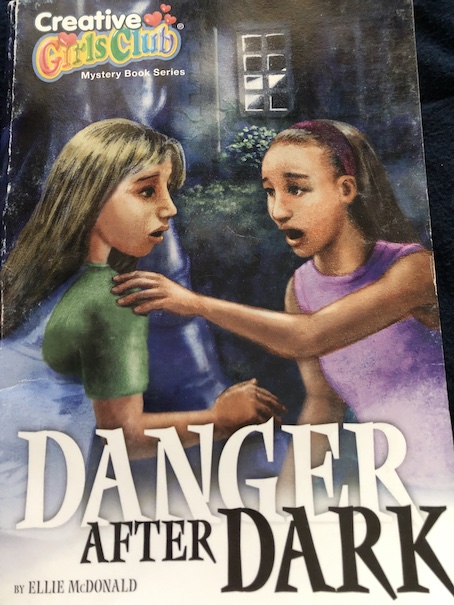
A group of friends in Summary, Indiana has had a club together for years, and they’ve always thought that their club would last forever. They call themselves the Silly Stuff Club because they collect all kinds of weird and silly things that they find at sales. However, when one of the girls, Sarah, finds out that her family is planning to move to another state, it looks like their club might come to an end. The club meets in the old carriage house on Sarah’s family’s property. If their family moves, where will the club go, and where will they store their collection of silly stuff? The other girls in the club aren’t just losing a friend but also losing their club’s home and maybe even the club itself.
Then, Lily gets an idea. Down the road, there is an old mansion that’s been abandoned for years. The Winston estate is the property of Melva Winston, who is something of a legend in their town. According to the story, the Winston heiress rode out of town on her motorcycle about 50 years earlier, and she hasn’t been seen since. Lily reasons that the Winston estate is huge and has outbuildings, and somewhere on the estate property, there is probably a place that they can claim for the club. Since nobody lives there or goes there anymore, who is to know or care if they move in?
Some of the other girls in the club don’t like that idea because they’ve been warned to stay away from the old Winston estate. An empty old house can be dangerous, and they might get in trouble for trespassing. Still, nobody has any better ideas, so they decide to sneak onto the property and have a look around.
When they do, they discover that the house isn’t quite as empty as they thought. After all these years, Melva Winston has returned to town. She now calls herself Annie, after one of her middle names, Anastasia. The girls’ sudden arrival startles her, but when she overhears them talking about needing space for their club, she becomes sympathetic. She also realizes that she could use their help. There’s plenty of space in her big house, and she agrees to give them some space in the attic for their club, and in exchange, she asks them to look after her cat while she goes out of town for a few days. She’s hired a local woman, Ms. O’Leary, to do some cleaning for her, but the woman is allergic to cats. The girls are eager to accept because the old mansion would be a fantastic place to have their club, and it would solve their problems … except missing Sarah when her family moves.
Then, one night, a couple of the girls see someone sneaking around the old mansion when no one is supposed to be there. Ms. O’Leary tells them that there were rumors that one of Annie’s ancestors, who made the family fortune in veterinary pharmaceuticals, became an eccentric toward the end of his life, and rumor has it that he hid a great deal of money somewhere on the property. Are the rumors true, and is someone looking for the hidden money?
My Reaction
This book is something of a mystery to me, even after reading it. It is clearly intended to be park of a series because it’s marked as being part of the Creative Girls Club Mystery Book Series, but when I looked up this series, there was only one other book in it. From the descriptions I’ve seen online, it might not even really be that there are two books in the series so much as one book with two different titles because the plots given for the two books sound alike. I’ve only ever seen one of the books, so I can’t be sure.
The book is clearly set up to introduce the set of six girls in the club and establish a basis for the rest of the series. Each of the girls in the club has her own section at the beginning of the book, providing her backstory. So, what happened?
The series had a web page that was given on the inside cover, so I looked it up. It still exists, after a fashion, but the Creative Girls Club is now a subscription box service with craft kits for girls ages 7 to 12. I think what probably happened is that the book series was meant to be a vehicle for marketing the craft kits, but they changed their minds and decided to just move forward with the craft kits in a subscription service without the associated books and characters. There are no actual crafts included in this book for readers to do, although that might have been planned for later books.
The craft kits are by Annie’s Attic, and Annie’s Attic published this book. The book incorporates Annie’s Attic by having the girls move their club to the attic of Annie’s mansion. Ha, ha. At the end of the book, Annie decides to open a craft store and studio in the old mansion, and the girls decide to reinvent their club as a crafting club in Annie’s attic, calling it the Creative Girls Club, and thus setting up the premise for the subscription box service.
Overall, I thought that it was a pretty nice mystery for kids. It kind of worked its way around to Annie’s Attic and the Creative Girls Club in a somewhat contrived way, but still, there are plenty of things in the stories for kids to like, from the club in the attic of an old mansion to a secret room and hidden treasure.