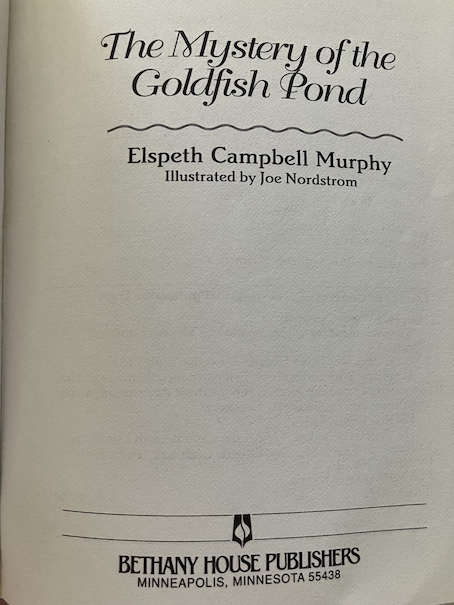
#15 The Mystery of the Goldfish Pond by Elspeth Campbell Murphy, 1997.
Timothy’s father wants him to sing at his boss’s retirement dinner. The boss’s wife heard Timothy sing once with his choir, and she wants him to sing a special song for her husband at the start of the dinner. His cousins are invited to come along so he won’t be the only kid there. Timothy doesn’t really want to do the singing, but his parents convince him to do it anyway because the boss’s wife is so fond of him and his singing.
Timothy’s father hopes that the dinner will go well because the boss has been worried about the possibilities of competitors getting their hands on information about their new product. Earlier, the boss temporarily misplaced an important memo about it, and he was worried that someone else got their hands on it.
Timothy’s song goes well, and after the dinner, the kids are allowed to walk outside in the garden while the adults listen to a series of speeches. The gardens outside the banquet hall are beautiful, and the kids start to enjoy themselves. Then, they accidentally overhear a couple of adults talking. They can’t quite catch everything they say, but something strange is going on, and something secret is hidden somewhere in the garden.
The theme of this story is Proverbs 11:13, “No one who gossips can be trusted with a secret, but you can put confidence in someone who is trustworthy.”
The book is available to borrow and read for free online through Internet Archive.
My Reaction and Spoilers
The crime that the adults were plotting involves the theft of information. The kids have to figure out the parts of the conversation they couldn’t hear clearly to figure out where the information is hidden. I thought that the clue the children try to figure out was fairly easy. Part of the conversation the kids try to figure out sounds like “-ake -urtle”, and there aren’t many words that sound like “-urtle.”
The boss’s wife seemed eager for the children to go outside, into the garden, and tell her about it later. The kids wondered why she seemed so eager for them to go outside and what she was hoping that they would tell her afterward. It sets the stage for the kids to expect that something unusual or mysterious might happen, which proves to be the case when they overhear the important conversation. The boss’s wife says later that she suspected something might happen because she knew her husband was worried about people stealing company information, and she realized that this dinner would be a convenient place to hand it off to someone.
We never learn exactly what kind of information or new company products the adults were concerned about. We also don’t know exactly who was trying to steal the information or what happens to that person later. The part that the children care about is that they were able to stop the hand-off of the information.
#13 Rosy Noses, Freezing Toes by Judy Delton, 1990.
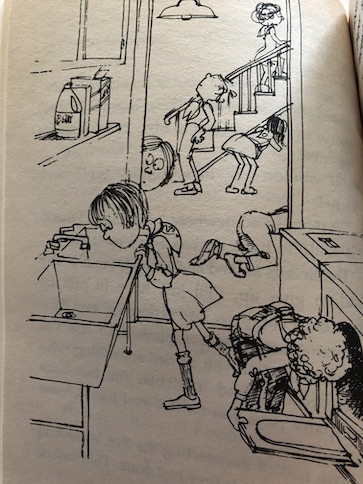
At one of the scout meetings, Mrs. Peters, the troop leader, says that her antique vase is missing. It’s a family heirloom, and Mrs. Peters wants to ask the scouts if they know anything about its disappearance or if they have any idea of what could have happened to it. None of them knows, but they’re fascinated by the mystery. After they search the house and can’t find it, Mrs. Peters says that she’ll just have to report its disappearance to the insurance company. Mrs. Peters is willing to let the matter go at that, but the scouts keep wondering what happened to the vase and if one of them could have taken it.
Mrs. Peters tells the scouts that the next badge they will earn will be their music badge. To earn the badge, the children will have to sing or play an instrument or tell the group about the life of a composer. Some of the children already play instruments and know what they’re going to do, but others aren’t sure. Since it’s December, Mrs. Peters suggests that some of them could sing popular Christmas songs or a Hanukkah song.
Sonny Betz declares that he doesn’t want to participate because he can’t play an instrument and over the next few days, he seems upset and nasty with people. Molly asks him what the matter is, and Sonny tells her that his mother is forcing him to take violin lessons. Mrs. Betz has always wanted Sonny to learn to play the violin, and his new violin teacher has assured her that Sonny will be able to learn the first line of Jingle Bells in time for the scouts’ music show, even though it’s coming up fast. Sonny isn’t happy about it, and to make him feel better, Molly tells him that he’s lucky because nobody else will be playing the violin and it will make him different. Unfortunately, the other kids tease him and call him “Maestro,” so he starts feeling bad.
Molly doesn’t like the way the others keep teasing Sonny, and when Tracy says that Sonny is a baby, Molly tells her that it’s not his fault because his mother is the one who makes him take violin lessons and keep the training wheels on his bike even though he’s in the second grade and all the other things that people tease him about. Mrs. Betz doesn’t realize how much Sonny hates some of the things that she makes him do and how much the other kids tease Sonny about these things. Molly overhears her mother saying that Sonny will “be a handful by the time he gets to high school,” probably because she’s imagining that Sonny will rebel against all things his mother has been making him do once he’s a teenager. Actually, it’s not going to take that long.
Mrs. Peters uses the insurance money from her vase to buy a piano. The scouts’ music show goes okay at first, although none of the kids are spectacular at music. Molly, Mary Beth, and Lisa paint their noses red and sing Rudolph the Red-Nosed Reindeer. Kevin whistles. Roger plays White Christmas on the drums with no other accompaniment, confusing everyone about what song he’s actually playing. Poor Sonny has to go last, when everyone is starting to get tired of the entertainment, but he doesn’t play well. The other scouts cover their ears, and the screeching of the violin makes the dog bark and Mrs. Peters’s baby cry. Sonny is so upset that he runs away from the show and has a fit.
The next day, Molly learns that Sonny has run away from home completely, leaving behind a note that he’s heading to Alaska. Everyone is searching for Sonny and getting worried about him being outside alone in the snow. However, Molly soon discovers that Sonny hasn’t gone as far as everyone fears and he’s certainly not on his way to Alaska. She discovers Sonny hiding in her family’s bathtub. Sonny explains to her that he didn’t have the money to go to Alaska, but he couldn’t bring himself to go home, and he picked Molly’s house to hide in because Molly is the only one who didn’t tease at him. Molly promises not to turn him in, but she says that he won’t be able to stay in her bathtub forever. His mother has called the police to report his disappearance, and Molly’s parents are bound to find him eventually. Sonny swears that he can’t go home because he hates playing the violin so much. What can Molly do to help him change his mind?
I didn’t like the way the other scouts were so mean to Sonny in the book. Sonny does do childish things, like being mean to the younger kids on the playground when he’s upset and throwing fits when things go wrong. However, Molly tries to be understanding with Sonny, even when he’s being fussy and whining, and she recognizes that Sonny is in a difficult position. His mother has certain expectations of him, and Sonny doesn’t think that anything will change her mind. The way things work out, though, makes it seem like Sonny never really explained to his mother how upset he was about the violin lessons and maybe not even how upset he’s been about some other things. Part of Sonny’s difficulty and the reason why he seems babyish to the other kids is that he seems to have trouble managing and articulating his emotions, including standing up for himself and what he really wants. Some of the other scouts help Molly to convince Sonny that running away isn’t the solution, and Molly calls Mrs. Betz to tell her that Sonny is okay but won’t come home until she promises that he can stop playing the violin. Sonny declares that he wants to see that in writing, and his mother gladly writes him a note that says that he doesn’t have to play the violin again.
So, what about the antique vase mystery from the beginning of the story? Before the end of the book, they do locate the missing vase (not really stolen, more misplaced and forgotten), but Molly accidentally breaks it. Mrs. Peters says that it’s okay because, with the vase broken, she doesn’t have to give the money back to the insurance company, and she gets to keep her new piano. She’s been wanting a piano, and the truth is that she never really liked the vase, even though it was a family heirloom. Yay? Merry Christmas!
The book is available to borrow for free online through Internet Archive.
Nate the Great and the Halloween Hunt by Marjorie Weinman Sharmat, 1989.
Nate the Great gets a Halloween case when Rosamond asks him to help her find one of her cats. Rosamond and Annie show up at Nate’s house, trick-or-treating. They’re both dressed as Little Red Riding Hood, and Annie’s dog, Fang, is the wolf/grandmother.
Rosamond has several cats, all named “Hex”: Big Hex, Plain Hex, Super Hex, etc. But, she’s worried because she can’t find Little Hex. Every Halloween, her other cats like to go to an old house in the neighborhood that is supposedly haunted in order to help haunt it, but Little Hex is afraid on Halloween and apparently hid somewhere. Nate thinks that Little Hex will probably come out as soon as Halloween is over, but Rosamond is so worried that he agrees to look for Little Hex anyway.
Nate interviews kids in the neighborhood to see if they’ve seen Little Hex, but they haven’t. Then, he and his dog, Sludge, go to the haunted house to look around. He sees Rosamond’s other cats, but not Little Hex. There’s a scary moment when he realizes that he’s locked in the house, but Sludge helps him to escape.
Little Hex isn’t as far away or lost as Rosamond thinks, and Nate realizes that both Sludge and Rosamond herself have given him the clues he needs to solve the mystery. Sludge demonstrates what an animal might do when it’s frightened, and Nate suddenly realizes why Rosamund’s treat basket was so much heavier than Annie’s even though they had been to the same houses.
The book is available to borrow and read for free online through Internet Archive.
The story takes place in occupied France during World War II. Children were often sent to the countryside to escape the violence of war, and a group of twenty children, both boys and girls, are staying at a small school taught by a nun, Sister Gabriel. Most of them are about eleven years old, although four-year-old Louis is allowed stay at the school with his older sister, Denise.
Janet, another student at the school, tells how a strange man comes to the school and begs them to help him hide ten Jewish orphans from the Nazis. Sharing their school with these newcomers means that they will have to share their already meager rations with them and to keep their presence at the school absolutely secret. In spite of the danger and difficulty, everyone at the school agrees to help. They think of it as being like when Mary and Joseph had to take baby Jesus to Egypt to hide him from King Herod, a story they had recently acted out in play form.
The two groups of children soon make friends, and one of the Jewish children, Arthur, shares something special with his new friend, Henry: a small piece of chocolate. With the rationing, none of them have seen chocolate in a long time. Henry decides to share a little with Janet because he likes her, and they decide to hide the rest and save it for later. When Denise spies them with the chocolate and wants to have a little herself, she steals the piece of chocolate from where Henry has hidden it. The others chase after her to get the chocolate back, and they end up accidentally discovering a cave that none of them knew was there.
This becomes a vital discovery when the children spot a pair of Nazis heading toward their school. Sister Gabriel is away, so the children have to take care of the situation themselves. Quickly, Arthur leads the other Jewish children to the cave, where they can hide. The other children remain at the school and try to keep the Nazis from learning anything. They try not to even talk to the Nazis when they start asking questions. But, how long can they keep it up? Something has obviously happened to Sister Gabriel, and the Jewish children can’t hide in the cave forever.
There is a movie version of this book called Miracle at Moreaux. The movie differs significantly from the book. In the book, the children at the school are all welcoming to the Jewish children, but in the movie, some of the children at the school are afraid of the Jewish children (there are only three of them in the movie), one of them in particular hating Jewish people because she believes anti-Semitic stories she’s heard. Also, instead of the cave that appears in the book, the movie uses a Christmas pageant as the device for confusing the Nazis and allowing the Jewish children to escape to Spain (instead of staying at the school until the end of the war, as they did in the book).






 Twenty and Ten by Claire Bishop, 1952.
 The two groups of children soon make friends, and one of the Jewish children, Arthur, shares something special with his new friend, Henry: a small piece of chocolate. With the rationing, none of them have seen chocolate in a long time. Henry decides to share a little with Janet because he likes her, and they decide to hide the rest and save it for later. When Denise spies them with the chocolate and wants to have a little herself, she steals the piece of chocolate from where Henry has hidden it. The others chase after her to get the chocolate back, and they end up accidentally discovering a cave that none of them knew was there.
 Jestress's Forgotten Books and Stories