The Mysterious Horseman: An Adventure in Prairietown, 1836, by Kate Waters, 1994.
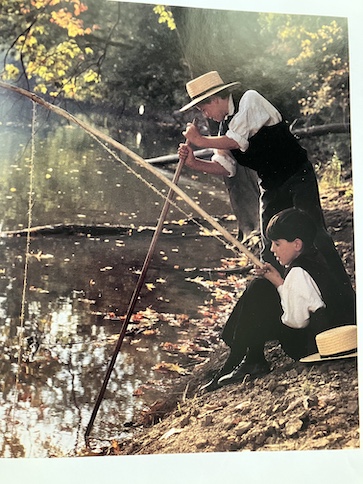
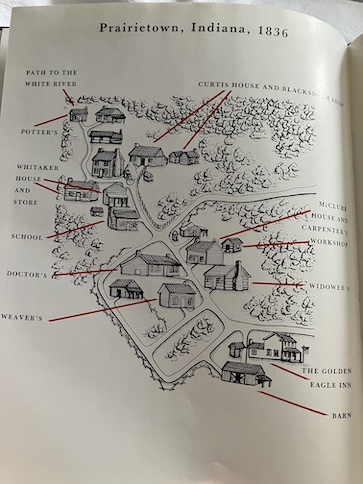
This book is part of a loose series of books by Kate Waters, showing child reenactors at living history museums, having adventures in the roles of the characters they play. While most of the books are set in Colonial times at Plymouth and Colonial Williamsburg, the setting for this story is the Connor Prairie living history museum in Indiana, which shows life in a small town in the 19th century.
The story centers around a boy named Andrew McClure. He is the only one of his siblings left still living with their parents. His older sister is now married, and his baby brother died of an illness during the last year. His family is still grieving for his little brother. Andrew’s best friend is a boy named Thomas Curtis, who lives nearby, and Andrew works part time at a local inn to earn some money.
One day, while Andrew is doing some sweeping at the inn, he overhears some men talking in the taproom. He doesn’t hear their entire conversation, but he hears them talking about a mysterious rider without a head who chased a schoolmaster. Andrew is startled, and he wonders if that has something to do with the new schoolmaster who is supposed to arrive in town.
When Andrew is done with his work, he goes to the schoolhouse, and he finds his friend Thomas and Thomas’s sister, helping the new schoolmaster to clean the schoolhouse and prepare it for lessons to start. Andrew wants to talk to Thomas about what he overheard at the inn, but the schoolmaster only wants to talk to the boys about lessons.
Later, Andrew does have a chance to talk to Thomas, and both of the boys are spooked by the idea of a headless rider. They even think that they hear the rider on the road! The frightened boys go see Thomas’s father, the blacksmith, and tell him about the rider. Fortunately, the blacksmith knows what the men were talking about, and he can settle the boys’ fears.
The book is available to borrow and read for free online through Internet Archive.
My Reaction
I didn’t know about this book until I was looking up Kate Waters’s books for my younger cousins. I was surprised because Kate Waters’s living history museum books are mostly set on the East Coast or focus on the Colonial era. This 19th century book set in Indiana somewhat departs from the theme and has a different feel from the other Kate Waters books, but I enjoyed it. I’ve been to Connor Prairie because I have relatives in the area, and I enjoyed my visit. It’s been years since I’ve been there, so I didn’t immediately recognize the setting. When I read the explanation in the back of the book, I was fascinated to realize that I had visited that location before.
Andrew has a fascination for life on the frontier because he often watches people pass through his town on their way further west, and he daydreams about going west himself. His family is also still coming to terms with the death of his little brother, so the subject of death is still on Andrew’s mind. The deaths of children due to illness were sadly common in the 19th century and on the frontier, and the mourning in Andrew’s family adds to the melancholy and spooky atmosphere of the story.
Most adults and older children will probably recognize what the men at the inn where actually talking about when they were discussing the headless rider who chased the schoolmaster. When the boys talk to Thomas’s father, he immediately recognizes the story as the plot of The Legend of Sleepy Hollow by Washington Irving, originally published in 1820, about 16 years before the story in this book is suppose to take place. The men at the inn were just discussing the plot of the story, not something that they saw on the road themselves.
Phoebe the Spy by Judith Berry Griffin, illustrated by Margot Tomes, 1977.
Phoebe Fraunces is a thirteen-year-old girl living in New York in 1776. The Fraunces family is black, but unlike most black people in the American colonies at the time, they have never been slaves. (There were some free black families who had never been slaves during this period of history, but they were uncommon.) Phoebe’s father, Samuel Fraunces owns a tavern called The Queen’s Head. It’s a popular place for people to meet, and Samuel Fraunces allows some prominent Patriots to meet there in secret and discuss their plans. Being party to such meetings could come with consequences as the colonies are on the brink of war.
One day, in April 1776, Samuel confides in his daughter that he has overheard something disturbing. He believes that George Washington’s life is in danger, that there are soldiers who are willing to kill their general for money. Samuel is worried about what he heard, but he isn’t sure what the plot against George Washington actually is and has no proof of what he heard. He’s afraid that if he tells Washington about what he heard too soon, without proof, the conspirators will just wait for a safer time to strike, so he asks Phoebe to help him uncover the truth. Samuel knows that George Washington will be coming to New York soon, and he has asked Samuel to help him find a housekeeper for the house where he will be staying. Samuel wants Phoebe to take the housekeeper position and to keep her eyes open for signs of danger.
Phoebe doesn’t know if she can do what her father wants her to do. She isn’t sure what she’s supposed to be watching for, and she doesn’t know how she could stop the plot if there is one. Her father tells her that she should look out for a man who is part of George Washington’s bodyguard and whose name starts with the letter ‘T’. This is all that Samuel was able to tell about the conspirator from the conversation that he overheard. He tells Phoebe to be careful, not to trust anyone, and to meet with him regularly in the market to tell him what she has learned. The two of them also discuss how odd it is that a man like George Washington, who owns slaves, would be at the center of a fight for freedom. Phoebe hopes that he will free his slaves after the war is over, although her father doubts that will happen. Still, the Fraunces family supports the cause of the Patriots, and Phoebe agrees to help her father find the conspirators and save George Washington’s life.
Phoebe is young to be a housekeeper, but she is accepted into Washington’s household. There, she meets Mary the cook and her son Pompey. Pompey also performs chores for the family, like carrying firewood. The work isn’t too hard for Phoebe because much of it is what she is accustomed to doing for her family’s tavern, like making beds, cleaning the silver, and making sure that meals are served on time. George Washington doesn’t say much when he’s around Phoebe, but she carefully observes the people around him. Every day, she goes to the market to buy food and see her father.
At first, Phoebe has nothing to report to her father. Everyone around George Washington seems to be nice or at least behaving normally, and nobody’s last name begins with the letter ‘T’. Mr. Green, a member of George Washington’s bodyguard, seems a bit unfriendly, but a younger man, Mr. Hickey, seems rather nice and sometimes gives Phoebe little presents.
However, there is a traitor among the household, and although it pains Phoebe when she learns who it is, she must do her duty and protect the life of the person she has promised to protect.
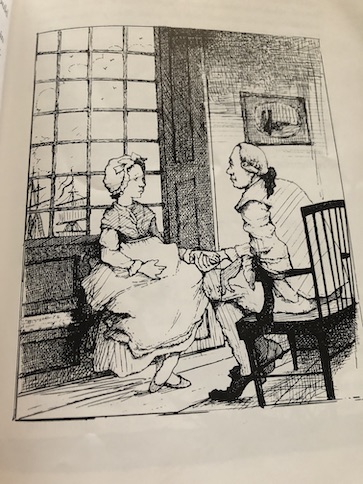
Some of the pictures in the book are black-and-white drawings, and some are in muted colors.
The original title of this book was Phoebe and the General. It is available to borrow and read for free online through Internet Archive.
Historical Background
The story is based on the real Fraunces family of New York. Samuel Fraunces really did own a tavern called the Queen’s Head and allowed Patriots to meet there. A note in the back of the book explains that after the war ended, he was given a reward by Congress, and he changed the name of the Queen’s Head to Fraunces Tavern. Fraunces Tavern still exists today, and it is still a restaurant, although part of it has been converted into a museum.
The racial identity of Samuel Fraunces has been in dispute for some time. No one is completely sure what he actually looked like. There is a portrait of a white man that has been reputed to be Samuel Fraunces, but the true identity of that portrait is in dispute. Samuel Fraunces is known to have had the nickname of “Black Sam”, but different sources describe the family differently. All that is known of Samuel Fraunces’s background is that he was born around 1722 and was originally from the West Indies. It’s possible that the Fraunces family may have been mixed race because some sources refer to Samuel Fraunces as “mulatto” (an old term for someone born to a white parent and a black parent, not considered a polite term now), which might explain the other, differing accounts of the family’s race.
The story of Phoebe Fraunces saving George Washington’s life is legend, but the facts regarding that incident are also in dispute. The legend might be based on a misunderstanding, and Samuel Frances’s real daughter, Elizabeth, does not seem to have been old enough at the time to have taken part in this adventure. The story has had a tendency to appear and reappear around patriotic milestones in the United States, first around the centennial in 1876 and then around the bicentennial in 1976, when this book was written.
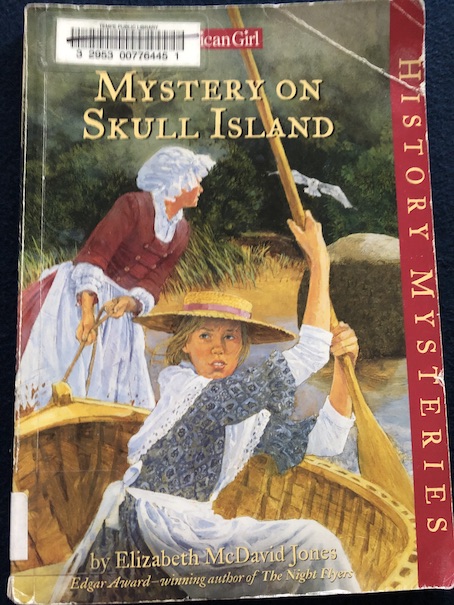
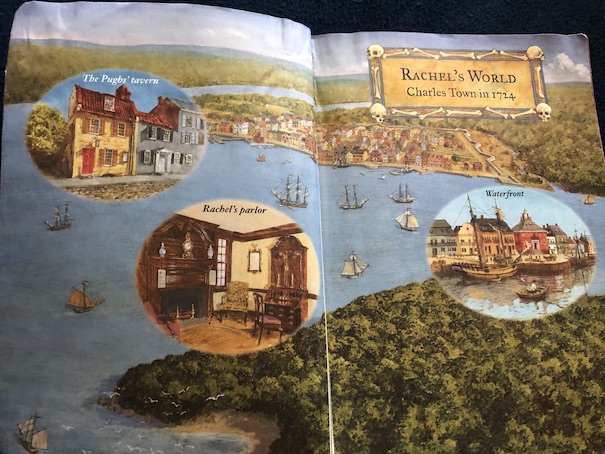
It’s 1724, and twelve-year-old Rachel Howell is traveling to where her father lives in Charles Town, South Carolina. Rachel has been living with her grandparents in New York since her mother died seven years earlier. Her father also used to live in New York, but after his wife’s death, he decided to move to South Carolina, hoping to start a new life. Now, her father has established himself in South Carolina and wants Rachel to come and live with him. Rachel has wanted to live with her father for some time, but she’s nervous because she doesn’t know what life in South Carolina will be like.
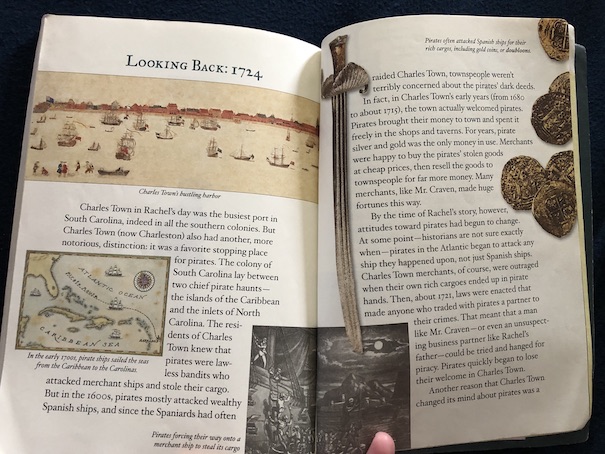
Rachel’s new life has a terrifying beginning when the ship that is taking her to Charles Town is attacked by pirates. The pirates force the passengers on board to hand over jewelry and other expensive items. They even take Rachel’s pendant, which belonged to her deceased mother. Fortunately, the pirates don’t hurt or kill anyone and let the ship go once they’ve taken everything of interest to them.
When Rachel arrives in Charles Town, she and her father have difficulty recognizing each other at first, but they are happy to finally be together. Rachel’s father is appalled when he hears about the pirates stealing Rachel’s mother’s necklace, but he is relieved that Rachel is all right. He explains that piracy has been a serious problem to shipping in the area. The local government has tried to combat the problem with harsh punishments, hanging many offenders. However, the pirates have money, and so local businesses still tolerate their presence.
The talk of pirates is shocking, but Rachel is soon in for another shock when her father tells her that he has become engaged and that Rachel will soon have a new mother. Rachel had been looking forward to having some time alone with her father to get to know him again, so she is not pleased at the news, but the engagement is the main reason why her father has sent for her. He wants Rachel to have a mother to care for her and for them to live as a complete family again. He tells Rachel that his fiance, Miranda LeBoyer, is from Philadelphia. She will be arriving in Charles Town soon with her aunt.
Rachel’s father is often busy with his work in the shipping industry, but he grants Rachel more freedom than she had with her grandparents, so she is able to explore her new town and make some new friends. The first friends she makes are the Pugh family, especially the daughter, Sally, who is about Rachel’s age. The Pughs own a local tavern, and Rachel often goes to visit them, sometimes helping with chores and learning to cook. She tells Sally about her worries about her new stepmother, but Sally says that she might not be so bad.
Like her life in South Carolina, Rachel’s first encounter with the woman her father plans to marry takes a disturbing turn. First, Miranda seems to disapprove of Sally and her brother, and Rachel fears that she will interfere with their friendship. Then, her father’s new business partner, Mr. Craven, stops by, and Rachel notices that Miranda seems to both recognize and dislike Mr. Craven. She overhears a conversation between the two of them in which Miranda calls Mr. Craven a “scoundrel” and refers to some kind of illegal dealings in his past. Yet, when Rachel’s father tries to ask Miranda what they’re talking about, Miranda lies and says that they’re discussing the weather and hurricanes that occur in Charles Town. Rachel worries about why Miranda would lie to her father and what kind of dishonest business Mr. Craven might be doing. What are the secrets that people in this town are hiding, and is Miranda really what she seems to be? With the help of her new friends, will Rachel find out the truth before it’s too late?
There is a section in the back of the book with historical information about piracy and life in South Carolina during the 18th century.
The book is available to borrow and read for free online through Internet Archive.
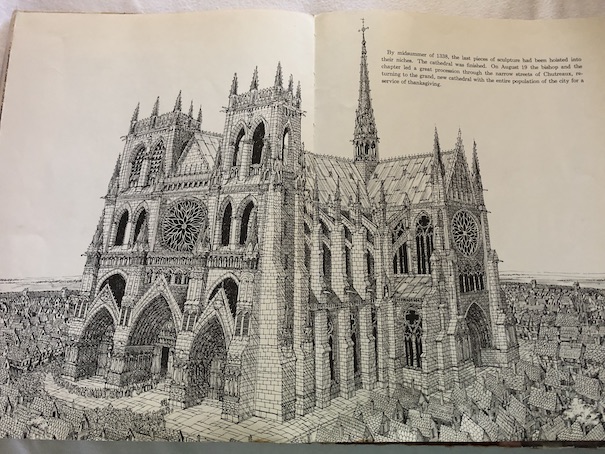
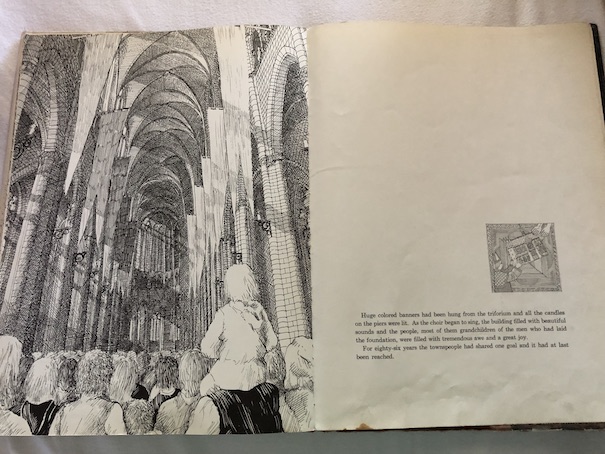
This is the story of the construction of a Medieval cathedral. The story takes place in a fictional town in France, Chutreaux, but it is based on the construction of real Medieval cathedrals.
In 1252, the people of Chutreaux decide to build a new cathedral because their old cathedral was badly damaged by a lightning strike and other towns in their part of France are building grand cathedrals. The people know that it takes decades to construct a grand cathedral, perhaps even more than 100 years. The people making the decision to build the cathedral know that they will never see the end of the construction themselves, but they believe that this is an important undertaking, both for the welfare of their community in the future and for the glory of God.
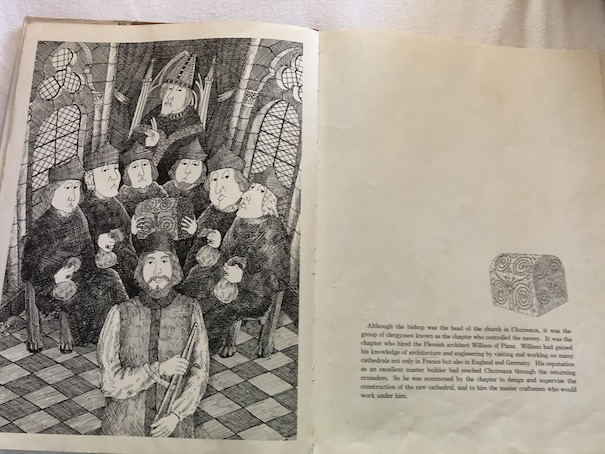
The church leader in Chutreaux is the bishop, but a group of clergymen have been given control of money for the cathedral project. They have chosen to hire a Flemish architect, William of Planz, to create the design for their cathedral and hire the craftsmen who will actually build the cathedral.
Building a cathedral is a massive undertaking that requires many different types of craftsmen and laborers. The book explains that the craftsmen building the cathedral will include a quarryman, a stone cutter, a mason, a sculptor, a mortar maker, a blacksmith, a carpenter, a glass maker, and a roofer. All of these craftsmen are masters of their crafts, with apprentices, assistants, and many general, unskilled laborers doing much of the heavy work.
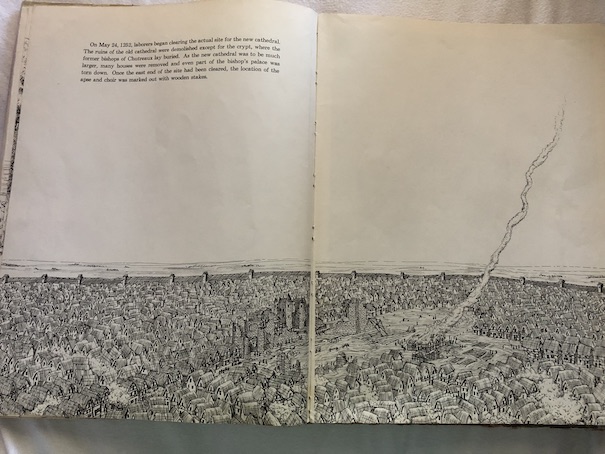
The building of the cathedral begins with the clearing of the site, marking the basic layout of the building, and building workshops where the craftsmen will be doing their work. The book shows the tools that the various types of craftsmen use. They also need to gather the materials that they will use. There is a quarry where they will cut the limestone blocks they will use to construct the cathedral, and the wood for the roof is brought from Scandinavia by boat.
From there, the cathedral is built in stages, beginning with the foundation and then the walls. The book explains each step of the construction and how it was managed, giving the dates when each phase is completed. It also explains the purpose of various architectural features, such as the flying buttresses that support the walls. There is also a glossary in the back of the book that defines various architectural terms.
Because this is an extremely long-term project, over the course of the book, William of Planz and various craftsmen age and one person dies in a work-related accident, and they are replaced by younger people. The construction is finally finished 86 years after it was started.
I recommended this book to people after the burning of Notre Dame in Paris last year because this cathedral is similar to Notre Dame and can give people an idea of what went into its construction. I think that the time invested in the cathedral construction is one of the key points of the story. The ability to delay gratification in the pursuit of larger goals is an important life skill, but the people who began the cathedral project showed this ability to an even higher degree than most. The book carefully notes that the people of this town understand that they will never see the final product of their contribution of money and labor because the project will take decades to complete, but they still begin the undertaking because they believe that it is the right thing to do for their community, for future generations, and for God. Their ultimate reward is not in immediately profiting from this project but in their legacy, laying the foundations (literally) for the future. In the end, it is their grandchildren who become the ones to complete the project and enjoy the beauty of the finished cathedral, and they consider it more than worth the wait.
The book was also made into a documentary film. The film follows the basic course of the book but with more focus on the lives of the characters, giving them more personality than the book does and inserting more drama into the construction of the cathedral. The story of the town and townspeople alternates with explanations about the history and architecture of cathedrals. The fictional cathedral serves as an example not only of the process of constructing a Medieval cathedral, but the difficulties and dangers it might involve.
The book is available to borrow and read for free online through Internet Archive (multiple copies).
Samantha is turning ten years old! She is having a birthday party with some other girls, and Aunt Cornelia’s younger sisters, the twins Agnes and Agatha, are coming to visit. Samantha’s grandmother is very strict, with very precise ideas about the way that things should be done. The twins are accustomed to being raised more permissively. When Samantha complains that her grandmother makes her wear long underwear for most of the year, even when it’s really too hot to wear it. Her grandmother thinks that it will help ward off illness. The twins encourage Samantha to think for herself. Few people wear long underwear anymore or believe that they will get sick by not wearing it, the twins say, and if Samantha doesn’t want to wear it, she should be allowed to make up her own mind about it. Samantha agrees that ten years old should be old enough to decide about simple things, like what kind of underwear to wear.
The twins have a lot of interesting ideas about how to do things differently, and they encourage Samantha to be a little more daring and try new things. When the cook talks about Samantha’s birthday cake and how it will have ten candles on it, the twins suggest that she could make ten smaller cakes, called petite fours, and put one candle on each of them. Samantha thinks that sounds so elegant that she wants to try it, although the cook thinks that it sounds a little strange for birthday cakes. They’re also going to have ice cream at the party, homemade. Samantha and the twins help to make it, although they are annoyed by Eddie, the nosy and bossy boy from next door, who shows up and tries to tell them what to do, hoping for a taste of ice cream himself.
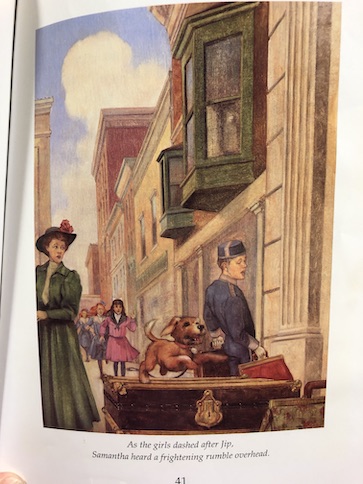
At first, girls the party act a bit self-conscious, trying to be polite and grown-up in their party clothes. After Samantha opens her presents, her Uncle Gard and Aunt Cornelia show up with a special surprise: a puppy named Jip. Jip is a little wild and doesn’t know how to obey commands. He runs off with Samantha’s new teddy bear (a recent invention in Samantha’s time), and the girls have to chase him and get him to drop the toy. Samantha distracts the dog by offering him her shoe, and Eddie, who was watching, picks up the bear. At first, he says that he’ll give it back if they give him some ice cream and let him play with the dog, but Samantha refuses because he was not invited to the party, and she doesn’t like him nosing in. Agatha wrestles the teddy bear away from Eddie before Samantha’s grandmother arrives and tells them that young ladies shouldn’t fight or make spectacles of themselves. Most of the rest of the party is elegant, and the girls are a little more relaxed, now that they look a little less elegant from chasing the dog. However, Eddie gets revenge on the girls by adding salt to the ice cream they made. Even though everything else is fine, including the petite fours, Samantha is still angry at Eddie for ruining the ice cream.
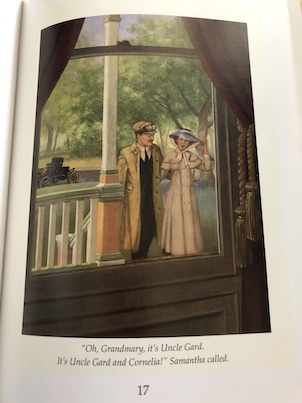
Since Samantha didn’t get to eat the ice cream at her birthday party, the twins and Aunt Cornelia suggest that Samantha return to New York City with them for a visit, and they can all go to a fancy ice cream parlor there. Grandmary agrees and says that she would like to go to New York City herself. On the way to Uncle Gard and Aunt Cornelia’s new house, Grandmary says to Samantha that she hopes that she thinks that the twins get too carried away with some of their ideas. She thinks that they’re too impulsive and don’t think before they act, and while they’ve been raised to be very modern children, she still thinks that some of the old ways are best.
When Grandmary and Samantha see a protest held by women’s suffragists, Grandmary is annoyed at the women, making public spectacles of themselves and inconveniencing passing traffic. She thinks that it’s just another “newfangled notion” that’s a lot of fuss and bother over nothing. She’s never had to vote in her entire life, and she doesn’t see why any other woman would need to. Samantha can tell that this opinion bothers Aunt Cornelia and the twins when Grandmary says it in front of them, but they don’t seem to want to discuss it further.
The twins and Samantha ask to take Jip to the park, and Aunt Cornelia says that’s fine. She has a meeting to attend, but she wants them back home in time to go to the ice cream parlor after her meeting. However, Jip gets away from the girls when they try to put him in Samantha’s doll carriage, and they chase him to the place where the suffragists are meeting. Although Samantha knows that her grandmother doesn’t approve of the suffragists, they have to go after the dog. There, the twins tell Samantha that Cornelia is also a suffragist, and she is speaking at the meeting.
Jip charges right up to the stage where Cornelia is giving her speech, and Cornelia lectures the girls about not thinking about the consequences of their actions and not following her instructions for taking proper care of Jip. Sometimes, they are too impulsive and don’t think ahead. Cornelia explains to the girls about the need to follow agreed-upon rules for safety and how that is different from the changes that her group is advocating. While Grandmary has been saying that the suffragists are also too radical and impulsive and making a fuss about nothing, Cornelia says that much thought, planning, and hard work has gone into their movement to ensure that the changes they’re advocating will be for the better. Grandmary doesn’t appreciate how much thought and preparation the group has done and how long it has taken them to get this far because she hasn’t really thought about the issues at all herself and she has not been to any of previous meetings, where the planning has taken place.
Note:The women’s suffrage movement was already decades old by 1904, when this story takes place, so it’s not really as “newfangled” as Grandmary describes it. It had been building for a long time. However, Grandmary may not have been aware of that because she never needed to be aware. Consider what her life has been like. Remember that Grandmary is a wealthy lady and that marriage and social connections have been the basis of her life. Her husband was wealthy, and she was likely born into a wealthy family. Her life has always been comfortable without her needing to have a job or vote or do anything other than be a wife and mother. Growing up, becoming a well-behaved young lady, and getting married set her for life, and up to this point, she hasn’t had any major problems with money or her lifestyle and hasn’t really needed to think much further than that. She’s used to letting the men in her life handle business and politics and provide her with money, and she now lives on the money that her husband left to her, which is more than ample. Mostly, what Grandmary has needed to manage in her life are the social graces necessary for entertaining her husband’s business associates and their wives and for helping to facilitate her children’s marriages and careers. Grandmary’s daughter was also married to a well-off man before their early deaths. Her son is also a wealthy man, who can provide for his wife, and Cornelia is also from a wealthy family in New York City, a natural extension of their social circle. Grandmary assumes that Samantha, raised in this wealthy social atmosphere, will also naturally meet and marry a wealthy man through the connections of her friends and family, one who will support her and their children in a comfortable fashion. She thinks that, besides caring for her future children, Samantha will likely occupy her time with good works for the less fortunate and that she will give elegant parties for the fashionably-dressed ladies of their social level to solidify their social connections. The elegant affair that her tenth birthday was supposed to be was also practice for her future, as Grandmary envisions it. Grandmary thinks that life will continue to follow this same general course in their family and that there will never be a need for anything different because her own life has been fairly smooth, comfortable, and predictable, largely unshaken, even by the deaths of her husband and Samantha’s parents. But, she’s about to change her mind.
The girls are a little disheveled when they go to meet Grandmary at the ice cream parlor because there is no time to go home and change. As they explain to Grandmary about why the girls look a little disheveled, she tells them that she already knows because she was there, watching the speech. When she saw that Cornelia was the one speaking, she decided to stop and listen, and she was impressed by what she heard. She liked the part where Cornelia talked about the importance of standing up for what is right, and that’s something that Grandmary believes in, too. She is now more open to the suffrage movement than she was before.
The story is partly about growing up and how Samantha realizes that she needs to learn to make her own decisions. She can’t always go by what her grandmother tells her, and sometimes, listening to the twins isn’t always the wisest choice, either. Samantha also begins to see that she has choices to make about the kind of young lady that she will grow up to be. She can be the elegant lady at the party or the public crusader for the causes she believes in or maybe something that combines aspects of both. In the end, Grandmary also begins to see the possibilities of change.
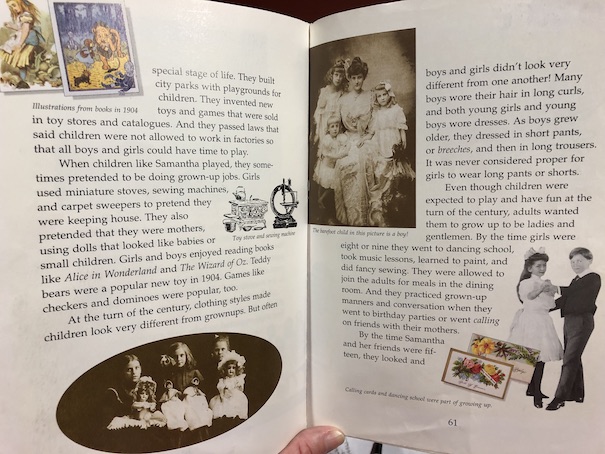
In the back of the book, there is a section about babies and children during the early 1900s. It discusses what children liked to do for fun and how adults would begin training children to be young adults early in life, emphasizing social skills, like dancing, how to behave at the dinner table, and how to engage in polite adult conversation. A girl from a wealthy family, like Samantha, might go to a finishing school instead of college after completing her basic education. At finishing school, she would learn how to manage a household, including how to manage servants (how to hire them, how to tell if they were doing a good job, etc.) and how to throw elegant dinner parties. She might have a coming out or debutante party to introduce her to society as an adult, which meant that she would be ready for introductions and dates with young gentlemen and would probably soon be considering marriage. (This is likely the path that Samantha’s grandmother took in life and the one that she is considering for Samantha.) However, some young ladies did go to college, had careers, or become suffragists, and some did some combination of the above. Samantha’s life is full of possibilities, and her future hasn’t been decided yet. Because Samantha was ten years old in 1904, she would have been eighteen in 1912. For an example of what college life would have been like for an eighteen-year-old girl at a college in the eastern United States in 1912, see the novel Daddy-Long-Legs.
The book is currently available to borrow for free online through Internet Archive.
Samantha and her family are spending the summer at their summer home at Piney Point. Besides Grandmary, Uncle Gard and Aunt Cornelia will be there. Cornelia has also brought her younger sisters, a set of twins named Agnes and Agatha. They are close in age to Samantha. Grandmary’s friend, Admiral Archibald Beemis, is also visiting from England.
The family’s summer home isn’t just a single house. They have a lodge in the style of a log cabin and separate guest cottages. This summer, Samantha and the twins will get a cottage to themselves with no adults. The girls have fun exploring the area around the lake together. However, there is one place that Samantha is afraid to go, the island in the lake called Teardrop Island. The only way to get to the island is by boat, and there are sharp, treacherous rocks in that part of the lake. That was where Samantha’s parents had their boating accident and drowned during a storm. To Samantha, Teardrop Island is a place of sadness and danger.
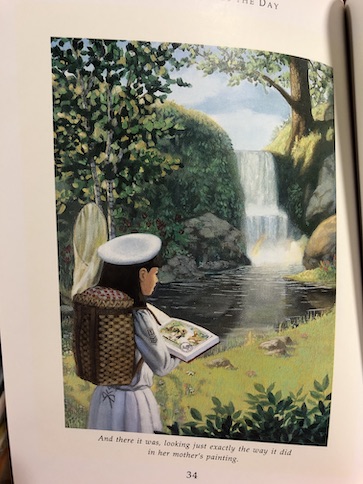
One rainy day, the three girls go up to the attic of the lodge to look for more paintbrushes so they can paint pictures. In the attic, they find old clothes and pictures of Samantha’s family. They also find Samantha’s mother’s old sketch book, labeled “Happy Memories of Teardrop Island.” In the sketch book, she drew pictures of Samantha and her father as they had picnics and played by a waterfall. Samantha was a very young child at the time, and she has no memories of having been on the island with her parents. From the pictures, it looks like it used to be her family’s favorite place.
Seeing the pictures makes Samantha want to visit the island once more, hoping to bring back memories of her earlier visits and her parents. The next day, the three girls go out to the island and try to find the places that Samantha’s mother drew in her book. Teardrop Island turns out to be a beautiful place, and Samantha loves it. The more time she spends there, the more she feels like she has been there before, although her memories are vague and dream-like.
However, the girls forgot to tie up their boat, and they find themselves stranded on the island! A storm comes, and the girls are afraid. When the Admiral tries to come out to the island to help them, he is injured, and the girls realize that they are going to have to find a way to save him! Can they make it home through the storm, or will they meet the same fate as Samantha’s parents?
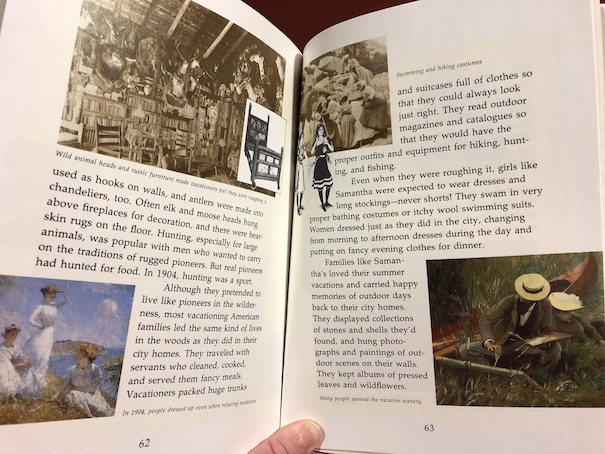
In the back of the book, there is a section with historical information about how people would spend their summers during the early 1900s. Wealthy families like Samantha’s would go to summer homes in the countryside to escape the heat of the cities.
The book is currently available to borrow for free online through Internet Archive.
Samantha Parkington is a nine-year-old orphan. She belongs to a wealthy family and lives with her grandmother, called Grandmary, in the Hudson Valley in New York. Grandmary is often strict with Samantha, trying to teach her to be a proper young lady, but Samantha finds it difficult. Samantha’s grandmother loves her, but she has very old-fashioned ideas about how girls should behave. When Samantha wants to try making and selling boomerangs in order to earn money to buy a doll, using instructions from The Boys’ Handy Book, her grandmother stops her, saying that young ladies do not earn money. She would rather that Samantha earn the doll as a reward for doing what she is told and practicing her piano lessons. Samantha also has an uncle, Uncle Gard, who has a girlfriend named Cornelia. Cornelia is a more modern woman, who would see nothing wrong with Samantha wanting to earn some money.
One of her grandmother’s servants, a black woman named Jessie, is kind and motherly to Samantha. Jessie often patches Samantha up after her various escapades and mishaps. Jessie’s husband, Lincoln, is a train porter, and Jessie tells Samantha exciting stories about the places that Lincoln has seen in his work, like New Orleans. Sometimes, Lincoln brings Samantha post cards from these places.
Samantha soon learns that a new girl her age is coming to a neighbor’s house. She has been wanting a playmate, so she goes over to the neighbor’s house to introduce herself. The new girl’s name is Nellie, but she has come to be a servant for the neighbors, the Rylands. Nellie’s family is poor, so Nellie needs to work as a maid help her parents earn money and support her younger sisters. Samantha is surprised when Nellie describes her family’s circumstances in New York City. Samantha has never been poor, and she doesn’t know what it’s like to be cold and hungry. Nellie says that the air in the countryside is better for her, and she gets better food working for the Rylands. Nellie tells Samantha that she has never been to school, and Samantha offers to teach her.
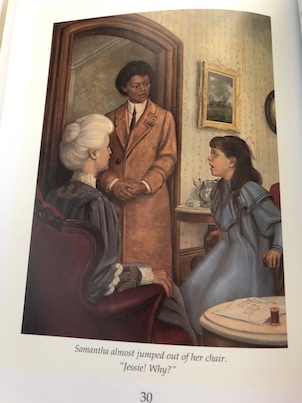
Then, Jessie suddenly announces that she is leaving her job at Grandmary’s house. Grandmary doesn’t seem surprised, but Samantha is. Jessie offers no explanation for leaving, and when Samantha tries to ask, Grandmary and the other servants do not want to talk about it. Samantha tells Nellie about Jessie leaving, coming up with fanciful reasons why she might leave her job, but Nellie offers the practical explanation that Jessie might be having a baby. Nellie knows more about it than Samantha because she has younger sisters, but she acknowledges that adults of this time period do not like to talk about people having babies, particularly in front of children. Neither Nellie nor Samantha entirely knows why.
However, Samantha is still concerned about Jessie. Samantha doesn’t know where Jessie lives, but Nellie does. The two girls sneak out one evening to visit Jessie and learn for themselves what the matter is. This is the first time that Samantha has been to the part of her town where black people live, further opening her eyes to the lives of people from lower classes of society. Nellie is a little surprised at how Samantha, who is more educated, sometimes knows so little about the ways that other people live.
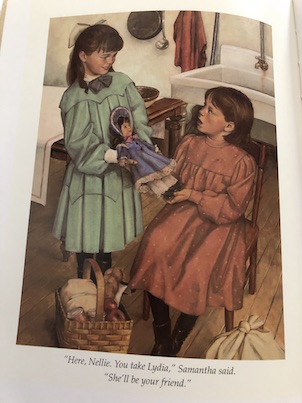
It turns out that Jessie does have a new baby. Jessie reassures Samantha that she and the baby are fine, but since her husband needs to travel because of his job as a train porter, she needs to stay at home with her baby now. Samantha thinks of a way to help Jessie keep her job and care for her baby at the same time, persuading her grandmother to let Jessie come back. Unfortunately, Nellie soon has to leave because Mrs. Ryland doesn’t think that she’s strong enough to work as a maid and decides to send her back to her family in New York City. Samantha gives Nellie her new doll as a going-away present, and she is very concerned about how Nellie and her family will manage.
In the back of the book, there is a section with historical information about how wealthy people and their servants lived during the early 1900s.
Something that occurred to me later is that Jessie is about the right age to be Addy‘s daughter, from another American Girls series. I don’t think that there’s a real connection between Jessie and Addy because the Samantha books were written before the Addy series. However, when I stopped to think about their relative ages (Addy would be about 49 years old in 1904, and Jessie is probably in her 20s), it occurred to me that if Addy had a daughter, she would probably be an adult at this time, and she might be doing something very similar to what Jessie is doing, working as a seamstress.
The book is currently available to borrow for free online through Internet Archive.
The year is 1925, and what 14-year-old Ida Bidson wants most is to graduate from her community’s small, one-room schoolhouse so that she can go to high school in a nearby city. She dreams of becoming a teacher when she grows up, and she knows that she can’t do that without more education. The problem is that, in her rural community in Colorado, not everyone thinks that higher education is important, especially for girls.
When their teacher’s mother becomes ill toward the end of the school year and the teacher has to leave, the man in charge of the local school board, Mr. Jordan, doesn’t want to bother to hire a new teacher to finish off the year. In fact, it seems a little dubious about whether they’ll even get a new teacher in the fall. Ida is crushed because, without a teacher, she can’t graduate this year as planned, and she had just about persuaded her parents to let her attend high school in the fall. Her friend, Tom, is in a similar position. More than anything, he wants to work with radio, the latest technological development of their time, and he also needs to attend high school. (So far, he’s just been teaching himself by reading Popular Mechanics – the magazine started in 1902 and is still in circulation today.) However, Tom comes up with a plan that could help everyone: What if Ida becomes their teacher?
Ida
knows that there’s no way that Mr. Jordan would actually hire her as the new
teacher. Everyone knows that he’s a
miser and that a large part of the reason they’re not getting a new teacher is
that he doesn’t want to have to pay for one.
Besides, what school board would hire a 14-year-old girl who hasn’t yet
graduated? After discussing it with the other
children, they make the decision to keep their school open secretly with Ida as
their secret teacher. Although Ida
confesses the truth about what they’re doing to her parents, most of the others
don’t, figuring that they’ll wait to tell them when the school year officially ends
in another month.
Although
it’s a daunting challenge, going from student to teacher while still continuing
her own studies, Ida sees it as the only way to get what she wants. She does her best to act out the part of
teacher, telling her friends to call her “Miss Bidson” when she’s teaching
instead of “Ida”, giving them their assignments to study, and checking their
work.
Most of
the other children agree to her terms as their new, secret teacher, although
one boy, Herbert, deliberately gives her a hard time. Herbert’s future ambitions don’t include
higher education, and he was originally looking forward to having an early
summer break. At first, he delights in
trying to push Ida, to see how she’ll deal with him as a discipline problem. Ida partly earns his cooperation by pointing out
with him that their secret school is voluntary, that no one is making him come,
that they had all voted to make her the teacher, and that if he makes problems
for the other students, they can also vote him out of the school. The thought of being rejected by his friends
for making problems keeps him more or less in line.
Then, a
woman from the County Education Office, Miss Sedgewick, comes to the school and
finds Ida teaching there. She is the one
who administers tests to graduating students, and she has come to ask how many
students will be tested this year. Ida
is forced to admit her circumstances to Miss Sedgewick. Miss Sedgewick is surprised to discover that
Ida is both teacher and student and says that she isn’t quite sure if she can
give the exams if the local school board has officially closed the school. She leaves, promising to look into the matter. What she eventually tells them is that they
can keep the school open with Ida as the teacher, but in order for the children
to get credit for their work, they will all have to take exams at the end of
the year, not just Tom and Ida.
As the
end of the school year approaches, Ida does her best to prepare the other
children for the exams and thinks about how her relationships with them have
changed. Tom, her best friend, has become
more her student and less her friend, which feels uncomfortable to her. She also has her own studying to do if she
hopes to pass the exams herself, which is difficult both with her teaching work
and the work that she must do on her family’s sheep farm.
Then,
Herbert’s father, who doesn’t value education at all and just wants Herbert
home to work their farm, finds out what they’re doing and gets Mr. Jordan to
shut the school down for good. Ida feels
like all her dreams and hard work have been for nothing. However, a talk with Herbert changes her
mind. Herbert knows that his father
fears his education. Herbert’s father is
afraid that Herbert will look down on him for not having as much education or
that Herbert will want to leave him.
Herbert admits that he’s been very unhappy at home because his father is
a bitter, angry man who doesn’t treat him much better than he does other
people. Herbert has actually learned
more than he pretends at school and really does have plans to leave home. Herbert also tells Ida that his father and
Mr. Jordan are planning a secret meeting to close the local school permanently,
purposely telling only people they know will agree about it, not local people
who value education.
Knowing about the secret meeting gives Ida’s parents, as well as other parents in the community who support their children’s education, to show their support for their children’s hard work. Faced with their opposition, Mr. Jordan agrees to let the school remain open while the children take their final exams. Ida not only does better on the final exam than she had feared, but she finds an ally in Miss Sedgewick, who will help her fulfill her wish to attend high school and become a real teacher.
The book is available to borrow for free online through Internet Archive (multiple copies).
Cassie is now in the fourth grade, and things are changing in her family. Cassie has come to love her little brother, John, called Jack, who is now a young child who likes to follow their grandfather around and imitate him. Caleb has gone away to school, and Anna is getting married, which is the major event of the story. Through the planning and anticipation that precedes the wedding, Cassie still keeps her journal, with its occasional flights of fancy.
Anna’s wedding brings new excitement to the family farm and thoughts of both the future and the past. Cassie, unlike her older half-siblings, has never been to Maine or met her relatives there, but Sarah’s brother and aunts are coming to the farm for Anna’s wedding. The others remember the last time they saw these relatives, and Cassie looks forward to seeing them.
Cassie wonders about why people get married, and she can’t imagine anyone she loves enough to marry and spend her life with, except maybe her dog. She tries to picture her own future wedding, with a dog as the groom, but it bothers her that she can’t picture her grandfather at her wedding. At first, she can’t quite figure out why she’s having trouble picturing him in the future, but the more she thinks about it, the more she realizes how old her grandfather is. He even comments on his age, saying that he’s getting older every day. Her grandfather seems to be increasingly feeling his age and his heart condition. Before Anna’s wedding, Cassie and her grandfather talk about her future wedding, and her grandfather tells her that he might not be there when she is married. Cassie tries to convince him that he will be, but he says, just in case he can’t, maybe they should have a wedding for Cassie now. He has Cassie put on the nice dress that she will wear to Anna’s wedding, and they stage a mock wedding for Cassie and their dog, Nick, so her grandfather can say that he was at Cassie’s wedding, too.
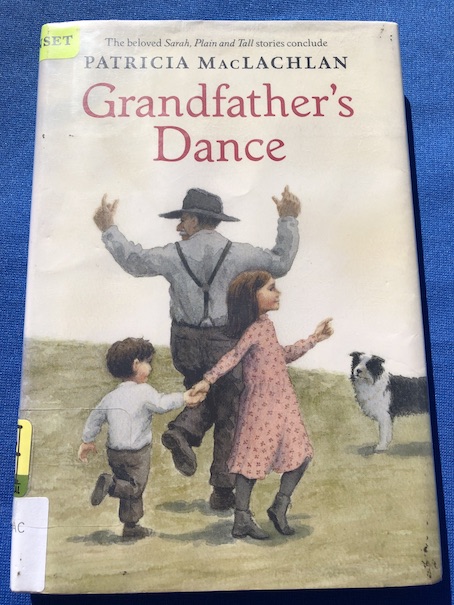
Anna’s wedding is beautiful, and Cassie and the others enjoy having Sarah’s brother and aunts visit. After the wedding, they have a picture taken of the whole family together. Sadly, it is the only picture of all of them together. Soon after, Cassie’s grandfather dies. All of the wedding guests are still visiting, so they attend the funeral. Jack is still a little boy and upset and confused by their grandfather’s death, but Cassie assures him that their grandfather loved them and that they won’t forget him. The title of the book comes from a little dance that their grandfather did for Jack earlier in the story, which Jack later imitates after his death.
In the back of the book, the author explains how her family was the inspiration for the family in the book. The grandfather in the story was based on the author’s father, and part of the dedication is to him. The author’s father died two years before this book was published. The farm and landscape around it are kind of a combination of the places where her family has lived in North Dakota, Kansas, and Wyoming, which is probably why the books in the series never specify which state they’re in.
Ten-year-old Ann Hamilton hasn’t been very happy since her family decided to move West. Her family lives in 18th century Pennsylvania, and moving West means homesteading in an area where there are few other families, none of which have girls Ann’s age. Her father and brothers love the adventure of starting over in a new place on the western frontier (what is considered the frontier for their era), but Ann is lonely, surrounded by boys, and missing their old home. When her father built their cabin, he purposely placed it so that the door faces to the west because he says that’s where their future lies. Ann’s brothers, Daniel and David, also make up a rule that no one can complain about the west (partly because Ann had already been doing a lot of complaining), saying that anyone who does so will get a bucket of water poured over their head, and they make a game out of trying to catch each other complaining about something. So, there is nothing Ann can do but suffer in silence and write in her diary, a present from her cousin Margaret when the family left Gettysburg.
There’s
a boy close to her age who lives nearby, Andy McPhale, but Ann doesn’t think
much of him. He makes jokes about her
being “eddicated” because she can read and write. Sometimes, he seems like he wants to play
with her, but she’s a girl, and he doesn’t want to play girl games.
Andy McPhale also worries about his mother. His father believes in hunting and trapping more than planting. Rather than grow some of their food, Andy’s father goes off for days at a time on hunting expeditions, leaving his family with very little while he’s gone. Ann’s family thinks that this is a sign of poor planning for the future and don’t think highly of Andy’s father for it.
Later, they
meet a young man named Arthur Scott who has just arrived in the area and is
looking for land to settle on. When Mr.
Scott first arrives, he meets Ann on the road. Ann has allowed the hearth fire to go out, and
she is on her way to her aunt and uncle’s house to borrow some from them
because she doesn’t know how to start a fire by herself. Understanding her problem, Mr. Scott gives
Ann a ride home on his horse and helps her to restart the fire, promising not
to tell her parents. They invite him to
stay for lunch, and he talks about his time at Valley Forge with Washington’s
soldiers when he was only 13 years old.
He was too young to fight, but he volunteered to drive an ammunition wagon. Ann thinks of George Washington as a hero,
and she finds it thrilling that Mr. Scott served with him.
Arthur Scott becomes a friend of the Hamilton family, and Andy McPhale seems jealous of him and the attention that Ann pays to him. Then, Andy tells her that his family has decided to go back to town for the winter. In the spring, they will return to the area and try farming, persuaded by their experiences working with the Hamiltons. To Ann’s surprise, Andy offers for Ann to come with them. She could visit Gettysburg and stay with her cousin Margaret again. Ann has been lonely, being the only girl in the area, and it’s a tempting offer. However, Ann feels like she must stay for her family’s sake and so she won’t feel like a deserter. When a storm destroys a good part of her family’s crop, she feels terrible and wonders if it’s all really worth it.
In the end, there is a great surprise coming for Ann: she gets to meet her hero, George Washington, when he comes to see some land that he has purchased nearby.
I first read this book when I was a kid in elementary school. As the cover of the book says, the author won the Laura Ingalls Wilder Medal, which honors authors and illustrators for children who have made long-term contributions to children’s literature. Laura Ingalls Wilder was the author of the semi-autobiographical Little House on the Prairie books, but because those books contain uncomfortable racial language and situations, her name were removed from the award in 2018. The award still exists, but it’s now called the Children’s Literature Legacy Award, which is more descriptive of its purpose.
I liked this book as a kid, although I had forgotten many of the details before I reread it as an adult, and I’m not sure if I fully understood the history behind the story when I was a kid. I think stories actually become more interesting when you know the background, so I’d like to discuss the history a little.
The story is based on the real life of Ann Hamilton, the great-great-grandmother of the author of this book, who did get to meet George Washington in 1784. The author is essentially retelling an old family story. The real Ann Hamilton married Arthur Scott when she grew up. The place where they lived, called Hamilton Hill in the story, is now called Ginger Hill. In fact, it seems that a member of the Hamilton family caused the name change, although that story isn’t really one for children.
One of the parts of the story that I always remembered from when I read it in school as a kid was the part where Ann talks about “mother’s fried wonders”, basically describing a fried donut. People in the 18th century did make various types of fried pastries, varying in style and name depending on where they lived. For an example of early American donuts, see this video by Townsends about 18th century doughnuts, where they make doughnuts and talk about the history and evolution of American “dough nuts” (they talk about the name and how it seems to come from the original shape – nut-shaped pieces of dough).























 Jestress's Forgotten Books and Stories