Look Up!

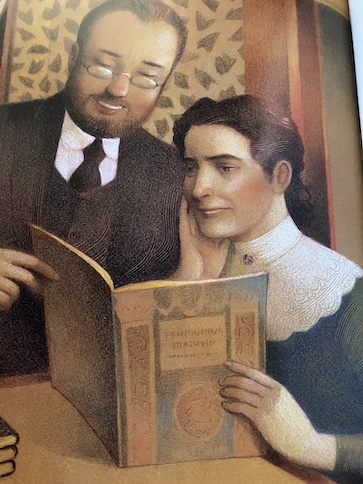
This picture book is about the life of Henrietta Leavitt, a “Pioneering Woman Astronomer” during the late 19th century and early 20th century.

The story says that Henrietta had a fascination with the night sky from a young age, often wondering just how high the sky was. When she got older, she formally studied astronomy, although most of the other students were men, and it was an uncommon profession for women.

After she graduated, she found a job with an observatory, although she rarely worked on the telescope. She was part of a team of other women who acted as human “computers”, doing basic calculations by hand and compiling information for others to use. Women like Henrietta were not expected to use this information themselves or draw conclusions from their own calculations, but Henrietta had her natural sense of curiosity and confidence in her ability to use her own mind.

She continued studying in her spare time, and while examining photographs of stars and doing her calculations, she began to notice some patterns that made her wonder about the explanations behind them. She studied an effect where stars seemed to become brighter and then dimmer, a kind of “blinking” effect.

She not only discovered that the existence of some of these stars had not been recorded yet, but she also found herself wondering about the pattern of this twinkling effect. Some stars appeared brighter and seemed to “blink” more slowly between bright and dim than other stars that weren’t as bright. By examining the relative brightness of the stars and the patterns of blink rate, she realized that it was possible to calculate the true brightness of the stars and use that to figure out how far away each star is from Earth. When she presented her findings to the head astronomer at the observatory, he was impressed. By using the chart Henrietta compiled, it was possible to calculate the distances of stars even beyond our galaxy. People of Henrietta’s time initially thought our galaxy might be the entire universe, but Henrietta’s finding shows that it was not and also that our galaxy is much larger than people thought.

The book ends with sections of historical information about Henrietta Leavitt and her discoveries and other female astronomers. There is also a glossary, some quotes about stars, and a list of websites for readers to visit.

I enjoy books about historical figures, especially lesser-known ones, and overall, I liked this picture book. The pictures are soft and lovely.

The only criticisms I have are that the book is a little slow and repetitious in places, and the subject matter is a little complex for a young audience. Some repetition is expected in picture books for young children, but how appealing that can be depends on what is being repeated. Henrietta’s work involves a lot of looking at pictures and figures and studying, so the text gives the feeling of long hours studying and “looking,” and many of the pictures are of her looking at books and examining photographs of stars through a magnifying lens. I found the story and pictures charming and in keeping with the Academic aesthetics, but I’m just not sure how much it would appeal to young children.

The story explains some of the concepts that Henrietta Leavitt developed and discovered, and it does so in fairly simple language. However, I still have the feeling that it would mean a little more to a little older child, who already knows something about astronomy, or to an adult like myself, who just enjoys the charming format of the story.

Part of me thinks that this story could have been made into a little longer book, perhaps a beginning chapter book, which would have allowed for a little more complexity. One of the issues with making the story of Henrietta Leavitt into a longer book is that, as the section of historical information says, “not a great deal is known about her life.” There just might not be enough known details about Henrietta’s life to put together a longer book.

Still, I really did enjoy the book, and I liked the presentation of 19th century astronomers and astronomical concepts. I especially enjoyed the way the story portrayed the concept of “human computers.” This type of profession no longer exists because we have electronic computers and computer programs that perform mathematical calculations faster than human beings can, but before that technology existed, humans had to do it themselves. “Human computers” had to work in groups to get through massive amounts of data and calculations, and it was long and tedious work, but their work was largely hidden from the public eye. As the story says, they were expected to do mathematical calculations and compile data, but they were compiling it for someone else’s use. Someone else would use their data to draw conclusions, and that person usually got the credit for whatever they discovered, ignoring all the people who did the grunt work that made it possible. Since women like Henrietta were more likely to be among the “human computers”, working in the background, they often didn’t get much credit for their work. The male astronomers were more likely to be the ones analyzing data and taking credit for the conclusions they drew, although they didn’t do the background calculations themselves. What made Henrietta different was that she stepped beyond the role of simply compiling information but also took on the role of studying patterns and drawing conclusions from the data she was compiling. She did all of it, from compiling data and making calculations to interpreting the data and laying out conclusions and discoveries from it.

Women once worked in similar positions as “human computers” at NASA. The 2016 movie Hidden Figures was about women working as “human computers” at NASA in the 1960s.

Fannie in the Kitchen

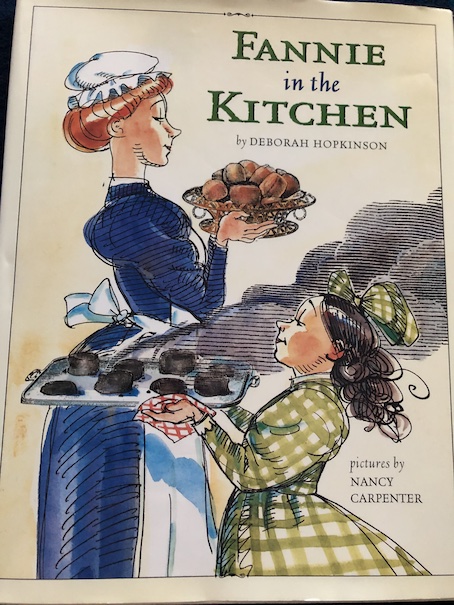
Fannie in the Kitchen by Deborah Hopkinson, 2001.

This is the story of Fannie Farmer and her famous and popular cookbook! When I first heard of the Fannie Farmer Cookbook (originally The Boston Cooking-School Cook Book (1896)), I wasn’t sure whether Fannie Farmer was a real person or if that was just a pseudonym or a marketing name for the cookbook, but Fannie Farmer was a real person in the late 19th century, and that was her real name. The story in this picture book is based on her real life, although details may be fictionalized, and the pictures give the story humorous twists.

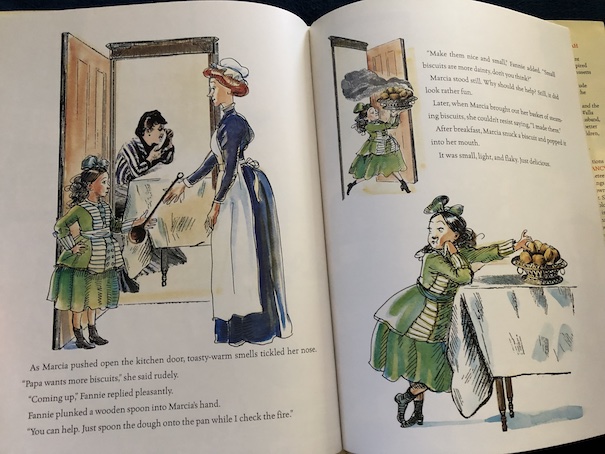
In the beginning of the story, a little girl named Marcia Shaw prides herself on how many things she can do around the house and how much help she can give to her mother. However, she’s still a little girl, and there are some things she doesn’t know how to do well. In particular, Marcia doesn’t know how to cook. Now that her mother is expecting another baby, Marcia’s mother decides that she needs to hire some extra household help, especially with the cooking.

Marcia is a little offended that her mother considers her inadequate to help by herself, but when the new help arrives, a young woman named Fannie Farmer, Marcia has to admit that she’s a good cook. Even better for Marcia, Fannie doesn’t consider her cooking techniques trade secrets. She enjoys letting Marcia help in the kitchen and teaching her cooking tips.

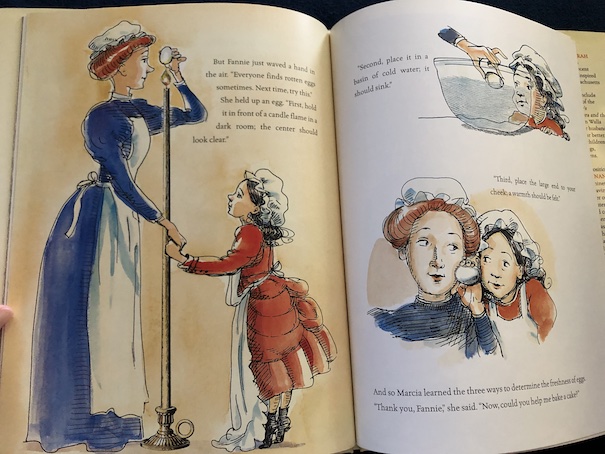
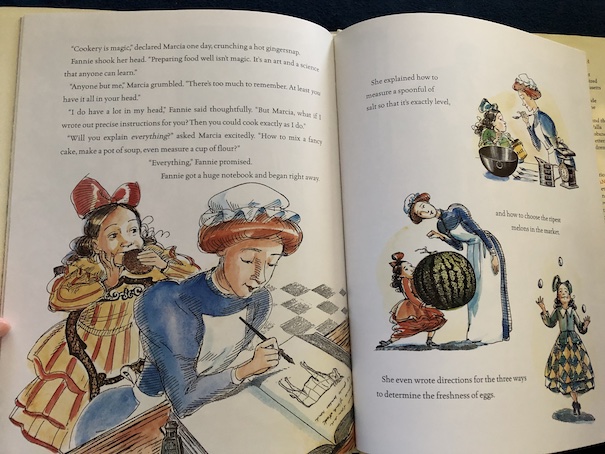
Under Fannie’s tutelage, Marcia’s cooking skills improve. Fannie teaches her many important pieces of information about cooking, like how to measure ingredients and how to tell when ingredients are fresh or if they’ve gone bad.

Marcia enjoys learning to cook with Fannie, but she thinks that she’ll never be as good as Fannie because there’s just too much to remember. She doubts that she’ll ever be able to memorize it all. Marcia is amazed that Fannie can keep all of that cooking information in her head. To help Marcia, Fannie decides to write out a notebook with recipes and cooking instructions, including all of the specific measurements for ingredients and detailed information about cooking techniques to make the recipes come out just right.

This is what makes Fannie Farmer and her cookbook so unique for their time period. If you’ve ever seen a very old recipe book or even just old family recipes written down, they often don’t have all of the amounts of ingredients written down, or the amounts are written in very vague terms. Old recipes also offer little to no cooking techniques, like how to tell when it’s time to turn a griddle cake over or how to tell if a cake is done baking. The assumption was that girls (usually girls for this time period) would learn to cook by watching their mothers and by learning from their examples. However, that assumes that their mothers knew all of these cooking tips themselves, that the mothers remembered to tell their daughters what they knew and explained it well enough for them to understand (some people don’t have much of a talent for teaching, even when it’s a subject they know themselves), and that the daughters understood or remembered everything their mothers said. Otherwise, the vague directions in cookbooks and family recipes were of little help, and new cooks had to learn through experimentation or trial and error. Fannie’s approach to cooking, as explained in the story, is an art and a science that anybody can learn if someone explains it well enough, so she puts her focus on recording all of the necessary details of her recipes.

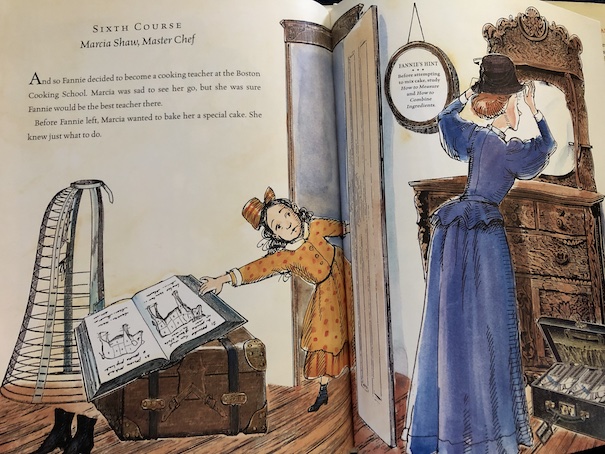
Fannie’s recipe book, started for Marcia, turns out to be very popular with both the Shaw family and their friends and neighbors. As word spreads about it, people start coming by to borrow recipes or get cooking advice. Fannie realizes that there is a lot of demand for better teaching of cooking techniques, and she really enjoys teaching cooking, so she decides to accept a job at the Boston Cooking School.

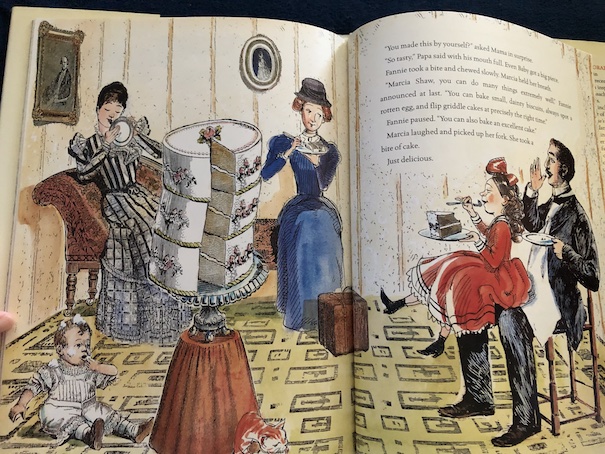
Before Fannie leaves the Shaws, Marcia borrows the cooking notebook and makes a special cake for Fannie to show her what she’s learned. The cake comes out just right because Marcia has followed Fannie’s directions.

There are hints from the Fannie Farmer cookbook throughout the book, and there is a section in the back of the book with historical information about Fannie Farmer. It also includes a sample recipe for Griddle Cakes.

The book is available to borrow and read for free online through Internet Archive (multiple copies). New and used copies are also available on Amazon. You can also buy the original Fannie Farmer Cookbook through Amazon or read it online through Internet Archive (multiple copies).

My Reaction

One of the things I liked about this book is the illustrations. There are eccentric details in the pictures that add humor to the story, like how Marcia stacks a bunch of chairs on top of each other while making candles, so she can make them extra long, and one of her extra long candles appears later, when Fannie shows her how to tell if an egg is fresh by holding it up to a light. For some reason, Marcia’s mother also has a weird habit of licking her dishes when she’s eating one of the yummy recipes, and there is one picture where it looks like she’s lost control of the baby carriage, and it’s rolling away with the baby. I’m sure these aren’t historical details and were just thrown in to be funny.

I think it’s also important to point out that the real-life Fannie Farmer lived an unconventional life for someone of her time period. She was plagued with health problems from a fairly young age. At some points in her life, she was unable to walk, possibly because of a stroke, and when she walked, she had a limp. She never married, but she built a fulfilling career around her talent for cooking. and achieved lasting fame because she wanted to share her knowledge with others. She is credited with establishing exact and level measurements in cooking in the United States, and she was also a strong believer in quality food and proper nutrition, especially for people with health problems.

Invincible Louisa

Invincible Louisa by Cornelia Meigs, 1933.

This is the story of Louisa May Alcott, the famous 19th century author who wrote Little Women and other books for children.

The book begins with Louisa May Alcott’s birth on November 29, 1832 in Pennsylvania and explains about her parents’ backgrounds. When Louisa’s mother, Abba (short for Abigail), had first become engaged to her father, Amos Bronson Alcott, people advised her not to go through with the marriage because Bronson didn’t seem like a very practical man and nobody really expected that he would amount to much. However, Abba genuinely loved him and understood him. They shared similar ideals, including Abolitionism and the practice of service and charity to others, although they didn’t agree about everything. Bronson was a scholarly man who worked as a teacher, although he struggled to get an education himself when he was young because he was born to a family of poor farmers. As a young man, he had worked as a traveling salesman and had seen much of life across the country. He was good at talking to people and was very good at speaking to children, which led him to eventually settle down to teaching.

The Alcott family was happy where Bronson Alcott was teaching in Germantown, but the death of his school’s patron was a heavy blow. Without his patron’s backing, the school didn’t last, so the Alcott family left Germantown and moved to Boston. Little Louisa enjoyed the busy city of Boston, but the book also describes a harrowing situation in which she almost drowned after falling into Frog Pond. This incident was a traumatic memory for Louisa, but it wasn’t just the trauma that left a mark on her. The person who rescued her from drowning was a black boy. (The book uses the word “Negro.”) Louisa never knew the boy’s name, but her gratitude toward her rescuer influenced her feelings toward black people for the better at a time when the country was heading toward Civil War over the issue of slavery.

The Alcott family had ties to some important people. Her father was friends with Ralph Waldo Emerson and Elizabeth Peabody, who was instrumental in the development of kindergarten education in the United States, worked at his school in Boston. Her mother’s elderly aunt, known as the formidable Aunt Hancock, had been the wife of the famous John Hancock. However, in spite of connections, Bronson met with opposition to his teaching when parents of the students learned that he was an Abolitionist. A friend of his, William Lloyd Garrison, was almost lynched by an angry mob for airing his views about ending slavery. When Bronson admitted a black boy as a student to his school, it was the last straw, and many parents withdrew their children. Louisa later remembered discovering that her parents helped to hide runaway slaves when she was young, but it isn’t clear at which of their homes they were doing this.

After his school in Boston closed, he moved the family to Concord. He didn’t have the heart to open another school, so he supported this family through farming. They were poor and lived very simply, but they enjoyed living in the countryside. However, her father did maintain some scholarly contacts and was involved with the Transcendentalist movement. In 1843, the family moved yet again to join a community of Transcendentalists, experimenting with a more isolated lifestyle. (A footnote in the book, added decades after the original writing, compares it to the communes of the 1960s and 1970s.) However, the community was not a success. When one of the leaders of the community suggested that Bronson give up his wife and daughters to live in the style of Shakers, Bronson discussed the situation with his family, and they all came to the conclusion that this community was asking too much. Giving up on his experimental lifestyle was difficult for Bronson, but Abba’s brother understood the situation and helped the family move to a new home. Eventually, the family resettled in Concord.

Compared to her sisters, Louisa was a boisterous and temperamental child. She loved running wild in the countryside, and her curiosity and impulsiveness sometimes got her into scrapes. She wasn’t as good at housework as her older sister, Anna. However, she was always imaginative. When the family returned to Concord, Louisa was able to have a room to herself for the first time, and she used her new privacy for writing stories. She created plays for her and her sisters to perform.

As she grew up, Louisa became increasingly aware of her family’s poverty and her father’s lack of understanding for the ways of the world. Her mother was frequently worn out from trying to make do and take care of the four girls in the family. She began making plans early that she would find a way to provide for her parents and her sisters when she got older.

At Concord, her family continued their friendships with Thoreau and Emerson, and Ralph Waldo Emerson allowed Louisa to read books from his library, She developed a kind of hero-worship of him as a teenager. The Alcott girls also attended a regular school for the first time. Louisa often felt awkward because she was taller than the other girls at school, but she was also very athletic. She frequently wished that she had been born a boy instead of a girl.

At age 16, Louisa began her professional life, giving lessons to Emerson’s children. She was a good teacher, although as an active person, she found quiet study and teaching for extended periods difficult. Her mind often wandered to ideas for romantic stories, and she wrote a collection of little stories for Ellen Emerson. However, the family was badly in need of money, and they had to leave Concord and return to Boston, where they would live with her mother’s brother.

In Boston, Louisa continued teaching and found work as a governess. She also picked up other odd jobs to help support her family. One of them, a job as a live-in companion for an invalid, turned out especially badly because the job had been misrepresented and turned out to be hard labor. She was paid very little for it, too. It was during this time that her father discovered the little stories that Louisa had written for Ellen Emerson. He took one of them to a publisher he knew, and the story was published. Encouraged, Louisa and her father had the rest of the stories published in a collection called Flower Fables, Louisa’s very first book.

This did not bring her instant success as a writer, though. The family’s lives were filled with ups and downs, and they moved house multiple times. Louisa left her family to pursue an independent living for a time, although she made very little money, taking teaching jobs, sewing, and anything she could find. It was during this time that Louisa’s two younger sisters became ill with scarlet fever while the family was engaging in their usual charity work. Elizabeth had it particularly badly, and her health was never good after that. Louisa rejoined the family when they once again returned to Concord, where Elizabeth passed away. Elizabeth’s death was reflected in Louisa’s semi-autobiographical Little Women with the death of Jo’s sister Beth.

The Alcotts had been such a tight-knit family that separations of the sisters were bitterly painful, but every family experiences change over time. After Elizabeth’s death, Anna became engaged to marry John Pratt. It upset Louisa because it felt like she was losing another sister. Louisa once again set out to try to make her own living, but for a long time, it seemed like nothing would go right for her. It was difficult for her to find work, and opportunities seemed to disappear when she was about to take them. At one point, she was in such despair that she even considered suicide. Fortunately, after hearing an uplifting sermon about girls who were in her position, she renewed her determination to succeed, and she received a job offer from someone she had worked for before. Meanwhile, her father was finally starting to have some success with his educational lectures, and he even became superintendent of schools in Concord.

During all of these trials and tribulations for Louisa and the Alcott family, the country was headed toward Civil War. The Alcotts were still Abolitionists, and Louisa’s father had even been involved in a riot in Boston where a mob of citizens had tried to rescue a runaway slave who was about to be returned to the slave owner. After the war started, Louisa felt the urge to do something to help the side of the Union, so she volunteered as a nurse. Conditions were rough at the hospital where she worked, and she was put to work immediately with no training. She had some talent for nursing and a good bedside manner, having nursed Elizabeth through her final illness, but nothing could have prepared her for dealing with the war wounded. It was difficult and often heart-wrenching work, and it took a toll on her own health. After only about a month of working there, she caught typhoid, and her father was summoned to come and take her home.

Louisa eventually recovered from her illness. She felt like a failure for not being able to complete the full term she had originally promised to the hospital, but her nursing experiences helped further her writing career. The letters that she had written to her family about the people she met and her experiences at the hospital were so interesting that they had them published as “Hospital Sketches”, and they were extremely popular. So many people had friends or family who had gone away to war that they were anxious to know as much as they could about what was happening to them and others like them. The success of the “Hospital Sketches” led publishers to ask Louisa for further writings.

When Louisa recovered further, she felt restless, so she accepted a position as a nurse/companion to a friend’s daughter, who was unwell but wanted to go on a trip to Europe. Traveling as a nurse/companion didn’t give Louisa all of the freedom she would have liked to see and do everything she wanted, but she did get to see many things in Europe. She was able to visit the home of the German philosopher Goethe, and she attended a public reading by Charles Dickens. During their travels, she also met the young man who would be the inspiration for Laurie in Little Women.

She started writing Little Women after she returned home from Europe, at the suggestion of her publisher, who thought that she should write books for girls. When her publisher read it, he wasn’t sure that it would be successful at first because its tone was different from the popular children’s books for girls at the time. He tested it out by giving copies to his niece and some other girls who were about the same age, and they all loved it, so he went ahead and published it. It was so successful that it provided Louisa and her parents with financial stability for the first time, and readers wanted more! Much of the story was based on Louisa’s own life with her sisters and on people they knew, but she changed some parts for the sake of the story. Since the real Louisa never married, she made up a fictional husband for her story counterpart, Jo. In the story, Jo marries a German professor, and in the sequel, she and her husband start a school for boys based on Louisa’s father’s theories about the ideal school. Many of her father’s theories about education were very progressive for the time, and since he never got the chance to try all of them, Jo and her husband did in the story.

Even though she never fully recovered her health after having typhoid, she continued to write books for children, and she visited schools to speak to children. The book explains how these other books were also inspired by aspects of Louisa’s life. She and her youngest sister, May, took another trip to Europe together. May always had a talent for art, and Louisa funded her further travels and studies in Europe. May eventually married, but sadly, she died not long after the birth of her only child, a daughter named after Louisa. In accordance with her wishes, May’s infant daughter was brought to Louisa to raise, and Louisa treated her like her own daughter, calling her Lulu as a nickname. The book ends with Louisa’s death, mentioning that she made one of Anna’s sons her heir to perpetuate her copyrights. In the back of the book, there is a chronology of events from Louisa May Alcott’s life.

The book is a Newbery Medal winner. It is available to borrow and read for free online through Internet Archive (multiple copies).

My Reaction

I bought my copy of this book at a Scholastic Book Fair back in the 1990s, but I didn’t notice until I was an adult that the book was originally published in the early 1930s. I think part of the reason why the author was interested in doing a biography of Louisa May Alcott at that particular time was that it was around the 100th anniversary of her birth. I appreciated how later reprintings of this book also tried to keep it up-to-date and relevant for modern readers, including the addition of the footnote in the book about communes of the 1960s and 1970s.

Something that shows how 19th century society was different from modern society is the qualifications required for certain types of jobs. In the past, there were relatively few professional and educations qualifications required for teachers and nurses. In the 21st century, both teachers and nurses are required to have college degrees and relevant certifications to apply for their jobs. Nobody in the 21st century gets those jobs without having the requisite professional credentials (with the exception of homeschooling families, where the teachers are the parents). It would be useless to apply for such careers without having all of the education and certification required. In the 19th century, it was sometimes more important to just find someone willing to do the job, whether they had any particular qualifications to do it or not. Where the need was sufficiently great, like in the hospitals tending to the war wounded, they would take almost anyone who showed up and was willing to take the job with the hardships and blood involved. (There is one episode where Louisa witnesses an applicant being turned down because, while this person wanted to help the war effort, they didn’t have the stomach or stamina for the demands of the job. Next to that, medical knowledge was less important.) I explained dame schools when I reviewed Going to School in 1776, and the concept still applied in the mid-19th century. Dame schools were informal schools set up by people, often women, who were simply willing to take on the job of teaching local children. They got the jobs chiefly because they were the people who were willing to do them in the area. The quality of education these informal teachers could provide varied drastically, depending on the individual teacher. Some of them were actually well-read individuals with a gift for teaching (this is what Louisa and her father were like, in spite of their relative lack of formal education), while others provided little more than day care while the children’s parents worked. In the section of this book that explains Bronson Alcott’s history, there is some discussion of how education levels and quality varied across the country in the mid-1800s.

Parts of this book and the lives of the Alcott family also offer a different perspective on what it means to be successful in life. Through most of their lives, the family has little money, and Louisa and her father often struggle to find jobs and get recognition for their work. Louisa May Alcott is famous now, but early in her life, she felt like a failure. She struggled to find and keep jobs and had health problems that interfered with her ability to find and keep work. In the end, it wasn’t having money that made her famous but her talent and perseverance. There were times when she wanted to give up, and she even felt suicidal at one point, but she kept going in spite of everything. Even her father eventually managed to carve out a career for himself that suited his real talents. Their early problems didn’t mean that they were worthless or incapable. Their talents were just unusual, and they needed time to find their proper niche in life, the right circumstances to demonstrate what they could do, and the right people to recognize and appreciate their abilities.

The Demon in the Teahouse

DemonTeahouse

The Demon in the Teahouse by Dorothy and Thomas Hoobler, 2001.

This is the second book in the Samurai Detective series.  Like other books in this series, it is not a book for young children!

Seikei is trying hard to learn all the things he must know as a samurai and Judge Ooka’s adopted son. One evening, while the judge is in Edo (now called Tokyo), he sends a message that Seikei and the other samurai must come immediately. Edo is in a state of emergency because of a series of fires that have been deliberately set in shops around the city. Although Judge Ooka helped to design a system of watch towers and fire brigades to help the city in case of fire, the threat of fire is still very serious because most of the buildings in Edo are made of wood.

The only clue they have to the person setting the fires is a geisha who was in one of the shops before it burned. Judge Ooka and Seikei go to the city’s pleasure district, Yoshiwara, where there are theaters and teahouses where geishas provide entertainment. While they are there, they learn that geishas have been dying under mysterious circumstances, and the people of Yoshiwara are afraid.

Judge Ooka has Seikei take a job as a servant at a teahouse in order to learn more. He soon discovers that the dead girls were all friends of Umae, one of the most popular geishas. Then, one of Umae’s many admirers brings her a present, and she is horrified to discover that it is the kimono that one of the dead girls was wearing. Who brought her the kimono, and what connection does she have to the fires?

The nature of the villain and the villain’s motives is rather dark for a middle school level book (although some middle school level books do get fairly dark).  Although the reading level of the book would be fine for someone aged twelve to fourteen, the subject matter might make the story more appropriate for someone a little older.  I recommend parental discretion on this one.  (Remember, it takes place in the “pleasure district” of Edo.)  It’s an exciting story, and it contains an interesting picture of feudal Japan, but it’s definitely not for young children!

The part about Judge Ooka organizing watch towers and fire brigades is something that the real, historical Judge Ooka actually did.

The book is currently available online through Internet Archive.

Pocahontas

Pocahontas

Pocahontas by Jan Gleiter and Kathleen Thompson, 1985.

The story about the life of the young Native American woman known as Pocahontas (“Pocahontas” was really a nickname, which the book mentions, although it doesn’t say that her original name was Matoaka) has been told many times in many forms, but this particular book is somewhat sentimental for me because it was the first one I ever read about her when I was a kid. It’s part of a series about famous and legendary figures in history and myth. Pocahontas was a real, historical person, but aspects of her life have taken on the characteristics of legend (as well as providing material for a Disney movie, although the Disney movie takes liberties with the real life of Matoaka/Pocahontas and the movie was not based on this particular rendition of her story).

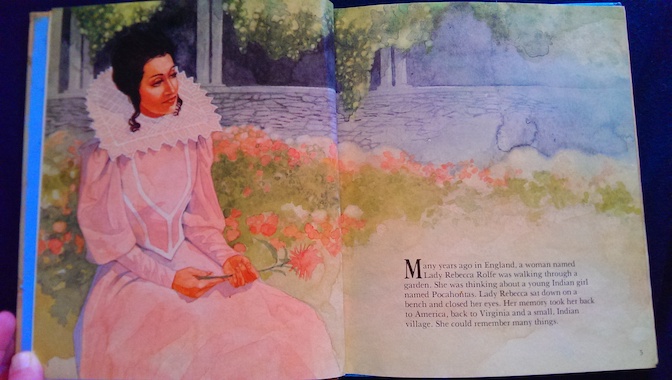
When this particular book begins, Pocahontas is a grown, married woman going by the name of Lady Rebecca Rolfe. While living in England, she reflects back on her life and youth, remembering when she first met Europeans.

PocahontasEngland

When she was ten years old, she heard her father, Powhatan (who was the chief of their tribe) and other men talking about the white men. Although Pocahontas hears that the white people had betrayed her people’s trust and even killed some of them, she is curious to get a look at them.

PocahontasSettlerChildren

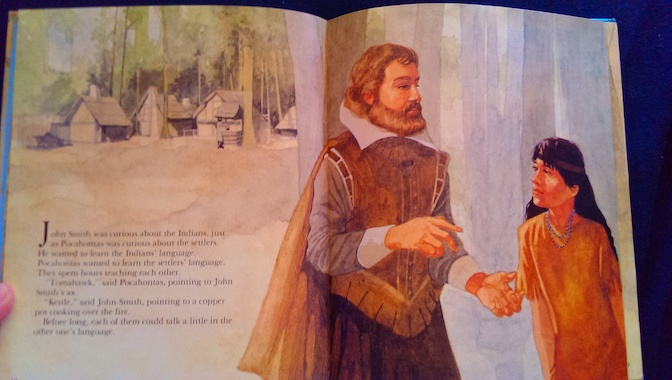
She ends up meeting with a group of boys from Jamestown and playing with them. She begins making friends with people in Jamestown and visiting them from time to time. A man named John Smith becomes curious about the girl and her people and gets Pocahontas to teach him some of her language.  (The book is more accurate than the Disney version here, showing that there is a significant age difference between Pocahontas and John Smith, with Pocahontas being a child at their first meeting.)

PocahontasJohnSmith

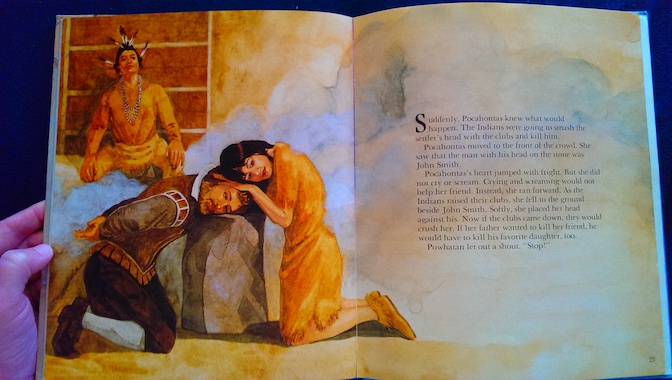
Then, one day, there is a feast in Pocahontas’s village, and some of the men of the tribe bring a white man who was caught trespassing in their territory. Pocahontas recognizes the white man as John Smith and, upon realizing that he is about to be executed, intervenes to save his life. (This is one of the most famous parts of the story of Pocahontas’s life, although the exact circumstances surrounding the real-life incident are a little confusing and may have actually been part of a more complex ritual that John Smith didn’t fully understand at the time, not an actual attempt at execution, if the event actually happened at all. This book offers a simplified version of the incident, supposing that John Smith’s life was in real danger, as he described it in his account of what happened.)

PocahontasExecutionAttempt

In the end, the settlers at Jamestown kidnap Pocahontas in the hope that Powhatan would end hostilities with them, using her as a bargaining chip.  (The book says that her father wasn’t too worried because he knew that the settlers were her friends and would treat her well, but I find this part of the book pretty worrying myself, reading it as an adult.  I’m pretty sure that is not how a parent would react to a missing child in real life.  I guess that the book is trying to keep the tone light for children, but it just sounds weird.) Pocahontas remains among the settlers, living according to their lifestyle and taking the name Rebecca. Eventually, she meets a man named John Rolfe and marries him. The two of them have a son together. With her new family, she travels to England and tries to help the people there to understand her people.  (The book says this in a very optimistic way, calling her visit a “success”, although in real life, this visit was largely a propaganda move on the part of the Virginia Company of London. On the other hand, she was, evidently, very well-received in England, if something of a social curiosity.)

PocahontasWedding

The story in the book ends here, with her still in England, thinking back on her life and her reasons for being there. Part of me wishes that it had explained a little more about Pocahontas’s earlier life and some other facts behind her story. Sadly, part of the reason why they might have been reluctant to tell the rest of the story to children was that the real Pocahontas didn’t live very long after the point where the story ends.  As she was preparing to return to Virginia from England, she became very ill and died.  Her exact age at the time of her death is unknown, but she was probably about 21 years old.  Her son, Thomas Rolfe, was very young at the time she died, but they do still have living descendants today.

Overall, I’d say that this is one of those stories that becomes more interesting when you’re older and realize the full depth of it.  This picture book is a very simplified version of the story, meant for kids, but when I was young, it did inspire me to learn more about Pocahontas.  There any many missing details of Matoaka/Pocahontas/Rebecca Rolfe’s life because of the limited records of it, but what is known is fascinating.  It’s sad because she died so young, but that the story of her life lived on in so many imaginations after her death is profound.  Different people, both when she was alive and after her death, tried to use her for their own purposes, but her legend still continues, out-living them all.  I’ve never seen the Disney Pocahontas movies, and I don’t really want to.  I already know how the story ends.

The book is currently available online through Internet Archive.

Kat and the Missing Notebooks

KatMissingNotebooks

Kat and the Missing Notebooks by Emma Bradford, 1999.

KatMissingNotebooksDaVinciThis book is part of the Stardust Classics series.

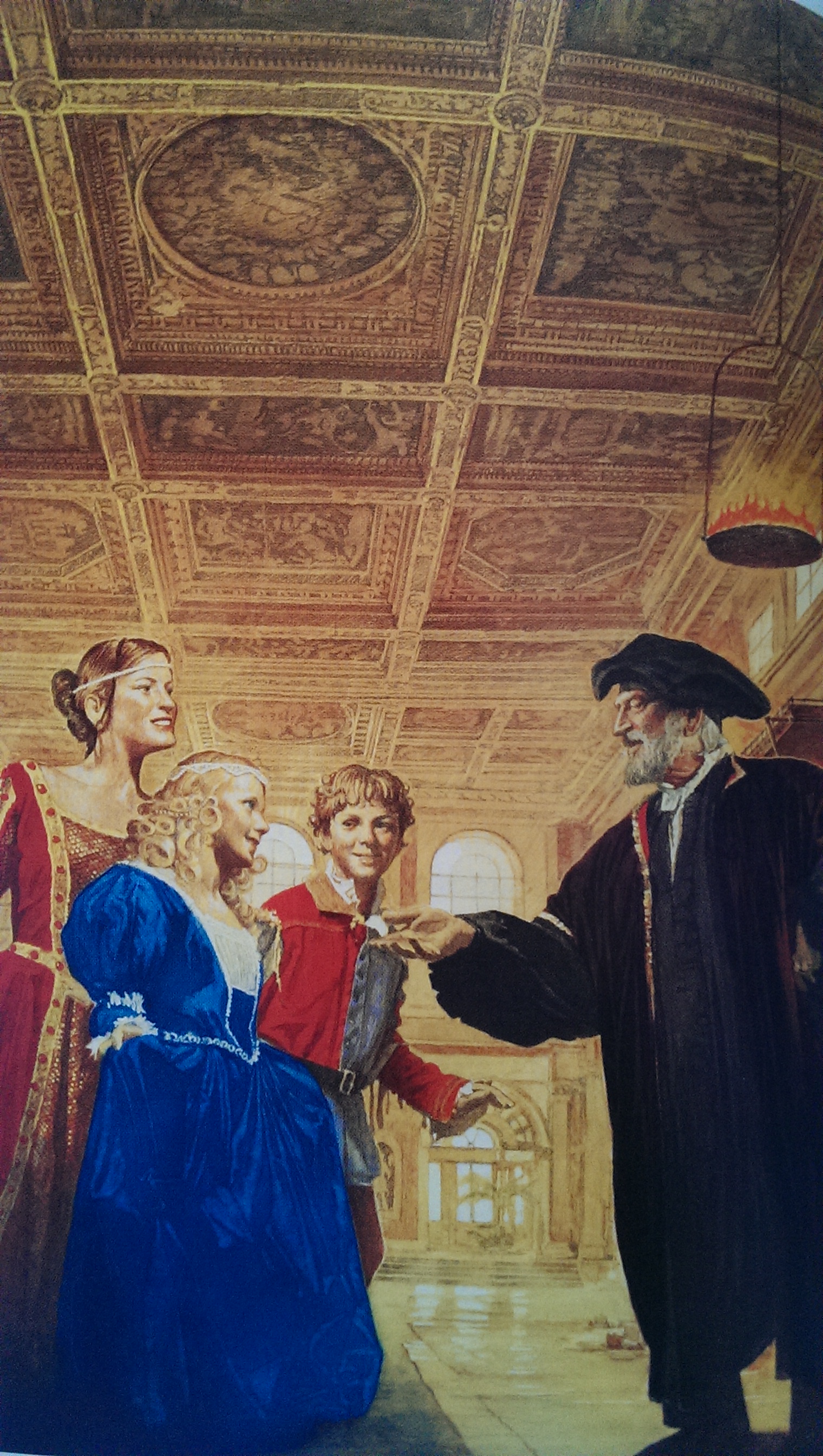
This time, Kat and her aunt, Jessie, find themselves in Florence during the Renaissance. They appear shortly before someone attempts to steal some very important papers belonging to the Florentine City Council from Signor Millori. Kat and Pietro, Signor Millori’s son, both run after the thief, and Kat helps to get the papers back. To thank Kat for her help, Signor Millori invites her and Jessie to stay with him and his family in their palazzo during their stay in Florence.

Signor Millori is a wealthy banker, and the palazzo is a grand place. Kat and Pietro become friends, and he confides in her how much he loves art. Pietro’s father wants him to become a banker, but Pietro’s dream is to study painting with Leonardo da Vinci. In fact, he takes Kat and her aunt to see Leonardo painting a mural at the Palazzo del Vecchio.

Leonardo notices Kat’s aunt and thinks that she has an interesting face. When he asks her to come to his studio to pose for some sketches, she eagerly accepts. Kat hopes that she can use the opportunity to show Leonardo Pietro’s artistic talent and convince him to take Pietro on as a student. However, although Leonardo likes the sketch of Pietro’s that he sees, he says that he has enough apprentices at the moment. Pietro cannot resist the opportunity to study Leonardo’s work, however, and borrows a couple of his notebooks to study.

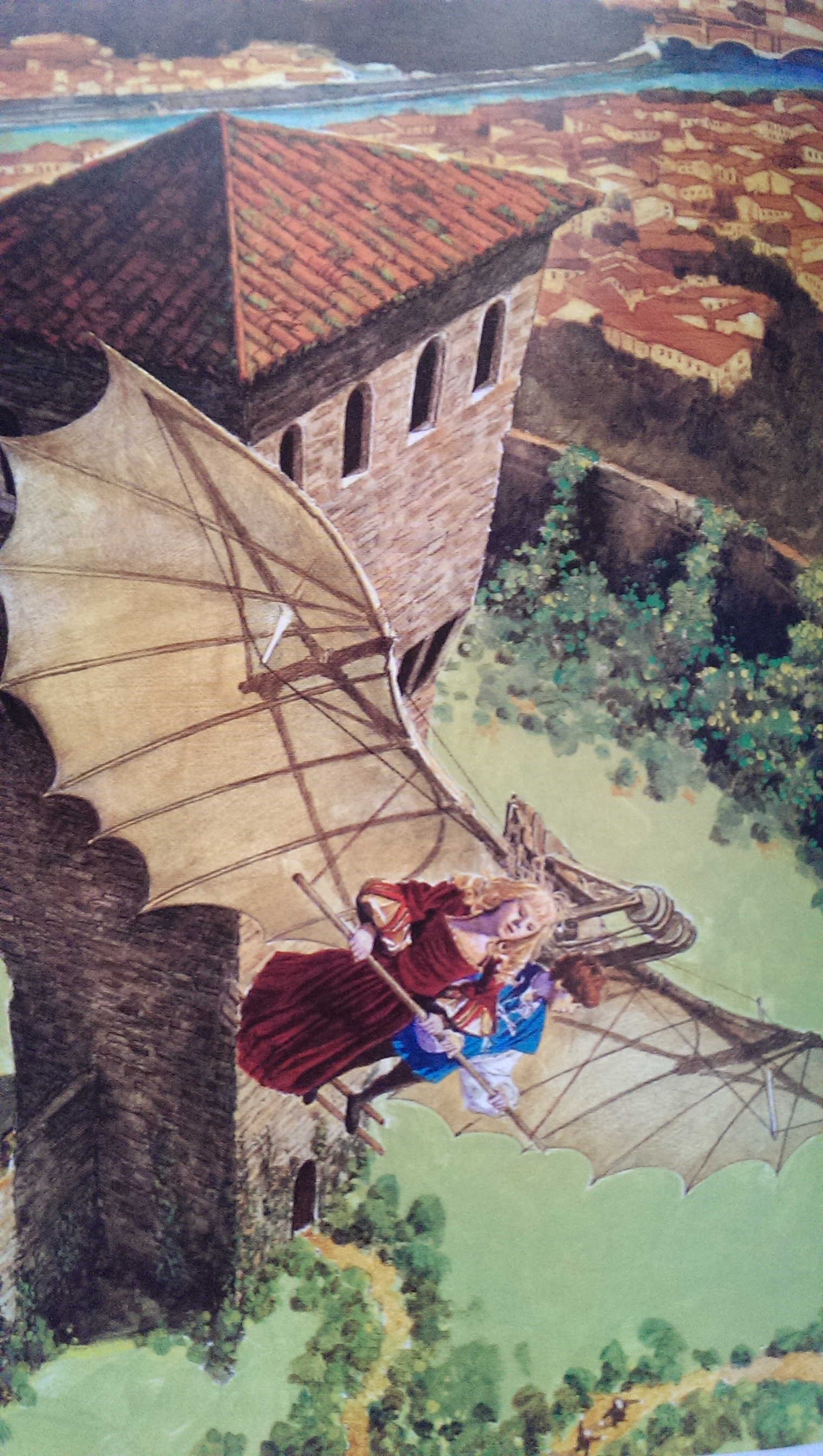
KatMissingNotebooksFlightBesides being a great artist, Leonardo da Vinci is also a scientist, and along with his notes on art, there are sketches and plans for possible inventions in the notebooks. Kat and Pietro go to return the notebooks the next day, but before they can get to Leonardo’s studio, the same thief who tried to steal Signor Millori’s papers steals the notebooks.

Florence has been at war with Pisa for some time, and the Florentine City Council has consulted with Leonardo da Vinci to see if he can come up with some inventions that would give them the upper hand. They know that the thief must be a spy for Pisa who is trying to see what Leonardo has been working on. However, Kat knows that if they do not retrieve the notebooks, history may be changed. Soon, it becomes obvious that the spy has an accomplice who is living in the Millori’s palazzo. Can Kat and Pietro find the notebooks and stop the spies before it is too late?

Although this is a fantasy story that involves time travel, it is based on historical events, and there is a section in the back that explains more about the Italian Renaissance and Leonardo da Vinci.  At the time of the story, Italy was not a united country.  The Italian peninsula was covered with many small city-states which frequently fought each other.  In 1494, Pisa broke away from Florence, and Florence fought for several years to bring it back under their control, until they eventually succeeded in 1509.  This conflict was the basis for the story, and the artist and inventor Leonardo da Vinci was consulted by the Florentine Council during the struggle.

Also in the back of the book is an explanation of mirror writing, which Leonardo da Vinci used in his notebooks.  There are also instructions for making fresco ornaments and a recipe for Nutty Biscotti.