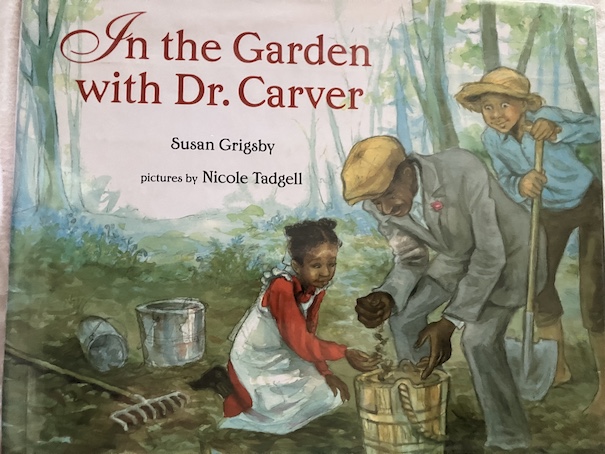
In the Garden with Dr. Carver by Susan Grigsby, 2010.
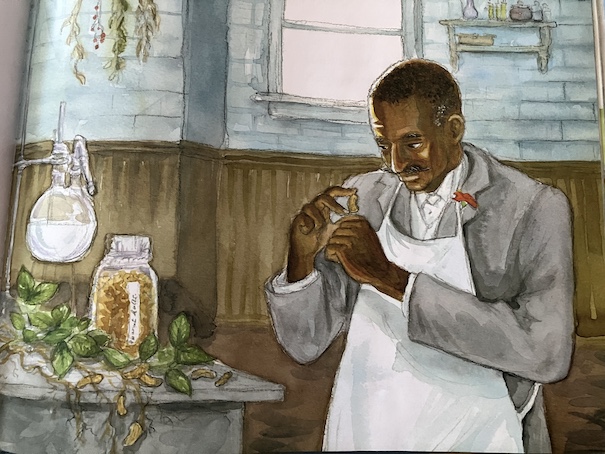
This picture book is about George Washington Carver, as told by a young girl named Sally.
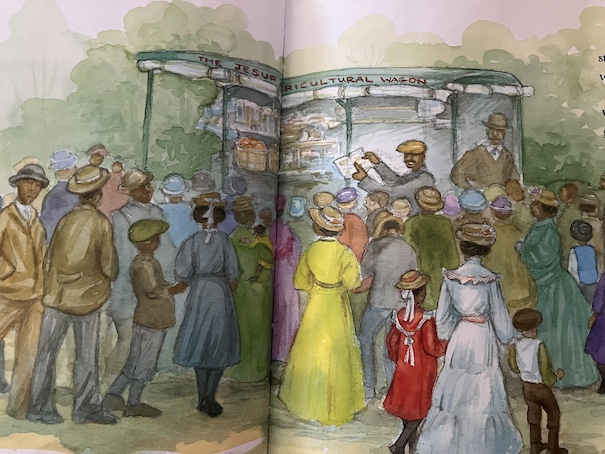
The first time Sally sees him is when he’s traveling with his wagon, pulled by a mule. Sally knows that Dr. Carver is a famous plant scientist from Tuskagee and that he uses his wagon as a kind of mobile school. It contains seeds, plants, and gardening tools, and people come to Dr. Carver for advice about growing plants. The nutrients in the soil of this area have been depleted by growing cotton, and Dr. Carver has been advising them about how to restore the soil. He also advises them about new ways to use common crops.
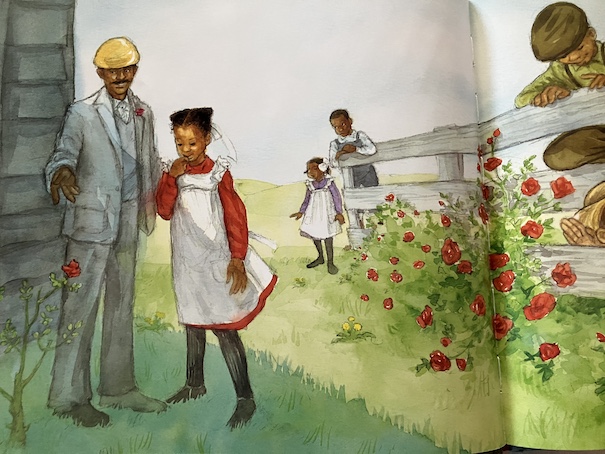
Dr. Carver visits Sally’s school to help the children with their garden. He teaches them how to use observation to notice the conditions that benefits plants and figure out how to help plants that aren’t doing well. When a boy is about to kill a spider, Dr. Carver stops him, pointing out that the spider helps their garden by eating bugs that are pests for the plants. He teaches the children that everything is part of an ecosystem (although he doesn’t use that word) and that they need to observe and understand the roles each plant and creature has in the ecosystem before deciding to eliminate or change anything. The reason why they remove weeds like dandelions is that their presence doesn’t help the other plants, and they take resources the other plants need. Although, he also shows them that dandelions are edible, so they are not wasted.
Dr. Carver teaches the children about restoring the nutrients in depleted soil using fertilizer and compost made from decaying plant matter and organic materials that most people simply throw away. Dr. Carver teaches them not to waste anything, helping them to make a scarecrow and markers for their plants from scraps of wood and other things people have thrown away.
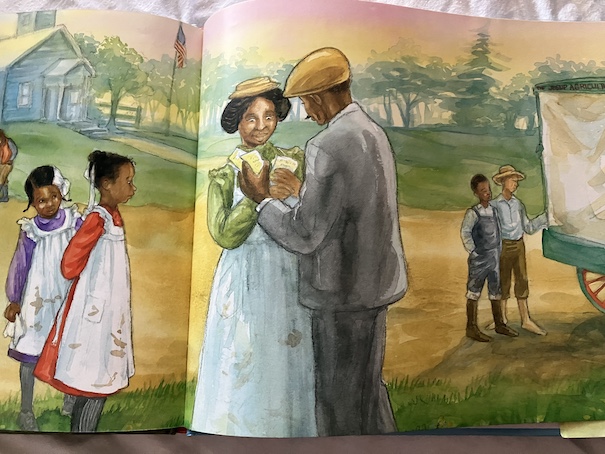
Eventually, Dr. Carver has to return to Tuskagee, but the lessons he teaches the children stay with them.
There is a section at the back of the book that explains that Sally and her school are fictional, but George Washington Carver was a real person and the story is based around his life and writings. He was born as a slave in Missouri about a year before the abolition of slavery, so he grew up as a free person. He began learning about agriculture and botany from an early age, and as he grew older, he sought out schools that would help him further his knowledge and share it with others. He taught at Iowa State College before Booker T. Washington (see More Than Anything Else for a picture book about his youth) recruited him to be the head of Tuskagee‘s Department of Agriculture in 1896. He also believed in bringing education to people who couldn’t come to a college to learn by sending out bulletins about farming techniques and booklets for teachers in lower grades to use in their classrooms. His mobile school in a wagon was another form of outreach that has been imitated in other places.
My Reaction
I enjoy books about historical figures, and I found this story about George Washington Carver gentle and fascinating. There are some parts that I think I appreciate more as an adult than I would have as a child, making this a book that I think would appeal to readers across different ages and something that parents and teachers would enjoy sharing with children.
Although Sally wasn’t a real person, the lessons she and her classmates receive from George Washington Carver help to illustrate Carver’s real-life work and the lessons that he shared with people of his own time. I appreciated the level of detail the story provided about how people can use observational skills to diagnose and fix possible issues with ailing plants, the importance of understanding that plants exist as part of an ecosystem and that gardeners and farmers need to understand how all parts of the ecosystem interact, and how nutrients can be restored to depleted soil. I can’t remember whether I had heard before about how cotton farming depleted soil nutrients, but I appreciated how that explanation helped explain a real problem facing farmers of Carver’s time and how Carver was helping them to solve it.
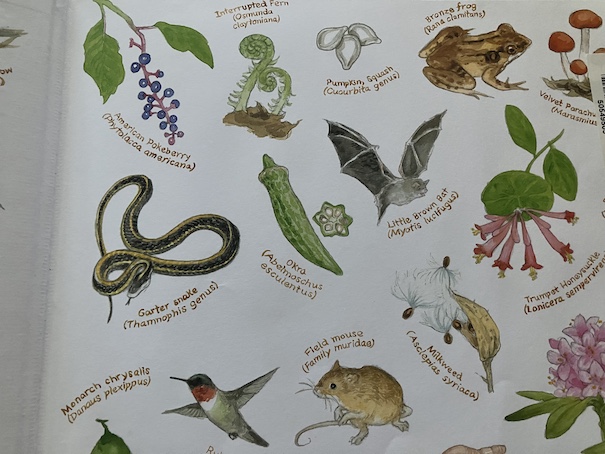
I think this book would appeal to fans of cottagecore as well as people interested in American history. The illustrations are beautiful, and even the inner covers are lovely, with small, labeled pictures of plants and creatures. As the book explains, George Washington Carver himself used drawings of plants and creatures in his work, and in the story, he teaches the children to make their own drawings to help themselves study details of the natural world.
 Jestress's Forgotten Books and Stories