On The Mayflower

On the Mayflower by Kate Waters, 1996.
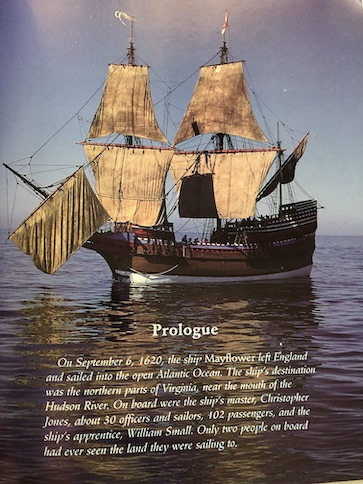
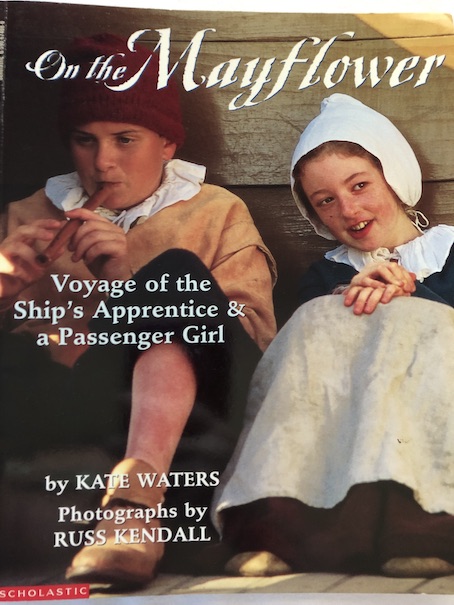
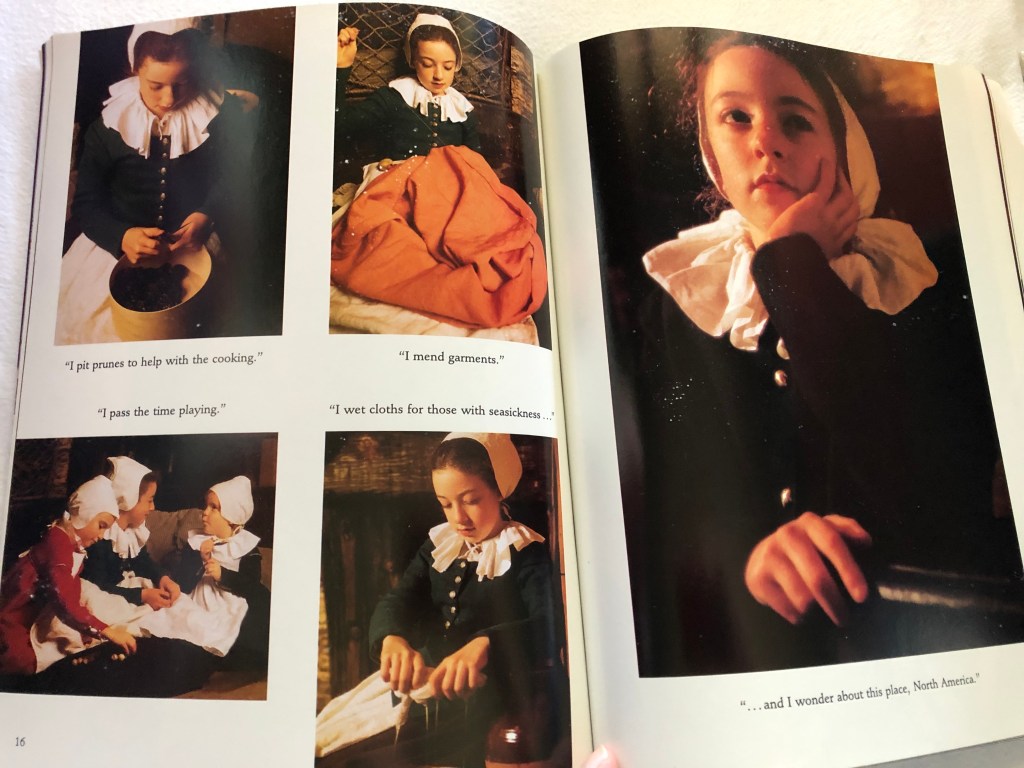
This book is part of a series by same author about children growing up in Colonial America. Each of the books is the series has photographs of historical reenactors portraying real people from Colonial history. This book focuses on two children who are traveling on the Mayflower in 1620, heading to what would become the Plymouth colony. One of the children is a girl who is a passenger on the ship, and the other is a boy who is part of the crew, a ship’s apprentice. In the section of historical information in the back of the book, the author explains that the girl was based on a real girl who was a passenger on the Mayflower, although the boy was not based on a specific apprentice; he is just meant to show what a ship’s apprentice would have been like at that time and to help explain the duties of the various crew members as he assists them.

The ship’s apprentice is called William Small. He is specifically apprenticed to the ship’s master, Christopher Jones (historical character). As an apprentice, he is learning basic navigation skills and assists the regular crew members with various tasks, including serving food.

The girl is named Ellen Moore. She and the other passengers are traveling in cramped quarters, and people are often seasick or trying to find ways to keep themselves occupied during the long journey. Ellen is traveling with younger siblings, and she plays with them in between performing routine chores, like sewing and preparing food.
During the voyage, there is a terrible storm, and the passengers are all confined below deck without light because lanterns and candles would pose too much risk of fire while the ship is rocked during the storm. William has to help the ship’s carpenter to repair leaks. Before the storm is fully over, Mrs. Hopkins, one of the passengers, gives birth to a baby she names Oceanus (historical person, the real Oceanus made it through the voyage although he sadly died young, possibly about age six, but the date of his death is uncertain).

The book ends with their arrival in the Americas. Because the storm blew them off course, the Mayflower did not arrive at its intended destination in Virginia but further north at Cape Cod in what is now Massachusetts. Because winter was setting in, the passengers decided not to risk further travel and established their colony there, 65 days after their ship first left England.

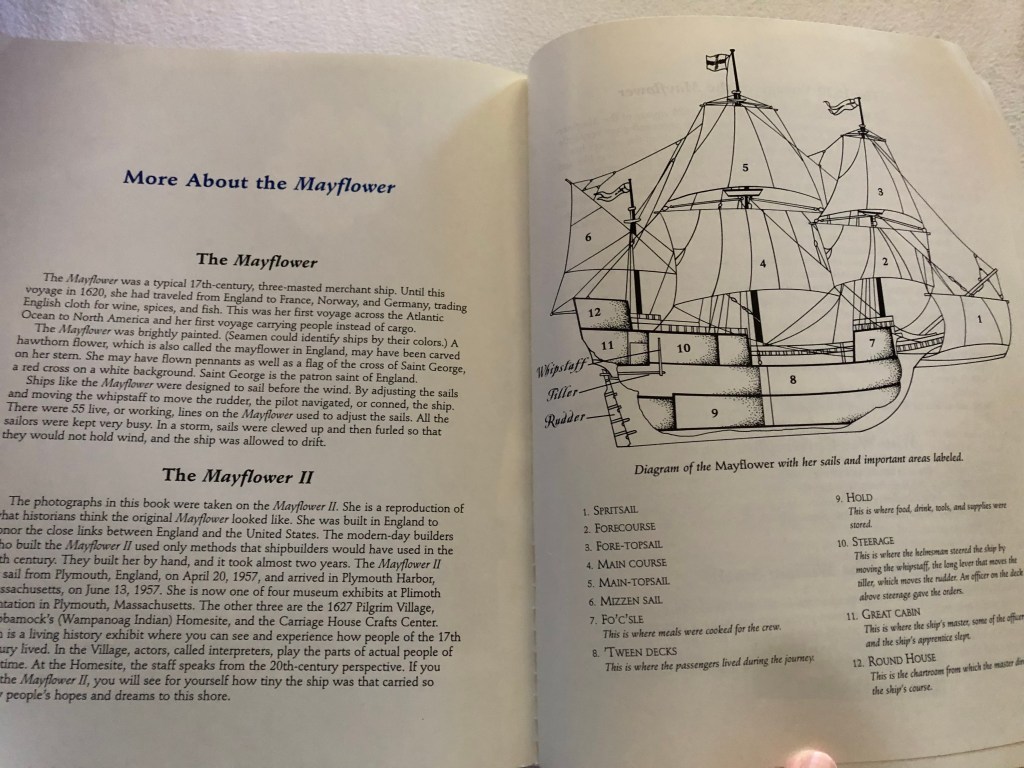
In the back of the book, the section with historical information explains more about both the characters in the story and the reenactors. The historical Ellen Moore and her siblings were traveling to the colony without their parents, under the guardianship of the other families, acting as young servants in their employment. The book mentions that the Moore children were without their parents because of a family tragedy but is not specific about what it was. I looked it up, and the story is both sad and bizarre. I can see why the author didn’t want to explain it in a children’s book. Apparently, the children’s parents had an arranged marriage and were not happy being married to each other. The children’s mother had a long love affair with another man, and also apparently, all of the children were the biological children of her lover. The mother’s husband began to notice that the children physically resembled his wife’s lover. The couple bitterly divorced, and after the husband was granted custody of the children (which, apparently, weren’t his anyway), he decided to send them away to the Americas with the departing pilgrims, paying for them to be taken on the voyage, never seeing them again. Sadly, Ellen probably did not survive the first winter at the Plymouth colony because she disappears from the historical record during that time. Out of the four Moore children traveling on the Mayflower, only one survived to adulthood, Ellen’s young brother Richard. Richard married twice in his life and had seven children of his own. He became a sailor and ship’s captain and eventually died an elderly man in Salem, Massachusetts, during the 1690s, not long after the Salem witch trials. None of this information about Richard is mentioned in the book, but I thought it was interesting background information. In the book, there is also additional information about the ship, The Mayflower, and the reproduction ship used in the pictures, The Mayflower II.
The book is available to borrow for free online through Internet Archive.
Meg Mackintosh and The Mystery at the Medieval Castle

Meg Mackintosh Mysteries

MMCastle

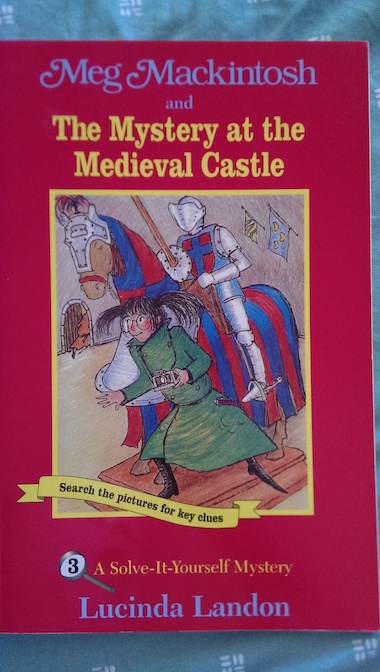
Meg Mackintosh and The Mystery at the Medieval Castle by Lucinda Landon, 1989.

Meg is visiting Dundare Castle with her teacher and some other students.  Dundare Castle is a special museum where people can learn about life in Medieval times, although it used to be a private home.  The owner’s family came from Scotland, and they built their home to look like their ancestors’ castle there.  Eleanor, the owner, now calls herself the Duchess of Dundare, and with her staff, dresses up to recreate the lives of people from the 1300s.

MMCastleTour

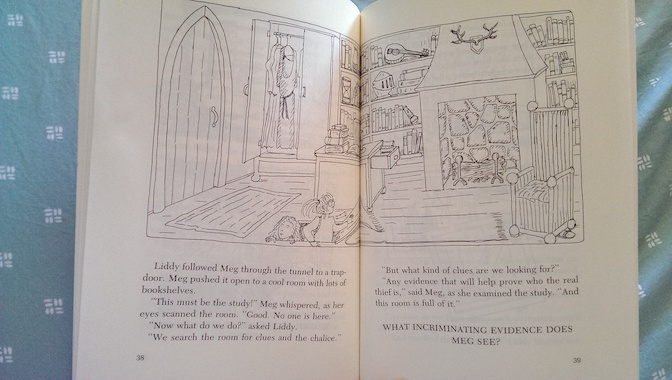
One of the Duchess’s prized possessions is a silver chalice studded with jewels that has been in her family for generations.  She keeps it on display in the castle’s “abbey,” guarded by the actor playing the part of a knight, Knight Henry.  But, when Meg and her classmates get to the abbey, the chalice is gone, and Knight Henry is lying on the floor, unconscious!

MMCastleTheft

Not long before they found Knight Henry, the kids had seen a robed figure run across the courtyard.  Monk William falls under suspicion, although the Duchess doesn’t really believe that he is guilty because he’s been with her family for a long time.  There are other possible suspects, and Meg believes that both the thief and the chalice are still in the castle.

The book is currently available online through Internet Archive.

MMCastleSearch

My Reaction

I love this series because the books are interactive, giving readers the opportunity to figure out the clues and solve the mystery along with Meg. As Meg interviews the other actors in the castle and explores every room, readers are invited to study the pictures and consider the evidence to see if they can solve the mystery before Meg can.  At various points in the story, there are questions for the reader to consider, giving them the chance to pause and see if they’ve noticed what Meg has seen. I recommend that adults who are introducing children to the mystery genre read a couple of these stories along with them and discuss the clues as they go, helping children to learn how to notice details, solve puzzles, and think critically. It’s a good learning opportunity as well as a fun mystery!

Colonial Crafts

Historic Communities

ColonialCraftsColonial Crafts by Bobbie Kalman, 1992.

In Colonial America, everything had to be made by hand.  There were people whose entire profession was to make certain types of things, and this book describes common types of craftspeople, how they learned their skills, the goods they made, and how they practiced their trades.

People who worked with their hands learned their trades directly from others in their profession by serving apprenticeships.  Schools as we know them were less common in Colonial times and were mainly for upper class families, especially the sons of wealthy men.  Girls typically learned domestic crafts such as sewing, weaving, and candle-making.  Girls were mainly expected to marry and be housewives, and boys often learned their father’s trade.  How long an apprenticeship would last depended on the trade, but apprentices usually started performing very basic chores for their masters and gradually worked their way up to more difficult tasks as they learned the trade.  At the end of an apprenticeship, the apprentice would produce a work called the “masterpiece” to show off their new skills.  Then, the apprentice would become a journeyman, traveling around and looking for work in their trade until they earned the money they needed to open a shop of their own.

ColonialCraftsBaskets

Some of the trades covered in the book are cabinetmaker, leatherworker (including related trades like shoemaker and harnessmaker), cooper (someone who makes barrels), wheelwright, blacksmith, silversmith, gunsmith, printer, and milliner (someone who could make and alter clothing and sell fashion accessories).  The descriptions for each profession include not only details about the trade and tools of the trade but interesting facts such as the fact that, in Colonial times, shoemakers did not make shoes different shoes for left and right feet.  Both shoes in a pair were shaped exactly the same because it was easier for the shoemaker and because people thought that the tracks of identical shoes looked neat.  Aside from the professional crafts, the book also explains a little about domestic crafts, the kinds of things that people made in their own homes.

The book is full of pictures of historical reenactors demonstrating different crafts and trades.  It is currently available online through Internet Archive.

Mary Geddy’s Day

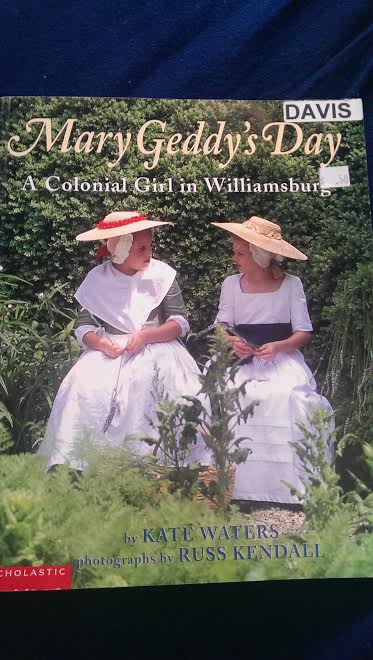
MaryGeddyMary Geddy’s Day: A Colonial Girl in Williamsburg by Kate Waters, 1999.

This book is part of a series of historical picture books about Colonial America.

Mary Geddy was a real girl living in Williamsburg in 1776. In this book, she is reenacted by Emily Smith, a young interpreter at the Colonial Williamsburg living history museum. The story follows her through a single day in her life as it would have been typically experienced by girls around the beginning of the American Revolution (lessons, chores, shopping, and visiting with her friend) up until the moment when the vote for independence at the Fifth Virginia Convention was announced.

Mary Geddy’s father was a silversmith, which put them in the middle class for the times.  They had a comfortable house with a shop next door where Mr. Geddy sold his silver work.  The Geddy family also had slaves to take care of household chores.

At the beginning of the story, Mary knows that the Fifth Virginia Convention is voting on the subject of independence from Great Britain.  Mary is concerned about the prospect of war, and she knows that if the vote is for independence, she will probably lose her best friend, Anne.  Anne’s family are loyalists, and her family plans to return to England if the colonies decide to break away.

All through the day, people are speculating and worrying about what is going to happen as they go through the typical routines of their day.  Mary explains the clothing that colonial girls would wear as she gets dressed in the morning.  Then, her mother sends her out to buy eggs at the market.  Although she can see Anne there and hear some of the talk about what’s happening, Mary is kept at home for most of the rest of the day, practicing her sewing, learning to bake a pie with her mother, helping in the garden, and having her music lessons. She is learning to play the spinet.  She envies her brothers, who are allowed to help their father in his shop and therefore able to hear more of the talk than she is.

I particularly liked how they showed the coins that Mary uses when she goes shopping.  Even though Mary’s family lives in an English colony, she’s using pieces of eight, which is Spanish money.  The book doesn’t explain what currency she’s using or why, but that’s why the coins are those little triangular shapes, like little pieces of pie. Let me explain.

First, the American colonies had a currency problem.  They actually had a shortage of English currency because England didn’t want wealth to leave the English economy and go out to the colonies.  One of the measures they took to prevent wealth from leaving England was to make it illegal to export higher-value pieces of currency to the colonies.  People in the colonies needed something to replace the pieces of currency that they didn’t have or had in too short supply, so they resorted to other methods of exchange such as barter, IOUs recorded in ledgers, and currency from other countries.  They had some standard units of exchange for converting different currencies into British money because that was the way people in British colonies thought about money.  One of the most popular coins in use was the old Spanish dollar or piece of eight, which was worth eight reales (unit of Spanish currency).  However, sometimes, people wanted to use a smaller piece of currency for small purchases and transactions (like buying eggs), so they physically cut one coin into eight pie-shaped pieces (hence, “pieces of eight”), each worth only one real.  They had to do the coin cutting very carefully because the value of this type of money was based on the amount of silver in the coins themselves, and if they cut a coin unevenly, it would impact the value of the sections.  Each section of a piece of eight was called a “bit“, and two bits would be worth one-quarter of the value of the original coin, which is why some people in the US refer to a US quarter as “two bits.”  That’s what Mary is holding in her hand in the picture.  For more information, see the YouTube video from Townsends about The History of Money in America.

When they discover that the Convention voted for independence, there is celebrating in the streets, and Mary goes with her parents and brothers to see everything.  Her little sister is afraid of the noise and stays at home with the slaves.  Everyone is excited, but Mary is worried because she knows that her friend will leave and nothing will be the same again.

Throughout the book, you can see that the slaves are always a part of the family’s activities.  They do chores together, and when the family is not doing housework, the slaves are still working in the background.  Having slaves didn’t mean that the family never had to do any chores themselves, but they had to do less of them, giving them more time for other things, like music lessons and visiting with friends.  When the celebrating starts, the boy slave, Christopher, who is about the age of the Geddy children, wants to go and see what is happening himself, but he has to stay and help look after the younger girl in the family.  Although the slaves live as part of the household and seem to be on friendly terms with the Geddys (Mary speaks of them fondly, wishing that Christopher could join in the celebration and is happy that Grace, the slave who mainly works in the kitchen as the cook, seems proud of her for learning to make a pie), they have no say in making decisions and are expected to follow the orders they are given, even when they don’t want to or larger events are taking place.

In the back, there is more historical information about the period and the Geddy family.  There are also instructions for making a lavender sachet like the kind Mary and her friend Anne make and a recipe for apple pie that was used in Colonial Williamsburg, like the one that Mary learns to make in the story.

The book is currently available online through Internet Archive.

Clues in the Woods

clueswoods

Clues in the Woods by Peggy Parish, 1968.

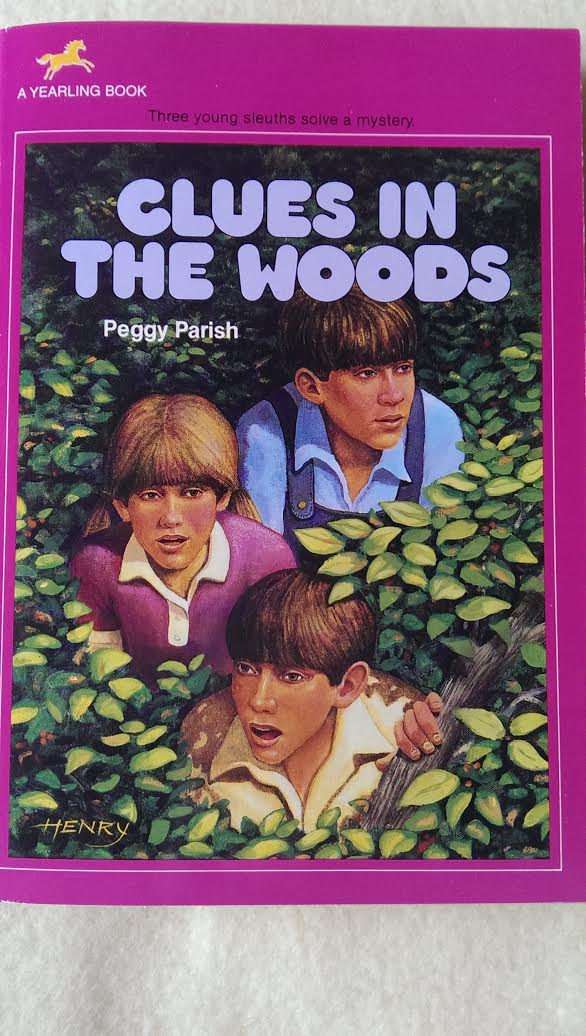
While Liza, Bill, and Jed are staying with their grandparents, their grandmother starts saving table scraps to give to some neighboring children who have adopted some kittens but who don’t have much money to buy food for them.  Unfortunately, someone keeps taking the scraps when the grandmother leaves them by the back door.  The grandmother even tries leaving them inside the can by the back door to make sure that no other animals can get to them, but they still disappear.  Although it doesn’t sound as exciting to the children as solving their family’s old treasure hunt was, the Roberts children decide to take on the case for the sake of the poor kittens!

The kids try sitting up and night and watching from a window, but Bill’s impatience and temper keep them from seeing what happens at the right moment and causes them to accidentally break their grandmother’s lamp.

They adopt a puppy from a neighbor and keep him on the back porch, hoping that he’ll bark if anyone trespasses out back, but the puppy suddenly disappears!  Can the children find both the scraps thief and their poor puppy, Jelly Bean?

Just when the kids think that they have everything figured out, they learn something surprising that changes everything!

This book is part of the Liza, Bill, and Jed Mysteries series.  It is available to borrow and read for free online through Internet Archive.

clueswoodspic1