The Demon in the Teahouse

DemonTeahouse

The Demon in the Teahouse by Dorothy and Thomas Hoobler, 2001.

This is the second book in the Samurai Detective series.  Like other books in this series, it is not a book for young children!

Seikei is trying hard to learn all the things he must know as a samurai and Judge Ooka’s adopted son. One evening, while the judge is in Edo (now called Tokyo), he sends a message that Seikei and the other samurai must come immediately. Edo is in a state of emergency because of a series of fires that have been deliberately set in shops around the city. Although Judge Ooka helped to design a system of watch towers and fire brigades to help the city in case of fire, the threat of fire is still very serious because most of the buildings in Edo are made of wood.

The only clue they have to the person setting the fires is a geisha who was in one of the shops before it burned. Judge Ooka and Seikei go to the city’s pleasure district, Yoshiwara, where there are theaters and teahouses where geishas provide entertainment. While they are there, they learn that geishas have been dying under mysterious circumstances, and the people of Yoshiwara are afraid.

Judge Ooka has Seikei take a job as a servant at a teahouse in order to learn more. He soon discovers that the dead girls were all friends of Umae, one of the most popular geishas. Then, one of Umae’s many admirers brings her a present, and she is horrified to discover that it is the kimono that one of the dead girls was wearing. Who brought her the kimono, and what connection does she have to the fires?

The nature of the villain and the villain’s motives is rather dark for a middle school level book (although some middle school level books do get fairly dark).  Although the reading level of the book would be fine for someone aged twelve to fourteen, the subject matter might make the story more appropriate for someone a little older.  I recommend parental discretion on this one.  (Remember, it takes place in the “pleasure district” of Edo.)  It’s an exciting story, and it contains an interesting picture of feudal Japan, but it’s definitely not for young children!

The part about Judge Ooka organizing watch towers and fire brigades is something that the real, historical Judge Ooka actually did.

The book is currently available online through Internet Archive.

The True Tale of Johnny Appleseed

JohnnyAppleseed

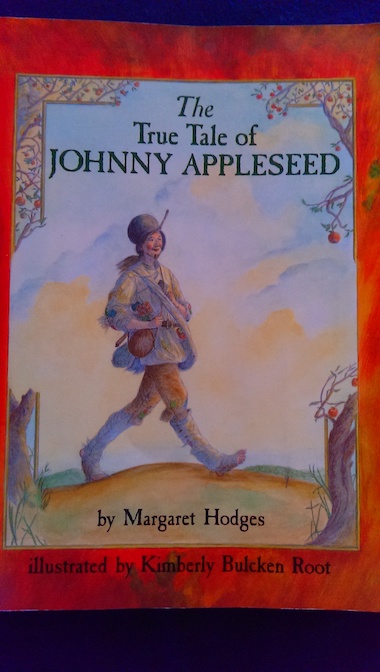
The True Tale of Johnny Appleseed by Margaret Hodges, 1997.

This American folktale was based on the life of a real person, John Chapman.

Johnny Appleseed was born as Johnny Chapman in 1774. His family lived in Massachusetts. There were plenty of apple trees there, and Johnny loved them. When he was grown, he started traveling west with the idea of spreading apple trees.

He carried very little with him, and some people said that he wore the pot that he used to cook his meals on his head as he walked. Everywhere he went, he planted apple seeds.

His reputation spread, and although people thought that traveling around just to plant apple seeds sounded crazy, they sometimes let him stay with them on his travels. Even Native Americans seemed to like him because he was friendly and helpful and interested in learning their languages. His legacy continued long after his death with trees that were enjoyed by generations of families across the Midwest.

There is a section in the back of the book that explains more about the history behind Johnny Appleseed’s story, including the end of the Revolutionary War and the beginning of westward migration in America. One of the things they mention is the effect that the War of 1812 had on relations between pioneers and Native Americans. Because pioneers were already pushing into the territory of Native Americans in the area that later became Ohio, the tribes there sided with the British in the war, hoping to push out the invading pioneers. After the war was over, though, the pioneers continued to come west, and when they did, they retaliated against the tribes that had been on the side of the British. The pioneers could be brutal, and part of the reason that Native Americans liked Johnny Appleseed was that he was different. He wasn’t trying to hurt anyone or take land for himself; he just wanted to plant trees. After he planted trees, he would build fences around them to keep animals from eating them while they were growing.

John Chapman’s life was unconventional.  He never married, and he acted as a Christian missionary in his travels as well as a planter.  Although he could be regarded as something of an oddball in the itinerant way he lived his life, he became a legend.

The book is currently available online through Internet Archive.

Hitty, Her First Hundred Years

Hitty

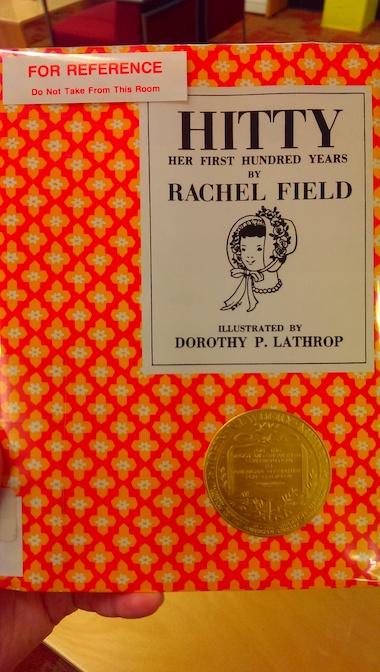
Hitty, Her First Hundred Years by Rachel Field, 1929.

Sometimes, I debate about how much detail I should use when describing the plots of books, but since this is such an old book and a more recently released version has altered the events in Hitty’s life significantly, I’ve decided to cover it in detail.  I do not have the updated version and haven’t read it, so what I describe below is the older version.  The book is episodic in nature, following the life and travels of a small doll named Hitty.  This book is a Newbery Award winner and is currently available online through Internet Archive (multiple copies).

These are the memoirs and adventures of a hundred-year-old wooden doll, which she writes as she lives in antique shop. She doesn’t recall exactly when she was made, but she knows that it was about a century earlier and that she was carved by a peddler in Maine for a little girl named Phoebe Preble.
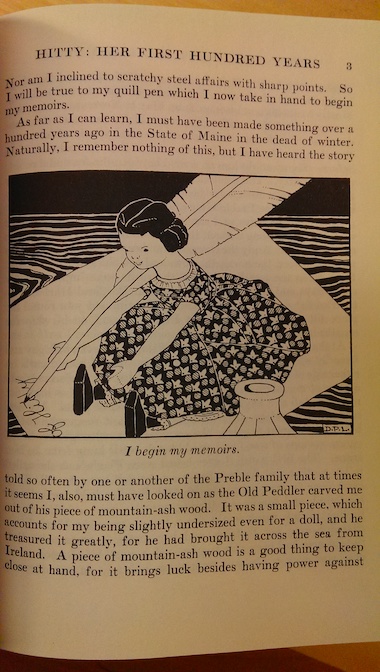
HittyMemoirsThe peddler did some odd jobs for the Preble family on their farm that winter, while the weather was too bad for him to travel. They named the doll Mehitabel (a Biblical name from the Old Testament), and Phoebe nicknamed her Hitty. At her mother’s insistence, Phoebe made clothes for Hitty and embroidered Hitty’s name on the doll’s petticoat. Phoebe’s mother says that as long as she has her name on her clothes, she’ll always know what it is, whatever happens to her. Phoebe doesn’t see what could happen to Hitty because she wants to keep her forever, but Hitty is destined to live an adventurous life.

Phoebe misplaces Hitty more than once during their time together. The first time, she accidentally leaves her at church (when she wasn’t even supposed to bring her there in the first place). Then, Phoebe takes Hitty out to play one day, but she and her brother are frightened when they see some American Indians. (Phoebe lives in the early 1800s.) When they run away from the Indians, Phoebe accidentally leaves Hitty behind. Then, Hitty is picked up by a curious crow and carried to the tree next to the Preble house. She hangs from a tree branch for awhile before they realize that she is there and rescue her.
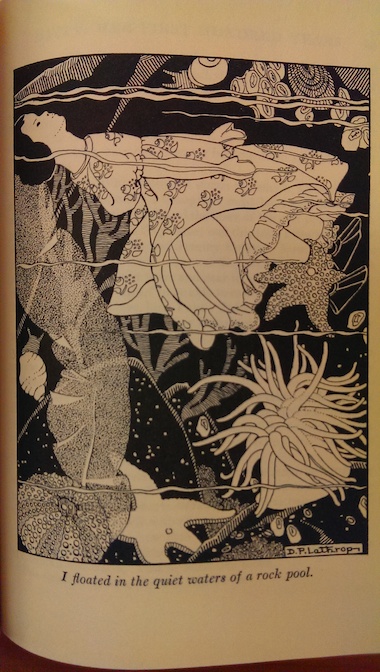
HittyShipwreckedThen, Phoebe’s father, who is the captain of a whaling ship, convinces his family to join him on a voyage. Life aboard ship turns out to be both exciting and perilous. One day, the ship catches fire, and the Preble family and all the crew abandon it. Hitty, once again, is unfortunately left behind. Although Hitty sees Phoebe gesture back at the ship and knows that Phoebe wants to return for her, it is too late for that.

However, luck is with Hitty, and instead of being burned, she is washed overboard as the ship goes down. Miraculously, she is washed ashore and found once again by the Preble family, who are now castaways on an island. They hope for rescue but fear the “natives” on the island. (Yep. “Savages”, “natives”, etc. These are sadly a common feature in vintage children’s literature. See Edward Eager’s Magic by the Lake for a funnier spoof version. The scene in this book is the sort of generic “savage natives” or “native savages” scenes he was making fun of, except that nobody tries any silly ooga-booga talk to communicate with them, and they don’t turn out to be cannibals. But, it does occur to me that if this book had been written in modern times, people would have insisted that the author give the proper name for the civilization on this island instead of just calling them “natives” and thoroughly research their actual habits and customs and present them in an informative, realistic way for the education of children reading this book, while writers and parents during this period didn’t seem to care about any of that.  Keep this in mind the next time someone tells you that younger generations are lazier and not as well-educated.)

One day, the natives come to have a look at the castaways, and their leader catches sight of Hitty and demands (through gestures) that she be handed over to him. Phoebe doesn’t want to give up her doll, but her father tells her that she has to. It turns out that the natives think that Hitty might be an idol that gives the castaways power, which is why they want it for themselves. Hitty is taken back to the natives’ village, and they use her as an idol themselves, making a little shrine to house her.

Hitty probably would have remained there if she had not been stolen from the temple by some curious monkeys and once again found by members of the Prebles’ party, who return the doll to Phoebe. Fortunately, the family sees a passing ship and manages to get rescued before the natives can come after Hitty again.

However, Hitty’s adventures are still not over. The ship that rescues them is going to India, and unfortunately, this is where Hitty and Phoebe are permanently separated when Phoebe loses her in a bazaar. Instead of being found by Phoebe or her family again, Hitty is found by a snake charmer, who uses her in his act, positioned near the snake. Even though Hitty is made of wood and not vulnerable to snake bites, she still finds the experience frightening.

From this point on (we’re about halfway through the story), Hitty changes hands repeatedly, gaining and losing owners every few years or so. Most of her new owners give Hitty a change of clothes, but they always keep her petticoat with her name still embroidered on it so, as Mrs. Preble once said, Hitty and her new owners always know her name.

An American missionary couple spot Hitty with the snake charmer and realize that her design looks like dolls in America. They have no idea how she got to India, but they buy her from the snake charmer and give her to their daughter, Thankful. Hitty lives with Thankful for a couple of years, and she enjoys her time with her, even though she really misses Phoebe.
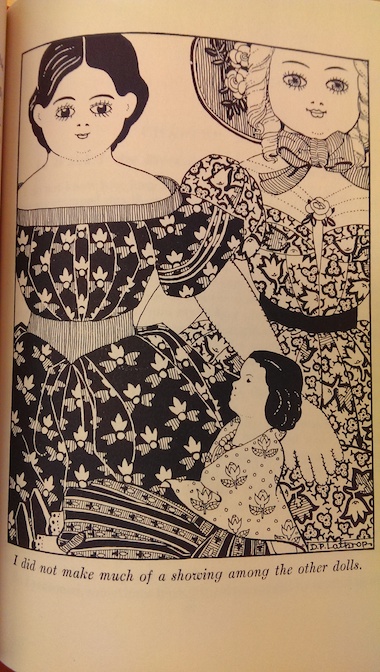
HittyOtherDollsThen, Thankful gets sick, and her parents decide that it might be time to send her home to the United States to stay with her grandparents. Thankful takes Hitty with her when she goes home to Philadelphia. Because Thankful’s early life was spent entirely in India, she has been unaccustomed to spending time with American girls her age, and she doesn’t know how to behave around the American children she meets when she first arrives in Philadelphia.  When the some of these (still 19th century) American girls first meet Thankful and Hitty, they think that Thankful is strange and make fun of her for her unusual habits and the way she dresses, telling her that her doll is ugly, too. Hitty has to admit that she isn’t as fancy as the other girls’ dolls. Thankful is so embarrassed by what the other girls say that she decides to hide Hitty in a sofa. After that, the sofa is taken up to an attic for storage, so Hitty remains hidden for a number of years.
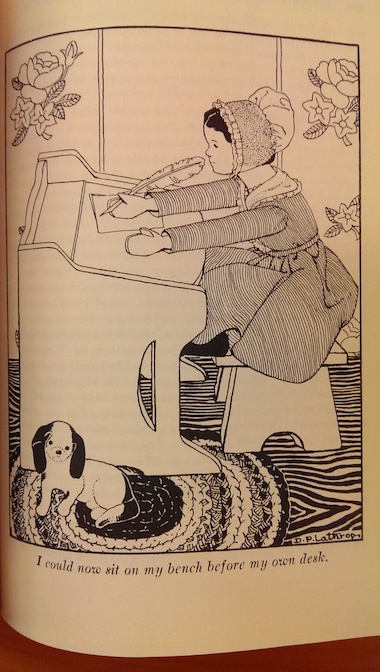
HittyQuakerDuring her time in the attic, Hitty resents Thankful for abandoning her, in spite of all the charitable talk of her missionary parents. However, when Thankful is grown, Hitty is finally found by one of Thankful’s younger cousins, Clarissa Pryce, who really appreciates her. She doesn’t know how Hitty came to be in the attic, but thanks to the name still embroidered on Hitty’s petticoat, knows what to call her. Clarissa is a quiet, conscientious girl in a family of Quakers. She dresses Hitty as a Quaker girl, and Hitty lives with her for many happy years, learning to write as Clarissa goes through her schooling.

By now, the time of the Civil War is approaching, and Clarissa’s family are abolitionists. Hitty doesn’t really understand what the war was about, but she remembers being with Clarissa and watching soldiers march off to war. (This is where the updated version of the book differs greatly.  In the older version, Hitty doesn’t witness the war directly, but in the newer one, she does when she is sent to Charleston.)

Eventually, Clarissa gets older and is sent away to boarding school. Hitty is put into storage for awhile and then sent to the Pryces’ relatives in New York, along with some other things. However, Hitty’s package is misdirected and ends up being delivered to the wealthy Van Rensselaer family by accident. There, she is found by Milly Pinch, a seamstress doing some sewing for the Van Rensselaer family. Miss Pinch makes some stylish new clothes for Hitty, although she still lets her keep the petticoat with her name on it.

The Van Rensselaers’ young daughter, Isabella, sneaks into Miss Pinch’s room one day and finds Hitty, and a debate ensues about who really owns her. Mr. Van Rensselaer, on hearing where Miss Pinch found Hitty, says that rightfully, Hitty belongs to their family but that the clothes she is wearing are obviously Miss Pinch’s because she made them. Miss Pinch is gratified that he is being fair about it, but because Isabella really wants both the doll and clothes together, the family purchases them from Miss Pinch and gives her an excellent employment recommendation for her sewing.

Isabella is rather spoiled and has several dolls already, but she genuinely likes Hitty and takes care of her. Unlike Thankful, she even speaks up for Hitty when others say disparaging things about her plainness. While living with Isabella, Hitty even gets the chance to meet Charles Dickens. However, Hitty is stolen from Isabella by a gang of mean boys.

One of the boys in the youth gang takes the doll home with him and gives her to his younger cousin, Katie. The family is poor, but Katie loves her and gives her plenty of attention. When Katie gets sick and goes to live in the country for awhile, Hitty is accidentally lost in some hay and spends a long time in the barn, living with the mice.

When she is finally found, a pair of traveling artists are staying at the farm, and one of them keeps her to use as an artist’s model. He uses her to amuse children when he paints their portraits and even adds her into still life paintings. Hitty worries about how her painted features have faded, but the artist thinks that she’s much easier to paint than newer china dolls because the light doesn’t glare off of her. She stays with him for many years while he travels around the country, but he eventually leaves her with a pair of spinster ladies, Miss Hortense and Miss Annette, in New Orleans when he rents a room from them.

HittyBrideWhile living with these ladies, Hitty learns that Miss Annette’s fiancé died young, fighting for the Confederacy in the Civil War, and she still feels bitterly toward the North because of it. From her time with Clarissa, Hitty knows that many people in the North could say the same about the South, but of course, she can’t actually say so out loud. The ladies make new clothes for Hitty, dressing her as a bride, with her clothes made from an heirloom handkerchief, and put her on display at the Cotton Exposition (aka the 1884 World’s Fair). From there, Hitty is stolen by a little girl named Sally, whose father is the captain of a riverboat that carries cotton up and down the Mississippi River.

Hitty learns that Sally is a lonely child who travels with her father frequently because her mother is an invalid and cannot always take care of her. Sally knows that it was wrong for her to steal Hitty, but she so badly needs a companion that she is even willing to risk jail if it means that she can keep Hitty. However, after attending a revival meeting where there are warnings against the evils of theft and getting caught in a sudden thunderstorm, Sally panics, thinking that God may be about to strike her down for her sins, and throws Hitty into the river. (I found this scene a little disturbing because, when Sally fears that God will smite her with lightning for stealing, she not only makes a desperate apology but asks if anyone has to be struck, couldn’t it be one of the newly-baptized kids, who are sinless and would know that they were going to heaven? The fearful apology is understandable, but it’s a little disturbing to hear this little girl try to throw someone else under the bus like that.)

From the river, Hitty is rescued by a couple of black boys (the book says “Negro” because it was written in the 1920s) who are fishing. One of them gives Hitty to his sister, “Car’line.” (Her name is probably really Caroline, but Hitty just says the name as she hears it, and the boys have a Southern accent. This is one of those books where they try to give the impression of accents with odd spellings like, “How you come by dat doll?” It’s not the worst example I’ve seen of this, but I have to admit that I’ve never really liked the use of odd spellings like that.) Car’line’s family is the poorest one that Hitty has ever lived with, with a fairly sizable family living in a small cabin. However, Hitty likes the way Car’line treats her and how close her family is, and she loves the music that they sometimes play and the old spirituals that they sing.

At Christmas, Car’line’s family goes to a big party at a house that was apparently once an old plantation. The wealthier owners of the house give presents to the poor children of the area, like Car’line. While they are at the party, one of the women at the house, Miss Hope, recognizes Hitty from a newspaper report that a doll in heirloom clothing had disappeared from the Exposition in New Orleans. Car’line is upset when Miss Hope tells her that the doll really belongs to someone else and should be returned, but Miss Hope understands Car’line’s feelings toward Hitty and soothes her by giving her the doll she had played with as a child, a fancy French doll named Mignonette, as a replacement for Hitty.

As the end of the book draws closer, Hitty changes hands more often than before, and she doesn’t describe her time with new owners in as much detail, partly because her new owners tend to be adults and mostly display her, not play with her. Miss Hope attempts to return Hitty to the ladies in New Orleans, but since the heirloom handkerchief clothes are ruined, they decide that she should really be returned to the artist who had her before. When they try to mail Hitty to his address in New York, it turns out that he has moved without leaving an accurate forwarding address. Hitty spends some time as a package in the postal service, ending up in the dead letter office, where she is sold off, along with other undeliverable packages, to people who are willing to take a chance that there might be something interesting or valuable in them. She doesn’t spend much time with the man who bought her because her package is accidentally left behind at a tobacconist’s shop, where she is accidentally delivered to a house with an order of pipes. The lady of the house has been wanting to try a craft project for turning a doll into a pincushion, so she adds padding to Hitty and puts some pins in her (terrifying but not actually painful for Hitty). From there, Hitty is sold at a craft sale, where she is bought as a present for someone’s great aunt. The great aunt doesn’t think much of the pincushion, but her friend collects dolls and recognizes that Hitty is a collectable. For awhile, Hitty lives happily with the friend as part of her collection, until she is lost out of a car on her very first automobile ride. Then, she lays alone in the countryside, fearful that this is going to be the end for her, until she is found and rescued by some picnickers.
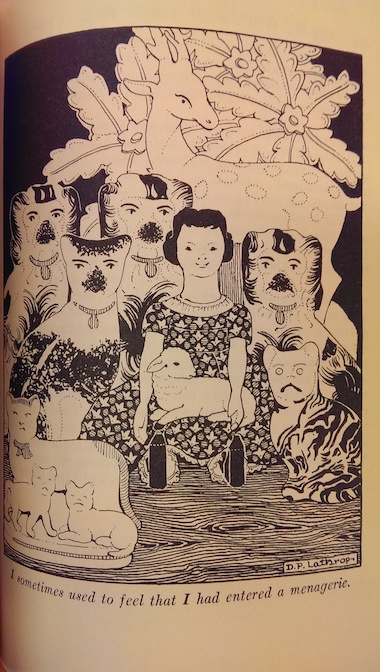
HittyCollectableIt is at this point that Hitty learns something astonishing: not only is she now about a hundred years old, but she has actually managed to make it back to her home state of Maine. To her further astonishment, she even returns to the Preble house where she originally lived, which is now the summer home of an elderly woman. Hitty knows that it’s far too late for her to have any hope of seeing Phoebe Preble again, and she never learns what exactly happened to Phoebe in her later life (which I thought was kind of a shame, bu it fits with the story of a doll, drifting from one owner to the next, unable to control her destiny or ask any questions of the people around her). The elderly lady collects antiques, and Hitty becomes a part of her collection, although the lady has no idea that this is Hitty’s original home.

Eventually, the elderly lady dies (it’s implied, but not stated – one summer, she simply never comes back), and her collection is auctioned off. Hitty is again surprised when she discovers that people view her as a valuable antique now. An Old Gentleman buys her at the auction, and when he takes her with him to New York, he comments that he supposes that it’s probably the first time she’s been outside of Maine and that her travels are about to begin. Hitty is amused.

At the end of the story, it is revealed that the Old Gentleman has purchased her for Miss Hunter’s antique shop, which is where she is now writing her memoirs. Miss Hunter and the Old Gentleman are delighted by Hitty and consider her a “museum piece.” Even though they could sell her, they don’t seem anxious to do so. She has become their shop’s mascot, and many people who visit the shop like to say hello to Hitty. Still, Hitty knows from her experiences that change is a part of life, and she is looking forward to seeing more changes in the world around her and the new adventures she may have with future owners!

My Reaction

In some ways, I was surprised by how much I enjoyed this story.  The length may seem a little daunting at first (262 pages about the adventures of a doll!), but the reading time is faster than you think, partly because of the episodic nature of Hitty’s life.  Books that are episodic can sometimes be a drag because, no sooner are the characters out of one situation, they plunge straight into another.  If it isn’t done right, it can leave the reader feeling like it’s all getting tiresome and repetitive and wondering where it’s all heading.  It’s a little different with Hitty, partly because the writing quality is good and partly because her owners and their lives are so varied.  I didn’t think much of the whole “natives” episode (because I never like “savage native” scenes in anything), but her other owners are a eclectic range of people, young and old, who have different interests and uses for Hitty.  Hitty ends up in some worrying situations, but you can feel reassured that she is going to be all right in the end because you know from the beginning that these are her memoirs that she is writing during the course of the story.

Hitty is unable to move around much on her own, which is part of the reason why she moves from place to place because of accidents or intentionally being carried or shipped by people.  However, she does seem to have the ability to move by herself in some small ways, such as writing her memoirs and when she tries to imitate Isabella’s dancing lessons, only to discover that she can’t quite do it because a doll’s legs aren’t jointed in the same way that human ones are.

Apart from the “savage native” scene, I don’t think the book was too bad, racially speaking.  I can’t recall any really objectionable terms being used.  Black people, when they appear, are called either “black” or “Negro”, and nothing insulting is said about them.  They are not treated cruelly in the course of the story.  Hitty enjoys her time as Car’line’s doll and doesn’t think badly of her or hold her in lesser esteem than other owners because she was poor.  The people in India aren’t described too badly, either, although Hitty thinks that the snake charmer was weird, and she seems to think well of the Indian nurse who took care of Thankful.  Thankful’s parents never discover that the Indian nurse gave her additional herbal remedies when she was ill, but Hitty appreciates the nurse’s devotion to the girl, doing everything she could to help her.  Hitty even says that she doesn’t know which medicines helped Thankful the most or if it was really the combination of all of them that saved her from her illness.

Some of Hitty’s owners are obviously nicer than others, with Thankful being arguably among the worst of them.  Even though Thankful’s upbringing is very religious, she and her new American friends are apparently rather shallow and thoughtless.  Even though her new “friends” in Philadelphia aren’t even nice to her, Thankful still worries about how she looks to them and is ready to chuck her beloved doll to please them.  Even spoiled little Isabella takes better care of Hitty and is more loyal to her, standing up to mean people as best she can instead of trying to appease them.

Mostly, Hitty prefers to be owned by young girls because she likes it when they play with her and carry her around, but she does enjoy being with adults who pay attention to her and treat her as a personality instead of as a mere object.  I was glad that none of the children Hitty lives with dies young, which could have been a risk in real life but would have been tragic.  Even with the elderly owner who presumably died, which was probably why her collection was being auctioned, Hitty never sees her die and doesn’t explicitly know that she is dead.  Whether Hitty will ever be owned as a child again now that she is considered an antique is unknown, but the author leaves the end of the story open, so just about anything could happen in Hitty’s future.

In a way, though, Hitty’s fate is already known.  Great Cranberry Island is the part of Maine where Hitty is supposed to have come from, and the Preble house is based on a real house. The story was based on a real doll that the author found in an antique store.  This doll is now at the Stockbridge Library Museum in Stockbridge, Massachusetts. There is also a cafe that is named after Hitty. There are fan sites dedicated to Hitty, some of which have tips for creating a doll very much like her.

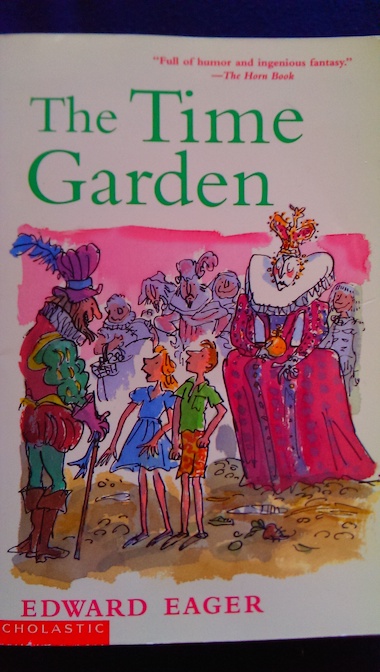
The Time Garden

TimeGarden

The Time Garden by Edward Eager, 1958.

About a year after the events in the previous book in the series, Roger and Ann are excited when their father writes a play and announces that it will be performed in England. Unfortunately, their parents aren’t planning to take the children to England with them because the trip there will be just business, focusing on getting the play together. If the play is a success, they plan to send for the children so they can do some sightseeing in England, but until then, the children will need to stay somewhere else during summer vacation. Their mother, Martha, calls her sister Katharine to see if the children can come visit their cousins, but it turns out the Katharine is also looking for a place where Eliza and Jack can spend the summer. By coincidence, Katharine and her husband are also planning a business trip to Europe.

TimeGardenMrsWhiton

The adults talk it over and end up arranging for all four children to stay with Katharine’s husband’s great aunt, Mrs. Whiton, who lives in a house by the sea, not far from Boston. The children don’t find this prospect very exciting. Then the adults tell them that Mrs. Whiton writes children’s books, Eliza is sure that she’ll be trying to analyze them for inspiration for her stories, but Mrs. Whiton turns out to be better than they thought. She is unsentimental, something that Eliza appreciates, and her house is very nice. There is a pretty garden there, and a staircase that leads right down to the beach.

One day, when Mrs. Whiton sends them out to play in the garden, they find an old sundial that has a motto written on it: “Anything Can Happen When You’ve All the Time in the World!” The children have had experience with magic before, so they begin to suspect that this garden isn’t quite what it appears . . . and they’re right. A strange, toad-like creature call the Natterjack introduces himself to the children and tells them that the thyme garden, where there are many varieties of thyme growing, is also a time garden. He explains that he and his family have helped this garden grow since his grandfather’s grandfather was brought there from England along with a shipment of primroses and that they’ve put all of their magic into the garden and its plants. If the children would like to visit another time, all they have to do is to pluck a sprig of thyme and smell it.

TimeGardenWhitonHouse

Jack, who has decided that he’s too old for magic and is now only interested in girls, refuses to try it at first, denying the existence of magic, even in spite of the talking toad. The other children try it and find themselves at the same house during the time of the American Revolution. Everyone who sees them seems to think that they are the Whiton children of that time, and they end up participating in a ride very much like Paul Revere’s, riding through the countryside to alert people that the British are coming. At first, their ride is thrilling and successful, but if you know the other books in this series, you can guess that things are going to go wrong at some point.

When the kids reach a tavern, they try to tell the drunken men inside that the British will be at Lexington soon, and they say that they don’t care. As far as they’re concerned, if the British are going to Lexington, let the guys in Lexington deal with it. The children are offended that they don’t want to help and try to appeal to their patriotism and fellowship with other Americans. It turns out that they don’t have much patriotism (the United States isn’t a separate country yet, so there is that) or feelings of fellowship because their plan for if the British are defeated is basically “every man for himself.” (I understand this scene so much more now as an adult than I did when I read this as a kid. I think I’ve met their descendants.) The children are angered at this mercenary attitude, and Ann accuses them of being pro-British. One of them insists that they’re not because, “We ain’t pro-anything.” (Yep, this is familiar. Some people just want to be contrary until there’s something in it for them to gain.)

It gets worse when the anti-British talk causes the Natterjack, in a surge of British patriotism, to cry, “Rule, Britannia!” The drunks in the tavern then decide that the kids were trying to deceive them about the British coming because they’re actually on the side of the British, trying to distract them from the British army’s real plans. When they discover that the voice actually came from a talking toad, they declare that it’s witchcraft and decide to throw the children into the pond to see if they will float (an old test in witchcraft trials).

In a bizarre twist, they are saved by a band of attacking American Indians. (Native Americans ex Machina?) There’s no real reason for a tribe of American Indians to be attacking at this particular moment, and the kids in the story seem to realize that.  This incident, like many others in this series, is partly based on other books in classic children’s literature, especially the works of E. Nesbit, the author’s favorite children’s author.  A similar incident occurs to the children in E. Nesbit’s Five Children and It, although under different circumstances.  The author of this story frequently pokes fun at tropes of classic children’s literature in his books and makes pop culture references from the 1950s, so the more old books you’re familiar with, the more you see the jokes, although I admit that, even knowing the background, this scene still bothers me. In the grand tradition of cheesy 1950s westerns, there’s a vague description of the carnage of the attack with the requisite scalping and tomahawking (yes, they use it as verb). Ann is upset about the attack and covers her eyes, although Roger says that he doesn’t think that this attack could really have occurred in real life because they would have heard about it if it were a real, historical event. Ann worries that they somehow caused it by messing with history. When the tribe is done tomahawking their attackers, the children are worried that they’ll be next, but the Natterjack tells the children that they can escape by smelling the thyme again.

Before we move on, I should point out here that, in different books in this series, it’s never entirely clear how much of the children’s adventures occur in the real world or in some kind of magical, alternate reality or maybe in their own minds, and this is actually intentional. The idea of sniffing a magical herb and being transported through time sounds kind of trippy. The whole “savage painted Indians” (their words, not mine) trope was a staple of old western shows, the kind that kids growing in the 1950s might have watched because that genre was popular, particularly in the late 1950s, when the book was published, so the children’s experiences may be partly patterned after what a 1950s kid might have imagined after watching those shows. (Sort of like the Arabian fantasies that their mothers had in previous books in the series, probably inspired by The Sheik.) So, this incident in the book is partly a take-off on similar ones in other children’s books, but it might also be the author’s commentary on the types of shows that were popular and children’s expectations.  Perhaps some of the implication is that the children’s expectations, based on things they’ve read or seen on tv are what caused this weird, otherwise inexplicable attack in the first place. (It’s like on tv, kiddos, and now you can see it in full color!  You expected it, so you got it.  Still think this stuff is fun?) Part of the problem with this scene for me is that it’s difficult to tell exactly how the author means it. I can guess a little, given the author’s taste for making literary references and parodying tropes of children’s stories, but even as a parody, it’s uncomfortable by modern standards and still makes very little sense why it’s even happening at all. This scene is just plain needless and cringe-worthy in my opinion, but you sometimes run into things like that with older children’s books.  It’s some consolation that this is the worst scene in the entire book, so it’s good to get it out of the way early.

Before we return to the main plot again, I’d also like to say that the children themselves don’t seem to understand exactly how the magic works (like other children in this series) or whether what happened to them was completely real or not.  They debate about it periodically and wonder about the children that they replaced on this adventure (and on later ones as well). They never quite know if those children went somewhere else while they took their place or if both sets of children were just living out the same adventure at the same time, just seeing it in slightly different ways.  These time travel questions are fun to ponder, but are never really explained, just theorized.

When the children get back to their own time from the Revolutionary War period, the Natterjack apologizes for getting them into trouble and asks them to put the plant sprig back in the ground, where it grows again (no “wasting thyme”, ha, ha). He also further explains that the name of the particular variety of thyme they pick in the garden is important because it has some bearing on where in time they will go. The thyme they had chosen was “wild thyme”, and they had to admit that their time was pretty wild. Ann borrows a gardening catalog from Mrs. Whiton’s old gardener and begins studying the different varieties of thyme. When they ask the Natterjack about the massacre at the tavern, he tells them that the mistakes they make or bad consequences of their interference will be erased by the good deeds they do, so their timely warnings about the British coming will have an effect, but that massacre has been erased from history. (Too bad it’s still in the book.  There’s still no real reason for it to be there, dang western trope.) Good deeds performed during their adventures will earn them more adventures, so they have to remember to do some good in every time they visit.

So, while Jack spends most of his time getting to know the local teenage girls and doing normal teenage things and trying to ignore his sister and cousins when they talk about magic, the others get to spend their summer having magical time adventures. The next variety of thyme they pick is “splendid thyme.” Once again, they are taken back in the history of the house, where they are again mistaken for past Whiton children. The time period is around the Civil War, and the house is being used as a station on the Underground Railroad. The children help some escaping slaves to flee to Canada. (Their sentiments are strongly anti-slavery, which is a relief after that massacre scene. The escaping slaves aren’t portrayed too badly, although mostly, they’re in hiding during the adventure and are oddly unquestioning of how the kids managed to use magic to get them to Canada so fast, just embarrassingly grateful for it.)

TimeGardenCrossOver

After that, Eliza wants to know if they’re restricted to historical adventures only or if they can visit times that are fictional as well, referencing their adventures with Ivanhoe in the previous book. It turns out that the time garden is very accommodating, and they are able to go back in fictional time to visit the characters in Little Women (which, fortunately, took place not far from where they are staying), especially since Louisa May Alcott based the characters on herself and her sisters, giving the book a sense of semi-reality. Jack, who has been denying the magic all along, comes with them on this adventure, and spends all of his time fawning over the teenage Meg and Jo. The children help to reform an ungrateful family that has been taking advantage of the girls’ generosity (and, as Jo says, reforming “is punishment enough”).

Sharing in this adventure with the other children is enough to get Jack to admit that they’re having adventures, although he still refuses to look at it as being magic, preferring more scientific terms. At one point, he describes a theory of time as looking down on the world from an airplane. From high above, you can see many different places at once, but it would take a person on the ground a long time to get from one place to another. Similarly, Jack thinks that everything in history is happening all at once, but it just takes people a long time to get from one event to another because of their vantage point.

TimeGardenElizaLondon

Then, the children get the idea to go visit their mothers in England. However, when they use Common Thyme with their wish, they end up seeing their mothers in the past, not the present. This is the point in the story where it crosses over with their mothers’ magical adventures as children in Magic By the Lake.

Eliza then gets the idea of using thyme seeds to travel through time instead of using a full-grown plant. She and Jack end up traveling to England. However, they end up in the wrong period of history, and because the magical rules are broken, everyone sees them as the modern children they really are and not as people from the appropriate time period. When Eliza manages to offend Queen Elizabeth I and ends up in the Tower of London, they need the help of Ann, Roger, and the Natterjack to straighten things out!

I think my favorite part of the story is really the thyme/time garden itself. Not only is it a fun pun, but I thought that it was clever how the titles of particular varieties of thyme relate to the times and places where the children end up. Different varieties of thyme plants really do have some incredible names in real life. At the end of the book, after the children go to England to join their parents because the play was successful, the Natterjack waits in the garden for the next set of children who will go on adventures, and after looking up other varieties of thyme that the book never mentioned, the possibilities for new adventures are tantalizing: Leprechaun Thyme (for adventures with leprechauns), Elfin Thyme (either for adventures with elves or maybe becoming smaller?), and Woolly Thyme (Want to go see a woolly mammoth? On the other hand, maybe it just goes to a sheep farm. This magic stuff never works like you think it will).

The book is currently available online through Internet Archive.

The Ninth Jewel of the Mughal Crown

BirbalTales

The Ninth Jewel of the Mughal Crown: The Birbal Tales by James Moseley, 2001.

BirbalTalesRealBirbalThe characters in the stories, Emperor Akbar and his friend and advisor Birbal (birth name Mahesh Das) were real people who lived in India during the late 16th century. Over the years, stories and legends have grown up around them, although the truth is pretty incredible by itself.

This book, which is a collection of some of the stories about Akbar and Birbal, begins by explaining a little about their history, and there is another section in the back that explains more about their lives.  The book’s introduction says that Akbar’s father died when he was young and that Akbar’s reign was considered a Golden Age in India’s history, although it mostly focuses on his “Nine Jewels.”  The section in the back gives a little more context.

To begin with, Akbar was one of the Mughal Emperors.  The book doesn’t explain much about what that means, but understanding it helps to set the stage for the stories.  The Mughal Empire consisted not only of modern day India but also some of the surrounding countries.  The empire was first established by Akbar’s grandfather, Babur, through conquest.  Babur was born in the region that we now call Uzbekistan, although his family’s origins were Mongolian.  They were distantly descended from Genghis Khan.  They were also descended from Tamir (sometimes called Tamerlane), giving them Turkic and Persian connections.  The early years of the Mughal Empire were unstable, but when Akbar’s father died and Akbar became emperor at a young age, his regent helped him to stabilize the empire and expand it through a mixture of further conquest and diplomacy.  The reputation of wealth and power in the Mughal Empire eventually led to the adoption of the word “mogul” in English to describe a wealthy and powerful person, especially one who has high standing in a particular field of expertise (something which, as you’ll see, was of particular importance to Akbar).  Using the riches and resources gained through his territorial expansion, Akbar worked to develop the economy of his empire and to support the arts and learning.

BirbalTalesRealAkbarAkbar had a great love of learning, but unfortunately, was dyslexic at a time when people didn’t understand the condition very well.  (To put it into context, Akbar was a contemporary of Elizabeth I of England.)  Even though, like the European Emperor Charlemagne (who lived much earlier but was also apparently dyslexic), he wanted to learn to read, he struggled with it throughout his life because of his condition.  Akbar didn’t want his reading difficulties to interfere with his learning or his love of the arts, so he found another way around the problem.  In a way, it’s similar to what Charlemagne did, surrounding himself with learned advisors who would read to him and discuss important topics with him, verbally teaching him whatever he wanted to know.  Akbar chose his advisors very carefully, seeking out people who had demonstrated excellence in subjects that were important to him. Akbar’s advisors became famous for their fascinating and unusual skills and personalities.  He had nine special advisors who were close to him, which is why they were called, “The Nine Jewels of the Mughal Crown.”  Legends grew up around these men and their abilities:

Tansen – An expert in music, whose singing voice was said to be so amazing that he could make candles burst into flame with a song.

Daswant – A master painter.

Todar Mal – An expert in finance.

Abul Fazl – A great historian.

Faizi – Brother of Abul Fazl, a famous poet.

Abud us-Samad – A master at calligraphy, he also designed the imperial coins.

Man Singh – A great military general.

Mir Fathullah Shirazi – A man of many skills, including the fields of medicine, astronomy, philosophy, and finances.

Birbal – Akbar’s Minister or Raja, who had a reputation for cleverness, quick wit, and the service of justice.  He was the “Ninth Jewel”, and his stories are the focus of this book.

BirbalTalesMeetingThere are many more stories about Birbal than the ones included in this book, but they are all about how Birbal uses his wits to serve Akbar and aid the cause of justice.  Like all good legends, the stories are partly based in fact, but have grown with each retelling to the point where it can be difficult to say where the real people leave off and the legends begin.

In the first story in the book, Akbar meets Birbal when he is still a child.  Fascinated by the boy’s combination of courtesy and boldness and his unusual wit, he gives the boy a ring and tells him that when he is grown, he should come to his palace at Fatehpur Sikri.  Years later, Birbal does go there, but when he shows the ring with the emperor’s seal on it to the guard on duty, the guard refuses to let him in until he promises to give him half of whatever the emperor gives him.  When Akbar sees Birbal, he is pleased to meet him again but stunned when Birbal asks him to give him 100 lashes.  When Birbal explains the reason for his bizarre request, it not only gets the laughter of the court, but the approval of Akbar, who appreciates this bold approach to the problem of bribery.

BirbalTalesPortraitFrom then on, Birbal gains a reputation for his ability to mediate disputes and find unusual solutions to problems.  His favored position at court gives him some jealous enemies, but he handles them with the same cleverness that he uses to solve every problem.

In one of my favorite stories, one of the noblemen at court attempts to cheat Daswant out of his rightful fee for painting his portrait by changing his appearance (shaving his beard, shaving his mustache, etc.) after each portrait sitting and then claiming that the portraits Daswant paints do not really look like him.  When Daswant explains the situation to Birbal, he gets the nobleman to promise to pay for an “exact likeness” of himself in the presence of Akbar.  Then, Birbal shows him a mirror, which Akbar agrees contains an exact likeness of the nobleman and deserves payment.

BirbalTalesCoinPurseIn another of my favorite stories, Birbal determines who is the true owner of a coin purse when a flour merchant and an oil merchant each claim that it belongs to them.  He pours the coins into a pot of boiling water and notes the oil that bubbles to the surface.  Because the coins are covered in oil, they obviously belong to the oil merchant.  If they had belonged to the flour merchant, they would have been covered in flour.

One of the interesting aspects of Akbar’s friendship with Birbal was their religious differences.  Akbar, like the rest of his family, was Muslim, and Birbal was from a family of Hindu Brahmins. The Mughal Empire was a multi-cultural society, and Akbar was aware of it.   At one point, he attempted to develop a new religious movement that combined aspects of Islam and Hinduism in order to further unite his subjects, but it never caught on as a mainstream religion, possibly because Akbar’s own strong personality as its leader was one of the most attractive features.  Akbar did seem to genuinely believe in religious tolerance and promoted widespread education among his subjects.

Birbal, the historical person, was eventually killed in battle, and Akbar greatly mourned his loss.  The Mughal Empire continued for generations beyond Akbar, although it eventually collapsed through a combination of military, administrative, and economic decline; the decentralization of power in the empire; internal discord; and interference from outsiders that paved the way for the British colonization of India.  That’s kind of a simplistic description of a long, complicated period of history, but the end of the Mughal Empire was marked by the beginning of British rule in India.  In 1858, the British East India Company deposed the last of the Mughal emperors, sending him into exile, around 300 years after the reign of Akbar began.

Kathleen: The Celtic Knot

KathleenKathleen: The Celtic Knot by Siobhan Parkinson, 2003.
Twelve-year-old Kathleen lives with her family in Dublin, Ireland in 1937. Like the rest of the world, Ireland is suffering under the Great Depression, and Kathleen’s father has been having trouble finding work. Her mother helps to support the family by working as a midwife.

One day, when Kathleen’s mother is off delivering a baby, Kathleen accidentally burns the porridge at breakfast, making her and her sisters late for school. Although they should have been marked as being on time, they are considered one minute late because the nun’s watch was fast. Discipline is harsh at the Catholic school they attend, and after a harsh lecture to Kathleen, the headmistress, Mother Rosario, calls for a conference with her mother. Kathleen is very upset about it, but Mother Rosario softens somewhat and says that she merely wants to see that everything is alright with Kathleen’s family because a nice girl like her shouldn’t be acting up.  Kathleen still worries because she knows that the nuns look down on poor families like theirs and consider their authority higher than the parents of the children they teach.  They are often unaware of the circumstances that families live in.

However, Kathleen’s mother isn’t fazed by the nuns’ attitude and is blunt with the Mother Rosario, telling it like it is. The headmistress does show that she has some compassion and is somewhat aware of their circumstances because she says that Kathleen’s lateness was only part of the reason she wanted this meeting. She has guessed that Kathleen’s father is looking for work, and there is a position for an assistant gardener open at the school. It doesn’t pay much, and it’s not as good as her father’s old job was before the factory where he worked closed, but he agrees to take it because it’s better than nothing.

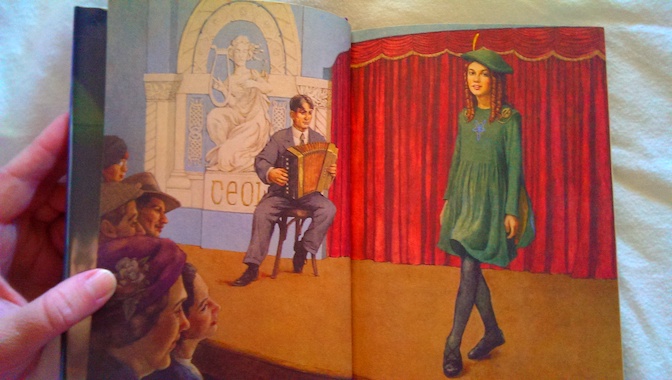
The headmistress also says that she has noticed that Kathleen is musically-talented. She likes to sing and has a good voice. Mother Rosario thinks it would be a good idea for her to take piano or dance lessons. The family doesn’t have a piano, so the headmistress suggest that Kathleen join the Irish dancing lessons because it’s a wholesome activity that reflects her heritage and that would keep her out of trouble. Kathleen’s mother isn’t big on heritage, but she agrees that dancing might be a good activity for Kathleen.

Kathleen isn’t happy about the dance lessons at first because the other girls who are involved are snobs. But, once she tries it, she realizes that she actually loves dancing. The problem is that the lessons aren’t free, like the other girls told her. At first, Kathleen feels cheated, finding out that she loves something that she can’t have after all, but her teacher says that she’s talented, so she offers Kathleen some free lessons anyway. She’s been looking for new talent so that her dancers can do well in the next dancing competition, and she doesn’t want to let a promising dancer like Kathleen slip through her fingers.

The snobby girls in class are all the more irritated when Kathleen is among those chosen to enter the next competition, but everyone also knows that there is one more obstacle for Kathleen: she doesn’t have a proper dancing costume or any money to buy one. She prays for one, even promising God that she’d become a nun if he gives her the costume she wants. Her mother has her eye on some beautiful cloth that she hopes to buy as a remnant, but the cloth gets snapped up by some of the wealthier, snobby girls, and her mother comes down with a serious illness shortly before the competition.

Kathleen begins to think that she was wicked for being so concerned about dancing and costumes when there are much more serious things in life. However, her aunt, Polly, understands how she feels and comes up with a plan to make the needed costume for Kathleen, using her favorite book, Gone With the Wind, as inspiration. Remember what Scarlett O’Hara did when she needed a new dress and couldn’t afford one?

KathleenDancing

One of the themes that runs through the story is questions and answers. Kathleen has a lot of questions about life. She knows that her mother deliveries babies for money, but she doesn’t really understand much about it, and her mother doesn’t answer the questions she asks. In fact, Kathleen notices that most of the adults she knows (with the exception of her father) brush aside her questions about the way the way the world works or the things people do because they simply don’t want to be bothered with them. They have too many concerns of their own, and they don’t really know most of the answers themselves. It kind of contrasts with the answers that Mother Rosario demands from Kathleen and immediately dismisses upon getting. Most of the time, she doesn’t really want to bother with answering questions or even dealing with the answers to questions she’s just asked. Only once does she answer a question that Kathleen had asked about St. Patrick, and Kathleen is astonished at getting an answer about something.

I have to admit that the attitudes about questions and answers from most of the adults in the story really irritated me, especially the way Mother Rosario demanded answers from Kathleen about her lateness and then dismissed everything that Kathleen said, angry that she had “answers.”  I’ve met people like that before in real life, and they’re just as illogical and crazy-making as this headmistress. I’m not talking about teachers who refuse to listen to flimsy excuses like “the dog ate my homework,” but people who get angry at others who have real explanations just because they have real explanations. People who demand to know the reasons why things happen and then immediately reject any explanation offered without a real reason for doing so are obnoxious. I’ve encountered people like that before, and it’s hard to have anything resembling a meaningful conversation with them.   They don’t want to talk to you; they just want to yell or lecture at you.  They don’t really care what the answers or explanations are for anything, and no answer would make any difference to them because what they really want is for the other person to just feel bad. It’s an unethical one-upmanship tactic, and it loses my respect the moment I hear someone use it because I recognize what they’re attempting to do. It’s so obvious, but frustrating at the same time (Kathleen in the story wonders why Mother Rosario is trying to torture her in this way) because there’s nothing you can say to stop the other person once they start (at least, I haven’t figured it out). Kathleen’s approach was probably the most effective.  She just stopped talking and prepared herself for the headmistress to hit her, which caused the headmistress to wake up a bit to the fact that the message that she was sending to Kathleen was that her only intentions were to hurt her.  Fortunately, those were not her only intentions, but I have to admit that I never really had any respect for Mother Rosario after that, in spite of what she did to help Kathleen’s family.  You can tell this is one of my pet peeves.  One-upmanship really bothers me in all of its forms, and I have even less time for that kind of nonsense than these characters do for answering a twelve-year-old’s questions.  At least you can talk to a twelve-year-old. Getting back to that, part of Kathleen’s trouble with some of her questions is that her elders often underestimate her, thinking that she’s really too young to understand anything, but the fact that she’s asking questions says that she’s really not. In fact, she might even be putting more thought into some issues than the people who have decided that some things aren’t worth thinking about in the first place.

Another theme of the story is growing up and changing goals in life. By discovering her talent as a dancer, Kathleen has found something that she would like to dedicate her life to, and if she becomes a dance teacher herself, it would give her a job to do in her future that could make her life better. Her aunt, Polly, who is twenty years old, also changes her mind about what she wants in life. As a single young woman, she likes to go out and have fun with her small earnings, hoping to meet a man as elegant as Rhett Butler.   However, when her latest young man turns out to be a cad, she accepts a proposal from the very shy but much nicer young man who she had previous thought wasn’t handsome enough. Polly’s experiences make her realize that handsomeness by itself isn’t much, and she and her new husband have plans for building a life together. At first, Kathleen is disappointed because she and Polly had talked about leading a carefree life together as single ladies when Kathleen was grown, but Polly explains to her that things will be better this way and that grown-ups have to build real lives for themselves, not live on dreams alone. Kathleen is still in the process of discovering the possibilities that life might hold for her and the talents that she can use to build her life.

I also found the parts about Irish history and politics during 1930s interesting.  One of the reasons why Kathleen’s family isn’t big on the Irish heritage movement is because her grandfather fought during World War I and wasn’t treated well as a veteran when he returned. During the meeting with Mother Rosario, Kathleen’s mother is blunt about her views on things, and Mother Rosario is surprised how much she understands of politics, showing that she looks down on poor people (possibly the source of her general rudeness and bullying tactics, even when she’s trying to be helpful – she’s decided that she’s superior and will remain so, whether she’s right or wrong), thinking that they aren’t smart enough to understand what’s going on around them.  The story makes it clear that the nuns at school are often out of touch with what ordinary families go through in their daily lives.  They underestimate what people know or read about, they have trouble understanding their daily struggles with money and how they are barely able to keep food on the table, and they seem unable to grasp what it’s like to be part of a family where any family member’s actions can affect all of the others.  For me, they were far more aggravating than the snobby little girl characters because I usually expect adults of a certain age to have grown out of some of these behaviors.

While reading the story, I was kind of comparing Kathleen’s circumstances in Ireland in the 1930s to life in America during the Great Depression, and many of their struggles were the same.  I was also kind of fascinated by Polly’s fascination with Gone With the Wind because it shows how pieces of culture and entertainment could become popular in other countries during this time.

This book is part of a series by the same publishers of the American Girls Books.  There is a section in the back of the book with historical information about the period.

KathleenHistorical

Changes for Addy

American Girls

AddyChanges

Changes for Addy by Connie Porter, 1994.

Since the Civil War ended, most of Addy‘s family has managed to reunite in Philadelphia. The one person who is missing is Addy’s little sister, Esther.  When Addy and her mother escaped from the plantation where they had been living as slaves, they were forced to leave Esther behind with family friends because she was too little to travel.  Since the end of the war, slaves have been released from plantations, but the Walkers haven’t received any word from their friends, Auntie Lula and Uncle Solomon Morgan and don’t know where they or Esther are.

Over the past months, the Walker family has sent inquiries to various aid societies helping war victims and displaced people, asking if the Morgans or Esther have sought help from them.  Finally, they get a response from the Quaker Aid Society, saying that the Morgans and Esther were at one of their camps in North Carolina.  They stayed for awhile because Esther was ill, but as soon as she was well enough to travel, they were eager to move on to Philadelphia.

Addy is happy because the news means that the Morgans and Esther might already be in Philadelphia, looking for them.  However, Addy’s parents are still worried because the Morgans are elderly, and from what the letter said, they were not in good health.  The family makes further inquiries to see if they could be at any of the local hospitals.

Eventually, the search for the Morgans and Esther pays off when Addy finds them at a church.  Uncle Solomon passed away on the journey to Philadelphia, and Esther seems unsure of who the people in her family are because she was so little the last time she saw them.  Auntie Lula pressed on for Philadelphia because she wanted to make sure that Esther made it safely back to her family.  Auntie Lula is in bad health herself, and she knows that she isn’t likely to live much longer, making the reunion bittersweet.

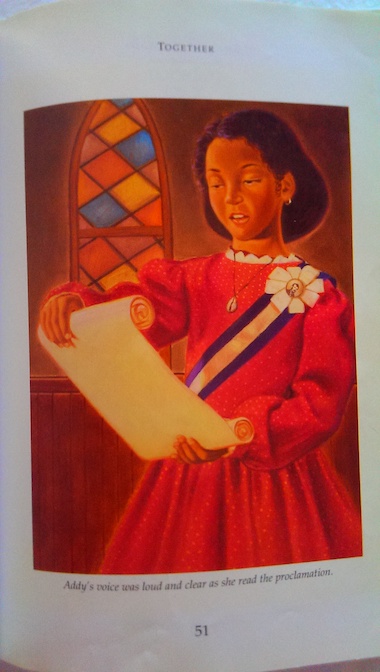
AddyChangesProclamationHowever, Auntie Lula does get to spend a little time with the family before her death, and she tells Addy not to be sad.  People don’t always get everything they want in life, but they can take some pride in what they do accomplish.  Lula and Solomon may not have gotten everything they wanted in life, not having had much time to enjoy being freed from slavery, but they did get to accomplish what was most important to them.  Solomon died knowing that he was a free man, far from the plantation where he’d been a slave.  Lula managed to reunite Esther with her family.  From there, Lula says, she is depending on the young people, like Addy and her family, to make the most they can of their lives, hopes, and dreams.

The theme of this story is hope and the need to persevere with determination.  Life has its difficulties, and not every problem can be solved.  However, things can get better.  After the reunion with Esther, Addy points out to her mother that Esther wasn’t walking or talking when they last saw her, and they never got to experience seeing her learn.  Addy is sad at the time they’ve lost with Esther, which they can never recover.  However, because of Lula and Solomon’s determination to bring Esther to them, they will have many more years to come with Esther.  Addy’s mother also reminds Addy that those who love us never leave us.  Auntie Lula and Uncle Solomon changed the family’s lives for the better because of the good people they were, and their memory will stay with them forever.

In the back, there is a section of historical information about the end of the Civil War, the emancipation of the slaves, and it further explains how racial issues continued into the 20th century, leading to the Civil Rights Movement in the 1960s.

AddyChangesHistorical

Addy Saves the Day

American Girls

AddySummer

Addy Saves the Day by Connie Porter, 1994.

Now that the Civil War is over, families are looking forward to the soldiers returning home and reuniting with loved ones.  Some families have been split forever because loved ones died in the war.  Addy‘s family still doesn’t know what happened to her brother Sam or her little sister Esther.  She and her parents have been making inquiries at various aid societies that have been helping people who were sick, injured, or displaced by the war, but so far, they haven’t received any word about Sam or Esther.  To help raise more money for their search, they’ve started growing vegetables in a community garden that they can sell.

The Walkers aren’t the only family in this position, and their church has decided to hold a public fair to raise money for victims of the war and families in need.  Addy and Sarah are looking forward to taking part in the fair, but they are annoyed because they’ll have to work with bossy Harriet, a snobby girl from their school.  Harriet’s family is wealthier than most black families, and Harriet loves to brag about the things they have that others don’t.  Although many families, like Addy’s, are worried about not knowing where their relatives are or whether they are alive or dead, Harriet brags about knowing exactly which army unit her uncle is in and what a distinguished career he has had.  Harriet is eager to take part in the fair and tell the other children what to do, but her family doesn’t need any charity themselves.

Harriet tries to tell the children’s group at the church what they should do for their act at the fair, and it mainly involves her being the star of the show.  However, the group decides to take Addy’s suggestion instead.  They are going to make puppets out of old thread spools and put on a puppet show.  They can also sell some of the puppets they make.  Addy is proud that her idea was the one that the group chose because she thinks of it as a victory over snobby Harriet, but her parents remind her that the fair isn’t supposed to be a contest.

The purpose of the fair is to raise money to help people, and no one is supposed to compete with anyone.  If the act for the fair is going to be a success, Addy and Harriet will have to find a way of working together to make it happen.  When Harriet picks a fight with Addy while the children are making their puppets, the minister’s wife tells them that she’s going to make them work with each other at the puppet show, forcing them to sort out their differences.

It isn’t until Harriet receives some bad news that she comes to understand the pain that other families, like Addy’s, have been feeling, and Addy comes to see that, in the end, Harriet is just an ordinary person, a little girl with feelings that can be hurt.  With a new understanding of each other, the girls find the motivation that they need to work together and make the fair a success.  Then, when someone tries to steal their group’s hard-earned money, the two of them find a way to stop the thief and get the money back!

This is the book where Addy’s brother rejoins the family.  When he was freed from slavery, he joined the Union army and lost his arm to a battle wound.  He shows up at the fair and recognizes the jokes and riddles Addy tells at the puppet show as ones that he used to tell her.

In the back of the book, there is a section with historical information about the changes taking place in American society around the time of the Civil War with increased immigration and urbanization.  It describes public parks and monuments built after the war.  Since this book took place in summer, it also talks about what people would do in order to cool off from the summer heat.  Wealthier people would travel to resorts, but poorer people would make do with enjoying the relatively cool public parks, swimming (less so for women and girls than men and boys), and taking part in outdoor activities.  In all cases, the various summer activities were still segregated by race with separate areas in public parks and sports teams for black people.

AddySummerHistorical

Happy Birthday, Addy!

American Girls

AddyBirthday

Happy Birthday, Addy! by Connie Porter, 1994.

Things are improving for Addy and her mother now that her father has finally joined them in Philadelphia.  Addy’s father has found work delivering ice, so the family has been able to move to bigger rooms in a boarding house.  However, making a new life for themselves in freedom still isn’t easy.  Addy’s father worked as a carpenter on the plantation where they used to live, and he’d like to find steady work in carpentry, but he’s having trouble finding an employer who is willing to hire a black man.

Addy’s family might be free from slavery, but they are still not treated as equals to white people.  There are places where black people can’t go and things they aren’t supposed to do, like riding on most of the city streetcars.  It angers and upsets Addy, but she doesn’t know what she can do about it.  She isn’t the only one who feels that way, and there’s been talk of violence in the city over it.

The boarding house where Addy’s family now lives is owned by Mr. and Mrs. Golden.  Then, Mr. Golden’s elderly, blind mother moves in with them.  Affectionately called M’dear, she’s a pleasant lady and tells Addy interesting stories, jokingly saying that she’s so old that she “was there the day God invented dirt.”  When she asks Addy how old she is, Addy says that she’s nine but doesn’t know when her birthday is exactly.  It was common for slaves not to know their birthdays because their parents couldn’t read or write and no one else thought it was important to record the dates of their births.  M’dear tells her that she should claim a birthday for herself.


Addy’s parents think that choosing a birthday for herself is a good idea, and her father says that he will make ice cream for her new birthday.  He has found a broken ice cream freezer that someone threw out, and he’s fixing it up for the family to use.  However, Addy isn’t sure at first what day she wants to choose.

One day, M’dear is feeling poorly, and she’s out of headache medicine.  Addy and Sarah offer to go get more for her.  To get to the drug store, they get on board one of the streetcars that black people are allowed to ride, which can be dangerous because they have to ride on the outside.  Then, the man at the drug store makes them wait until he’s served the white customers, speaking rudely to them.  When they try to take the streetcar back home, there is an argument that ends with all of the black people being thrown off the streetcar.  When M’dear hears about what the girls went through, she offers some wise thoughts about how people have to continue living their lives and being themselves, no matter what difficulties life throws their way.


In the end, circumstances continue to improve for Addy’s family when her father finally finds the kind of work he’s been looking for and Addy finds a special day to claim as her birthday when the end of the Civil War is finally announced.

I liked M’Dear’s message that the way people are treated doesn’t really change who they are.  The black people in the story are treated badly not because of what they did so much as what other people think they are or want them to be.  However, what other people think doesn’t change the nature of reality.  No amount of bullying or thinking that someone else is inferior or telling them that they are inferior can actually make them be inferior.  It can make things hard and unpleasant for the other person, but it will never actually change the reality of who they are, and people who think it does delude themselves.  M’Dear may be blind, but she sees much more clearly that most because she understands the reality of the situation better than they do.  Addy’s father has trouble finding work because he is black, but the fact that potential employers don’t like his appearance doesn’t make him any less the craftsman he is.  He has all the skills he needs; he just needs someone who has the ability to notice them.

In the back of the book, there is a section with historical information about how children were raised during the Civil War with some special information about the lives of slave children.  It also talks about children helped to support the war effort.


Addy’s Surprise

American Girls

AddySuprise

Addy’s Surprise by Connie Porter, 1993.

Christmas is coming, and although Addy and her mother have started to establish a new life for themselves in Philadelphia, they miss the rest of their family, whose whereabouts are still unknown.  Money is tight, and Addy’s mother is trying to save up for a new lamp for their room at Mrs. Ford’s.  Addy wants to buy her mother a pretty red scarf at the second-hand shop for Christmas, but saving up the tips she earns delivering packages for Mrs. Ford is slow.  Addy still wishes that they could afford beautiful dresses, like the rich women who visit the dress shop.One thing that Addy is looking forward to is the Christmas celebration at their church.  Her new friend, Sarah, has told her all about it.  She describes the potluck dinner, the beautiful decorations, and the shadow play they have to entertain the children.


Then, at church, the Reverend Drake tells everyone that more “freedmen,” people who have just come out of slavery, will be arriving in the city soon.  Reverend Drake asks the congregation to help, just as many of them received help when they first arrived.  Like Addy and her mother, these new people will be arriving with almost nothing, not knowing where to go and what to do, and will need money for food and clothes and places to live.  Addy and her mother decide that they want to help, although it means stretching their already-tight finances even tighter.

Addy is reluctant to part with the little money she’s been saving to buy the scarf for her mother, so she offers to help out in greeting the new arrivals and taking them to the church instead.  When Addy and Sarah go to the pier to meet them and guide them to the church, Addy feels badly at seeing the condition they are in.  This particular group is made up of slaves who were freed because the owner of their plantation was under pressure from the war.  He simply turned them loose with only the clothes on their backs and little idea of where to go or how to get help in establishing a new life.  Some of them are sick or injured, some have no shoes in the winter cold, and none of them have had enough to eat.  Addy reassures them that the church will help them.  The baby in the group particularly makes Addy think of her little sister, Esther, who is still in slavery in the South.  Addy begins to feel like the things she was worried about before, like dresses, a new lamp, and the scarf aren’t as important as she once thought they were.  When Addy has finally collected enough money for the scarf for her mother, she decides to donate the money to help the others instead.

It looks like Addy and her mother won’t be getting the special things that they had hoped for at Christmas, but Christmas is a time of surprises.  Through their own hard work, they’ve made some special friends in Philadelphia who care about them, and other, unexpected circumstances allow Addy to not only get the special Christmas dress she’s been dreaming of  (a customer returns a dress to the shop because her daughter can’t fit into it anymore) but to make a scarf of her own to replace the one that she was going to buy for her mother.  The Christmas party at the church is as wonderful as Addy expected, but there’s an even more wonderful surprise to come: Addy’s father has finally made it to Philadelphia!


I like the way Addy and her mother showed generosity and consideration to others in the story, even though they are also somewhat struggling themselves.  Through their own hard work and ingenuity, they manage to make their own Christmas presents with scraps from the dress shop, and Mrs. Ford shows her appreciation for their hard work by buying them the lamp they need.  Good things come to those who work for them!

AddySurpriseHistorical

There is a section in the back with historical information about Christmas celebrations around the time of the Civil War.  Because of the war, families weren’t always able to get or afford things they could before.  People sometimes raised money for soldiers or send them special care packages.  Slaves were allowed small celebrations, being released from work for a new days and given small gifts from the plantation owners.