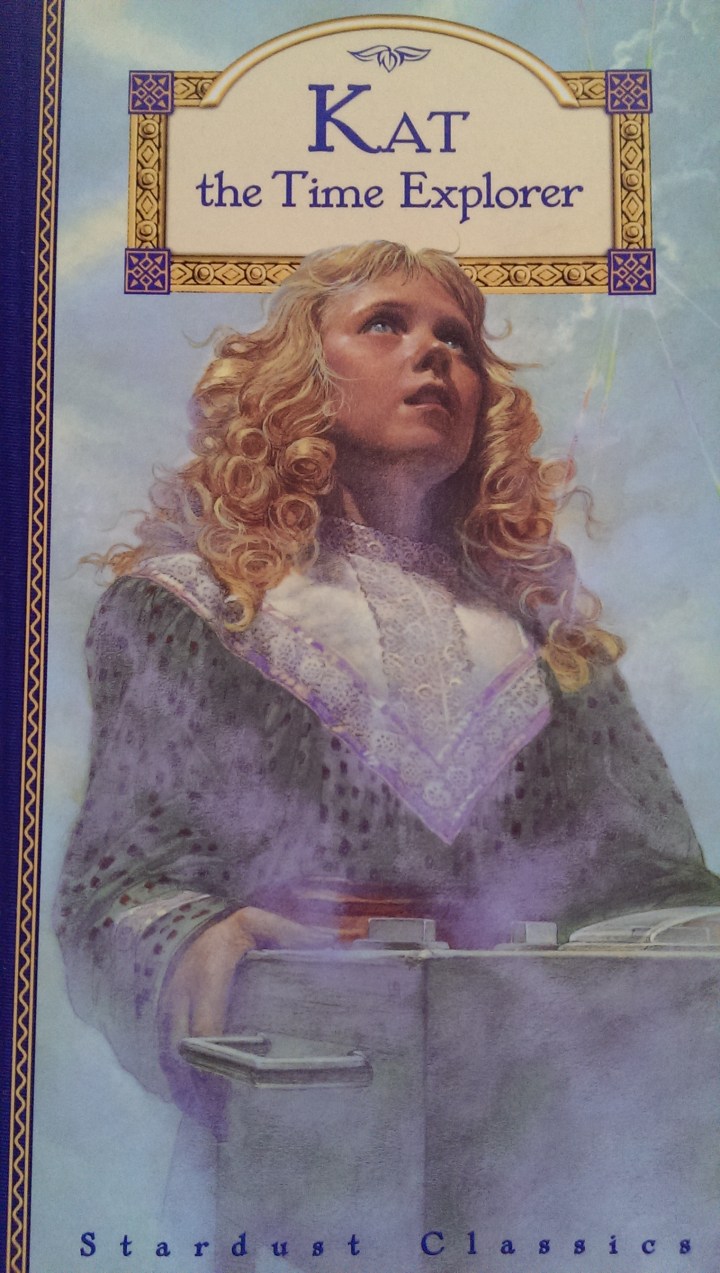
Kat the Time Explorer by Emma Bradford, 1998.
 Ten-year-old Kat is going to be living with her Aunt Jessie for the next year. Her parents are botanists, and they are spending a year in South America, studying rain forest plants. Aunt Jessie lives in a house in the same town as Kat and her parents so, by staying with her, Kat can continue going to the same school and see her friends.
Like Kat’s parents, Aunt Jessie is also a scientist and teaches physics at the same college where her parents teach when they’re not doing research abroad. She inherited her house from their Great-Uncle Malcolm, who was an inventor. Malcolm never invented anything that made much money or got much attention, but Jessie has been going through his things and discovered something interesting among his unfinished projects: a time machine. The time machine seems to be nearly complete, although Jessie isn’t quite sure how to operate it or what should power it. There is a drawing of a strange medallion in Malcolm’s notes, and Jessie found one with the same markings among Malcolm’s belongings, but it’s unclear whether this medallion is supposed to play any role in the time machine’s function or if it’s completely unrelated.
Then, Kat discovers another medallion in Malcolm’s old room, one with identical markings but made out of a different type of metal. There is a space on the time machine for each of the medallions to fit. When Kat experiments with how the medallions can fit into the machine, she activates it, transporting herself and Jessie back in time to England in 1851.
They find themselves on a train with other travelers heading to The Great Exhibition in London where people from around the world will be displaying new developments in industry and technology. No one notices Jessie and Kat’s sudden arrival because the train is packed with people and the time machine has somehow altered their clothing and other small objects in their possession to ones that are appropriate to the period. They also seem to be able to understand people speaking other languages neither of them knew before. The time machine itself is packed into an ordinary-looking bag. The two of them decide that they can’t use the time machine on the train where everyone will see them, and besides, they are both curious about the time they find themselves in. After a temporary mix-up where they are separated at the train station, they find each other again and manage to locate a woman who will rent a room to them for a couple of days.
Unfortunately, when they start unpacking in their room, they discover that their bag was accidentally switched at the station for an identical one. They no longer have the time machine and can’t get home! Inside the bag they have, they find articles of men’s clothing, a small spring of some kind, an incomplete sketch of some kind of invention, a ticket to the Exhibition, and a letter written to someone named Edward from his brother Sidney about the Exhibition and the invention they plan to demonstrate there. The brothers are very concerned about the success of their demonstration and are depending on results to make some money and save their family’s estate. With those clues, Jessie and Kat must track down these inventors and find their time machine, saving not only themselves from being stuck in the past but the future of the two brothers!
There is an educational section in the back that explains about the Victorian Era and the Great Exposition. It also discusses Victorian manners and tea parties. There are tips for making little sandwiches of the kind people would eat at tea parties.
This book is part of the Stardust Classics series.


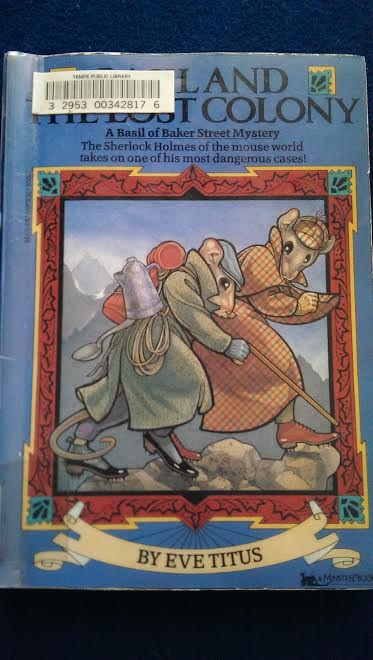 Basil and the Lost Colony by Eve Titus, 1964.


 The Gentleman Spy — This is the story of Captain John Andre and General Benedict Arnold during the American Revolution. John Andre was a British officer who was executed for his role in helping Benedict Arnold defect to the British side.
 The Phantom of the Desert — Lawrence of Arabia was actually Thomas Edward Lawrence, a British army Captain. He helped the Arabs to fight against the Turks during WWI.
 Mystery on Taboga Island by Patricia Maloney Markun, 1995.
 They also introduce Amy to Madame Odelle, who people call The Bird Woman because of all the birds she keeps around her house. She is a widow who lives alone and hardly ever sees people, but she invites the children in and when she learns that Amy is interested in art, she shows them a special painting that her family has had for generations. Madame says that her grandfather bought the painting years ago from a traveling Frenchman who was in need of money. Amy thinks that it looks like one of Paul Gauguin’s paintings, and she knows that some of his work is unaccounted for. However, the initials on the painting are PGO. What could the ‘O’ stand for?
 In the Kaiser’s Clutch by Kathleen Karr, 1995.
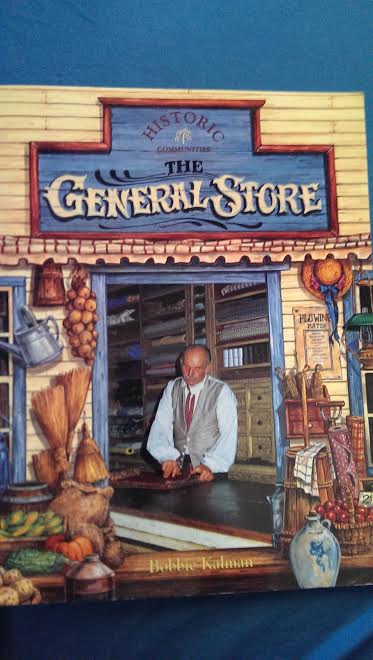 The General Store by Bobbie Kalman, 1997.
 Store owners also had to decide how much they should charge for each item or how much they would be willing to take in trade. Farmers often bartered for goods with the produce from their farms, and it was common for store owners to use a form of credit to keep track of what their customers owed and what they owed to their customers. Farmers would typically sell their goods at harvest time, and the store owners would give them a certain amount of credit at their store, based on what they thought the farmers’ produce was worth. Then, the farmers could use the credit on their account at the store until the next harvest and selling time. If a farmer ran out of credit before the next harvest, the store owner would usually extend credit at the store to the farmer to allow him and his family to buy some necessities, knowing that the farmer could make up for it when he came to sell his next batch of produce.
 Another odd kind of code that the book mentions was the kind that people would use on mailed letters. Instead of the sender paying the postage, as they do now, people receiving letters were supposed to pay for them when they picked them up from the general store. If a receiver returned a letter unopened, they wouldn’t need to pay anything, so some people would try to cheat the system by writing a message in code on the outside of the envelope so the receiver would know the most important part of what the writer wanted to tell them for free.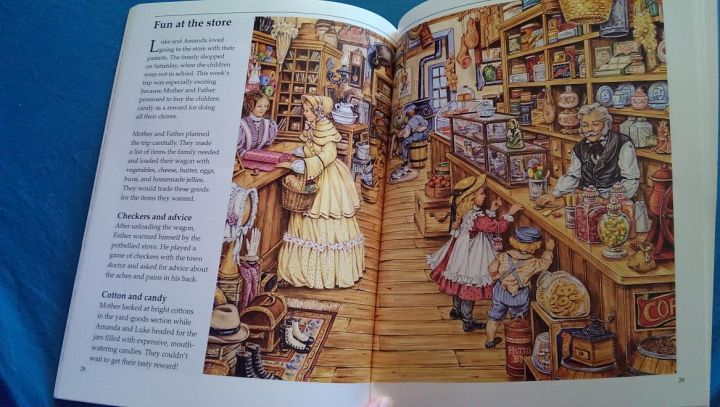
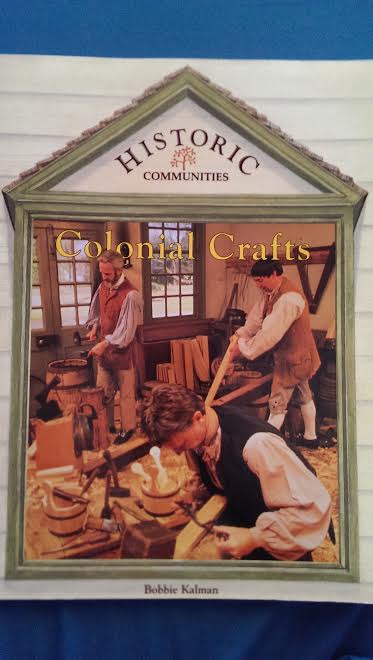 Colonial Crafts by Bobbie Kalman, 1992.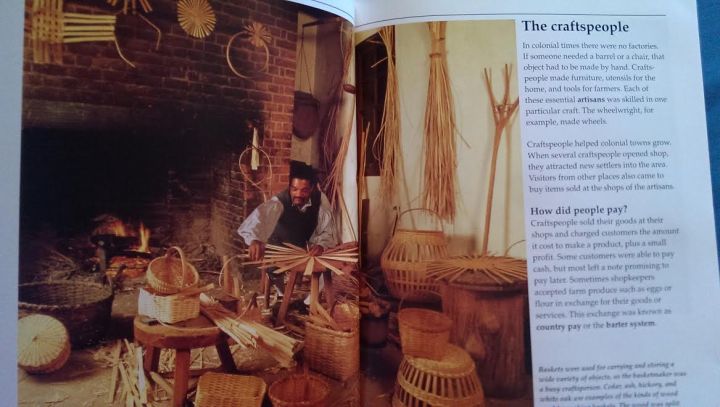


 The Secret of the Strawbridge Place by Helen Pierce Jacob, 1976.
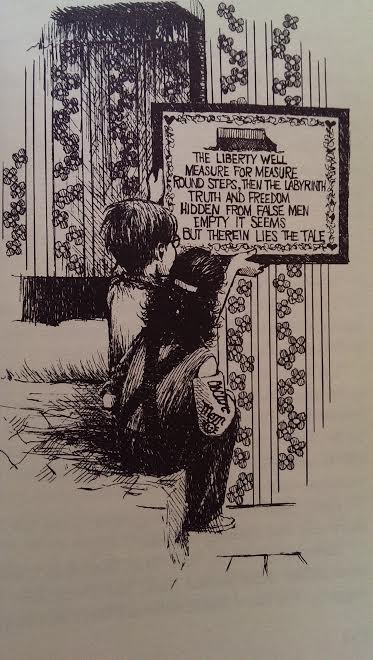 Oscar, a boy visiting his grandfather nearby, becomes Kate’s friend. Since he was also injured in one of Josh’s escapades (having broken his leg when the kids were fooling around in the haymow), she invites him to join her in the search for the secret. They form a partnership called Cripples Incorporated and have fun inventing code words and writing secret messages about what they’ve discovered. Pursuing the secret comes with some risks, and before Kate can discover the whole truth about Strawbridge Place, she has a serious brush with danger.




 Jestress's Forgotten Books and Stories