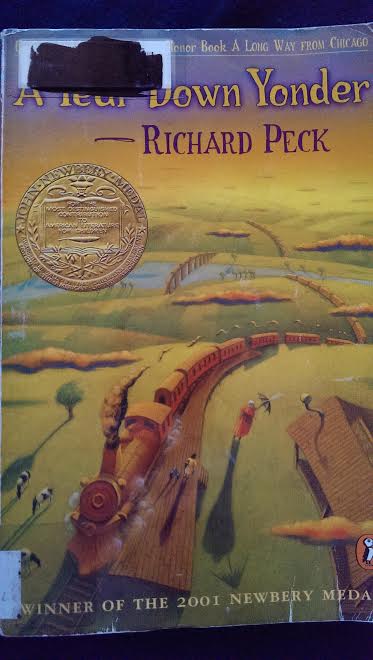
 A Year Down Yonder by Richard Peck, 2000.
This is the sequel to A Long Way from Chicago. The story takes place shortly after the Great Depression, in 1937.
Times are still hard, and a recession has left a lot of people out of work again. Mary Alice’s father is out of work, and her brother Joey is out west working for the Civilian Conservation Corps. Because her family has to move to a smaller apartment, fifteen-year-old Mary Alice leaves Chicago to stay with her Grandma in the country for the year. Times are hard in Grandma’s small town as well, but Mary Alice’s Grandma is as wily and eccentric as ever.
Like the first book, this book is really a series of short stories about Mary Alice’s adventures with her Grandma during their year together. The stories generally have a hilarious turn as Grandma gets the better of everyone, often in the name justice or a good cause. (Although, Grandma’s sense of justice is debatable since it involves “borrowing” pumpkins from the neighbors in the dead of night and other questionable activities.)
These stories present a detailed picture of rural life during the 1930s, from pranks played on Halloween to how Armistice Day was celebrated in the years following World War I, when people were still alive who had strong memories of that war. The stories also capture some of the personalities and politics of life in a small town, from a disreputable family of outcasts to the local elite, who have more money than the others and brag about having ancestors who fought in the Revolutionary War (which may or may not be so).
Rich Chicago Girl: Mary Alice arrives in Grandma’s small town and is enrolled in the local school. She meets the class bully, and Grandma helps her to deal with her.
Vittles and Vengeance: At Halloween, Grandma gets revenge against a group of pranksters and raids her neighbors for ingredients to make the school Halloween party better.
A Minute in the Morning: Armistice Day, November 11, has more meaning for people who have actual memories of The Great War (World War I). Grandma makes sure that those who can afford it pay what they owe to the veterans of that war and shows Mary Alice the price that some soldiers paid for supporting their country.
Away in a Manger: Mary Alice is picked to play Mary in the school’s Christmas Nativity play. The baby Jesus turns out to be a surprise for the whole town, and Grandma arranges a special surprise for Mary Alice.
Hearts and Flour: The head of the local branch of the DAR pushes Grandma to make cherry tarts for their annual tea in honor of George Washington’s birthday. Since she will neither allow Grandma to join the DAR (because Grandma doesn’t have the proper lineage) nor pay Grandma for her work (she thinks Grandma should ‘volunteer’ her services as part of her patriotic duty), Grandma insists that if she bakes, she must host the tea as well . . . with a couple of special surprise guests. Meanwhile, a handsome new boy named Royce joins Mary Alice’s class at school.
A Dangerous Man: An artist working for the WPA rents a room from Grandma, treating Mary Alice and Royce to a scandalous but hilarious sight when his subject matter gets out of hand.
Gone with the Wind: A tornado sweeps through the town, and Grandma and Mary Alice go to check on residents who live alone. Mary Alice also prepares to return home to her parents in Chicago.
Ever After: The final story in the book is about Mary Alice’s wedding, years later, toward the end of World War II.
This book is a Newbery Award winner. There are multiple copies currently available online through Internet Archive.
 #4 Mandie and the Forbidden Attic by Lois Gladys Leppard, 1985.
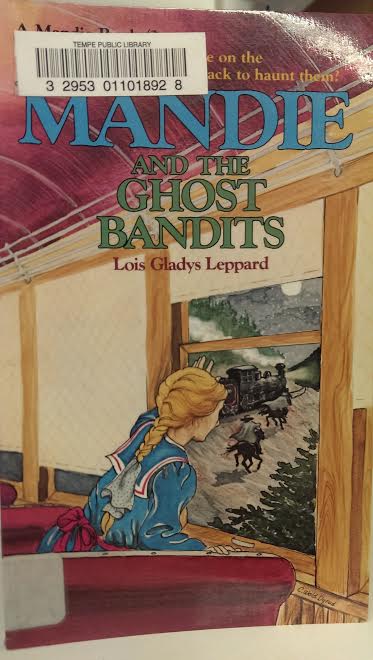 #3 Mandie and the Ghost Bandits by Lois Gladys Leppard, 1984.
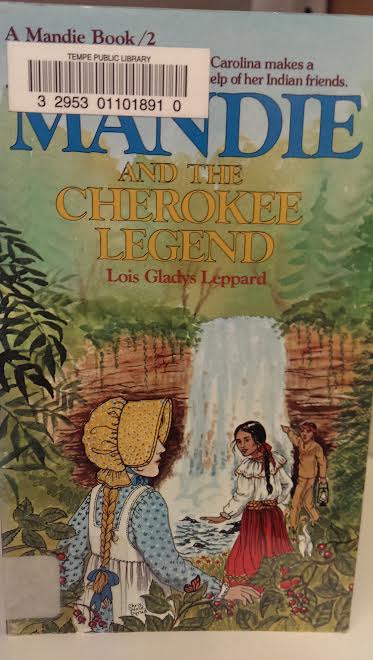 #2 Mandie and the Cherokee Legend by Lois Gladys Leppard, 1983.
 Mystery of the Roman Ransom by Henry Winterfeld, 1971.
 When they return to the slave dealer’s home, he is gone, and the place is boarded up. An elderly slave who was left behind said that all of the other slaves were sold, and then the dealer simply fled, abandoning him. He also says that there was someone else who had come to see the dealer, demanding that he hand over the slave called Udo (the one that the boys had already bought). This man was a former gladiator with only one eye, and he was very angry that Udo was gone. He swore that he would he would get Udo one way or another, dead or alive. He threatened the dealer, saying that he would return later and kill the dealer and all of his slaves if Udo was not among them then. The slave dealer, not knowing the names of the boys who had bought Udo or where he could be found and therefore unable to get Udo back, fled in fear of the former gladiator’s threats.
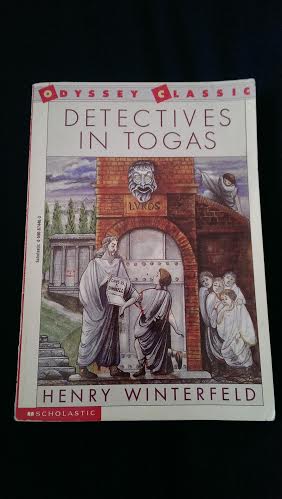 Detectives in Togas by Henry Winterfeld, 1956.
 The next day, when the other boys arrive at school, they discover that their teacher has been attacked and robbed during the night. Worse still, when they go to Rufus’s house to visit him, they learn that someone has written “Caius is a dumbbell” on the side of the Temple of Minerva, which has been dedicated to the emperor. Defacing a temple is a crime, and soon Rufus is arrested and sent to prison (being young and part of an important family does not guarantee him special treatment). Rufus swears that he was not the one who defaced the temple, but who else could have done it?
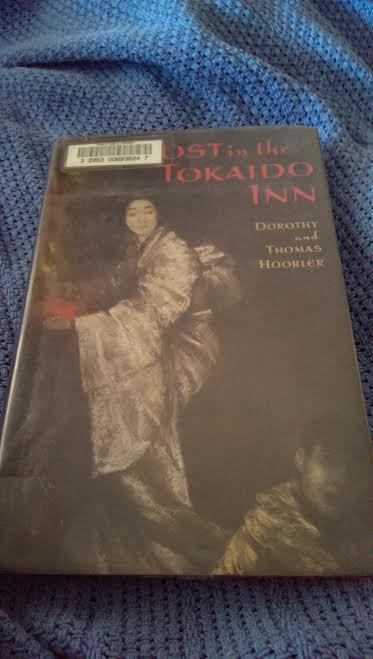 The Ghost in the Tokaido Inn by Dorothy and Thomas Hoobler, 1999.
 Journey to America by Sonia Levitin, 1970.
 But, getting on the train out of Germany is only the first step of their long journey. Lisa and her mother and sisters live as refugees in Switzerland, waiting for her father to help arrange for their passage to America. Often, they have too little to eat because they don’t have much money. There are some people who help them, and they make some new friends, but the long wait is difficult. Meanwhile, they must face the frightening events taking shape around them, around the people they left behind, and their own uncertain future.
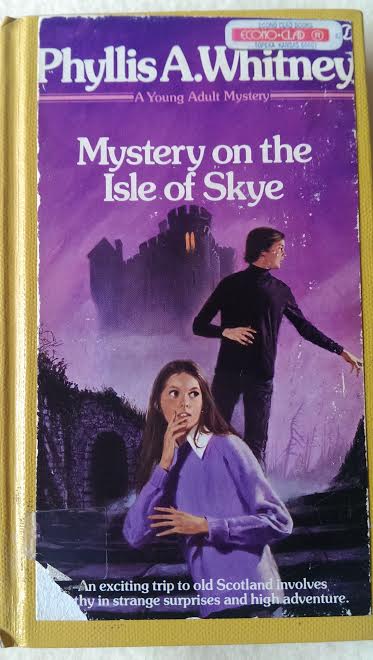 Mystery on the Isle of Skye by Phyllis Whitney, 1960.
 Ghosts in the Gallery by Barbara Brooks Wallace, 2000.
 Jestress's Forgotten Books and Stories