The Colonial Cookbook

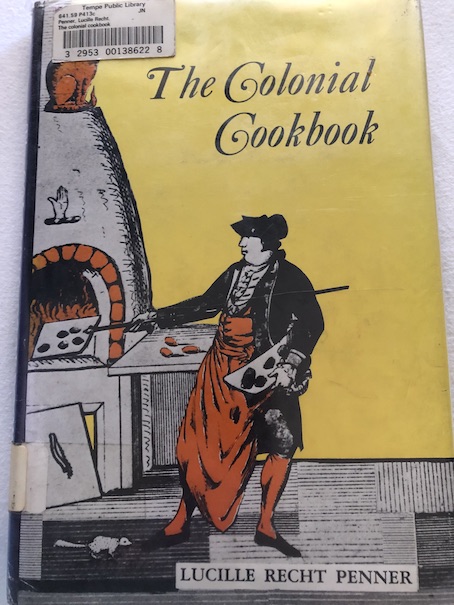
The Colonial Cookbook by Lucille Recht Penner, 1976.

This cookbook explains the history of food, cooking, and dining habits in Colonial America and provides recipes that readers can make themselves.

The first part of the book provides most of the historical background, although each section of recipes also has some additional information. The earliest European colonists in North America had to struggle to feed themselves. In many ways, they were unprepared for their lives as colonists, and not all of them had planned to stay as long as they did. The ones who hadn’t planned to stay long had heard stories about gold and silver in the New World, and they had hoped to stay only long enough to seek their fortunes and return home rich. The realities of life in North America did not meet their expectations and survival turned out to be harder than they thought.
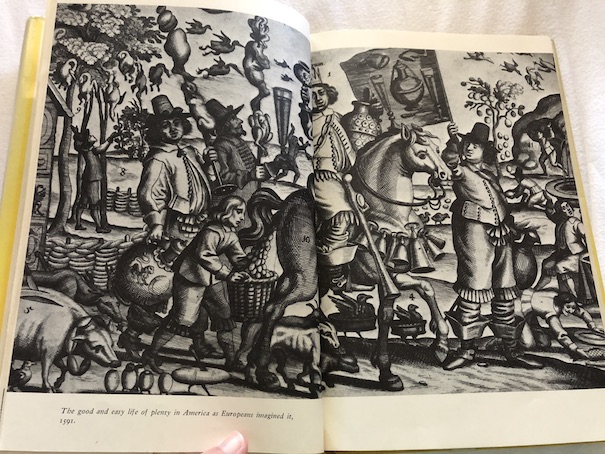
The colonists ended up relying on Native Americans (called “Indians” in this book) to help them survive. As they used up the stores of salted beef and hard biscuits that they had brought with them, they began trading for food with the Native American tribes. From the Native Americans, they also learned farming, finishing, hunting, and foraging techniques that they used to help themselves survive. There were many edible plants and animals at hand, but the early colonists were unaccustomed to which plants in the Americas were edible and how to find them and where to find and trap animals. One of the chores colonial children were given was to gather wild plants for the family to eat, like nuts, mushrooms, dandelion greens, wild leeks and onions, and wild fruit, like plums, cherries, melons, and berries.

Gradually, as the colonies grew, the colonists established farms and farm fields. They needed more land for farming to support their population than modern farms would use to support the same number of people because farming has become more efficient since the colonial era. Later, new colonists came and brought livestock with them. Men and boys usually took responsibility for the livestock on family farms. After animals were butchered, the women and girls would clean and prepare them for eating. Food required much more work to prepare because the colonists had to do all the preparation themselves. Families would not only butcher their own animals but make their own cheese. The book provided details about the processes and tools that colonists used for making their food.

The more specific eating habits of colonists changed over time and varied depending on where the colonists lived in North America and where they had originally come from. For early colonists, meals were eaten off of trenchers made from pieces of stale bread, and the day began with a breakfast of mush or pudding with cider or beer to drink. Later, foods became more varied. People in New England often ate fruit pies for breakfast, and people in the Middle Colonies liked scrapple (a cornmeal mush with pork scraps) and oly koeks (a kind of holeless donut containing bits of fruit). (Neither scrapple nor oly koeks appear as recipes in this book, but there are recipes online.) Southern plantation owners had elaborate breakfasts with many different kinds of food, including ham, eggs, pastries, and more, but poor people typically had mush and scraps of leftovers.

The book provides a variety of recipes, organized by type. Most of the recipes in the book do not look too difficult, although some call for more unusual ingredients, like rosewater. You can still find it, although I’ve usually seen it at specialty cooking stores or import stores. The categories are soups, meat, poultry, seafood, vegetables, puddings, breads, sweets, drinks, and sauces and relishes. Not all of the recipes look like things that would interest modern children. I don’t imagine that many children would be excited at the idea of making Scalloped Oysters, for example. (Seafood was an important food source for early colonists.) Even though children might recognize Pease Porridge from the rhyme, I’m not sure that a thick pea soup would be something that they would be excited to eat, either. Hasty pudding is mentioned in the song Yankee Doodle, but the recipe itself is a little bland. The book does mention that you can flavor it with maple syrup, and there are other cornbread pudding recipes that contain spices and sweeteners in the book.
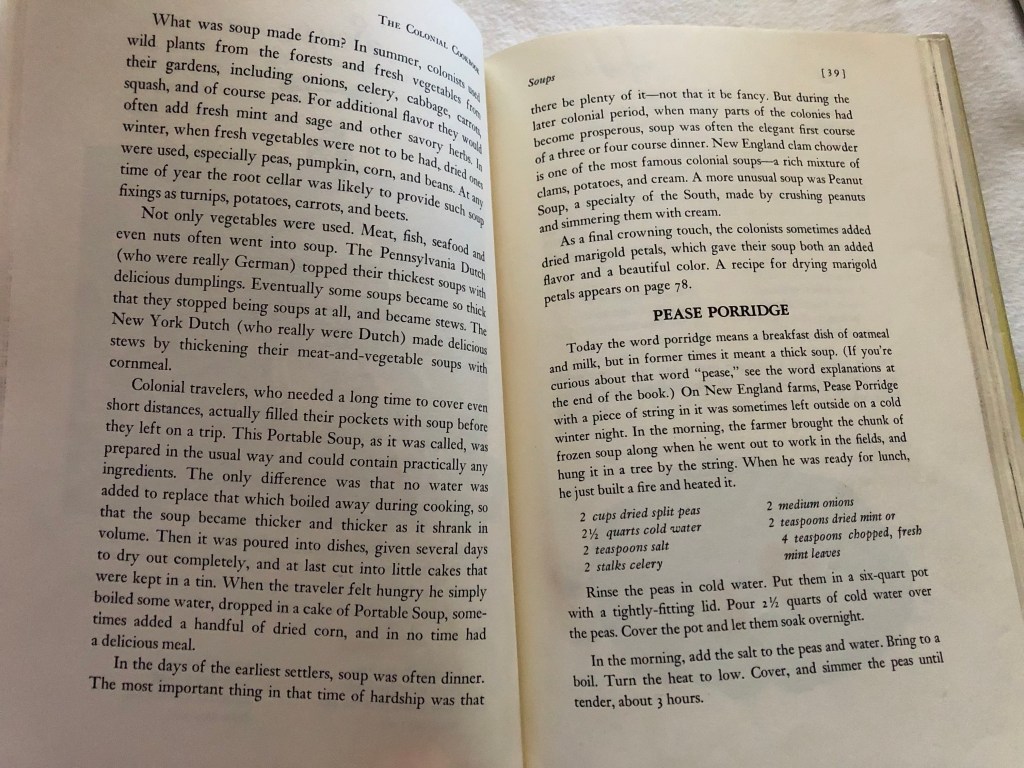
However, there are some recipes that I think would be interesting to try. The book explains that pumpkins were a staple food for the early colonists, as shown by the old rhyme from the Plymouth:

We have pumpkin at morning
And pumpkin at noon
If it was not for pumpkin
We would be undoon.

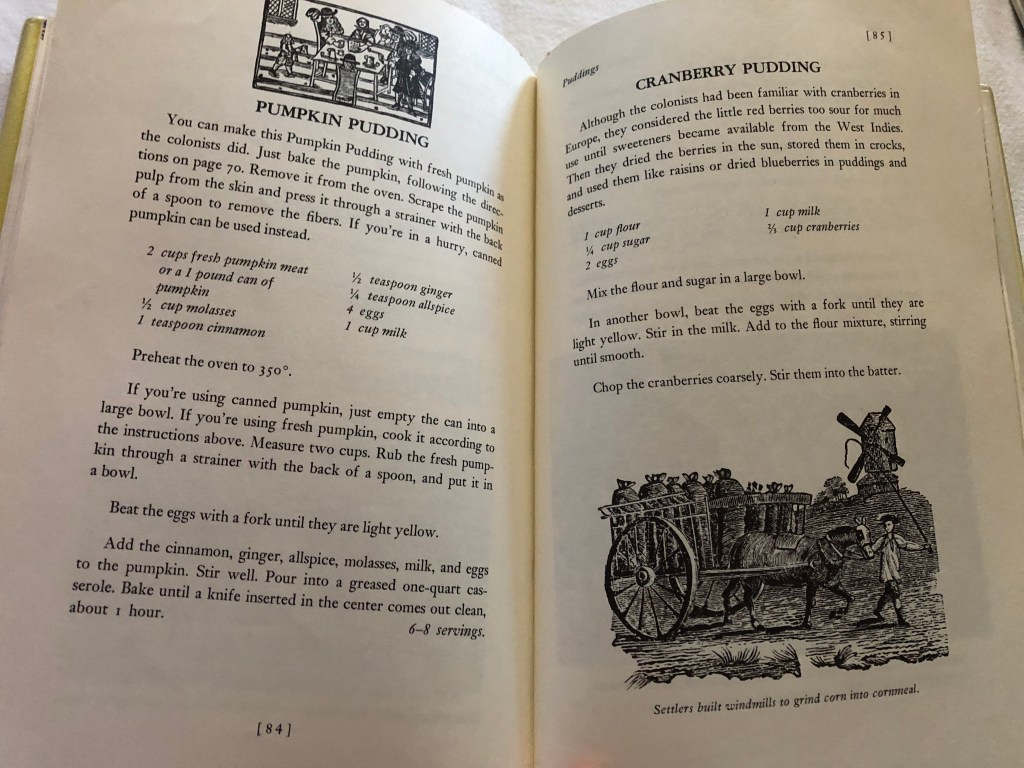
The book explains the different ways that colonists would prepare pumpkin. You can bake it and eat it in pieces with syrup, molasses, honey, or cream. The book explains how to cook it, and it also provides a recipe for Pumpkin Pudding, which can be made with either fresh pumpkin or canned pumpkin. I haven’t made it yet myself, but from the recipe, it reminds me of a pumpkin pie without the crust:
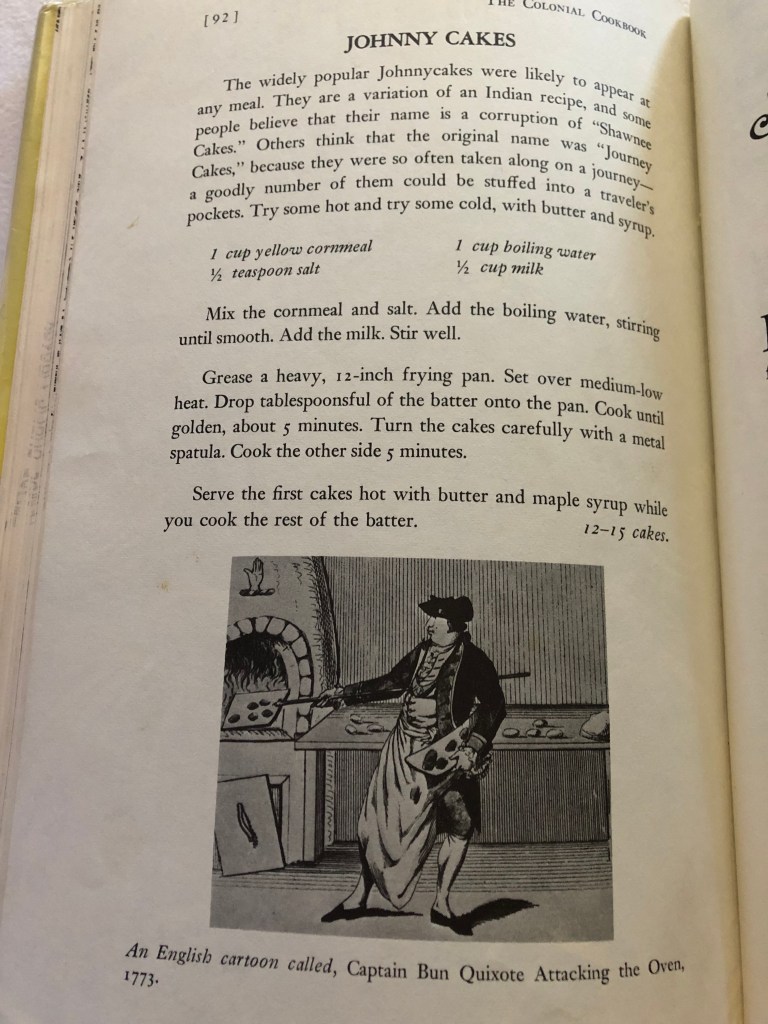
Johnny Cakes are a little like pancakes but made with cornmeal. The basic recipe is a little plain, but they can be served with butter and maple syrup.
This book was published in 1976, which was the United States’ Bicentennial celebration. Unfortunately, I haven’t been able to find an online edition yet.
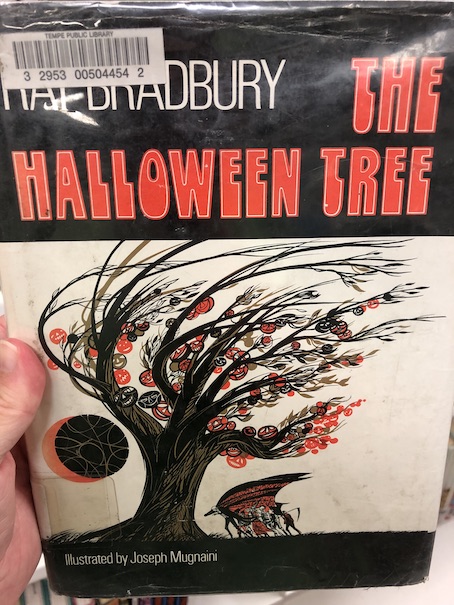
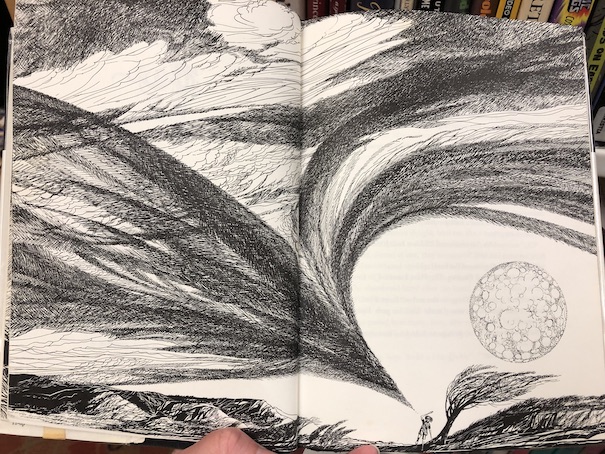
The Halloween Tree

The Halloween Tree by Ray Bradbury, 1972.

A group of neighborhood boys want to go trick-or-treating on Halloween night, but they’re upset because it looks like a friend of their, Joe Pipkin, won’t be coming with them.  When they get to Pipkin’s house, he seems ill and is clutching his side.  His friends worry that he’s sick, but he valiantly reassures them that he’ll be fine.  He sends them on, telling them that he’ll catch up with them and that his costume will be great.  Specifically, he tells them to “head for the House” which is “the place of the Haunts.”
The house that Pipkin is talking about is the creepiest house in town.  It’s large, so large that it’s hard to tell how many rooms it has.  The boys knock on the creepy-looking door knocker on the front door, and a man answers the door.  When the boys say, “trick or treat,” the man says, “No treats.  Only—trick!”  Then, he slams the door without giving them anything.

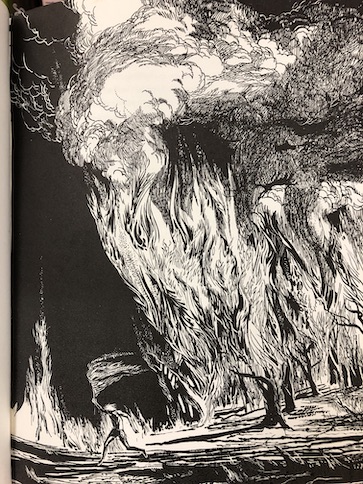
Not knowing what else to do, the boys walk around the side of the house and see a large tree, filled with jack o’lanterns.  This is the Halloween Tree.  The strange man they saw before rises up from a pile of leaves and scares the boys, giving them the “trick” that he promised them earlier.  He finally introduces himself as Carapace Clavicle Moundshroud.  He begins talking to them about the history of Halloween and asks them if they understand the real meanings behind the costumes they have chosen.  The boys admit that they really don’t know the meanings behind their costumes, and Moundshroud points off into the distance, calling it, “The Undiscovered Country.”  He says that out there likes the past and the history of Halloween and that the boys will learn the answers if they’re willing to go there.  The boys are interested, but they say that they can’t go anywhere without Pipkin, who promised that he would come.

Pipkin suddenly appears in the distance, by a dark ravine, holding a lit pumpkin.  He says that he doesn’t feel well, but he knew that he had to come.  Pipkin trips and falls, and the light in his pumpkin goes out.  From a distance, the others hear him calling for help.  Moundshroud says that something bad has happened.  Pipkin has been taken away to The Undiscovered Country by Death.  Moundshroud says that Pipkin may not be taken permanently but perhaps held for ransom and that, if they follow Pipkin to The Undiscovered Country, they might be able to get his soul back and save his life.

Moundshroud has the boys build a kite that somewhat resembles a pterodactyl, and they use it to travel into the far distant past.  The first place they arrive is Ancient Egypt, where the boys learn about mummies and how the Ancient Egyptians viewed the dead.  They see Pipkin as a mummy, being laid to rest in a sarcophagus, surrounded by hieroglyphs, telling the story of his life.  (Or, as Moundshroud says, “Or whoever Pipkin was this time around, this year, four thousand years ago,” hinting that Pipkin has been reincarnated before and what they are seeing during their journey are his past lives and deaths.)  Pipkin calls out to his friends for help.  Moundshroud tells the boys that they can’t save Pipkin now, but they’ll have a chance later.

They continue their journey through time and around the world, seeing glimpses of Halloweens past in Ancient Rome and the British Isles, where they learn about druids, Samhain, and witches.  Moundshroud describes how the Romans supplanted druidic practices with their own polytheistic religion until that was eventually replaced by Christianity.  All along, they can still hear Pipkin calling to them, and he seems to be carried off by a witch.  As they pursue him, Moundshroud teaches them the difference between fictional witches and real-life witches, which he characterizes as being more like wise women, who don’t really do magic.

From there, they go to Notre Dame to learn about gargoyles.  They continue to see Pipkin in different forms, even as a gargoyle on the cathedral.  Pipkin tells them that he’s not dead, but that he knows that part of him is in a hospital back home.

In Mexico, the boys experience Dia de los Muertos and learn about skeletons and a different kind of mummy from the ones they saw in Egypt.  They find Pipkin, held prisoner in the catacombs by the mummies, and Moundshroud tells the boys that the only way to save him is to make a bargain, both with him and with the dead: each boy must give one year from the end of their lives so that Pipkin may live.  It is a serious decision, for as Moundshroud says, they won’t miss that year now, being only about 11 or 12 years old, but none of them knows how long they will actually live.  Some of them who were destined to die at 55 would now only make it to 54, and as they reach the end of their lives, the year will seem that much more important to them.  Even those who live longer will still want every day they can possibly have.  However, each decides that he is willing to make the sacrifice because, without that sacrifice, Pipkin has no chance, and they can’t just let him die.

They make the bargain and are soon returned home.  When they go to Pipkin’s house to check on him, they are told that Pip is in the hospital because he had his appendix taken out, just in time to save his life.  At the end of the story, Tom (who is the leader of the boys through most of the story), wonders silently who Moundshroud really was, and he hears in his mind, “I think you know, boy, I think you know.”  Tom asks him if they will meet again, and Moundshroud says that he will come for Tom many years from now, confirming that Moundshroud was Death all along, which was why they had to make the bargain with him.

I saw the animated movie version of this story long before I read the book, and it really gave me the creeps!  Moundshroud is creepy because he is kind of two-faced.  On the one hand, he seems somewhat helpful in helping the boys to find Pipkin and teaching them about the history of Halloween, but on the other, he does not admit to the children that he is Death until the very end, that he is the very thing that they need to save Pipkin from, and that they can only do it by offering a sacrifice of years from their own lives. Although it does occur to me that Moundshroud may not be quite as two-faced as he seems because Pip’s illness and potential death may not have been planned by him but simply the fated situation for Pip, and Moundshroud might have just taken it upon himself to provide a way for Pip’s friends to save him in the least painful way. By not telling them that a sacrifice of part of their lives would be necessary until the very end, after they had come to a better understanding of life and death in the history of Halloween, he may have made the choice easier for them to make. Also, he never says exactly how much time they bought for Pip with their sacrifice. The implication is that Pip is now free from his early appointed death date and will now live a full life, similar to what his friends will have. The exchange does not seem to be an even one, a year for a year, with the children needing to decide how many years they will donate to Pip. Although the kids still don’t know at the end how many years each of them will live, it seems that none of the rest of them is in danger of dying in childhood, and they will all live for many more years.

I wouldn’t recommend this book for young children (it still gives me the creeps, and I’m in my 30s), but it is interesting how they take a journey through the origins of Halloween. The book and the movie were somewhat different, partly because there were more kids in the group in the book and partly because the group of kids in the movie also had a girl in a witch costume. In the book, the kid in the witch costume was also a boy.

Both the book and the animated movie are available online through Internet Archive.

Samantha Saves the Day

American Girls

Samantha Saves the Day by Valerie Tripp, 1988.

This is part of the Samantha, An American Girl series.

Samantha and her family are spending the summer at their summer home at Piney Point. Besides Grandmary, Uncle Gard and Aunt Cornelia will be there. Cornelia has also brought her younger sisters, a set of twins named Agnes and Agatha. They are close in age to Samantha. Grandmary’s friend, Admiral Archibald Beemis, is also visiting from England.

The family’s summer home isn’t just a single house. They have a lodge in the style of a log cabin and separate guest cottages. This summer, Samantha and the twins will get a cottage to themselves with no adults. The girls have fun exploring the area around the lake together. However, there is one place that Samantha is afraid to go, the island in the lake called Teardrop Island. The only way to get to the island is by boat, and there are sharp, treacherous rocks in that part of the lake. That was where Samantha’s parents had their boating accident and drowned during a storm. To Samantha, Teardrop Island is a place of sadness and danger.

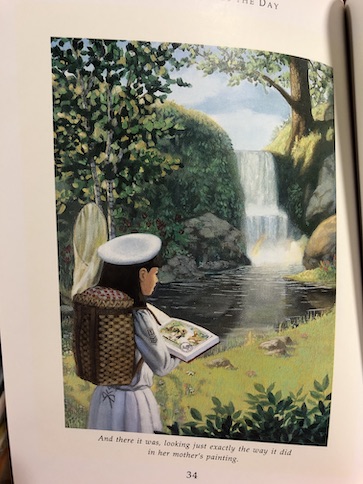
One rainy day, the three girls go up to the attic of the lodge to look for more paintbrushes so they can paint pictures. In the attic, they find old clothes and pictures of Samantha’s family. They also find Samantha’s mother’s old sketch book, labeled “Happy Memories of Teardrop Island.” In the sketch book, she drew pictures of Samantha and her father as they had picnics and played by a waterfall. Samantha was a very young child at the time, and she has no memories of having been on the island with her parents. From the pictures, it looks like it used to be her family’s favorite place.

Seeing the pictures makes Samantha want to visit the island once more, hoping to bring back memories of her earlier visits and her parents. The next day, the three girls go out to the island and try to find the places that Samantha’s mother drew in her book. Teardrop Island turns out to be a beautiful place, and Samantha loves it. The more time she spends there, the more she feels like she has been there before, although her memories are vague and dream-like.

However, the girls forgot to tie up their boat, and they find themselves stranded on the island! A storm comes, and the girls are afraid. When the Admiral tries to come out to the island to help them, he is injured, and the girls realize that they are going to have to find a way to save him! Can they make it home through the storm, or will they meet the same fate as Samantha’s parents?

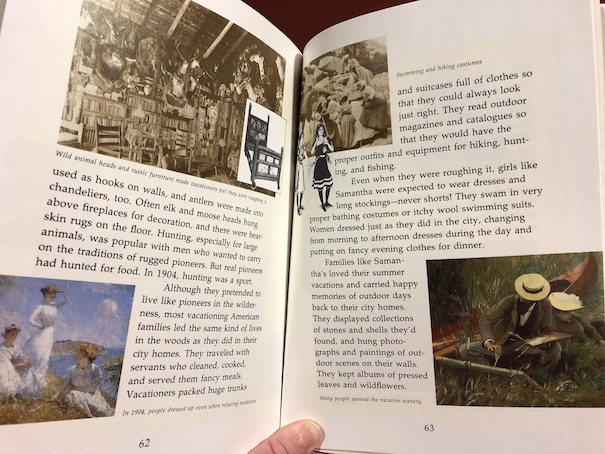
In the back of the book, there is a section with historical information about how people would spend their summers during the early 1900s. Wealthy families like Samantha’s would go to summer homes in the countryside to escape the heat of the cities.

The book is currently available to borrow for free online through Internet Archive.

Samantha Learns a Lesson

American Girls

Samantha Learns a Lesson by Susan S. Adler, 1986.

This is part of the Samantha, An American Girl series.

Samantha attends Miss Crampton’s Academy for Girls in Mount Bedford. She is doing well and has some friends at school, but she misses her friend Nellie. She knows how poor Nellie’s family is and worries about how they are doing.

One day, Samantha comes home from school to a surprise: Nellie has returned to town with her family. Samantha’s grandmother recommended Nellie’s family to a friend, Mrs. Van Sicklen, who has hired Nellie’s father as a driver and Nellie’s mother as a maid. Nellie and her sisters will also be helping with household chores. They will also get the chance to go to school, although they will be attending public school and not the private school that Samantha attends.

When they begin attending school, Nellie’s younger sisters do fine in the first grade, where they are expected to be beginners, but Nellie herself has trouble in the second grade. Nellie is a little old for second grade, so the other children make fun of her for being there, and she is so nervous that she makes embarrassing mistakes in front of her teacher and the other students. Nellie thinks that perhaps she’s too old to start going to school, but Samantha realizes that what she needs is a little extra help.

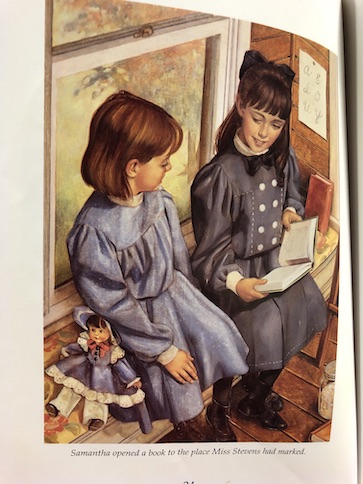
Samantha talks to her own teacher and explains the situation. She says that she would like to help teach Nellie what she needs to know, but she is not sure what Nellie needs to know in order to pass the second grade. Samantha’s teacher, Miss Stevens, thinks that it is nice that Samantha wants to help Nellie and gives her a set of second grade readers to study with pages marked for assignments. Samantha tells her grandmother what she is planning to do, and she says that it is fine, as long as the extra tutoring doesn’t interfere with Nellie’s house work too much.

Nellie accepts Samantha’s help at their secret, private “school” that Samantha calls “Mount Better School.” During their lessons, Samantha discovers that Nellie is very good at math because she used to have to help her mother with shopping and had to keep track of her money. Nellie cannot always come for lessons because of her work, but Samantha’s tutoring helps her to improve.

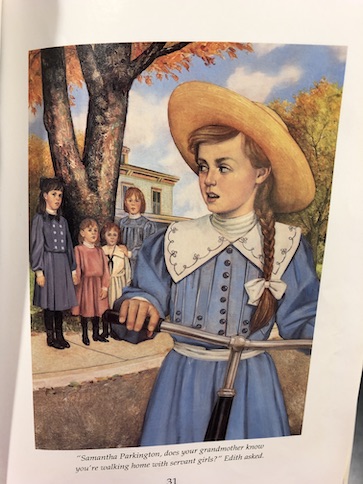
One day, when Samantha is walking home from school with Nellie and her sisters, a mean girl from Samantha’s school, Edith, sees them and criticizes Samantha for spending time with servants. She says that her mother would never allow her to play with servants. Samantha asks her grandmother what Edith means, and her grandmother says that Edith is a young lady. When Samantha asks why she is allowed to play with Nellie, her grandmother says that they are not really playing, that Samantha is helping Nellie, which makes it different. That explanation doesn’t entirely satisfy Samantha.

However, her grandmother is both understanding of the help that Samantha has been giving to Nellie and serious about the need to help others. When Edith’s mother and other ladies of the neighborhood come to visit and complain about Nellie’s family and how Samantha is spending time with them, Samantha’s grandmother defends them and says that Samantha is doing good.

Meanwhile, Samantha’s school is preparing for a public speaking contest with the theme “Progress in America.” To prepare for her speech, Samantha asks her grandmother, her Uncle Gard, and other people what they think about progress and what the best inventions are. They mention inventions like the telephone, electric lights, automobiles, and factories. Samantha is fascinated by the idea of factories and the variety of products that they can make. However, when Samantha reads her speech to Nellie, Nellie is not nearly so enthusiastic about factories as a sign of progress. Nellie used to work in a factory herself, and she knows that they are not pleasant places. She tells Samantha how factories are noisy and how dangerous the machines are for the workers. The factory workers are also very poorly paid, which is why the products they make are so cheap.

Nellie’s stories about factories bother Samantha. When it is time for the public speaking contest, Samantha delivers a changed version of her speech in which she discusses the dangers of child labor and how some form of progress, particularly ones that endanger children, are not good forms of progress. Samantha’s thoughtful speech wins the contest, and her grandmother understands that Samantha has been learning things from Nellie even while teaching her.

In the back of the book, there is a section with historical information about education and child labor during the early 1900s.

The book is currently available to borrow for free online through Internet Archive.

Meet Samantha

American Girls

Meet Samantha by Susan S. Adler, 1986.

This is the first book in the Samantha, An American Girl series.

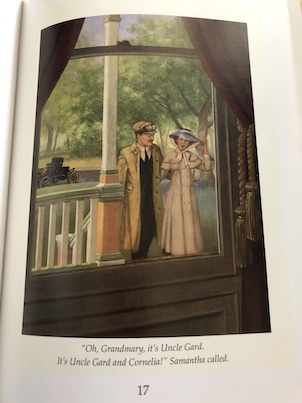
Samantha Parkington is a nine-year-old orphan. She belongs to a wealthy family and lives with her grandmother, called Grandmary, in the Hudson Valley in New York. Grandmary is often strict with Samantha, trying to teach her to be a proper young lady, but Samantha finds it difficult. Samantha’s grandmother loves her, but she has very old-fashioned ideas about how girls should behave. When Samantha wants to try making and selling boomerangs in order to earn money to buy a doll, using instructions from The Boys’ Handy Book, her grandmother stops her, saying that young ladies do not earn money. She would rather that Samantha earn the doll as a reward for doing what she is told and practicing her piano lessons. Samantha also has an uncle, Uncle Gard, who has a girlfriend named Cornelia. Cornelia is a more modern woman, who would see nothing wrong with Samantha wanting to earn some money.

One of her grandmother’s servants, a black woman named Jessie, is kind and motherly to Samantha. Jessie often patches Samantha up after her various escapades and mishaps. Jessie’s husband, Lincoln, is a train porter, and Jessie tells Samantha exciting stories about the places that Lincoln has seen in his work, like New Orleans. Sometimes, Lincoln brings Samantha post cards from these places.

Samantha soon learns that a new girl her age is coming to a neighbor’s house. She has been wanting a playmate, so she goes over to the neighbor’s house to introduce herself. The new girl’s name is Nellie, but she has come to be a servant for the neighbors, the Rylands. Nellie’s family is poor, so Nellie needs to work as a maid help her parents earn money and support her younger sisters. Samantha is surprised when Nellie describes her family’s circumstances in New York City. Samantha has never been poor, and she doesn’t know what it’s like to be cold and hungry. Nellie says that the air in the countryside is better for her, and she gets better food working for the Rylands. Nellie tells Samantha that she has never been to school, and Samantha offers to teach her.

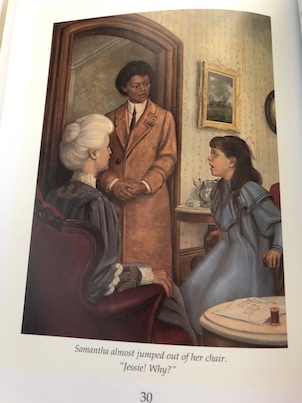
Then, Jessie suddenly announces that she is leaving her job at Grandmary’s house. Grandmary doesn’t seem surprised, but Samantha is. Jessie offers no explanation for leaving, and when Samantha tries to ask, Grandmary and the other servants do not want to talk about it. Samantha tells Nellie about Jessie leaving, coming up with fanciful reasons why she might leave her job, but Nellie offers the practical explanation that Jessie might be having a baby. Nellie knows more about it than Samantha because she has younger sisters, but she acknowledges that adults of this time period do not like to talk about people having babies, particularly in front of children. Neither Nellie nor Samantha entirely knows why.

However, Samantha is still concerned about Jessie. Samantha doesn’t know where Jessie lives, but Nellie does. The two girls sneak out one evening to visit Jessie and learn for themselves what the matter is. This is the first time that Samantha has been to the part of her town where black people live, further opening her eyes to the lives of people from lower classes of society. Nellie is a little surprised at how Samantha, who is more educated, sometimes knows so little about the ways that other people live.

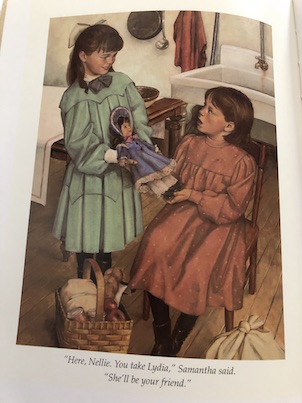
It turns out that Jessie does have a new baby. Jessie reassures Samantha that she and the baby are fine, but since her husband needs to travel because of his job as a train porter, she needs to stay at home with her baby now. Samantha thinks of a way to help Jessie keep her job and care for her baby at the same time, persuading her grandmother to let Jessie come back. Unfortunately, Nellie soon has to leave because Mrs. Ryland doesn’t think that she’s strong enough to work as a maid and decides to send her back to her family in New York City. Samantha gives Nellie her new doll as a going-away present, and she is very concerned about how Nellie and her family will manage.

In the back of the book, there is a section with historical information about how wealthy people and their servants lived during the early 1900s.

Something that occurred to me later is that Jessie is about the right age to be Addy‘s daughter, from another American Girls series. I don’t think that there’s a real connection between Jessie and Addy because the Samantha books were written before the Addy series. However, when I stopped to think about their relative ages (Addy would be about 49 years old in 1904, and Jessie is probably in her 20s), it occurred to me that if Addy had a daughter, she would probably be an adult at this time, and she might be doing something very similar to what Jessie is doing, working as a seamstress.

The book is currently available to borrow for free online through Internet Archive.

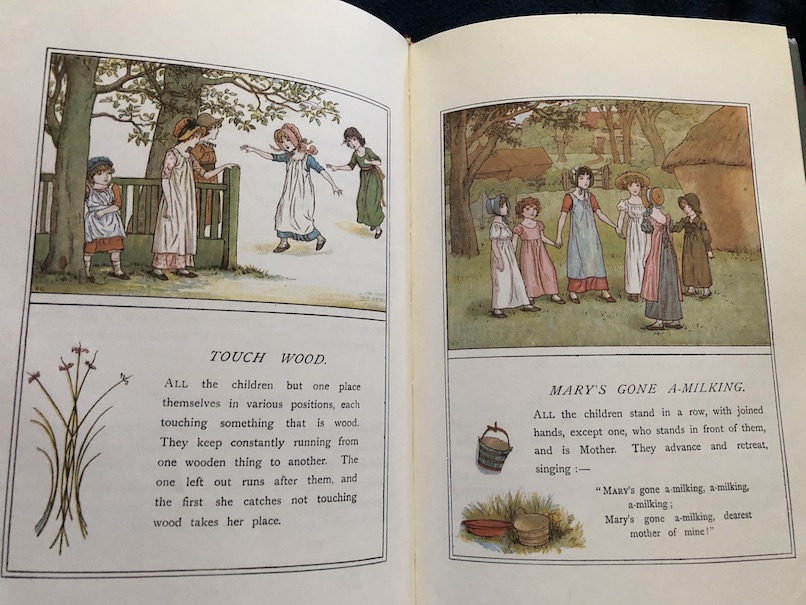
Kate Greenaway’s Book of Games

Kate Greenaway’s Book of Games by Kate Greenaway, 1889.

A book about children’s games with rules and general pastimes. The book doesn’t distinguish between the two, but I do because, to me, games have specific rules whereas more general pastimes and toys do not.

Many of the games and pastimes would be familiar to people in modern times and are still popular. Some games are like playground games (some of them are even still played on playgrounds today) that require running and motions, and others are more talking games (some of those have become classic road trip games, played in the car). Pastimes include making soap bubbles, flying kites, and using swings.

The book includes games like I Love my Love with an “A”, Blind Man’s Buff, Frog in the Middle, Russian Scandal (This is an old name for the Game of Telephone, before the invention of the telephone became really popular. I’ve also heard it as Russian Gossip, although I don’t know why it’s specifically “Russian.”), French and English (which is basically Capture the Flag), Oranges and Lemons (which is played like London Bridge is Falling Down, only with a different rhyme), and Twenty Questions. Some of the less familiar ones, especially to young Americans today, might be Puss in the Corner (a game that involves players running and changing places with each other and the person who is left without a place being “it” or the “puss”), Mary’s Gone A-Milking (a chase game with a song), What Is My Thought Like? (a talking/guessing game that involves creativity), and The Old Soldier and Judge and Jury (which are both talking games with words that are forbidden to say).

One of the interesting things about this book, besides noticing which games are still played and which are more obscure now, is that the children in the pictures are actually wearing clothes that are from an earlier part of the 19th century from when the book was written. This is a classic feature of Kate Greenaway’s illustrations, also seen in her other books. Modern people who are less familiar with the evolution of 19th century clothing might not notice that detail.

This book is still in print in modern times. It also available to borrow for free online through Internet Archive (multiple copies).

For more information about Victorian games in general, see the Victorian Games section of my Historical Games site. History and games are both hobbies of mine.

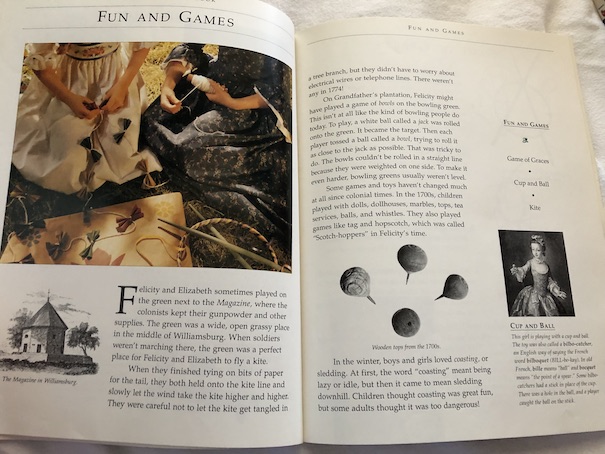
Felicity’s Craft Book

American Girls

Felicity’s Craft Book by Rebecca Sample Bernstein and Jodi Evert, 1994.

This is a companion book to the Felicity, An American Girl series.  It explains about the types of crafts that people would do in Colonial America and gives instructions for projects that readers can make at home.

In the beginning of the book, there is a brief history of crafting in America.  It explains that, in the earliest days of the American colonies, people had to get most of their goods from Europe because they had to spend their time and energy on building homes and establishing farms in order to survive.  However, as the colonies became more established, people were more able to make goods for themselves, both in their own homes and as professional craftspeople.  By the time that Felicity lived, during the late 1700s, there were many skilled craftspeople, and those craftspeople also trained new people in their professions in apprenticeships.

Before presenting craft projects that readers can make, the book also offers a few tips for safety and neatness while making things. The crafts are also divided into sections relating to topics like writing, sewing, games and toys, and scented objects that you can make with plants.

The projects explained in this book include:

A quill pen and two types of ink – The book gives instructions for making ink from different types of berries (such as raspberries, strawberries, and blackberries, which make red or purple ink) and walnut shells (which makes a brown ink).

A wax seal – To be used with sealing wax or wax from a candle. These were used to seal letters before the invention of envelopes with glue. (I know that there are people and companies that still make these because I have one myself and the sealing wax to use with it.)

Game of Graces – A hoop with a pair of sticks that were used for a tossing game.

Cup and Ball Game – A common toy in which a cup is attached to the end of a short stick and a ball is tied to it.  Players have to move the toy around and make the ball swing into the cup.

Kites – Made with lightweight paper.

Folding Fan – Made with poster board and ribbon.

Fancy Straw Hat – Explains how to decorate a hat with flowers and ribbon.

Fruit Pyramid – Used as a table centerpiece.

Cross-Stitch Sampler – A basic sampler using only the cross-stitch. (Colonial girls would create more elaborate samplers to show off the range of stitches they could make.)

Sachet – A small bag of potpourri (sweet-smelling dried plants).  Colonists would put sachets into trunks and wardrobes where they were storing their clothes to make them smell nice.  (Some people still do this in modern times.)  In a later part of the book, they also give instructions for making potpourri with herbs and flower petals.

Friendship Pincushion – An embroidered pincushion.

Tussie-Mussie – A small bouquet, like the kind that bridesmaids and flower girls might carry.  (The book says that people in Colonial times might carry one or maybe a pomander ball if they went to visit a sick person because they had an idea that breathing bad air would spread sickness and they were trying to freshen the air with fresh scents.  That’s not quite how sickness is spread, but they were partly correct about sicknesses being airborn.)

Pomander Ball – An orange scented and decorated with spices and cloves.  Besides freshening the air, they can also make nice decorations.

In the sections about different types of projects, there is additional historical information about life and crafts in Colonial America. Because, in the books, Felicity’s grandfather owns a plantation and one of the books takes place there, the craft book also has a section about plantations that includes a brief description of plantation life and slavery, noting that the lifestyle and pastimes that plantation owners enjoyed would not have been possible without their slaves to take care of the plantation chores for them.

The book is currently available online through Internet Archive.

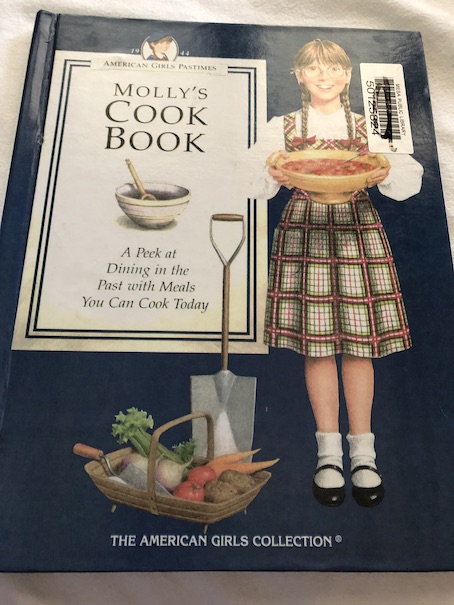
Molly’s Cook Book

American Girls

Molly’s Cook Book by Polly Athan, Rebecca Sample Bernstein, Terri Braun, Jodi Evert, and Jeanne Thieme, 1994.

This is a companion book to the Molly, An American Girl series.  It has recipes from the 1940s that people would have made during World War II.  A section at the beginning of the book explains how shortages and rationing during the war changed the way that people shopped for food and cooked.  For example, people on the homefront didn’t have many canned foods because many canned foods were shipped overseas to soldiers and much of the metal that would have been used to make more cans for food was being used to make other war supplies.  Because certain types of food were in short supply, individuals and families would receive ration books, which contained stamps that represented which types of foods they would be able to buy and how much.  Cookbooks printed during the war focused on creating meals that used little or no rationed products.  People also planted Victory gardens and grew their own vegetables to fill out their meals.

The cookbook is divided into sections for different meals:

Breakfast – Fried Potatoes, Toad-in-a-Hole (not the British dish – this is eggs cooked in a frame of bread, what I first learned to make as Eggs-in-a-Frame), Fried Bacon, Quick Coffee Cake, and Frozen Fruit Cups.

Dinner – Vitamin A Salad (made with carrots and lemon gelatin), Deviled Eggs, Carrot Curls and Celery Fans, Vitality Meat Loaf, Parsley Biscuits, Volcano Potatoes, and Applesauce Cupcakes.

Favorite Foods – French toast, Waldorf salad, PBJ Roll-ups, Jelly Flags, Victory Garden Soup, Nut-and-Raisin Bread, and Fruit Bars.

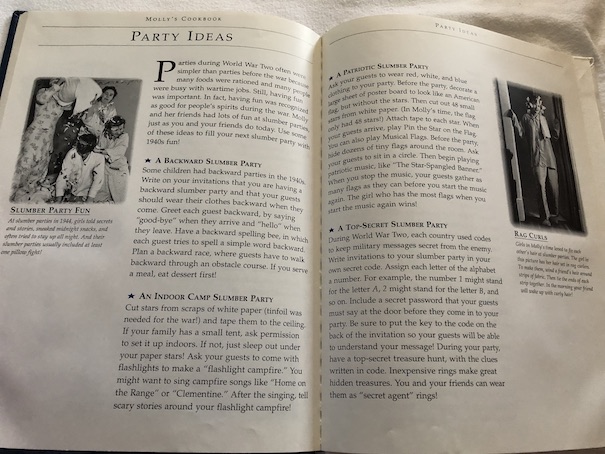
In each section of recipes, there is more historical information about food in World War II.  There is also a section in the back with party ideas from the 1940s.

For more World War II recipes, I recommend The 1940’s Experiment, which is a blog with recipes from World War II and an explanation of how they can be used to both save money and lose weight because they were intentionally designed to make maximum use of limited resources, both economically and nutritionally. In Molly’s Cook Book, there is a chart that government experts during World War II used to give people guidance on how to budget their food money among seven food groups. The diet that they recommended, both nutritionally and to limit certain rationed foods, was heavy on vegetables and fruits and lighter on meats, grains, and dairy products. This type of diet is basically in keeping with modern nutritional advice, which also emphasizes the importance of vegetables and fruit.

The book is currently available online through Internet Archive.

The Ravenmaster’s Secret

The Ravenmaster’s Secret by Elvira Woodruff, 2003.

Forrest Harper is the son of the Ravenmaster of the Tower of London in 1735.  The story begins by explaining the tradition of keeping ravens at the Tower of London because of the superstition that the Tower would be conquered by its enemies if the ravens ever abandoned it.  This superstition led to the creation of the job of Ravenmaster, who looks after a flock of ravens that live at the Tower with wings clipped so that they can’t fly away.

Forrest Harper lives at the Tower with his parents and sisters, training to become a Ravenmaster, like his father.  He likes the ravens, and they like him.  He is pretty good at caring for ravens, but there is something that bothers him: he thinks that he isn’t brave enough and that others think that he is a coward, too.  He is smaller than the other boys and is often teased.  He has trouble cutting up the squirrels that the rat catcher’s boy (his only real friend, although his mother doesn’t approve of him) brings to him to feed to the ravens.  Even though it’s necessary, Forrest doesn’t like the sight of blood and feels kind of sorry for the squirrels.  Worse still, when Forrest’s family attends the public hangings (which were treated as a kind of festival day with music and entertainment in Forrest’s time), Forrest is unable to look at the criminals who are being hanged.  The one time he does try it, he throws up, and again, the other boys tease him mercilessly for it.  Forrest’s problem, as readers will see, isn’t so much that he’s a coward as he has more empathy than the other boys, both for animals and people, and that isn’t really as much of a problem as he believes.  His father tells him to ignore the bullies because they are foolish, and their foolishness will show in time.

Forrest sometimes dreams of going out into the wider world, beyond the Tower, where he could do something brave that would impress everyone.  The rat catcher’s boy, whose real name is Ned although most people just call him Rat, also dreams of running away because he is an orphan, treated harshly by his master and always in danger of being turned over to the chimney sweep to be used as a climbing boy.  He doesn’t think that Forrest has a real problem because his life at the Tower is pretty good, living comfortably at the Tower with his parents, whatever the local bullies say.  Still, the two boys often imagine what it would be like to go to sea together and have adventures.  When there is an announcement that a new prisoner will be arriving at the Tower, a Scottish Jacobite rebel, Forrest thinks that helping to guard a dangerous rebel will make the Tower bullies respect him.

To Forrest’s surprise and embarrassment, this rebel actually turns out to be a girl.  She is the daughter of the rebel Owen Stewart, who is being held in a different tower at the Tower of London (the Tower of London is actually a fortress with multiple towers – she is imprisoned in Bloody Tower and her father is in Bell Tower).  She has been charged with treason, along with her father and uncle.  Forrest isn’t happy about being given the task of taking food to a girl prisoner. 

However, Madeline McKay Stewart, the girl prisoner, is pretty tough in her own right.  Although Maddy’s been separated from her father and uncle and all three of them are likely to be executed, she is being pretty brave about it.  She talks to Rat and Forrest.  She is interested in Forrest’s pet raven, Tuck, and tells him about how she used to feed baby owls back home.  She talks about her life and family in Scotland, and Forrest realizes that he’s starting to think of her as a friend instead of an enemy to be guarded.

While Forrest is used to hearing English people criticize the Scots for being “savage,” he is astonished and a bit offended when Maddy talks about English people being “evil.”  For the first time, it makes him think of the situation from the other side.  He knows that not all English people are evil and realizes, having seen that Maddy actually has refined manners, that Scottish people aren’t “savage.”  One day, at Maddy’s request, he takes a message to her father in exchange for her ring, which he plans to sell in order to buy Ned back from the chimney sweep after the rat catcher loses his term of indenture to the chimney sweep in a game of cards, sparing him from the horrible life and health problems that the young climbing boys suffer.  Then, Owen Stewart gives Forrest a message to take back to Maddy.  Without really meaning to, Forrest realizes that he has suddenly become a go-between for the rebels and could be considered a conspirator under English law.

As Forrest considers the fate that lies ahead for Maddy and the nature of war between England and the Scottish rebels, it occurs to him that the adults in his life have often done the opposite of the things that they have always taught him were important.  His father always emphasized fairness, yet the war and Maddy’s possible execution are unfair.  Maddy shares Forrest’s feeling that the world might be a better place if people didn’t become adults and abandon their values.

Then, Maddy’s father and uncle are shot while attempting to escape, and Maddy is left completely alone.  Forrest feels badly for Maddy.  Soon after, he is unexpectedly approached by a carpenter who seems to know that he has become friends with Maddy.  The carpenter, who is a stranger to Forrest, tells him that Maddy will soon be executed by beheading but that he has a way to save her life.  Forrest has to decide if he is willing to trust the stranger and save Maddy, knowing that doing so would make him a traitor himself.

One of the parts of this story that interested me was how Forrest noted the hypocrisy in the adults around him as he was trying to decide what he should do.  Qualities that adults often praise and try to instill in their children are often ignored in the way that the adults live and even in how they treat other children, like Ned and Maddy.  Abandoning values, even the ones that they really want their children to have, isn’t something that adults have to do as they grow older, but it is something that some adults do if they think they must in order to live as they want to live or accomplish something that they want to accomplish.  The adults who think that Maddy should be beheaded would probably say that they were doing it for the greater good in promoting their cause against the rebels.  However, treating Ned as a piece of disposable property is something that they mostly do because they can and because they know that there is nothing that Ned can do to stop them.  Ned actually tries to repay his indenture legally with money that Forrest gives him, but although the sweep accepts the money, he refuses to let him go, saying that no one will take Ned’s word over his and that he could always use the money to make sure that Ned is hung as a thief if he tries to make trouble.  It is this type of attitude and situation that make the children realize that they are on their own to solve their problems and that working within the law is not going to be an option for them because the law is not just and it is not on their side.  It’s a frustrating situation, and I often feel frustrated when I encounter this type of thing in books, but fortunately, things do turn out well in the end.

This is one of those coming-of-age stories where a boy must decide what he stands for and where he really belongs.  Through Maddy and the inscription on her ring, which means “Face Your Destiny,” Forrest comes to understand the destiny that is right for him as he helps both Maddy and Ned escape to a better life elsewhere. 

The book also includes some interesting historical information. There’s a map of the Tower of London in the front of the book, and in the back, a short history of the Tower with information about famous prisoners and escapes. There is also a glossary of English and Scottish words that modern children (especially American children) might not know, such as breeches, wench, loch, and tattie-bogle (scarecrow).


The book is currently available online through Internet Archive.  (To borrow a book through Internet Archive, you have to sign up for an account, but it’s free, and then you read the book in your browser window.)

Spoiler: In the last chapter of the book, it explains what happened to the characters after the story ends.  Forrest does become the Ravenmaster after his father, realizing that it is the right kind of life for him and that he no longer desires to have adventures outside the Tower.  He has a wife and daughter, and years later, he receives a message from Ned, who says that he has become a captain in the Royal Navy and that Maddy has gone to live in the colonies with other Stewarts (something that my own Jacobite ancestors did, which is how I got to where I am now).

The Time of the Forest

The Time of the Forest by Tom McGowen, 1988.

The story takes place in the prehistory of Denmark, among its earliest inhabitants.  It shows the conflict between the hunter-gatherers, who are native to the forests of that land, and the farmers, who have traveled to the area to build a new home on the edge of the forests.

When the two groups learn of each other’s existence, they become frightened of each other. The hunters are afraid that the new people will take over their hunting grounds, and they are offended that the newcomers cut down the trees to build their homes and clear land for farming. The farmers are afraid of the forest, the wild animals inside it, and the hunters, who they fear might start hunting them.

A young hunter, Wolf, watches the farmers to learn more about them, and he is fascinated by what he sees. In some ways, the two groups are alike, and Wolf finds himself wanting to know more about the ways of the farmers and maybe even make friends with the pretty girl, Bright Dawn, who he sees tending the farmers’ goats.

However, the son of Wolf’s chief has decided that the newcomers must be destroyed. When Wolf saves Bright Dawn from the chief’s son, the two of them must learn to work together and combine the skills of their different peoples in order to survive.

In the end, after a bloody clash between their respective peoples, both Wolf and Bright Dawn are each exiled from their tribes.  However, their exile actually gives them the freedom to start their own tribe that combines aspects of both of their societies.

The book is available to borrow and read for free online through Internet Archive.

My Reaction

This story was somewhat speculative about the early days of Europe, when societies were starting to shift from hunter/gatherer groups to more settled agricultural groups.  The author says that he was theorizing about the cultural clashes that may have taken place during this time.

Something I noticed about the story is that the groups, particularly the hunter/gatherer group, somewhat resembled some Native American groups around the time that they first encountered European settlers.  The author didn’t say anything about using their lifestyles as inspiration or drawing any parallels between them and early Europeans, but it did make me think about the similarities between groups that are living similar lifestyles but in different places.  In other words, it does seem reasonable that hunter/gatherers living in Europe would be living in circumstances that would be very similar to hunter/gatherer groups in the Americas.